



Abstract
This study employed Kolb’s experiential learning cycle to investigate whether experiential learning could gain effective results via cross-cultural management theories in teaching and learning. Data from experts was collected to design a teaching program, which was then implemented with the Intercultural Senility Scale to compare between the experimental and control groups using a quasi-experiment research design. Finally, using a focus group discussion, the experts’ opinions were collected for an effective guideline development. The results revealed in the proposed teaching program that elements of the experiential learning such as curricular, teaching environments, and teaching pedagogies should be taken into account by educational stakeholders. The implementation of the teaching program found to have made a positive effect and suggested that a recommended guideline for various stakeholders should make full use of formal, non-formal, and informal learning. Formal education is effective in conceptualizing abstract values and assumptions for explicit culture, while non-formal and informal education are effective in gaining experiences for implicit culture, which then becomes a base for forming abstract values and assumptions.
Keywords
Introduction
International students have to adapt to their host country’s culture when they study or sojourn abroad. Cultural shock and cultural misunderstandings are common issues to deal with not only for the international students but also for the teachers and educational managers as well (Karaman et al., 2018). Most importantly, cultural gaps further exacerbate these problems that affect international students’ academic success (Sato et al., 2020). Therefore, how to improve their ability in interaction and adjustment in their host country are important teaching goals for educators. Intercultural sensitivity and competence are significant indexes for measuring international students’ abilities in interactions which manifest in three domains: attitudes, skills, and knowledge learning (Deardorff, 2019). In gaining all of these domains, international students can overcome cultural mismatches between teachers and students and help minimize racial prejudice.
Confucianism is a cultural philosophy that influences most Asian students. However, when these groups of students communicate in international programs, their attitudes toward other cultures, unsophisticated skills in adapting to diverse cultural environments, and the lack of knowledge about foreign cultures often result in cultural misunderstanding especially in cross-cultural management. For instance, due to the cultural differences, Japanese students performed more conservatively than their host American family members, who preferred a more straightforward than these Asian students (Kobayashi & Viswat, 2015). Book-originated impression of Confucianism made Chinese immigration be viewed more stereotypically in the United States (Hsieh, 2018). Additionally, the results studied in Australian universities revealed that Chinese students also encountered language barriers and cultural differences that caused comprehension problems and low-quality interactions (God & Zhang, 2019). It can be inferred that key issues consist of cross-cultural management in cultural differences, with the aspects of attitudes, skills, and knowledge effecting poor international students’ intercultural sensitivity.
In China, most universities implement the curriculum named “Chinese Panorama” that introduces cultural profiles about traditional cultures across China, especially Confucianism. However, most universities adopt examine-originated and teacher-centered teaching pedagogies (You, 2020). When international students have studied this program, most of them have found the program too abstract to comprehend and adapt to the cultural immersion. To solve such issues, some researches have explored some pedagogies that enrich the teaching process. Experiential learning has been adopted as one of these pedagogies. To increase positive experiences for the foreigners in the host country, schools usually organize field trips of cultural significance. This kind of teaching pedagogy not only enhances students’ intercultural competence but also reinforces some negative hetero-stereotypes without appropriate guidance (Egekvist et al., 2016). Hence, it is necessary for educational managers and teachers to control and provide guidance in shaping students’ intercultural competence as well as their intercultural sensitivity. This research combining Confucianism with experiential learning, to enhance students’ intercultural sensitivity and intercultural competence in the aspects of attitudes, skills, and knowledge, is worth investigating to explore the adaptations in the experiential learning theories in Chinese universities.
In this research, the main purpose was to propose a guideline which aims at improving intercultural sensitivity through management focusing on cultures. To achieve this goal, the researcher designed a teaching program based on Kolb’s experiential learning cycle, then confirmed its teaching effectiveness on improving international students’ attitudes, skills, and knowledge. Finally, the results were discussed by experts for proposing a guiding combining with the theory of cross-cultural management. The research questions were posed as follows: Research question 1: What constitutes a teaching program that aims to foster intercultural sensitivity of international students inside and outside of schooling? Research question 2: What is the learning effectiveness of international students in the domains of intercultural sensitivity, attitudes, skills, and knowledge? Research question 3: What constitutes a guideline to improve intercultural sensitivity in cross-cultural management?
Literature review
Intercultural sensitivity and intercultural competence
Intercultural sensitivity and intercultural competence are often intertwined when discussed in previous studies. Intercultural sensitivity, according to Bennett (2017), is the ability of changing individual behaviors in different cultural environments flexibly, whereas intercultural competence is the enactment of intercultural sensitivity by perceptual adaptation. To enhance individual intercultural sensitivity and intercultural competence, Deardorff (2019) synthesized attitudes, skills, and knowledge as generally highlighted domains. The development of intercultural sensitivity and intercultural competence can be also subscribed as a continuum in the form of Development Model of Intercultural Sensitivity (DMIS) (Bennett (2017), which demonstrates individuals’ intercultural sensitivity from ethnocentrism to ethnorelativism. In the phase of ethnocentrism, people treat their culture as superior to others due to their limited perceptions. Through cultural learning and interaction with other people from foreign cultures, the ethnocentric people may gradually change their perceptions to accept foreign cultures. In return, they may reconsider their previous conceptions and be more open-minded to other cultures, which is considered as the characters of ethnorelativism.
In practice, scholars explore the ways in enhancing students’ intercultural sensitivity and intercultural competence in international education programs. They generally agree the enhancing process is comprehensive and depends on various factors, which requires for cultural immersion and the guidance from teachers. For instance, it has been proved students’ language competence alone cannot indicate a level of high intercultural competence when they study abroad, having skills and knowledge about the host country’s culture are far more effective. (Wattanavorakijkul, 2020). Furthermore, intercultural competence education should go beyond focusing on communicative skills and include more about cultures. In addition, positive attitudes toward host country’s culture should also be considered by educational stakeholders (Karkour, 2020). All in all, cultural environments affect students’ intercultural sensitivity. Hence, a teaching program should not only focus on the skills or knowledge alone but also on creating a learning environment for cultural immersion.
In this particular study, intercultural sensitivity refers to the ability of adapting to different cultural environments; while intercultural competence refers to international students’ ability in developing attitudes, skills, and knowledge that lead to visible behavior and communication. In other words, international students’ intercultural sensitivity is enhanced through the training of intercultural competence in the domain of attitudes, skills, and knowledge.
Experiential learning
Experiential learning emphasizes on the knowledge learned through experience. In the view of Patil (2020), experiential learning is a continuous cycle in which students learn by relating and observing abstract conceptions and then applying them to concrete experiences. Kolb’s experiential learning cycle (1984) is a typical learning cycle consisting of four stages utilized by educators, involving Concrete Experience (CE), Reflective Observation (RO), Abstract Conceptualization (AC), and Active experimentation (AE), which represent experiencing, reflecting, thinking, and acting, respectively (Kolb & Kolb, 2009). Formal, non-formal, and informal learning provide opportunities for students gaining experiences to transform into knowledge. Formal learning refers to systematic design lectures by teachers teaching in the classroom; non-formal learning refers to learning that takes place outside the formal learning environment but within some type of organizational framework, carried out loosely by teachers; informal learning refers to a learning process by which students acquire knowledge from their lifetime of experiences without institutional organization (Eaton, 2011). Álvarez et al. (2020) pointed out that most students were unaware of the existence of institutional support from agents, and experienced a lack of approval from supervisors in formal and non-formal learning, while most students relied heavily on web-based or internet-based learning as informal learning. Meanwhile, educators also encounter other issues. For instance, educators generally ignore that formal learning contributes significantly to students’ value preferences (Ferrari et al., 2019). In contrast to formal learning, non-formal and informal learning develop individual cultural identity and motivate learning motions (Ferrari et al., 2019; Sahin & Demirbas, 2021). Thus, it is necessary for educators to guide students how to make full use of these supports from formal, non-formal, and informal education and learning.
Cross-cultural management and Confucianism
Regarding management in cultures, Weinstein et al. (2004) pointed out that teachers could adapt a more culturally responsive way regarding management in cultures, which encompassed five domains: recognition of one’s own ethnocentrism; knowledge of students’ cultural background; awareness of the broader social, economic, and political context; ability and willingness to use culturally appropriate management strategies; and a commitment to building caring classroom communities. All of these five domains were utilized to explore a guideline for cross-cultural management.
Confucianism has great influence for Asian international students as most of their cultures have roots in Confucian values. Due to the cultural differences, most of them suffer from isolation when they study in non-Confucian countries. These situations may be avoided or diminished if educators have a complete picture of the cultural contexts that related to Confucianism (Young, 2017). Meanwhile, it is also suggested that educators should adopt a Confucian worldview in their blended learning (Chan, 2019). One of these ideologies that can be adapted is that of the Confucian Five Constant Virtues which are benevolence, righteousness, propriety, wisdom, and trust. Benevolence refers to love others; righteousness refers to principles that lead people to abide by social orders and moral norms; propriety refers to a serious matter for dealing with relationships with others; wisdom refers to knowledge in the morals; and trust refers to keeping one’s words once promised (Shek et al., 2013). Combined with cross-cultural management, this work attempted to incorporate the Confucian Five Constant Virtues as the main contents to a new proposed teaching program cultivating students on improving their intercultural sensitivity.
Research method
Research design
This research employed a sequential exploratory mixed-method design and applied the ADDIE model as a reference model in guiding phased activities and delivering related deliverables. ADDIE is abbreviation for Analysis, Design, Develop, Implement, and Evaluate. The mixed-method design was based on a sequential “qualitative to quantitative and qualitative” method. First of all, qualitative method was adopted in Analysis, Design, and Develop phases of ADDIE model to construct a teaching program. Following that, quantitative method followed by qualitative method was deployed in the Implement and Evaluate phases to explore the effectiveness of the teaching program by a quasi-experimental design to gain reasons of international students’ changes in the aspects of attitudes, skills, and knowledge, and finally the experts’ opinions were gathered to propose a guideline in cross-cultural management.
Research setting
This research chose Guangxi University of Finance and Economics as a setting. There were three levels examined at the target university in linguistic learning: elementary, intermediate, and advanced. Intermediate-level students were chosen because they were more skillful in linguistic proficiency than elementary students, and there was more room for cultural improvement than advanced students. In this study, the focus was on cultural lecturing more than linguistic teaching. In the academic year 2020, there were three classes at intermediate level which contained 30 students per class. Concerning the study of the effectiveness of the teaching program implementation, a purposive sampling was adopted, whereby 30 international students took part in the teaching program and the contemporary regular teaching schedule as the experimental group; whereas another 30 international students took part in the contemporary regular teaching schedule as the control group. To propose a guideline, three experts were invited by a purposive sampling, with the selection criteria of the experts being educational managers or have rich experience in charge of international education.
Research instruments
Intercultural Sensitivity Scale (ISS) and semi-structured interview were employed as quantitative and qualitative research tools, respectively. ISS was designed by Chen and Starosta (2000), to measure students’ intercultural sensitivity in five domains: Interaction Engagement, Respect for Cultural Differences, Interaction Confidence, Interaction Enjoyment, and Interaction Attentiveness. As for the interview, the interview script concentrated students’ feedbacks about the teaching program in attitudes, skills, and knowledge learning experience, for further explanation of the quantitative results. Interviewees were students who were willing to take part from the experimental group. Seven of the participating students came from different countries, including Ethiopia, Uzbekistan, Thailand, Madagascar, Vietnam, France, and the USA, which ensured cultural variety.
Data collection
There were three steps in the data collection. First in the designing of a teaching program, the researcher collected opinions of the experts about teaching pedagogies in Kolb’s experiential learning cycles. Second, based on the quasi-experimental design, ISS was implemented before and after the teaching program for comparing the effectiveness of learning in the experimental and the control groups. The formula is presented as follows:
E O1 X1 X2 O2
C O1 X1 O3 Where E = Experimental group C = Control group X1 = Treatment one: regular teaching schedule X2 = Treatment two: teaching program with Kolb’s experiential learning cycle O1 = Observation before treatment one: ISS O2 = Observation after treatment one and two: ISS, interview seven experimental group students about their attitudes, skills, and knowledge O3 = Observation after treatment one: ISS
Finally, the experts’ opinions were gathered to develop a guideline by means of focus group discussion.
Data analysis
Following the phases of data collection, data analysis also traced the “qualitative to quantitative and qualitative method” of the mixed-method design. First, qualitative data analysis stemmed from the experts’ opinions in the focus group discussion, to form a teaching program aligned with CE, RO, AC, and AE. Second, quantitative data was analyzed from ISS by means of paired sample t-test for the before and after treatments of experimental group, and by independent t-test for the control and experimental groups, to list a comparative result in this quasi-experimental research, to list a comparative result in this quasi-experimental research. Interview scripts contained semi-structured items for consulting their learning experiences in each phase of Kolb’s experiential learning aimed at explaining the results of the intercultural sensitivity in attitudes, skills, and knowledge inside and outside of classroom. Finally, the experts’ opinions were synthesized to propose a guideline in enhancing students’ intercultural sensitivity and intercultural competence in cross-cultural management.
Findings
The study findings presented are based on the mixed-method design to solve research questions.
Research question 1: What constitutes a teaching program that aims to foster intercultural sensitivity of international students inside and outside of schooling?
First, the qualitative method is presented as follows. Experts analyzed the contemporary teaching pedagogies and curricular in the regular teaching program. Because of the limited time budget and other resources, only one curriculum named “Chinese Panorama” was introducing about the host country’s culture, which was taught via cramming method in teacher-centered teaching pedagogy inside the classroom. In the regular teaching schedule, formal education and learning mostly occurred inside classroom; non-formal education and learning concentrated more on the atmosphere of the building in the cultural immersion; and informal education and learning were ignored by most teachers in the teaching process.
In the following phase, the experts designed a four-phase teaching program which included a Confucian shrine visit, opera show, lecture teaching, and group discussion that aligned with Concrete Experience, Reflective Observation, Abstract Conceptualization, and Active Experimentation, respectively. For the development of the teaching program, the experts expanded more details about teaching pedagogies and curricular based on the Kolb’s experiential learning cycle. In the Concrete Experience phase, students would visit a Confucian shrine for gaining experience in learning. After that, they would watch an opera show about Confucianism as Reflective Observation for deep understanding about the host country’s traditional culture. Then in the third phase of Abstract Conceptualization, teachers would introduce Confucianism to form a set of values and assumptions for students, and finally, students would present, discuss their learning and experiences in life in the phase of Active Experimentation.
In the part of experiential learning, the experts believed that non-formal education and learning were conducted in the Concrete Experience and Reflective Observation as these two styles were loosely guided by teachers; formal education and learning were conducted as Abstract Conceptualization; and informal education and learning were conducted as Active Experimentation.
Teaching program designed by Kolb’s experiential learning cycle.
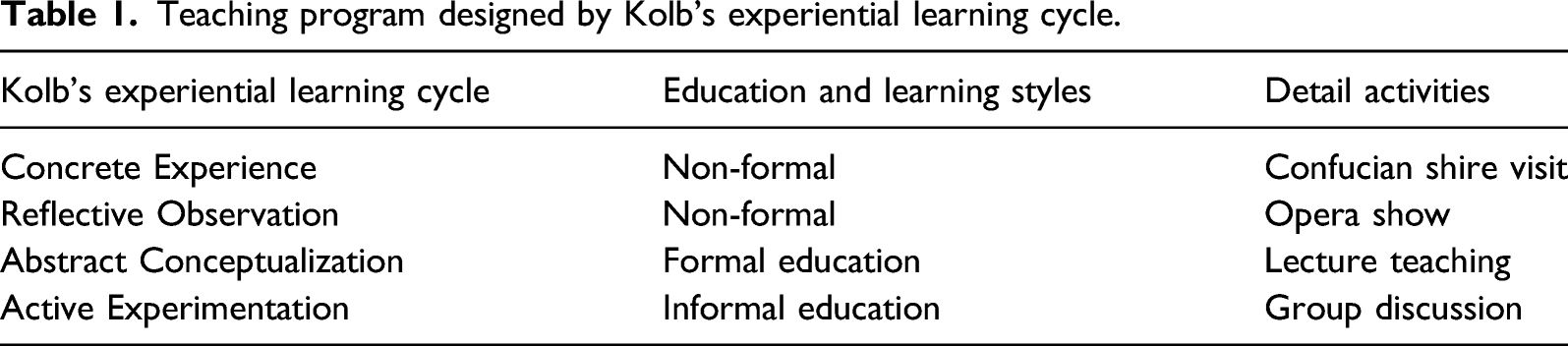
As the designing progressed, four elements emerged as the constitutions of the teaching program, which were educational stakeholders, teaching environment, teaching pedagogies, and curricular. Stakeholders were identified as educational managers, teachers, and students. Educational managers and teachers were responsible in designing curricular; and teachers were executors of the teaching program for creating the teaching environment with detailed teaching pedagogies.
Research question 2: What is the learning effectiveness of international students in the domains of intercultural sensitivity, attitudes, skills, and knowledge?
Findings include questionnaires for the quantitative method and interview for the qualitative method.
Quantitative findings
The results of quasi-experiment show that the experimental group and the control group were at the same level of ISS. Based on the result, the teaching program was launched and detailed results of the launch are presented as follows:
Experimental group before and after the regular teaching schedule and teaching program for paired sample t-test.
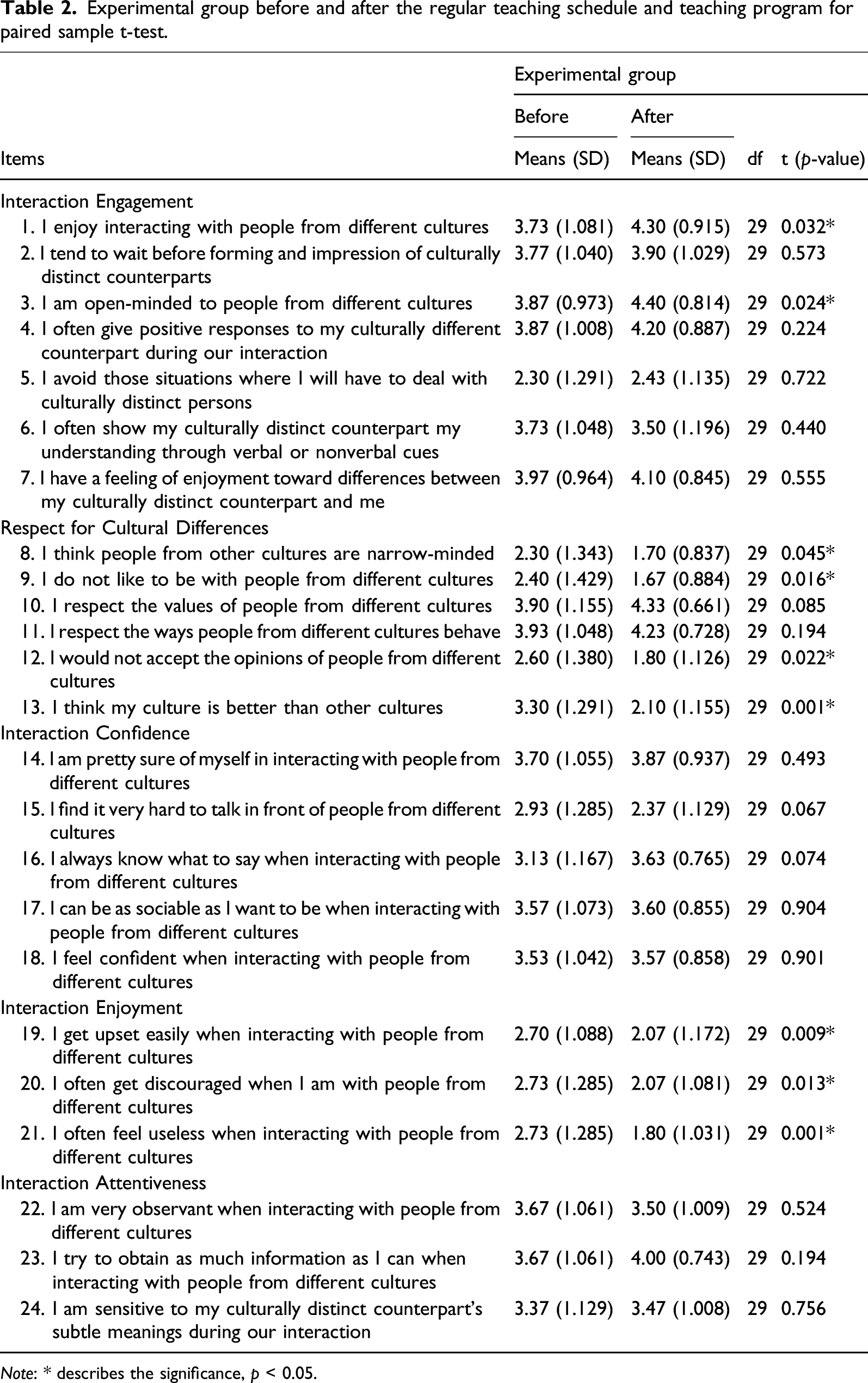
Note: * describes the significance, p < 0.05.
Experimental group and the control group for independent t-test.
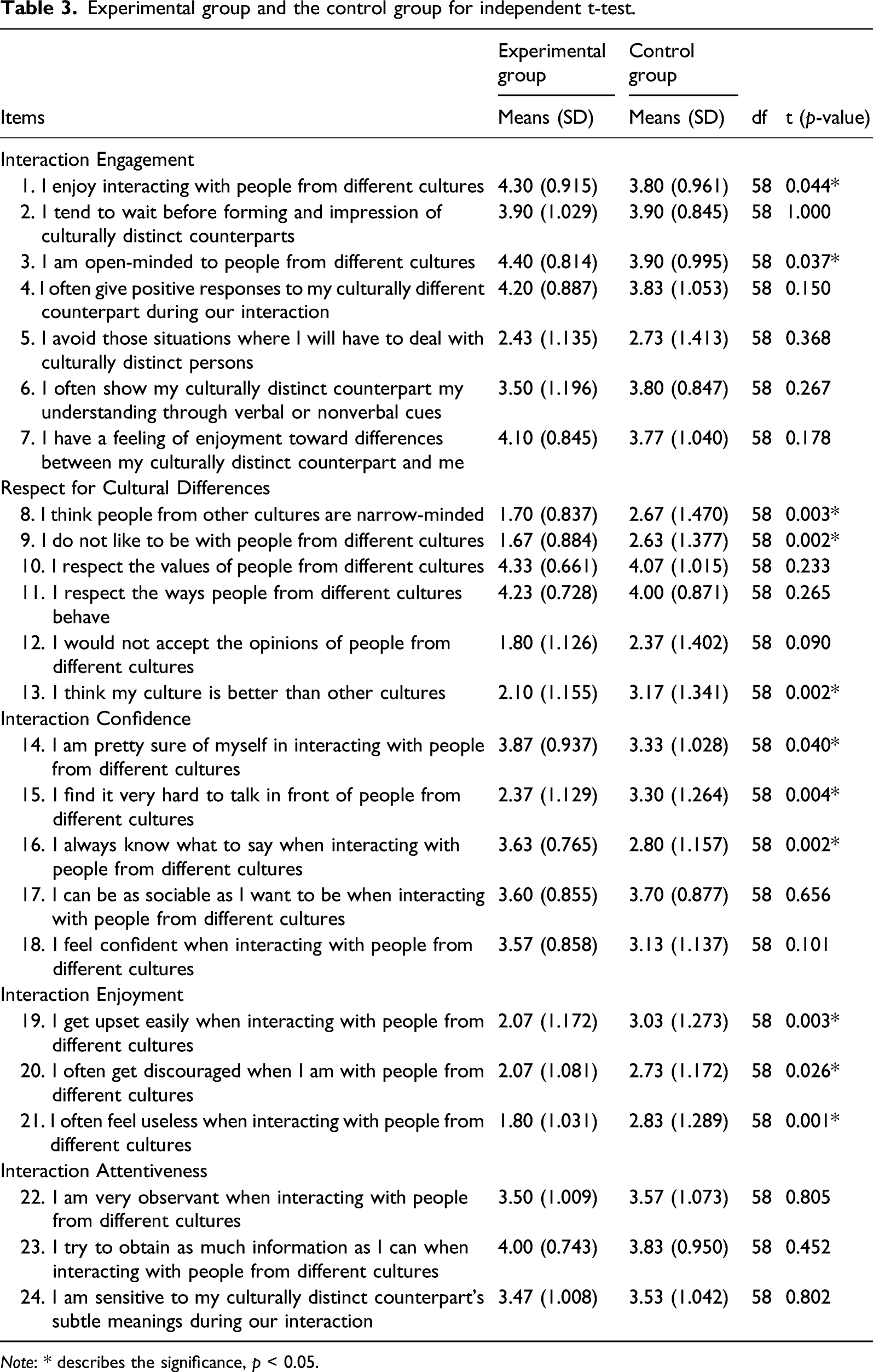
Note: * describes the significance, p < 0.05.
Among 24 items of ISS, nine items show significant differences before and after the learning in the experimental group, of which belong to three domains: Interaction Engagement, Respect for Cultural Differences, and Interaction Enjoyment. Meanwhile there are eleven items that show significant differences between the experimental and the control group, of which consist in four domains: Interaction Engagement, Respect for Cultural Differences, Interaction Enjoyment, and additionally Interaction Confidence. Comparing with the control group, the experimental group indicates that there are a bit more changes in ISS, which reveals that the experimental group students were more confident during their interactions with other cultural environments. However, this teaching program reveals no items significantly change in Interaction Attentiveness in both the experimental and the control group.
In sum, there are almost the same items changed in the quasi-experiment. It can prove that this teaching program consistently changes students in the domains of Interaction Enjoyment, Respect for Cultural Differences, and Interaction Enjoyment.
Qualitative findings
This part utilizes interview to analyze the reasons of low efficiency in the improvement of Interaction Attentiveness, reasons of changes in the Interaction Confidence between the experimental and the control group, and the experimental group students’ feedbacks of attitudes, skills, and knowledge in formal, non-formal, and informal education and learning.
Reasons of insignificant changes in the domains of intercultural sensitivity scale
It is obvious that the teaching program emphasized more on student-centered teaching pedagogies. Comparing with the control group students with regular teaching schedules, the experimental group students had more chances in communicating with others, which improved the Interaction Confidence. Interviewees expressed the teaching program helped them widen their field of visions outside of schooling. “This is fantastic in the Confucian shrine, much more I cannot experience in books. I can sense the differences from classroom learning (American student).” Thus, it can be concluded that students benefit from outside schooling, which is the reason of increasing students’ confidence during their interactions.
In the domain of Interaction Attentiveness, interviewees expressed their hesitations and helpless in communication. This is due to less guidance from educational managers and teachers. For instance, “Talking about cultural taboos, I feel upset once I offend others’ religions unconsciously. Hence I would prefer to talk with my friends who share with similar values (Uzbeks student).” As a student-centered in the experience learning, educational managers and teachers were less concerned about students’ requirements.
Students’ attitudes toward formal learning
The interviewees expressed their agreement on the teaching content, especially among Asian country’s students. An interview record from a student who came from Vietnam: Some customs between my country and host country are interrelated. For example, we are polite to others, which is the same character to courtesy. Even some customs are different, we can still communicate in a way in common because I believe the Virtues are popular in most parts of the regions.
Interviewees outside Asia also admitted the Confucian Constant Five Virtues. “The virtues cultivate people how to deal with the relationship in a good way. So, people can live together peacefully.” A reply from a Madagascan student. It was obvious that international students generally accepted a person who was benevolence, righteousness, courtesy, wisdom, and faithfulness from the interview, because it manifested human’s natural manners.
Attitudes changed from non-formal and informal learning
In non-formal and informal learning, students were more conscious in the learning that organized by teachers and unconscious in social learning without teachers' organization. Organized non-formal learning by teachers was a filter that erased negative factors in forming a poor impression. The organizer admitted that he tried to avoid bad experiences and presented the positive parts to students. Meanwhile informal learning’s environment liked a coin of two sides, which could shape good and bad stereotypes for students. Interview record indicated that part of the negative impression came from the mass media or some poor personal manners. “I could not understand why Chinese spoke so loudly when they had a dinner together. In my country, everyone is supposed to be quite in case of disturbing others (Thai student).” American students responded as news obtained from the internet did not match with the reality of Chinese culture. “Chinese are not underprivileged as the news described. In fact, they are well educated in their schools and capable of their jobs.”
The non-formal and informal learning was like a window that opened the students’ horizon. “In my childhood, I had learned Confucianism in elementary school, but I have no opportunities to get in touch with such detail contents learning till I come to the host country. An environment helps me deepen the Virtues comprehension.” (Ethiopian student).
On the contrary, some students expressed their disagreement about the values presented in the opera show. From the interview records, some students especially who came from non-Asian countries had more diverse opinions about Confucian Constant Five Virtues in practice. These disputes were mostly how they executed, the way how they behaved. A student commented: “Confucius’ apprentices show their respects to their master, they almost obey masters’ orders and it looks like the high-power distance between teachers and students. For me, I believe students and teachers shall respect each other instead of the paternalism. Students are supposed to respect teachers in the name of courtesy but not in the form in the show.”
Skills improved from formal learning
In the lecture, students reported that they had learned how to deal with local residents in daily life, and these sets of values and assumptions can guide their activities. They mostly reflected that this lecture enhanced their listening skills. “Since the lecture is about abstract ideology explanation, I try my best to listen and figure out the meaning.” A French student answered in the interview. As for other skills such as empathy and independent thinking skill, it needed time to transfer into knowledge, impressions, and stereotypes. Like an Uzbek student expressed: “following the lecture is enough for me in such around 40 minutes class. If I had enough time to practice it I would, but in the class we only can sit and record what teacher teaches us.” Thus, the process of transforming knowledge required more time and opportunities for students proving in their non-formal and informal learning.
Skills improved from non-formal and informal learning
Skills learned during the field trip and opera show required more practice with communication than lecture learning and group discussion. As a student indicated: “During the visit of the shrine, some local visitors were also surprised about their ancestors’ allusions. They were glad to communicate with us. It was more beyond the linguistic communication. I could sense the motion of true enthusiastic.”
However, in the group discussion, students also reported some dilemmas in their interactions. In the workshop of some activities, some students tended to preserve their own culture and excluded others who were not in their group. “Faced with this problem, I kept silence and left.” A student said. On the contrary, some other students chose to engage with them. “They just did not familiar with you. You could approach them with honesty. When they could realize the differences and even got used to it, it was easier to talk with them by a better understanding of their cultures might help you approach them easier.”
Knowledge learned through formal learning
Some knowledge was unique and it only emerged in some special circumstances. The interview reported that students could not realize the values and culture beyond the surface. Several feedbacks indicated the lack of knowledge in such areas: “I am blank in such information until I began this study. Otherwise, I had no chances to experience this kind of knowledge sets.”
Detail explanations about Confucian Constant Five Virtues was the tip of the iceberg for culture, which could not fulfill students’ requirement in learning. “Confucianism, as it seems to appear everywhere, still hard to explain what it exactly is and how it manifests in our communication with teachers and residents.” Another student expressed, “This lecture can explain some behaviors of Chinese in daily, but it still cannot tell me more about the attributes of other actions.”
Knowledge learned through non-formal and informal learning
Non-formal learning was organized by teachers in the phases of Concrete Experience and Reflective Observation of Kolb’s experiential learning cycle while informal learning was in the form of self-learning without teacher interaction and summited in the phase of Active Experimentation. Students reported that during the shrine visiting, they gained experiences as first-hand data. It is more like a blend class. For instance, as a student revealed in the interview about the visit: This was amazing. In the trip we learned a lot of interesting history that was not in the textbooks. After the trip we had some typical Chinese cuisines. I believed this was a good combination of history and cuisine lesson. Similarly, they also reported it was a blend of cultural immersion in the opera show: This show included many aspects of Chinese cultures, such as language, history and legends. It was not only about a show, but also helping us learn about cultures. The mask painting, trying on traditional Chinese customs, making Chinese knots were impressive.
In story circles and group discussion, students’ experiences mainly came from web-based learning and daily interactions. These sources could be selected by students’ preferences but might lead to mismatches between real and imaginations. Like an interview report from the French student presented “When I watched movies on the internet, Chinese or other Asian people used to bow to show their respect or humble, but in real, people especially the youth rarely do that. Their actions just like us, no much differences from others.”
Findings of each learning type.
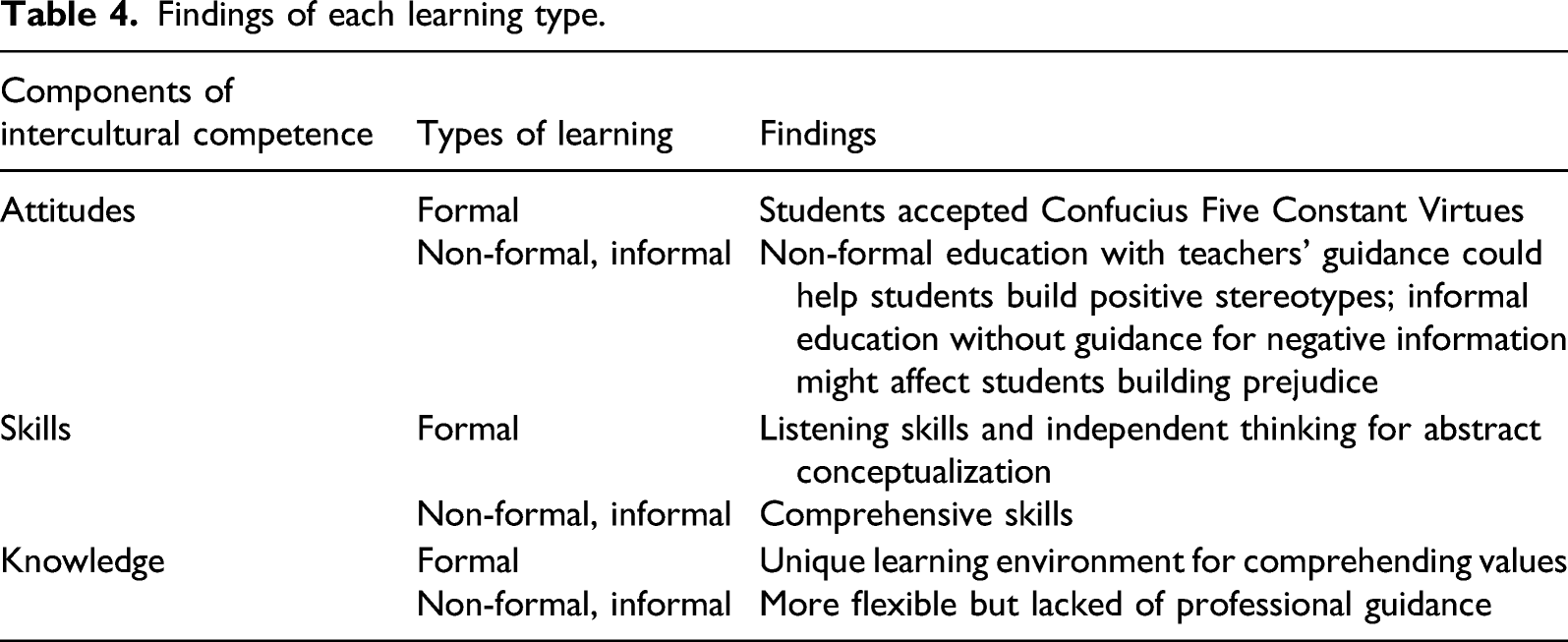
Combining with quantitative and qualitative findings, intermediate-level students show significant changes in Interaction Engagement, Respect for Cultural Differences, and Interaction Enjoyment, but no significant changes in Interaction Confidence and Interaction Attentiveness. The shrine visit and opera show contributed greatly to students’ Interaction Enjoyment, lectures explaining for earning Respect for Cultural Differences, and group discussion for Interaction Engagement. However, without proper guidance about communication skills in formal education, students were still lacking in skills in dealing with others in practice.
Research Question 3: What constitute a guideline to improve intercultural sensitivity in cross-cultural management?
To propose a guideline that improves intercultural sensitivity in cross-cultural management, the experts were invited for a focus group discussion and synthesized five areas to improve students’ intercultural sensitivity: planning, organizing, leading, directing, and controlling. In the teaching program, stakeholders (educational managers, teachers, and students) can make full use of the teaching environments and adopt appropriate teaching pedagogies in the curricular design.
Basic cycle of experiential learning
Formal, non-formal, and informal are three types of education and learning for students. Formal education and learning are the most effective way in abstract conceptualizations. Students can present their confusions to teachers and classmates, gain answers to help with clarification. In return, non-formal and informal learning are opportunities for students’ practicing, to verify their values and basic assumptions in mind. During the practice, students have the mindset “why they are different from us?” which meant they could distinguish self-cultural awareness and the host country’s culture. Then students explore the reasons for differences, by acknowledging history, culture, and other related knowledge systematically, to form stable views and basic assumptions toward the host country’s culture. Finally, students reinforce what they comprehend in life, correct their wrongs, and update previous views, values, and basic assumptions
Guideline for managers
In the cycle of experiential learning, the traditional cramming teaching pedagogies cannot fulfill students’ requirements in cultures. As the limited improvement of intercultural sensitivity, managers shall consider experiential learning with student-centered teaching pedagogies outside schooling. In the outside schooling, educational managers can arrange more resources for students pre-learning of the teaching program, such as club, field trip, and so forth. In addition to interview and group discussions, students still had their confusions about customs, which required managers to emphasis more on the goal development in values and assumptions.
Regarding the cross-cultural management, educational managers are supposed to investigate, monitor, and control throughout the whole process. At the planning phase, managers shall consult the requirements of teachers and students. Even though managers’ previous experiences helped them design the teaching program, they still focus too much on students’ linguistic practicing but neglect the shaping of values and basic assumptions, balancing the teaching contents with such limited resources. In the organizing stage, managers shall recognize the resources in informal learning because, from students’ interview they all gained information by themselves and it caused a lot of confusion. Therefore, during the program, managers shall keep in contact with teachers and students, adjusting and revising their plans in time.
Guideline for teachers
Teachers are at the center role of conducting the teaching program, which means to change the focus more on the learning, directing, and controlling. To make full use of resources inside and outside of schooling, formal, non-formal, and informal education and learning are effective ways in shaping students’ values and basic assumptions but are ignored by teachers. Formal education launched by teachers via cramming method rigidly is the most cost-effective way in shaping students’ values and assumptions; if students in learning have some related knowledge in advance, the formal learning would be more effective. Experimental learning is to supplement the formal learning if students have missed the previewing. In non-formal education, teachers act more as an organizer in the teaching program, who guide students in solving confusions while they are experiencing cultural immersions. After initiating “why they are different from us?” teachers can help students realize their cultural awareness in this learning phase. In informal education and learning, more cultural attributes are hidden in the learning environment. Teachers can act as a role in tutoring daily routine, requiring students to summarize their opinions and discuss their assumptions, guide a better way in developing values and basic assumptions. However, teachers cannot control students in informal learning; they can only provide opportunities for students in accepting the host country’s culture.
In the teaching program, students improved little in Intercultural Confidence and Intercultural Attentiveness, and most items showed that they tried to avoid culturally distinct counterparts. Answers from the interview explained they tended to avoid conflicts when they had diverse disputes. On the other side, other students could bridge relationships as they were willing to accept culturally distinct counterparts. Since teachers’ jobs are more about leading, directing, and controlling in a more likely student-centered education, teachers were supposed to improve personal charisma, which lead students to accept and follow. To achieve this goal, the knowledge of students’ backgrounds is necessary for teachers, which can help students have a sense of belonging.
Discussion
Compared with theories mentioned in the literature review, some distinctions emerged from the research are discussed through similarities and dissimilarities.
Intercultural sensitivity improvement with experiential learning
The findings revealed that students’ intercultural sensitivity could be enhanced as well as their intercultural competence, which is aligned with Deardorff’s model (2019) in the domains of attitudes, skills, and knowledge. This might be because the teaching program provided more chances in skills practicing, expanded their horizons then in return, shaped their attitudes.
Regarding the experiential learning, formal, non-formal, and informal learning affected students consciously and unconsciously. Formal learning could help students form an impression systematically with teachers’ appropriate guidance. With the guidance of teachers, students could correct their misunderstandings in the learning process and solved confusions, which was significant in shaping students’ values through teachers’ explanations about Confucian doctrines in formal learning. This proved the effectiveness in value conceptualization (Ferrari et al., 2019). At the same time, most students were not aware of the existences of formal and non-formal agents’ support until they were organized to take part in the activities such as the field trip and opera show. The rarity of these activities was the limited budgets and uncertain effectiveness of the intercultural sensitivity and incompetence development. Compared with formal learning, non-formal and informal learning were more flexible, and they were more self-developed in knowledge gaining. This opened a broader view than formal learning. Students mostly relied on web-based learning in gaining experiences as informal learning, which is similar to the study of Álvarez et al. (2020).
Cross-cultural management in the teaching program
In the teaching program, Weinstein et al.’s culturally responsible classroom management (2004) could not be fully applied in this study. This was due to the curricular design and teaching pedagogies. In the curricular, most of the time was student-centered despite of lecture’s conceptualization. Teachers acted more as a facilitator by creating a friendlier environment, more than the traditional teacher-centered teaching pedagogies. To be more suitable in this study, five domains of culturally responsible classroom management, namely, recognition of ethnocentrism and knowledge of students’ cultural backgrounds; context about society and other related fields; ability and willingness in management strategies; and building a caring classroom, could focused more on students’ requirements and expectations also emerged as issues in the study, such as relationship building, cultural differences, and language barriers. All these issues required managers, teachers, and students’ cooperation so that they could be better solved.
Confucian Five Constant Virtues with development model of intercultural sensitivity
In examining the Confucian Five Constant Virtues acceptance with DMIS, the results revealed that teachers’ active engagement with students’ learning could effectively shape a positive attitude toward the host country’s culture from ethnocentrism to ethnorelativism. In this case, some intermediate-level students were at the stage of ethnocentrism, believing in their own stereotypes from previous experiences gained from mass media. They learned via first-hand experience personally, realizing cultural differences. Some students accepted Confucian Five Constant Virtues by understanding the history, while others criticized or still held their previous views toward Confucian Five Constant Virtues. Furthermore, this study could not verify all students had achieved ethnorelativism as they held opposing opinions or even rejected some host country’s doctrines. This appears to be due to the insufficient time in deeper learning to resolve cultural gaps.
Conclusion
This study contributes to the field of improving international students’ intercultural sensitivity through cross-cultural management of international students by proposing a novel teaching program and establishing an effective guideline. To better improve students’ intercultural sensitivity and competence, experiential learning outside schooling would be a better supplement to the formal inside schooling. Without proper guidance with outside schooling, students are easily influenced by negative information that reinforces their previous stereotypes. Therefore, educational managers and teachers shall keep their influences with the experiential learning. Further research should explore cross-cultural management in the area of outside schooling and how to improve students’ intercultural sensitivity and competence more efficiently.
Recommendations for further study
The findings of this study have provided a guideline for teachers and managers to utilize the resources inside and outside of classroom. Inside classroom learning has advantages in abstract conceptualization, initiates students for deep thinking about values and assumptions. The environment building is a critical element for students’ stereotypes forming. Inside classroom teaching environment is easier to build and control than outside classroom teaching environment, whereas outside classroom teaching environment has advantages in gaining a broader experiences and more welcome by international students. Teachers and educational managers are supposed to step out of the interference and encourage students to practices in relationship building for themselves. However, due to the small sample size and the study is dependent on a single institution study, the findings also have limitations and further study can be extended to investigate and reaffirm the applicability and usefulness of the guideline in a larger scale.
Footnotes
Declaration of conflicting interests
The author(s) declared no potential conflicts of interest with respect to the research, authorship, and/or publication of this article.
Funding
The author(s) received no financial support for the research, authorship, and/or publication of this article.