



Abstract
The big-fish-little-pond effect (BFLPE) has been proved by numerous studies. However, few researchers have focused on university students, particularly gifted students in elite universities (big fish in the big pond). This study adopted a two-level linear model to discuss the BFLPE on talented students in an elite university through a longitudinal survey involving two waves (n = 1073). The results indicated that peer achievements had negative effects on the ASC of competent students in the elite university. Additionally, student–faculty interactions and university support had remarkable effects on ASC, despite students’ personal achievements. This study contributes toward enriching the BFLPE research framework and encouraging more researchers to focus on university students’ ASC, not limited to intelligent students in elite universities. Furthermore, the study provides an example of minimal research for building hierarchical linear models. Finally, the findings of the study can help elite students build a positive ASC in elite universities.
Introduction
Academic self-concept (ASC) is widely defined as students’ perceptions and evaluations of their academic abilities and achievements. It is a self-perception of individuals formed through experience with and interpretations of environment (Marsh & O’Mara, 2008, p. 534; Guo et al., 2021). A positive ASC was always linked to good learning behaviors and academic achievements (Marsh & Martin, 2011). Both external and internal comparisons play an important role in the formation of the ASC (Marsh, 1986), while the big-fish-little-pond effect operates primarily through external comparisons with peer achievements (Schwabe et al., 2019).
According to the big-fish-little-pond effect (BFLPE), students enrolled in the high-peer-achievement schools (classes) had lower ASC compared with equally capable students engaged in the low-peer-achievement learning environment (Marsh 1984, 1987). Several studies have testified the existence of the BFLPE, and most researchers believed that personal achievements had positive effects on ASC while peer achievements had negative impact on ASC (Lüdtke et al., 2005). In higher education, although few studies discussed the BFLPE on university students, extensive research found that the peer academic ability had significant effects on university students’ personal performances (Foster, 2006; Brunello et al., 2010). According to the levels of personal achievement and peer achievement, previous studies could be split into four categories: big fish in the little pond, little fish in the little pond, little fish in the big pond, and big fish in the big pond.
Numerous studies have explored high-personal-achievement students enrolled in the low-peer-achievement learning environment (big fish in the little pond) or low-personal-achievement students enrolled in the high-peer-achievement learning environment (little fish in the big pond) (Dumont et al., Becker 2017). Furthermore, some research also discussed peer effects on the ASC of specially abled students in special schools (little fish in the little pond) (Stabler et al., 2017). However, thus far, very little attention has been paid to big fish in the big pond. In addition, most of the previous research in the BFLPE domain focused on students enrolled in elementary and secondary schools (Nagengast & Marsh, 2011), whereas few studies explored the peer effects on ASC in higher education (Jackman et al., 2011). The results of previous studies conducted in Western countries were consistent with those found by studies of the BFLPE on Chinese students’ ASC (Marsh et al., 2000; Seaton et al., 2009); however, their limitations were similar.
Therefore, the present study aims to explore peer effects on the ASC of competent students in an elite university. Additionally, it contributes to the extant research in three significant ways. Theoretically, it contributes to enriching the framework of the BFLPE by applying it to students of schools and universities, focusing on intelligent students in an elite university. Technically, this study provides an example for minimal research of the BFLPE in higher education by adopting a two-level linear model to calculate the random effect of each level. Moreover, we call on more researchers to focus on the BFLPE in higher education, but not limited to elite universities. Practically, it provides empirical insights to improve students’ ASC in elite universities in China. Furthermore, the study suggests that a healthy evaluation should be encouraged, a sense of honor must be cultivated, and active support and interactions should be provided to the students.
Prevailing research frontiers and insights
Predictors of academic self-concept
ASC was formed with reference to dimensional comparison (internal comparison) and social comparison (external comparison) (Marsh, 1986). Students compared their subject-specific (domains) achievements. Additionally, they also compared their achievements with those of their peers (Chiu, 2012; Marsh et al., 2015).
Therefore, ASC is the result of students’ personal factors, learning environment, and interactions between individuals and learning environment. First, students’ previous academic achievements and personal characteristics, such as gender, subjects (disciplines), ethnicity, personalities, and motivations, were recognized as important influencing factors of ASC (Marsh, 1986; Jonkmann et al., 2012; Liem et al., 2013). Second, peer achievements and other learning environment related factors, such as students’ perceptions of school and class environment, also had a significant effect on ASC (Nagengast & Marsh, 2011; Ludtke et al., 2005). Third, the interactions with peers and teachers were treated as influencing factors (Schwabe et al., 2019).
Framework of the BFLPE research
As Marsh (1987) stated, the BFLPE operated through personal and peer achievements. Thus, we split the previous studies of the BFLPE into four areas and built a framework first based on these two factors (Figure 1), followed by its analysis and insights. The framework of the research in the BFLPE.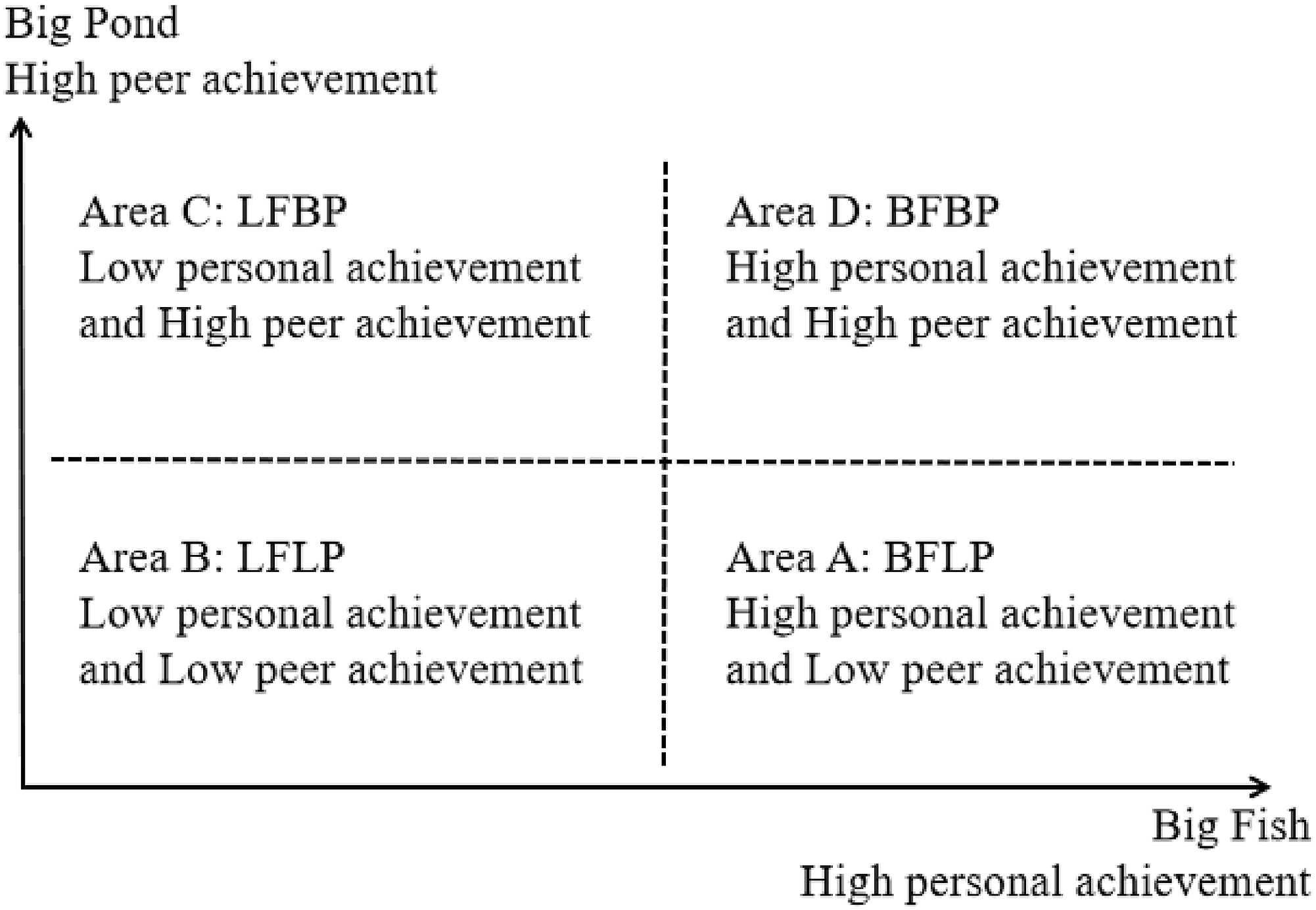
Studies in Area A mainly explored students who had high-personal achievements and enrolled in the learning environment with low-peer achievements (big fish in the little pond). This is unusual because most competent students can enter better schools (universities and classes) through entrance tests, unless their performances in these entrance tests are unsatisfactory. Students in Area B possessed low-personal achievements and enrolled in low-peer-achievement learning environment (little fish in the little pond). Area B is possibly the worst situation for students’ academic performances but not for their ASC (Marsh et al., 2006). Area C represented research focused on students who had low-personal achievement but entered high-peer-achievement learning environment (little fish in the big pond), which may occur when students perform exceptionally in the entrance exams. Studies in Area D paid attention to students with high-personal achievements, who are enrolled in high-peer-achievement learning environment (big fish in the big pond). This is quite usual as competent students always get excellent results in examinations to get admission tickets of elite schools and universities.
Most of the previous studies were included within Areas A and C. The big fish in the little pond and little fish in the big pond had been demonstrated across different countries and subjects or general academic domains (Nagengast & Marsh, 2011; Wang & Bergin, 2017). For example, Marsh et al. (1995) found that students who refused to enroll in gifted classes had higher ASC compared to those who had equivalent abilities in pretests and enter in gifted education classes; Sung et al. (2014) explored the junior students who had equal abilities but attended different high schools. The results indicated that the ASC of the low-performing students of the first-ranked school was lower than those of the high-performing students of the second-ranked school. Besides, some studies focused on little fish in the little pond (Area B). Such as Marsh et al. (2006) pointed out that disadvantaged children who continued to enroll in special education classes would have higher ASC than those who converted to enter mainstream classes.
However, little research discussed big fish in the big pond (Area D). Goetz et al. (2008) investigated 769 gifted Israeli students in grades 4 to 9 who enrolled in gifted classes. However, they mainly focused on the effects of individual and class achievements on gifted students’ test anxiety. Another study explored 1330 fifth-grade students from regular or gifted classes in Germany, and reported that in gifted classes, negative contrast effects of peer achievements on mathematical ASC were stronger than positive assimilation effects of group status (Herrmann et al., 2016). However, this study only discussed gifted students from elite classes of secondary schools.
Furthermore, several studies have proved that peer group has positive effects on students’ performances and other behaviors in higher education (Brunello et al., 2010; Zimmerman, 2003), whereas few researchers have focused on the application of the BFLPE on university students’ ASC (Jackman, et al., 2011). Most of the previous studies of the BFLPE only highlight the ASC of students in primary and secondary schools (Parker et al., 2013; Niepel et al., 2014).
The present study
The present study aims at enriching the framework of the previous BFLPE research by exploring effects of big-fish-big-pond in higher education. The two key research questions are as follows. First, how does peer achievement affect gifted students’ ASC in an elite university? Second, what are the key factors of intelligent students’ ASC?
The Hierarchical Linear Modeling (HLM) was adopted to understand these issues because most data in educational research were nested. In addition, Marsh et al. (2009) suggested that HLM, which is helpful in controlling measurement error at student- and school-levels, is more suitable for exploring the BFLPE. Therefore, a two-level linear model was built to discuss relationships among students’ personal achievements, peer achievements, and ASC: 1) student-level, including students’ characteristics, personal achievements, perceptions of university resources and supports, and interactions with teachers and peers; 2) discipline-level, including peer achievements, faculty–student ratio, and the type of discipline.
Methods
Participants and data collection
All participants of this study were enrolled in an elite research university in mainland China. The test paper of the NCEE (National College Entrance Examination) varies across provinces in China, which makes the scores of different test papers strictly incomparable. This study collected the results of NCEE of freshmen who take the test paper of National Volume I at the end of first semester (T1), as more candidates took this paper in NCEE. As Marsh et al. (1999) suggested, one-year intervals were better for a longitudinal research. At T2, the end of the third semester, all freshmen were invited to voluntarily participate in the survey, and 2069 students completed the questionnaires, and the results of NCEE of 1085 were recorded at T1. Next, all participants were divided into 13 disciplines. We deleted six disciplines, in which the sample size was under 30 students. In the end, seven disciplines remained, namely economics, law, literature, engineering, medicine, management, and science. Finally, a longitudinal sample with 1073 students aged from 19.5 to 21.02 at T2 was collected in this study. Precisely, there were 501 (46.7%) men and 572 (53.3%) women in this study. Additionally, about 455 (42.4%) came from rural areas, and 618 (57.6%) came from urban areas. There is no significant difference of the average scores of NCEE between the sample with 1073 students and the total sample with 2069 students.
Measures
The dependent variable was students’ academic self-concept (Appendix A). This was captured through a five-item Likert scale which was a short version adapted from Damme et al. (2002), such as “I think I am able to deal with the discipline matter” (ranging from 1 = “strongly disagree” to 5 = “strongly agree”). The scale focused on student’s perceptions and evaluations of their general achievements. High scores showed that students’ ASC was positive. The reliability and validity of this instrument were testified by Cronbach’s α and CFA (Cronbach’s α = 0.83, NNFI = 0.95, CFI = 0.96, GFI = 0.97, RMSEA = 0.07).
The independent variables could be divided into two levels. Discipline-level variables included peer achievement and two control variables: faculty–student ratio and the type of discipline. The peer achievement was calculated by the average NCEE scores of students in each discipline. While faculty–student ratio indicated the specific value of numbers of teachers and undergraduates, and the type of discipline was divided into two types: 0 = science, engineering, and medicine, 1 = humanities and social sciences. Students-level variables included students’ characteristics, personal achievement, perceptions, and interactions. First, students’ characteristics, such as students’ gender, residence, nationality, and parents’ educational experience, were recognized as control variables. These variables were treated as virtual variables before entering the values in the model. The details were as follows: gender, 0 = male, 1 = female; for residence, 0 = rural areas, 1 = urban areas; nationality, 0 = minority, 1 = majority; parents’ educational experience was coded as the sum based on their years of schooling. Second, personal achievement referred to student’s personal NCEE scores. Third, students’ perceptions of university resource and support and interactions with peers and teachers were also obtained at the end of the third semester, and the scales for capturing these data were developed by Guo and his colleagues (Appendix A) (Guo et al., 2017; Guo, 2018).
University resource was captured by five items, such as “There are several IT resources” (Cronbach’s α = 0.86, NNFI = 0.95, CFI = 0.94, GFI = 0.95, RMSEA = 0.06), ranging from 1 = “strongly disagree” to 5 = “strongly agree” (Appendix A). The scale evaluated students’ perceptions of learning resources like books, classrooms, IT resources, and so on. High scores represented positive perceptions of the university resources.
University support was evaluated by seven items such as “Provide support for social practice, survey, or experiments” (Cronbach’s α = 0.92, NNFI = 0.97, CFI = 0.97, GFI = 0.98, RMSEA = 0.06), ranging from 1 = “strongly disagree” to 5 = “strongly agree” (Appendix A). This scale focused on students’ perceptions of university’s support through learning opportunities and activities. Similarly, a higher score indicated positive perceptions of the support offered by universities.
A 6-item Likert scale was developed to evaluate student–faculty interaction (Appendix A), such as “Discuss my academic performance with a faculty member” (ranging from 1= “never” to 5 = “very often”). Additionally, the reliability and validity of this scale were evaluated (Cronbach’s α = 0.96, NNFI = 0.90, CFI = 0.91, GFI = 0.85, RMSEA = 0.06). This scale focused on students’ investments in interactions with lecturers. Similarly, a higher score indicated students’ higher investment in communicating with teachers.
Another scale with four items, which had qualified reliability and validity tests, was used to capture peer interaction (Cronbach’s α = 0.87, NNFI = 0.95, CFI = 0.95, GFI = 0.96, RMSEA = 0.06), such as “Actively participate in group or team collaborative learning,” ranging from 1= “never” to 5 = “very often” (Appendix A). The scale evaluated student’s engagement in interactions with their classmates. A higher score indicated a high student engagement in peer interactions.
Data analysis
Generally, the data obtained in educational studies tend to be hierarchical. For example, students are nested in classes (or disciplines), meanwhile classes (or disciplines) are nested in schools (or college and universities). Compared with ordinary regression models, HLM helps to calculate the random effects of each level to clarify the variance component. Therefore, HLM was selected to testify the BFLPE of university students in this study.
The data analysis began with description analysis, including mean and standard deviations. Next, this study discussed correlations among the university’s resource and support, students’ personal achievement, peer achievement, peer interaction, student–faculty interaction, and ASC. Finally, a two-level linear model was built to discuss the effect of personal achievement, peer achievement, and other factors on ASC based on the full maximum likelihood estimation by HLM 6.08.
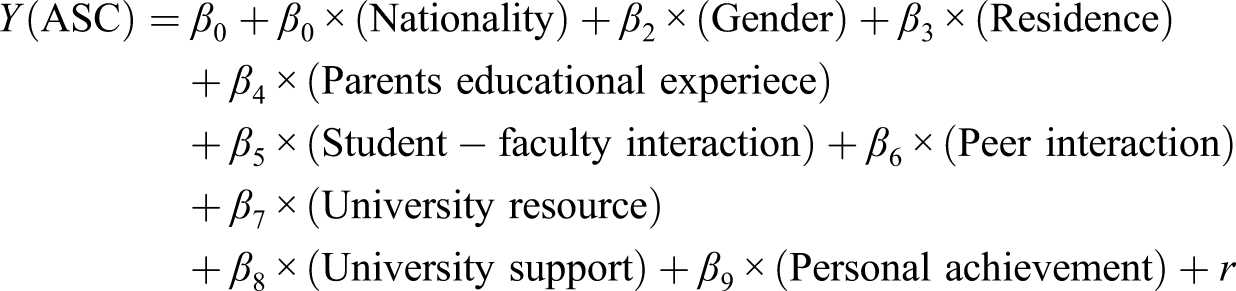
At the student level, the dependent variable was students’ ASC and the independent variables were students’ characteristics, personal achievement, university source, university support, peer interaction, and student–faculty interaction. At the discipline level, peer achievement of different disciplines, type of discipline, and faculty–student ratio were added into the model. All continuous variables in this model were standardized. The independent variables were group centered in level 1 and grand centered in level 2. The details of the two-level linear model are showed as follows: Level-1: student level Level-2: discipline level

Results
Descriptive analysis and correlations
Correlation matrix and descriptive statistics.
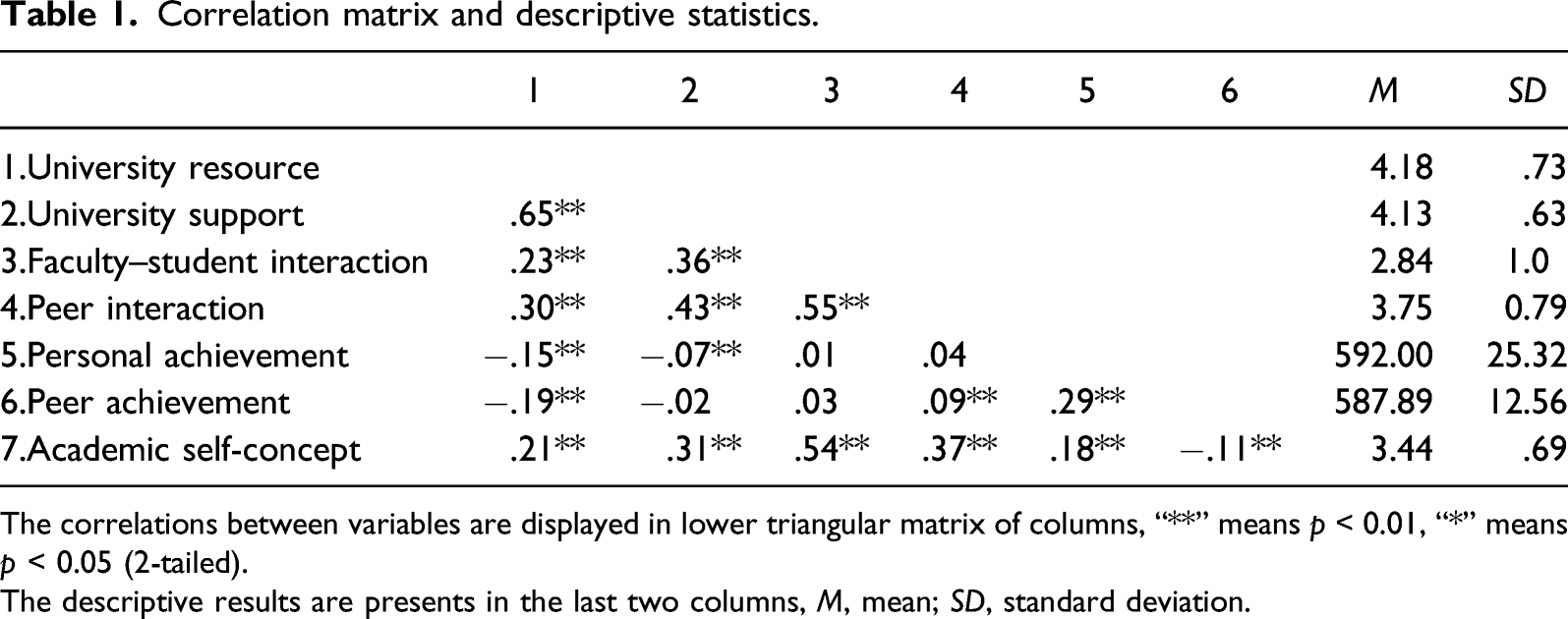
The correlations between variables are displayed in lower triangular matrix of columns, “**” means p < 0.01, “*” means p < 0.05 (2-tailed).
The descriptive results are presents in the last two columns, M, mean; SD, standard deviation.
Next, all variables were standardized, and their correlations were presented in Table 1. The results shown in Table 1 also depicted expected significant correlations between academic self-concept and other factors. Student’s ASC was positively correlated with their perceptions of university resource, support, interactions with faculties and peers, and personal achievement, whereas it was negatively correlated with peer achievement (p < 0.01). In addition, the correlations between students’ ASC and interactions and their perceptions of support were moderate ranging from 0.31 to 0.54, while the correlation coefficients between ASC and other factors were generally weak, ranging from 0.11 to 0.21.
Two-level predictors of ASC
Before forming the two-level linear model, the normal distribution of the dependent variable was tested (Skewness = 0.02 ± 0.05, Kurtosis = 0.42 ± 0.11). Another test was conducted to exclude the multi-collinearity among independent variables, according to VIF (ranging from 1.09 to 1.99). Additionally, we calculated the ICC (Intraclass Correlation Coefficient) based on the results of the Null Model. The results indicated that although only 3% variance was explicated in the discipline level, a Hierarchical Linear Model was also necessary because of the nested data (Luke, 2004).
The fixed effect of two-level predictors.
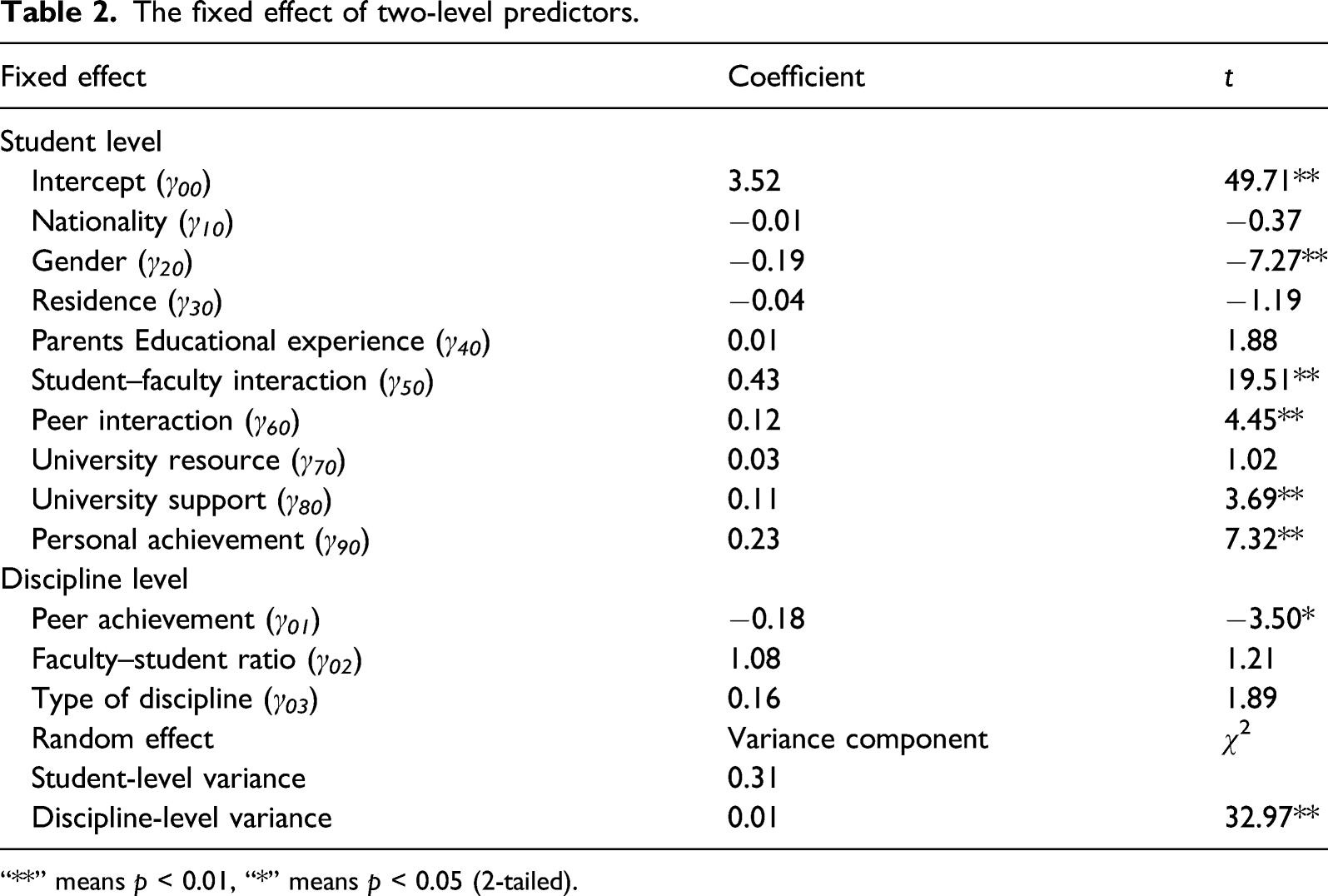
“**” means p < 0.01, “*” means p < 0.05 (2-tailed).
Discussion
This study explores the effects of peer achievements on ASC of competent students in an elite university and clarifies their ASC-related factors. The purpose of this study is to enrich the framework of the previous BFLPE research by highlighting big-fish-big-pond and university students’ ASC. By building the hierarchical linear model, we have two key findings. First, peer achievement has a negative impact on the ASC of competent students in an elite university. Second, despite students’ personal achievement, student–faculty interaction, peer interaction, and university support have positive effects on students’ ASC.
Theoretically, this study applied the BFLPE from schools to universities and discussed peer effects on ASC in the context of big-fish-big-pond effect. The results indicate that BFLPE also operates in higher education, and peer achievements have a negative impact on ASC, which is consistent with the results of previous studies mostly focusing on schools (Parker et al., 2013; Marsh et al., 2006). However, some researchers provided evidence for no BFLPE and weak peer effects caused by the neutralizing effect of the sense of honor which generated when students felt a strong sense of belonging and pride to high-achieving learning environment (Sung et al., 2014; Marsh, 2016). Marsh and his colleagues argued that the power of peer effect was stronger than that of the sense of honor by conducting a series of surveys in schools (Lüdtke et al., 2005; Trautwein et al., 2009). This study further indicated that BFLPE also exists in the elite university. Generally, intelligent students in elite universities are prone to cultivate a stronger sense of glory, which is significantly positive toward their ASC. However, the results indicated that peer effect had significantly negative achievement on ASC of intelligent students in elite universities, which had been neutralized by the positive effect of the sense of honor. Therefore, on the one hand, elite universities should train students to enable their self-evaluation in multiple ways, instead of GPA-oriented evaluation. Thus, when making comparisons with peers, other advantages could also be discovered by students, even if their academic achievements were unsatisfactory. On the other hand, the collective sense of honor, which is positive to students’ ASC, should be cultivated by enhancing the university identity and sense of belonging. This can be achieved when students qualify in their educational activities in universities.
Methodologically, a two-level linear model was adopted to explore the BFLPE and factors for university students’ ASC so that the random effect of each level can be easily calculated. The results indicate that only 3% variance was explained by the discipline level. Some previous studies also used HLM to explore the BFLPE by dividing factors into student and class levels (Sung et al., 2014). However, in universities, students are not simply grouped into one fixed class; rather, they simultaneously belong to different classes. Thus, in the present study, we choose to divide students by disciplines instead of classes. However, all participants were enrolled in the same elite university, which led to a relatively small peer variance of peer achievement among disciplines. For future studies, we hope that researchers analyze BFLPE on university students and examine the effects of peer achievements on students’ ASC in different levels of universities. In addition, we recommend the involvement of more discipline-level factors in future studies.
Practically, this study also provides insights about improving talented students’ ASC in elite universities. First, the results showed that university support was more beneficial for students’ ASC than university resource. The construction and development of universities depend heavily on material resources (Zhang et al., 2016), such as funds, teaching and learning space, advanced facilities, library resources, and so on. However, students in elite universities require their universities’ support, rather than material resources, to build positive ASC. Therefore, we suggest that universities should not blindly pursue abundant learning resources; rather, they should focus more on including practical and efficient support activities, such as opportunities, seminars, lectures, and practice activities. Second, we found that student–faculty interaction and peer interaction positively predicted students’ ASC. It was surprising that peer achievement and peer interaction had opposite direction of effects on ASC as students interacted with a similar peer group. It can be attributed to positive interaction, such as cooperation learning, communication, and collaborative activities, had significant benefit to students (Sultan et al., 2011), while negative comparison with peers might lead to confidence decrease. Higher education was treated as a social process, instead of an individualistic process (Ostermann, 2000). Students could acquire higher education by interacting with their learning environment, particularly with their lecturers and peers. Additionally, positive interactions are beneficial for improving students’ engagement both in and out of the classroom (Rimm-Kaufman et al., 2015). Further, a timely relief can be provided to students’ confusion and depression by encouraging discussions with their lecturers and peers. Therefore, we hope universities provide more activities for students to enable their interaction with lecturers and peers, both in and out of classroom.
This study has several limitations, which need to be addressed in future research. First, although we attempted to apply the BFLPE to higher education, only one university with high-level peer achievements was explored in this study. Second, discipline-level factors only explained a small part of variance because the differences among disciplines in the same elite university were quite small. Third, some factors, such as the sense of glory, may integrate the contrast effect of peer achievements on ASC. This has not been included in the current study’s model. Therefore, we call for future studies to explore more elite universities and include other missed factors into hierarchical linear models, for example, the sense of glory and discipline or university-related factors. In addition, as students’ learning in universities are different from schools, we hope that future studies focus more on the BFLPE in higher education, not limited to elite universities.
Footnotes
Acknowledgments
The author acknowledges colleagues and families, especially Jianpeng Guo provides the data.
Declaration of conflicting interests
The author(s) declared no potential conflicts of interest with respect to the research, authorship, and/or publication of this article.
Funding
The author(s) received no financial support for the research, authorship, and/or publication of this article.

The instruments used in this study (translated from Chinese)
Author Biographies
Juan Zhang is a Ph.D. student at Tsinghua University’s Institute of Education, mainly concentrating on students’ learning and development in higher education.