



Abstract
The Gaokao exam is still a hot topic in contemporary Chinese society designed to select people for the country by testing their knowledge of specific exam subjects. People from all walks of life have different attitudes and understandings towards it. The purpose of this study was to examine how do Chinese female students from Top Universities in China perceive the gāokǎo exam by using a semi-structured, in-depth interview (N = 5) and an open-ended interview questionnaire (N = 7). The findings suggest that an evaluative dichotomy can characterize the exam itself and exam preparation period. Although initially this time was seen in terms of immense sacrifice and was highly intense, positive attitudes to the Gaokao exam dominated, and the exam was considered a relatively fair and equitable selection method. It should be borne in mind that this study does not attempt to be globally representative. However, we do trust that the findings will have a universal appeal to educational communities.
Introduction
In the last two decades, there has been growing literature on gaokao research from sociological, pedagogical, and gender perspectives. This interest may be because the Gaokao is seen as one of the most competitive exams in the world (Cai et al., 2019). Thus, the gaokao participants compete for indexes of the best universities and a passport to career, social prestige, and material well-being. In 2020, 10.71 million people sat in the gaokao. The below literature review focuses on three essential components of the author’s research: the importance of education tests, the history of the Gaokao exam, and women in education.
Review of pertinent literature
Educational tests
Even if the tests are not perfect (Heubert & Hauser, 1999), they are an integral part of any education level, regardless of the cultural context. They perform both a selective and stratification function. They are often criticized for their destructive influence on young people to reduce their identity (Herbert et al., 2017). The opponents of the tests claim that they cannot measure critical thinking (Harris et al., 2011), which is a vital competence in the post-trust era. Despite the criticism of the tests, some researchers point out that the tests are part of the liberal idea of meritocracy (Liu, 2013), which gives children a chance to compete fairly regardless of their origin status. The tests have actually allowed millions of people from disadvantaged groups to achieve educational success (Park, 2008). Therefore, in many countries, test results are seen as a way of emancipation for people from families who are low in the social hierarchy (Ayalon & Livneh 2013). Undoubtedly, the tests significantly changed the educational situation of women, which is supported by the mentioned arguments, namely the increase in the number of women studying, e.g., in China (Liu, 2017). One potential flaw with an overreliance on tests is that they may negatively affect students with distinctive talents, who are incapable of translating those talents into a standardized test. This way, they may end up deprived of access to higher education, even though they may have thrived in that environment. On the reverse, students who score well on the test may not necessarily possess other necessary nonacademic qualities (Wu et al., 2019).
The National College Entrance Examination
The Gaokao exam, also known as the National College Entrance Examination, is a large-scale competitive and selective test, determining which testers qualify for college. Its importance cannot be understated; it inadvertently affects elementary and secondary education as well, as schools may begin preparing students incredibly early. It first appeared in Chinese society in 1952 and resumed in 1977, after the Cultural Revolution and China’s development into a socialist market economy (Liu & Wu, 2006). By 2006, sixteen of China’s provinces had included province-specific questions, a decision that proved to be relatively unpopular and controversial (Wang, 2010). The Gaokao is considered among the most competitive globally, with a low passing rate relative to exams common in Western societies. In contrast to Western societies, which can use holistic evaluation methods, the Gaokao is typically the only criterion used. The students’ total scores decide which of China’s nearly 2000 colleges they gain admission to. China’s colleges comprise three tiers: key universities, regular universities, and technical colleges. The main differences are based on ranking and programs’ duration; however, attending a key university is seen as improving job prospects in a fiercely competitive job market (Li, 2012). The importance of this exam cannot be overstated. Some students feel such intense pressure that they study while hooked up to oxygen tanks (supposedly to improve concentration). At the same time, some use additional methods to skip their periods during exam week (Lua et al., 2018). The Gaokao creates a ripple effect by being one of the criteria used to determine whether a student attends a particular college. Preparations for the exam begin as early as primary school. Students spend their entire senior year preparing for the Gaokao. According to Ho Mok and Wu (2016), there exists a vast expanse between the possibilities of elite university graduates and non-elite graduations. This results in “madness” gaokao, in terms of the mental state of both Chinese students and their parents, who are equally preoccupied with their futures, and even the mass media, which whips up a frenzied atmosphere during exam season (Gromkowska-Melosik, 2017b). Considering the Gaokao’s supposed egalitarianism, the effects of gender on educational opportunity in China has attracted much interest. A student’s choice of the university extends into their luck in the job market as well. According to research by Huang et al. (2015), the probability of a woman receiving a job offer compared to a man (when all other factors such as the school rank are equal) is lower for most majors. These difficulties in the labor market may eventually create a negative feedback loop to the educational process itself. Across the world, men earn more on average than women in both developed and developing countries. According to the 2020 Survey Report on the Status Quo of Chinese Women in the workplace & the overall salary of Chinese women in the workplace is 17% lower than men. The income gap is narrowing rapidly. The rapid rise in women & education in recent years is also why the pay gap has narrowed.
Women in higher education
In contemporary society, women’s access to higher education has radically changed in nearly every country in the world (Liu, 2018; Marginson, 2016; Renn, 2014; Shao, 2016). Noting this change (erase). The authors may lead one to believe that women in higher education are no longer an issue requiring further study or discussion, as women can globally attend private or public coeducational institutions (Yangb & Shena, 2020). One such example is Oxford University, which on 7 October 2020 recognized its 100th anniversary of formally admitting women. Meanwhile, women in “China also had more opportunities to participate in higher education, reaching 50% participation in 2013, up from less than 30% in 1980” (Liu, 2017, p. 946). Although these numbers have increased, they still do not match up to Western numbers, and many potential students are not accepted into any universities, leaving them without the option of higher education (Lu, 2011). Much like the rest of the world, in the second half of the 20th century, China experienced a rapid expansion of its higher education system, notably experiencing large growth since the start of the 21st century (Wang, 2011). Wu et al. (2020) also found that gender inequality when accessing higher education decreased in elite education far more than in non-elite education. However, Cai et al. (2019) found that women are underrepresented in the top academic programs.
Methods/methodology
The purpose of this study was to examine how do Chinese female students from Top Universities in China perceive the preparatory period for the gāokǎo exam? This study uses interpretivism as its theoretical framework. This approach allows us to view individual experiences as socially constructed and reflect the multiple realities students inhabit (Glesne, 2011). It is equally important to note that these realities affect individuals’ perceptions of their environment and the way they choose to interact with others (Glesne, 2011). Equally important, however, was phenomenology, which asks “what is the nature or essence of the experience of learning” (Van Manen, 1990, p. 10). For qualitative research interviews, phenomenology plays a guiding role in elucidating the mode of understanding (Brinkmann & Kvale, 2014). Our aim is not to create new theories and instead understand the collected cases and their relations. They interrelate to make a student’s point of view regarding the gaokao exam. Ultimately, these studies seek to understand the societal reality the students live in.
This question guided the author inquiry:
Participants
The authors made use of deliberate sampling, which is “defined as the selection of units concerning special purposes regarding answering the given research questions” (Teddlie & Yu, 2007, p. 77). By using Linear Snowball Sampling, which is a non-random selection of respondents to the research sample. This method starts with one individual, who refers to another, and so on until an appropriate sample size is reached (Teddlie & Yu, 2007). This type of selection method often acts as an efficient chain and is very helpful when conducting large-scale research in environments challenging for the researcher to reach. In deliberate sampling, its participants must have a trait or traits of interest to the researcher (Ritchie et al., 2003). The first criterion for being included in the study sample was to be a woman, second pass the gaokao exam, and third be a student of one of the top Universities in China. See Table 1 for student demographics.
Student demographics.
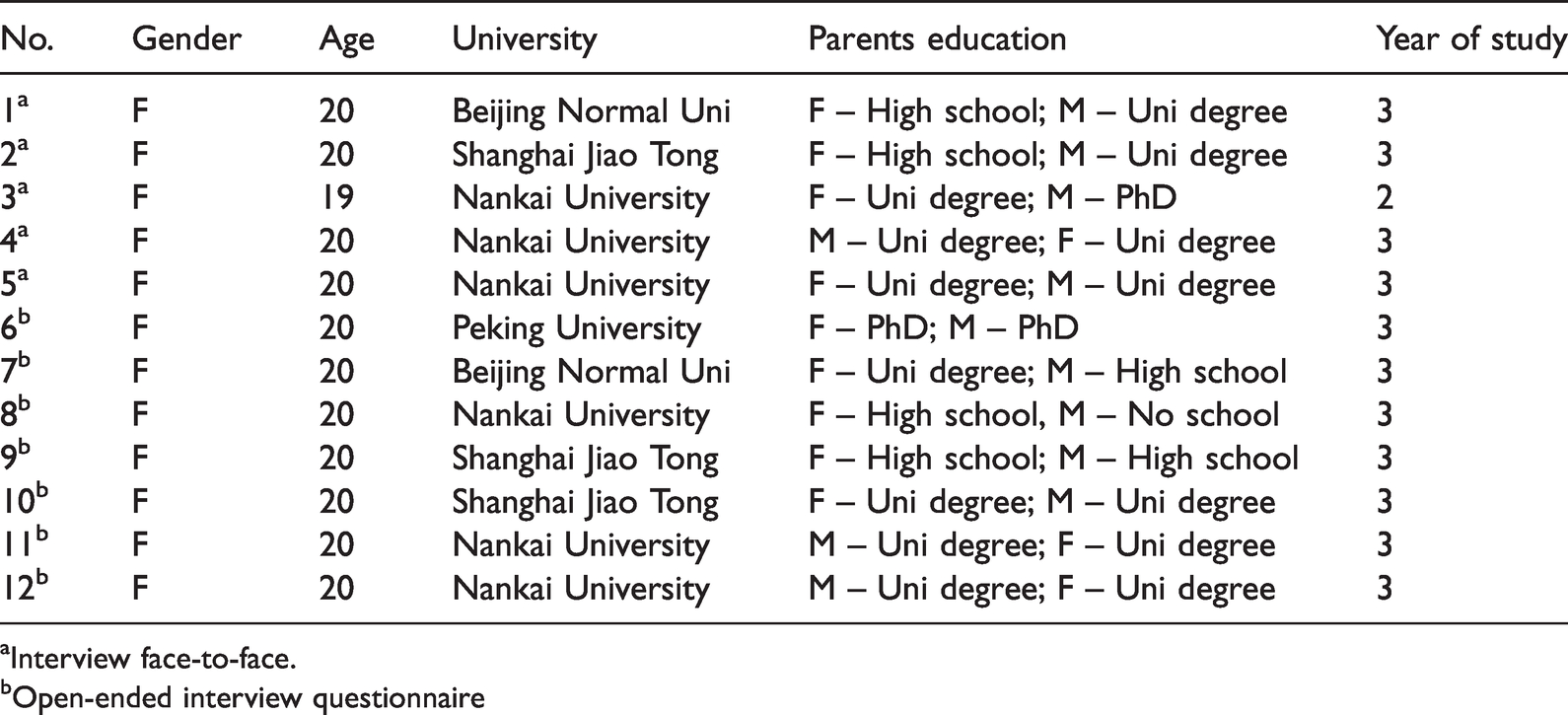
Interview face-to-face.
Open-ended interview questionnaire
Data collection
Two forms of data collection were used—a open-ended questionnaire (without a time limit and with unlimited space to answer the questions) and a 30-to-40-minute individual semi-structured interview. In accordance with APA Ethical Guidelines for Research (Campbell et al., 2010), students received Student Consent Forms with information about the purpose of the study, the procedure, voluntary participation, privacy and confidentiality and risks (there were no anticipated risks beyond those encountered in everyday life). The written information also included a statement, permissions, and student signatures.
Interview procedure
Interviews were conducted in the form of free statements during which the respondents were led to thematically specific narrative spaces in order to provide detailed and in-depth answers. The questions asked were open-ended. The interviews conducted were registered via recorders (with the respondents’ permission) and then transcribed. Notes were taken throughout the research process to serve as auxiliary materials in grouping the collected data, combining it into broader categories, and identifying the interpretation bases of the phenomena recognized (Huberman & Miles, 2002).
Open-ended interview questionnaire procedure
The open-ended interview questionnaire included information about the family background (e.g., parent education level, siblings) and educational information (e.g., college and career goals) and six below questions. Via emails, the students received the open-ended questionnaire and Student Consent Forms to the students by email.
Questions:
When you hear gaokao, what comes to your mind? How do you perceive the preparatory period time for gaokao exam? How do you perceive gender equality/inequality in the gaokao exam? How do you perceive the thesis that everyone is equal and has an equal opportunity for success regarding gaokao? How did your gaokao results shape your further educational path?
Analysis
The process of analyzing the data encompassed two stages. The first stage was made up of a within-case analysis. During this analysis, every sample was first treated as a comprehensive case in and of itself. The second stage sought out thematic problems that emerged in the research through a thematic analysis across the cases (Braun & Clarke, 2006). The purpose was to seek out the central metaphor, tying together disparate passages and finding similarities within different cases. The analyses presented were created due to the respondents’ statements being subjected to structural description and division into cohesive segments (problem areas) (Rowley, 2002; Thompson, 2000). Therefore, the analyses do not quote all responses given by the students. It cites only those that overlap with the needed information to the greatest extent. The sample selection thus expanded to the stage of presentation of research results (Flick, 2009).
Results
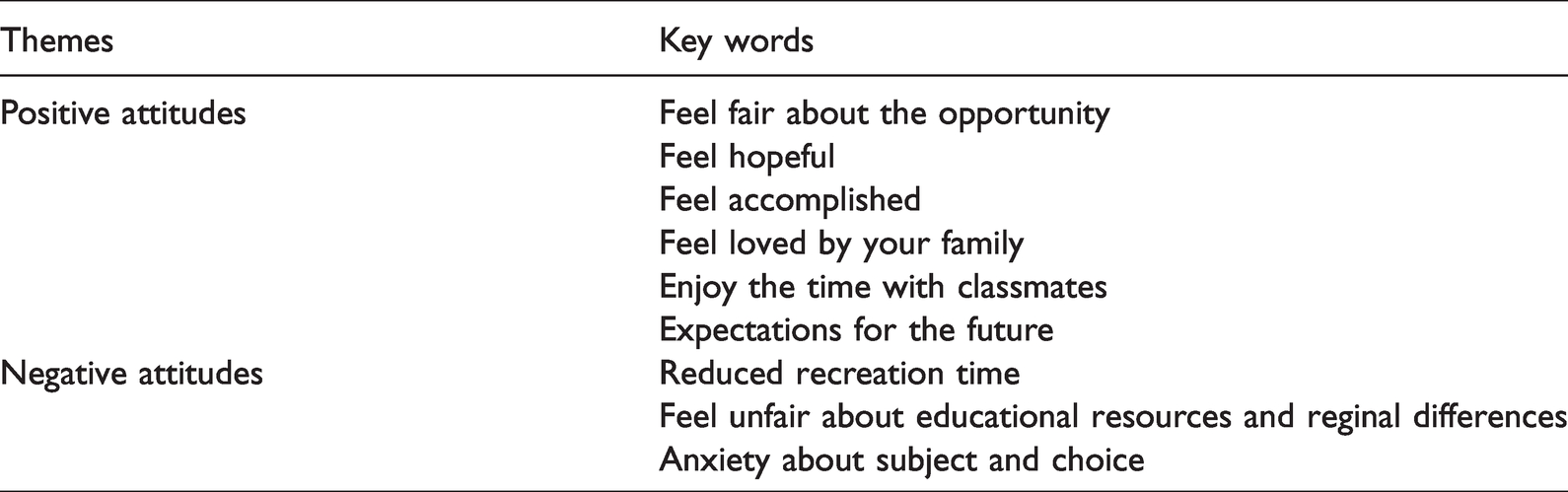
Based on analysis, two major themes emerged, which include (a) positive attitudes (b) negative attitudes which can be find by key words (see Table 2). These themes emerged out of the significant overlap in responses, which all pointed to similar ideas while still retaining individualistic views.
Summary of main themes and key words.
Preparatory period for gāokǎo exam
The current findings suggest that the students the Gaokao preparation time can be divided into two groups: positive and negative. Generally speaking, there were much more positive attitudes to the Gaokao exam preparation time. Moreover, perceiving this period was determined by factors such as attitude towards life, character traits, support from family, friends and peers, national characteristics and the school climate. These elements are shown in bold in the following statements: I don't agree that the college entrance examination will affect the lives of young people. On the contrary, I think that the college entrance examination is an On the contrary,in I think gaokao is a […] during the period of preparing for the gaokao, I gained another kind of life pleasure, that is, the sense of accomplishment of making questions and getting high scores. As a Chinese student, the gaokao is also The preparatory period for gaokao was a little tedious and hard, but Although the process to prepare for gaokao is a little boring and rigid, we can learn to improve our capability and something really inside ourselves much more better than just considering the joy of life. By the way, gaokao doesn’t mean that we don’t have time to play or enjoy the youth The joy of life depends on one’s choice. For me, though the during the preparatory time for gaokao Preparation for the college entrance examination for most young people, the daily life is to study, eat and rest. The amount of time involved in other forms of entertainment has been reduced correspondingly, The grade of gaokao is almost the only thing that decides I ma mostly never touch my mobile phone during the third year in senior high school. It The preparatory period of gaokao almost took all spare time. And so, do my schoolmates
For the respondents, preparing for the exam was actually intense. It cost them many sacrifices, but in retrospect, they say that the effort paid off, and learning also gave them a lot of satisfaction. Although preparing for the college entrance examination is a Indeed, I think it In my memory, I think the preparatory period for gaokao
Equality and fairness
The current findings suggest that the students’ perception of equality and fairness can be divided into two groups: positive and negative. Generally speaking, the test was seen as fair Equality. It is worth emphasizing that the gaokao exam is reformed every few years (Tan & Ng, 2018). The aim of the reform was so far to make the examination more open, democratic, fair, and diverse. Despite its shortcomings, the gaokao exam is viewed as fair, and its results provide a reasonable basis for placing different people in universities of varying prestige: We are having the same opportunity to take the exam and we are in the same starting point. (Individual interview, No 5, August, 2019). It’s not absolute fair but I think it’s equal. The rules of gaokao is strick and objective, and gaokao provide equal opportunity. The problem is about resource but not the system of gaokao. (Individual interview, No 1, July, 2019). I think it is equal, but I don't think it has equal opportunity for success. (Individual interview, No 7, July, 2019). […] Gaokao is the equalest before there is a better way. And without gaokao we can hardly get a better education than the rich or the power. (Interview questionnaire, No 6, July, 2019). There is no absolute fairness, but there must be relative fairness […] All candidates face the same opportunities and enter the right school based on their individual abilities. (Interview questionnaire, No 10, July, 2019). Nothing is fair, and […] Gaokao system is the To some extent, gaokao is fair. They gave everyone the chance to change their life. But there are also some unreasonable aspects. It causes some discriminations. (Interview questionnaire, No 8, July, 2019). It depends on the district because some province My opinion is that gaokao […] If someone works hard, they can get better results in most cases. But I have to say that there is something unequal as well, though a little. (Interview questionnaire, No 8, July, 2019). Society will never be fair, the college entrance examination for other things in society, is really relatively fair, after all, there is no difference without comparison. (Interview questionnaire, No 12, July, 2019). I don't Although I admit that it is partly unfair, especially comparing the difference
Further educational path
The gaokao exam shapes the educational path of young students, which reflects in the respondents’ statements. In his research exploring how Chinese students see the relationship between the gaokao and access to university, Heger (2017) found that the effort to enter university is seen as a glorious topic from the perspective of the students. This was also shown in the statements below: […] It also taught me lots of lessons like how to be a polite, diligent, creative, rigorous and moral person. And the great friends I made here would support me and be my side in the future, just like the good habits we got here. (Individual interview, No 2, July, 2019). Sometimes I am regretful cause I didn’t get what I want . I try to make the difference between me and the others from prestigious school smaller. To get more certifications that I need for my future career. It would affect your life obviously but you can’t let it to change what you always want to do. (Interview questionnaire, No 7, July, 2019). We use gaokao results to choose school and major. In other words, what we will do in the It got me into a key university, and in a way I'm a little higher than some people's platform. It means I am
Gender and the gaokao exam
An undoubted advantage of the gaokao is that gender does not matter when evaluating the exam. Everyone has the same chances, and a good result depends only on diligent work and proper methods. I fully agree the We choose science or liberal arts during high school. Gaokao of Science contains Chinese, English, more difficult mathematics, physics, chemistry and biology, while Liberal arts contains the same Chinese, English, but simpler mathematics, history, politics and geography. There’re always more boys in Science and more girls in Liberal arts. I don't think whether a person can do well in the gaokao has much to do with gender. I […] Girls and boys have their own advantages in gaokao. If they study hard similarly, they have the same opportunities to get a great result. (Interview questionnaire, No 8, July, 2019).
Discussion
The Gaokao is often called the most crucial test of students’ lives, as shown by the conducted analysis. In students’ statements, we can also notice the thesis put forward by Heger (2017) that students describe their entrance to university as a significant turning point. And some surveys show that parents with different incomes have different attitudes toward the gaokao. High-income parents pay more attention to the life experience of attending college through the gaokao, which can broaden their knowledge and establish three concepts. Low-income people, on the other hand, think the gaokao is very important. The surveys in recent years have shown that 16 percent of examinees sleep less than five hours a night, and 96.9 percent sleep less than eight hours a night. Lack of sleep has become a problem for middle school students nationwide (Xiong, 2016).
Although China still has to grapple with an educational system that is sensitive to institutional corruption, the Goaokao is seen as an equitable method of selection (Ross & Wang, 2010), which was shown by the conducted analyzes. Despite observable points of unfairness – some families can move to areas with more favorable admission conditions or send their children abroad to study – the examination itself is treated as fair. The investigation on the primary motivation of high school students to study overseas shows that some of them choose to study overseas because they do not adapt to the domestic education model and educational environment (Wu, 2014). You and Hu (2013) also note that the gaokao is seen as a fair method of competition in China since the decision is based on nationally-comparable scores. Wu et al. (2019) note that although this method is seen as relatively fair and equitable, it has far-reaching consequences for primary and secondary education, leading to an exam-oriented teaching method. Many respondents’ perceptions of the gaokao may have been related to the fact that their own parents were highly educated. As found by Zhang and Chen (2014) “parental educational level greatly influences higher education opportunity. Parents with a junior high education level have higher odds than those with primary school education or below” (p.13). According to the research conclusion of Xing Hui Tian in 2014, said that grade three students are in the moderate and severe level of test anxiety. The test anxiety of girls is slightly higher than boys; the anxiety level of ordinary middle school is somewhat higher than critical middle school. Our interview for this article also reveals these problems (Tian, 2014).
The students did not notice the problem of gender inequality in the case of the gaokao exam, only paying attention to the differences in results obtained in different scientific disciplines, which is also confirmed by the results of analyzes carried out by Cai et al. (2019). In science, men outperform women at almost all points of the test score distribution, and the male advantage becomes even more pronounced during the Gaokao. Due to the stereotype, “male discipline” and “female discipline” appear in higher education. Scholars at home and abroad regard this phenomenon as “gender segregation of discipline and specialty,” which is joint worldwide.
Conclusions
Along with the greater access to higher education, the number of people joining the gaokao (voluntarily assumed) has increased. Gaokao participants compete for top university indexes as a gateway to career, social prestige, and material well-being. Despite the case study method being frequently criticized by the representatives of currents associated with the positivist paradigm, the method finds increasingly wider application in empirical studies and brings cognitively valuable effects (Coleman et al., 2007). In this study, the qualitative approach made it possible to gain access to data on the students' experiences in the context of complex environmental, situational, and structural conditions that result in cognitively beneficial effects. The preparation time for the exam and how students prepare for the exam in COVID-19 epidemic is also assessed. According to the interview and related research, we can see the following points: A) Chinese people still attach great importance to the college entrance examination. Students can treat the college entrance examination with a correct attitude when they feel pressure. B) China has constantly been correcting and perfecting the problems in the college entrance examination, such as the emergence of the new college entrance examination. However, it has not solved all of the issues. C) Anxiety exists among three senior students. Universities and relevant departments should effectively adjust the anxiety points, and parents and teachers should give them support and attention. D). Unfairness exists in the college entrance examination. Still, it is not gender inequality, but the imbalance of educational resources between regions and the difference in admission rate.
Limitation
In studies, like this one, based on deliberate sampling, the interpretation of results is limited to the cases studied and generalizations are not valid (Tongco, 2007). The authors are fully aware that qualitative studies, unlike quantitative studies, are considered “soft, descriptive, ‘feminine,’ ‘microscopic,’ less exact/precise/objective/rigorous, systematic (…) and non-scientific” by many (Vissa, 2007, p. 378). The study results are not representative of any whole population, nor can they be generalized; the knowledge obtained concerns merely the analysed phenomenon in the specific context and cannot be “transferred” (Shenton, 2004). Future research should include a comparative study among male and female students from the Top Universes in China.
Footnotes
Declaration of conflicting interests
The author(s) declared no potential conflicts of interest with respect to the research, authorship, and/or publication of this article.
Funding
The author(s) received no financial support for the research, authorship, and/or publication of this article.
1
One of the significant measures deployed the reform, the implementation opinions on September 4, 2014, which is also the most comprehensive and systematic reform of the examination and enrollment system since the restoration of gaokao. On April 23, 2005, Hebei, Liaoning, Jiangsu, Fujian, Hubei, Hunan, Guangdong, and Chongqing issued the implementation plan for the comprehensive reform of the college entrance examination. The new “3 + 1+2” gaokao model will be tested in eight provinces and cities, starting with first-year high school students entering in the fall of 2018.