




Abstract
This paper brings issues around forecasting and change to the fore to stimulate a conversation around three related questions: How do we understand the challenges of this global era? What might be the role of higher education in re/shaping this future? What competences might students need and how should be go about developing these?
Introduction
This conference – Constructing HE for the Global Era: Proving Student Competence – invites us into a conversation about the future of higher education, what its shape might be, and why it is important. But it goes beyond calls for change. Instead it asks us to consider what might be at stake when providing evidence to those who matter –students, their families, policymakers and employers – that these particular attributes of students are important, and matter for our future. After all, by definition – we can’t know the future, and any effort to shape education in anticipation is likely to be something of a fruitless exercise.
That said, there is no shortage of accounts out there that asserts that higher education is on the precipice of changes which will radically alter the nature of knowledge production, and implication, the teaching and research agendas of universities. Analysts point to the rise of artificial intelligence, robotics, big data and Massive Open Online Courses (MOOCS), arguing that together these will transform who has access to knowledge resources that had once been the province of universities.
In a provocatively titled An Avalanche is Coming, Michael Barber and colleagues (2013) argued that the university as we know it has had its day. They go on: “The models of higher education that marched triumphantly around the globe in the second half of the twentieth century are broken … The traditional multi-purpose university with a range of degrees and a modestly effective research programme has had its day. The next 50 years could see a golden age for higher education, but only if all the players in the system, from students to governments, seize the initiative and act ambitiously …” (Barber et al., 2013).
Similarly, Nathan Harden, in an influential essay in the US in 2012, argued that half of the roughly 4,500 colleges operating in the US would cease to exist. In his words: “The future looks like this: access to college level education will be free for everyone; the residential college campus will become largely obsolete; tens of thousands of professors will lose their jobs; the bachelor’s degrees will become increasing irrelevant; and ten years from now Harvard will enrol ten million students”. Why? “Because the college classroom is about to go virtual”. He further added: “The higher-ed business is in for a lot of pain as a new era of creative destruction produces a merciless shakeout of those institutions that adapt and prosper from those that stall and die. The changes ahead will ultimately bring about the most beneficial, most efficient and most equitable access to education that the world has ever seen. There is much to be gained” (Harden, 2012).
These dramatic accounts of the melt-down of the university as we had come to know it have been somewhat overtaken with world events. The emergence of MOOCs, as new kinds of teaching and learning spaces, have had an impact on higher education but not in ways the pundits had predicted. For sure MOOCs have opened up new vistas for learners around the world. But education credentials continue to be important resources to determine employment and earnings. Universities also engage in more than teaching; they are currently major producers of ideas and innovation, and to have an important role in developing forms of social cohesion. That is, university educated graduates are more likely to be politically engaged, and civic minded. Universities have also shown a remarkable capacity to endure over time.
Yet at the same time universities have been challenged to review the nature of the knowledges that they teach (the classical western canon), to engage with the knowledges their more diverse student populations bring into the classroom, and to challenge themselves around what it might mean to be interculturally minded. And whilst many of these discussions are directed at schools, there is a strong case to be made that universities need to take this on as part of their core mission.
This case is propelled by evidence of growing social inequalities across many countries, stalling social mobility, and ruptures in social cohesion (Organisation for Economic Co-operation and Development (OECD), 2011). A stimulus to these conversations and challenges have without doubt been given an edge with the rise of populist authoritarian politics in the US, UK, Brazil and Hungary, amongst others since 2016, and more recently concerns over pressing global issues such as environmental sustainability and climate change. If a higher education is to enable students to engage with the challenges of the global, then we need to think through how we might insert the idea of the global and the development of global competences, into teaching and learning.
In my presentation I want bring these issues to the fore to stimulate a conversation around three related questions: How do we understand the challenges of this global era? What might be the role of higher education in re/shaping this future? What competences might students need and how should be go about developing these?
Why promote ‘the Global’ now?
A great deal is currently being made of the need to insert ‘the global’ into the curriculum in schools and universities around the world to enable learners to acquire those knowledges, skills and values so as to engage with pressing societal and environmental challenges. Many of these challenges are seen as cultural; for example, our attitudes toward others who we see as different from ourselves, our behaviour toward the environment, and a culture of individualism.
Throughout the 1990s, neoliberal globalisation was mobilised as either a solution to a myriad of cultural, political and economic issues within nation states, or a force to be reckoned with. However, the promise of neoliberalism, whose instruments were argued to enable all boats to rise, were increasingly in question.
As early as 2008 an OECD report Growing Unequal? flagged rising income inequalities and poverty in OECD countries and beyond. Yet the OECD was insistent that countries should embrace, rather than retreat from, greater integration into the global world order. What was needed, the OECD argued, was a more adequate statistical infrastructure to monitor changes in poverty and income inequality over time (OECD, 2008, p. 3).
In 2011, the OECD returned to the issue of growing global inequalities in Divided We Stand (OECD, 2011). They noted that income inequalities had already begun to increase in the UK and the USA in the early 1980s (p. 22), and that this pattern had become more widespread by the 2000s, including in those regarded as ‘low-inequality countries; Germany, Sweden and Denmark. However, again the OECD Report was equivocal as to the determining role of neoliberal ideas (p. 24), arguing the evidence was mixed. However, they did agree that policy choices, regulations and institutional arrangements mattered (OECD, 2011, p. 26).
A chorus of voices, including well-known economists (cf. Piketty, 2014; Stiglitz, 2010), added to the volume of evidence that neoliberal policies had effects. The accumulated consequences of speculative financial capital, low levels of corporate taxation, the rise of a managerial elite, and a small group of super rich was contrasted with middle and low-income earners who now had now declining incomes, precarious work, a smaller share of global wealth. This, in turn, undermined the necessary social cohesion at the base of an inclusive society as well as resources to fund public services, like education.
According to Sennett (2006), a key culprit in the rise of inequalities and social unrest lay emerged out of the culture of the new capitalism. He pointed to the rampant promotion of individualism, narrow-minded entrepreneurship, and the replacement of meritocracy with the idea of talent. In combination, these attributes fostered individual competitiveness, and the view that winning was everything. But winning is premised on someone losing, in turn reinforcing new social differences. When some groups come to understand themselves as losing out economically and socially, new resentments as to who is to blame have surfaced (Cohen, 2019). Rather than point their finger at the pernicious effects of neoliberal policies, those who have been left behind have turned on those who are different – migrants, ethnic groups, gypsies and travellers – as the cause of their loss in status.
Boven and Wille (2017) point to a new education cleavage emerging in many countries across Europe. They place on one side a cosmopolitan, well-educated, elite, and on the other those whose education experiences are limited, and whose worldviews are shaped by a parochial media, and jingoistic politics.
Such cleavages have become a breeding ground for conflict and resentment amongst those who have been on the sharp end of redistribution and recognition failures. They have also been fuelled by the war on terror, the rise of Islam, conflict in the Middle East, and the mass movement of refugees across the surrounding borders. Close on 70 million forcibly displaced people have found themselves on the move toward Europe, or uneasily incorporated into its communities. The rise of populist politicians and politics – from Trump in the United States, to the Brexit vote in the UK, and right-wing movements in Europe, are all manifestations of deeper challenges facing many societies and their communities.
If the rights of forced immigrants and asylum seekers has divided communities, so too has the future of the planet around claims regarding the extinction of many of the earth’s species, fossil fuel depletion, evidence of climate change, and the sustainability of current models of economic development. This has divided experts, countries and generations. However, earth-orbiting satellites and other technological advances have enabled scientists to see the big picture, collecting many different types of information about the planet and its climate on a global scale. Melting glaciers, shrinking ice-sheets, warming oceans and a rise in sea levels, can be detected and measured. This has galvanised a younger generation of school children (e.g. Extinction Rebellion) who in 2018 and 2019 have become active as climate change protestors and put the older generation on notice. Such concerns reinforce the need to include sustainability in education’s global agendas. So, what is to be done, and what are the implications what is it that universities might do to?
New education solutions to global problems
In his chapter entitled ‘Pedagogy for a runaway world’, Alexander makes the following remark: … if we contemplate the increasing fragility, inequality, and instability of our world as a whole, and believe that these are not only unacceptable in themselves but are also, as a matter of fact, contrary to the national interest – because like first-class passengers in an aircraft crash, in a global catastrophe no country remains immune – then education will need to espouse very different priorities: moral no less than economic, holistic rather than fragmented, and collective rather than individualistic. (2008b, p. 127)
Its 2016 Global Competency for an Inclusive World, and its 2018 Global Competence Framework provide us with an insight into how the OECD read the world. For example, a globally-competent student in the 2018 Framework Report is one who learns to live harmoniously in multicultural communities, is able to thrive in changing labour markets, able to use media platforms responsibly, and supports the realisation of the SDGs. In other words, global competences are a: … a multidimensional capacity. Globally-competent individuals can examine local, global and intercultural issues, understand and appreciate different perspectives and worldviews, interact successfully and respectfully with others, and take responsible action toward sustainability and collective well-being. (OECD, 2018, p. 4)
However, in my view there are problems with the OECD’s global competence project, in large part as it tries to promote a one size fits all solution to be applied to all countries, ignoring the specificities of local-situated cultures, and their diverse forms. In recognising this issue in 2018, some 30 countries (40% of PISA member countries) declined to administer the test due to the problematic nature of the items which they argued required deep cultural and contextual knowledge to inform answers. As a result, the items on the test were limited to cognitive constructs and not beliefs and values. Furthermore, the OECD’s items appear to be underpinned by western values and outlooks which are viewed as being imposed on those countries with rather different views of the world. This, is turn, undermines the very premises that drive the test in the first place; of being open to diversity and to the intercultural.
By way of contrast, United Nations Educational, Scientific and Cultural Organization (UNESCO), currently responsible for delivering on the Sustainable Development Goal 4 (education), and Target 4.7 – global citizenship education and sustainability, do point out that there is no agreed definition of global citizenship. However, it goes on to argue that the globally competent citizen at the heart of Global Citizenship Education (GCED) has the skills to bridge the cultural and social diversity in the world, to examine societal orders and policies, and to make informed choices so as to transform their communities and societies toward being more peaceful, just and sustainable (p. 14).
In Preparing Teachers for Global Citizenship Education UNESCO (2018a) provide a template for teachers to help inform ‘the art of teaching’ global citizenship education. Their template is quite open and not prescriptive, though the main areas of knowledge to be addressed are clear: globalisation and interdependence, social justice and inequality, identity and diversity, sustainable development, and peace and conflict (p. 29). It is also directed at teachers who they see as lacking capacity regarding implementing GCED. The template is, in effect, a set of resources to be used by teachers as part of a whole school approach or as part of existing subject lines. In relation to what kind of pedagogy to be engaged in teaching GCED, UNESCO (2018a) argue that what is needed is an approach that goes beyond a cognitive (know that) dimension, to include “.actual experiences and opportunities to develop, test and build their own views and attitudes, and to design how to take actions responsibly for the socio-emotional and behavioural dimensions” (pp. 19–20).
In 2018 UNESCO (2018b) published a new development in their thinking related to GCED and how they might engage with diverse local realities around the world around deeper civilizational values. The report opts for the term cosmonogy rather than cosmology. Technically, the term ‘cosmonogy’ refers to the study of the origin of the cosmos itself, or the universe (e.g. big bang theory), which is a more limited idea.
This can be contrasted with cosmology which refers to the study of the universe in its fullest of senses, including its dynamics, evolution and future. It then opts to use the idea of liberty, equality and fraternity (French Republican thinking) to search for equivalences in “…local cosmogonies, founding stories and national histories” (UNESCO, 2018b, p. 2), and in constitutions, national anthems, government policy documents and the writings of historical figures (OECD. 2018b, p. 2). Examples (from 10 in all) from the report include ‘ubuntu’ (South Africa) – ‘I am because we are: we are because I am’; the idea of ‘shura’ (Oman) – ‘consultation’; and ‘buen vivir’ (Boliviar) –‘living well’. In doing so, it marks an important shift in thinking about the cultural within the context of the global as more than how well individuals relate to each other, and their capacity to participate in a community. In the context of China, what ways of thinking about these issues have a deep cultural anchor that might shape the nature of the university curriculum?
In light of the previous discussion, we note that both the OECD and UNESCO point to the important role of culture in mediating the global. But what do they mean when they talk about culture, for there is no one single definition or conceptualisation? The literature broadly identifies culture as working at several levels; at the level of the individual (meaning making); a community or communities to which an individual belongs (social bonds); and at the level of a society (worldviews), or societies, as in diasporic communities (c.f. Cox & Schechter, 2002).
Understanding culture at a societal level means recognising the effects of different civilisations (Cox & Schechter, 2002); Indic, Scinic, Arab, European, and so on. Civilisation, Cox notes, is especially relevant in understanding global change today,). We often don’t talk about culture at this level – in part because it is so much part of the taken for granted common sense of a shared reality. Yet, Cox’s three dimensions of time/space, individuality/community, and spirituality/cosmogony, and his discussion, is a fruitful line for inquiry in our approach to cultural diversity, and the complexities to be accounted for so as to move towards ‘global’ understanding.
Across different civilisations, notions of time and space, the tensions between individual and community, and finally notions of spirituality that carry and convey the relationship between nature and the cosmos, shape very different realities, and thus common-sense understandings. And it is precisely these realities that are culturally shaped, and with which we as humans operate in and on the world. By reflecting on these dimensions, we can take steps to enable us to recognize “ … there are different perspectives on the world, different understandings about the nature of the world, different perceptions of reality” (Cox & Schechter, 2002, p. 162). Understanding culture as civilisation is “the common notion of the relationship of humanity to nature and the cosmos, or spirituality or cosmology” (2002, p. 177) brings into view fundamental assumptions about the nature of the world and of humanity’s place in it, “having expressions in conflicts concerning material life – in the connections of race, gender, ethnicity and religion with economic oppression, and in the common fate of humanity in fragile biosphere” (2002, p. 178).
A dialogic approach
Curriculum planners in higher education often point to international mobility programmes as a means of promoting the idea of global awareness and cultural competences. It may well be the case that students learn to be more open-minded, tolerant and respectful of differences. However, there is also a great deal of evidence that students often cling together in linguistic communities, whilst the host institution might do very little about promoting ongoing conversations and activities that more actively engage with the student’s diverse cultural backgrounds. Such an approach tends to also focus on these who are moving, rather than also keeping in mind that global competences are for all students.
My proposal is thus aimed at weaving an approach to the global through the students’ higher education experience – formally and informally. This transversal approach is meant to generate conversations and create new knowledges and understanding in the classroom (see Figure 1. A Six Step Dialogic Approach).
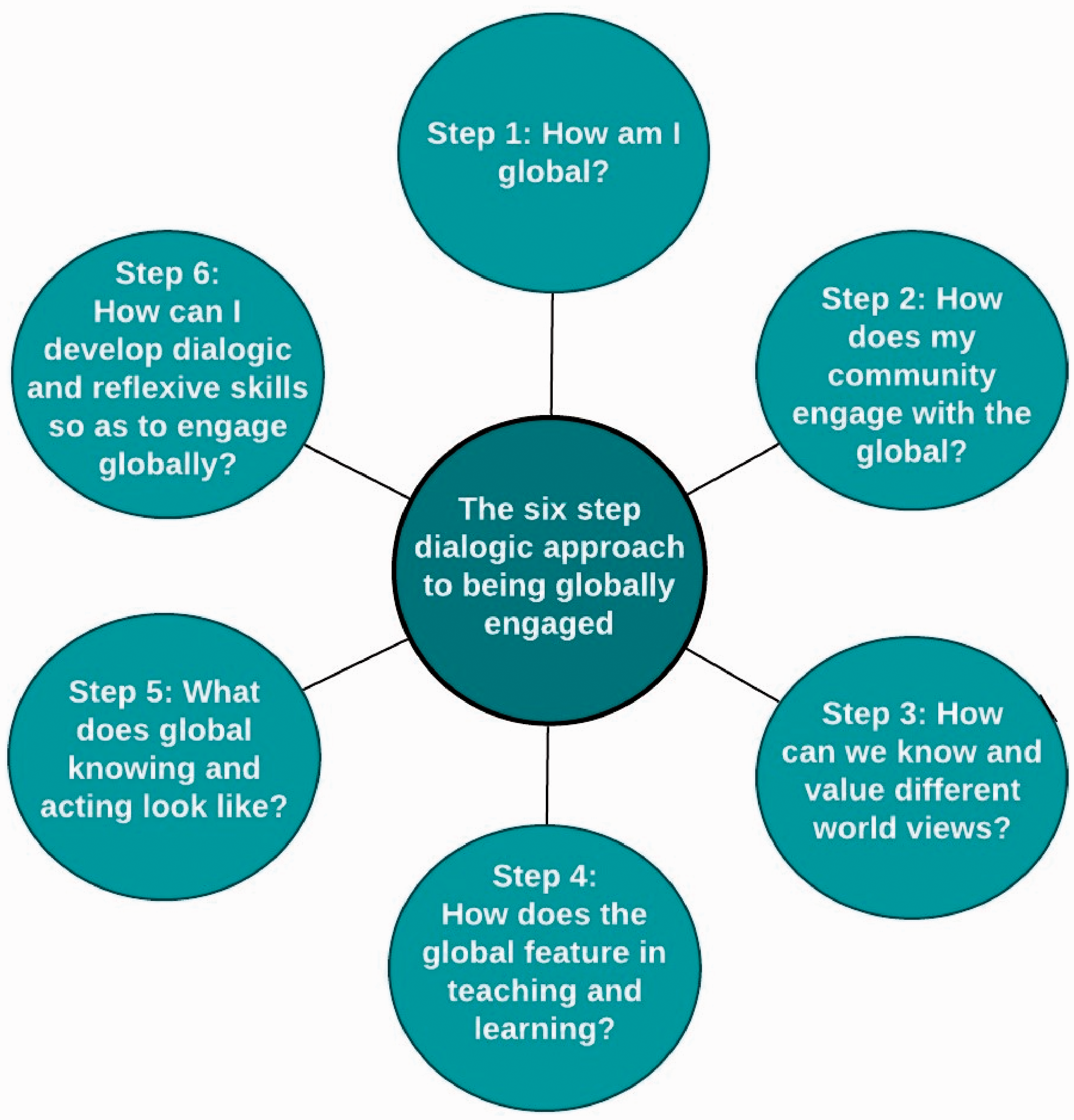
A Six Step Dialogic Approach to knowing about and acting globally.
These steps are not in any obligatory order. Each step moves outward from the individual to the wider communities and societies, but each step can also be an entry point in engaging in classroom dialogue.
Step one asks: what does it mean to be a global citizen at the level of the person? What obligations and responsibilities does it imply? What common problems are shared, and how might individuals stimulate conversations that help overcome these issues? Where there are differences, what are the causes of these differences, as we perceive them? What role do different perspectives, experiences, access to resources, aspirations for the future, mean for coming to also understand the other?
Step two asks: what does belonging to a community imply for an individual and their responsibilities when addressing global issues? Do all communities the individual belongs to see the issues in the same way? If not, why not, and what are the cultural, political and economic reasons for this? What about communities that the individual does not belong to? Or those from which they have been forced to leave? How might they speak over divides to arrive at an understanding that recognises differences and similarities? Are communities mediated by technologies (such as online communities) similar to, or different from, those that take place without digital technologies? What responsibilities and obligations to each other operate in a digitally-mediated community world?
Step three asks: what are the implications of different world views, and the common-sense understandings that these worldviews generate, for how we engage with each other, and with common global issues? Do those societies with world views which privilege individualism over collectivism face particular challenges around coming together when a collective response is needed? What can they learn from those societies whose world views promote collective interests over the individual in order to resolve global challenges, and vice versa?
Step four asks: what curriculum, pedagogies and modes of assessment might be deployed in the classroom? How might these modes privilege an active role as knowledge creator for students, a curriculum drawn from the global challenges facing individuals, communities and societies, and forms of assessment that promote reflexivity, are sympathetic to exploratory work, and attuned to personal and interpersonal transformation?
Step five asks: what does successful acquisition of a global perspective look like? Can students recognise these attributes? Is there a continuum of improvement, or a back and forth movement, as new problems and challenges are encountered? Do the developmental levels of students matter for what is engaged with when in the classroom?
Step six asks: how can dialogue, reflexivity, and discussions around values be fostered in the classroom so as to enable students to acquire the attributes to become globally aware? Potential contributions to further our knowledges will not happen outside dialogue. For it is only through dialogue that these can be made visible, known to students, and worked out. In promoting dialogue as a pedagogical approach in the classroom, it means placing on the table those knowledges, skills and values that will enable young people to recognise, reflect, adjudicate and transform their understandings of the world.
Dialogue and reflexivity, listening and learning, are key skills here. Dialogue within the classroom lays the foundations not just of successful learning, but also of social cohesion, active citizenship and the good society” (2008, p. 122). By dialogue, Alexander does not mean a mere conversation that “people reductively call communication skills”, or to what characterises a political dialogue, empty of content value but described as ‘constructive’ (p. 122). It is rather a dialogue that “requires willingness and skill to engage with minds, ideas and ways of thinking other than our own…” (p. 122). This requires openness to listening, and adopting a critical, reflexive approach to one’s teaching by taking into consideration children’s ideas and ideals, and how they can become makers of futures.
Proving student’s global competences
It is now time to return to the challenge laid out for us in this conference regarding the burden of proof. Given that these students are our future – whether as thought-leaders, programme shapers, or community builders, one of the registers of change might be that families, communities and societies are more tolerant, open and respectful toward each other. Are they happier, on the happiness index? Are they more willing to share what they have with their neighbour? Are they willing to be sufficiently open-minded to listen to others’ different points of view? And if they are, and our universities have been a key to this shift, they quite rightly can argue that they have invested in reshaping higher education for a global era.
Footnotes
Declaration of conflicting interests
The author(s) declared no potential conflicts of interest with respect to the research, authorship, and/or publication of this article.
Funding
The author(s) received no financial support for the research, authorship, and/or publication of this article.