




Abstract
In China, the dual structure of higher education, professional art academies and art schools within comprehensive universities, provides a unique context to investigate how institutional settings shape student engagement. Drawing on Student Engagement Theory as the analytical framework, this study compares art students’ experiences at T University, a leading comprehensive university, and G Academy, a renowned professional art institution. Data were collected through semi-structured interviews with undergraduates and graduate students, supplemented by textual and secondary sources. The findings reveal systematic differences. Comprehensive university students benefit from interdisciplinary opportunities but often feel marginalized within resource distributions, whereas professional academy students experience intensive artistic immersion but limited exposure to broader academic and cross-disciplinary contexts. These patterns reflect the contrasting institutional logics of “broad but less specialized” versus “specialized but less broad.” The study contributes by extending the applicability of Student Engagement Theory to art education, providing empirical insights into institutional diversity in Chinese higher education, and offering implications for curriculum design and policy development.
Introduction
In higher education research, the learning experiences and developmental trajectories of students have been extensively studied, with a strong focus on how students’ engagement in academic and co-curricular activities shapes their outcomes (Kuh, 2009; Tinto, 2006). Yet despite this vast body of literature, art students remain largely absent from mainstream discussions. This omission is partly because art education possesses distinctive features that set it apart from other disciplines in admissions, curriculum structure, pedagogy, and career development. To be more specific, admissions often rely on separate examinations emphasizing creative portfolios rather than standardized academic tests (Burke & McManus, 2011). Curricula in art programs are typically studio-based and practice-oriented, contrasting with the theory-driven structures of most disciplines (King & McCall, 2024). Pedagogy frequently follows a workshop or master–apprentice model, in which close student–faculty interaction and hands-on guidance are central (Johnson, 2002). Finally, art graduates enter a labor market characterized by high competition, unstable employment, and strong dependence on industry networks, unlike the relatively standardized professional pathways of law, medicine, or engineering (Hjelde, 2015).
These particularities suggest that the engagement patterns of art students may diverge substantially from those of their peers in other majors. Yet existing studies tend to generalize from mainstream disciplines, implicitly assuming that art students’ experiences can be represented by broader survey results (King & McCall, 2024). As a consequence, research on college student learning and development, despite its sheer volume, has not adequately captured the realities of art students. This lack of attention not only marginalizes an important group within higher education but also leaves a blind spot in theoretical development: whether established concepts such as student engagement can fully account for the unique characteristics of art education.
The neglect of art students is especially visible in the Chinese context. Unlike in the West, where many art academies historically originated from guilds or professional associations, China’s modern art education system was largely initiated by overseas-trained artists and intellectuals in the early 20th century (Ma, 2018; Zheng, 2016). Since then, a series of higher education reforms has resulted in a bifurcated structure: independent professional art academies on the one hand, and art schools or academies embedded within comprehensive universities on the other (Zhou, 2020). Professional academies, such as the Central Academy of Fine Arts or the China Academy of Art, emphasize intensive training in artistic skills, traditions, and techniques, often within a relatively closed disciplinary environment. Comprehensive universities, by contrast, place art students within a broader institutional ecosystem, exposing them to interdisciplinary resources, general education requirements, and international opportunities.
Despite these differences, little research has systematically examined how the two institutional types shape the engagement and development of art students. Existing literature has compared curriculum design, faculty structures, or institutional prestige (Bie & Xia, 2013; Li, 2019), but rarely has it explored how art students themselves experience their education differently across these contexts. This gap is significant because institutional arrangements not only structure students’ daily learning environments but also influence their long-term developmental pathways. By focusing on the contrast between a leading comprehensive university (T University) and a top professional art academy (G Academy), this study aims to illuminate the underexplored question of how institutional settings mediate art students’ engagement in higher education.
To address this question, the study draws upon George Kuh’s Student Engagement Theory as its analytical framework. Student engagement is one of the most widely used models of college student development, operationalized through five dimensions: academic challenge, active and collaborative learning, student–faculty interaction, enriching educational experiences, and supportive campus environment (Kuh, 2009). This framework has informed large-scale surveys such as the National Survey of Student Engagement (NSSE) in the United States and the China College Student Survey (CCSS), where it has been shown to capture the diverse learning experiences of students across institutional types (Shi & Wen, 2014; Wen et al., 2023a). Although the detailed indicators of engagement may not fully reflect the distinctive features of art education, the five core dimensions nonetheless provide a robust lens through which to examine how art students’ experiences are structured and how they differ between professional academies and comprehensive universities.
This theoretical choice is deliberate. First, focusing on engagement emphasizes the process of learning rather than only its outcomes, allowing the study to explore the day-to-day realities of art students. Second, applying engagement theory to art education offers an opportunity to test the framework’s applicability in a new context, potentially refining or extending its explanatory power. Third, by situating art students within an established theoretical tradition, the study bridges the divide between mainstream higher education research and the relatively isolated scholarship on art education.
Building on these considerations, the study pursues three interrelated research questions: • What differences exist between art students in comprehensive universities and those in professional art academies across the five dimensions of student engagement? • How do these differences reflect the distinctive educational missions and institutional logics of the two types of institutions? • In what ways do the findings extend the applicability of Student Engagement Theory and provide insights for the improvement of art education in China?
By answering these questions, the study makes three contributions. Theoretically, it expands the scope of student engagement research by applying the framework to an underexplored population. Empirically, it provides a comparative analysis of two major institutional forms of art education in China, highlighting how institutional contexts shape students’ lived experiences. Practically, it offers implications for policymakers and university leaders seeking to balance breadth and specialization in cultivating art talent for a rapidly evolving society.
Literature Review and Theoretical Framework
Research on Chinese Art Education
Research on art education in Chinese higher education has expanded in recent decades, but it remains limited compared to mainstream studies on science, engineering, and humanities students. Much of the literature has focused on institutional history, curriculum design, and faculty development rather than on the lived experiences of students (Burke & McManus, 2011; Duan, 2015; Zhou, 2020). Scholars have documented how the admission process for art programs differs significantly from that of other disciplines. Instead of relying solely on the national college entrance examination, art programs admit students largely through specialized art examinations and portfolio reviews, which prioritize creativity and technical skill over standardized academic achievement (Li, 2019). This unique admissions pathway produces a student body with different academic backgrounds, motivations, and expectations than peers in other fields.
The curriculum of art education also diverges from conventional university programs. Whereas most disciplines emphasize lectures, exams, and essay-based assessments, art programs are highly practice-oriented, organized around studio work, workshops, and exhibitions. Pedagogically, they often adopt a “studio-based” or “master–apprentice” model, where students work closely with instructors in small groups or even one-to-one mentorship arrangements (Jin & Ye, 2022). This emphasis on practical engagement fosters creativity but may limit exposure to broader academic challenges or interdisciplinary content.
Career development further highlights the distinctive position of art students. Graduates face a competitive and often unstable job market, where success depends not only on individual skill but also on social networks, project opportunities, and institutional reputation (Chen, 2006; Li et al., 2009). Unlike disciplines with relatively standardized professional pathways, art graduates often navigate precarious employment and portfolio-based careers.
Despite these well-documented particularities, two key gaps remain in the literature. First, there is a lack of research from the student perspective. Most studies describe institutional policies, curriculum reforms, or teaching methods, but few capture how art students themselves experience the learning process. Without this perspective, our understanding of art education remains incomplete and overly institutional. Second, existing scholarship rarely differentiates between the two major institutional forms of Chinese art education: professional art academies and art schools embedded in comprehensive universities. While some research notes historical differences between these two forms, systematic comparative analysis of their educational impact on students is absent. These gaps suggest that art students’ learning processes and institutional experiences remain underexplored, and addressing them is essential to build a fuller picture of higher education in China.
Student Engagement Theory
Framework of Student Engagement Theory

The theory has been widely applied in global higher education research. The National Survey of Student Engagement (NSSE) in the United States and similar instruments in other countries have consistently demonstrated that engagement is a strong predictor of student learning, satisfaction, and personal development (Kuh, 2009). In China, the China College Student Survey (CCSS) adapted the NSSE framework and validated its applicability in the local context (Shi & Wen, 2014). Numerous studies have since used the engagement model to analyze students in diverse institutional types, including research universities, teaching-oriented colleges, and vocational institutions, and across different disciplines, including engineering, medicine, and the humanities (Guo et al., 2022; Wen et al., 2023a; Xu et al., 2021). These applications show that the engagement framework is robust across contexts, capturing essential aspects of student learning regardless of institutional mission or disciplinary content.
Although most engagement studies focus on mainstream academic fields, the framework’s core dimensions align closely with the distinctive features of art education. For instance, academic challenge can capture the rigor of artistic training and the demands of continuous creative production. Student–faculty interaction is especially relevant in studio-based or mentor-apprentice models, where close personal guidance is the norm. Enriching educational experiences may highlight interdisciplinary and extracurricular opportunities prevalent in various universities. Finally, supportive campus environment can reflect differences in resource allocation and institutional support for art programs. In this sense, student engagement provides a useful lens to examine how art students experience learning and development within different institutional contexts.
A possible critique is that engagement theory may not fully capture the uniqueness of art education. For example, standardized measures such as the number of term papers or hours spent in laboratories may not apply to art students’ studio work. However, this limitation can be reframed as a research opportunity. By applying the engagement framework to art students, this study not only addresses a neglected population but also tests the flexibility of the theory itself. If the framework proves illuminating, it strengthens the case for engagement as a cross-disciplinary model; if it reveals shortcomings, it points to areas where the theory requires refinement. In either case, the study contributes to theoretical advancement.
It is worth noting that engagement theory has been extended to a variety of less conventional fields internationally, including professional training programs, community colleges, and interdisciplinary learning contexts (Li & Wang, 2020). While direct applications to art students are scarce, the absence of precedent does not weaken the framework’s relevance; rather, it underscores the novelty and significance of this study. By positioning art education within the engagement paradigm, this research opens dialogue between the relatively isolated field of art education and higher education scholarship.
Analytical Position of This Study
Bringing together the literature review and the theoretical framework, this study positions itself at the intersection of two research streams. On the one hand, research on Chinese art education has highlighted the distinctive features of admissions, curriculum, and pedagogy but has not adequately addressed students’ own learning processes, nor has it compared the two institutional types. On the other hand, research on student engagement has established a powerful framework for analyzing student learning across diverse contexts but has seldom been applied to art students.
Against this backdrop, the present study uses the student engagement framework to analyze and compare the experiences of art students in a leading comprehensive university (T University) and a leading professional art academy (G Academy). This approach allows the study to make three contributions. Theoretically, it tests the applicability of student engagement theory in the underexplored context of art education, potentially refining the framework. Empirically, it addresses a gap in the literature by comparing art students’ experiences across the two main institutional forms of Chinese art education. Practically, it offers implications for curriculum design, institutional support, and policy development aimed at improving art students’ educational experiences and outcomes.
Research Design
Research Ethics
This study strictly adhered to ethical research standards. Participation was voluntary, and informed consent was obtained from all interviewees prior to data collection. Interviewees were assured that their identities would remain confidential and that pseudonyms would be used in all transcripts and publications. No direct interest relationship existed between the authors and the interviewees, and the interview protocol was not shaped by prior value judgments. One-on-one interviews were adopted to ensure that participants’ responses were not influenced by peer presence. The research team also ensured that all data storage and handling complied with established ethical guidelines for qualitative research (Seawright & Gerring, 2008).
Case Background
The study focuses on two representative institutions in Chinese art education. T University is a leading comprehensive university that houses a School of Arts within a broader disciplinary ecosystem. Its students benefit from exposure to general education and interdisciplinary resources but may also face challenges of marginalization in resource allocation. G Academy, by contrast, is an independent and professional art academy with a long-standing reputation in training specialists in fine arts and design. By comparing these two cases, the study captures the dual institutional forms of Chinese art education and highlights their implications for students’ learning engagement.
Data Collection
Basic Information of Interviewees
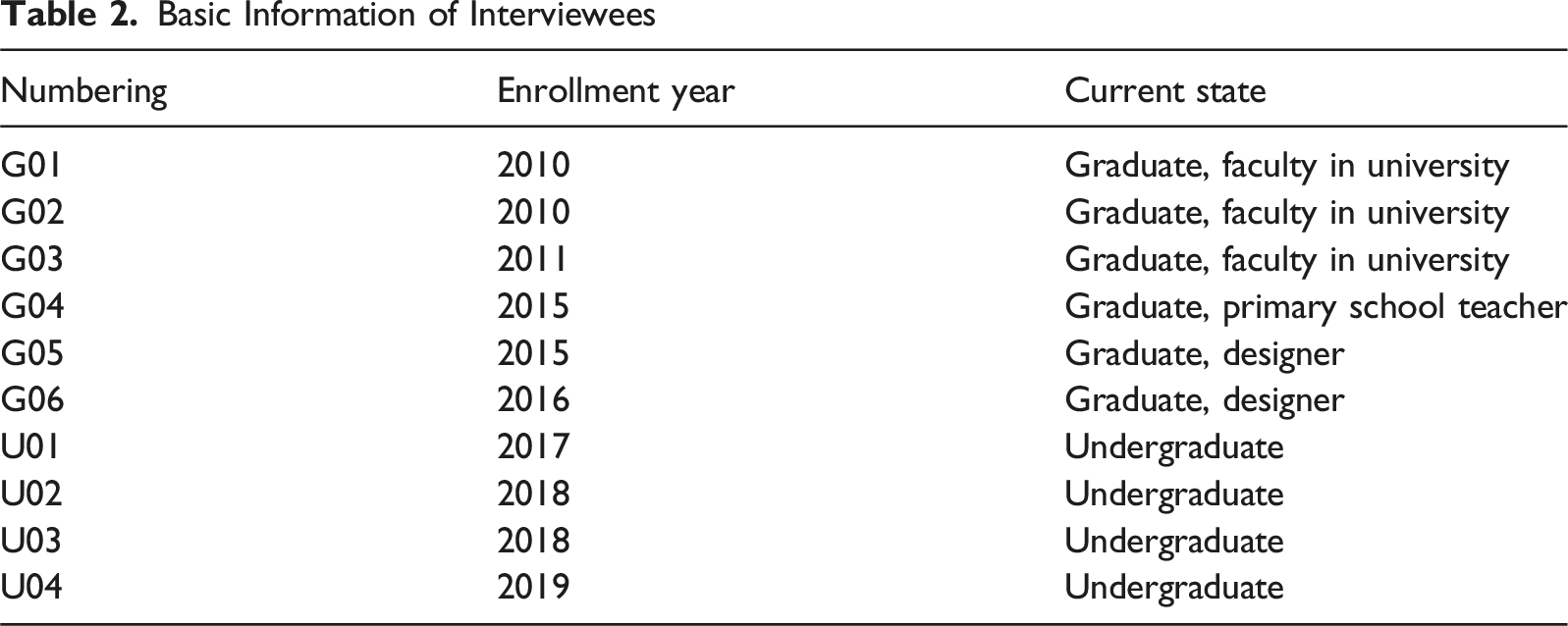
In addition to interview transcripts, supplementary textual materials were collected, including course syllabi, student transcripts, and institutional documents. These materials offered contextual evidence about the undergraduate education system at T University and G Academy, and increased the generalizability of the findings to other art institutions. To broaden the scope of comparison, indirect data were collected for students through publicly available materials such as social media posts, published interviews, news reports, and research articles.
Data Analysis
Data analysis followed a thematic and comparative approach. First, interview transcripts were coded according to the major dimensions of the interview protocol. Additional themes emerging during the interviews were also incorporated through open coding. Thematic analysis enabled the identification of patterns in students’ learning experiences and their engagement within institutional contexts (Shi & Wen, 2014).
Second, a comparative method was applied. This involved cross-validating the coded interview data with secondary sources, including social media posts, public reports, and curriculum documents, in order to enhance the authenticity and reliability of findings. By juxtaposing the two institutional cases, the study identified both convergent and divergent patterns of student engagement.
Finally, data collection and analysis proceeded until theoretical saturation was reached; that is, no new themes emerged and the research questions were sufficiently addressed. While the reliance on indirect data for G Academy represents a limitation, the triangulation of multiple sources strengthens the robustness of the findings.
Findings
Educational Goals
Educational Goals of the Two Institutions

Data Sources: Authors, handbooks of undergraduate curriculum of T University and G Academy.
Level of Academic Challenge
With the shift towards a learning society, higher education is increasingly focusing on providing students with new and diverse experiences, as well as building their resilience to social change (Huang, 2015; Wen et al., 2023b). As a result, the curriculum system is evolving to be more diverse, open, and focused on developing students’ capabilities (Lattuca & Stark, 2011). From a curriculum perspective, while T University and G Academy had similar credit regulations for curriculum, there were significant differences in specific details, leading to varying academic challenges for students at both institutions (Table 4).
In terms of general education curriculum, the two schools had comparable credit regulations, but the differences lied mainly in three aspects. Firstly, T University had a much more extensive range of general education course resources, with 527 electives available to undergraduates each semester, compared to only 40 at G Academy (of which only 16 are offered by faculty at G, while the other 24 are online courses provided by other comprehensive universities on the MOOC platform). This disparity means that T University students had access to a richer range of course resources.
Additionally, T University placed greater emphasis on the cultivation of reading and writing skills, offering compulsory reading and writing courses. This approach stemed from Boyer’s advocacy for integrating communication skills into the curriculum, which had a significant impact on higher education in the United States and China.
Lastly, the teaching mode for general education courses differed significantly between the two institutions. G Academy’s general classes were more concentrated, and the teaching schedule for art majors followed a staged half-day teaching mode, with one general class course taken every month. In contrast, T University’s general education courses were taught consistently throughout the semester, with 2–3 class hours per week. This difference means that T University students may invest more time and energy in general courses, which to some degree had a negative impact on their ability to focus on professional courses.
Regarding professional courses, T University offered a higher number of courses, but the content of these courses was less challenging than those offered at G Academy. Moreover, the status of professional courses at G Academy was much higher than that of general courses in the curriculum system. According to student interviews, the professional courses at T University did not pose as much of a challenge as those at professional art colleges, and students spent more time and energy on other courses or extracurricular activities. G Academy adopted a “two-stage teaching” system, with a unified professional basic course offered in the first year, followed by various teaching modes such as studio, group, and project-based teaching in the second year. T University had a similar system, but the interviewed students reported that T University students invested less in professional courses than professional art academies, particularly in professional quality and skills training.
In summary, while T University and G Academy had similar credit regulations for courses, there were significant differences in specific details, leading to varying academic challenges for students at both institutions. T University offered a more extensive range of general education courses, but G Academy placed a higher value on professional courses. The teaching mode for general education courses also differed significantly between the two institutions. Ultimately, these differences mean that students must navigate distinct academic landscapes and prioritize their efforts accordingly.
Active and Collaborative Learning
Curriculum System of the Two Institutions

Data Sources: Authors, handbooks of undergraduate curriculum of T University and G Academy.
First of all, in terms of interdisciplinary curriculum learning, with the changing methods of knowledge production, universities have gradually become more open systems, and this knowledge production model has a high demand for interdisciplinary innovative talents (Limoges et al., 1994). Therefore, universities need to develop students’ ability to link interdisciplinary knowledge with the skills needed to solve complex problems (Lattuca, 2001; Zhou, 2025). The disciplinary structure of a comprehensive university is more complex, and students have the opportunity to study courses in other majors, and even pursue further studies or employment in interdisciplinary directions. Some respondents cited program diversity as one of the main reasons for choosing a comprehensive university. The advantages of a comprehensive university were taken into account when choosing T University. In addition to professional courses, I also took courses in other majors such as law and psychology, which had a certain impact on my later research direction. (U03) One of the courses I am deeply impressed by is “Face to Face with Famous Entrepreneurs”, which invites alumni from Beijing, including computer, artificial intelligence, finance, and sharing their entrepreneurial experience most contacted. He allows you to see the status of other fields, which is equivalent to getting started. Although you don’t understand the terminology, it is enlightenment, and you will pay attention to this field. (G06) It has some influence on my thesis writing. The sociology taught by Mr. J does make me feel that their research methods are interoperable with ours. I have been thinking about the differences between our research, but our footholds are different, the topic selection and depth should be very similar. Our majors rarely intervene in these perspectives. You can use this professional standard to ask yourself. (U01)
Secondly, in terms of cooperative learning, the more interaction students have with their peers, the higher the level of social engagement, which helps students’ emotional development and critical thinking, thereby achieving long-term development. Habermas believed that communicative behavior is for the purpose of reaching understanding and agreement (Habermas, 1990; Reunanen & Kunelius, 2020). Compared with the order relationship between students and teachers, the dialogue environment in cooperative learning between students is more equal. At comprehensive universities, art students had ample opportunities to work collaboratively with students from other majors to learn to use effective speech acts to promote mutual understanding (Cohen, 2018; Guzzardo et al., 2021). When working in groups, there will be many people from different departments. When working with people from different departments, you will find that their perspectives on things and problems are completely different from those who study design. Opinions are not unified, and the best solution is selected after consultation (U02). In this drama team, not everyone is from the Academy of Fine Arts, but also some students from the School of Journalism, School of Economics and Management, or some engineering departments. After that, we will also go to self-study and dinner appointments in our daily life, and everyone's ideas will collide. I think it's a bit more interesting (U04).
Student-Faculty Interaction
Student-teacher interaction refers to the influence and interaction between teachers and students in various settings, including teaching situations and social environments (Kuh & Hu, 2001). It has been a significant research topic in higher education since the 1960s (Xu et al., 2021). According to relevant theories, whether through formal interaction in the classroom or informal communication outside the classroom, the interaction between students and teachers can enhance students’ integration into the campus system and is strongly correlated with the development of their social abilities (Dwyer, 2017; Lillis, 2011; Sax, 2008; Zhou, 2024). Students interviewed reported that the teacher-student ratio at T University was approximately 1:1, allowing for personalized guidance from teachers. Additionally, T University was influenced by engineering disciplines and departments of humanities and social sciences. It prioritized the overseas background and scientific research ability of faculties, and emphasized the need to guide students in scientific research. The teacher opened my research ideas. I was studying Dunhuang. My vision was limited to Dunhuang at first, and I didn’t even want to know about the Kizil Grottoes next to it. But I found that the teacher’s vision was very broad, and he guided me to study the evolution of related cultures, and told me that my research vision should not be limited to the Mogao Grottoes in Dunhuang. The teacher publishes a lot of small papers every year. The words, phrases and rhetoric of the teacher’s writing make me, a design student, feel that the words are used just right, no more and no less, a small paper is very academic, very rigorous, not the same as the study of design. (U04) One of the teachers who influenced me the most was a PhD in Europe. He introduced me to the exploration of materials in a lot of European fashion design courses that I didn’t know before. He was also very willing to recommend me to his alma mater for exchange study and encouraged me to try an innovation in the field of interest. (G04)
Enriching Educational Experiences
In addition to formal coursework, extracurricular activities play an important role in the long-term development of students, as they allow students to develop their general competencies and build their professional identity through comprehensive practical activities (Carter et al., 2016; Lattuca et al., 2017). As a top research university in China, T University offers abundant resources for campus activities. Compared to professional art academies, T University had an advantage in size, with approximately 57,000 students in 2022, compared to G Academy’s approximately 10,000 students, providing students with a richer experience in extracurricular activities such as club activities, cultural events, and sports.
We compared the student clubs of T University and G Academy and found that G Academy had the highest proportion of art clubs (44.4%) with few technological clubs, and even those related to technology are closely related to art (Table 5). In contrast, T University had a larger number and wider range of clubs, covering a variety of niche subcultures. For instance, T University had 49 sports clubs, covering almost all major categories of the Summer Olympics. Additionally, T University had a large-scale scientific and technological clubs with long-term and stable technical and financial support from various departments. The interviewed students from T University stated that combining their professional skills with other disciplines in the science and technology community and applying them to projects broadened their horizons and greatly stimulated their enthusiasm for creativity. Undergraduates have participated in some clubs. The clubs include students from various departments, and they will find that they are different from us art student in terms of behavior and thinking, and have their own characteristics. I worked with the Department of Computer Science and the School of Software to develop some small programs. At that time, I was in charge of vision, and they were mainly responsible for the development of user logic and programs. Through discussions with them, I understood that it is not only from the aesthetic point of view of the design, but also needs to consider the user's thinking, why do it, and what kind of effect I want to achieve. (G05) Student Clubs at the Two Institutions Data Sources: Authors, social media accounts of T University and G Academy.
Supportive Campus Environment
Through a review of relevant literature, Pascarella found that the long-term impact of universities on students depends on two aspects: the efforts and participation of college students themselves and the availability of various supports (Pascarella et al., 2004; Pascarella & Terenzini, 2005). In the 21st century, college students face diverse environments and complex challenges that require them to have an international perspective, the ability to understand different cultures, and the ability to communicate across cultures. These skills enable students to work effectively and live harmoniously in a global cooperative and competitive society (Hunter et al., 2006; Ramirez & Meyer, 2012; Williams, 2005).
T University, which has an excellent international support system, was mentioned by almost all respondents. Ranked around 20 in the world, T University has established international exchange relations with many world-class universities, providing students with opportunities for exchange programs and joint summer schools. Art students could benefit from these resources and go to the world’s top comprehensive universities or art academies for short-term exchanges. Compared with professional art academies, T University received more government support and higher social recognition, which enabled it to provide sufficient funds to support students going abroad for exchanges. Consequently, there were abundant exchange opportunities and scholarships available at the university. There are a lot of exchange opportunities and scholarships at our universities. I wanted to get rid of the original environment and change to a new environment. At that time, there were three students who were selected, first by the Academy of Fine Arts, and then by foreign schools. At that time, I chose the best school in the field of costumes. It was very helpful. After the application was successful, and the procedures were completed, the scholarship was given to me. (U01) I stayed in the United States for three months! My university has a very good cooperation relationship with the Politecnico di Milano, so every year, there are exchange programs with a large number of students. For example, in the postgraduate stage, you can get a double degree from Politecnico Milano and T University by exchanging for one year. (G01)
In addition to the international support system, T University had more extensive career guidance resources. Many interviewees mentioned the school’s career development center, which provided services such as employment orientation consultation, interview guidance, and internship resource recommendations. Moreover, T University had an entrepreneurial support program that provided venues and financial support to students with entrepreneurial ideas. The discipline structure of T University also helped art students who were good at design to find partners in technology, law, finance, marketing, and other fields in other colleges of the university. Compared with professional art academies, T University alumni were active in different industries and provide more employment and entrepreneurial resources. T University offers various opportunities for students to participate in research and innovation projects. For instance, students can participate in the TAI program at T University or the school’s research trip to Japan. The Future Lab also has a significant impact on students, guiding their creative direction, expanding their knowledge, and influencing their job-hunting works and research directions (G03).
To sum, T University provided students with abundant international exchange opportunities, career guidance resources, and research and innovation projects, making it an excellent institution for students to develop their skills, achieve their career goals, and contribute to society.
Discussion and Conclusion
This study explored how art students in two distinct institutional contexts—a comprehensive university (T University) and a professional art academy (G Academy)—experience higher education through the lens of student engagement. The findings were organized according to the five dimensions of Student Engagement Theory, revealing both similarities and contrasts between the two institutional settings. In this section, we revisit the three guiding research questions. First, what differences exist between art students in comprehensive universities and those in professional art academies across the five dimensions of student engagement? Second, how do these differences reflect the distinctive educational missions and institutional logics of the two types of institutions? Third, in what ways do the findings extend the applicability of Student Engagement Theory and provide insights for the improvement of art education in China? The following discussion addresses these questions in turn, situates the findings in relation to existing literature, and outlines the theoretical and practical contributions of the study.
Comparative Insights Into Student Engagement
The first research question asked what differences exist between art students in comprehensive universities and those in professional art academies. The findings indicate that, across the five dimensions of engagement, clear patterns emerged that distinguish the two groups.
In terms of academic challenge, students at T University reported facing a relatively broad but less intensive set of academic requirements, including general education courses and interdisciplinary electives. In contrast, G Academy students experienced greater depth and rigor in their specialized art training, often at the expense of exposure to broader academic content. For active and collaborative learning, T University students highlighted opportunities for interdisciplinary collaboration, particularly in project-based courses or extracurricular activities that crossed disciplinary boundaries. G Academy students, however, reported collaboration primarily within their artistic field, emphasizing peer critique sessions and collaborative studio projects. Regarding student–faculty interaction, G Academy stood out. The studio-based or apprenticeship model facilitated close mentorship, with faculty members deeply involved in students’ creative processes. In T University, while students valued faculty guidance, the relationship was often diluted by larger class sizes and more diverse teaching responsibilities of professors. With respect to enriching educational experiences, T University offered a wider range of opportunities, like study abroad, participation in university-wide clubs, interdisciplinary research, and cultural activities though art students sometimes felt marginalized within these broader structures. G Academy, by contrast, provided fewer institutionalized enrichment opportunities but fostered a strong immersion in artistic culture, with exhibitions, competitions, and external collaborations concentrated within the arts. Finally, the supportive campus environment revealed a contrast in institutional positioning. T University students reported feeling peripheral in a resource distribution system dominated by science and engineering faculties, while G Academy students described a stronger sense of belonging within an institution wholly dedicated to the arts, although with fewer overall resources compared to comprehensive universities.
These differences demonstrate that art students cannot be adequately represented in mainstream student engagement research, which tends to generalize across disciplines. Existing large-scale surveys such as NSSE and CCSS capture important aspects of student engagement but may mask the specific experiences of groups whose learning is structured by unique disciplinary and institutional logics (Coates & Mahat, 2014). In this sense, the findings highlight the necessity of disaggregating data and analyzing engagement patterns among underrepresented student groups such as art students.
Institutional Logics of Comprehensive Universities vs. Professional Academies
The second research question asked how observed differences reflect the distinctive missions and institutional logics of the two institutional types. The comparative analysis suggests that the variations in student engagement are not incidental but are deeply embedded in the historical and organizational structures of Chinese higher education.
Comprehensive universities follow a mission of providing broad-based education across multiple disciplines, aiming to cultivate graduates who possess interdisciplinary knowledge and adaptability (Huang, 2015). For art students at T University, this logic manifested in the requirement to take general education courses, participate in interdisciplinary learning, and integrate their artistic identity into a broader university culture (Lattuca, 2001). While this broadened their horizons, it also weakened the intensity of specialized training and sometimes created feelings of marginalization when compared to students in dominant disciplines (Gu et al., 2018). This finding resonates with literature on institutional stratification, which shows that in multidisciplinary universities, fields with lower economic or social capital often occupy peripheral positions (Han & Guo, 2015; Wu & Guo, 2018).
Professional academies, in contrast, embody a mission of specialization, rooted in traditions of craft, artistry, and immersion. G Academy students benefited from intensive studio training and strong faculty mentorship, developing a solid professional identity as artists. However, this specialization also limited their opportunities for interdisciplinary learning and broader academic challenge. The isolation of professional academies reinforces students’ artistic identity but may constrain their ability to navigate diverse career paths, echoing findings from international literature on conservatories and specialist institutions (Henderson et al., 2022; Jamison et al., 2022; Lattuca et al., 2017).
The interaction of these two logics, “broad but less specialized” versus “specialized but less broad” clarifies why student engagement differs systematically between the institutions. Rather than treating the differences as deficiencies, they should be understood as reflections of distinct educational missions. This interpretation contributes to debates on institutional diversity in higher education, showing how different organizational forms create varied but equally legitimate pathways for student learning and development (Clark, 1986; Scott, 2019).
The observed differences in student engagement are not only experiential but also rooted in the distinct historical trajectories and governance structures of Chinese art education. These institutional logics help to explain why comprehensive universities and professional academies foster divergent patterns of engagement.
First, the historical trajectories produced enduring epistemological differences: professional academies are grounded in a fine-arts-centered knowledge tradition, while university art schools are more strongly linked to applied, vocational, or interdisciplinary orientations. This divergence shapes the ways in which students engage with academic challenge, faculty, and curricular breadth. The origins of modern Chinese art education can be traced directly to Western influences. In the early 20th century, Chinese students who had studied in France and Japan established the first modern art schools, including the Shanghai Academy of Fine Arts in 1912 (a private institution) and the Beijing Academy of Fine Arts in 1918 (a public institution) (Chen, 2006). Today’s leading professional art academies such as the Central Academy of Fine Arts and the China Academy of Art, all emerged from successive transformations of these early schools and largely preserved the Western fine arts tradition (Zheng, 2016). By contrast, many art schools within comprehensive universities were not founded to cultivate pure artists but were closely tied to other professional domains, especially teacher training (preparing art educators) or architecture and design (training industrial designers and architects) (Duan, 2015).
Beyond historical roots, institutional governance also plays a decisive role in shaping student engagement. Professional art academies enjoy considerable autonomy in admissions, curriculum, and pedagogy. As specialized institutions, they are granted high levels of freedom from government oversight in daily teaching and academic affairs, though this autonomy comes with relatively limited financial support. Comprehensive universities, by contrast, impose stronger constraints on their art schools. Departments of art must align their admissions criteria, curricular structures, and assessment standards with those of other faculties, and they are subject to direct administrative interventions from both university leadership and government authorities (Zha et al., 2017). Resource distribution is also highly stratified: the extent of funding, facilities, and recognition available to art schools within comprehensive universities is closely tied to their relative status vis-à-vis dominant faculties such as engineering, science, and economics. These institutional conditions contribute to art students’ reported experiences of marginalization in comprehensive universities and, conversely, to the strong artistic immersion but constrained resources experienced by students in professional academies.
Taken together, these historical and organizational differences clarify why art students in the two institutional types report systematically different patterns of engagement. Professional academies embody a legacy of Western fine arts traditions and institutional autonomy but operate within limited financial capacity, while art schools in comprehensive universities are more embedded in interdisciplinary and applied domains but constrained by governance and resource hierarchies. These logics not only differentiate institutional missions but also structure students’ day-to-day opportunities for learning, interaction, and development.
Theoretical and Practical Contributions
The third research question concerned the theoretical and practical implications of the findings. In terms of theoretical contributions. By applying Student Engagement Theory to art students, this study demonstrates the framework’s adaptability but also exposes its limits. The five dimensions successfully captured major aspects of art students’ experiences, particularly in areas such as student–faculty interaction and supportive environments. Yet certain indicators such as the number of research papers written or participation in laboratory work, proved less relevant to studio-based learning. This misalignment highlights the need to refine engagement measures for disciplines with distinctive pedagogical traditions. The study thus contributes to theory by extending engagement research into an underexplored domain and suggesting directions for indicator modification. In this way, the study echoes and builds upon critiques that call for more context-sensitive applications of engagement theory (Isaeva et al., 2024; Kuh et al., 2008; Zepke, 2024).
As for practical contributions, the findings underscore the need to strengthen art students’ professional identity while preserving their interdisciplinary opportunities for comprehensive universites. This could involve allocating more resources to art programs, creating platforms for art students to showcase their work within the university, and ensuring that general education requirements do not dilute specialized training. For professional academies, the findings suggest a need to broaden horizons by introducing interdisciplinary courses, enhancing general education components, and encouraging collaboration beyond the arts. For policymakers, the study highlights the value of institutional diversity: rather than seeking to homogenize art education, policies should support both forms while addressing their respective shortcomings.
Limitations and Future Research
Like all research, this study has limitations. The use of Student Engagement Theory, while valuable, inevitably imposed a pre-existing framework onto art students’ experiences. Some aspects of art education such as the tacit knowledge embedded in studio practice may not be fully captured by the five dimensions. This limitation suggests avenues for refining engagement theory to better account for discipline-specific contexts.
Future studies could also extend this research in three directions. First, expanding the sample to include multiple professional academies and comprehensive universities would allow for broader generalization. Second, longitudinal studies could examine how art students’ engagement evolves across different stages of study and into professional careers. Third, international comparisons would shed light on whether the patterns observed in China hold in other cultural and institutional settings, thereby situating Chinese art education within global debates.
In summary, the findings of this study provide empirical evidence that art students’ engagement differs systematically across institutional types, reflecting the underlying logics of comprehensive universities and professional academies. These differences not only illuminate the unique challenges and opportunities faced by art students but also extend the applicability of Student Engagement Theory to a previously neglected context. By situating art education within the engagement framework, the study bridges the gap between mainstream higher education research and the distinctive field of art education. At the same time, it provides practical guidance for institutions and policymakers seeking to strengthen the quality and inclusiveness of art education in China.
Footnotes

Funding
The authors disclosed receipt of the following financial support for the research, authorship, and/or publication of this article: This work was supported by National Social Science Foundation of China Youth Project: “Reforming Organizational Models for Interdisciplinary Graduate Education to Foster New Quality Productive Forces” (No. CIA240289).
Declaration of Conflicting Interests
The authors declared no potential conflicts of interest with respect to the research, authorship, and/or publication of this article.