




Abstract
This study aims to identify the main drivers of Chinese students’ motivations to pursue a higher education degree in Australia after the Covid-19 pandemic. Using a survey sample of N = 437 Chinese students seeking to study a postgraduate degree, our results show that both conventional factors (i.e., culture ties with families and friends, recommendations from education agents, the reputation of international universities, and the destination degree’s potential to enhance job prospects in desired field) and PESTLE (Political, Economic, Social, Technological, Environmental, and Legal) factors are important determinants. Specifically, we find a positive association between conventional factors and Chinese students’ choice to study abroad in Australia, and this association is amplified when students receive more information on PESTLE factors. Our results provide implications for government and University policy and practice. Future research areas are suggested that are crucial for attracting Chinese international students in the post-pandemic era.
Introduction
Amid the third wave of international student mobility, Australia has emerged as one of the largest host countries for international students (Zayim-Kurtay et al., 2025; Zhai et al., 2019). 1 However, the financial landscape of Australian universities has changed significantly since the advent of the COVID-19 pandemic in 2020 (Universities Australia, 2024). The pandemic further exacerbated financial pressures, forcing universities to make rapid adjustments to their operations and budgets. Inflation and flat domestic demand also left Australian universities more vulnerable than before COVID-19 (Ross, 2024). One notable impact was the decline in international student enrolments, particularly Chinese students, the largest cohort of international students in Australia. The number of Chinese students in Australia fell from 211,986 in 2019 to 166,163 in 2023 (Department of Education, 2025c). Given that Australian universities heavily rely on international student enrolments as a significant source of revenue, there is a need to understand the key factors that motivate students to select Australia as their study destination.
Today, Chinese students, even with a university degree, face difficulties in securing employment. According to the National Bureau of Statistics of China, the youth unemployment rate in China reached a record high of 21.3% for individuals aged 16 to 24 (Textor, 2025). To remain competitive in the job market, many Chinese students continue to pursue higher academic qualifications, leading to increased difficulty in gaining entry to elite local universities (Chen et al., 2024). This intense competition has driven an increasing number of students to seek further educational opportunities abroad. Gaining a deeper understanding of the factors that drive Chinese students to choose Australia for postgraduate studies, therefore is crucial and timely.
In this study, we examine (1) how conventional factors, such as familial ties and peer networks, recommendations from education agents, the reputation of international universities, and career opportunities influence Chinese students’ choice to study postgraduate education abroad in Australia; and (2) how the PESTLE (Political, Economic, Social, Technological, Environmental, and Legal) framework moderates the relationship between conventional factors and Chinese students’ choice to study abroad. We are motivated to investigate these two research questions for several reasons.
Firstly, while prior studies have explored how the attitudes of Chinese students are shaped after they arrive at their study destinations (e.g., Arkoudis et al., 2019; Leonov, 2024), we know little about the factors that motivate students to study abroad while still residing in China. This is surprising because Chinese students often select their destination country before choosing a higher education institution.
In addition, limited scholarly research provides a comprehensive understanding of the key factors driving Chinese students to choose Australia as their study destination over other popular countries. Australia faces increasing competition in the international student market, particularly from the US, UK, and Canada. A recent report by the Parliament of Australia (2024) indicates these countries as key competitors in the global educational sector, with each actively positioning itself as an attractive destination for Chinese students. This competition could be shaped by a combination of factors, such as the perceived quality of education, career opportunities, and favorable immigration policies. In light of this, it is timely to assess the factors influencing the mobility of Chinese international students in the post-pandemic era. Gaining insight into what drives Chinese students to choose Australia is crucial, as it impacts Australia’s ability to remain competitive in attracting international students compared to its global rivals.
Moreover, the issue of Chinese students’ choice to study abroad has recently become a source of much concern and research interest. A growing body of literature explores the factors influencing Chinese student mobility, with many studies relying primarily on the push-pull framework to distinguish between positive (pull) factors in the host country and negative (push) factors in the home country. According to this model, students are encouraged to move by favorable factors abroad and discouraged by unfavorable factors at home. Our study aims to move beyond the push-pull framework by integrating the theory of planned behavior to develop a more targeted understanding of conventional factors influencing Chinese students’ choice to study in Australia. Specifically, we focus on four key factors that align with stakeholders’ concerns: culture ties (students/families), education agents (recruitment industry), university reputation (institutions), and career prospects (students/employers/governments). By limiting the scope to these four factors, our study provides greater depth in each rather than covering many factors.
Furthermore, according to Zayim-Kurtay et al., (2025), push-pull factors (i.e., conventional factors) are typically applied at the micro level to explain individual decision-making. However, international student mobility has attracted increasing attention from governments at the macro-level, suggesting that international student mobility cannot be explained solely through individual push-pull factors. To better capture this complexity, we expand the push-pull model by incorporating the PESTLE framework, shaped by political, economic, social, technological, legal, and environmental factors. This allows for a more systematic and multidimensional analysis.
The PESTLE framework has attracted growing interest within the education sector, while prior research has primarily offered a theoretical overview of PESTLE analysis (e.g., Walsh et al., 2019). To our best knowledge, Paynter et al. (2023) is the first study to empirically examine the presence of PESTLE. However, they did not explore how this association is influenced by conventional factors. Accordingly, we extend their study by examining whether the impact of conventional factors on Chinese students’ destination choices is moderated by the PESTLE framework.
Our study opens new avenues for research by examining how conventional factors and PESTLE factors influence Chinese students’ destination choices in the post-pandemic era. Our results contribute to the literature by addressing the limited empirical examples of the PESTLE framework being applied to educational studies. Building on the recent work by Paynter et al. (2023), we provide a more comprehensive explanation of the moderating role of PESTLE factors and how they interact with conventional factors to shape Chinese students’ decisions. Our findings also offer valuable insights for key stakeholders – including Australian universities, Chinese students, education agents, and policymakers – by highlighting the nuanced interplay between individual-level (conventional) and structural (PESTLE) influences. Understanding this interaction is essential for designing more effective recruitment strategies and informed policy responses.
Literature and Hypothesis Development
Conventional Factors and Chinese Students’ Choice to Study in Australia
We first investigate whether conventional (or traditional) factors play an important role in Chinese students’ decision-making regarding the country to study. The conventional factors in our study originate from the Theory of Planned Behavior (TPB) developed by Ajzen (1991), which aims to understand and predict a student’s intention to study abroad. The theory posits that attitude towards behavior, subjective norms, and perceived behavioral control affect an individual’s behavioral intention (Asare, 2015; Conner, 2020). The first two constructs of the theory are behavioral attention (i.e., the motivational factors that influence behavior) and attitude towards the behavior (i.e., the extent to which a person has a favorable or unfavorable appraisal of a given behavior) (Asare, 2015). The stronger the intention and attitude to engage in a behavior, the more likely the behavior is to be performed. Specifically, mobility factors such as university reputation (Bano & Vasantha, 2019; Liu et al., 2024) and career prospects (ICEF, 2025) are significant motivational influences on students’ decisions to study abroad. Subjective norms, such as advice from family, friends, or agents, also play a key role in the theory, referring to the social pressure to perform or not perform a specific behavior. Perceived behavior control is the fourth construct, which refers to an individual’s perception of the ease or difficulty of performing the behavior of interest (Asare, 2015).
In addition, the literature has predominantly focused on the push-pull model in examining the drivers of Chinese international student mobility (e.g., Feng & Horta, 2021; Leonov, 2024; Mazzarol & Soutar, 2002; Mok et al., 2021; Nikou et al., 2023). Generally, push factors are associated with unfavorable conditions in the home country (e.g., low wages, limited job opportunities, and poor education) that may drive students to leave their home country. In contrast, pull factors are related to attractive conditions in the host country (e.g., high education quality, friendly immigration opportunities, promising job prospects) (Leonov, 2024; Mok et al., 2021). The push and pull factors motivate students to study abroad, which explains the determinants that are relevant to the TPB. While several factors influence Chinese international students’ mobility to Australia, the two most cited conventional factors in the literature are the awareness of the host country (e.g., academic reputation and career prospects) and the influence of referrals such as family, peer networks, and agent recommendations (Mazzarol & Soutar, 2002). In addition to these factors, Mazzarol & Soutar (2002) and Mok et al. (2021) further suggest other important pull factors, such as cost-related issues (e.g., living expenses), environmental factors, and geographic proximity. We refer to these additional pull factors collectively as PESTLE factors and will discuss them in the section on the moderating role of PESTLE factors.
The first conventional factor,
Families continue to play a significant role in influencing students’ decisions even in the post-COVID-19 era. Health concerns, potential discrimination, visa requirements, and strict border policies may have led some families to discourage overseas study. For example, the Australia-China relationship has declined dramatically within the past decade (Maunsell, 2024). This strained diplomatic relationship may have impacted family trust in Australia as a safe and welcoming study destination for Chinese students.
Friends and peers also have a strong influence on the study abroad choices of Chinese students (Cao & Tran, 2015; Leonov, 2024; Mazzarol & Soutar, 2002). If friends have studied or are planning to study in a particular destination, it can create a network of support and shared experiences that encourage others to follow the same path (Azmat et al., 2013). Positive feedback from friends who have studied abroad about the destination’s academic programs, job prospects, and ease of cultural adaptation has been shown to create a sense of trust and validation that the destination is a good fit, encouraging others to follow (Cao & Tran, 2015). In addition, for Chinese students, knowing that friends are already studying in a particular country or university can provide comfort and confidence, reducing the anxiety of adapting to a new culture (Maringe & Carter, 2007). This suggests that the prospect of joining a familiar community in a foreign environment can make the destination feel more accessible. Furthermore, the formation of peer groups and networks among students from similar regions or the same schools can create trends. For example, students may be more inclined to follow the trend to maintain social connections or be part of a wider community, making certain destinations more popular over time, leading to a ‘Bandwagon effect’ (Bindra et al., 2022).
For the post-COVID-19 shifts, peer recommendations continue to influence students’ decisions to study in Australia. For instance, students currently studying in Australia often use social media platforms like Xiaohongshu and TikTok to stay informed about real-time updates on issues such as the cost-of-living crisis, which shape their perception of affordability. In addition, shared experience of post-lockdown trauma has heightened students’ concerns about Australian institutions’ social readiness (Gannon et al., 2024), including mental health services and multicultural inclusivity.
The second conventional factor is
Education agents present as cultural and informational intermediaries in guiding Chinese students in their destination choices for studying abroad, such as assisting foreign universities in recruiting international students and helping students enroll in universities abroad (Yang, 2025). They have extensive knowledge of different destinations, including details on universities, programs, and scholarship opportunities. Their expert guidance helps Chinese students identify the best-fit destination based on their academic interests, career goals, personal preferences, language proficiency, and financial capabilities, ensuring that students are well-prepared to study abroad. For instance, education agents might suggest countries like the US or the UK for students seeking top-tier research opportunities, Australia or Canada for those looking for a more affordable and culturally welcoming environment, and South Korea or Malaysia for those interested in emerging educational systems or easier visa pathways. More specifically, education agents often provide targeted guidance in students’ fields of study. 3 This is supported by Su & Harrison (2016), who find that many international students rely on the recommendations from education agents to decide on not only city destinations but also university and field of study.
Education agents also help students through the visa application and immigration process. Countries like Australia, Canada, and New Zealand, which offer post-study work visas or pathways to permanent residency, are often recommended (Study Australia, 2024). This is particularly important because the availability of post-study work visas or pathways attracts Chinese students seeking residency (Li, 2024). Furthermore, education agents often have established relationships with universities. Agents tend to steer students toward universities with strong global reputations, such as those in Australia. These institutions are seen as providing excellent student satisfaction, job placement rates, and career opportunities.
Agents have continued to exert considerable influence on students’ decisions in the post-pandemic landscape. For example, in response to Australia’s strict student visa application and visa delays (The Guardian, 2024), many agents adapted by promoting hybrid or fully online programs, or by directing students toward alternative destinations that offered more flexible and accessible entry requirements. These shifts in agent behavior have had a significant impact on student destination preferences.
The third conventional factor,
Motivated by this symbolic capital, Chinese students and their families are highly sensitive to such international standing of overseas universities, believing that these institutions offer superior education and enhanced career opportunities (Cheah & Shimul, 2023). The Australian higher education system has a good academic reputation in the world (McCrohon & Nyland, 2018). Many Australian universities (e.g., University of Melbourne, University of Sydney, etc.) rank highly in global rankings such as QS World University rankings, Times Higher Education, and Academic Ranking of World Universities, which significantly influences students’ decisions. 4 Their degrees, internationally recognized and accredited by relevant industry bodies, are often viewed more favorably by employers both in Australia and internationally. Because of its perceived academic reputation, Australia is a popular study destination for Chinese students (Calderon, 2025; Zhai et al., 2019).
It is plausible that negative media coverage of China-Australia tensions may overshadow the reputation of Australian Institutions, particularly those involved in the relationship (Sun, 2024). In the post-COVID-19 era, Australian universities have increasingly offered financial aid, mental health resources, scholarships, and career support, which are now seen as tangible indicators of institutional commitment to student well-being. These measures not only address immediate student needs but also serve to enhance the attractiveness of Australian institutions to prospective Chinese students in the competitive international student market.
The fourth conventional factor is
According to the recent survey from the Australian Minister of Education (2023), graduate employment rates have reached their highest level in more than a decade. The undergraduate employment rate reached 79%, and the overall employment rate increased to 88.9% in 2023 (Ministers’ Media Centre, 2024). In addition, many Chinese students enrolling in occupational therapy courses aim to pursue migration pathways and build careers in their destination country after graduation (Dos Santos, 2021). Australian universities maintain close ties with industry partners through work-integrated learning (WIL) initiatives, offering students opportunities for internships and work placements that directly enhance students’ employability after graduation (Jackson, 2024). Australia’s post-pandemic recovery faces challenges such as economic downturns, which may reduce work opportunities for international students. In addition, rising inflation and currency fluctuations could diminish the financial appeal of studying in Australia, motivating students to compare costs with alternative destinations.
In summary, we expect that these conventional factors will positively impact Chinese students’ choice to study abroad in Australia. Our first hypothesis is presented as follows:
PESTLE Factors and Chinese Students’ Choice to Study in Australia
At the micro level, traditional push-pull factors, commonly used in human geography and migration studies, explain why student mobility occurs through a binary lens: motivations to leave (push) versus incentives to arrive (pull). However, at the macro-level, international student mobility has attracted increasing attention from governments, as it serves as a tool for exerting soft power (Zayim-Kurtay et al., 2025). Given this broader context, student mobility cannot be reduced to students’ cost-benefit calculations alone. Rather, it represents a complex phenomenon shaped by political, economic, and social factors, in addition to the rational choices of individuals. To better capture this complexity, we expand the push-pull model by incorporating the PESTLE model to enable a more systematic approach. While both frameworks may consider overlapping factors, such as economic conditions and environmental challenges, the push-pull model focuses on migration-centric motivations, whereas the PESTLE model provides a more holistic and structured analysis of the external environment.
The PESTLE framework is a set of group macro-environmental factors, including six categories (Political, Economic, Social, Technological, Environmental, and Legal) to identify the general opportunities and risks that can impact the future strategic planning outcomes in competitive markets (Paynter et al., 2023; Walsh et al., 2019). 5 PESTLE is a structured, more overarching form of analysis for identifying the external opportunities and threats to an organization (Christodoulou & Cullinane, 2019).
We begin with
However, political relations (visa approvals, ease of travel) could impact students’ decision-making. Tensions such as trade disputes and visa policies between China and Australia have worsened in the post-COVID-19 period (Edmonstone, 2024), and this continues to affect student mobility. In response to growing security concerns over China’s increasing military activities (Shi, 2025; Taimoor et al., 2025), host governments have become more cautious about the transfer of knowledge from host countries back to China (Ketchell, 2025). These concerns have led to restrictions on Chinese students’ access to certain research areas, such as robotics, aeronautics, and material sciences. Thus, the ongoing political tensions can cause Chinese students to hesitate to apply to various countries.
In terms of
However, the significant social differences between China and Australia have been shown to pose challenges (Paynter et al., 2023). These stem from differing cultural values, academic systems, and social norms. For example, the more individualistic nature of Australian society contrasts with collectivistic values often emphasized in China, leading to a potential feeling of isolation or difficulty in navigating social interactions (Sun et al., 2024). This is confirmed by Mekonen & Adarkwah (2023), who noted many Chinese international students have reported experiencing social isolation and homesickness, as well as difficulties in forming friendships with students from other nations. Some students have struggled with adjusting to the different educational learning styles, as the teacher-centric approach common in China contrasts with the student-centered learning experience in Western countries, including Australia. 6
In addition to online learning quality, technology factors also influence students’ ability to maintain connections with family and friends back home. Social media platforms such as WeChat, TikTok, and QQ are widely used by overseas Chinese students to communicate with their social networks in China. These tools not only enable students to navigate “digital homophily” whereby shared cultural content reinforces with peers in China (Zhu et al., 2024) but also help them feel more connected during their studies abroad, which alleviates feelings of homesickness. Post-pandemic studies show that social media platforms help reduce isolation by simulating the ambient copresence effect, particularly important for students residing in restrictive time zones (Wu & Yu, 2023). In summary, technological factors are becoming increasingly important for Chinese students, as they offer greater flexibility in adapting to the study environment abroad.
Lastly,
Based on the above discussion, PESTLE factors are expected to impact Chinese students’ choice to study abroad in Australia.
The Moderating Role of PESTLE Factors
We hypothesize that PESTLE factors will amplify the influence of conventional factors on students’ destination decisions. For example, students and their families may evaluate pandemic-related PESTLE factors when accessing a study destination. Chinese parents are likely to prioritize political stability and the likelihood of future lockdowns (P, L), safety (E2), the quality of food (E2), racism concerns (S), social/culture friendliness (S), online learning platforms (T), infrastructure (T), and visa requirements (L). Furthermore, economic challenges brought on by COVID-19, such as household income loss or reduced international student scholarship availability (E1), continue to influence perceptions of affordability and suitability. Family influence, therefore, increasingly incorporates geopolitical and safety considerations alongside traditional prestige-related metrics. Countries that offer these features, such as political stability, public safety, low crime rates, and strong support systems for international students, may be viewed more favorably. In turn, they would encourage their children to study in countries like Australia that are perceived as providing these advantages, further amplifying the student’s choice to study abroad in Australia.
Education agents increasingly use social media platforms such as WeChat, Weibo, and TikTok to share peer testimonials and provide updates on Australia’s post-COVID-19 policies. For example, agents now emphasize Australia’s extended post-study work visas and skilled migration pathways (L) to retain talent, remaining a priority. These features are particularly attractive to students seeking career opportunities and long-term residency prospects. In addition, the shift to online education during the pandemic (T) has led to a permanent transformation in learning delivery. Agents now recommend flexible learning options (e.g., short-term programs and hybrid options) to students and their families who prefer to maintain closer contact or minimize extended time abroad. To rebuild trust and support informed decision-making post-COVID-19, agents strategically balance promoting Australia’s strengths (e.g., welcoming social environment (S); clean and safe environment (E2)) with transparently addressing its challenges (e.g., cost of living (E1); ongoing political tensions between Australia and China (P)).
University reputation and career outcomes have become more important than ever as students and families seek to justify post-pandemic tuition investments (Callaghan et al., 2025). While students may initially be drawn to Australia due to its strong academic reputation and career opportunities, some ultimately choose alternative destinations (e.g., UK, Germany) due to factors like faster visa processing times (P, L). In addition, the Australian education sector, which reportedly lost more than $10 billion during the pandemic (Universities Australia, 2024), now places greater post-pandemic research (e.g., public health and climate science) to attract students seeking cutting-edge experience. Therefore, we present our second hypothesis as follows:
Data and Method
Questionnaire and Sample
To test our hypotheses, we conducted an online survey of Chinese undergraduate students who were considering pursuing a postgraduate degree abroad. Our survey was conducted in September 2022. As discussed previously, although the pandemic is no longer classified as a global emergency, its aftershocks continue to reshape international student mobility. Australia’s ability to attract international students now depends on effectively addressing post-pandemic anxieties, rebuilding trust in its institutions, and enhancing the social networks that influence international students’ decision-making (e.g., Gannon et al., 2024; TEQSA, 2021). Ignoring these factors risks losing the international student market share to its main competitors, such as the US, the UK, and Canada, which are also adapting to post-COVID-19 realities.
Since Chinese students were non-native English speakers, we employed translation-reverse translation procedures to ensure the accurate conveyance of meaning and responses to each question (Bodycott & Lai, 2012). We translated the English questionnaire into Mandarin Chinese, and participants were given the option to complete the survey in either language. Questionnaires completed in Chinese were translated into English before analysis. Both English and Chinese versions of the questionnaire were approved by the university’s Human Research Ethics Committees (HREC). To ensure the clarity and relevance of our survey questions, a small group of Chinese international students was invited to participate in a pilot test. Participants were then recruited through our HREC-approved advertisement (reference number A21-111), which was distributed via two popular social media platforms used by Chinese students, QQ and WeChat.
Specifically, participants were recruited from three reputable Chinese universities located in Chongqing and Shenzhen, based on accessibility. These two cities were chosen because Australia is a common destination for many students from these two cities, given their large populations, high GDP per capita, and established education pathways (see Statista, 2023). 8 In addition, ICEF’s (2024) report shows that Chongqing and Guangdong province (home to Shenzhen) are among the top sources of Chinese student visa applicants. IDP Education and Austrade have identified Chongqing and Shenzhen as priority cities for student recruitment (Australian Education International, 2018). The names of universities are kept anonymous to protect confidentiality.
Participants were then invited to complete an approximately 10-minute online survey through the SurveyMonkey platform (https://surveymonkey.com) on a voluntary and anonymous basis. At the beginning of the survey, a screening question confirmed that all respondents met the following three criteria: (i) being a Chinese resident, (ii) being aged 18 or older, and (iii) planning to complete their postgraduate degree in another country. The questionnaire was written in both English and Chinese versions, which were completed voluntarily and anonymously online (see Appendix A for the English version of the survey questionnaire). The survey remained open for two weeks, and a total of 571 responses were received. After excluding responses with missing data, our final sample consisted of 437 respondents.
Variable Measurement
Dependent Variable
Our dependent variable is Chinese students’ choice of Australia as their destination for higher education. Students were invited to answer the following question “If you were to study abroad, how likely are you to choose to study in each of the following countries?”. 9 The listed countries include Australia, the United States, the United Kingdom, Canada, New Zealand, France, Japan, and South Korea, which are commonly cited in UNESCO (2022) and followed by IAS Services (2025). The questionnaire used a 7-point Likert scale, ranging from “Not at all likely” to “Extremely likely” with Cronbach’s alpha = 0.87. The alpha value is consistent with the threshold reported by Taber (2018, p. 1278), suggesting that our exploration of students’ choice to study abroad was conducted with an acceptable measurement reliability.
Independent Variable
Conventional factors (CF) was measured using a 7-point Likert scale (ranging from “Not at all important” to “Extremely important”) with 4 common items dervied from prior literature (Leonov, 2024; Mazzarol & Soutar, 2002; Nikou et al., 2023): (1) employment and future career prospects: “You feel that graduating with a degree from that country would enhance your chances of getting a job in your desired field” (CF1), (2) university reputation: “The international reputation of their universities” (CF2), (3) recommendations from education agents: “It was recommended by an education agent” (CF3), and (4) familial ties and peer networks: “It was recommended by a close friend or family member” (CF4). Reliability analysis shows strong internal consistency (Cronbach’s alpha = 0.81). Following prior survey-based studies (Astleitner & Schlick, 2025; Benner et al., 2017), we averaged the four items to compute an index score and create a composite variable, with higher scores indicating higher levels of conventional factors.
Moderator Variable
As suggested by previous studies (Graham, 2007; Paynter et al., 2023; Walsh et al., 2019), in a PESTLE analysis, political considerations may overlap with other factors, particularly legal factors, when governments introduce legislation and policies that affect businesses’ operations and strategic plans. 10 Following these studies, we combined both political and legal factors (PL). The PL variable was measured using a 4-item questionnaire from Paynter et al. (2023). Items such as “There is a good political relationship between the Chinese government and that country” were answered on a 7-point Likert scale (ranging from “Not at all important” to “Extremely important”; Cronbach’s alpha = 0.81). An index score was created based on the average of the four items, with higher scores representing greater levels of political and legal factors.
Following Paynter et al. (2023), we applied the same method for the remaining Economic factors (E1) using 4-item questionnaire (e.g., “It is generally less expensive to study in that country relative to other countries”); Social factors (S) using the 4-item questionnaire (e.g., “The culture of that country is similar to Chinese culture”); Technological factors (T) using the 4-item questionnaire (e.g., “The IT of that country makes communicating with China easier by supporting social media such as TikTok, WeChat, and QQ”), and Environmental factors (E2) using the 6-item questionnaire (e.g., “It is relatively free of pollution (e.g., clean air, safe drinking water etc)”). For each factor, items were rated on a 7-point Likert scale (ranging from “Not at all important” to “Extremely important”; Cronbach’s alpha = 0.78, 0.83, 0.88, and 0.87, for E1, S, T, and E2, respectively) and averaged to create an index score for each factor. In summary, our overall PESTLE variable was calculated by averaging these six component variables to form an index score, with higher scores indicating greater levels of PESTLE factors.
Control Variables
Consistent with Paynter et al. (2023), we controlled participants’ demographic characteristics, including gender, age, and educational background. Gender was an ordinal variable that was coded as 1 for male participants, 2 for female participants, and 3 for others. Age was an ordinal variable that took a value of 1 for participants aged between 18 and 24; 2 for participants aged between 25 and 30; 3 for participants aged between 31 and 40; and 4 for participants aged above 41. Education is an ordinal variable that equals 1 for participants holding a High School degree; 2 for participants holding a TAFE or College degree; 3 for current undergraduate students; 4 for current postgraduate students, and 5 for others.
We also control the majors that students would like to study. The variable, Majors, was presented as an open-ended question variable where Chinese students indicated their intended field of study abroad. Following common university majors and programs categories, responses were coded as 1 for participants that would like to choose majors in Architecture, planning, and design; 2 for majors in Arts, humanities, and social sciences; 3 for majors in Business; 4 for majors in Education; 5 for majors in Engineering, information technology, and computer science; 6 for majors in Law; 7 for participants majors in Medicine, and 8 for majors in Science, following Benner et al. (2017).
Validity and Reliability of Measures
Descriptive Statistics

Note. N = 437. *** significant at the 0.01 level, ** significant at the 0.05 level, * significant at the 0.1 level. Values reported in the diagonal parentheses are Cronbach alphas.
CF = conventional factors; CF1 = destination degree’s potential to enhance job prospects; CF2 = the destination university’s reputation; CF3 = recommendations from education agents; CF4 = advice from family and close friends; PL = Political & Legal factors; E1 = Economic factors; S = Social factors; T = Technological factors; E2 = Environmental factors.
In addition to reporting Cronbach’s alpha, we conducted two additional tests to further assess the validity and reliability of our variables. First, we used principal-component factor analysis (PCA) to test the validity of our variables of interest. Panel B of Table 1 presents the results of an iterated PCA on the mean judgement of four items operationalizing conventional factors, and the mean judgement of five items operationalizing PESTLE factors, respectively. Consistent with prior studies (Meijers & Zaslove, 2021), the PCA confirms our expectation that these items constitute a latent construct of convention factors and PESTLE factors. Each of the individual items covers unique variance in that latent construct, suggesting that our variables of interest are well explained by the retained factors. Second, we estimated a confirmatory factor analysis (CFA) to examine the discriminant validity of our main variables of interest (Brown & Moore, 2012). The results showed that our model fitted well to our data (χ2(437) = 1596.78, p = .000; RMSEA = 0.071; CFI = 0.983; TLI = 0.965), where both CFI and TLI values are greater than 0.9, indicating a good model fit (Whittaker & Schumacker, 2022). The CFA confirms the discriminant validity of our measures. We summarize that our results are reliable in performing multiple regression analysis.
Estimation Models
Since our dependent variable is a discrete ordered outcome, we followed prior studies that suggest an ordered-response method, such as an ordered logit, is appropriate for the discrete ordered outcome (Xing, 2014). We estimated the following ordinal logit regression models to test our hypotheses.

Empirical Results
Baseline Analysis
Ordinal Logistic Regression Results (Main Effect)
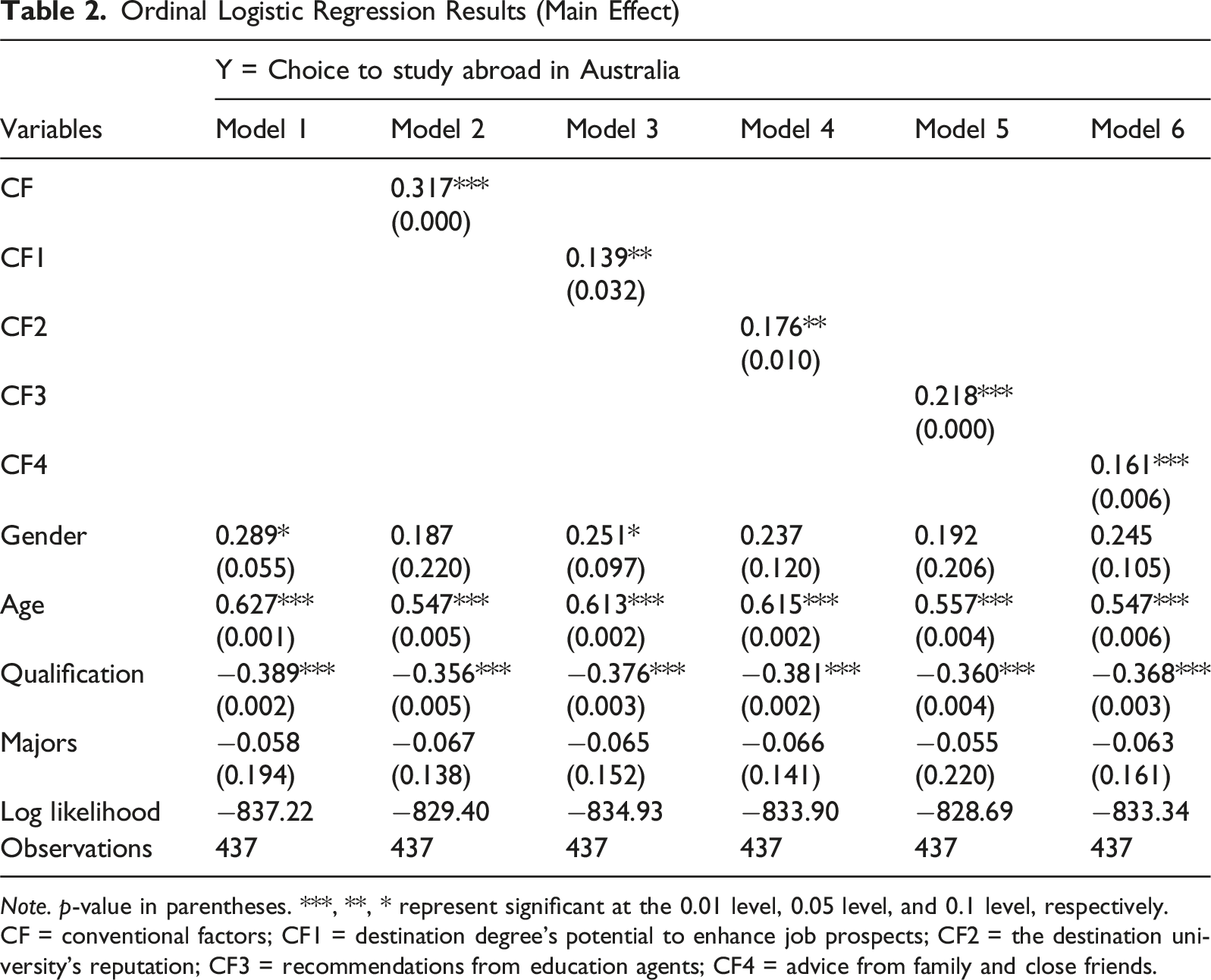
Note. p-value in parentheses. ***, **, * represent significant at the 0.01 level, 0.05 level, and 0.1 level, respectively.
CF = conventional factors; CF1 = destination degree’s potential to enhance job prospects; CF2 = the destination university’s reputation; CF3 = recommendations from education agents; CF4 = advice from family and close friends.
For further robustness analysis, we investigate whether individual conventional factors have equal or different impacts on Chinese students’ choice to study abroad in Australia. We re-estimate Equation (1) by replacing CF with each conventional factor as the main variable of interest and report the results in Models 3 to 6. 11 We find that all conventional factors, such as the career opportunities (CF1), the destination university’s reputation (CF2), recommendations from education agents (CF3), and advice from family and close friends (CF4) are positively and significantly associated with students’ destination choice to study abroad in Australia (Model 3: b = 0.139, p < .05; Model 4: b = 0.176, p = .01; Model 5: b = 0.218, p < .001; and Model 6: b = 0.161, p < .01). Our results suggest that students considered each conventional factor as an important determinant in their decision to choose Australia as a destination to study abroad. Among all four conventional factors, recommendations from education agents have had the most significant impact on determining Chinese students’ choice to study abroad in Australia. Our results suggest that education agents play a critical intermediary role in communicating Australia’s evolving visa regulations, scholarship opportunities, and university-specific requirements. They also contribute to rebuilding trust by addressing post-pandemic concerns and countering perceptions of Australia as ‘unreliable’ during the pandemic period of border closures. Students and their families rely heavily on agents to interpret and navigate the best destination to study abroad.
Moderation Analysis
Ordinal Logistic Regression Results (Moderating Effect)

Note. p-value in parentheses. ***, **, * represent significant at the 0.01 level, 0.05 level, and 0.1 level, respectively.
CF = conventional factors; PL = Political & Legal factors; E1 = Economic factors; S = Social factors; T = Technological factors; E2 = Environmental factors.
To further interpret the moderating role of PESTLE factors, we use a simple slope analysis. Figure 1 demonstrates a plot of the effect of CF on the choice to study abroad in Australia at high and low levels of PESLTE factors, represented by one standard deviation above the mean (+1 SD) and one standard deviation below the mean (−1 SD). In support of H2, Figure 1 shows that when the level of PESTLE factors is high, conventional factors increase the likelihood of choosing Australia. Conversely, when the level of PESTLE factors is low, conventional factors reduce the likelihood of choosing Australia. The Moderating Role of PESLTE Factor
To provide complementary evidence, we also test the moderating role of individual PESTLE factors and report the results using Equation (2) in Models 3 to 12 of Table 3. Interestingly, without considering the interaction term, we find that only economic factors had a significant impact on our dependent variable. This suggests that students are most concerned with economic issues, such as tuition fees, cost of living expenses, a favorable exchange rate between the Chinese Yuan and Australian dollar, scholarships offered by Australian universities, and post-graduation job opportunities in Australia.
When including the interaction term between conventional factors and each PESTLE element, we find that the positive and significant association between overall conventional factors and Chinese students’ choice to study abroad is stronger when political/legal factors (Model 4: b = 0.171, p < .05), economic factors (Model 6: b = 0.151, p < .05), technological factors (Model 10: b = 0.234, p < .001), and environmental factors (Model 12: b = 0.286, p < .001) are considered. One exception is the interaction effect of conventional factors with social factors, which has no significant influence on students’ destination choice, regardless of the level of social factors (Model 8: b = 0.073, p = n.s.). This finding might suggest that even if Chinese students receive feedback from social networks, they may still prioritize their choice of destination, like academic reputation or job prospects, which may not change much based on social influence. Taken together, our findings suggest that, in addition to our main effect analysis, environmental factors have the most moderating influence, followed by technological factors, political and legal factors, and economic factors.
Conclusion and Discussion
Drawing on the perceptions of students, our study uses a questionnaire approach to examine the influence of conventional factors on Chinese students’ choice to study abroad in Australia. Our results show there is a positive association between overall conventional factors and students’ destination choice. To corroborate our findings, we extend the work of Paynter et al. (2023) by investigating the moderating role of the PESTLE framework on this association, and find that the positive association is stronger when students receive more information on PESTLE factors. Our results suggest that both conventional and PESTLE factors are important determinants in Chinese students’ decision-making process when choosing a country to study abroad.
Implications
Our study contributes to the current literature by examining how the combined influence of conventional and PESTLE factors shapes Chinese students’ decision-making on study abroad in the post-pandemic era. Our results offer several important implications to multiple stakeholders. In addition to traditional push-pull analyses (conventional factors) that focus on micro-environmental factors, our inclusion of PESTLE factors provides a more comprehensive framework for understanding the impact of macro-environmental factors. Our findings help universities in Australia and other potential host countries by suggesting that the complex interplay between conventional factors and PESTLE factors can serve as opportunities. By incorporating these considerations into their marketing and recruitment strategies, institutions can more effectively align their offerings with the evolving priorities and concerns of international students.
Second, due to the intense competition in the international student market, Australia strives to position itself as a desirable study destination for Chinese students intending to study abroad (Parliament of Australia, 2024). Our results can assist policy makers in Australia and other host countries in recognizing the significance of both conventional and PESTLE factors when developing polices that impact international students. For instance, strengthening post-study work rights and maintaining stable diplomatic relations with China may help alleviate the concerns of prospective students and their families, thereby enhancing a country’s attractiveness as a study destination.
Third, our results highlight the complexity of the decision-making process for Chinese students, indicating that their decisions are influenced not only by conventional factors but also by the interaction of these with broader PESTLE considerations. Our results suggest that Chinese students may evaluate a wide range of interconnected factors when choosing their study abroad destination.
Furthermore, education agents can also benefit significantly from our study, as our results help them to offer more comprehensive and tailored guidance. By understanding the interplay between conventional and PESTLE determinants, agents can better support Chinese students and their families in identifying a study destination that is safe, affordable, and aligns with students’ long-term academic and professional goals.
Limitations and Future Research
We acknowledge there are some limitations in our study. First, due to the limited sample size, the findings of our study are not representative of all Chinese students seeking to study abroad and cannot be generalized. Future research may overcome this limitation by expanding the study population to include participants from more cities in China. Second, we test our hypotheses only on Chinese students who are pursuing a postgraduate education abroad. This may raise concerns about whether our findings apply to students from different nations or those in different study programs. We encourage future research to investigate how conventional and PESTLE factors vary in other national or cultural contexts. Future research could also explore how these factors change over time, particularly in response to global events such as political changes (e.g., new elections in the US) or geopolitical impact (e.g., the Russia-Ukraine War), to further understand the dynamics of international students’ decision-making.
Supplemental Material
Supplemental Material - How to Go Above and Beyond to Attract Chinese International Students to Australia
Supplemental Material for How to Go Above and Beyond to Attract Chinese International Students to Australia by Wen Hua Sharpe, Abdel K. Halabi, Tianmin Cheng, Merryn Paynter, and Tak Yan Leung in International Journal of Chinese Education
Footnotes

Funding
The author(s) received no financial support for the research, authorship, and/or publication of this article.
Declaration of Conflicting Interests
The author(s) declared no potential conflicts of interest with respect to the research, authorship, and/or publication of this article.
Supplemental Material
Supplemental material for this article is available online.
Notes
References
Supplementary Material
Please find the following supplemental material available below.
For Open Access articles published under a Creative Commons License, all supplemental material carries the same license as the article it is associated with.
For non-Open Access articles published, all supplemental material carries a non-exclusive license, and permission requests for re-use of supplemental material or any part of supplemental material shall be sent directly to the copyright owner as specified in the copyright notice associated with the article.
