



Abstract
As a growing model of Transnational Education (TNE) in China, Sino-Foreign Cooperative Universities (SFCUs) present both unique opportunities and challenges. This study examines the academic and social adaptation of first-year Chinese students at a leading SFCU through the framework of Tinto’s (1993) Student Integration Model, with a particular focus on the impact of English-Medium Instruction (EMI). Employing a mixed-methods approach, the research explores the relationships between students’ self-efficacy, mindset, language proficiency, and social engagement. Findings highlight significance between language proficiency and social interaction as critical to students’ sense of belonging and academic confidence. Additionally, gender differences and fixed mindsets further complicate adaptation, underscoring the need for targeted interventions. Recommendations include promoting growth mindsets, strengthening peer networks, and providing tailored language support. This study enhances the understanding of adaptation dynamics in TNE contexts and offers practical strategies to support student success in an increasingly globalized higher education landscape.
Keywords
Introduction
Among the three primary types of transnational education (TNE) programs, Sino-foreign cooperative universities (SFCUs) are distinguished by their flexible transfer pathways and integration of Western educational models, which emphasize holistic development. These institutions place a focus on English proficiency, a highly valued skill in China’s job market (Wu et al., 2022). However, SFCUs also present distinct challenges: students must navigate the academic rigor of English-Medium Instruction (EMI) while adjusting to the social and cultural dynamics of a Westernized educational environment. This dual transition can be particularly demanding for Chinese students accustomed to rote learning and teacher-centered pedagogy.
Despite prior exposure to English as a foreign language, many students struggle with EMI due to language anxiety, limited confidence, and fear of judgment from peers and instructors (Yu & Wright, 2017). These difficulties often contribute to lower academic performance, heightened stress and increased attrition rates (Andrade, 2009; Arunasalam & Burton, 2018). Beyond basic comprehension, linguistic barriers affect students’ ability to engage with complex academic content and participate in collaborative learning with peers and faculty in an English-speaking environment.
The study of Chinese students in SFCUs holds global significance as it reflects broader trends in international higher education. As transnational education continues to expand, institutions worldwide face the challenge of integrating Western pedagogical approaches with local educational traditions (Xie et al., 2024). Understanding how Chinese students adapt to the academic demands of EMI while navigating cultural differences provides valuable insights for educators and policymakers striving to create inclusive and effective learning environments. Moreover, as China’s role in global education grows, the experiences of students in SFCUs serve as a microcosm of both the challenges and opportunities inherent in cross-border education.
While existing studies have examined the general adaptation challenges faced by English as a Foreign Language (EFL) students, limited research has explored the unique context of SFCUs. The interplay between academic and social integration, as conceptualized in Tinto’s (1993) Student Integration Model, remains underexplored within the SFCU context. Furthermore, academic beliefs including self-efficacy and growth mindset have not been sufficiently examined as potential factors supporting students’ successful adaptation in this educational setting. By integrating Tinto’s (1993) Student Integration Model with Dweck’s (2006) Growth Mindset theory and Bandura’s (1997) Self-Efficacy framework, this research offers a comprehensive understanding of the factors that influence student retention and achievement in SFCUs. The findings are not only timely but also crucial for informing targeted interventions that can improve the experiences of students in TNE settings worldwide.
Literature Review
Transitional Challenges for Chinese SFCU Students
While much of the existing literature focuses on Chinese international students and their challenges in adapting to foreign academic environments (Knight, 2007; Wu et al., 2022), relatively few studies have explored the experiences of Chinese students in SFCUs, where they represent the dominant student group. In this context, students must navigate the hybrid nature of their learning environment, balancing Western educational models with local academic traditions (Lai & Jung, 2024).
Noman et al. (2023) identified several academic challenges faced by students in a Sino-US context, including adjusting to diverse curricula, unfamiliar assessment methods, and differing teaching philosophies. Learning strategies that were effective in secondary school often prove inadequate in university settings (Cook & Leckey, 1999). Additionally, many Chinese students enter university with limited experience in educational practices that emphasize collaboration and discussion (Dai et al., 2019). This can result in “learning shocks,” a form of cultural shock specific to academic environments, triggered by differences in learning styles and mismatched academic expectations (Wang & Devarajoo, 2022).
Compared to traditional Chinese public universities, SFCUs typically have a higher proportion of international staff and students. Chinese students accustomed to teacher-centered, exam-focused high school environments often struggle to adapt to the discussion-based, student-centered classrooms characteristic of Western educational models (Dai et al., 2019). This shift can hinder active participation in discussions, limiting opportunities to deepen their understanding of specialized subjects. Moreover, the interactive nature of EMI lectures can overwhelm students as they simultaneously process new academic content and the language of instruction, straining their working memory (Hu & Duan, 2018). These academic challenges are further complicated by navigating intercultural interactions and building relationships with peers and instructors.
In light of these challenges, social adaptation presents additional difficulties for students in SFCUs. Hang and Zhang’s (2022) study of Chinese undergraduate students at an SFCU found that students often experienced discomfort during both academic and sociocultural transitions, particularly when interacting with unfamiliar teachers, classmates, and roommates. Many students reported a lack of belonging and expressed limited interest in intercultural interactions on campus. Linguistic barriers and cultural mismatches often extended into social settings, making it difficult for students to form meaningful connections with peers, thereby adding another layer of complexity to their academic transition (Andrade & Fernandes, 2022; Li et al., 2017).
Building on this, research by Yuan et al. (2019) highlights that Chinese students in internationalized institutions often experience identity paradoxes, where they must balance a global outlook with strong Chinese values in their learning. However, research involving 565 Chinese college students suggests that many students avoid initiating social interactions and instead gravitate toward familiar social circles, limiting their engagement with peers from diverse backgrounds and reducing exposure to differing perspectives (Xing, 2023). Consequently, students in SFCUs must navigate these conflicting values, which can either enhance their learning attitudes or disrupt their adaptation to campus life (Lai & Jung, 2024).
Theoretical Framework
Student Integration Model
Given the multiple challenges affecting students’ success in EMI contexts, this study employs Tinto’s (1993) Student Integration Model as its theoretical framework. This model emphasizes that a student’s integration into both the academic and social systems of the university is critical for their persistence and success. This framework identifies key components, including academic integration, faculty interaction, and social engagement, which have been extensively studied to understand student retention and success in higher education (Tinto, 1993).
Tinto’s model delineates two main types of integration: academic and social. Academic integration refers to students’ formal and informal interactions with the academic learning community, including faculty and staff interactions (Tinto, 1993). Active participation in learning activities fosters a sense of belonging within the academic community and strengthens the bond between students and their institution (Endo & Harpel, 1982). Whereas, social integration involves students’ sense of belonging within the university’s social environment, both formally and informally, including involvement in extracurricular activities, participation in campus organizations, and interaction with peers (Chrysikos et al., 2017). Social integration fosters emotional support and helps build a supportive peer network, which is vital for students’ overall adaptation and well-being (Tinto, 1993).
Academic Beliefs
Building on Tinto’s (1993) Student Integration Model, this study examines how academic beliefs, growth mindset and self-efficacy, influence students’ adaptation in EMI contexts. In such environments, students’ behavior is shaped by both personal attributes (e.g., abilities and skills) and external factors. Within this framework, personal perceptions of capability such as growth mindset and self-efficacy mediate the impact of various challenges by influencing students’ persistence and effort.
The concept of growth mindset, introduced by Dweck (2006), refers to the belief that abilities can be developed through dedication and hard work. Individuals with a growth mindset believe that their abilities can improve through sustained effort, while those with a fixed mindset perceive abilities as innate and unchangeable. These contrasting mindsets significantly influence leaners’ behavior, emotions, and cognitive processes (Dweck & Yeager, 2019). Previous research has demonstrated that students with a growth mindset are typically more motivated and better equipped to overcome language and cultural barriers (Yeager & Dweck, 2012). Moreover, growth mindset is linked to greater learner engagement, persistence, and commitment in challenging learning environments (Lou et al., 2022; Zhang et al., 2022). However, research on the mindsets of SFCU students remains limited.
In addition to mindset, self-efficacy, as defined by Bandura (1997), refers to an individual’s belief in their ability to succeed in specific tasks. This motivational construct is crucial for achieving positive academic outcomes. Neuville et al. (2007) identified self-efficacy as a significant predictor of students’ academic performance, complementing Tinto’s (1993) integration model. In EMI contexts, self-efficacy shapes not only students’ perceptions of their capabilities but also influences their academic behaviors. Higher levels of self-efficacy correlate with greater engagement in effective study practices, enabling students to manage linguistic and academic challenges more effectively (Zhou et al., 2023). Moreover, students with stronger self-efficacy are better equipped to overcome the linguistic barriers and “learning shocks” previously discussed, facilitating their successful adaption to EMI environments.
Given these insights, this study posits that both growth mindset and self-efficacy critically foster the persistence and engagement required for successful academic and social integration in SFCUs. By investigating these internal factors, this research aims to provide deeper insights into Chinese students’ experiences in EMI institutions, addressing the need for further studies in Chinese EMI settings (Hu, 2023) and expanding the mixed-method research base on learner motivations (Iwaniec & Wang, 2022). Figure 1 illustrates the analytical framework developed by the authors, which integrates these theoretical perspectives to guide the research. Student Integration Model Adapted to the Research Study to Include Growth Mindset and Self-Efficacy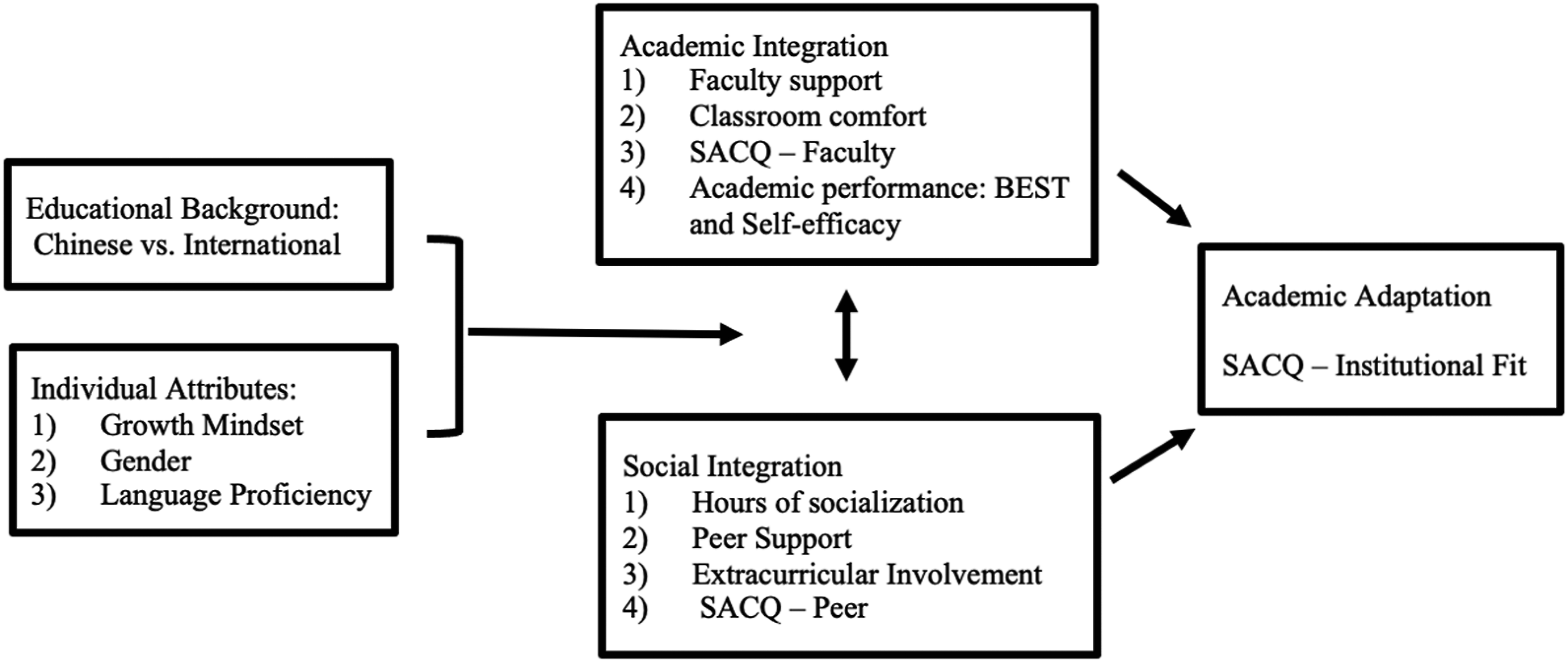
Methodology
Research Design
This study adopts a mixed-methods approach, integrating both quantitative and qualitative methods to comprehensively address the research questions (Creswell & Clark, 2017). This design is particularly well-suited for exploring the complex academic and social challenges faced by students in TNE contexts.
The quantitative phase employed validated instruments to measure students’ academic adaptation and academic beliefs, providing measurable insights into key factors influencing their transition to a SFCU. The qualitative phase involved six first-year Chinese students selected from across EAP proficiency levels and 1 focus group with 7 students. Maximum variation sampling was used to identify the students for the focus group and interviews looking at variation in growth mindsets, English proficiency levels, reported social interaction, and self-efficacy scores. This sampling method examines the multifaceted nature of our research questions in detail to reveal similar and different aspects of various situations to deepen our understanding of survey responses and illuminated challenges in academic and social integration. An inductive approach guided the thematic analysis to explore student interviews and focus group transcripts. While initial codes were developed through open coding by each researcher independently, the final themes were established through joint review. Open coding allows for participants’ voices and unexpected insights to shape the final analysis. To ensure rigor, triangulation was achieved by comparing themes with survey data trends, and intercoder consistency was monitored through coding alignment meetings. By combining these two approaches, the study benefits from the breadth and generalizability of quantitative data alongside the depth and contextual richness of qualitative data. This enhances the credibility and validity of the findings by cross-verifying evidence from different sources for a more nuanced exploration of the interplay between students’ beliefs, behaviors, and adaptation strategies. Before conducting the research study, the university’s Ethics Committee reviewed survey instruments and research methods, and ethical approval was obtained for the study.
The following research questions guided the study: (1) Based on Tinto’s (1993) Integration Model, how are Year 1 Chinese students adapting to a SFCU? (2) What are Year 1 Chinese students’ beliefs and mindsets regarding their academic and social adaptation to a SFCU? (3) To what extent do academic beliefs (self-efficacy and mindset) impact students’ ability to adapt to challenges at a SFCU?
By addressing these questions, the study aims to contribute valuable insights into the experiences of Chinese students in EMI environments and inform strategies to support their academic success and well-being.
Participants
The study was conducted at a joint venture between a Chinese and UK-based university with a dynamic mix of pedagogical approaches and values. The majority of students at the SFCU are Chinese, many of whom have transitioned from traditional Chinese educational settings. Adapting to an EMI academic environment presents significant challenges for these students
The demographic profile of the participants provided important context for the study. Of the 232 participants, 58% were female, and students were drawn from four different EAP classes organized by English proficiency levels. Notably, 40% of the participants identified as first-generation college students, which may influence their academic experiences and support needs. The majority of participants (96%) resided on campus, and 80% were actively involved in clubs or social organizations, indicating a high level of engagement in campus life.
Instruments
To understand Year 1 students’ adaptation at the SFCU, the study employed the following instruments, each aligned with the research questions.
Student Adaptation to College Questionnaire (SACQ)
The institutional subscale from Baker and Siryk’s (1999) SACQ was used to measure students’ attachment to the university and their sense of fit within the academic environment. This subscale comprises 14 items measured on a 5-point Likert scale (1 = “completely untrue” to 5 = “completely true”) with a Cronbach’s alpha of 0.85.
Sense of Belonging Survey
Hoffman et al.’s (2002) Sense of Belonging Survey examined three key components of academic and social adaptation: faculty support, peer support, and classroom comfort, using a 5-point Likert scale and demonstrated excellent internal consistency with a Cronbach’s alpha of 0.945.
Beliefs in Educational Success Test (BEST)
Majer’s (2009) BEST was used to assess students’ confidence in their academic abilities, offering insights into their self-efficacy in tasks such as completing homework, studying notes, and managing coursework. Responses were rated on a scale from 0% (not confident) to 100% (very confident), with a Cronbach’s alpha of 0.919 indicating high reliability.
Mindset Survey
Dweck’s (1999) Mindset Survey was employed to investigate students’ beliefs about intelligence and character, distinguishing between “fixed” and “growth mindsets”. The survey included eight items rated on a 4-point Likert scale (1 = “strongly agree” to 4 = “strongly disagree”). The survey demonstrated acceptable internal consistency with a Cronbach’s alpha of 0.774.
Results
Academic and Social Integration
The results of the SACQ institutional attachment subscale indicated that participants generally reported high levels of agreement with items measuring their attachment to the university (M = 3.49, SD = 0.98). Responses to specific items revealed that students felt positively about their academic and social adaptation. For instance, the item “I feel that I fit in well as part of the academic college environment” received a mean score of M = 3.43, SD = 1.14, further highlighting this positive trend.
Conversely, items addressing social challenges indicated that such difficulties were less prevalent among participants. For example, the item “I am having difficulty feeling at ease or socializing with other people” received a lower mean score of M = 2.75, SD = 1.23, suggesting that while some students faced social integration challenges, these issues were not widespread.
Sense of Belonging Scale and Subscales Differentiated by Gender

Note. M = Mean, SD = Standard Deviation.
In addition to the quantitative findings, qualitative data from interviews and focus groups provided deeper insights into students’ experiences. These narratives highlighted key themes related to academic autonomy, faculty support, and social integration.
Students frequently expressed appreciation for the “freedom and openness “It’s the openness of its education that gives us a real chance to explore a way that really suits ourselves” (P12, Foundation, Focus Group).
However, while this autonomy was viewed positively, it also introduced challenges. Several students reported feeling uncertain about academic decisions emphasizing the need for guidance in navigating educational pathways. Faculty support emerged as crucial to students’ adaptation, with participants valuing office hours and email communications as resources. However, logistical issues, such as limited availability and language barriers, occasionally impeded these interactions. These language limitations further discouraged some students from seeking help, as their previous educational experiences had inadequately developed their English-speaking skills (P1, Pre-Intermediate, Interview).
Peer relationships emerged as both a valuable resource and a significant challenge. While some students reported relying on classmates for academic support, others described difficulties forming meaningful connections or establishing trust. For instance, one student characterized classmates as distant: “Our classmates in the class are just like a passerby” (P11, Intermediate, Focus Group). Another student emphasized the challenge of balancing self-reliance with seeking support. Some students described difficulties forming “sincere friendships” (P12, Intermediate, Focus Group), noting that many peers seemed more focused on personal achievement.
Participation in clubs was identified as an effective way to enhance social belonging. While not all students engaged in these activities, participants found them valuable for building connections. One student highlighted their involvement in a “K-pop club” (P11, Intermediate, Focus Group), emphasizing how shared interests foster social integration. These qualitative insights underscore the diverse SFCU student experiences, revealing both positive aspects of autonomy and social integration, as well as ongoing challenges in navigating faculty support and forming meaningful peer relationships.
Sense of Belonging Scale Differentiated by Reported Hours of Socializing

Note. M = Mean, SD = Standard Deviation.
To further explore the role of extracurricular involvement, the study examined differences between students who participated in clubs and those who did not. Descriptive statistics indicated that students who participated in clubs reported slightly higher scores on sense of belonging (M = 3.32, SD = 0.78) compared to those who did not participate (M = 3.02, SD = 0.93). An independent samples t-test confirmed that club participants demonstrated significantly higher levels of sense of belonging than non-participants (t(49.25) = 1.87, p = .034, d = 0.37). However, no significant differences were found between the two groups for other measured variables such as institutional attachment, beliefs, and mindsets.
Mindset and Beliefs
Participant Mindset Subscales

Interviews provided deeper insights into students’ fixed mindset tendencies, particularly regarding intelligence. One student reflected on their belief that intelligence is largely unchangeable, despite recognizing the importance of effort to change their “abilities” (P8, Advanced, Focus Group). The student cited that they could increase their critical thinking skills but not their general intelligence, which was something they believed since high school.
Despite such fixed mindset beliefs, several students demonstrated resilience and ambition, particularly regarding long-term academic goals such as studying abroad. Furthermore, growth-oriented behaviors such as persistence in overcoming language barriers were also evident. For example, one student reflected positively on their progress in adjusting to EMI classes: “Although it’s more challenging, I think I can understand the classes in English this semester after last semester’s study.” (P1, Pre-Intermediate, Interview)
Further analysis explored the relationship between the mindset subscales of character and intelligence against key survey measures such as sense of belonging, institutional attachment, and beliefs. ANOVA results for the character subscale indicated that differences between groups across all variables did not reach statistical significance. (1) Sense of Belonging: F(3, 228) = 1.730, p = .162 (2) Institutional Attachment: F(3, 228) = 1.033, p = .379 (3) Beliefs: F(3, 228) = 1.033, p = .379
While no significant differences were found for sense of belonging and beliefs, significant differences emerged for institutional attachment with the intelligence subscores. (1) Sense of Belonging: F(3, 228) = 0.338, p = .798 (2) Institutional Attachment: F(3, 228) = 3.318, p = .021 (3) Beliefs: F(3, 228) = 0.580, p = .629
Post hoc results from the Tukey HSD test revealed significant differences in institutional attachment scores between specific groups. The mean difference between Group 2 and Group 4 was 1.359 (p = .029), while the mean difference between Group 3 and Group 4 was 1.287 (p = .049), both reaching significance at p < 0.05. Contrary to expectations, students with a growth mindset reported significantly lower institutional attachment.
Mindset Subscales Differentiated by First-Generation College Student Status

Note. M = Mean, SD = Standard Deviation.
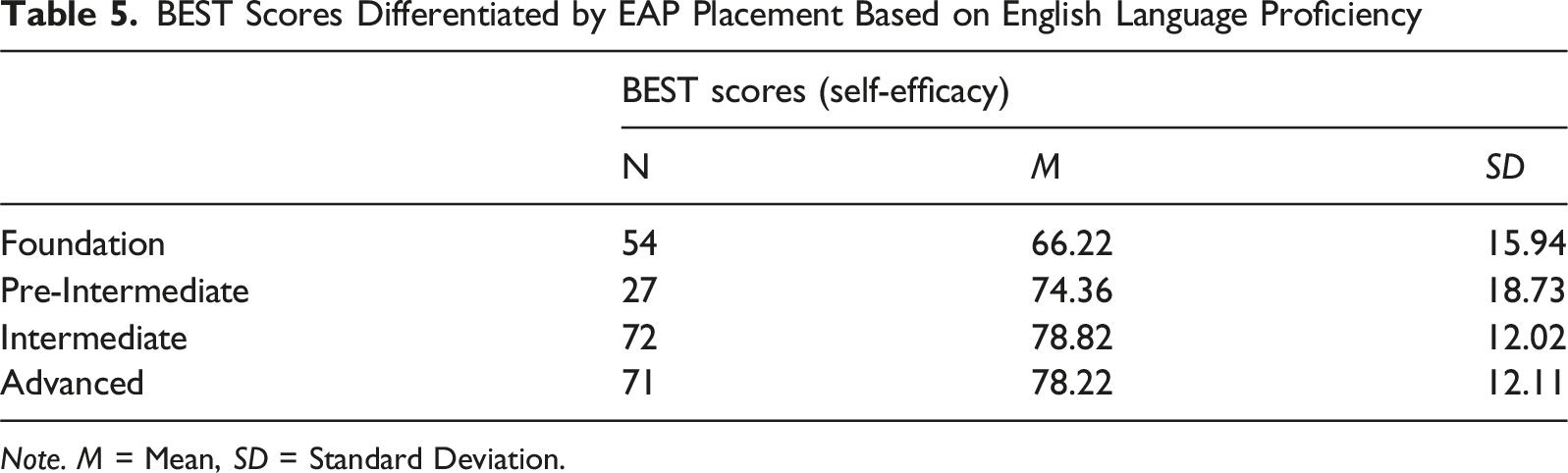
Findings from the BEST (Majer, 2009) indicated that students at this particular SFCU demonstrated high self-efficacy, with a mean score of M = 75.16, SD = 14.93. This suggests that participants generally felt confident in their ability to manage academic challenges and achieve success in their educational pursuits.
To explore differences across student groups, an ANOVA was conducted to examine variations in several dependent variables, including sense of belonging, mindset, beliefs, and institutional attachment across the four EAP groups. The results revealed a statistically significant difference in belief scores across the four groups (F(4, 227) = 3.09, p = .017).
BEST Scores Differentiated by EAP Placement Based on English Language Proficiency
Note. M = Mean, SD = Standard Deviation.
Interviews and focus group discussions provided deeper context for the self-efficacy and beliefs findings, revealing key themes related to independent learning, self-regulation, and language barriers. A recurring theme in the data was the emphasis on independent learning. Students recognized the necessity of developing learner autonomy, particularly in the SFCU context where attendance requirements are less stringent, and students experience greater academic freedom. Freed from the structured supervision typical of their previous educational experiences, many students reported exploring new learning strategies that suited their individual needs. Participants described various strategies for managing their learning, such as note-taking, self-review, and frequent use of online resources and AI tools for writing support.
While this independence fostered positive learning behaviors for some students, others faced significant challenges in adapting to the university’s less structured environment. Students frequently cited struggles with time management and self-discipline as major obstacles. Many participants expressed frustration with their own inefficiency during self-study and described experiences of procrastination that hindered academic progress.
The shift to major-specific coursework further compounded these challenges. As students moved into more specialized subjects, they faced greater difficulty applying independent learning strategies effectively, particularly when encountering language barriers in content-heavy subjects. Several students expressed anxiety about their ability to grasp course material when faced with unfamiliar terminology. Difficulties in understanding foreign instructors further complicated learning experiences. Additionally, students found math-related coursework particularly challenging when delivered in English.
Discussion
This study examined the academic and social adaptation of first-year Chinese students at a SFCU, focusing on their integration into a new academic and social environment and the role of self-efficacy and mindset in this process. The findings reveal a complex interplay between internal factors, such as students’ beliefs, and external factors, including language proficiency and institutional support.
Drawing on Tinto’s (1993) Student Integration Model, the study found that students experienced moderate levels of academic and social integration, consistent with transitional challenges identified in prior research (Gravett & Winstone, 2019; Jindal-Snape & Rienties, 2016). Notably, students exhibited higher levels of academic integration compared to social integration. Positive contributors included the open major system, accessible faculty support, and the freedom and openness of the SFCU environment, aligning with Zhou et al.’s (2024) findings.
Language proficiency emerged as a critical factor influencing both self-efficacy and academic integration. Students with higher English proficiency demonstrated greater confidence in navigating academic challenges, consistent with Bandura’s (1997) theory of self-efficacy, which emphasizes mastery experiences as key to building self-efficacy beliefs. Proficiency in English enables engagement with course materials, participation in discussions, and effective communication with peers and faculty, all of which strengthen their sense of competence. Conversely, limited proficiency hindered classroom participation and students’ willingness to seek help from teachers, resulting in frustration, diminished self-efficacy, and reduced academic confidence (Evans & Morrison, 2011; Noman et al., 2023). The SFCU examined in this study primarily enrolls Chinese students, with English serving as the medium of instruction across all programs. Although the institution hosts a small number of non-Chinese students at less than 5% according to University Admissions, this study focused exclusively on Chinese nationals to maintain a consistent lens on academic adaptation patterns (Xi’an Jiaotong-Liverpool University, 2025). The small international cohort is unlikely to have skewed the group norms presented. This demographic context is important for interpreting the findings, as the observed relationship between English proficiency and academic success is particularly relevant for Chinese students, who often enter these programs with varying levels of English ability. Non-Chinese students, who may have near-native fluency in the English language are unlikely to significantly influence the overall trends observed in this study. However, future research could explore how non-Chinese students’ linguistic advantages shape their academic and social outcomes in SFCUs. To address language barriers, tailored support programs, such as academic writing workshops, speaking practice sessions, and peer tutoring could help Chinese students build confidence and succeed in EMI contexts. These interventions would not only enhance students’ academic performance but also encourage classroom discussions and peer interactions, ultimately supporting both academic and social integration. Strengthening faculty support is also critical. Providing more accessible office hours and adopting supportive communication strategies can help students seek academic assistance more confidently. Moreover, TNE programs should implement policies that prioritize faculty training in inclusive pedagogical strategies, such as culturally responsive teaching (Ladson-Billings, 1995). These approaches affirm students’ cultural identities and cultivate a sense of belonging by drawing on students’ existing knowledge systems. Specifically, educators should be trained to integrate students’ cultural and intellectual resources, which Moll et al. (1992) term “Funds of Knowledge” into the content curriculum. By intentionally incorporating these assets, instructors can enhance academic integration, bolster student confidence, and democratize classroom dynamics, ensuring that diverse strengths are recognized and valued (Moll et al., 1992).
Social integration presented a more nuanced picture. While students generally felt compatible with their peers, their overall satisfaction with their social lives was moderate, reflecting challenges in forming meaningful connections. Students expressed a preference for engaging with faculty over peers, highlighting stronger academic integration than social integration. Qualitative data revealed difficulties in establishing genuine friendships, with classmates often described as “passersby.” This aligns with Hang and Zhang’s (2022) findings, which highlight sociocultural discomfort and a struggle to develop a sense of belonging among Chinese students at SFCUs. Enhancing peer engagement is crucial to addressing these challenges. Universities should implement structured opportunities for interaction, such as team-based projects, social events, and extracurricular activities, to foster a stronger sense of belonging and improve social integration (De Sisto et al., 2022). Creating collaborative spaces can help students build meaningful connections with their peers, ultimately enhancing their overall university experience.
Gender differences in students’ sense of belonging were observed, with male students reporting lower levels of belonging than female students, particularly in faculty interactions and peer relationships. While cultural expectations and educational norms may contribute to this disparity (Hu & Duan, 2018), further research is needed to explore how gender influences academic and social integration in SFCUs. Given the limited research in this context, future studies could examine the role of traditional values, competitive learning environments, and social expectations in shaping students’ experiences. Such insights may inform targeted strategies to enhance student belonging and integration.
Students’ beliefs and mindsets influenced their adaptation experiences significantly. Results from the Mindset Survey (Dweck, 1999) indicated a prevalence of fixed mindsets, with many students perceiving intelligence as largely innate, despite acknowledging the potential for learning. This mindset may stem from the Gaokao, China’s standardized university entrance exam, which strongly shapes perceptions of intelligence by equating exam performance with inherent ability (Fu, 2024). Additionally, the Gaokao’s emphasis on exam-focused English skills, rather than practical language proficiency, may explain students’ discomfort using English in SFCU settings, further reinforcing fixed-mindset tendencies.
Despite these tendencies, qualitative data revealed resilience and long-term aspirations among students, particularly regarding overseas study. In China, transnational higher education experiences are highly valued for career advancement (Mok et al., 2017) and social prestige, serving as powerful extrinsic motivators. These motivators may counteract fixed-mindset beliefs, as students perceive tangible benefits from international education. Furthermore, SFCUs’ alignment with foreign partner universities’ educational models, which emphasize growth-oriented skills like problem-solving and adaptability (Suh et al., 2011), appears to support a gradual transition toward a growth mindset. Targeted interventions, such as workshops on goal setting and self-reflection, could further promote this transition, helping students view challenges as growth opportunities. Additionally, training for both students and staff could address fixed mindsets by encouraging more adaptive approaches to learning and personal growth equipping students with valuable tools for their academic and linguistic development within the TNE context. For example, student onboarding programs could integrate an adapted mindset curriculum into the start of the semester to build growth-oriented skills.
First-generation students faced unique challenges, reporting lower mindset attributes scores compared to their non-first-generation peers. This aligns with research suggesting that first-generation students often experience lower academic confidence, limited access to social and cultural capital, and unfamiliarity with higher education environments (Stephens et al., 2012). These factors may reinforce a fixed mindset, as first-generation students perceive their abilities as constrained by external circumstances. Family expectations further amplify performance pressures, promoting a performance-oriented mindset over a growth-oriented one (Covarrubias et al., 2015). Addressing these disparities requires targeted interventions, such as mentorship programs, workshops promoting growth mindset principles, and instructor-delivered growth mindset messages, which have been shown to motivate first-generation students and eliminate performance gaps (Canning et al., 2024).
Interestingly, growth mindset students reported lower institutional attachment scores compared to their peers. This may reflect higher expectations for their university experience; if the institution fails to meet their aspirations for personal and academic development, growth mindset students may feel less connected. Additionally, their focus on long-term goals, such as studying abroad, may reduce their sense of attachment to their current university. This interpretation aligns with Limeri et al.’s (2020) findings, which suggest that students’ mindsets are shaped by their academic experiences.
Overall, the findings of this study highlight several important implications for improving student adaptation at SFCUs. By implementing structured opportunities for peer engagement, promoting growth mindsets, strengthening faculty support, and offering tailored language programs, institutions can better support students’ academic and social integration. These strategies, combined with inclusive extracurricular activities and robust advising systems, can enhance students’ sense of belonging and overall university experience.
Limitations and Conclusion
While this study offers valuable insights into the academic and social adaptation of first-year Chinese students at a SFCU, several limitations should be acknowledged. First, the study’s cross-sectional design restricts the ability to track changes in students’ adaptation over time. Adopting a longitudinal approach in future research could provide a more comprehensive understanding of how students’ beliefs, mindsets, and integration evolve throughout their academic journey. Second, the sample was drawn from a single SFCU, which may limit the generalizability of the findings to other TNE contexts. Variations in institutional structures, cultural dynamics, and support systems across different SFCUs could result in differing student experiences. Lastly, while the study employed both quantitative and qualitative methods, the qualitative data were drawn from a relatively small number of participants. This limited sample size may not fully capture the diversity of experiences within the broader student population. Future research could enhance the depth of qualitative insights by expanding the participant pool to explore a wider range of adaptation challenges and strategies. Addressing these limitations in future studies would contribute to a more robust understanding of Chinese students’ adaptation experiences in TNE settings.
This study highlights the complex and multifaceted nature of academic and social adaptation among first-year Chinese students at a SFCU. By addressing key challenges related to social integration, mindsets, and self-efficacy, universities can better support students in their transition to TNE environments. Future research should adopt a longitudinal approach to examine the sustained impact of these interventions, with a particular focus on how growth-oriented beliefs and self-efficacy evolve over time. Investigating these factors could provide valuable insights into their contribution to students’ long-term academic achievement and social well-being.
Supplemental Material
Supplemental Material - Academic Crossroads: Chinese Students in Sino-Foreign Cooperative Universities – Navigating Beliefs, Overcoming Challenges, and Informing Policy
Supplemental Material for Academic Crossroads: Chinese Students in Sino-Foreign Cooperative Universities – Navigating Beliefs, Overcoming Challenges, and Informing Policy by Ana Li Zhong, Han Wang, Jiayu Zhou in International Journal of Chinese Education
Footnotes

Funding
The author(s) disclosed receipt of the following financial support for the research, authorship, and/or publication of this article: This article is funded by the Xi'an Jiaotong-Liverpool University (TDF2324-R27-224).
Declaration of Conflicting Interests
The authors declared no potential conflicts of interest with respect to the research, authorship, and/or publication of this article.
Supplemental Material
Supplemental material for this article is available online.
References
Supplementary Material
Please find the following supplemental material available below.
For Open Access articles published under a Creative Commons License, all supplemental material carries the same license as the article it is associated with.
For non-Open Access articles published, all supplemental material carries a non-exclusive license, and permission requests for re-use of supplemental material or any part of supplemental material shall be sent directly to the copyright owner as specified in the copyright notice associated with the article.
