




Abstract
This article examines the relationship between career adaptability, self-monitoring, academic effort, and job search self-efficacy among university students. Guided by the career construction and self-monitoring theories, we propose that self-monitoring mediates the relationship between career adaptability and job search self-efficacy. Furthermore, we hypothesize that the indirect relationship is stronger for those with high academic effort. We test our proposed model using two samples (Sample 1 = 340, Sample 2 = 547) of university students from Thailand. Results confirm our hypothesized relationships and suggest that career adaptability is positively associated with job search self-efficacy above and beyond the effects of gender. Moderated mediation analyses revealed that the conditional indirect effect of career adaptability in predicting job search self-efficacy via self-monitoring is stronger for students with high as opposed to low levels of academic effort. Implications for theory and practice are discussed.
Keywords
The career prospects of university students, as new entrants to the workforce, are overshadowed by uncertainty and intense competition. In some Asian developing countries, job search of university students is particularly threatened by economic and political instability. For example, the school-to-work transition in Thailand has become increasingly challenging owing to recent political crisis (e.g., anti-government protests), which has been slowing down the economic performance and education reforms since 2013 (The World Bank, 2017). As a result, many qualified graduates receive fewer job offers while others take on available employment opportunities despite the job–skill mismatch (International Labour Organization, 2014). Another global trend indicates that an increasing number of new graduates are postponing their job search due to a lack of confidence to tackle career demands and compete with experienced job seekers (Marcus, 2014). Job search can be challenging for first-time job seekers who have limited career knowledge and skills, access to various job information channels, and instrumental professional networks (Kanfer, Wanberg, & Kantrowitz, 2001). Given these contemporary career issues confronting the youth, it is important to further understand the resources that foster students’ willingness and confidence to engage in the job search process.
Job search self-efficacy refers to perceived general competence to engage in job seeking. Those with high job search self-efficacy anticipate success in finding a suitable employment because they generally view themselves as competent in locating job vacancies, making good impressions in job interviews, and persuading employers to give them a good offer (Ellis & Taylor, 1983). Hence, it is one of the widely investigated person factors predicting job search intensity, job search effort, assertive job seeking behavior, higher job offers received, and reemployment (Brown, Cober, Kane, Levy, & Shalhoop, 2006; Kanfer et al., 2001). However, we know relatively little about the antecedents of job search self-efficacy. The limited work in this area mainly focused on specific traits such as proactive personality and self-esteem (Brown et al., 2006). Advancing our knowledge of factors influencing job search self-efficacy is important considering the rising trend of students postponing their job search due to career-related anxieties and insecurities associated with poor employment prospects (Marcus, 2014).
We draw from the career construction theory’s (CCT) model of career adaptation (Savickas, 2013) to explicate antecedents of job search self-efficacy. The sequence between the theoretical model’s dimensions involves a recursive transaction whereby willingness and ability to adapt, also referred to as adaptive readiness and adaptability resources, shape the adapting responses or actions that individuals perform to achieve adaptation results indicated by career goodness of fit, advancement, and satisfaction (Savickas & Porfeli, 2012). More recently, the theoretical model specified that adapting responses among students involve career construction behaviors of planning, exploring, deciding, and implementing (Savickas, Porfeli, Hilton, & Savickas, 2018). Our current focus is on the implementation of adapting responses relevant to job search self-efficacy. Related empirical studies lend support to the CCT’s assertion that mastery and practice of career behaviors with adaptive functions result in successful career adaptation as indicated by goodness of fit in a chosen career. Current empirically supported indicators of adapting responses include university students’ career decision-making self-efficacy (Duffy, Douglass, & Autin, 2015), career planning (Hirschi, Herrmann, & Keller, 2015), career exploration (Li et al., 2015), and ingratiation among employees (Sibunruang, Garcia, & Tolentino, 2016). Consistent with this perspective, our article aims to examine how career adaptability resources and adapting responses operate during early operate during early school-to-work transition (STWT), specifically to further understand the link between career adaptability and job search self-efficacy of students.
Recent meta-analyses call for future research to address the current knowledge gap about the dimensions of CCT’s model by further examining the underlying mechanisms and boundary conditions of career adaptability (Rudolph, Lavigne, Katz, & Zacher, 2017; Rudolph, Lavigne, & Zacher, 2017). In view of this, we aim to examine the role of self-monitoring as the underlying psychological mechanism that elucidates the relation between career adaptability and job search self-efficacy. By examining this mediated relationship, we clarify the behavioral dimension of the CCT model and specify the direction of the path between adaptability resources and adapting responses. Self-monitoring refers to the extent to which an individual regulates behavior in response to social cues of situationally appropriate behaviors (Snyder, 1974). It is investigated extensively as an individual difference antecedent of career advancement in management research (refer to meta-analysis; Day, Schleicher, Unckless, & Hiller, 2002) but rarely articulated or systematically linked to student job search that unfolds in early career development. Self-monitoring is useful in STWT because it signifies social awareness and interpersonal flexibility that are imperative in first-time job seekers’ employability and social integration. High self-monitors are described as social chameleons because of their ability to adjust and execute appropriate behaviors according to changing social situations (Gangestad & Snyder, 2000). Indeed, empirical evidence suggests that high self-monitors are adept at using impression management skills to achieve favorable evaluations and enhanced likability at work (Turnley & Bolino, 2001).
Following this line of inquiry, another objective of this article is to examine the moderating role of academic effort in the proposed indirect relationship between career adaptability and job search self-efficacy via self-monitoring. By doing so, we clarify the moderating variables in the CCT’s model of career adaptation. Academic effort reflects an individual’s perceived value of academic tasks, which determines the amount of engagement and hardwork devoted to the tasks (Deci & Ryan, 2003). Job search activities, such as seeking information about prospective employment opportunities, can be considered as academic activities as they enable final year university students to transition from school to work more successfully. In this regard, we expect academic effort to strengthen the relationship between career adaptability, self-monitoring, and job search self-efficacy because its motivational nature enhances adaptive responsiveness and perceived competence in job seeking. Furthermore, the amount of effort exerted and sustained engagement exemplified in academic tasks should prepare students to approach their job search tasks in a similar manner. Empirical evidence likewise suggests that mastery goal orientation predicts higher learner effort by directing the allocation of effort within a learning task (Fisher & Ford, 1998). Similarly, adaptive motivational dispositions (e.g., learning goal orientation in Creed, Fallon, & Hood, 2009; Tolentino et al., 2014) associated with greater academic effort were also found to predict dimensions of the CCT’s model of career adaptation. Taken together, our article contributes to the career adaptability and job search literature by examining the role of career behaviors that have psychosocial (e.g., self-monitoring) and motivational (e.g., academic effort) adaptive functions in predicting job search self-efficacy of students. Figure 1 illustrates the proposed research model.
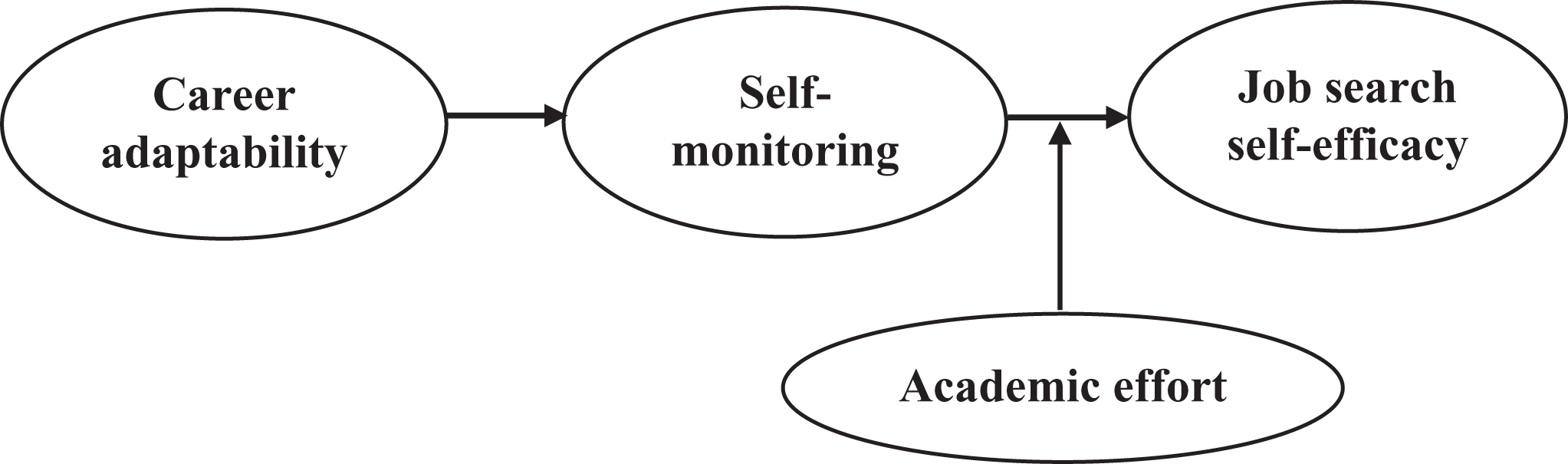
The proposed research model.
Theoretical Background and Hypotheses
Career Adaptability and Job Search Self-Efficacy
Job search is a dynamic and goal-oriented process (Barber, Daly, Giannantonio, & Philips, 1994). Undeniably, it is important to understand the nature of adaptive responses in STWT since early job search experiences and initial employment quality have implications on immediate as well as long-term career success (Saks, 2014). Guided by CCT (Savickas, 2013), we posit that career adaptability is vital to university students’ job search self-efficacy because the job search process requires high personal agency and self-regulation capacity to apply career knowledge and job seeking skills. The CCT perspective views the individual as a self-organizing, self-regulating, and self-defining agent rather than a static entity. This agentic viewpoint suggests that students, as first-time job seekers, have the capacity to mobilize their STWT and respond to changing conditions by enacting their career adaptability resources. Career adaptability refers to psychosocial resources and self-regulation strengths (i.e., concern, control, curiosity, and confidence) for managing career construction tasks, transitions, and trauma (Savickas & Porfeli, 2012). Prior studies demonstrate the important role of career adaptability in enabling successful STWT, specifically aiding career planning and exploration of students (Hirschi & Valero, 2015), fit perceptions, job offers, and chances of obtaining high-quality employment after graduation (Guan et al., 2013; Koen, Klehe, & van Vianen, 2012).
Correspondingly, we expect highly adaptable students to have job search self-efficacy because they can draw upon their career self-regulation strengths to find work that suits them. Consistent with the CCT’s model (Savickas, 2013), we expect that students can derive their job search self-efficacy from having concern (i.e., a guiding vision of their career future), from having control (i.e., a sense of personal responsibility to manage oneself during the job search process), from having curiosity (i.e., an interest to explore the occupational roles and job opportunities), and from having confidence (i.e., an optimistic pursuit of a suitable work and successful transition from school to work).
The Mediating Role of Self-Monitoring
Consistent with CCT’s assertions, the theory of self-monitoring posits that interpersonal flexibility is driven by a desire to be integrated into one’s social environment by regulating the expression of socially acceptable behaviors (Gangestad & Snyder, 2000). Self-monitors seek to understand how others perceive their actions, so they can adjust their behaviors to suit diverse social situations. Career adaptability, operating as psychosocial resources, prompts this process of social integration by shaping the adapting responses performed to meet social expectations related to occupational roles and tasks (Savickas, 2013). Hence, we expect that students’ career adaptability shapes self-monitoring as an adapting response for job search tasks during STWT. Self-monitoring involves careful observation and appraisal of social situations to inform behavior regulation (Gangestad & Snyder, 2000). Accordingly, this study suggests that self-monitors are cognizant of career opportunities because they possess social acuity.
To date, there is strong empirical evidence supporting the desirable career outcomes associated with self-monitoring, such as having larger professional networks, favorable job performance evaluations, and promotions (Barrick, Parks, & Mount, 2005; Day et al., 2002). High self-monitors appear to have a competitive advantage not only in job search but also in attaining overall career success because they are more in tune with themselves and their social environment. Correspondingly, we expect high self-monitors to feel more competent because they have sound social awareness, which enables them to demonstrate appropriate career behaviors in social interactions to benefit their job search. For example, in job interviews, students are more likely to gain positive evaluations from the interviewer by being attentive to social cues and by utilizing impression management skills properly (Day et al., 2002; Turnley & Bolino, 2001).
Given their social acuity and strong self-regulative capacity, we also expect students high in career adaptability and self-monitoring to navigate STWT transition with confidence, even when confronted with career setbacks. Indeed, self-monitoring was found to influence successful task performance and coping in threatening environments (Inzlicht, Aronson, Good, & McKay, 2006). This study suggests that self-monitoring is also a key enabling factor in young people’s resilience to career threats and barriers. Along these lines, we assert that students who display high self-monitoring will likely feel competent to seek employment because they are more attuned to social cues and adept at regulating their career behaviors according to different situations. Self-monitoring enables students to respond effectively in situations where interpersonal skill is critical, such as during job search when they must engage in professional networking, presentations, and interviews. Taken together, career adaptable students who self-monitor demonstrate interpersonal flexibility and self-regulative capacity, which in turn allow them to seek jobs with a stronger sense of competence. Thus, we predict that:
The Moderating Role of Academic Effort
CCT suggests that adapting involves a cycle of constructive career activities from orientation, exploration, establishment, and management to disengagement (Savickas & Porfeli, 2012). In line with CCT’s assertions, we argue that academic effort denotes active role management, which also exemplifies commitment to fulfill career development tasks. Academic effort pertains to an individual’s perceived value of academic tasks, which further determines the amount of energy and the level of perseverance directed toward these tasks (Trautwein, Lüdtke, Roberts, Schnyder, & Niggli, 2009). We contend that job search is regarded by effortful students as the culmination of their academic life and a significant turning point of their career development. In view of this, we argue that students who exert high academic effort are more able to implement self-monitoring because they are highly motivated to understand their social environment and confident to engage in job search activities. Indeed, academic effort can be reflected in the amount of time spent on a certain academic task (Dweck, 1986), the amount of mental capacity that is allocated to the task (Paas & Van Merriënboer, 1993), and the attentional focus put on the task (Kanfer & Ackerman, 1989). Students exert effort because they take personal responsibility and ownership of their academic learning and development. As shown by past research, conscientiousness predicts academic effort across a wide range of academic subjects (Trautwein et al., 2009). Accordingly, we posit that self-monitoring requires a strong motivation and conscious effort to be adaptive and growth oriented.
We argue that academic effort serves as a boundary condition on the influence of career adaptability on job search self-efficacy via self-monitoring. The amount of effort exerted and the level of perseverance exemplified in academic tasks should prepare students to approach job search activities in a confident manner. Moreover, students who exert effort in their academic activities exemplify high levels of self-regulation necessary for career adaptation. Prior empirical studies substantiate the link between career adaptability and motivational dispositions (Pouyaud, Vignoli, Dosnon, & Lallemand, 2012; Tolentino et al., 2014). A recent meta-analysis also demonstrates the positive relationship between career adaptability and education (Rudolph, Lavigne, & Zacher, 2017). We contend that self-monitoring along with academic effort strengthen job search self-efficacy because students’ social acuity and interpersonal flexibility are complemented by a high regard toward academic experiences. Thus, we predict that:
Method
We tested the proposed model using two samples of university students in Thailand. In Sample 1, we collected data from final year business students to test our proposed mediation model (Hypothesis 1). In Sample 2, we collected data from university students in various year levels and programs of study. We used this sample to replicate our results in Sample 1 and to also test our moderated mediation hypothesis (Hypothesis 2).
Participants and Procedures
Sample 1
Questionnaires were distributed to 400 final year university students majoring in business studies at a large private university in Bangkok, Thailand. Once permission was given by the dean of the School of Management, a member of the research team explained the purpose of the study and administered and collected completed questionnaires during class time. A total of 340 completed questionnaires were retrieved, representing a response rate of 85%. This final sample consisted of 59% females with a mean age of 22.16 years (SD = 1.21).
Sample 2
Questionnaires were distributed to a total of 600 university students at a public research university in Bangkok, Thailand. The sample consists of students from various year levels (35% freshmen, 9% sophomores, 20% juniors, and 36% final year) and program majors (6.4% Arts, 33.4% Business Administration, 9.1% Communication Arts, 9.3% Economics, 6.5% Engineering, 9.1% Humanities, 6.4% International Relations, 0.7% Law, 9.1% Multimedia Studies, and 10% Political Science). Once permission was given by the respective deans, a member of the research team explained the purpose of the study and administered and collected completed questionnaires during class time. A total of 547 completed questionnaires were retrieved, representing a response rate of 91.17%. The final sample consisted 58% males with a mean age of 20.64 years (SD = 1.76).
Measures
Unless otherwise specified, the response format for all items excluding demographic variables was a 7-point Likert-type scale (1 = strongly disagree, 7 = strongly agree), with items coded such that a higher score indicated a greater amount of the focal construct (except for reverse-coded items). A 7-point Likert-type scale was used to provide participants with more response options (Dawes, 2008) and to reduce neutral responses (Aguinis, Bommer, & Pierce, 1996).
Given that English is not a native language in Thailand, survey measures were translated from English to Thai following Brislin’s (1970) back-translation procedure. The translation from English to Thai was done by a Thai academic who is teaching a course delivered in English. Hence, the translator is proficient in both languages. After which, the back-translation procedure was done by another Thai faculty member coming from the same department who is also proficient in both English and Thai. A qualitative pretest was later conducted, which involved an interview with seven university students, all of whom were recruited from the participating private university. The interview mainly involved the discussion on how the questions contained in the questionnaire could be improved to make them more specific, concise, and simple for the participants. Further adjustments were made to ensure a high degree of language equivalence. An example of adjustments made is a revision of one questionnaire statement from “once I know what the situation calls for, it’s easy for me to regulate my actions accordingly” (i.e., original statement) to “I can easily adjust my actions according to the situation I am in” (i.e., revised statement). This revision addressed two major concerns. First, the sentence structure is not grammatically correct when written in Thai. Second, the statement is not concise when written in Thai.
Career adaptability
Career adaptability was measured using the 12-item Career Adapt-Abilities Scale (CAAS)—Short Form (Maggiori, Rossier, & Savickas, 2015) in Sample 1 and the full 24-item CAAS-International (Savickas & Porfeli, 2012) in Sample 2. The CAAS has been translated and validated for use in Thailand with subscale reliability coefficients ranging from .85 to .91, while the overall score yielded a reliability coefficient of .96 (Sibunruang et al., 2016). The scale yielded a reliability coefficient of .90 and .92 for Sample 1 and Sample 2, respectively.
Self-monitoring
Self-monitoring ability was measured using the scale developed by Warech, Smither, Reilly, Millsap, and Reilly (1998). In Sample 1, we used a 4-item short version of the scale due to the time and survey space constraints imposed by the participating university. Items were included in the survey based on high factor loadings. Participants indicated how strongly they agreed to statements such as “I have found that I can adjust my behavior to meet the requirements of any situation I find myself in” and “In social situations, I have the ability to alter my behavior if I feel that something else is called for.” Prior work has found a coefficient α of .83 (Warech, Smither, Reilly, Millsap, & Reilly, 1998). The scale yielded a reliability coefficient of .65 and .71 for Sample 1 and Sample 2, respectively.
Job search self-efficacy
Job search self-efficacy was measured using the 10-item scale developed by Ellis and Taylor (1983). Participants were asked to rate the extent to which they feel confident with their general job search ability, knowledge, and skills. Sample items include “I am confident of my ability to make a good impression in job interviews” and “I know exactly how to find the kind of job I am looking for.” The scale evidenced adequate internal consistency reliabilities of .82 and .83 (Ellis & Taylor, 1983). Cronbach’s α for this scale was .70 in Sample 1 and .75 in Sample 2.
Academic effort
In Sample 2, we further introduced the moderating role of academic effort. The measure of academic effort was adapted from the Intrinsic Motivation Inventory (Deci & Ryan, 2003). The items have been modified slightly to fit schoolwork activities. Specifically, participants were asked to rate the extent to which they exerted effort in performing well at school. The 3 items used were “I put a lot of effort in my schoolwork,” “It is important to me to perform my schoolwork well,” and “I try as hard as I can to perform my schoolwork well.” Prior work has found a coefficient α of .84 for the Effort subscale (McAuley, Duncan, & Tammen, 1989). Cronbach’s α for this scale was .87.
Control variables
We controlled for student gender (0 = female, 1 = male) since prior work has found that men generally have higher levels of job search self-efficacy (Guan et al., 2013) and engage in more job search activities compared to women (Kanfer et al., 2001). In Sample 2, we also controlled for the student’s year level (1 = freshmen, 2 = sophomores, 3 = juniors, 4 = final year). Based on social cognitive theory (Bandura, 1986), students in higher year levels may have stronger job search self-efficacy due to career counseling interventions provided as they progress in their studies.
Results
Means, standard deviations, and intercorrelations are summarized in Table 1. We conducted a confirmatory factor analysis for career adaptability, self-monitoring ability, and job search self-efficacy in Sample 1 (three-factor model) and Sample 2 with the inclusion of academic effort (four-factor model). Item parcels were created to improve the ration of N relative to the number of parameters to be estimated (Little, Cunningham, Shahar, & Widaman, 2002). In Sample 1, the three-factor model had an acceptable fit with the observed data, χ2(145) = 302.626, p < .001, χ 2 /df = 2.087, CFI = .94, TLI = .93, RMSEA = .057, 90% confidence interval (CI) = [.066, .110]. Similarly, in Sample 2, the four-factor model also yielded acceptable fit indices, χ2(199) = 532.285, p < .001, χ 2 /df = 2.675, CFI = .94, TLI = .94, RMSEA = .055, 90% CI [.050, .061]. We also compared these measurement models with several alternative models. The three-factor (Sample 1) and four-factor models (Sample 2) had the best fit. Overall, this analysis provides evidence that the constructs in the theoretical model are distinct from one another.
Means, Standard Deviations, Reliabilities, and Correlations of Variables in Samples 1 and 2.
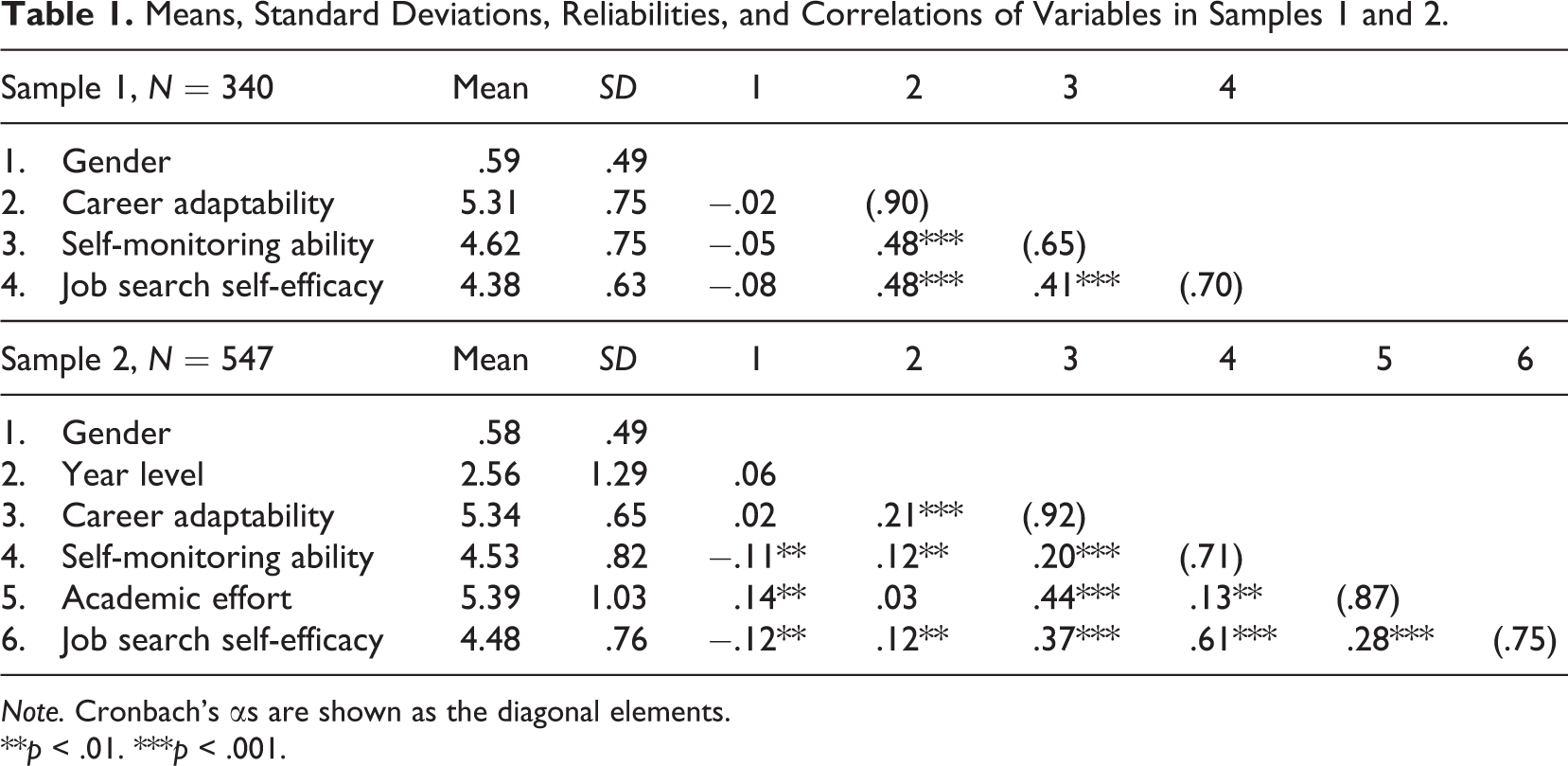
Note. Cronbach’s αs are shown as the diagonal elements.
**p < .01. ***p < .001.
Hypotheses Testing
We then assessed the mediation and moderated mediation hypotheses using the PROCESS macro developed by Hayes (2013). This approach was used as it makes no assumptions that the total and indirect effects are normally distributed, and it allows for the estimation of bootstrapped CIs for hypothesized paths in the model. Results of the analyses are summarized in Table 2.
Summary of Mediation Analyses for Samples 1 and 2.

Note. CI = confidence interval.
Hypothesis 1 proposed that the relationship between career adaptability and job search self-efficacy was mediated by self-monitoring ability. As shown in Table 2, the total effect (Sample 1 total effect = .40, SE = .04, 95% CI [.32, .48]; Sample 2 total effect = .43, SE = .05, 95% CI [.34, .52]) and direct effect (Sample 1 direct effect = .31, SE = .04, 95% CI [.22, .40]; Sample 2 direct effect = .31, SE = .04, 95% CI [.23, .39]) were significant for both samples. Career adaptability was also found to have an indirect effect on job search self-efficacy in both Sample 1 (indirect effect = .09, SE = .03, 95% CI [.04, .15] and Sample 2 (indirect effect = .12, SE = .03, 95% CI [.06, .25]). Given that the CIs for the indirect effects were positive and do not include zero, Hypothesis 1 was supported.
We further posited that the strength of the indirect effect of career adaptability on job search self-efficacy would be conditional on the level of academic effort (Hypothesis 2). Specifically, academic effort will act as a second-stage moderator, moderating the path between self-monitoring ability and job search self-efficacy. The cross product term between self-monitoring ability and academic effort in predicting job search self-efficacy was significant (B = .08, SE = .03, 95% CI [.02, .14]). Simple slopes were plotted to demonstrate the nature of the significant interaction. As depicted in Figure 2, there was a stronger positive relationship between self-monitoring ability and job search self-efficacy when academic effort was high (B = .56, SE = .04, 95% CI [.49, .63]) as opposed to when it was low (B = .39, SE = .05, 95% CI [.29, .49]).
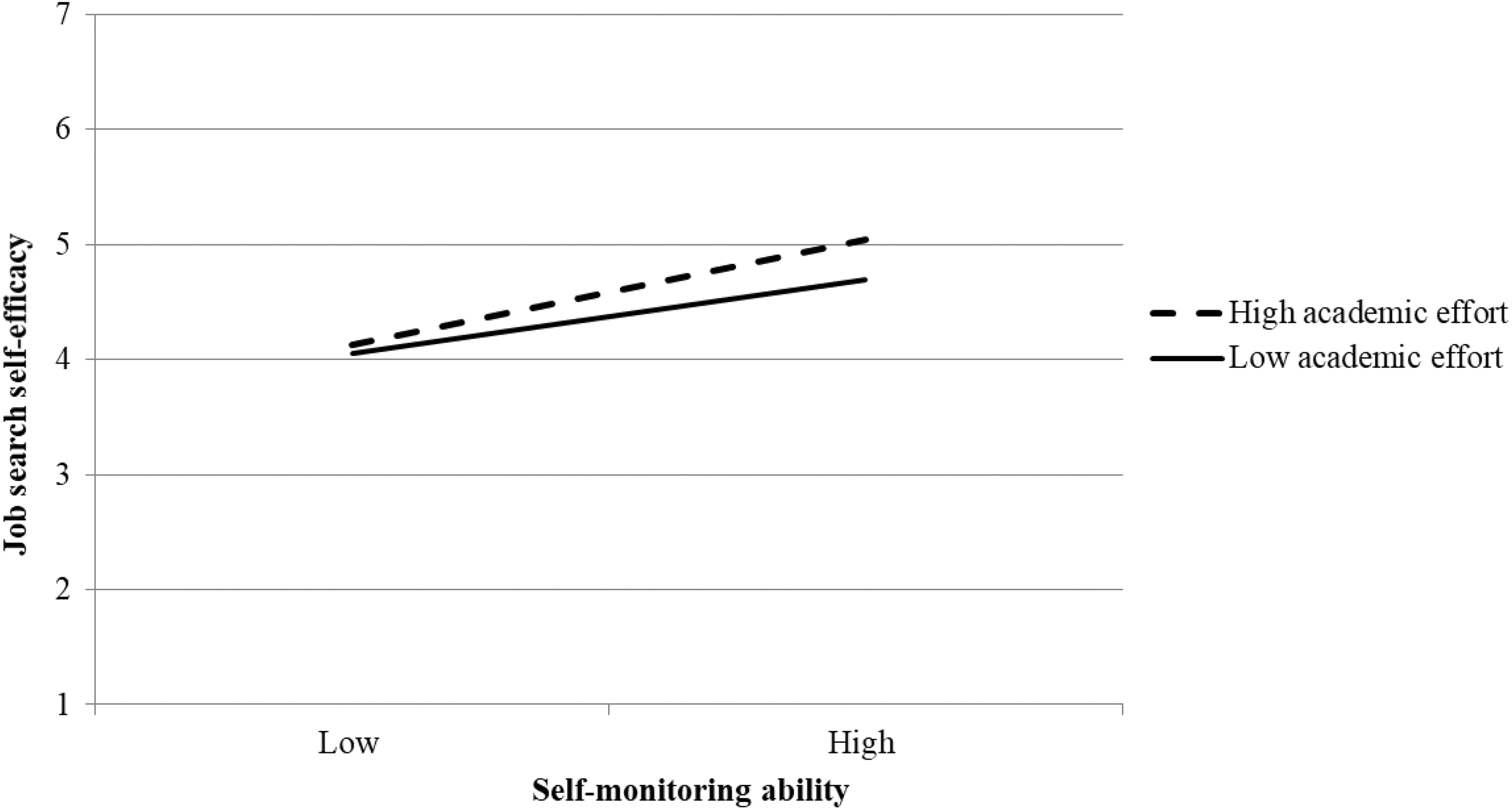
Simple slopes representing the interaction between self-monitoring ability and academic effort in predicting job search self-efficacy in Sample 2.
Further examining the indirect effects at specific values of academic effort (i.e., 1 SD above and below the mean) revealed that the conditional indirect effect of career adaptability on job search self-efficacy via self-monitoring ability was stronger at high (indirect effect = .13, SE = .04, 95% CI [.06, .21]) as opposed to low levels of academic effort (indirect effect = .09, SE = .03, 95% CI [.05, .14]). Given that the CIs do not include zero, Hypothesis 2 was supported.
Supplementary Analyses
As a robustness check, we tested the mediation and moderated mediation models again without control variables (Becker, 2005). In both samples, we observed no differences in the results, indicating that the presence of the covariates did not influence the significance of the results. We also tested the possibility for academic effort to act as a first-stage moderator (i.e., moderating the path between career adaptability and self-monitoring ability). The interaction term was not significant (B = −.01, 95% CI [−.10, .09]). Overall, these results lend further support to the proposed model.
Discussion
Pattern of Results
Consistent with the career construction model of adaptation, the observed pattern of relationships confirms our prediction that self-monitoring acts as an underlying psychological mechanism in STWT. More specifically, career adaptability is positively related to job search self-efficacy via self-monitoring (Hypothesis 1), thus lending support to CCT’s assertion that adaptability resources foster the implementation of adapting responses. Indeed, our present findings correspond with prior empirical evidence that demonstrates the valuable role of self-monitoring in promoting career advancement (Day et al., 2002) and resilience to threatening environments (Inzlicht et al., 2006). Self-monitoring denotes the ability to manage and obtain positive evaluations from professional networks. A desirable career reputation is considered useful because it positively influences the quality of social interactions and advancement opportunities at work (Warech et al., 1998). Moreover, high self-monitors likely consider themselves readily adaptable because their social acuity enables them to confidently adjust and express their behaviors appropriate to situational demands. Similar to career adaptable individuals, high self-monitors possess self-regulation strengths (e.g., behavioral control) and coping resources (e.g., psychological resilience) that help them deal with adverse situations (Inzlicht et al., 2006). In sum, career adaptability and self-monitoring predict job search self-efficacy because they draw upon a strong sense of personal agency to positively influence one’s career development and social relationships. Furthermore, we speculate that self-monitoring is perceived to be adaptive in our current samples of Thai university students since social interactions in Asian and collectivistic cultures are expected to be highly regulated according to its hierarchically organized social structures (Triandis, 1989). Positive self-presentation is particularly highly regarded in collectivistic contexts (Snyder, 1974). These theoretical speculations, however, warrant further empirical investigation.
In addition, the overall results confirm that the positive relationship between career adaptability and job search self-efficacy via self-monitoring is stronger for students with high as opposed to low levels of effort in their academic activities (Hypothesis 2). More specifically, academic effort acts as a second-stage moderator strengthening the positive relationship between self-monitoring and job search self-efficacy. Academic effort reflects an individual’s perceived value of academic tasks, which further determines their intensity of energy and the level of perseverance devoted to these activities (Deci & Ryan, 2003; Trautwein et al., 2009). Indeed, our findings confirm that students are more likely to take interest and persist in career-related tasks because they consider it to be a valuable endeavor and condition to their future career success. Likewise, the results indicate that the perceived value of academic tasks as reflected in an individual’s level of academic effort complements the adaptive function of self-monitoring ability on job search self-efficacy by enhancing the positive relation, thus affirming the role of motivation in career adaptation (Pouyaud et al., 2012; Tolentino et al., 2014). In sum, the extent to which self-monitoring positively impacts job search self-efficacy differs for those with high academic effort compared to those with low academic effort because sustained engagement or persistence exemplified in academic activities prepares students to approach job search tasks in a similar adaptive manner.
Theoretical Implications
The model developed and tested in this article is consistent with a process-oriented view of career development, emphasizing individual adaptation to a changing environment. We add to the growing empirical evidence by supporting the extent of validity and applicability of the CCT career adaptation model and CAAS in non-Western cultural contexts and developing countries such as Thailand. Our research findings inform the CCT perspective in several important ways. Firstly, confirming the positive sequential relation between adaptability and adapting components of the CCT, thereby substantiating the notion that students draw from their adaptability resources or self-regulation strengths (e.g., concern, control, curiosity, and confidence) in performing adapting responses (e.g., self-monitoring and academic effort) relevant to job search as part of their school-to-work transition.
Another important contribution of our article is the integration of self-monitoring theory to offer an explanation for interpersonal flexibility as a career adapting response to job search during STWT. We consider self-monitoring as a socially focused adaptive course of action that favors preparatory job search and STWT because it signifies social awareness and interpersonal relation adeptness. Our current findings support the utility of self-monitoring theory in explaining why career adaptable students feel competent to seek employment and continue navigating an unpredictable job market for opportunities. We maintain that behavioral adjustments exemplified in self-monitoring act as a mechanism of social integration in STWT. Self-monitors tap on their social perceptiveness to build positive social relations that will enable them to find career opportunities or progress in their goal pursuit. Indeed, the role of self-monitoring as an explanatory adapting response confirms the importance of behavior regulation and personal agency in career adaptation. It clearly affirms CCT’s assertion that individuals act as self-regulating agents who proactively shape their career development (Savickas, 2013).
Our findings suggest that academic effort strengthens the expression of adapting responses during STWT. The personal control and persistence exemplified by those with high academic effort complements the adaptive function of self-monitoring in job search, thus affirming CCT’s emphasis on personal agency in career development. Finally, our article also contributes to the literature of career adaptation by explicating how adapting responses, specifically active role management behaviors implemented in STWT, facilitate students’ social integration during STWT. Notably, the confirmation of the present research hypotheses lends support to the conceptualization of career adaptability as a psychosocial resource that prompts the expression of adapting responses to STWT, which implies a dynamic process of adaptation that is relative to the changing nature of the person and environmental contingencies.
Practical Implications
School-to-work transition is the first major work adjustment of university students. We recognize that the quality of students’ initial job search and employment experience will eventually set the trajectory of their career development. Our current findings imply that students undergoing STWT may benefit from higher levels of career adaptability because it boosts a sense of personal agency critical in job search. Primary career guidance for students, as first-time job seekers, involves assessing their career adaptability and adapting responses prior to engaging in job search activities. Indeed, our findings signify that self-monitoring and academic effort are additional critical components to career adaptability for assessment and career intervention aimed toward enhancing job search self-efficacy. It also further substantiates prior validity evidence about the cross-national measurement equivalence and usefulness of CAAS among Thai students and employees (Sibunruang et al., 2016).
To help university students cope better with career challenges, dynamic interventions can be offered to enhance their adaptive capacity and job search self-efficacy during uncertain times. Firstly, helping students tap into their career adaptability resources to execute adapting responses (e.g., self-monitoring) proficiently in a safe environment (e.g., one-on-one counseling or group workshops) and by also emphasizing the practical benefits of academic effort to STWT and overall career development. In addition, participation in internship programs provides authentic career-related information and experiences to effectively thrive in subsequent formal work roles. Internship programs provide a safe learning environment for students to practice the effective use of career management behaviors, such as self-monitoring, because they can obtain immediate and useful feedback from more experienced coworkers and career mentors. Furthermore, an internship program helps develop career adaptability resources by enabling students to become more aware about possible career options that they can pursue after their study (i.e., concern), by enabling them to take on real work responsibilities through the full-time training (i.e., control), by enabling them to work closely with and learn from professionals (i.e., curiosity), and by enabling them to engage in problem-solving tasks to gain relevant practical skills (i.e., confidence). For example, a number of financial institutes in Thailand provide internship opportunities to third-year and final year Thai students who may be coming from any areas of study to learn more about career management and gain practical skills in finance and banking through their full-time training (Siam Commercial Bank, 2018).
Furthermore, a resource-oriented transition model of career counseling may also strengthen university students’ career adaptability and confidence capacity as they prepare to seek employment. This counseling model recommends a guided reassessment of oneself, the career transition situation (e.g., school-to-work transition), available career supports, and application of career strategies with a primary focus on identifying available resources to increase personal agency (Anderson, Goodman, & Schlossberg, 2011). Specifically, a career mind-set is reframed by turning perceptions of imminent transitions from threats to growth opportunities. Consequently, these suggested interventions empower university students to draw from their psychosocial resources and to positively approach school-to-work transition, specifically job search, with improved confidence.
Limitations
This article includes limitations that warrant discussion. First, given that both samples were university students from Thailand, the specificity of the samples examined may limit the generalizability of the results obtained. However, we consider students a relevant sample to study career adaptability and job search self-efficacy as they are new entrants to the workforce. In Study 2, we collected data from a diverse sample (i.e., students from various year levels and program majors) and from a different university to address the limited Business students sample in Study 1. Secondly, the career outcome measured is limited to perceived competence in job search and the preparatory phase of school-to-work transition. Although we recognize that a longitudinal study is more useful in capturing the entire job search process, our current outcome is still relevant in understanding university students at various stages of their study who are preparing to obtain their first employment. Our current focus on job search self-efficacy also addresses the scarcity of empirical evidence about its antecedents. University students, as new entrants to the workforce, are confronted with career uncertainty and difficulties that may eventually cause severe stress and anxiety (Saks, 2014). It is therefore important to also understand how students can prepare and adjust confidently to imminent school-to-work transition. Accordingly, we focused our investigation on career adaptability and job search self-efficacy.
Furthermore, we only accounted for self-monitoring ability since we operationalized it as an adapting behavioral response based on CCT’s model of adaptation. We recommend future research to also explore the motivational aspect of self-monitoring tendency to determine differential career outcomes when compared to self-monitoring ability. We speculate that, unlike self-monitoring ability, the desire to self-monitor may not necessarily translate to proficiency in performing impression management because it only captures willingness and not ability to regulate social behavior. However, further empirical test is warranted to support these theoretical speculations. Lastly, while we have employed two samples and constructively replicated our results, the data were cross-sectional in nature. Hence, inferences regarding causal relationships cannot be assumed between career adaptability, self-monitoring, academic effort, and job search self-efficacy. Nevertheless, the proposed sequence of the variables in our study is in line with the career construction theoretical principles and supported by recent empirical evidence clarifying the temporal ordering of adaptability resources, adapting responses, and adaptation results (Rudolph et al., 2017).
Conclusion
The present pattern of results further substantiates CCT’s career adaptation model (Savickas, 2013), specifically the positive relationship and sequential order between career adaptability resources and adapting responses. Essentially, we provide new insights on the adapting response component of CCT, by examining self-monitoring as an underlying psychological mechanism predicting job search self-efficacy of university students. By integrating the self-monitoring and career construction theories, we shed light on the importance of social awareness and self-regulation capacities in student job search. The findings demonstrated the enabling role of self-monitoring, as interpersonal flexibility associated with gaining positive social evaluations, within a competitive job search environment. Our results also highlight the motivational role of academic effort. It indicates that the positive relationship between career adaptability and job search self-efficacy via self-monitoring is stronger among university students who devote greater investment and perseverance in their academic activities and requirements. We hope that our current findings provide valuable information for career researchers and practitioners on how they can better equip university students in becoming adaptable and confident first-time job seekers as they eventually transition from school into the world of work.
Footnotes
Declaration of Conflicting Interests
The author(s) declared no potential conflicts of interest with respect to the research, authorship, and/or publication of this article.
Funding
The author(s) received no financial support for the research, authorship, and/or publication of this article.