



Abstract
This study investigates the impact of transformational leadership on teaching performance among academic staff at Universities in Wenzhou, China. Focusing on the four dimensions of transformational leadership—idealized influence, inspirational motivation, intellectual stimulation, and individualized consideration—the research examines how these factors influence teaching performance and the moderating role of perceived organizational support (POS). Data from 290 full-time faculty members were analyzed using AMOS software. Results show that all four leadership dimensions positively affect teaching performance, with POS enhancing the effects of inspirational motivation, intellectual stimulation, and individualized consideration, but not idealized influence. The findings offer valuable insights for Chinese higher education leaders to improve teaching performance through targeted leadership practices and contribute to the broader literature on transformational leadership in academic settings.
Keywords
Introduction
Performance is critical for both individuals and organizations, with improvements in staff performance directly driving organizational growth. Research consistently highlights performance as a critical predictor of organizational success and a central focus in studies of organizational outcomes (Pritchard et al., 2008; Sonnentag & Frese, 2002). Effective leadership involves leading high-performance employees and optimizing their contributions, which are essential tasks indicative of a leader’s effectiveness (Armstrong & Taylor, 2014; Bakker & Demerouti, 2008; Yukl, 2013). The rapidly transforming landscape of higher education necessitates robust leadership to drive faculty performance, meeting evolving academic and institutional goals. Transformational leadership (TL)—characterized by Inspirational Motivation (IM), Intellectual Stimulation (IS), Individualized Consideration (IC), and Idealized Influence (II) —has enhanced employee performance across sectors. However, its specific impact on faculty performance in academia remains underexplored. The current study addresses this gap by examining the relationship between TL dimensions and faculty teaching performance (TP) in higher education institutions (HEIs).
Universities need highly competent faculty to ensure effective teaching and learning, aiming to advance knowledge through teaching, research, and community engagement (Yousefi & Abdullah, 2019). University academic staff are responsible for shaping and disseminating students’ scientific knowledge; their leadership style impacts performance, includes research, teaching, and service, and affects students’ achievement. Significantly, China encourages its universities to adopt reforms toward strategic and sustainable goals aligned with those of developed countries. In China’s regional HEIs, the caliber of academic personnel is a significant obstacle to reforms and faculty development and performance present significant constraints. (Li & Wang, 2021). Assessing and enhancing educators are essential for China’s attainment of its 2030 sustainable development objectives (Weng et al., 2019). Addressing these challenges through targeted improvements in faculty capabilities is critical to advancing educational quality and meeting long-term strategic goals. For this reason, in 2018, China’s Ministry of Education (MOE) and other ministries released the “Action Program for the Revitalization of Education” (2018–2022), targeting teaching staff development. On the other hand, leadership, defined as influencing others, is crucial in teaching efficacy. University leaders can improve teaching and learning outcomes by enhancing motivation, skills, departmental culture, and faculty environment through various leadership styles (Ross & Gray, 2006). According to Yang and Li (2019), TL, widely recognized for ensuring effective task fulfillment among corporate team members, requires further study in Chinese HEIs. This leadership style is based on Sun (2013) and is characterized by influence, motivation, intellectual stimulation, and creativity, which can enhance academic staff’s teaching performance and suggest significant improvements in educational settings.
While past research has established a positive correlation between TL and TP (Brouer et al., 2016), a more detailed examination of its specific dimensions is required. Furthermore, Perceived Organizational Support (POS) ‘s moderating role in this relationship must be investigated. POS signifies how employees perceive their organization, appreciate their contributions, and are concerned about their well-being. Elevated POS levels correlate with increased job satisfaction, organizational commitment, and overall performance. These factors can either strengthen or weaken the impact of TL on faculty performance.
Shaped by its historical context and Confucian principles, China’s higher education environment presents unique challenges and opportunities for examining the relationship between TL and teaching activities. This study investigates two core questions: (1) To what extent do the dimensions of TL—namely IS, IM, IC, and II—directly influence TP in HEIs?
(2) How does POS moderate the relationships between TL dimensions and TP? To address these questions, the study proposes four hypotheses regarding the direct effects of TL dimensions on TP and another four hypotheses concerning the moderating role of POS. Understanding these dynamics is crucial for university administrators and policymakers who aim to create an environment that enhances faculty performance and improves student outcomes. The findings have significant academic and practical implications for advancing the quality of higher education in China. This research aims to provide actionable insights for leadership development programs and organizational policies in HEIs by clarifying the interplay between TL, POS, and faculty performance. In doing so, it addresses a critical gap in the existing research.
Literature Review
Transformational Leadership
Transformational leadership emphasizes the development of strong relationships between leaders and their team members to inspire and motivate the team to achieve better performance and morale. Rather than relying solely on charisma or influence, this leadership style encourages leaders to push their teams toward higher levels of performance and innovation (Bass & Avolio, 1994). Unlike the transactional leadership style, TL emphasizes motivating employees to complete work, fostering mutual respect and trust, and creating an atmosphere that supports innovation and collaboration (Northouse, 2016). The theoretical foundation of TL goes back to early leadership theories, especially trait and behavior theories. Trait theory states that leaders’ inherent qualities and competencies significantly determine their success, while behavioral theory emphasizes the importance of leaders’ behavior and interactions with team members (Ronald, 2014). These theories provide a basis for comprehending how leaders influence the behavior and performance of team members through their personality traits and skills that cause them to adopt different leadership styles (Zaccaro, 2007), originating in the 1970s with Burns and later developed by Bass and Avolio, TL was initially applied in political contexts before being introduced to organizations. It emphasizes four main aforementioned components: idealized influence (II), inspirational motivation (IM), individualized consideration (IC), and intellectual stimulation (IS). These components collectively promote collaboration, innovation, and performance, fostering employee satisfaction and organizational success (Bass & Avolio, 1994; Bishop et al., 2023; Mathende & Yousefi, 2021; Samad, 2012; Thamrin, 2012).
Empirical studies have demonstrated TL’s efficacy in enhancing trust, performance, satisfaction, and organizational commitment (Banks et al., 2016; Judge & Piccolo, 2004). According to Raes et al. (2013), TL stimulates innovation among educators and encourages student creativity by developing conducive environments, integrating knowledge, and setting specific goals. Also, the same recent study indicates that TL improves teaching performance, academic research quality, and student satisfaction in HEIs (Al-Husseini et al., 2021). While TL is effective across various fields, it may not be universally applicable. Leaders must adapt strategies to specific organizational structures and cultural contexts (Bass & Riggio, 2006). In Chinese HEIs, leaders face unique challenges and must balance collective and individual needs, requiring cultural sensitivity and cross-cultural communication skills (Zhang & Zhou, 2014). Despite these challenges, TL remains crucial for responding to global competition and advancing educational practices in China.
Leaders in Chinese higher education institutions (HEIs) face significant challenges due to a rapidly evolving landscape influenced by economic, political, and social factors. According to Zhang and Zhou (2014), effective leadership requires balancing institutional goals with the needs of faculty and students while demonstrating cultural sensitivity and cross-cultural communication. The push for global competitiveness further complicates this, requiring teaching, research, and governance reforms. On the other hand, transformational leadership (TL) is vital in addressing these complexities by inspiring faculty, staff, and students to embrace change and work toward a shared vision of continuous improvement (Bass & Riggio, 2006). In China, transformational leaders encourage collaboration, provide innovation, and enhance academic performance while upholding cultural values like collectivism and harmony (Hofstede, 2011).
As Chinese universities strive for global recognition, TL helps align institutions with international standards, driving performance, collaboration, and reputation improvements while preserving cultural relevance (Wang, 2024; Yu & Jang, 2024). The increasing demand for digital innovation, particularly post-COVID-19, adds another challenge. TL supports the adoption of technology-enhanced learning, promoting flexibility and risk-taking while ensuring faculty are prepared for digital transformation without compromising teaching and research quality (Bohari et al., 2024; Chen & Zhou, 2023).
Teaching Performance
Assessing faculty performance, a cornerstone of institutional strategic planning is crucial for evaluating educational quality and effectiveness. Well-performing faculty deliver high-quality education and foster critical thinking, creativity, and teamwork, and this contributes to students’ academic and social development while reducing work stress in private universities (Yousefi et al., 2020).
Additionally, faculty performance directly influences institutional reputation and attractiveness. Top-notch faculty attract students, secure financial support, and create partnership opportunities, which enhance overall institutional performance and impact (Harris & Jones, 2010).
Faculty performance assessment and management have gained heightened attention as educational reform progresses. Traditional faculty performance assessments prioritize metrics like publications, teaching hours, and student evaluations, often emphasizing research output and institutional service (Boyer, 1990). However, novel assessments are more holistic, valuing innovation, interdisciplinary collaboration, and digital engagement (O'Meara & Braskamp, 2005). This shift recognizes diverse roles, such as community engagement and pedagogical innovation, while allowing for flexible, non-linear career paths (Kezar, 2018). Hence, contemporary performance management systems now provide a comprehensive overview of a faculty member’s professional development, continuous learning, and community engagement, extending beyond traditional evaluations focused on teaching and research. These systems recognize the importance of diverse contributions, including mentorship, interdisciplinary collaboration, and societal impact. Factors such as organizational culture, leadership style, resource allocation, and professional development opportunities significantly influence faculty performance (Fullan & Hargreaves, 2012; Hallinger & Heck, 1998; Kezar, 2018).
Moreover, aligning institutional priorities with individual goals is critical for fostering faculty engagement and innovation (O'Meara & Braskamp, 2005; Boyer, 1990). HEIs must support faculty with ongoing professional development to meet modern educational challenges. Modern challenges in higher education institutions (HEIs) include the rapid pace of technological advancements, the shift towards digital and hybrid learning environments, increasing globalization, and the demand for interdisciplinary research and collaboration. Additionally, faculty must navigate evolving student needs, including fostering inclusivity and addressing mental health concerns, while adapting to new educational policies and performance metrics. These challenges require ongoing professional development to ensure that faculty remain effective and innovative in their teaching, research, and leadership roles. A conductive education environment offering additional resources and support promotes faculty performance (Fraser & Taylor, 2019; Sudirman et al., 2021). Skilled faculty can create an ideal learning environment that engages students’ curiosity, sparks passion for learning, and encourages continuous improvement. Quality teaching promotes active student engagement, critical thought, and knowledge retention, resulting in students building essential skills for academic excellence and future career success (Marzano, 2007).
Teaching performance significantly influences HEIs’ reputations, directly associating with teaching quality. Professional development substantially impacts instructional practices, particularly in instructional strategies and assessment methods (Desimone et al., 2002). Institutions emphasizing teaching excellence provide resources, training, and support to improve teaching strategies, assessment methods, and course design.
This investment in faculty development leads to better teaching practices and student outcomes (Gibbs & Coffey, 2004). Teaching performance is also a core component of HEIs’ accountability and accreditation processes that directly impact student learning outcomes, satisfaction, institutional reputation, faculty development, accountability, and student success.
The dimensions affecting teaching performance in higher education are multifaceted, involving individual, organizational, and environmental factors.
Educational background, work experience, teaching methods, and attitudes determine teaching performance. Faculty members’ teaching methods and attitudes impact student interactions and subsequently influence student learning outcomes (Harris & Sass, 2014). Effective leadership providing adequate technical support and training opportunities can help faculty improve their teaching skills and knowledge (Ruslan, 2020).
Transformational leadership’s impact on academic staff performance is significant in China’s cultural and social contexts. Transformational leadership involves linking leaders, employees, and organizational interactions. This leadership style encourages innovation, support, and motivation among faculty, promoting a supportive atmosphere for teaching and learning and significantly improving teaching performance (Sadeghi & Pihie, 2012). Despite transformational leadership’s widespread effect, research remains lacking in Chinese higher education, presenting a valuable direction for future research. Enhancing these factors facilitates teaching performance, creating practical teaching-learning activities requiring appropriate leadership styles.
Interaction Between TL Style & Teaching Performance
The TL style encourages leaders to develop deep connections with their followers to inspire and motivate them to improve overall performance and morale. Historically, research on TL has focused primarily on the corporate sector, but it is now applied in many fields, including education. As mentioned above, Bass and Avolio (1994) state that TL comprises four dimensions, as shown in the conceptual framework below.
Intellectual stimulation (IS) describes how leaders contribute to innovation and learning by inspiring the exploration of solutions among participants and the questioning of established assumptions and views. It stimulates critical thinking and creativity. Day et al. (2016) researched the influence of leadership on organizational behaviors. They suggest that IS plays a vital role in educational contexts. They also indicate that leadership encourages questioning and innovative teaching methods. Jamali et al. (2022) explored how different leadership styles influence faculty performance, particularly IS, in a vibrant academic environment.
They found that educational organizations are more adaptable and practical if leadership emphasizes intellectual development and critical thinking. Andriani et al. (2018) further explored an environment conducive to innovation and steady personal growth. They found that leadership motivates educators to shake off conventional shackles to positively impact teaching methods and education. As a result, the study proposes the following hypothesis (H1):
Intellectual stimulation has a valuable impact on the teaching performance of the academic staff.
Idealized influence (II) stresses how leaders become respected by acting as models through behavior and values. If leaders show high morals and values, employees will be inspired to follow them for higher goals and visions (Bass & Avolio, 1994). Ngaithe et al. (2016) support this idea by suggesting that leaders with II positively influence staff performance. Firmansyah et al. (2022) further explored the connection between II and instructor performance in the educational sector.
They suggested that teachers led by people with idealized solid influence are more content with their job performance. Similarly, Harefa et al. (2022) emphasize that leaders serve as moral example. Therefore, the II could foster an environment suitable for teaching practices. According to Arifin et al. (2014), leaders with high ethical standards and values help create a positive organizational culture for effective teaching and learning. Thus, the hypothesis (H2) is proposed below:
Inspirational Motivation has a favorable influence on the teaching performance of the academic staff.
Inspirational motivation (IM) refers to the intrinsic motivation leaders inject into their team members. The aim is to encourage them to do beyond expectations. This can help create objectives with great significance and direction. Nyamubi (2021) illustrates that school leaders can make teachers more enthusiastic in their jobs through inspiration. Notably, this motivation is based on acknowledgment, and positive reinforcement outstrips the motivation created by financial rewards. Anwar et al. (2020) examine how a supportive and motivating educational environment is created as a result of leadership. A leader can depict an attractive vision and make it a reality. Educators make more significant efforts to drive personal and professional growth by doing so. Based on these insights, the following hypothesis (H3) is formulated:
Individualized Consideration has a beneficial effect on the teaching performance of the academic staff.
Individualized consideration (IC) refers to how leaders contribute to personal and professional growth by providing care and support. If leadership meets individual needs and professional development, it helps create an environment for educators to be motivated in terms of excellent performance and innovation (Jamali et al., 2022). This can ensure that educators feel valued and supported in their teaching engagement and effectiveness. Andriani et al. (2018) suggest that individualized consideration boosts job satisfaction and educational performance. Leaders interested in developing their team members could boost morale and create a productive teaching team. Furthermore, Alzoraiki et al. (2018) reveal that teachers become more dedicated and influential thanks to personalized support from leaders. Consequently, this study proposes the following hypothesis (H4):
Idealized Influence has an affirmative impact on the teaching performance of the academic staff.
Enhancing the role of POS between TL & teaching performance
According to Eisenberger et al. (1986), POS is the extent to which employees believe their organization values their contributions and cares about their well-being. POS influences teachers’ commitment and performance. Stinglhamber et al. (2015) suggest that POS influences followers’ affective commitment. According to research on the moderating role of POS in education, POS can significantly improve the nexus between leadership styles and their outcomes. Hoch et al. (2018) reveal that TL positively influences employee performance and dedication due to POS. Therefore, the effect of TL depends on teachers’ POS.
The connection between TL and POS indicates that leadership directly influences teaching performance. It also interacts with teachers’ POS. This interaction is also explored by Wang (2022). The author suggests that TL and high POS make employees more creative and show better performance. It is proposed that POS determines the effectiveness of TL.
Moreover, Song et al. (2013) discuss how TL fosters knowledge-creation practices in an organization, indicating that TL helps create a conducive environment for knowledge-sharing and innovation among teachers through inspirational and intellectual stimulation. For instance, according to Bachtiar et al. (2018), idealized influence, under which leaders serve as ethical models, significantly impacts teaching performance in environments where teachers perceive high organizational support. Purwanto (2020) reached a similar conclusion.
They indicate that inspirational motivation improves teaching strategies and classroom outcomes when teachers feel they receive enough support from their institution. Under POS, teachers are spurred to question established assumptions. They are also encouraged to try new methods (Chi et al., 2014). So, it can be said that an organization with greater POS can make teachers open to new approaches.
Furthermore, Wulandari et al. (2023) suggest that individualized consideration and personalized support for teachers help with professional development and teaching performance. The following hypotheses are proposed according to the above insights:
Idealized influence enhances the relationship between transformational leadership and teaching performance.
Inspirational motivation enhances the relationship between transformational leadership and teaching performance.
Intellectual stimulation enhances the relationship between transformational leadership and teaching performance.
Individualized consideration enhances the relationship between transformational leadership and teaching performance.
The past studies on TL within educational settings stress its positive impact on teaching performance and the beneficial role of POS. However, the literature reveals a gap in understanding how POS moderates the relationship between TL dimensions and teaching performance, particularly in Chinese education. This study seeks to address this gap by examining the intricate dynamics between these variables to offer a new layer of insight into effective leadership practices and potentially enrich the global discourse on educational leadership.
Methodology
Participants and Data Collection
This study utilizes scales adapted from prior research to ensure consistency and validity within the model. For exogenous variables, we employed the Transformational Leadership Questionnaire (TLQ) structure, adapted by Chaoping and Kan (2008) from Bass’s questionnaire, incorporating four variables and utilizing a 5-point Likert scale. Additionally, the study includes POS as a critical variable, based on the work of Eisenberger et al. (1997), measured using a 7-point Likert scale to assess participants’ perceptions of organizational support. The endogenous variable, teaching performance, was measured by Moeller (2009), evaluating participants’ self-assessed performance in teaching activities. The target population for data collection comprised full-time faculty members at public universities, including normal, vocational, and Sino-foreign structures in Wenzhou, China. A simple random sampling approach was employed, with the questionnaire designed and distributed through an electronic platform. Faculty members were invited to participate via email to ensure equal participation opportunities across universities. Before conducting a pilot test, the Teaching Performance scale was translated from English to Chinese and subjected to content validity verification by five experts, including researchers, translators, and faculty members.
Data Analysis
Data analysis was conducted in two phases: first, Confirmatory Factor Analysis (CFA) was conducted to assess structural validity, while the internal consistency reliability was assessed through Cronbach’s alpha coefficients. Next, structural equation modeling (SEM) tested the hypothesized relationships to provide insights into the strength and direction of the relationships between TL dimensions, POS, and TP. Moderation analysis was conducted using interaction terms to examine the moderating effects. These analyses ensured the validity and reliability of the measurement model and the structural model’s robustness and explanatory power, which provided a solid foundation for further analysis.
Results and Findings
Profiles of Respondents.
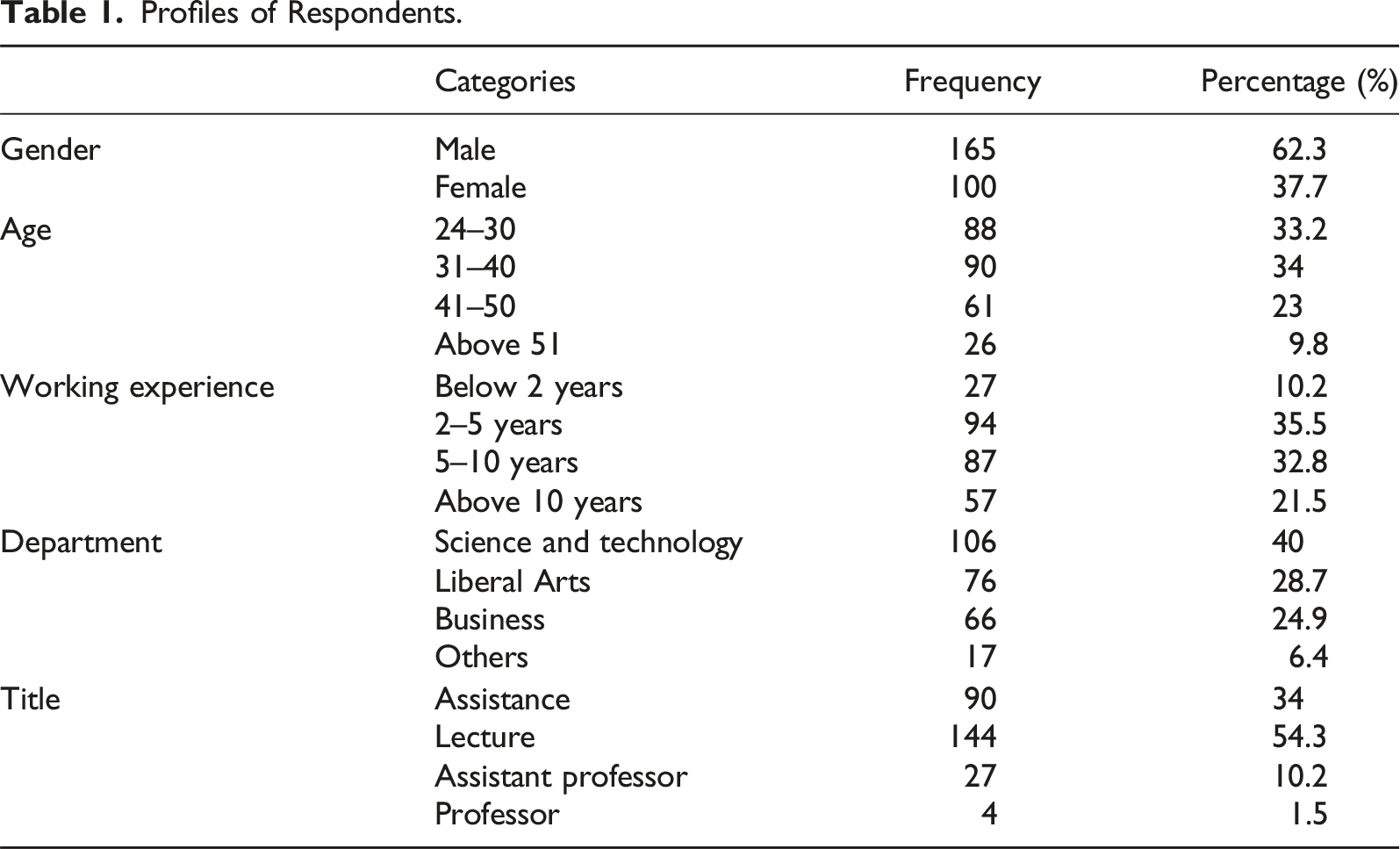
Confirmatory Factor Analysis & Normality Test
Evidence supporting the construct validity of the TLQ was substantiated through the execution of Confirmatory Factor Analysis. Furthermore, Harman’s Single-Factor Test was utilized to examine the potential issue of bias, as recommended by Podsakoff et al. (2012), to evaluate the existence of common method bias in data collected from a single source. Specifically, the highest variance attributed to a single factor was 12.47%, which falls below the 50% threshold.
Confirmatory Factor Analysis (CMV).

Normality Test.

Reliability of the Latent Constructs
Descriptive Statistics.

Measurement Model
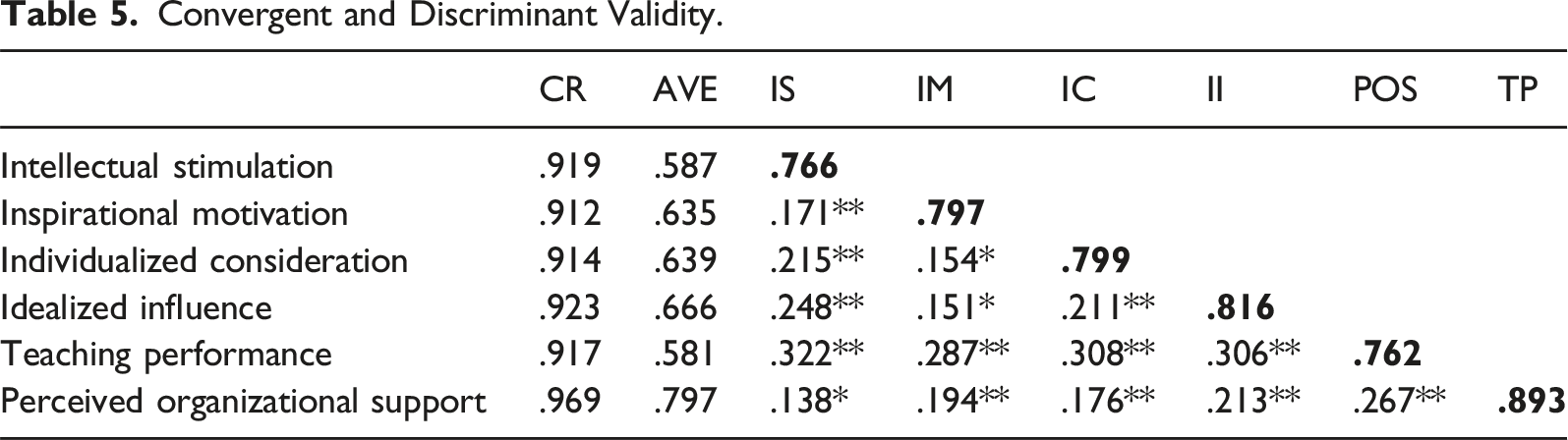
Convergent and Discriminant Validity
Subsequent to the descriptive statistics analysis, CFA was utilized to verify that the observed variables effectively represented their underlying latent constructs, with factor loadings exceeding the 0.6 thresholds.
Convergent validity was evaluated by computing the Average Variance Extracted (AVE). As outlined in the accompanying table, the composite reliability (CR) and AVE metrics for each construct were calculated. The CR values across the constructs ranged from 0.912 to 0.969, and the AVE metrics varied from 0.581 to 0.797. Following the criteria established by Hair et al. (2010) and Straub et al. (2004), all constructs demonstrated CR and AVE metrics that exceeded the advised minimums of 0.7 and 0.5, respectively.
Convergent and Discriminant Validity.
Model Fit
Model Fit Indices.

These fit values follow the standards proposed by Byrne (2016) and Hooper et al. (2008) and confirm the model’s adequate representation of the observed data.
Path Analysis
As mentioned above, AMOS 26 was adopted to perform the measurement model in the first phase and, afterward, assess the path analysis with the structure model analysis to figure out the results of the proposed hypotheses in this study. Figure 1 shows the model with all four hypotheses included, and the arrows indicate the regression weights. The details of the hypotheses are outlined in Table 7. In the path analysis, all four variables exhibited significant positive associations with teaching performance. Specifically, IS (β = 0.286, p < .01), IM (β = 0.207, p < .05), IC (β = 0.451, p < .001), and II (β = 0.249, p < .05), were resulted to have a positive effect on teaching activity, with IC having the most pronounced effect (Table 8). Conceptual framework. Structural Model Results. Notes: IS = Intellectual Stimulation, IM = Inspirational Motivation, IC = Individualized Consideration, II = Idealized Influence, TP = Teaching Performance. Path Analysis (Moderation). Notes: IS = Intellectual Stimulation, IM = Inspirational Motivation, IC = Individualized Consideration, II = Idealized Influence, TP = Teaching Performance, POS = Perceived Organizational Support.


The study examined the moderating effects of POS on four impact pathways by constructing interaction terms as proposed by Ping (1995) and Liu (2019). The results presented in Table 7 reveal that POS significantly enhances the positive impact of IM, IS, and IC on TP, as evidenced by the supported hypotheses (H5, H6, and H7) with respective path estimates of 0.125, 0.164, and 0.142, and p-values underscoring statistical significance (p < .05). Conversely, the Idealized Influence (II) dimension, when moderated by POS, does not exhibit a significant effect on TP, as indicated by the unsupported hypothesis H8 (β = −0.091, p > .05).
A moderation effect graph was constructed using the method proposed by Preacher et al. (2006). Figure 2 illustrates the positive moderating effect of POS on how IS influences Teaching Performance. Specifically, for academic staff with high POS (one standard deviation above the mean), the impact of IS on Teaching Performance is more pronounced; conversely, for academic staff with low POS (one standard deviation below the mean), the influence of IS on Teaching Performance is comparatively weak. Similarly, the same generalization could be applied to IM and IC. Thus, Hypotheses 5, 6, and 7 are supported. Moderation graph.
Discussion
This study proves that transformational leadership (TL) positively impacts teaching performance in higher education institutions (HEIs) in China, specifically within Wenzhou’s educational framework. The results affirm the broader literature’s assertions that TL improves employee performance across various sectors (Banks et al., 2016; Judge & Piccolo, 2004). In line with Al-Husseini et al. (2021), this study’s findings confirm that the key dimensions of TL—Intellectual Stimulation (IS), Inspirational Motivation (IM), and Individualized Consideration (IC)—all contribute to enhanced teaching performance. However, our study extends the understanding of TL’s role in education by highlighting the moderating effect of Perceived Organizational Support (POS), which plays a crucial role in amplifying the positive influence of TL on teaching performance in Chinese HEIs. Notably, Individualized Consideration (IC) emerged as the most influential dimension of TL in this study, diverging from Western-centric findings where Inspirational Motivation (IM) is typically highlighted as the most significant factor. This discrepancy may be attributed to China’s collectivist culture, which emphasizes relational leadership, mentorship, and group harmony (Hofstede, 2011).
In Chinese academic settings, where leaders are expected to nurture and provide personalized support to faculty, the prominence of IC aligns with cultural preferences for fostering strong, individualized relationships between leaders and their subordinates. This cultural specificity stresses the importance of understanding how leadership effectiveness is shaped by the cultural environment in which it is practiced. While IC reflects the importance of cultural alignment in leadership, the findings also reveal the practical significance of other dimensions, such as IM, in driving teaching behaviors. For example, IM fosters intrinsic motivation and a shared sense of purpose among faculty, which can be pivotal for encouraging innovative teaching methods. Even seemingly modest coefficients, such as IM (β = 0.207, p < .05), suggest meaningful implications for real-world leadership behavior. A 0.1-point increase on a 5-point Likert scale could lead to improved teaching strategies, enhanced student engagement, or more effective collaboration among faculty members. When supported by an organizational climate that fosters innovation and collaboration, these incremental changes have the potential to elevate academic quality and organizational outcomes.
Beyond these individual dimensions, the broader organizational climate, as shaped by POS, further amplifies the effects of TL practices. The moderating role of Perceived Organizational Support (POS) is another significant contribution of this study. The findings show that POS strengthens the positive effects of TL dimensions—particularly IC, IS, and IM—on teaching performance, emphasizing the importance of a supportive organizational climate. As Eisenberger et al. (1986) described, POS refers to the degree to which employees believe their organization values their contributions and cares about their well-being. When faculty members perceive high organizational support, they are more likely to respond positively to leadership efforts, resulting in higher performance. This suggests that leadership development programs in Chinese universities should focus on fostering transformational leadership skills and creating organizational policies that increase perceived support for faculty. University administrators and policymakers should prioritize building a supportive environment that recognizes and values faculty contributions. This approach would enhance the effectiveness of TL and ultimately improve teaching performance.
In addition, this study reinforces the global discourse on TL’s positive impact on performance while offering new insights into how cultural context and organizational support modulate these effects. Developing leadership strategies that align with cultural values and enhancing organizational support mechanisms are crucial for optimizing faculty performance in Chinese HEIs.
Limitations and Future Research
Despite the significant contributions of this study, it is essential to acknowledge certain limitations. One fundamental limitation is the geographic specificity of the sample, which may restrict the generalizability of the findings beyond the context of Chinese higher education. However, studying Wenzhou’s diverse academic universities, including public and Sino-foreign universities, provides a comprehensive understanding of the local educational landscape. Future research should aim to replicate the study across broader and more diverse geographic contexts to assess the generalizability of these conclusions globally. Additionally, while this study focuses on the relationship between TL and teaching performance, other factors, such as research productivity and service activities, warrant further investigation to provide a more holistic view of faculty performance.
Furthermore, educational institutions can leverage TL more effectively to elevate faculty performance by considering these cultural and contextual nuances. Exploring POS and its long-term effects will also provide a more comprehensive understanding of the dynamics between leadership and performance in academic settings.
Implications of the Study & Conclusion
This study shows that TL practices can significantly increase professors’ teaching performance. Leaders who exhibit ideal influence act as role models and inspire faculty members to adopt high standards of teaching excellence (Bass & Avolio, 1994). Inspirational motivation encourages teachers to engage more deeply with their work and foster a more passionate and committed approach to teaching. Intellectual stimulation promotes innovation in teaching methods and enables faculty to explore new instructional strategies and improve student outcomes (Leithwood & Jantzi, 2006). Individual consideration ensures that faculty members feel valued and supported, which can increase their job satisfaction and teaching effectiveness (Podsakoff et al., 1990). The moderating effect of POS suggests that the nexus between TL and teaching performance is strengthened when faculty members perceive high levels of support. This highlights the significance of building a supportive environment where faculty feel their contributions are recognized and valued (Eisenberger et al., 1986). University leaders, administrators, and decision-makers should focus on developing policies and practices that foster POS, such as providing professional development opportunities, recognizing and rewarding teaching excellence, and ensuring fair and transparent communication. Additionally, university leaders must implement TL practices while fostering a supportive organizational culture. This dual approach can create a synergistic effect and significantly improve teaching performance. Administrators should also consider training programs for department chairs and other leaders to develop leadership skills and enhance their ability to support faculty effectively (Hoch et al., 2018). In addition, policymakers should consider integrating these findings into broader educational reforms. By promoting TL and increasing institutional support, universities can improve the quality of teaching, which is critical to student success and the overall development of higher education in China.
Footnotes
Declaration of conflicting interests
The author(s) declared no potential conflicts of interest with respect to the research, authorship, and/or publication of this article.
Funding
The author(s) received no financial support for the research, authorship, and/or publication of this article.
