



Abstract
International collaboration for sustainable development is increasingly crucial in the face of global environmental challenges. This article presents a conceptual framework and relevant approaches for such collaboration, focusing on the Third Space—a dynamic arena where diverse cultures converge, contest, and cooperate. Drawing on a China-US sponge city exchange as a case study, the article explores how language and communication, relationships and culture, team performance and policies, and technology and outreach intersect in the pursuit of sustainable urban development. Through autoethnographic analysis grounded in pedagogical theories and real-world experiences, the study elucidates key themes and strategies for successful international collaboration, answering the question “how can international teams better collaborate towards sustainable development?” The resulting conceptual framework provides valuable insights for practitioners, policymakers, and researchers seeking to navigate the complexities of sustainable development across international borders.
Introduction
In recent decades, there has been a shift from conventional urban drainage systems towards ones that prioritize the mutual benefits of both human society and the natural environment (Mitsch, 2012; Nguyen et al., 2019). As different regions around the world have adopted these modern urban drainage practices that integrate engineering and ecological objectives, local terminology for them have emerged (Fletcher et al., 2015; Perrelet et al., 2024). While the term “green infrastructure” emerged from the United States (US), it is used globally to describe the concept and process of designing, installing, and maintaining multifunctional urban drainage systems that not only mitigate urban flooding, but also provide economic, sociocultural, and ecological co-benefits (Fletcher et al., 2015; Kim & Song, 2019). Locally to China, the term “sponge city” has emerged to describe China’s modern urban drainage system strategy.
A direct translation from hǎimián chéngshì (海绵城市) in Mandarin, the goal of sponge cities is to update urban drainage system design to encourage water infiltration, detention, retention, purification, and reuse, while also providing other co-benefits (Yin et al., 2022; Zevenbergen et al., 2018). Wetlands, green roofs, and bioretention (an engineered rain garden) are examples of specific technologies being integrated into China’s urban drainage system through the sponge city concept (Nguyen et al., 2019). Chinese sponge city development commenced in 2012, followed by the construction of 30 pilot sponge cities in 2015 and 2016. Now, 60 sponge city demonstration cities are being implemented at the national scale between 2021 and 2025 (Guo et al., 2024; Yin et al., 2022).
As sustainable development, sponge cities foster resilient urban environments by harmonizing urban development with the needs of city dwellers and ecosystems. A systematic literature review suggests that integrating nature into cities through green infrastructure projects, such as sponge cities, worldwide may achieve all 17 of the United Nations Sustainable Development Goals (SDGs) and 74 of 169 (44%) of its targets (Lombardía & Gómez-Villarino, 2023). Achieving such a feat requires transnational, interculturally competent (1) partnerships among countries, sectors, and actors (2) educated for sustainable development and (3) collaborating in the Third Space (each defined in the following paragraph; Caniglia et al., 2018; Eweje et al., 2020; Pattberg & Widerberg, 2016; Stafford-Smith et al., 2017).
Partnerships and a spirit of collaboration between techno-scientific and engineering sciences and social sciences and humanities are needed to achieve the SDGs on a global scale (Ruano-Borbalan, 2024). Education for sustainable development aims to equip every human, especially young learners, with the knowledge, skills, and values necessary for a sustainable future, emphasizing action-oriented engagement in sustainable development (Yuan et al., 2024). The Third Space, proposed by Bhabha (1990) as a postcolonial sociolinguistic theory, is an ambiguous area that develops when two or more individuals/cultures interact, and it can be applied to many contexts (Leonard et al., 2024). “Third Space… where different cultures converge, contest and cooperate; where expectations for the actors and interpretations of their actions do not entirely or constantly conform to the assumptions and norms of one culture but dynamic and fluid, motivated by specific goals of the interaction in question and negotiated among involved actors; and where the cooperative interactions of the actors’ emerging multilingual and transcultural personae are made possible by, and in turn, continue to co-construct the multilingual and transcultural Third Space that is continuously becoming” (Jian, 2020, p. 8).
Few works have explored how advanced-level Chinese language learners establish domain expertise in the Third Space and their motivations for doing so (Jia, 2017, 2020). Fewer, if any, provide a first-hand account of an advanced-level Chinese language and culture learner’s process of and motivation for establishing domain expertise about sustainable development in the Third Space. To address this gap, the foundation for this article is a first-hand account of a noteworthy international collaboration for sustainable development -- a China-US bilingual, bicultural team working in the Third Space towards sponge city sustainable development. This article examines the research question “how can international teams better collaborate towards sustainable development?” The objective of this research is to identify and describe effective strategies for enhancing international collaboration for sustainable development.
Methods
Data collection
Data collection occurred through a method grounded in non-positivist paradigm called autoethnography. In autoethnography, the author treats their own experiences as the primary data source, and the act of writing serves as the means through which they conduct data analysis and derive meaning (Liu, 2022). The Ohio State University Office of Responsible Research Practices determined this research method to not be human subjects research requiring institutional review. Despite being an emerging method in educational research, autoethnography can be rigorously conducted with available guidance. Following the guidance of Chang (2016), I first collected textual data, such as my Chinese MA thesis (Smith, 2021; written in Mandarin) and the daily journals from my time as a Senior Visiting Scholar at Wuhan University, and non-textual data, such as discussions with former teachers and revisiting photo- and video-documentation of milestone moments (e.g., Figures 2–4 and Supplemental Materials). Next, I systematically organized the collected data into a timeline and wrote a self-narrative about my journey learning Chinese as a foreign language, transition from learning the foreign language to learning domain knowledge about sustainable development in the foreign language, and experience collaborating internationally for sponge city sustainable development.
Data analysis
Two predominant pedagogical approaches from my foreign language and sustainable development educations were used to guide analysis: the Performed Culture Approach (PCA) and experiential learning, respectively. PCA, an innovative language pedagogy method, integrates language and culture instruction through scripted cultural performances. Emphasizing contextual language learning through events like acted-out dialogues and games, it engages learners and creates authentic language experiences. Its learner-centered, performance-based, and culturally integrated learning by doing distinguishes PCA from traditional language teaching methods (Walker, 2000; Yu et al., 2020). In parallel, experiential learning is a dynamic pedagogical approach that emphasizes learning through firsthand experiences and active engagement; it emphasizes the cyclical nature of learning, where individuals engage in concrete experiences, reflect on those experiences to extract meaning and understanding, conceptualize new ideas or concepts based on their reflections, and then apply these concepts in new situations, thus continuing the cycle of experiential learning (Kolb, 2014). Used as a lens for data analysis here, the PCA is a form of experiential learning, supporting the performative, iterative processes needed for sustainable development in the Third Space.
Data interpretation and supporting frameworks
A conceptual framework comprised of eight themes emerged from the data (Figure 1). Illustrated by the seesaw (adapted from Yuan et al., 2024), each theme is essential to bridge teams working across international borders. The black and white in the Yin-Yang symbol denotes where cultures converge in the Third Space. The people symbolize individuals from various cultural backgrounds collaborating, while the globe signifies a sustainably developed world. As Yin harmonizes Yang, and vice versa, a sustainably developed world supports people of all cultures, and cross-cultural collaboration supports a sustainably developed world. “Guiding international collaboration for sustainable development in the Third Space” conceptual framework.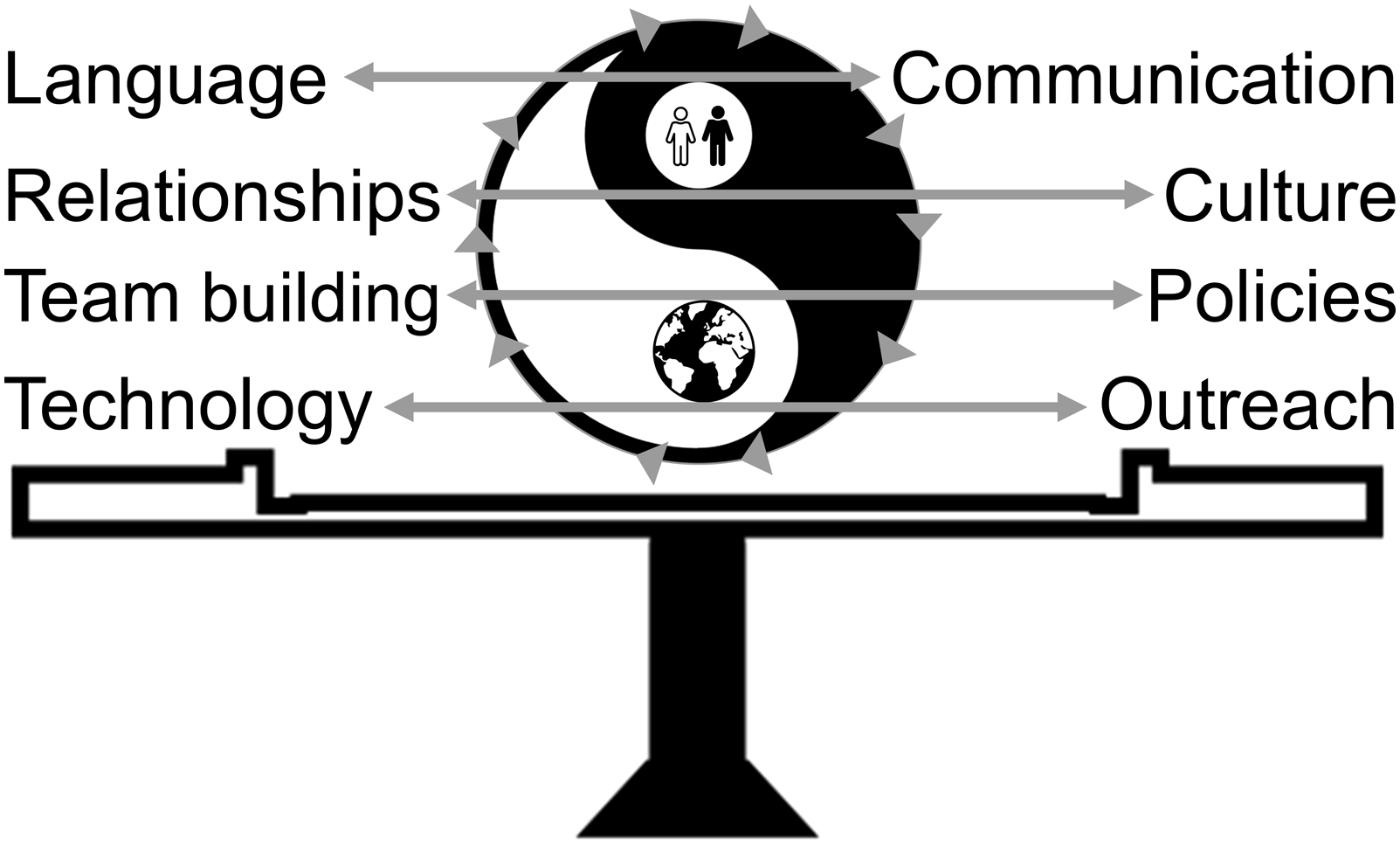
comparing several conceptual frameworks international for collaboration for sustainable development, how they emerged, and their groupings and approaches.
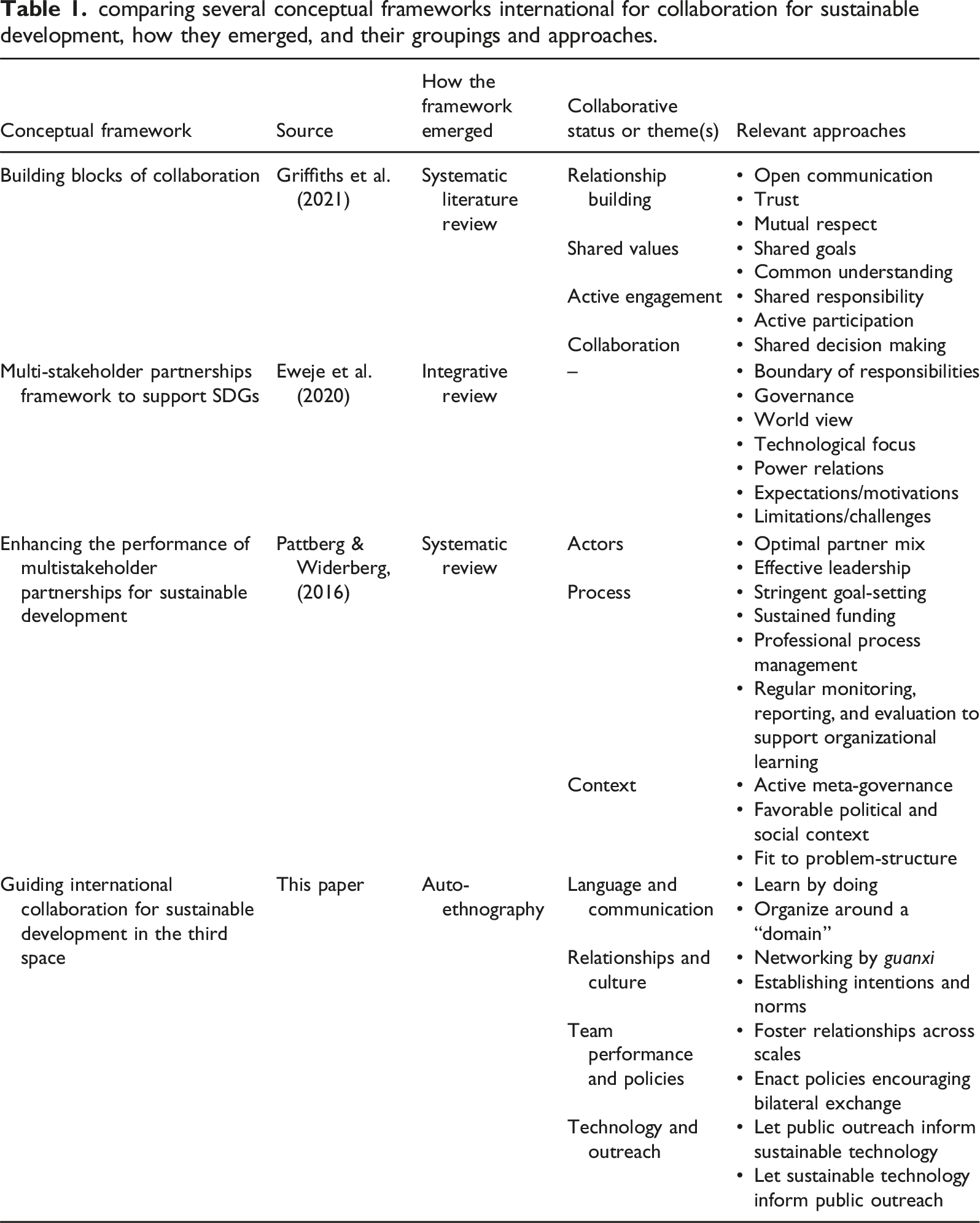
Other work documents putting sustainability programs and conceptual frameworks into practice. Yuan et al. (2024) found their Green School Program to be an effective tool in educating for sustainable development to achieve the SDG in 98 primary and secondary schools in Beijing. Their findings highlight the importance of policy, learning environments and classroom norms, and local contexts. Luo and Li (2024) applied the Inclusive Pedagogical Approach in Action evidence-based framework, concluding that multi-stakeholder collaborations, tailoring solutions to local contexts, and respecting diversity were among the most important for inclusive education in China. In their glocal – a combination of the words global and local – model for transnational collaboration for sustainability, Caniglia and colleagues (2018) fill gaps related to the theory and practice of higher education for sustainable development. They highlight universities as an underutilized opportunity to teach sustainability competencies in local and global contexts.
The conceptual framework presented herein is the result of universities teaching sustainability competencies locally and globally through theory and practice. It arises from the process of organizing and coding the autoethnographic dataset into themes, known as fracturing, which is part of the data interpretation process (Chang, 2016). As such, using two-way arrows in Figure 1, I have joined the eight themes into four couplings that are interdependent, each reinforcing and improving the other. These couplings are the foundation for the discussion about international collaboration for sustainable development in the Third Space that follows: • Language and communication: Proficient language skills facilitate effective communication. Effective communication fosters mutual understanding and a common language for sustainable development. • Relationships and culture: Strong relationships contribute to the development of a shared culture of collaboration for sustainable development. Effective participation in a culture opens avenues for building new relationships, fostering teamwork towards shared sustainable development goals. • Team performance and policies: The positive outcomes produced by such teams lead to more pro-collaboration policies. Such policies promote the high performance of international teams collaborating for sustainable development. • Technology and outreach: Technological advancements drive sustainable development, benefiting both nature and people. Outreach efforts inform people about sustainable development technologies, soliciting feedback that, in turn, enhances the technology.
Themes and relevant approaches
Language and communication
I am a final-year PhD candidate researching green infrastructure for sustainable development who has been a Chinese language learner for 20 of my 23 years in the US school system. While most US students typically begin their language studies in middle or high school, with Spanish and French being the most commonly studied second languages (Pufahl & Rhodes, 2011), I embarked on my Chinese language journey during third grade in elementary school. This early start was facilitated by graduate student volunteers from the Ohio State University’s (OSU) Midwest US-China Flagship Program, the same program from which I would later earn my Chinese MA fifteen years later, who came to my elementary school to teach me using PCA.
Learn by doing
I have fond memories of my formative years learning Chinese language and culture. My first Chinese lesson in third grade included painting a dragon mask, wearing it, swaying side to side, and chanting gong hay fat choy, xīnnián kuàilè, which are wishes for good fortune and a happy lunar new year in Cantonese and Mandarin, respectively. The previous sentence’s verbs of painting, wearing, swaying, and chanting embody the learn by doing I experienced in my first lesson through the PCA. Subsequent lessons were full of learning by doing through songs, games, performed dialogues, and class meals. From a pedagogical perspective, music, games, and other active learning has many benefits (Li, 2018; Wang, 2020) that I believe sustained motivation to continue studying Chinese for two decades.
Continuing to learn Chinese as a foreign language continuously from third grade, distance-learning through the local high school during middle school, in-person high school classes, traveling to China for two 2-week tour trips organized by my high school, and even taking some classes at OSU as a senior in high school. I entered OSU as an ecological engineering and Chinese double major having completed Chinese 2151.51 – level two (see Jia, 2017, p. 230 for the full eight levels of OSU Chinese language curriculum that I have completed). As a busy double major studying sustainable development and foreign, the only way I was able to complete my coursework was through individualized instruction courses. For individualized instruction, students were expected to use course pedagogical materials to independently prepare for a fifteen-minute, one-on-one session with an instructor. Between zero and seven sessions could be scheduled per week. These courses improved my language skills to a fluency where I was prepared for the “‘critical period’ of transiting from ‘learning the language’ to ‘learning in the language’” (Jia, 2017, p. 28 and ch. 3).
Organize around a “domain”
During this “critical period,” there was a curriculum shift from being provided a context in which to learn Chinese to being able to select the context around which I organized my Chinese studies - a domain. This domain provided me not only with an invisible Third Space to organize my studies around, but also provided me with a community-based setting – Wuhan – serving as a context for my situated learning (Leonard et al., 2024). I traveled to Wuhan for a month and learned that China and the US were both adopting green infrastructure for sustainable development. Therefore, I selected my domain to be sponge cities. The hallmark of domain studies in PCA is the domain studies course (Chinese 7671.51 and 7672.51 in Jia, 2019, p. 230), which consisted of two one-on-one classes and a presentation class all in Mandarin every week. Ultimately, I was supposed to study abroad in Wuhan as the second portion of my domain studies experience. This was prevented by the COVID-19 pandemic, but collaboration continued online until international travel was allowed. The domain studies course and study abroad experience are the PCA as experiential learning. One-on-one classes would prepare me for the presentation class, I could reflect on my previous presentation in the next one-on-one class, and the iteration continued.
The culmination of my domain studies course was writing and defending my Chinese MA thesis all in Mandarin (see Smith, 2021 for my thesis, and Supplemental Materials S1–3 for videos shown during my defense). The first chapter explores Wuhan residents’ opinion about and knowledge of sponge city infrastructure to guide the engineering and social dimensions of sponge city sustainable development. The second chapter critically reflects on the mistakes made and lessons learned from collaborating in the Third Space for sustainable development. This project was made possible only by existing relationships that led to teambuilding and my abilities to perform in Chinese culture.
Relationships and culture
While conducting field work on bioretention installed for sustainable development in a neighborhood just north of OSU, I experienced residents who opposed and even protested these engineered rain gardens (Parks, 2017). I did not experience such opposition to rain gardens during my time in Wuhan. Curious about Wuhan residents’ experience with sponge city development, I conducted an online questionnaire, which found that Wuhan residents were generally supportive of sponge cities. However, conducting such research on sustainable development in the Third Space requires team building and formation.
Networking by guanxi
“In order to form teams, investigators must first be able to find each other” (Weber & Yuan, 2019). In my opinion, the most effective networking tool in a Chinese context is guānxì (关系), which translates directly as “relationships,” but implies “connections” in context (Mancl, 2010). Being linked with my host professor in China involved five degrees of separation. As a new student at OSU, my mother accompanied me into the foreign language publications bookstore to purchase my Chinese pedagogical materials. The bookstore manager recognized my mother due to her curly hair, and it happened that her son and I had attended the same preschool. The bookstore manager via recognizing my mother, introduced me to Professor Galal Walker who served as my Chinese MA advisor at OSU, who introduced me to Professor Minru Li who served as my cultural coach collaborating with China in the Third Space, who finally introduced me to Professor Xiang Zhang, Professor and Director of the Experimental Center of Hydrology in the State Key Lab of Water Resources and Hydropower Engineering Science at Wuhan University who would serve as my host- and collaborating-professor in China. In my case, networking by guanxi and ultimately forming a collaborative team for sustainable development followed:
Me → my mother’s curly hair → bookstore manager → Professor Walker → Professor Li → Professor Zhang
Establishing intentions and norms
Now that the connection had been made, I sought to demonstrate to Professor Zhang that I was capable of meeting him in the Third Space to collaborate on sponge city sustainable development. To do so, I filmed a self-introduction video (Supplemental Materials S1) not only showcasing my bilingualism, biculturalism, and domain knowledge of China’s sponge cities, but establishing my intended thesis topic. Professor Zhang responded warmly, expressing a willingness to collaborate on my proposed thesis topic. Since my proposed thesis topic bridged the social and natural sciences, Professor Zhang invited colleagues of interdisciplinary backgrounds to join our team. I did the same by introducing Professor Zhang and his team to my OSU network, including my PhD advisor, Professor Ryan Winston. We collaborate to create a questionnaire about resident perspectives of bioretention in sponge cities (Smith, 2021, pp. 47–72). Following the process of team development, our team had formed and was norming (Tuckman, 1965).
Storming and unexpected obstacles, such as few respondents to the questionnaire, were inevitable. Given we had formed a team of sponge city and foreign language pedagogy experts in the Third Space with a shared passion for ameliorating storms, we quickly overcame such obstacle through/to perform. To resolve the issue of few questionnaire respondents, the team recommended I film a video introducing myself and the questionnaire’s objectives (Supplemental Materials S2). Realizing that I was a dedicated Chinese learner, people were willing to participate in my questionnaire, and respondent numbers quickly rose to 300.
Team performance and policies
While the social perspectives questionnaire project was the initial project that linked our team, our OSU-Wuhan University team has collectively accomplished many achievements since then. During a virtual celebration in January 2021, with program leaders from both sides in attendance, I officially invited Professor Zhang to be my teacher by asking him to join my OSU PhD committee. Together, we have co-created public outreach videos to educate the public about bioretention in the China and the US (Supplemental Materials S3), jointly published academic articles (Guo et al., 2024; Zhao et al., 2023) with more forthcoming, constructed and monitored bioretention cells together, received multiple grants to continue our work, and hosted bilateral travel every six months. Our successful collaboration in the Third Space has been made possible by fostering relationships across scales and enacting policies to encourage bilateral exchange.
Foster relationships across scales
“Leveraging educational influence and leadership can bring together families, communities, schools, educators, and policymakers to promote sustainable development” (Yuan et al., 2024). Following my initial person-to-person linkage with Professor Zhang, more and more of his students began joining our biweekly meetings. He was introducing me to my shī xiōngdì jiěmèi (师兄弟姐妹). Shī means “teacher,” and xiōngdì jiěmèi means “brothers and sisters” – my siblings through our shared teacher – or “lab mates”, as we say in the US. Team-to-team relationships were built with a uniting goal of tiān rén hé yī, meaning “restoring harmony between nature and mankind,” through sponge city sustainable development (Figure 2). Arriving upon such a culturally situated goal was only made possible by operating in the Third Space. Through our cultural learning, we discovered the deeply rooted world wisdom traditions that unite our team– “a profound connection not only with ourselves but also with one another and Mother Nature [that] would lead to peace and stewardship of the Earth” (Lin, 2024). (a) From left to right, me, Professor Ryan Winston, Professor Xiang Zhang, and Professor Minru Li co-create calligraphy in Wuhan (b) and then pose with the framed calligraphy in the United States. (c) For the calligraphy, each collaborator wrote one character of the idiom tiān rén hé yī, meaning “restoring harmony between nature and mankind,” signing his name to the left.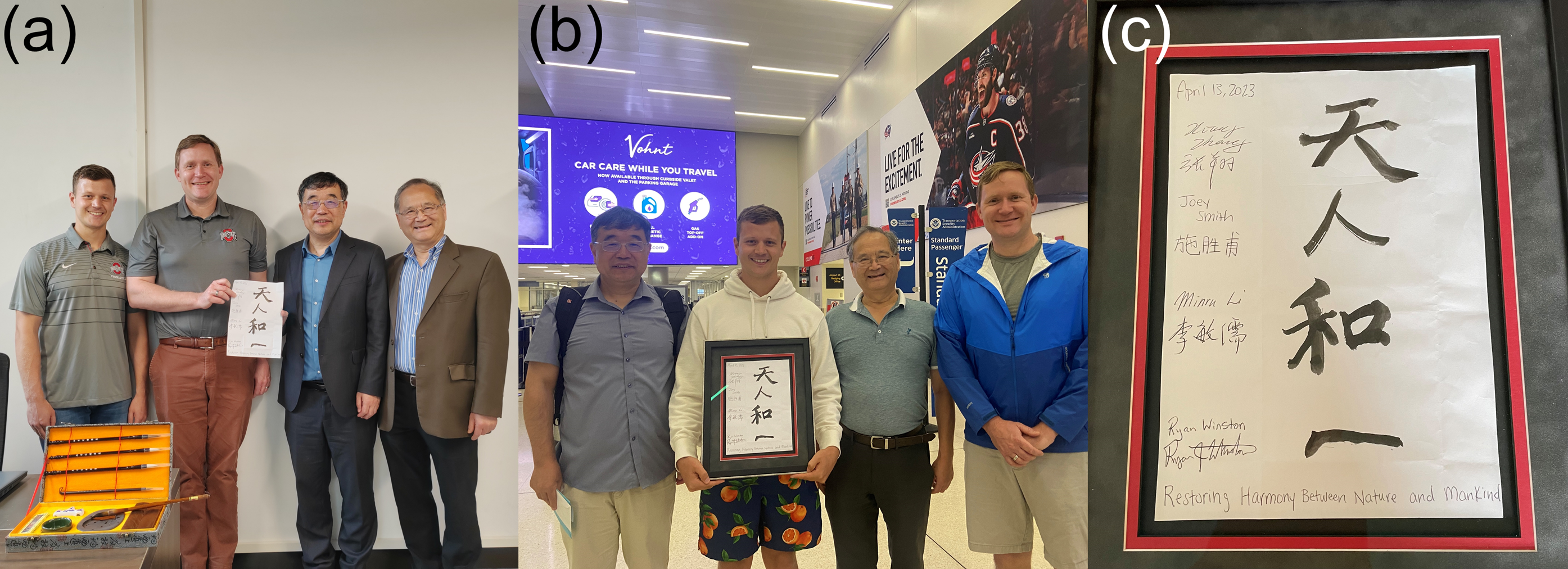
As paved by former OSU-Wuhan University professors who previously collaborated on wetlands and irrigation ponds for sustainable development (Dong et al., 2009; Wei et al., 2012, 2013), our team’s collaboration on bioretention for sustainable development rekindled and strengthened program- and university-level relationships that were interrupted by the COVID-19 pandemic. We informed China-US government officials of our exchange by visiting respective consulates, and fostered relationships with government-level officials by sharing our research findings about government-sponsored bioretention facilities in green infrastructure and sponge city projects.
Enact policies encouraging bilateral exchange
While in Wuhan, I worked alongside Wuhan University collaborators and Chinese construction workers to build three bioretention cells and two soil columns in the experimental field on campus (Figure 3(a)). These were to support our international, collaborative sustainable development project to see how different soil blends in China and the US impact bioretention drainage rate and pollutant removal. During construction, I befriended a Chinese construction worker who offered me a cigarette. Through the PCA, I had memorized a dialogue on how to decline a cigarette politely but humorously, so I did just that. Laughing, my new friend picked up a rock, and crouched down to write the characters qiú tóng cún yì (求同存异) on the sidewalk (Figure 3(b)). The idiom means, “seeking common ground while putting differences aside.” As embracing differences is vital element in human development (Luo & Li, 2024), we put the differences of our countries aside, finding shared passions for tea, mahjong, and bioretention. (a) Me working alongside Chinese collaborators at an active rain garden construction site. (b) Rain garden construction worker teaches me the idiom qiú tóng cún yì (求同存异) by carving it into the concrete with a rock. The idiom signifies putting aside differences to discover common ground.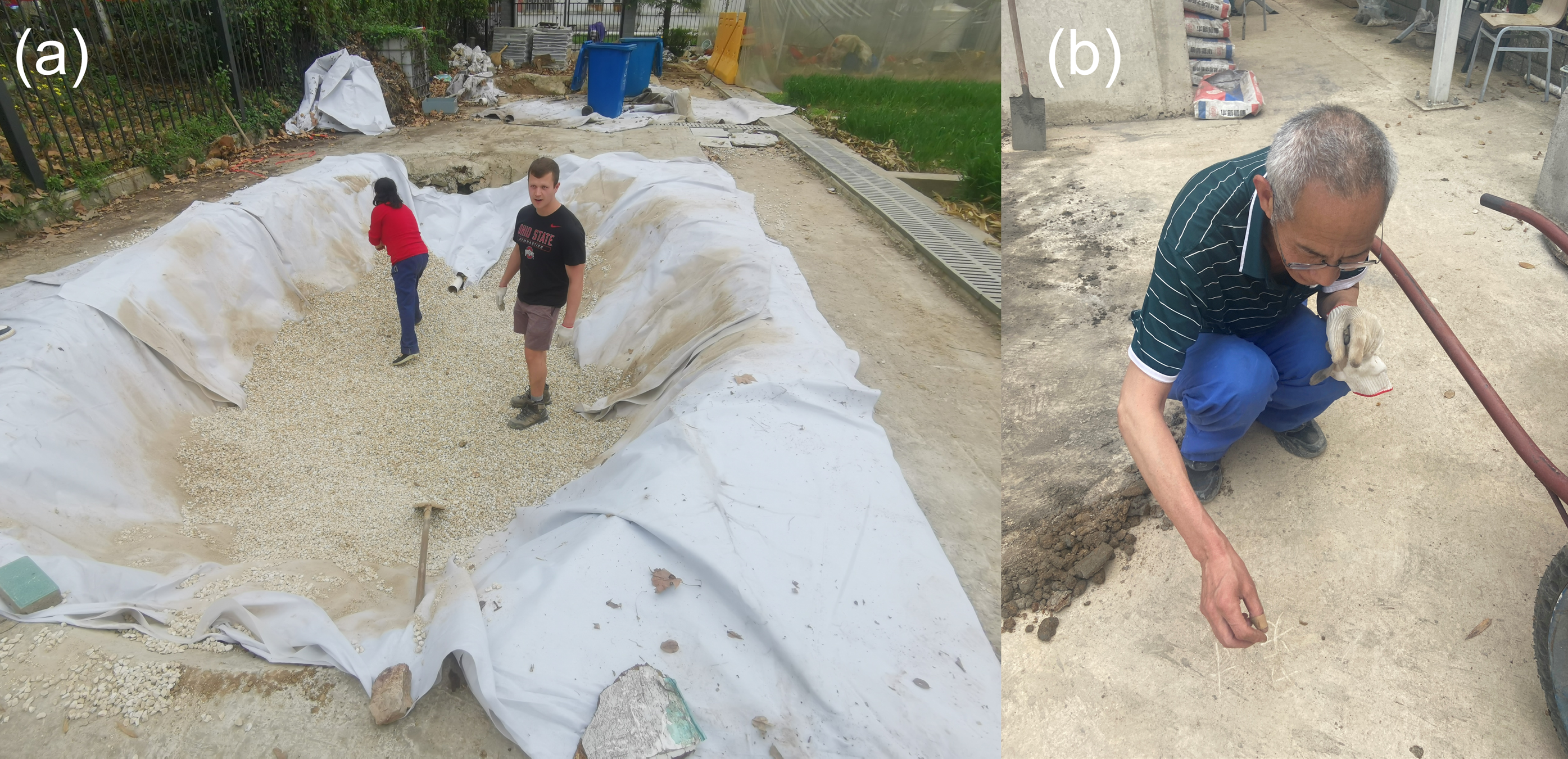
Regardless of government-to-government tensions, people-to-people relations in the Third Space can remain strong. Our international collaboration on sponge city sustainable development was made possible by a longstanding, 40-year partnership between Ohio State and Wuhan Universities. Our work was made possible by a policy encouraging bilateral exchanges (an OSU-Wuhan University MOU sustains and encourages our exchanges). To encourage sustainable development and collaboration internationally, policy matters (Ruano-Borbalan, 2024). Given that urban areas around the world are using similar methods for sustainable development, policies should encourage international exchange to assist in achieving the SDGs.
Technology and outreach
Although different countries are adopting the same technologies, like bioretention, neighborhoods are arranged differently in other countries. For example, I grew up in a single-family home with a front and backyard in the US. Bioretention is being installed in publicly owned land adjacent to privately owned front yards in my hometown. Meanwhile, the neighborhoods I visited in Wuhan were full of high-rise residential buildings organized into gated neighborhood blocks with no privately owned land. Bioretention is being installed into these gated neighborhood blocks as shown in Figure 4. While digital technologies like online meetings allow for international collaboration, they must be leveraged with in-person collaboration that allows teams to understand the local conditions, such as the differences in neighborhood styles mentioned here (Caniglia et al., 2018). The map on the left is posted by the main gate of the 107 neighborhood in Wuhan’s Qingshan district, and the color-coded map key shows the many types of green sponge city infrastructure present. The rain garden (bioretention) pictured on the right is situated within the 107 neighborhood and collects rainwater from the roof and road.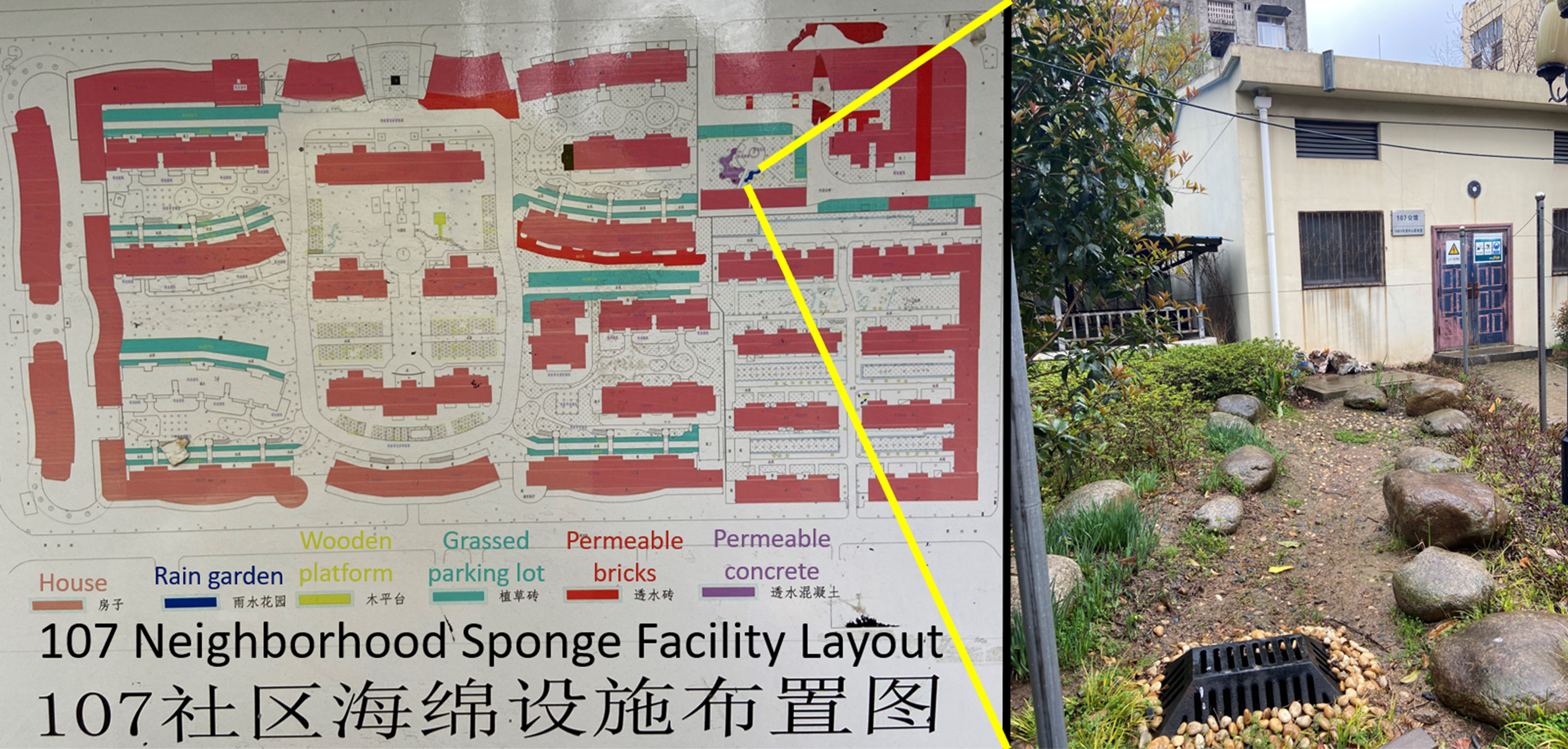
Applying Arnstein (1969)’s ladder of participation to sponge cities being installed in residential neighborhoods, sustainable development in partnership with residents are more likely to garner support than sustainable development that merely informs or consults them. International teams collaborating on sponge cities should holistically integrate residents into and educate residents about the sustainable development occurring in their neighborhoods. This education should span nonformal, informal and formal education (Yuan et al. (2024)) depending on the audience.
Let public outreach inform sustainable technology
Since people live, work, and play in and around sponge city infrastructure, residents ought to have a voice in sponge city development throughout the whole process. Sponge cities aim to restore harmony between nature and mankind, so people are inherently part of the equation. Recent studies recommend that sustainable development practitioners should work in tandem with residents to co-design sponge city infrastructure (Bahrou et al., 2024; Everett et al., 2021). Therefore, sponge city practitioners are, in part, responsible for ensuring that residents champion the infrastructure updates being installed in their neighborhoods and that residents are incorporated in sponge city implementation.
Through my promotion of our team collaboration for sustainable development in the Third Space, I was invited to speak at the 2nd Tsinghua Higher Education Forum entitled Higher Education for Sustainable Development: Global Perspectives and Practices. I created a promotional video (Supplemental Materials S4) and used my speech as an opportunity to explain how our collaboration not only arose in response to residents’ concerns about bioretention in the US but also aims to integrate residents more holistically into sponge city implementation.
Let sustainable technology inform public outreach
Meanwhile, since implementing sponge city infrastructure requires professional planning and engineering, certain concepts may exceed the comprehension of residents. This highlights the need for an emerging field dedicated to educating residents about sustainable development technologies in simple, informal ways that they can grasp. Whenever I introduce sponge cities to people who may not be familiar with the concept, I use a physical sponge to assist with the explanation. I explain how before cities, there was lots of green space with soil that could soak up the water when it rains. However, urban development introduced impermeable surfaces like parking lots and roads, that mask the soil from absorbing rainwater, leading to urban water issues like flooding. The goal of sponge cities is to reintroduce soil to cities through bioretention, green roofs, and other solutions that mimic the sponge’s ability to absorb and filter rainwater. It’s crucial for practitioners and international teams collaborating for sustainable development to articulate how sponge city technology aligns with the SDGs in terms that residents can readily understand.
The Third Space – where international collaboration for sustainable development occurs
Personally, collaborating in the Third Space for sustainable development has provided me with the opportunity to gain colleagues who have become friends. Such deep connections have shaped us into an effective and resilient team. International teams can better collaborate towards sustainable by being able to navigate the Third Space. Such teams must develop a strong bond for each other, with members that shared a common language and mission. Language can be learned by doing, such as through the PCA, and can open the initial door to the Third Space. A shared vision must be co-created and clearly communicated. Students and practitioners working in the sustainable development space already have busy schedules learning and applying domain knowledge, so foreign language and culture pedagogy must be flexible and complementary. Organizing study and collaboration around a domain and iterating leads to improved understanding and efficacy. Harnessing existing relationships is an effective way of networking, and upon establishing intentions and norms, teams will navigate the stages of team development and the Third Space concurrently. Upon fostering relationships across scales and enacting policies to encourage bilateral exchange, teams can enhance their performance and more fully contribute to sustainable development. Moreover, careful attention must be given to the human dimension of sustainable development, promoting resident engagement in the process, and educating them about the technology in a manner that is easy to understand. Overall, effective international collaboration for sustainable development requires a holistic approach that integrates language and communication, relationships and culture, team performance and policies, and technology and outreach.
Conclusion
This article examined the research question “how can international teams better collaborate towards sustainable development?” Data was collected by autoethnography based on a noteworthy bilingual, bicultural team collaborating for sponge city sustainable development. Meaning was derived from the data by critical examination through the lens of action-oriented pedagogy and fracturing. Themes and relevant approaches that answer the research question emerged, which were developed into a conceptual framework called “Guiding international collaboration for sustainable development in the Third Space.” This conceptual framework gained theoretical and empirical support by comparing it to similar ones but distinguishes itself by emphasizing the skills needed to navigate the Third Space. Emergent themes of language and communication, relationships and culture, team performance and policies, and technology and outreach are discussed in the context of the case study yet generalized so that other international teams better collaborate towards sustainable development.
Supplemental Material
Supplemental Material
Supplemental Material
Supplemental Material
Footnotes
Acknowledgements
Thanks to Professors Galal Walker, Minru Li, Qiaoping Nie, Xiaobin Jian, and Junqing (Jessie) Jia whose guidance and scholarship allowed me to become an advanced-level Chinese language and culture learner capable of navigating the Third Space. Thanks to Professors Ryan Winston and Xiang Zhang, the green infrastructure and sponge city experts, for their perseverance and for bringing their groups together into one team collaborating internationally for sustainable development. Thanks to the two anonymous reviewers for their comments, which not only improved the manuscript, but also enriched the autoethnography process.
Declaration of Conflicting Interests
The author(s) declared no potential conflicts of interest with respect to the research, authorship, and/or publication of this article.
Funding
This work describes a graduate school career made possible by funding from the Ohio State University Graduate School, Foreign Language Area Studies (FLAS) Fellowship, Chinese Government Scholarship, Ohio State University Office of International Affairs, and Wuhan University Office of International Affairs.

Supplemental Material
Supplemental material for this article is available online.
References
Supplementary Material
Please find the following supplemental material available below.
For Open Access articles published under a Creative Commons License, all supplemental material carries the same license as the article it is associated with.
For non-Open Access articles published, all supplemental material carries a non-exclusive license, and permission requests for re-use of supplemental material or any part of supplemental material shall be sent directly to the copyright owner as specified in the copyright notice associated with the article.
