




Abstract
While it is common knowledge that language shapes how we think about gender and sexual identity there is no standard educational practice to create awareness about the place of sexual and gender diversity in the context of language learning. This article draws on queer pedagogy and queer theory to devise teaching practices that acknowledge queer visibility in the classroom. The goal of this article is to examine strategies to enhance inclusion, recognition and visibility of sexual and transgender minorities in the classroom. I propose that language instruction is in need of a queer pedagogy that challenges both the heteronormative assumptions of most language textbooks, and classroom practices that erase Lesbian, Gay, Bisexual, Transgender, Queer, Intersex and Asexual (LGBTQIA) visibility. I argue that language instructors need to be inventive and critical, willing to address in class what most language manuals omit. This way, I hope to contribute to the development of tools and strategies that guarantee a safe, affirmative space for sexual and transgender minorities in our classrooms.
Introduction
“My partner and I are both Latino, and we speak a lot of Spanish when we’re around each other. You would think that Spanish would be really limiting, because there’s no real way to be gender neutral: most words end in a masculine o or a feminine a. But in fact, you can express a lot, and you can be really playful. You can combine words like hermoso and linda. In writing you can use the ‘at’ symbol to show neutrality in the end of a word. When my partner and I write to one another we always write novi@, and when we talk we’ll combine adjectives and nouns to create playful phrases: bonita novio, o guapo novia.” Wright Schultz (2015, p. 114).
As a language teacher who has instructed students at all levels from middle school to college, I have faced various situations in which students and faculty had to deal with questions concerning gender identity and expression. In a 2016 article (see Guimarães et al., 2016), I mention and elaborate my experience with a language coordinator who questioned a male student who self-consciously referred in a class room activity to his ‘husband’ (in Spanish, marido or esposo) and not to his ‘wife’ (esposa). On another occasion, a non-binary student in class asked me what pronouns they 1 could use when referring to themselves in Portuguese. More recently, at a presentation at Columbia University addressing questions of identity in the classroom, university faculties from different areas shared experiences and presented examples of how such issues have been expressed by students.
These examples suggest the importance of addressing sexual orientation, gender identity and expression in our daily pedagogical practices. This article intends to think about how queer pedagogy could be used to create more inclusive pedagogical practices that can prevent situations of exclusion, indifference, or intolerance in academic settings. This article seeks to affirm the importance of making visible the sociocultural and linguistic presence of Lesbian, Gay, Bisexual, Transgender, Queer, Intersex and Asexual (LGBTQIA) students in different academic settings. I will first briefly discuss queer theory and queer pedagogy as a theoretical framework to propose a more nuanced understanding of gender identity and sexual orientation. Then, I will explore the different uses of what I call, ‘social’ and ‘grammatical’ gender in classroom contexts. Finally, I propose an analysis of gender relations and sexual identities in several foreign language textbooks. In doing so, this essay proposes to analyze not only aspects of representation in textbooks, but also of LGBTQA visibility in the U.S. academic environment more generally.
Queer pedagogy and questions of gender identity and sexual orientation
For many American researchers and activists, the concept of queerness seeks to incorporate bodies that lost visibility during the gay movement of the 1960s and 1970s. From this perspective, the gay and lesbian movement was normalized as it adopted heteronormative practices (like marriage and the adoption of children) to gain public acceptance. The term ‘queer,’ then, attempts to recover individuals erased by this normalization, such as feminine boys, transsexual people, transgender people, and non-binary or gender non-conforming people among others.
Briefly retracing a possible historiography of queer theory, by the beginning of 1970s, gay literary studies began to flourish in the American academic world. As the gay movement started to seek out and create its own culture and identity, it began to look not only to the past but also to the future. In the 1980s, U.S. political activism, still maintaining its attention to the past, adopted the word ‘queer’ as a driver of the movement, a word that up until then, had been considered the most commonly used homophobic term in the country. In other words, the political movement reincorporated a term, previously carrying a negative connotation, trying, in this way, to deconstruct its pejorative meaning.
Taken up by the academy, queer theory seeks to denounce the heteronormativity that influences even the gay movement. That is, the gay movement is accepted only to the extent that it conforms to certain social values pre-established by society, rejecting those who do not follow that norm. 2 Teresa de Lauretis (1991) states that the term ‘queer’ should function as something that causes discomfort, juxtaposed to the words lesbian and gay in the subtitle to mark a certain critical distance from the vocabulary used in the past. For De Lauretis, queer is the ‘non-canonical,’ polyphonic, transgressive, and problematic. Eve Kosofsky Sedgwick (2008) too affirms that the term constitutes a moment, a movement, a continuous motive.
Queer pedagogy, based in these ideas of a queer theory against normalization, seeks to contribute to practices of education, analyzing the fluidity and the mobility of society and affirming that educational institutions should not attach themselves to one set model, since these ideals end up alienating, even excluding, certain individuals. For Britzman (1998), queer theory transgresses seemingly stable representations and, in this sense, queer pedagogy works to question situations of apparent normality in the classroom and concerns itself with the social production of what is learned. Queer pedagogy does not seek the ‘correct’ method or the ‘right’ questions, but rather the possibility to question our practices or notions of equality and acceptance. Just as queer theory sought to distance itself from the markers of gender associated with gay and lesbian studies, queer pedagogy offers everyone involved in academic spaces, whether they be heterosexual, homosexual, bisexual, asexual, etc., the possibility of understanding issues of sexuality from a new angle. As Louro (2001) explains: “(…) a queer pedagogy and curriculum ‘speak’ to everyone and aren’t only directed at those who recognize themselves in this subject position, that is, as queer subjects.” 3 (p. 256).
Queer pedagogy offers a critical view of the practices of exclusion that are naturalized in the classroom by a banal heteronormativity 4 that makes all those who don’t fit into a certain standard invisible. As Britzman (1998) demonstrates, queer theory recognizes the exorbitant normality in effect and the ways in which that normality ignores queer pleasures, practices, and bodies. Neither does said pedagogy seek merely to trade one norm for another, to simply leave a heterosexist binary for a heterosexual–homosexual modality. A queer lens for pedagogical practice would mean observing the varied possibilities of expression of sexuality without the necessity of labels or fixed identities. The recognition of different forms of expression would broaden an individual’s perspective, without that person having to necessarily adopt one of these fixed identities, allowing them to acknowledge these identities or even recognize themselves in said identities.
It becomes necessary, then, to question and challenge dominant models in schools today so that socially favored groups are not the only ones visible, including as well other bodies that are still oppressed by different spheres of society. Queer pedagogy can help us in two ways. First, by problematizing the very school structure, the normalization of teaching per se and of the fixed and exclusionary content that is presented. Using a queer lens would involve, for example, discussing why terms like gay, lesbian, bisexual, and transgender do not find space in school vocabulary and why when they do, it is only through insults that should be silenced. More than prohibiting that students or even teachers use these words as insults, it is important to have a discussion of such use. To be gay or transgender is part of the identity of an individual and as such, should be included in the day-to-day just as ethnicity, religion, and many other aspects should be. 5 As Britzman (2012) explains, queer pedagogy aims at ‘something different than a plea for inclusion or merely adding marginalized voices to an overpopulated curriculum.’ (p. 297). It is not the normalization of the ‘different’ that queer pedagogy proposes, is to ‘recognize difference outside the imperatives of normalcy.’ (p. 304).
In order to recognize such difference, therefore, I propose a second way that we can think of the queer in the academic environment, of a more concrete character, suggesting a critical perspective on the teaching materials that we use in the classroom. Are there LGBT representations in these materials? How are families represented? And in what ways can we include without necessarily normalizing these minorities in the school routine? To this end, this article considers the LGBTQIA population’s representation in four foreign language textbooks used in the classrooms. However, prior to the observations of such textbooks, it is important to take into consideration questions related to gender identity and sexual orientation.
We have come a long way from the ‘one-sex model’ in which woman was seen as an inverted man (Silva, 2000), and the ‘two-sex model’ when woman becomes a complement to man, 6 passing through Havelock Ellis, who wrote the first book in English on homosexuality, and Karoly Maria Kertbeny, the first researcher to use the term ‘homosexual,’ to more recent studies in which identities have been deconstructed, our notions and perceptions of gender identity and sexuality have been challenged, reformulated and reshaped.
Throughout the XX century, personal and or collective experiences and research have reformulated the way we understand our sexuality. Since, for instance, Simone de Beauvoir’s seminal text in which she affirms that one is not born a woman (1973, p. 301), the views on how we understand gender, sex and sexuality have been drastically shaped and reshaped. One important aspect, that goes to the heart of my understanding of queer pedagogy, is the importance for both teachers and students to respectfully broach the topic of ‘identity’ in the classroom. For instance, as Michel Foucault famously argued in The History of Sexuality, homosexual ‘identity’ came into being at the end of XIX century as a medical and legal term, which suggested the ‘truth of sex’ lay at the heart of subjectivity. Spearheaded by medical and legal discourse, it is only during the XX century that we began to think of ‘identity’ as a self-defining ‘natural’ feature that can (and should be) freely expressed, for instance, as an irrevocable proof of ‘sexual orientation.’ This model of identity, of course, was privileged in the 1970s’ homosexual liberation movement in the U.S. and throughout the Western world. Arguably, since the 1990s flowering on queer theory and the increasing visibility of transgender activism in the following decades, this model of identity politics has been put under pressure. In fact, recent critiques of ‘homonormativity’ and ‘homo-nationalism’ 7 stand as an important reminder of the challenges of professing an inclusive theory and praxis of LGBTQIA 8 representation.
Yet, as in the older identity model of Gay Liberation, the investment in negotiating an adequate language of self-expression and identity remains an indispensable tool for propagating visibility and understanding – in politics as much, I will argue, as in the classroom. For instance, in 2009, in Brazil, the ABGLT (Associacão Brasileira de Lésbicas, Gays, Bissexuais, Travestis e Transexuais) the Brazilian Lesbian, Gay, Bisexual and Transgender Association – developed a guide attempting to reduce the inadequate use of terminology that affects the citizenship and dignity of millions of people in the country (ABGLT, 2009, p. 5). The guide presents to the reader a list of words and definitions so that citizens and professionals in communication media and research are able to express their identities in ways that protect their integrity as citizens. In the U.S., too, government-run initiatives and various mainstream media have started paying attention to the need for a new terminology that reflects changing times. For instance, in a 2015 article in the New York Magazine, Lauren Kern and Noreen Malone state that ‘some things about sex haven’t changed, and never will. But for those of us who went to college decades ago – or even just a few years ago – some of the newest sexual terminology can be unfamiliar’ (p. 49). Yet, even if some things have not changed, the terminology did change and is still evolving. In the same article, they introduce terms that define new sexual and gender identities such as ‘demisexual,’ ‘cisgender,’ ‘agender’ and ‘genderqueer.’
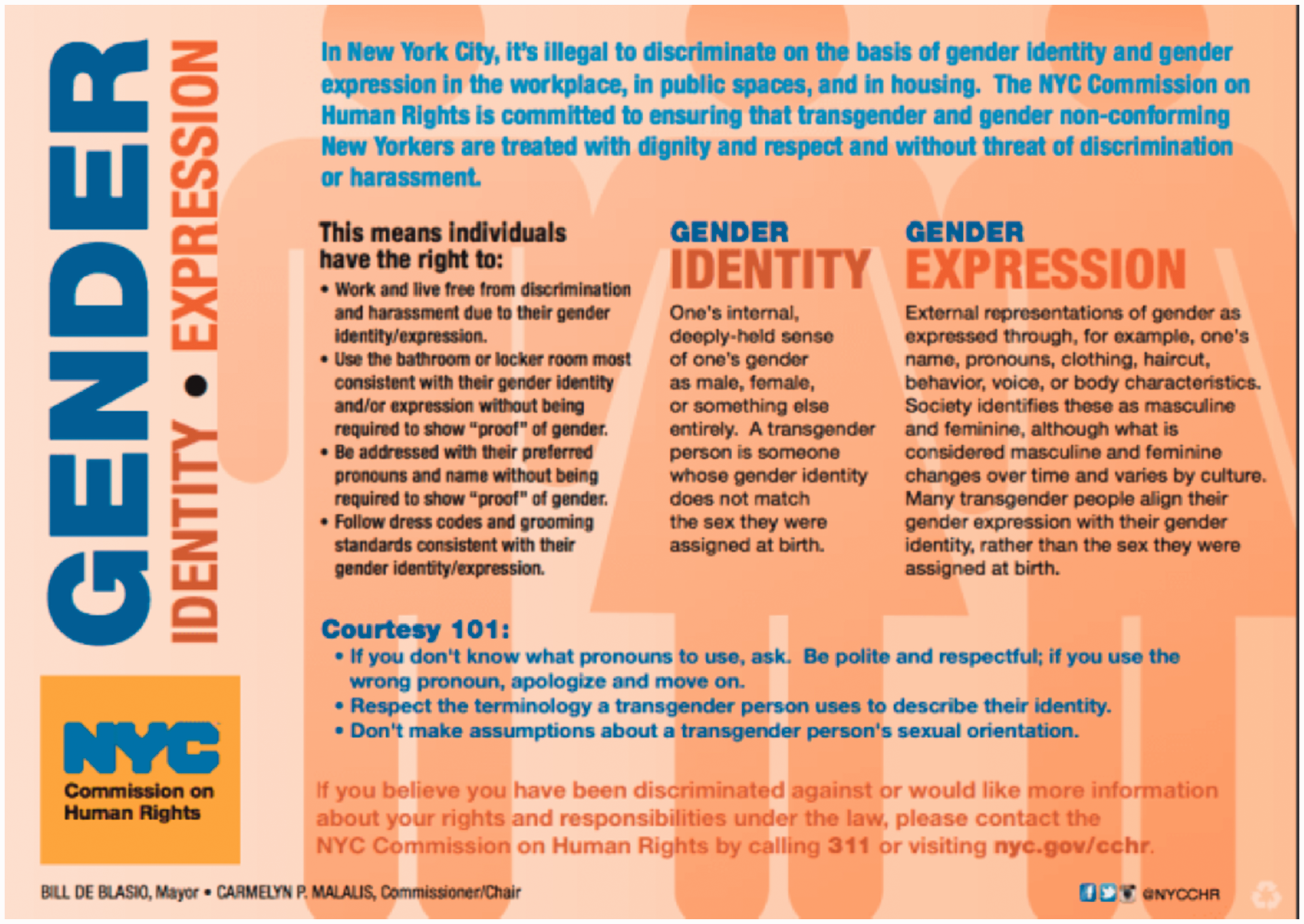
Also, in 2015, New York City published directives for city employees and city-wide citizens stating the acceptance of 30+ different categories defining gender identity and gender expression. The info card released by the New York City Human Rights Commission stated, ‘It is illegal to discriminate on the basis of gender identity and gender expression in the workplace, in public spaces, and in housing.’
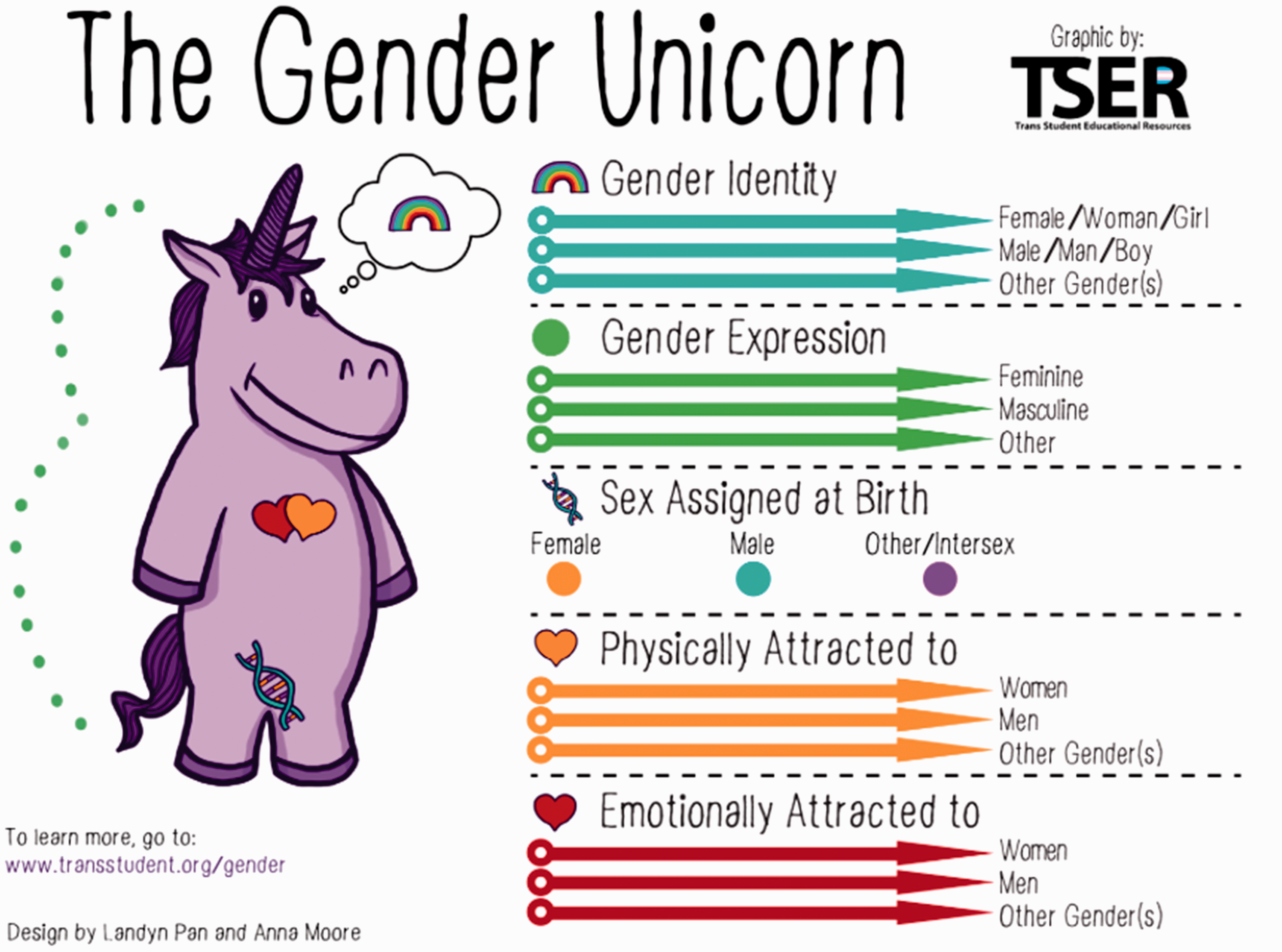
Making these new terminologies comprehensive in a playful manner, the Trans Student Education Resources (TSER) website then designed the following pamphlet, freely available online:
Beyond the idea of sexual orientation and gender identity, the ‘gender unicorn’ allows possible options and attachments regarding one’s gender expression, assigned birth sex, and a wide array of emotions and physical sensations. The result is a chart that allows for a more fluid, nuanced and ‘queer’ understanding of gender and sexual identity. For instance, a person identifying as a cisman may be emotionally attracted to women, or men, or both, yet physically attracted to men. All the while, this person may be comfortable adapting a feminine gender expression. The idea of multiple expression allows individuals to place themselves on a queer continuum between and beyond both heteronormative and homonormative ideals. The chart of the ‘gender unicorn’ is particularly refreshing, even for the gay and lesbian movement, as it allows a more nuanced articulation of identity that takes in to account a broad range of sexual, gendered, affective, and physical modifiers that constitute our attachment to identity. Even so, it is worth noting that these categories do not encompass all the possibilities of gender expression and gender identity.
But have our educational practices followed suit to these changes? As a lead into this question, I shall now turn to the distinction between, what linguistics and language teachers, call ‘grammatical’ gender and ‘social’ gender, and explain its relevance to consider the manner in which the language-learning process is indelibly shaped by our own experiences. Fig. 1 shows New York City guide for gender identity and expression. Fig. 2 shows the Gender Unicorn by Trans Students Educational Resources.
New York City Guide for Gender Identity and Expression.
13
The Gender Unicorn by TSER – trans students’ educational resources.
14
Grammatical gender and social gender
One common question among native English-speaking students who learn a foreign language (for instance, romance languages – my area of specialty as a language instructor) is how to address their gender identity. Nowadays, as I explained in endtnote 1, in English, the use of they as a neutral, non-binary form of identity has been accepted in many formal and informal settings. However, by my knowledge, romance languages have not yet adopted the use of a gender-neutral pronoun in daily usage. In writing, Portuguese and Spanish have used ‘@’ or ‘x’ to avoid marks of masculine or feminine and more recently, the use of ‘e’ in both languages has tried to solve the questions of pronunciation that the use of @ or x have posed to speakers. Even though Italian, unlike French, Portuguese or Spanish, has a neutral form for they in the plural, its use as a singular form has not caught up yet and in informal conversations with Italian instructors, they have affirmed that such use is yet to be seen.
One important aspect to be dealt with the students is the distinction between grammatical gender and social gender. Since languages like Portuguese and Spanish do not have neutral nouns or pronouns (as it in English), all the words are divided between masculine and feminine. Grammatical gender is, as linguistics say, random 9 . Objects are either masculine or feminine and they vary from region and most importantly with time. For example, the word mapa (map in English) is masculine in Portuguese but it was feminine until the XVII century.
However, the use of social gender is a point of studying in romance languages. Maria Rodriguez Fernández (2009), for instance, has written on the evolution of the masculine grammatical gender as a generic term. There is a common sense in accepting the masculine forms in most romance languages as the neutral form. For example, ‘os alunos’ (the students) encompasses all students in one space regardless of their gender identities and expressions. On the other hand, ‘as alunas’ (the feminine form for students) would only refer to women. In order to avoid what some activists have called sexism, people have resourced to the use of ‘todas y todos’ in Spanish. However, the RAE – Real Academia del Español – has recently issued a statement considering such use of ‘todas y todos’ unnecessary since ‘todos’ refers to both genders. Another point that such discussion must see is the question of binarism. When RAE says that the use of todas y todos is redundant, it includes only male and female forms. The erasure of non-binary individuals is blatant in such forms of the language.
Foreign language textbooks
Queer pedagogy, in addition to other goals, proposes to analyze heterosexist society and the ways in which its practices can generate symbolic instances of violence (or, in many cases, real violence: physical, moral, or social) for bodies that do not fit into the established norms. As Miskolci (2012) writes, “…the violent recusal of forms of expression of gender or sexuality that diverge from the standard is preceded and even supported by a process of heterosexist education, or in other words, by a hidden curriculum committed to the imposition of compulsory heterosexuality.” (p. 35).
Foreign language instruction, despite its particularities, reproduces the oppressive system in that there is only one modality of expression of sexuality: the heterosexual, a model of emotional union, between a man and a woman; and a binary identity representation: the masculine and the feminine. Questions of sexual orientation, gender identity and expression are, in most cases, not considered in foreign language instruction.
The starting point for many methods, approaches, and textbooks for the study of foreign language is the ‘I.’ In other words, many methods for foreign language instruction use the daily lives of students as the starting place from which they can learn to express themselves in the target language and construct vocabulary and structures: the school and work routines, housing, the city in which they live, personal, physical, and psychological characteristics, and the family. 10 From this, ‘self-knowledge’ in a foreign language is left out all of the possible expressions of sexuality and behavior not conventionally accepted.
Students learn to speak about their physical and psychological characteristics, about their families, about school, about their daily routines, if they are married, single (more recently, divorced appears discretely in some books), but never about questions of sexual identity or orientation. A certain disappearance of these identities ends up meaning that these individuals keep silent, afraid of exposing themselves since there is no space in the content for them to express themselves.
The consistency in most foreign language textbooks is so striking that all the textbooks used for this article: Horizons (for French) by Manley et al. (2014); Imágenes (for Spanish) by Rusch et al. (2013); Avanti! (for Italian) by Aski and Musumeci (2013); and Ponto de Encontro (for Portuguese) by Jouët-Pastré et al. (2013) present ‘Family’ in chapter 4 11 . As presented before, in terms of identity, questions of gender and sexual orientation are blatantly erased in most foreign language textbooks. Even though most vocabulary learned focuses on the ‘I’: where one comes from, what one does for a living, whether one is single or married (and even divorced in some books), the assumption of compulsory heterosexuality and heteronormativity is the norm. In order to illustrate that, we should take a look at the family unit.
All four books present a normative family tree in which members of the families, all married with kids, are portrayed. As the images below show:
The Portuguese textbook present Paulo’s family, an all-white heteronormative family, as seen below:
Fig. 3 shows a Family Tree depicted in Ponto de Encontro, a Portuguese Textbook. Paulo's family (p. 153).
Family tree as depicted in Ponto de Encontro (p. 152): Paulo’s family.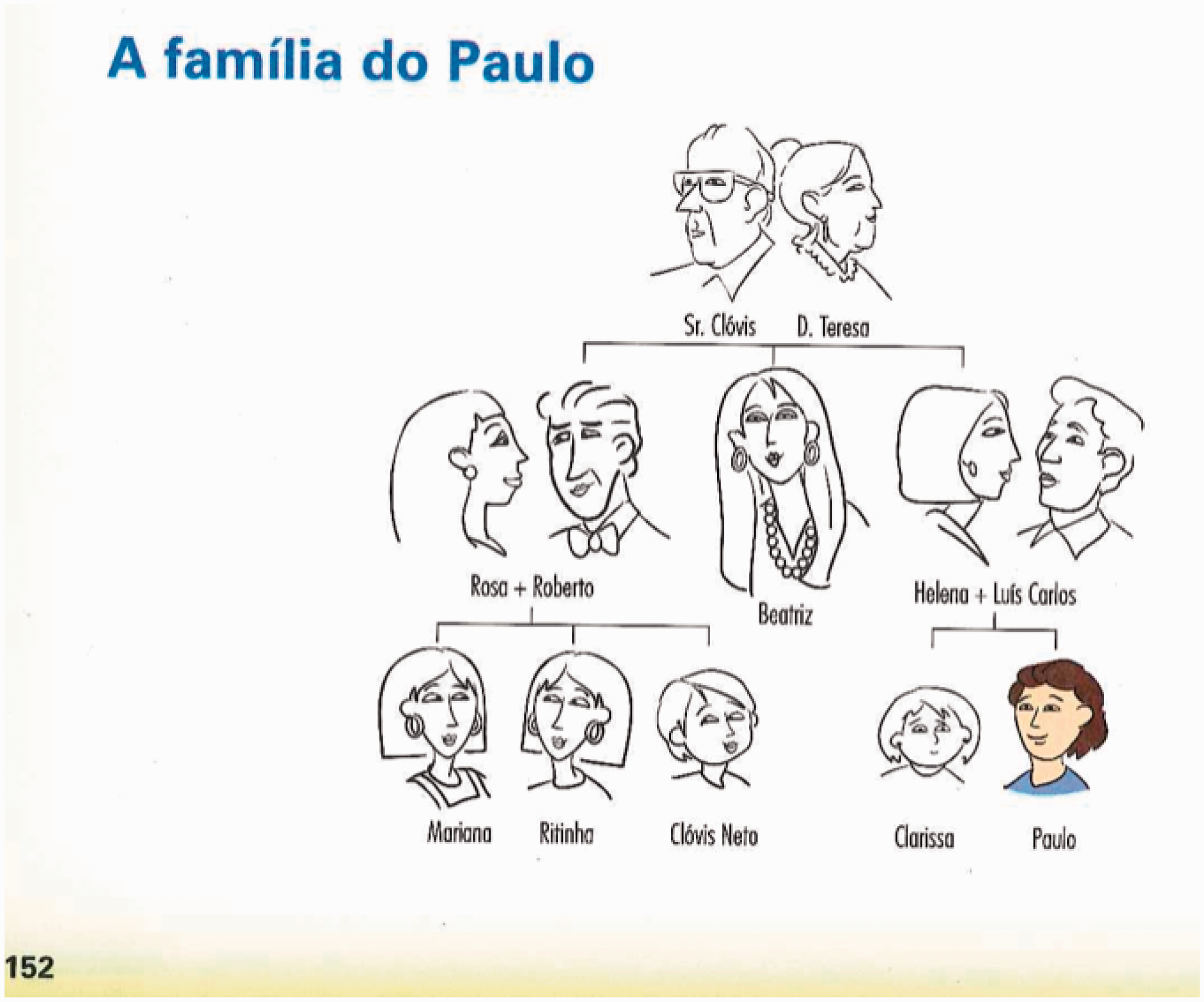
In the Portuguese textbook, the image shows a patriarchal family with Sr Clóvis at the top of the tree beside his wife, followed by the children and grandchildren. The text describing the members of the family becomes somewhat confusing, as can be seen in the excerpt below: “Meu nome é Paulo Ferreira. Moro em Belém do Pará com meus pais e minha irmã Clarissa. Meus avós moram em um apartamento no bairro da Cidade Velha, muito perto de nossa casa. Minha mãe telefona para minha avó todos os dias! Minha mãe tem um irmão e irmã. My translation: “My name is Paulo Ferreira. I live in Belém, Pará with my parents and my sister Clarissa. My grandparents live in an apartment in the Cidade Velha neighborhood, very close to our house. My mom calls my grandmother every day! My mom has a brother and a sister.
Avanti!, the Italian textbook in turn also presents a similar family to the one above. The difference in Avanti! is the multiracial aspect of it:
Fig. 4 shows a Family Tree depicted in Avanti!, p. 91.
Family Tree as depicted in Avanti! (p. 91).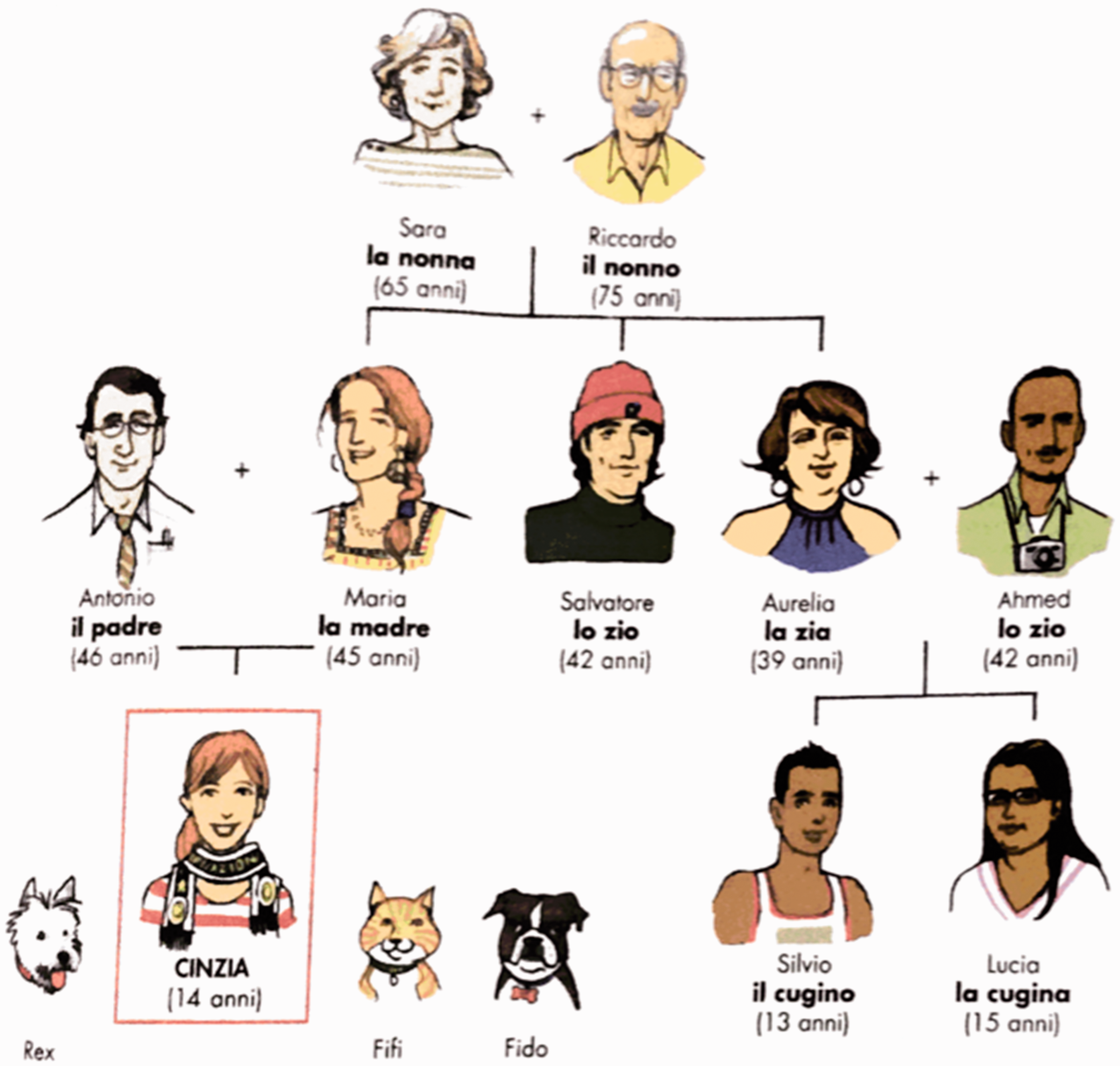
Horizons, for learning French, also in chapter 4, depicts a very similar family to the ones above:
Fig. 5 shows a Family Tree depicted in Horizons, p. 144.
Family Tree as depicted in Horizons (p. 144).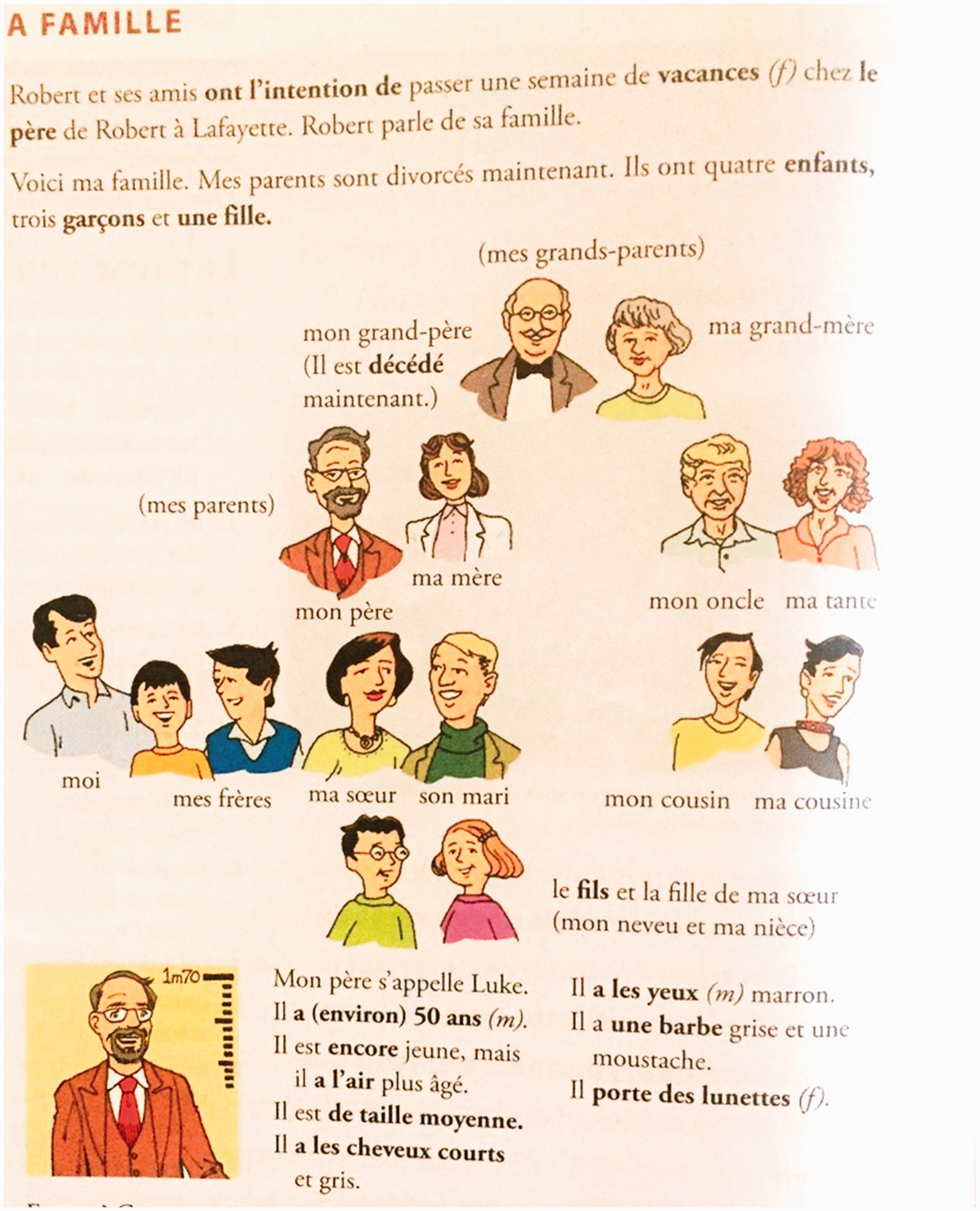
Finally, Imágenes, the textbook for Spanish goes a bit further (or backwards) presenting not only a family tree, but one with the symbols for male and female:
Fig. 6 shows a Family Tree depicted in Imágenes, p. 197.
Family Tree as depicted in Imágenes (p. 197).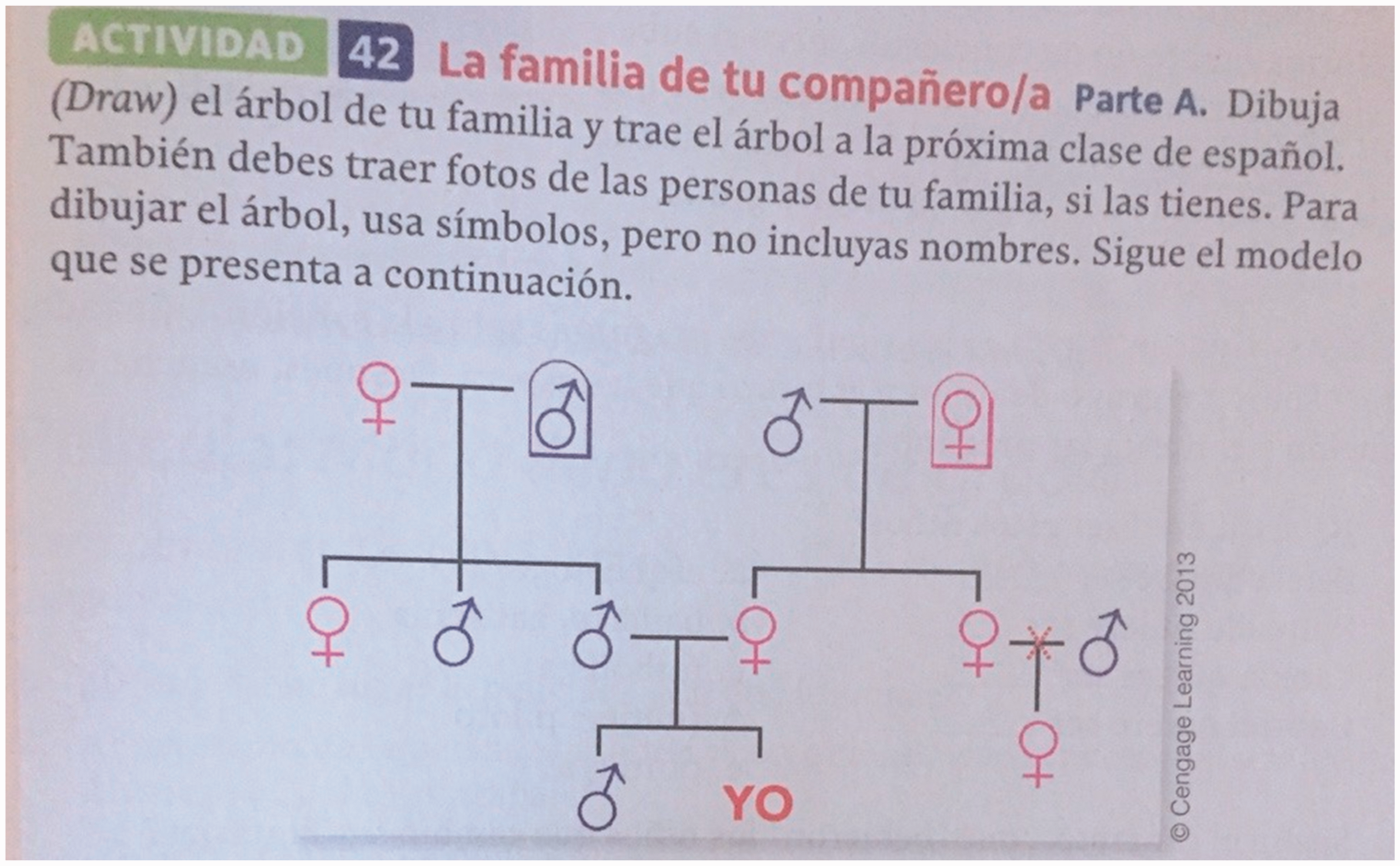
The instructions for teaching this unit are all based not only on the heteronormative idea of a family but also on a heteronormative idea of teaching. The instructions for teachers present different activities in which students could role-play different family members maintaining the notions of normativity. For instance, in the teacher’s instructions for Imágenes, it is suggested how to work with such vocabulary in class: “Practice vocabulary by forming a ‘live’ family tree with your students. Recycle prepositions of location while giving instructions. Have a male and a female student (abuelos) stand on two chairs behind the instructor’s desk. Have a male and female student (hijos) sit on the front two corners of the instructor’s desk…” (p. 188).
The only mention that any of books makes of the LGBT population is with respect to the legalization of marriage between people of the same sex in Portugal and the civil union in Brazil in Ponto de Encontro: “A família moderna é diferente da família tradicional e a lei da família também muda. Em Portugal o divórcio foi legalizado em 1910; no Brasil a legalização ocorreu só em 1977. Hoje em dia há muitos casais divorciados ou separados nos países de língua portuguesa. O casamento entre as pessoas do mesmo sexo foi legalizado em Portugal em 2010, mas não é legal em nenhum outro país lusófono. No Brasil, desde 2011, os casais homossexuais têm direito ao reconhecimento legal da união civil estável.” (p. 172). In free translation: “The modern family is different from the traditional family, and family law changes too. In Portugal divorce was legalized in 1910; in Brazil, it was only legalized in 1977. Today there are many divorced or separated couples in Portuguese-speaking countries. Marriage between people of the same sex was legalized in Portugal in 2010, but it is not legal in any other Lusophone country. In Brazil, as of 2011, homosexual couples have the right to legal recognition of the stable civil union.” (idem, p. 172).
The foreign language textbooks presented above, like others on the market, show themselves to be heterosexist. In other words, they present the hypothesis that everyone is heterosexual, married, and following a binary heteronormative logic of man–woman. As Morris (1998) correctly asserts, ‘…there is nothing natural about the family album, about sex or gender, about our lives generally.’ (p. 278).
Based on the images and passages presented here, it can be said that a queer lens is necessary in foreign language instruction. What this would mean is an unsubordinated perspective, a questioning and attentive lens to the students who end up not being represented in the pages of books and go unheard and unseen in the classroom setting. It is important to note that this queer perspective does not only turn to LGBTQIA questions, but also to the most diverse family formations such as female-headed households, a common phenomenon in different cultures. It is worth remembering that most foreign language textbooks seek to present a sociocultural perspective, since for them, learning a language is also ‘learning’ a culture.
Throughout the pages of these books there are various cultural tips on practices of sociability in a range of common situations such as university life, meeting people on the street (whether we kiss or hug upon meeting someone, for example), but, despite all the social changes presented in official documents, the family is still represented by a predominantly white constitution, in which the father and mother are married, having on average two children: a boy and a girl (to guarantee the necessary vocabulary). Divorce is not considered.
The proposal of this article isn't to transform the classroom into a space of obligatory outing, but to suggest that it become, at least, a space that is open to the free expression of sexuality, not just of the students, but also of the teachers or professors. The acknowledgement of sexual diversity through the use of language on the part of the professors and instructors and in teaching materials can open a space for discussion, inclusion, and respect.
Conclusion
Maybe, even today, some people might question if it is really that important to consider the impact of normalization and heteronormativity on our teaching practices. Clearly, if we hold that education is a good and a necessity for everyone, then it is a necessity to consider the importance of sexual identity in our classroom, alongside considerations of race, gender, and disability. Along with the ideas proposed by Inclusive Pedagogy (Florian and Black-Hawkins, 2010, for instance), Public Pedagogy (Gutierez-Schmich and Heffernan, 2016) and Freire’s Pedagogy of the Oppressed and all pedagogical practices and methodologies that seek models of education in which respect and presence are parts of our everyday practices, Queer Pedagogy aims at understanding individualities as part of our collectivities.
As Carlson (1998) points out, ‘…instead of merely affirming diverse identities, a democratic multicultural education needs to take on the process of identity formation itself.’ (p. 114) One of basis of such formation is through language. Perhaps particularly in the case of foreign language instruction, the social and grammatical meaning of gender should be discussed in classrooms with the theoretical sensibilities of queer theory and queer pedagogy in mind. English, among other languages, possesses very few explicit distinctions of gender. For example, the phrase ‘my partner is a teacher’ does not give us the gender (or sex) of the person mentioned. However, romance languages directly declare gender in stating the noun, article, and generally in the corresponding use of adjectives as well. For someone who learns to speak Spanish, French, Italian or Portuguese as a foreign language, these issues offer potentially productive points for cultural reflection and learning – not only for LQBTQIA students, but for all involved. Yet the salient point is that particularly for those who are most affected by the lack of alternative visibility in textbooks, the classroom can make a positive difference – certainly in the hands of a sensitive and critical teacher.
By choosing to focus on the LGBTQIA representations in foreign language manuals, we cannot remain blind to the invisibility of certain social groups in higher education today. This is an exclusionary practice that is also reflected in different other spheres, such as the media, the work place and public spaces more generally. As I have argued, queer pedagogy can help us analyze and – if successfully implanted – counter exclusionary practices. Students will feel more comfortable in the learning process if they can express themselves freely in a classroom setting that relies on teaching materials that acknowledge sexual and gender difference in a positive manner. As long as our teaching materials and practices reflect and reproduce heteronormative perspectives, too many students will feel excluded. During the past years in which I participated at several talks and meetings on foreign language teaching, one frequently heard complaint is the lack of – and lack of positive affirmation of – LGBTQIA visibility. Ultimately, in the context of language learning as much as in real life, is important to remember that declaring one’s partner, spouse, companion, girlfriend/boyfriend… as someone of the same sex or gender is never reducible – not even from a willfully homophobic point of view – to a linguistic ‘error’; it is an expression of real-life attachments, desires, and – certainly so in the case of students at all ages – a will to learn how to better communicate our identities with the world.
Footnotes
Declaration of conflicting interests
The author(s) declared no potential conflicts of interest with respect to the research, authorship, and/or publication of this article.
Funding
The author(s) received no financial support for the research, authorship, and/or publication of this article.