



Abstract
Australia competes with other popular study destinations for its share in the international student market. As the largest cohort of international students in the country, this article explores factors influencing Chinese students to select Australia as their final study destination instead of the United States, the United Kingdom, or Canada. Within the theoretical lens of the push-and-pull model and drawing on semi-structured interviews with 22 Chinese graduates who studied at Australian universities, this research provides evidence about the factors driving Chinese international students to choose Australia as their study destination. Notably, the research participants had also considered other study destination countries for their popularity among young Chinese, sought-after education systems, and career opportunities. However, higher costs and colder climates were among the major push factors of those countries. A prior connection to the country was Australia’s foremost pull factor. China’s competitive education system and labour market, and social and cultural norms pushed participants to seek international education options.
Introduction
Since the opening-up reforms in the late 1970s, overseas education has become popular among many Chinese families in Mainland China. According to the Ministry of Education of the People’s Republic of China (2020), from 1978 to 2019, over 6.5 million Chinese students and scholars studied overseas. By the end of 2019, nearly 5 million had completed their studies, and over 1.6 million were still studying abroad (Ministry of Education, 2020).
While China has a significant number of international students studying in different countries, specific study destinations are more preferred than others. These countries are often Western, such as the United States, the United Kingdom, Canada, and Australia. Asian countries, like Japan and South Korea, have also gained popularity among Chinese families. Recent data from the UNESCO Institute for Statistics (2023) showed that the United States, the United Kingdom, and Canada were the leading destination countries for Chinese international students. Similarly, a New Oriental’s study that involved an online survey of over 9500 respondents (parents and students) from Mainland China conducted between December 2022 and February 2023 also concluded that these countries were the top three countries considered for overseas education (2023a). The United States has been the leading study destination for many Chinese students. According to the U.S. Institute of International Education (IIE) (2023), the number of Chinese students in the United States was 328,547 in the 2015-16 academic year and 372,532 in 2019-20. Since 2019–20, the number of students from China has declined, reaching 289,526 in 2022-23. Despite this decline, China has remained the largest source country of international students for the United States (IIE, 2023). According to the Higher Education Statistics Agency (HESA) (2023), China is also the top non-EU source country of international students in the United Kingdom, hosting 151,690 Chinese students studying in the 2021-22 academic year. Canada is another popular country of choice for overseas education among many Chinese families and young people. Statistically, after India, China is the largest market for international students in Canada. According to the data from Immigration, Refugees and Citizenship Canada (2023b), as of December 2022, over 100,000 Chinese students were studying in Canada. In addition to these three popular countries, Australia is also one of the top preferred destinations for Chinese students. For many years, China has been the leading source of international students in Australia. According to the data from the Australian Government Department of Home Affairs (2023a), over 745,500 Chinese students studied in Australia between 2002 and 2022. As of July 2023, there were around 152,000 international students from Mainland China studying in Australia (Department of Education, 2023b).
The United States, the United Kingdom, and Canada are the key competitor markets for Australian international education (Department of Education, 2021). A combination of various factors, generally relating to the quality of education, favourable immigration policies, and employment prospects following graduation, influence Australia’s competition with these countries for international students. Every one of these nations seeks to position itself as a desirable study destination for international students, including Chinese students who are interested in studying abroad. The previous studies have provided a series of factors influencing Chinese international students to choose Australia and its higher education. However, little scholarly work is available that explores a nuanced and comprehensive understanding of the main factors driving Chinese international students to choose Australia as their study destination and not the United States, the United Kingdom, and Canada. This research addresses this gap by examining these factors and offers valuable insights for future discussion on Australia’s international education policy improvement.
Literature Review
Many factors influence an individual’s decisions and motives for leaving their home country and moving to a host country for overseas education. In academic literature, including international education, the factors influencing Chinese international students’ mobility are studied through a prominent push-and-pull model (Altbach, 1998; Mazzarol & Soutar, 2002; Wang & Shan, 2006; Cheung & Xu, 2015; Zong & Lu, 2017; Ruan, 2020; Huang et al., 2022, p. 83; Liu et al., 2023). Mazzarol and Soutar’s paper (2002), drawing on the findings from research studies undertaken in Indonesia, Taiwan, China, and India, explored push and pull factors influencing the final choice of host country among international students. The push-and-pull model applies to both home and host countries. Typically, push factors are unfavourable conditions in the home or potential host country, whereas pull factors are attractive conditions in the host country. Push factors such as poor economic or living conditions, low wages, or inadequate education may drive individuals to leave their home country in pursuit of better conditions and a future elsewhere. For example, a host country might offer them benefits or pull factors they would not otherwise have in their home country. Similarly, when exploring Chinese international students’ mobility to Australia, scholars generally explore pull factors applicable to Australia as a host country and China’s push factors as the home country. While there are several factors that influence Chinese international students’ mobility to Australia, the most common factors described in available literature include future migration prospects, education in Western and English-speaking countries, family, and other factors like geographic proximity.
The prospect of future migration, including obtaining a permanent residency, is one of the common pull factors among Chinese students who choose to study in Australia (Wang & Shan, 2006, p. 7; Stafford, 2011; Guo, 2010, pp. 150–151; McCrohon & Nyland, 2018, pp. 21–22; Liu et al., 2023). The study of Chinese students in Australia conducted by Tan and Hugo (2016, p. 6) found that difficulties getting visas in other countries (particularly in the United States) influenced their decisions to choose Australia as their destination. Similar findings are echoed in Wang and Shan’s (2006, p. 7) qualitative research on Chinese international students. As a host country, after graduation, Australia allows international students to apply for short-term or long-term stay visas, including permanent residency. For instance, Australia’s skilled migration program is designed to attract qualified individuals in industries with skill shortages (Department of Education, 2023c).
For many Chinese families, obtaining higher education overseas, particularly in Western countries, including Australia, is a preferred option to domestic education (Huang & Yeho, 2022, as cited in Tan & Hugo, 2016, p. 3; McCrohon & Nyland, 2018, p. 21). The quality of education, a university’s reputation, and overall costs are one of the most common pull factors for Chinese international students and their parents when they explore universities in Australia (Wang & Shan, 2006, p. 7; Stafford, 2011; Azmat et al., 2013, pp. 102–104). Yang (2007, p. 8) explained that Chinese students viewed the Australian education system as world-class, significantly influencing their decision to choose Australia. In addition to the quality of education, Australian education is also cheaper than in popular host countries such as the United States and the United Kingdom (Hao et al., 2016; Liu et al., 2023).
Families (Azmat et al., 2013, p. 102; Hao et al., 2016; Stafford, 2011), friends (Cao & Tran, 2015a, 2015b), or peers and former alums (Cao & Tran, 2015a, 2015b, p. 43) are also important factors affecting Chinese students’ decision to move to Australia for overseas education. For example, many Chinese international students choose their destination country based on whether they have social networks such as family or friends in that country (Azmat et al., 2013, pp. 104–105). In contrast, families and parents can also push some Chinese students to leave their country (Wang & Shan, 2006, p. 7; Cao et al., 2016, p. 200). For instance, participants in Wang and Shan’s (2006 p.7) study mentioned that they went to study overseas to meet their parents’ expectations.
Other common factors include Australia’s geographic proximity to China (Azmat et al., 2013, p. 103; Hao et al., 2016; Reyes & Zhang, 2020; Liu et al., 2023) and learning English in an English-speaking country like Australia (Stafford, 2011; Cao & Tran, 2015a, 2015b; McCrohon & Nyland, 2018, p. 21).
Getting into higher education institutions is vital for many young Chinese. However, the highly competitive education system in China adds extra pressure on them and their families. In fact, the competitive education system in China is one of the typical push factors in choosing to study abroad. According to Stafford’s (2011) research, negative experiences within the education system in China, such as dealing with a high-pressure environment together with long hours dedicated to studies, especially during times leading up to the National College Entrance Examination (NCEE) (also known as gaokao in Chinese), drove many Chinese students to travel to Australia for overseas education. NCEE is known as one of the major stressful events that many young Chinese people learn about by either experiencing or preparing to go through. Typically, in the last year of senior high school, Chinese students would dedicate their entire time to gaokao preparation at school and home before the final exam. Such intense focus and practice bring extra pressure on young Chinese people, whether from families, schools, peers, or their own goals and ambitions, especially when the expectations from families are so high. Gaokao lasts a few days, usually in June every year, when millions of students in Mainland China participate. In 2023, according to MOE, nearly 13 million Chinese students registered to partake in gaokao in China (Shuo, 2023).
Methodology
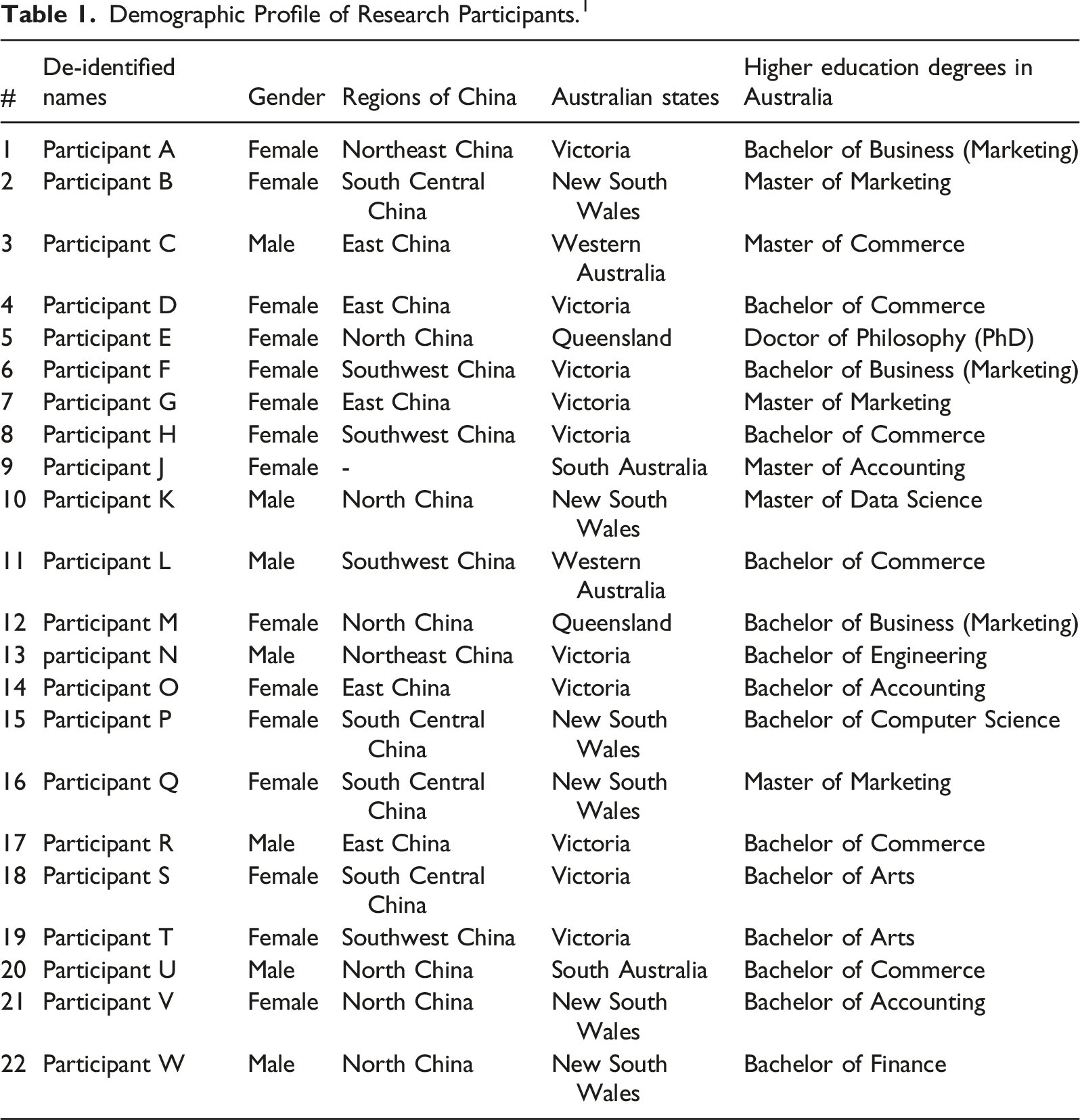
Demographic Profile of Research Participants. 1
Findings
While Australia was the ultimate destination choice, the research participants reported that they had also considered other foreign countries for overseas education.
The United States
The United States was one of the top choices among the participants, although not their final destination. Those participants who did not include the United States as their top study destination still considered the country as a possible option. The United States’ popularity and high-ranking higher education system, future career opportunities and work experiences in the country add credibility within their social networks to many Chinese students returning to China. These are among the most commonly described reasons for its popularity as a study destination among the research participants.
Some participants considered the United States because many people in their circle or from school either travelled and studied or considered moving to this country. For instance, female participant “A” illustrated that the United States had an excellent education system, and her friends had gone to the United States to study, so she believed it to be an excellent opportunity to join them there: ‘My friends and some senior students went to the USA to study. So, we thought, okay, maybe the USA is a great chance with a very representative education.’ (female participant “A”)
Nevertheless, the higher cost compared to other countries, the more complex and lengthy process of getting visas, and safety concerns in the country were the most reported common push factors influencing the participants’ decisions not to choose the United States as their final study destination. The United States remains a popular destination for many Chinese families who can afford tuition fees. However, families with financial constraints may consider other options that are less expensive than the United States. For instance, female participant “B” observed that in comparison to other countries, it was more expensive and relatively more difficult to get into the U.S. education. Yet, if Chinese families can afford it financially or students have a high academic achievement (for instance, qualifying for paid scholarships to study in the country), they would often choose the United States instead of anywhere else.
Many participants expressed safety concerns as their main push factor for deciding against travelling to the country. While acknowledging that the country has good universities, male participant “L” explained that for his parents, safety was essential, and issues of gun or drug violence in the United States made them reconsider the country’s choice for overseas education: ‘There are good universities in America. But my family worried about my safety if I went to America. So, you know, guns, drugs.’ (male participant “L”)
The United Kingdom
Like the United States, the United Kingdom, with its prestigious higher education system and top global universities such as Oxford and Cambridge, was also an appealing overseas study destination for the research participants. Nevertheless, cost and cold weather conditions were the primary reasons the participants decided against travelling to the United Kingdom. For example, when female participant “G” researched the cost of living and tuition fees in the United Kingdom, she realised that studying and living there was more expensive than in Australia: ‘My first choice was actually the U.K.; however, the U.K. was very expensive. A Master [degree] in the U.K. was one year, while a Master [degree] in Australia was two years, and also the tuition fee is like twice as expensive as in Australia.’ (female participant “G”)
Canada
Due to Canada’s popularity as an overseas study destination among the Chinese population, many research participants also considered it one of their top choices. Most participants who stated that Canada was one of their top choices, like the United Kingdom, weighed against travelling to the country mainly because of the environment, particularly the cold weather. For instance, male participant “L” considered both Canada and the United Kingdom (specifically England) as the top choices; however, due to ‘freezing weather’, he did not choose either in the end: ‘I did not want Canada and England because of freezing weather…So, we thought about the cost and about the studies between Canada and Australia to choose. But Canada is too cold.’ (male participant “L”)
Choosing Australia as the Final Host Country Destination
Many research participants and their families were driven by pragmatic and calculated decisions when choosing Australia as their host country, such as a possibility of future migration, including permanent or career perspectives, if not returning to China immediately after graduation. However, for a small number of participants, it was an accident or spontaneous decision without much time for consideration as long as they could leave China for the West.
Many participants wanted to gain a good overseas education and, ideally, overseas work experience to make themselves more competitive in the labour market upon their return to China. Others desired to avoid the growing competition in their home country and find alternative ways to “beat” it, either by moving overseas temporarily or permanently. Furthermore, several participants wanted to escape China’s social and cultural expectations, which was especially relevant among the female participants. Some had more autonomy when it came to choosing the country. In contrast, many participants described the choice as solely belonging to their families, who played a decisive role in the decision.
Family plays a crucial role in Chinese culture, including guiding decisions about children’s future in terms of their human capital, specifically investment into education, including the possibility of travelling overseas for higher education. Because of China’s one-child policy, many Chinese families have parents and grandparents who save and spend money on one child’s education. Similarly, in addition to providing financial and moral support, many research participants mentioned that their families played a primary or significant role in deciding which host country they should travel to for their overseas education.
A small number of the research participants attributed the choice of Australia to their individual decisions, noting that their parents trusted their selections as they had proven to be more independent and capable of supporting themselves financially even abroad. Many participants mentioned that their parents decided that they would move to Australia instead of any other country. For instance, in the case of female participant “F”, whose father chose Australia as her final study destination: ‘Australia is the destination that my dad always wanted me to come over for education or higher education.’ ‘[…] and also my dad wanted me to settle down in Australia. So, I did not go to any other country for university studies’ (female participant “F”)
Australia: Major and Other Pull Factors Among Participants
For many research participants, having an existing connection to Australia was one of the most important pull factors for deciding to move to Australia. The participants described the connection through family members, friends, or someone else from their town who left for Australia and was residing there before their arrival, as well as collaboration projects or programs between universities in Australia and China. Indeed, being concerned about the safety of moving to a new country and having existing connections made participants and their families feel safer and reassured.
For some participants, choosing to study in Australia because of having extended family members living in Australia was an obvious choice. For example, female participant “S” visited her aunt living in Melbourne (Victoria) several times before deciding to move to Australia. This existing connection through family members in the host country became a key pull factor that helped female participant “S” to choose Australia over other preferred countries: ‘My auntie’s family moved to Melbourne when I was around ten years old, and since then, they would invite me to come here for some holidays or any time when I had school holidays. I got a few chances when I was 15 and 17 to spend the summer holidays here. Actually, in Melbourne, it’s winter. I got to know more about this city and the people here back then.’ (female participant “S”)
Having friends from China moving to Australia was also considered helpful and welcoming, especially to worried parents. This was the case for female participant “A”: ‘I had two options – U.K. or U.S.A. And why I chose Australia because of one of my best friends. She was planning to go to Australia to study because she wanted to apply for permanent residency. Even though she did not like accounting, but because she wanted to apply for the residency. She decided to apply and study majoring in accounting. She also asked me if we could go and study in Australia together. I think it was great to go to a very different country with a friend.’ (female participant “A”)
For others, like female participant “O”, having someone they know from the same city in China who went to Australia for overseas education reassured them and their parents to prefer the country: ‘My parents thought that I probably had like some childhood friends in Melbourne, that if I really need to ask someone for help as an emergency contact that you know, there is someone available, but I hardly contacted them at all ….’ (female participant “O”)
Collaboration programs between Chinese and Australian higher education institutions and joint research programs or formal exchanges are other types of connections that some participants described as one of the primary pull factors influencing their decisions to choose Australia as the country destination for overseas education. This factor was common mostly among participants who moved to Australia to study postgraduate degrees, such as Master’s or PhD. For instance, female participant “P” credited her choice of Australia to an existing education connection program between the Australian university and the research participant’s university in China, where she had studied before moving to Australia: ‘My Chinese university had an education connection program with an Australian university (University name).’ (female participant “P”)
In addition to these significant pull factors, the prospect of future migration to a Western and English-speaking country, a safer environment with convenient time zones and a more enticing climate influenced the participants’ and their families’ choice in Australia. For male participant “W”, future migration to Australia with a potential permanent residence played a key determinant when choosing the country and its universities: ‘University studies, majoring in accounting and marketing in my bachelor’s. The reason why I chose these majors is because I did have an opportunity to choose both majors and one for immigration purposes. At that time, from a strategic view, you could get a permanent residency for studying accounting.’ (male participant “W”)
Although safety was not the primary determinant, having a safer country to travel to was one of the substantial contributing factors to many research participants’ decisions. Unlike the United States, some participants and their families, for example, male participant “R”, considered and viewed Australia as a safer option: ‘And they [parents] thought that study in Australia is a good option because Australia is a very safe country.’ (male participant “R”)
Some participants mentioned assessing a country based on cultures and languages when choosing it. This research has found that for some research participants and their families, moving to a Western English-speaking country was necessary. For instance, female participant “J” preferred to move to Australia as a Western and English-speaking country: ‘Also, Australia is more affordable and closer to China. And it’s one of, you know, the most vibrant and economically sound western country that speaks English, so I wanted to go to an English-speaking country.’ (female participant “J”)
This research has found two critical aspects of Australian higher education that influenced many participants and their families when considering Australian universities and education in general. These factors are affordability and entry and study requirements. Most of the time, the research participants compared these factors against those of other preferred countries. For some participants, competitive tuition fees and the lower cost of living played important roles when deciding to choose Australian higher education over education in other countries like the United States, the United Kingdom, or other countries. The parents of some participants noted tuition fees and living costs as key factors in the decision process: ‘So basically, my dad asked me to choose either New Zealand or Australia because that’s what my family could afford. Other countries were too expensive. When I was choosing, my dad said that Australia was cheaper. So, go to Australia.’ (female participant “Q”)
Alongside more affordable tuition fees and the cost of living in Australia, some research participants described that they and their families considered the study requirements in applying for and studying degrees in Australian universities. For these participants, like male participant “R”, Australia was a better and easier study option than countries like the United States or the United Kingdom: ‘Another reason is because they [parents] think studying in Australia might be much easier for the coursework compared to the U.S. or U.K. This might be a wrong perception, but my parents and, like many Chinese people, have that perception. So, they thought I could do many different things besides my coursework in Australia. So, that’s why I chose Australia for my study.’ (male participant “R”)
China: Major push factors identified in the research
One of the major reported push factors for leaving China among many research participants was the competitive environment in the home country, particularly in the education and job markets after graduation. Many Chinese students also face a competitive educational environment, whether enrolling in particular schools, studying, or preparing to pass a national exam in the country.
Since the economic growth in China, the young Chinese population, alongside their parents, have become accustomed to a constantly competitive and stressful environment, whether to get into a prestigious high school, pass gaokao and enter a top-tier university or program, and later join the workforce with stable career opportunities. As one participant (male participant “U”) noted: ‘So, number one is again coming back to the competition factor. I think the entire narrative was ultra-competitive, right, so it’s very difficult to get into a top-tier university like a really good program. For example, if you want to do law in China, a top-tier university is exponentially harder. I think the second factor is mainly about lifestyle. So, you know, again, in China, when you graduate, if you want to find a good graduate job, you are against millions of candidates.’ (male participant “U”)
Sharing her experience with such a competitive environment and the expectations attached to it, female participant “D” described that, in China, the education system is not forgiving because of the gaokao. Contrary to this participant’s and her family’s expectations, and despite all the hard work and good marks in the last three years of high school, the final college entrance gaokao exam resulted in a subpar performance in a specific subject. The result prevented this participant from getting into one of China’s prestigious universities: ‘I think in China, the education system is very lenient because you have to get really good results in one exam [gaokao] to be able to be accepted into a very good university. I had very good marks throughout [last] three years. But in the final exam, I just didn’t do very well in a specific subject. I can’t remember which one now, but yes, I didn’t get into Fudan University or top universities as expected.’ (female participant “D”)
Facing and dealing with a competitive education environment in China, many young Chinese and their parents are forced to look for alternatives to boost their children’s human capital and competitiveness if they cannot pass the exam and enter a desired Chinese university. One such alternative has been overseas education, including in Australia. Some research participants, including female participant “O”, also opted to avoid the pressure of gaokao. However, in this participant’s instance, they decided to leave China and complete the last two years of high school in Australia, allowing some time to learn English and the Australian culture before applying for higher education degrees. Once again, one of the main reasons was to avoid the gaokao and the competitive environment in China: ‘… [ I ] think [it] is too competitive in China, it was better for me to go overseas a bit early, so then I [could] study language and culture.’ (female participant “O”)
Beyond graduation, China’s job market is also very competitive. Many young people must compete for better career prospects. This environment in China encouraged the research participants and their families to search for alternative options, including temporary or permanent migration overseas. The idea behind the temporary departure was to focus on developing and improving human capital overseas and help the participants become more competitive in the labour market in their home country when they return. Alternatively, some participants and their families concentrated on permanently migrating to a different country to avoid future employment competition in China as well.
This research found that some social and cultural norms in China were also significant push factors for some research participants but were primarily prevalent among the female participants. Several participants saw an overseas education, particularly in Australia, as a way to escape some of China’s traditional social and cultural norms and become more independent. Such norms included typical family expectations of women getting married, having children, and staying at home to look after the household. One interviewed research participant (female participant “P”) described her reason and motivation for moving to Australia. Her description resembles a plot in Roald Dahl’s famous novel Charlie and the Chocolate Factory, where children search for limited edition “golden tickets” in Willy Wonka’s chocolate bars, which would give them access to Wonka’s chocolate factory and supply of chocolates. Illustrating an opportunity to study in Australia as a golden ticket, female participant “P” explained her decision to study in Australia as follows: ‘The honest answer about Australia is my freedom outside. Anything outside China, outside the title restriction for me, is just a fantasy like a waterfall, like I feel like the gateway to get out. It doesn’t matter how far Australia looked like. I think I just did a simple search and said all the weather looks nice. It’s very basic, and I did not have any understanding of the culture or anything. But it was a golden ticket for me to ride outside and see the world. I think, mainly curiosity, makes your eyes widen, and you just forget about everything and just go until you land there. You start to immerse in the environment and start to figure out.’ (female participant “P”)
Discussion and Conclusion
The global competition for international students, including those from China, highlights the importance of understanding why students choose certain countries for their education. Due to evolving and changing policies and global dynamics between China and other countries like the United States, the United Kingdom, Canada, and Australia, factors impacting the mobility of Chinese international students may change over time. Understanding these factors is crucial for Australia and its international education sector to remain competitive in the global market. While various studies have examined Chinese students’ motivations for studying overseas, few have specifically focused on why they opt for Australia over other popular destinations like the United States, the United Kingdom, or Canada. This research fills that gap by employing the push-and-pull model to explore the factors influencing Chinese students’ decision to pursue higher education in Australia. The push-and-pull model remains a popular framework for studying international students’ mobility and provides insight into the decision-making process of Chinese students and their families.
In this research, participants’ families are pivotal influencers in the decision-making process, weighing numerous factors to select an overseas education destination. The research has also identified several critical push factors driving students away from China, including the intensely competitive education and job market environment and societal expectations, especially for female participants. Many participants saw studying abroad as a means to acquire valuable human capital and escape the pressures of China’s educational and employment systems. These findings align with previous research, which noted the role of families and the negative impact of China’s gaokao system on students’ desire for overseas education (Stafford, 2011; McCrohon & Nyland, 2018) and some social norms (Martin, 2017). According to Martin (2017), there are ‘gendered risks’ that many Chinese women must deal with. One of those risks is gender bias in China’s labour market. For Martin’s (2017) research participants, overseas education represented a means to escape – either temporarily or permanently from social norms regarding women’s behaviour in China.
Moreover, in this research, having prior connections to the host country emerged as one of the most crucial factors influencing students’ decisions to choose Australia. The connection to the host country encompasses family, friends, or someone the participants knew who had moved to the country, as well as joint education programs between Chinese and Australian higher education institutions. Some of these research findings support the previous studies. For example, Azmat et al. (2013) and Cao and Tran (2015a, 2015b) reinforced the significance of social networks, such as family and friends in the host country, which influenced Chinese international students’ decisions regarding their education destination. Expanding on the findings outlined in Ding & Li, (2012), which emphasized the influence of social networks between Chinese and American universities on Chinese students’ selection of educational institutions in the United States, this research reveals a similar trend in the Australian setting. Connections through joint educational programs between Chinese and Australian higher education institutions can provide valuable support and guidance to Chinese international students. These connections can offer insights into the Australian education system and cultural norms, helping students navigate their new environment more easily. In essence, prior connections to Australia made most research participants and their families feel safer and provided a sense of familiarity and reassurance about their decision to move to a new country.
Australia’s migration opportunities also played a part, along with being a Western and English-speaking country, a relatively safe environment, with affordable tuition fees and easier entry and study requirements for Australian higher education. Some of these research results are similar to the findings of studies on Chinese students in Australia that showed that some Chinese students choose to study in Australia because of future migration and permanent residency opportunities (Wang & Shan, 2006, p. 7; Stafford, 2011; Guo, 2010, pp. 150–151; Hao et al., 2016; McCrohon & Nyland, 2018, pp. 21–22; Liu et al., 2023), and desire to study in English-speaking countries (Stafford, 2011; Cao and Tran, 2015a, 2015b; McCrohon & Nyland, 2018, p. 21).
In contrast, the research participants’ most common consideration of the United States, the United Kingdom, and Canada was the popularity of these countries among Chinese families in Mainland China. The United States was the most popular other country considered among the research participants, followed by the United Kingdom and Canada. This research finding is aligned with statistical data on the number of Chinese students studying in those countries (UNESCO, 2023). Factors influencing the participants’ decisions not to move to those countries included costs, such as higher tuition fees and cost of living, a colder environment, safety concerns, and lengthy and complex immigration processes.
While the research findings have contributed to emerging literature on Chinese international students, it is important to note some limitations. Specifically, due to a limited sample size, the findings do not represent and cannot be generalised across all Chinese international students in Australia.
Because of the population size, China will likely remain one of the leading sources of international students for countries like the United States, the United Kingdom, Canada, and Australia for many years into the future. An increased understanding of the factors influencing Chinese international students’ decisions on the study destination is vital for higher education institutions and the international education sector in Australia to support one of its largest service exports and remain competitive.
Footnotes
Acknowledgments
I want to acknowledge the two anonymous reviewers for their helpful and valuable comments, which have significantly helped me improve this paper.
Declaration of conflicting interests
The author(s) declared no potential conflicts of interest with respect to the research, authorship, and/or publication of this article.
Funding
The author disclosed receipt of the following financial support for the research, authorship, and/or publication of this article: This work was supported by the Curtin University of Technology (The Research Training Scholarship).
