




Abstract
Since the UN passed its Universal Declaration of Human Rights in 1948, there has been a seemingly commonsense equation between schooling and education, and access to quality schooling is considered to mean the assurance of educational rights. Against such an assumption, this paper demonstrates the complex nature of educational equity in the modern world, where the demands for knowledge are in constant flux. If the purpose of education is solely to acquire knowledge, learning can occur outside the institutionalized school system. However, individuals and societies place a high value on formal education and its credentials, which intensifies the competition for higher and better education. The simple equation of educational rights with schooling has a risk of fanning such thirst for credentials rather than equalizing opportunities. The author argues that the world culture of schooling and international tests have contributed to standardizing the popular aspiration globally along the axes of years in school and test results. In today’s dynamic world, individuals have to continue learning throughout their lives to catch up with changing demands for knowledge. Therefore, the concept of equity should be more in line with individuals’ motivations and contexts of learning than with the access to and quality of educational institutions.
Keywords
Introduction: The discourse on educational equity and the global market mechanism of schooling
The concept of equity has become increasingly important to educationists in recent years. But can equity be achieved simply by reducing the disparities among nations and social groups in their access to school education, its quality, and their students’ relative success in passing diploma exams? Since the UN passed its Universal Declaration of Human Rights in 1948, the assumption that the right to education is achieved through school attendance has gained traction worldwide. This seemingly commonsense equation between schooling and education has been accepted without much question by both policymakers and individual parents, teachers, and students. Accordingly, to ensure that the right to education was distributed “equitably,” the school system has prevailed in every corner of the world, including remote villages and urban slums in developing countries. Since the 1990s in particular, under the banner of Education For All (EFA), international development partners have concentrated their financial and technical assistance on countries with lower educational indicators to improve their access to and quality of basic (primary and lower secondary) education (d’Aiglepierre & Wagner, 2013; UNESCO Office Dakar and Regional Bureau for Education in Africa, 2013). As a result, as of 2018, the global net school enrollment rate, including developing countries, had reached 89% in primary education and 66% in secondary education (World Bank, 2022).
Such interventions to increase access to schooling are well-intended, and in fact, evidence from various sources demonstrates the positive effect of a few years of schooling, compared with illiteracy, for social and economic development (Hahn & Truman, 2015; Teles & de Andrade, 2004). Despite the positive outcomes they report, however, these studies fall into the trap of equating schooling with literacy, numeracy, and other essential life skills, including an understanding of health, sanitation, and child-rearing. It is not necessarily the number of years spent in school that helps improve people’s lives and contributes to alleviating poverty. The direct cause of such reported changes is the knowledge learned during this period. Regardless, many studies on the impact of schooling have been done without clearly segregating the effects of years in school and knowledge acquired in this period. A reason for such academic practices was the handy accessibility and global comparability of school year variables worldwide, which scholars often use as the proxy for the impact of education as a whole.
Also, it has been difficult to specify which aspect of school education had essential effects in improving the graduates’ lives. Since children and youths spend a large part of their time in school, the experience there would have significant implications for not only their knowledge formation but also their personality development and aspirations. Such diversity of potential impact of school life, pinning down the relationship between knowledge acquired in school and its lasting impact requires rigorous micro studies, which is in most cases difficult. Measuring the proficiency level in core subjects’ curriculum contents is possible by standardized curriculum-based tests, which would be helpful to examine the effectiveness of the school education in conveying the curriculum contents precisely. However, the question here is if the mastery of curricular content leads to the formation of competencies to live in today’s fast-changing world. The realities that school graduates will face are diverse and dynamic. How can schools ensure to educate their students to keep up with the changing needs of knowledge after graduation? Measuring its impact by years in the formal education system or proficiency in curriculum contents would not be enough. Also, the question of equity should be considered along with this consideration. When the demands for knowledge outside of school cannot be standardized, what would be the criteria for us to judge whether the “rights for education” are ensured equitably?
Social meanings of school certificates and investments in them
Suppose the purpose of education is solely to acquire knowledge. In that case, learning can occur outside the institutionalized school system, and the granting of any formal diploma becomes a minor issue, if not entirely unnecessary. However, in reality, young people and their families aspire to stay longer in school and, hopefully, in a prestigious one. Dubbed the “diploma disease” decades ago (Dore, 1997), this die-hard phenomenon has been observed in almost all societies: even today, the desire and competition for schooling are strong, particularly in societies where education systems were introduced later, and therefore, the opportunities are still limited (Jonbekova, 2020; Little, 2006)
In response to such phenomena, two contrasting views have arisen on the global expansion of the modern school system. The first considers this expansion a sign that most people enjoy learning opportunities regardless of their diverse socioeconomic and cultural backgrounds (Murphy, 2018; UNESCO, 2023). Along this line, after equal access to schooling, the next envisioned challenge is to achieve “equity” in attaining knowledge taught in the school. How equitable according to what criteria? In fact, that is a huge unanswered question which this paper tries to address.
Another important but different view is that school expansion would instill in the minds of educated individuals a thirst for even further chances. According to the latter view, school certificates are tokens to be exchanged for income or social status, and education is desired only as a commodity, not for the value of the knowledge gained (Williams, 2012). Not only do students and their parents want a higher “exchange value” of schooling, but the governments of developing countries invest significantly in school-based education in the hopes that increasing the population’s average number of years in school will raise the value of human capital and boost their economies.
The two positions about the global school expansion can be considered that of educationists and economists who see the social functions of schooling from different angles. The former sees it as the object of right, while the latter sees it as an investment. The economic theory of human capital treats human beings as a form of capital that contributes to economic growth. Education is always a significant determinant of the abilities of human capital, which justifies the investment in it both by individuals and by society (Galiakberova, 2019; Schultz, 1961). To measure the size of investment and return, education is to be represented by measurable proxy indicators, which have mostly been years of schooling and the registered programs (majors) in it. Even today, creating and using indicators of abilities themselves are challenges for the econometric analysis of human capital. However, as I have demonstrated elsewhere, with the ability-related data we collected by ourselves, the effects of schooling and abilities on labor market outcomes are different in nature (Yamada & Otchia, 2022).
Regardless of the positional differences between rights-based and economic perspectives on education, a significant commonality is that they both seem to equate education with schooling. In this paper, I will consider the meaning of equity in the contemporary world, where the demands for knowledge are in constant flux. As educationists, many of us discuss that access to quality education is a fundamental human right. Is there any confirmed set of knowledge to which access should be “equitable”? Do we still consider school as the best channel of learning, based on which equity is to be discussed? In the following sections, I will pose my considerations on these questions with the hope of promoting scholarly exchanges.
A danger of standardized vision of “equity”
Let us return to the issue of equity, which many educationists consider a building block of educational rights. Figure 1 depicts the view of equity often found in the reports of international organizations and other development partners. The illustration conveys the powerful message that equity does not mean providing the same service (in this case, the box to climb) to everyone regardless of need, but instead ensuring the same results (being able to see the baseball game at the same eye level). For example, allocating the same amount of subsidies to all school-aged children is an “equality” measure. However, children from well-off families would go to school with or without financial aid and they may even use it to cover the expenses of additional educational services such as private tutors, which would increase the gaps caused by households’ economic capacities. Meanwhile, children of poor households may not still be able to enroll at school as the subsidies are not enough to cover the schooling cost. To mend this problem, the concept of “equity” is to provide weighted support to prioritize the disadvantaged population so that all children, regardless of parental income, will receive the same level of education. The difference between equity and equality.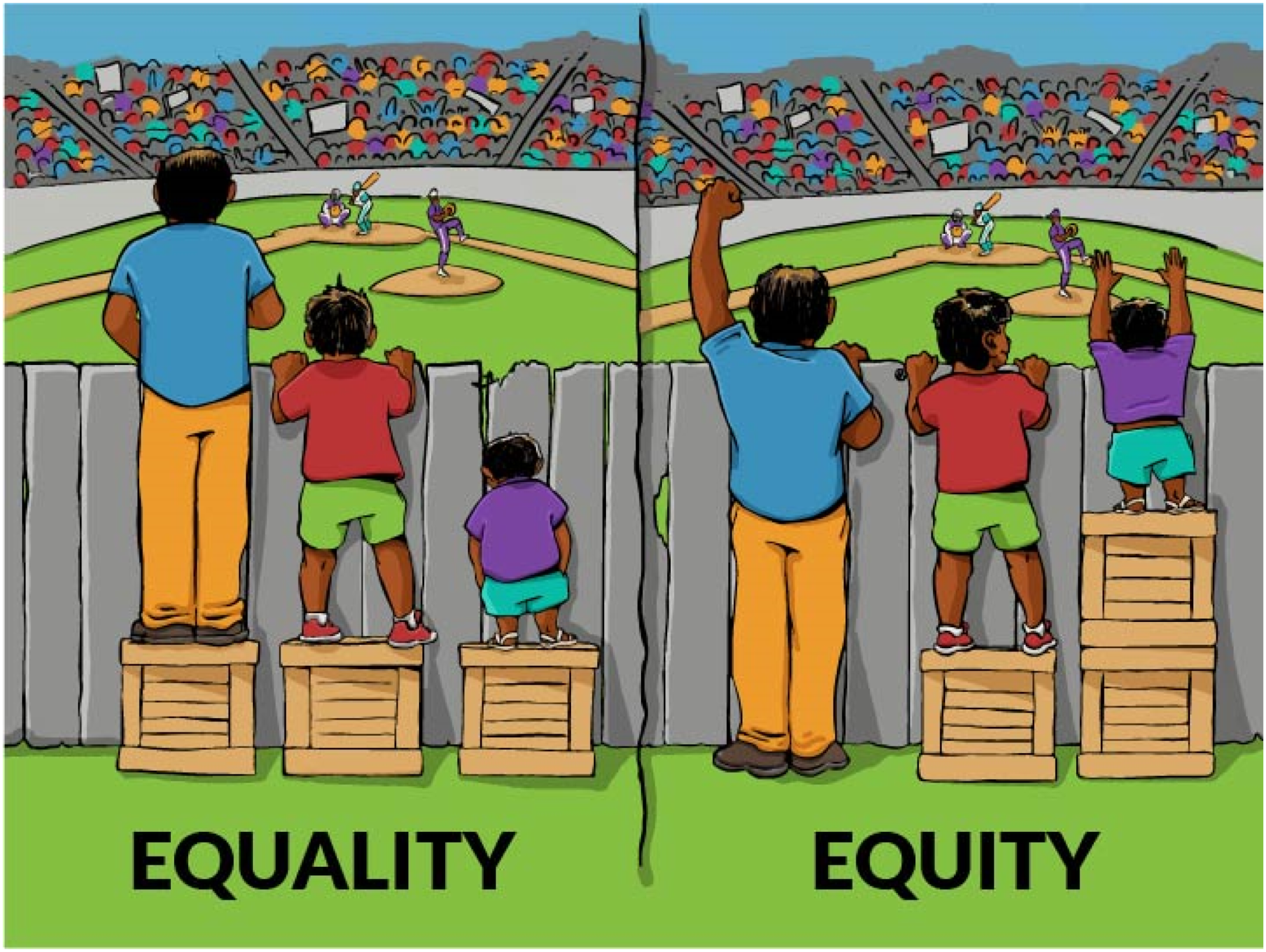
Ensuring equity is a more demanding task than achieving equality because one cannot easily predict the outcomes of an intervention, and there is no common formula to estimate the equitable outcomes of educational interventions. For example, the outcomes of primary education certificate examinations, which are done at the end of the primary education cycle, cannot be known until respective students sit for the exams after the whole period of schooling. Of course, the exam data from past students would be used to check if the education system was internally efficient or if the disparities caused by students’ socio-economic backgrounds persist or are reduced. Improving equity within the education system itself is challenging, and experts, teachers, and officials have made admirable efforts to improve the situation.
At the same time, I would like to raise a question here: Is it fine that we take it as given that the mastery of curricular contents is the effective yardstick to check the level of equity in guaranteeing the rights to education? Why do we assume that the three people in the illustrations all want to watch baseball played in the stadium? While the concept of “equity” advanced the idea of being equal to be more result-oriented, it maintains the same universalistic assumption as “equality” that everybody needs the same thing. If there is no preconception, the difference in heights is a simple fact. However, once we apply the judgment that all three need to watch baseball, being short turns to mean inferiority.
If everybody is eager to watch the baseball game, it is because they have all internalized the shared belief that what goes on behind the wall is universally interesting. Put differently, if the stakeholders in education, including parents and students, do not question this premise that better access to and outcomes from schooling are the signs of improved equity in education, without considering broad domains and application of knowledge that individuals need for their lives, they may be trapped in the conceptual cage which devoid them of the imagination about real nature of learning and knowing.
Being oriented to desire the same thing, the short boy in the illustration would be reminded that he cannot stand at the same eye level as others unless someone provides him with two boxes. School dropouts may suffer the idea that they are inferior to people who finished school throughout their lives. People who are not strong at written tests may internalize the extrinsic judgment that they are less capable, even if they may have unique creative or technical capacities outside the scope of the core curriculum in school.
Indicators such as enrolment rate or students’ test results serve as a convenient axis to organize data, showing the variance among individual samples along it. At the same time, one should note that, statistically, it is impossible for all samples to overlap at the same point on a coordinate axis. In other words, dispersion always occurs. And if the variance involves a value judgment of superiority or inferiority, then the human rights-based theory of equity gives a hypocritic outlook.
The spread of schooling has thus globalized the assumption that all societies desire the same outcomes for their school-age populations. Behind such a belief lurks the modernist fantasy that all societies are striving for modernization, which they will all eventually achieve. This view perceives differences among societies not as distinct characteristics but as indicators of their relative distance from a common goal. Through the modern project of school expansion, educationists and proponents of a rights-based approach, albeit unintentionally, have contributed to the development of the global school certificate market, propelled by the thirst of customer-learners.
The world culture of schooling and hierarchical measurement
The argument that testing has the effect of standardizing notions of education and policies and systems across countries with different realities and histories has been made by many comparative educationists. One of the major scholarly domains in this field describes the mechanisms by which certain forms and models of education spread across different societies. One group of scholars examines policymakers’ practice of copying educational ideas from elsewhere and adapting them to their own systems, describing it as policy borrowing (Auld & Morris, 2014; Phillips & Ochs, 2003). In order to explain the diffusion of some policy ideas to multiple societies simultaneously, world culturalists have pointed to the shared assumption that a certain type of school model is a precondition for national development, an assumption that in itself constitutes a “world culture” (Benavot et al., 1991; Meyer & Ramirez, 2000).
International tests are often said to have functioned to trigger such policy convergences. For example, the Trends in International Mathematics and Science Study (TIMSS) (Baker & LeTendre, 2005) and the Programme for International Student Assessment (PISA) (Waldow and Steiner-Kamsi, 2019) both involve students from member countries of the Organisation for Economic Co-operation and Development (OECD). International tests are the main tool for evaluating the efficacy of the education systems in different countries under a common framework. Students of the same age or in the same grade in primary or secondary schools participate, and their test scores (learning outcomes) are ranked by country.
Despite scholars’ warnings and criticism, the media of participating countries report PISA rankings sensationally, influencing the discourse of not only the public but also policymakers. For example, Finland, consistently a top ranker on the PISA, welcomes so many study tours to learn from its education system that educational tourism has become an important industry (VisitFinland, 2024). In addition, many countries have revised their school curricula to encourage the type of problem-solving competencies that the PISA measures (Kadijevich et al., 2023; Lingard, 2017). The standardized measurement of learning outcomes has a boomerang effect, with the result that the national curriculum, pedagogy, and education system as a whole are similarly standardized. In this way, countries’ education systems continue to converge, as their methods of evaluation become increasingly homogenized.
Global agendas such as the Sustainable Development Goals, the Millennium Development Goals, and EFA also play a part in setting common targets to be pursued by all countries, regardless of the diversity of national contexts. Multilateralists study the processes by which organizations with different motives and characteristics interact with each other and formulate the shared norms and agendas of international educational development (Chabbott, 2003; Mundy, 2010). This “global governance” of education, as they would call it, formally and informally defines goals and targets, and articulates the indicators by which progress toward achieving them can be monitored. Particularly after the rise of data science—which was influential in the discourse on the SDGs and international education as well—in the 2010s, quantitative evidence based on big data analysis has been preferred, spurring on the standardized measurement of various indicators in education, from inputs and quality to outcomes (Yamada, 2016).
In this highly standardized “world culture” of education, the promotion of equity can easily become mere lip service from the human-rights faction of policymakers and educationists. The convergence of educational models and the reliance on large-scale quantitative measurement place individuals and countries on a common comparative axis, according to which they are ranked. We compare because there are differences. These rankings display countries’ relative positions in an irresistible format and spur lower-ranking nations to reach higher. However, evaluation along a relative axis of school attendance and curricular attainment never treats everyone equitably. Both the higher and lower performers in this ranking system perpetuate the structure, while the latter cannot escape disappointment and covet the greater opportunities higher-ranking nations possess.
The diversity of “21st-Century Competencies” and equity
While schooling has become increasingly homogenized and globalized, the knowledge that graduates need in life and work varies depending on their situations. Our knowledge-based economy shortens the life cycle of the knowledge required in economic activities, and without the ability to constantly update their knowledge, people find it difficult to keep their jobs and adapt to societal changes. The release of Chat GPT at the end of 2022 stirred public anxiety that white-collar jobs will be taken over by AI. Routine work in the offices is likely to be done by AI as well as or even better than humans. Therefore, we are under unprecedented pressure to keep developing capacities relevant to work and life. Today, the media often report an urgent need for adult workers to upskill in order to keep up with industries’ demands (e.g., Forbes, 2019; Harvard Business Review, 2021), and various educational service providers advertise programs for adult learners in skills for improved performance at work, such as computer programming, foreign languages, and management. Some of these programs are offered by traditional educational institutions like universities and lead to degrees and diplomas, but most are for people pursuing the use value of knowledge for specific applications. Learning has become a lifelong process, which means that a significant portion of it occurs after leaving school, regardless of the length of time spent in the education system. Moreover, learners can select the content and modes of learning according to their interests, needs in work, and circumstances.
Recent academic discourse identifies the ability to respond to an employer’s or society’s demands, such as to perform an activity or solve a problem, as a key competency of living in the 21st century (OECD, 2005; UNESCO, 2013). This competency involves different types of mental skills, including cognitive, metacognitive, and noncognitive skills (Anderson & Krathwohl, 2000). 1 Among seven targets of SDG4, some focuses on improving such competencies of learners. For example, target 4 focuses on job-related skills of youths and adults, target 6 on literacy and numeracy, and target 7 on various noncognitive and behavioral skills necessary for living a sustainable life in a democratic society. This is a fundamental change from earlier educational goals, including those of EFA, which mostly focused on providing better education services to more students but paid little attention to the competencies these students gained (Yamada, 2016).
It is good news that SDG4 recognizes the importance of competencies, as it suggests that key actors in global education governance have shifted their attention from the materials taught in school and the management of the school system to the learners and what they learn. However, it is highly concerning that a primary indicator of learning outcomes is still standardized written test scores, such as the national certification exams conducted at the end of primary or secondary education or international tests like PISA. Even though the necessity of adaptive, lifelong learning and the multidimensional and context-dependent nature of competencies have been recognized, learning outcomes are still measured by school students’ test scores. As someone who has worked in this field for some time, I understand the difficulty of collecting data on the learning outcomes of people who do not attend school. Furthermore, even if a researcher should assess the competencies of some working adults in one society, such a localized measurement would not be suitable for global comparison. Unless global comparisons and rankings are possible, however, international development agencies and experts would not be able to make decisions that can convince stakeholders with different interests or justify the priorities of their aid programs. A series of technical, administrative, and political factors perpetuates hierarchical comparison based on the “world culture” of schooling. Nevertheless, it is necessary to separate these operational concerns from academic debates on educational equity in today’s changing world.
What does it mean to ensure equity when the modes of learning and the very meaning of knowledge are diverse and in flux? The scholarly discourse on competency inherently recognizes that there is no single stadium where the baseball game of everybody’s interest is played. Needs for knowledge vary from person to person and from society to society. Thus, the challenge for our generation is to achieve equity starting from learners’ perspectives and, at the same time, to abandon the inclination to find superficial commonalities and use them as yardsticks to rank education systems and nations against each other. Unless we break out of the trap of this type of false equity in schooling, we will forever be arguing over the necessary years of schooling and educational services, and the people’s pursuit of more and more of the same kind of services will not cease.
Final thoughts: The COVID pandemic as a turning point
The COVID pandemic forced schools to shut down on a massive scale in both developing and developed countries. This became a painful but unique opportunity for us to reflect on the meaning of schooling and learning. What would it mean to continue learning while face-to-face schooling was suspended? A new kind of educational gap emerged, one stemming from the availability of the facilities and equipment, such as tablet computers and the internet, necessary to continue learning at home (The World Bank et al., 2022). At the same time, educational programs based on information technologies personalized the learning process, adapting the mode, content, and level of learning according to individual interests and progress.
For a long time, education to foster self-motivations and interests of learners have been considered difficult, except in segregated small schools in which teachers can pay close attention to individual students. To manage classes of a large number of children, a school system was invented to teach modules of content designed for age cohorts. Therefore, standardization and the school system have been closely linked as if they are two sides of the same coin. However, the personal optimization of learning enabled by technologies and entered into the formal education system to overcome the emergency challenges may force us to change such presumptions.
Today, providing the education that prepare learners for the knowledge needs outside the school and that is based on their interests and progress may not be unrealistic idealism but has the potential to become a reality for the masses. Of course, the concept and method of assessing the learning outcomes would need to be fundamentally changed from standardized testing, but evidence-based constructive learning may no longer be a fantasy.
The global discourse on educational development states that equity in opportunities, quality, and outcomes of education should be ensured across school-aged populations, regardless of socioeconomic background, gender, ethnicity, and culture. However, as we face our new, post-pandemic reality, it is useful to ask ourselves if it is meaningful to measure equity objectively by separating knowledge acquisition from the learner’s own motivations and needs in life.
What, then, does equity in education mean? This question is not a mere metaphysical exercise, but one we face in our daily life, as school education is criticized for failing to nurture basic social skills and 21st-century competencies. In this context, equity in education would be achieved only by making a society a place where people are motivated to continue learning throughout their lives and can apply what they have learned in real life, based on the premise that what people want to learn is diverse and depends on the environment in which they learn. A person would not lose motives for learning if he/she can get due support to access educational services regardless of their modes of provision. Such a matching between motivated learners and education would be a key to achieve relevant and equitable opportunities of learning. And the measurement of their learning achievement would be made not by the relative position against other learners using a common yardstick but by individual progress from his/her own past abilities.
Footnotes
Declaration of conflicting interests
The author(s) declared no potential conflicts of interest with respect to the research, authorship, and/or publication of this article.
Funding
The author(s) received no financial support for the research, authorship, and/or publication of this article.
