



Abstract
Given Hong Kong’s robust, high-performing, and entrepreneurial higher education system, universities are preparing their students to adapt, contribute, and thrive as productive workers, capable citizens, and life-long learners. With the employment of both qualitative document analysis and inductive thematic analysis, this study aims to analyse how the eight publicly funded universities in Hong Kong conceptualise and frame their graduate attributes, and reveal the similarities and differences of their underlying motivations and implications. This study brings together eight discourses, namely life-long learning, critical thinking, communication and collaboration, interdisciplinary mindset, contextual systems thinking, commitment and responsibility, ethical values and moral principles, as well as technological capability. Using both the lenses of academic entrepreneurism and future readiness, although several attributes are founded to be academically entrepreneurial in orientation due to the emphasis on equipping students with individual skills and dispositions, some other attributes are bringing students back to the humanistic and social nature of human beings, which reveal that Hong Kong universities are preparing their future-ready students both as agents for personal development and of social good. This study can inform how various universities worldwide can revamp and reinvigorate a common set of future-ready graduate attributes, while contextualising and adapting institution-specific variations.
Keywords
Introduction
Universities nowadays are no longer the isolated ivory towers, given that they need to align their vision and mission to the wider societal, national, and global goals (Lee, 2014). Many of them recognise the need to prepare their graduates who can meet the changing aspirations and new demands of society and the world (Barrie, 2006). This leads to the development of graduate attributes, which refers to a detailed of qualities, skills, and understandings that are what students expected to have developed and acquired upon the completion of their university degree programmes (Barrie, 2012). Meanwhile, there are general consensuses towards the value, importance, and relevance of imposing a set of graduate attributes (Budwig & Alexander, 2020). This set of attributes publicly available on the official websites also reflects the types, specifications, levels, and standards of talents cultivated by these universities, especially when they are increasingly held accountable for their graduates’ development as a manifestation of their provision of quality education for preparing graduates to contribute to the public good (Bendixen & Jacobsen, 2017). The emergence of graduate attributes is also aligned with the globally homogenous developmental paths adopted by many universities, which are becoming more entrepreneurial in everyday management and operations, as well as operating under managerial discipline and control (Chan & Lo, 2007). Under the influence of academic entrepreneurialism, universities are becoming increasingly important for supporting social and economic development, as well as enhancing local and national competitiveness. Students are also expected to become more enterprising and resourceful through their university education, such that they can cope with their ever-changing futures with much greater uncertainty and complexity (Yang, 2012). Therefore, university education nowadays bears an entrepreneurial spirit as students need to be well prepared for coping with the rapidly evolving labour market in the contemporary knowledge-based generation (Sam & Van der Sijde, 2014). All these perspectives reveal the imperative to analyse the emergence of graduate attributes as one of the entrepreneurial activities initiated by universities, especially whether these attributes are instrumental and pragmatic in nature and orientation, and to what extent are they reflecting or even shaping university’s underlying conception of future society and the world.
Taking Hong Kong’s as an example, since the 1990s, its higher education system has been undergoing rapid changes in order to cultivate more talented and knowledgeable workers with diverse and adaptable skills to support the overall economic development and transformation (Lo & Tang, 2020). According to the Education Commission Report Number 3, it was proposed that the top priority of Hong Kong at that time should be to increase the overall number of students entering higher education each year, given that resources were readily available (Education Commission, 1988). In view of this suggestion, the government initiated three major strategies to attain this end. First, it started by increasing the enrollment rate of higher education by establishing a new university and granting university status to existing institutions. It also encouraged the non-government sector to offer sub-degree education, including associate degree and higher diploma programmes. Furthermore, it introduced non-local higher education provision and increased non-local students (Lo, 2020). As Hong Kong’s higher education system has been undergoing expansion and massification, the eight publicly funded universities have simultaneously been evolving in terms of both research and teaching, especially in terms of competing for the best quality of students and most amount of research funds (Jung & Postiglione, 2015). As a city with a long-standing history of urban entrepreneurialism, Hong Kong’s higher education sector remains highly strategic and entrepreneurial, which is well reflected by its institutional dynamics and everyday operations. This agenda is particularly important when the government aspires to develop the city into a regional education hub with the hybridity of the East and the West (Tang & Chau, 2020). At the same time, the approach to reforming Hong Kong’s higher education system is largely managerial, meaning that neo-liberal discourses like efficiency, effectiveness, and excellence are dominating throughout the process (Mok & Welch, 2003). Nonetheless, each university in Hong Kong still possesses autonomy and power in terms of managing their daily matters as the wider reform was initiated within a decentralisation policy framework (Mok, 2009). Therefore, it becomes interesting to observe how these universities with agencies are navigating through the wider structures and subtle nuances.
Influenced by the overarching goal of academic entrepreneurism, all eight publicly funded universities in Hong Kong are equipping their students to adapt, contribute, and thrive as productive workers, capable citizens, and life-long learners (Chan, 2010). An obvious example could be traced back to the Education Commission (2000)’s Review of Education System Reform Proposal, which highlights an imperative need to offer opportunities for Hong Kong students to cultivate their global skills and competencies in order to sustain Hong Kong’s competitiveness in the knowledge-based economy. Another similar remark is made by University Grants Committee (2010), which proposes that Hong Kong universities should be regarded as the prime providers of complex skills, agility and creativity, and innovation, and students should learn to remain thoughtful, self-reliant, adaptable, and contributing all the time. Furthermore, the emergence of the future-ready discourse in university education is also inviting universities around the world to empower and transform their students by becoming both resilient and adaptable with the necessary skills, competencies, dispositions, and mentalities to cope with the issues and challenges emerging from changing and unfamiliar landscapes ahead of them (Lam, 2023). Despite the wider contextual backdrop, there are simultaneously multiple institution-specific factors, such as tradition and culture, which affects how each university is to define and advance their own distinctive graduate attributes in order to attract students to enrol in their programmes and build their own reputation within the competitive environment (Aitken et al., 2019). In the words of Bester et al. (2018), any graduate attributes that are decontextualised are unlikely to be implemented or attained, given that they the structural and contextual forces are influencing the shaping of these attributes among universities. Therefore, it is useful for understanding how graduate attributes are conceptualised and framed by various Hong Kong universities, and revealing the similarities and differences of their underlying motivations and implications, especially through both the lenses of academic entrepreneurialism and future readiness as two dominant discourses. To these ends, this study is framed based on the following three research questions: 1. What are the similarities and differences of the graduate attributes conceptualised and framed by the eight publicly funded universities in Hong Kong? 2. How can the graduate attributes articulated by the eight publicly funded universities in Hong Kong allow students to remain future-ready? 3. To what extent are the graduate attributes articulated by the eight publicly funded universities in Hong Kong academically entrepreneurial in orientation?
Literature review
Emergence of academic entrepreneurism in universities
Although academic entrepreneurialism remains as a broadly defined term, it generally refers to how universities are capitalising new opportunities and resources, managing limitations and risks, as well as maximising revenues, reputation, and human capital in response to the demands for education, research, and knowledge solutions associated with the development of both knowledge-based society and economy. In particular, the entrepreneurial turn of development of universities around the world has lingering implications on what it means for them to research, teach, educate, and learn (Tang & Zhang, 2023). Siegel and Wright (2015) highlight that the question of whether a university is effective in engaging academic entrepreneurism is not simply an empirical issue but also a policy issue, which touches upon understanding both the universities’ fundamental purposes and everyday operations. According to Tang (2023), the major criticism regarding the emergence of the global template of entrepreneurial university is how they target at exploiting commercial value from the production, diffusion, and application of academic knowledge. These subsequently create immense pressure for universities to operate more like quasi-economic institutions. At the same time, the wider move that universities around the world are now becoming more entrepreneurial is highly appealing to many stakeholders, for instance, governments want to reduce unemployment rate and cope with economic crises affecting citizens, employers want the graduates to be more skillful, efficient, and innovative, and students want to obtain better jobs and higher salaries (Hannon, 2013). All these explain why Guerrero and Urbano (2012) report that there have been a series of theoretical and empirical studies in the field of university education, which focus on investigating the dynamics embedded throughout these entrepreneurial universities. Some of the directions include these universities’ overarching missions and goals, adaptation processes and organisational changes, strategic policies and initiatives, environmental pressures, practical recommendations, and academic implications. Nonetheless, Schulte (2004) suggests that the most appropriate way is that each university should come up with their appropriate organisational structure and well-prepared configuration, in order to attain its unique version of entrepreneurial university.
The rapid popularisation of academic entrepreneurialism in the contemporary university setting is emphasising that rational and productive students should invest in themselves and their futures by securing and maximising the best possible outcome as well as becoming more resourceful and valuable in society. As a result, the agenda of globalised knowledge and service-based economy, the advocate of life-long learning, and the emphasis on competence-cultivation are commonly found in contemporary university education (Lundbye Cone, 2018). The notion of self has become an aspirational and normalised subject position under the wider university landscape of academic entrepreneurialism, which consists of an internal, knowable, and calculable set of skills and attributes that can be controlled, managed, and maximised by students themselves. The focal point of university education is subsequently to construct, evaluate, and calibrate students’ selfhood accordingly, such that they can become competitive, marketable, and useful (Vassallo, 2020). Meanwhile, those students who can remain efficient and productive will be rewarded, while those who are outcompeted by their counterparts will be marginalised accordingly (Woo, 2013). However, there are concerns whether students would become too inward-directed and selfish under such goals of individual empowerment and self-actualisation, even they might need to exploit others for personal gain (Veugelers, 2019). The universalisation of the egoistic rational thinking and behaviour among students may lead students ignoring other parts of the human identity that focus on interconnectedness and solidarity (Kaufmann et al., 2019). Another problem is how various narratives and assumptions of practicality and functionality embedded throughout university education, are constraining ideas and possibilities for creating more resilient and sustainable futures by the students. There seems to be a misperception that all human problems are simply boiled down into mechanical and technical matters, which can be universally solved with continuous and robust development, especially through economical and instrumental approaches and initiatives (Arora-Jonsson, 2023). The problem reflected here is that all these agendas are threatening democratic citizenship, encouraging further intense self-interest, and reproducing various structural inequality problems in the contemporary world (Vassallo, 2013). Lamentably, it becomes increasingly prevalent to see how governments and individuals worldwide have been legitimising and normalising these agendas throughout the arena of university education in the name of competitiveness and accountability, and rooting it in educational practices and values, even thought it might do harm to the spirit of social justice (Chen & Chin, 2016). In the long run, these hegemonic discourses are turning universities to become powerless in effecting change as they simply serve to maintain the status quo (Saunders & Blanco Ramirez, 2017).
Incorporation of future readiness into university education
There is now a call for ensuring university education to remain future-ready, so as to ensure its alignment to new and evolving realities of purposes, time, and context (Wong & Ng, 2020). One of the reasons is that many university students are now remaining retroactive and reactive or even unresponsive and resistant with the various issues and challenges of varying scales and scopes confronting humanity (Lui & Lam, 2022). The situation becomes more problematic after the outbreak of the coronavirus disease 2019 (COVID-19) pandemic affecting all parts of the world, given that much of what individuals have often taken as normal have become obsolete. Therefore, policymakers, educators, and practitioners start to futurise education by thinking and doing it consciously and differently (Khadri, 2022). Nonetheless, the fundamental paradox is that education cannot prepare students for a given or a foreseen future as the future with various unknown unknowns is largely unpredictable. Instead, the more appropriate ways for actualising future-ready education is organising, resourcing, and supporting learning in the dimensions of knowing, doing, and being (Bolstad et al., 2012). This implies that students should be able to assess themselves in relation to the complex, uncertain, and fluctuating contexts in which they live, work, and learn, in order to make the most effective decisions, responses, and actions (Ryan, 2013). In the end, students should outgrow to being resilient and strategic as well as proactive and innovative (Kara, 2021). Given the diversity of perceptions and the possibilities for modes of engagement regarding futures ahead, the discussion of future-ready education among various stakeholders has become much richer than it first emerges (Mangnus et al., 2021). In the recent decades, a number of international organisations (e.g., Organisation for Economic Cooperation and Development, 2018; United Nations Educational, Scientific, and Cultural Organisation, 2021; World Economic Forum, 2016) and scholars (e.g., Brosens et al., 2022; Kotsiou et al., 2022; Ng et al., 2020; Twining et al., 2021) have been proposing and elaborating on various all-encompassing set of necessary future-oriented skills, competencies, and dispositions that should equip students along their education, training, and employment pathways. They have also been delivering specific frameworks and evidence-based recommendations on the appropriate curriculum design, learning environments, pedagogical methods, and assessment strategies in affordance of the cultivation of these skills, competencies, and dispositions at the school and classroom levels (e.g., Geertshuis et al., 2022; Tan et al., 2017).
The ultimate purpose of actualising such future-ready education is seemingly framed as facilitating students’ aspiration to become effective, fulfilled, and autonomous selves on an individual, progressive, and linear journey throughout their life. Students need to self-modify and self-improve, followed by preoccupations with self-liberation and self-enlightenment along their way (McLean, 2015). They are expected to cultivate and enact a form of personhood that promises to make themselves secure in an increasingly precarious future environment which is full of various issues and challenges (Green et al., 2020). This implies that students are now putting as an enterprising self at the centre of learning and teaching, who should always remain capable of initiating and conducting as well as monitoring and regulating their own learning (Rodriguez, 2013). Meanwhile, teachers should guide and facilitate their students to understand and find appropriate and effective ways for striving to self-organise, self-direct, and self-endorse in ways that allow self-actualisation and sense of volition (Cohen & Slobodin, 2022). In short, a high extent of individual autonomy and personal value rather than social consciousness and collective agency are characterising the prototype of future-ready education. As a result, such individuality lead students coming to understand themselves as autonomous monads consciously and deliberately making and defining their own realities and subjectivities (Casey, 2020). Nonetheless, such constitution of self embedded along this line of thinking of future-ready education also simultaneously involves the removal of students’ dependence on and links with society and the world, as well as de-emphasis of inner values and commitment to the social good (Davies, 2005).
Framing of graduate attributes among universities
Although the notion “graduate attributes” is used as the umbrella term throughout this article, a multiplicity of adjectives like “generic”, “core”, “key”, “enabling”, “transferable”, and “professional” are often used in tandem with nouns like “attributes”, “skills”, “capabilities”, and “competencies” throughout the literature, which are all meant to be broad enough to be the desirable graduate outcomes fostered across and within university offerings (Green et al., 2009). There are three overarching premises influencing the framing of graduate attributes among universities. First, since education itself is a life-long process, universities need to offer a foundation for future learning as well as the development of learnt citizens. Moreover, there should be a tighter connection between university education and graduate employment, meaning that universities should better cultivate students with skills or competencies to cope with the demands and changes in the industry and market. Furthermore, universities can better monitor and evaluate their educational quality by focusing on the extent to which it leads to specific graduate outcomes (Bath et al., 2004). There are also four key characteristics defining the fundamentals of graduate attributes. First, they are not independent of any single discipline, but are cultivated through multiple disciplines. Moreover, they are ultimate outcomes rather than entry requirements, which come as a result of the process of receiving university education. Furthermore, they are portrayed as attributes because they involve more than skills and dispositions. Lastly, they emerge out of university education, meaning that there should not be requirement for curriculum extension (Barrie, 2012).
There are various categories which are useful for explicating the nature of various understandings of graduate attributes. Young and Chapman (2010) conducted a historical overview of the generic competency frameworks and come up with a list of 58 competences across six clusters, which include basic skills, conceptual skills, personal skills, people skills, business skills, and others. Meanwhile, Barrie (2006) proposed four empirically derived and increasingly complex categories of graduate attributes as understood among academics, which include precursory conception as basic but irrelevant skills that serve as a prerequisite for university entry, complement conception as useful skills that complement or round out disciplinary learning, translation conception as abilities that let allow students make use of or apply disciplinary knowledge in the world, as well as enabling conception as abilities that create and transform university learning and knowledge. At the same time, there are several empirical studies conducted to map out the graduate attributes in specific countries and regions. In the United Kingdom, Wong et al. (2021) discovered four overarching discourses of graduate attributes, which include self-awareness and life-long learning, employability and professional development, global citizenship and engagement, as well as academic and research literacy. In Australia, Oliver and Jorre de St Jorre (2018) reported seven broad categories of graduate attributes, which include communication, critical thinking, global citizenship, teamwork, independence, problem-solving, as well as information literacy. Meanwhile, Cook (2018) commented that Australian universities are combining graduate attributes with skills, qualities, and values spanning cognitive, social, personal, and interpersonal domains, which are often overlapping when applying in everyday reality. In Canada, Kanuka and Cowley (2017) gained insights into how academics understand undergraduate graduate attributes and find out some aligned viewpoints towards student attributes, which include that they are engaged citizens, are self-directed, have imagination, are questioning, are flexible, display leadership, are problem solvers, and possess character.
Research methodology
The scope of this study will be the list of graduate attributes articulated by the eight publicly funded universities in Hong Kong. This study will employ qualitative document analysis to undergo a systematic review and critical evaluation of these graduate attributes as pre-existing data sources offered by the universities (Morgan, 2022). The list of graduate attributes is all publicly accessible on the official webpage of each university, either as a stand-alone page or sub-section of a page. All the relevant pages from the eight universities publicly funded by the Hong Kong government through the University Grants Committee (UGC) include (1) University of Hong Kong (HKU) (Educational Aims and Institutional Learning Outcomes for Ug Curricula), (2) Chinese University of Hong Kong (CUHK) (The “Outcomes-Based Approach”), (3) Hong Kong University of Science and Technology (HKUST) (Teaching and Learning Strategy), (4) Hong Kong Polytechnic University (PolyU) (Preferred Graduates), (5) City University of Hong Kong (CityU) (City University Graduate Outcomes), (6) Hong Kong Baptist University (HKBU) (Whole Person Education @HKBU), (7) Lingnan University (LN/LU) (Lingnan’s Liberal Arts Education), as well as (8) Education University of Hong Kong (EdUHK) (Learning and Teaching Home). Although some of these universities offer more detailed descriptions of the graduate attributes, such as HKUST and PolyU, the key content of all eight universities in Hong Kong remain generally clear and comprehensible, which are hence appropriate for further investigation. All these data also satisfy the four fundamental criteria for selecting documents for analysis as mentioned by Kridel (2015), namely authentic and genuine; credible and error-free; representative and typical; as well as significant and valuable. After collecting all the relevant data online, the author systematically and rigorously coded them through inductive thematic analysis (Nowell et al., 2017). He first created the initial set of codes through identifying and comparing relevant concepts and themes by moving back and forth between the data and analyses for several times. He subsequently proposed a coding framework, followed by refining and collating the themes into broader categories, and eventually coming up with a list of eight major discourses of graduate attributes conceptualised and framed by the eight publicly funded universities in Hong Kong to be discussed in the following sections.
Findings and analysis
Life-long learning
One of the most common graduate attributes that appears across all eight publicly funded universities in Hong Kong is life-long learning. For EdUHK, it includes it as part of the most essential question that frames all its graduate attributes, which is considering what teachers want their students to know, be able to do, and value as life-long learners. The notion is hence the fundamental ground linking all the associated graduate attributes that will be required of citizens in the 21st century. In particular, students are encouraged to develop the readiness to learn and engage in life-long learning, and cultivate the aspiration to continuous improvement and development, such that they can contribute to sustainable social and economic development in Hong Kong and beyond. Meanwhile, for CUHK, it recognises the need for students to be committed to life-long learning and professional development in the contemporary generation as such ability is far more important when compared to factual knowledge acquired during university studies, which can easily become redundant, trivial, or even obsolete as the world is rapidly changing and evolving. Similar perspectives are also shared by PolyU, which suggests that their students need to recognise the need to better themselves through continual learning, and be able to plan and reflect on their own learning, as well as being able to use life-long learning skills for learning autonomously for professional or personal development. For HKUST, while it does not mention life-long learning explicitly, it still highlights the need for students cultivating a passion for learning, followed by developing clear and forward-looking goals, as well as the maintaining self-direction and discipline to achieve these goals. While for the remaining universities, some of them like CityU and LN/LU simply generally and briefly highlight life-long learning as an ideal graduate attribute to be cultivated among their students. Meanwhile, other universities go more detailed and specific by mentioning some of the relevant characters that are helpful for students to successfully become a life-long learner, such as pursuit of academic or professional excellence, and critical intellectual inquiry as mentioned by HKU, as well as being independent with an open mind and an inquiring spirit as mentioned by HKBU.
As all these publicly funded universities in Hong Kong are entitled to the important goal of shaping future societies and world, students need to first learn how to learn and possess a deep positive attitude towards learning, so as to enable them to undergo the relevant transformations (Nimmi et al., 2021). Meanwhile, uncertain futures ahead also require students’ ability of life-long learning, given that every newly emerged scenario will prompt them to accordingly review their existing paradigms, revisit their prejudices, renew their positions, and revise their strategies (Panthalookaran, 2022). With life-long learning, students can remain adaptable and flexible through engaging in the processes of un-learning, learning, and re-learning in which whatever is already learnt may be made redundant, trivial, or even obsolete by new learning. This involves both the external interactions with the environment by making sense of the situations, changes, problems, issues, and challenges, as well as the internal processes of the individuals questioning, challenging, acquiring, assimilating, and developing new knowledge in different ways, at different points, and across different contexts (McGuire et al., 2009). Most importantly, students should be able to learn throughout their lifetimes, regardless of the exact roles, circumstances, and environment they will be situated in their futures (Levrini et al., 2019). At the same time, the life-long learning discourse offered by these Hong Kong universities is seemingly constructing an individual duty and responsibility for students to become employable and remain updated by making strategic use of various life-long learning opportunities available for them. This can subsequently direct their life towards self-fulfillment and the good of society (Fejes, 2013). Meanwhile, the discourse is regarded as one of the critical economic and social levers to address the series of challenges arising from the rapidly changing contexts of work and employment under the emergence of the Fourth Industrial Revolution, such as technological transformation, disruptive innovation, and accelerating growth. Students who are the future workforce should hence be equipped with the relevant skills and competencies, which can ensure the larger economy continue to innovate, compete, and flourish (Chia & Sheng, 2022).
Critical thinking
Another most common graduate attribute that appears among all eight publicly funded universities in Hong Kong is critical thinking. For LN/LU, it explicitly and clearly highlights that students should demonstrate independent critical thinking and strong analytic competence. HKUST holds similar positions by going further to describe critical and analytical skills as high-end and transferrable competencies for students’ capacity building. Meanwhile, some universities instead frame critical thinking together with some other similar or even relevant attributes. For instance, CUHK is linking being critical with being independent, HKU is linking critical thinking with self-reflection, CityU is linking being critical with being innovative, and HKBU is linking being able to think critically and creatively together. By linking critical thinking with different desirable qualities, universities are seemingly emphasising the multifaceted nature and applications of critical thinking. Similar to the notion of life-long learning, some universities offer more detailed and concrete illustrations of how students are countered as successful critical thinkers. For example, PolyU states that students should be able to identify, define, and resolve problems pertinent to their future professional practice or daily life. To this end, they also need to be able to examine and critique the validity of information, arguments, and different viewpoints, and reach a sound judgment on the basis of credible evidence and logical reasoning, as well as be able to generate and experiment with novel ideas, methods, and approaches. Meanwhile, EdUHK mentions some of the similar dimensions when describing the relevant traits of critical thinking skills, which include identifying the issue, examining the influence of the context and assumptions, analysing and evaluating the issue, as well as formulating a conclusion or position like perspective, thesis, and hypothesis.
To better prepare for futures, students should possess not only cognitive skills and abilities related to logical reasoning and inference, but also extends to incorporate the attitudinal dispositions and characters to consider problems thoughtfully and systematically, which constitute the dual sides of critical thinking (Ng et al., 2022). Nonetheless, it seems that many publicly funded universities in Hong Kong predominantly frame critical thinking skills as facilitating students to become knowledgeable and constructive in decision-making and problem-solving, which requires them to collect relevant and credible information, and come up with sound reasons, rationales, and justifications, as they are defending their own judgement or conclusion (Facione et al., 1995). They need to remain conscious and reflective of their own thoughts, ideas, or judgments with awareness, creativity, and refinement of these processes as needed (Murawski, 2014). Students should be able to systematically and confidently articulate their beliefs and values, to honestly and rigorously explain how and why they have come to hold the arguments and views they do, and to imaginatively and carefully consider perspectives and evidence that might be different from or even competing with their own ones (Ennis, 2011). Nonetheless, the conceptualisation by some universities do not touch upon the thick, context-sensitive, and more controversial side of critical thinking, which requires students encouraging students to question or even challenge the meaningfulness of the tradition and authority, established interests, socially and politically desirable goals, and objective knowledge (Mok & Yuen, 2016). This side is particularly prominent in the post-truth generation with rapid advancement of information and communication technologies, advancement of political and ideological agendas, and attainment of economic gains and corporate interest (Barzilai & Chinn, 2020).
Communication and collaboration
All universities highlight the need for students to become capable of communication and collaboration as one of the graduate attributes. To this end, the foundational requisites cut across various dimensions as suggested by these universities. One of the most obvious requisites is language proficiency. For instance, CUHK mentions that students should have a high level of bilingual proficiency in Chinese and English, HKBU suggests that students should have a trilingual and biliterate competence in English and Chinese, PolyU suggests that students should be able to comprehend and communicate effectively in English and Chinese, orally and in writing, as well as in professional and daily contexts, and LN/LU suggests that students need to demonstrate excellent communication skills, including oral and written English and Chinese (Putonghua as well as Cantonese) skills. EdUHK goes further by specifying what count as important oral and written communication skills as well as social interaction skills, which include conveying a central message with context and purpose, using supporting evidence, displaying organisation, and using proper language and engaging and audience in terms of oral communication skills; considering context and purpose, using supporting evidence, displaying organisation or structure, and using proper language or grammar and format in terms of written communication skills; initiating and maintain relationships, interacting with others appropriately in specific contexts, practising negative assertions, and managing conflicts in terms of social interaction skills. Another apparent requisite is leadership and teamwork. For instance, HKU suggests the need for leadership and advocacy for the improvement of the human condition. Meanwhile, HKUST suggests the need for students to possess the capacity for leadership and teamwork, including the ability to motivate others, to be responsible and reliable, and to give and take direction and constructive criticism. The last relevant yet less discussed requisite is cross-cultural competence. For HKU, it emphasises intercultural communication, which involves heightening awareness of own culture and other cultures, and developing cultural sensitivity and interpersonal skills for engagement with people of diverse cultures. Meanwhile, CUHK mentions the need for their students to possess a high degree of intercultural sensitivity and tolerance.
Many publicly funded universities in Hong Kong agree that students should cultivate effective communication skills of active listening, oral, written, and non-verbal expression, which allow them to acquire, share, and combine their unique ideas and knowledge with one another clearly and effectively (Bedwell et al., 2014). Meanwhile, they also think that interpersonal skills will allow students to build relationships easily, explore and interact with others empathetically, coordinate among individuals smoothly, and resolve disputes and conflicts appropriately (Savitri et al., 2021). All these are helpful for developing collaborative and cooperative cultures, which can prepare students to be supported and motivated by their peers, to confront and solve problems together, and to network and exchange knowledge in their futures ahead. They are important as intelligence for initiating and sustaining changes are distributed across minds, cultures, disciplines, and tools (Azorín & Fullan, 2022). Students need to unpack their inherent assumptions and re-examine their fundamental belief structures, followed by looking at alternative perspectives as well as imagining different ways of thinking and behaving. Without such reframing of thinking and action among students, the result will simply be superficial surface-level changes, rather than innovative radical transformation (Gilbert, 2016). The emergence of new patterns also hinges on students’ responsiveness towards one another as well as their awareness of each other’s ideas and response (Seong, 2019). Most importantly, students need to create more respectful and equal interactions on what is the current situation, what should be the targeted goals, and how to transition or transform from the current to targeted state (Pearce et al., 2018).
Interdisciplinary mindset
A number of publicly funded universities in Hong Kong propose interdisciplinary mindset as one of their graduate attributes. They emphasise the need for students acquiring in-depth knowledge within a specialised area as well as broad range of general knowledge. It is understandable that many universities highlight the need of strengthening disciplinary understanding among students. For instance, HKU emphasises the pursuit of academic or professional excellence, which requires developing in-depth knowledge of specialist disciplines and professions. HKUST also mentions similar attribute of academic excellence through an in-depth grasp of at least one particular area of study based on a forward-looking and inquiry-driven curriculum. Nonetheless, apart from disciplinary education, some universities go further by mentioning the need for students to receive broad-based interdisciplinary education across various disciplines. For instance, HKUST suggests the need for broad-based education with intellectual breadth, flexibility, and curiosity. This requires students to attain an understanding of the role of balanced inquiry and discussion, and a grasp of basic values across the core disciplines of science, social science, engineering, and humanities. HKBU also suggests the need for students to have up-to-date and in-depth knowledge of an academic specialty, as well as a broad range of cultural and general knowledge. At the same time, CUHK further articulates the interplay of disciplinarity and interdisciplinarity in its education. It mentions that students should have acquired an appreciation of the values of a broad range of intellectual disciplines as well as general knowledge, and within that wide spectrum, have gained a depth of knowledge within a specialty. It also emphasises disciplinarity and interdisciplinarity should not treated as the ultimate goals but catalysing vehicles for students to attain comprehensive and useful study and enquiry experience. Similar perspective is shared by LN/LU which mentions that its graduates should remain both scholarly and interdisciplinary at the same time by developing a secure grounding in a chosen academic field(s) and cross-disciplinary applications.
The cultivation of interdisciplinary mindset emphasised by several publicly funded universities in Hong Kong is important for students to prepare for their futures which are full of wicked problems, such as wrestling with climate change, reducing social injustice, and minimising political polarisation (Turner et al., 2022). All these problems reveal the fact that many different disciplines converge, each with an important but disarticulated contribution to offer (Pharo et al., 2014). The interdisciplinary approach cannot replace rigorous teaching of the disciplines (Van der Wende, 2013). Instead, interdisciplinary mindset can allow students interacting, fostering, and adapting suitable concepts, knowledge, methods, and tools from different disciplines when creating joint solutions, products, and explanations of the world, which emphasises a holistic whole that entails knowledge integration and synthesis (Biseth et al., 2022). Although Hong Kong universities are made up of disciplinary experts and peers who are essential for understanding the particular and rich ways of knowing within specific fields of study, it is also important for students drawing from and leveraging their ideas, theories, and practices across their personal and professional lives (Bridle et al., 2013). Any meaningful relationality and collaboration across disciplines stands by having valuable differences and diversity of disciplinary perspectives, be it complementary, nested, or challenging in nature (Akkerman et al., 2012). As a result, an interdisciplinary mindset allows students learning to situate themselves in heterogeneous contexts where typical hierarchies, boundaries, and delineations are diminished, which allows them to experiment, stimulate, question, and negotiate for their futures (Keck et al., 2017). Meanwhile, the collisions with various disciplines can expose the underlying assumptions, paradoxes, congruencies, and conflicts that are linked to the emergence of many fundamental and important issues that would otherwise have been missed (Schaefer-McDaniel & Scott, 2011).
Contextual systems thinking
Several publicly funded universities in Hong Kong emphasise the need for students to develop contextual systems thinking as one of the graduate attributes. This involves navigating within and across the three interrelated and interdependent contextual layers, namely the local, national, and global ones. Among these universities, the global dimension is the most attended one as reflected by attributes like global citizenship at HKU, international outlook at both HKUST and HKBU, as well as globally minded professional at CityU. This is subsequently followed by both the national and local dimensions, such as CUHK emphasising the need for students to understand Chinese culture, and cultivate a sense of national identity and pride, while PolyU highlighting the need for students to have national and social responsibility towards their nation and society, and interest in appreciating and participating in various forms of local and international affairs. Although these layers are mostly addressed by universities as separate attributes, some universities go further by articulating their underlying connections and potential relationships. For instance, LN/LU succinctly captures the potential linkages with the attribute of remaining globally minded among students. Meanwhile, EdUHK proposes the need for students to recognise the interactions and interconnections of global issues.
Many publicly universities in Hong Kong portray students as part of the humanity, which should learn to co-exist in and contribute to the web of life with variety and integration. This is not simply for themselves but also for others. Throughout the process, they need to expand and evolve the various systems within which they situate, so that they can thrive and flourish (Laszlo, 2019). There is an imperative for cultivating and strengthening togetherness and collectiveness headed for a changeable future as common humanity, given that personal transformation is an important and a necessary part of societal transformation (Larsson & Samuelsson, 2019). As students are involving in a series of judgment and decision-making as well as analysis and evaluation in futures ahead of them, they should be able to observe and interpret the causes and factors, decisions and actions, as well as impacts and outcomes across individuals and institutions through the lenses of interconnectedness and interdependence as the fundamental emphases of contextual systems thinking (Gilissen et al., 2020). Without these dimensions, students cannot observe the holistic and integrative relations and networks as well as dynamic and emerging trends and pattern, especially when each layer will bring along interactive and reciprocal influences, casual and feedback loops, as well as anticipated and unanticipated repercussions of varying nature and extent on another (Rodríguez, 2013). Throughout the process, students need to learn how to navigate the complexities of both differences and similarities in a highly polarised and pluralistic environment spanning across the local, national, and global dimensions (Wong & Lee, 2019). As students are formulating connections and relationships as well as leveraging intersections and integrations as highlighted by some of the universities, contextual systems thinking allows them to balance dual poles and formulate optimal decisions across the competing tensions and conflicting dilemmas, and consider the associated constraints, costs, and trade-offs (Smith et al., 2017).
Commitment and responsibility
Many publicly funded universities in Hong Kong highlight the need of developing commitment and responsibility as another graduate attribute. A case in point is CityU which suggests that students need to remain civically oriented. HKBU also states that students need to become responsible citizens. Meanwhile, LN/LU proposes that students need to have a commitment to service to the community. Furthermore, EdUHK suggests that students need to have awareness of and commitment to being a caring and socially responsible citizen. Some universities even offer more detailed descriptions of the relevant commitment and responsibility. For example, CUHK mentions that students should be capable of contributing as citizens and leaders, which should have a sense of purpose, responsibility, and commitment in life, a desire to serve, as well as taste in their pursuits. PolyU also mentions that students should become educated global citizens with social and national responsibility that involves willingness to engage in services and activities beneficial to society. Furthermore, HKUST mentions that an ongoing priority is to bring the community into the campus life, which can enable and encourage students to serve the community. Among all universities, HKU is the only example which goes more concrete and detailed by highlighting the need for their students to perform social responsibilities as a member of the global community. Students are expected to play a leading role in improving the well-being of fellow citizens and humankind; uphold the core values of a democratic society, including human rights, justice, equality, and freedom of speech; and participate actively in promoting the local and global social, economic, and environmental sustainability.
The commitment to social justice is often undermined when many of the practices and values are not aligning with the promotion of economic advancement. Lamentably, such line of thinking further contradicts the conception that universities should remain as a public good (Knoetze, 2023). Nonetheless, many publicly funded universities in Hong Kong highlight that students should recognise themselves as active and engaged citizens by discovering and investigating issues and challenges around the world, and exploring and implementing solutions that might tackle all of them (Mansilla & Jackson, 2012). Students should always remain as powerful change agents who can meaningfully and pragmatically shape the future world for transformation (Ropers-Huilman & McCoy, 2011). They should not only concern about and commit themselves not only to their own future, but also the future of others, society, and the future of generations yet unborn. Therefore, they are responsible for shaping common relationships and engaging one another as their collective futures should be embedded with harmony and wholeness (Miseliunaite et al., 2022). This requires students tapping on the series of real-world issues and challenges mutually confronted by all individuals in the world (Lawrence et al., 2022). Students can subsequently learn to become committed to and responsible for the common good upon which all individuals depend, and practise a common consciousness of connection (Ball, 1999). Such reciprocal bonds can also lead students to sincerely attain justice, peace, and harmony (Yang et al., 2022).
Ethical values and moral principles
A number of publicly funded universities in Hong Kong mentions ethical values and moral principles as one of the graduate attributes. For example, EdUHK suggests that students should uphold ethical responsibilities and moral values. Meanwhile, PolyU mentions that students need to need to demonstrate ethical reasoning in professional and daily contexts. Some universities accompany their descriptions with several essential positive values and attitudes that students are expected to develop. For instance, HKBU mentions that students should cultivate a sense of ethics and civility. Meanwhile, LN/LU suggests that students should develop tolerance, integrity, and civility, especially in terms of the awareness of the complexities that characterise enduring human dilemmas and accordingly maturity of judgement. Furthermore, HKUST suggests that students should have ethical standards in terms of maintaining respect for others and high standards of personal integrity when it comes to engagement with others, both in-class and on-campus. This echoes HKU which suggests the need for their students to have greater understanding of others, and upholding both personal and professional ethics. At the same time, CUHK makes similar reference to the attitude of honesty and integrity in relation to self, family, and society, which signifies some of the ideal characters that students should possess.
University education is never simply about cultivating scholarly knowledge among students. Instead, it should be a holistic and competent learning experience that touches upon the domains of personal life, ethical learning, and character development (Hernando et al., 2018). Students’ understanding and application of ethical values and moral principles to be constantly evolving to enable them to adapt to and respond to issues that arise in their personal and professional lives as it adapts to contextual realities and demands (Prendeville & Kinsella, 2022). In view of the series of problems related to individual, society, and the world, many publicly funded universities in Hong Kong agree that students need to develop their own characters and personalities in a way that they will be able to realise their full potentialities, choose a worthwhile way of living, and contribute to the common good (Mathur, 2022). Meanwhile, the series of contemporary issues and challenges confronted by individuals are primarily human-induced in nature, which are primarily due to the absence of compassion, values, solidarity, and inclusiveness (McCloskey, 2020). To safeguard and nurture the humanity of human existence, both within themselves and with others, students should not stress merely basic values and principles, but also resort to virtues that are situated at the inner heart of each of them, and can also emerge on the level of society and the world (Ćurko et al., 2015). Most importantly, students should possess the inner compass to think and act ethically and morally, especially when they are confronted with tensions and dilemmas, on the basis of the relevant appropriate standards (Van Stekelenburg et al., 2020).
Technological capability
A few publicly funded universities in Hong Kong highlights technological capability as one of the graduate attributes. For example, LN/LU suggests that students should remain digitally literate, meaning that they should have proficiency in technology. HKBU also mentions that students should have the necessary information literacy and information technology skills. CUHK further highlights the need for students to be equipped with information technology capability appropriate to the modern age. For EdUHK, it briefly suggests the need for students to possess technological literacy. Compared with other graduate attributes, although it is seemingly the least and most briefly mentioned by universities, some universities still recognise the need to highlight it in an explicit and a separate manner.
In view of the rapid advancement and diffusion of digital, technological, and Internet developments in the recent decades, such as Internet of Things, Big Data, and Artificial Intelligence, these domains have now become indispensable parts of university education (Yeşilyurt & Vezne, 2023). According to Tan (2017), such development has subsequently led to changes of both the nature of knowledge and participation in the real world. Universities subsequently need to make extensive and imaginative use of digital technology, which remains critical for students’ future employability and citizenship (Morgan et al., 2022). To prepare for futures ahead, student need to learn to become proficient and competent as well as proactive and critical when it comes to the identification, development, evaluation, selection, and implementation of digital technology with the relevant knowledge base and practical skills (Nes et al., 2021). After all, many stakeholders believe that the future generation should be able to think and act in technological terms, and know what and how solutions can be facilitated or even achieved through the effective and efficiency use of technology across academic, career, and everyday life contexts (Lestari & Santoso, 2019).
Discussion and implications
The eight publicly funded universities in Hong Kong exhibit both similarities and differences in their conceptualisation and framing of graduate attributes. One of the most prevalent attributes is the emphasis on lifelong learning, which reflects the recognition of the need for continuous personal and professional development in an evolving world. Another widely acknowledged attribute is critical thinking, which highlights the importance of independent analysis, problem-solving, and evaluation of information. Communication and collaboration skills are also recognised as an essential attribute, with language proficiency, leadership, teamwork, and cross-cultural competence being emphasised by various universities. Meanwhile, an interdisciplinary mindset is acknowledged, with some universities focusing on the need for both disciplinary depth and broad-based interdisciplinary education. Several universities also mention contextual systems thinking as an attribute, which requires the awareness of the local, national, and global dimensions as well as their interconnectedness and interdependence. Commitment and responsibility are identified as one of the attributes, which highlight a sense of purpose, social and national responsibility, and engagement with the community. Ethical values and moral principles are also highlighted as an attribute, which touch upon integrity, civility, tolerance, and ethical standards. Lastly, an additional attribute suggested by a few universities is technological capability, which involve the cultivation of both information literacy and information technology skills.
Comparisons of the graduate attributes of the eight publicly funded universities in Hong Kong.
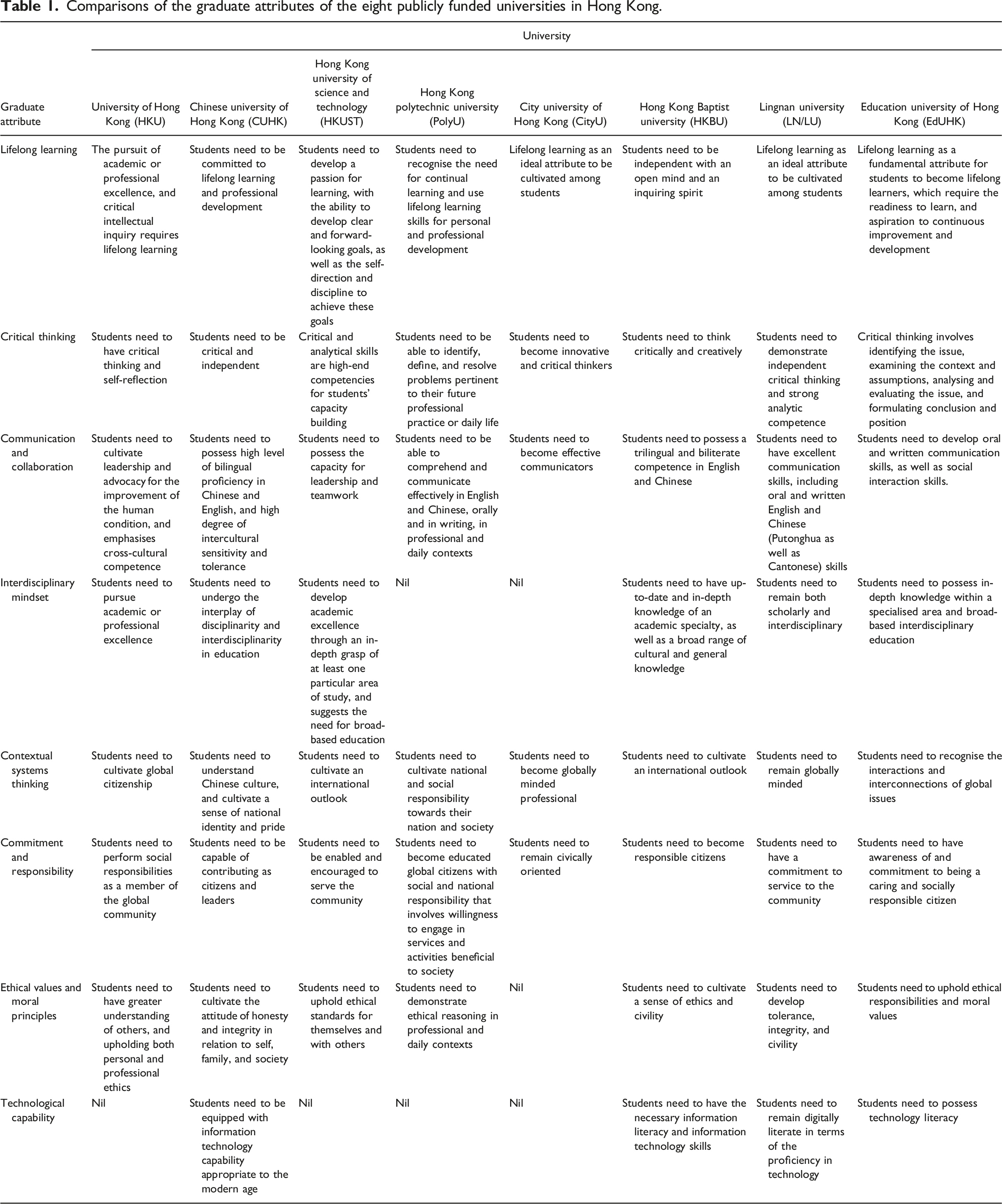
The series of graduate attributes conceptualised and framed by the eight publicly funded universities in Hong Kong are highly future-oriented as they allow their students to sense and seize their strengths, resources, and opportunities in order to remain responsive to the constant, rapid, and complex changes, which constitute their overall engagement and sustained transformation of ever-changing societies and the world (Gifford et al., 2022). This also involves shifting and prioritising the overarching focus from the fluctuating world with all the uncertainties and indeterminacies to the organised and planned self that will never become obsolete (Mertanen et al., 2022). This can also address fundamental challenge of unfolding and planning the future learning landscape for students when futures are remaining largely complex and almost unknowable to all (Lam, 2023). All these future-ready graduate attributes should remain intrinsic and fundamental in nature, which allows students to be capable of responding to embrace the inevitable and accelerating change processes ahead of them, regardless of the nature, scale, and intensity (Gurukkal, 2019). After all, students as the agents for change should get engaged in envisioning their own futures with different variations and directions by connecting future possibilities to their lifestyles and choices, and by contemplating the meaning of decision-making and action in light of their future envisioning (Liu, 2022). For instance, as students are taking up their effective and responsible roles as members of the local, national, and global communities under contextual systems thinking as well as commitment and responsibility, they need an interdisciplinary mindset as well as communication and collaboration skills when working across various disciplines and with different individuals around the world. They also need to apply critical thinking, and uphold ethical values and principles throughout the process of advancing, expanding, and communicating the ever-evolving knowledge as an important part of their life-long learning trajectory, followed by the support and facilitation of relevant technological capability. All these discussions also align with Wong et al. (2021) who argue that graduate attributes remain broad and fluid, and overlap and interact with one another as they are meant to be applicable across a range of contexts, such as education, society, community, work, and career, as well as for various goals and purposes, such as scholarship, citizenship, and employability.
The series of future-ready graduate attributes articulated by the eight publicly funded universities in Hong Kong are not entirely academically entrepreneurial in orientation. The imposition of many of these attributes reveals a heightened commitment to putting students at the centre and empowerment as a goal (Reimers, 2020). Many of them are also seemingly economic and individualistic in nature, which is building on instrumental and pragmatic values that are rooted in capitalistic thought (Deuel, 2022). Students are expected to become enterprising and competent as well as resilient and responsive in the knowledge-intensive and globally competitive economy, and eventually make and support such economy to flourish and expand (Mehta et al., 2020). They need to imagine, work on, and optimise themselves as enterprises, and cultivate behaviours and dispositions largely shaped by market-driven rationalities and ethics (Goring et al., 2023). Meanwhile, they are accordingly trained and programmed to suit the dominant needs and expectations of society, and disciplined and controlled to follow the status quo shaped by the relevant authorities. Therefore, it becomes sensible for students to simply invest in domains that will increase their competitiveness, marketability, and employability in the labour market (Brabazon, 2021). All these explain why a number of the graduate attributes framed by the universities are mostly related to individual skills and dispositions practised among students, such as life-long learning, critical thinking, communication and collaboration, interdisciplinary mindset, contextual systems thinking, and technological capability. Nonetheless, upon closer examination of the graduate attributes proposed by the universities, there are still several attempts for universities to bring their students back to the humanistic and social nature of human beings, which moves away from the uncritical focus of being academically entrepreneurial (Biesta & Priestley, 2013). This can allow students to both recognise the humanity in others and have their own humanity recognised by others (Brabazon, 2021). This also requires students to link the personal and the collective dimensions together by relating their self-development with the evolution of humanity as a collective whole. The underlying implication is that students should not only identify their personal preferable futures and ideals, but also their socially and globally preferable futures and ideals (Lombardo, 2009). Therefore, several universities also include some other equally important graduate attributes, such as commitment and responsibility, and ethical values and moral principles, which involve the collective and affective dimensions, especially in terms of ethics, morals, and values. In short, Barrie (2005) describes graduate attributes as complex interwoven aspects of human ability. All these attributes can hence be regarded as the desirable qualities that universities want to prepare their students as agents for personal development and of social good. At the same time, this signifies the start for universities to consider the possibilities for shaping both humanistic and socially oriented future-ready education within a neoliberal and individualistic context.
Conclusion and limitations
Given the increasing call for coming up with a more consensual and systematic approach to the development of graduate attributes, the first and foremost matter is to consider a fundamental question, which is about the nature of the graduate attributes included by universities around the world (Green et al., 2009). Moreover, the understanding of graduate attributes should also be perceived in a holistic and interrelated rather than atomised and fragmented manner (Hager, 2006). The series of graduate attributes proposed by universities are not only locating at the forefront as guiding ideas, rationales, and philosophies, but also functioning as prospectively strong frames for the actual initiatives and activities (Lambert & Penney, 2020). Furthermore, there are concerns shared by scholars like Arvanitakis and Hornsby (2016) as well as Oliver and Jorre de St Jorre (2018) that the graduate attributes are not able to equip students for a future characterised by substantial major disruptions and ongoing structural changes. In view of these three gaps in the existing scholarship, with the employment of both qualitative document analysis and inductive thematic analysis, this article aims to offer a comprehensive and systematic analysis of how the eight publicly funded universities in Hong Kong conceptualise and frame their graduate attributes, and reveal the similarities and differences of their underlying motivations and implications. This study eventually brings together eight discourses, namely life-long learning, critical thinking, communication and collaboration, interdisciplinary mindset, contextual systems thinking, commitment and responsibility, ethical values and moral principles, as well as technological literacy. This article aims to contribute to the field by shedding light on how educators and practitioners around the world can revamp and reinvigorate a common set of future-ready graduate attributes, while contextualising and adapting institution-specific variations at the same time. These attributes should be continuously reviewed, renewed, refined, and modified, which involve universities building on the existing and distinctive strengths, as well as addressing the potential gaps and issues, so as to ensure that all attributes are remaining living and validated under the alignment with their unique aspirations and emerging needs (Bath et al., 2004). Most importantly, both the conceptualisation and framing of graduate attributed by universities has lingering implications on the series of institutional and curricular strategies, policies, and initiatives, which can influence their students’ comprehensive, balanced, and synergistic learning experience, and subsequently their teachers’ teaching, support, and assessment of learning (McCabe et al., 2021).
Nonetheless, there are several lines of further inquiry to be pursued among researchers and practitioners. First, they can collect and analyse information on the concrete actions that these eight publicly funded universities in Hong Kong have taken and would take to achieve these aims and goals as mapped across their graduate attributes. This allows a more thorough evaluation of how far these graduate attributes have been attained within and across universities, such that more efforts and resources are devoted to deepening the existing achievements and resolving the potential tensions. Moreover, they need to better understand these graduate attributes as top-down constructs from bottom-up perspectives, meaning that the input from teachers and students are essential. By gauging their perceptions and interpretations of these attributes, this can narrow the discrepancy between intended design and actual outcome, which allow teachers to best plan and design, and students to best learn and master throughout curriculum, pedagogies, and assessments on the basis of the graduate attributes. Furthermore, as the graduate attributes should joint together to constitute a comprehensive and competent development for students, there can be further empirical studies on how these attributes are complementing and reinforcing one another both conceptually and practically. Lastly, the most important but also challenging aspect is reflecting and reviewing after planning and enacting the graduate attributes, which are at times individual and subtle. The particular focus should be put on understanding to what extent students have attained, internalised, and applied these attributes throughout their study or even upon their graduation. This is mainly because these attributes often slowly emerge, shift, and progress as students insist and keep on making small and subtle changes throughout their development. Meanwhile, the value and influence of these attributes are continuous, cumulative, and potentially life-long, given that the inspirations, experiences, and reflections of students are possibly retrieved, utilised, consolidated, and deepened across time and space.
Footnotes
Declaration of conflicting interests
The author(s) declared no potential conflicts of interest with respect to the research, authorship, and/or publication of this article.
Funding
The author(s) received no financial support for the research, authorship, and/or publication of this article.
