



Abstract
International students have played an important role in bolstering the soft power of host countries. However, despite their significant contributions to enhancing soft power, Chinese international graduate students, in particular, have faced a less-than-welcoming environment. As US-China geopolitical tensions grow, we know less about the effects on Chinese international graduate students’ experiences and mobility. Through a phenomenology study of eleven Chinese international graduate students’ narratives, this study draws interrelated theories of soft power and the push-pull model to explore how US-China geopolitical tensions shift Chinese students’ experience and mobility. The findings indicate that Chinese students are changing and have more academic and career options. Chinese students have also encountered stereotypes, xenophobia, and Sinophobia, which might shift their decisions on future mobility.
Keywords
International education, as soft power, has attracted international students to study in the United States due to career opportunities, institutions’ prestige, and academic structure (Altbach, 2004; Marginson, 2006; Nicholls, 2018; Trilokekar, 2010). Soft power, derived initially from Nye, is defined as the capacity for the attractiveness of others’ culture, political ideals, and policies (Nye, 2004). An example of soft power at work is what makes the American culture and way of life attractive to international students. International students undertake different processes of coming to study in the United States because of the attractiveness of the U.S. higher education system, the culture of student freedoms, and opportunities unique to the American way of life. According to the Institute of International Education (IIE, 2019). China has been the top country sending students to study in the United States for a decade, with 369,548.
Nevertheless, there has been a less welcoming environment for international students, particularly Chinese international students (Pottie-Sherman, 2018). which resulted in an increasing number of Chinese international students avoiding the United States as their choice of host country (Bader, 2018). Existing research focuses on generic challenges that international students encounter, such as language barriers, culture shock, and adjustment to different cultural norms (Heng, 2018; Khawaja & Stallman, 2011; Will, 2016). However, we know less about the effects of geopolitical tensions on Chinese international students’ experiences and mobility upon graduation (Li, 2023). In addition, it is essential to address the loss of Chinese international students, which will decrease the U.S. soft power in the globalization era. If we agree with Nye’s definition, it is common sense to state that adverse effects on soft power are a double-edged sword. These tensions not only affect international students but also hurt the U.S. economy surrounding higher education institutions.
This study aims to illuminate the impact of geopolitical tensions on Chinese international students pursuing their academic endeavors within the United States, elucidating the intricate interplay between these experiences and the broader geopolitical landscape. It seeks to discern whether Chinese international students are positioned as instruments of soft power or as causalities trapped within the web of geopolitical discord. In its essence, this study endeavors to foster discourse and dialogue among scholars, practitioners, and policymakers, offering both a macro and micro perspective on the subject matter. Therefore, this paper takes the pragmatic route of defining soft power in its relation to international studies and then looks at it through the lens of international education as a form of soft power. To do so, I will review the recent policies or proposals related to China and Chinese international students or scholars. I will then synthesize the existing literature on the experiences of Chinese international students studying in the United States, particularly during the COVID-19 pandemic. Next, I will address how U.S. higher education is significant in constructing soft power by attracting international students and scholars. US-China geopolitical relations and tensions will likely lead to a decline in U.S. soft power. The restrictions on Chinese international students and scholars and unfriendly policies toward Chinese people as a whole will create an intense and unwelcoming environment for Chinese international students, leading to a decreasing enrollment of Chinese international students and Chinese scholars’ collaboration in globalization and internationalization of higher education. These geopolitical tensions should not restrict the academic sector and the internationalization of higher education.
The interrelated theories of soft power (Nye, 2004, 2005) and the push-pull model (Mazzarol & Soutar, 2002) as the conceptual framework support the study. This study aims to address the following research questions: What are the experiences of Chinese international students studying in the United States in US-China geopolitical tensions? How do US-China geopolitical tensions shift Chinese international student mobility?
Literature review
China threat
When President Trump took office, he articulated a National Security Strategy report, which proposed to put Americans first by revitalizing the economy, rebuilding their military, defending borders, and protecting sovereignty (The White House, 2017). The Trump administration regards China as a revisionist to erode “American security and prosperity” and addressed that China is building a less free and fair economy, growing its military, and controlling formation and data to expand its power in the world (p. 2). Notably, the United States started a trade war against China in 2018 by implementing a 25% tariff on Chinese imports due to the following concerns: the decreasing job creation in the United States because of the Chinese trade surplus; using U.S. technology in unfair and illegal ways; and threatening U.S. national security (Liu & Woo, 2018). There are also geopolitical tensions related to Taiwan and South China Sea issues (Zhao, 2019). The United States has taken “a whole-of-government approach to curbing China’s rising power and international influence through better harnessing America’s various policy tools” (p. 372).
The US-China dispute goes beyond trade war to fierce geopolitical competition and rivalry: U.S. academic sector and scientific and technological production (da Costa, 2019; Lee, 2019). According to Coats (2019), in World Wide Threat Assessment, “China’s intelligence services will exploit the openness of American society, especially academic and the scientific community, using a variety of means” (p. 14). In addition, U.S. officials claim that most Chinese international students study in the United States for legitimate purposes and as spies to steal American secrets (Cohen & Marquardt, 2019). The U.S. official states that China, as the top resource country sending students to study in the United States, United States is training scientists and engineers for China to rival the United States. Furthermore, U.S. official has stated that the Chinese government has been using Chinese international students to access sensitive military and civilian research. The United States has restricted the United States to export technology to China and import Chinese goods and investments to the United States. The US-China technology battle is symbolized by the restriction of federal agencies from using Huawei products and blocking Huawei gear in the U.S. market and the U.S. allies’ market (da Costa, 2019).
While there is a distinctive lack of peer-reviewed evidence and literature to add to this discussion, there is an abundance in the way of presidential orders, political discourse, and editorial pieces that shed a great deal of light on the current state of US-China relations under the current administration. While the list is extensive, going back to Trump’s inauguration in January 2016, the following section will focus on the events resulting from U.S. presidential orders that are currently the subject of much literary debate and Chinese students’ experiences afterward.
Restrictions on Chinese students and “China virus” and student mobility
Chinese international students have been caught amid escalating US-China geopolitical tensions and the “New Cold War” (Lee, 2021; Yao, 2021), a multifaceted conflict encompassing ideological disparities, geopolitical rivalries, and economic intricacies (Yao, 2021). In 2020, Presidential Proclamation 10,043 was enacted, targeting Chinese international students and scholars pursuant to F or J visas with ties to China’s “military-civil fusion strategy” (National Archives, 2020). This proclamation specifically bans the entry of Chinese students and scholars from institutions known as the “Seven Sons of National Defense,” which includes Northwestern Polytechnical University, Harbin Engineering University, Harbin Institute of Technology, Beihang University (formerly known as Beijing University of Aeronautics and Astronautics), University of Aeronautics and Astronautics, Beijing Institute of Technology, Nanjing University of Science and Technology and the Nanjing University of Aeronautics and Astronautics (NAFSA, 2021). The U.S. administration revoked the visas of more than 1000 Chinese students with ties to the Chinese military. Acting secretary for the Department of Homeland Security, Chad Wolf, claimed, “We are blocking visas for certain Chinese graduate students and researchers with ties to China’s military fusion strategy to prevent them from stealing and otherwise appropriating sensitive research” (Davidson, 2020). The former Trump Administration considered a travel ban on Chinese Communist Party members and their families (Spetalnick, 2020). Chinese graduate students who study robotics, aviation, or high-tech manufacturing have limited visas to one year (Dennis, 2019). Consequently, Chinese students and scholars are confronted with heightened risks, driven by considerations related to their national identity (Lee, 2019).
Moreover, the COVID-19 Pandemic has exacerbated these geopolitical tensions and triggered anti-Asian racism within the United States (Hou, 2023; Yu, 2021). Terms such as “Wuhan virus,” “China virus,” and “Chinese virus” have been used in social media, initially propagated by influential American political figures starting in March 2020 (Darling-Hammond et al., 2020). This period witnessed a staggering 650% increase in Twitter activity featuring these phrases on March 8, 2020. Many Asian international students, particularly Chinese students, were subjected to xenophobia, isolation, and discrimination during the COVID-19 pandemic (Chen et al., 2020). This anti-Asian sentiment culminated in 2583 hate crimes and instances of discrimination against Asian Americans attributed to the pandemic (Chinese for Affirmative Action and Asian Pacific Policy & Planning Council, 2020). Chinese international students have expressed heightened concerns about being discriminated against, stereotyped, and attacked (Hou & Jam, 2020; Yu, 2021). Furthermore, the pandemic exacerbated anxieties among Chinese and Asian students due to varying perceptions and crisis management measures (Mok & Montgomery, 2021).
The intensifying rivalry between China and the United States has significantly influenced international student mobility (Mok & Montgomery, 2021; Yu, 2021). The number of international students in the United States started to decline after 2016 (IIE, 2020), which coincides with the Trump Administration and might result from geopolitical rhetoric (Buckner et al., 2022). The outbreak of the COVID-19 pandemic has interrupted student mobility and exacerbated anti-Chinese sentiments (Mok & Montgomery, 2021). Consequently, there has been a shift in the flow of Chinese international students toward East Asian nations, while the international student population in the United States has witnessed a decline (Mok et al., 2021; Yang et al., 2022). Notably, international students are increasingly inclined to select countries perceived as safer and more affordable, such as China, South Korea, and Japan. Additionally, geopolitical tensions and anti-Asian racism have compounded the challenges faced by graduates in their pursuit of employment and the acquisition of H-1B visa sponsorship (Hou, 2023; Li, 2022). U.S. employers have displayed hesitancy in hiring temporary visa holders due to the policies emphasizing American interests and the proliferation of anti-China rhetoric (Li, 2022).
Conceptual framework
For the purpose of the study, interrelated theories of soft power (Nye, 2004). and the push-pull model (Mazzarol & Soutar, 2002), are employed to examine how US-China geopolitical tensions shape Chinese international student experience and mobility. According to Weber (2009), power, as a symbol of social status, is “the probability that one actor within a social relationship will be in a position to carry out his own will despite resistance, regardless of the basis on which this probability rests” (p. 152). Soft power, distinct from its counterpart, hard power, constitutes an intangible form of influence encompassing cultural, political values, and policies (Li, 2018; Nye, 2004). Soft power as a rising power shapes capabilities and attraction of others’ culture, values, and politics. It signifies the capacity to exert attraction rather than coercion (Blanchard & Lu, 2012; Nye, 2004). The realm of culture engenders a plethora of values and practices, and the amalgamation of these factors augments the potential for eliciting attraction. Furthermore, foreign policies play a pivotal role in either reinforcing or squandering a nation’s soft power (Li, 2018). In the era of globalization, technology and education development have become increasingly important in constructing soft power (Li, 2018). Soft power is further categorized into two types: direct, which pertains to institutional investment, and indirect, which is synonymous with individual investment. Within this framework, international education is classified as a form of indirect soft power (Altbach, 1998).
The push-pull model has been used in the international higher education context to understand influential factors of student mobility (Mazzarol & Soutar, 2002). Pull factors encompass influences that attract international students to a host country, including the economic and political interests of the host nation, the academic milieu, career prospects, and geographic proximity (Altbach et al., 2009; Mazzarol & Soutar, 2002). In contrast, push factors encapsulate the influences compelling international students to depart their home countries and seek education abroad, often emanating from dissatisfaction with the academic and political environment in their home country (Mazzarol & Soutar, 2002).
International education, as an embodiment of soft power, has pulled international students to study abroad due to the institution’s reputation, career opportunities, and cultural enrichment experiences (Gesing & Glass, 2019; Hauptman Komotar, 2019; Mazzarol & Soutar, 2002). Li (2018) underscores that the soft power of higher education hinges not only on a nation’s culture, values, and policies but also on the structure of the international education system, which encompasses international education norms, rules, and institutions. The manifestation of soft power transcends geographic boundaries, national identities, and cultural disparities, underpinning the internationalization of higher education and contributing to educational influence through history (Li, 2018). Higher education attracts and pulls international students to pursue quality and prestige higher education, increase social status, and obtain more career opportunities upon graduation (Mazzarol & Soutar, 2002). Simultaneously, attracting international students serves as a strategic means to bolster the U.S. knowledge economy, promote U.S. foreign policy, and increase international leadership and soft power (NAFSA, 2006).
The export of higher education has become increasingly implemented in activities and programs after the Cold War (De Wit, 2002). The post-World War II and Cold War drove the U.S. governments to emphasize national defense, public diplomacy, and national security by stimulating international exchange and cooperation (De Wit, 2002). The political rationale shifted from aid to trade to sustain and grow international recognition, knowledge of other countries, and language and education systems to construct soft power (De Wit, 1998). An emphasis on “the knowledge economy, demographic shifts, mobility of the labor force, and increased trade in services” are driving factors for nations to recruit human capital and increase soft power through international initiatives (Knight, 2004, p. 22). Federal policies and recruitment strategy changes have attracted international students and scholars in higher education with the potential for constructing and strengthening soft power.
At the same time, China has implemented a set of policies to attract international intellectuals and technicians as well as attract haigui (Chinese students who graduate from foreign institutions and return to China upon graduation) to promote soft power. Increasing international educational attractiveness and competitiveness is significant to constructing and promoting soft power for nations. The Chinese government has implemented a few education policies for the internationalization and globalization of Chinese higher education, such as enhancing the global reputation of Chinese universities, sponsoring Chinese students and scholars to study and research abroad, providing financial support to selected universities, etc. (Li, 2018).
Methodology
To support the argument, a hermeneutic phenomenological methodology (Creswell, 2007). with a constructivist research paradigm (Denzin & Lincoln, 2018). was utilized to seek and explore Chinese international students’ experiences and mobility in US-China geopolitical tensions. Hermeneutical phenomenology describes individuals’ lived experiences as phenomenology and interprets the texts of life (hermeneutics) (Creswell, 2007).
Data collection
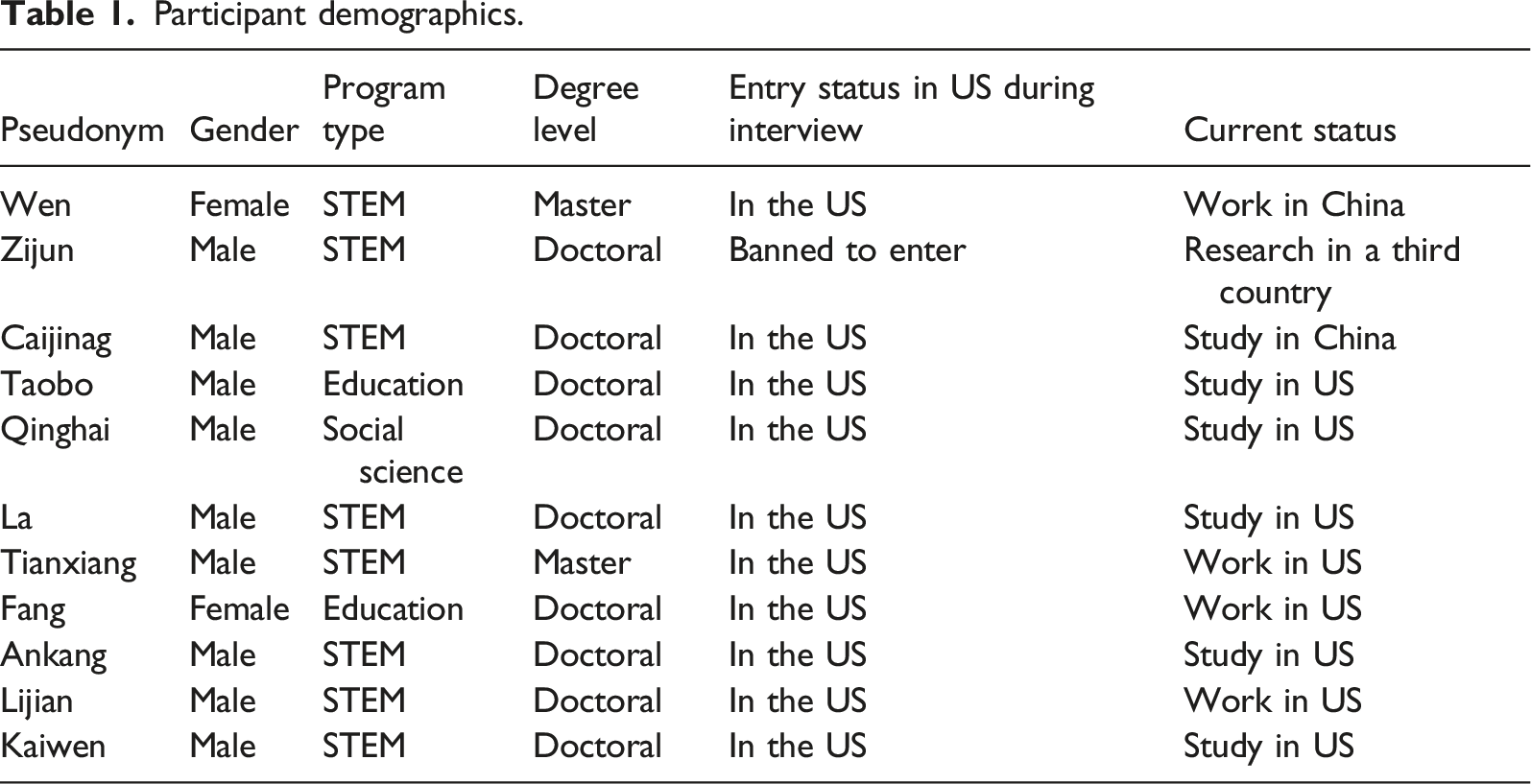
Participant demographics.
Data analysis
This paper used a two-stage data analytic process. For the first process, the research used horizonalization (Moustakas, 1994) to review the interview notes and transcriptions and highlight the significant quotes. For the second stage, the researcher developed clusters of meaning (Creswell, 2007) from the notable quotes into different themes. These themes or meaning units were context-laden. With “structural description” (Creswell, 2007, p. 159), the researcher could understand in what settings and contexts and how these experiences happened. The whole process included participant validation strategies (member checks) to ensure the validity and credibility of the study (Ravitch & Carl, 2019).
Trustworthiness and credibility
Several approaches were utilized to establish reliability, trustworthiness, and credibility (Creswell, 2007; Merriam, 2009). I personally transcribed all the interviews and reviewed the transcripts. After each interview, I summarized the participants’ highlights and main experiences. These distilled summaries, alongside the original interview transcripts, underwent a rigorous comparative analysis, thus bolstering the verifiable consistency of the emergent themes and insights. The researcher’s reflexivity plays an important role in the research process and the subsequent interpretation thereof (Patton, 2002). Importantly, the profound impact of the researcher’s own positioning, biases, and subjectivity were conscientiously acknowledged and reckoned with. Participants’ experiences were interpreted through my lens as a Chinese international who shared similar but nuanced experiences. My insider perspective helped me build rapport with participants and engendered a heightened depth of insight.
Findings
The study examines how US-China political tensions shape Chinese international students’ experiences and mobility. When I interviewed these eleven participants, ten were studying in the United States, and one could not enter the United States because of Proclamation 10,043. The participants’ narratives reflect their imaginaries of the United States as a developed and advanced country and real-life experiences of unsafety, isolation, and uncertainty. The findings yield three prominent themes around Chinese international students’ experiences and mobility: (1) pull versus push; (2) unexpected experiences and decline of soft power; and (3) student mobility.
Pull VS. push
Due to advanced education and resources, as well as the development of the economy and education in China, participants were more pulled to study in the United States. The majority of participants articulated that they chose to study in the United States because of experiencing Western culture, gaining advanced education and resources, and expanding career opportunities. These pull factors are consistent with Gesing and Glass’ (2019) and Wei’s (2013) study on determinants of student mobility. One participant described that his parents arranged for him to study in the United States. For all the participants, political factors were not considered in their decision to study abroad. Most participants were attracted by the U.S. advanced higher education system and programs. Studying in a Chinese 2 + 2 program, studying in the United States was Caijing’s only option. Unlike other participants, Caijing did not have higher expectations because the state he went to was like a desert from Google pictures. Nevertheless, he was excited to experience the American culture and learning atmosphere. I really want to experience American culture and scientific research. Also, America is the most powerful nation in the world and has a very high level of education. I want to experience the learning atmosphere (Caijing).
Caijing made future decisions before studying in the United States–working in Chinese higher education. Studying in the United States could enrich his academic experience and expand his career opportunities to work in Chinese universities. Taobo chose to study in the United States because his program originated in the United States. Furthermore, he wanted to experience a different academic environment and culture. Zijun wanted to research in the United States because of the resources and the postdoctoral offer.
Two participants were more pushed to study in the United States due to family reasons or program requirements. As an only child, La’s parents arranged everything for him to study in the United States after high school. At that time, every country was the same for him, and he did not care which country he would study in. Unlike La, Wen chose to study in the United States because the program she wanted to study in China had such high requirements, which she thought were unnecessary. Instead, she chose to study in her favorite program at a private university in the United States. She recalled that, The program in China needs high drawing skills, which I don’t think is right. The drawing is important, but the more important is to design with creative ideas. It is impossible for me to get an offer from XXX University in my city. So why not change an environment to pursue my passion?
Unexpected experiences and decline of soft power
Participants in this study have encountered unexpected manifestations of stereotypes and xenophobia that predate the Trump administration and have been further exacerbated by the complex interplay of factors. Their initial aspirations of studying in what they perceived as a dream destination underwent a transformation as they gradually confronted unforeseen and previously unimagined challenges, particularly within the United States, a nation whose portrayal in popular media did not align with their lived experiences. These unexpected encounters were intricately linked to enduring issues of racial discrimination and Western supremacy (Lee, 2021). The stereotypes to which participants were subjected encompassed a spectrum of attributes, including their physical appearance, gender, and nationality. For example, Lijian’s classmate used a specific hand gesture to make his eyes a triangle shape and claimed Lijian had small eyes, which made Lijian feel very uncomfortable. Fang was considered Korean or Japanese a few times. Although Lijian and Fang took these incidents as jokes, they felt uncomfortable. As a woman, Wen was questioned by her religious community about whether she should study abroad. Wen recalled, I was invited to go to church, but I am not sure what’s their denomination. A few people told me I should stay home in China to support the family and educate my children. I was just shocked! What the heck? I just kept smiling and didn’t argue back.
Additionally, the dynamics of US-China geopolitical tensions exacerbate xenophobia and Sinophobia in various ways, with participants reporting that their nationality became a focal point for stereotyping. Kaiwen, for instance, recounted instances where his former supervisor perpetuated stereotypes and exhibited hostility towards China by asserting that “Chinese people like stealing intellectual property.” Although Kaiwen understood the context, he was offended by the persistent denigration of Chinese individuals. Similarly, La found himself in a situation where his advisor persistently delved into discussions about Chinese politics during their meetings. La shared that “Having these political jokes in our project meetings was inappropriate. He has a sense of White supremacy.” Such dynamics rendered it challenging for La, as a student, to engage in constructive dialogues regarding Chinese politics with his advisor. Likewise, Qinghai shared experiences of his professor harboring stereotypes concerning non-democratic countries and expressing a hope that all such nations would transition to democracy by saying, “He thinks the Chinese government is very brutal to the protesters. He also hopes that all non-democratic countries could become democratic countries.” Additionally, participants noted instances where individuals posed questions laden with certain expectations and predetermined answers. For example, Fang shared how her American classmates held stereotypes about China’s monitoring system, frequently asking whether the deployment of 365 Degree Action cameras was primarily intended for surveillance purposes. In response, Fang endeavored to clarify that the primary objective was to enhance safety and gather evidence in case of adverse incidents.
A few participants also experienced xenophobia within their communities. Oksana (2009) described xenophobia as “distrust, unreasonable fear, or hatred of strangers, foreigners, or anything perceived as foreign” (p. 116). Xenophobia and Sinophobia are not new phenomena and have historical roots dating back to the 19th century when Chinese immigrants served as low-wage laborers in the United States (Alvarez, 2009). However, the COVID-19 pandemic, coupled with recent escalation in US-China geopolitical tensions, has compounded anti-Chinese sentiments. Participants such as Taobo reported instances of xenophobia before the pandemic, where he was subjected to hostile calls to return to his home country. For Ankang and Caijiang, these experiences of xenophobia intensified during the COVID-19 pandemic, with Ankang describing an incident where a driver yelled, “Build the wall! Go back to your country!” as he crossed the road.
Chinese students have become the victims of this “new cold war” (Lee, 2021, p. 3). Notably, Chinese graduate students enrolled in specific academic programs or affiliated with particular universities found themselves experiencing nuanced forms of xenophobia. The former Trump administration’s issuance of Proclamation 10,043 on May 29, 2020, added an additional layer of complexity by suspending the entry of Chinese students and researchers connected to China’s Military-Civil Fusion Strategy (NAFSA, 2021). Specifically, seven military-affiliated universities, the so-called “Seven Sons of National Defense” are targeted. Unfortunately, Zijun was one of the researchers who was affected by this policy, was barred from pursuing post-doctoral studies in the United States due to his graduation from one of the seven universities. The visa officer said my profile totally matched the position, but I was rejected only because of Proclamation 10043. The visa officer and my professor in the US suggested I pay more attention to the presidential election, hoping Proclamation 10043 could be withdrawn if Biden could be the president. I waited for now, but it still is withdrawn. I graduated from University XXX in 2013. That was way before the proclamation, so as long as students graduated from those institutions, no matter which year they graduated, they couldn’t get a visa to study in the US. We don’t have any opportunity to defend or prove ourselves. We feel so hopeless.
Zijun felt very hopeless and helpless about his situation. As a victim or scapegoat of the new cold war, he wishes he could have the opportunity to provide evidence to prove his innocence. He further articulated, Every country has spies, but you need to provide data and evidence to prove it. They say all the Chinese students are spies, so they need to provide evidence. In my field, the best researchers are from China, and one is from [another foreign country name]. Why are we stealing from Americans?
As tensions and competition between the United States and China continue to escalate, participants voiced concerns about the profound impact on the bilateral relationship, the developmental trajectories of both nations, and the declining appeal of the United States as a destination for Chinese international students. They recognized that these geopolitical tensions could precipitate a decline in the number of Chinese international students, thereby all these factors will cause the United States to decline its soft power (Trilokekar, 2021). Caijing, for instance, articulated that, The United States is an immigrant country. Its rapid development depends on the recruitment of large numbers of international talent. Although there are also family immigrants, they are only a small portion. The unilateralism policy in the Trump administration will make it more difficult to maintain the United States to have hegemony in the world and will lose a large number of international students.
Regarding US-China relations, Zijun noted, “I don’t think the US and China will have a good relationship unless the US can accept it can be the second in the world. Deep down, they think America is the best in the world.” In the same vein, Caijing and La also shared the same perspective. Caijing and Tianxiang shared that Chinese international students need to “pick a side” for their binary mobility due to the restrictions on Chinese residents who have ties with the Chinese Communist Party. Tianxiang described that “the COVID-19 pandemic is a catalyst for US-China geopolitical tensions. If you want to stay in the US, you must pick a side and withdraw from the Chinese Communist Party. You cannot pick both sides.”
Factors that shape Chinese international graduate student mobility
The narratives conveyed by the participants encapsulate a pervasive sense of uncertainty, insecurity, and isolation that permeated their educational sojourn in the United States, a landscape profoundly shaped by the concurrent challenges of the COVID-19 pandemic and escalating US-China geopolitical tensions. These multifaceted experiences and emotions have played a defining role in shaping their directions regarding international mobility, effectively functioning as compelling push factors compelling Chinese international students to reconsider their continued presence in the United States.
Conversely, the economic and educational landscape in China has emerged as a potent set of pull factors, enticing students back to their home country. During the manuscript’s preparation, noteworthy instances of participants, such as Wen and Caijiang., returned to China because they believed working in China was better than in the United States. Wen described the hidden politics when seeking jobs in U.S. higher education: I am an adjunct faculty member in my department, and my supervisor wants to hire me as a full-time professor. Nevertheless, due to the hidden policy in the department, they need to hire a faculty who is a diversity, which means a Black female faculty.
Wen felt confused and helpless in this situation. “I am an Asian female international student. Why am I not considered diverse?” Finally, Wen chose to accept the offer from a Chinese university to be a faculty. She further stated, “Within ten years, China has been developing so fast. In my hometown, I have access to all the resources I need.”
Similarly, Caijiang’s decision to return to China was rooted in the belief that studying in the United States would better prepare him to excel in his home country. The allure of education quality and career prospects beckoned individuals like La and Qinghai to embark on their educational journeys in the United States. While they expressed intentions to gain work experience in the United States over the short term, familial ties ultimately weighed as a significant factor in their long-term career plans, leading them back to China.
Notably, Tianxiang articulated the importance of school rankings and “guanxi” (a special relationship) in China’s higher education. After a period of work experience in China, Tianxiang chose to pursue another master’s degree in the United States, recognizing the formidable challenges associated with securing faculty positions in Chinese universities. It isn’t easy to be a professor at Chinese university. They need students who graduate from Harvard or MIT, a prestigious university. It is difficult to find a job with [his university] degree unless you have guanxi in universities.
Furthermore, the discourse surrounding US-China political relations played a nuanced role in conversations with participants and their mobility decisions. Despite the assurances of anonymity, participants displayed a cautious approach when discussing the impact of US-China political relations on their mobility. Ankang, for instance, evaded inquiries concerning the implications of these tensions on his mobility and refrained from engaging in political discussions. For Taobo and Tianxiang, China’s politics is also a driving force for their mobility. While Taobo initially intended to return to China upon completing his studies, evolving political circumstances orchestrated by the Chinese leadership compelled him to reconsider, contemplating either remaining in the United States or pursuing opportunities in another English-speaking country. The dynamics were particularly pronounced for Tianxiang and Caijiang, who elucidated the necessity for Chinese students to adopt a binary approach to mobility due to the constraints imposed on Chinese residents with ties to the Chinese Communist Party. Tianxiang described that “Many Chinese people are Chinese Communist Party members. If you want to stay in the US, you must pick a side and withdraw from the Chinese Communist Party.”
The prevailing sentiment among the majority of participants suggested a proclivity to return to China or explore alternative destinations following graduation or after several years of work in the United States. They viewed the United States predominantly as a site for education or temporary sojourn, a perception encapsulated succinctly by Zijun, who regarded the United States solely as a destination for temporary visits, spurred by his encounter with a gun shooting incident in Chicago and his visa rejection in light of Proclamation 10,043.
Discussion and conclusions
The study illuminates the multifaceted factors influencing the decisions of Chinese international students to pursue their education in the United States, highlighting the pivotal role of cultural, educational, and economic considerations. It underscores that the choice to study abroad is predominantly shaped by individual academic interests, cultural factors, career prospects, and social networks, aligning with extant research that underscores the significance of these pull factors in attracting students to the United States (Gesing & Glass, 2019). Importantly, the study unveils a novel dimension wherein political factors were not initially at the forefront of students’ considerations prior to embarking on their educational journey. However, it posits that these political factors may exert a more pronounced influence on their future mobility decisions, introducing a nuanced perspective into the existing discourse on the determinants of students’ country and university choices, especially within the milieu of evolving and uncertain circumstances (Zhang et al., 2021).
By contextualizing Chinese international students’ narratives and stories within the geopolitical rhetoric, the study provides evidence of their inadvertent entanglement in racial formations, characterized by stereotypes, xenophobia, and Sinophobia. The study underscores the exacerbation of these challenges through policies promulgated by the Presidential Administration, which have placed additional hurdles before Chinese international students seeking to enter or remain in the United States (Zhang et al., 2021). Notably, this heightened anti-immigrant sentiment and Sinophobia, despite historical antecedents, have intensified students’ sense of alienation and apprehension about their future prospects (Hou, 2023; Johnson, 2018; Zhang et al., 2021). Chinese students have found themselves particularly targeted due to their nationality and academic program affiliations. Furthermore, the intricate interplay of US-China geopolitical tensions and racial dynamics has compelled and pushed Chinese international students to make a binary choice, precipitating a waning desire to continue their sojourn in the United States, potentially precipitating a decline in the country’s soft power (Lee, 2021; Nye, 1987; Pottie-Sherman, 2018).
This study provides empirical evidence that Chinese international students’ experiences are impacted by their nationality and US-China geopolitical tensions. The findings align with the recent U.S. geopolitical tensions on international students (Pottie-Sherman, 2018; Rose-Redwood & Rose-Redwood, 2017; Todoran & Peterson, 2020). Significantly, the study reveals the repercussions of Proclamation 10,043 on Chinese international graduate students, even those who had graduated from the affected institutions several years prior. Additionally, it illuminates the dichotomous pull and push factors, where students are pulled to the United States for education and career prospects but feel compelled and pushed to depart or seek alternative destinations post-graduation due to geopolitical tensions.
It is crucial to underscore that this study while shedding light on the experiences of Chinese international students affected by US-China geopolitical tensions, does not purport to provide a universal account of all Chinese international students. The diverse backgrounds of participants underscore the potential for variations in experiences and mobility determinants among this demographic. Therefore, future quantitative research endeavors should be undertaken to explore the impact of geopolitical tensions on Chinese international students from diverse backgrounds.
The study provides several implications for higher education contexts and policymakers. First, for international education to continue serving as a conduit of soft power, the U.S. government must consider relinquishing some control over international education and education programs, fostering higher education autonomy and global collaboration to facilitate exchange of ideas across nation-states (Trilokekar, 2021). Like Nye (2015) claimed government policies can strengthen or weaken a nation’s soft power. Second, higher education institutions need to acknowledge the nuanced experiences of Chinese international students and endeavor to provide a welcoming and inclusive learning environment, even in the face of geopolitical tensions (Todoran & Peterson, 2020). Third, institutions need to establish mechanisms and allocate resources to help Chinese international students navigate racial dynamics (Glass et al., 2022). Last but not least, engaging in dialog among researchers, policymakers, and practitioners on the implications of soft power may foster a comprehensive understanding of the repercussions of government policies. Increased advocacy and support for Chinese international students and researchers are essential to facilitate scientific collaboration and dispel unfounded assumptions, fears, exclusion, and persecution (Lee, 2021).
To conclude, this study posits that the geopolitical rhetoric surrounding Chinese citizen, framed as potential spies and intellectual property thieves threating U.S. national security, has precipitated and will continue to precipitate a decline in the enrollment of Chinese international students. The past few years have witnessed a decline in international student enrollment, underscoring the urgency of addressing these issues (IIE, 2022). In light of these considerations, this study calls for robust discourse among researchers, practationers, and policymakers to foster understanding and support for Chinese international students in a dynamic and evolving educational landscape.
Footnotes
Declaration of conflicting interests
The author(s) declared no potential conflicts of interest with respect to the research, authorship, and/or publication of this article.
Funding
The author(s) received no financial support for the research, scholarship, and/or publication of this article.
