



Abstract
Pursuing equity and diversity on internationalized higher education campuses has become an urgent agenda. Chinese Graduate Teaching Assistants (GTAs) do not always have smooth experiences with this internationalization. While they are often overlooked in racial discussion in the U.S., they cannot escape the racial and cultural inequalities in the same context. Using Bronfenbrenner’s bioecological systems (2005) and Lee’s neo-racism (2020) as analytical lenses, this study revealed the racial and cultural challenges experienced by 21 Chinese at micro-, meso-, exo-, macro-, and chrono-levels. The study helps educators charged with the complexity of Chinese GTAs’ plights by considering contextual influences using critical concepts (e.g., neo-racism). This study is significant in addressing unique equity and diversity issues in globalized higher education using both phenomenological and critical perspectives. Finally, we call for actions on the part of higher education institutions to create more equitable and caring systems to improve all students’ academic and sociocultural experiences.
Keywords
Introduction
With the increasing global mobility, internationalization is crucial as it is deepening (Munna, 2022). Importantly, international students from China are the largest group among all international students (US Mission China, 2021). As a significant subset of international students from China, the number of Chinese graduate students in the US reached 118,859 by 2020/21 (Duffin, 2022), many of whom work as Graduate Teaching Assistants (GTAs), to support their studies while providing educational assistance to college students.
Even though Chinese international students 1 bring different social-cultural perspectives that contribute to diversity in higher education institutions, they do not always have a smooth experience in global higher education (Lee, 2020; Tsai & Wei, 2018; Yao & Mwangi, 2022; Ye & Edwards, 2017; Yu, 2021; Zhang, 2016b). The students are likely categorized into only one ethnic group based on their country of origin rather than race (Lee, 2020; Yu, 2021), and their racial, cultural, and linguistic identities are usually marginalized from the US institutional discourse. Escaping racial, cultural, linguistic, and geographical inequalities seem impossible for Chinese international students (Yao & Mwangi, 2022). Nevertheless, Chinese international students are mainly overlooked in the current discussions of racism, which heavily focus on the Black-and-White dichotomy (Yu, 2021).
Previous literature has focused on the cognitive and instructional aspects of GTAs (e.g., Gilmore et al., 2014), but the previous studies only presented a partial view of GTAs’ experiences. In reality, discussing the racial and educational challenges experienced by the GTAs has become more important during the Covid-19 pandemic (Alsandor & Trout, 2021; Lee, 2020). For example, Chinese international students are defined as students crossing borders for the specific purpose of studying (WENR, 2009). Chinese graduate students have been threatened and viewed as threats (Gover et al., 2020; Lee, 2020). In 2020, the Department of Homeland Security (DHS) ruled that Chinese international students would be deported if their universities went online (Castiello-Gutiérrez & Li, 2020). Harvard and MIT filed lawsuits in response to this discriminatory policy. In their appeal, DHS stated to the court that international students would otherwise be a threat to national safety. Moreover, many Chinese graduate students had to balance family duties while working from home (Alsandor & Trout, 2021). While realizing these various factors and challenges, scholars recognized that the pandemic exacerbated inequalities in education (Callaghan, 2020; Cisneros & Smith, 2021) and their studies drew people’s attention to various racism and hate crimes against Chinese international student communities, including Chinese GTAs (Lee, 2020). Thus, promoting racial equity in higher education is significant and needed (Cisneros & Smith, 2021).
The reason why more attention should be given to GTAs’ experiences is that they play a critical role in the functioning of US higher education, which includes teaching a significant number of undergraduate courses and becoming a future workforce in western higher education (Yang et al., 2018; Ye & Edwards, 2017), and offering mental and academic support to Chinese undergraduate students. While Chinese international undergraduate students have attracted some attention in higher education, the research on Chinese GTAs was unexplored and their plights have been rarely understood via a combined Bronfenbrenner’s bioecological perspective (2005) and a Lee’s neo-racism perspective (2020).
To help Chinese GTAs express their voices and contribute to the educational field, this study aims to understand how GTAs make sense of their experiences in US higher education. As an analytic lens to explore both the GTAs and their environments, as well as the interaction between the two, the Bronfenbrenner’s perspective is suitable, and it enables us to examine such complex experiences through such lens, “the detection of such wide-ranging developmental influences becomes possible only if one employs a theoretical model that permits them to observed” (Bronfenbrenner, 2005, p. 51). Bronfenbrenner’s perspective is “new in its conception of the developing person, of the environment, and especially of the evolving interaction between the two” (Bronfenbrenner, 2005, p. 50).
While Bronfenbrenner’s perspectives provide us a foundational framework, neo-racism helps us explore the participants’ narrative in nuances. Neo-racism means covert and quiet new racism that is different from overt racism, which may directly offend minorities (Lee, 2020; Lee & Rice, 2007; Parker & Gillborn, 2020). Neo-racism refers to “a new racism that is not based on one’s skin color alone but also includes stereotypes about cultures in a globalizing world” (Lee, 2020, p. ii). It is also worth pointing out that research on the internationalization of higher education found that neo-racism is based on a hierarchy of cultural preferences, as not all international students are unwelcome. That said, neo-racism is suitable for exploring the deep complexity of Chinese GTAs’ experiences. We hope through this study, the participants’ rarely known stories can be heard, and in doing so, to explore ways that higher education institutions can better serve this population.
This Study
This study explores the experiences of Chinese GTAs within the newest Bronfenbrenner bioecological systems (i.e., Bronfenbrenner, 2005) and neo-racism (Lee, 2020). It acknowledges how struggles are fluidly and progressively wired into societal conceptions, such as national origin (Ladson-Billings & Tate, 1995). Given the significance of Chinese GTAs within the US higher education, we ask this research question: What are the experiences and plights of Chinese GTAs? This question deserves attention so that higher education could better support them to overcome their current plight.
Literature Review
In this section, we first review the relevant research on GTAs. Then, we review studies on Chinese GTAs. Next, we briefly discuss existing conversations on Chinese GTAs, critical topics emerging in studying contextual influences on Chinese international students’ plights, and our theoretical lenses of bioecological systems and neo-racism. Across these topics, this paper argues that Chinese GTAs’ plights remain unexplored and are critical to reveal.
Graduate Teaching Assistants
GTAs have been an integral part of higher education for the past half-century (Allen & Paesani, 2022; Branstetter & Hendelsman, 2000; Gilmore et al., 2014; Sargent et al., 2009). It is a widespread phenomenon that GTAs undertake a significant amount of teaching responsibility in higher education institutions in many countries (Wald & Harland, 2020), where GTAs may be named differently depending on the context. For example, casual academic staff and tutors in Australia (Moore et al., 2021), student teaching assistants and tutors in New Zealand (Sutherland, 2009), and graduate teaching assistants (GTAs) in the UK (Muzaka, 2009). Given the current socio-political tensions between the United States and China (Yu, 2021), other contexts’ findings about Chinese GTAs, such as UK or Australia may not be transferrable in US situations. There are unique statuses of the ways in which US higher education institution functions (Bettinger et al., 2016). It is critical to understand the Chinese GTAs on US campuses.
More than 42% of programs in the US employ GTAs (Marincovich et al., 1998), indicating the importance of investing in GTAs’ development since it directly affects the quality of higher education (Bettinger et al., 2016). Existing GTA research also broadly suggests that being a GTA is a pivotal experience contributing to GTAs’ future academic development as potential prospective faculty members (Gilmore et al., 2014; Jones, 1993; Lowman & Mathie, 1993).
GTAs of color experienced struggles (Amanova et al., 2022; Lee, 2020; Lowman & Mathie, 1993). Explorations of GTAs of color and their unique experiences with workplace systemic oppression and structural discrimination (Crumb et al., 2020; Lee, 2020; Zhang, 2020b August) can provide a deeper and more nuanced understanding of their complex and hegemonized experiences. For example, in research on black graduate students, Crumb and colleagues (2020) discussed the complications of higher education’s discrimination, bias, exploitation, and oppression that could and did happen along other principal social axes such as class and gender. In Mayne’s (2019) study on Arab international female students’ experiences in a US higher education institution, most participants felt challenges in English language proficiency, and some experienced the struggle of balancing graduate assistantship work with academic and social life. However, they had no choice but to work as a teaching graduate assistant to pay for the tuition. Similarly, Zhang (2020a) discussed GTAs of color in neoliberal teacher education settings who had othering experiences and called for attention to this population.
In sum, there are various challenges experienced by GTAs of color. However, there are also essential differences between the challenges of Chinese GTAs and other GTAs of color. The differences include but are not limited to their unique identities and complex statuses in the US. (1) Chinese GTAs are considered students of color, but they are also international students, which were not included in general ethnic American minorities. (2) They have marginalized voices because, in the US context, the heated attention has been heavily given to Black and White American racial tensions, and certain attention to other domestic racial groups such as Latinx or Asian Americans. As members of the Asian community, Chinese GTAs are struggling to find their agency as they are not like Asian Americans who have more access to resources and rights. (3) They are student employees on US university campuses. However, they have their international status that has restrictions and immigrant policies as barriers to their work and study. While recognizing these differences, we also noticed that research has rarely examined the specific group of Chinese GTAs.
Chinese GTAs
As student employees of color, Chinese GTAs likely face racism. The systems of oppression with power structures permeate traditional higher education systems (Andrade, 2006; Parker & Gillborn, 2020; Tsai & Wei, 2018; Ye & Edwards, 2017; Zhang, 2016a, 2016b). The oppression impacts Chinese students, resulting in the exclusion and isolation of Chinese GTAs. Research on general international students’ experiences has explored Asian students’ plights and experiences with racism in the US (Bonazzo & Wong, 2007; Lee & Ahn, 2011; Lee & Rice, 2007; Swagler & Ellis, 2003; Wong et al., 2014). Yet, research on oppressions toward Chinese GTAs is scant.
Contextual Influences of GTAs’ Plights
Contextual influences on graduate students teaching are important (Sebald et al., 2021). Existing literature has paid attention to Chinese international students’ plights and contextual influences. First, Chinese international students had communication struggles with domestic students (Andrade, 2006; Heng, 2017; Yao, 2016), and lacked respect from American undergraduate students’ classroom behavior and emails (Amanova et al., 2022; Tran, 2018) due to stereotypical impressions of their status as monolith Asian Group, coolie, yellow peril, model minority, and cash cows as affluent international students with global capital in the western world (Iftikar & Museus, 2018). Second, Chinese students’ faced challenges in advisor-advisee relationships (Zhang, 2016b) and lack of social capital (Yeh & Inose, 2002) during their study abroad experiences. Third, Chinese students faced general restrictions of immigrant and institutional policy (Riaño et al., 2018). Fourth, Science, Technology, Engineering and Math (STEM) Chinese graduate students faced struggles (Zhou, 2014). Fifth, Chinese students, especially females, faced identities related discrimination and pressure (Tsai & Wei, 2018; Wong et al., 2014; Zhang, 2016a). Nevertheless, the higher education field lacks specific insight into Chinese GTAs’ plights. Specially, research on Chinese international students indicates the need for higher education to become a more equal and just system for international students (e.g., Zhang, 2016a), including Chinese GTAs (Lee, 2020).
All these studies of Chinese students point to Chinese GTAs’ overall plights (Amanova et al., 2022; Andrade, 2006; Heng, 2017; Iftikar & Museus, 2018; Lee, 2020; Riaño et al., 2018; Tran, 2018; Tsai & Wei, 2018; Wong et al., 2014; Yao, 2016; Yeh & Inose, 2002; Zhang, 2016a, 2016b; Zhou, 2014). Chinese GTAs faced many layers of discrimination from their direct and indirect social circles, which hindered their development as humans. In terms of contextual influences, it is essential to note that their social environment dramatically changed through time from their previous lives in China into their current lives as marginalized persons in the US (Brazill, 2022; Xiong & Zhou, 2018). A few studies explored contextual influences on Chinese student mobility. For example, Li and colleagues (2021) explored macro-, meso- and micro level factors influencing Chinese students’ transnational experiences. However, with all these struggles in Chinese GTAs’ lives, little research has collectively tackled these experiences from a Bronfenbrenner’s perspective.
Theoretical Frameworks
Bronfenbrenner’s Bioecological Systems and Neo-Racism
The central idea of Bronfenbrenner’s bioecological perspective is that human beings are active individuals who constantly interact with their (bio) ecological systems (Bronfenbrenner, 2005). The five environmental contextual factors are nested (See Figure 1). The dual lenses of neo-racism and Bronfenbrenner’s ecological systems.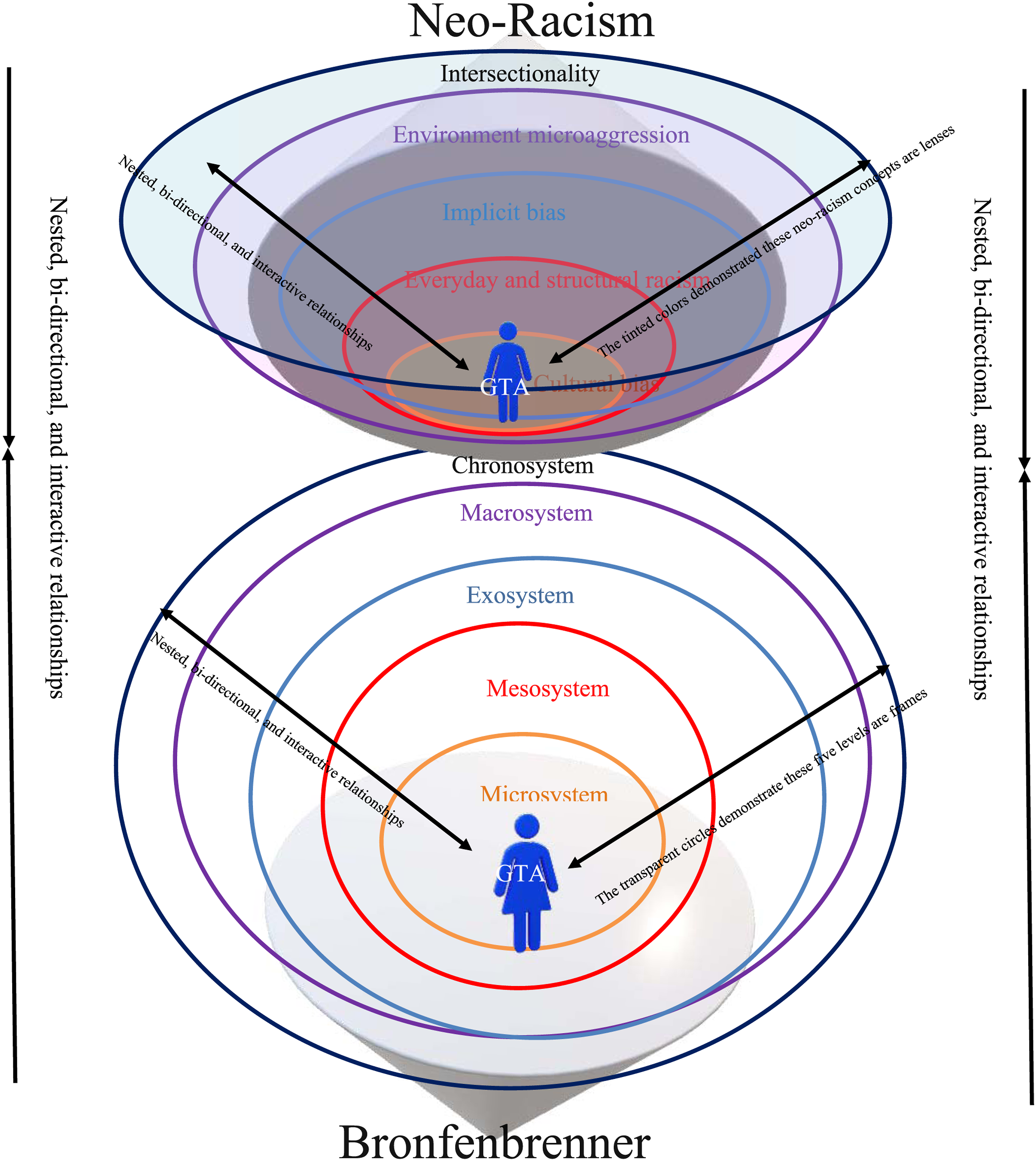
Existing education research implicitly or explicitly acknowledged Bronfenbrenner’s bioecological systems (e.g., Liu et al., 2022; Swallow & Olofson, 2017). For example, using Bronfenbrenner’s perspectives and data from interviews with 12 high school EFL teachers from China, Liu and colleagues (2022) found high school English teachers have anxiety when teaching online. They identified six types of anxiety at the micro-, exo-, and macro-levels, namely, anxiety related to the COVID-19 pandemic, limited technological support from school authorities, students’ parents, inadequate technological pedagogical and content knowledge (TPACK), and insufficient effective teacher–student interactions. Using their online education perspective, Liu and colleagues called attention to alleviating teachers' online anxiety to enhance the teachers' confidence and the teaching quality in the post pandemic era. Yet, little research is available using Bronfenbrenner’s perspective to study Chinese GTAs.
In addition, previous empirical studies focused on contextual factors, which were largely implicitly or inconsistently defined via a Bronfenbrenner perspective. Moreover, few studies adopted the most comprehensive version of Bronfenbrenner at five levels. Most education research only used a part of Bronfenbrenner’s Bioecological Model. Yet, Bronfenbrenner’s framework was implicitly used without explicitly discussing and citing Bronfenbrenner’s Bioecological Model. Liu and colleagues (2022) used micro-, exo-, and macro-levels in teacher’s technology integration. Similarly, Swallow and Olofson (2017) used mico-, meso-, and macro-systems as parts of the whole Bronfenbrenner’s systems at five levels to explore contextual factors in teacher education. In other words, the existing studies in education research employed partial and/or typically three levels of Bronfenbrenner’s earlier version, which has the levels of micro-, exo-, meso-, and macro-system. However, few empirical studies that we found discussed chrono-level. It is worth mentioning that the newer and more impactful recent version of Bronfenbrenner’s bioecological systems (2005) was ignored mainly in educational contextual factors studies.
Limited studies focused on international education via Bronfenbrenner’s perspective. Li and colleagues (2021) used three levels: macro-, meso- and micro-level factors to explore student mobility and transnational education. However, none of the existing studies exploring contextual factors in international education focused on GTAs. Education research calls attention to contextual approaches exploring educators' development (Li et al., 2021; Porras-Hernández & Salinas-Amescua, 2013; Rosenberg & Koehler, 2015). We did not find any research using Bronfenbrenner’s (2005) five levels in studying Chinese GTAs.
Responding to this call, this study helps fill in this gap by exploring the experiences of Chinese GTAs. We used the most cited newest Bronfenbrenner’s bioecological perspective notably to include all five levels: micro-, meso-, exo-, macro-, and chrono-levels (See the bottom half of Figure 1), to reveal the entangled complexity of GTAs’ plights, through these specific views below: (1) Micro-level factors include Chinese GTAs’ direct contacts in their immediate environment, such as GTAs’ students. (2) Meso-level factors included interactions between the people in the microsystems, such as the interactions between the Chinese GTAs’ advisors and their colleagues, or between school peers and GTAs’ students. (3) Exo-level factors included intersections in formal and informal social structures, which may not contain the Chinese GTAs, but indirectly impact them by influencing microsystems. (4) Macro-level factors are related to larger social and political environments. (5) Chrono-level factors are related to individual changes caused or developed by time.
The relationship between these levels is the nested connections among these contexts and their interaction. As Bronfenbrenner claimed, the five levels are nested and interactive. The most critical role in the ecological system is the individual, who deserves a specific understanding of its unique contextual levels (See Figure 1 for a visual aid of these nested levels).
Bronfenbrenner’s perspective is powerful and suitable for this study because it allows us to understand how the multiple contextual influences shape Chinese GTAs’ situation. It is helpful because it helps us look at various factors rather than only use a single perspective of racial oppression to explain the layers of individual, systematic, international, socio-political-, and globalization aspects added to struggles of Chinese GTAs.
Indeed, we need critical lenses within these five systems to discuss, interpret, and understand the GTAs’ plights. Therefore, in our study, critical concepts are needed to be added with Bronfenbrenner’s bioecological systems to address how the elements act and interact under the surface of the GTAs’ plights through the participants’ stories or counter stories (Parker & Gillborn, 2020).
We use neo-racism (Lee, 2020), an overarching concept to explore GTAs’ struggles. Stemming from neo-racism, we further use five of its sub-critical concepts, which are located in the five layers in Bronfenbrenner’s bioecological system: (1) cultural bias at the micro-level, (2) every-day and structural racism (Kempf, 2020) at the meso-level, (3) implicit bias (Museus & Iftikar, 2013) at the exo-level, (4) environment microaggression (Mills, 2020) at the macro-level, and (5) intersectionality (Crenshaw, 2017) at the chrono-level.
Cultural Bias
The commonly used term xenophobia does capture how Chinese students are discriminated against over those coming from Canada, Australia, or western Europe (Lee, 2020). In this study, neo-racism allowed us to use cultural bias to understand GTAs’ internalized mild contextualized disrespect and cultural stereotypes at the micro-level. Cultural bias in this study concerns the struggles Chinese GTAs experienced due to cultural differences, cultural norms, and contextualized neo-racism working against Chinese GTAs.
Every-Day and Structural Racism
Neo-racism also is about cultural stereotypes (Lee, 2020) due to every-day and structural racism (Kempf, 2020). Every-day and structural racism are also helpful in problematizing and critiquing the daily encounters in the systems shaping GTAs’ experience. Every-day racism refers to the normalized and typically unquestioned practices resulting from how power is structured in our society. Structural racism concerns how cultural understandings can be used to “determine a group’s supposed attributes or lack thereof” (McGee, 2020, p.634). Structural racism can also deal with the discriminatory policies, unfair rules, and inequitable systems within institutional structures (Bonilla-Silva, 2015). In this study, every-day and structural racism helped us understand how Chinese GTAs’ environmental interactions impacted their plight, at the meso-level.
Implicit Bias
Implicit bias argues the uniqueness of cultural stereotypes and Asian American experiences of racism (Museus & Iftikar, 2013). Similarly, in classroom studies, numerous US universities included reports of faculty discriminating against Chinese students, and scholars called attention to the reality that such implicit bias and othering incidents are not isolated events, but rather are quite pervasive across US higher education (Redden, 2019). In this study, the concept of implicit bias, as part of the larger concept of neo-racism, enabled an exploration of Chinese GTAs’ experiences in international educational contexts, such as immigrant policies, which adversely affected the GTAs at the exo-level.
Environmental Microaggressions
The notion of environmental microaggressions (Mills, 2020) was built on the original concept of microaggression (Sue, 2010). Microaggressions have been discussed as a neo-racism demonstration (Lee, 2020). Mills (2020) referred the idea of environmental microaggressions to black students. Mills points out how individual and systemic-level racism has evolved from overt bigotry and physical abuse to more quiet and indirect ways of enacting racism rooted in their macro-level environment. The reason for bringing in environmental microaggression, even though it had similarities with structural racism (Bonilla-Silva, 2015), is that we considered it a valuable concept that made our discussion at the macro-level more explicit to be “environmental”. According to Lewis (2021), a negative stereotype is being built and reinforced that stigmatizes anyone who has any quality of being “like-China” (Zhang, 2020a August, para 5). In Lewis’ study of microaggression in the larger society environments, she found that the Department of Justice, including the FBI, depicts China as taking on individualized characteristics, such as “China can steal” and “China can cheat” (Zhang, 2020b August, para 6).
The idea of “environmental microaggression” articulately refers to the specific types of microaggressions that happen due to the environmental context. Relating to the concept of neo-racism, Lee (2020) found that Chinese international graduate students in science, technology, engineering, and math (STEM) fields were portrayed in national discourses as spies who were good at technical work but lacked the theoretical depth to become true scholars.
In this study, the concept of environmental and racial microaggressions is directly connected to struggles of GTAs at the macro level, such as the Trump administration’s discourse on STEM majors (e.g., as spies) at the macro level.
Intersectionality
We connected intersectionality with neo-racism. Kimberlé Crenshaw first coined the term intersectionality to discuss the complex oppressions from multiple systems, such as racism and sexism (Crenshaw, 2017). The notion of intersectionality has been used in various disciplines, but is relatively new in the field of international higher education and is used in efforts to understand Chinese graduate international students and their intersecting experiences of being a GTA. In Science, Technology, Engineering, and Math, Yang et al. (2022) found that female Chinese Ph.D. students faced challenges in their study, including gender bias, the pressure of age and marriage, and the “glass ceiling.” Similarly, Martin (2017) found that in post-socialist China, female students were the majority of all international students and female Chinese students chose to study abroad as international students demonstrated complexity of their motivation in a gendered society. Martin claimed that international female Chinese students faced increased blatant gender discrimination, and choosing to be an international student is a strategy of their risk management for upward mobility facing the re-traditionalized Chinese society and job market today. Related to intersectionality, Martin discussed female Chinese international students’ struggles. In this study, the idea of intersectionality helped understand the majority of the female participants at their chrono-level. Martin’s study focused on the decision-making process of studying abroad rather than the extent to which it delivers on such promises and called for future work on how female international students actually experienced their study abroad via a gendered perspective. Our study responds to that call. In brief, together, these neo-racism-related or based conceptions helped us explore how individual, university-contextual, social environments, laws, and policies can privilege a dominant race, while ignoring, marginalizing, and disadvantaging international minorities, such as Chinese GTAs.
Methods
We used both phenomenological and critical orientations in this study to allow us to understand the lived experiences of Chinese GTAs via the critical interpretative lens. Simply put, if phenomenology was the frame for viewing this study, then our critical orientation was the lens of that frame, enabling deep analysis. Phenomenological research studies in educational settings generally embody lived experience, perception, and feelings of participants about a phenomenon (Creswell & Creswell, 2017). The main purposes of phenomenological research are to seek reality from individuals’ narratives of their experiences and feelings, and to produce in-depth descriptions of the phenomenon (Creswell & Creswell, 2017). This methodological direction is consistent with the study’s purpose of exploring Chinese international students’ experiences via their GTAs’ roles, through narratives, feelings, and in-depth descriptions of the phenomenon of being GTAs. We discuss our critical interpretive approach in our data analysis section.
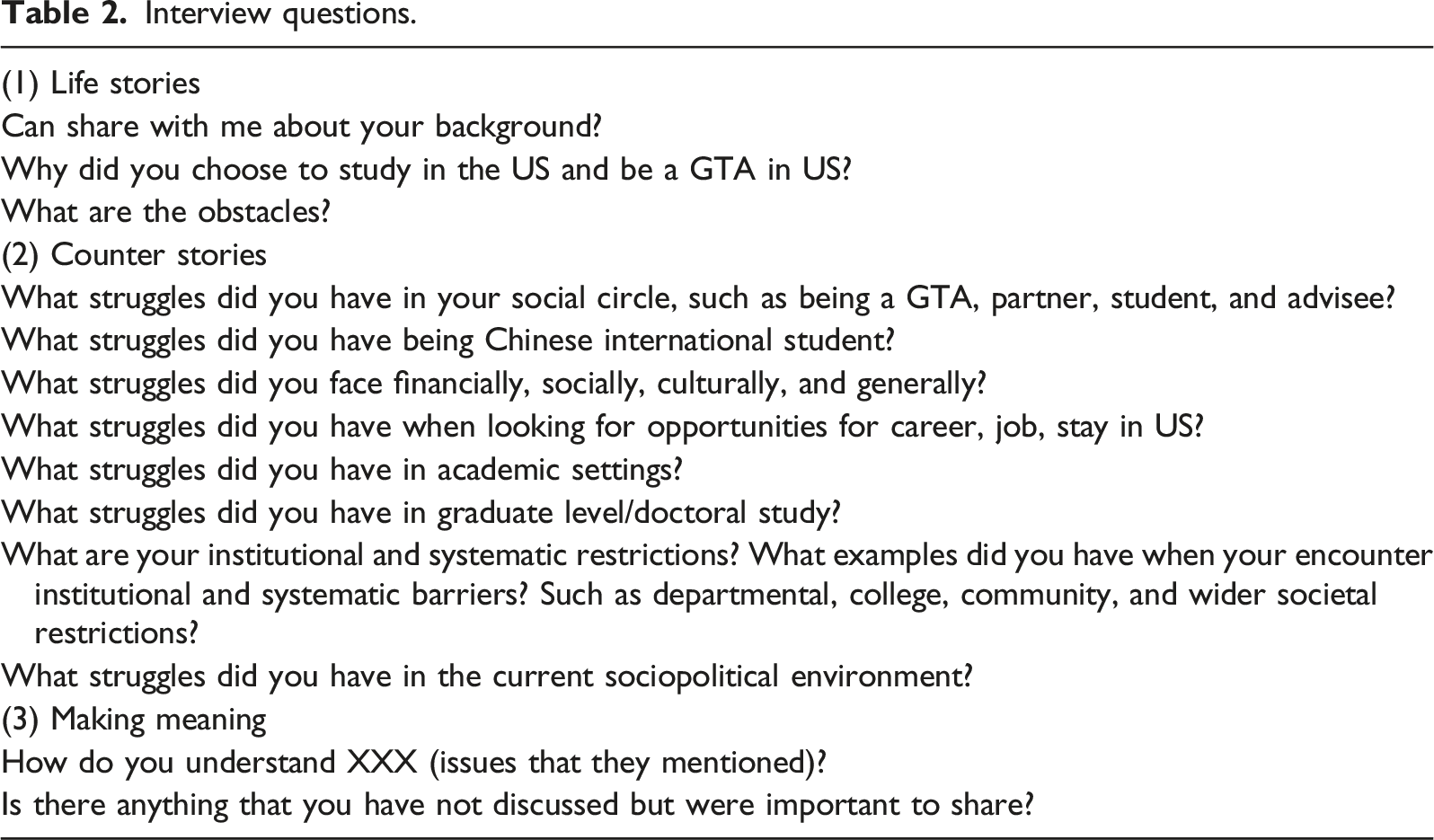
Consistent with the phenomenological method, we conducted phenomenological interviews (Seidman, 2013) (see Table 2 for interview questions). Phenomenological interviews are appropriate in this study because this approach provides a framework of exploring GTAs’ experiences in three steps: (1) their general life history, (2) their sharing of counter stories of their everyday experiences in their roles, while suspending the researchers’ preconceived assumptions about the phenomenon, and (3) making meaning of such experiences via reflections and interpretations.
Participants
After getting approval of institutional human subject board view, this study invited Chinese GTAs from two universities in the US, one public university located in the Midwest (Grant University, a pseudonym) and another on the East Coast (Lake University, a pseudonym) (see Table 1 for demographic information of participants). Grant University ranked as one of the top 50 largest US colleges. In 2018, the university enrolled slightly more than 6000 international students, representing approximately 12% of the whole student body. Among them, more than one-third are students from mainland China. Lake University is a private university, which ranked as one of the top 40 best colleges by US News and World Report (n.d.). Lake University enrolled nearly 3700 international students in 2018, 770 from mainland China. Both universities view the internationalization of higher education as one of their top institutional visions.
While qualitative research seeks trustworthiness, our study followed researchers’ purposeful sampling in selecting interview participants (Creswell & Creswell, 2017). A total of 21 Chinese GTAs participated in the study. Most GTAs graded/taught graduate and undergraduate courses in various majors, such as data science, human development, and education. There were 10 students from Grant University and 11 students from Lake University. There were five males out of the 21 interviewees that were recruited. Sixteen participants were in their 30s and female. This is understandable because of the positionality of Dr. Huang, who shared similar backgrounds with these female Chinese GTAs in terms of her earlier experiences as an international Chinese GTAs and as a female faculty who had connections with the community of GTAs. Because we had more female participants than male counterparts, we shared more female GTAs’ experiences at the chrono-level via intersectionality in our study. Overall, we reported saturated data reflecting prominent themes that emerged from both genders, except at the chrono-level; we also discussed a theme that emerged explicitly from the female Chinese GTAs (i.e., the idea of “left-over ladies” in dating).
Data Collection
Dr. Huang conducted phenomenological interviews with the participants, and each of which lasted from 30 minutes to 1 hour. As shown in Table 2, the three following aspects were discussed during the interviews: (1) preliminary questions about their life journeys and opinions about being Chinese GTAs, (2) sharing stories while paying attention to their encounters and reactions to their plight and racial bias at work, and (3) collaborative discussions with Dr. Huang, including reviews of their previous responses to make meaning together. Interviews were conducted in Mandarin or English, depending on each participant’s preference. Interviews were first recorded and then transcribed through Zoom. Those interviews conducted in Mandarin were first recorded and then transcribed into English before analysis. Pseudonyms were used to maintain confidentiality. In addition, memos (Merriam, 1998) were written during and after interviews to document the interactions, note reflections, and better understand GTAs’ experiences.
Data Analysis
A critical hermeneutic (interpretive) approach asks marginalized groups or members to share experiences resulting from their lack of privilege and power (Phillips & Brown, 1993). Because we have the goal of revealing struggles and challenges of Chinese GTAs, a critical hermeneutic approach offers us the needed critical and interpretative lens to analyze the interview data, using the critical concepts shared above. From this perspective, we coded the data and wrote memos informed by this critical hermeneutic method, which allowed us to use these critical concepts, such as every-day racism, to find themes and patterns of Chinese GTAs’ experiences. Smith and Osborn (2015) considered that such data analysis is useful “to make sense of the participants trying to make sense of their world” (p. 26). Together, critical concepts and Bronfenbrenner’s (2005) five levels allowed us to articulate the themes we found in Chinese GTAs’ plight. Therefore, the hermeneutic approach is the most appropriate for this study as it allows participants to share their stories with their sense-making and reflections.
NVivo 12 was used to organize interview transcripts, field notes, and memos, which enabled us to create and merge codes across these data sources. We began the initial coding analysis by focusing on situations where participants identified discriminatory practices using themes such as grading. The first round of initial reading of each transcript resulted in 957 initial codes. Our inter-coding reliability reached 90% (i.e., the meanings of codes from different researchers were similar across codes). Then, we used sensitizing concepts (Blumer, 1954) from our theoretical lens and the literature to collapse our initial coding; hence, we also coded the types of plights (micro, meso, exo, macro, and chrono levels), along with identifying GTAs’ perceptions of these discriminations, and the subsequent ways participants interpreted these interactions and responded to them. Next, open coding (Saldaña, 2013) was used to identify the uniqueness of each participant’s teaching experiences. After that, axial coding (Saldaña, 2013) was conducted to compare and contrast participants’ experiences to identify patterns and categories. Finally, we built trustworthiness by meeting participants weekly throughout the data analysis and writing process, checking our conclusions (Creswell & Creswell, 2017), and inviting the participants to expand and problematize the notions of the data as a way of member checking.
Positionality
The researcher’s positionality deeply affects the process of data collection and analysis, so we continuously engaged in reflexive practices (Yao & Vital, 2018) in this research. Dr. Huang was an international Chinese student and is now a Chinese international faculty member in Education. Spending over a decade working with Chinese GTAs on American campuses, Dr. Huang understands Chinese GTAs’ struggles and aspirations, having been one of them and now being there as an advocate. Si Chen is a Chinese GTA currently working on doctoral studies in education and hence had first-hand experiences as a GTA by himself and from his GTA peers. Dr. Lin and Dr. Cun share similar backgrounds as Author1. They were both international GTAs before, and now are Chinese international faculty members in Education. Being insiders in relation to the research participants, we not only understand their experiences through the lens of being a Chinese GTA but can also draw on our collective scholarly expertise as a research team to interpret their experiences of GTAs’ plights via lenses such as Bronfenbrenner’s bioecological systems in the context of larger social processes.
Findings
Chinese GTAs encountered many challenges yet felt unable to share explicitly about them in ways that might address their plights. The complex micro-, meso-, exo-, macro-, and chrono-systems (levels), along with factors such as race, nationality, language, gender, and class, were all interwoven into their struggles. Within Bronfenbrenner’s five systems, we report neo-racism at (1) cultural bias at the micro-level, (2) every-day and structural racism at the meso-level, (3) implicit biases at the meso-level, (4) environmental microaggressions at the macro-level, and (5) intersectionality at the chrono-level. Overall, we argue that Chinese GTAs felt that many factors of these struggles in neo-racism, such as cultural bias, structural racism, microaggressions, institutional-level discrimination, and their intersectionalities, were all included in their experiences.
Micro-Level
Micro-level factors include Chinese GTAs’ direct contacts in their immediate environment, such as their undergraduate students. Even though some participants reported overt discrimination such as “Chinese, go back home!” which they heard on the streets (e.g., in New York City), more offensive experiences were from neo-racism (Lee, 2020), compared to outright abuse (Ren & Feagin, 2021). In their teaching context, many GTAs experienced US undergraduate students’ lack of respect. Even though domestic GTAs or GTAs in other countries may also experience a lack of respect, which could be partly a result of undergraduate students’ less appreciation of GTAs being assistant roles lacking authority, instead of being professors (Muzaka, 2009). However, Chinese GTAs’ experience of lacking respect is usually combined and aggregated with cultural bias.
A prominent theme in our study is the disrespect and inappropriateness of emails, which echoes existing GTAs’ studies (Zhang, 2016a). Pearl, a 32-years-old participant, explained how she understood the lack the respect from students in emails: I felt that many undergraduate students--maybe because they are still too young and I am just their TA, not a formal professor--are not respectful. For example, one student emailed me to ask a question with no standard greeting words like ‘hello’ or ‘thank you.’ I consider these words to be basic manners to show respect. They may end the email with ‘please reply to my email as soon as possible.’ Was this because I was just a TA? Or was this because this student was an undergraduate student, and so they did not know the basics of email etiquette? Was it because I was not their real professor and I am a female and Chinese? (Pearl, Interview, December, 2020)
As a Chinese GTA, Pearl expected cultural humility from her students, but students did not adhere to these expectations. That might be because students were unaware of how they viewed her teacher’s identity status and thus treated her as their peer with a casual conversational style, which is normal in the low-power distance US society. Moreover, Pearl struggled as she felt disrespected but could not specify any identifiable reasons. The situation was complicated and also subtle.
Neo-racism, here, in a form of cultural bias, an off-the-record evolution of racial discrimination, which refers to a new racism that is not based on one’s skin color alone, but also includes stereotypes about cultures in a globalizing world, has created new ways of identifying and understanding racism (Ladson-Billings & Tate, 1995; Lee, 2020). From Pearl’s accounts, students’ disrespect is not expressed in an obvious or accusable way. Therefore, these uncomfortable encounters were not overt racism or physical abuse, but might be more similar to the “quiet” neo-racism, and even more destructive.
In a similar vein, neo-racism in its form of cultural bias is also shown by some American GTA peers who take advantage of acting out American culture and are not willing to understand or respect Chinese culture during GTAs’ training sessions, which their university organized to train all the GTAs to be better prepared for teaching. Joey (math major, 33-years-old) shared that during teaching discussions, his White GTA peers were always the ones leading the conversations while he did not compete to get his voice heard. Joey reflected that it was partly due to his English language learner status and his manners and humbleness, which are essential qualities in Chinese culture. Moreover, this plight was echoed by 80% of all Chinese GTAs.
When asked about how to deal with disrespect from their students and peers, many Chinese GTAs said they would commonly internalize by themselves rather than doing anything to confront these mildly abusive emails. For example, Pearl, who felt disrespected by students, shared that she tried to see herself as a learner in this GTA role, not as a teacher (December, 2020), like how students treated her. Using Bronfenbrenner’s bioecological systems in human development (Bronfenbrenner, 2005), we found the participants experienced new racism, which can be explained and legitimized as a reasonable concept to understand GTAs’ stories in their email encounters. Finally, responding to the call of revealing counter stories (Ladson-Billings & Tate, 1995), we valued our GTAs’ feelings and shared these voices here.
Meso-Level
Meso-level factors included interactions between the people in the microsystems, such as between the Chinese GTAs’ advisors and colleagues or between school peers and students. Some of the shared stories included how their advisors’ roles in the department impacted their experiences. Overall, because our contexts were two large research universities, GTA positions were typically competitive, and power structures of advisor-advisor relationships were at play. Hence, academic advisors’ interactions in their departments played a role in indirectly impacting the participants’ opportunities of securing course teaching opportunities.
In our data, supervision was a point of struggle in their meso-level systems due to every-day and structural racism. Many participants feared losing their teaching opportunities if they complained about overtime for the workload or not having valuable teaching opportunities compared to their US peers. For example, Chinese GTAs are mostly graders versus their US peers already teaching independently for graduate courses. Faculty advisors who are racially marginalized may be less competent to support their Chinese GTAs. In more than half of our participants’ interviews, Chinese GTAs tended to have faculty of color (Korean or Chinese faculty being their advisors). For example, some GTAs shared that they did not receive enough teaching opportunities (funding) from their advisors of color, who also faced their plights (e.g., neo-racism) in their contexts. Shishi (computer science major, 3rd PhD student, 30 years old) indicated, Even though my advisor was very supportive, he, being a Korean new faculty, did not have much [teaching] resources [as compared to other white senior faculty] to support me. (Interview, December, 2021)
Shishi had to tolerate structural and every-day mild racism, such as students’ poor behavior (e.g., disrespectful emails) because she was not confident about her advisor’s help in seeking other teaching opportunities. While all participants reported experiencing discriminatory behavior, their feelings about their teaching opportunities varied greatly, depending on who their supervisors were and the power positions those individuals held (Field notes, May, 2020). For example, Yen, a GTA whose advisor was a white male and department chair, felt more confident in her opportunities of securing a graduate teaching position to prepare her for the job market, as compared to other Chinese GTAs whose advisors were people of color.
At this level, Bronfenbrenner’s Bioecological Model offers ways of thinking about the neo-racism, structural and every-day mild racism within the departmental contexts in which GTAs worked, and their micro-level connections (e.g., advisors or partners) with other microsystems (e.g., departmental faculty, policy, and campus communities, and partners’ work environments) can be complex contexts that engender plights. This results in their various struggles in regarding finances, job opportunities, and academic success.
Exo-Level
Exo-level factors included intersections in formal and informal social structures, which may not directly contain the Chinese GTAs, but indirectly impact them by influencing microsystems. In the analysis, a primary example of exo-level factors included campus restrictive immigrant policies. Some GTAs’ experiences echoed the literature on immigrant policies’ impact on their financial well-being (Crumb et al., 2020; Ezell, 2021) and suggested that these policies embodied implicit bias. Our GTAs shared that immigrant policies, such as the F-1 student status restricted them from working more than 20 hours. The restriction, which mandated that GTAs were only allowed to work a maximum of 20 hours per week and only on campus, pressured them to limited GTA positions while these opportunities were beyond their control.
In contrast, many campus policies did not consider the needs of Chinese GTAs and their overall development, which were biases within an unequal power structure of the western-led institutionalized process. For example, Joey had to balance his financial needs and accept the assigned miscellaneous grading duties by his department; he felt that such arrangement was restrictive and in the long run would disadvantage his career development.
The same restrictive policy of GA positions led to different levels of pressure on domestic students and international GTAs, who had to face another restrictive policy of “only working for no more than 20 hours a week”, which highly limits international GTAs’ choices and chances of switching GTA positions for better development. Joey had another independent teaching opportunity that he applied to via the business school. However, that independent course teaching is 10 hours load, and he could not give up his 20 hours load within his own department (which also covers tuition as a package) to accept another 10 hours load, even though that teaching opportunity could advance his career. He tried to negotiate to take only 10 hours within his department, but policy prevented his department from allowing him to do so. Finally, he had no choice but to give up the valuable independent teaching opportunities offered by the business school because of his financial needs. We echo with scholars who called attention to such implicit bias and othering incidents. These struggles are not isolated events, but as rather pervasive across US higher education (Redden, 2019).
Institutional contexts vary when it comes to GTAs’ assignments and opportunities. In some contexts, for example, Amy (Education major, 3rd year Ph.D., 32-years-old) shared that she did not get equal teaching opportunities compared to her white peers from departmental administration, who were considered more qualified in communication skills and other experiences. Amy felt frustrated because though she agreed she was not a native speaker and had no teaching experience in K-12 systems in US, her other working experiences, including diverse backgrounds, should have been valued. Not getting the same prominent teaching opportunities as her White peers, Amy was often assigned project support and other miscellaneous duties by her department. Amy worried that she would eventually lose her competitiveness in the job market if she continued to miss opportunities for formal course teaching experiences due to these implicit biases from faculty members/administrative leaders in her departments.
At this level, using implicit bias as a concept, Bronfenbrenner’s Bioecological Model allowed us to understand both the individual level plights, campus restrictive immigrant policies, and the interwoven complexity that Chinese GTAs had to navigate.
Macro-Level
Macro-level factors are related to larger social and political environments. Using the idea of environmental macro-aggression (Mills, 2020), Science, Technology, Engineering, and Math (STEM) GTAs had travel restrictions for STEM students due to socio-political tensions between China and the United States. One of the prominent themes at the time of the study is US-China socio-political tension. Most science GTAs reported their dilemma in the current STEM-oriented United States. At the time of the study, the Trump administration had initiated national policies against STEM capital flowing to China to prioritize the US fighting for the leading role in STEM innovations in the global economy. Ironically, many STEM Chinese GTAs are working on US campuses and contributing to the US economy (Yang et al., 2018).
Our STEM Chinese GTAs struggled with their teaching roles on a personal level (e.g., travel restrictions) when reflecting on their choices and realities in teaching in higher education institutions within the US. Resulted from such political and social tensions; the travel mobility for international students, primarily STEM international students, was restricted. Shishi, a computer science GTA also faced many restrictions in visa applications for studying in the United States and reported that Chinese GTAs’ opportunities to travel back to visit family in China faced many restrictions and risks. Hence, many of them “stuck” with her for the period of pursuing their degree.
At the macro-level, Bronfenbrenner’s work on layering out the impact of social and cultural environments helps us to see that politics interplayed with individual GTAs’ disciplines (e.g., a STEM related major), their personal needs and wants, economic systems, and the active individual beings (GTAs). Together, these systems interact and create the holistic plights that participants faced and voiced here.
Chrono-Level
Chrono-level factors are related to individual changes caused or developed over time. For both genders, upon transitioning from the previous life into an international GTA in the US, multiple difficulties appeared over time, including struggling due to multiple marginalized identities, facing a different sociocultural environment, being away from family and friends, and lacking resources and support (Xiong & Zhou, 2018). When studying in the US, Chinese GTAs must rebuild their personal, social, cultural, and professional identity as well as overcome the misconception held by American students of Chinese GTAs being a homogenous group (Brazill, 2022). In a word, GTAs temporarily lose the fundamental emotional, financial, and social support they used to have in China; on the contrary, they must adjust to a new society that is culturally and linguistically different. Using the idea of intersectionality, we had a particularly prominent theme emerge among female Chinese GTAs at this level.
Women who do not usually get married by the age of 30 are considered to be leftover ladies in China (You et al., 2021). Amy (Education major, 3rd year Ph.D., 32-years-old) shared that her determination to pursue her PhD and left her full-time teaching position in an international high school in China was highly influenced by two reasons: (1) Her rich high school students looked down upon her due to socio economic status differences. She felt it meaningless to teach these rich kids. (2) The pressure of “needing to get married” made her leave China. This echoes Martin’s (2017) study on how female Chinese international students and their families managed gender inequalities and new risks in such a society. Studying aboard is their strategy of avoiding getting trapped into a standard feminine life course and risk management strategy in a gendered society for self-fashioning. Yet, female international students felt that even though finding a partner could alleviate some pressure of studying aboard and being a GTA, in the long run, they continued to face gender discrimination.
Amy left China only to find that she was in an even more complex situation as a GTA in the US. First, due to her multiple marginalized identities (e.g., being a woman and an alien), she experienced environmental racial aggressions (Mills, 2020) while taking a subway, “A white person asked me if I had a green card and if I wanted to marry him for a green card” (Amy, interview, 2021). This incident indicates how an Asian woman can be portrayed as an object and a third-class woman who would trade freedom for marriage just to stay in the US. All these environmental microaggressions and multiple vulnerable intersectional identities made the plight faced Amy.
Moreover, financial difficulty has been a prominent theme in the interview data, which was reported by both genders. In our study, many GTAs, who had working experiences in China prior to their graduate programs in the US, struggled with the dramatic decrease in financial status, which is a key aspect of intersectionality. Worse, as F-1 visa holders and Asian students who came to the US, GTAs passively gained identities as racially-marginalized, non-resident aliens with lower financial status. However, they needed the GTA positions to make a living, and voicing their negative experiences became high-stakes, making them less able to advocate for themselves. Therefore, their plights are an outcome of the change in their social context over time.
At the chrono-level, GTAs faced multiple struggles through their chronological transition from their previous lives in China to their lives as current graduate students living on the GTA stipend. Their difficulty transitioning could be explained by intersectionality, which represents the multiple aspects of identities such as race, gender, ethnicity, and class when exploring GTAs’ experiences (Boylorn, 2021).
In summary, Bronfenbrenner’s ecological systems, Lee’s neo-racism, and its related critical lenses in each of these five systems allowed us to understand the relationship between the challenges experienced by Chinese GTAs from different levels (see Figure 1). We found the struggles of Chinese GTAs are nested, bi-directional, interactive, complex, and nuanced based on individuals’ lived experiences. Hence, higher education professionals need to understand and value individual GTA’s unique experiences and their plights, instead of categorizing them in a simple box based on their group membership (e.g., students of color, or Chinese students). It is also essential to consider Chinese GTAs’ intersectional and multiple identities and complex and nested connections to their ecological systems under the lens of neo-racism. In the next section, we reflect on the meaning of these findings and offer some suggestions for further thoughts.
Discussion
This study echoed existing findings about Chinese students’ plights and struggles (Andrade, 2006; Gillborn, 2003; Wong et al., 2014; Yeh & Inose, 2002) by adding the complexity of their plights, internationality, and intersections in their bioecological systems using lenses from bioecological systems (Bronfenbrenner, 2005) and neo-racism (Lee, 2020). We presented our findings to urge scholars and practitioners to challenge and rethink common classifications, assumptions, and policy models on higher education campuses, when they think about the complexities of GTAs and Chinese GTAs, in particular in relation to nuances of immigration policy and education.
In this section, we first discuss how our study builds on existing research about Chinese international students, extends Bronfenbrenner’s work, and moves the agenda in diversity for higher education. Then, we offer implications for practices and research before we outline the limitations of this study.
Building Research on Chinese International Students
Our study comprehensively reveals that Chinese GTAs faced multilevel and multifaceted discrimination as they navigated their teaching roles. Not only did they lack access to appropriate supervisory training, mentors, or peer support, they had expectations placed upon them that could be deemed unreasonable. Identifying and challenging the institutional roles that oppress them (Greeno, 1998) could impact the Chinese GTAs’ experience and their students’ experience. Expanding Chinese international students’ literature on their employee status, our work contributes new insights into contextual factors of teaching-related frustrations, adding to the growing number of studies on Chinese international students in a needed area (Yao & Mwangi, 2022; Yu, 2021).
We offered nuanced discussions of GTAs’ plights. Our data echoed and provided detailed descriptions as responses to scholars who called attention to neo-racism (Lee, 2020) such as cultural bias (Lee, 2020), structural racism (Kempf, 2020), implicit bias (Museus & Iftikar, 2013), environmental microaggressions (Mills, 2020), and intersectionality with female’s experiences of othering (Redden, 2019). We build on previous scholarship about Chinese students (Lee, 2020; Zhang, 2020b), and their white peers (e.g., Heng, 2017; Kempf, 2020; Lee, 2020; Mills, 2020; Yao, 2016); Chinese students’ advisor and advisee relationships (Zhang, 2016b); general restrictions of immigrant and institutional policies for international students (Lee, 2020; Riaño et al., 2018); Science, Technology and Math Chinese graduate students and their motivations and resistances (Lee, 2020; Zhou, 2014); and female international students’ experiences of intersectional marginalized identities within the gendered and unequal society.
For instance, we echoed that implicit bias and othering incidents are not isolated events, but rather are quite pervasive across US higher education (Redden, 2019), as our data repeatedly show. For example, GTAs are often neglected in teaching and learning in academic settings for their various intersectionalities (Sargent et al., 2009). Studying the decisions of Chinese female international students prior to their actual study abroad experiences, Martin (2017) called research to attend to the actual experiences in studying in Western countries and explore whether such studying abroad experiences indeed “fashioned” them with better opportunities. Responding to Martin’s (2017) call, at the chrono-level, we provided in-depth evidence of how female students specifically felt about their intersectional identities. Chinese female GTAs’ struggles were complicated by their initial decisions to study abroad in the United States as a way of self-fashioning and risk managing in a gendered society in China. We also complemented Yang and colleague’s (2022) discussions revealing the complex female GTAs’ gendered experiences dealing with inequalities in higher education institutions. Overall, our study extends the research of Chinese GTAs internationalization in higher education.
Extending Bronfenbrenner’s (Bio) ecological Theory
We expanded Bronfenbrenner’s newest version of the bioecological perspectives (Bronfenbrenner, 2005) by comprehensively studying Chinese GTAs. We extended the theory from a limited educational research perspective (e.g., typically partial lens of only the earlier version of micro-, meso-, and macro-levels, occasionally at the exo-levels) to the more comprehensive five levels (micro-, meso-, macro-, exo-, and chrono-levels) with a critical discussion of neo-racism on international education for GTAs. Our study innovatively included an intersectionality perspective to neo-racism, at the chrono-level, which can offer future international education and researchers nuanced understanding and directions in studying the entangled plights of Chinese international female students.
Moving Higher Education Institutions’ Agenda in Diversity
Learning from graduate students of color and their experiences makes it possible that institutions of higher education can enhance the equality, equity, and quality of processes to support diverse minority cultural students, such as GTAs, as they develop into future faculty/educators (Crumb et al., 2020; Zhang, 2020a). We extended the higher education research in the arena of GTAs of color (Crumb et al., 2020; Mayne, 2019). For example, we extended Mayne’s (2019) finding on GTAs of color. Mayne suggested that Arab international graduate students’ different long-term goals also affected their understanding of the teaching assistantships. We agree with Mayne (2019) and call for the importance of addressing discrimination when understanding the experiences of students of not just racially marginalized groups, but also culturally marginalized GTAs. Higher education practitioners and scholars can avoid bias by learning to better individuate—focus on GTAs’ unique experiences rather than their group membership. Higher education professionals should also consider taking more effectively on different students’ voices and perspectives into consideration so that campuses can be more equitable and inclusive.
Implications and Limitations
Implications for Practice
From theory to practice, this study offered more opportunities for Chinese GTAs, university faculty, and GTAs trainers to become more critical and reflective thinkers. To this end, we appeal that higher education institutions provide more equality and care for Chinese GTAs, who are part of the force advancing higher education in the United States and the western world. To do that, higher education institutions can (1) develop more comprehensive systems for reporting discrimination and bias on campus at both subtle and blatant levels, (2) provide campus climate change analysis, and (3) build more campus diversity awareness via formal diversity training and informal courageous conversations in the community.
Implications for Future Research
This study offers counter-stories (Parker & Gillborn, 2020) around the teaching role of GTAs as invisible, marginalized, silenced, and struggling higher education employees. Racism continues to negatively impact Chinese GTAs due to the historically low status of Chinese entering the United States, stereotypical notions about their financial well-being, and current political tensions between China and the US (Iftikar & Museus, 2018; Poyrazli & Lopez, 2007; Tsai & Wei, 2018). Future studies should include more voices of Chinese GTAs to explore higher education diversity and inclusion practices. Longitudinal studies are also needed to continue investigating the continued (but ignored) gendered racism and inequality due to the intersectionality of Chinese female international students.
Limitations
First, as a phenomenological study on Chinese GTAs’ lived experiences, findings can not be generalized; yet, generalizability is never the intention of a qualitative research. Second, this study only investigated the experiences of Chinese GTAs on campus at two prestigious universities in the United States. While these findings offer specific insights into what these Chinese GTAs experienced, it is limited in only being able to speak to these particular contexts. Structures of racism and oppression differ across public and private sectors (Povey et al., 2021). Therefore, it is crucial for future studies to explore more successful Chinese GTAs’ teaching and learning cases to broaden the view of minority GTAs’ experience in other higher education contexts. As Chinese GTAs continue to enter the teaching force as part of the global education process, acknowledging their past neglect and better supporting them becomes more critical.
Third, our study reflected our analysis of this group of Chinese GTAs, which may represent a similar demographic group. By better understanding the experiences of Chinese GTAs, higher education institutions can use culturally responsive strategies to adopt findings to support students from all over the world.
Conclusion
By asking Chinese GTAs as underprivileged groups to stand up, speak up, and challenge oppressive systems, this study offers space for them to voice their difficulties and call for higher education institutional attention to offer a better future for them. To continue the research, the work should not only rely on Chinese GTAs themselves to deal with all these levels of plights in micro-, meso-, exo-, macro-, and chrono-levels within the frame of Bronfenbrenner’s human development work. More efforts need to come from higher education. We should value Chinese GTAs’ experiences because only by respecting them do we reveal a commitment to positive relationships and support for each individual within a community (Bevis & Lucas, 2007). With such effort, Chinese GTAs may transcend the boundaries between teaching and learning, and learning and living to become an integral part of the teaching force for a better future in higher education.
Footnotes
Appendix
Interview questions.
|
(1) Life stories |
| Can share with me about your background? |
| Why did you choose to study in the US and be a GTA in US? |
| What are the obstacles? |
| (2) Counter stories |
| What struggles did you have in your social circle, such as being a GTA, partner, student, and advisee? |
| What struggles did you have being Chinese international student? |
| What struggles did you face financially, socially, culturally, and generally? |
| What struggles did you have when looking for opportunities for career, job, stay in US? |
| What struggles did you have in academic settings? |
| What struggles did you have in graduate level/doctoral study? |
| What are your institutional and systematic restrictions? What examples did you have when your encounter institutional and systematic barriers? Such as departmental, college, community, and wider societal restrictions? |
| What struggles did you have in the current sociopolitical environment? |
| (3) Making meaning |
| How do you understand XXX (issues that they mentioned)? |
| Is there anything that you have not discussed but were important to share? |
Acknowledgments
Dr. Huang, wanted to thank William & Mary for a summer research fund for junior faculty working on their research.
Declaration of conflicting interests
The author(s) declared no potential conflicts of interest with respect to the research, authorship, and/or publication of this article.
Funding
The author(s) received no financial support for the research, authorship, and/or publication of this article.
Ethical approval
The study has ethical approval which was obtained as an exempt study from the local ethics committee from William & Mary.