



Abstract
“National Regional, Rural and Remote Tertiary Education Strategy Final Report” is a national strategic policy aimed at promoting higher education development and personal education welfare of Australians in regional, remote and rural areas (RRR areas). The strategy clarifies the disadvantages of higher education in RRR areas, including fewer educational opportunities, less students' aspirations and slow regional development. It proposes specific measures in 7 areas like support for learning opportunities, financial subsidies and emotional support. This paper uses literature review and adopts “Four Stages of Policy Borrowing in Education” theory as theoretical framework to discuss policy transfer possibility. This paper focuses on the theoretical inspiration level. In stage 1, it discusses the policy background and similar education context in two countries, to clarify the “cross-national attraction” and provides comparative value for higher education of ethnic minorities and rural areas in China. In stage 2, the paper discusses the “decision” and “implementation” of the policy. In stage 3, it focuses on “internalization”, it provides new ideas for development and puts forward four suggestions for improving the higher education of ethnic minorities in remote areas in China, including policy position, policy system innovation, course design and integration.
Introduction
The development and fairness of higher education, as an important intellectual support to boost the national economy and improve people’s happiness, is of special significance to social equity, stability and development in the new era. The regional, remote and rural (RRR) areas are the weakness of China’s economic and social development. Due to the limitations of the natural environment and the problems left over by history, the minority people and the poor rural people in China’s border areas are at a disadvantage situation in higher education. The conflicts between economy and superstructure restrict each other and form a vicious circle. Therefore, it is urgent and necessary to promote the development of higher education in RRR areas, to build new policy system, and to achieve equity in the whole process of higher education for ethnic minority students and rural students.
In this context, learning from other countries' policies becomes an effective way to achieve policy innovation and promote institutional reform. This paper studies on the possibility of transferring the Australia preferential education policy into China, and discusses the inspiration for China. The targeted Australia policy is “National Regional, Rural and Remote Tertiary Education Strategy Final Report” (final report). Preferential education policy here refers to laws, regulations, administrative rules, courts, orders, and other public interventions to provide certain public and private goods, to protect the education well-being of minority students in rural areas, such as admission into colleges and sufficient education resources (Yamada, 2020). This paper focuses on the policy background comparison, content and suggestions, with policy background comparison as the core.
The final report is a national strategic policy issued by the Australian government in 2019 to address the low education rate of Australians living in RRR areas in grade 12 and higher education. It aims to improve the opportunities and outcomes of higher education for students. In terms of policy content, the report focuses on two core themes: improving the learning and growth of students in RRR areas, and promoting higher education in RRR communities. This policy provides strategic direction and specific plans to address the differences in higher education between RRR areas and metropolises in Australia, and tries to solve the fairness problems faced by high-quality higher education (Napthine et al., 2019).
There are two research questions:
Is the main content of “National Regional, Rural and Remote Tertiary Education Strategy Final Report” applicable to higher education in remote ethnic areas of China?
What can China learn from this policy?
Methodology
This paper uses literature review and adopts “Four Stages of Policy Borrowing in Education” theory as theoretical support, which includes cross-national attraction, decision, implementation and internalization (Phillips & Ochs, 2003). This theory contributes to the whole process of education policy transfer. However, this study focuses more on possible transfer suggestions based on common background, instead of complete decision-making and implementation. This choice of research focus can be supported by Rose’s “learning from experience” theory, which means getting theoretical inspiration and providing policy suggestions by discussing policy contents, policy consequences and differences between countries' educational situations (Rose, 1991). Therefore, in this paper, the “Four stages” theory is simplified into three stages (common education background, policy content and possible suggestions), which focus more on inspirations in theoretical level.
This qualitative research method bases on interpretation, criticism and understanding, which means the purpose of policy research is to analyze the complex root causes and influencing factors behind the policy process. The social background and educational environment that the policy relies on become the priority in analysis (Han & Li, 2013). This paper analyzes ethnic minority higher education background in both China and Australia to discuss common points and transfer values. This analysis accords with “cross-national attraction” stage. Then in the second part, this paper discusses the content of “National Regional, Rural and Remote Tertiary Education Strategy Final Report”, and summarizes the policy features. The features of policy act as the reflection of discussion on actions, and the policy transfer based on policy content appears in the form of imitation and inspiration. This part accords with “decision” and “implementation” stages in “Four Stages of Policy Borrowing in Education” theory (Phillips, 2015). In the third part, this paper proposes suggestions for improving ethnic minority higher education in RRR areas in China, which accords with “internalization” (Chen & Zhao, 2019). This paper provides reference experience for the improvement, integration and innovation of China’s higher education policies for ethnic minorities in rural areas. (Figure 1) Theoretical framework: Four stages of policy borrowing.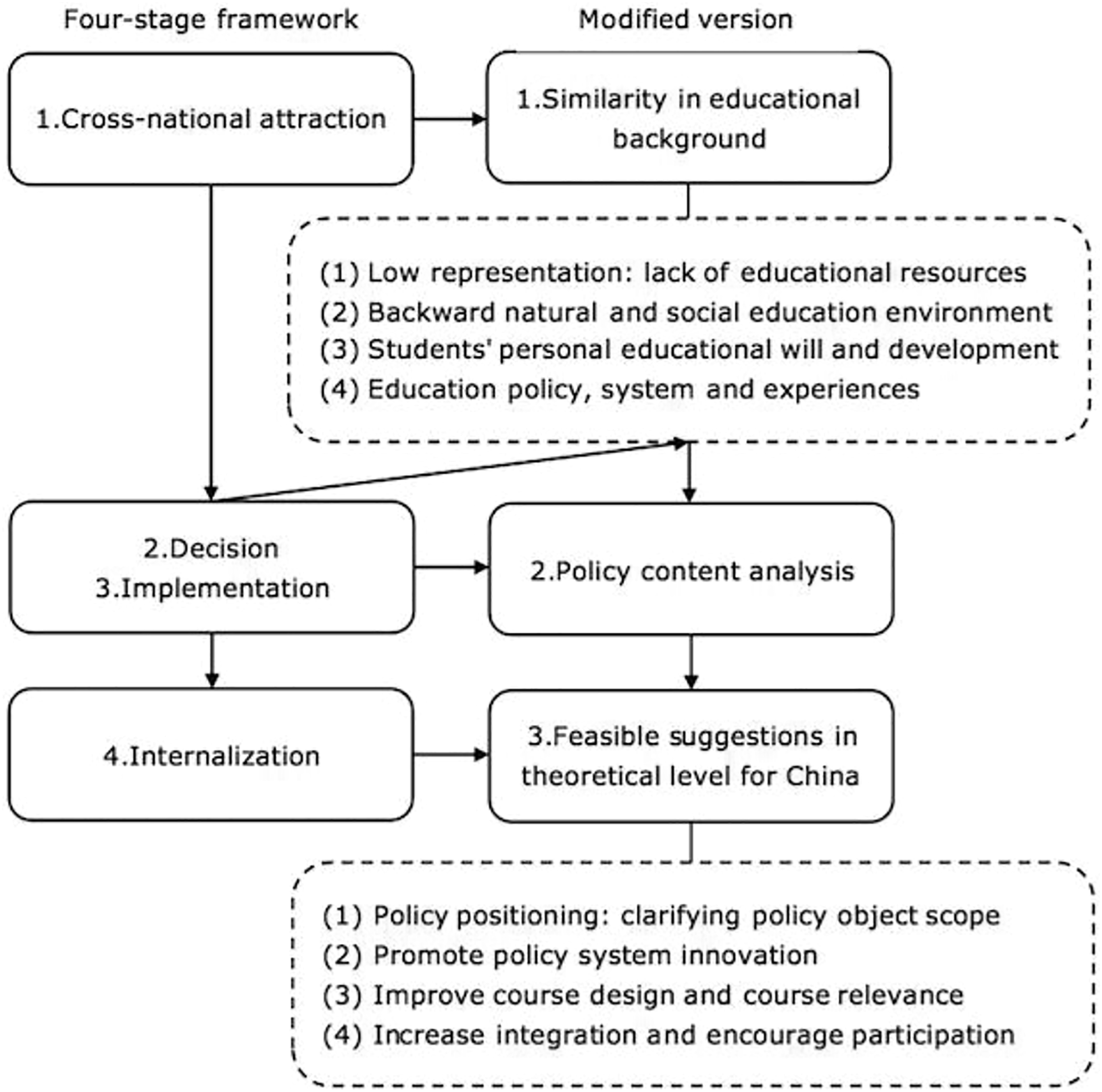
Cross-national attraction: Similar policy environment offers comparative value
Local and global context of education policy is the priority and basis of policy transfer. The purpose of migration is to get inspiration for the formulation and implementation of national higher education policies and seek to establish a path of higher education reform and development that is suitable for national conditions, rather than simply absorbing or discarding (Cheng, 2008). Educational policy borrowing is endemic, with local and global context as its basis. Only with careful attention to key ideas of contextualization and ownership can its value be achieved (Lex, 2012). In terms of policy background, China and Australia have common points in four aspects: low representation, natural and social environment that hinders education development, barriers to students personal development and difficulties in education construction like policy and system. This similarity offers comparative values and transfer possibility.
Low representation: Inequality in educational resources distribution
The Review of Australian Higher Education identifies continuing under-representation of Indigenous people in higher education in two key issues: school academic preparation and completion rates, and university retention (Wilson & Wilks, 2015) . Other indicators that can reveal the plight of minority students include academic achievement, course enrollment numbers, course completion numbers and available post-school opportunities (Pechenkina & Anderson, 2011). The proportion of indigenous undergraduate students is still significantly lower than that of non-indigenous students and the attrition rate of indigenous students is high (Gore, Patfield, Fray, et al., 2017). Indigenous students also have significantly lower rates of access, retention, and completion (Gore, Patfield, Fray, et al., 2017).
To be specific, compared to individuals in metropolitan areas, remote rural Australian students are about 40% less likely to obtain a tertiary qualification, and participation in tertiary secondary education is lower in rural areas. The share of students with suitable age for school in remote rural areas is 27.3%, but their share of tertiary enrollment is only 21.7%, and the share of doctoral students is even lower, demonstrating most of them participate in lower-level vocational education. This more serious educational inequity for indigenous students, who have less than half the tertiary enrollment rate of other students (Napthine et al., 2019; Welch, 2013). Besides, only 40.3% RRR students may complete secondary education, and they are 30% more likely to reject an offer, twice as likely to delay entry as urban students, and 48.7% less likely to complete tertiary education, reflecting the relative disadvantage of remote rural students in Australia at the full tertiary education stage (Cardak et al., 2017; DET, 2018a; DET, 2018b; Napthine et al., 2019). It is important to identify the existing problems of remote rural higher education in Australia, and to formulate strategic guidelines and take targeted measures that are in line with its development status.
Reasons for this longstanding under-representation are complex and multifaceted, including a broad range of social, cultural, geographic, economic conditions, social class, rage and gender (Gibson et al., 2022; Gonski et al., 2018). With the increase of remoteness, the level of achievement is also declining (Halsey, 2018).
Similarly, the rural-urban disparity in access to higher education opportunities is still clear in China. The college entrance exam participation rate of rural students, registration statistics and enrollment rate of rural and minority students does not attain the proportion of rural residents in the national population (Liu et al., 2012). Besides, the proportion of rural and ethnic minority children in schools decreases as the rank of the university rises, the portion of students with low social economical status and farming background is highest at vocational colleges (Qiao, 2010).
Ethnic minorities in China lack higher education resources. To be specific, this is manifested by the 30% lower enrollment rate of ethnic minority students in higher education compared with other students, weak infrastructure of ethnic colleges and universities after enrollment, disproportionate teacher-student ratio, and imbalanced educational investment. Besides, ethnic cultural differences and backward economic level make ethnic minority students lack social and emotional support resulting in low academic level and limited employment opportunities (Jiang & Sun, 2018; Napthine et al., 2019) . In addition, the enrollment rate of rural higher education students is only about 10%, the number of rural students accounts for only 15%, and the average number of years of higher education is about 3 years less than other students. There is low representation of ethnic minority students (Liu, 2012). The disadvantages of remote rural students throughout the higher education process are common to both Australia and China and make it feasible to learn from relevant Australian policies.
Backward social environment rooted in natural environment disadvantages
The final report bases on the macro context of higher education development in remote rural areas in Australia. It derives from analysis of existing problems and shortcomings, which are similar in contextual environment and reality to those faced by ethnic minorities and rural higher education in China. This similarity has the feasibility and necessity of learning from them. Ethnic minority students in remote rural areas in China and Australia both face the backward social environment and social system construction due to the restriction of the natural environment. The disadvantages of the natural and social environment lead to the scarcity and unfair distribution of educational resources, which has spawned many social problems, including the conflict between educational needs and economic development, resettlement dilemma, inefficient education institutions and low community contribution.
Firstly, contradiction between education and economy forms a vicious circle. Most of main indigenous tribes in Australia, including Anangu, Bama, Koori, Murri and so on, suffer from drought and harsh climate, closed geographical environment and remote geographical location. This harsh natural environment results in backward economic development, leading to high crime rate, high unemployment rate, low family income, low labor market share and marginalized status of indigenous students. Indigenous people have a low share of the labor market, a high unemployment rate and a low family income (Giddy et al., 2009). Most of them rely on social welfare funds to live. Therefore, the development of RRR higher education is an urgent need for Australia, and an important way to improve productivity and industrial development in local communities. Higher education can transforms the huge population pressure into population advantage, it combines sparsely populated indigenous people with rich natural resources by training professional and technical personnel and labor. This reduction of the differences between indigenous people and the main ethnic groups in the field of vocational education brings economic benefits (Deloitte Access Economics, 2011). Vocational education and technical and further education (TAFE) are closely linked to economic development, undertake the social function of cultivating social labor force and optimize talent structure, promoting indigenous education and economic development at the same time (Dockery, 2013).
However, the backward economy hinders this equal distribution of educational resources, which in turn fails to attract talent, leads to wasted human resources, reduces the vitality and social cohesion of remote rural areas, diminishes economic radiation, and increases urban pressure (Napthine et al., 2019). Weak higher education in remote rural areas constrains the national flow of resources and overall productivity growth of the country. Besides, state government focuses more on indigenous economy and employment outcomes than equity, and reduces government funding in higher education equity programs like Higher Education Participation Program (Australian Government, 2014). This is the deviation from previous government social justice policies to equalize higher education opportunities, and undermines the sustainable development of indigenous higher education in RRR areas (Wilson & Wilks, 2015).
To be specific, the cumulative economic benefit gap between higher education in RRR areas and urban higher education output is $56 billion, and this gap could be closed over time through lower-cost higher education career development grants (Holden & Zhang, 2018). Similarly, if remote rural higher education is developed and the gap between metropolitan and remote rural enrollment is halved by 2030, the Australia GDP will grow by 0.6% (approximately $25 billion) in 2050 (Napthine et al., 2019). Therefore, the development of RRR higher education and the scientific and equitable distribution of educational resources is a long-term solution for the overall development of Australia, and specific policies to address the existing problems are the necessary and powerful support to achieve its development.
Similarly, 40% of 592 poor counties locate in ethnic areas in western and southern China with backward economy and concentrated poor population, and their investment in education resources is much less than central and eastern cities. With scarce higher education opportunities, only 40% of ethnic minority students choose to return to RRR areas, resulting in a lack of human resource support and professional talent pool for economic and social development in ethnic minority areas (Jiang & Sun, 2018). The contribution of higher education to economic growth in rural areas is about 10%, which is 20% lower than that of other regions, and the gap between urban and rural areas is increasing, resulting in mutual constraints between economy and education. Therefore, China’s ethnic minorities and rural areas also suffer from disadvantaged higher education, insufficient support for regional development and mutual constraints. It is necessary to find new ideas for the development of higher education by drawing on the experience of other countries.
Secondly, there is geographic limitation represented by resettlement dilemmas. Remote and blocked geographical location acts as physical barrier to indigenous student, since they need to travel to more advanced areas for higher education, which may cause problems like cultural shock, nostalgia, additional learning cost, outflow of talent and negative learning attitude (Gore, Patfield, Fray, et al., 2017).
Resettlement dilemmas deprive students with financial and social-emotional support. Relocating to a large city remains the primary way for remote rural students to participate in higher education and increase their educational options. 60% of remote rural students relocate to cities to study and another 12% relocate to other remote areas, which doubles the cost of upbringing for parents and puts financial pressure on families of approximately $30,000 per year (Godden, 2007; Norton et al., 2019). This situation lforces RRR students to take more gap years to obtain sufficient funds for their education through internships or jobs. It forces them to delay enrollment or graduate early, and face more financial stress during daily commuting, professional intensive training, and internship travel, increasing the uncertainty and difficulty of completing higher education (Quin et al., 2017). In terms of emotional and social support, relocating to urban areas for schooling makes students unsociable and eccentric, removes them from the traditional social network of emotional support systems and weakens the sense of intrinsic belonging, with 50.5% of students considering dropping out of school due to health and stress issues (Vernon et al., 2018). The culture in big city is different from the indigenous culture, which makes students have cultural identity conflicts. In addition, many RRR students have multiple responsibilities and need to address family, ethnic, work issues. Students cannot often go home to participate in family and community activities. Less opportunities to feel indigenous culture gradually reduce their sense of identity with indigenous culture (Guenther & Osborne, 2020). They also need additional government support services such as academic support, childcare, and facilitation of ethnic participation. In addition, the related policies are temporary and localized, which decreases RRR students’ sensitivity to existing support policies, offering them difficulties in obtaining clear and timely information about support programs (Napthine et al., 2019). Therefore, cross-regional study only relatively compensates for access to higher education with equal quality, there are still many practical difficulties in the implementation process. In the next stage of policy development and implementation, ensuring targeted support for the educational process and high efficiency of educational outputs will become the main focus.
The resettle dilemma in ethnic minority higher education in China usually appears in the form of national classes. In high schools and universities, ethnic minority students in remote areas may go to the national classes or mixed classes in more advances provinces in eastern China to get better education, or they may move to their provincial capital for further study. The changes of learning locations increase learning cost like transportation and accommodation fees. The new learning and social environment also offer challenges in social emotional well-being and cultural belonging (Xiong, 2020; Xu & Zheng, 2020).
Thirdly, inefficient educational institutions result in less opportunities and participation. For indigenous people, the education institutions in rural and remote areas are mainly regional universities, which act as an important role in regional economy, social development, and cultural life. However, lack of regional universities causes brain drain, lack of jobs and investment. Less regional universities offers less intellectual support to regional development, regional governance, community services and economic growth. RRR higher education institutions are weak in talent training, scientific research, community construction and social services with cultural and local characteristics (Gao, 2020). They are weak in attracting RRR students and alleviating the brain drain in non-metropolitan areas.
Higher education in RRR areas propose higher requirements for teacher training, resulting in more urgent demand on qualified teachers. Qualified teachers with love, kindness, respect for indigenous students and their culture, patience, responsibility, passion and dedication are in great need. Some RRR teachers lack community-related qualities, like the sense of belonging to the community, bilingual teaching skills and profession knowledge, and communication skills to understand students’ education need (Guenther et al., 2016). They need to have two-way methods to cooperate with community members.
RRR areas are weakness in education market. Weak market demand and harsh natural environment hinder private educators from conducting academic operations in RRR areas. Students can only rely on higher education channels funded by the federal government, they suffer from insufficient funds, limited degree distribution, low participation rate, low completion rate and imperfect Internet infrastructure (Halsey, 2019). Rural education institutions suffer from economic recession. In addition to the loss of teachers due to the decrease in institution number, rural schools are facing more and more social and welfare problems, housing problems, job problems and student decline. Due to harsh nature environment like drought, the infrastructure and communities in rural areas are eroded and facing recession. Due to the restriction of the economic benefits of education, the provision of education has also decreased. When a town declines with the decrease of employment opportunities and the increase of social problems, students lose motivation and support to break through these difficulties and break the cycle (Kelly & Fogarty, 2015). Besides, most rural teachers do not meet the aforementioned qualification, lacking indigenous knowledge, determination to teach and necessary communication skills.
A vicious circle is formed in which educational institutions are set up because of the weak market and ignorance of remote villages. The unequal distribution of educational resources undermines development of higher education in RRR villages. This leads to reduction of follow-up employment opportunities, forcing more graduates from RRR areas to participate in technology and trade work and to compete for limited opportunities to participate in management positions (Norton et al., 2019).
Existing system has not only shortcomings in the specific education process, but also gaps in specific institutional facilities. In higher education in RRR areas, especially in vocational education, the construction of community basic education institutions is not sound, lacking learning file information, credit recognition services, and student resource reserve (Joyce, 2019). Therefore, it is of great significance and urgency to build a new functional higher education system with mutual recognition of achievements at different stages of learning and a regional learning center.
The ethnic minority serving institutions (EMSIs) also face external and internal challenges when realizing their missions. Ethnic minority education institutions are in the marginalized position in the Chinese higher education (HE) system, which means they have a high position in the education strategy, but are obviously insufficient in the actual investment of education resources due to the harsh natural environment and backward social environment. The primary internal challenges for ethnic higher education institutions is the unscientific ethnic programs, ineffective multilevel administration and traditional organization structure, inadequate support for student successes, and high faculty turnover (Xiong, 2020). Besides, there are insufficient teachers in remote rural areas and ethnic minority areas in China. Rural teachers suffer from difficulties including low quality, low happiness, insufficient material and social support, less development opportunities, teaching pressure, misunderstanding brain drain, cultural shock and turnover risk (Cui et al., 2022a, 2022b). The teachers are either too young or too old, and lack professional attraction, enough teaching materials and sufficient supplementary channels and access to education information (Sun & Wu, 2018).
Barriers to personal development of minority and rural students
Firstly, low community contribution leads to predicament of individual education demand (Postiglione et al., 2012). Geographic location is identified as a physical barrier to greater opportunities for indigenous youth in RRR communities. The backwardness and decline of rural areas lead to lower community contribution. The constant decline of rural areas is characterized by population decline, income reduction, service reduction, life quality decline, and loss of key services and government assistance (Kelly & Fogarty, 2015). In addition, when pursuing further education, indigenous students may lack support and encouragement from family and community (Gore, Patfield, Fray, et al., 2017). RRR students face challenges in academic aspirations, career advice, and schooling. They have difficulties in preparing for higher education because of limited personal choices, traditional family perceptions and expectations, local employment perceptions, basic and secondary education experiences, and education cost analysis. They have a natural disadvantage in education process, and a profit-seeking nature of pursuing jobs as soon as possible while foregoing long-term educational opportunities, making it difficult to achieve the same educational outcomes as urban students (Jiang & Sun, 2018). Indigenous students, even those with high achievements, are more reluctant to go to university than their non-indigenous peers, they eager to drop out of school early and receive technical and further education (TAFE) than their non-indigenous peers. Indigenous male students are more inclined to engage in sports based occupations. Indigenous female students women yearn for more prestigious careers that need higher education level (Gore et al., 2017a, 2017b).
Some indigenous students from rural areas believe that their opportunities to go to university are limited by geographical distance. RRR areas are varied in landscape types, which leads to diversity in economic status, access to facilities, educational achievement, occupational engagement, social values and education aspirations. Environmental conditions like sever drought accentuate problems such as key community service closure and employment opportunity loss (Edwards et al., 2018). Certain material realities of rural life hinders students’ education aspirations. Shrinking rural populations and backward social development force school-aged indigenous children to leave, causing further community depopulation in the vicious cycle (Roberts, 2015). As indigenous youth enter the ranks of professions, they have a deep understanding of their incompatibility with the modern civilization of the mainstream culture, their lack of survival ability and knowledge in key fields. They yearn for professional education to better integrate into society, improve their living standards and social status. Developing successful initiatives to address equitable participation in higher education requires a departure from hegemonic discourses of rurality and greater recognition of and respect for the diverse needs and desires of indigenous students (Gibson et al., 2022). Rural indigenous youth leave their communities primarily because of a shortage of educational and employment opportunities (Fray et al., 2020). However, for indigenous students who want to stay and study in the community, moving away for education can be a difficult choice, making them uncomfortable and isolated. They also face low self-esteem, lack of confidence, and self-doubt (Gore, Patfield, Fray, et al., 2017). Students with this hope of returning will demonstrate a clear preference for rural life if local education opportunities are available (Gibson et al., 2022).
At individual student level, RRR students who lack higher education support become negative participants in economic and social life, and have fewer career options and salary incomes than other students (ABS, 2017). RRR students without a degree have 27% lower total career wages than those with a high school degree and 50% lower than those with a bachelor’s degree (Sinning, 2014). The unemployment rate for those without higher education is 7.9%, 3% higher than those with higher education experience (Anderson et al., 2022). In addition to the most basic salary, the lack of higher education makes RRR students lack the professional skills and learning capacity upon which to survive, and the increasing labor market demand for professional and technical personnel rejects RRR job seekers lacking higher education experience from social production (Gibson et al., 2022). Higher education also has strong inter-generational benefits. Lifetime earnings of children decreases by an average of 1.2% when parental education decreases 1 year (OECD, 2019).
The harsh natural environment and backward economic level not only hinder the development of higher education in RRR areas, but also block the channels for higher education to feedback local social development. RRR areas contain great potential for development, but the current state of scarcity of higher education institutions limits local economic enhancement and long-term development of local industries. Therefore, only by enhancing research capacity in remote areas and supporting, attracting and retaining RRR students can individuals contribute to their communities (Smith et al., 2018). In addition, weak international attractiveness of higher education in RRR areas, including vocational education, insufficient international educational resources, slow financial flows, and poor cultural exchange, are all factors that hinder the development of RRR communities.
Similarly, the realization of one’s own value is an important reason for ethnic minority students to participate in higher education in China, yet the available higher education resources in RRR areas lack both impetus and attraction, forcing college graduates to leave their hometown and sever their value from the welfare of remote rural society (Qi, 2021; Sun & Wu, 2018) . Moreover, for RRR students, the unique function of higher education to promote social mobility and reproduction is greatly compromised by the inequitable distribution of educational resources and fierce educational competition (Mai, 2019). The ethnic community in China acts more like the clan and extended family, which focusing more on family and social relationships instead of individual’s academic achievement in higher education. The elders in community may be helpful in providing youth with good job in local areas, but lack the social connections in higher education system in other provinces (Fang & Wang, 2019). Therefore, improving higher education in RRR areas becomes an important element in achieving educational equity, and the sustained learning capacity and employment opportunities generated by higher education become not only a way for minority students to improve their lives, but also an important channel for them to achieve class mobility, promote equitable distribution of educational resources, and build an egalitarian society.
Secondly, ethnic minority students suffer from limited access to information, which derives from disadvantages of family cultural capital (Liu et al., 2012). Compared to urban students, RRR students lack career planning advice and counseling support in higher education, they have low enthusiasm for learning and career enthusiasm, lack understanding of available educational options and awareness of expanded educational pathways, and are confused about the link between higher education and future employment (Herbert, 2020). The reasons for this unfamiliarity include both inefficient infrastructures and lack of family cultural capital.
In terms of infrastructure, insufficient education institutions and departments can not provide indigenous students with useful information and well-designed courses. The construction of education information system and publicity platform is incomplete. There is no social contact department that can offer vocational guidance and promote understanding of vocational and continuing education for indigenous students (Gore, Patfield, Fray, et al., 2017). The teachers can not offer proper emotional support except for academic knowledge, which may cause loss of confidence, anxiety, low academic self-concept (Gore, Patfield, Holmes, et al., 2017).
Indigenous students in rural areas lack direct experience in higher education environment, educational role mode, and previous experience from family members (Gore, Patfield, Fray, et al., 2017). They lack the inter-generational higher education experience and access to cultural and material resources, they have lower values related to the field of higher education and more vague path to higher education (Gale & Parker, 2015). Therefore, there are four reasons for the inadequate participation of indigenous students in higher education and poor academic performance: ethnic and cultural isolation caused by lack of indigenous middle class; weak financial support; limited social connections and distrust relationships between indigenous students and institutions; the social mobility of indigenous students in education process is both constrained by traditional concepts and excluded by mainstream culture (Gore, Patfield, Holmes, et al., 2017). Besides, it is common for indigenous students to delay accessing higher education in favor of employment and family and community responsibilities, which result in the loss of productive time for learning and professional career (Pechenkina & Anderson, 2011). This sense of disconnection from student life also makes indigenous students feel uncomfortable when searching for information. The low social economical status is the symbol of lack of social capital. Indigenous students with low SES background usually have lower education level, low awareness of long-term benefits of higher education, low willingness to participate, and more need for additional economic, academic and personal support in higher education courses (Frawley et al., 2017).
In addition, subgroups from RRR areas, including remote rural students from low social economic backgrounds, Aboriginal and Torres Strait Islander people, people with disabilities, and other special interest groups, face greater higher education challenges like dropping out and require additional assistance (Kilpatrick et al., 2019). Although existing subgroup support policies do raises academic achievement, there is still a lack of other dedicated policies implemented in concert, resulting in narrow scope for subgroup students to participate in education, rigid models of education delivery, and hazards like catastrophic weather.
As mentioned above, ethnic minority students in China also suffer from limited education resources and information. The reasons for this dilemma are the same as those of Australia. Ethnic minority students usually can not get enough support from their family or community, they can only rely on local government, local school and teachers, and education department. However, due to poverty, these channels may be blocked by family members or reasons for religious belief, since parents may want children to drop out of school and work to subsidize their families (Postiglione et al., 2012). Sometimes high school education is considered to be enough for them. Economic difficulties and real life deprive them of education supplies, weaken students’ inner drive to change their fate through higher education and strong learning motivation, lower their educational expectation and hinder academic communication (Xu & Zheng, 2020).
Educational superstructure: Policy, system and experience
Firstly, there is similarity in policy structure, including decision and implementation. The subject of education policy refers to individual, group or organization who involve in the formulation, implementation, evaluation and monitoring of education policy. Both the final report and higher education policies in China are formulated by the national government and education departments. The implementation and evaluation subjects include the government, schools, communities, enterprise organizations and students, which is reasonable for reference.
Target objects are similar. Policy object refers to the social problems, social members and target range targeted by the policy. The final report focuses on current education and student situation in RRR areas, and puts forward corresponding development measures. Similarly, China’s ethnic minorities and rural higher education policies also focus on development of education and the individual growth of students in economical and educational backward areas like remote, rural and ethnic minority inhabited areas. Both China and Australia focus on development of education in RRR areas in the macro level and individual development in micro level. Besides, the scopes of policy objectives are similar. The final report focuses on regional, remote and rural areas in Australia, like the north of South Australia, the periphery and northern territory of Western Australia, and the northwest of Queensland, emphasizing the two characteristics of “remoteness” and “rural”, which have common ground with ethnic minority areas and rural areas in China. The target areas are characterized by “remoteness”: relatively remote geographical location, relatively harsh natural environment, and most of them are inhabited by ethnic minorities, which is similar to the ethnic minority areas in China (Jiang & Sun, 2018; Mai, 2019). The target area has the characteristics of “rural”: backward economic and social development, low urbanization level, inadequate infrastructure, and lack of educational resources, which are similar to the characteristics of rural areas in China (Jiang & Sun, 2018; Mai, 2019) . Therefore, the target range selected in the final report is similar to that of ethnic minorities and rural areas in China, which is comparable and has reference significance for ethnic minorities and rural higher education in China.
Preferential policies in China and the final report in Australia have similar policy goals. The essential demand of education policy is the handling, distribution, regulation and integration of educational resources and benefits. Under the theme of RRR education, both Chinese and Australian policies focus on improving the current situation of educational inequity, giving more educational resources to remote rural areas and ethnic minority areas, optimizing local higher education process, and improving the educational outcomes and welfare of students.
The final report aims to improve the current situation of higher education in RRR areas in Australia by giving equal educational resources and opportunities to students there, to help them achieve sustainable development. Essentially, it aims to improve educational equities between remote rural areas and other areas, and between RRR students and other students (Napthine et al., 2019). China’s remote rural higher education dilemma is mainly manifested as equity issues. There is unbalanced development of education between rural and urban areas, and between ethnic minority areas and more developed areas. There are inequitable occupation of educational resources between rural and urban students, and among different ethnic groups within the same region and among students within ethnic groups, as well as the complex and diverse educational inequities in the relationship (Jiang & Sun, 2018). Therefore, equity issues, as the common ground and focus of remote rural higher education policies in China and Australia, provide rationality and comparative value.
Secondly, education policy development offers transfer possibility. In Australia, before the Second World War, indigenous people were excluded from the national education system, and were under the policies of massacre and isolation, they were expected to go to natural extinction. However, due to the unique upbringing mode of aboriginal women and their tenacious vitality, the aboriginal people of Australia and their indigenous tenaciously survived (Wilson & Wilks, 2015). The “White Australia Policy” greatly undermined ethnic diversity, but laid a foundation for the promotion of the rights and interests of indigenous people and the development of ethnic diversity in the future. The large-scale immigration plan made the national structure of Australia’s population increasingly complex, and brought about the increasing diversity of languages, customs and cultures. In 1972, Australia finished the transition from a homogeneous society to a pluralistic society.
Australian government has published a series of multicultural policy to promote indigenous higher education since 1972. Characteristics of multicultural policy include democracy and equality, cultural diversity, emphasis on the construction of national education policies and regulations, and feedback and revision of laws and policies and so on (Frawley et al., 2017). The representative policy documents include the National Aboriginal Education Policy (NAEP), which later become the National Aboriginal and Torres Strait Islander Education Policy (NATSIEP); Education & Employment of Aboriginal Teachers Report; Improving Indigenous Outcomes and Enhancing Indigenous Culture and Knowledge in Australian Higher Education; 2015 National Aboriginal and Torres Strait Islander Education Strategy; More Aboriginal and Torres Strait Islander Teachers Initiative (MATSITI); Review of Higher Education Access and Outcomes for Aboriginal and Torres Strait Islander People; Indigenous Education Strategy 2015–2024 and so on (Street et al., 2017). The main policy content include: research and review on aboriginal higher education and personal background; aboriginal teacher training and special tutoring for indigenous students; financial support to indigenous vocational education construction and individual education welfare; bi-lingual teaching with cultural diversity in education; curriculum design oriented to the educational needs of indigenous people, such as professional skills, small and medium-sized enterprises and township management; accountability measure improvement; education system innovation, including education leadership, nationalized curriculum, the National Assessment Program (NAPLAN) and professional teaching standards; quality teaching and workforce development under partnerships; boarding school construction; language, culture and identity (Frawley et al., 2017; Street et al., 2017).
Recently, The Department of Education, Skills and Employment cooperates with the National Indigenous Australians Agency (NIAA) to ensure that Indigenous programs and services are delivering for Aboriginal and Torres Strait Islander peoples as intended. Job-ready Graduates package includes measures in response to the National Regional, Rural and Remote Tertiary Education Strategy like offering financial, academic support and accommodation to indigenous higher education students. Indigenous, Regional and Low SES Attainment Fund (IRLSAF) helps universities to support indigenous students with low socio-economic status (SES) and RRR backgrounds. Higher Education Participation and Partnerships Program (HEPPP) is reformed to optimize education resources allocation and financial support, to balance the barriers to education faced by low SES, Indigenous, and regional and remote students (Australian Government Department of Education, 2022). The new National Agreement on Closing the Gap aims to narrow the gap between indigenous and non-indigenous Australians, to improve RRR students’ educational achievement, employment opportunities and life expectancy (Wilson & Wilks, 2015).
To conclude briefly, the priority areas in current policies include: building pathways for indigenous students like Torres Strait Islander people to higher education; raising indigenous students’ aspirations and confidence; improving undergraduate and postgraduate enrollments, overall success rates and academic performance, and indigenous staff numbers; enhancing the status of indigenous cultures and knowledge on campus; and ensuring wider participation of indigenous students in university governance and management. Many educational barriers have been largely mitigated, including financial pressures, resettlement dilemma, health problems, racism and prejudice, low levels of academic readiness and aspirations, indigenous students’ high academic demands and insufficient academic support, social and cultural alienation, and indigenous social cultural values conflicting with teaching styles and courses (Pechenkina & Anderson, 2011). This effectiveness of Australia policies offers transfer possibility and value.
Similarly, the higher education preferential policies for ethnic minority in China also focus on education equality, ethnic minority students’ academic performance and educational welfare. Developing ethnic minority higher education plays an important role both in improving personal happiness and in promoting economic development rural and remote minority inhabited areas. In 1949, the first constitution file “Common Program of Chinese People’s Political Consultative Conference” proposed that “the people’s government should help the people of all ethnic minorities to develop their educational undertakings”. Ethnic minority education in this period mainly focused on training ethnic minority cadres and public functionary, demonstrating the evaluation orientation of lowering standards and giving priority to admission (Fang & Wang, 2019). The development of ethnic minority higher education policy also encountered setbacks. The ethnic minority educational institution were canceled or suspended from 1966 to 1976. Most of minority students were deprived of the access to higher education.
The Third National Conference on Ethnic Education held in 1981 proposed to strengthen the construction of the existing 10 ethnic colleges, technical secondary schools and colleges and universities in autonomous regions, gradually increase the proportion of minority students in colleges, continue to run ethnic classes in universities, and offer more ethnic culture and language courses, and professional skills training in response to the educational needs of minority students (Chen, 2020). The government strengthens the training of various talents in ethnic minority areas. In addition to extra points and legacy policy in enrollment, it runs ethnic classes and preparatory courses in more advanced provinces, to offer minority students from RRR more education opportunities and resources. In learning process, tutoring groups and communication departments are set to guarantee the educational welfare, participation and learning outcomes of ethnic minority students. The universities and other social organizations are also required to provide minority students with more financial support through tuition waiver and scholarship (Xu & Zheng, 2020). The policy “Outline of the national program for medium and long term educational reform and development (2010–2020)” put forward higher requirements for the quality and management level of higher education in ethnic areas. In 2015, The policy “Decision of the State Council on Accelerating the Development of Ethnic Education” proposed to formulate and implement the layout plan and discipline and specialty adjustment plan of universities in ethnic areas. Priority should be given to the establishment of higher vocational schools that are compatible with the development of the real economy and industry. The government should actively support the establishment of engineering and application-oriented undergraduate colleges in ethnic areas with conditions. In 2018, Ministry of Education required universities to improve the ability of autonomous training and centralized training of minority students (Chen, 2020).
Besides, existing policies provide the possibility to explore new educational objectives and classification standards. The final report integrates ethnic areas and rural areas, focusing on the common educational dilemmas and the special problems of each of the two regions, and innovates special measures for remote rural areas. China has made a specific division of China’s hard and remote areas into six categories with a total of 634 counties and cities, noting that they are mainly located in the western region of China like Xinjiang, Qinghai and Ningxia. This division criterion captures the commonality between ethnic minority areas and rural areas, integrates ethnic areas and rural areas to a certain extent. It has similarity with the final report, and provides policy support for China to learn from the selection principles and positioning ideas of remote rural areas in Australia. In addition, the discussion on higher education in similar regions in China is still mostly conducted under the respective policy frameworks of minority education and rural education. Although there are corresponding specialized policy bases and common policy contents, there is a lack of targeted policies and specialized measures to integrate the two, and there is still a possibility of opening up new ideas of higher education development and integrating new policies of innovative education.
To conclude, both Australia and China face multi-ethnic social reality, they both hold a supportive attitude towards ethnic minority higher education, and have a clear understanding of the importance of multiculturalism and the harmfulness of excessive capital expansion on cultural diversity. Both countries regard vocational education, minority (indigenous) teachers, cultures, mutual understanding and financial support as key elements in higher education for minorities (Guenther et al., 2016). The similarity in education development, macro strategic direction and micro main composition contributes to policy transfer possibility and policy borrowing values. Besides, all other countries that face ethnic diversity in education and backward natural and social environment may benefit from this strategy since the similarity in educational background is the basis of policy transferring.
Decision and Implication: Policy content analysis
The policy content includes decision-making and measures, which accord with the decision and implementation stages in the “Four stages” theory. Analyzing the constituent elements of the report, including the stages of education policy formulation, implementation, feedback and monitoring, is of great significance for clarifying policy logic, understanding policy values, clarifying the interaction between subject and object, and obtaining new policy ideas and inspiration.
Policy design: Based on analysis of existing problems
“National Regional, Rural and Remote Tertiary Education Strategy” focuses on five aspects: access opportunities and choices of higher education, student support, students' aspirations, career advice and school education, special interest groups and regional development. It clarifies the current situation and important findings of Australia’s higher education in RRR areas, including the main problems that the policy seeks to solve. Among them, choices of higher education admission opportunities and regional development focus on the lack of overall regional higher education capacity, while the remaining three focus on clarifying the plight of individual higher education.
Policy implementation, feedback and monitoring: Key measures
The report identifies 6 priority areas for reform: access and choice, financial support, life and emotional support, student aspirations and preparation for success, special interest groups, and regional development. It then proposes 7 recommendations including 33 related actions as core programs to enhance higher education in RRR areas, which have implications for relevant education policies in China.
The strategy increases higher education options for RRR students through regional centers. Government provides federally supported curriculum-driven funding for remote students. This policy strengthens vocational education design by offering programs that focus on practice and professional and technical skills. It expands regional learning centers by using existing educational institutions like libraries. Regional learning centers are community facilities in RRR communities that offer college courses to local students, they provide infrastructure such as computers, Internet, printers, and textbook libraries, and are able to provide consultation on educational, administrative, and technical issues, as well as offer academic courses and skills workshops. It has online education platforms and access to Australian Qualifications Framework with uniform standards and transferable credits.
The strategy provides financial support, like higher education entrance fees, independent youth allowances and transportation allowance, scholarships and living service, to RRR students. It lowers the threshold for subsidy applications to reduce family financial pressure. This policy expands access to information and creates new websites for information integration.
The strategy provides social and emotional support. It offers educational services and life amenities including priority housing, academic guidance services, orientation courses, and corporate internships. It provides instructional, daily life information services, and builds online service platforms and community training institutions.
Career counselors are set to provide RRR families with educational information and advice through websites, regional aspirations enhancement programs, and alumni networks. It promotes specific employment strategies and high-quality vocational education programs to build regional school-community partnerships (Kilpatrick et al., 2019). The policy provides teacher support and principal training and provides RRR students with internships and academic exchanges (Wooltorton et al., 2022).
The strategy connects with Higher Education Participation and Partnerships Program (HEPPP) and the Indigenous Student Success Program (ISSP) to promote RRR student participation through regional and cross-sector curricula, emotional support, financial support, and pilot innovations that guarantee equal access to higher education for RRR subgroups (Kilpatrick et al., 2019).
This policy emphasizes on research capacity of educational institutions in RRR areas, especially vocational education, and supports regional universities to collaborate with metropolitan universities, local employers, and industry firms to maximize educational institutions’ functions in community development. Work Integrated Learning (WIL) internship provides students with internships in RRR areas, attracts them through local support, to meet local industry needs through improved employment and skill outcomes (Jackson, 2013). By building strong education sectors and vocational education links with industrial enterprises, educational institutions are able to train and transfer innovative talent to local employers, boosting the local economy and continuing to attract talent in a virtuous cycle (Napthine et al., 2019).
This strategy builds efficient macro systems including management mechanisms, feedback systems and communication mechanisms. It sets up education commissioners in RRR areas for education management. It improves geographic classification system to analyze the education situation in RRR areas.
Policy features
Firstly, current situation analysis acts as policy basis. Policy decision and implementation derives from the information analysis of the current situation. Actions aim at improving the current situation of inequitable higher education in RRR areas. They base on a comprehensive analysis of current situation, and get data and literature support with clear purpose, relevance, feasibility and scientific nature. The actions focus on the details of existing problems, like the report’s refinement of the student support issue into financial support and social emotional support measures, to make the implementation process more hierarchical, comprehensive, and progressive.
Secondly, the conceptualization emphasizes the combination of macro-conceptual construction and micro-concrete measures. The policy measures not only focus on concrete and practicable specific measures like building regional learning centers and encouraging teacher-principal training, but also clarify the educational objects, build a macro-level consciousness of higher education, and reflect the higher education needs of remote rural students with a clear political and principled focus. The report points out the scope of higher education policy goals for RRR higher education, which is integrative and innovative, and clarifies the overall attitude that educational participants should have toward higher education. The policy proposes requirements for students' learning attitudes and enthusiasm, and provides initiatives and encouragement for educators' professionalism and overall changes in society’s perceptions.
Thirdly, the policy combines existing design improvement and system innovation practice. The policy is systemic and functional, including content of the existing design improvement and system innovation practice. The final report incorporates other support policies, such as the Higher Education Participation and Partnership Program (HEPPPP), into policy measures, emphasizing the implementation of existing related measures and formation of a theoretical system of higher education support linked to other policies and regulations, as well as portfolio of measures. On this basis, the strategy proposes new specific practices, like regional learning centers and tailor-made courses, to realize the unification of consolidation and innovation in the content of measures, which is overarching and forward-looking.
Fourthly, the subject and object coverage is comprehensive. The report reflects the special needs of educational subjects, it not only makes demands on government, communities, enterprises, schools and other organizations and groups, but also makes ideological demands on students to develop proper attitudes and build enthusiasm for learning, it even encourages students' parents to support education. This more comprehensive coverage of educational participants also focus on social problems that the policy is intended to solve, which demonstrates a hierarchical and complete policy object that reflects the educational needs of all parties.
Internalization: Inspiration
1Policy positioning: Clarifying policy object scope
In the process of policy formulation and implementation, the definition, objectives and classification criteria should be clearly defined based on reality, and the economic and social development, educational resource situation and ethnic cultural background of the student’s region should be completely examined. The policy should guarantee that the educational resource inclination is not bound to vague geographical division or simple ethnic identity. It is the inner fundamental characteristics and the actual educational situation of the region that should prevail as the guiding concept of constructing RRR higher education policy, important principle of guiding philosophy and target positioning of RRR higher education policy (Clothey, et al., 2018; Napthine et al., 2019). China can learn the positioning idea of the final report. They can integrate ethnic minority higher education with rural higher education, expand and integrate the existing policy framework, innovate a new object and scope of higher education policy with reference to the criteria for the classification of RRR areas, and construct a targeted higher education policy system that specifically serves special areas with complexity and overlap characteristics such as RRR areas (Xiong & Jacob, 2020). The policies formulated in response to existing inequities should focus on promoting educational equity between urban and rural students, and between majority and minority ethnic students. It should improve the macro-level policy design, integrate educational subjects, expand the scope, refine practices, and build a special policy system to meet the complexity of RRR areas.
Promote policy system innovation
The government should create a macro environment that supports higher education in RRR areas to fill gaps in systems through institutional innovation and reforms. Based on current Chinese preferential educational policy framework, it should improve existing policies, laws, financial and educational management systems, increase financial investment and educational resources to ensure equality (Li, 2019; Sun & Wu, 2018). In practice, policy designers should adhere to preferential enrollment and academic support for students from ethnic minorities and remote areas, and increase or decrease the number of extra points according to the real educational situation (Yang, 2010). The policy strategy should focus on improvement of RRR higher education quality, and expand the scope of vocational education to continuously optimize the implementation process of existing policies.
Innovation in education systems and facilities is the core idea. Organization, information, operation mode and teaching content will be the cores of educational institution optimization (Stensaker, 2021). Chinese government should build higher education learning centers and distance education centers in RRR areas to improve higher education level and utilization of educational resources. Building learning centers with scientifically designed disciplines and teaching platforms is more effective than constructing a complete university in the traditional sense. Government uses regional learning centers to expand front-line teaching positions and give RRR students more educational choices and more convenient channels (Yuan Gao, Dollinger, D’Angelo, & Harvey, 2022). To be specific, regional learning centers should have well-developed infrastructure, stable management, skilled educators, sufficient financial support, cooperation system with other educational institutions, and department for liaison with ethnic minorities. It establishes special RRR higher education commissioners and education equality committees to optimize the usage of local talents and professionals in teaching and management engagement. The committees analyze current situation in different regions, provide information feedback for policy formulation, and implement scientific distribution of educational resources and orderly decentralization of educational rights (Napthine et al., 2019). In the implementation process, the government should improve the information exchange, supervision and feedback mechanism, and set up online platforms and portals to compensate for the inequality in educational information for RRR students (Li, 2019). It should establish career counselors to provide constructive advice on education and career planning for RRR students, and monitor the status of educational equity through various forms such as education commissioners and relevant departments, so that it can provide timely feedback on problems in the implementation process then optimize policy programs (Napthine et al., 2019; Street et al., 2022).
Improve course design and course relevance
Drawing on policy measures for social-emotional support for remote rural students in Australian higher education, the Chinese preferential policies should include social emotional learning at the higher education level. Educators should enhance mental health education, bridge policy gaps related to RRR students, integrate individual school programs into macro policy design, and engage schools, communities, and organizations under a complete policy framework through social emotional learning courses and activities (Rochecouste et al., 2017).
Government should promote vocational education, distance education to meet special education needs. Designers should expand policy content that are related to school-enterprise cooperation and community involvement through regional teaching centers, to provide various practical internship experiences and diversified learning approaches for RRR students. Government should improve network construction and information technology to bridge geographical gaps through online classes, then to enable students’ access to high-quality educational resources (Gibson et al., 2022; Napthine et al., 2019).
To address the unique educational needs of special groups such as minority students and students with disabilities, government should design specialized teaching materials that fit their educational backgrounds to promote educational equity by meeting educational differences (Yuan Gao et al., 2022). Educators should promote bilingual education, and consolidate a well-developed support curriculum system with multiple levels including courses on minority history and culture and seminars on hot social issues (Liu et al., 2022; Smith et al., 2018).
Increase integration and encourage participation
Community support is the basis of integration. Community should offers comprehensive support to historically underserved ethnic minority students. The support plan should include both academic items and social ones. In academic level, community support lies in STEM discipline constructions, mentoring, academic advising, learning models and career awareness and so on. In social level, community support includes family support, expectation, working with faculty, structured education pathways and so on (Kezar & Holcombe, 2018). In terms of teaching management, college leaders and managers should improve the school management system, conduct principal training, and build a scientific school structure and operation model. In terms of teacher training, mangers should maximize the role of the community by employing teachers who are familiar with local conditions and can elicit emotional empathy from RRR students (Zhu, 2010). Universities should select outstanding teachers to ensure teaching quality, and give educators multiple forms of support including raising teachers' salaries, improving teacher allowances and teacher training. In the teaching process, educators should meet the needs of special interest groups and respect the unique cultural background of ethnic minorities (Yuan Gao et al., 2022). They are responsible in cultivating students' enthusiasm for learning and clarifying their direction in life. They must set up the education concept that educational equity and the concept of student-centered education are important to the fairness of the educational process and outcomes for individuals, and they should make clear career plans to encourage RRR students to establish a firm belief in their pursuit of education and career (Fowler et al., 2018; Napthine et al., 2019).
Discussion
Compared to Australia, Chinese ethnic minorities have more complex ethnic groups and natural environment, with more scarce educational resources and higher educational needs based on larger population, requiring greater policy support. Therefore, the policy borrowing should meet the reality of China and the needs of the people instead of simple copy. China’s complex ethnic situation requires stronger and more comprehensive policy implementation. The differences in policy reference between China and Australia are mainly manifested in the degree of differences in policy elements such as educational institutions, learning opportunities and choices, financial support, emotional support for life, student aspirations, and regional development. The critical application may be applied to other developing countries that share similarities with China in terms of natural and social education environment, education policy logic and system, complexity of ethnic student composition, and level of economic development.
China not only needs to promote the construction of offline regional centers for ethnic higher education, but also needs to optimize online course design. COVID-19 has greatly changed ethnic minority higher education. Online education has become the new direction for higher education for ethnic minorities in RRR areas after pandemic. The social distancing and isolation policy during COVID-19 have hindered offline education and reduced student mobility (Pokhrel & Chhetri, 2021). At the same time, ethnic minority students often reside in areas with harsh natural conditions such as mountainous and desert areas, facing more difficulties in the infrastructure construction, electricity and water supply, internet information and communication equipment, and daily learning transportation of large-scale regional learning centers. The construction of regional learning centers in RRR areas has been hindered, and students are unable to go to learning centers or universities for learning, forcing them to study at home through online learning platforms (Mok et al., 2021). Therefore, Chinese Communist Party acts as advantageous role in unified governance and educational resource allocation. The policy borrowing should be a combination of Australia RRR higher education policies and China’s national conditions. Online education and network platform construction is the core content, and infrastructure in extremely remote and impoverished areas, including water and power supply and signal station construction is its prerequisite. Besides, the online courses should include basic academic knowledge, vocational skills, Chinese language, culture and minority history, and teachers’ digital literacy should be enhanced (Li & Xue, 2022). Based on this, regional learning centers should be used as offline entities to enhance the scope and intensity of higher education’s radiation to ethnic minority in RRR areas, to ensure that regional learning centers is promoted spatially towards RRR areas and gradually upgraded to local vocational colleges and 4-year universities (Zhu & Liu, 2020).
China not only needs to promote local talent feedback, but also to promote the influx of external talents in eastern areas. The brain drain in RRR areas in China is severe. Relying solely on the local minority talent feedback mentioned is not enough (Zong & Lu, 2017). Besides, excessive talent in the eastern region will generate malicious competition and internal consumption of resources, which hinders scientific, reasonable, and balanced allocation of education resources. Therefore, China should increase investment in educational institutions, focus on local talent cultivation, increase talent transmission in the eastern region, strengthen the influx of international talents and educational resources into RRR areas, and achieve diversification of assistance subjects and channels (Li & Xue, 2022). Social organizations and enterprises in both ethnic minority areas and developed eastern regions should be responsible for promoting feedback effect of vocational education and technical education and enriching opportunities for ethnic minorities to pursue further education. Education policies should guide students by career planning suggestions and ambition cultivation, with individual freedom of learning choices. The policies should encourage ethnic minority students to repay their hometowns and Han students to support the RRR areas, enhancing students' willingness to education equality.
China not only needs to provide professional knowledge teaching, ethnic culture cultivation, and social emotional support at the course level, but also needs to integrate these three into all aspects of learning and life. Because of vast territory and complex minority habitation condition, there are significant cultural differences among ethnic minorities, many of whom have their own languages and cultures. The distinct characteristics of each ethnic group, coupled with the huge differences in economic and social development levels, lead to poor educational learning and socio-cultural integration of ethnic minority students. Therefore, the policy should promote integration of academic knowledge, ethnic cultural knowledge, and social emotional support in all aspects, like campus and community activities and family education, instead of just in classrooms (Long et al., 2021). It is necessary to leverage the collaborative role of teachers and curriculum design, to apply into producing what is learned, and to integrate science research and education with industry. Knowledge transmission and ability enhancement should be integrated into all aspects of ethnic communication, classroom learning, and work.
Conclusion
“National Regional, Rural and Remote Tertiary Education Strategy Final Report” is formulated to improve indigenous higher education for aboriginal students from regional, remote and rural areas (RRR areas) in Australia. This paper simplifies “Four stages in policy borrowing” theory into the three stages one, and demonstrates the rationality and necessity of transferring the policy into ethnic minority higher education in China. This paper focuses more on policy environment analysis and theoretical inspirations. The similarity in low representation, harsh natural environment and backward social environment, students’ education demand and related policy development offers policy transferring possibility. Based on the decision and implementation of the strategy, this paper summarizes its actions and characteristics. Key actions include building community center, giving financial support, offering social emotional support, cultivating learning aspiration, protecting special groups, using education as the driving force of social development and constructing macro policy environment. The analysis on policy content offers experience in emulation and inspiration for Chinese policy improvement in four aspects: clarifying targets, policy system innovation, course design and teaching practices. This paper may give theoretical support to indigenous higher education and education policy comparison researches, and may offer experiences in policy improvement and teaching practices in ethnic minority higher education in China. The key elements in policy optimization may include regional education centers, online courses and cultural courses, ethnic minority educator teams and innovation in talent cultivation mode.
Footnotes
Declaration of conflicting interests
The author(s) declared no potential conflicts of interest with respect to the research, authorship, and/or publication of this article.
Funding
The author(s) received no financial support for the research, authorship, and/or publication of this article.
