



Abstract
Over the past two decades, China has formulated a series of policies regarding how to assess students’ holistic development, aiming to transform its highly exam-oriented culture which traditionally emphasises knowledge transmission and book learning. Although the efforts have met with some success, various issues persist when bringing such policies into practice. This article has three goals — (1) to outline the 20 years of assessment policies of students’ holistic development under the holistic suzhi assessment scheme in China, (2) to explore how these policies have been translated into practice and the issues arose from practice, and (3) to discuss the potential implications for nurturing and assessing students’ holistic development in times of increasing uncertainties.
Keywords
Introduction
Fostering the holistic development of our younger generation is essential to equip them for an increasingly complicated and unpredictable future. Although the definition of ‘holistic’ remains disputed in the literature, it is widely believed that the idea of cultivating students’ holistic development challenges education ideologies that only prioritize knowledge transmission and ignore students’ moral, social, and emotional development (O’Flaherty & McCormack, 2019).
In China, to develop students holistically, the government launched suzhi education (素质教育) in the 1990s, which yielded profound influence nationwide and now becomes a household term for billions of Chinese (Lin, 2019). The direct translation for suzhi is ‘a person’s holistic quality’, with more details to be discussed later. The promotion of suzhi education has close links with the country’s efforts to remedy the undue focus on rote learning, which allegedly hampered the cultivation of all-rounded talents capable of contributing to China’s future development. As commented by Deng Xiaoping, former President of China: ‘the power of our nation (and) the development of our economy are increasingly dependent on the suzhi of our workforce’ (Ministry of Education, 2005). As a result, China’s emphasis on holistic development is not only important for each individual student, but also for the nation’s desire for global competitiveness.
To evidence the outcomes of suzhi education, many Chinese researchers and government officials emphasised the need to assess students’ holistic development (e.g., Chen, 2016; Guo, 2017; Luo, 2015). As Wagenaar (2021) noted, ‘measuring is knowing’ (p. 2) – with increased attention to accountability, assessing students’ learning outcomes plays an important role in understanding the effectiveness of education policies and programmes. Therefore, not long after the proposal of suzhi education, a series of policies were further introduced to assess students’ holistic development under the holistic suzhi assessment scheme. During the past two decades, these assessment policies have been continuously revised, refined, and implemented across different provinces in China.
This study aims to review how holistic development has been legislated and assessed in China, with a focus on the challenges in policy implementation. We will first (1) review the 20 years of assessment policies of holistic development under the holistic suzhi assessment scheme, (2) explore how these policies have been implemented and the issues involved, and (3) discuss the implications for nurturing and assessing students’ holistic development.
Holistic development and suzhi education
There is a need to clarify how holistic development has been understood internationally and locally before elaborating on the assessment policies. So far, no consistent definition of holistic development can be located in the literature, but O’Flaherty and McCormack (2019, p. 126) believed that ‘it is reflected in the discourses of moral, social and emotional development and positive education, among others’.
Internationally, the holistic development of students is often viewed in relation to cultivating their holistic competencies, also commonly referred to as soft skills, generic skills, or 21st-century skills (Chan & Luo, 2020; Zlatkin-Troitschanskaia, 2021). From this angle, holistic development relies upon students’ learning of a variety of competencies deemed vital for their personal and professional life, including interpersonal skills, teamwork, and resilience. Many universities worldwide have launched ‘General Education’ programmes to help students develop these competencies (Lam, 2023). Some other researchers approach students’ holistic development via the lens of socio-emotional learning (e.g., Johnson, 2016; O’Flaherty & McCormack, 2019; Shek, 2010), and particularly focus on students’ self-management, social awareness, relationship skills, self-awareness and responsible decision making (Collaborative for Academic, Social, and Emotional Learning [CASEL], 2023). Finally, research on positive education also engages with students’ holistic development, with an emphasis on the connection between learning and well-being.
In China, students’ holistic development is closely related to a large-scale, long-term national curricular reform called suzhi education. If people have suzhi, they demonstrate certain values, behaviours, thinking or overall ‘quality’ that are appreciated in Chinese society (Chinese Association for Suzhi Education, 2017). However, in practice, suzhi is a ‘floating signifier with changing meanings across social and historical settings’ (Wu, 2012, p. 659). Therefore, instead of dwelling on its meaning, Lin (2019) argued that suzhi is an overarching label to express how the Chinese government as well as its people endeavour to foster students’ holistic development and not merely their academic progress. From this perspective, the term suzhi speaks more to its goal to cultivate all-rounded individuals rather than its content.
Holistic suzhi assessment
Holistic suzhi assessment is among the many pedagogical efforts under suzhi education to promote students’ holistic development. Focusing on secondary school students, holistic suzhi assessment has been explicitly recorded in many governmental policies in the past 20 years and officially recognised as part of the assessment system in China (Chen, 2016).
Two main goals have been identified – (1) formatively, holistic suzhi assessment is expected to drive students’ development towards a more well-rounded manner; and (2) summatively, the assessment results should serve as important references for local universities/senior secondary schools to admit high calibre students who not only excel in academic knowledge but demonstrate excellence in a holistic sense (Liu, 2020). While holistic suzhi assessment started with good intentions, the implementation is not without challenges.
The study
The study aims to address two research questions (RQs):
How is holistic suzhi assessment legislated in China?
What are some issues and challenges of implementing the legislation?
Method
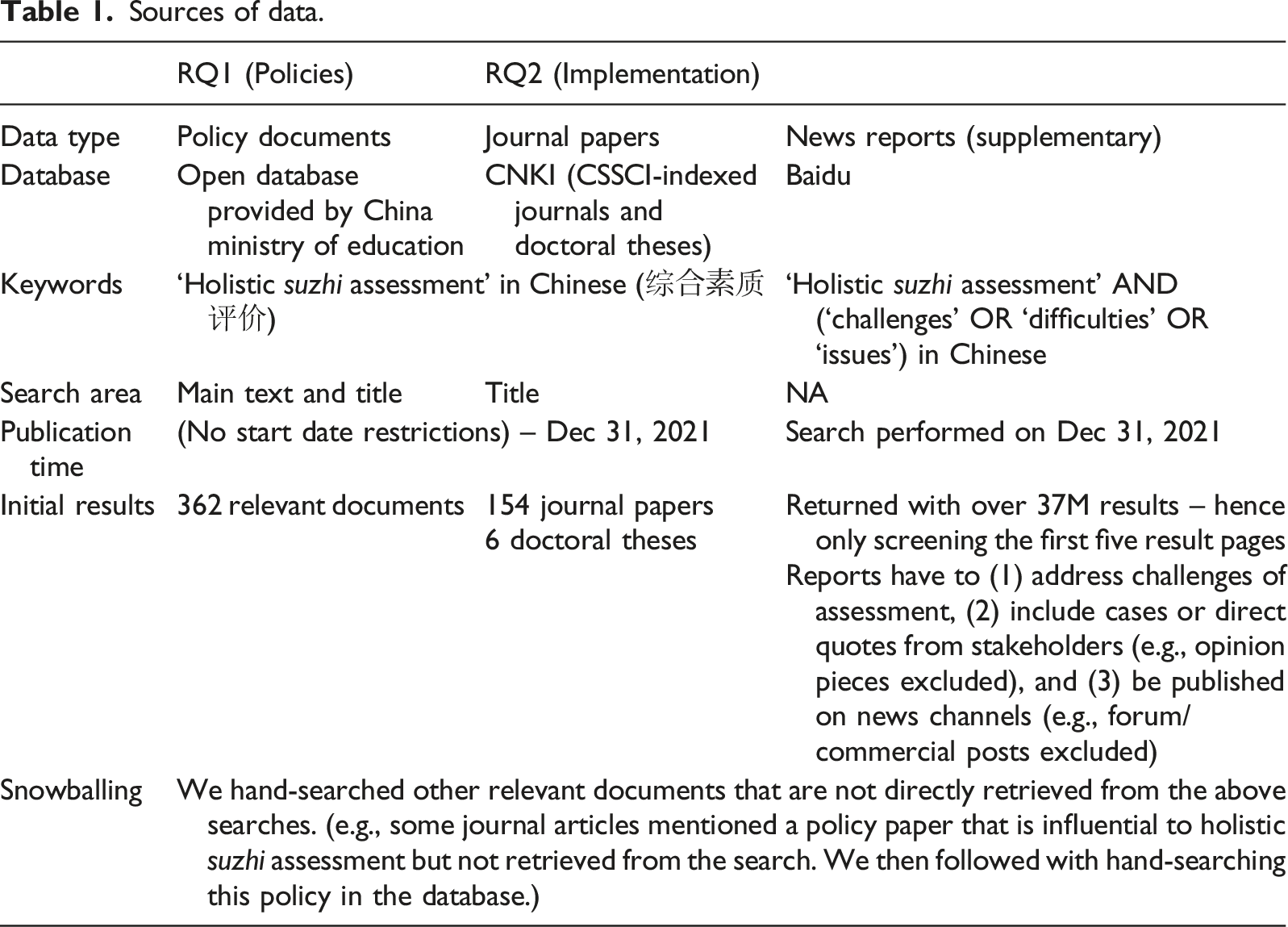
We conducted an integrative review to address the research questions. Unlike systematic reviews, integrative reviews do not aim to cover all articles published on a topic but to synthesise some relevant literature to generate new perspectives or to provide an overview of the knowledge base (Snyder, 2019; Torraco, 2005). Snyder (2019) argued that ‘a more creative collection of data’ is required, extending beyond the traditional focus on journal articles (p. 336).
Data collection
Sources of data.
Data analysis
For RQ1, we first skimmed through all the retrieved documents to gain an overview of the policy landscape. Policies with nationwide implications and specifically directed to holistic suzhi assessment were marked as ‘important’ (see Section ‘Policies on holistic suzhi assessment’ for these policies). Content analysis was then performed on these marked policies to extract the main content.
For RQ2, we also first reviewed the abstracts of all the retrieved research to gain an overview. Research specifically addressing the issues and challenges of holistic suzhi assessment in secondary school education was marked as ‘important’ (see Section ‘Implementation issues’ for the cited research). However, since the goal of this study is not to provide a comprehensive review, when two papers report on the same issue, the latter one being reviewed was not marked if it does not add new information. Issues reported in the marked research were deductively coded into pre-assessment, assessment and post-assessment phases. The retrieved news reports followed the same analysis procedure.
Policies on holistic suzhi assessment
This section reviews assessment policies formulated under the holistic suzhi assessment scheme. The policies are presented in three phases, marked by three seminal policy documents issued in the year 1999 (i.e., proposal of the term ‘holistic suzhi’), 2004 (i.e., official use of the term ‘holistic suzhi assessment’), and 2014 (i.e., inclusion of ‘holistic suzhi assessment’ as an important assessment system in China).
Phase 1 – Preparation (1999–2003)
The preparation phase includes policy efforts that laid the foundation of holistic suzhi assessment before it was officially introduced. The China State Council (1999) originally proposed the phrase ‘holistic suzhi’ in a debate about what should be examined in competitive tests like Gao Kao. Gao Kao, China’s well-knowingly competitive college entrance test, determines which students could be admitted to universities. In response, the Ministry of Education (2001) argued that rather than fixating on students’ academic achievement, assessment should address students’ needs, value their diverse potential, and help them develop self-understandings.
These two documents provided an initiative for future assessment reforms, but they were too general to be put into practice. Neither of the documents precisely indicated what should be included in the assessment of holistic suzhi. As a remedy, the Ministry of Education (2002) published a more detailed notice which listed six basic development goals for students (i.e., morals and virtues, citizenship, ability to learn, communication and collaboration, fitness and well-being, aesthetic performance) alongside academic goals. The 2002 Notice was considered significant as the six goals provided a fundamental content framework for assessing holistic suzhi.
Phase 2 – Implementation (2004–2013)
In this phase, major assessment policies of holistic suzhi assessment were formulated, contextualised, and implemented in different provinces in China. During this decade, holistic suzhi assessment has been promoted at full speed.
In 2004, the Ministry of Education (2004) issued Guidelines on reforming admissions to senior secondary schools, which marked the official use of the term holistic suzhi assessment in policy documents. The Guidelines advised that (1) the contents of holistic suzhi assessment follow the six basic developmental goals outlined in 2002, but local governments and schools have the autonomy to contextualise them; (2) the assessment values students’ self- and peer-assessment; and (3) the assessment results consist of comments and a grade, which will serve as important references for students’ admission to senior secondary schools. In 2008, the Ministry of Education (2008) further published Guidelines to include holistic suzhi assessment in higher education admissions, expanding the assessment to include senior secondary school students. Since then, all provinces, autonomous regions and municipalities in China have successively introduced their contextualised holistic suzhi assessment system for junior and senior secondary education.
Although the above Guidelines have made a profound impact on the implementation of holistic suzhi assessment in the coming years, they were ‘result-oriented’ (e.g., using a grade to indicate students’ holistic development) and unclear as to how the assessment results can inform the admission processes.
Phase 3 – Standardisation and refinement (2014-now)
With the implementation of holistic suzhi assessment, many issues arose from the frontline (e.g., different schools interpreted the six student developmental goals differently and conducted the assessment in various ways) – these differences have demanded more detailed policies to guide the assessment. Therefore, policies in this phase aimed to further standardise holistic suzhi assessment so it can be more effectively followed by secondary schools nationwide.
In 2014, the Ministry of Education (2014) published a new Notice to improve holistic suzhi assessment and included it as an important assessment system in China. The Notice contains five sections, clarifying the significance, basic principles, contents, procedures, and management of assessment. Below introduces several sections as examples.
Regarding the assessment content, the six developmental goals have been adjusted and reorganised into five dimensions – i.e., ideology and morality, academic performance, physical and mental well-being, artistic accomplishment, and experiential practice. Academic performance, which was not listed as the six basic developmental goals in 2002, was included. The five dimensions manifest China’s deeply ingrained educational philosophy, known as ‘wuyu bingju’ (i.e., ‘pursuing five educational aims at the same time’). In the ‘wuyu bingju’ (五育并举) thinking, education should equip young people with strong moral, intellectual, physical, and aesthetic foundations with a hard-working disposition (Wang, 2009). The ideology and morality dimension also includes components that represent China’s political orientation, such as adhering to fundamental socialist principles and patriotism. Under each dimension, there is a descriptor explaining its meaning. For example, ‘experience practice’ places a strong focus on students’ practical application of knowledge and assesses how well students perform in authentic tasks and experiential learning (e.g., internships, field trips, and community work). But again, local governments are allowed to contextualise these dimensions based on their needs – a case in point would be Shanghai which additionally includes ‘creativity’ and ‘citizenship’ in holistic suzhi assessment (Shanghai Municipal Education Commission, 2018). Local governments and schools are also expected to create detailed rubrics to operationalise assessing these broad dimensions.
Regarding the assessment procedure, every student in secondary schools is required to maintain a holistic suzhi portfolio, which will be utilised for both formative and summative (admission) purposes (see Shanghai Municipal Education Commission, 2018 for an example portfolio format). To facilitate the process, teachers are expected to assist students in documenting and evidencing their holistic suzhi development in the portfolio, which should reflect the five suzhi dimensions. In line with this, schools are also advised to organise more experiential activities to provide students with opportunities to develop holistic suzhi. The 2014 Notice does not mention using grades to report the assessment results but instead stresses how the assessment should guide students to understand their own strengths and weaknesses for future development. Furthermore, the portfolio should be maintained on a regular basis rather than created at the end of the semester. The 2014 Notice also proposes to quantify students’ holistic suzhi, albeit in controversial ways. It writes – ‘the assessment of “experiential practice” should concentrate on the frequency of participation, time spent on the experiential activities, and the outputs (e.g., reports; reflections) from these activities’. In later sections, we will discuss why these regulations cause controversies.
Regarding assessment management, the Notice assigns autonomy to universities to decide how they wish to use the assessment results for admission purposes. Universities are advised to formulate their own admission policies in a way that holistic suzhi assessment results can be used wisely. However, the Notice does not mandate that all universities refer to holistic suzhi assessment in their admission.
In the following years, apart from restating the importance of holistic suzhi assessment in deepening educational reforms, no significant changes were made from the top-down (Liu, 2020).
Implementation Issues
This section introduces how the above policies have been translated into practice, especially the issues involved. We identified three major types of issues and present them following the three stages of implementing holistic suzhi assessment – i.e., pre-assessment, assessment, and post-assessment.
Issues of Equality
The pre-assessment stage denotes the preparation work done before students’ holistic suzhi portfolios are constructed and assessed. Since ‘evidence’ is prioritised in assessing these portfolios, students are expected to participate in activities that allow them to practise and demonstrate their holistic suzhi (Ministry of Education, 2014). Experiential activities, which present students with opportunities to engage in authentic learning and real-world issues, are considered central to evidencing their holistic development. However, while the original intention was to encourage schools to provide more experiential opportunities so that students are not bound to paper-pen exercises, the intention is often distorted in practice (Wu et al., 2019).
Research revealed that students from well-off families are more likely to participate in experiential activities because their parents have more social capital to offer them such opportunities (Fu & Xie, 2011; Li & Fan, 2012; Zhou & Zhang, 2014). Take Shenzhen (a south-eastern city in China) as an example: in 2018, the Shenzhen Department of Education included ‘overseas experience’ as a performance indicator in its Guidelines on assessing holistic suzhi. The Guideline came under strong criticism for disadvantaging students from lower socioeconomic backgrounds who cannot afford to go abroad and hence ‘practise’ their intercultural communication skills (Wu et al., 2019).
But Shenzhen is not the only case accused of exacerbating education inequality. Following the 2014 Notice which emphasises students’ time spent on experiential activities, many local governments stipulated the ‘minimum participation time’ required for students to pass their holistic suzhi assessment. In Shanghai (Shanghai Municipal Education Commission, 2021), senior secondary school students are advised to complete at least 30 days of social work (e.g., field trip, community service, internship) each semester and be validated by organisations to which students provide service. In Guangzhou (Guangzhou Department of Education, 2019), junior secondary school students are advised to complete at least 24 hours of voluntary work each semester to demonstrate their social responsibility. However, given the large number of students, social work opportunities are not always available to all students at school and there is a limited number of extracurricular organisations which can provide evidence for validation purposes. Local news reported that parents with strong social networks are often more likely to secure their kids with these opportunities (Su, 2020; Wu et al., 2019). Some parents even paid a considerable amount of money to fabricate evidence of students’ participation in different activities, so that their children can build up a strong portfolio for holistic suzhi assessment (Y. Zhang, 2020).
Issues of Malpractice and Validity
The assessment stage denotes the construction and assessment of students’ holistic suzhi portfolios. Many challenges in this stage are related to whether the assessment can be trusted and here we elaborate on two frequently contested foci in practice.
Malpractices in Assessment
As introduced, the policies value different sources of assessment and feedback on students’ holistic suzhi (e.g., self-/peer-/teacher-assessment), with an aim to cultivate students’ evaluative judgement as well as to establish a more comprehensive evaluation profile. Chen (2016) surveyed 951 senior secondary school students from five cities in China and found evidence to support the above aim – 85.1% believed holistic suzhi assessment helped them better understand themselves.
However, since the assessment results are supposed to connect with students’ admission to higher education or senior secondary schools, some students deliberately overrate themselves but downrate their peers to get in a more advantageous position (Luo, 2015; Zhou & Zhang, 2014). Teacher assessment is also found susceptible to malpractice. As the student admission rate is closely associated with a school’s reputation, it is almost an unsaid rule to avoid grading students C or D in holistic suzhi so the schools would look good in promoting student holistic development (Luo, 2015).
In view of this, some provinces stipulated that only the top 30% of students can be awarded the ‘A’ grade, which unfortunately causes more issues than it solves (Luo, 2015). For one, norm-based assessment like this fuels unhealthy competition among students that ironically undercuts opportunities for them to develop collaboration skills. For two, in practice, students who excel academically are more likely to be awarded ‘A’ regardless of their holistic performance. As the admission rate to top universities in China is often used to indicate a school’s teaching quality, some schools manipulate the holistic suzhi assessment results to make sure these students have better chances of admission (Chen, 2016).
Worse still, Liu and Chen (2020) reported that in some schools, student self- and peer-assessment are also performed by their teachers. Due to a lack of assessment literacy, these teachers fail to acknowledge the significance of self-/peer-assessment and are unwilling to relinquish part of their assessment power.
Validity Issues in Assessment
In practice, questions arise as to whether holistic suzhi assessment measures, reflects, and nurtures a student’s holistic development in a valid way (Zhang et al., 2021). The first validity issue concerns the assessment content, which has been criticised for being too partial. Although the five proposed dimensions reflect Chinese traditional thinking of what constitutes ‘a holistic person’, they do not explicitly capture higher-order cognitive skills (e.g., creativity, critical thinking), interpersonal competencies (e.g., leadership, intercultural communication, teamwork) and more recently highlighted capabilities (e.g., digital literacy). The extent to which the five dimensions have been based on scientific research is unknown.
The second validity issue concerns the assessment standards stated in the 2014 Notice, highlighting students’ frequency and duration of participation in experiential activities. Although these recommended foci have to some extent facilitated operationalisation in assessment practices, they failed to capture the quality of students’ holistic suzhi performance (Luo, 2015; Ma, 2015). In a similar vein of thought, Gao (2013) argued that students who participate less frequently in voluntary work should not be seen ‘morally inferior’ because the quality of participation also needs to be considered. Under the current mechanism, some parents and students admitted that they are more concerned with whether their efforts can be recognised for assessment rather than whether students actually ‘develop themselves’ in the process (Wu et al., 2019).
Issues of Box-Ticking
In the post-assessment stage, although the policies repeatedly advocate including holistic suzhi assessment in higher education admissions, this has been reduced to some kind of ‘box-ticking’ activity due to reliability concerns (Zhou & Zhang, 2014; Wang & Ding, 2015; J. Zhang, 2020). Luo (2015) criticised that ‘the policies are weak, abstract, and without any substantial effects’ (p. 34).
First, the assessment results are not necessarily comparable across provinces, cities and even schools, making it difficult to be used formally for admission purposes. Although the 2014 Notice provides descriptors for each of the five dimensions, no detailed rubrics or standards are available to differentiate different performance levels (Ma, 2015; Wang & Ding, 2015). The original policy intention was to account for the vast diversity across different regions in China, but the localising process also leads to numerous available rubrics devised by different governments and schools.
Second, the assessment does a poor job to differentiate students based on their holistic suzhi performance, limiting its effectiveness in admission (Chen, 2016; Zhou & Zhang, 2014). As mentioned earlier, the assessment results are often shown in letters and schools tend to refrain from giving students lower grades to uphold the school’s reputation (Luo, 2015). In localisation, many local governments stated that universities should give priority to applicants with better holistic suzhi in cases when two or more students, who apply for the same major under the same university, also coincidently achieve the same Gao Kao score in academic subjects (Luo, 2015). This is not only a low probability case but also a weak statement considering the problematic grading process where almost everyone ends up with ‘A’ or ‘B’ in holistic suzhi.
Third, students’ self- and peer-assessment results are often questioned in terms of accuracy. Liu and Chen (2020) noted that the current curriculum in China does not support students in developing their evaluative judgement on holistic suzhi, so it is questionable that they can evaluate their own and others’ holistic development in a sound manner. In view of this, universities have been hesitant to use these results in their admission process.
Therefore, holistic suzhi assessment has more or less become a ‘formality’ that every school has to complete. Research revealed that some schools only perform holistic suzhi assessment at the end of the semester so that they have something to report to the local government (Chen, 2016); others even outsource the assessment to some companies to ‘save work’ for the teachers (Luo, 2015). That said, due to the hyper-competitive nature of college admission in China, many parents and students still work hard to ensure an ‘A’ grade in holistic suzhi assessment to secure themselves a more advantageous position, even just by a little – but as discussed, malpractice is common, and students often focus more on the results than the learning process.
‘Remedy’ to the Implementation Issues
Among the many criticisms of holistic suzhi assessment, the new national project on ‘key competencies’ has emerged and is often discussed as a ‘deepened reform’ to holistic suzhi. In 2016, the China Ministry of Education entrusted Professor Lin Chongde to lead a team of top researchers to work on the development of ‘key competencies’ for Chinese students of all education levels. ‘Key competency’ is the official translation of its Chinese counterpart ‘hexin suyang’ (核心素养), defined as ‘the essential character and core competencies students develop through education for individual and social development on a lifelong basis’ (Lin, 2016, p. 29). It consists of competencies from three main dimensions described by six core descriptors and more than 20 sub-descriptors, including both competencies in alignment with international education agendas (e.g., creativity, critical thinking), and competencies imbued with Chinese characteristics (e.g., perseverance and benevolence) (see Lin, 2016 for a detailed list).
However, how these key competencies should be assessed has not been explicitly clarified by the top down. Since the key competency framework appears to be more comprehensive than the five dimensions of holistic suzhi proposed in the 2014 Notice, some scholars argued that key competency assessment deserves to be promoted at full speed (Guo, 2017; Huang & Zheng, 2018). Other researchers are more reserved about undertaking key competency assessment to promote students’ holistic development. They argued that ‘key competency’ is just another ‘more fashionable, more international, and more eye-catching phrase that does not change anything about the previous holistic suzhi assessment’, calling it ‘old wine in a new bottle’ (Chu, 2016, p. 2). More time is needed to ascertain whether the key competency project provides a direction to improve holistic suzhi assessment in the future or remains only as a fanfare.
Discussion
Judging from its policy, the Chinese government recognises the power of assessment in promoting students’ holistic development, especially as exemplified by the ‘holistic suzhi assessment’ scheme. However, policy implementation has encountered many challenges. In this section, we highlight some potential reasons for the implementation issues to generate deeper insights into holistic suzhi assessment.
First, there is a noticeable gap between research and policy on holistic suzhi assessment. For example, the five dimensions proposed in the 2014 Notice were not informed by research evidence and no explanation has been given as to how these dimensions were selected. Although the more recent ‘key competencies project’ has followed a rigorous research procedure, the 2014 Notice remains influential in practice. In a similar vein, Luo (2015) observed that research on holistic suzhi assessment is often guided by policies rather than the other way around, and there have been insufficient interactions between researchers and policymakers.
Second, a lack of independent supervision has incurred malpractices in assessment via the portfolio approach. No external agency is available to investigate the truthfulness of evidence, or to regulate the extent to which the final grades are fair enough to represent students’ actual holistic development. At present, most regulatory work is conducted by local governments whose performance review is also affected by local students’ admission rates, leading to weak quality assurance and supervision. Meanwhile, provided with such independent supervision, the subjective nature of some holistic suzhi (e.g., moral values) still makes it difficult to guarantee ‘real’ learning.
Third, experiential learning forms an important part of holistic suzhi assessment, but well-structured experiential learning opportunities are not always available to all students at school. The review shows that at present, experiential learning often takes place in the form of extracurricular activities rather than embedded in students’ disciplinary learning or formal curriculum. Since well-off families have more resources to engage their children in experiential learning (e.g., overseas exchange; field trips), it creates equality concerns when students are left to their own to locate these learning opportunities.
Fourth, stakeholders (e.g., teachers, students, parents) may not possess assessment literacy in holistic suzhi assessment. Assessment literacy refers to a set of knowledge, skills, and dispositions required for teachers and students to effectively engage in the assessment process (Taylor, 2009). Although assessment literacy has been extensively researched in the academic context, it was not until very recently that the first papers on cultivating teacher and student assessment literacy in holistic competencies were published, foregrounding elements such as the critique of standards, appreciation of assessment goals, and knowledge of the nature of holistic development (Chan & Luk, 2021a; Chan & Luo, 2020). The paper identified instances that reflect a low level of assessment literacy among Chinese teachers and students, creating barriers to effectively implementing holistic suzhi assessment. Some examples include teachers failing to recognise the value of self-/peer-assessment and students lacking the ability to make evaluative judgements of the holistic development of themselves and others.
Implications
Based on the above discussion, we propose some implications for assessing students’ holistic development.
Ensuring Sustainable Research to Inform Policy and Practice
There is a need for establishing a professional working group that consistently contributes to refining holistic suzhi assessment and policy making. The working group is expected to include not only government officials but also researchers and school representatives (e.g., principals, teachers, students, and parents). Luo (2015) argued that the working group should be directly funded by Public Finance to ensure long-term and sustainable efforts in researching students’ holistic development. More support is needed to cultivate researchers who specialise in this field, such as setting up special grants and providing academic exchange opportunities.
Establishing Independent Supervisory Systems and Reconsidering High Stakes Assessment
Malpractices may be reduced by establishing independent supervisory agencies to oversee the assessment process. Several scholars argued that when holistic suzhi portfolios are used for high-stakes purposes, the submitted materials should be carefully verified and dishonesty must carry heavy penalties (Fu & Xie, 2011; Luo, 2015; Zhou & Zhang, 2014).
However, an excessive focus on ‘evidence’ and ‘regulation’ may lead to superficial learning and student performativity (e.g., pretending to behave in a certain manner) (Lin, 2019; Luo & Chan, 2022b). Unlike technical knowledge, the nature of some holistic suzhi tends to be abstract, subjective, and difficult to measure. For example, how can we make sure that students do not pretend to have ‘good’ moral values? The nature of holistic development necessitates a reconsideration of assessing holistic suzhi for high-stakes purposes. In Hong Kong, Chan and Luk (2021b) found that students prefer having a qualitative record of their holistic development without grading. Under the holistic suzhi assessment scheme, policymakers can consider moving towards a ‘grade-free’ system that supports students in recording and reflecting on their holistic development.
Another recommendation is to certify courses or programmes that contribute to students’ holistic development. For example, the International Holistic Competency Foundation (IHCF) is a global certification scheme to recognise courses that cover competency outcomes (e.g., leadership, communication, critical thinking) and employ appropriate assessment methods (Chan, 2023). Courses approved by the Foundation will receive official credentials, subject to bi-annual quality assurance led by the credential committee consisting of education researchers, community partners and industry leaders across the world. Students taking the certified courses will be issued a competency development report to evidence their participation and performance in competency development.
Integrating Experiential Activities into the Formal Curriculum
Experiential learning opportunities should be available to students within the formal curriculum, especially when holistic suzhi are assessed. With careful design, experiential activities can be integrated into everyday teaching, rather than merely as a bolt-on module. For example, in the mathematics classroom, teachers can engage students in small groups to solve real-life tasks by applying mathematical thinking (e.g., devising a suitable loan plan for cars). In the English classroom, teachers can use role-play simulation where students represent different character types to communicate with each other.
Another suggestion regards improving authenticity in traditional written exams as a cost-effective option. Within the current educational discourse, holistic development is often considered diametrically opposed to teaching to the exam, especially high stakes written exams. However, we argue that such a dichotomous view needs to be changed. Villarroel et al. (2019) proposed how written exams can be redesigned to assess 21st-century skills (e.g., problem-solving, critical thinking) rather than promoting rote learning. Some of the proposed principles include situating test items in authentic professional contexts, privileging open questions, and using open-book exams.
Developing Assessment Literacy of Teachers and Students
No matter how well the policies are written, it is contingent upon many bottom-up factors to effectively translate policies into practice. By ‘bottom-up’, we refer to teachers, administrators, students and parents who work in the frontline regarding holistic development assessment. While top-down policies outline the central goals to pursue in the future, successful implementation of these goals needs to be genuinely understood and supported by the bottom-up as well. Are students and teachers prepared for holistic development assessment? Do they have the expertise to actualise what is expected from the policies?
These questions foreground the importance to develop teacher and students’ assessment literacy in holistic development. For example, more professional training should be provided to teachers for this end, including introducing teachers to different purposes of assessment and supporting them in creating meaningful feedback to enhance students’ holistic development (Chan & Luk, 2021a). It is important that students understand how the assessment of holistic suzhi connects with their future development and the potential of utilising self- and peer-assessment to help them develop a better understanding and evaluative judgement of their holistic suzhi (Luo & Chan, 2022a).
Limitations and Future Studies
One limitation of this study regards the scope and validity of data sources. For example, it remains controversial whether news reports can be considered legit data sources, and the inclusion of data in this study is more integrative than systematic. Due to space limitations, the study mainly includes examples from several big cities in China (e.g., Shanghai, Shenzhen) to illustrate the contextualisation of policies, which may not represent the situation in other less-developed cities and counties. Therefore, we consider this study exploratory in nature and encourage future research to expand this line of research.
Future research can consider conducting a systematic review on this topic to provide a thorough understanding of holistic suzhi assessment. It would also be interesting to investigate how these assessment policies at the national level are contextualised by different local governments. Comparative studies featuring different policies on assessing holistic development in different countries would be valuable.
Conclusion
The paper represents one of the first studies in English on China’s holistic suzhi assessment scheme. Twenty years of efforts to assess holistic suzhi have widely raised public awareness of students’ holistic development and provoked lively discussions about what constitutes ‘good’ education in China. However, it seems that the assessment policies have received more criticism than acknowledgement when it comes to implementation. Through reviewing these policies and implementation issues, we do not aim to decry the country’s efforts in promoting holistic education but to provide some ‘food for thought’ for nurturing and assessing students’ holistic development.
Footnotes
Declaration of Conflicting Interests
The author(s) declared no potential conflicts of interest with respect to the research, authorship, and/or publication of this article.
Funding
The author(s) received no financial support for the research, authorship, and/or publication of this article.
