




Abstract
This article will show how the global educational policy expectations of being a self-managing learner unfold in the context of two school organisations in Norway, and contribute to the exclusion of so-called newly arrived minority language students. The theoretical framework is Niklas Luhmann’s theory of the global educational system, and the article offers a semantic analysis of inclusion and exclusion processes, where inclusion is operationalised as fulfilling educational expectations and exclusion as the failure to meet these expectations. The findings are based on ethnographic fieldwork in two upper secondary schools with introductory classes for newly arrived students in Norway, but will be interpreted in light of recent policy initiatives from the Organisation for Economic Co-operation and Development (OECD). The article will show similarities between expectations in the schools and the ones embodied in the so-called 21st century skills. The article argues that the knowledge-economic ideal of the self-managing learner demonstrates a reductionist notion of the student role and constitutes a risk for newly arrived students’ educational careers.
Introduction
This article argues that the notion of the self-managing learner can be seen as a significant feature of the policies of lifelong learning and the knowledge economy promoted by multilateral organisations such as the Organisation for Economic Corporation and Development (OECD), and that this policy constitutes a risk for newly arrived minority language students’ educational careers. 1 The article is based on fieldwork in two upper secondary schools in Norway with introductory classes for newly arrived students, and the findings from this fieldwork will be interpreted in the context of descriptions of the so-called skills for the 21st century from the OECD.
In interviews with teachers in introductory classes, newly arrived students’ allegedly insufficient abilities to self-manage their own learning processes were perceived as one of the greatest challenges to educating this group. As one of the teachers put it: ‘They do not know what it means to be a student […]. That is, to take responsibility for your own learning processes’. The students, for their part, perceived the expectation that they must become self-managing learners, as well as the symmetrical relationships between teachers and students, as being divergent from the expectations prevalent in the schools of their home or transit countries.
The purpose of this article is to investigate the characteristics of inclusion and exclusion processes for newly arrived students. Inclusion will be understood as fulfilling educational expectations, while exclusion will be understood as the failure to meet these expectations. The analytical framework is systems-theory, as understood by the sociologist Niklas Luhmann. According to Luhmann (1995: 96–97), systems operate with generalised expectations of what is typical and normative, and these expectations narrow the repertoire of conduct for the persons at issue. The article investigates how expectations associated with student and teacher roles are constructed in interviews with teachers, as well as with newly arrived students, and explore how newly arrived students relate to expectations in the Norwegian schools.
Through a semantic analysis, the article focuses on how concepts and notions are meaningfully constructed in different communicative contexts. The article will show that both the teachers and newly arrived students operate with a distinction between the ideal student who has been socialised as a self-managing learner, and the newly arrived minority student who has been socialised into ‘other’, ‘traditional’ or ‘old’ student roles. By providing context from the OECD document Better Skills, Better Jobs, Better Lives (2012), the article displays similarities between expectations in the Norwegian schools and expectations deriving from the so-called skills policies for the 21st century. In both cases, the semantic descriptions evolve around a binary distinction between educational expectations that are attuned to modern society, with an emphasis on meta-learning and generic skills, and traditional educational forms that are deemed inappropriate for modern society. Newly arrived students, also referred to as immigrant youths by the OECD, are categorised on the exclusion side of these semantic distinctions: as the deviant student, associated with traditional, old or local expectations.
The article thus understands the educational expectations of becoming self-managing learners in view of the conception of the knowledge economy promoted by multilateral organisations such as the OECD. Based on the findings in this article, it can be argued that this policy excludes newly arrived students and constitutes a risk for their future educational careers. From a systems-theory perspective, the emerging ideal of the self-managing learner can be seen as a tightening of the structural coupling (interrelation) between the function systems of education and economy. As the ideal of the self-managing learner is set forth primarily to serve knowledge-economic concerns, it constitutes a reductionist notion of the purpose of education. This article thus calls attention to the processes of exclusion that result from globalised expectations promoted by the knowledge economy.
The political context
During recent decades, the Norwegian school system has undergone a number of changes, many of which have been interpreted as a shift along neo-liberal lines (Solhaug, 2011; Trippestad, 2011; Wiborg, 2013). 2 This entails that the latest governments of Norway have aimed to base education policy on international trends to enable the country to compete in the global knowledge economy (The Norwegian Ministry of Education and Research, 2009). Many of these changes can be understood as adjustments to the impact of global organisations, in particular the OECD (Hovdenak and Stray, 2015: 55). Telhaug et al. (2006) thus argue that the recent educational policy phase in Norway can be characterised as an era of globalisation and neo-liberalism, emphasising instrumental goals, for instance improvements of learning outcomes and test results, at the expense of traditional social democratic values such as solidarity, community and tolerance.
Up until the 1970s, Norwegian society was fairly homogeneous, but immigration has increased with each passing decade, and immigrants and Norwegian-born children of immigrant parents now constitute 15.6% of the Norwegian population (Statistics Norway, 2015). Simultaneously, the globalisation of education manifests itself through increased emphasis on international reports and intensified evaluations of academic skills, so-called output-management (Telhaug et al., 2006). Thus, in Norwegian schools, an increasingly diverse student body encounters outcome-based educational rhetoric and intensified testing regimes. Pursuant to this, the so-called minority language pupils, the newly arrived ones in particular, are considered at risk of poor learning outcomes, school dropout and marginalisation. Accordingly, they have become a target group for educational policy measures (Hilt, 2015).
Theoretical framework
The research field of inclusive education is a substantial but contested field of study, with many competing definitions of inclusion (Nind et al., 2004: 260). Although the processes of inclusion and exclusion have been illuminated by many theoretical perspectives, there have not been studies conducted of these processes from the perspective of Niklas Luhmann’s systems-theory. Still, as will be shown in this section, systems-theory may prove useful for such studies, as it can provide global and multi-systemic contexts for analyses. Systems-theory is a theory of communication in social systems, and systems can basically be seen as contexts, where the context exhibits certain characteristics (Jønhill, 2012). From this perspective, inclusion and exclusion processes are not generalisable, but must be explored in their specific, systemic context. In this section, I will present the different levels of this theoretical framework.
Lindblad and Popkewitz (2003) argue that globalisation and the homeless dissemination of education expertise require new obligations in interpretations of ethnographic research. As Stäheli (2003) points out, however, globalisation is often perceived as a teleological, homogenising and primarily economic force in contemporary theories, giving rise to the notion that eventually nothing will be left untouched by its hegemony. Niklas Luhmann’s systems-theory shares the central idea of Wallenstein’s and Meyer’s globalisation theories: we now have a world society because fundamental social processes emerge continuously around the globe (Beyer, 2003; Luhmann, 1997). Contrary to these theories, however, Luhmann sees world society as a ‘Unitas Multiplex’ (Luhmann, 1995: 18), functionally differentiated into several part systems that perform different functions for society. As world society is seen as consisting of several thematically specialised communication complexes, systems-theory avoids both the economic and political reductionism entailed in many globalisation theories, as well as the assumption of a teleological and homogenising economic force.
The educational system, by analogy with the systems of politics, economy and law, can be seen as a function system (Luhmann, 2006). The expansion of the educational system was a result of changed societal needs at the end of the 18th century, and it finally emerged, as Ramirez (2012: 423) also points out, through ‘the rise and triumph of mass-schooling’. Unlike in earlier, stratified versions of society, educational communication on a global scale potentially addresses everyone in the scope of their entire lifespan. Luhmann therefore suggested that the ‘lifespan’ (Lebenslauf) has replaced the ‘child’ as medium of educational communication. Educational communication is now increasingly globally attainable and interrelated, and the educational system describes itself as a global system (Luhmann, 2006).
According to Luhmann, functional differentiation changes the mode of inclusion and exclusion in society. Access to systems is now regulated to a lesser degree by spatial boundaries and to a larger degree by rules of inclusion and exclusion that follow the function systems. In this perspective, inclusion is equal to becoming a person for a social system and to being able to participate in communication (Luhmann, 2002). The educational system reproduces specialised communication about education and therefore excludes everything and everyone that is not relevant for this purpose (functional code educable/non-educable). The rules of inclusion are further actualised through role expectations towards achievement roles such as teachers, or complementary roles such as students (Luhmann and Schorr, 2000: 36).
For society as a whole, the educational system has a special role when it comes to inclusion, as it fulfils a necessary societal function of career selection and enables inclusion into other systems of society by making human beings into persons (Luhmann, 2006). This process, at least in Foucault’s (1991) terms, is disciplining, because it aims at fabricating particular kinds of persons rendered desirable to society. As the educational system potentially addresses everyone, internal differentiations and thus re-entries (duplications) of the distinction between inclusion and exclusion emerge on the inside of the system. Categories and distinctions order and differentiate persons, a process of power that is not essential or natural, but rather contingent and functional.
Function systems, such as the global educational system, are semantic complexes, decontextualised from interactions and local contexts, and their abstract nature entails that they are not restricted by spatial or regional boundaries. They are also open and inclusive, potentially addressing everyone. However, these abstract communication complexes are internally differentiated and unfold through formal membership organisations, since only organisations have the capacity to make decisions. Organisations are also equipped with the ability to make decisions about exclusion (Luhmann, 2000), and inclusion and exclusion processes can therefore be fruitfully analysed in the nexus between the semantic complexes of function systems and organisations. Considering education as a global semantic encounter is not, however, equal to macro determinations of local phenomena (Luhmann, 2013; Stichweh, 2000). Instead, function systems are seen as a macro-environment, contextual framework and semantic reservoir for organisations, while organisations constitute the ‘infrastructure’ of functional systems (Luhmann, 2013; Stichweh, 2007).
This analytical framework will be used to analyse inclusion and exclusion processes that are generated by educational expectations in two school organisations in Norway. The article will also shed light on the structural couplings (interrelations) between the semantic constructions in the school organisations and recent developments from OECD. In systems-theory terms, the OECD can be considered an organisation that primarily works within the framework of the function of the economic system (code profit/non-profit). However, the OECD has become increasingly important in setting policy agendas in other domains of society as well, especially in education (Rinne, 2008) and, as will be shown in this article, there are clear alignments between educational expectations in the Norwegian schools and the ones embodied in the 21st century skills.
Methods
This article is based on ethnographic fieldwork in two upper secondary school organisations in Norway with introductory classes for newly arrived students. The students came from all regions of the world and had usually migrated to Norway as refugees, family-migrants or children of work-immigrants. In order to be included in mainstream upper secondary education, they were offered a year of remedial education and language training to catch up. Introductory classes are offered in agreement with the Education Act, as minority language students have the right to language training in Norwegian. Still, there are few national guidelines, and substantial regional variations in terms of how these classes are organised.
I paid regular visits to the schools from autumn 2013 to spring 2014. At both schools, newly arrived students were ranked into skill levels: basic and advanced at one school, and basic, intermediate and advanced at the other. This is different from ordinary classes, which are organised segmentarily (equal classes). In all, I observed 48 school hours at all levels and in all subjects except physical education. I focused on the utterances, actions and contextual issues that I saw as relevant for inclusion and exclusion processes.
I also conducted several field conversations about newly arrived students and introductory classes in general, as well as inclusion and exclusion processes specifically, with the school administration, minority advisor, 3 teachers and students. I also participated at one parents’ meeting and one teachers’ meeting. I made careful records of observations and field conversations, and field and observation notes constituted important material for analyses.
The findings in this article build primarily on the interviews, which were conducted at the end of the observation study. The interviews can be characterised as semi-structured, prepared with separate and adjusted interview guides for teachers and students (Kvale, 1996). The guides indicated themes with examples of questions designed to gain information about inclusion and exclusion processes at the schools. All the interviews were audio-recorded and transcribed afterwards. All informants signed a declaration of informed consent.
Informants among the teachers were selected directly when observing the classes. In all, 12 teachers were asked to participate, and nine of them volunteered. The participants were class teachers or taught introductory classes to a substantial degree. Most of the teachers had taught these classes for some years, and had previously taught ordinary classes. One of the informants had taught introductory classes since the 1970s, and one of them had recently started her teaching career. All except one had university degrees at graduate level and taught English (1), Norwegian and social science (5) and mathematics and science (3). 4
The informants among the students were recruited indirectly through the teachers, but were purposely selected to mirror the academic, linguistic and cultural diversity of newly arrived students. The reason for this was that I wanted the interviews to mirror the complexity of this group, as it was my impression that the category of newly arrived minority students entails an over-simplification of a very diverse group. Twelve students were selected, six from each school. The students were between 16 and 25 years old, and had very diverse educational backgrounds with regard to both amount as well as quality of previous schooling. They had earlier attended schools in Somalia/Kenya (1), Ecuador (1), Philippines (1), Eritrea (2), Uganda (1), Iraq (1), Afghanistan/Iran (1), Poland (1), Romania (1) and Lithuania (2). Six were boys and six were girls. I selected informants from all levels: five from basic, five from advanced, and two from intermediate level. All students accepted the request and participated in the study. 5
I have previous experience from this field as teacher and researcher as well as advisor in integration and settlement for the Norwegian Government. These experiences were both a resource and a challenge when conducting fieldwork, and I had to be constantly aware of how I positioned myself in the field. For instance, it became crucial to take into consideration the unequal distribution of power between the informants and me. Still, these experiences were also a rich source for reflections and knowledge about governmental and administrative structures, school matters and immigration processes. This has probably made it easier for me to grasp the complexity and multifaceted nature of inclusion and exclusion processes.
Data analysis
The fieldwork material is analysed as educational semantics. The concept of semantics indicates that themes of communication are not created de novo in each communicative event. Rather, all systems produce stabilised supplies of possible concepts, ideas and symbols that are at disposal for communicative selections (Luhmann, 1995). A semantic analysis thus implies analysing a system’s reservoir of forms and concepts: the condensed and generalised expectations actualised by a system (Andersen, 2014).
A systems-theory semantic analysis distinguishes between first and second order observations. A second order analysis provides re-descriptions of something that has already been described on a first-order level, but from a more abstract perspective (Hilt, 2015; Luhmann, 2006; 1993). The guiding research question was: What characterises the processes of inclusion and exclusion for newly arrived students? In general, observations consist of forms of meaning that are binary schemes constituted by a marked and an unmarked side. The leading distinction in the data analysis was accordingly inclusion/exclusion, where inclusion was operationalised as being addressed in the form of condensed role expectations and exclusion as the failure to meet these expectations (see Figure 1).
This is the form of inclusion consisting of a marked side (inclusion) and an unmarked side (exclusion) (Hilt, 2015). The inside and outside of the form are separated by a distinction, symbolised by an angle. The distinction can be duplicated or re-entered, resulting in internal differentiations, for example including exclusions. Society is, as illustrated, the final horizon or observational frame for every form of meaning, as society consists of all possible communication (Luhmann, 2013).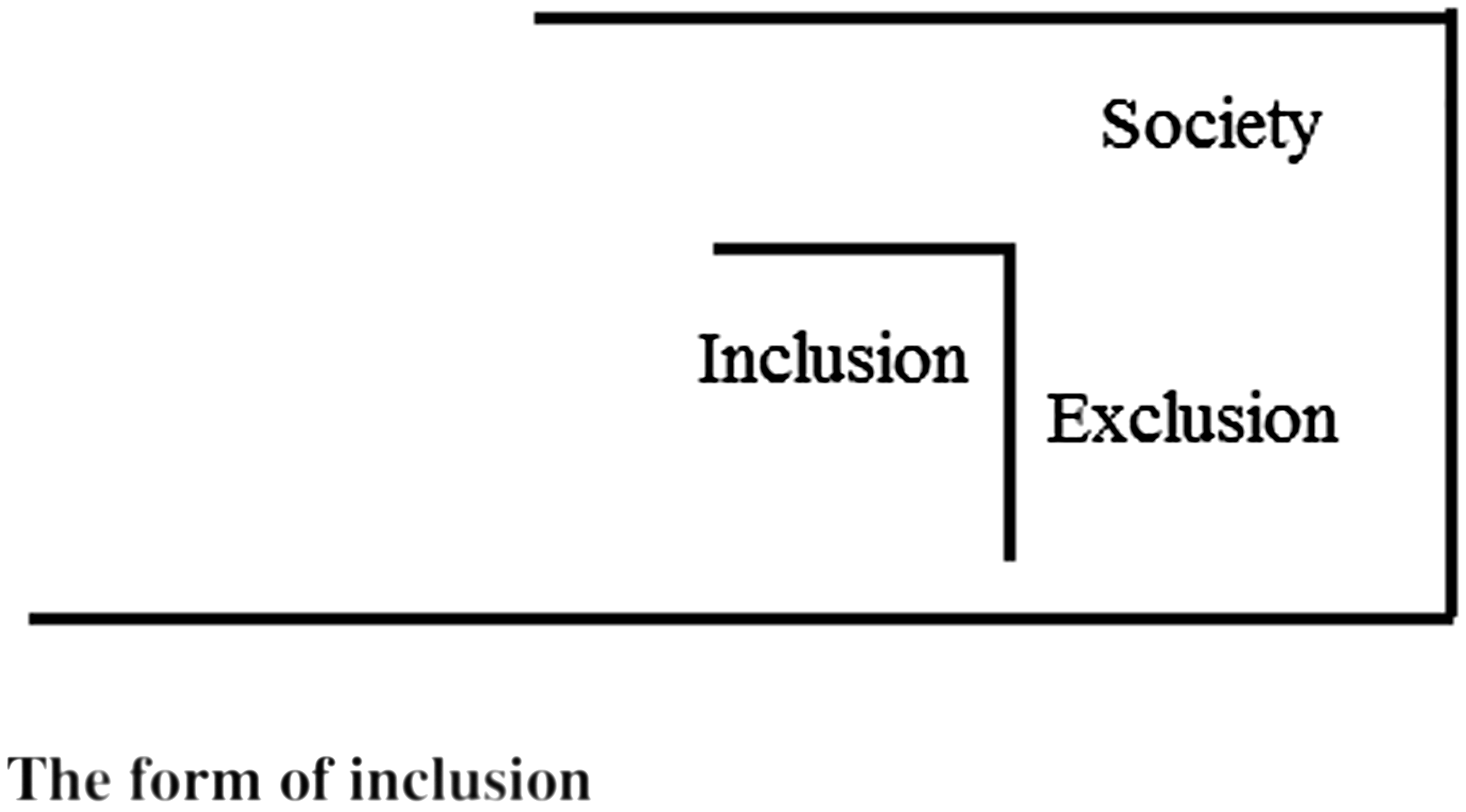
Both first and second order observations observe through binary schemes, but at the first-order level only the marked side of the distinction is visible. For example, the educational system, through organisations, can decide the educational expectations that should be recognised. In this process, forms of inclusion are constructed, but only the expectations are visible for the system. The unmarked side and the excluding consequences, the failure to meet these expectations, is invisible. Nevertheless, they follow one another, like figure and shadow. A second order observation, however, because of its level of abstraction, may reflect the contingency of the first-order observation by observing blind spots and relativise taken-for-granted notions (Luhmann, 1998). The outside also becomes visible. This does not, however, entail that one reserves truth claims to the second order perspective, but it provides better opportunities for reflection.
In the data analysis, the qualitative data analysis program NVivo was used to code the fieldwork material according to the analytical focus on expectations towards student and teacher roles. In the teacher interviews, I coded descriptions of the characteristics of newly arrived students, including utterances about what distinguishes newly arrived students from mainstream students. In the student interviews, I coded descriptions of the students’ encounters with educational expectations in Norwegian schools and their home or transit countries respectively.
The analytical framework made it possible to go beyond an understanding of exclusion as non-access, and also identify internal exclusions by focusing on descriptions of deviances from expectations. The main research question was further divided into two sub-questions, addressed in the two following sections of the article. After presenting the findings for these questions, the article will add a layer to the analysis by providing context from a recent OECD (2012) document, Better Skills, Better Jobs, Better Lives, and show similarities with the educational expectations embodied in the 21st century skills.
The teachers’ semantics of educational expectations
Introductory classes are segregated classes that offer language training (Norwegian and English) and academic catch-up in different subjects in order to prepare newly arrived students for upper secondary school. The teachers, however, also saw these classes as an important forum in which to re-socialise newly arrived students according to a set of expectations. This section will address the sub-question: What characterises the role expectations for teachers and students constructed in the interviews with the teachers, and how are newly arrived students positioned in terms of these expectations?
One of the teachers emphasised that ‘the aim of introductory classes is to give the opportunity to start upper secondary education […] they have to learn the language. But it is also about meta-learning, to learn what it means to go to school’. As newly arrived students had attended elementary schools of varying quality and duration in their home or transit countries and were accordingly qualified for upper secondary school, this teacher obviously did not mean that the students merely needed to learn what it means to go to school per se. The students had to learn the expectations that characterise schools similar to Norwegian ones, valuing particularly generic skills such as meta-learning and ‘learning to learn’, skills that it is necessary to obtain in order to be a self-managing learner. However, newly arrived students were perceived as generally lacking these aptitudes, and their learning strategies were thus in need of remediation.
One of the teachers, ‘Turid’, said the following when asked if the aim of moving on to upper secondary within a year was realistic: ‘Uhm, only for those students who know what it means to be a student […] know the student role, are independent. […] take responsibility … know what it means to be responsible for your own learning’. 6
Responsibility and independence were thus seen as crucial traits for educational success. At both schools, many teachers regarded having these traits as tantamount to mastering the student role, but according to this teacher, only a minority had them. To master the student role was thus understood as equal to being a self-managing learner. When I asked the same teacher what, on the other hand, characterised the majority, she answered: They are just like Norwegian students, but they do not know what it means to be a student. […] They do not understand that if they are going to learn anything, they also have to work in order to learn it. […] That it is not the teacher who is responsible for their grades; they are themselves [responsible]. […] The teacher is supposed to guide, try to motivate, and teach them what they need. But if they do not do anything with this [teaching] themselves, […] we cannot move them forward.
Crucially, the role expectation of being responsible for one’s own learning is also connected to the expectation that teachers are to be the facilitators of this process. As expressed in the excerpt, the teacher is supposed to guide, motivate and select information, but eventually it is up to the students themselves to act upon what is being taught. If newly arrived students fail to internalise the necessary aptitudes during their year of remedial education, they face the risk of retention in introductory class or school dropout.
Consequently, the teacher is not considered the most important epistemic source, and the aim of education is not the transfer of knowledge rendered important by the teachers. Teachers are instead expected to facilitate individual learning processes for students in the best possible manner. They are supposed to enable the students to become self-managing learners. Despite this semantic, however, the teachers’ ways of organising educational interaction in the classroom were not always in accordance with these conceptions, and the expectation of students becoming self-managing learners was thus also a question of tactfulness and timing. Education was often traditionally organised, with the teacher instructing at the blackboard and the students listening and working according to instructions. Nevertheless, when the students were writing texts or working on projects, they were expected to communicate experiences and manage their own learning processes. The expectations were thus actualised in some settings, but not in others, and the students had to learn to adjust themselves to different educational situations.
Most of the teachers thought that newly arrived students were uneasy with the individualised expectations as well as with the more symmetrical relationships between students and teachers. While some teachers expressed that they considered adjusting their expectations to take into account the students’ previous experiences, others saw it as crucial to teach the students the expectations that would benefit their further education in the Norwegian system. Some of the teachers expressed hesitation about this situation, and oscillated back and forth between these two positions. Here, two teachers reflect on the differences: ‘Mette’: Most of them are used to teachers who make the decisions in the classroom, where it is the teacher who tells them what to learn and a great, great deal of them want pat-answers. […] they are not at all used to our way of using ourselves and our experiences as a point of reference. […] They are used to facts, facts, facts, right? ‘Ingunn’: Some of them may come from schools where there is a lot of reproduction […], and our school system is, at least partially, moving away from that. […] You are supposed to be independent and creative, and … Maybe that is a bit confusing? […] I see it when they write texts: They often replicate […] the examples.
The perceived differences in student and teacher roles also had consequences for the assessment of students’ conduct. Bad student behaviour was often ascribed to past education in different countries. Yet, the teachers also ascribed extraordinarily respectful and well-behaved conduct to the students’ previous education: ‘Beate’: […] they are not used to the way teachers relate to them. Here in Norway we are sort of at the same level. […] You feel sort of on equal footing, you are supposed to treat them with respect. […] And they are probably not used to that. […] They insist on calling you ‘teacher’ […] and not ‘Beate’. […] I find it a bit strange, but it is probably a way of showing respect.
The teachers did not have an arsenal of disciplinary sanctions, but they could give reprimands, write remarks and make students leave the classroom if they caused a disturbance. Eventually, their most important disciplinary technique was the means of communication and internalisation of expectations. If the students failed to understand the requirements of being responsible for their own learning, the teachers made intensified communicative efforts to explain these expectations, obviously with the best intentions. The dialogue was thus used as a disciplinary technique: ‘Ingunn’: We have talked about it, about what we are supposed to do to get them to understand the Norwegian system, [about the fact] that you have to be responsible for your own learning. […] It works, more or less. We invite them to have a conversation if it becomes a pattern. […] Then they promise to improve. Still… it does not work with all of them. ‘Ingunn’: One of them said to me: ‘In my home country I worked a lot in school, I always did my homework and I always prepared for tests. But here, I do not.’ […] He did not have a very good explanation, but I think it has to do with us being … not an easier school, but … a different kind of school.
The newly arrived students’ semantics of educational expectations
Overall, there were substantial overlaps between the semantics expressed in the interviews with the teachers and the newly arrived students. Regardless of where the students had attended school earlier, most of them were seemingly puzzled about the role expectations in Norwegian schools. This section will address the sub-question: What characterises the role expectations towards students and teachers that newly arrived students ascribe to Norwegian schools and schools in their home or transit countries, respectively, and how do they position themselves with regard to these expectations?
In general, most newly arrived students experienced a drop in educational expectations in Norway. However, many of them also realised that the expectations in Norway were different rather than non-existent, for example ‘Naod’ who compares Norwegian schools with schools in Eritrea: In my home country, the teacher is the one who tries to teach you everything – what he knows. […] But here, […] it is a bit different, because it is the student who is supposed to learn everything! The teachers say something, but it is your responsibility to be […] learning.
All the students, regardless of educational background, considered Norwegian teachers to be less strict, kinder and more attentive, communicative and helpful than teachers from previous experiences. Many of them experienced school in Norway as less stressful, sometimes easier, and were bemused about the many recesses between educational sessions. As explained by ‘Julio’: Interviewer: But how were they different? How were the teachers in Ecuador for instance? Julio: Work, work, work! […] And when you were finished working, okay, more work. Interviewer: But how are they here then? Julio: Here, okay, work, take a recess, uhm, have some water or something, a little more work, talk about something. Not like work, work, work. Anna: There [in Lithuanian school] the teacher does not treat you with respect. […] They are very, like, stricter […]. And here, teachers are friendly and want to communicate with you and understand what you want. […] There, they just say that you have to! They do not care if you can’t, you must! Elena: Yeah, it is different; this is different, because here they are helping you. […] When it is not good they say: ‘It is not good, but it is okay, you can read it again or do it differently’. And in Poland: ‘This is not good!’ [Imitates a strict voice.] It is totally different. The teachers there [Eritrea] … you do not get the kind of information that you get here [Norway]. The teacher is a bit strict […] and then we have to write everything they say from the blackboard. Yes, ah, here you need self-control. […] But there [Uganda] … You might have self-control … but you know, if you do anything wrong, the teacher comes along and strikes you […] So, there you have guidance, but here you have to guide yourself. Here, in school, we have health services […]. But in my home country it is different. If you do anything wrong, […] they can decide that you have to stay at home instead of going to school. […] they do not give you a second chance to get better. […] Here [Norway] the teacher tries to discuss with you if you have a problem, then he or she tries to find a solution […] for the problem that you have got. […] And it helps; it helps these students […] to improve themselves.
In many of the excerpts cited here, the students employ concepts from the same semantic reservoir as the teachers. They often consider themselves deviant with regard to educational expectations in Norwegian schools and use the same binary opposites as the teachers: the learner who is guided from the inside vs. the learner who is guided from the outside; the facilitating teacher vs. the authoritarian teacher. They are thus not only positioned in spaces of exclusion by the teachers, but position themselves as deviants. Many of them are accordingly already aware that they have to change their way of relating to themselves and their environments in order to be successful in education in Norway.
Nevertheless, we need to consider the observation study to provide a more nuanced account of exclusion processes. During the observations, different kinds of conduct that can be interpreted as resistance towards the system emerged. Some students refused to speak Norwegian in class, and some consistently communicated with students who shared the same mother tongue, at the expense of other possible interactions. There were also expressions of apathy and resignation, and there were students who preferred to communicate on social media instead of interacting in class. Moreover, what the teachers described as motivation problems, homesickness or depression can be understood as unwillingness to meet the system’s expectations. There were also cases of clearly expressed resistance, such as interruptions, loud talk and disturbances.
These expressions were of great concern to the teachers. The students obviously did not accept the educational expectations and were unable to ‘improve’ accordingly, but were instead on a path towards exclusion from education. To understand the conduct of these students, one has to take into account that the seemingly divergent educational expectations, along with their current position in the space of exclusion, are additional barriers they have to manage in order to be included in mainstream education and succeed in their educational careers. In addition, they also have to learn to master new languages, subject content and the general references deemed important in Norwegian schools.
The traditional asymmetrical relationship between teachers and students, where the teacher is the epistemic authority and the students are docile subjects executing the teachers’ instructions, is an unacceptable form of inclusion in Norwegian schools. These are considered ‘old’ and ‘traditional’ expectations of which remnants allegedly are still present in the home and transit countries of newly arrived students. According to these semantic descriptions, educational conflicts may arise when students migrate to Norway, at least if they fail to re-orient themselves and become self-managing learners. The cases in this section show that some of the newly arrived students are at risk of eventually being excluded from education, as a consequence of the obstacle of finding themselves positioned in a space of exclusion within education.
The OECD and the immigrant student as the outside of the knowledge economy
The notion of students’ own responsibility for learning became influential during what Telhaug et al. (2006) call ‘the era of globalisation and neo-liberalism’ in Norwegian educational policy. More precisely, it was introduced in the educational reform of 1994 and has since been prominent at all levels of the school system. The political aims of the conception are to produce self-managing individuals that can take responsibility for their lives, their learning processes and their social environments (Meland, 2011). As has been shown in the previous sections, newly arrived students are positioned as deviants in terms of these educational expectations. The aspiration to make students self-managing learners, however, is not a phenomenon confined to national contexts.
The Norwegian school system has made several adjustments in the wake of OECD policy reforms (Hovdenak and Stray, 2015: 55), and the findings in this article will therefore be discussed by providing a context from some recent developments coming out of this organisation. It is well known that the OECD is concerned with human capital formation, where the main idea is that national economies have to develop the skills and competencies of the population in order to compete in the global knowledge economy (Robertson, 2005). Against the backdrop of the financial crisis, the OECD has now called for a major redesign of education curricula, answering new demands for human capital. According to the OECD (2012: 3), ‘Skills have become the global currency of the 21st century’, and these so-called 21st century skills are the ones that will produce effective learners, workers and citizens in future society.
In their redesign of curricula, the OECD (2012) operates with a binary distinction on the one hand between old and traditional curricula that are inappropriate for the reality of the modern society and, on the other hand, new and modern forms of educational expectations, suitable for the needs of society in the 21st century. A traditional curriculum is overburdened with content and is thus an obstacle to acquiring skills. In contrast, the appropriate, global and modern curricula focus on the necessary attributes for the future workforce, namely generic skills, that is, skills that are transferable across subject structures. It is therefore argued that a global shift in educational focus is necessary from the teaching of subject knowledge to the teaching of character traits. To mention a few of these desired traits: adaptability, persistence, resilience, ability to learn to learn, interdisciplinarity, self-management and meta-cognition (OECD, 2012).
The same tendency can be seen in the Programme for International Student Assessment (PISA) questions. PISA collects information not only about student performances in subject domains, but also about motivation, self-belief and learning strategies. This information will enable the OECD to find out about the students’ potential for lifelong learning (OECD, 2014b). The new skills of the 21st century are supposed to establish lifelong learning habits and produce self-managing learners that are prepared for the future society, understood as their economic life.
The skills that are deemed valuable by the OECD overlap substantially with the individualised expectations in the Norwegian schools. So-called generic, meta-cognitive or higher order cognitive skills in particular are deemed important as educational expectations for the 21st century, aptitudes that newly arrived students in the Norwegian schools were considered to lack. As Muller (1998) has pointed out, such outcome-based educational expectations converge around the empowerment of learners to seize responsibility for their learning and societal destiny, and are in a binary opposition to traditional education, with its emphasis on subject knowledge.
This reflects the Norwegian teachers’ understanding of the educational expectations ascribed to newly arrived students’ home or transit countries as something we are ‘moving away from’. Thus, in both cases, the semantics are structured by a distinction between old and new, traditional and modern structures, where only the new and modern ones are considered acceptable. Additionally, however, the OECD explicitly understands the modern society as a global knowledge society. The educational expectations that are considered appropriately attuned to society in the OECD’s terms are therefore globalised expectations, as opposed to the specific local ones.
Moreover, the OECD (2012) realises that the global trend of skills policies with emphasis on generic and meta-cognitive skills coincides with increased migration, and thus the inclusion of what they characterise as immigrant youths in school systems worldwide. Immigrant students, especially those who arrive late in their educational careers, are considered to be a group with poor foundation skills and greater risks of experiencing economic disadvantage, unemployment and dependency on social benefits. This classification is strengthened by the fact that immigrant students underperform in PISA testing, which has resulted in a performance gap between them and non-immigrant students (OECD, 2012).
Consequently, and in alignment with the semantics in Norwegian schools, immigrant students are considered deviant from the educational expectations deemed important for modern society. The ideal student is addressed as the self-managing learner with evolved generic and meta-cognitive skills and individualised dispositions for educational success in the global society of the 21st century. The Norwegian teachers considered newly arrived students’ dispositions to be in accordance with ‘old’ or ‘traditional’ educational expectations, emphasising replication, obedience and reproduction. Correspondingly, immigrant youths are considered by the OECD to lack the skills that are important for educational success in the future society.
In both the interviews and the OECD document, the failure to succeed in education is ascribed to the individual students and their insufficient past education. The point of reference is thus the educational expectations, the inclusion-side, and not what is inevitably excluded because of the conditions set by the system. The semantics of the OECD, as well as the ones that are prevalent in Norwegian schools, are embedded in a first-order perspective, operating blindly with respect to the exclusions that result from their systemic expectations. In the next section, a discussion from a second order perspective will bring to light the complexity and paradoxes of these semantics of inclusion by considering the other side of the coin.
Second order reflections
According to the OECD (2014a), the proposed skills, also addressed in the PISA-questions, are the ones that are necessary for full participation in modern society. Thus, one can say that the ideal of the self-managing learner and the related abilities are forms of inclusion. The analysis in this article has, however, shown that although the aim of these semantic constructions is inclusion, they paradoxically also produce deviances and exclusions as side effects. If we observe the reconstructed distinctions from a second order perspective, the logic can be illustrated as in Figure 2.
The educational expectations actualised by the Organisation for Economic Co-operation and Development (OECD), here observed through the distinction between inclusion (inside) and exclusion (outside). The economic system is the functional context for this observation.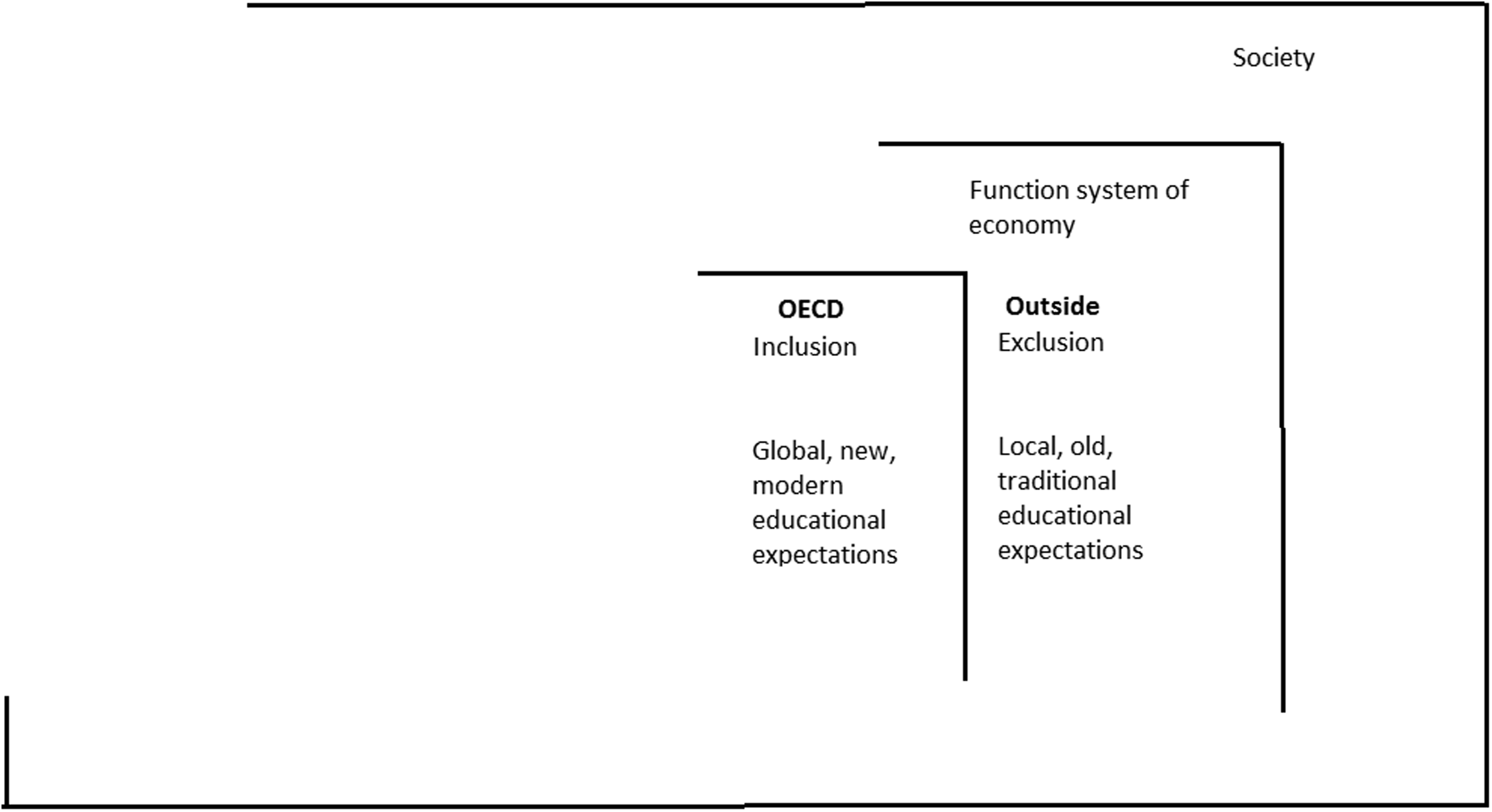
As detailed in Figure 2, the inside of the form ‘inclusion’ contains the expectations that are considered valuable by the OECD: the new, modern and global structures. What is not seen, but is nevertheless a logical necessity, is the outside of these semantic expectations. What is excluded from global skills policies are the local, old and traditional educational expectations, the contemporary remnants of which are considered doomed to perish. As Stäheli (2003) points out, such distinctions constitute a temporal logic related to social epistemology: only the new perspective is attuned to the reality of modern society. As illustrated in Figure 2, the OECD is an organisation that works primarily in the context of the function of economy, and the reality of the modern society according to the OECD is therefore equal to an economic society, more precisely the knowledge economy.
As both the teachers and the OECD make their contributions to a global educational semantic, however, the unacceptable traditional, old and local educational expectations are re-entered into the global communication and become an internal exclusion side. After all, the expectations are addressed, and are therefore a part of the system’s semantics, but they constitute the necessary, disapproved backdrop for the new and modern expectations. Local and traditional educational forms are therefore no longer local and traditional per se. New diversities and exclusions are produced by communication, by differentiation and re-entries of the distinctions inclusion/exclusion, old/new, global/local and global/traditional on the inside of the system.
The semantic constructions represented by the teachers as well as the OECD therefore produce new diversity by the means of expectations. Consequently, we cannot assume that either simply mirrors a local or regional diversity that exists a priori among newly arrived/immigrant students. The semantic constructions of local and traditional expectations can be seen as a requisite internal outside of the globalised expectations towards being a self-managing learner. The same applies to the distinction between inclusion and exclusion. Obviously, as newly arrived students/immigrant youths are being addressed by educational expectations, they cannot be seen as excluded in the sense of non-access. Rather, they are being addressed and included by the system, but labelled as being deviant from the ideal student – they are paradoxically included and excluded at the same time.
Systems-theory problematises the totalising notion of globalisation, neo-liberalism and new, modern educational structures as a teleological process towards an all-inclusive stance. Globalisation, according to Luhmann, is not understood as homogenisation, where new structures cumulatively replace old structures (Stichweh, 2000), but rather one of contemporary society’s self-descriptions (Guy, 2009) where old and new structures are reproduced and co-exist within global semantic complexes (Stichweh, 2007). Re-entries (duplications) of binary distinctions such as global/local, modern/traditional or inclusion/exclusion constitute several paradoxes within function systems. Diversity is therefore no longer merely the same as local variety, and exclusion is no longer merely equal to non-access. Instead, the global educational system produces its own (internal) diversity and exclusions. As Stichweh (2007: 147) points out, the structures of world society can therefore be seen as ‘production machines of nonlocal diversity’.
Concluding comments
As a consequence of the binary constitution of educational expectations, structures of inclusion also produce exclusions and new diversity. In earlier societies, an individual was either fully included in or fully excluded from a multifunctional household, placed in a societal stratum (Braeckman, 2006). The modern, functionally differentiated society, however, entails that function systems address and include persons according to the systems’ own conditions. An individual is no longer fully included in one system, but is addressed in different manners by different systems, for instance as citizen, family-member, student or employee (Luhmann, 2002). However, since functional systems exclude those who do not meet their conditions – and this can happen independently of, but structurally coupled to, other functional domains – exclusion has become one of the greatest problems created by modern society (Luhmann, 1997, 2002). Those who do not meet the expectations of being a self-managing learner are excluded in, and face the risk of eventually being excluded from, education. As education enables inclusion in other systems as well, educational exclusion may be the start of a domino effect entailing a cascade of exclusions (Hilt, 2015). As Luhmann (1982: 134) expressed it: Small differences in the beginning – be it in credit, in educational prospects […] – become large differences in the end, because functional subsystems utilize differences, employ differences in pursuing their specific functions, and there no longer exists a superior mechanism such as stratification which controls and limits this process. The whole society, therefore, tends to proceed in the direction of increasing inequality […].
Globalisation, functional expectation-structures and their side effect of exclusions are realised because there no longer exists a superior mechanism to limit this process. This lack of equilibrium between differentiation and integration (Kerwer, 2004) makes it difficult to provide valid and overreaching solutions for the problems of exclusion by the means of normative communication. Following systems-theory, the problems of exclusion can only be solved in a system-specific and differentiated manner. The educational ideal of the self-managing learner is a homogeneous conception that produces exclusions in the encounter with a heterogeneous student body. On this background, it can be argued that newly arrived students will have better chances of educational success if the expectation-structures of the educational system were better attuned to differences in the student population.
The list of educational expectations for the 21st century holds a domain-independent and cognitivist quality that creates an aura of universalism, as if these dispositions were (at least potentially) innate in all students. As Vasallo (2013, 2014) has pointed out, however, there are clear alignments between the discourse of self-regulated learning and the ideology of neo-liberalism. 7 This is also in line with Foucault’s (2008) notion of homo economicus and Rose’s (1998) conception of the enterprising individual. The expectation-structures of the self-managing learner are economically biased, and therefore in many respects a reductionist conception of education.
In systems-theory terms, the self-managing learner can be seen as a semantic construction that entails a structural coupling between the systems of economy and education, represented by organisations such as the OECD. Both the OECD and certain globalisation theories understand society as a primarily economic society. Given such a reductionist notion of society it is not surprising that qualification and socialisation as preparation for future work life are understood to be the chief purposes of education. Given Luhmann’s notion of the ‘Unitas Multiplex’, however, one avoids such reductionist descriptions of society, and the theory can encompass several observational positions and functional domains. The consequence is that education can be considered a system on its own terms, and not only a vehicle for political and economic progress. Although the educational system obviously also fulfils the previously mentioned purposes, one must not forget that the function of the system is also to make human beings into persons (Luhmann, 2006), and that decisions on how to comply with this purpose should not be left to political and economic interests alone. At best, the findings in this article can provide sufficient systemic irritations to initiate processes of reflection in relevant systems, especially in the educational system.
Footnotes
Declaration of conflicting interests
The author(s) declared no potential conflicts of interest with respect to the research, authorship, and/or publication of this article.
Funding
The author(s) received no financial support for the research, authorship, and/or publication of this article.