



Abstract
Organisational literature draws a tension between technical and conformance goals and means for socio-economic development and the merits of one versus the other. However, the tension between the technical and conformance core might be transitive when the focus shifts from evaluating the outcome to assessing the intentions. This study addresses this issue in the context of the Sino-foreign university alliance and its technical-conformance tension at the earlier stages of organisational development through innovativeness. How does conformance influence the link between the intended technical core and organisational innovativeness? This study addresses the question of the tension and transition between conformance and technical core devices used in the strategic alliance formation between universities. We used a unique set of data: the MOU (memorandum of understanding) signed for the Sino-foreign alliance in the internationalisation of Chinese universities. Based on 831 MOUs (1994 to 2013) available in the press release, we coded and developed integrated three main concepts: innovativeness (dependent variable), technical core for technical devices, and conformance for normative devices. After normalising and standardising the dependent variable, we tested the direct and interaction effects. The main effect of the technical core is positive, but the main effect of the conformance core is negative. Thus, the interaction between them is positive. Furthermore, the path of the conformance-to-technical core has stronger effects on the negative correlation than the path from technical-to-conformance.
Keywords
Introduction
The internationalisation of Chinese higher education through Sino-foreign university collaboration has entered the global movement. The OECD (Organization for Economic Cooperation and Development) estimated that 4.3 million international students in the world in 2011 moved across countries, and China is becoming an active participant in this movement. The Chinese Ministry of Education (MOE) revealed that China hosted some 119,000 globally mobile students by 2011 (Yang, 2013). Moreover, the Chinese MOE anticipated about 500,000 international students at Chinese universities by 2020, and various Sino-foreign institutional arrangements have emerged in China and abroad (Malik, 2020). Several foreign universities have set up campuses in China, and some Chinese universities have set up campuses abroad. A host of other hybrid structures contributes to this trend in the Sino-foreign university alliance for innovation in the education system through the technical core (cognitive aspect) and institutional conformance (normative aspect). While the empirics are visible in trends and numbers, we know little what structures lay behind these developments.
Does the Sino-Foreign university alliance structure reflect the conventional argument of the internationalisation goals and means at the early stages of an alliance in academia? The theory offers competing arguments for innovation orientation development among partners. One literature stream contends that the organisation’s technical capabilities contribute to the innovation strategies, and this technical capability perspective relies on intellectual development through relevant resources. In the education sector, this intellectual development rests on knowledge creation and its development as its functional core (Altbach, 2013; Knight, 2011). For instance, inter-organisational knowledge transfer, publications, patents, people’s skills, and other technical development, representation and incentive structures. The other stream contends that conformance to external norms (legal, sectoral, governmental, and international) contribute to innovation. A mere technical core is insufficient to supersede the environmental pressure exerted on these organisations. For instance, inefficient technologies have been adopted because of conformance, and efficient technologies have been rejected because of environmental pressure (Arthur, 1994). Thus, the technical and conformance arguments generate tension and competing positions for innovation.
However, the institutional theory suggests that either alone offers a partial explanation for the innovation and socio-economic development orientation as input and implied output. Together, the internal technical core and the external environmental pressure for conformance interact so that the latter moderates the former. For good reasons, the conformance device moderates the link between technical devices and innovation activities in organisations, sectors, and nations (Scott, 2003). Firstly, the conformance reflects stable conformance mechanisms than the technical aspect. Norms develop gradually over time, while technological development changes faster. Secondly, the conformance scope is wider than the technical core because of the external entities. For instance, conformance includes the entire society, culture, and conformance standards of the sector. The technical core captures the organisation’s internal efficiencies, which have a narrow scope than environmental change or stability; therefore, the conformance to institutional pressure moderates the link between technical core-oriented policies to change and innovation (DiMaggio, 1988).
Based on these assumptions from the institutional theory, we assess the technical and conformance devices used by Sino-foreign partners in press releases at the early stages of these alliances in academia. After analysing the main effects and interaction effects of technical and conformance core on innovation devices, we addressed the complementary question about the path to innovation devices. Does technical to conformance (t-to-c) or vice versa (c-to-t) a better path towards the innovativeness of the alliance? Based on the conventional assumption that structures lead to an outcome, this systematic analysis can provide insights into academia’s competing structural paths. Although revealed outcomes can deviate from the ex-ante proposed intentions, the cost of ignoring to know is greater than knowing some aspect of it.
For this empirical purpose, we use Sino-foreign MOUs (memorandums of understanding) in higher education. We coded the rhetorical devices used in the MOUs signed between the Chinese and foreign partners along the three thematic devices: innovativeness, technical core, and institutional conformance. We gained access to 831 MOUs on Sino-foreign alliances, coded the text for quantitative analysis and linked the innovativeness as the predicted variable to the two predictors: technical and conformance orientations, respectively. The notion of innovativeness refers the intellectual development, physical technologies or organisational technologies such as management learning and system development (Schumpeter, 1942). Likewise, the development of processes and structures encompasses innovation for efficiency (OECD, 1997). The following section develops the theoretical framework, leading to the conceptual model and related hypotheses.
Theoretical framework
The institutional theory supports the main argument, research design and analysis of its three major assumptions in organisational research. Firstly, the technological efficiencies (technical core) capabilities in the institutional theory on intellectual development and related devices are the technical core of the focal organisation, regardless of the sector (Scott, 2003). On the other hand, the conformance capabilities of an organisation on their environmental fit through conformance devices. Secondly, organisational innovation assimilates the devices of technical and conformance independently and interactively. Thirdly, the conformance (norm) devices should moderate the link between technical and innovation devices (Hirsch, 1975; Meyer & Rowan, 1977). These assumptions enabled use development of the conceptual model in Figure 1 for clarity and concision. The right side of the conceptual model shows the innovation devices; the left side shows the technical devices, leading to the anticipated positive correlation with innovativeness. The middle part shows the moderation (interaction) of conformance (norm) devices used in the Sino-foreign collaboration deals signed and disseminated through the media. Conceptual model. Note: Institutional theory literature refers technical core to reputation and conformance to legitimacy (Scott, 2003). Technical = T. Conformance = C. T-to-C = Technical to Conformance path towards innovation. C-to-T = Conformance to Technical path towards innovation.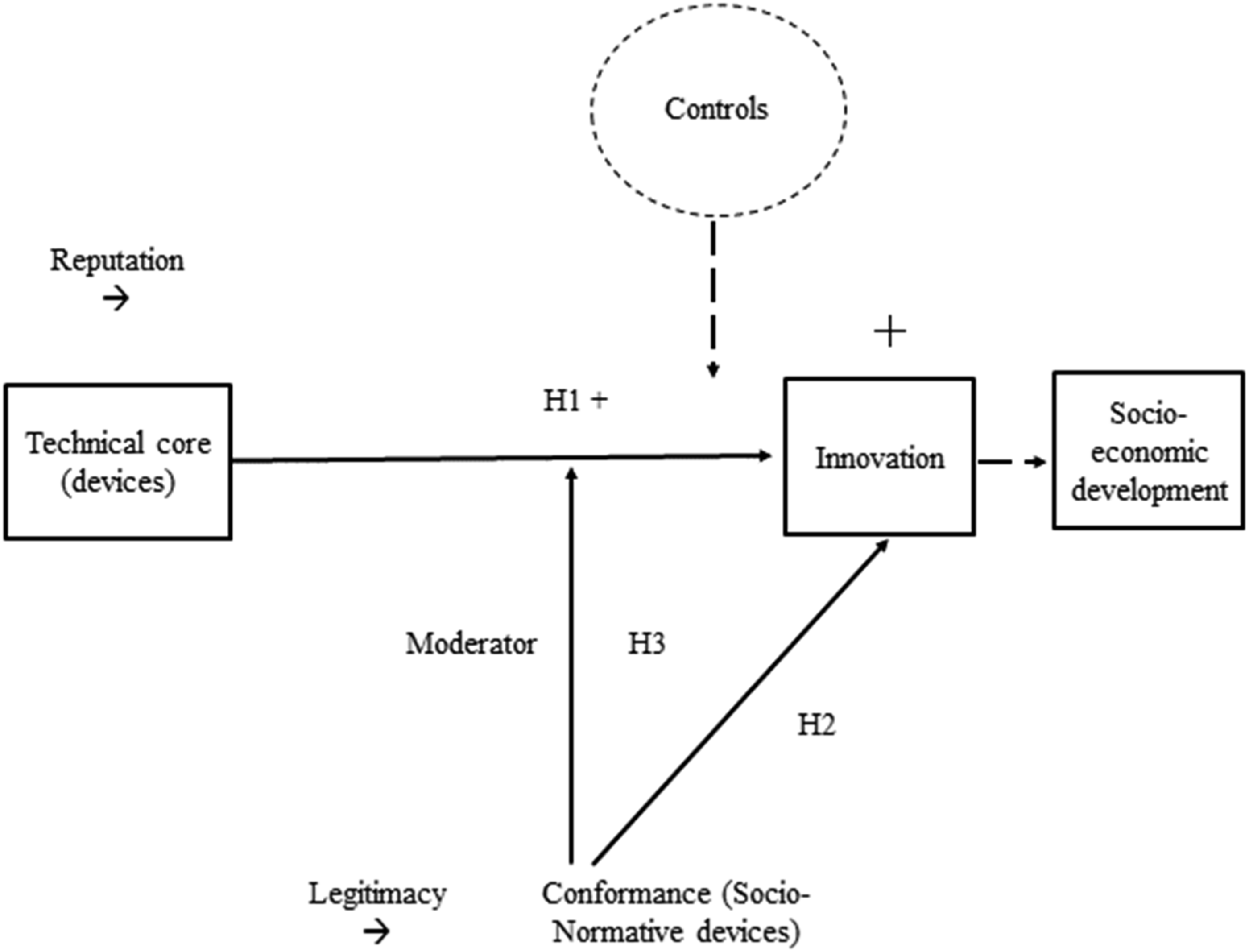
Innovation devices
Innovation refers to learning and changes in physical and social technologies, and the inter-organisational relation per se qualifies as an innovation because it deals with the organisation’s internal resources, efficiencies, coordination and external boundaries (OECD, 1997; Schumpeter, 1942). These boundaries reflect buffers and bridges, which reflect abstract-concrete rhetorical devices on the scale. In line with these rhetorical devices, scholars from multiple disciplines agree that the definition of innovation has multiple institutional concepts, levels of concepts, the formality of concepts and the goal-mean order of those concepts (North, 2005). This disciplinary variety of innovation concepts reflects some level of convergence in the technical and organisational development of goals and mean setting: the convergent themes of technical (difference) and conformance (isomorphism) in devices (DiMaggio, 1988; Scott, 2003). Thus, conformance to the field can lead to technical in some strategic decisions and technical-to-conformance in other strategic decisions.
If the theory holds, then the Sino-foreign collaboration in higher education takes these independent, convergent and coordinated (order) to desirable outcomes (innovativeness). Firstly, inter-university relations drive the innovation orientation in policy and practice. This inter-university interaction reflects the university-university level of negotiation, deals, and disclosures of the Sino-foreign alliance. Secondly, the Government-University interaction reflects alliance negotiation, deals and disclosures that drive the policy and practice from either perspective. In some cases, foreign governments and Chinese universities collaborate; in other cases, foreign universities and Chinese governments are involved in collaborative interaction. Thirdly, university-industry collaboration has become commonplace in theory and practice, dealing with negotiation, contracts and disclosures. For instance, the literature explains the university-industry alliance in the biotechnology sector in international settings (Malik, 2013) and the role of foreign firms and Chinese universities reflect in the national setting (Malik et al., 2021). Based on this rationale why we apply institutional theory to the design in Figure 1; now, we present the components of the conceptual model towards hypotheses development related to the two predictors.
Technical devices
The technical device postulates that the negotiating parties in the Sino-foreign alliance highlight the technical efficiency rhetoric in the MOU and press release. The premise of this assumption is that intellectual development positively correlates with the policy devices, and this premise fits with the purpose of the Chinese side in negotiating and disclosing the agreements. In other words, the Sino-foreign university alliance is likely to symbolise the technical devices for the critical audience’s attention, meaning, values and responsibilities relative to the action. Those audiences include administrators, employees, academics, and students, among others in society. Thus, the technical devices aiming at the technical core, university prestige, high ranking and market orientation (tradeable products) values can capture the essence of the link between the purpose of technical-oriented clauses in the agreement and the innovative outcome.
This technical perspective of the institutional theory reflects resources for efficient operations and comparative technical core among peers in the field. In this relationship between the production and output targets, the technical perspective links the inputs, processes and structures to technological efficiencies (Grossman & Stiglitz, 1980; Wernerfelt, 1984). While different devices present those technical resources, the comprehensive notion of knowledge (explicit and tacit) defines the technical input processes and output goals (Polanyi, 1967). The explicit knowledge reflects the declarative principles and offers clear links to causes and effects; the tacit manifests in experience and path-dependent routines (Ryle, 1949). It may start from the explicit towards tacit or vice versa (Brown & Duguid, 2001). For instance, in today’s ranking and reputation building, universities are heavily relying on technical signals (money generation, articles publications, and resource consumption-production ratios.
The institutional theory’s technical mechanism has diffused in the social sciences because it explains inter-organisational differences within the sector or field. The technical core of the organisation separates it from others in the field. For instance, two universities in a city facing similar environmental pressure for technical core differ in the scale of comparative positions because of their technical positions on the scale. The institutional theory’s technical perspective explains that organisations differ in this scale because of their attention-structure that differentiates agents from each other in the same situation and the field (March, 1994). The attention-structure, in which the agent responds to a situation, rests on three steps. First, the attention level to the situation differs between agents. Second, the relevance (importance) of the situation to the agent differs between entities. Third, the capabilities for responding to the situation differ between agents. The attention, evaluation and action depend on the interpretative decisions in the context-specific situation (March, 1994). The devices used in the policy and practice allude to those attention structures, explaining the link between the technical core and the innovativeness orientation.
In line with this argument, Chinese universities extend their internal collaboration to increase their knowledge resources to improve their technical core through the attention-structure view (foreign alliances and delimited devices). For instance, training scholars, general technical learning, scientific publications, patents, new product development, process development and other efficiency-oriented inputs improve the technical core. The academic core (Knight, 2007) would have been more illuminative than the technical core, but it limits the concept’s scope in contemporary universities. Universities are increasingly crouching into the territories of industrial organisations, and organisations are increasingly moving into the territories of universities (Nelson, 2005). Chinese universities are no exception in their technical capability development, and they divert their attention to foreign resources (universities, governments, students, and other enterprises). Secondly, Chinese universities select relevant and important technical resources. For instance, the selection process depends on the technology type and scale of the resources endowed to foreign partners. But more so, the relevance of one type supersedes the other in some technical aspects. Thirdly, the fit between the Chinese university’s selected technical resources and capabilities narrows down selecting the partner, negotiation, and related devices in the agreement.
Technical devices positively correlate with innovative devices in the narrative of the Sino-foreign alliance in the higher education sector
Conformance devices
The notion of a conformance device alludes to the isomorphism view in institutional theory, in which agents emulate policies, structures, and practices to be accepted as members of the broader community (DiMaggio, 1988). This view of the institutional theory contends that conformity to norms stems from legal pressure, related fields, traditions, and cultural pressures (Scott, 2003). In comparison, institutional theory and the isomorphic assumption explain that culture influences learning across time and norms influence space. The development of enabling technologies (e.g. Information and communication technologies) has intertwined time and space, leading to the converging theme of conformance. Universities need this type of conformance to gain legitimacy for survival and growth. Once legitimacy is achieved through conformance, the institutional theory suggests that legitimate actors gain high status, power and discretion in the field. As a result, the legitimacy-oriented discretion enables the focal actor to deflect the environmental pressure, leading to innovative orientation by deserting conformance or changing from isolation to isomorphism.
The conformance rhetoric in the alliance suggests that the negotiation results in the correlation between conformance for the partners' innovation and socio-economic development in the Sino-foreign alliance. In other words, the rhetorical discourse in the disclosure of press releases highlights the institutional norms that enable the partners to conduct innovative development in their system: the sociological paradigm’s conformance perspective that the external and internal interactions influence each other (Warren, 1979). In other words, the conformance perspective suggests that the external environment influences the actor’s behaviour in a structured way (Hinings & Greenwood, 1988). Authors of conformance research show conformance standards influence the actor’s conformance for isomorphism and legitimacy (Ridgeway, 1978). The conformance view implies that this conformance behaviour benefits the actor and reduces the cost associated with deviant behaviour.
Here, the actor’s conformance values differ from the technical benefits such as functional tasks, information processing and knowledge development (exploitation). The conformance benefit provides the actor’s credibility in the community of practice by recognising its presence, appropriateness and desirability (Suchman, 1995). Hence, conformance motives, mechanisms, and processes increase credibility and legitimacy for input resources' attention and attraction in the social context. The conformance confuses theorists and practitioners for subtle reasons because of their common sources, coevolution, contradictions, and mutual relevance to the actor and environmental. For instance, conformance adaptation to the environment increases technical input flow towards the actor and between actors. Towards the actor, knowledge flow between organisations through conformance standards because of the similarities and legitimacy. Likewise, the flow from the actor to others, the community in the field, relies on those legitimacy signals because the majority of the values are the focal actor is undisclosed. We distinguish between the conformance adaptation from the institutional theory’s technical adaptation in two simple ways to elaborate on the tension described earlier.
First, the technical assumption accepts that the conformance may reduce the technical capabilities from a higher position or increase the technical capabilities from a lower position to a higher position through adoption. For instance, an organisation with better knowledge above average has little value unless others in the environment recognise it. Chinese universities may have technical and information capabilities far more than some universities in the US and the UK. But to gain the legitimacy of those actors who have a long history or are based in those conventional regions, the conformance standards require them to ascend to conform to the conformance line. Those who support the conformance argument suggest that the transaction of resources within and between national and regional systems takes precedence over technical transactions. The European paradox explains this position, which argues that the European weakness in the education and innovation system lies in the weak policy and conformance systems rather than technical systems compared to the US innovation systems. In other words, the conformance ideas offer a dynamic explanation of institutional development (Schmidt, 2008). Chinese universities that fall below this conformance policy line need to rise to the conformance line to signal their credibility and legitimacy to the global actors.
Second, rising to the conformance line or descending to it from the above also defines innovation in policy and practice because of its demands for comprehensive changes, depending on the national norms’ salience compared to the global norms' salience (Foot & Walter, 2015). For instance, Chinese universities and the government policy in the Sino-foreign collaboration strive for credibility in global standards, despite the types and intensity of pressures and resistance. Evidence shows that conformance pressure and resistance outweigh the technical resistance and pressure in experiments in micro settings. Taking cues from these experiments in micro contexts (Schilke, 2018), we perceive macro contexts as delineating similar contexts and implications. Chinese universities have risen to prominence since the conformance processes used to evaluate the league tables’ university ranking. This example demonstrates that it arises from below the conformance line, and a decline from the above conformance line increases legitimacy for the innovation: credibility, appropriateness and understanding (Suchman, 1995). In short, standards, conformance codes, principles, values, rights and wrongs, ideals, creed, credo, ethos, rules of conduct, virtues, and the dictates of conscience support the conformance innovation that governs behaviour and interactions in the broader social system (Kavalski, 2013). In other words, the actor’s situation and identity in that situation shift the focus from a universal paradigm to an institutional paradigm from the theoretical perspective (March & Olsen, 1989). Hence, although the technical institution coincided with conformance institutions at the appropriate level and discussed below, it differs from it at some levels more than others.
The conformance device positively correlates with innovativeness in the narrative of Sino-foreign alliance in the higher education sector
Conformance moderation
Institutional theorists and empirical analysts have converged on the moderating effects of conformance between technical input and innovativeness as the organisation’s outcome. While those writers differ in the direction of the moderating effect that technical and conformance paths contract or complement, they agree on the contingent role of conformance with rules, standards, norms and assumptions of organisational institutionalism (Scott, 2003). In the education sector, tension arises between globalisation and the localisation of public universities. Local pressure demands conformance with public funders, and global competition requires high positions on global league tables (Knight et al., 2020). Then there is technical and conformance pressure from inside the university, the region of its location and foreign exposure (Liu, 2019). Rhetorical institutionalism further elaborates that the narratives of the organisation reveal its goals, means, meanings and values for action (Fisher, 1988). This rhetorical institutionalism suggests that technical and conformance interact so that the technical aspect mediates and the conformance aspect moderates this relationship. At some point, instead of being at odds at the binary level, the technical and conformance dynamics can coexist (Scott & Meyer, 1991). The technical and conformance principles operate within the institutional framework because an organisation needs both. On the one hand, organisational visibility attracts the stakeholders' attention and flow of resources, and on the other hand, the resulting visibility increases environmental pressure and expectations. Conversely, conformance yields some of the organisational power to the environment, and at the same time, the organisational increases the discretionary organisational actions (DiMaggio, 1988; Zucker, 1987).
This complementary view of technical and conformance dynamics suggests two possibilities. In some cases, the technical aspect supersedes, decreasing conformance attention and vice versa (Ridgeway, 1978). Rhetorical theorists of institutionalism show logic between organisations and sectors vary because of the different audience of the same entity (Harmon et al., 2015). The logic of one type of stakeholder of universities demands technical attention, and the logic of the other type of stakeholder of universities demands conformance attention. Some audiences want an increased ranking of universities at any cost, suggesting the logic of technical core. Other audiences demand high ethical standards, regardless of the outcome. A majority of the audience falls between these two ends of the spectrum. Analytically, this interaction between technical and conformance points to the former’s mediation and moderation in the actor-environmental interaction.
Figure 1 above points to the analytical aspect of the conceptualised phenomenon, and the concepts of moderation versus mediation demarcate their micro positions. In a general view of the two concepts, mediation occurs at the micro-level, and moderation occurs at the macro-level (Baron & Kenny, 1986). Moderation implies that the broad factors influenced both the predictor and predicted outcome. The mediator level implies that an intermediary factor facilitates the link between the broader context and outcome through micro mechanisms (Baron & Kenny, 1986). In the current context, conformance moderates because its stakeholders are relatively broad, its structures are stable, its attributes are enduring, and its environment is social. These stakeholders of the conformance logic are broader society, the market or the sectoral norms. The technical stakeholders comprise the sector-specific actors—competitors, academics, students, recruiters and funders. They seek efficiencies in the discovery, development and commercialisation of products and services.
The extant literature overemphasizes the conformance in the internationalisation process (Horta, 2009; Huang, 2007; Liu, 2012; Macfarlane et al., 2012; Tadaki & Tremewan, 2013; Wang, 2008; Xu, 2005). Two reasons create the need for the internationalisation of conformance motives. First, the conformance behaviour needs recognition by others, and internationalisation bridges this gap by acknowledging the conformance requirements (Kavalski, 2013). Second, an organisation’s conformance enhances its legitimacy, giving it the benefit of the doubt when negative incidents occur at the institution. Despite organisational actors deviating from their contextual norms to seek support for technical efficiencies (Mansfield, 1996), they need to justify their goals and means (Deephouse & Carter, 2005; Elsbach & Sutton, 1992). These complementary dynamics of technical and conformance aspects draw our attention to the moderating role of conformance devices between technical devices and the innovativeness goals in the Sino-foreign alliance in the education sector.
Conformance devices moderate technical core devices in correlation with innovation devices in the narrative of Sino-foreign alliance in the higher education
Methodology
Research setting
The technical-conformance tension in the Sino-foreign university alliance guided the research setting to the alliance formation stage. Three elements describe this stage. Firstly, the Sino-foreign MOUs in higher education are the starting point of further information exchange related to technical core, conformance and innovation frames of references. An MOU is not a formal contract in the conventional sense of dyadic alliances. Secondly, the setting encompasses the MOU signed and disclosed to the media through press releases. This research setting element implies the press release to the media rather than the MOU. Thirdly, the participants varied from the Chinese side. They included government officials, universities (administrators), and academics. Naturally, the university-university, Government-university, government-government, and university-industry levels disclosed MOUs in the setting.
The temporal and spatial scope also limit the setting. We began research on this topic in 2013, which implies that the data on MOUs represent the previous years. After removing the duplications, we included 831 MOUs-based press releases in the scope. Textually, the press releases varied between MOUs as the unit of analysis. Appendix A shows these press releases’ temporal patterns in conjunction with MOUs signed by Chinese and foreign partners. From 1991 to 2011, the trend shows an upwards trajectory; since 2012, it has started declining. However, the data limits prevent anticipating whether the trend will go up or down after 2013. We expect a positive trend because of the Belt and Road Initiative and international students’ flow to China (BRI, 2019; Malik, 2022).
Content analysis
The study uses a content analysis of the text of the alliance agreements announced to the public as a narrative. While qualitative studies of a narrative focus on the context, quantitative studies focus on the contents through Linguistic Categorisation Method (Harpur, 1974; Semin & Fiedler, 1988). Content analysis is a technique that aims to objectively identify special characteristics of the message in the text (Berg, 2006, 240) in any communication research (Abramson, 1983, 286). Compared to survey methods for obtaining opinions of relevant respondents, the content analysis makes up the deficiencies related to memory loss or deliberately misguided responses by reducing subjectivity in the textual data compared and reliability issues. Therefore, content analysis has a place to fill the gap where empirical studies rarely exist in the technical sense.
Technically, content analysis supports qualitative and quantitative research and a mix of both. The approach is twofold: top-down or bottom-up. The top-down approach starts with the hypothesis and codes data to match that hypothesis, and the bottom-up approach starts with the coded text and formulates the hypothesis. The former approach is vulnerable to the error of omission, and the latter is open to the error of commission. We used a middle approach, which takes the hypothesis as a framework to guide the content analysis, but it takes the bottom-up approach to code the data to avoid the error of omission. Therefore, this research benefits from these techniques’ guidelines to develop concepts, coding, and analysis of the types of content analysis of the manifest and latent levels.
Data sources
The idea of the Sino-Foreign university alliance has been developing since 2013 in our research projects, and we stumbled upon two instances of an MOU. In the first instance, we are engaged in a Sino-foreign university alliance in which we signed an MOU with an American Business School and the Chinese Business University. We needed to see the scope of MOUs signed before the focal event and searched for exemplars. This search for the template led us to multiple MOUs, and the research started from there on the MOU. We searched Factiva, the Dow Jones interactive database, which integrates press releases by any organisation reported in the media. We searched all MOUs signed between the Chinese and foreign partners in higher education, captured in the media press releases. We found 831 press releases until the end of 2013 after removing the duplicates and irrelevant ones.
Then we coded the main concepts of conformance and technical core frames and their sub-classes after coding the constituents of the targeted innovation concept. The constituent of the concept came from two levels: the manifest level and the latent level. Manifest content refers to the text’s actual words; latent content refers to interpreting the actual meaning. Manifest contents deal with the structure’s surface in the text, and latent contents deal with the meaning of the textual data. We selected meaning-making units (nouns, verbs, objects, and context) in the hierarchy’s meaning-level coding of supplementary and integrated concepts. The content analysis method dictates that words and phrases represent major factors of every communication (Carley, 1993). Words contain symbols and meanings with definable boundaries. These boundaries can quantify words for a specific purpose (Krippendorff, 2004). Since content analysis deals with the manifest and latent aspects in reliable and valid ways (Berg, 2006, p243), the current study relies on words and their constituents by combining manifest and latent contents to formulate and develop the conceptual level of analysis and their respective assumptions.
The sample becomes clearer with the list of countries and the timeline of the alliance announcements. Appendix-A shows the listed countries in the MOU by September 2013, and Appendix-B shows yearly trends in the MOU signing.
Variables
Dependent variables
The dependent variable refers to innovation devices integrated from the frequency of the concept in the MOU. The constituent of innovativeness refers to physical and organisational technologies (e.g., technology, knowledge, skills, change, capabilities, competition, and efficiencies) and context (e.g., growth, development, variety, diversity, organisational structure). Then the variable was normalised (log transformation) and standardised on the 10-scale.
Independent variables
: Technical core: Frequency of manifest and latent devices in the MOUs : Conformance: Frequency of manifest and latent devices. : Control variables: A list of confounding variables: ◦ Dummy years ◦ The text size of the press (word count) ◦ Dummy of firms mentioned. ◦ Dummy of multinational firms mentioned. ◦ Government-government participation ◦ Government-university participation ◦ University-university participation ◦ University-industry participation ◦ Dummy of bilateral relations mentioned (Malik, 2022). ◦ Dummy of 11 strategic technologies in the state policy
Analysis and modelling
The Multilevel Mixed Method operates at the unit of analysis of the event (agreement, MOU) and national level (different foreign partners). A simple linear regression specification is below, and the multilevel model specification is at the end article in Appendix F.
Model specification







Results
The result section comprises two types of data presentations: graphs and tables. The graphs show two-way correlations of multiple analyses for visual inspection, and the tables show statistical results.
Graphical results
Figure 2 shows two-way correlations between the predictors and the outcome in linear and nonlinear depiction, independently and concurrently. The technical correlation is linear (a & c), and the conformance correlation is slightly curvilinear (b & d). Appendix E predicts the inter-institutional preference comparison for a complimentary chart, and the university-industry combination supersedes all other dualities. Two-way linear & nonlinear correlations between predictors and innovativeness. Note: Linear and nonlinear correlations compared in stages through four stages. Technical = T. Conformance = C. T-to-C = Technical to Conformance path towards innovation. C-to-T = Conformance to Technical path towards innovation.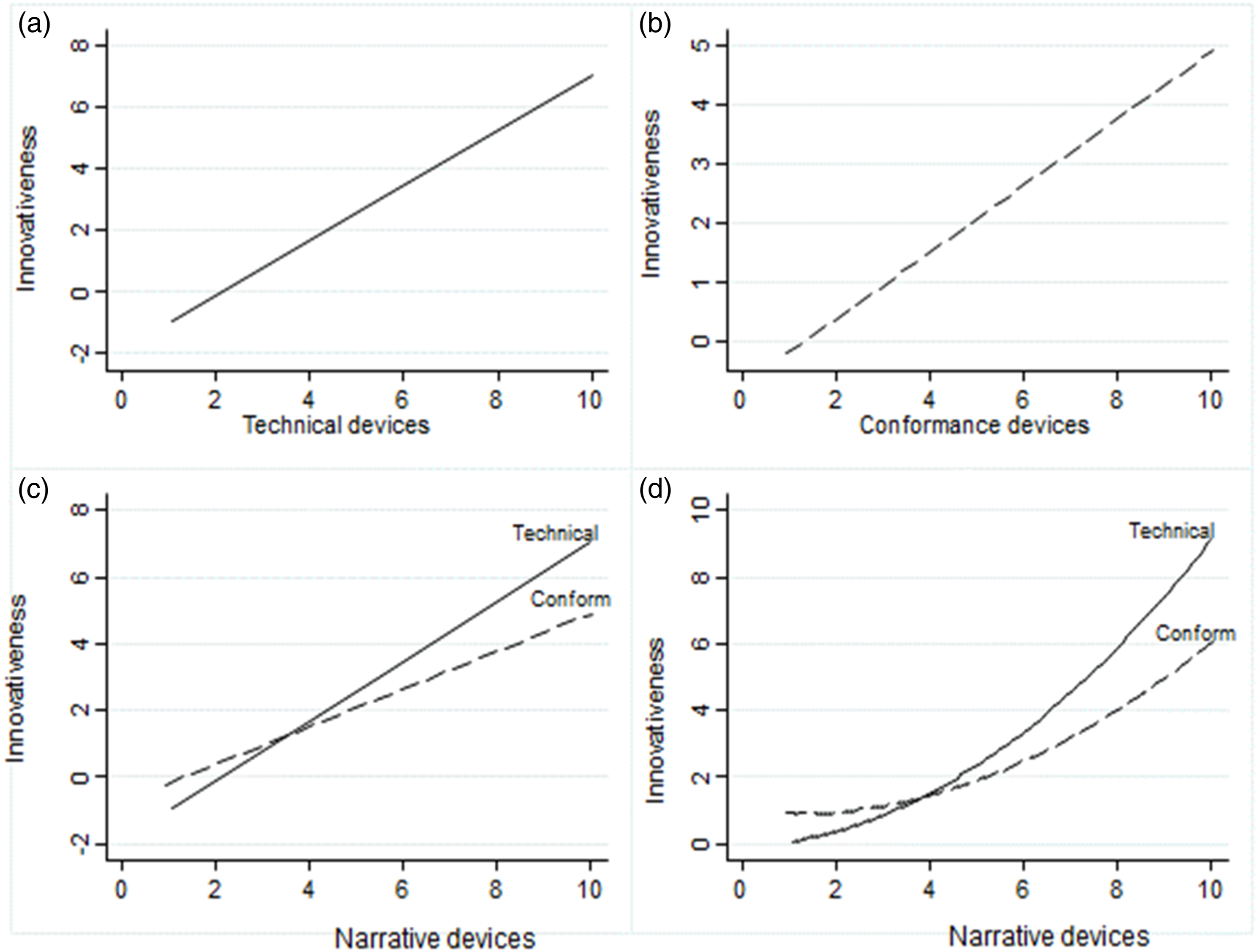
Figure 3 shows the trade-off between technical and conformance devices towards innovation devices. Graph (a) reveals technical devices supersede, and graph (b) shows conformance devices supersede. The lower part shows the linear and nonlinear contrast with the current presentation. Technical-conformance spectrum on the scale. Note: Trade-off between technical and conformance devices. Technical = T. Conformance = C. T-to-C = Technical to Conformance path towards innovation. C-to-T = Conformance to Technical path towards innovation.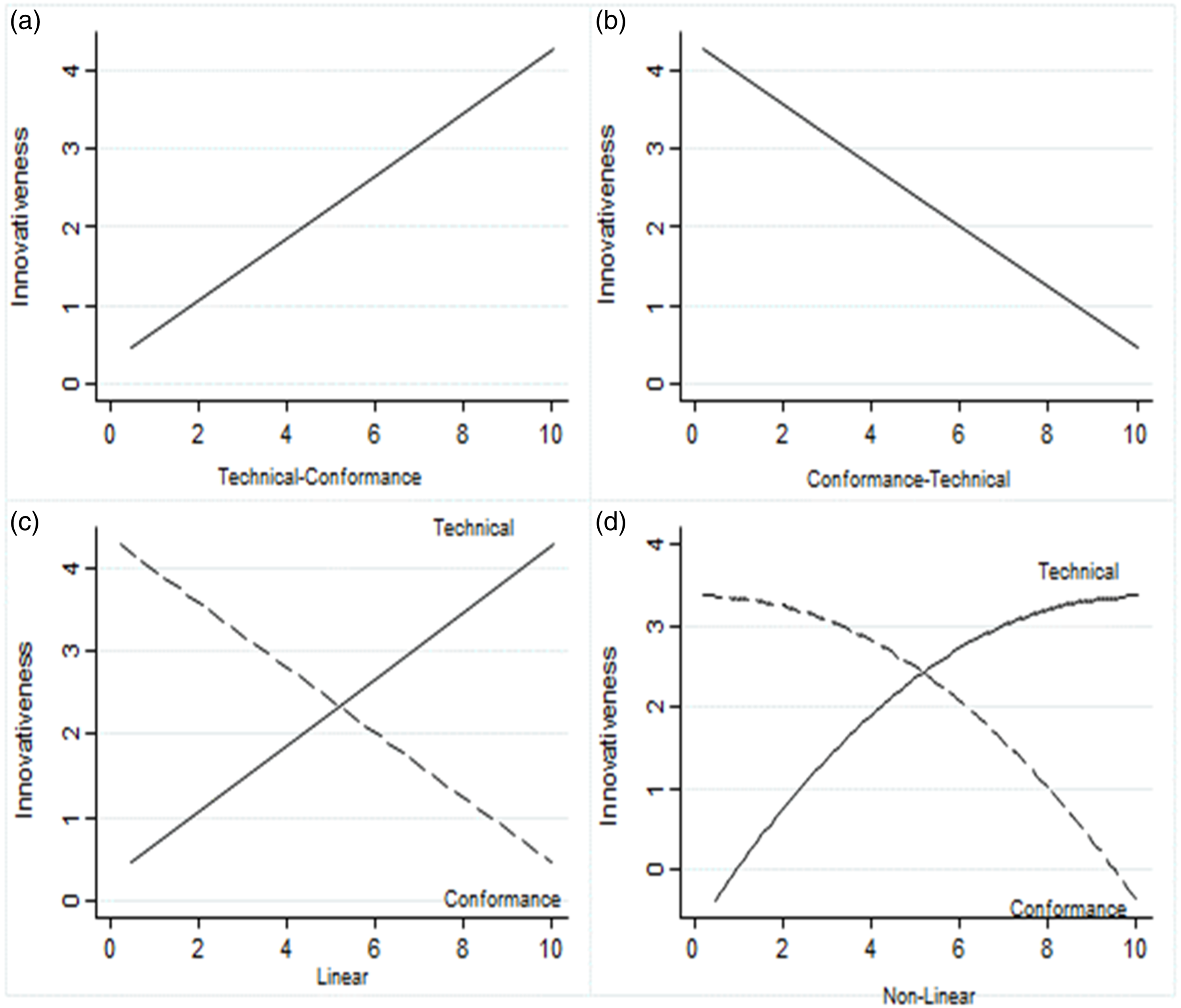
Figure 4 shows the alternative paths from one predictor to the outcome via the other predictor. In relative terms, the effects of T-to-C are stronger than the effects of C-to-T in these two-way correlations. Alternative paths to innovativeness. Note: Alternative paths to innovativeness devices. Technical = T. Conformance = C. T-to-C = Technical to Conformance path towards innovation. C-to-T = Conformance to Technical path towards innovation.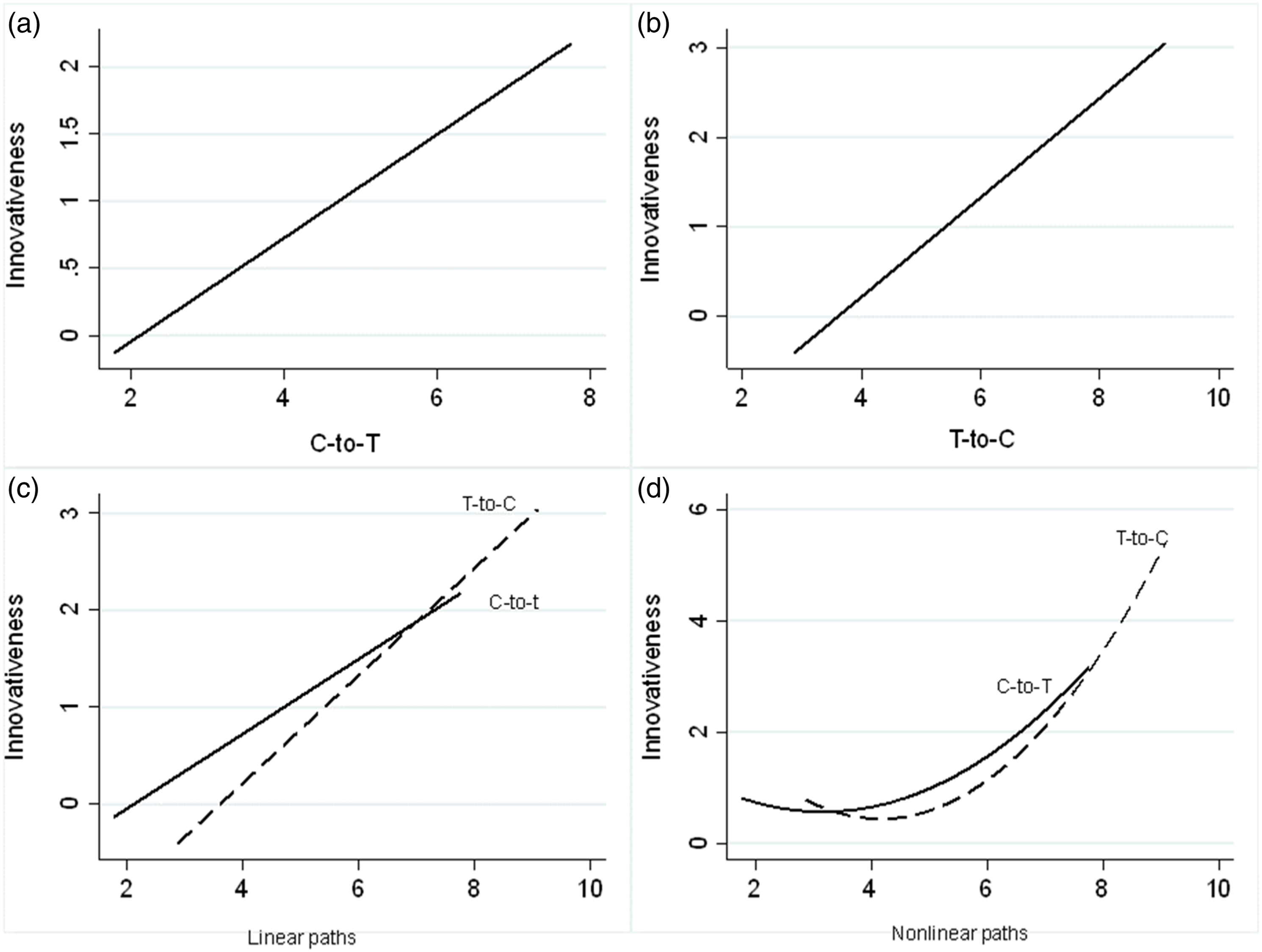
Figure 5 shows the margins plot of the interaction effect. The dashed line represents conformance devices, and the dark line represents technical devices. Different slopes between the two lines suggest the presence of an interaction effect. Margins plot of interaction effects. Note: X-axis: Interaction of technical & conformance devices; Y-axis: Innovativeness devices.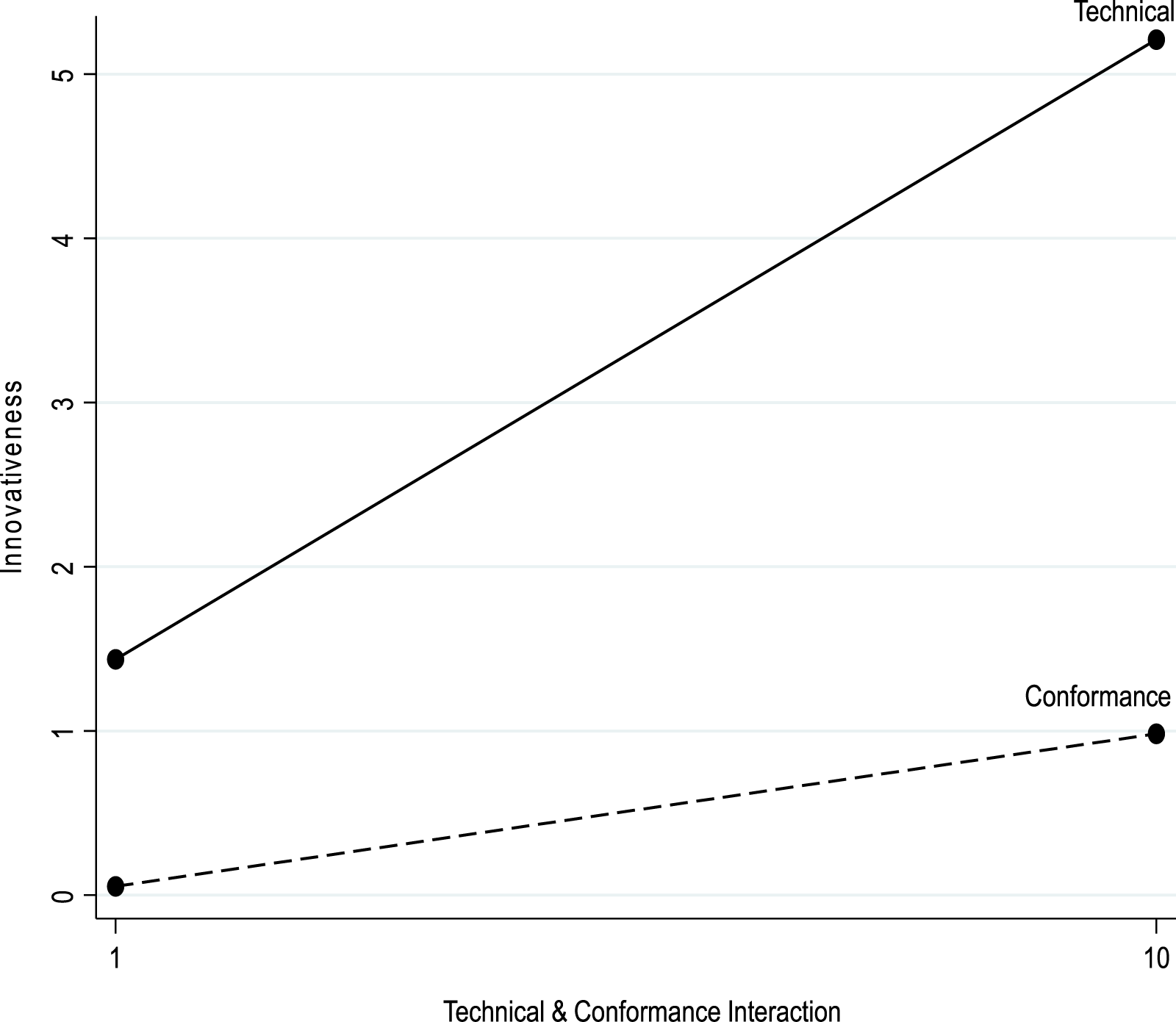
Statistical results
Summary of variables.
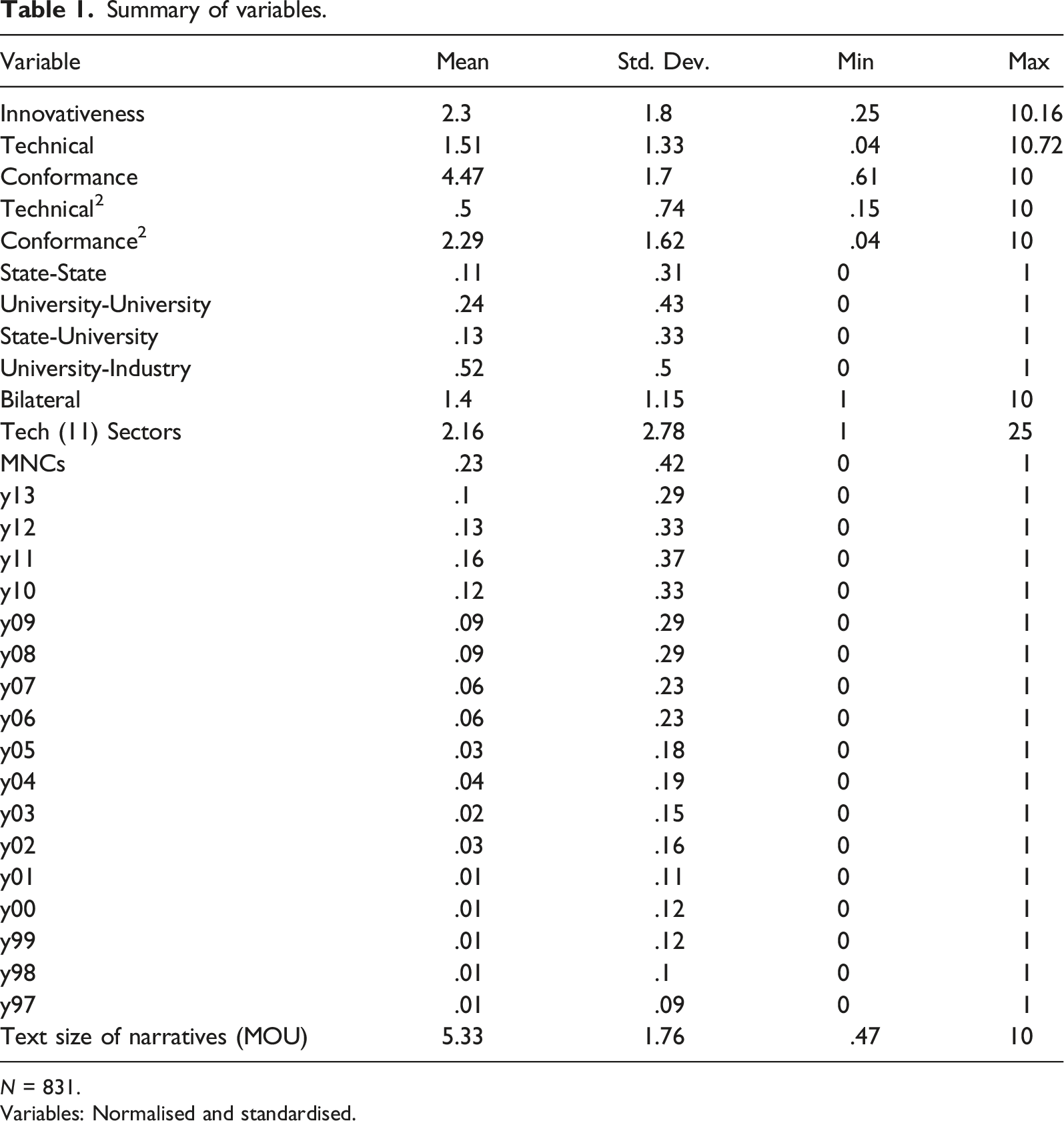
N = 831.
Variables: Normalised and standardised.
Inter-variable correlations.
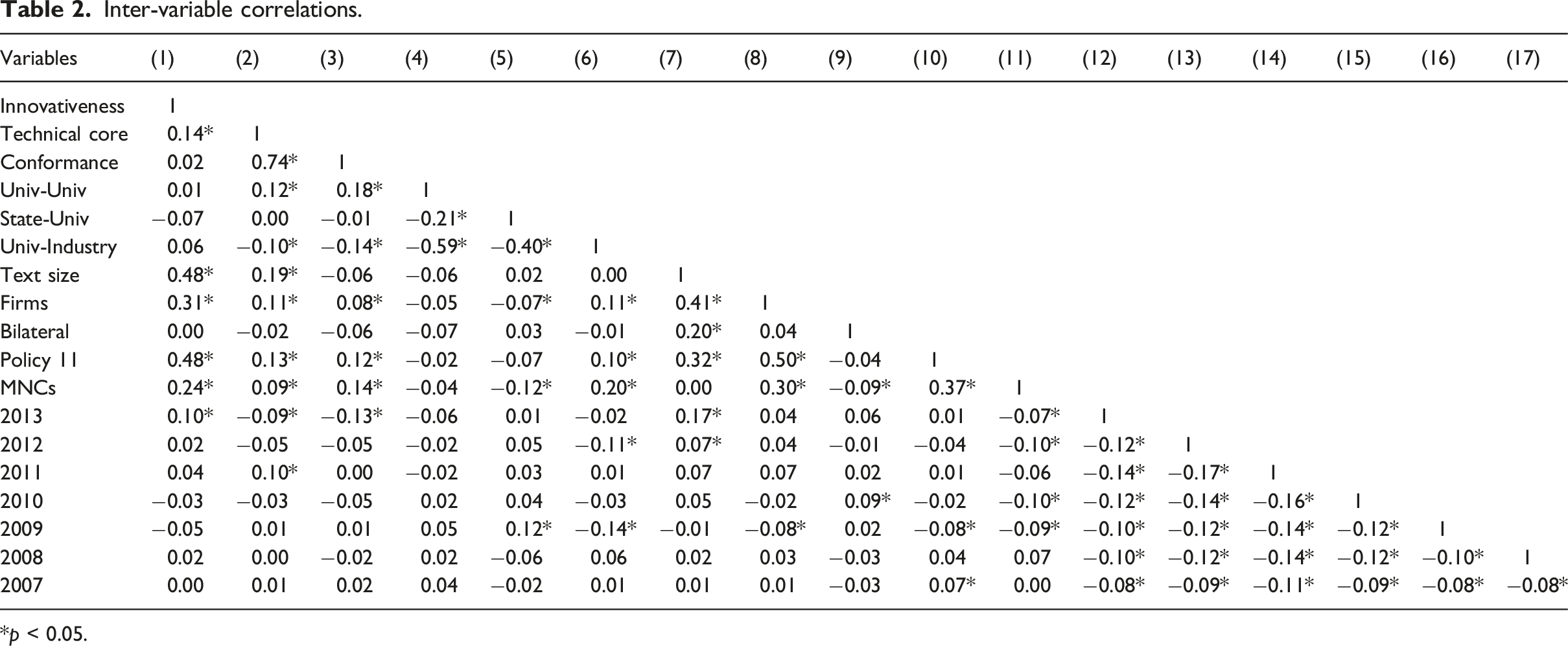
*p < 0.05.
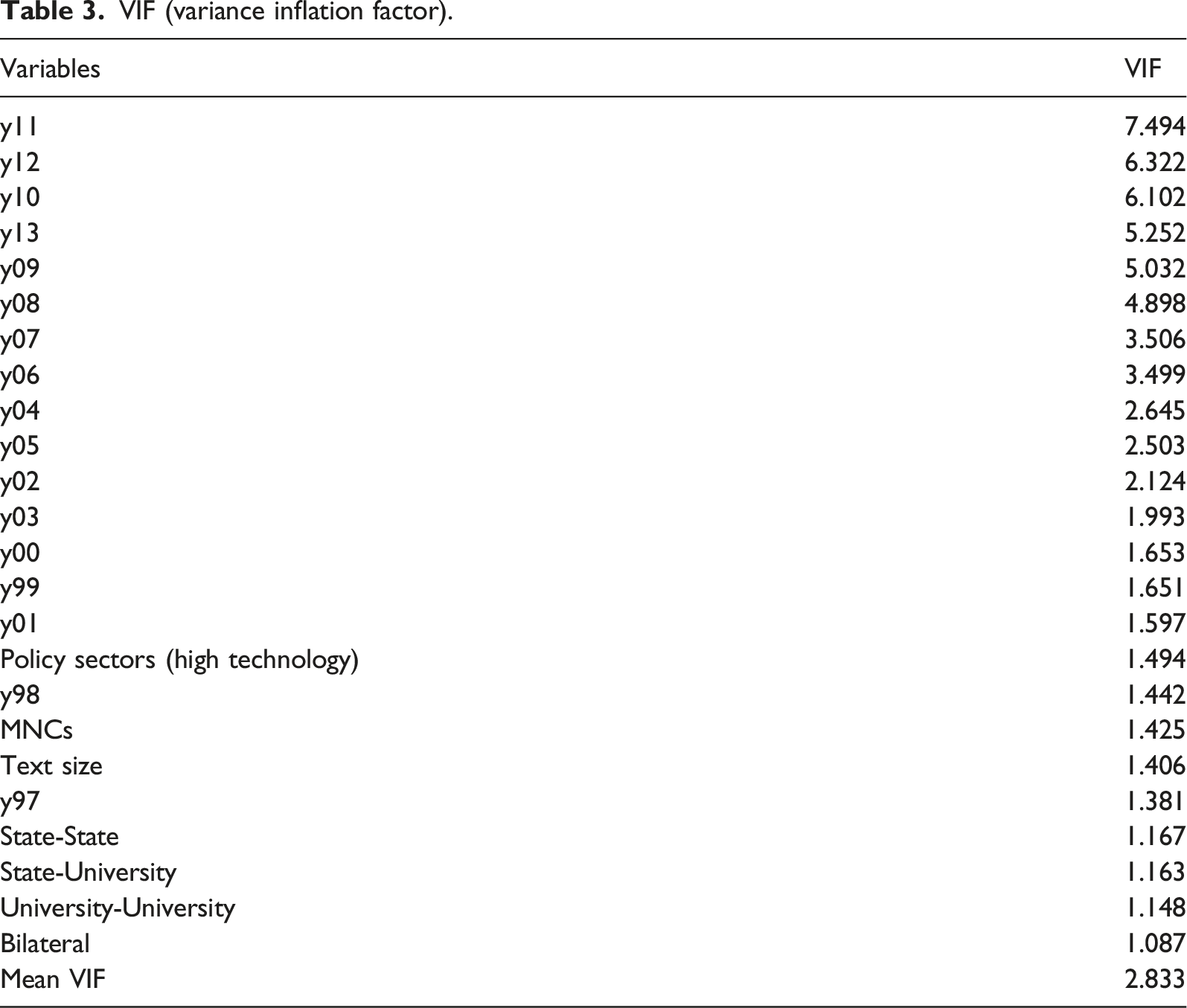
VIF (variance inflation factor).
Direct effects (Multilevel Mixed Model).
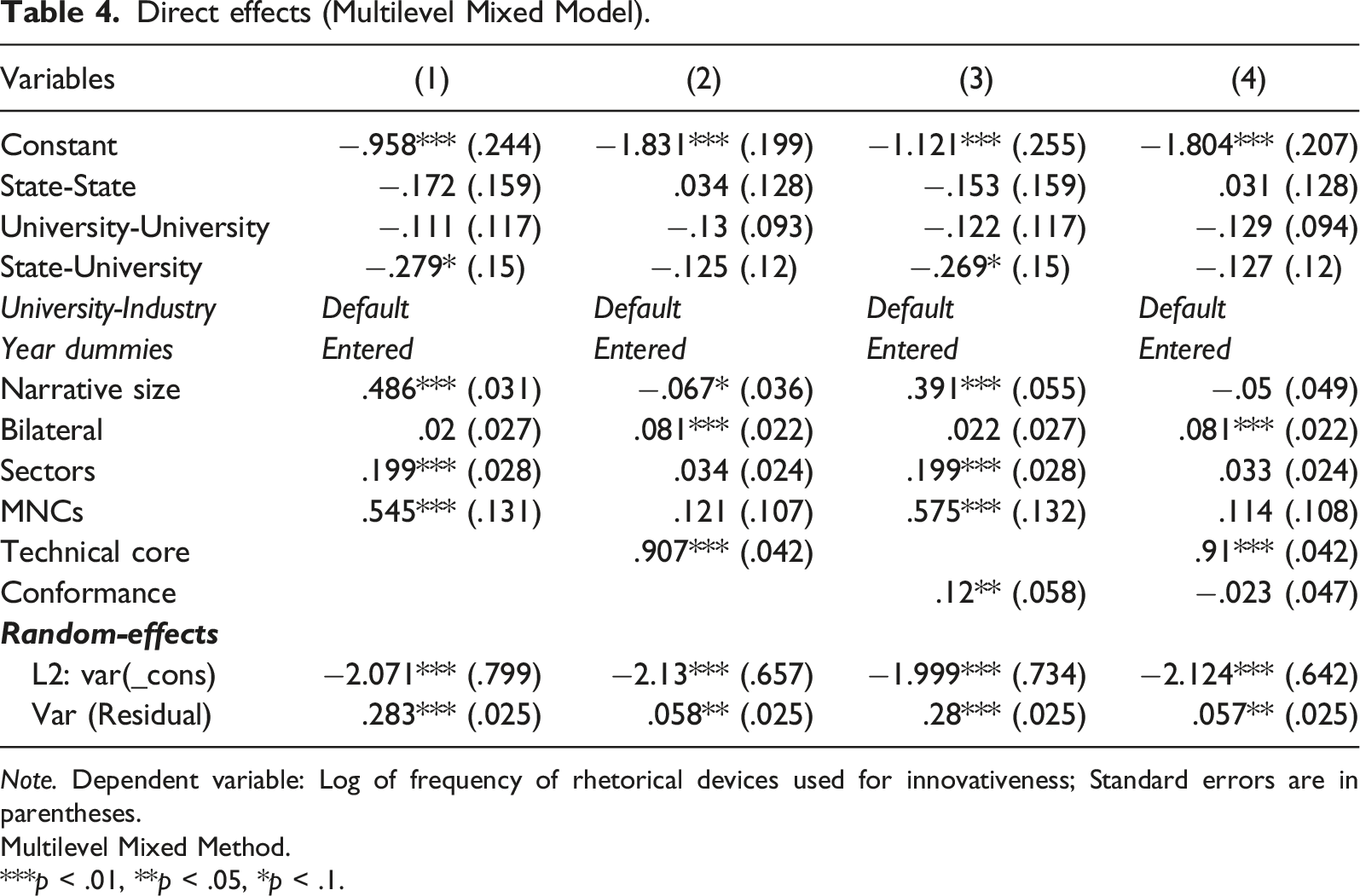
Note. Dependent variable: Log of frequency of rhetorical devices used for innovativeness; Standard errors are in parentheses.
Multilevel Mixed Method.
***p < .01, **p < .05, *p < .1.
Interaction effects (Multilevel Mixed Model).
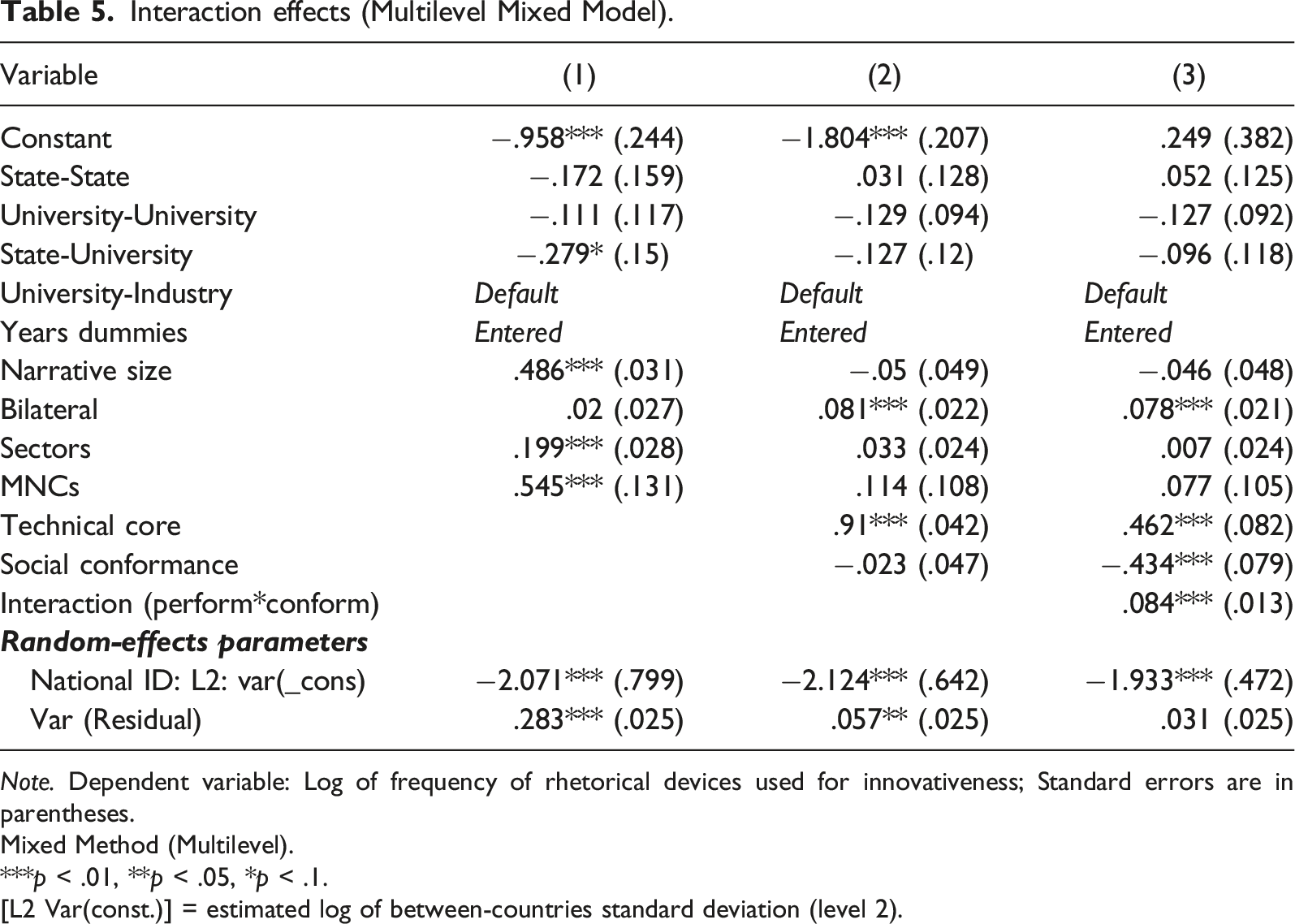
Note. Dependent variable: Log of frequency of rhetorical devices used for innovativeness; Standard errors are in parentheses.
Mixed Method (Multilevel).
***p < .01, **p < .05, *p < .1.
[L2 Var(const.)] = estimated log of between-countries standard deviation (level 2).
Nonlinear tests.
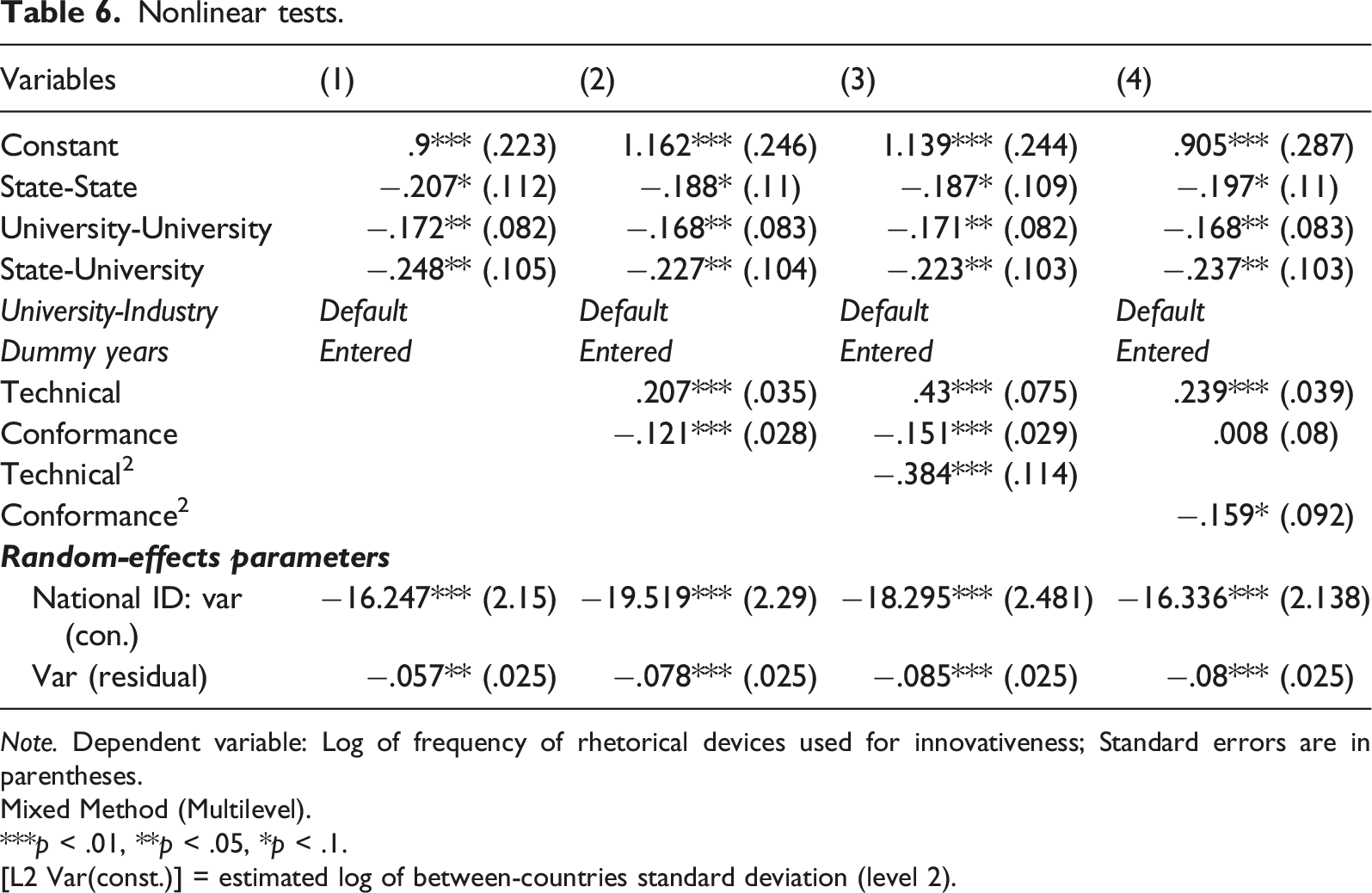
Note. Dependent variable: Log of frequency of rhetorical devices used for innovativeness; Standard errors are in parentheses.
Mixed Method (Multilevel).
***p < .01, **p < .05, *p < .1.
[L2 Var(const.)] = estimated log of between-countries standard deviation (level 2).
Path of technical core-conference to innovation.
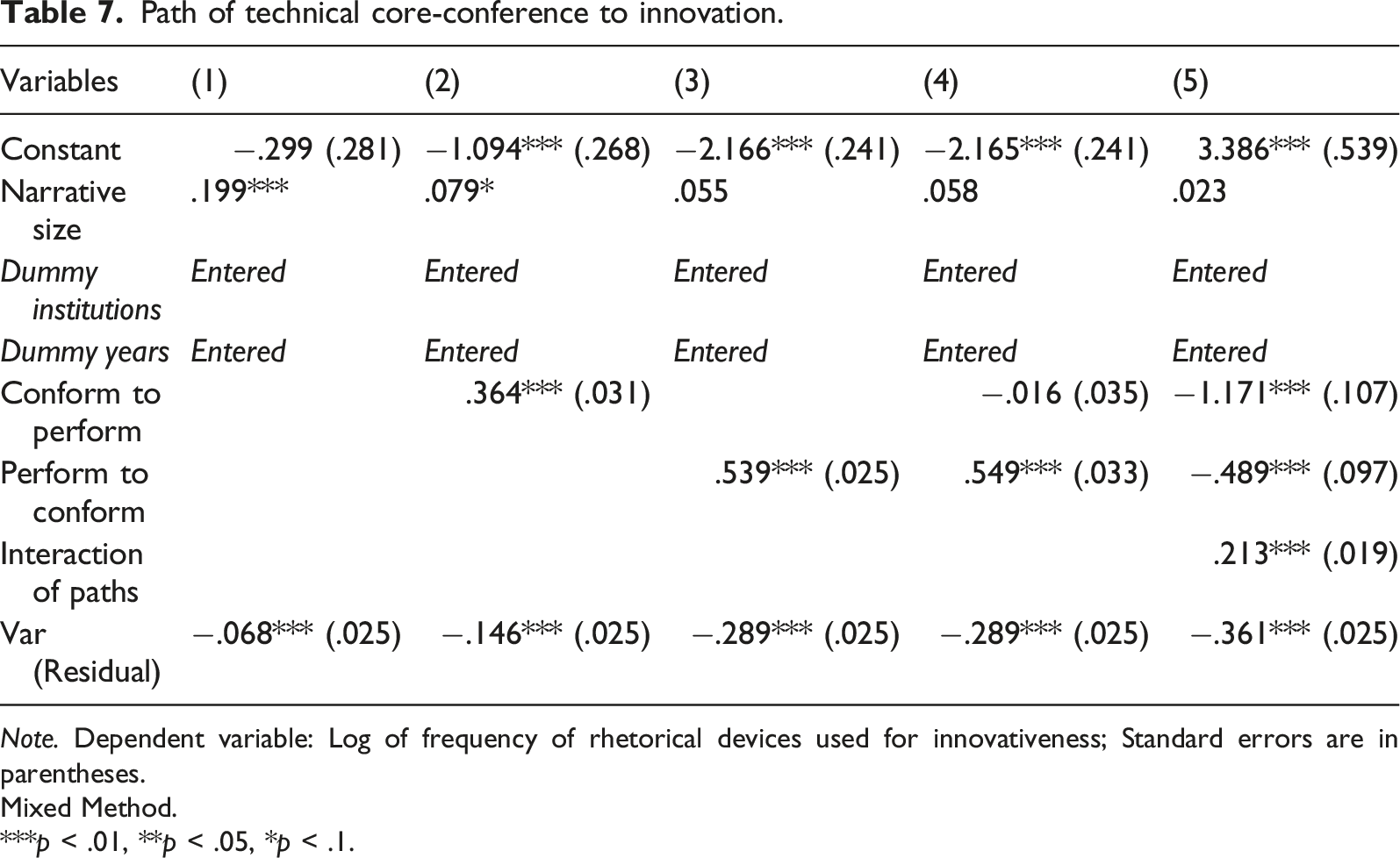
Note. Dependent variable: Log of frequency of rhetorical devices used for innovativeness; Standard errors are in parentheses.
Mixed Method.
***p < .01, **p < .05, *p < .1.
Discussion
The study answers multiple crucial questions in line with the previous literature. Firstly, it highlights the point that technical and conformance lead to innovation that partially justifies the social value. In this social value, innovation contributes to the development of new organisations and new learning methods while inhibiting some social values in the Sino-foreign university education. Second, the study highlights the potential to explain whether and why social values have a weak representation in the Sino-foreign university alliance to prior exploratory studies (Wen et al., 2022). Because the intended purpose is more of innovation and economic value creation for foreign and domestic institutions, the idea that economic progress precedes institutional progress appears to be driving these patterns of Sino-foreign alliance arrangements.
Third, this study offers an alternative context of the research setting: the context of China for the frameworks developed the western settings (Wen et al., 2022). It reveals that, to some extent, China has its own model of creating technical and social values in which the desirability and feasibility (contents, order and relevance) shape the formation of alliances and their implementations. Last, this study explored the feasibility aligned with desirability. In the Sino-foreign university alliances, the desirability concept is innovation, which is given in the Chinese policy narratives at all levels. A narrative contends two points: its credibility (logic) and fidelity (guided action) (Fisher, 1988). How those policymakers intended to reach desirability is the central focus of this study. Thus, it builds on the gaps drawn from the prior literature on international alliances.
The internationalisation of Chinese higher education has been one of the major policy developments of the last three decades, whether, how and why Chinese universities seek foreign alliance partners. In pursuit of the long-term strategic goal of innovation, Chinese higher education has entered a host of alliances with foreign institutions. Prior research has dealt with the issue of Sino-foreign universities at two levels: alliance formation (structures) and alliance effectiveness (technical core). However, venturing into the analysis of structures and technical core of those alliances, we need to understand the micro mechanisms of feasibility (technical and social processes). Do Sino-foreign university alliances seek technical processes, social conformance processes or a combination of the two competing processes in achieving the innovativeness status for long-term positioning in the world?
We explored this question of feasibility issues with the help of institutional theory and empirical evidence based on the narrative in the MOU (memorandum of understanding) signed between Chinese partners and their foreign collaborators in higher education. Prior literature draws a tension between technical and conformance paths towards an intended goal (Oakes & Vidich, 1999). The current study settled this issue by coding and analysing the partners' convents (narratives) of the MOUs. In the first step of the analysis, the direct effects of technical devices and conformance devices were related to innovativeness devices in the narratives of those MOUs. In the second step, the interaction effect was evaluated to establish the moderating role of conformance devices on technical devices. In the last step, the predicted paths were compared to whether technical-to-conformance has merit over conformance-to-technical in strategic planning.
Guided by rhetorical institutionalism and multilevel mixed models, the study makes insightful discoveries. First, the main effect shows that technical and conformance devices positively predict correlation with innovativeness devices, and the effect size of technical devices is stronger than the effect size of conformance devices. Second, the interaction effect is positive, and the net effect of technical devices is positive, but the net impact of conformance devices is negative. Third, the technical-to-conformance path is stronger than the conformance-to-technical path towards innovativeness. These findings are consistent with the general observation of Chinese universities’ phenomenal growth in the technical path. Chinese universities have surpassed the USA’s level publications and patents in science and engineering disciplines in the technical core. In many other disciplines, Chinese universities are second to the USA’s. In general education achievement, Chinese post-graduation per capita is more than that of the USA’ (Malik & Huo, 2019a). Thus, it is an institutionalised pattern of the technical path to innovativeness.
The institutionalised pattern is visible in the comparative analysis of Chinese and American legislators. Chinese legislators tend to have postgraduate degrees, most of which form science and engineering degrees; USA’s legislators tend to have fewer postgraduate degrees in social sciences (Malik & Huo, 2019b). For instance, about 80% of the USA’s legislators have law degrees, and 20% have science and engineering degrees. About 80% of Chinese legislators have science and engineering degrees, and 20% of social science degrees. It explains why innovativeness appears to be the long-term goal, and technical learning is its dominant path, a view consistent with some prior literature. Our study draws support from three arguments related to the internationalisation of Chinese higher education.
One study suggests that Chinese technical disciplines and humanities differ in the internationalisation process and goal achievement and the humanities have faced challenges in this process (Zhu & Liu, 2016). Our study reflects on this observation in the humanities as opposed to science and engineering (technical) paths. The second argument explains that Chinese higher education has benefitted from the technical exchange but not from the social exchange because of the disintegrated system of teaching and research between foreign and Chinese students in China (Wen et al., 2022). If the literature points to the issues in practice, our study points to the issues in policy formation through forensic analysis. The third argument in the prior literature argues that bilateral-level relationships have been successful for the partners in technical and social sciences (Hu & Fan, 2020). We acknowledge that the success stories of inwards Sino-foreign collaboration have superseded the outwards Sino-foreign collaboration, and this issue requires further probes into the phenomenon.
We also note the limitations of this study. First, we rely on secondary data rather than primary data. Second, we use cross-section analysis rather than panel analysis. Third, the sample limits the scope of the study to a single sector, narrowing the inter-sectoral implications. Fourth, it combines the Sino-foreign alliance’s negotiation outcome but not the process on the negotiating table. The power and purpose of negotiation may influence the technical-conformance interaction as it does the explorative-exploitative interaction elsewhere (Malik & Yazar, 2016). Fifth, our data collection ended in 2013, and the Belt and Road Initiative (BRI) launched afterwards has diffused across regions, including attention to the education sector (Malik, 2022). More recently, in 2020, The Regional Comprehensive Economic Partnership (RCEP), a free trade agreement between the Asia-Pacific nations of Australia, Brunei, Cambodia, China, Indonesia, Japan, Laos, Malaysia, Myanmar, New Zealand, the Philippines, Singapore, South Korea, Thailand, and Vietnam, added further stimulus to Sino-foreign interaction in the higher education (Malik, 2022). Therefore, future studies may use this research as a foundation for analysing interdisciplinary, inter-institutional and inter-paradigmatic arguments.
Conclusion and contribution
The study concludes that the technical and conformance policy persists at all levels of inter-organisational relations in higher education. The Sino-foreign inter-university alliance reveals these patterns and levels at the organisational and national levels of analysis. The analysis reveals that an increase in technical core rhetorical devices positively aligns with the innovation policy goals of the Sino-foreign university alliance. Likewise, the conformance rhetorical devices positively contribute to the innovativeness of the policy of the Sino-foreign university alliance as long as they operated independently. However, the technical core supersedes the conformance core (removes the effects of the conformance) towards the innovativeness intention stated in the policy. We believe that Chinese universities have achieved an innovation-oriented technical core but lack legitimacy; nevertheless, they seek legitimacy through technical core because of their liberal counterparts in the USA and elsewhere.
This research aimed to make three contributions. Firstly, it addressed the issue of innovation as a policy and practice at two levels. One level refers to the Sino-foreign university collaboration, which qualifies as an ‘organisational innovation’ (OECD, 1997). The second level of innovation refers to the situated attention to the rhetorical discourse concept, which refers to the product, process and management innovation in its abstract form. While most studies rest on the physical count of products or processes to assess innovation, policy innovation (a contextualised phenomenon) merited a renewed focus. Secondly, this study contributed to the theory, resolving the contention and concordance between an organisation’s technical and conformance cores. Thirdly, this study includes a broader relevance to policy and practice.
Policy and practice can benefit from these discoveries. Chinese internationalisation of higher education has increased in the ensuing. The MOE of China indicates that the inflow of international students to China has increased by 51% from 2011 to2016 1 . This flow coincides Belt and Road Initiative (BRI, 2019; Malik, 2022). The China Scholarship Council offers scholarships in postgraduate research programs (Hu & Fan, 2020), leading to the training of 5000 science and technology students from these partner countries. Some 2300 universities in 287 prefecture cities in China mobilise international students, foreign investment and technological resources (Malik et al., 2021). Per capita, the university population has a strong potential. Naturally, the stakeholders increase in variety, scales and relational structures. Thus, this article has a broader implication for China and its foreign partners.
Footnotes
Declaration of conflicting interests
The author(s) declared no potential conflicts of interest with respect to the research, authorship, and/or publication of this article.
Funding
The author(s) received no financial support for the research, authorship, and/or publication of this article.

Note
Appendix F. Multilevel Model Equation.
Multilevel mixed model with MOU at Level 1 and nations at Level 2, and the resulting equation for the given outcome can be written as:
Level 1 (MOU):
Yij = β0j + β1j(X1ij) + β2j(X2ij) + β3j(X1ij * X2ij) + eij
Level 2 (Nation):
β0j = γ00 + u0j
β1j = γ10 + u1j
β2j = γ20 + u2j
β3j = γ30 + u3j
Where:
Yij = the outcome for MOU i in nation j
X1ij = technical core for MOU i in nation j
X2ij = social conformance for MOU i in nation j
X1ij * X2ij = interaction between technical core and social conformance for MOU i in nation j
β0j = the intercept for nation j
β1j = the slope coefficient for technical core for nation j
β2j = the slope coefficient for social conformance for nation j
β3j = the slope coefficient for the interaction between technical core and social conformance for nation j
eij = the Level 1 residual for MOU i in nation j
γ00 = the grand intercept
γ10 = the fixed effect coefficient for technical core
γ20 = the fixed effect coefficient for social conformance
γ30 = the fixed effect coefficient for the interaction between technical core and social conformance
u0j = the random intercept for nation j
u1j = the random slope for technical core for nation j
u2j = the random slope for social conformance for nation j
u3j = the random slope for the interaction between technical core and social conformance for nation j
The equation for the given outcome would be:
Yij = (γ00 + u0j) + (γ10 + u1j)(X1ij) + (γ20 + u2j)(X2ij) + (γ30 + u3j)(X1ij * X2ij) + eij
Appendix
Countries and regions in the internationalisation of higher education.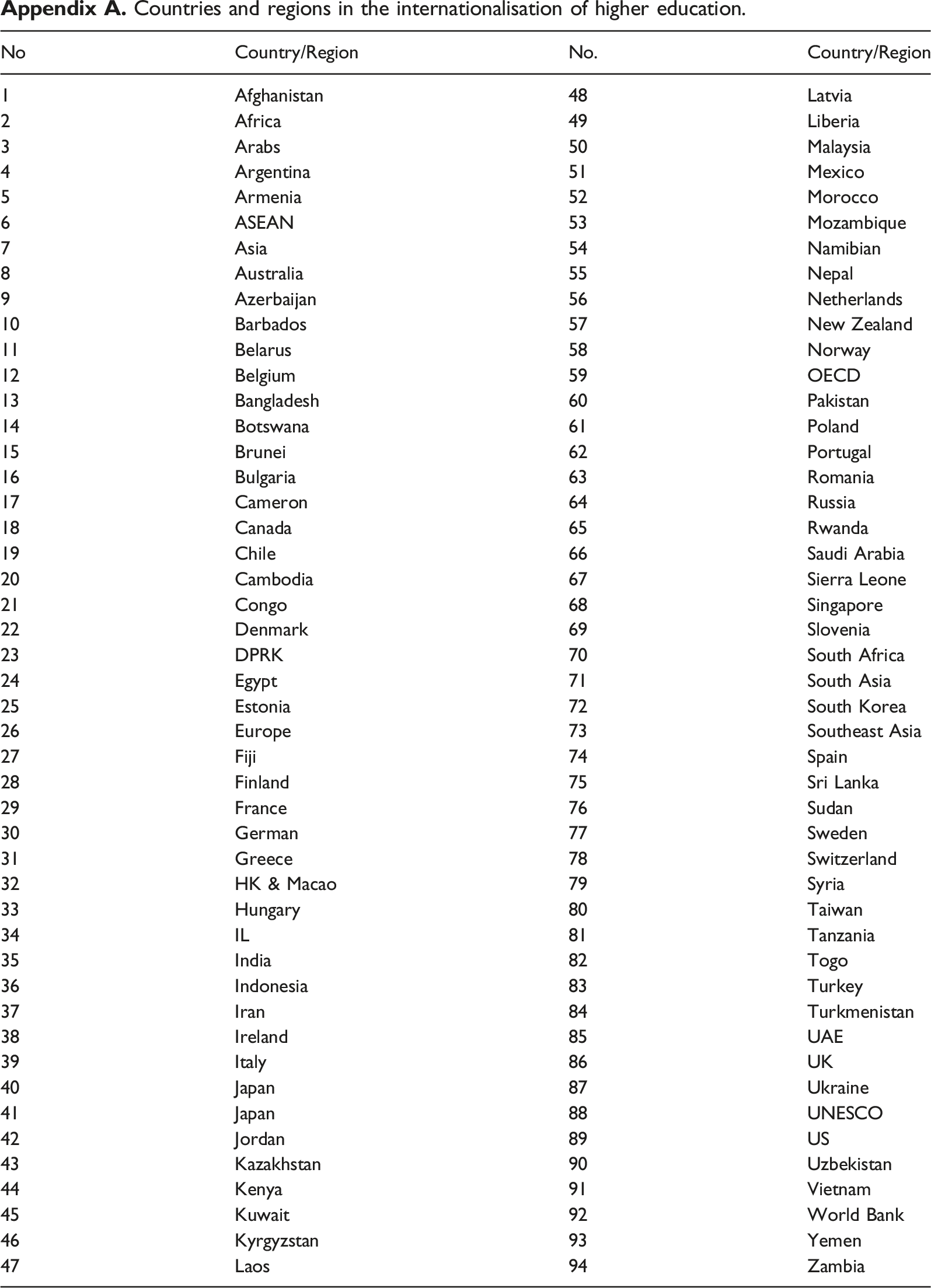
No
Country/Region
No.
Country/Region
1
Afghanistan
48
Latvia
2
Africa
49
Liberia
3
Arabs
50
Malaysia
4
Argentina
51
Mexico
5
Armenia
52
Morocco
6
ASEAN
53
Mozambique
7
Asia
54
Namibian
8
Australia
55
Nepal
9
Azerbaijan
56
Netherlands
10
Barbados
57
New Zealand
11
Belarus
58
Norway
12
Belgium
59
OECD
13
Bangladesh
60
Pakistan
14
Botswana
61
Poland
15
Brunei
62
Portugal
16
Bulgaria
63
Romania
17
Cameron
64
Russia
18
Canada
65
Rwanda
19
Chile
66
Saudi Arabia
20
Cambodia
67
Sierra Leone
21
Congo
68
Singapore
22
Denmark
69
Slovenia
23
DPRK
70
South Africa
24
Egypt
71
South Asia
25
Estonia
72
South Korea
26
Europe
73
Southeast Asia
27
Fiji
74
Spain
28
Finland
75
Sri Lanka
29
France
76
Sudan
30
German
77
Sweden
31
Greece
78
Switzerland
32
HK & Macao
79
Syria
33
Hungary
80
Taiwan
34
IL
81
Tanzania
35
India
82
Togo
36
Indonesia
83
Turkey
37
Iran
84
Turkmenistan
38
Ireland
85
UAE
39
Italy
86
UK
40
Japan
87
Ukraine
41
Japan
88
UNESCO
42
Jordan
89
US
43
Kazakhstan
90
Uzbekistan
44
Kenya
91
Vietnam
45
Kuwait
92
World Bank
46
Kyrgyzstan
93
Yemen
47
Laos
94
Zambia
Partners, alliance date and disciplines.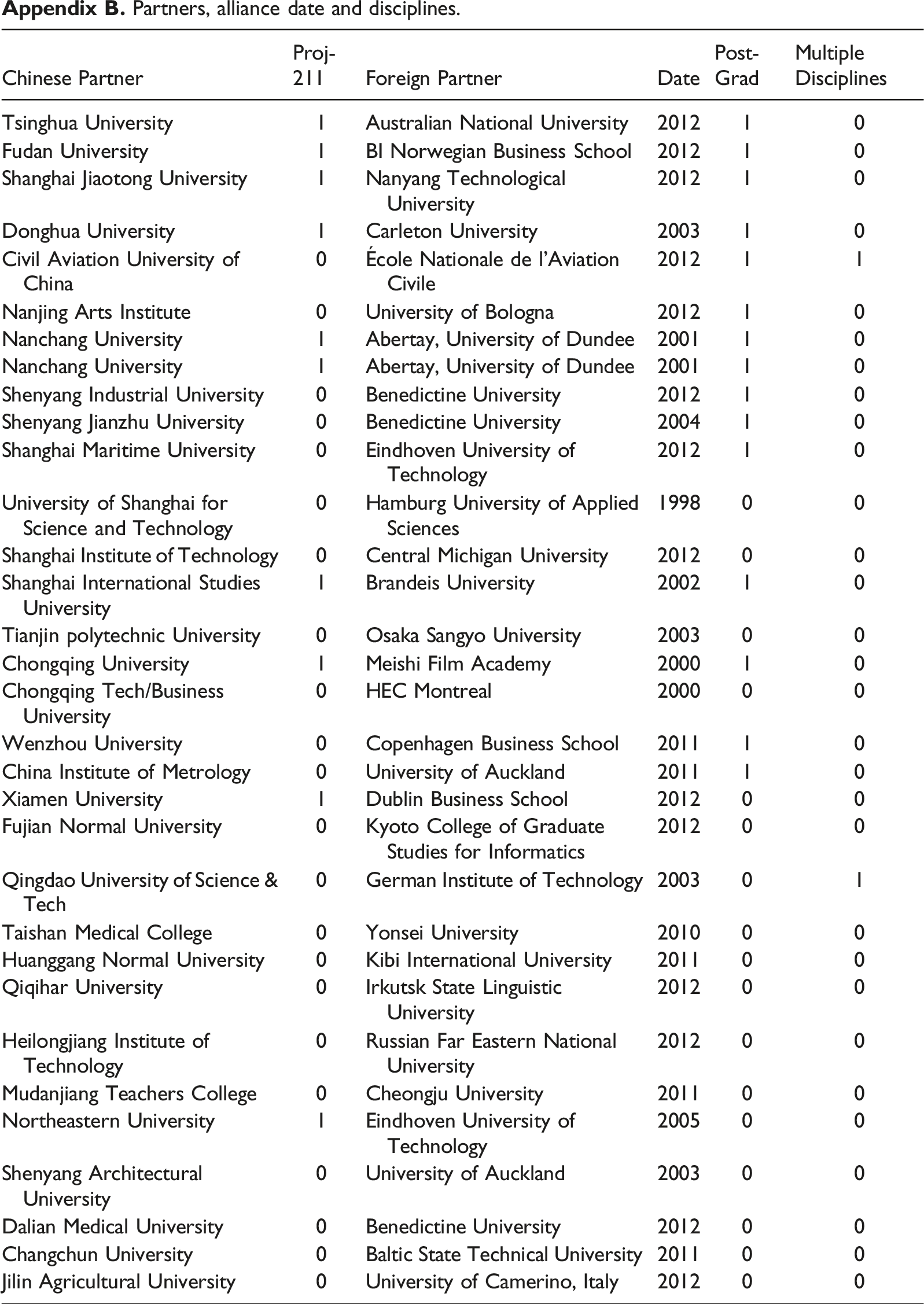
Chinese Partner
Proj-211
Foreign Partner
Date
Post-Grad
Multiple Disciplines
Tsinghua University
1
Australian National University
2012
1
0
Fudan University
1
BI Norwegian Business School
2012
1
0
Shanghai Jiaotong University
1
Nanyang Technological University
2012
1
0
Donghua University
1
Carleton University
2003
1
0
Civil Aviation University of China
0
École Nationale de l'Aviation Civile
2012
1
1
Nanjing Arts Institute
0
University of Bologna
2012
1
0
Nanchang University
1
Abertay, University of Dundee
2001
1
0
Nanchang University
1
Abertay, University of Dundee
2001
1
0
Shenyang Industrial University
0
Benedictine University
2012
1
0
Shenyang Jianzhu University
0
Benedictine University
2004
1
0
Shanghai Maritime University
0
Eindhoven University of Technology
2012
1
0
University of Shanghai for Science and Technology
0
Hamburg University of Applied Sciences
1998
0
0
Shanghai Institute of Technology
0
Central Michigan University
2012
0
0
Shanghai International Studies University
1
Brandeis University
2002
1
0
Tianjin polytechnic University
0
Osaka Sangyo University
2003
0
0
Chongqing University
1
Meishi Film Academy
2000
1
0
Chongqing Tech/Business University
0
HEC Montreal
2000
0
0
Wenzhou University
0
Copenhagen Business School
2011
1
0
China Institute of Metrology
0
University of Auckland
2011
1
0
Xiamen University
1
Dublin Business School
2012
0
0
Fujian Normal University
0
Kyoto College of Graduate Studies for Informatics
2012
0
0
Qingdao University of Science & Tech
0
German Institute of Technology
2003
0
1
Taishan Medical College
0
Yonsei University
2010
0
0
Huanggang Normal University
0
Kibi International University
2011
0
0
Qiqihar University
0
Irkutsk State Linguistic University
2012
0
0
Heilongjiang Institute of Technology
0
Russian Far Eastern National University
2012
0
0
Mudanjiang Teachers College
0
Cheongju University
2011
0
0
Northeastern University
1
Eindhoven University of Technology
2005
0
0
Shenyang Architectural University
0
University of Auckland
2003
0
0
Dalian Medical University
0
Benedictine University
2012
0
0
Changchun University
0
Baltic State Technical University
2011
0
0
Jilin Agricultural University
0
University of Camerino, Italy
2012
0
0
Reference to enterprises.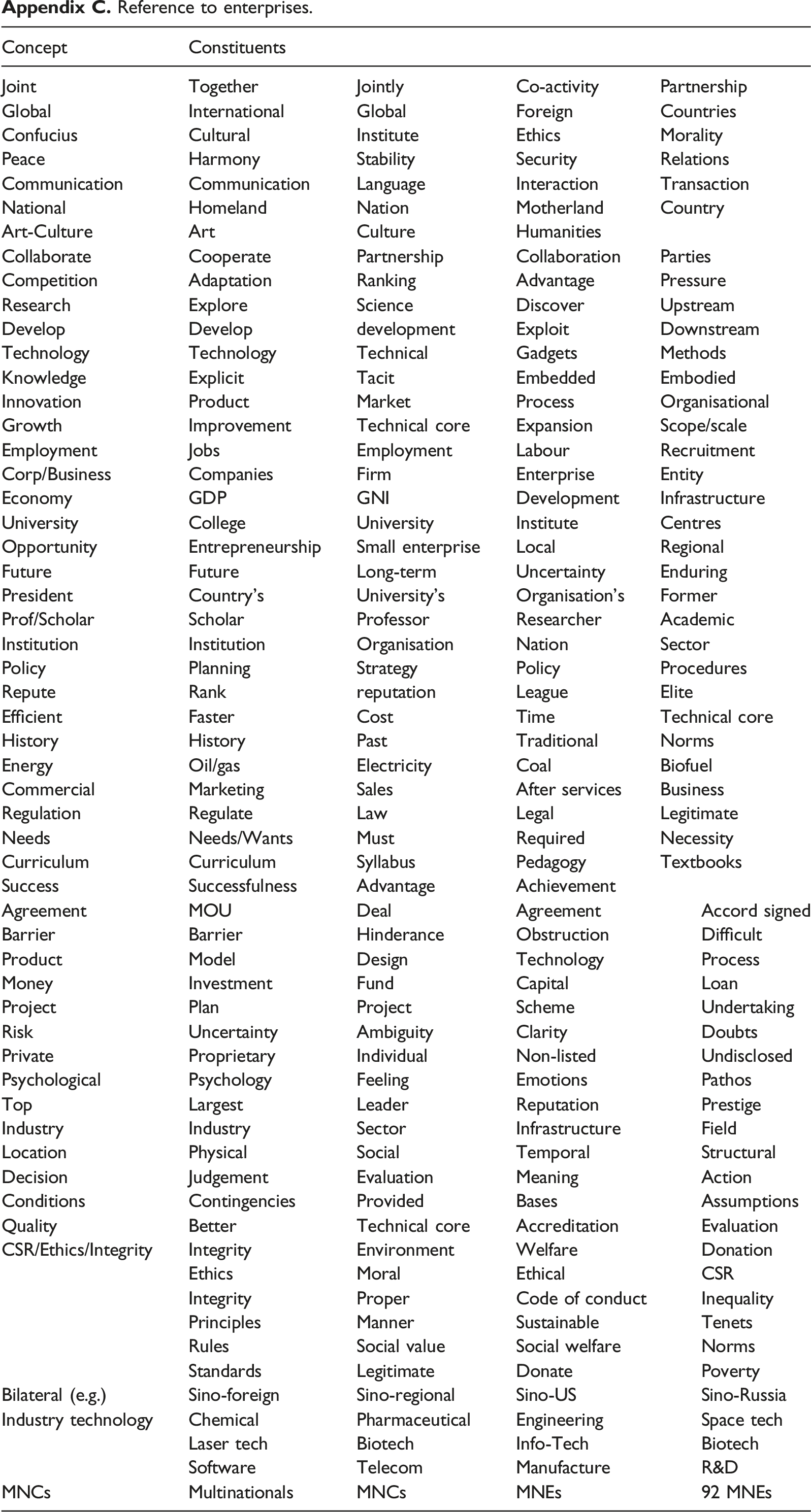
Concept
Constituents
Joint
Together
Jointly
Co-activity
Partnership
Global
International
Global
Foreign
Countries
Confucius
Cultural
Institute
Ethics
Morality
Peace
Harmony
Stability
Security
Relations
Communication
Communication
Language
Interaction
Transaction
National
Homeland
Nation
Motherland
Country
Art-Culture
Art
Culture
Humanities
Collaborate
Cooperate
Partnership
Collaboration
Parties
Competition
Adaptation
Ranking
Advantage
Pressure
Research
Explore
Science
Discover
Upstream
Develop
Develop
development
Exploit
Downstream
Technology
Technology
Technical
Gadgets
Methods
Knowledge
Explicit
Tacit
Embedded
Embodied
Innovation
Product
Market
Process
Organisational
Growth
Improvement
Technical core
Expansion
Scope/scale
Employment
Jobs
Employment
Labour
Recruitment
Corp/Business
Companies
Firm
Enterprise
Entity
Economy
GDP
GNI
Development
Infrastructure
University
College
University
Institute
Centres
Opportunity
Entrepreneurship
Small enterprise
Local
Regional
Future
Future
Long-term
Uncertainty
Enduring
President
Country’s
University’s
Organisation’s
Former
Prof/Scholar
Scholar
Professor
Researcher
Academic
Institution
Institution
Organisation
Nation
Sector
Policy
Planning
Strategy
Policy
Procedures
Repute
Rank
reputation
League
Elite
Efficient
Faster
Cost
Time
Technical core
History
History
Past
Traditional
Norms
Energy
Oil/gas
Electricity
Coal
Biofuel
Commercial
Marketing
Sales
After services
Business
Regulation
Regulate
Law
Legal
Legitimate
Needs
Needs/Wants
Must
Required
Necessity
Curriculum
Curriculum
Syllabus
Pedagogy
Textbooks
Success
Successfulness
Advantage
Achievement
Agreement
MOU
Deal
Agreement
Accord signed
Barrier
Barrier
Hinderance
Obstruction
Difficult
Product
Model
Design
Technology
Process
Money
Investment
Fund
Capital
Loan
Project
Plan
Project
Scheme
Undertaking
Risk
Uncertainty
Ambiguity
Clarity
Doubts
Private
Proprietary
Individual
Non-listed
Undisclosed
Psychological
Psychology
Feeling
Emotions
Pathos
Top
Largest
Leader
Reputation
Prestige
Industry
Industry
Sector
Infrastructure
Field
Location
Physical
Social
Temporal
Structural
Decision
Judgement
Evaluation
Meaning
Action
Conditions
Contingencies
Provided
Bases
Assumptions
Quality
Better
Technical core
Accreditation
Evaluation
CSR/Ethics/Integrity
Integrity
Environment
Welfare
Donation
Ethics
Moral
Ethical
CSR
Integrity
Proper
Code of conduct
Inequality
Principles
Manner
Sustainable
Tenets
Rules
Social value
Social welfare
Norms
Standards
Legitimate
Donate
Poverty
Bilateral (e.g.)
Sino-foreign
Sino-regional
Sino-US
Sino-Russia
Industry technology
Chemical
Pharmaceutical
Engineering
Space tech
Laser tech
Biotech
Info-Tech
Biotech
Software
Telecom
Manufacture
R&D
MNCs
Multinationals
MNCs
MNEs
92 MNEs
Inter-university, state and industry participation on innovativeness devices. Note: Institutional preferences for innovativeness devices.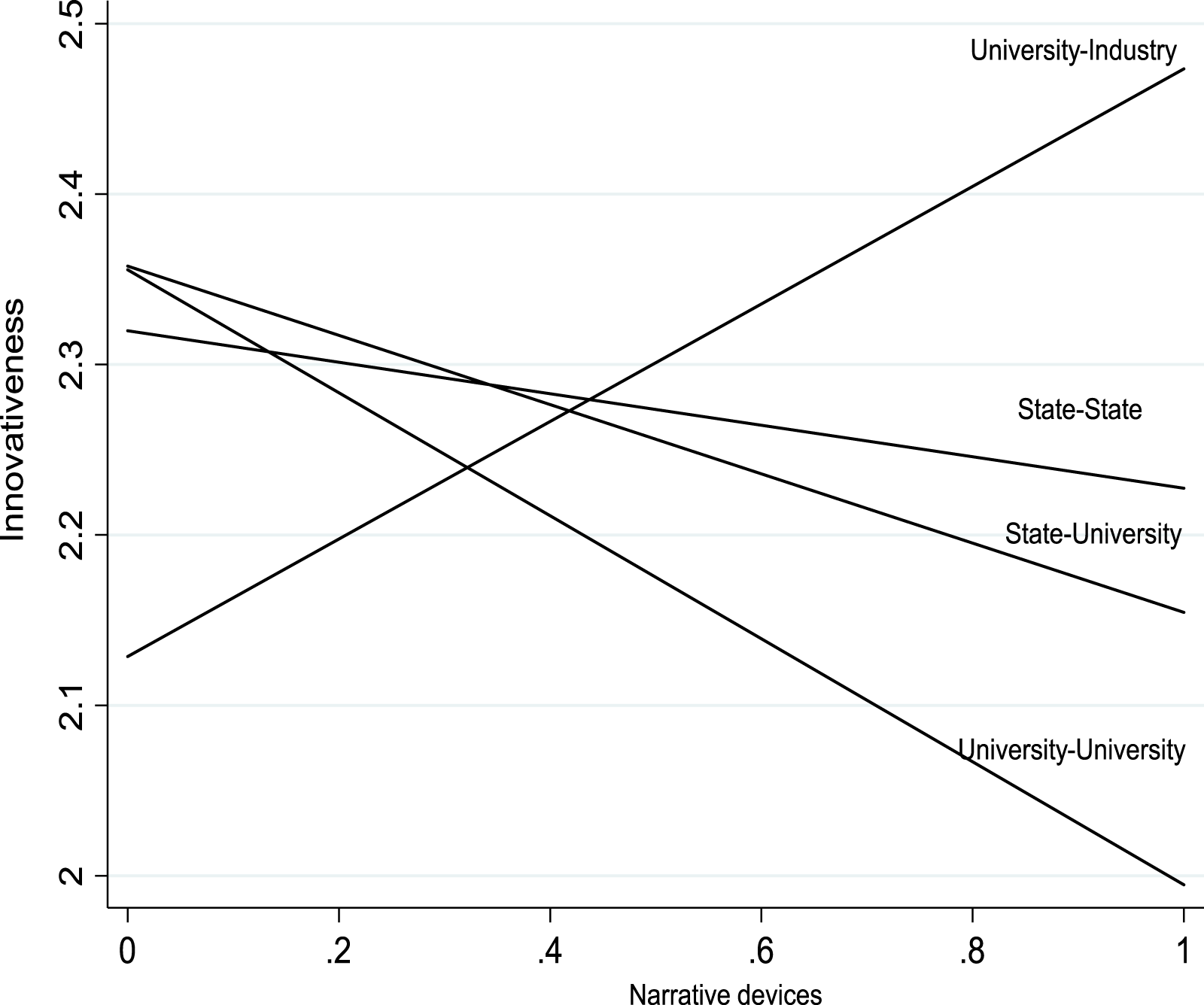
Effects of dummy years & participant organisations. Note. Dependent variable: Log of frequency of rhetorical devices used for innovativeness; Standard errors are in parentheses. Mixed Method (Multilevel). ***p < .01, **p < .05, *p < .1. [L2 Var(const.)] = estimated log of between-countries standard deviation (level 2).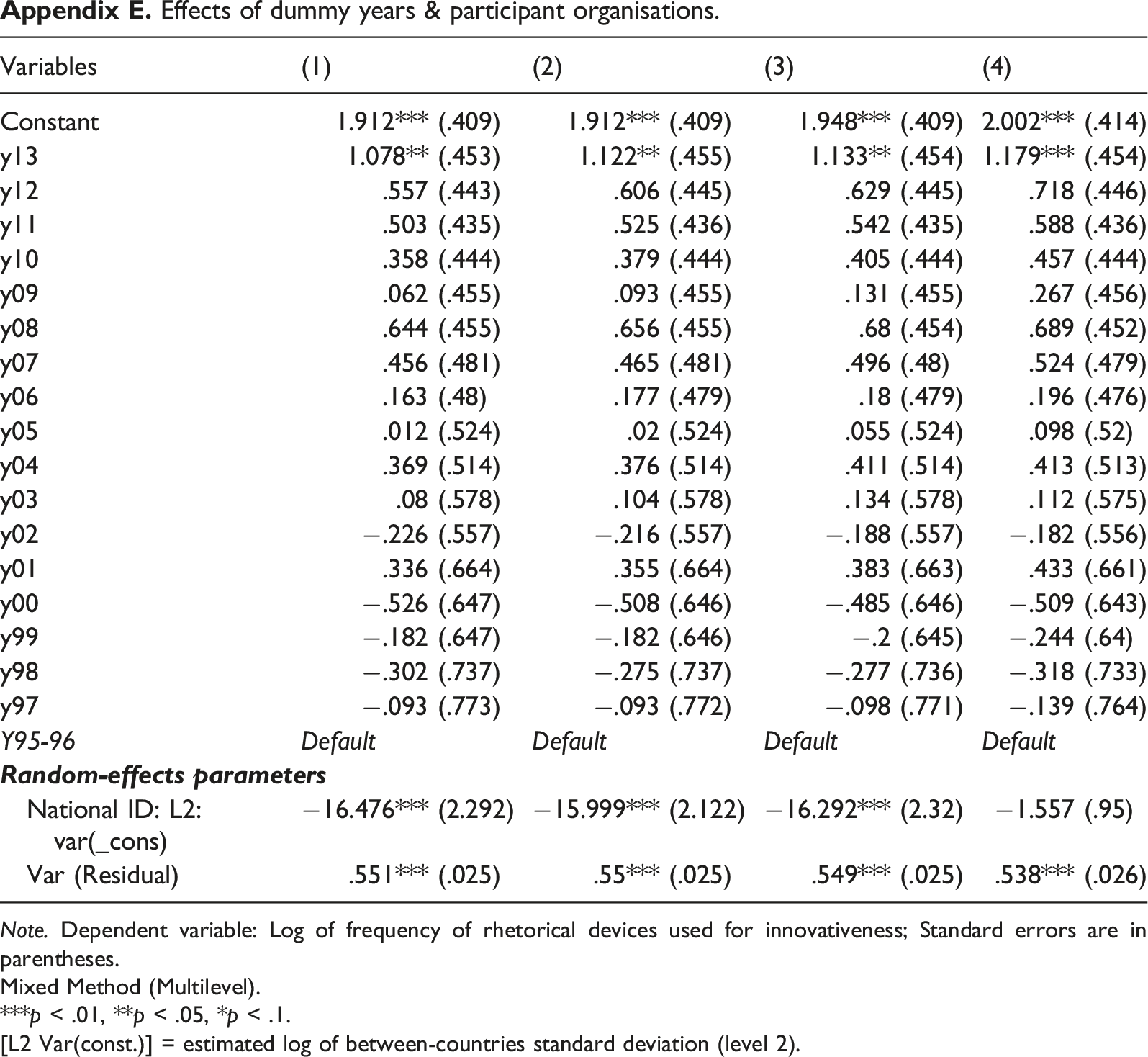
Variables
(1)
(2)
(3)
(4)
Constant
1.912*** (.409)
1.912*** (.409)
1.948*** (.409)
2.002*** (.414)
y13
1.078** (.453)
1.122** (.455)
1.133** (.454)
1.179*** (.454)
y12
.557 (.443)
.606 (.445)
.629 (.445)
.718 (.446)
y11
.503 (.435)
.525 (.436)
.542 (.435)
.588 (.436)
y10
.358 (.444)
.379 (.444)
.405 (.444)
.457 (.444)
y09
.062 (.455)
.093 (.455)
.131 (.455)
.267 (.456)
y08
.644 (.455)
.656 (.455)
.68 (.454)
.689 (.452)
y07
.456 (.481)
.465 (.481)
.496 (.48)
.524 (.479)
y06
.163 (.48)
.177 (.479)
.18 (.479)
.196 (.476)
y05
.012 (.524)
.02 (.524)
.055 (.524)
.098 (.52)
y04
.369 (.514)
.376 (.514)
.411 (.514)
.413 (.513)
y03
.08 (.578)
.104 (.578)
.134 (.578)
.112 (.575)
y02
−.226 (.557)
−.216 (.557)
−.188 (.557)
−.182 (.556)
y01
.336 (.664)
.355 (.664)
.383 (.663)
.433 (.661)
y00
−.526 (.647)
−.508 (.646)
−.485 (.646)
−.509 (.643)
y99
−.182 (.647)
−.182 (.646)
−.2 (.645)
−.244 (.64)
y98
−.302 (.737)
−.275 (.737)
−.277 (.736)
−.318 (.733)
y97
−.093 (.773)
−.093 (.772)
−.098 (.771)
−.139 (.764)
Y95-96
Default
Default
Default
Default
National ID: L2: var(_cons)
−16.476*** (2.292)
−15.999*** (2.122)
−16.292*** (2.32)
−1.557 (.95)
Var (Residual)
.551*** (.025)
.55*** (.025)
.549*** (.025)
.538*** (.026)