




Abstract
Global disruptions are marking our days and calling on individuals, institutions, and the State for institutional change. Given the need to understand changing processes and their implications for society and public policy, it is vital to equip Public Administration students with the knowledge of relevant theories to assess the complexity of such institutional dynamics. Interpretation of institutional changes in motion can benefit from revisiting the Institutional Theory. This article analyzes the works of Douglass North and Ha-Joon Chang, two preeminent contributors to Institutional Theory. Their distinct views on institutions, policies, institutional change, and the State contribute to our understanding of current worldwide socio-economic and institutional challenges. Contemporary phenomena, such as the COVID-19 pandemic, the long-term climate change effects, and the recent Russia-Ukraine war, require the use of institutional theories that have proved to be still relevant.
Introduction
Public administration and public policy scholars have long emphasized the importance of institutional theory for understanding policy action and institutional change. In the last decades, the role of institutions in shaping economic and political behavior and development has been recognized across major social sciences disciplines. Institutional theory has gained a multidisciplinary scope attracting the interest of scholars from Political Science, Public Administration, Sociology, and Economy. This increasing interest in Institutional Theory is also reflected both in the research and teaching of Public Administration. In recent years, authors concerned with public administration education advocated the need to articulate theory and practice, suggesting that coursework undertaken by students needs to include relevant theoretical background (Farrell et al., 2022). Recently, the world has changed dramatically with the COVID-19 pandemic. From a teaching point of view, the pandemic may serve as an opportunity for academia and the public administration discipline to rethink the value of determined theories and their teaching in public administration curriculums (Carrol, 2021). The pandemic together with other disruptive events such as the acknowledgement of long-term climate change effects and the recent Russia-Ukraine war have accentuated the ongoing profound structural changes influencing the dynamics between institutions, social actors, and public policies pressing for public policy innovation and institutional change (Binns and Low, 2022; Hwang and Hollerer, 2022).
These global shocks compel each and every society to create, adapt and develop institutions capable of tackling new challenges. The impact of institutions and institutional change on every nation’s socio-economic evolution is thus in today’s agendas of academics, organizations, institutions and governments. Interpretation of the institutional changes in motion can benefit from revisiting institutional theory, its distinct lines of research, interdisciplinary diversity, and richness in theoretical assumptions and predictions. Public Administration research has been shaped to a very large extent by all the dominant institutional perspectives, including rational choice institutionalism, historical institutionalism, and sociological institutionalism (Siddiki and Frantz, 2021). These different approaches to institutional analysis are largely characterized by distinct theoretical and methodological assumptions leading to different analytical patterns of assessing social phenomena (Mackay et al., 2010). Institutional theory is a relevant theoretical tool to describe the linkages, networks, and couplings of institutions coping with fragmentation, disarticulation, asymmetries between public problems and public jurisdictions, and their high interdependence (Frederickson et al., 2016). Given the turbulent times that we are living in and the need to analyze the changing processes and implications related to these phenomena, it is crucial to equip Public Administration students with the knowledge of valuable theories to assess the complexity associated with such institutional dynamics.
Institutional Theory integrates different research streams namely rational-choice institutionalism, old institutional economics, and new institutionalism, which derive from major social sciences disciplines. In this article, two relevant authors were selected as representative of the diversity of approaches in Institutional Theory literature: Douglass North (1990, 1991, 1995, 2005) and Ha-Joon Chang (2002a, 2003, 2007, 2011). These authors developed distinct approaches regarding the concept and role of institutions, the State, and public policy. North integrates the New Institutional Economics (NIE) rooted in neoclassical assumptions. His work is recognized for expanding the scope of economic analysis by bringing institutions into the neoclassical economics framework. Criticizing NIE, in particular North’s work, Chang adopts early assumptions of old institutional economics and introduces an alternative school of thought designated as Institutional Political Economics (IPE). These two authors’ contrasting views seem particularly relevant for understanding today’s global shocks and the resulting waves of change. Schmidt (2020), for instance, agrees that a pluralist approach, combining different neo-institutionalist analytical frameworks, is required to fully capture the institutional change and governance issues resulting from the Covid-19 pandemic.
The objective of this article is to critically review the main divergences between North and Changs theories while reflecting on the prospect of combining the two strands of thought on key concepts pertaining to Institutional Theory, i.e. institutions, institutional change, policies, and the State. The proposed review is conducted based on three findings in the institutional literature: (i) there is no single definition of institution, thus, different conceptions of institution generate distinct conclusions regarding policies; (ii) North values methodological individualism while Chang prioritizes institutions; (iii) different ontological positions generate contrasting perspectives on the role of the State and political strategies. The proposals of both authors will be compared according to five criteria: i) Theoretical basis - definition of the object of study and ontological assumptions; ii) Definition of institutions and their functions in development; iii) Institutional change and copying; iv) Cause-effect relationships between individuals and institutions; v) State policy.
The article is structured in four parts. In the first and second parts, we address North’s and Chang’s theoretical conceptions, respectively. A comparative analysis of the two authors' theories is presented in the third part. We conclude with some final considerations.
The old institutional economics
The Old Institutional Economics (OIE) is the starting point for our review. This theory, pioneered by Veblen (1898, 1919), is also known as American Institutionalism and Radical Institutionalism among other designations; and has its roots in the American institutionalist tradition prevalent at the turn of the 18th century to the 19th century. This school of thought, developed by the academic community during the 1920s and 1930s, was dominant in American universities until after the Second World War (Hodgson, 2002, 2006). The main topics addressed by this literature were: (i) the neoclassical theory’s inadequate dealing with innovations without considering the conditions of their implementation across societies; (ii) the concern about how institutional change occurs; and (iii) the emphasis on the process of evolution of economies and their technological transformation (Rutheford, 1994).
The main foundations of the OIE are institutions, habits, and rules. Recognizing the crucial role of institutions in molding human behavior and economic interactions, the OIE questions key neoclassical economics assumptions, particularly the lack of importance given to institutions (Kherallah and Kirsten, 2002), and argues that institutions are key to explaining and influencing economic behavior. Using other areas of research on the behavior of individuals, such as psychology, anthropology, and sociology, the OIE seeks to explain how the behavior of individuals is influenced by habits and rules that are integrated and transmitted in society over time and/or are reinforced by institutions. Individuals’ rational choices are thus explained by mental habits and these, in turn, are customary forms of thought embedded in the culture of a society as norms of conduct and acceptance. The relationship between individual and institution is conceptualized as a ‘‘top-down reconstitute causation model’’, a process of evolution through the interactions between human behavior and institutions. Institutions are a complex set of relationships, which implies that they cannot simply be chosen, implemented, or discarded by individuals according to their maximization goals. Institutions precede individuals and are interconnected, that is, there is no one without the other, and there is double relational causality between institutions and individuals.
The emergence of the new institutional economics
In attempting to address both the limitations of the neoclassical theory and the lack of analytical rigor of the OIE’s analyzes, the New Institutional Economics emerges as a new multidisciplinary field integrating institutions in the neoclassical analytical approach (North, 1974). The term neoclassical economics was coined in 1900 reflecting the contribution of influential authors from the 19th and 20th centuries who advocated that the forces of supply and demand lead to an efficient allocation of resources. In essence, according to the neoclassical economics paradigm, societies operate in a world of scarce natural resources and unlimited human needs (see; North, 2010, 1997, 1990) leading individuals to act rationally in their economic decisions.
The New Institutional Economics incorporates the neoclassical assumptions regarding transaction costs and property rights (Ménard and Shirley, 2014). The assumption of rational agents who function as self-interested individuals striving to maximize their expected utility (methodological individualism), constitutes an important feature of the neoclassical thinking (Kjosavic, 2003). In the NIE framework, self-seeking individuals maximize their utility or profits subject to several restrictions, with institutions being integrated as an additional restriction. In this theory, individuals are decision-makers thus the relationship between individuals and institutions is conceptualized as an individual-to-institution, bottom-up model.
It is commonly acknowledged that The New Institutional Economics (NIE) started with Coase’s 1937 article “The Nature of the Firm”. This article and his other famous essay “The Problem of Social Cost” (1960) set in motion profound changes in economic theory. Coase´s influential work provides an integrated way of thinking about the legal character of institutional arrangements. This institutional research stream has its roots in economic theory and incorporates contributions from major social sciences disciplines such as history, sociology, political science, law, and public administration. The main goal here is to explain the functioning of institutions and their role in economic development. Rational choice theory, influenced by its roots in economics and organizational theory, considers institutions as systems of rules and incentives which serve as boundaries influencing collective action. Political life involves collective action in which actors create institutions through dynamics of voluntary agreement, cooperation, and conflict behavior (Leeson and Harris, 2018). Moreover, rational choice theory employs behavioral characteristics and assumptions from neoclassical reasoning together with theoretical principles applied to the “new economy of the organization” (see Moe, 1984; Weingast and Marshall, 1988). This view emphasizes the importance of property rights, rents, and transaction costs for the development and functioning of institutions (Hall and Taylor, 1996; North, 1990, 1994). In essence, the key assumption of the rational choice literature is that aggregate social behavior is the result of the behavior of individuals, who act rationally (rationality assumption) in determining their own choices (methodological individualism) taking into account the information available and the potential costs and benefits associated with their choices. That is, individuals, driven by their own desires, beliefs, and preferences, seek to maximize their utilities in the pursuit of their goals (Brodbeck, 1958; Lawson, 2013; Thelen, 1999). Aggregate social behavior and institutions result from these individual choices and interactions. In sum, this new direction of economics considers that the cost of transacting – determined by institutions and institutional arrangements – is the key to economic performance (Kherallah and Kirsten, 2002). It is here important to note that the first notion of transaction costs goes back to the seminal contributions of Coase (1937, 1960). For this author, the goal is to understand firms’ decisions on whether to produce their goods and services or outsource them, assuming the existence of efficiency gains from the division of labor. In his own words: ‘‘a firm will tend to expand until the costs of organizing an additional transaction within the firm become equal to the costs of carrying out the same transaction employing an exchange in the open market or the costs of organizing in another firm’’ (Coase, 1937: 395). Within the institutional framework, through property rights, individuals appropriate over their labor and their goods and services (North, 1990). In practice, the transaction costs determine the nature and effects of property rights, which play an important role in North’s theory. According to North, contrary to the neoclassical assumptions, property rights and institutions are not simply the result of the evolution of a market economy, resulting instead from a complementary process of institutional change where individuals change the rules of the game in order to maximize profit opportunities. This stance concerning individual behavior reveals an important departure from mainstream neoclassical thought. For North, individuals are not fully rational, they have incomplete, limited rationality, since they are not able to process all available information (North, 1990, 2005; North and Denzau, 1994).
Moreover, North broadens another neoclassical assumption, namely that of the choice under scarcity with utility maximization. Since resources are scarce, individuals´ utility maximization implies restrictions. In turn, these restrictions are inherent to the conceptualization of institutions as proposed by North. In his own words; “Institutions are the rules of the game in a society or, more formally, are the humanly devised constraints that shape human interaction. In consequence, they structure incentives in human exchange, whether political, social, or economic. Institutional change shapes the way societies evolve through time and hence is the key to understanding historical change” (North, 1990: 3).
Restrictions are thus particularly important for understanding the interaction between institutions and individuals. In other words, institutions, viewed as a set of rules, norms, and beliefs, impose restrictions on individuals and influence the relationships between social actors and the process of development among nations.
The role of institutions and organizations in economic development
North’s theoretical-methodological development comprehends three phases. In the first (1950–1971), designated the ‘‘clinometric phase’’, North applies the foundations of neoclassical economics to historical topics. In the second phase (1971–1981) ‘‘from reality’s perspective’’, North expands the neoclassical model, with tools provided by the new institutionalism, to address long-term development issues. The third phase, initiated in 1981, considers the ‘‘refined neoclassical model phase”, in which instead of applying models to historical events, North focuses primarily on theorizing the relationship between institutions and economic growth, incorporating themes ignored by neoclassical models, such as the use of behavioral perceptions (Brownlow, 2010). North (1990, 1994, 1995) believes that the development of countries is intrinsically related to the evolution of institutions. He seeks to demonstrate that one society’s historical evolution is conditioned by the formation and evolution of its institutions (North, 1991, 2005; North and Thomas, 1973). This analysis made North a pioneer of New Economic History (Kherallah and Kirsten, 2002).
For North, ‘‘institutions are the rules of the game in a society or, more formally, are the devised constraints that shape human interaction’’ (North 1990: 3), “(…) they structure incentives in human interaction, whether political, social or economic‘‘ (North, 1995: 23). The principle of ontological individualism is fundamental here, that is, individuals precede institutions: ‘‘Institutions are creations of human beings. They evolve and are altered by human beings; therefore, our theory must begin with the individual’’ (North, 1990: 5). To his individual-to-institutions bottom-up model, North adds the fact that individuals’ information processing does not generate a perfect picture of the world, due to incomplete information and individuals’ limited rationality. Consequently, individuals compete in an environment of uncertainty and scarce resources (North, 1990, 1991). As individuals do not know all their choice possibilities in an ex-ante way, uncertainty becomes responsible for the “malfunction’’ of transactions, which makes it impossible for individuals to achieve optimal solutions, leading to increased transaction costs. It follows that institutions emerge as important mechanisms capable of defining and implementing exchange agreements that ‘‘reduce transaction costs and uncertainty by providing a structure for everyday life” to guide, and constrain human interaction (North, 1990: 4). Institutions also play the role of ‘‘incentive structure’’ by defining the gains that can be obtained through economic decisions made by individuals and organizations.
The “rules of the game’’ principle refers to the important role that institutions play in influencing rules and norms, the humanly devised constrictions that structure and guide human interaction. It pinpoints the restrictive nature of institutions, defining and limiting individuals’ set of choices. The “rules of the game” are made of formal restrictions (rules, laws, constitutions) and informal restrictions (norms of behavior, conventions, and codes of conduct or self-imposed). Together, formal, and informal institutions define one society’s incentive structure (North, 2010) and as that structure evolves – institutional change -, it influences the direction of socioeconomic change (North, 1991).
Organizations defined as ‘‘groups of individuals linked by a common purpose to achieve goals” are the main agents of society. They include political bodies (political parties, senate, town hall, regulatory agency); economic bodies (companies, trade unions, family farms, cooperatives); social entities (churches, clubs, athletic associations); and educational entities (schools, colleges, vocational training centers)" (North. 1995:6). The main difference between institutions and organizations is that institutions are formed between different levels of efficiency, across societies, capable of encouraging cooperation between agents in different ways. Institutions determine opportunities in society and organizations are created to take advantage of these opportunities. As organizations evolve, they change institutions - Organizations are reflections of one society’s institutional structure and, conversely, the main cause of change of such institutional structure (North, 2005: 63). That is, institutions, or the institutional matrix (formal and informal restrictions), shape organizations’ goals and actions, which in turn have feedback repercussions on institutions. The way in which organizations and individuals acquire knowledge and skills to accomplish their goals, reflects the country’s global performance and level of development (North, 1990, 1994, 2005). In North’s framework, organizations are conceptually the main agents of change, by whom dynamics and institutional change are understood. Institutions and belief systems change as the mental models of individuals and organizations shape their choices (North, 1995: 353). The learning process, culture, and ideology are crucial in such an institutional changing process.
Institutional change - the learning process, culture, and ideology
North points out that the neoclassical theory fails to explain long-term economic and institutional changes in society (North, 1994, 1995, 1997, 2005) and provides a relevant contribution to institutional theory by introducing a historical context to the neoclassical analysis through the introduction of institutions in the neoclassical model. It is worth noting that Douglass North was awarded jointly with Robert W. Fogel the Nobel prize in 1993 ‘‘for having renewed research in economic history by applying economic theory and quantitative methods to explain economic and institutional change’’.
In a world of continuous and atypical changes where there is no formation of stable expectations for the future (non-ergodic world), learning is a cumulative process, involving ideological changes and new knowledge, that results in production increases (North, 1999). Institutions provide incentives for learning in productive activities, and individuals continuously adapt to the constant transformations of the environment (North et al., 2005). The learning process depends on the established belief system. Individuals´ choices are shaped by their mental models which are integrated in shared belief systems that are the product of repetitive feedbacks from the social environment (North et al., 2005). Individuals with common cultural backgrounds and experiences share similar mental models, ideologies, and institutions, whereas individuals with different learning experiences (both cultural and environmental) have different perspectives (models, ideologies) to interpret the environment. The information feedback from individuals’ choices is not sufficient to allow for the convergence of competing interpretations of reality. Under such uncertainty, it is vital to understand the relationships between the mental models that different individuals construct to make sense of their reality (North and Denzau, 1994: 3,4).
Institutions are common mental models hence an institutional change requires the transformation of collective belief systems, which occurs slowly and gradually (North, 1990, 1991; North et al., 2005). The transformation of belief systems is essential for institutional change, but it does not necessarily guarantee that institutions change in a more efficient way (North et al., 2005). Indeed, the application of the same rules in different societies (institutional copying) usually produces unequal results due to the cultural values and ideology of each society (North, 1990). Institutional change depends thus on cultural values and ideology. One economic or political change can be either facilitated or hindered by the cultural values (transmission of knowledge in time) and ideologies prevalent in each society.
Ideology is fundamental in behavioral change as people’s actions are influenced by ideological principles, myths, dogmas, and theories (North, 1981, 1991; North and Denzau, 1994). When, through ideology, individuals perceive the economic system as fair, uncertainty can be reduced by shaping collective behavior beyond individualistic behavior. This enables a reduction in transaction costs, as it lowers the costs of monitoring individuals prone to the transgression of rules (North et al., 2005). In addition to its importance in sustaining informal rules, ideology influences the constitution of one society’s formal rules. The functioning of the political system determines the origin and dynamics of formal rules in a society. Ideology shapes the legal framework of society (North, 1981) and the State. It matters for the understanding of the rules and laws that derive from the functioning of the political system, through the decisions that political agents make through norms and rules.
According to Vogelpohl and Aggestam (2012), institutions can be perceived as structures and mechanisms of social order and cooperation. These features have been extremely important to analyze the response of global international institutions in dealing with the Covid-19 pandemic and to guide institutional change. In a reflective commentary on the Covid-19 and its consequences, Hwang and Hollerer (2020), maintain that this pandemic has emphasized the fragility of institutional orders and has radically altered our understanding of collective action. The impact of this health crisis on institutional change has been, according to these authors “unprecedented in our lifetime” and it is still an ongoing process. This emphasizes the importance of further studies on institutions and institutional change, which will also be beneficial to Public Administration curriculums. Indeed, this context can be viewed as an opportunity to understand the current changes in a dynamic process that tests and advances the “well-stocked conceptual toolbox” of institutional theory (Hwang and Hollerer, 2020).
The adaptive institutional change, maximization of results and path dependency
For North, institutional change occurs through a process of adaptation in which societies adjust to shocks and make institutions capable of effectively dealing with a new reality (North, 1999). Changes are cumulative, that is, they are caused by individuals who encourage other individuals to increase productivity, which eventually produces positive social change (North, 1990; Davis and North, 1971). Change moves in the adaptively efficient direction when institutions provide incentives that encourage decentralized decision-making processes that enable individuals and societies to maximize the search efforts for new ways of solving new problems (North, 1990). For instance, the sustainability of our planet depends on governments of all countries complying with international agreements related to the planet’s boundaries (Rockström et al., 2009). This involves, among other resolutions, the transition to a net-zero energy system, until 2050, which requires sustained investment in low-carbon energy sources, such as renewable energy technologies over the next decades (Steffen and Patt, 2022). This transition implies a strong commitment from policymakers who have not been implementing the needed changes. It is commonly agreed that crises are important drivers of political change when individual and organizational perceptions of problems and their solutions converge to effective political actions. In this sense, the Russia-Ukraine war, too, has exposed the weaknesses of some European energy politics and has placed renewable energies on top of the policymakers' agendas.
According to North, two principles are important for understanding the dynamics of institutional change: maximization of results and the path dependency mechanism. Regarding the first, organizations seek to maximize their results, and this may not be reached through relative price changes and preferences. Organizations can reorganize their productive structure by investing in changing the institutional matrix under which they operate. Such institutional-change investment happens when the organization’s cost-benefit analysis leads it to act in the political sphere, to change the laws, contracts, and norms, which prompts institutional change (North, 1990, 1991, 1994). In this regard, not all institutional changes are beneficial, once institutions can influence transaction costs and coordination possibilities and thus impact differently on the pace of economic growth (Kherallah and Kirsten, 2002). It follows that institutions can acquire different configurations leading to distinct paths of economic development.
The second principle is the path dependency mechanism. Path dependency is the cumulative process of institutional evolution in which one institutional structure provides the future opportunity set for organizations and individual entrepreneurs (North, 1991). It also explains how informal institutions originate and evolve (North, 2005). For instance, the institutions of developed countries are the result of a long process of adaptation. Path dependency affects the degree of institutional change and renders it impossible to transplant one society’s institutional model to other societies. Path dependency also explains how inefficient solutions can persist in time, even if chosen by rational agents, because institutional evolution results from culture, learning, and mental models which evolve in time. As the informal norms are different across societies and these norms have an impact on formal norms, the institutional copying of one country to another is deemed inefficient.
The state
Coordination in productive activities is central to North’s theory. As several agents have to make decisions related to one another in productive activities, the cooperation of agents (individuals, companies) is essential for growth and development. Poorly defined private property rights are the main obstacle to cooperation and development. In an economy with ill-defined property rights, high investment in fixed capital (machinery, installations) and long-term amortization are compromised, with higher risks and uncertainty - higher transaction costs. In this case, investments will be short-termed, with low fixed capital. Therefore, firms will be small, uncompetitive, unable to grasp economies of scale in industrial activity, and unable to grow, which compromises economic growth and development. Conversely, an efficient institutional matrix is one capable of stimulating an agent or organization to invest in one economic activity with higher social returns than its social costs (Davis and North, 1971). Economic, political, and individual (social) freedoms are directly associated with property rights. To these, North et al. (2009) add the function of equal individual rights. Property rights determine the entire functioning of the economic system, innovation activity included.
The ideal institutional structure ensures property rights, reduces transaction costs, and reduces conflict between agents. Recognizing that efficient institutions do not emerge as automatic responses from the market, North (1990) believes that a theory of the State is fundamental because it is the State that specifies the property-rights structure and is responsible for its efficiency, upon which depends economic growth and development. In North’s (1981) reasoning, the State defines rules that reduce transaction costs and increase the level of economic activity, thereby increasing government revenue. Interacting with the market, by defining efficient property rights, the State generates positive externalities (North and Thomas, 1973).
There are, however, situations in which the State fails to ensure efficient property rights. Some governments, along their historical processes, create property rights for their own benefit, making them inefficient and high in transaction costs. Sometimes, the sharp difference between rich and poor countries is better justified by the existence of an institutional structure that stimulates the accumulation of physical and human capital rather than by the accessibility to technology. Some countries have evolved at a slower pace because they lack an efficient institutional configuration with a set of rules, laws, and customs capable of stimulating economically productive activities. Countries must then devise policies that create and enforce efficient property rights and an institutional matrix that adapts to evolving technologies and demographic changes (North, 1995).
The institutional political economics approach
The institutional political economics (IPE) approach developed by Chang emerges as an alternative perspective to the neoclassical paradigm. By refuting, with empirical facts, the hypothesis of efficient and self-regulated markets as promoters of development, Chang establishes his criticisms of the New Institutional Economics paradigm, in particular of North’s theory.
Chang’s institutional political economics (IPE) contributes to the complex debate on the role of institutions in the socio-economical evolution of nations. Chang (2006) argues that one difficulty in studying the relationship between institutions and development is that there is no widely accepted definition of institutions. Without knowing what institutions are, there is no consensus on what they can do, in particular to promote development. Institutions are organic, that is, each institution carries one historical baggage that involves varied processes of decision-making and learning by trial and error. An institutional approach must explain how institutions shape economic behavior and outcomes; and how institutions themselves are formed and change over time, shaping individual and collective economic behavior and outcomes (Chang and Evans, 2005).
In contrast to North’s definition of institutions as the rules of the game, that is, restrictions to human action, Chang (2006) sees institutions as mechanisms capable of simultaneously restricting, constituting, and enabling human action. In agreement with the NIE, Chang and Evans (2005) sustain that individuals do influence the way institutions are formed and run, however, the two authors argue that there is a two-way causation between individual motivation and institutions, and ultimately institutions come, at least ‘‘temporally’’, before individuals. Moreover, deliberate decisions produce changes in institutions, and, consequently, the chain of causality between institutions and individuals is also subjected to changing processes. In this respect, the institutional political economics follows the old institutional economics’ top-down relationship between institutions and individuals.
Institutional change
One reason for the existing cultural and institutional diversity is that cultural/institutional changes and economic development influence each other through complex chains of causality over time. In addition, institutions are persistent and stable, but not necessarily immutable, and may even change dramatically. Ultimately, people reproduce and transform institutions, which does not imply reducing institutions to individuals (Chang, 2005). The transformation of institutions by individuals occurs through processes not necessarily driven by personal material goals. Choices based on ideas and culture are shaped in time to cause institutional change (Chang and Evans, 2005). Individuals have ideological-cultural interests in favor of some conception that is following their worldviews. Chang (2006, 2011) names this type of behavior the ‘‘human agency’’, according to which choices are deliberately made and based on ideas and culture. That is, individuals are, a priori, shaped by the institutions in which they are inserted, absorb the moral codes and norms that are materialized in the social structure that surrounds them, and then, through the ‘‘human agency’’, individuals shape and change the institutions. This means that people’s preferences are not given, they are instead formed according to the relationships that occur between agents in the institutional environment dynamics through interaction and policies (ideal relations).
According to Chang and Evans (2005), the process of institutional change can be understood through the “emphasis on efficiency” and “emphasis on interests” perspectives, both based on culture. Firstly, the “emphasis on efficiency” depends on what the agents consider efficient, which entails a high degree of subjectivity. Certain institutions may be preferred as efficient over others simply because they fit better into a particular worldview (culture). This leads individuals to legitimize some institutions and challenge others, regardless of the institutions’ real, objective efficiency. Secondly, the “emphasis on interests” refers to the process of institutional change through the interests of agents, according to which the interests of determined groups shape institutions through political and social institutions legitimized by culture. As culture influences worldviews, culture can be manipulated to benefit a particular institutional matrix favored by a specific group.
The State, the market, and policies
Chang and Evans (2005) argue that institutions such as the State, the market, and firms need to be understood as mechanisms capable of, at the same time, constituting, restricting, and enabling human action. An institution is a complex configuration of formal and informal rules, maintained and/or transformed by agents’ intentional actions through numerous different institutions. In Chang’s view, understanding the relationships between the market, the State, and politics is essential for understanding institutional change. The market does not exist in an institution-free environment. In fact, the market is itself an institution.
With examples of historical and empirical facts, Chang (2002a, 2002b) refutes the neoclassical hypothesis of efficient and self-regulated markets as promoters of the development of countries, and highlights the State’s intervention as far beyond regulating and ensuring property rights. The market and the State are connected by political relations and the State is a strategic actor, a planner, and a coordinator of development through the construction of political relationships with the market (Chang, 2002a, 2003). In our days, the market actually calls for the State’s intervention. For instance, under the Covid-19 pandemic, and the Russia-Ukraine ongoing war, governments have been diligent in mitigating the economic and financial costs through policy measures directed at vulnerable individuals and organizations. Regarding the climate global crisis, governments have been introducing legislation to reduce the damage caused by human activity on the planet.
The State is the result of a complex net of human motivations within the public sphere, which are multifaceted, ranging from self-interest motivations to unselfish behavior based on ideologies, value judgments, and groups. The agents who operate in the public sphere are also influenced in their motivations by the institutional environment in which they are integrated, with values internalized in commitments to public issues (Chang, 2002a). The State is an institution capable of creating new institutions besides being responsible for controlling existing ones (the market). The creation and control of institutions by the State are mediated by political relations, there being no correct way to delimit how far these relations permeate. Political relations occur between agents who have different conceptions about the structure of property rights and duties instilled in institutions. An example of the complexity of these political relations can be observed in the work of Fligstein (1996) who shows how political relations permeate the functioning of the market, considering how the influence of social actors within the State can direct government policies according to their interests, shaping, for example, the characteristics of the firms participating in the market in which they operate.
For Chang (2006), the diverse and multifaceted character of property rights can be captured by incorporating them in a complex set of institutions such as bankruptcy laws, intellectual property, and contract laws, among others. A specific property right can become good or bad for society depending on the underlying technology, population, the balance of political power, or even ideologies. For example, when perpetuated, property rights can protect obsolete technologies and cause stagnation, limiting a technological progress trajectory (Chang, 2006). The State and society must decide which property rights should be protected and under which conditions.
Institutional performance (quality) and institutional copying
The institutional matrix is a set of formal and informal institutions. It faces measurement problems of quantification, aggregation, and comparison. Institutions being qualitatively different from each other, there is no common denominator that can be used to quantify institutional quality. This leads to subjective judgments about the institution, through the worldviews of those who evaluate them (Chang, 2006, 2011).
It is fundamental to clearly distinguish between institutions’ forms and functions. Kaufmann et al. (1998, 2002) compile the main “governance” indices (institutional quality indices), which combine variables that capture differences in the forms of institutions - democracy, independence of the judicial system, absence of State property -, and the functions they perform - rule of law, respect for private property, compliance with the treaties, price stability, fight of corruption.
Institutions can have many functions, hence identifying the most important functions of one institutional arrangement is a very complex exercise, which can lead to errors of judgment (Chang, 2007). Firstly, the same institution may fulfill more than one function. For example, political institutions serve for conflict resolution, provision of social cohesion, and decision-making processes (Chang, 2007). Secondly, several institutions can perform the same function, for example, the economic stability function can be fulfilled by different institutions: one central bank focused on reducing inflation, government budget institutions, and financial regulatory institutions (Chang, 2007). Thirdly, the same function may be performed by different institutions in different companies (or in the same company in different periods). Failure to understand that there is a functional multiplicity of institutions can lead to the problem designated by Chang (2007) as institutional monotasking, that is, the attribution to one institution of one function that does not agree with the institution´s reality.
Adding to the problem of institutional monotasking, Chang (2006, 2011) argues, many institutions are conceptual compositions of several other concrete institutions. One example is the property law system, which consists of land laws, urban planning laws, contract laws, bankruptcy laws, and intellectual property rights laws (Chang, 2011). The problem of aggregation lies in the fact that one must ‘‘add’’ distinct institutions, which are qualitatively different and inserted in different environments. When adding these different institutions, the resulting index is a value incapable of correctly expressing the institutional quality. One last problem is that of the heterogeneous sample, in that even if a reasonable measurement of institutional quality is made and an aggregation of the measures is made in a single value (indices), these are not comparable across countries (Chang, 2005, 2011), since the relationships that take place in the institutional environment of one country are qualitatively different from those that occur in another.
Regarding institutions and economic development, Chang (2006, 2011) disputes the literature defending the neoclassical free trade and the ‘‘global standard institutions’’ (GSI), because they compel developing countries to conform to them in order to ‘‘survive’’ in the globalized world. The author criticizes the literature that supports or models institutional “fetish of the form” formats, that deny institutional diversity. Chang believes in offering public policy authorities several alternatives, for which empirical evidence of the various forms of institutions that carry out similar functions in different contexts is needed. Transplanting a formal institution does not guarantee the same positive results as those of that institution in its country of origin. There is an interaction with local institutions, making it necessary to readjust the copied institutions to different social conditions (Chang, 2005, 2006). If not contextualized, one institution’s copy ignores the historical, political, and social context of the receiving country, disregarding institutional diversity.
Chang (2002b) argues that the exemplar institution model of developed countries did not exist before they became developed. The historical evidence is that firstly countries developed economically and afterwards developed the institutions they have today. The accumulation of capital and the increase in the populations´income generated new demands in society, which stimulated the process of institutional change. Thus, the strongest causality of institutional change goes from economic development to institutions (Chang, 2002b, 2006, 2011). In other words, the good institutions of developed countries are a consequence of their development process, which culminated in a process of institutional maturation. Therefore, institutions should not be copied across countries with different levels of economic development and “institutional maturity”.
Concluding, although there are identified essential functions that institutions can perform for development, there are no exact types and forms of institutions to fulfill these functions. Institutions are related to a systemic and broad institutional environment, where interaction happens with other formal institutions, as well as with informal institutions which are more difficult to modify in a short period. Institutional copying is rarely sufficient to ensure successful institutional development. Behind each institution there is a historical context inherent to a given society, involving varied processes of decision‐making and learning through trial and error, hence reproducing in a developing country the policies or institutions of a developed society may be counterproductive (Chang, 2002b). It is very difficult to identify a single set of functions and forms of desirable institutions for socially and economically diverse countries.
Chang and North: Contrasting views
Comparative summary of key assumptions regarding North and Chang.
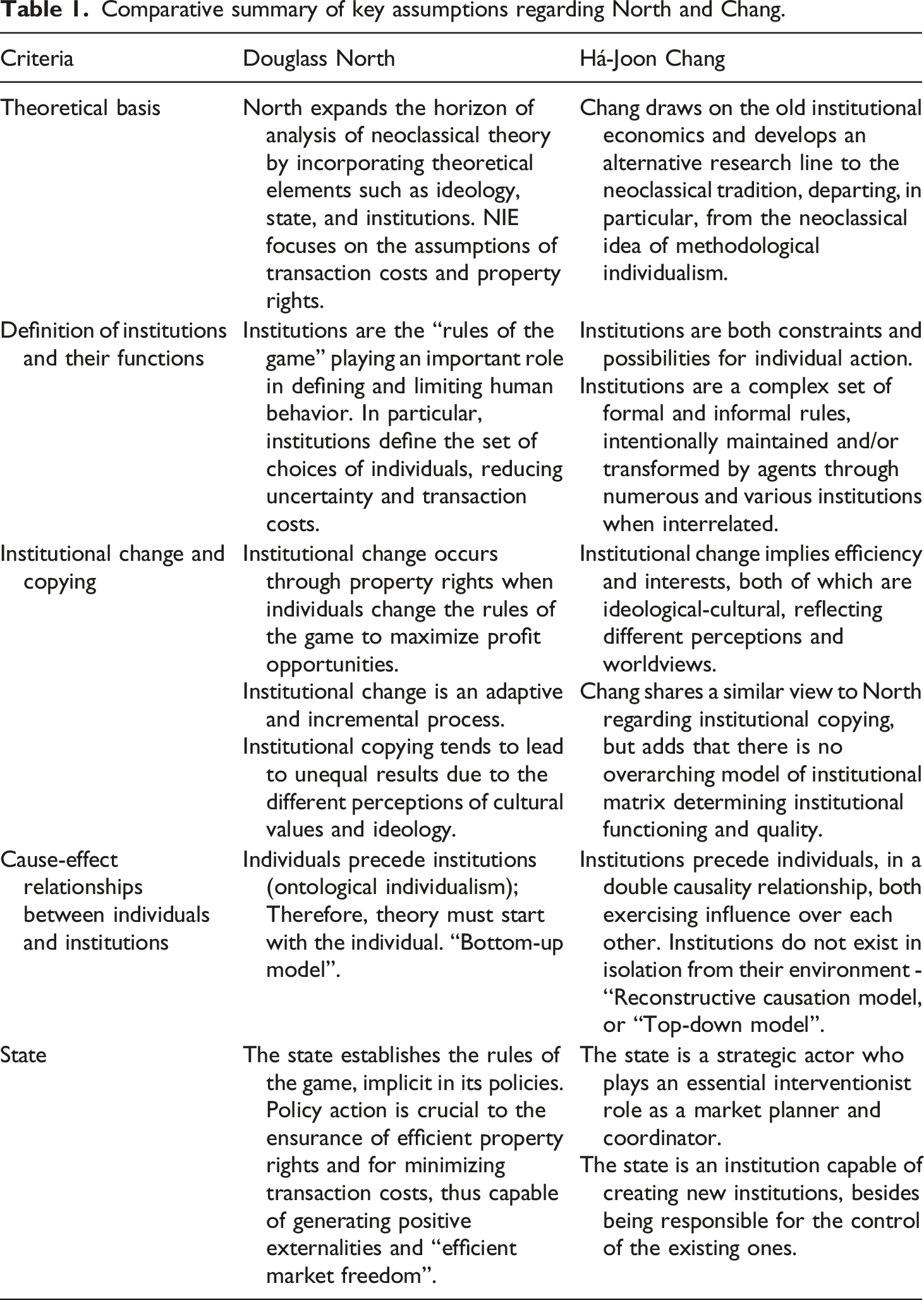
In terms of theoretical basis, the New Institutional Economics extends the neoclassical model of transaction costs and property rights, introducing elements such as ideology, State, and institutions in the analysis. North contributes to this analysis with the concept of limited rationality, which creates an environment of uncertainty and increased transaction costs. By providing a structure for everyday life, institutions emerge then as important mechanisms capable of defining and implementing trading agreements that reduce uncertainty and transaction costs. Institutions define ‘‘the rules of the game’’, with guide lining rules and norms (restrictive characteristics) that limit the set of individuals’ choices, and perform the function of ‘‘incentive structures‘‘ by defining the gains that can be obtained in transactions. For North, institutions are creations of individuals, that is, individuals precede institutions. North seeks to demonstrate how one society’s historical evolution is conditioned by the formation and evolution of its institutions. This author believes that the development of countries is strictly related to the development of their institutions. In his turn, Chang refutes the existence of a state of nature populated by atomized individuals and argues that institutions (social structures) precede individuals. Accordingly, institutions are considered complex relationships that cannot be simply chosen, implemented, or discarded by individuals according to their maximization objectives. In Chang’s view, institutions are mechanisms capable of, simultaneously restricting, constituting, and enabling human action. There is a two-way causation between individual motivation and institutions, and ultimately institutions precede individuals. Moreover, deliberate decisions alter institutions, and, consequently, the chain of causality between institutions and individuals. Chang proposes to modify the ontological starting point of the New Institutional Economics by refuting with empirical facts the hypothesis of efficient and self-regulated markets as promoters of development. Each institution is created within a historical and cultural context inherent to a given society, through varied processes of decision-making and learning through trial and error. It is hence very difficult to identify a single set of functions and forms of desirable institutions for socially and economically diverse countries. It follows that reproducing the policies or institutions from a developed society in a developing one may be counterproductive.
In what concerns the definition of institutions and their functions, North considers that institutions exercise the “incentive structure” function by setting the gains that can be obtained from transactions, depending on the economic decisions made by individuals and organizations. Organizations are thus created to take advantage of the gain opportunities. Once individuals precede institutions, they create and change them. According to North’s assumption of ontological individualism, individuals are the unit of analysis. In contrast, Chang sustains that there is a relationship of double causality between institutions and individuals. Institutions are persistent and stable, although not immutable since they are transformed and reproduced. The institution is a complex set of formal and informal rules, maintained and/or transformed by intentional agents through numerous and different interrelated institutions. According to Chang, identifying the key functions of institutional arrangements is a challenging task that can lead to errors of judgment, because of the functional multiplicity of institutions. Institutions perform several functions, and the same function may be performed by different institutions in different environments.
Regarding institutional change, North broadens the neoclassical assumption of choice under scarcity with the individual’s maximization of satisfaction (of utility). Institutions define the restrictions on individuals’ actions. An institutional change occurs through property rights in that individuals change the rules of the game to maximize profit opportunities. A short-run change happens through a relative price change, whereas a long-run change occurs through the transformation of individuals’ belief systems (mental models). In this process of change, the learning process, ideology and culture are rather important. A different stance is assumed by Chang, who maintains that institutional change occurs through a combination of projects that are not necessarily based on the pursuit of personal material interests. Individuals have ideological-cultural interests reflecting conceptions of their worldviews. These are formed in the relationships that occur in the institutional environment through the exchange procedure (interaction) and policies (ideal relations). Institutions are persistent and stable, but not immutable in the long-run and may even change drastically. In North’s view, institutional change is an adaptive and incremental process, in that societies adjust and develop institutions that deal with altered reality. Since institutional evolution is the result of culture, learning, and mental models, path dependency or factors throughout history are relevant for understanding institutional change. For Chang, institutional change is based on the emphasis on efficiency and interests, both based on culture. The efficiency phase comes from the agents’ understanding of institutional efficiency, which is highly subjective. Determined groups of individuals can influence institutional change through their interests, thus shaping institutions through political and social institutions, legitimized by culture. As culture influences worldviews, it can be manipulated to favor one particular institutional matrix.
Concerning the fourth criterion of analysis, the “Cause-effect relationships among institutions”, North considers that the improvement of institutions allows nations to develop. In contrast, for Chang, the strongest causality goes from economic development to institutional development, in that the accumulation of capital and the increase in the population’s income generate new demands and press for institutional improvement. Regarding institutional copying, North finds that it tends to lead to unequal results, due to the distinct cultural values and ideologies of each people. Chang agrees concerning the inefficiency of the institutional copy, adding that there is no institutional matrix model. Institutions are qualitatively different from each other, they relate systemically in a broad institutional environment, and many institutions are conceptual compositions of several others. There are thus methodological difficulties in aggregating and comparing them, there being no common denominator to quantify them. Adding qualitatively different institutions, inserted in different environments leads to subjective judgments dependent on the worldview of those evaluating them.
The last criterion relates to the role of the State in the economy. North and Chang have distinct views regarding this criterion. North considers that “efficient market freedom” exists and the State is expected to design policies that ensure and enforce well-defined and efficient property rights, while minimizing transaction costs to generate positive externalities. Thus, property rights determine the entire functioning of the economic system influencing innovation and reforming processes. This notion is particularly relevant for examining development trends. That is, if countries want to develop or evolve through successful institutional reforms, they must change the belief system and the cultural context which shapes mental models, consequently influencing individual choices and institutional arrangements (North, 2005). In contrast, Chang argues that one property right can be good or bad for society, depending on changes occurring in the areas of technology, population, and in the balance of political power, or even ideologies. Important is the ability of each society to decide which property rights should be protected and under which conditions. Chang questions the assumption that a less interventionist State promotes development, arguing that the State is an important actor who acts directly in the promotion of policies and intervention in markets. In other words, the state is primarily a planner and a coordinator of development through the construction of political relations with the market. Market and State are connected by political relations and are essential for understanding institutional change. The market itself is an institution and the State, in turn, is an institution capable of creating new institutions, besides being responsible for controlling existing ones. The creation and control of institutions by the State are mediated by political relations and there is no correct way to delimit how far these relations permeate.
Concluding remarks
With this article, our main goal has been to provide a critical review of the contributions of Douglass North and Ha-Joon Chang to Institutional Theory, while emphasizing the value of this theory in addressing global socioeconomic and institutional challenges currently faced worldwide. Within the public administration domain, the challenge of facing current disruptions associated with contemporary phenomena, such as the COVID-19 pandemic, the global long-term climate change effects, and the recent Russia-Ukraine war, requires the use of these institutional theories that have proved to be still relevant.
North and Chang provide rich and insightful, although contrasting, perspectives regarding key dimensions of Institutional Theory, which may assist public administration students to explain the functioning of institutions, the role of the state, social actors, institutional change, and development. We believe that the complementary contributions of North and Chang to Institutional Theory are indeed relevant to the teaching of Public Administration.
Chang and North have a common view regarding the role of institutions in the development of economies, which allows for bridging dialogue between their theories. As these authors have one common object, although reflecting different ontological stances, their research can be considered crucial to institutional thought. Their importance to Institutional Theory can be summarized in the following aspects. Firstly, these authors develop different research lines. North develops the New Institutional Economics, intending to broaden the spectrum of issues addressed within the neoclassical tradition, whereas Chang proposes an alternative line of thought to the neoclassical tradition, the Institutional Political Economics. Secondly, North focuses on examining the mechanisms of choice under scarcity and uncertainty contexts. Given the current worldwide crises, the work and the conceptual tools proposed by North might be applied to provide economic and political programs for existing problems. But Chang’s view that individuals may be more than self-interest seekers can come into consideration in the required new economic and political programs.
Concerning the role of institutions in development, North believes that institutional change allows nations to develop, whereas Chang argues that, instead, it is economic development that leads to the improvement of institutions. Moreover, in what concerns cause-effect relationships between institutions, Chang emphasizes that although there is a two-way causality relationship between individual motivations and social institutions, development creates new demands that place in motion institutional change. It is worth noting that the practice of transplanting institutional arrangements from developed countries to underdeveloped regions is complex and does not always produce the intended results. Indeed, both authors converge regarding the ineffectiveness of institutional copy due to the specific cultural values and ideology of each geographical setting. Interestingly, North finds that institutional copying tends to lead to unequal results and Chang adds the lack of an institutional matrix model to serve as a paradigm to be followed. For both authors, the copying of institutions and policies from developed to developing countries does not produce in the latter the same results as those of the former.
Regarding the role of the State, whereas North sees the State mainly as a regulator; a keeper of the “rules of the game” as well as of property rights, Chang envisages an interventionist State; a planner, conductor and coordinator.
The theoretical pluralism brought by Chang and North has great value to address contemporary global phenomena. The review of these two authors´ main contributions to the institutional theory allows us to better interpret the ongoing movements of institutional change brought about by the current global phenomena.
Footnotes
Declaration of conflicting interests
The author(s) declared no potential conflicts of interest with respect to the research, authorship, and/or publication of this article.
Funding
The author(s) received no financial support for the research, authorship, and/or publication of this article.
