




Abstract
The disability resource centers (DRCs) of world-class universities play a central role in achieving the goal of promoting inclusion and equity in higher education. To provide a reference for the development of inclusive education in China’s double first-class universities, the DRCs of the top 10 universities were selected as typical cases to analyze their experiences and dilemmas. Regarding service mechanisms, DRCs aimed to ensure equitable access so that students with disabilities (SWD) could fully and holistically participate in universities, thereby improving inclusion on campus. In addition, DRCs established official websites as a service platform and developed clear service procedures and grievances to ensure the quality of service. Regarding service content, DRCs emphasized enhancing the disability awareness of campus members and provided support and services for SWD in their study, life, and employment to ensure that SWD could receive high-quality higher education. However, DRCs also suffered from dilemmas of low service application rates, flawed service mechanisms, and controversial service quality. Accordingly, suggestions and implications are proposed to improve inclusion and equity in China’s double first-class universities, including establishing a collaborative disability service system with DRCs as the core, optimizing the service mechanism, and providing personalized and diversified support service content.
Keywords
Introduction
Since 2015, providing inclusive and equitable education for all students, including students with disabilities (SWD), has become one of the important goals of the United Nations 2030 Sustainable Development Goals (2017). This goal focuses on providing opportunities for enrollment, increasing the practices that lead to full participation, and reducing the exclusion and isolation of SWD (Aguirre et al., 2020). In recent years, inclusion and equitable education have been regarded as important evaluation indicators for higher education quality (Moriña, 2016). Universities are expected to provide equitable learning opportunities and learning resources to support the progress of all students, including disadvantaged groups such as SWD (UNESCO, 2017). Meanwhile, the number of SWD in world-class universities has continued to rise. For example, the number of SWD at Oxford University increased from 7.8% in 2007 to 11.6% in 2021 (Oxford, 2019), while UC Berkeley reported that the number of SWD in 2021 reached 11% (Berkeley, 2020). Thus, to guarantee the rights of SWD to receive inclusive and equitable quality education, world-class universities established disability resource centers (DRCs) as the core of disability support services for SWD, and these DRCs effectively enabled SWD to benefit from high-quality education and enjoy full participation in the universities (Haezendonck et al., 2016).
Similarly, China’s double first-class universities have carried out preliminary explorations of inclusive higher education and have made initial achievements (Zhang et al., 2020). However, SWD in China’s double first-class universities still face many difficulties in aspects such as major selection, accommodation, examinations, daily life, and social activities (Wang & Deng, 2021). Thus, this study aimed to systematically explore the experiences and dilemmas of DRCs in world-class universities and provide lessons for the development of inclusive education in China’s double first-class universities.
The Important Role of DRCs in Ensuring the Quality of Inclusive Higher Education
Inclusive and equitable education refers to “a process that helps to overcome barriers limiting the presence, participation, and achievement of learners” (UNESCO, 2017). However, SWD often experience various barriers in their social activities, curriculum, learning, and examinations (Lombardi et al., 2018). To enhance the inclusion and equity of higher education received by SWD, universities instituted DRCs, also known as the Office of Disability Services, Student Accessibility Services, or the Office for Inclusive Education (Mendoza-González et al., 2022). DRCs have played an important role in improving quality of life on campus, academic performance, and learning ability for SWD and have gradually addressed problems of the low academic achievement, high deferral rates, and high dropout rates of SWD (Kim & Crowley, 2021). World-class universities, such as Harvard University and Stanford University, also set up DRCs to improve the quality of inclusive higher education for SWD. Thus, the experiences of DRCs in world-class universities might have important implications for improving the quality of inclusive higher education in China’s top universities.
The Development of Inclusive Higher Education in China
With the global trend of inclusive education, China has promoted inclusive higher education in two main ways: raising the enrollment rate of SWD and improving education quality for SWD. Accordingly, the number of SWD admitted to universities in China increased from 7864 to 13,551 from 2014 to 2020, showing an obvious increase (Federation, 2021). In addition, China has been committed to improving the quality of inclusive higher education. In 2017, the China Disabled Persons' Federation and the Ministry of Education of China launched a pilot project on inclusive higher education and selected six pilot universities to explore disability services for SWD (Federation, 2018). Among the six universities, Sichuan University, as the representative of the double first-class universities, has improved the quality of inclusive higher education by reforming the service mechanism for persons with disabilities, adjusting the service policy, and organizing inclusive activities (Ministry of Education of China, 2021).
However, SWD still face many challenges in inclusive higher education. For example, university faculties had inadequate training in inclusive education and had limited awareness of disability (Zhang et al., 2017). Second, most universities in China did not set up an administrative department in charge of disability services, and SWD faced the dilemma of having nowhere to turn to for help (Wang & Deng, 2021). Notably, in universities that had established DRCs, there was also a lack of uniform service standards, so the role played by DRCs was inefficient and limited (Fan et al., 2022). In double first-class universities, SWD also faced multiple difficulties, such as reduced opportunities for admission and choice of majors, ineffective campus accessibility, insufficient support for learning and examinations, and poor interpersonal communication between SWD and students with typical development because of the misunderstanding of disability identities (Li et al., 2021). Therefore, it is imperative to improve the quality of inclusive higher education in China’s double first-class universities.
The Background of China’s Double First-class Universities
In 2015, an Overall Plan to Develop World First-Class Universities and First-Class Disciplines (Double First-class) was issued by the Ministry of Education of China, which was an essential approach to realize China’s transformation from a large country of higher education to a strong country of higher education (Ministry of Education of China, 2022b). Therefore, world-class universities have become the benchmark for China’s double first-class universities, and the evaluation standards of world-class universities have become the evaluation standards of China’s double first-class universities (WU et al., 2020). Among these evaluation standards, inclusion and equity have become hallmarks of quality universities (Moriña, 2016). Indicators related to inclusion and equity have been incorporated into university evaluation systems, and the principle of inclusion and equity has been implemented in university agendas, policies, and teaching and learning practices (Moriña, 2016). Thus, to keep pace with world-class universities, inclusion and equity should not be ignored in the development of China’s double-class universities.
In addition, “cultivating first-class talent” was the key goal in the development of China’s double first-class universities, which emphasizes that universities should be “student-centered, focusing on the learning experiences, academic achievements and growth and success of each student” (Ministry of Education of China, 2022a). Thus, as SWD are an integral segment of university students, the success of SWD should also be taken into account. Accordingly, China’s double first-class universities should take initiatives to improve the study experiences and academic achievements of SWD, nurturing them to succeed.
Research Questions
This study aimed to explore the experiences and dilemmas of DRCs in world-class universities to provide lessons for the development of inclusive higher education in China’s double first-class universities. Specifically, the study sought to address the following research questions. (1) What service mechanism do DRCs use to provide efficient and high-quality services for SWD? (2) What services content do DRCs provide to meet the diverse needs of SWD? (3) What are the dilemmas of DRCs in providing services?
Method
Research Design
We performed an international and comparative study of DRCs at world-class universities through a collective case study, which involved studying multiple cases and comparing them (Nicol & Bice, 2022). Since a collective case study is used to understand a theory or problem by combining information from smaller cases for comprehensive, multifaceted, holistic, and in-depth investigations of complex issues in real-life settings (Hancock et al., 2021), this method was deemed especially appropriate for the current study.
Research Sample
DRCs of world-class universities and official websites.
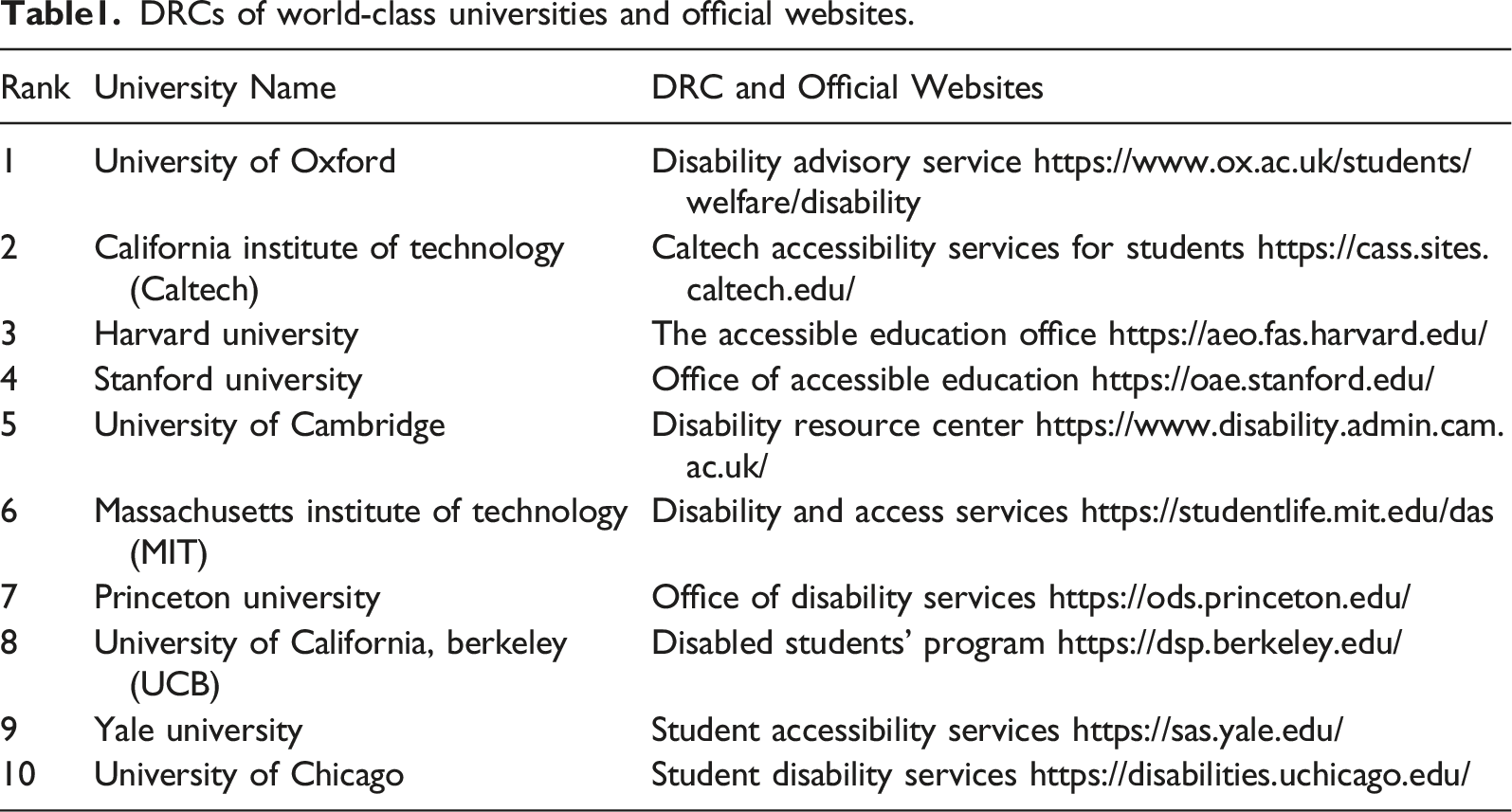
Data Collection and Analysis
We collected data in two ways: the official websites of the DRCs were regarded as key channels to collect data related to the experiences of DRCs (Costello-Harris, 2019), while data related to the dilemmas of DRCs were collected from existing studies. Then, we analyzed the data using content analysis to determine the experiences and dilemmas of DRCs at world-class universities. Specifically, we inductively generated a three-level codebook regarding the experiences and dilemmas of DRCs. We identified 383 and 71 specific units of initial codes for experiences and dilemmas, respectively, and later, we collated all relevant codes into broader subthemes. Finally, we formed themes related to experiences and dilemmas. In terms of experiences, service mechanisms and service content were identified as the themes. Moreover, three themes, including a low service application rate, flawed service mechanisms, and controversial service quality, were identified for dilemmas.
Results
The Service Mechanisms of DRCs in World-class Universities
Service Target: Promoting Inclusion and Ensuring Equity
DRCs are committed to building an inclusive campus environment that ensures that SWD have access to quality higher education in an inclusive and equitable environment by providing systematic and comprehensive disability support services (Scott et al., 2016). Students with statutory disabilities can apply for services from DRCs; these disabilities include sensory and developmental disabilities, such as visual impairment, hearing impairment, movement impairment, speech and language impairments, intellectual disabilities, and autism; learning disabilities, such as dysgraphia, dyslexia or ADHD; psychological diagnoses, such as depression and anxiety; and chronic health conditions with long-term health problems. In addition, nine top universities provide services for students with short-term illnesses such as fractures and concussions.
As the core departments of disability services on campus, DRCs can provide direct services to SWD or coordinate services from different departments for SWD. The services of DRCs for SWD are as follows: (1) operating the service platform to promote information about disability services; (2) managing service applications and reviewing students’ eligibility for disability services; (3) receiving service complaints and improving the quality of disability services; (4) developing service plans and negotiating individualized services with students; and (5) serving students by providing letters of accommodations and assistive technologies and arranging human support. In addition, DRCs coordinate with faculty and relevant responsible departments to implement disability services.
Service Platform: Providing Information on Comprehensive Service Resources
Information on the support and services provided to SWD is presented through the official websites, and the information is regularly updated by DRCs. As the websites are the primary source of information on disability services for SWD, insufficient information on the official website could lead to the underutilization of support services provided by the DRCs and a perception of inadequate inclusion on campus by SWD (Flink, 2018). Therefore, extensive and continuously updated information should be provided on the official website of DRCs, such as available academic accommodations and support services.
Service Application Procedures: Determining Eligibility and Individual Need
There are three types of documents that SWD should submit when applying for disability services as a basis for explaining and legitimizing their request for appropriate accommodations (Life, 2021). First, an assessment report about disability status should be provided. The assessment should be conducted by qualified professionals, such as physicians, educational psychologists, or therapists, to identify the type and extent of disability and describe the current impact of the disabling condition. Notably, the individual’s functional limitations due to the disability are critical in determining eligibility for disability services, and thus, the frequency and severity of the limitations in the educational setting resulting from disability should be clarified. Second, a history of previous disability services received and recommendations for receiving disability services completed by professionals should be provided. Third, proof of the qualifications of the professionals is required to be submitted. Moreover, it is important to avoid the existence of kinship between evaluators and SWD.
After SWD submit the above application documents, DRC staff conduct interviews with SWD to develop individualized disability services. Students’ needs for disability services vary greatly due to differences in their type of disability, major, and experience (Newman et al., 2021). Therefore, staff must interview SWD for further information, such as individual plans and limitations in studying and living. Finally, appropriate support services are developed based on the above information.
Service Implementation Procedures: Self Application and Collaborative Service Implementation
Three principles should be followed in the implementation of disability services, namely, self-disclosure, confidentiality, and the dynamic adjustment of disability services. First, DRCs require SWD to self-disclose their disability to apply for services; that is, SWD cannot receive the services unless they submit an application. Indeed, some SWD do not apply for disability services. They believe that the impact of their disability on their learning and life can be overcome on their own, and they want to be less dependent on outside support and more independent (Kim & Crowley, 2021). Second, DRCs are obligated to maintain confidentiality of the disability of SWD, and faculty and staff of departments cannot ask SWD to explain their disability. Third, disability services should also meet the principle of dynamic adjustment. DRCs can modify disability services when individual needs change or when the current services cannot provide effective assistance to SWD.
Once the content of the individual services of SWD are confirmed, DRCs work with the responsible instructors and departments to provide these services. For example, in the case of the learning support provided by the University of Chicago, some services, such as providing assistive devices and arranging for assistants, are provided directly by the DRCs; other services, such as modifying curriculum requirements and adjusting grading criteria, need to be implemented by instructors. Therefore, a letter of accommodations is sent to instructors via email by the DRCs indicating what support services the student needs. The student then communicates with the instructor to clarify and request support services.
Service Guarantee Process: Informal and Formal Grievance Procedures
To guarantee the quality of disability services, a grievance procedure is established by DRCs. An appeal can be filed when SWD face the following situations: first, when SWD disagree with the decisions or services conducted by the DRCs; second, when SWD are discriminated against because of their disabilities; and third, when faculty and staff refuse to implement reasonable disability services, and campus activities or infrastructure fail to meet the accessibility requirements.
Two categories of grievance processes, informal and formal grievances, are conducted to help SWD solve problems. For informal grievances, SWD interview the designated staff to seek solutions. In addition, if the dispute is not resolved, SWD can file a formal grievance in writing that contains a detailed description of the controversy, a report on the measures taken in the informal grievances, and measures that SWD expect to take to resolve the issue.
The Service Content of DRCs in World-class Universities
Building an Inclusive Culture on Campus
Due to misleading information, irrational fears, or a lack of knowledge about SWD, campus members might have prejudices and stereotypes about SWD, associating disabilities with incompetence, disadvantage, and laziness (Werner, 2012). Thus, studies have reported that instructors have lower expectations of SWD and are reluctant to provide support to SWD and that SWD experience unfair treatment from their peers and even isolation (Herrick et al., 2020).
To build an inclusive culture on campus, DRCs conduct various public awareness campaigns to reshape the opinion of disability among campus members. First, DRCs emphasize the fundamental right of SWD to inclusive higher education. For example, Stanford University held an annual lecture on the theme of Disability Rights Are Civil Rights: Diversity, Equity, and Inclusion in Higher Education, introducing the law that protects the rights and interests of SWD and the case law related to disability services. Second, DRCs direct the attention of university members to disability issues and eliminate negative stereotypes on disabilities. For example, the University of Cambridge held a lecture, Career Achievement of Scholars with Disabilities, to draw campus members’ attention to the abilities and strengths of SWD rather than their inabilities.
In addition, university members might offend SWD by being unaware of the use of inclusive communication. Thus, DRCs have issued guidelines to suggest polite interactions between university members and SWD, creating a respectful and friendly atmosphere. For instance, the University of Cambridge issued Etiquette: Meeting and Working with Disabled People, which lists precautions in situations such as providing assistance or interacting with SWD.
Providing Learning Support and Promoting Equality of Learning Opportunities
Effective and reasonable accommodations are critical to improve the academic performance of SWD (Brown, 2017). Thus, DRCs provide various academic accommodations, including offering accessible physical spaces, human support and assistive technologies; designing flexible criteria and requirements without changing academic requirements; and maintaining academic integrity. The following are some of the most important measures of these accommodations.
In terms of accessible physical spaces, DRCs provide an accessible and comfortable environment for SWD. For example, UCB installed height-adjustable freestanding tables or standing desks in the classroom for students with physical disabilities and prioritized physically accessible classrooms for them. In addition, distraction-reduced environments are provided for SWD when needed. For example, Yale University provided private rooms or noise-shielded headphones to help students with ADHD focus on tasks when they were taking examinations. In addition, SWD who use screen reader technology or exam scribes can also request a private testing area to prevent disruptions to others.
A variety of human support and assistive technologies are used to guarantee the real-time information reception and full participation of SWD. First, DRCs aim to help SWD address the difficulties in accessing course content and examination text by adapting text materials into various formats. For instance, UCB provided alternate format books, which include textbooks and classroom handouts converted into large print, Braille, or electronic versions. Second, DRCs ensure that students with different types of disabilities can receive information during courses and examinations. For example, Stanford University provided sign language interpreters and Communication Access Realtime Translation software for students with hearing impairments and offered visual information descriptors and text-to-speech technology for students with visual impairments. Third, DRCs help SWD keep complete records recorded during courses and examinations. For example, the University of Chicago provided services such as smart recorders, note-taking software, and note-taking assistance. Moreover, Yale University allowed students with limited hand movement or learning disabilities to dictate their answers using speech recognition software in the examination. In addition, DRCs ensure the full participation of SWD in classroom activities. For example, Stanford University provided laboratory assistants to help students with visual or physical impairments with their experiments.
DRCs develop flexible requirements and standards of course and examination for SWD. First, DRCs make flexible adjustments in attendance and deadline for assignment submission. For instance, the University of Chicago stated that absences and late submissions due to emergencies such as seizures would not affect evaluations. Second, SWD with hearing and speech impairments might have difficulty taking foreign language courses. Caltech established a course substitution policy so that SWD can apply for credit in other courses. Third, extension of examination time is allowed for students with visual impairment and students with physical disabilities who need more time to record their answers. In addition, DRCs recommend adopting inclusive scoring criteria. The University of Oxford issued Inclusive Marking Guidelines to inform teachers about the barriers and needs of SWD. For example, students with learning disabilities may make mistakes in spelling, punctuation, and writing because of their cognitive and fine motor deficits. Thus, DRCs recommend that teachers should focus on the core ideas and critical thinking in the students' assignments and not deduct points for details such as blurred handwriting.
Building a Barrier-Free Living Environment to Improve Quality of Life
DRCs aim to build an accessible campus in terms of the physical environment to improve the quality of life of SWD. Meanwhile, the needs of SWD in emergencies and mental health are also emphasized.
There are four approaches to ensure campus accessibility for SWD. First, DRCs provide electronic campus maps and recommend appropriate routes to travel around campus for SWD. For example, MIT indicated the locations of buildings on campus, such as ramps, entrances to academic buildings, and accessible restrooms in the electronic map. Second, DRCs set up special transportation on campus to facilitate SWD’s mobility around campus. For example, Stanford University provided free bus service in traffic control areas for SWD. Third, dormitories equipped with accessible facilities are assigned to students with physical disabilities. For example, Harvard University provided rooms on the first floor or near the elevator for SWD, while the University of Chicago provided wheelchair-accessible dorms. Moreover, service animals, usually dogs or miniature horses, are allowed work for SWD on campus. At Harvard University, for example, service animals were allowed to guide students with visual impairments, alert students with hearing impairment and so on.
In terms of emergency preparedness, SWD may need assistance with seeing or hearing alarms, evacuation, and sheltering. Therefore, DRCs issue evacuation advice and make emergency preparedness plans for SWD. For example, Stanford University provided emergency preparedness tips to guide SWD in preparing for emergencies and to guide school members in properly assisting SWD when an emergency occurs. In addition, the University of Chicago installed strobe alarms and door alerts in classrooms and dormitories to provide visual information to students with hearing impairments, and two rescue assistants were designated to provide training services to assist SWD in case of emergency.
DRCs are concerned about the mental health of SWD and thus allow emotional support animals on campus. Support animals are beneficial in alleviating or mitigating the negative effects of disability and are considered a medical treatment for depression, anxiety, and certain phobias. Cats, dogs, rabbits, or other domesticated animals can be used as support animals for emotional support and companionship. Stanford University agreed to the use of support animals for students, and to minimize the impact of support animals on other students, designated a special dormitory area to house students who use the service.
Implementing Employment Support Services to Alleviate Employment Challenges
SWD who receive higher education are more likely to obtain job opportunities, earn a higher income, and ultimately achieve independent living than those who do not receive higher education (Moriña, 2016). However, there is still a significant gap in the employment of SWD compared to students with typical development (Library, 2021). Thus, DRCs provide support services for SWD to improve their employment.
First, DRCs provide employment guidance to help SWD prepare for their careers. At UCB, for example, a full-time employment counselor coached SWD on resume writing, interview skills, job search networking, and communication strategies to improve their interview performance.
Second, information about internships and employment in disability-friendly workplaces is provided. For example, the University of Chicago collected internship and employment resources, recommending organizations such as Microsoft and the National Business and Disability Council, which view people with disabilities as an important part of the diversity of their teams and which have more inclusive hiring and placement policies.
The Service Dilemmas of DRCs in World-class Universities
Low Application Rate for Disability Services
The social model of disability asserts that it is not the disability itself that creates barriers but rather the existing social environment and institutions that impose limitations on people with disabilities and prevent them from participating equally in society (Wang & Deng, 2021). This view provides the theoretical basis for DRCs to provide support services to build an inclusive and equitable campus environment. However, researchers have shown that only 35% of SWD in higher education are enrolled in DRCs (Han & Zhong, 2015). This dilemma may be related to the following issues.
First, SWD are unwilling to disclose their disability and apply for disability services due to the discrimination and prejudice they face. Their unwillingness might be caused by the external environment as well as their own individual factors. Specifically, some university members have negative attitudes and contempt toward SWD, and thus, SWD are treated differently and even isolated (Hong, 2015). In addition, some SWD internalize external rejection and discrimination through self-stigma, equating disability with incompetence (Kranke et al., 2013), and they choose to keep their disability a secret for fear of being exposed to negative attitudes, experiencing isolating behavior, or being labeled disabled.
Second, disability services are mistaken as unfair preferential treatment. Some campus members view disability as a medical issue at the individual level, and they do not realize that reasonable accommodations are allowed by law (Yu & Huang, 2015). As a result, they view disability services as preferential treatment that might undermine academic fairness and academic integrity (Sniatecki et al., 2015). Moreover, some SWD are also influenced by this perception, and they are afraid that others will think they are receiving special treatment (Mamboleo et al., 2020). Therefore, some SWD are apprehensive about applying for disability services or even give up their applications.
Third, there is a lack of understanding of disability and disability services among SWD. On the one hand, some SWD believe that their disabilities are not severe enough to apply for disability services, a situation that is particularly prevalent among students with learning disabilities. These students often compare themselves to students with sensory and physical disabilities and believe that their disabilities are not severe enough to qualify for disability services (Lyman et al., 2016). On the other hand, some SWD are unaware that the DRCs provide disability services, or they have no idea about the application process and details of disability services (Lyman et al., 2016).
Limitations of the Service Mechanisms
DRCs establish a set of standardized service systems to work in an orderly and effective manner. However, there are shortcomings in the service mechanisms of DRCs in the following aspects.
First, there are difficulties in implementing collaborative services because some faculties are not cooperative in implementing disability services. On the one hand, some teachers are reluctant to provide services to SWD, especially students with “invisible disabilities”, such as students with learning disabilities and students with ADHD (Barnard et al., 2008). This is due to the difference between “invisible disability” and “visible disability”, which leads teachers to believe that students with “invisible disability” are not eligible to receive disability services (Barnard et al., 2008). On the other hand, some teachers lack the knowledge and awareness to provide disability services, and thus, they do not have enough time or are unwilling to provide services (Toutain, 2019). Moreover, some teachers disregard the principle of confidentiality and still require students to prove their disability status (Moriña, 2017).
Second, some DRCs do not establish proactive service safeguards. For example, DRCs may lack proactive monitoring tools, such as questionnaires and interviews, to track the learning status of SWD. This makes it difficult for DRCs to understand whether disability services meet the special needs of SWD and to improve the deficiencies in services in a timely manner.
Third, service principles need to be optimized. SWD are required to self-disclose to apply for disability services; that is, SWD have to proactively apply for services with the DRCs and negotiate their service with their instructors. However, some SWD consider it a burden to consult with teachers about their special education needs and are reluctant to seek support from teachers (Fossey et al., 2017).
Inefficient Service Quality
Overall, DRCs support services have a positive impact on the inclusive higher education of SWD. Related data and SWD perceptions show that disability services have been effective in improving academic performance and have helped to reduce anxiety and promote communication with faculty and students (Chan, 2016). However, there is still room for further improvement in the quality of DRC disability services.
First, some DRC staff are not professional enough to provide quality disability services. For example, they lack knowledge and experience in disability services, resulting in inadequate matching of disability services with the needs of SWD, long application times for disability services or delays in providing auxiliary aids for SWD (Hong, 2015; Kim & Crowley, 2021).
Second, attention should be given to the effectiveness and quality of the reasonable accommodations provided by DRCs. For example, the effectiveness of notetaking services is controversial. Some researchers have suggested that notetaking services help improve the performance of SWD, while some researchers have shown that notes taken by others may be difficult to understand due to illegible handwriting (Toutain, 2019). Moreover, some researchers have found that SWD who receive notetaking services might have lower grades (Chiu et al., 2019). Thus, we need to further explore the effectiveness of notetaking services. In terms of examination accommodations, some SWD have been allowed to take exams in separate rooms. However, these rooms were not marked with Do Not Disturb signs, so people still continued to come and go during exams, interfering with SWD to complete examinations (Mamboleo et al., 2020). In addition, the speech-to-text technology is too slow to convert speech to text, which may interfere with students' thinking and performance on examinations (Hanafin et al., 2007).
Third, we should be concerned about whether the provided services meet the diverse needs of SWD. On the one hand, disability services lack individualization, and DRCs often provide services based on the type of disability rather than the individual needs of SWD (Collins et al., 2018). For instance, DRCs have failed to provide appropriate disability services for SWD enrolled in different disciplines, which resulted in SWD who were enrolled in STEM having worse academic performance than SWD enrolled in social sciences (Hanafin et al., 2007).
Conclusion
The DRCs of world-class universities have provided disability services for decades and have accumulated a wealth of experience in disability service mechanisms, service approaches, and service content (Mendoza-González et al., 2022). Specifically, these DRCs have formed collaborative service mechanisms with relevant functional departments and faculties, operated service platforms with real-time updates, established clear and standardized service procedures, and provided individualized and diverse service content. However, these DRCs still have certain deficiencies in service application, service mechanisms, and service validity. First, the social model of disability and disability services is not broadly accepted, which leads to a reluctance of SWD to self-disclose to apply for disability services, resulting in low application rates for disability services. Second, there are deficiencies in service mechanisms, including collaborative service models, proactive supervision mechanisms, and principles of disability services. Third, the quality of disability services needs to be further improved, as evidenced by the poor professionalism of some staff, the questionable quality of some services, and the low level of service individuation.
Implications for China’s Double First-class Universities
First, China’s double first-class universities should establish a normative and standardized disability service system across the university to conduct inclusive and equitable higher education. The successful implementation of disability services requires the engagement of the entire university community (McCarthy et al., 2018). Thus, the core position of the DRCs in campus disability support services should be established at the institutional level (Li & Wang, 2019). Meanwhile, the responsibilities of relevant institutional departments and colleges need to be clarified in detail, specifying the process of collaborative services (Li & Wang, 2019). In general, the above measures might promote inclusive practices in a well-organized way and lead to the gradual development of a collaborative disability service system on campus.
In addition, the DRCs in China’s double first-class universities should optimize the service mechanism and improve the quality and efficiency of the service mechanism. First, a dual-channel approach of service application should be established to ensure that all SWD receive the appropriate services. While encouraging SWD to apply by themselves, DRCs should take the initiative to contact SWD to understand their service needs. Second, to streamline the service process, the official websites of DRCs should form a one-stop disability service platform that provides interactive functions including consultation, application, and complaints to improve service efficiency. Notably, timely and comprehensive service information should be presented because official websites are important channels for SWD to receive information on disability services (Costello-Harris, 2019). Third, service quality must be given high priority. For DRC staff, professionalism and responsibility should be improved through high-quality training in inclusive education, and well-trained staff should assist faculty members in implementing accommodations because faculty members may lack inclusive education strategies (Zhang et al., 2018). In addition, the effect of service implementation should be tracked through telephone callbacks or questionnaires, making timely adjustments for any improprieties.
Furthermore, attention should be given to provide personalized and diversified support service content, which might be one of the core factors guaranteeing the “authentic inclusion” of SWD in higher education (Li et al., 2021). First, DRCs should consider the individual needs of SWD when determining disability services, including their types of disabilities, daily mobility route on campus, disability service experience, career planning and other personalized needs. Moreover, DRCs should raise the awareness and responsibility of university faculty to promote inclusion and equity across campus. Numerous studies have shown that university faculty members and students without disabilities have low awareness of inclusion and low acceptance of SWD (Zhang et al., 2017, 2018). Therefore, consciousness of disability and diversity understanding among campus members should be taken into account (Lombardi et al., 2018), and DRCs should provide related training for these campus members to raise their awareness of inclusion.
Footnotes
Declaration of conflicting interests
The author(s) declared no potential conflicts of interest with respect to the research, authorship, and/or publication of this article.
Funding
The author(s) disclosed receipt of the following financial support for the research, authorship, and/or publication of this article: This work was supported by Chongqing Social Science Planning project of China [grant number 2021YC027]; Key project of Chongqing Language Committee [grant number yyk22101]; Innovation Research 2035 Pilot Plan of Southwest University [grant number SWUPilotPlan004].
