



Abstract
In the context of rapid development of internationalisation in Chinese higher education, as well as the increasing mobility of academics across country borders, more and more international scholars are seeking career opportunities in Chinese universities. Using 21 in-depth interviews, we investigated international scholars’ acculturation strategies at Chinese universities through Berry’s theoretical tools. We find that the adaptability of experienced international scholars are key indicators that have successfully led participants to achieve integration strategy, and we demonstrate how a lack of response and feedback from the institution might lead participants to the status of marginalisation and separation. Moreover, we emphasise that the individual strategy is not always freely chosen, but largely impacted and constrained by the contextual feature of institutional culture. We highlight the importance of notifying the dynamic nature of cross-cultural adaptation, and recognise the fluidity ingrained in this process.
Keywords
Introduction: Global mobility of academic talents and China talents introduction
As regards globalisation and the increasingly integrated world economy, the global mobility of academic talents is prescribed for higher education and further international competition (Altbach, 2002; Altbach et al., 2019; Altbach & Knight, 2007). Many governments (e.g., European Union and China) have issued policies and founded funding schemes on international academic mobility (Fahey & Kenway, 2010). Additionally, academic institutions and individuals have undertaken many policies and practices to react to the global academic environment during the past half-century (de Wit & Altbach, 2021). For example, internationalisation has become a global trend; new educational programs for promoting mobility and exchange programs are founded; many scholarships are granted for supporting migrant academics (de Wit & Altbach, 2021; Ha & Fry, 2021; Pustelnikovaite, 2021). While most of literature focus on the group of overseas students (Li & Li, 2013; Wang & Sun, 2019; Yu & Cao, 2015), and few pay attention to the group of overseas scholars.
In the context of rapid development of China’s economy and internationalisation of higher education, China has actively launched a series of policies and funding programs to attract global talents, and an administrative department (the State Administration of Foreign Expert Affairs) is responsible for managing relative affairs (Li, 2007; Ma et al., 2012). The Ministry of Science and Technology (MOST) also enacted a recent policy (National High-end Foreign Experts Recruitment Plan) in 2019 to introduce high-level foreign experts (MOST, 2021). Global talents have several categories, such as management experts and educational experts. This research focuses on the latter who work in higher education institutions as a foreigner. With the help of a string of policies implemented since 1978, China has conducted actively influential policies and seen a rising number of international scholars working in universities or colleges, from 3495 in 2002 to nearly five times 18,520 in 2019 (Cheng & Fang, 2021; Welch & Cai, 2011). Moreover, talent introduction projects are initiated unevenly across different provinces. In more developed provinces, governments have more resources like financial support to attract talents, such as the “Hai Ju Project” in Beijing, “Foreign Professional Hundred Plan” in Jiangsu, “the Twenty Provisions” and “the Thirty Provisions” in Shanghai (Liu et al., 2019).
However, the percentage of foreign educational experts in China’s higher education institutions is comparatively low, only 1.1%, with 18,520 international scholars out of 1,760,786 university staff in 2019 (Cheng & Fang, 2021). One of the major barriers to the low volume of global experts is the different environments structurally and culturally, whose expectations are opposed to their situation and who find it hard to adapt (Braun Střelcová et al., 2022; Cai & Hall, 2016). As global talents are essential to current international competition, exploring the reason behind the insufficient number is of eminent significance. Nevertheless, recent research on global talents in China mainly lies in the research of policy implications, and only a few academics choose to research from the perspective of individual experience (Chen & Zhu, 2022; Xu et al., 2022). Therefore, this article aims to explore the subjective experience of international scholars in Chinese universities through the theoretical lens of acculturation strategy theory. Moreover, this study seeks to understand what these international scholars encounter and what their reaction made to the context. We intend to unpack the complex pathways towards acculturation strategy and present how international scholars generate diverse approaches to cope with cross-cultural challenges. Moreover, we hope the empirical findings of this study could help higher education institutions and governments to better accommodate international scholars from diverse backgrounds and facilitate their adaptation process in Chinese universities.
International scholars in a globalised academic market
There is an abundant body of literature on international scholars working in higher education institutions worldwide. As evident from the sufficient research in Australia, the UK, and the US, institutional cultures are found as an important factor impact on international academics; for instance, institutional cultures play a vital role during the transition between own culture and local culture; international academics employment influenced by different modes of academic production (like interdisciplinary group-based projects and self-contained projects) (Cantwell, 2011; Robson, 2011; Saltmarsh & Swirski, 2010). Moreover, previous international experience of global academics is significant not only to themselves but also to their students. On the one hand, these experiences may help realise career promotion in high education institutions (Trahar, 2011); also the cross-cultural adaptation experience improves the lecturers’ understanding of students from all over the world (Richardson & McKenna, 2003). According to other research, some sojourners tend to leave their working place abroad based on their unsatisfaction of the working institutions and low level of integration with the new cultural context (Chen & Zhu, 2020; Snodin et al., 2021).
With a burgeoning body of empirical research on international scholars in China, researchers usually take the interdisciplinary insight by analysing academics’ motivations, challenges, and policy context. Chinese policy is usually a research hotpot and the cornerstone to observing the specific field. The “talents attraction” policy framework, including “Young Thousand Talents” and “the Thirty Provisions” in Shanghai, shows a positive result in “talents attraction” (Cheng & Fang, 2021; Liu et al., 2019; Marini & Yang, 2021). For global academics, their motivation is mainly related to career development, professional opportunity, and personal links. With the offer of a tenured position and more favourable working conditions than in the US, professional experts are willing to accept the opportunity in China to realise their academic ambitions (Chen & Zhu, 2020; Farrer, 2014). The challenges faced by foreign academics in China are another key point, such as administrative issues, low level of cultural adaptation, and ‘cross-cultural misfits’(Chen & Zhu, 2020, 2022; Wu & Huang, 2018).
Researchers have paid increasing attention to international scholars’ encounters in China. However, existing published empirical studies mainly focus on presenting this groups’ motivations and challenges and there is little research about in-depth analysis on their strategies and interactions with the unique cultural and organisational context in Chinese universities. To cover this research niche, thus, we brought in the theoretical perspective of cross-cultural adaptation theory as an analytical tool to explore how international scholars experience, respond and strategise their journey through Chinese academia.
Brief review on cross-cultural adaptation theory
Understanding how international sojourners react to the cross-cultural context and how the social structure, in turn, impacts individuals plays a vital role in the research on global academic mobility and the establishment of cross-cultural infrastructure (e.g., policy, administration and social welfare) (Chen and Zhu, 2020). There is a considerable body of literature from multidisciplinary insights on cross-cultural adaptation theory. In this field, the cross-cultural adaptation stage and development model are far-reaching and have been applied in many empirical studies (Chen and Zhu, 2020). In this section, we will briefly review the key developments in cross-cultural theory and highlight the value of Berry (1980, 1997, 2005)’s acculturation strategy theory in interpreting international scholars’ diverse experiences in a foreign and challenging cultural setting.
As a classical and influential lineage in cross-cultural adaptation theory, the stage model theory considered the cross-cultural adaptation process as a multiple-stage process in which the sojourners’ practices and perceptions demonstrated certain collective trend and patterns, represented by the U-shape curve model and the W-shape curve model (Chen and Zhu, 2020). Lysgaand (1955) used a U-shape curve to describe the dynamic process of cross-cultural adaptation on the basis of the finding that Norwegian sojourners who stayed in the United States for six and 18 months take it more challenging to adapt than those who stayed for less than 6 months. Based on the U-shape curve model, Oberg (1960) combined the process with culture shock and developed the four-stage model: honeymoon, crisis, recovery, and adjustment. Adler (1975) adopted five stages to describe the cross-cultural adaptation process: contact, disintegration, re-integration, autonomy, and independence. Linked to the previously stated U-shape curve, Gullahorn and Gullahorn (1963) add a new part to the adaptation process, which is known as the W-shape or double U-shape curve adaptation model, which extends the time from the start of entering a new context to the end of returning to the original context.
Additionally, cross-cultural adaptation development theory pays more attention to the individual’s subjective experience and their dynamic adjustment to the new environment. The representative theoretical tools include Ward’s sociocultural and psychological theory and Berry’s acculturation strategy. Generated from an empirical study on 98 expatriates working in a New Zealand international organisation, Ward and Kennedy (1994) proposed the theory of sociocultural and psychological adaptation. The former dimension emphasises individuals’ ability to adapt to the local social and cultural environment, while the latter dimension highlights the emotional adjustment that might impact one’s mental health or life satisfaction. Based on this theory, Ward and Kennedy (1999) further developed the Sociocultural Adaptation Scale (SCAS) based on their sociocultural and psychological adaptation research, which obtained a wide application in quantitative empirical study in this field. They considered the sociocultural and psychological dimensions are interconnected and impacted by a number of factors that can be measured and predicted.
Berry (2005) shared with Ward and Kennedy (1994)’s arguments that the adaptations can be primarily psychological or sociocultural, and he extended his ideas further by emphasising the importance of understanding the cultural characteristics of both society of origin and society of settlement in acculturation study. He suggested that a descript on individual’s cultural background and one’s political, economic and demographic conditions in their society of origin are necessary to understand the migration motivation and following encounters in the new cultural environment. For the society of settlement, Berry argued that its general orientations towards pluralism is determinant for international travellers’ experiences and chosen strategies. A society with a positive multicultural ideology (Berry & Kalin, 1995) will be more likely to ‘support the continuation of cultural diversity as a shared communal resource’, while some might ‘seek to eliminate diversity through policies and programs of assimilation’ or even to achieve the segregation and marginalisation of different social groups (Berry, 2005. p. 703).
Based on acculturation context, Berry proposes the concept of acculturation strategy, to capture the variations of individuals’ approaches to undergo acculturation. He identified two issues that are decisive in shaping one’s acculturation strategies, referring to the individual’s orientations towards one’s own group and those towards other groups (Berry, 1980). Specifically, these issues entail ‘the distinction between (1) a relative preference for maintaining one’s heritage culture and identity, and (2) a relative preference for having contact with and participating in the larger society along with other ethnocultural groups’ (Berry, 2005. p. 704). Thus, acculturating individuals’ positive or negative orientations towards each issue might lead to four types of acculturation strategies, respectively, integration, assimilation, marginalisation and separation, which will be further defined and explained in detail in the finding section. It is worth noting that Berry (1997) distinguished the perspectives of the non-dominant group and the dominant group, which recognised the power struggles embedded in the process of crossing cultural and social borders. Both dominant and non-dominant groups in a given cultural setting are engaged in the process of mutual or reciprocal acculturation (2005 p.704). Therefore, integration (as well as other strategies), is often not ‘freely chosen’ but an outcome of cultural interaction.
Built upon Berry’s acculturation theory and extended it into the corporate setting, Black and Gregersen (1992) analysed expatriates’ experiences and sorted them into four types: dual citizen, going native, leaving their hearts at home, and free agents, respectively responding to Berry’s intercultural strategies. Black and Gregersen (1992) integrated the process of cross-cultural adaptation with a company’s overseas dispatch process, which is helpful to understand international scholars, as academic expatriates’ experiences. As we have argued elsewhere, international scholars have the dual identity that they are academics while at the meantime they are also international expatriates, and most of them have various international experiences, which make it difficult to identify their ‘society of origin’. Therefore, we consider investigating international scholars’ cross-cultural encounters within an institutional environment as an appropriate approach to capture the primary acculturating challenges faced by this group.
In addition, there are plenty of empirical studies adopting Berry’s acculturation theory, including immigrants’ intercultural communication (e.g. Tonsing, 2010; Yu, 2013) students’ adaptational experiences (Shafaei et al., 2016). According to Brunsting and colleagues’ review, Berry (2005)’s theory is still among the most widely used theory in studies on international students in the U.S. in recent two decades (Brunsting et al., 2018). However, most of the applications of Berry’s theory mainly focus on the measurement and categorisation of individual strategies, often using quantitative research methods to identify trends and patterns of acculturation practices, lacking the emphasis on the interaction between individuals and the environment highlighted in Berry’s theory. Furthermore, we recognise that the current empirical research applying Berry’s theory focuses on the categorisation of acculturation process, but there is a lack of exploration of the nuanced experiences of individuals. Therefore, this article aims to unpack the process of how international scholars perceive and respond to the institutional culture in Chinese universities, and how they generate their unique acculturation strategies to navigate their journey in a cross-cultural setting. In addition to this, we find that the cross-cultural adaptation strategy of marginalisation and separation are perplexing in the empirical explorations adopting Berry’s framework. We also explore the intersections between marginalisation and separation to further enrich Berry’s theory.
The study
As part of a larger project on international scholars’ cross-cultural adaptation experiences in China, this article focuses on the exploration of international scholars’ acculturation strategies and how their choice of strategies were affected by their unique encounters with the social and cultural context of Chinese universities. We adopted a qualitative research method and conducted in-depth interviews between 2015 and 2016 in top research universities in Shanghai. We collected 281 international scholars’ profiles from universities’ official websites and recruited 21 international scholars through email contact or snowballing. To achieve a more representative and balanced group of participants, we also adopted purposive sampling method to incorporate participants relatively underrepresented in the profile analysis stage, such as female academics and those from non-Western countries. Although the data we collected are a few years ago and Chinese society is changing, it is worth noting that the process of Chinese higher education reform is still under development, given that the percentage of international talents is still relatively low. Thus, the data we collected and further data analysis are still of value to presented to discuss.
Regarding participants’ demographic information, we invited participants originally from 11 countries in Europe, Asia, and North America. Regarding the gender dimension, we interviewed 20 male scholars and 1 female scholar (see Appendix A). Considering the scarcity of female academics among international scholars working in Shanghai, the interview with this female scholar was of great significance for this project despite the small percentage she represented of the total number of participants. In terms of the type of institution, only 5 international scholars were working in joint-venture schools 1 in universities (23.8%), and the rest were employed in ordinary schools in universities (76.6%). Among them, 17 participants held full-time positions and 4 took visiting roles in the university. Regarding their academic titles, there were 11 professors, 5 associate professors, 2 lecturers, and 1 researcher. In terms of the discipline, 12 interviewees researched or taught in the humanities and social sciences, and 9 in natural sciences and engineering.
The interview questions used in this project were constructed through a review of existing literature, such as Berry and ward’s theoretical framework. These interview questions were tested in a pilot study before being applied to the data collection process. In the data analysis phrase, we first conducted descriptive quantitative analysis on 281 international scholars’ profile and demonstrated the overall demographic information of this group, as reported elsewhere in (Chen and Zhu, 2020). Then we transcribed the recordings of interview data, and carried out thematic analysis, after four-round coding. We used MaxQDA to help process the raw data and generate codes and themes emerged from the interview. In this process, we anonymised participants’ real names and used pseudonyms to protect participants’ confidentiality. Based on the Berry’s (2005) theory, this study categorised the respondents into two parts: one is who prefer to maintain previous identity and the other is who prefer to actively involve into ethnocultural groups. Our research follows the ethical guidelines and adhere to the principle of respect throughout the research and analysis process.
Findings
Integrating into the institutional culture of Chinese academia: Inclusiveness and adaptability
As Berry (2005) argued, a precondition for individuals to achieve the strategy of integration is when the dominant social and cultural context is open and inclusive in regards to cultural diversity. 2 Therefore, the integrated strategy can only be ‘freely chosen’ when the mutual accommodation is achieved, which requires both the incoming groups to acquire the basic values of the place of settlement, and the dominant group to be prepared to meet the needs of diverse groups living and working in a plural environment (Berry, 2005). Drawing upon participants’ feedback, we consider 8 participants (out of 21) to match with Berry’s definition of integration strategy. We further identify two conditions that are vital to achieve integration, namely the inclusiveness of the institutional culture, and the adaptability of experienced international scholars. We will utilise several participants’ interview data to illustrate these points.
As we have reported elsewhere, the leaders’ management philosophy is crucial in determining the institutional culture in Chinese universities (Chen and Zhu, 2020; 2022). Participants generally reported that a dean with good communication skills, an overseas background, and outstanding personability can contribute to the creation of an institutional culture inclusive of international scholars. Nearly half of the interviewees thought that their school leaders had an open and receptive management philosophy and good stewardship skills. Two participants explicitly commented that their dean had overseas study experience and thus aimed to build the school to be a more open and international institution. They considered that this coincided with their work and study experiences and made it easier for communication and cooperation.
Moreover, an inclusive institutional culture could enable international scholars to get involved in the existing social network, and further facilitate their integration with the new environment. For instance, Daniel, as an early career academics, developed a close collaborative network with his dean, colleagues and students in the department. Daniel said his department paid great attention to the establishment and maintenance of international cooperation and network. There are a number of international joint-program and academic seminars, regularly inviting overseas academics to visit the department. Benefited from this dense network of academic communication, Denial obtained a series of remarkable achievements at the time of being interviewed. Daniel attributed his satisfied development in China to the internationalised and friendly institutional culture that he has been immersed in. He commented that, ‘I don’t know why it’s very international everywhere. I find people all like to interact with me.’ Sharing similar viewpoints and working style, Daniel felt being embraced by the open and inclusive atmosphere of his department and achieved a certain degree of integration there. We find that an inclusive organisational culture can potentially help international scholars develop integration strategy, and the generation of such strategies is based on the interaction of organisational culture and individual experiences.
In addition, we find senior academics with sufficient international working experiences are more likely to develop a high level of personal adaptability, which enables them to identify the suitable institutional culture for them and cope with a wide range of cross-cultural situations. For instance, William is a professor, and he had various international working experiences in different continents. In China, he had changed three universities, and the geographical locations include north-east China, Beijing, and Shanghai. Having accumulated abundant positive and negative communication experiences with Chinese universities, William has developed a criteria of screening job opportunity and identifying potential partnership. He explained his criteria in detail,
‘There are probably four conditions: they must speak English, their work must be of good quality in my opinion, and they must have a long term respectful and mutually profitable relationship with me and must respect my interests. And finally I have to like them.’
William’s selecting criteria specified his requirement for the institutional culture to have an international and inclusive atmosphere. William represents a very typical case for senior scholars’ integration strategy. Senior scholars in this study mainly refer to international scholars who have more overseas experience than others, or have lived and worked in China for a long time, as well as those who are engaged in China-related research for a long term thus having a more in-depth knowledge of China. On one hand, these senior academics adopting the integration strategy usually have a clear understanding of their own principles and insistence, and have the ability to cope with different scenarios, due to their rich overseas and working experiences. On the other hand, they are more likely to see through the disguises and capture the embedded culture and values of the targeted school. Therefore, they intentionally choose the type of institution that suits their requirement for inclusiveness when seeking for job opportunity, and they actively maintain a balance between their own needs and the environment’s expectations, to avoid encountering conflicts or misalignments. We also find that this group of scholars do not necessarily identify with the institutional culture they are working in. They are rather critical and independent from the institution, to keep a ‘buffering distance’ to manage potential cross-cultural obstacles.
Conformity and comparison: Unpacking the pathways towards assimilation strategy
In the application of Berry’s acculturation strategy theory, a common dispute is to distinguish assimilation from integration. As Berry noted, for a long time, non-dominant groups were encouraged to transform their ways of livings from the ‘traditional’ way to a way representing the value of the dominant group (2005). When individuals choose to shed their cultural background and become fully engaged in the dominant group, the assimilation strategy is defined (1997). Therefore, different from the integration strategy, which emphasises the maintenance of one’s cultural heritage, the assimilation strategy indicates a high degree of compliance to the dominant culture. In this section, we will focus on two representative conditions of assimilation to discuss how it can be achieved in the context of Chinese academia.
First, early career researchers, who obtained their very first formal academic position in China, are more likely to be assimilated to the institutional culture and establish a strong sense of identification. For instance, Kevin reported positively about his interactions with his dean with international background, though his workload was no doubt the heaviest among all the participants in this research. He was assigned a number of tasks since he joined the department, and he felt all the things he has done for the department were also rewarding to his own development. As in his words, ‘obviously, this is not only your contribution to the future development of the school, but also the exercise of your own ability.’ He also mentioned another key feature that makes him feel identified to the school is that he has been treated equally and with respect. He emphasised that though his workload seemed to be stressful, and he never though he could manage to do so many things at the same time, everyone else in his school faced the similar situation. He did not feel being treated differently as an international scholar here.
In Kevin’s case, we suggest that, as this is Kevin’s first formal academic position after he obtained the PhD degree, he had limited knowledge about what to expect from this job and he hardly formulated a certain mode of working style. The prestigious reputation of this school he is working in, and the conformity of heavy workload and hard-working atmosphere encouraged within the institution, together lead him to a high degree of acceptance of the underlying logic of this school. Though it remains unclear that to what extent he gave up his ‘old’ ways of doing things to catch up with the rapid development of this school, Kevin was willing to adapt himself fully to the rhythm of working in the institution and voluntarily justify for his choice. It should be noted that the close integration of the school’s strategic goals with the career development of individuals and the equal treatment of all faculty members are helpful in building an inclusive institutional culture in Kevin’s case, however, not necessarily leading to a real integration. We suggest that Kevin’s acculturation strategy matches with the definition of assimilation, which implies a compliance to the conformity of the dominant culture and a withdrawal from the power struggle in the shared cultural context. His working experiences in this school also plays a role of shaping his understanding of the academic career, and form another layer of his ‘heritage culture’ and keep impacting his future journey.
Second, we find that previous working experiences play a prominent role in determining participants’ perceptions of their current working conditions. Three participants applying assimilation strategies explicitly expressed how they were excluded or unfairly treated in their last job prior to China. For instance, Ethan, originally from a former socialist country, spent several years working in Europe. In his interview, when recalling this period of life, he talked in length about his security concern (his bicycle was stolen there), the sense of alienness as someone not so ‘European’, and his difficulty of adapting to the social life in the ‘Western’ way. These three points constitute the basis for his ‘romanticised’ impression on his life in China. He spoke highly of the security situation in Shanghai, he was comfortable with the way how colleagues and neighbours socialise with him and his family, and most importantly, he was very satisfied with the academic support provided by his school. In his own words, he commented, ‘…all good here. Life, work, I have no complaints…I don’t know how to spend the money[funding]. Because there’s too much money. You need to find ways to spend them’.
In Ethan’s case, we find that some participants’ strong identification towards the institutional culture in Chinese universities was derived from their comparison with previous working experiences as well as the positive feedback received from the school. Usually, those who were socially excluded due to hidden ethnic discrimination or conflicting political standpoints in other countries might demonstrate a much higher willingness to assimilate with the institutional culture in Chinese universities. However, it should be alerted that, some non-Caucasian participants (Jack and Amanda, originally from Asia) reported that they experienced worse discrimination they believed to relate to their ethnic identity in China compared with their previous experience in the western countries. Though Ethan did not mention the ‘white privilege’ he experienced in China, this is documented in various empirical studies (Lan, 2011; Liu and Dervin, 2022). Therefore, we suggest that participants’ pathways towards assimilation should be viewed critically, as in certain cases, it entails both the compliance and complicity with the dominant culture.
Marginalisation or separation? The destructive power of disappointment
Marginalisation and separation refer to two conditions of negative orientations towards building relationships with the society of settlement. According to Berry’s definition, marginalisation strategy will be adopted if an individual has neither interest in maintaining one’s cultural heritage, nor interest in establishing relations with locals. The separation strategy refers to the situation that individuals value their original culture and avoid contacts or interactions with others (Berry, 1997, 2005). Based on participants’ narratives, we find that acculturation strategy is not static, but fluid and might subject to changes at different stages of international scholars’ adaptation phrase. Most of them started with hoping to adopt more positive strategies, like integration or assimilation, however, gradually shifting to the status of marginalisation or separation.
International scholars who appeared to adopt a marginalisation or separation strategies at the time of interview, expressed significant disagreement with the institutional culture of the university, and in some cases, self-exclusion becomes a way of self-protection after repeated frustrations in their process of cross-cultural adaptation. For instance, two participants, Jack and Amanda, from the same institution encountered a series of obstacles related to administrative issues. They reported these issues to the dean and administrative staff, but they received no response. They continued to advocate for themselves by communicating with leadership, but there was no resolution. Living with this continual sense of frustration and disappointment, they gradually felt “loneliness”, “no sense of belonging”, and “isolated” in this institution (Chen and Zhu, 2020). Jack and Amanda’s encounters were not unique. 5 other participants shared similar experiences of being denied or neglected by the dean or administrative staff at their institution.
In this case, the hierarchical management model within Chinese universities has led to a failure of bottom-up feedback and an inability to accomplish timely adaptation when international scholars point out a problem in the system. Their encounters actually expose the institution’s unpreparedness of accommodating international scholars. As a result, participants are faced with a solidified and silent system on a daily basis, receiving and accumulating disappointment and confusions day after day. As mentioned earlier, most of the interviewees, when they first arrived in China, chose more positive acculturation strategies in an attempt to fit into the Chinese university’s institutional culture. However, as their perceived barriers to cross-cultural adaptation grew over time, the participants became aware of the significant differences between the institutional culture of their university and their own ways of doing things, and in this case, some of them chose to adopt a separation approach to cope with cross-cultural adaptation and protect their sense of worth in a place that is not open to them. In such circumstances, participants applying marginalisation or separation strategies generally reported lasting emotional sanctions, which echoed the empirical research on the potential mental health outcomes following each acculturation strategy (Berry & Sam, 2003; Curran, 2003).
As mentioned earlier, most of the participants held an open and positive attitude when they first entered the institutional culture of Chines universities, but the feedback from the institution they received from the institution kept disappointing and distancing them. At this stage, their strategy fits with the definition of marginalisation. As a result, participants working in such scenarios would choose to reserve thoughts and attitudes to themselves, either actively or passively, and work in his or her own way with little interaction with the environment. When it comes to this situation, participants’ strategy slowly shifted towards separation, and ‘turn their back on involvement with other cultural groups, and turn inward toward their heritage culture’ (2005 p.705). It can be seen that the change and shift among different acculturation strategies is to some extent involuntary, rather generated from the dynamics between individual and the context.
Concluding Remarks
In this article, we revisit Berry’s influential theory on acculturation and utilise it as a conceptual tool to identify international scholars’ strategies and unpack the hidden contextual determinants that take a significant role in generating their unique pathways towards cross-cultural adaptation. We find that most participants adopt a positive attitude when first entering the institutional culture of Chinese university, but their acculturation strategies gradually change according to their interactions with and feedback received from the new environment. In regards to the integration strategy, we find the inclusiveness of the institutional culture, and the adaptability of experienced international scholars are key indicators that have successfully led participants to achieve mutual accommodation in a plural cultural environment. In assimilation strategy, we explain why early career academics and those who have unsatisfied previous working experiences are more likely to apply the assimilation strategy, which entails a high degree of compliance with the dominant culture. Moreover, we demonstrate how a lack of response and feedback from the institution might cause an enduring sense of disappointment and emotional suffering, and eventually lead participants to the status of marginalisation and separation. The results of this study provide detailed discussions on international scholars’ encounters in the context of Chinese higher education system, which complicate the current linear understanding of this group’s cross-cultural adaptation process and further contribute to the application of Berry’s theory with rich and nuanced empirical data.
We emphasise that the individual strategy is not always freely chosen, but largely impacted and constrained by the contextual feature of institutional culture and social milieu in general. In the analysis of international scholars adopting marginalisation and/or separation strategies, we utilise participants’ frustrated shift from a positive attitude to self-separation, to demonstrate how context plays a determinant role in shaping individuals’ encounters. In addition, we highlight that the acculturation process is fluid rather than static. According to the dynamic interactions between the individual and the dominant group, one’s adopted strategy might subject to changes at different stages of the adaptation phase. We suggest that the categorisation and identification of acculturation strategies are helpful to understand international scholars’ situation at a given point, but it is of necessity to notify the dynamic nature of cross-cultural adaptation, and recognise the fluidity ingrained in this process.
In terms of the potential impact of this research, we hope the empirical findings of this study could help higher education institutions and governments to better accommodate international scholars from diverse backgrounds and facilitate their adaptation process in Chinese universities. In addition, it should be noted that the empirical data were collected in 2015 and 2016. In subsequent years, the COVID-19 pandemic significantly affected academic mobility and educational policies. The international talents in Chinese universities might have different feelings and more experience to entail. Thus, we are conducting a follow-up project on international scholars’ experiences during (and after) the COVID-19 pandemic and hope to provide a timelier report on this group’s journey in China. Furthermore, limited to the time and the sample size, this study was not able make comparisons across cultural and institutional contexts and generate the characteristics of Chinese academia. We aim to address this limitation in our future research.
Footnotes
Declaration of conflicting interests
The author(s) declared no potential conflicts of interest with respect to the research, authorship, and/or publication of this article.
Funding
The author(s) disclosed receipt of the following financial support for the research, authorship, and/or publication of this article: This work was supported by the soft science research projects under the “Science and Technology Innovation Action Plan” (Grant No. 22692199500), and the Shanghai Pujiang Program (Grant No. 22PJC071).

Notes
Appendix
General information of the interview respondents. Note. For “Gender”, M stands for male and F for female.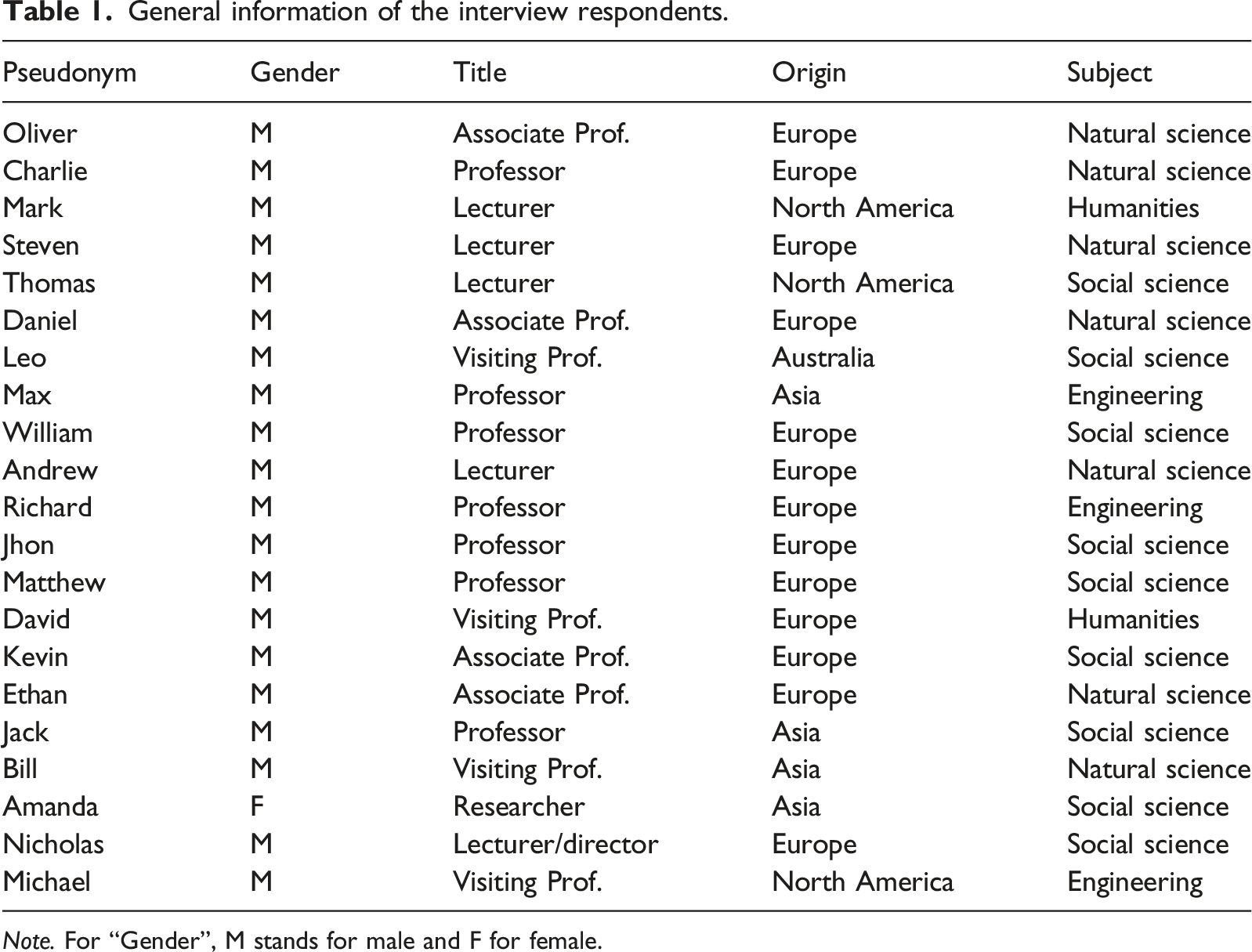
Pseudonym
Gender
Title
Origin
Subject
Oliver
M
Associate Prof.
Europe
Natural science
Charlie
M
Professor
Europe
Natural science
Mark
M
Lecturer
North America
Humanities
Steven
M
Lecturer
Europe
Natural science
Thomas
M
Lecturer
North America
Social science
Daniel
M
Associate Prof.
Europe
Natural science
Leo
M
Visiting Prof.
Australia
Social science
Max
M
Professor
Asia
Engineering
William
M
Professor
Europe
Social science
Andrew
M
Lecturer
Europe
Natural science
Richard
M
Professor
Europe
Engineering
Jhon
M
Professor
Europe
Social science
Matthew
M
Professor
Europe
Social science
David
M
Visiting Prof.
Europe
Humanities
Kevin
M
Associate Prof.
Europe
Social science
Ethan
M
Associate Prof.
Europe
Natural science
Jack
M
Professor
Asia
Social science
Bill
M
Visiting Prof.
Asia
Natural science
Amanda
F
Researcher
Asia
Social science
Nicholas
M
Lecturer/director
Europe
Social science
Michael
M
Visiting Prof.
North America
Engineering