




Abstract
Contextualizing cultural foundations of modern university development has increasingly been ubiquitous. This paper probes cultural awareness of Taiwan’s academia in times of change. Despite the government-driven motives to impose Western indicators in measuring success, the study’s empirical evidence reveals that Taiwanese academics cherish their traditional culture. Ambitions were spawned from attempts to underpin their higher education system along cultural lines, while tensions were escalated when coping with the government policy benchmarking against Western standards. Citing the perspectives of two premier universities’ executives and faculty members, Taiwan’s academic society shares cultural affinities to rally a blended model that synthesizes its longstanding indigenized values and imported Western experiences. Revitalizing cultural consciousness calls for alternatives to Taiwan’s existing Western-oriented model of higher education.
Introduction
The remarkable growth of higher education in Chinese societies has put universities in mainland China, Hong Kong, and Taiwan in the spotlight. Sharing common cultural roots and geographic proximity, these Chinese societies’ development of higher education has faced fundamentally similar challenges yet has had divergent historical trajectories. Although Chinese cultural values have been influenced by external forces with differentiation across Chinese-bounded societies over time, their core set of unique features has been retained (Yang et al., 2018). To this end, Confucianism, Daoism, and Buddhism constitute the essence of Chinese culture, with Confucius (551-479 BCE) regarded as the orthodox pillar (Tang, 2015). While aiming to become international, their deeply rooted cultural foundations differ significantly from Western experiences. In an era of increasingly intensified globalization, exploring how modern universities balance being global institutions with maintaining their traditional values is timely and crucial.
The term “twisted root,” coined by Altbach (1989), reflects the cultural conflicts in Asia’s higher education development due to adopting Western models of higher education. The Western-style institutional forms and practices implemented in non-Western societies’ contemporary university models do not conform with the latter’s traditional value systems. Thus, constant tensions or clashes affect the efficiency and effectiveness of university operations (Yang, 2016a). Matters become even more complex when policymakers in various jurisdictions adopt different approaches to embracing or encountering the West.
Operating Western-style university models in the Confucian societies of mainland China, Hong Kong, and Taiwan has never been easy. With the salient role of the government in East Asia, the notions of academic freedom and autonomy can be interpreted differently from their Western origin (Lin & Yang, 2021), where the tension between power and truth is considered healthy (Yang, 2022). Altbach (2016) cited China as an example of the “glass ceiling” phenomena, arguing that China’s higher education institutions’ impressive rise in some global rankings is not sustainable and will soon top out. He called China’s inappropriate funding system higher education’s feet of clay, noting that only a few premier universities are heavily funded, leaving a large group underfunded.
In recent years, there have been growing calls among East Asian higher education institutions to integrate two value systems as alternatives to the Western hegemonized model. According to Marginson (2011), mainland China, Hong Kong, and Taiwan are Confucian-influenced societies possessing a special developmental dynamism that is even more effective in some respects than existing Western modern university models. They benefit from an effective nation-state system that makes large public investments in research and world-class universities. Later, Marginson (2014) insinuated that the West’s global higher education hegemony cannot be sustained in the face of emerging and spreading indigenous capacity. Meanwhile, Yang (2016b) emphasized the strikingly different cultural roots and heritages that have led to continuous tensions when these societies try to combine Chinese and Western ideas of a university. However, he noted that such situations could be resolved due to flexible and open perspectives. In other words, East Asia’s fluid mode of cultural thinking could be a driving force that allows the appreciation of two opposing poles and contradictory opportunities (Yang, 2017). As a result, higher education institutions in these societies have the potential to show signs of self-formation that coincide with two different ways of learning (Marginson, 2017).
Taiwan’s higher education society has also raised awareness of the continuous conflicts between the Western imported/patterned university model and indigenous values. Tsai (1996) examined how the deregulation of Taiwan’s higher education system due to political liberalization offered more academic freedom and institutional autonomy. Hou (2011) was concerned that international accreditation might become cultural imperialism in academia if Anglo-Saxon accreditation standards and practices were uncritically adopted. More specifically, ChanYang (2016) raised the specter of quality through accreditation’s potential cultural impact. Others have raised how Taiwan has adopted less-culturally-minded internationalization strategies in response to globalization in recent decades (Chou et al., 2013; Ho et al., 2015; Sung & Tai, 2007). Chan and Yang (2017) proposed the notion of a hybrid university model after their empirical observation of two universities that combined Western and Confucian intellectual values. More recently, Lin and Yang (2021) conducted a cultural examination to understand the government’s role in stimulating universities in their quest for world-class status.
Taiwan’s higher education system has adopted various key Western standards regarding academic structure, curriculum, accreditation, and faculty appraisals, as well as the West’s emphasis on general education and governance model. Since it is patterned after the imported experiences, it faces many fundamental challenges, especially in its integration of Western ideas of a university with society’s deep-rooted values and heritages. Both the challenges it faces at present and the achievements in the past decades have been empirically under-documented by the international community. This study examines the experiences and perceptions of executives and academics in two premier universities. Given the government-driven decision to impose Western indicators to measure the success of Taiwan’s higher education, two major research questions are (1) how does the primacy of the imported Western structures and features 1 affect the development of Taiwan’s higher education from the past to the present? and, (2) what are Taiwanese scholars’ perceptions of and aspirations for Taiwan’s higher education development from a cultural perspective 2 ?
The internationalization strategies of Taiwan’s higher education
Despite being colonized by Japan for almost five decades, the current Taiwanese higher education has been designed according to imported Western experiences, particularly the American Anglo-Saxon model (Hawkins, 2015; Hayhoe, 1994; Hou, 2011; Lin, 2020). The direction of Taiwan’s higher education development is closely associated with government goals. Aiming to secure Taiwan’s visibility on the international stage, policymakers have striven to imitate Western practices and benchmark their higher education performance against international standards from the past to the present.
Taiwan’s quest to elevate its major universities in the global rankings stage by pursuing world-class excellence has become prevalent in the past two decades. Policy under the former Kuomintang Party government was geared towards research, infrastructure, and support for research and development. Two continuous financial phases have supported Taiwan’s research universities: the Plan to Develop First-Class Universities and Top Research Center (2006–2010) directed NTD 50 billion to 15 universities over 5 years, while the Stepping towards Premier University Plan (2011–2015) provided 12 universities with NTD10 billion per year for 5 years. These two plans aimed to uphold academic excellence and improve Taiwanese universities’ international competitiveness and visibility (Chou et al., 2013; Sung & Tai, 2007). Under the current Democratic Progressive Party government, the most recent 5-year initiative (2018–2022), Higher Education Sprout Project, distributed NTD 16.72 billion per year, or NTD 83.6 billion in total (Ministry of Education, 2017). Supporting research universities’ and research centers’ pursuit of world-class status is a primary goal, drawing NTD six billion in funding, including four billion for 4 premier universities and two billion for research centers (Ministry of Education, 2018).
Taiwan’s Ministry of Education introduced a series of university governance policies promoting academic excellence to enhance Taiwanese higher education’s global competitiveness and international visibility. Since 2005, both individual and institutional research performance has been predominantly assessed based on research outputs published in journals indexed by the Science Citation Index (SCI), Social Science Citation Index (SSCI), Engineering Index (EI), Arts and Humanities Citation Index (A&HCI), and related factors (Chou et al., 2013). Furthermore, in 2005, the Ministry of Education and all higher education institutions in Taiwan jointly established the Higher Education Evaluation and Accreditation Council of Taiwan (HEEACT) to develop a quality assurance mechanism. To correlate local institutions’ quality with international standards, HEEACT adopted the American accreditation model, which features peer reviews, onsite visits, and a self-enhancement process that includes international benchmarks like output monitoring, accountability measurement, and auditing (Hou, 2011).
More recently, the National Development Council (NDC) formulated policy goals and strategies for developing Taiwan into a bilingual nation by 2030. In 2020, a language proficiency strategic plan was developed, and potential barriers were identified based on interviews with policymakers and academics in 15 universities (conducted by the British Council). In 2021, as part of the 2030 Bilingual National Policy Development Blueprint (Ministry of Education, 2021), selected universities were funded under the Program on Bilingual Education for students in College (BEST) to raise citizens’ English proficiency to enable them to communicate in the international lingua franca. Four benchmark universities and 41 colleges of 25 institutions have been subsidized in the first phase (2021–2025), with an approved budget of NTD 587 million in 2021 (Ministry of Education, 2021). The Blueprint’s main objective is to promote English as a medium of instruction (EMI) and create an immersive English learning environment. In line with the Bilingual Nation 2030 plan, at least 50% of students are required to achieve a B2 English proficiency level in the Common European Framework of Reference CEFR (or equivalent) in their sophomore year and offer 50% of EMI credited courses by 2030 in these benchmarked universities and colleges.
Method
This study adopts case study research. Case study is a naturalistic generalization process (Stake, 2007) in which previously unknown relationships and variables can be expected to emerge, leading to a rethinking of the phenomenon being studied (Merriam, 2009). Two of Taiwan’s premier research national universities—a science and technology-oriented university (University A) and a comprehensive university (University B)—were chosen as purposive cases (Punch, 2009). Research universities are national institutions that contribute to the culture, technology, and society, and international institutions with links to global intellectual and scientific trends (Altbach, 2011). While these universities embrace international norms to attain world-class status, they also work with the government to support social and economic development domestically. Hence, the intensity of convergence and divergence in policy and practice can be largely observable through their adaptation, imitation, and transformation efforts to conform with the Western model.
Participants from Universities A and B.
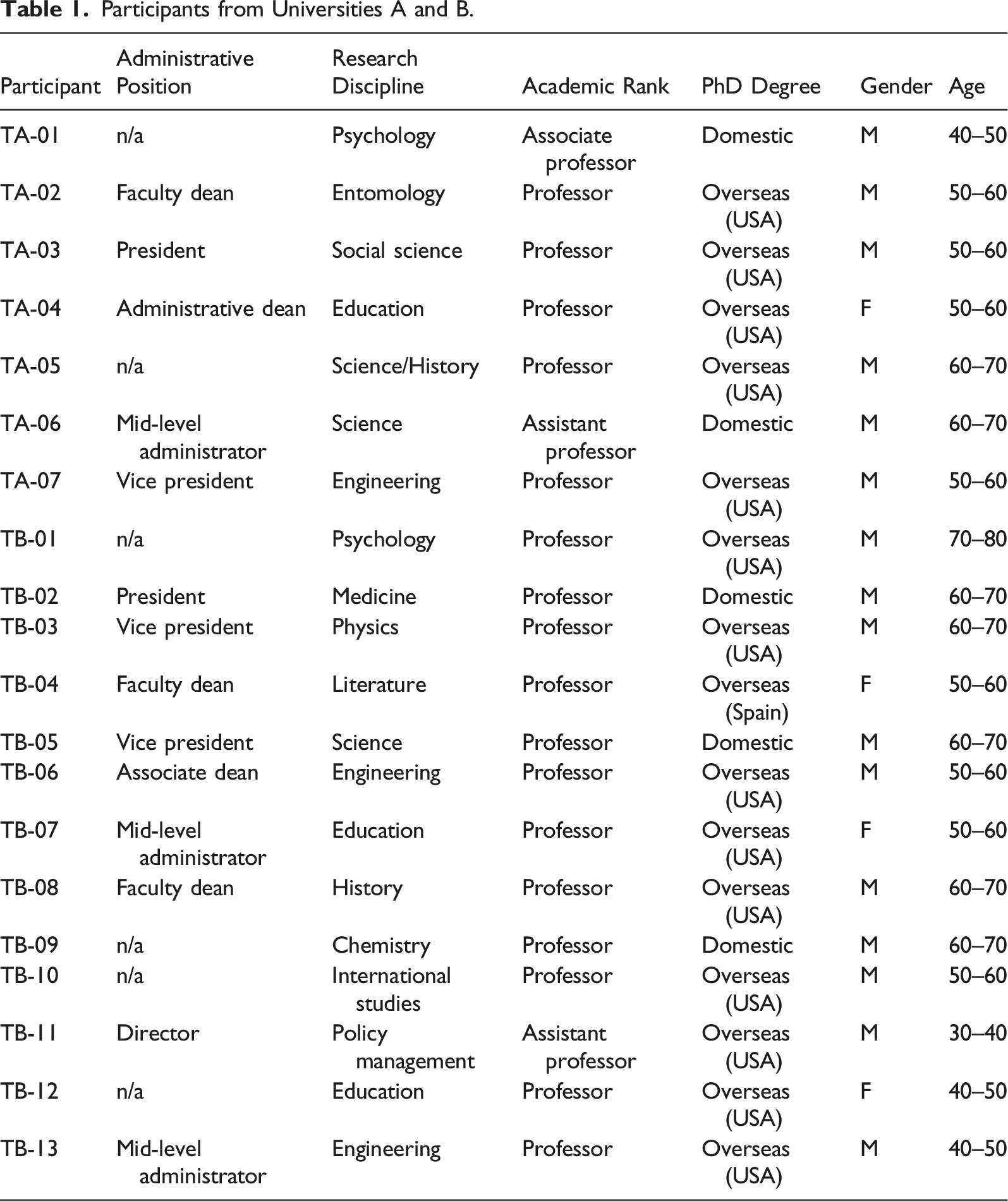
Content and thematic analyses were conducted. Data were analyzed in a step-by-step process (Merriam, 2009). Interview data were compared to search for aggregated themes (Gibson & Brown, 2009). Notes, comments, observations, and queries were jotted down while reading the transcripts. This process generated initial tentative categories, based on which the data and categories were sorted and codes and themes assigned accordingly. Some codes were aggregated as field experience continued, and additional codes were formulated to match the observations. Last, the interview findings were cross-validated and triangulated with the written documents to ensure consistency and accuracy between the two cases.
Findings
Two major themes emerged from our analysis of the empirical data: (1) early imitation of the Western university model and its profound impacts at the system, institutional, and individual levels, and (2) Taiwanese academics’ cultural consciousness and aspirations.
Early imitation of Taiwan’s modern university model
The history of Taiwan’s higher education system can be traced back almost a century. Its first university—Taikohu Imperial College, renamed National Taiwan University in 1945—was established in 1928 during the Japanese colonial period. After World War II, Taiwan was restored to China. Later, the Japanese education system was replaced by a more modern Chinese model based on the American system. Political democracy has contributed to the changing context of the Taiwanese higher education system. From the 1950s to the 1980s, universities in Taiwan were under direct bureaucratic control by the Kuomintang government. The cabinet-level Ministry of Education (MOE) dominated almost every aspect of higher education institutions, including tuition fees, course offerings, student recruitment quotas, and university president appointments (Tsai, 1996).
After martial law was lifted in 1987, the Taiwanese higher education system increasingly moved towards pursuing academic freedom and autonomy. Civil education reform groups emerged after the 1989 enactment of the Civil Organizations Laws (Chou & Ching, 2012). Acknowledging that academic freedom and institutional autonomy are essential for higher education development (Davies, 2015), Taiwan’s government stipulated the University Act in 1994 to restrain the government’s authority and grant more academic freedom and flexibility to universities (Lo, 2010). A number of education reforms promoting deregulation, university-based management, the diversification of education provision, and teachers’ professional autonomy were subsequently implemented (Mok, 2010). Led by the 1986 Nobel Laureate Lee Yuan-Tze, the Council of Educational Reform was established, aiming to internationalize the system. A participant who had witnessed the changing process elaborated on the influence of Taiwanese scholars returning from the US during the 1994 educational reform. We made use of those US returnees and adopted the US system. In an early stage, we imitated. Although we have tried to keep some ‘goods’ and remove some ‘bads,’ I think it is still a long way. (TB-05)
After the major reform in 1994, a high-level advisory board to the Executive Yuan was established to modernize university operations (Chan & Chan, 2015). Since then, the system’s institutional structure, length of study, curriculum, types of degrees, and graduation requirements have substantially been patterned after the American Anglo-Saxon model (Chou, 2015).
The primacy of the Anglo-Saxon model & its impact
Internationalization, an increasingly pressing government priority, has become a central aspiration of Taiwan’s higher education regarding Western learning. Some scholars have reflected on Taiwan’s past higher education development with frustrations. Our higher education system has been colonized for too long by the West. We need to find a balance [between Chinese and Western traditions]. This is what we need, somehow what we want. It can’t continue this way, right? (TA-02) The current [Taiwanese] academic community has been completely westernized. We all talk about Western components. There has been limited localization in Taiwanese academia. We have become a group of Western slaves. (TB-01)
Pursuing world-class status is closely articulated with institutional aspirations to be recognized as high achievers in global rankings (Mok, 2007). Although using or not using rankings to construct world-class universities remains controversial, Taiwan’s government encourages universities to benchmark their performance against set indicators aligned with international standards (Hou, 2012). In this regard, some participants have addressed the importance of universities being on par with global research and development; others have indicated the hindsight inherent in using global rankings and their Western hegemonized schemes (TB-03). Many scholars are concerned about how ranking systems compromise local engagement (TA-06, TB-06) and services to domestic society (TA-01, TA-07). The vice president of University B elaborated: It [global rankings] is such a long rope that ties our fingertips tightly. They [government policymakers] don’t care about other parts of our body. They crush and press us to work on this. As responsible academics, we should not emphasize too much on this matter but what else can we do. (TB-03)
Although global rankings could instrumentally serve as an impetus to identify institutional strengths and weaknesses (TB-05) and promote international visibility (TB-03), the catch-up mentality (Hawkins et al., 2013) has caused inefficiency or even stained Taiwan’s academic culture. For instance, overreliance on SCI and SSCI indexed publications has distracted academics from their first-hand research interests (TB-10) and compromised Taiwanese academics’ ethics (TB-01, TB-10). The vice-president of University B shared further: Some academics in Taiwan would like to rush through the process. So, they faked their research outcomes or even bought them. It causes a lot of I [international ] problems, SSCI and SCI. Many professors could not stand this environment. (TB-03)
A mid-level administrator of University A heavily involved in research and development planning emphasized that Taiwanese researchers cannot blindly follow global research trends. Certain research areas beneficial to Taiwan’s society should be localized. The SCI and SSCI papers with high impact factors are highly valued here. But we cannot simply look at journals’ impact factors. It’s time for a twist. We must turn around and reflect on what the contribution of our research to the local community would be, not just about international publications. There could be a divergence between international and local needs. The current performance evaluation weighs heavily on international publication records and much less on service to our own society. (TA-06)
An associate dean of engineering at University B pointed specifically to the risk of losing identity through the blind imitation of past experiences. We need to have our identity. We should reexamine our copying strategies. If we only follow others blindly, we may achieve global rankings; yet, we somehow lose our identity. Who are we after all? (TB-06)
Taiwanese academics in the study showed a marked cultural awareness. Several participants no longer assumed that academic excellence could be defined as merely imitating Western models.
Western-benchmarked accreditation with centralized government supervision
Unlike in many Western societies (Jaschik, 2011), the close alignment between universities and the government with a high level of support and intervention is more evident in Taiwan (Lin & Yang, 2021). Jointly endowed by the Ministry of Education and 153 colleges and universities (Hou, 2011), the Higher Education Evaluation and Accreditation Council in Taiwan (HEEACT) accredits programs and audits institutional operations (ChanYang, 2016; Cheng, 2012; Hou, 2012). This American-patterned agency adopts a 5-year review cycle to promote institutional self-enhancement (Hou, 2011). However, many universities question whether accreditation is for quality improvement or performance rating (TA-05). One administrator at University B, also a HEEACT reviewer, shared how this quality assurance agency has tried to decouple its role from the government over time. They [HEEACT] have changed their role. The unit was first established in 2005. At first, we felt like their close relationship with the Ministry of Education would affect us. Later on, they adopted peer review measures and have become on par with other international accreditation associations. As HEEACT reviewers, we learn from those international accreditation agents, but we also bear the pressure to cope with these internationally benchmarked standards. (TB-08)
Correlating quality assurance with international standards has been HEEACT’s specific focus to be competitive globally (Hou, 2011). Initially, the government used accreditation results to rate universities (TB-08), then announced that they would not be the sole indicator of funding allocations in response to public concerns. However, some participants still doubted how the results posed their significance in the government’s funding decision (TA-06, TB-03). Although it is claimed that the result will be used as a reference only, do you really think the government will not make a connection between HEEACT’s performance review results and funding allocation? (TB-03)
Another administration department director (TB-11) touched on the university’s relationship with the centralized political system, which has demystified a healthy tension of “speaking truth to power” in the West (Bové, 2000). Throughout various efforts that the government has repeatedly tried to decentralize the system since the 1994 reform, we are still under strict control. Even when we see the needs and demands right in front of us, our tuition fees cannot be raised, and special programs cannot be offered unless the government approves them. What flexibility do we have, after all? (TB-11)
In contrast to the decentralized American system, Taiwan’s central government has legitimate authority to approve the establishment of universities and the addition or elimination of academic programs (Yang, 2022). A central tenet of Confucianism is a system of harmonious relationships featuring differentiated roles and duties (J. Chan, 2008). Such relationships have deep historical roots, dating back to the Spring and Autumn Era (770-453 BCE) and Warring States Periods (453-221 BCE) (Gardner, 2014). Despite the highly institutionalized Western education system, traditional heritage and values remain pervasive in Taiwan. While the government attempts to liberate its higher education system to promote modern universities’ core values, the Ministry of Education retains its supervisory role, demonstrating the longstanding sociopolitical order in Sinic societies (Lin & Yang, 2021).
The above scenarios demonstrate the tension incurred from imposing the Western-based accreditation system and values on Taiwan’s indigenous-bounded society. They set examples of the government’s intent to liberate the system while centralizing its supervision.
Contextualizing East and West cultural foundations
Chinese culture has a profound influence on almost every dimension of Taiwan’s society. A striking difference in cultural foundations has led to continuous conflicts between indigenous and Western higher education values (Mora, 2001). Being an academic in Taiwan today means one is both Chinese and Western. Interviews with Taiwanese academics were conducted to contextualize the differences between East and West from their perspectives. Based on the research objectives of this study, three areas of distinction were identified from the various interviews: ways of learning, perception of human relationships, and the pursuit of knowledge and pragmatism. One administrative dean used ways of learning as an example: The ways we learn are different. For example, Western people adopted Socrates’ pedagogy that students may voice, enquire and challenge teachers. Although we tried to follow this way of interaction with students very early on, it does not seem to be functioning. Our traditional values have penetrated us. Learning behavioral models in the East and West are different. (TA-04)
Western and East Asian people possess fundamentally different beliefs about learning. Whereas the former aims to cultivate the mind to understand the world, the latter prioritizes morally and socially cultivating the self (J. Li, 2012). The fundamental differences that shape ways of learning begin with home parenting. Regarding social desires and acceptance, Western parents foster age-honored Socratic learning values, while East Asian parents tend to infuse Confucian-encoded ideology. As such, at a cognitive level, maternal mental frames shape one’s behavior to be aligned with social expectations. For instance, in the West, verbal eloquence is regarded as a personal quality of self-expression marking one’s intelligence, cognitive maturity, knowledge ownership, or charisma (J. Li, 2012). In contrast, East Asian traditions value expressing wisdom without the need to speak 3 . While humility is regarded as a virtue of self-cultivation in the East, it may be perceived as personal weakness or even low self-esteem in Western eyes (J. Li, 2016).
Another mid-level administrator, who worked in the US before returning to Taiwan, observed the differences in lifestyles and human relationships. Living in the States, academics concentrate on teaching and research while putting aside other matters. It seems like living in Taiwan, we keep ourselves busy all the time. We seem to interact too much. We always consider the people around us. I don’t know why. Perhaps, we must cultivate a more independent culture with further distance. This is so ironic. To be professional knowledge producers, we need more distance and independence; but in the Chinese world, we cherish harmony and relationship. (TB-07)
Taiwanese scholars work in a relation-oriented society, meaning one’s life is meaningful only through coexistence with others (Hwang, 2000). Harmony is the most cherished ideal in a Confucian society 4 (C. Li, 2006). Easterners seeking harmony as “way-seekers” are markedly different from Western “truth seekers.” According to Hall and Ames (1998, p. 106), to seek the Truth is to look for something absolutely and ultimately true in the world that corresponds with objective fact—the prototypical mode of philosophy in the West. In contrast, to seek the Way means searching for solutions that correspond with being a good individual (e.g., a good person, colleague, parent, or child) within society. While Westerners typically pursue logical orders from the antecedent pattern of relatedness to a given situation, the Chinese naturally yearn to synthesize various elements (e.g., openness, flexibility, respect, etc.) to generate harmonization (C. Li, 2006).
A scientist and academic dean reconciled the importance of pursuing knowledge based on Western rationality while reiterating the importance of knowledge application to suit local needs. The West has its merits. Western education with the pursuit of knowledge and truth is indisputable. On the one hand, we need to progress well in science to compete or synchronize with the world. On the other hand, we should ensure the practicality of knowledge that suits the Taiwan context. We must seek a balance on both sides. (TA-02)
His thoughts echo a well-known ti-yong Formula 5 (Osterhammel, 2014). Western science and traditional knowledge constitute different paths of knowledge acquisition but are rooted in the same reality (Mazzocchi, 2006). While modern scientific knowledge and its rationality have been central to Western civilization, pragmatic orientation has long been emphasized since China’s early modernization (Hwang, 2012).
Disciplinary differentiation is essential for us to notice. It was evident that when we discussed the coexistence of Western imported experiences and deeply rooted Chinese traditions, some of the natural scientists (TA-02, TB-01, TB-05) seemingly concentrated on science-related matters and their application. In fact, the interpretations of the so-called “science” were naturally diverted to Western science - modern science after the European enlightenment of the 18th century (Mazzocchi, 2006). On the other hand, when talking with the social scientists during our fieldwork, they tended to share their perceptions towards ways of learning and human relationship as the foundational differences between Eastern and Western experiences, as reflected in the excerpts above. (TA-04, TB-07)
A cultural consciousness of Taiwanese academia
Taiwan is considered to have one of the fastest-rising higher education systems in East Asia, with Marginson (2011) placing it among the world’s “highly developed knowledge economies
6
”. The common feature of these societies is their Western-imported higher education models, coupled with local education values greatly influenced by Confucian ideology. Operating Western-style universities in Confucian socio-cultural contexts has never been easy for Chinese societies (Yang, 2019). Many participants cited the Confucian cultural roots in the conversations. You can say that overall we possess a profound oriental culture originating from China. Politically, there is tension between China and Taiwan, but culturally we share a common origin. Confucianism is deeply rooted. (TA-01) Five thousand years of Confucian beliefs and values are deeply implanted in our minds. Numerous aspects are different [from the West]. These matters need to be addressed. (TB-12)
Admitting cultural loss
Western knowledge and values have taken over Taiwan’s academia institutionally and ideologically in the past decades. Similar to China’s experiences, the adoption was more a matter of survival than a choice (Lu & Hayhoe, 2004). After lengthy experimentation to pattern Western-style higher education and learning, most Taiwanese academics realized the “loss of cultural traditions,” a kind of collective amnesia involving a sense of alienation from one’s own culture (Steinbauer, 1999). One senior scholar with psychology background remarked: When academia does not have its tradition, we don’t know how it can be connected to our culture. This causes a so-called “split personality.” Culturally, it’s hollow. (TB-01)
The prescribed Western-patterned model of higher education and its early adoption allows little room for integrating Taiwan’s indigenous intellectual values. This cultural tension has caused a significant impact on the efficiency of Taiwan’s contemporary higher education. At an individual level, academics possess a bicultural identity (Yang, 2022); at institutional and systemic levels, the tension has led to constant conflicts in operations and decision-making.
Revitalizing cultural consciousness
As evidenced from the fieldwork, most participants acknowledged having strategically copied the West in the past. However, they also stressed the importance of cultural heritage and their unwillingness to let it go. In this regard, they are very keen to integrate their traditions into the existing modern university structure and features. The leaders of two premier universities reassured the need to revitalize Taiwan’s cultural consciousness.
The president of University A remarked Educational models are not transplantable [across cultures] because we do not share a common cultural background. The development of higher education systems should consistently be amended in parallel with cultural needs. To develop an ideal model, it’s possible. One generation after another, we must overcome the current issue of “one body with two heads. (TA-03)
A similar aspiration was expressed by the president of University B: If we only imitate, we will be behind forever. We must find ways to identify our strengths. We should develop our uniqueness and characteristics. Shouldn’t Asians define the concept of a university, particularly at this time with its opportunities? (TB-02)
Looking retrospectively, both leaders explicitly touched on the revival of the longstanding Chinese legacy of higher learning. They emphasized the engagement of Taiwan’s academia in discovering cultural needs, identifying existing strengths, and developing a unique model that effectively paves the way for Taiwan’s future higher education success.
Connecting polarized cultures
While the participants sympathetically admitted past cultural losses, their cultural awareness of the need to reexamine the existing imported model was salient. Most participants envisioned the need to bring back cultural traditions and create a model that acknowledges two polarized cultures—deep-rooted Chinese values and imported Western structures and features. The following participant quotes illustrated their ambitions to combine cultures: Our cultural roots must become visible with sufficient passion and respect. It is possible that adopting an oriental approach can be more appropriate. (TA-04) Chinese heritages in economic, political, cultural and artistic development and ancient medical development should synthetically be strengthened. (TB-08) It must be an implementation of Western disciplines together with the inclusion of Confucian spirits. This is rather complicated and can’t conveniently be achieved in the near future. (TB-06)
One scholar of international studies proposed a hybrid model as a solution, despite the ambiguity involved in implementing it. Hybridity is not grey; it is a mutual survival of black and white. We are not grey. We are non-synthetic hybridity. Our tradition will gradually resume. (TB-10)
These participants believed that Taiwan’s higher education lacked the underpinning cultural values needed to operate Taiwan’s modern universities and must develop beyond imitating Western experiences. The above comments mirror the viewpoint that modern universities in Asia are hybrids overlaid with indigenous and Western elements (Hawkins, 2015). The above findings echo Chan and Yang’s (2017) study confirming Taiwan’s desire to create a hybrid university model integrating Western and traditional Chinese values.
A senior scholar in psychology distinguished between conservation and restriction of traditions. Aiming to embrace global demands and local needs, we should conserve traditions, yet we cannot be restrained by our traditions. We should be conscious of what is relevant out there and try to adopt and adapt them to the current needs at home. (TB-01)
More explicitly, a university administrator who had received an overseas degree explained: Being conscious of our own heritage and background will help us to better understand the Western system. We must understand our strengths and shortcomings before connecting our culture to the West. We then can make progress. (TA-05)
Facing common global demands and based on distinctive cultural roots, contemporary higher education should try to balance domestic and international agendas. Inevitably, tension and conflict occur when international forces confront local traditions. Despite the lack of an explicit pathway to connect polarized cultures, Taiwanese academics expressed their confident ambition to bring back longstanding traditions and explore new cultural paths in Taiwan’s higher education development.
Concluding remarks
Modern universities are the product of Western origins and features. In past years, Taiwan’s higher education has been patterned after the American model, with little consideration of indigenous values. These days, although the Taiwanese government benchmarks higher education performance against Western standards of excellence, Taiwanese academics have been awakened and aspire to implant Taiwan’s cultural genes into the transplanted foreign model.
The first part of the findings section illustrated the primacy of the American model (Marginson, 2014) imposed on Taiwan’s academia in many aspects at the system, institutional, and individual levels. It empirically demonstrated escalated tensions through the eyes of Taiwanese executives and academics, delineating the major impact of these conflicts on universities’ operations and decision-making (Altbach, 1989). Sinic societies have long highlighted a state-citizen relationship with a strict sociopolitical order, featuring the state’s strong, close supervision or even control of educational agendas and priorities (Marginson, 2011). At a system level, pursuing world-class status and global rankings and adopting a Western-based accreditation system has led to a lack of local engagement and toxic academic culture 7 (Yang, 2016b). Despite several decentralized attempts since the late 1990s, the government still exercises much control over the system. At an institutional level, overreliance on international publications has distracted scholars from meaningful research required to support domestic needs, resulting in a disservice to local society. At an individual level, participants raised ways of learning, a relationship-oriented academic lifestyle, and approaches to scholarship as examples of distinctions between East and West.
In the second part of the findings, the study probed the cultural consciousness of Taiwan’s academia. Despite government-driven efforts to impose Western indicators for measuring success, most respondents stressed the importance of Taiwan’s cultural heritage. Ambitions have arisen from attempts to underpin their higher education system along cultural lines. They admitted having adopted copying strategies in the early adoption of the American model, particularly after the 1994 educational reform. Some explicitly referred to the process of cultural loss leading to a catch-up mentality and, more detrimentally, split identity (Hayhoe, 2015). Even with policymakers’ heavy promotion of Western values, most participants were vocal about bringing back indigenous values and expressed cultural affinities to rally a blended model. They believe that Taiwan’s rich intellectual traditions could fill the missing cultural pieces in Taiwan’s contemporary higher education when appropriately and carefully integrated. Taiwanese academics demonstrate flexible minds and do not see East and West as a dichotomy (Lo, 2016); rather, spawned from constant tensions of cultural mismatch, they call for necessary changes.
The remarkable growth of East Asian higher education development has reached an uncertain stage. A longstanding Chinese-Western interaction has revealed the complexity of the interconnections among diverse cultural and educational patterns, the Chinese ideas for their own practical needs, the pride in their deep-rooted cultural values, and growing distrustful respect for Western intellectual traditions (Hayhoe, 1996). East Asian higher education systems have been developed with diverse degrees of Western influence according to their historical and political trajectories. As evidenced in this study, the Taiwanese experience is unique in that its cultural consciousness tends to be considerably generated by academics, whereas government policies adhere substantially to Western references. In other words, the empirical data from participants’ voices from two premier universities in Taiwan has revealed their individual-level cultural consciousness. Nonetheless, this initial cultural resurrection, especially when endorsed by the leaders of Taiwan’s two flagship universities, could open new pathways to explore the unfinished mission of institutional-level cultural integration.
Supplemental Material
Supplemental Material - Revitalizing cultural consciousness in Taiwan’s higher education: Ambitions and Tensions
Supplemental Material for Revitalizing cultural consciousness in Taiwan’s higher education: Ambitions and Tensions by Warangkana Lin and Rui Yang in International Journal of Chinese Education
Footnotes
Declaration of conflicting interests
The author(s) declared no potential conflicts of interest with respect to the research, authorship, and/or publication of this article.
Funding
The author(s) disclosed receipt of the following financial support for the research, authorship, and/or publication of this article: This paper was supported by the Ministry of Science and Technology, Taiwan under Grant No. 107-2410-H-214-001 and the Research Grants Council, Hong Kong under Grant No. 751313H.

Supplemental Material
Supplemental material for this article is available online.
Notes
References
Supplementary Material
Please find the following supplemental material available below.
For Open Access articles published under a Creative Commons License, all supplemental material carries the same license as the article it is associated with.
For non-Open Access articles published, all supplemental material carries a non-exclusive license, and permission requests for re-use of supplemental material or any part of supplemental material shall be sent directly to the copyright owner as specified in the copyright notice associated with the article.
