



Abstract
A major cluster of economic engines that have changed Asian higher education, Hong Kong, Singapore, South Korea, and Taiwan have all developed high-income societies as well as world-class universities which linked local “knowledge economies” to global science and created hubs for international collaborations and mobility. However, there has been limited analysis of interdependencies between the rise of world-class universities and changes in the flows of international talent. This paper elaborates on the concept of higher education internationalization that aims at enhancing geopolitical equity in global mobility and re-positioning local students for improved access to the world-class excellence. The paper compares key themes and patterns that define the Tiger societies’ unique positions in the field of global higher education.
Keywords
The power of transformations and new questions
The four Asian Tigers—Hong Kong, Singapore, South Korea, and Taiwan—ushered in a new era of transformations in the 1960s–1990s (Chen, 1979; Li, 2003). Since then, they have continued to play a crucial role in reshaping the potentials of East Asia in the global economy as well as in global higher education (Altbach, 2013). As high-income societies, the four jurisdictions succeeded in shaping a number of reputed world-class universities (WCUs) which linked local “knowledge economies” to global science and created hubs for international exchange and collaborations (Lo, 2011; Mok, 2012b). They also stimulated transformations in higher education of the greater region, such as encouraging openness and competition among higher education institutions (HEIs) in Mainland China (a term commonly used to describe the territory under the direct control of the People’s Republic of China’s government, but excluding, for example, Hong Kong and Macau, which maintains its own education system) (Collins and Chong, 2012; Mok, 2003a, 2010). With the rise of global reputational leagues, university performance in the Four Tiger economies (as much as the continued growth of GDP and improvement of quality of life) also urged local populations to rethink their choices in global mobility (Lo and Chan, 2020; Mok, 2012a; Mok and Yu, 2013). The enhanced capacities of local universities led to attraction and retention of academic talent from abroad, and subsequently urged a re-imagination of collaborative and competitive flows in East Asia (Chan, 2012; Kim, 2015; Oleksiyenko et al., 2013; Yonezawa et al., 2017). This re-imagination corresponded well with similar trends in greater Asia, as papers in the Special Issue by Phan and Fry (2021) indicate (see Hanada and Horie, 2021; Kheir, 2021; Kumpoh et al., 2021; Lipura, 2021). The inbound-outbound mobility ratios began to improve in the Tigers’ higher education systems, with more regional students (primarily from Mainland China, as well as Southeast Asia) choosing to study for degrees and seek post-graduate employment and residence there (Chan, 2012, 2014; Kim, 2015; Li and Bray 2007; Mok, 2003b).
While economic and educational changes have been widely investigated in the Four Tigers, comparative research on correlations between repositioning of their universities and restructuring of student mobility in global higher education has been scant. Little attention has been dedicated to how access regarding WCUs contributes to a more equitable global mobility. The WCUs’ roles in improving the spread of the wealth educationally as much as economically is understudied, and their impact on the change of international student flows for a more equitable and democratic development of the region and the world is still poorly understood.
In the following sections, we elaborate on what has been known about the WCUs’ role in repositioning international student flows, and how cases of jurisdictions with a greater synergy of economic and educational agendas can enrich our comprehension of successes and dilemmas in this research domain. Afterward, we provide four cases, by drawing on policy narratives of the Four Tigers, to show how this repositioning took place and which implications it caused. Finally, we compare key themes and patterns that define the Tiger societies’ unique positions in global higher education, and discuss a range of prospects for further research within this comparative cluster.
The WCUs’ role in repositioning international student flows
The previous studies inferred that WCUs can be effective in attracting higher inflows of talents locally and internationally (Altbach and Salmi, 2011). Pursuing global norms of scientific performance, these universities endow students with knowledge and skills (as well as credentials) that allow them to compete for opportunities at the best graduate programs at home and abroad (Salmi, 2009). The growth of such universities is, however, dependent on a sustainable economy, lack of corruption, and commitment to research capacity-building. Resources are essential for improving research and teaching facilities, attracting competitive faculty members and students, and rewarding top performers. Resource management requires a competent team of executives who can create endowment funds and donor networks that contribute to campus development. Yet, the developmental ambitions can end up with excessive rhetoric and under-investment if legal frameworks are weak and power struggles prevail in the higher education systems (Oleksiyenko, 2021).
Not every country can ensure sustainable funding in higher education. In postcolonial contexts, where human resources are conceptualized primarily as cheap labor, building research universities and educating the masses for critical inquiry is not a priority (Hladchenko et al., 2018; Oleksiyenko, 2015). There are more voices calling for skills and vocational training instead (Mok and Cheung, 2011). Economic and political elites in some countries prefer to under-invest in the national university development while sending their own offspring to study abroad (Altbach and Salmi, 2011). This allows these elites to satisfy their personal consumption needs as well as develop more influence abroad as they contribute to the wealth of overseas providers. In illiberal societies, the ruling elites prioritize R&D that enhances the state’s military capacity and emulative innovation for global influence (Economy, 2018). Innovative research (implying costly, risky, and frail experimentations) may be deemed unnecessary if most knowledge products and designs are emulative.
When innovation becomes important for local economies, nations and regions look for opportunities to enhance their R&D capacities. WCUs emerge as a new idea of university which becomes a player in the global networks of science and development (Altbach, 2007). Research excellence as well as enhanced equity in access to innovative knowledge become important in creating competent and competitive professionals, as well as attracting and accommodating the best talents from abroad. Within this context, the less advantaged postcolonial nation-states find it difficult to gain access to resources, in particular developing human capital, producing new scientific knowledge, and translating that knowledge into innovative knowledge products. Social sciences and humanities in postcolonial contexts acquire more power and prominence, as national elites seek to educate local students for greater confidence in their identity, culture, and citizenship, and more competence in local politics, social dilemmas, and capacity-building needs. Wide access to critical inquiry in social sciences and humanities helps de-colonize the political contexts, as well as secure societal sustainability and economic empowerment. Moreover, building safe grounds for the rule of law, democracy, integrity, and civil society in such contexts also requires a stronger knowledge of geopolitical neighborhoods and global politics (Oleksiyenko et al., 2018). Those can be impossible to understand without a critical perspective on international relations, identity and memory politics, and local pursuits of global engagement. A good balance of social sciences, humanities, and technical sciences creates the educational environment which facilitates a sustainable and fertile ground for societal and economic development.
In trying to find a balance between the imperatives of economic and educational agendas, WCUs prioritize innovation and internationalize their research and teaching for local scholars and students to be better informed about, as well as engaged in best practices worldwide. In that regard, inbound and outbound mobility of faculty and students is not only the long-standing educational legacy of the academia, but also an important developmental leverage for institutional and social capacity building. Local researchers and students learn “about the world” as well as communicate their needs and discoveries “to the world”. Acting as ambassadors of their own cultures abroad, scholars and students also become conveyors of other cultures back home. These exchanges create soft power for diplomacy, trade, and innovation of their nations (Lo, 2011). Respectively, WCUs act as strategic media where inflows and outflows of ideas and resources contribute to developing a globally engaged and locally relevant space of higher learning.
Methodological approach
We have conducted a case-study analysis while drawing on the important work of Bartlett and Vavrus (2017) to re-envision the complexity of culture, context, and comparison in education. While exploring these complexities in Hong Kong, Singapore, South Korea, and Taiwan, we seek to expose nuances in their political, demographic, economic, and educational capacities, as can be seen in Table 1. They do have an impact on the dynamics of WCUs’ strategies pursuing global mobility and collaborations. The growth in economic capacities has led to enhanced access in higher education and increasing inbound and outbound student mobility. This also correlated with the growth of foreign direct investment (FDI) capacities and export trade.
Economic-education developmental dynamics in the Four Tiger societies.
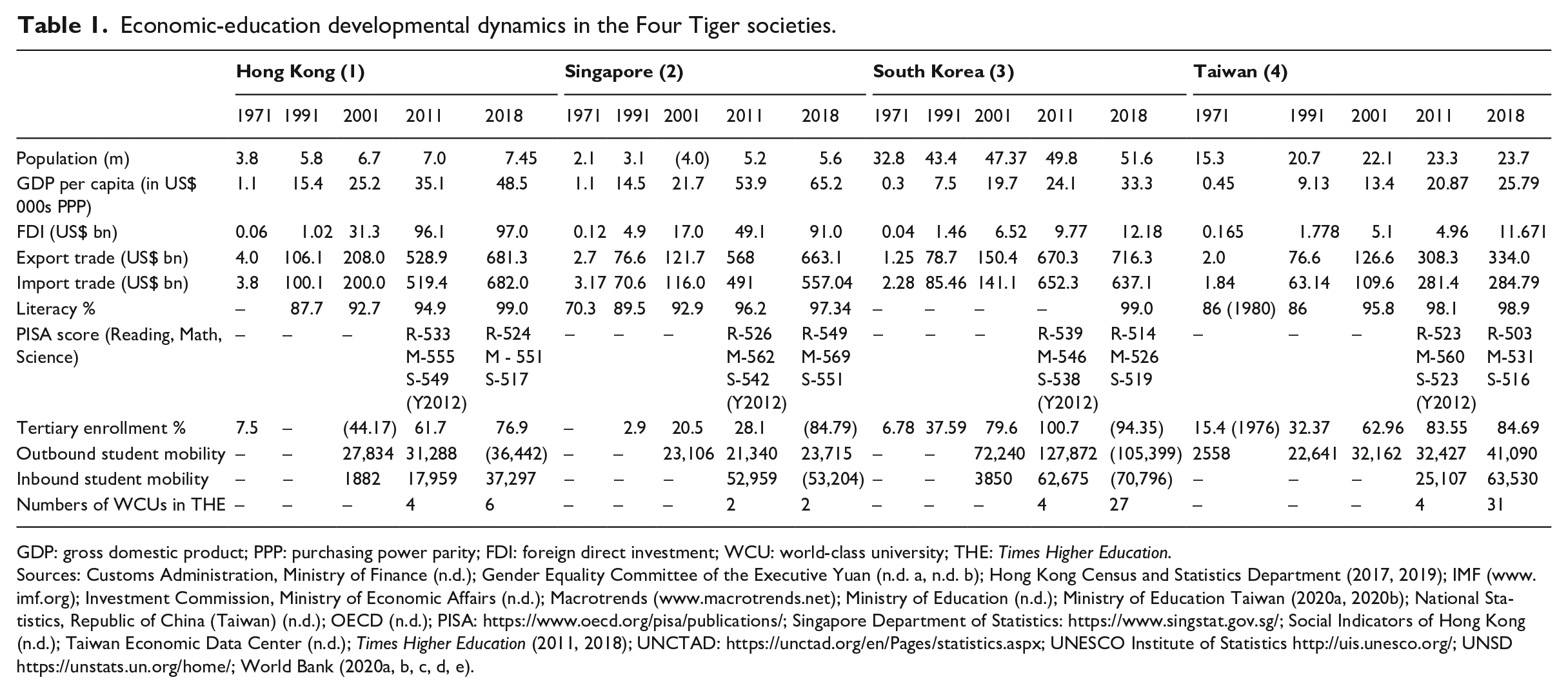
GDP: gross domestic product; PPP: purchasing power parity; FDI: foreign direct investment; WCU: world-class university; THE: Times Higher Education.
Sources: Customs Administration, Ministry of Finance (n.d.); Gender Equality Committee of the Executive Yuan (n.d. a, n.d. b); Hong Kong Census and Statistics Department (2017, 2019); IMF (www.imf.org); Investment Commission, Ministry of Economic Affairs (n.d.); Macrotrends (www.macrotrends.net); Ministry of Education (n.d.); Ministry of Education Taiwan (2020a, 2020b); National Statistics, Republic of China (Taiwan) (n.d.); OECD (n.d.); PISA: https://www.oecd.org/pisa/publications/; Singapore Department of Statistics: https://www.singstat.gov.sg/; Social Indicators of Hong Kong (n.d.); Taiwan Economic Data Center (n.d.); Times Higher Education (2011, 2018); UNCTAD: https://unctad.org/en/Pages/statistics.aspx; UNESCO Institute of Statistics http://uis.unesco.org/; UNSD https://unstats.un.org/home/; World Bank (2020a, b, c, d, e).
In Table 2 we have also juxtaposed top 200 Times Higher Education (THE)-ranked WCUs and their dynamics in scores on major indicators: teaching, research, citations, industry income, and international outlook. The THE World University Ranking has been criticized among other global reputation tables for its limits in covering the spectrum of genuine university missions. At the same time, THE’s annual rankings were recognized as standing out in providing a more balanced view on academic perspectivization as perceived by a wide range of academic expert-rankers worldwide. In this paper, the table was engaged primarily to show the challenges in sustaining top performance in the glocal dynamics of multiple university missions.
Top 200 THE-ranked universities in the Four Tiger economies.
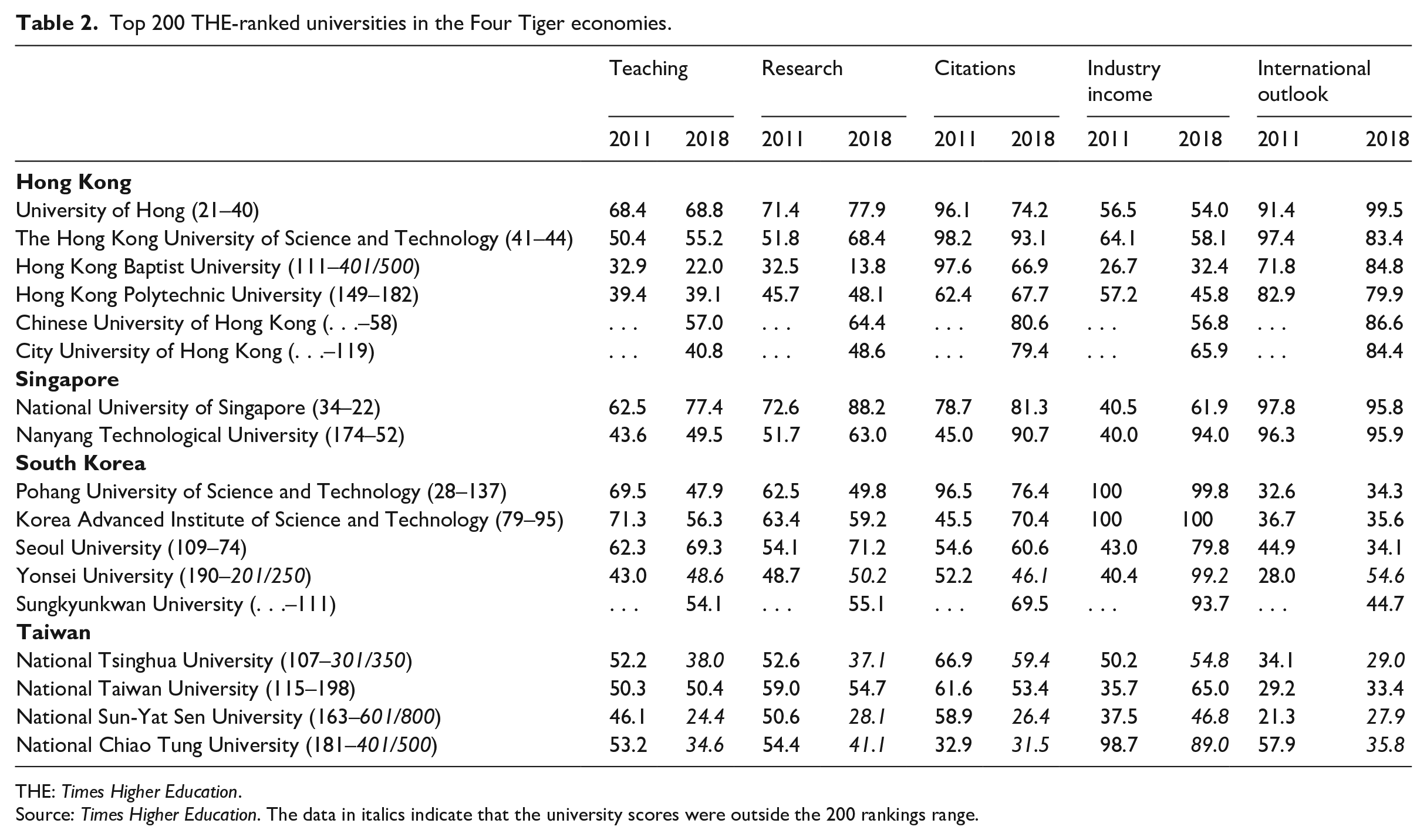
THE: Times Higher Education.
Source: Times Higher Education. The data in italics indicate that the university scores were outside the 200 rankings range.
Each author then wrote a case by engaging in a thorough review of key scholarly and policy reports produced between 1970 and 2020. These cases focused on specific jurisdictional dimensions, especially regarding educational policies concerned with pursuing world-class excellence in the selected jurisdictions’ higher education systems. The cases looked into major factors that had affected the university-mobility reinforcements in each jurisdiction, as well as notable challenges that contribute to different dynamics in repositioning global mobility and access to the world-class excellence in higher education. Afterward, we compared these cases and identified key themes and patterns that were essential in balancing the expectations of societies and universities, and discussed their influence on the prospective developments in each jurisdiction and in the region.
Cases and insights
Hong Kong
Hong Kong positions itself as a regional education hub characterized by a concentration of WCUs. The policy of developing Hong Kong into a regional education hub was announced in the early 2000s. Its main objectives included promoting Hong Kong as “Asia’s world city” as well as exporting educational services (UGC, 2004). In the late 2000s, in the context of economic downturn, the education hub strategy was repositioned as a way to boost economic development, create new business opportunities, and enhance competitiveness for Hong Kong. As the University Grants Committee (UGC) put it, the education hub initiative is “a policy of investment in the competitive knowledge economy by providing educational services to a population that is non-local with a strong emphasis on inward pull” (UGC, 2010: 54). However, the idea of developing an education hub not only means an influx of non-local students, but also incorporates the enhancement of profiles, branding and ranking of universities. Thus, the education hub strategy implies a desire to increase the capacity of the higher education system both quantitatively and qualitatively (Knight, 2013). This call for building an education hub explains the emergence of discourse on establishing WCUs in Hong Kong.
To pursue the world-class excellence, the UGC introduced various assessments of teaching and research of its funded institutions. For example, the Quality Assurance Council was established in 2007 under the UGC to oversee the quality of programs at first-degree and above levels offered by eight UGC-funded universities. The Council conducts quality audits regularly to monitor the quality of teaching and learning of the universities. Meanwhile, to monitor their research performance, the Research Grants Council of the UGC has periodically executed its Research Assessment Exercises (RAEs) since 1993, parallel with its British counterpart. Consequently, a culture of competitive performance (as well as managerial control) was successfully imposed on the higher education sector in Hong Kong (Lo, 2018b).
While the UGC attempts to promote world-class excellence through its assessment exercises, individual universities are keen to pursue better performance in global ranking exercises in order to enhance their reputation and increase their brand awareness among local and international students. Unlike its neighboring societies, the Hong Kong government did not use university rankings as a policy tool to benchmark universities against the global elites. However, as the RAEs run parallel to global university rankings and both focus on assessing universities’ research performance by international scientific publications, university management often employs the rankings’ figures as indicators to appraise the performance of their universities and as an instrument to market their institutions regionally (Li, 2016).
These policy initiatives and organizational behaviors of universities generate a competitive environment, in which inter-institutional competition has been intensified in the higher education sector of Hong Kong (Mok and Cheung, 2011). With their reputation increasing, these universities find it easier to launch and advertise new programs that invite a growing number of self-funded postgraduate students. The emphasis on globally measured research, however, generates a trend of isomorphism, which emphasizes international perspectives and undermines traditions and characteristics of local culture and institutions in the city (Li, 2016). Yet, in the context of global competition, climbing on international ranking schemes and pursuing world-class status is an effective way to improve universities’ global reputation and enhance their attractiveness to international students.
Given that the education hub strategy aims to increase the size of the non-local student population in Hong Kong, the UGC and universities have been keen to promote higher education internationalization for facilitating the growth of the number of non-local students. For example, in 2010, the allowed proportion of non-local students in the UGC-funded programs was doubled to 20% (UGC, 2010). To attract more non-local students, the government also loosened the regulations on immigration and employment and increased scholarship availability. Specifically, the amended regulations enable non-local students in their study period to take part-time jobs and internships; and to stay and work after completing their degrees. Since 2008, the government has also been offering more scholarship opportunities for non-local students through the Hong Kong Government Scholarship Fund.
These initiatives have successfully boosted the non-local student population in Hong Kong’s higher education system. During the period between 2001 and 2018, the proportion of non-local enrollments in UGC-funded programs remarkably increased from 2.9% to 17.9%. The total enrollments of non-local students also increased from 2253 to 18,061 during the same period (UGC, various years). Nevertheless, despite the rapid growth, most of the non-local students came from Mainland China (e.g. the UGC recorded 93% of such students in 2006). However, it is noteworthy that the policy of developing the education industry was abandoned and universities became keen to diversify their non-local student population in recent years (Lo, 2017). As a result, the proportion of Mainland China students to non-local students decreased to 68% in 2018. However, the heavy reliance on Mainland students remains an issue in the internationalization of higher education in Hong Kong.
Research indicates that Mainland students see Hong Kong as a stepping stone for further international development, and that they were attracted by the quality and reputation of universities in Hong Kong (Li and Bray, 2007). Indeed, research shows that Mainland Chinese students see studying in Hong Kong as an instrumental and a strategic means for facilitating further international mobility, as degrees from Hong Kong WCUs enable abundant opportunities for studies aboard (Xu, 2015). At the same time, some Mainland students are not satisfied with their learning experience and career opportunities in the territory (Xu, 2015). The dissatisfaction often relates to the lack of integration and inclusivity, including the unique environment of Hong Kong where Cantonese is used as the social lingua franca (Gardner and Lau, 2019). Besides, Hong Kong also had political situations where anti-Mainland sentiments and the resulting discrimination were observed (Xu, 2015). Some Mainland students, especially elite students, felt a sense of double-disadvantage. On the one hand, their Hong Kong education credentials are not recognized as prestigious by either Hong Kong or Mainland Chinese employers. While the former cherish qualifications from the West, the latter prefer graduates from top universities in Mainland China itself. On the other hand, these students also miss opportunities to establish and extend their social networks on the Mainland, which, they believe, are more useful than ones gained in Hong Kong (Xu, 2017). According to a survey conducted in the late 2000s, though the Hong Kong government had attempted to develop the city into an education hub since 2000, its universities were not well known by students outside the Asia-Pacific region (Cheng et al., 2011). Nevertheless, the international environment of Hong Kong’s higher education system successfully attracted students from Mainland China and neighboring countries, thereby sustaining the city’s position as a gateway to a robust economic region of the world. Meanwhile, non-local students who are well-integrated and collaborate with local students to engage in opportunities provided by the WCUs have been advancing their pursuits for education abroad (Oleksiyenko et al., 2013; Oleksiyenko, 2015). These research findings are important in revealing the close link between the quest for building WCUs and the intensification of the global flow of students.
Singapore
The small island nation on the tip of the Malay Archipelago is home to roughly 6 million people, of whom approximately 40% were born outside Singapore (Sanders, 2019). Following Singapore’s ejection from Malaysia in 1965, the government has been faced with the challenge of how to compete globally as a nation given its small size and population. Due to its lack of natural resources, Singapore’s government placed significant emphasis on education as a means of economic development (Daquila, 2013; Gopinathan and Lee, 2011; Ng, 2013). Singapore’s sense of its own threatened position has served as both a source of legitimacy for the government, and as a driver of government policy since independence (Gopinathan and Lee, 2011).
Singapore is an accelerationist state which practices a form of authoritarian liberalism, meaning that the economy in Singapore is heavily directed and “accelerated” by strong government, regulation, and intervention (Lo, 2018a; Sanders, 2019). This has also been the case in higher education, as moves to attract foreign institutions to Singapore have largely been driven by the Economic Development Board, rather than the Ministry of Education (Mok, 2012c).
Singapore’s higher education system was initially established for the purpose of providing work skills for the local population, particularly in manufacturing, and can be traced back to the founding of the University of Malaya in 1949, which later evolved to become the National University of Singapore (NUS) in 1980 (Bolton et al., 2017). Following the authoritarian liberalist model, investment in educational infrastructure has been heavy and consistent, despite economic fluctuations (Gopinathan and Lee, 2011). In 2011, the National University of Singapore collaborated with Yale University to develop a joint liberal education college and sought to advance a liberalized residential undergraduate education in Singapore. More recently, it has reoriented Singapore, and its education policy, towards fostering an innovation economy, and training the talent to perform in this capacity (Sanders, 2019). Internationalization and quality have been emphasized in an attempt to prevent brain-drain, and to attract international talent (Daquila, 2013).
In 1997, the Singaporean government introduced the World Class University Program which aimed to attract prestigious foreign universities to establish campuses in the country to help drive innovation; this plan was further expanded in 2002 to establish Singapore as a hub for higher education (Mok, 2012c). This gradually developed into the Global Schoolhouse Program which aimed to dramatically increase the number of non-local students studying in Singapore, utilize higher education to drive the innovation economy, and capture the benefits of internationalization to develop local students’ creativity and entrepreneurialism (Lo, 2018a; Sanders, 2019). In 2003, the Singaporean government established the Singapore Education initiative, which was a collaborative effort between the Economic Development Board, the Ministry of Education, the Tourism Board, the Standards, Productivity and Innovation Board, and International Enterprise Singapore (Mok, 2012c) to expand the number of international students pursuing degrees in Singapore from 100,000 to 150,000 (Ng, 2013). However, it is noteworthy that figures for “inbound internationally mobile students” in Singapore were approximately 52,000 in 2018, and apparently declining, according to UNESCO Institute for Statistics (n.d.), given that the government abandoned the intention of developing the education industry in the late 2000s (Lo, 2014).
Presently, there are six autonomous universities, five polytechnics, eight branch campuses of foreign HEIs, and three degree-awarding sub-university institutions (ICA, 2020). Singapore’s two flagship higher education institutions (NUS and Nanyang Technological University (NTU)) have only recently been exposed to competitive pressures, but have risen sharply through the international rankings (Sanders, 2019). NUS and NTU reached #11 and #13 in the QS rankings (QS, 2020), #25 and #48 in the Times Higher Education ranking (THE, 2020), and #67 and #73 in the Academic Ranking of World Universities (ShanghaiRanking, 2020). Singaporean universities have been forced to be entrepreneurial under the existing system, establishing relationships with prestigious international universities in order to boost their own competitiveness (Ng, 2013). Following the success of the Global Schoolhouse Program, the two flagship institutions in Singapore outpaced many of their foreign partners in international rankings (Sanders, 2019).
Attracting internationally mobile students was, at this point, a cornerstone of Singapore’s internationalization project. Many of the branch campuses established in Singapore have been geared towards international students, rather than locals (Mok, 2012c). Singapore’s attractiveness for “Asian” students is largely driven by: parental pressures, inability to access prestigious higher education at home, relatively low costs (compared to prestigious destinations in the “West”), a high degree of personal safety, and the draw of the English language (Chue and Nie, 2016). More broadly, Singapore is considered attractive due to its use of English, cultural diversity, and the perceived quality of its institutions (Bolton et al., 2017; De Jager and Soontiens, 2010; Mok, 2012c; Sanders, 2019). Institutions have also been able to rely on government support structures, such as overseas marketing (even within niche educational markets) (Ng, 2013), and provision of scholarships for exceptional students; however they are often limited by nationality, or by subject (Ng, 2013).
More recently, however, the domestic political and social situation has changed in such a way as to reduce the inward flow of international students into Singapore. Following some initial success of the government’s plans, public sentiment resulted in a record low level of electoral support for the ruling People’s Action Party, which saw the government retract many of its incentives for international students in order to quell displeasure among locals (Lo, 2018a; Sanders, 2019), including reducing the ability of international graduates to gain access to permanent residency (Daquila, 2013). Some international students have also cited mismatches between their expectations and the reality of their study experience. Despite English being a strong draw for internationally mobile students, many who arrive in Singapore find the English medium of instruction environment difficult to deal with, and in some cases it influences their studies, particularly those enrolled in postgraduate programs who experienced difficulties communicating effectively in academic English; this was especially true of engineering and sciences students (Bolton et al., 2017). Some concerns have also been raised by international students and faculty of the prospect of true academic freedom in a soft-authoritarian state like Singapore, although other reports have noted that the situation in the country has changed significantly of late and most attendees of local HEIs report feeling free to discuss any topic (Ng, 2013).
Overall, Singapore’s rapid economic rise has also allowed it to develop a “world class” higher education system, able to compete with the most established and prestigious institutions in the world. While many have criticized the government’s high degree of control in Singapore, it is undeniable that it has made significant achievements in the field of higher education. However, recent socio-political shifts in Singapore may see a refocus away from internationalization of the higher education environment as the government chooses to focus more on meeting the needs and wants of the local population.
South Korea
Like the other Tiger economies, South Korea is often heralded for its rapid economic advancement alongside its rapid advances in educational attainment. Today, South Korea has the most educated youth population in the world, with 70% of the country’s 25 to 34-year-olds having completed tertiary education (OECD, 2019). But South Korea is also an example of educational extremes. The country’s high-pressure culture around education has created a predatory shadow education market of cram schools and private tutors that adds significant non-formal education costs that are financed by private households (Byun, 2014). There is also a widespread culture of study abroad at all levels of education, with families across the class spectrum sending their children overseas in order for them to gain a competitive edge in schooling and job prospects upon return. At the tertiary level, South Korea, with a population of only 51 million, sends over 105,000 students overseas (UNESCO Institute for Statistics, 2017) — over three times more students than Mainland China sends and over eight times more students than India sends when adjusted for population.
The mass departure of South Korean students, coupled with the country’s incredibly low fertility rate for the past several decades, has resulted in a shrinking youth population from which South Korean universities can recruit. As a response to the domestic student shortage, the South Korean government introduced a series of policies intended to internationalize the country’s higher education sector as a means to attract more international students beginning in the early 2000s (for a more detailed discussion, see Kim, 2013). The most direct initiative to do so is the Study Korea Project, which actively targets international student enrollment through scholarships and publicity programs. Other initiatives sought to improve the standing of South Korean universities within global rankings by improving their research capacity, such as the Brain Korea 21 Project that poured money into a small basket of universities to encourage faculty to produce more articles published in indexed journals. And as global rankings began to account for the proportion of international faculty members, the government launched the World Class University Project that invited overseas scholars to South Korean universities through special subsidy programs. Subsequent initiatives, such as the Brain Korea 21 Plus Project, have continued to augment the research capacity of South Korean universities by improving the quality of graduate education.
These policies underscore the growing sense that universities in South Korea need to improve institutional quality to attract more international students, a need that has become critical as an economic response to a serious domestic student shortage (Byun and Kim, 2010). Meanwhile, in order to foster institutional excellence under a WCU rubric, the government has allocated funding to universities on the basis of specific evaluations, and universities have responded aggressively in a way that has spurred deep institutional changes, including a culture of research productivity (Jung, 2014; Shin, 2009), the adoption of English as the academic lingua franca (Byun et al., 2011), the recruitment of overseas faculty members (Kim, 2011, 2016b; Kim et al., 2021; Park, 2018; Shin and Gress, 2018), an increasingly centralized form of institutional governance (Shin, 2011), and a dependency culture on US-dominated global rankings and other “imported” measures of excellence (Byun et al., 2013; Deem et al., 2008; Mok, 2007; Palmer and Cho, 2012).
While South Korean universities have had some success in attracting international students from other Asian countries (Chan, 2012; Hanada and Horie, 2021), notably Mainland China, and increasingly Vietnam, there is growing evidence that internationalization reforms have also resulted in the retention of domestic students who may otherwise have studied abroad (Kim, 2015). Indeed, international students account for less than 5% of total enrollment in the South Korean higher education sector, but internationalization reforms have had an outsized influence on teaching and learning within South Korean universities. For example, top universities now offer over 30% of their classes in English, with some STEM focused institutions offer over 90%, effectively resulting in an English-language curriculum for the benefit of primarily South Korean students. In short, internationalization reforms provide domestic students with intercultural learning opportunities (Jon, 2013) without the need for those students to study abroad.
It is precisely this globally minded but locally bound population that universities in South Korea seek to capitalize on as they offer international campus settings to expand into greater student markets. These “glocal” students (Choudaha, 2012: 4) are “characterized by aspirations that usually outstrip both their ability to afford a full fee-paying overseas education and their academic merit to gain admission to an overseas institution.” South Korean universities are adopting internationalization reforms as a direct result of government policies, and they have resulted in the retention of students from within the country’s own borders. And these efforts seem to have palpable results, as the number of students leaving South Korea for universities abroad has been steadily shrinking since 2011.
As South Korean universities have become internationalized learning spaces for primarily South Korean students who seek international learning at home, the student experience has transformed in notable ways. In terms of language and pedagogy, the rapid increase of English-taught courses has created an “English divide” between students who are good at English and students who are not that corresponds remarkably with students’ class backgrounds (Jon and Kim, 2011). Because of such class-laden ideologies, students have begun to resist using English when it is aggressively incorporated as part of their institutional learning environment (Kim, 2016a). Similarly, as internationalization reforms have fueled a demand for faculty members who can teach and do research in English, tensions between junior and senior professors have escalated as junior professors take on heavier teaching loads in English (Jon et al., 2020) and fulfil more demanding publication requirements in English (Jung, 2014).
Such examples of rising tensions within South Korean universities are part and parcel of the higher education sector’s aggressive adoption of the WCU logic and rationale. They are also perhaps particular to the student and professor experience in places like South Korea and Taiwan, where English is not the native tongue, rather than across more multilingual contexts like Hong Kong or Singapore, where English is much more integrated into a general curriculum. Meanwhile, similar to the other Tiger economies, the South Korean government has invested considerable resources into holistically transforming South Korea into an education hub within northeast Asia, particularly through the establishment of the Incheon Global Campus in Songdo (Looser, 2012), thus pitting its higher education sector against its East Asian neighbors.
Taiwan
As an emerging economy, Taiwan pursued its competitive position in East Asia by becoming an active education agency at the global stage. Given its strength in high technology and engineering, particularly regarding the information communication industries, Taiwan has become aware of the need for greater internationalization so as to secure its position in the global trade and commerce community (Chou and Chan, 2016). To effectively support the further development of the economic and social dimensions, the higher education system in Taiwan has gradually engaged with internationalization-at-home through international students. As in the past, Taiwan and other East Asian Tigers are interested in sending elite students to “Western” institutions to gain knowledge and exposure to cutting-edge technology (Chan, 2012). Such a tendency for outflow has been criticized for the potential danger of “brain drain” (Hsueh, 2018). To reverse local talent loss and strengthen its international competitiveness in national development, Taiwan has begun to create a new blueprint for higher education.
With the introduction of the new White Paper for Universities in 2001, the government clearly identified that “the degree of internationalization [was] insufficient” (Ministry of Education Taiwan, 2001: 54). In other words, universities had been criticized for not being internationalized. In addressing this deficit, a wide range of relevant internationalization initiatives was proposed, such as Enhancing International Competitiveness of University Plan and Improving English Proficiency of Higher Education Students, released in 2002 (Su, 2007: 14). It was obvious that policy-makers believed that raising university competitiveness was essential for the national competitive position on the global stage. Soon after the release of these official documents, the recruitment of international students (or non-local students) into Taiwanese campuses gradually became regarded as the cornerstone of international engagement (Kheir, 2021; Ma, 2013). Such a move was even included in the national key development plan by the Executive Yuan in 2004 (Su, 2007: 14). In addition, the Taiwanese government announced the Development Plan for World-class Universities and Research Centres of Excellence Initiative in 2005. One of the major targets of this ambitious project was to help get at least one university in Taiwan ranked in the top 100 universities worldwide and become one of the top 10 world-class research centers or academic fields (Lawson, 2007; Tang, 2019). An additional critical objective of this scheme was to increase the number of inbound international students. In fact, the attraction of non-local students is highly intertwined with the pursuit of WCU status for Taiwan. In the subsequent decade, more related policies and schemes were announced by the government, placing emphases on international students and having WCUs.
A more thorough policy discourse for foreign student recruitment was formed during the presidency of the then-elected President Ying-Jeou Ma, who vowed to strengthen Taiwan’s international position. In the Policy Blueprint on Foreign Student Recruitment at Higher Education announced in 2009, a strong economically driven approach was endorsed (Ministry of Education Taiwan, 2009). Though it recognized the importance of raising the international outlook, language proficiency, and immersion in other cultures, this blueprint clearly documented how Taiwan should attract more international students to increase its national competitiveness. The policy states, “attracting foreign talent has already become the major means to accumulate human capital and boost economic growth of the developed countries” (Ministry of Education Taiwan, 2009: 5). From the perspective of national competitiveness, Recruiting international students helps control the source of human capital. It also retains significant implications to economic benefits and can be the source of greater competitiveness in modern industries, societies, and states. Thus, talent mobility will have profound impacts upon knowledge creation and mobility, the productivity enhancement, international competitiveness, income generation, and the development of [the] middle class (Ministry of Education Taiwan, 2009: 5).
This spearheaded recognition of the importance of international students as human capital and talent for the purposes of economic utility in achieving national interests. This also generated a discourse where WCUs were encouraged to invite more inbound international students (Tang, 2019). For leading universities, international students were seen as serving several key purposes. First of all, this inbound talent was supposed to play a key role in promoting knowledge production and publications, which was essential to world university rankings. The international student number per se was viewed as an important indicator within these global rankings. Secondly these non-local students were supposed to bring extra income for universities through tuition fees and so on. Finally, this elite human capital also became an extension of top universities in Taiwan for global outreach and engagement as the graduates and alumni would improve institutional recognition and branding after being awarded a degree.
Despite these long-standing motivations for greater inbound international student mobility, Taiwan has been facing some challenges while promoting its institutions to world-class status. A significant number of elite local students continues to prioritize studies abroad, mainly in Europe, North America, Japan, and Australia (Chan, 2012). In other words, Taiwan still loses valuable students to more competitive countries as around 30,000 to 40,000 students in Taiwan annually choose to study abroad (Ministry of Education Taiwan, 2020a). This figure has remained stable during the past decade. In contrast, the number of inbound students has risen from around 45,000 in 2010 to 130,000 in 2019 (Ministry of Education Taiwan, 2020b). This number has almost tripled during this time period. The major sources of these inbound students include: Vietnam, Indonesia, Malaysia, Mainland China, Hong Kong, Japan, Macao, South Korea, and Thailand. The major subjects that international students choose include business and management, information communication technology, engineering, hospitality and tourism, language, and the arts. These subjects reflect the relatively strong areas and domains in Taiwanese universities.
In general, the number of inbound students has been exceeding the number of outbound students since 2010. In other words, Taiwan, to some extent, has achieved its goal as an international destination. Nevertheless, the main body of inbound students are the result of regionalization in Asia (Hawkins, 2012). Very few non-Asian students choose to come to Taiwan. Close examination of the statistics of top universities in Taiwan reveals that less than 10% of the student body (some even less than 5%) of these universities is international (Control Yuan, 2017). Meanwhile, the student mobility between Taiwan and Mainland China has been suspended since 2020 due to political tensions. This further demonstrates that student mobility and academic exchange can be vulnerable to political interference, despite the significance of the economic agenda in higher education development (Lo and Chan, 2020). In other words, political factors still play a significant role in terms of student mobility or even academic exchange. In summary, with the implementation of internationalization initiatives and WCU projects, brain drain is no longer the same serious issue in Taiwan today as it was in the past. Based on the economic or human capital rationale, it seems that the WCU movement has reshaped the flow dynamics of international student mobility in Taiwan. Nevertheless, these top universities still need to pursue improvements in internationalization of their programs if they want to be competitive internationally.
Tigers and bounds: Comparative analysis
Over the last 50 years, the Asian Tigers have redefined their societies, repositioned their universities, and restructured their student mobility patterns. The emphasis on the roles of international education in shaping globally and regionally significant economies was prominent in the past and has remained prominent in the present (Li, 2003; Ma, 2013; Mok, 2003a,b; Oleksiyenko et al., 2013). However, the comparative analysis suggests that there were major changes as well as challenges in how local universities pursued and adjusted internationalization policies and persisted in world-class excellence to empower their students for international mobility.
Initially, the economic success of the Tigers was regarded as dependent on absorptive capacities of the local workforce in the international value-supply chains. Hence, the discourse and practices of enhancing access to better schooling and higher education became important. Likewise, each jurisdiction, to varying degrees, implemented policies to increase their attractiveness to international talent, increasing the opportunities for regional student mobility, as well as increasing the pull force of local institutions (as in Hong Kong), or by attracting prestigious institutions from elsewhere (as in Singapore). Probably more than their “Western” colleagues, the managerial classes in the Tiger economies were eager to embrace the imageries such as a “knowledge-based economy”, “knowledge society”, and “human capital”. Universities in the Tiger economies became critical anchors of global flows of knowledge while contributing to local research and education through international networking and collaborations (Oleksiyenko et al., 2013; Postiglione, 2013). The international linkages were viewed as important in augmenting global competence and competitiveness of local professionals as well as improving education for local students (Cheung, 2005).
The universities’ approaches to the internationalization of curricula and pedagogies, however, differed with regard to the previous legacies of their jurisdictions. While universities in Hong Kong and Singapore drew on their British legacies, they had to change the curriculum to become more independent from the colonial past as their societies sought to redefine their roles regionally and internationally. While positioning themselves for world-class research and teaching, they had to seek better balances for access of local students to international higher learning. It can be hard to say that equitable mobility was their major target, given that they encouraged competitiveness, selectiveness, and elitist perspective. Nevertheless, they became places of attraction for local talents to be internationalized at home instead of seeking opportunities in prestigious degree programs abroad. The dynamics of internationalization, however, differed in view of their legacies: that is, South Korea and Taiwan, which were more influenced by the Japanese imperial university, were more captivated than Hong Kong and Singapore by the US university model in later years (O’Sullivan, 2016; Yang, 2011). The US model could be argued to have encouraged a more entrepreneurial perspective in teaching and research than the British model did (and the differences can be seen in the Tigers’ university rankings on industrial income, as shown in Table 2). Even among Chinese-speaking jurisdictions, the differences in the interpretations of meanings of internationalization, international students, and mobility are significant as a comparative analysis of Hong Kong and Taiwan shows (see also Manning et al., 2019).
The intensive international exchange and engagement of students and scholars, which were linked to the economic discourse, made the universities’ internationalization efforts sustainable during economic globalization. Under the influence of the various regulatory regimes that consist of productivist, soft authoritarian, market-accelerationist, and neoliberal ideas (Holliday, 2000; Mok, 2011) 1 , the universities were urged by performative demands of the households that pushed (often excessively) their offspring to excel in education and compete for top university credentials in business, law, or economics, that is, in the fields which were tightly linked to high-income jobs propelled by multinational corporations. At the same time, the productivist model embedded in the transnational economy (Holliday, 2000) also implied that these offspring felt that they could develop competitive advantage locally by being more connected to the prestigious universities that performed well regionally and globally (Oleksiyenko, 2013). The globally connected corporations in all jurisdictions required more confidence and prominence from their local staff in the global supply chains (Hemmert, 2017; Tang, 2020). Unsurprisingly, employment requirements for proficiency in both local languages (e.g. Cantonese, Putonghua, or Korean) and English increased (Bacon and Kim, 2018; Chan, 2018). Local businesses began to compete to attract and retain versatile graduate talents from local WCUs (Gao, 2019).
While outbound student mobility grew significantly in the Tiger economies at the turn of the 21st century, it became increasingly challenged by the growing reputation of local universities several decades later (Oleksiyenko et al., 2013; Tang, 2020). The numbers of WCUs and inbound students increased in Hong Kong (primarily from Mainland China) and in Singapore, South Korea, and Taiwan (from greater Asia), while the outbound flows reduced as Table 1 shows (except for Taiwan). While the earlier outbound mobility was largely linked to a significant number of students seeking degrees at top universities in globally competitive economies abroad, many students had to leave their home countries in the last decade because their high scores still left no opportunity for them to compete at the top performing universities at home. Besides, the growing connections with a booming and competitive industry of Asia seemed to provide more graduate employment at home rather than abroad.
It is also true that the WCUs productivist pursuits in one domain (e.g. industry income or research) did not necessarily correlate well with achievements in other areas (e.g. teaching and internationally recognized papers and engagement of international scholars, or industry income). Achieving a balance of excellence across all areas of performance appears to be a challenging call, as has been reflected in studies of international student satisfaction in each of the Tiger jurisdictions. With traditionally persistent aspirations for high-status goods, many families in these jurisdictions continue to seek access to WCU-type higher education. Given that local carrying capacities at WCUs are insufficient (in view of the relatively high volume of top-scoring students compared to the rest of the region; see Table 1) and performance anxieties are pervasive, the households continue to send their offspring for studies abroad, and they will most likely continue to do so in the future. Concurrently, student mobility within the region has also created an attractive pool of international students from which WCUs in these jurisdictions can draw. For example, while many high-achieving students in Taiwan, particularly those with the financial resources, still go abroad to study in the more traditional WCUs, such as in the United States and United Kingdom, there is an increasing population of incoming students from South and Southeast Asia who recognize the comparatively high quality of Taiwanese higher education, and are attracted by its affordability, among other qualities.
Additionally, the accomplishment of massification of higher education stimulates local policy-makers and university developers to pursue WCU-oriented research and education (Shin et al., 2016). Local universities and faculties are encouraged to think in terms of a global standard of excellence, which implies collaborating (as well as competing) with counterparts worldwide in order to contribute to the internationally peer-reviewed discourses of science and graduated education as well as shape the improved methods of governance, teaching, and research for institutional autonomy, academic freedom, creativity, and critical inquiry. The latter determine the WCU’s ability to champion influential innovations and discoveries and attract talents locally and globally. Once rooted into the political legacy of centralization, corporatization, and bureaucracy, universities in the Tiger economies were successful enough in shaping academic experiments for a different modeling (Mok, 2012a). Developing the East Asian space of world-class excellence is essential for local professors to feel equitably positioned for collaboration, exchange, and trading with their international counterparts and colleagues (Ng, 2011; Oleksiyenko et al., 2013; Takeda, 2020). Likewise, many non-local students report the attractiveness of not only the perceived quality of the institutions themselves, but also of the academic staff when considering their overseas study destination (Manning, 2019).
Concluding remarks: Reimagining the global field of international student mobility
Hong Kong, Singapore, South Korea, and Taiwan have variably succeeded to reposition their universities for world-class excellence and to empower their students and faculty for greater global mobility and international higher learning. While growing in regional and global significance, the universities’ capacities to create a greater equity in global mobility and attaining prestigious degrees are, however, limited. In pursuit of higher status and competitive powers, the WCUs in these jurisdictions generate inequity as much as access in global higher education. As experienced by other research-intensive universities, this disequilibrium is most likely to lead universities to misguided aims of higher education, caused by disintegration of research and teaching agendas, and withdrawal of sustainable funding and stakeholder commitments. As WCUs are reoriented from teaching to research and then toward competitive talent hunting and revenue generation, effective synergies between research and teaching excellence will be harder to achieve, especially when global mobility and higher learning become preoccupied with engagement of international students as “cash cows” rather than “pedagogic partners” (Lomer et al., 2021). The latter will be particularly difficult to sustain when freedoms of inquiry, speech, teaching, and learning are challenged in the age of post-truth and authoritarianism (Oleksiyenko and Jackson, 2020).
As the regional competition increases in view of Mainland China’s improving its HEIs, research capacities, and engagement of returnees and international students (Jöns and Hoyler, 2013; Mulvey, 2021; Yang, 2020), the four Asian Tigers would need to be more strategic in how they position their WCUs for enhanced pursuit of regional and global reputation, and capacities to mitigate brain drain and sustain international competitiveness of their economies and education systems. Contemplating on transformations and new paradigms amid the currency of geopolitical considerations, we anticipate their strategic visions to be affected by COVID-19 and the post-COVID prospects of restricted global mobility and critically minded internationalization (Oleksiyenko et al. 2020). Nevertheless, as the desirability of “the West” has been deeply hampered by concerns about public health, security, and visas, this may open up new possibilities for the Tiger destinations as they continue to emphasize their desirability to invest in “world-class excellence” (Altbach, 2013; Salmi, 2009). While previous WCU logic entailed that Asian universities look to Western ones for standards of excellence, as each of the cases show in the paper, this current rupture calls for a new paradigm that reconfigures Asian universities as the ones leading the new era of student mobility and finding measures of excellence within a paradigm where the “West” faces increasing competition from the “East”.
Footnotes
Acknowledgements
We would like to thank Phan Le Ha and Gerald Fry, the co-editors of this Special Issue, as well as anonymous peer-reviewers for their rigorous review and thoughtful suggestions that have made this paper stronger.
Funding
The author(s) received no financial support for the research, authorship, and/or publication of this article.