



Abstract
This semi-structured interview study seeks to describe Chinese teachers’ understanding and concerns about the use of play in supporting young children’s English learning. Eight English as a foreign language (EFL) teachers of children aged between 3 to 8 years were involved, including both local teachers and international teachers. Findings reveal that because of the unique feature of EFL learning, structured play-based learning was mainly discussed and favored by teachers. Although teachers showed an inclination of separating learning from play, they believed that play serves a supporting role in maintaining students’ interest and motivation in English learning, which is especially crucial important for young children. However, teachers are concerned that play’s benefits would be considered being neutralized when children get older from parents’ perspectives which will eventually negatively impact teachers’ teaching practices. Teachers also face the barriers of balancing the gap between child’s language abilities and cognitive development in EFL teaching. The findings and discussions raise implications for researchers and practitioners to rethink how to define play. A broader definition of play-based learning will help balance both the needs for academic teaching and the benefits of incorporating play, as well as provide implications for integrating play pedagogy in public school systems.
Globally, the significance of play in supporting young children’s optimal development has been written and emphasized in many countries’ early learning frameworks (OECD, 2017). According to OECD, roughly 80% of its member countries and jurisdictions value play in their early learning framework and guidelines. For example, in Canada, the Council of Ministers of Education, Canada explicitly discussed learning through play and play-based learning in its early learning framework (Canadian Council of Ministers of Education, 2014). However, recent research data demonstrate a decline of the child’s playtime and the emphasis on academic learning both at home and at school across the world, for example in the United States (Gray, 2017), in the United Kingdom (Mullan, 2019), in Denmark (Ellegaard & Kryger, 2020), in United Arab Emirates (Baker, 2014), etc.
The above trend indicates tensions and conflicts involved with learning and play, the difficulties and complexities of the formulation of play in early learnings, as well as the discrepancies between educational theory or policy and practice. The purpose of this study is to examine and compare how early learning teachers in China understand and use play. Specifically, teachers of English as a foreign language (EFL) learners from private school systems were targeted, as private schools or language training institutions can decide their teaching approaches that reflect their own teaching philosophies. The authors hope such a recruiting design would ensure more flexible and broader perspectives about play from teachers. The findings are intended to provide empirical evidence on how play is understood, used, and delivered in China. Therefore, the present study responds to the following research questions: What do teachers believe about play and learning? What are the prevalent play patterns in EFL classrooms in China?
Play and play-based learning: Theoretical and empirical insights
Defining play has been a debate and has not achieved an agreement for many years because of its multilayered features (Pellegrini & Bjorklund, 1998; Pyle & Danniels, 2017; Rentzou et al., 2019). According to the content of play, Piaget (1962) classified play into functional play, constructive play, symbolic/fantasy play and games with rules. From a social interaction perspective, play is described as unoccupied behavior, onlooker behavior, solitary play, parallel play and cooperative play (Parten, 1932; Rubin, 1982). The most controversial factor of defining play often revolves around the level of child autonomy and adult control which divide play into three categories: free play, guided play and structured play/play-based learning (Pellegrini & Bjorklund, 1998). Running through abundant literature, the most commonly accepted definition of play is that play should be spontaneous, unstructured, child-centered and child-directed (Garvey, 1990; Gray, 2017; Shipley, 2007; Weisberg et al., 2013), namely free play. However, some critics argue that the idea of spontaneity and child-directedness embedded in free play is based on children’s prior experiences, which are frequently imparted by adults rather than stemming from inherent tendencies. Therefore, a purely child-selectiveness and directedness do not exist. (Pyle & Danniels, 2017). Guided play and playfulness in teaching or play-based practices have thus been brought to the forefront of discussions.
Prior to discussing guided play and play-based learning, the conceptualizations of child-centeredness and child-directedness need to be clarified. According to Pyle and Danniels (2017), child-centeredness advocates that teaching and learning should consider children’s development, interests and abilities, whereas child-directedness means that child takes control over certain teaching and learning activities. Not all child-centered teaching practices are child-directed, for example, play-based practices and teacher-directed learning activities are child-centered but not child-directed. Guided play which is considered a middle ground between didactic instructions and free play is initiated, structured and maintained by adults and remains child-directed (Weisberg et al., 2013). Play-based learning differentiates from guided play by incorporating rules throughout the play to engage children in learning skills that cannot be spontaneously acquired in free play (Pyle & Danniels, 2017). Therefore, teachers play active roles in guided play and play-based learning, ranging from guides, supervisors, teammates to onlookers. From a play continuum perspective, guided play and play-based learning enable teachers to find a balance between play and learning, by adding child control or teacher control. Consistent with Vygotsky’s sociocultural learning theories, the integration of play and learning emphasizes (1) the nature of instruction is to stretch young children’s limits beyond their age; (2) the active and varying roles that adults serve in children’s play (Moll et al., 2013; Vygotsky, 1978).
A substantial body of research has also explored teachers’ perspectives and practices about play. Broadly speaking, teachers’ play belief is situated in specific cultural contexts and shaped by the evident/not evident cultural beliefs and practices, which in turn crucially influence their use of play in the classroom (Roopnarine, 2012). For example, Wu et al., (2018) investigated Chinese and German teachers’ understanding of play and found that compared to German teachers who value children’s agency in play, Chinese teachers underscored teachers’ intervention and control in play. Chinese teachers’ reluctance in using free play is also identified by Cheng (2012), Fung and Cheng (2012) and Wu (2019). Similarly, studies conducted in India (Hegde & Cassidy, 2009) and Abu Dhabi (Baker, 2014) revealed the discrepancy between teachers’ play beliefs and practices, meaning teachers value the concept of child-centered and developmentally appropriate practices whereas their practices follow a more teacher-directed approach. Nonetheless, Rentzou and colleagues’ (2019) comparative research found in the researched eight western countries (e.g., the United States, Italy, Greece, Denmark etc.), teachers’ understanding of play varied. For example, in USA, Spain and Italy, play’s support in learning and optimal development was emphasized, whereas, in Denmark and Cyprus, the playfulness and fun in play were valued.
Specifically examining guided play or play-based learning, the systematic review conducted by Bubikova-Moan et al. (2019) nuanced teachers’ perceptions of play and learning based on 62 studies from 24 countries which can be further clustered into three territorial groups. They found that play-based learning was even not a shared term in (Northern) European countries (e.g., Norway, Sweden, German), as teachers in this cultural context consider play, learning and a holistic view of development are a mutually related integral. Interestingly, although the findings showed that teachers from English-speaking countries (e.g., USA, Canada, Australia) and Asian (e.g., China, Japan, Saudi-Arabia) favored play-based pedagogies, the underlying reasons are opposite. Recent early learning frameworks in English-speaking countries witness a leaning to academic learning outcomes (OECD, 2017), leading to a compromised middle ground between play and formal instructions—play-based learning. Asian early learning system follows the opposite trajectory of transiting from a traditional teacher-led didactic teaching to a child-centered play-based approach.
No matter play or play-based learning, the inconsistency between theory and practices is identified by many studies (Bubikova-Moan et al., 2019; Fung & Cheng, 2012; Jensen et al., 2021; Vorkapic & Katic, 2015). Reasons are multilayered: pressure to meet the academic goal set by school and government; parents’ concerns about play; the challenges regarding class size and time; children’s unreadiness in play and teachers’ lack of knowledge of play pedagogies (Bubikova-Moan et al., 2019). Although plenty of studies focusing on teachers’ perspectives on play were conducted in China, most of them were conducted in Hong Kong (e.g., Cheng, 2012; Fung & Cheng, 2012; Wu et al., 2018) and Taiwan (Tsai, 2017). To facilitate the effective implementation of play pedagogies in the Chinese context, the present article aims to develop a broader definition of play and play-based learning from both local and international EFL teachers. This broadened definition will effectively balance the needs for academic teaching and the benefits of incorporating play, as well as provide implications for integrating play pedagogy in public school systems.
Research methods
To explore the shared understanding of play-based learning and play practices by Chinese EFL teachers, a phenomenological qualitative design was applied. Phenomenological inquiry is often used to explore a group of individuals' subjective and objective experiences of certain phenomena (Creswell & Poth, 2017), for example, EFL teachers’ play beliefs and play practices in the present study. Ethical approval was issued by the researcher’s university and teachers’ consent to participate in this study was collected.
Sampling and participants
Demographic data of teachers.
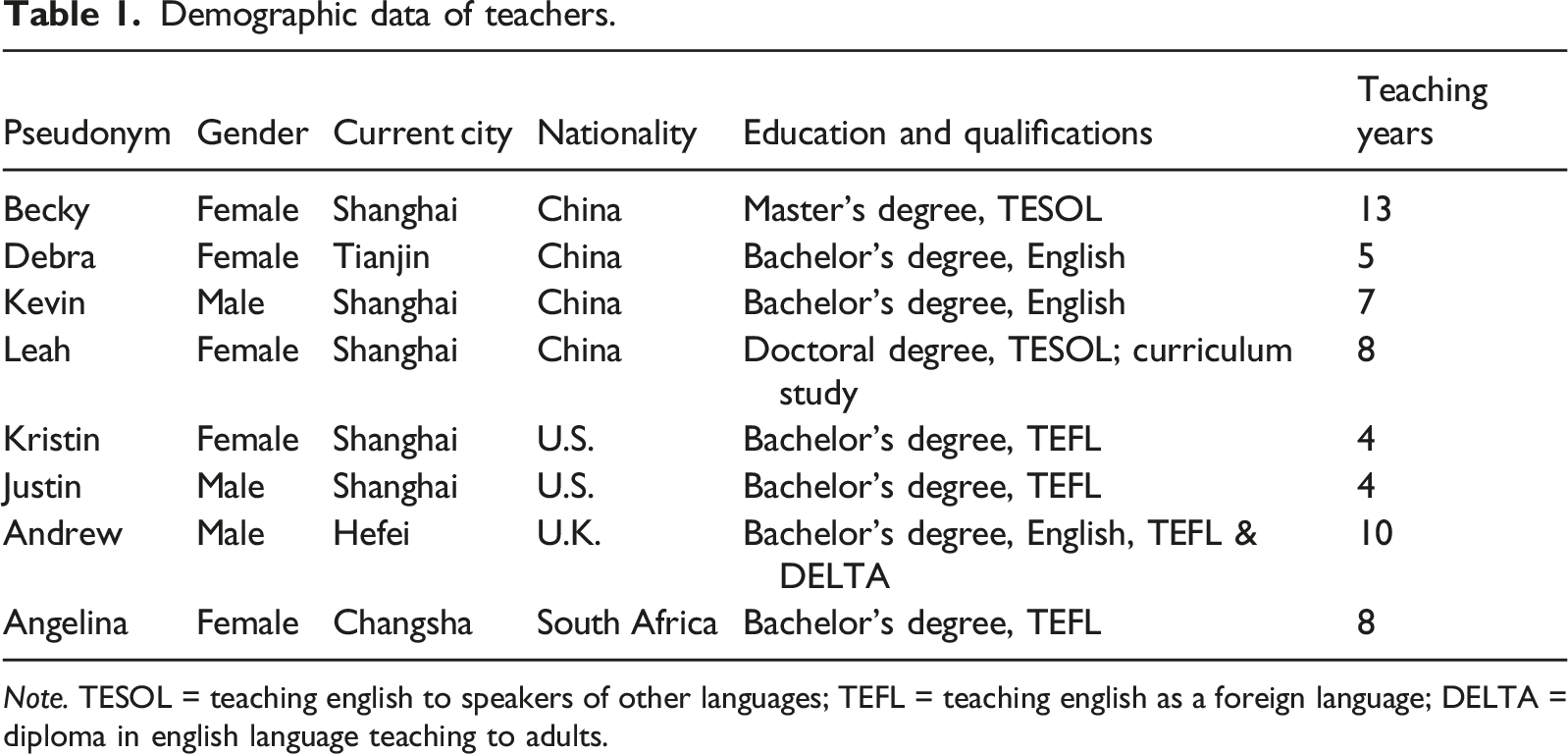
Note. TESOL = teaching english to speakers of other languages; TEFL = teaching english as a foreign language; DELTA = diploma in english language teaching to adults.
Data collection and analysis
Semi-structured interviews were the primary data source for this study. The interview questions were designed based on the research questions and focused on exploring teachers’ interpretations of play and its use in young children’s English learning. Interviews were conducted via phone calls, in Mandarin with Chinese teachers and English with international teachers. All telephone interviews were audio-recorded for later transcription and translation. To analyze the data, the researcher followed a thematic analysis technique: familiarizing with the data, coding, generating themes, reviewing themes, defining and naming themes, and reporting (Braun & Clarke, 2006). Regarding coding, Glaser and Strausss’ (1967) constant comparative method was employed. We compared the codes among teachers, resulting in five categories: free play versus structured play, play benefits, implementation constraints, play practices, and teacher roles. Following a comparison of these categories among the participants, two distinct themes emerged: teachers’ perceptions of play and teaching practices.
Findings
Teachers’ perceptions of play
Constant comparative analysis identified 76 statements that reflected teachers' perceptions of play. Three shared themes emerged: free play versus structured play, academic versus non-academic benefits and implementation constraints. The themes were elicited from the following interview questions: What does “play” mean to you? What would be the constraints of using play in your classroom?
Free play versus structured play
When asking about teachers’ understanding of play in general, the number of discussions about free play was few, only three international teachers spontaneously but briefly talked about free play. As for these teachers, play is unstructured, freely chosen, designed and controlled by children. Play, essentially for me, you get to kind of play, you get free play, whether the child can decide what they want to play with, what and how they want to make believe what they're playing (Angelina, international teacher). Child’s play is always unstructured. It's always based on their ideas and interests, um, often includes their friends (Kristin, international teacher).
However, the majority of teachers valued structured play that has a specific learning objective and is set in a structured framework. According to the teachers’ interpretations, they consider parents’ expectations of children’s English learning when discussing EFL learning in early years, therefore the curriculum design always sets learning outcomes and target language goals. Children play within the environment and context that the teachers set for them. Unlike free play, teachers need to interact with children to encourage language production. Consequently, structured play is viewed as more effective to achieve teaching aims. I would say that every time we play, well, I choose to call it a game, but um, what a lot of teachers consider a game in the classroom. It's always with a focus. Okay, we were playing this game, but are the students also producing language? So if the students aren’t producing language throughout the lesson, then it’s considered kind of a failure on the teacher’s part to transmit that knowledge and get the students to use the language (Justin, international teacher). The so-called play means that teachers create and set a play environment where children play and meanwhile teachers try to interact with the children in a language they can understand as much as possible. This is the one type of play that comes to mind. (Leah, local teacher).
Because of the nature of teaching young children English, teachers admitted they have to follow a more structured curriculum: introducing and teaching the target language at the beginning and following structured and playful activities to practice and produce language. Unlike free play, teachers need to interact with children to encourage producing language and ensure learning objectives.
Play benefits
This theme consisted of 29 statements that can be further divided into two subthemes: implicit academic benefits (e.g., concentration, engagement, motivation) and explicit academic benefits (e.g., language and school preparation). Both local and international teachers agreed on the importance of play in children’s development. As for the relationships between play and children’s EFL acquisition, teachers value the use of play in helping maintain children’s interest in English and concentration in learning. Particularly, promoting younger children’s interest in English is crucial as children lack the motivation of learning English, and moreover are not aware of the importance of English in later school learning. In this sense, the use of play to improve and maintain children’s interest in English is crucial. In Debra’s words: Unlike adults who learn English for a specific strong purpose like for work or getting a certificate, young children, especially preschool children, don’t have a purpose and motivation to learn English, so they don’t understand why they should learn English. They even don’t have a sense of score, they don’t know they’re expected to gain a high score in future primary school. So interest and fun are crucially important and play is one effective approach to ignite their interest in English (Debra, local teacher).
Engagement was also frequently mentioned by teachers, as it is a key factor to maintain young children’s learning motivation and concentration. Explicit academic-related benefits were less mentioned by teachers (8 statements) compared to implicit academic benefits (21 statements). This difference relates to parents’ expectations of young children’s English learning. As many teachers (n = 5) noticed, parents of young children do not emphasize academic-related performance (e.g., vocabulary, grammar, sentences, etc.); and all they expected are to develop English interest and learn through play.
Implementation constraints
The last theme with 34 statements revolved around constraints of implementing play. Teachers’ difficulties in incorporating play-based teaching methodology into class can be categorized into three layers: (a) parent factors, (b) classroom dynamics, and (c) children’s readiness. Parents’, especially primary schoolers’ parents’, concerns about the effectiveness of play in helping improve children’s test scores become the teachers’ biggest constraint in terms of implementing play in the classroom, as parents may not support teachers’ teaching approach. According to Angelina (international teacher), parents of primary school children naturally view the extra-curricular English program as supplementary to formal schooling and rely on it to improve their children’s test scores in public school. For example, Angelina once received parents’ complaints about her center’s failure to improve students’ scores. If the centers continually fail to satisfy parents’ demands on children’s test scores, parents will transit to another more academic-based and examination-oriented program. The phenomena of high drop-out rates from play-based English programs for primary school-age children were observed and discussed by all the interviewed teachers, as Justin said: I do know at least from the PA (progress advisor) and CC (course consultant) side, they say it’s more difficult for parents to stay with our center because they do want to focus on specific things, like testing, like focusing their students on the specific test skills that they need to move to a good middle school or high school (Justin, international teacher).
It is worth noting that parents’ concerns about play are highly related to children’s age. Five teachers pointed out that parents of younger children care about whether their children can have fun in English other than tests and scores, thus they favor the play-based program. However, once children get older, parents’ attitudes towards play and academic learning completely change. According to Debra’s observations (local teacher), there are two turning points: at children’s 5 years of age when it is time for preparing for primary school, and at grade three, the period of preparing for junior secondary school. The high drop-out rate from the play-based approach, starting from grade three is described by teachers Justin, Andrew, and Angelina, representing the change in parents’ attitudes towards play and play-based teaching.
The complexity of classroom dynamics, including class size, time constraints, safety issues, and discipline, is also one major concern of teachers. For many teachers, it is difficult to maintain a balance between having fun and fulfilling learning objectives in a big size classroom therefore many times they save time for learning rather than play. Safety issues are another important constraint for teachers. According to the teachers, competitive play which involves running, jumping, chasing or other intensive physical movements was often implemented. Therefore, how to keep children safe is crucial and may distract teachers from their focus on teaching objectives. Discipline was also frequently mentioned by both local teachers and international teachers. For example, according to Becky (local teacher), play sometimes is unstructured, and children will get very excited, emotional or even get into quarrels. Therefore, keeping children disciplined in play is challenging.
Three teachers indicated that children should have the requisite language skills to engage in play. However, according to their experiences, it is impossible for teachers to use play at the very beginning. Therefore, teachers have to design direct instructional time to give children a whole picture of target learning aims and understand the target language, at least to ensure children understand teachers’ rules in the later playtime. In addition, when teaching students whose English skills cannot match their cognition, it is difficult for teachers to design age-appropriate and English-level-suitable games. For example, in Leah’s non-profit English program for children of migrant workers or children from rural areas in Shanghai, she found: These students are usually in Grade three to five, however, their English level is quite low, no better than a four- or five-year-old preschool child. Therefore, what kind of play or activity is suitable for them? If I introduce them a difficult game, their English level doesn’t allow them to engage in this game. However, if I design a simple one, like the game designed for preschool kids, they won’t be interested in playing. So it’s problematic when child’s English level doesn’t match with their coginitive development (Leah, local teacher).
Teaching practices
This section concerned teachers’ play practices and their perceptions about teachers’ roles in children’s play and learning. A total of 45 statements (of which 25 referred to teachers’ play practices) comprised two themes: play practices and teacher role.
Play practices
In the EFL classrooms, structured play is mostly used by teachers including both local teachers and international teachers. In particular, prior to play or activities, teachers always have an initial introduction that relies on teachers’ direct introduction and focuses on instructing children in the target language. According to teachers’ sharing about their practices of using play in the classroom, play or activities can be further classified into three categories: playful activities facilitated by various realia, competitive play and role play. When asking what kinds of play they implemented in the classroom, most teachers (7 out of 8) referred to the activities facilitated by flashcards, toys, multi-media, or other realia as playful teaching practices. The second major play category is competitive play. Including race and reward, competitive play was frequently used and considered a good way to develop children’s sense of teamship and emotional regulation. For example, as for Angelina (international teacher), competitive play provides opportunities for children to learn life lessons of winning and losing more interactively. Theme-based role play that provides children an immersive environment to practice language is also discussed by some teachers. Often teachers will create a scenario and assign children different roles to complete this activity and meanwhile practice language, for example, Andrew (international teacher) designed a journalism activity for practicing questioning sentences, and Kristin (international teacher) included princess and prince play prompts to elicit the discussions around royalty in Europe.
Teacher roles
All of the interviewed teachers agreed that their role will change depending on the purpose of play. In the beginning, most playful activities serve as a means of facilitating children’s understanding of a new concept or knowledge, so teachers are more active and usually act in a leading role. As students gradually grasp the target language and learning objectives, teachers will step back and pass the leading role to students themselves. Teachers are more observing and monitoring the process, as Debra stated: My role is always changing. In the beginning, as students know little about today’s knowledge, I will lead and teach them to learn. However, once children gradually master the target knowledge after practices I lead before, I will change my role from a leader to a participant. So during practicing words and pronunciations, I will first ask them to read after me, then I will lower my voice, and eventually, I won’t read, even without any mouth movement demonstration…I will step back gradually (Debra, local teacher).
It is worth noting that two local teachers spontaneously brought up the discussions about the roles of local and international teachers, therefore, as an emerging question of interest, defining the roles of local and international teachers was asked. All teachers agreed that the combination of local and international teacher would optimize children’s English learning. However, teachers held a slightly different perspective. Local teachers tended to define the role of international teachers as for fun and authentic language, whereas local teachers were more leaning to impart language skills, such as vocabulary, sentences and grammar. On the contrary, international teachers did not see the difference. For example, Andrew (international teacher) clearly expressed: “At least my centers, we don’t make that distinction. You don’t say local teachers are the academic teachers and our foreign teachers are the fun teachers. We say everyone is a teacher, everyone teaches the same.”
Discussions
The indigenized perspectives about play
Both local and international teachers situated the discussions about play and their play practices within the Chinese cultural context and current Chinese education systems. The majority of teachers in this study did not believe that free play would suffice young children’s learning, especially considering learning EFL. Rather, they emphasized the importance of setting concrete learning goals and integrating them into play activities. Indeed, the play practices the teachers described reflected their preference for structured play activities. Such perception is different from the western knowing of free play and guided play, in which the former emphasizes the spontaneity and child-directedness of play (Gray, 2017; Weisberg et al., 2013), and the latter incorporates teacher’s scaffolding role into child-directed play (Weisberg et al., 2013). In the present study, Chinese knowing of play is teacher-designed and teacher directed, which has also been seen in other studies that were conducted in China (Cheng, 2001; Fung & Cheng, 2012; Wu, 2019).
Another distinction lies in the perception of play benefits. Various studies confirm that play predicts both children’s cognitive and non-cognitive success, such as literacy development (Colliver et al., 2020), mathematics (Vogt et al., 2018), social competence (Lehrer et al., 2014), and self-regulation and self-discipline (Sezgin & Demiriz, 2019). However, in the present study, only academic-related benefits were discussed by teachers, which can be divided into two broad categories: the implicit academic benefits that serve for better learning (e.g., concentration, engagement, and motivation) and the explicit ones (e.g., language and school preparation). In particular, the implicit ones are crucial to young children as play will increase children’s likeness and willingness to learn foreign languages.
However, as the majority of teachers observed, parents’ perceptions about play benefits will change when children get older, leading to children’s high dropout rate from less academic-focused programs and influencing teachers’ teaching techniques. Similarly, Badzis' (2003) and Warash’s et al. (2017) studies confirmed that parents’ acceptance of the use of play is influenced by the child’s age. Together with Warash’s et al. (2017) study, two key changing timing were identified: one is at 4–5 years when it is about entering formal schooling, and one is at 9–10 years when it is for more advanced learning. Although teachers in this study did not take a similar perspective as parents, they admitted they had to accommodate parents’ concerns. This explained why teachers in this study favored more structured play and emphasized more on the academic benefits of play. The inclination of separating play and learning identified in the present study, according to some researchers, is considered “superficial” (Fung & Cheng, 2012, p. 26) and needs to be improved (Vorkapic & Katic, 2015). The questions are: Who defines play? According to what standards? Should play be a universal phenomenon or a culturally responsive and appropriate one?
Play-based learning: A third place
In the present study, the play-based practices that teachers shared were structured, teacher-centered, and learning-oriented. The most frequently used play approaches were those aided by various materials including flashcards, pictures, multi-media and other themed props. According to the western definition of play or play-based learning, these practices cannot be viewed as play (Fung & Cheng, 2012). In the present study, for example, one international teacher, Justin stated “I would say that every time we play, well, I choose to call it a game”. When comparing play and play-based learning, researchers and teachers tend to deny considering the activities that involve adults as play (Pyle & Danniels, 2017). However, children do. According to Wu (2015), compared to German children who only considered free play as play, Chinese children accepted all playful activities, no matter whether they are child-directed or teacher-directed, as play. Chinese children’s interpretation of play and learning puts the questions of “what is play”, and “who defines play” on the table again.
The widely accepted notion of free play is drawn on Foucauldian discourses around power dynamics and thus advocates child’s control and power in play (McCabe & Farrell, 2021). However, as proposed by Pyle and Danniels (2017), the definition of play should be expanded based on a continuum/power varying from child-directed to teacher-directed. This broadened interpretation of play views play and learning as an indivisible whole (Pramling Samuelsson & Johansson, 2006) and thus allows teachers to include varying levels of adult control from more teacher-led to more child-led, ensuring both children’s needs for playfulness in learning and different stakeholders’ expectations in academic performance (Pyle & Danniels, 2017). The change of teaching practices (from direct instructions to playful activities) and teacher role (from a director, a facilitator to an onlooker) in the classroom in the present study vividly depict the fluid way of manipulating the power dynamics in play-based learning to meet children’s needs and fulfill teachers’ course plan.
The underlying theory of a continuum of play-based learning is child-centeredness which is different from the concept of child-directedness but is often misunderstood as child-directedness (DeLuca et al., 2020; Pyle & Danniels, 2017). The clarification between child-centeredness and child-directedness is crucial for practitioners to elucidate and implement play. Teacher-directed play/play-based learning/playful activities that are often considered a misunderstanding and misused of play (Cheng, 2012; Fung & Cheng, 2012; Vorkapic & Katic, 2015) or disturbing/hijacking child’s play (Goouch, 2008; Pramling Samuelsson & Johansson, 2006), however according to Pyle and Danniels (2017), are effective pedagogical approaches to promote both play that is favored by children and learning that is expected by various stakeholders. Looking at play-based learning from a continuum lens also enables teachers to solve parents’ polarizing views of play and learning and meet parents’ expectations for academic outcomes observed by the interviewed teachers.
Limitations and future directions
The present study has its limitations. The purposeful convenience and snowballing sampling method and the small sample size cannot be generalized to findings relevant to all Chinese teachers. In addition, although there were participants recruited from second or third-tier cities, like Tianjin, Changsha and Hefei, most of the participants were from Shanghai a well-developed city. China varies greatly when comparing first, second and third-tier cities in terms of socio-economic status, education level and other factors. The voices of teachers primarily from Shanghai are not representative of Chinese teachers in general. Lastly, this research explored play-based learning and practices in the context of private English institutions rather than in the public school system. In this sense, the research findings cannot be utilized to describe EFL teaching in the public school system. Therefore, future researchers may expand this study by using various methods, like quantitative research design, classroom observations or case studies and by involving more teachers from more diverse school settings and socioeconomic backgrounds.
Conclusions
The present study specifically examined the extent and nature of play and play-based learning in EFL classrooms for younger learners. The widely accepted definition of play is free play, however, because of the unique feature of EFL, purely free play might not work. A combination of the use of direct instructions and play-based learning was applied by both local and international English teachers in the present study. Teachers’ sharing from this study might shed light on the complex situation that EFL teachers are likely to encounter in their classrooms. According to the perspectives and practices of teachers from the present study and previous studies (Bubikova-Moan et al., 2019; Fung & Cheng, 2012; Jensen et al., 2021, etc.), there seems to be a gap in what researchers are trying out or recommending to teachers and what teachers are doing in the classroom, as well as a gap in what western play belief is and what eastern play perception is. Instead of questioning the inconsistency and naming it a “superficial/mistaken” understanding of play, we proposed to rethink the definition and use of play in teaching English to young children. Especially considering the constraints of teaching English to young children, free play and direct instructions do not necessarily antagonize each other. Therefore, in EFL classrooms for young children, there might be a third-place or an in-between space (Aoki, 2003), where a balance between curriculum-as-plan and curriculum-as-lived, between teachers and young students, as well as between learning and play, could be achieved. Play-based learning situating in the middle of child-directed play and didactic instructions might be the third place by which EFL teachers are able to negotiate teacher’s and children’s control over play, as well as the different needs that are possessed by various stakeholders (DeLuca et al., 2020; Pyle & Danniels, 2017). Given the double-reduction policy that is aiming for reducing students’ learning burden, the findings provide some insights into informing policy decisions concerning appropriate pedagogical approaches provided to young learners. However, still more needs to be done in exploring how and where play-based learning and curriculum meet and more specifically how to support a play structure to learning in the early EFL learning. Researchers and policymakers alike must listen to practitioners’ voices and endeavor to reflect their teaching perspectives and respond to their concerns.
Footnotes
Declaration of Conflicting Interests
The author(s) declared no potential conflicts of interest with respect to the research, authorship, and/or publication of this article.
Funding
The author(s) received no financial support for the research, authorship, and/or publication of this article.