



Abstract
The changes in clinical laboratories are occurring at an ever-increasing pace. Cost pressures on healthcare systems continue to escalate and the laboratory remains a target.
ADVIA® LabCell™* is a flexible automation system that can be scaled to offer a wide variety of configurations, from a workcell approach to a totally automated laboratory.

The philosophy of providing services carte blanche for physicians is evolving to providing only those services which are reimbursable, can be cost justified, and have a direct and measurable impact on patient health.
Clinical laboratories are, therefore, putting as much emphasis on eliminating costs from their operations as they are putting on improving analytical accuracy and precision. Labs are beginning to implement quality goals for sample handling, while decreasing staff skill levels at the same time. Studies presented at ICAR '96 and published in JAMA (February 1996), respectively, indicate that 40% of testing costs and 56% of laboratory errors occur in the pre-analytical sample management processes. In addition, workloads are increasing while reimbursement is decreasing, leading to the need for productivity improvements. These data provide ample incentive for laboratory management staff to explore and implement alternatives to the traditional approaches for sample sorting, centrifugation, aliquotting, routing/transport, and loading/unloading of samples onto analytical systems. Technology now has to deliver or enable a productivity benefit to gain acceptance.
The ADVIA® LabCell™* system from Bayer® Corporation, Diagnostics Division is a flexible automation system that can be scaled to offer a wide variety of configurations, from a workcell approach to a totally automated laboratory. The menu of modular components can be variably configured to create open, automated laboratories that add capacity for testing and the opportunity for a high level of efficiency, without adding personnel costs.
The modular design of the LabCell™ system offers the freedom to choose which components to include in any individual configuration, allowing each laboratory to phase and manage the implementation of various components over time, as needed. This modularity allows labs to meet current needs while providing options for the planned and managed expansion of the system, including management of the various lifecycles of current systems, as well as the implementation of new technologies as they become available to the laboratory.
The intent of the LabCell™ system is to provide a modular system to manage the workflow of samples in the clinical laboratory. The ADVIA® LabCell™ system uses a single tube carrier “puck” to promote efficient sample management. The puck (weighted cylindrical carrier) will transport sample tubes of varying diameters (∼11.5 mm to 16.2 mm). The use of a puck instead of a multi-sample rack creates the basis for non-linear sample management. Processing sample tubes individually allows the laboratory to balance three critical aspects of laboratory testing: the capabilities of the various analyzers, the need to prioritize and process all work as quickly as possible, and the ability to report patient results in the shortest time possible.
The modular design of LabCell™offers the freedom to choose which components to include in any individual configuration.

LabCell™ uses a single tube carrier “puck” to promote efficient sample management.

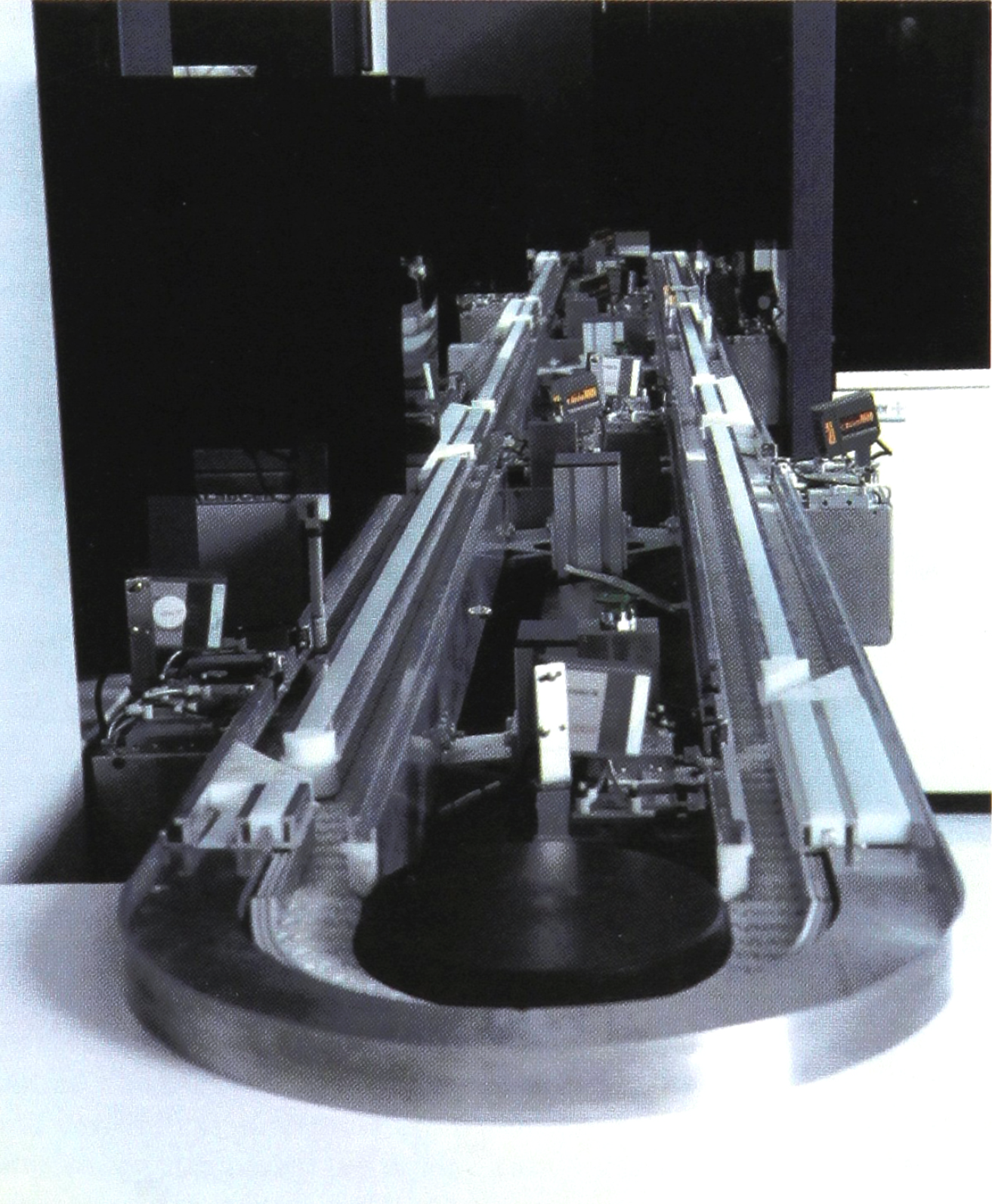
The main transport system component is a 2-meter long, dual-lane conveyor module linked by cross rails. These modules may be linked together to form work-cells with up to 16 instrument or device connections. The main transport lane is comprised of a continuous chain that travels down one side of the work-cell, around a return bend, and back up the opposite side, around a drive unit. The conveyor is a separate sub-assembly that can be mounted to a freestanding Installation System which provides the ability to connect instruments to high voltage and low voltage power, telephone and computer cabling as well as deionized water, compressed air, a waste line, and city water (for flushing the waste line). The Installation System provides the opportunity to efficiently utilize valuable lab space while providing a clean, organized, and safe work environment. And because the same support infrastructure can be used again with new analyzers, it represents a one-time investment.
Individually driven conveyors are attached to the main transport lane at appropriate locations to create instrument workstation connections. A divert gate is attached to the interior side of each conveyor main rail, at the upstream side of the module. The divert gate identifies samples carried on the conveyor and deflects appropriate samples from the main conveyor onto the workstation lane.
An interface gate is attached near the end of each workstation lane to provide the connection between the ADVIA® LabCell™ system and the instrument or device located there. The interface gate positions samples so that they are within reach of the connected instrument or
Distinctive Features
System Interfaces
Instruments can be directly interfaced to the system or interfaced via robot. For instruments that are not automation friendly, a simple approach to provide a robotic interface has been developed which can be configured to access the sample input area of the analyzer. The robotic interface is capable of loading single samples, linear racks, curved segments or circular trays.
For instruments that are automation friendly, the LabCell™ system presents the sample tubes within 50 mm of the instrument. In this way the instrument can sample directly from the tube or take the tube from the gate, process it and return it to the gate where a carrier will be waiting to receive the tube.
Loader / Unloader
Drawer-based sample loading and unloading is designed to provide an efficient means of getting samples placed onto and removed from the ADVIA® LabCell™ system. Samples are placed into a barcoded 100-tube tray in the accessioning area. Trays are loaded into drawers on the Loader/Unloader, and the robot then moves the samples to the track for routing to appropriate workstations. Drawer-based loading provides the opportunity for labs to minimize the number of personnel required for sample sorting, loading individual instrument trays, and sample routing to the correct instruments.
The main transport system component is a 2-meter long, dual-lane conveyor module linked by cross rails.
Drawer-based sample loading and unloading is designed to provide an efficient means of getting samples placed onto and removed from LabCell™.
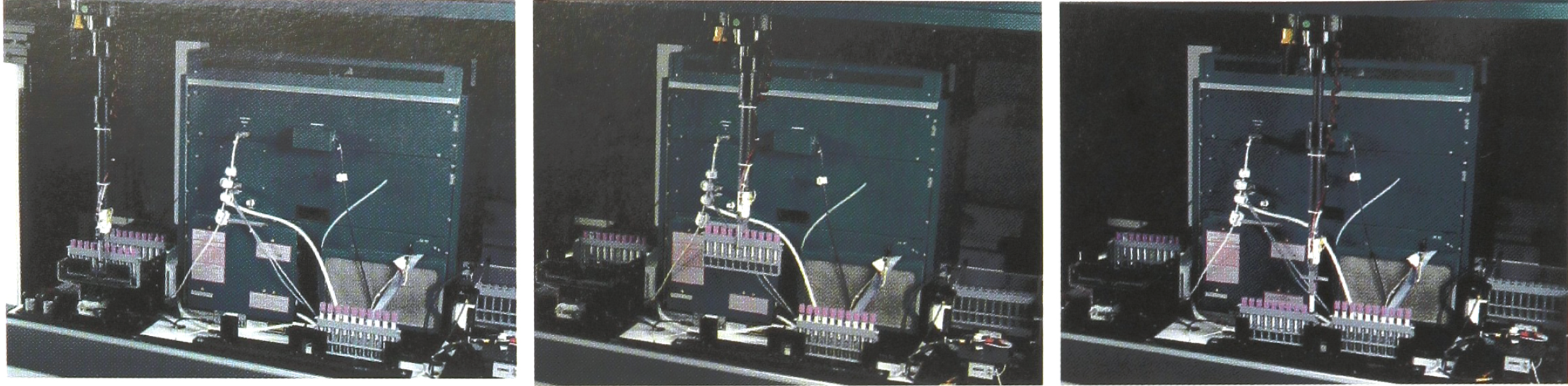
After testing is complete for a sample, the tube is removed from the track by the robot and placed into a tray with other completed samples. That tray may then be removed and placed in the laboratory's refrigerated storage area. Barcodes on the trays are used to identify where each individual sample has been stored, in case retrieval of that tube is necessary for follow-up testing.
Sorter / Rack Loader
This unique module provides the potential for labs to minimize the number of personnel required for pre-analytical sample management by automating the sorting and loading of tubes into the sample carriers associated with instruments which are not robotically connected to the ADVIA® LabCell™ system.
Software for the Sorter/Rack Loader module is being designed to enable the creation of “maps” of the various racks, sample wheels, and sample wheel segments which need to be filled with sample tubes. The robot in the Sorter/Rack Loader places sample tubes into the appropriate sample device, according to the workload sent to the LabCell™ system from the laboratory information system (LIS.)
Once the rack, sample wheel, or segment is ready to be removed from the Sorter/Rack Loader and taken to an analyzer, a message will appear at the LabCell™ system administration console and the operator will be able to load the instrument with the proper sample carrier.
Once processing is completed, the sample carrier is loaded back onto the Sorter/Rack Loader and the robot places the tubes back on the hack where they are sent to the “unload” drawer in the Loader/Unloader module.
Software & Communications

The computer controls sample flow on the entire system. It constantly monitors system status and manages communications between the ADVIA® LabCell™ system, the network of instruments connected to it, and the LIS. The on-line status of each instrument connected to the system will be displayed on the computer as well. The LabCell™ system is designed to allow management of the automation cell from a single “system administrator” position, providing the opportunity to minimize the number of personnel required to operate the LabCell™ system and streamlining operator interface with the entire cell.
The ADVIA® LabCell™ system offers an innovative and practical approach to laboratory automation for medium to large clinical laboratories. LabCell™ is part of the ADVIA® family of products and services from Bayer Diagnostics, designed to provide flexibility and choice to today's laboratory.
Footnotes
* In development
ADVIA® is a registered trademark of Bayer Corporation.
LabCell™ is a trademark of Bayer Corporation.