



Abstract

Preliminary Program and Short Course Description
Keynote Speaker: Joseph Engelberger, “The Father of Robotics”

The Best Way to Expand Your Knowledge in the Rapidly Evolving Field of Laboratory Automation!
To register for a Short Course at
Monday, January 20, 1997
Registration
Welcome and Presentation of the Beckman Lecture Award Robin A. Felder, Program Chairman
BECKMAN AWARD LECTURE
Robotics in Medicine — From Hospital to Home Care Joseph Engelberger, Chairman, HelpMate Robotics Inc., Danbury, CT, USA
Investing in Health-Related Robotics: What the Future Holds, Skip Klein, Manager, T. Rowe Price Health Sciences Fund, Baltimore, MD, USA
High-Density Microplate Formats and Supporting Automation Al Kolb, Packard Instruments, Inc., Meriden, CT, USA
Coffee break
Recent Advances in Combinatorial Chemistry Sheila DeWitt, DIVERSOMER Technologies, Inc., Ann Arbor, MI, USA
Changing Technologies for High Throughput Screening Mark Goldman, Signal Pharmaceuticals, Inc., San Diego, CA, USA
Fundamentals of Mass Spectrometry for High Throughput Screening Ronald Hendrickson, Department of Chemistry, University of Virginia, Charlottesville, VA, USA
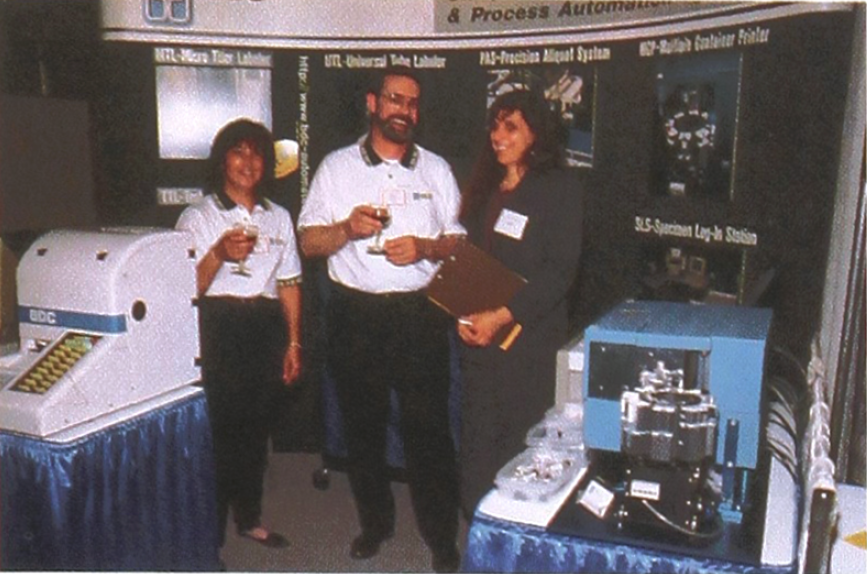
Foster Session/Exhibition Food and Drinks will be served in the Exhibition Hall
TRACK 1 — CLINICAL OVERVIEW SESSION
Recent Trends in Clinical Laboratory
Automation Rod Markin, University of Nebraska, Omaha, NE, USA
Modular Automation for Commercial Clinical Laboratories David O'Bryan, SmithKline Beecham Laboratories, Collegeville, PA, USA

Break
STANDARDS SESSION
Annual Report from International Standardization Committees Rod Markin (NCCLS), Moderator, University of Nebraska, Omaha, NE, USA, Gary Kramer (NIST), Gaithersburg, MD, USA, Torsten Staab (ASTM), Los AAlamos National Laboratory, Los Alamos, NM USA Pierangelo Bonini (European Committees), Hospitale San Rafaele, Milano, Italy Tom Astle (Microplates), Tomtec Inc., Hamden, CT, USA
TRACK 2 — MASS SPECTROMETRY SESSION
Combinatorial ADME/PK: Applications of Mass Spectometry Jacqueline A. Gibbons, Eric W. Taylor, Hong Luo and Rene A. Braeckman, Chiron Corporation, Emeryville, CA, USA
Simultaneous Pharmacokinetic Screening of Compound Mixtures Using Atmospheric Pressure Ionization LC/MS for Increased Throughput Kathy A. Halm, Kim K. Adkison, Judd Berman and Joel E. Shaffer, Glaxo Wellcome, Research Triangle Park, NC, USA
Identification of Novel Receptor Ligands from Combinatorial Libraries: Affinity Selection-Mass Spectrometry V. Hueber, S. Kaur, L. McGuire, D. Tang, G. Dollinger, Chiron Corporation, Emeryville, CA, USA
Break
Automated Time-of-Flight Mass Spectrometry for the Analysis of Small Molecules and Biological Polymers Marvin Vestal, PerSeptive Biosystems, Inc.
Presentation to be announced
Wine and Cheese Reception in the Exhibit Hall
Tuesday, January 21, 1997
Registration
TRACK 1 — CLINICAL SESSION
Laboratory Automation and FDA: Regulations, Policies and Mythology—Past, Present and Future Gary Gamerman, Fenwick & West LLP, Washington, DC, USA
Presentation to be announced Sysmex, Long Grove, IL, USA
Presentation to be announced Automed Corporation, Richmond, British Columbia, Canada
Experience With The Boehringer Mannheim/Hitachi Clinical Laboratory Automation System Dennis A. Lamb, South Bend Medical Foundation, South Bend, IN, USA
Break
Laboratory Automation — Ingredients for Disaster and Recipies for Success Michael Quintan, Labotix, Peterborough, Ontario, Canada
Presentation to be announced Coulter Corporation, Miami, FL, USA
Lab Automation: A Stepwise Approach Kirk Kimler, Abbott Laboratories, Abbott Pk., IL, USA
Poster Session/Exhibition Food and Drinks will be served in the Exhibition Hall
Presentation to be announced Alain Truchaud, Insitute de Biologie, Cedex Nantes, France
Automated Sample Handling, A Case Study Sue Stephans, SmithKline Beecham Laboratories, Norristown, PA, USA
Presentation to be announced Mark Cederdahl, LAB-Interlink, Omaha, NE, USA
Break
Laboratory Automation: The Design Of User Interfaces Alain Laugier, Technidata SA, Zirst, Meylan, France
Presentation to be announced Johnson & Johnson Clinical Diagnostics, Rochester, NY, USA
TRACK 2 — ANALYTICAL/ENGINEERING SESSION
A New Approach To Supporting Biopharmaceutical Automation Steven D. Hamilton, Joel Boymel, Peter L. Burris, Richard A. Gerren, Burt Goodman, Garry W. Gregory, Keith M. Hoyle, Mark E. Jury, James V. Petersen, Amgen Inc., Boulder, CO, USA
Robotic Workstations Compliment Tracked Robot Systems Robert F. Trinka, Cyberlab, Inc., Brookfield, CT, USA
Automated Retrieval of Clone Libraries Utilizing the Biomek 2000 Robotic Workstation Petar Stojadinovic, Douglas N. Gurevitch, Andy R. Watson, Sequana Therapeutics, La Jolla, CA, USA
Automated Workstation for Potency Testing of Transdermal Systems Ben Mendoza, Steven Lenz, Scott Echols, Cygnus Therapeutic Systems, Redwood City, CA, USA
Break
A Fully Automated Oligonucleotide Ligation Assay Using the Biomek® 2000 Robotic Workstation Marcos A. Piani, Robert Saiz, Phillip A. Morin and Andy R. Watson, Sequana Therapeutics, La Jolla, CA, USA

A Real-Time Microtiter Plate Reader Based On A High Throughput Imaging Fluorometer John F. Turner II, University of Pittsburgh, Pittsburgh, PA, USA, Patrick J. Treado, ChemIcon, Inc., Pittsburgh, PA, USA, Paul Hyslop, Eli Lilly & Company, Indianapolis, IN, USA, Thomas W. Astle, Tomtec, Inc., Hamden, CT, USA
The ASTM Laboratory Equipment Control Interface Specification Torsten Staab and John Elling, Los Alamos National Laboratory, Los Alamos, NM, USA
Poster Session/Exhibition Food and Drinks will be served in the Exhibition Hall
A Powerful New Search Algorithm Combining Parallel and Evolutionary Approaches Jonathan Lindsey, North Carolina State University, Raleigh, NC, USA
cDNA Library Subtraction Using a Neural Net Classifier Rick Stanton, Merrie Jo Johnson, Jennifer Giles, Amgen, Inc., Thousand Oaks, CA,
The Mathematica Link To LABVIEW: An Environment To Develop Electronic Laboratory Notebooks Jean Peccoud, Grenoble School of Medicine, La Tranche, France
Break
Novel enzyme-linked oligonucleotide assay (ELONA) using oligonucleotide aptamers created by teh SELEX combinatorial chemistry process Daniel W. Drolet, Lotus Moon-McDermott, Timothy S. Romig and Sumedha Jayasena
The Master Patient Index Mediator: Merging Disparate Patient Record Number Systems Dave Kilman, Los Alamos National Laboratory, Los Alamos, NM, USA
TRACK 3 — COMBINATORIAL CHEMISTRY SESSION
Automated Solution Preparation and Distribution of Chemical Compounds at Merck using the Packard MultiPROBE® Collette S. DeChard, Merck and Company, Rahway, NJ, USA and Craig Cardella, Packard Instrument Company, Meriden, CT, USA
Automated Systems for HTS at AMGEN Jason Armstrong, Robert Pacifici, David Sawutz, Jennifer Batac, Kathy Henige, Steve Hamilton, Amgen Inc., Thousand Oaks, CA,
Workflow Analysis, Automation And HTS: A Case Study In Optimizing Complex Transcriptional Cellular Assays For HTS Melvin Reichman, Ligand Pharmaceuticals Inc., San Diego, CA, USA
Screening Libraries and Discretes: Theory and Reality Paul Domanico, Glaxo Wellcome, Research Triangle Park, NC, USA
Break
Standardization Of 96-Well Microplates For Automated Handling Thomas W. Astle, Tomtec Inc., Hamden, CT
Implementation of Microvolume Assays in High-Density Microtiter Plates Jonathan Burbaum, Pharmacopeia, Princeton, NJ, USA
High-Throughput Functional Drug Screening Based on Measurement of Intracellular Free Calcium by Fluorescence Imaging Michael Akong, Sibia Neurosciences, Inc., La Jolla, CA. USA
Poster Session/Exhibition Food and Drinks will be served in the Exhibition Hall
Accelerating Drug Discovery By High-Throughput Combinatorial Synthesis Steve Banville, Chiron, Emeryville, CA, USA
Automated Parallel Synthesis of Antitubercular Agents J. Andrew Towell and William Baker, PathoGenesis Corporation, Seattle, WA USA
The Use Of Reactive Fragment Structure Transformations For Automated Structure Generation In Automated Combinatorial Chemistry With Applications To Diversity Analysis John Cargill, Ontogen Corporation, Carlsbad, CA
Break
A Novel Spatially Addressable Automated Synthesizer for Combinatorial Chemistry and Drug Development W. Rapp, Rapp Polymere GmbH, Tübingen, Germany and J. Gerhardt, C.A.T. GmbH & Co. KG, Tübingen, Germany
Closed-Modular Approach to Solid-Phase Synthesis Patty Ahrweiler, Bohdan Automation, Inc., Mundelein, IL, USA
Gala Evening
Wednesday, January 22, 1997
ADVANCED TOPICS SESSION
Presentation to be announced Paul Heney, Orchid BioComputer
Genosensors and Hybridization Arrays M. Doktycz and Kenneth L. Beattie, Oak Ridge National Laboratory, Oak Ridge, TN
An Autonomous, Bottom-Transecting Vehicle For Making Long Time-Series Measurements Of Sediment Community Oxygen Consumption To Abyssal Depths R. C. Glatts, A. H. Uhlman, R. J. Baldwin, and K. L. Smith, Scripps Institute of Oceanography, San Diego, CA, USA
New Emerging Technologies To be announced
Break
COMBINATORIAL CHEMISTRY SESSION
Automated Technology With Interactive Graphical Sample Tracking For Analytical HPLC And Milligram Scale Preparative Chromatography Of Combinatorial Analogues Joan Stevens, Gilson Instruments, Middleton, WI, USA
High Throughput Analysis Of Tandem Mass Spectrometry Data For Peptides John Yates, University of Washington, Seattle, WA, USA
Design Considerations For A Chemists Automated Workstation Wayne Schmidt, Hewlett Packard, Wilmington, DE, USA
Lunch on own
Information Management for Automated Parallel Synthesis Dave Nickell, Parke Davis Pharmaceutical and DIVERSOMER Technologies
Task-oriented Robotic Workstations Robert Elliott, J-KEM
Automation For High-Throughput Parallel Synthesis Cheryl Garr, John Peterson, Panlabs, Bothell, WA, USA
Break
Automated LC/MS Analysis of Combinatorial Libraries: From Analytical Characterization to Prep Scale Purification D.B. Kassel, L. Zeng, CombiChem, Inc., San Diego, CA, USA and L. Burton, K. Yung and B. Shushan, Perkin Elmer-Sciex, Thornhill, Ontario, Canada
No Static At All: Using Radiofrequency Memory Tubes Without (Human) Interference Tony Czarnik, IRORI Quantum
Microchemistry, San Diego, CA, USA
Automated Synthetic Chemistry: Resins To Instrumentation Paul Hoeprich, Argonaut Technologies, San Carlos, CA, USA
INDUSTRY WORKSHOPS
Advanced Hardware and Software Architecture for Laboratory Robotic Systems ZYMARK Corporation, Hopkinton, MA,
Others to be announced
Short Courses
Sponsor Spotlight!
LabAutomation '97 is brought to you by sponsors who are important patrons of laboratory automation and robotics as demonstrated by their commitment to the education and scientific advancement in this rapidly gropwing field. As of October, we would like to thank the following sponsors for their continued dedication:
Abbott Laboratories
AutoLab Systems — A Division of MDS Health Group
Beckman
Becton Dickinson Vacutainer Systems
Boehringer Mannheim
Ciba Corning
Coulter Corporation
CRS Robotics
Dade International
Johnson & Johnson Clinical Diagnostics
Hitachi
Packard Instruments
Sysmex
Introduction to Barcode Technology
Topics to be covered will include:
Overview of three main applications: patient sample ID tracking, reagent ID, and tray ID
Symbology Selection in Laboratory Automation
Barcode Scanner Technology in Laboratory Automation
Barcode Scanner Integration and Beyond
Beyond Scanning Barcodes
Robotics & Automation Intelligence Using Barcodes
Hands-On Training in Combinatorial Chemistry
An informal workshop designed to provide chemists an opportunity to evaluate and implement alternative methods in combinatorial and automated synthesis. The workshop will focus on hands-on experiments, explanations of enabling technologies and commercial systems.
Introduction to Clinical Laboratory Robotics
Robotics and automation technology can improve the efficiency of health care delivery. However, laboratory directors must set reasonable automation goals for their laboratories. Based on a high return on investment, there are two basic choices for automating the laboratory, central receiving and point-of-care. This workshop will focus on discussion of the issues involved with considering, planning, implementing, and justifying laboratory automation.
CENTRAL RECEIVING AUTOMATION
Central receiving is presumably the most likely area of the laboratory to automate since labor costs are highest for sample processing. Recent technology has become available for specimen labeling, sorting, centrifuging, aliquotting, and transportation. In order for automation to be cost effective we must understand the benefits and limitations of pre-analytical processors. Recent progress will assist with their success such as new developing defacto standards for sample conveyance, laboratory information/automation system (LIS/LAS) software, interfaces which provide the necessary control data, and high reliability which should allow unattended operation. Limitations of sample tube variety and the ability of automation to handle exception specimens may compromise the cost savings of pre-analytical automation.
Three approaches to laboratory automation include
The use of modular devices (e.g. Autolab Autoquot, BDC universal tube labeler, and LabInterlink conveyor system)
The use of a modular conveyor system (e.g. the LAS from Coulter/IDS),
The use of a full turnkey system (e.g. the CLAS from Boehringer Mannheim/Hitachi).
The benefits of each of these systems will be discussed.
POINT-OF-CARE AUTOMATION
Point-of-care testing has traditionally been reserved for analytes which are necessary for rapid assessment of critically ill patients. Only limited menus of tests have been offered at point-of-care due to high costs and the lack of tests available on whole blood specimens. The ideal point-of-care system would utilize commercially available instruments, offer blood gases, electrolytes, chemistry, coagulation and hematology tests, provide rapid turnaround on whole blood specimens, be operated by nurses and ward clerks yet maintain control in the hands of laboratory professionals. We have developed the Remote Automated Laboratory System (RALS™) which provides these features at a cost less than that of performing the same test in the central laboratory. Our clinical outcomes studies have demonstrated that automation of point-of-care analysis reduces the time patients spend on mechanical ventilation. Recently, many point-of-care systems which imitate RALS have come on to the market.
SUMMARY
The need for central Laboratory Automation Systems will increase in the near future as laboratories consolidate into regional laboratories. Point-of-care automation will remain an expanding necessity during this consolidation process. Eventually, 80% of laboratory testing will be performed at point-of-care with the remainder split between small on-site automated laboratories and a few large commercial laboratories. Therefore, laboratories should develop both central laboratory as well as point-of-care automation in order to be competitive in the upcoming medical marketplace.
Electronic Laboratory Notebooks
Collaborative electronic notebooks, groupware, workflow and document management systems, and other “team tools” are the next big wave in laboratory automation. These tools build on the networked technical and social infrastructures present in most medium to large organizations today, allowing specialists to build R&D team computing systems that provide real competitive advantage over commonly available LIMS and even Internet systems. The course gives a comprehensive survey of the new automation area of “R&D Team Computing.”
The first part of the course covers the legal, regulatory, technical, and social issues of collaborative electronic laboratory notebooks as an example of new types of scientific groupware systems hitting the market today. Background on the legal and regulatory requirements of recordkeeping and records management systems is given first to help attendees understand rigorously correct implementations of electronic notebooks based on the “Recordkeeping Business Rules” and “The 13 Fundamental Properties of Records.”
The second part of the course covers R&D team computing tools and systems, including groupware, electronic recordkeeping, electronic notebooks, workflow and document management, and collaboration systems used in R&D organizations now. Technical design features and benefits of these systems are covered in significant enough detail to allow attendees to begin to evaluate systems for in-house use after returning home. The social impact of these new R&D Team Computing Systems will be covered. The instructor will demonstrate several systems and show their application to scientific R&D problems solely to illustrate and drive home the concepts being introduced. This course also covers key issues typically encountered when piloting such systems, and introduces methodologies to successfully deploy such systems. Case studies of successful deployments in large R&D organizations will discussed. Results from an on-going, industry-wide study on R&D Team Computing will be presented also.
Attendees will walk away with a sound understanding of brand new areas of R&D computing, grounded concept illustrations and demonstrations, and plenty of course notes that they will find useful for deeper study on their own.
Internet I: Introduction
The Internet has become a vast information source with a growing network of people, ideas, resources and markets. More than 100 million users world-wide utilize it's interconnectivity, send and receive E-mail, access forums and databases, send and receive client, vendor and remote staff information. It is estimated that by the end of 1997, more than 1 million new domains will pop up. With this enormous explosion of information becoming readily available, now is a perfect time to learn about this amazing — and ever-popular — technology.
This course provides comprehensive hands-on experience with the Internet, geared to the needs of scientists. The content will be geared to the LabAutomation'97 attendee who is not necessarily a software expert.
A short history of the Internet will be provided. You will learn how to choose and implement the Internet connection most appropriate for you needs, install and configure Internet access tools, communicate text and data worldwide, locate and retrieve information using FTP, Gopher and the World Wide Web, utilize the various search engines and directories available on the Web, establish an on-line information service, protect you internal networks and data from unauthorized instrusion, and exploit the full range of Internet resources and services.
Internet II: Intermediate
With the enormous explosion of information now available on the Web, there is no time like now to learn how to weave your own web space. This course provides comprehensive hands- on experience with HTML (HyperText Markup Language), the language of the Web. Participants must have at least an understanding of the Web or had attended Introduction to the Internet and Untangling the World Wide Web.
A brief overview of what HTML is will be provided. Students will learn how to create a homepage using basic HTML, including adding lists, hyperlinks, anchors, and images. Time allowing, students will also learn HTML 3.0, including tables. A presentation will be given in the afternoon on how to set-up and manage a Web site.
An Introduction to Laboratory Automation and Robotics
Today's increasingly competitive business environment continues to emphasize on the use of automation technology to improve laboratory productivity, to accelerate discovery, and to maintain quality. With the proper planning and implementation, robotics can be a highly flexible tool for laboratory automation.
This is an introductory course, aimed at those considering automating their laboratory operations and those managing increasingly automated laboratories. The topics covered will be:
Reasons for employing laboratory automation
An overview of current laboratory automation and robotics technology and usage, from workstations to fully integrated systems
Planning, implementing and maintaining successful automation applications
Automation specific issues involving documentation, validation, open systems and standards
A review of specific automation-related technologies, such as automatic ID, sensors, vision systems, and software for system control and scheduling.
Understanding the relationship of automation and informatics, and the various options, tools and strategies that may be employed to manage automation-generated data.
A preview of emerging technologies that may have an impact on laboratory automation.
LIMS in the Organization
Laboratories are under increasing pressure to increase productivity and reduce costs. The implementation of a LIMS is one way of achieving these goals. However, the success rate of LIMS implementations is not high and organizations do not usually get payback from the investment they make in time, equipment, and human effort.
The aim of this course is to give participants the information and tools to implement a LIMS effectively. The course will cover:
Neural Networks — Hands-On Computer Workshop
This course is a two-day hands-on workshop in neural networks and their applications. Three other computational intelligence methods — knowledge-based and fuzzy systems and genetic algorithms — will be introduced and their areas of usefulness and overlap with neural systems discussed. On both days attendees will perform experiments, the first day using specially written software that allows them to watch a network as it learns a task, the second day using commercial professional software. A copy of the specially written software is included with the course textbook.
Neural networks are information processing systems modeled after the structure of the brain and are among the most innovative problem solving methods in use today. Unlike traditional computers, neural networks are trained to solve problems, learning appropriate solutions from examples rather than forcing the developer to provide detailed algorithmic instructions. They are often successful in problem domains that have not yielded to algorithmic or expert-system approaches. Neural networks can be applied to both spatial and temporal problems, including classifying patterns, controlling complex processes, providing expert-level advice, clustering unknown data, and mapping functions. They are especially appropriate for applications in which human expertise is the current usual solution, typically performing as well or better than their human counterparts at lower cost.
The hands-on nature of this workshop allows all participants to gain practical experience with these innovative systems. In the first day's sessions, Dr. Butler will introduce neural networks, then cover the two most useful application networks, back propagation and Kohonen self-organization. Attendees will train their own back propagation and Kohonen networks and learn the effects of several of the important parameters governing their operation. Dr. Butler will then introduce three complementary methods, expert systems, fuzzy systems, and genetic algorithms, and compare their areas of usefulness to those of neural systems.
On the second day, Dr. Butler will lead attendees in applying commercial professional simulator software to data from actual applications to help them gain experience in using back propagation networks to solve difficult “real-world” problems and to illustrate the need for and methods of proper data preparation. If time permits, the day will close with an open question-and-answer session on topics related to neural networks.
Visual BASIC for the Laboratory
The Visual Basic programming system for Microsoft Windows has become one of the most prominent custom application development tools for the automated laboratory. Visual Basic (VB) combines a simple programming language and an intuitive graphical user interface development environment with a wide range of built-in and third-party software libraries. This ease-of-use and continually increasing number of available software libraries make VB attractive for developing custom software components for automated laboratory systems.
This short course will introduce the Visual Basic programming system (version 4.0) and cover the features that make VB an invaluable tool for the laboratory. Several relevant sample programs will be examined. Hands-on sessions will provide the opportunity to work with VB and sample programs. Topics to be covered include:
The VB approach to graphical user interface development
Dynamic Data Exchange (DDE), Object Linking and Embedding (OLE) and OLE Automation
Instrument communication and control using RS-232 and IEEE protocols
Visual Basic for Applications (VBA)
Network application development with VB
Database application development with VB
Advanced topics
This class will provide a sufficient background to begin successful development of a wide range of custom laboratory applications using Visual Basic.
Machine Vision For Laboratory Automation
Over the last fifteen years, machine vision — the extraction of useful symbolic descriptions from video images — has matured as a technology and is now considered an indispensable tool for manufacturing automation. Manufacturing applications of machine vision include part presence/absence detection, part location/orientation determination, part recognition, quality inspection, precise two-dimensional (2D) or three-dimensional (3D) gauging, robot or other machine guidance, and process control.
As the use of robotic automation in the laboratory becomes more widespread, the need for and application of machine vision technology has also expanded. Machine vision is now finding increasing utility in pharmaceutical research laboratories, in DNA mapping/sequencing automation applications, and in the clinical laboratory. Applications of machine vision include labware inspection, dissolution testing, procedure validation, colony picking, machine guidance, and quality control.
In this short course we will cover the basics of machine vision and image analysis and examine examples of these emerging applications of machine vision in the automated laboratory. The course will start with examples of laboratory applications of machine vision and will include interactive sessions for setting up sample applications. We will then detail the parts of the machine vision system and briefly cover some of the theory behind image processing and analysis. The latter segment of the course will be free time in which course participants will have access to state-of-the-art machine vision workstations on which they may explore and experiment with different image analysis algorithms and vision-guided motion applications.
Participants are encouraged to bring their own ideas and lab consumables or other apparatus for mocking up applications on these development stations.
List of Exhibitors (as of October 7, 1996)