




Abstract
A visual search task assesses whether children's understanding of the offside rule is more dependent on domain-specific interests than on gender-specific abilities (Lange-Küttner & Bosco, 2016). Nine- and 12-year-old children (N = 60) were tested with a display of two soccer teams and a target player in an onside, or offside, spatial position. There were 100 trials including four practice trials. One half of the children were tested on the grounds of a football club, while the other half were assessed in a library where they spent their spare time. Both groups were gender balanced. Domain-specific interest was more important than gender differences. The football club members practiced three to four times a week or more and made faster decisions. The 9-year-olds in the football group made reasonable choices, but the 12-year-olds in this group showed significantly better discrimination of onside trials suggesting that they had created a benchmark of what is a correct position that clearly differs from an offside position. This suggests that they were actively engaged in determining a legitimate position and avoiding an offside position that would make a scored goal invalid. The 9-year-olds in the library group could not identify onside position trials as well as offside trials, although this was improved at 12 years. Ballgame practice explained onside/offside task difficulty, but not age differences. It is concluded that the development of a perceptual judgment of a legitimate spatial position in the field is a more systematic approach than giving priority to spatial rule violations.
Visual search by children can be relevant in many areas, for instance reading acquisition (Guilbert & Guiraud-Vinatea, 2022) and dyslexia (Guilbert & Rochette, 2023; Liu et al., 2019) as children are required to scan the letter sequences. When spatial cognition also has motor inhibition origins like in ADHD, visual search is also used as a diagnostic instrument (Hokken et al., 2023; Lin, 2023). However, not only shortcomings, but also better performance can occur in children's visual search, for instance, when they are on the autistic spectrum (Abassi Abu Rukab et al., 2022; but see Doherty et al., 2018; Kaldy et al., 2016). It turned out that better performance by children on the autistic spectrum was only found with adequate motor proficiency present (Lange-Küttner & Kochhar, 2020; Lindor et al., 2018). The current experiment is a visual search task that assesses whether children's understanding of the offside rule is more dependent on domain-specific interests than on gender-specific abilities (Lange-Küttner & Bosco, 2016). The experiment does not vary the number of distractors, or the similarity between distractors and the target, or the set size, but investigates the effect of domain-specific interests of children on their decision-making of whether the target in a visual display is in an onside or offside position on a soccer pitch. We expected that children playing soccer in football clubs would show more accuracy than children whom we assessed in libraries as they preferred reading books rather than playing football in their leisure time after school.
The Offside Rule
Already in 1863, the Football Association (FA) stated what is offside, following the rules of the University of Cambridge. There is a difference between just being in an offside position which involves being close to the goal of the opponents’ team and behind their defenders, and committing an offside offence when this player gets in possession of the ball by a teammate while he is in the offside position (FIFA, 2023). Being offside with the ball aiming at the goal gives an unfair advantage because the player can shoot at the goal unhindered by the defense players. Thus, linesmen and lineswomen constantly monitor during a dynamic football game whether the defense players are lined up in such a way that the attacking player is placed before their lineup and the goalie at the time when scoring (Oudejans et al., 2005). An offside offence invalidates the scored goal, so the penalty is quite severe.
To judge a visual display with a player in an offside position requires advanced spatial cognitive skills that are still in development in children at least until about age twelve (Lange-Küttner, 2024; Newcombe & Huttenlocher, 2003; Piaget & Inhelder, 1956). Accordingly, football rules for children are different than for adults and called ‘Laws for Mini Soccer’ (Football Association, 2018). Children do see such modifications as supportive and they produce better outcomes (García-Angulo et al., 2020; McCalpin et al., 2017; Smith & Harrison, 2024). The playing field is smaller. Instead of teams of 11, children play in teams of 5 because a smaller team size allows them to become more active (Hintermann et al., 2021). When under seven or eight years of age, they are not permitted to play in leagues, but they are allowed to take part in one-off short-term experiences of trophy events helping children to learn about winning and losing. There is a rule against fouls, with penalty kicks awarded, but no offside rule until they are older than ten years.
These modified rules for mini soccer play tribute to the fact of the ongoing development of children's spatial concepts. Even naive adults as well as linesmen still show considerable error in judging offside in football (Ogilvie, 2000; Oudejans et al., 2000, 2005) but can improve their judgement with computerized training (Catteeuw et al., 2010). Offside offences decreased in number in European football after the introduction of video assisted refereeing (VAR) (Zhao, 2021).
Children's Understanding of the Offside Rule
To date, research into the understanding of the offside rule has primarily focused on adults (A. M. Williams et al., 1999, chapter 5, ‘Visual search strategy in sport’; M. A. Williams & Jackson, 2019). The reason may be that research with children playing soccer focuses more on motivation, social skills and team cohesion, build-up of physical and mental strength and appropriate pedagogical training methods (Hamzah et al., 2025). However, the understanding of spatial boundaries and spatial alignment rules are an important part of soccer and may also transfer into other areas such as rank-ordering by distance (Liben, 1988). This does not mean that there would not be any research on children playing according to soccer rules. An interesting recent study tried to get children and adolescents to play soccer according to artificial rules (Gonzalez-Artetxe et al., 2022). Linear team tactical behavior change occurred in centroid position, dyads, and in the total area of the soccer field. Moreover, tactical behavior tended towards greater regularity after artificial rules were introduced in comparison with free play without restrictions.
However, there is one study that investigated whether 7- and 9-year-old children could understand and apply the offside rule by identifying if a player was in the wrong position on a football pitch (Lange-Küttner & Bosco, 2016). At this age, the spatial knowledge of lineups could not be expected to exist in every child. For instance, children's spatial concepts in their drawings are initially topological and implicit as they draw only figures but not spatial fields that have boundaries and segments (Lange-Küttner, 2006), but from about age seven, children gradually depict lineups of figures on a groundline, followed by more complex configurations in a spatial field (Lange-Küttner, 1997, 2004, 2009, 2014).
In this previous research on the offside rule understanding in 7- and 9-year-olds (Lange-Küttner & Bosco, 2016), authors provided the children with training by using a Subbuteo game to explain the offside rule. Thereafter, children would demonstrate their understanding by drawing figures on a ready-made printed half of a football field. They were given color pencils, red for the defending team, green for the attacking team, black for the referee and purple for the goalkeeper. In this way, the experimenter could judge whether they actually depicted an offside position. They repeated these drawings until they were able to correctly depict it (learning criterion). Moreover, they answered a questionnaire asking them if they played, liked, and watched football games and how often they played. The result was that more than one third of girls did not play more than twice per month, while nearly two thirds of the boys played football more than three times a week. Besides these two groups with very different commitments to the game, there was also a more gender-balanced group that played once or twice a week.
In the previous study, the actual offside task was designed like a visual search experiment, see Figure 1, where the target is unique to the surrounding ‘distracters’ (Woods et al., 2013). A football field was depicted with two teams consisting of 10 players each, one in a red soccer kit and one in a green soccer kit. The linespersons were wearing black shirts and the goalie an orange shirt. Except for the goalie who usually wears an individual sports strip, the colors were the same as in the drawing task. The interaction in a football game leading to an offside penalty was depicted by an arrow pointing towards a player in a non-offside (onside) or offside position receiving the ball. The task was presented on a laptop with a touchscreen which was appropriate for these age groups. Children would tap onto the player if they thought the player was in an offside position, while they would tap into the center circle if they evaluated that no offside offence would be involved. Like in visual search tasks, there were equal numbers of offside and onside displays, in their study 48 trials of each sort.
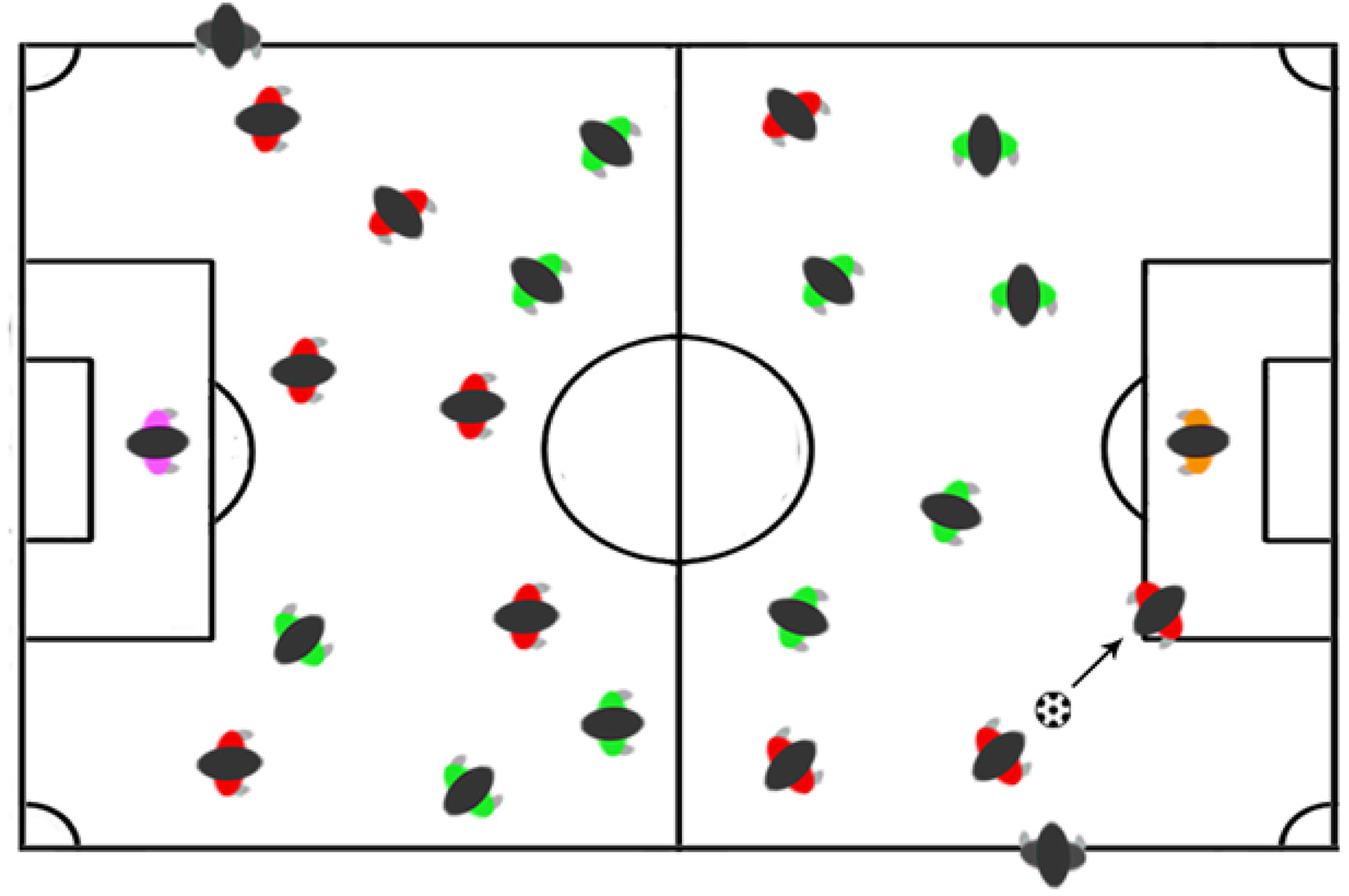
The Visual Search Display (with a Player in an Offside Position) (Lange-Küttner & Bosco, 2016)).
In this study, children showed significantly higher accuracy when recognizing an offside position (71.6%) than when judging that the player was not in an offside position (62.6%). When the analysis was controlled with the number of drawings needed to graphically represent the offside position (learning criterion) as a covariate, this main effect of the difference between offside and onside judgments was no longer significant. This result showed that the children's drawings reflected their understanding of the offside rule. When instead children's ballgame experience was added as a covariate, the significance of the offside position effect was still intact, but an interaction with gender emerged because the discrimination between offside and onside position in the visual displays was only present in boys, but not in girls, even though both performed better than chance. Thus, the lower experience of girls playing football was a reason for their lower accuracy when identifying the offside position of a player. Sex-specific personality differences can indeed influence visual search, especially extended long-tail reaction times under high cognitive load (Lange-Küttner & Puiu, 2021). In this offside rule study, the age of the children mattered for reaction times, independently of gender. While 7-year-olds were deciding significantly slower than 9-year-olds, within the group of 9-year-olds, children with the most practice of ballgames took at least 3.5 s longer to decide about the offside position than less experienced children. Thus, experience of the game fostered spatial reasoning and decision-making, and not speed.
In short, a previous offside rule study showed that both the short-term explanation of the offside rule in the football game by the experimenter to the children as well as the long-term experience of playing football on the pitch facilitated the application of the offside rule in this experimental task.
The Current Study
As the previous section showed, research into children's understanding of the offside rule is rare. However, the offside rule is an excellent example of a gradual introduction to children in football clubs that makes it especially useful for research. Although the previous study (Lange-Küttner & Bosco, 2016) provided some insights, there were also some limitations. First, the factor of gender and domain-specific interest was confounded because boys were much more engaged in the game of football than girls. Also another recent study found that girls were less engaged when playing in mixed teams with boys than when playing in girls’ teams, and at the same time, boys thought it was less fun to play soccer in mixed teams (Póvoas et al., 2018). Such results show that the gender question in children's soccer is still an open question. Second, in mini soccer for children, the offside rule is only introduced and expected to be adhered to when children are ten years of age and older. While this could be compensated with the introductory Subbuteo game in the previous study, the interest in the game can be better operationalized by football club membership that requires a commitment that children regularly give up their spare time after school to play football.
Thus, the protocol of the previous study was adapted in two ways. First, we assessed a sample of both girls and boys on the grounds of their football club. As a control sample, we tested boys and girls who would spend their spare time in public libraries reading books. Previous research showed that while shared book reading with a parent solely predicted vocabulary in preschoolers, in middle childhood their own motivation to read was more important and actually increased, unlike the motivation decline that is usually observed the older pupils become (Sun et al., 2024). We also selected this type of control sample because book reading involves the opposite of running across the field, namely sitting still in a chair. Thus, the between-subject variable measuring domain-specific interest also operationalized a motor factor while balancing the gender distribution. Second, instead of testing 7- to 9-year-olds who are not familiar with the offside rule, we decided to test the transition when the offside rule is being introduced to children in football clubs. We tested 9-year-olds as a younger age group before the introduction and 12-year-olds as the older age group after the introduction of the offside rule and omitted the hands-on introduction with the Subbuteo game. Instead, both age groups were given a verbal explanation.
The two hypotheses were that (1) there would not be an interaction of offside position evaluation by gender because we recruited both boys and girls in football clubs, (2) instead, there would be an interaction between offside position evaluation and domain-specific interest operationalized by testing ground (football club, library) (Renninger, 2000). It is predicted that children who play football in their spare time will score higher in identifying the offside rule in comparison to children who prefer going to libraries in their spare time.
Method
Participants
Sixty children from small London commuter villages along the M40 and M25 in North-West London, UK, took part in the research. The children of the football group were from St Joseph's Football club in Gerrard's Cross. The library group was recruited in local libraries in Harefield and Denham. No child took part twice. We did not collect further demographic information, but the population in these areas are lower to upper middle class.
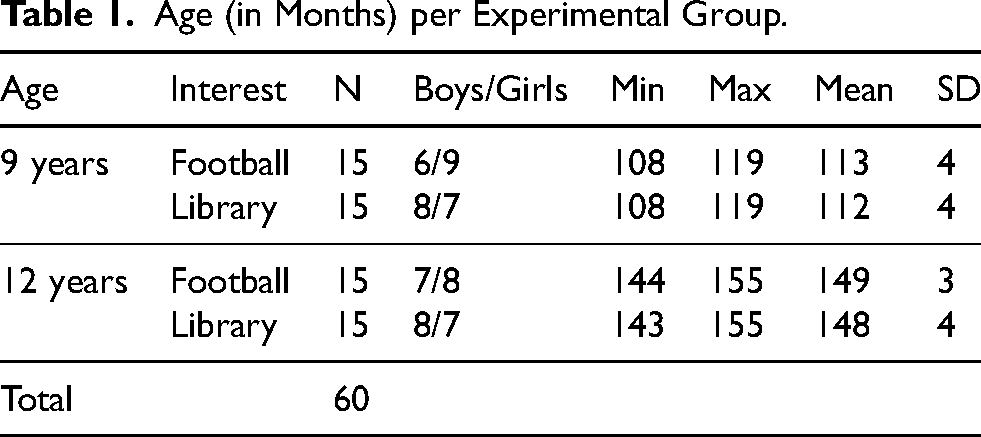
For their age in months per age group and interest group as well as the number of girls and boys, see Table 1. The football club coaches of the football group were FA certified. The average age of the younger age group was 9 years; 5 months and of the older age group 12 years; 5 months.
Age (in Months) per Experimental Group.
The previous study had shown an effect size of .21 for accuracy and of .35 for reaction times (Lange-Küttner & Bosco, 2016). Thus, an average effect size of .28 was used in a post-hoc G*Power F-Test of a gender- and age controlled 2 (spatial position) × 2 (interest) × 2 (age) × 2 (sex) ANOVA with repeated measures and between-subject factors (interest, age, sex) with an alpha-error probability of .05, an effect size of .28, the sample size of N = 60, and the correlation between the percentages of onside and offside accuracy of r(60) = −.60, p < .001 yielded the following output parameters: the critical F-value was 2.19, with 52 df and a power of .93. The values reported in the results section show that the actual F-values were higher, but the effect sizes were closer to the previous study.
Apparatus and Materials
A questionnaire about ballgames was given to the children to complete, see Appendix A1, with questions about whether they liked ballgames, how often they played ballgames, and if they watched football games. Children were then given as many drawing sheets in A4 Format as necessary that depicted half a football field, see Figure 2, until they could draw an offside position of a player. They were given colored pencils to use for the different roles in the game, red for the attacking team, blue for the defending team, green for the goalkeeper, and black for the referee.
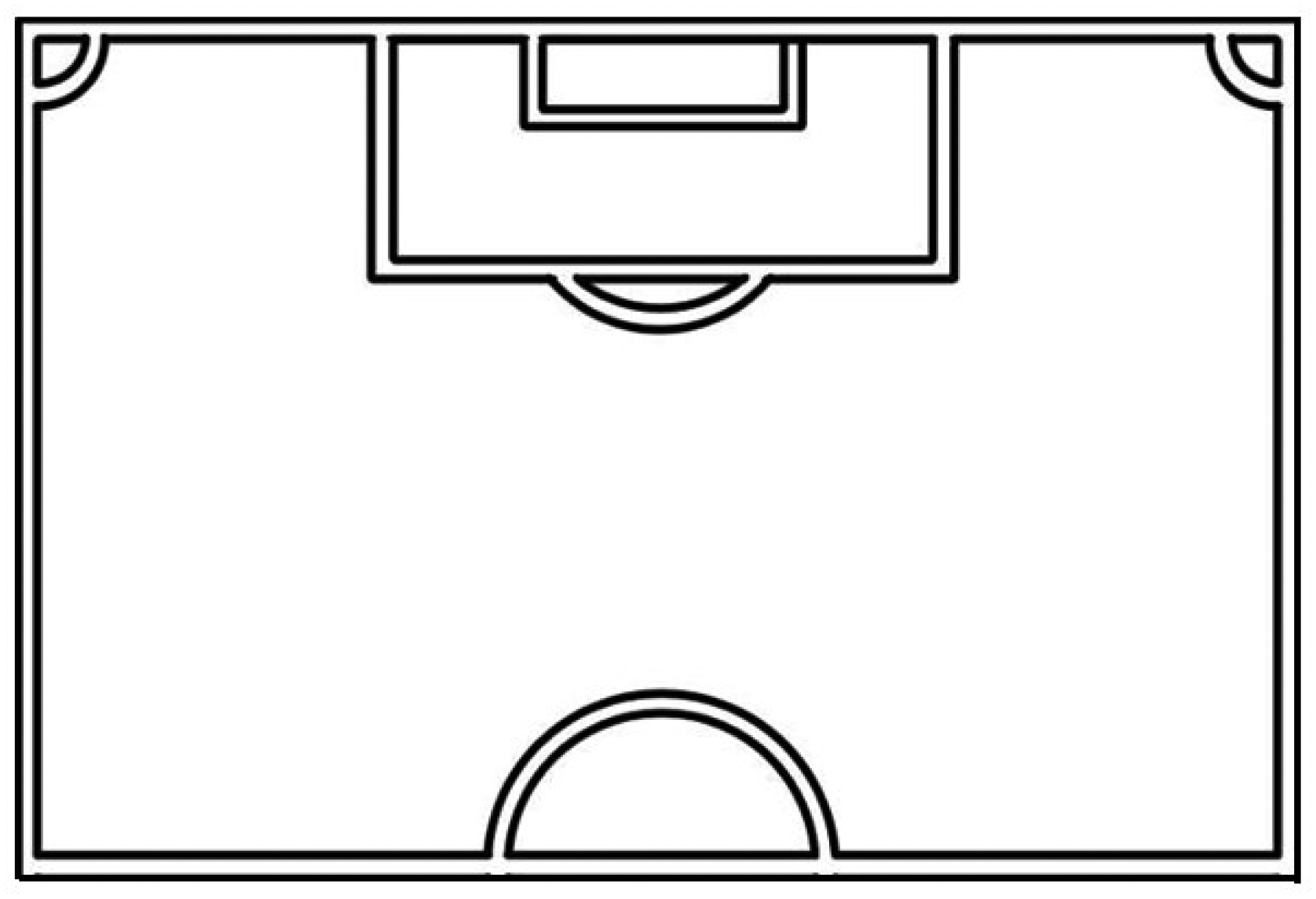
Drawing Sheet of one Half of a Football Field (Lange-Küttner & Bosco, 2016).
The offside rule task was displayed on a 15.5-inch touchscreen laptop, with an Intel i5 core processor and Windows 10 software. The experimental task, see Figure 1, was presented using E-prime software (Psychology Software Tools, 2015). The experimental code and the raw data sheet are deposited on https://osf.io/brpwv/.
Procedure
Ethics
The study was approved by the departmental Ethics committee. Children were briefed about the aim of the experiment and if they were interested, their parents were asked to sign a consent form to allow their child to take part in the experiment. The children were allowed to withdraw at any time during the experiment if they felt uncomfortable, stopped being interested in the task, or became distracted. No child did so.
Pre-Test Assessment
Children were tested individually, either at the library or the football club. The tests were performed in a quiet space to limit external distractions. First, they were given the questionnaire to answer. Following the completion of the questionnaire, the offside rule was explained to the children using a standardized script: ‘A player is in an offside position when the player is in the opponent's half of the pitch and is the only player in line with the goalkeeper of the other team, with no defenders in front of him. The player then becomes offside if they have contact with the ball, or they affect play’ (FIFA, 2015/16, p. 36). Children were then asked to draw the offside position by drawing one goalie in the one-half of the field, one referee, three players from one team and three players from the opposing team. Drawing stick men or circles as players when depicting their position was sufficient to demonstrate their comprehension of the offside rule. Once children produced a correct drawing, they were moved to the next stage of the research. All children passed this phase, but some needed several trials (learning to criterion).
Offside Rule Experiment
The experiment was then performed on the touchscreen laptop, see the display in Figure 1. The target player whose position needed to be evaluated was indicated by an arrow. After half the trials, as in real-life games, the teams swapped sides. The experiment consisted of 100 Trials. In half the trials, the target player was in an offside position and in the other half of the trials, the target player was not in an offside (onside) position. The sequence of the two types of trials was randomized by the experimental program.
The first four trials were counted as practice and used to ensure the children understood how the computer task worked: two practice trials were given for each of the two teams, one in an offside position and one in an onside position. The remaining 96 trials were the experimental test trials. If the target player was in an offside position, the children would touch the player on the screen with an index finger. If the target player was onside, they were asked to tap the circle in the center of the football pitch. No time limit was given, but once the screen was pressed, it would count as a response and the experiment would progress to the next screen, starting the next trial. The E-Prime experiment produced an Excel spreadsheet that allowed responses to be averaged across types of trials and imported into SPSS for statistical analysis.
Data Analysis
The offside trials are named as such. The trials without a player in an offside position are labelled as onside throughout the report of the results. We first describe the number of drawings that children needed to demonstrate their understanding of the offside rule and compare frequencies in the interest groups with a chi-square analysis in order to make sure that learning was comparable in the two sub-samples. We then report the results from the questionnaire about their ballgame experience to confirm that the group allocations were correct and reliable to denote children's preferences.
We carried out a post-hoc power analysis of the sample size with G*Power 3.1.9.7 (Faul et al., 2009), see the power calculation in the participant section. Finally, we conducted a 2(offside/onside) by 2(interest) by 2(age group) by 2(gender) ANOVA with repeated measures on the first factor. Between-subject effects are reported before within-subject effects. Group means and SDs can be found in Table S1.
Results
Learning Criterion
A chi-square analysis showed no significant differences in reaching the learning criterion between the football and the library group, Χ2(3, 60) = 5.97, p = .113. Ten children (16.7%) would draw the correct offside position on their first try, 29 (48.3%) were correct in their second drawing, 15 (25%) needed three drawings and six children (10%) needed four drawings until the offside position was correctly depicted.
A chi-square analysis of the number of drawings needed showed a clear age difference, with 9-year-old children needing more drawings than 12-year-olds, however, this was not significant because about half of the children in either age group just needed two drawings to depict a player in an offside position. The Ordinal Spearman correlation was significant though, r(60) = −.30, p = .019.
Ballgame Questionnaire
The ballgame questionnaire can be found in the Appendix. Chi-square analysis showed that all football club members liked ball games (100%), while in the library group only nine children (30%) liked ballgames and several children either did not like ballgames (40%), or preferred other types of sports (30%), Χ2(2, 60) = 32.31, p < .001. Also when asked about the particular ballgame that they liked, all football club members (100%) liked football best, while the library group had more distributed interests and only seven children (23.3%) liked football best, Χ2 (6, 60) = 37.30, p < . 001. These percentages clearly showed that the football club members had a preference for their chosen sport, while half of the library group did not like ball games at all.
The different preferences were also clear when children were asked about a more passive pastime, namely watching football on television. In the football group, only two (6.7%) children did not watch football games. In contrast, the majority of the library group (66.7%), or twenty children, did not watch football games, Χ2(1, 60) = 23.25, p < .001. This item showed that almost all children in the football group were taking an active interest in football even if they were not playing themselves, while this was not the case in the library group.
The football club members played either 3–4 times (26.7%) or more (73.3%) during a week. In the library group, one child never played football, seven (23.3%) children played less often than once in a month, another seven children played 1–2 times a month, another seven children played 3–4 times a month, another seven children played 1–2 times a week, while only one child (3.3%) played – as the majority of those in the football club – more than four times a week, Χ 2 (5, 60) = 41.24, p < .001. Thus, this comparison clearly showed that children in the football club practiced playing football more than those in the library group.
Offside Rule Experiment / Accuracy
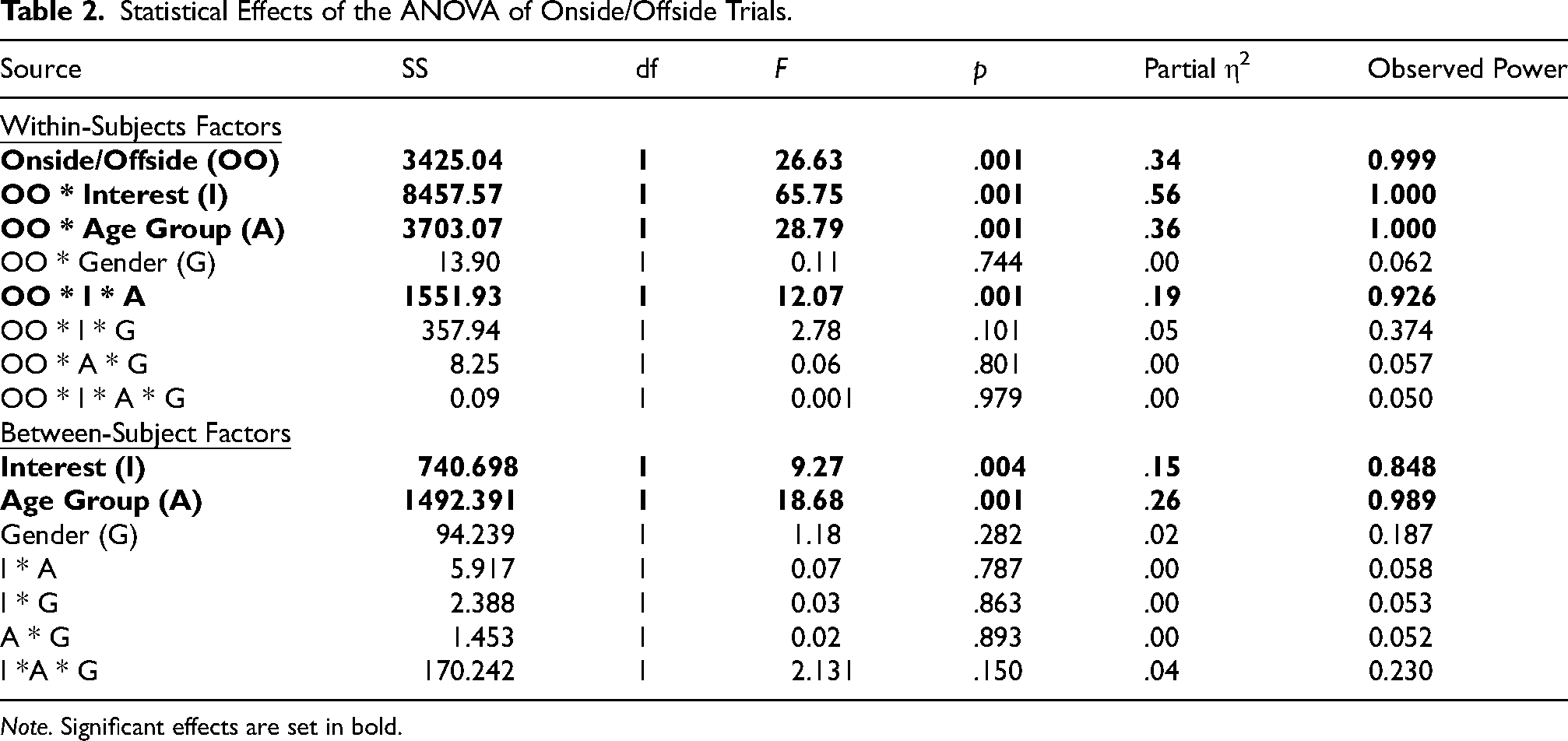
The complete results of the ANOVA are listed in Table 2. The ANOVA with repeated measures for accuracy showed a main effect of domain-specific interest, F(1, 60) = 9.27, p = .004, η2 = .15, because as expected, the football club members (M = 84.5%) showed higher accuracy spotting an offside position of a player on the screen displays than the library group (M = 79.5%). Twelve-year-olds (M = 85.6%) demonstrated an improved understanding of the offside rule compared with 9-year-olds (M = 78.5%). Importantly, as the hypothesis was that there would not be an interaction of offside position evaluation by gender because we recruited both boys as well as girls in football clubs, gender differences were not significant, p = .282, nor were any other interactions of the between-subject factors, ps > .150. Gender also did not interact with the within-subject factors, ps > .101, see Table 2.
Statistical Effects of the ANOVA of Onside/Offside Trials.
Note. Significant effects are set in bold.
Instead of gender differences, we expected that there would be an interaction between correct offside position identification and domain-specific interest operationalized by testing ground (football club, library). With regards to the experimental onside/offside position trials, F(1, 60) = 26.63, p < .001, η2 = .34, offside trials (M = 87.4%) were more often correctly identified than onside trials (M = 76.6%), showing a stronger F-value and effect size than the critical values of the power analysis. Confirming our hypothesis, this main effect significantly varied with domain-specific interest in football, F(1, 60) = 65.75, p < .001, η2 = .56, as the library group showed difficulty in recognizing onside trials (onside M = 65.7%, offside M = 93.3%), while this was not the case in the football group (onside M = 81.4%, offside M = 87.6%). The F-value and effect size of the offside by interest interaction was still stronger than the one of the main effect and the critical values of the power analysis.
The experimental onside/offside position trials also varied two-way with age, F(1, 60) = 28.79, p < .001, η2 = .36. Here the 9-year-olds did not recognize onside trials (M = 67.5%) as well as offside trials (M = 89.4%), while this was not the case in 12-year-olds (onside M = 85.4%, offside M = 85.8%). This age difference indicated that it is easier to recognize whether the offside rule has been violated than to identify a correct player configuration.
The three factors onside/offside trials, age and domain-specific interest also interacted three-way, F(1, 60) = 12.07, p = .001, η2 = .19, see Figure 3 which shows the plotted means and the results of the post-hoc tests. Especially 9-year-old library readers found it significantly more difficult to identify the onside than the offside trials, while in 12-year-old library readers this had improved but the discrimination of onside and offside trials was not significant. The 12-year-old boys and girls who were football club members turned out to be significantly better in identifying the onside trials as they appeared to be able to use the onside position as a benchmark. In short, rather than looking out for rule violations, they focused on being in a legitimate place.
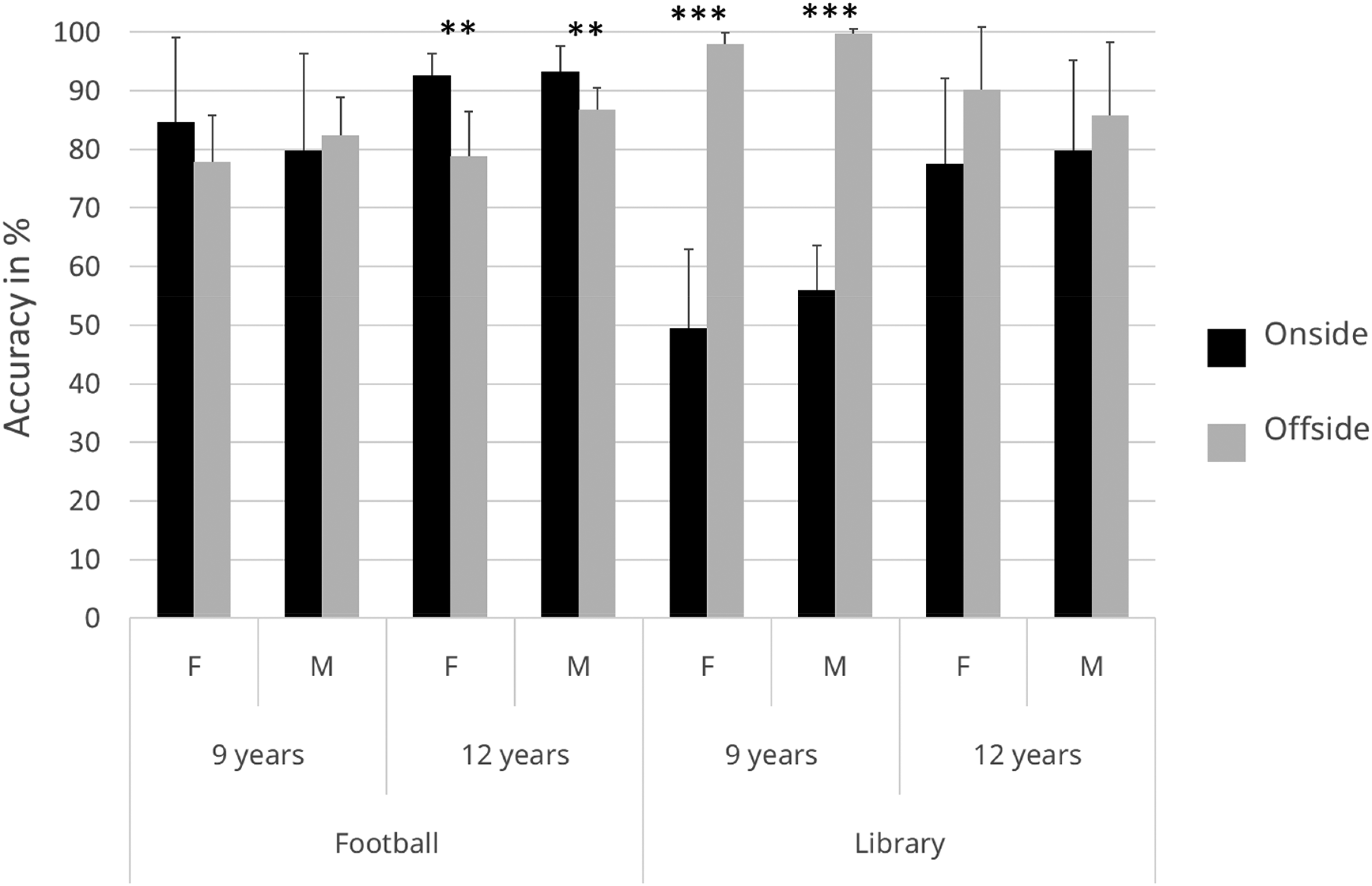
Onside/Offside Position Discrimination in 9- and 12-year-old Children Playing in Football Clubs or Attending Libraries.
We then controlled whether these results would change when the learning criterion (number of drawings) was included as a covariate, but the significant results stayed as such. The main effect of the learning criterion was not significant, p = .854, and none of the interactions with the onside/offside trials were significant, ps > .101.
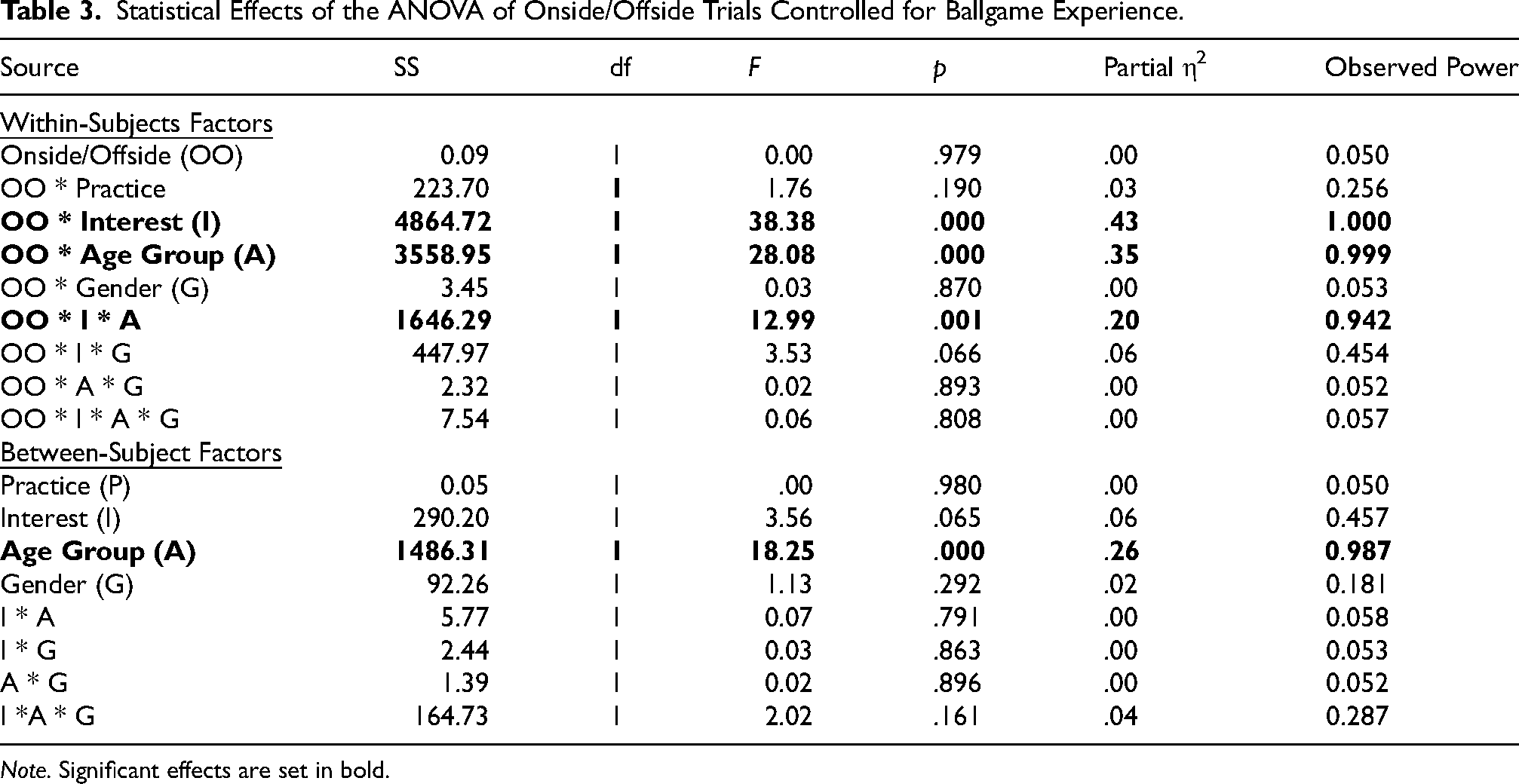
When instead the ballgame experience was added as a covariate, some results were changed, see Table 3. The main effect of the covariate was not significant, p = .980, and it also did not interact with onside/offside trials, p = .190. However, the ballgame experience covariate did reduce the main effect of domain-specific interest to a trend, p = .065, and rendered the main effect of the onside/offside trials non-significant, p = .979. Thus, the club membership as well as the soccer experience explained differences in basic offside position discrimination. However, the two-way interaction of onside/offside trials with domain-specific interest stayed intact, showing that there was possibly more to the difference between the two groups than football experience.
Statistical Effects of the ANOVA of Onside/Offside Trials Controlled for Ballgame Experience.
Note. Significant effects are set in bold.
Also the age effect was not affected by ballgame experience because age as the only main effect as well as the two- and three-way interactions with age stayed significant. In short, experience with the game did not explain age effects.
Offside Rule Experiment / Reaction Times
Reaction times were not correlated with accuracy, neither with offside trials r(60) = −.12, p = .362, nor with onside trials, r(60) = −.17, p = .195. The same model for reaction times did not yield any significant results. Boxplots were generated and it was found that two children in the football group showed reaction times that were on average longer than ten seconds, in both onside and offside trials. When these data sets were excluded, a main effect of domain-specific interest was found, F(1, 58) = 17.59, p < .001, η2 = .26. The football group showed significantly faster reaction times (M = 3887 ms) than the library group (M = 5651 ms). However, the MANOVA showed that faster speed did not have a significant effect on the offside position identification, ps > .123. This implies that fast speed was good for both recognizing false and legitimate player positions on the field.
Discussion
Understanding of soccer rules is not complete until late adolescence (Gonzalez-Artetxe et al., 2022) and the many adjustments in soccer made for children speak to this long process (Hintermann et al., 2021; McCalpin et al., 2017; Smith & Harrison, 2024). The present study investigated in particular whether children's understanding of the offside rule is more dependent on domain-specific interests than on gender-specific abilities (Lange-Küttner & Bosco, 2016; Póvoas et al., 2018). Nine- and 12-year-old children were tested with a visual search task that displayed two teams, with a target player in an onside, or an offside spatial position. One half of the children were tested on the grounds of a football club, while the other half were assessed at a library where they spent their spare time. Both groups were gender-balanced. It could be demonstrated that domain-specific interest in the spatial context of the visual search task was more important than gender differences.
The football club members practiced three to four times a week or more. They made faster decisions than the library group although this did not make offside decisions faster than onside decisions. The 9-year-olds in the football group made reasonable choices, but the 12-year-old boys and girls in the football club showed systematically better discrimination of onside trials suggesting that they had created a benchmark of what a correct position is. This clear and systematic decision-making strategy is likely to be the result of the introduction of the offside rules in football clubs once children are ten years and over. The 9-year-olds in the library group could not properly recognize onside trials. While this was improved in the 12-year-old library group, the focus was still on offside rule violations rather than whether a target player was onside, although this was not statistically reliable. The violation of expectation paradigm can already be used with infants (Margoni et al., 2024). In previous research on the offside rule, this focus on rule violation also occurred in younger boys with extensive playing experience (Lange-Küttner & Bosco, 2016).
In this previous study, an important underlying fact in interpreting whether a player is offside was ballgame experience (Lange-Küttner & Bosco, 2016). However, because we balanced gender in the group who played football frequently as well as in the library group where children were more likely not to like football, nor to play it, nor to watch it, ballgame experience was no longer confounded with gender. The football club members in the current study played in mixed teams. In recent years, girls and women have taken great strides both in playing competitive football as well as attracting crowds to their games and scoring in the international league, so the result that domain-specific interest is more important than gender differences may not come anymore as a surprise. It still was to be demonstrated given the previous research where domain-specific interest was confounded with gender and hence boys were better at discriminating the offside from the onside position.
The experiment also showed an interesting aspect of decision-making about spatial rules. Children only gradually recognize configurations in spatial arrays (Uttal & Chiong, 2004) and this needs quite some training and repetition (Lange-Küttner & Küttner, 2015; Uttal et al., 2013). Thus, it is very instructive to find as a result in the current study that the 12-year-old football group appeared to use the onside position as a benchmark for offside rule violations. It does make sense to first appreciate what a ‘Good Gestalt’ is before deviations and rule violations can be evaluated. In contrast, the younger library group showed the very opposite perceptual bias and focused on the offside position but could hardly recognize a regular onside spatial position of a target player. This focus on rule violations could be evaluated as a ‘false positive’ which occurs when there is a bias to decide that a player is in an illegal position (Botella & Palacios, 2002). It may be that the library group was more passive and focused on rule violations like a referee would do. In contrast, the football group would have been more action-oriented because as players, if they scored a goal, it would be revoked if they had been in an offside position. Thus, for an active football player it is extremely important to be in an onside position when scoring a goal.
Practice in soccer playing explained onside/offside task discrimination, but not age limitations. Thus, there seems to be maturation factor in visual search involved here that is not to be underestimated (Quiroga & Santacreu, 2018). In the current task, it may be that the younger children still have a ‘figurative bias’ (Lange-Küttner et al., 2023) and prefer to focus on players rather than spatial configurations. Person-centered cues work less well than spatial field-oriented coaching cues in real-life soccer (Moran et al., 2024). It is a limitation of the current study on individual differences in the recognition of an offside position that additional tasks that could have measured maturation with age were not included, for example, spatial working memory (Guilbert et al., 2020).
To conclude, the introduction of the offside rule in football clubs at age 10 provided a formidable opportunity to test whether this new rule may have turned children's visual attention to normative regular player positions. The current study showed for the first time that typically developing children's sports activity and experience has a profound impact in a visual search task that requires some rule-based spatial evaluation.
Supplemental Material
sj-docx-1-dev-10.1177_2192001X251352487 - Supplemental material for Visual Search and Domain-Specific Interests in Children
Supplemental material, sj-docx-1-dev-10.1177_2192001X251352487 for Visual Search and Domain-Specific Interests in Children by Christiane Lange-Küttner and Viron Erotocritou in International Journal of Developmental Science
Footnotes
Author Note
The study was conducted while the authors were at the School of Psychology, London Metropolitan University, UK. We thank the parents, children and adolescents who took part in the experiment and to St. Joseph's Football Club in Gerrard's Cross, Buckinghamshire, England. The study was presented in March 2024 on the ‘Tagung Experimentell Arbeitender Psychologen (TEAP)’ [Conference of Experimentally Working Psychologists] in Regensburg, Germany, while the first author was working at the Leibniz Institute for Educational Trajectories, Bamberg, Germany.

Funding
The authors received no financial support for the research, authorship, and/or publication of this article.
Declaration of Conflicting Interests
The authors declared no potential conflicts of interest with respect to the research, authorship, and/or publication of this article.
Supplemental Material
Supplemental material for this article is available online.
Author Biographies
Appendix
References
Supplementary Material
Please find the following supplemental material available below.
For Open Access articles published under a Creative Commons License, all supplemental material carries the same license as the article it is associated with.
For non-Open Access articles published, all supplemental material carries a non-exclusive license, and permission requests for re-use of supplemental material or any part of supplemental material shall be sent directly to the copyright owner as specified in the copyright notice associated with the article.
