




Abstract
Visual search is often impaired in children with cerebral visual impairment (CVI), but the current assessment of visual search performance is limited. This study aimed to investigate underlying visual search processes in detail by including gaze-based measurements. Twin brothers (age 11.8 years), one diagnosed with CVI and one with neurotypical development, underwent a newly developed conjunction visual search task while simultaneously their gaze was recorded. In addition to speed and accuracy, we analyzed additional timing and spatial parameters of the search process before and after their initial fixation in the target area. The twin with CVI had good visual sensory functions, but impaired search performance indicated by longer search time and larger search areas. Also, it was observed that in more difficult task conditions, he tended to miss the target, even when fixating on it. These results point towards higher-order visual deficits. This study gives insight into the visual search challenges of a child with CVI. Mapping the search process in detail provided new and distinctive information that can shape more tailored support. Coupling verbal and nonverbal gaze-based outcomes is a promising first step towards a more inclusive nonverbal and nonmotor assessment.
Introduction
Children born preterm are at an increased risk of developing cerebral visual impairment (CVI), characterized by brain-based visual deficits (Khetpal & Donahue, 2007; Macintyre-Béon et al., 2013). While the visual profiles of children with CVI vary, difficulties in visual search are often reported (Bennett et al., 2018a, 2018b; McKillop & Dutton, 2008). In clinical practice, these difficulties are typically evaluated through a neuropsychological assessment using, among others, pen-and-paper search tasks. The performance on such tasks is typically expressed in terms of speed and accuracy, thus focusing on the end result rather than the process of task execution. In addition, the current assessments are not inclusive since they exclude children with motor disabilities and/or of a young developmental age. This means that assessing visual search abilities, and even achieving an early diagnosis of CVI, below 6 years of age, is very challenging (Lueck et al., 2023). Ideally however, deficits are detected as early in life as possible, to maximize the use of high levels of brain plasticity in infancy through interventions and support systems.
Simultaneous tracking of gaze (eye movements) during visual search tasks may overcome the mentioned diagnostic limitations. When coupled with appropriate paradigms, gaze measurements give insights into search patterns and processes. This is especially of interest in a specific type of search task: the conjunction search tasks. In such tasks, a more serial visual exploration of all visual elements in the display is necessary because the distractors share a feature with the target (Treisman & Gelade, 1980). A recent study by Manley et al. (2023) reported impaired conjunction search performance in adolescent and young adult patients with CVI.
Given that gaze measurements do not require verbal nor hand-motor responses, a gaze-based method is perfectly feasible to use in young, preverbal children and children with motor disabilities. Before such a nonverbal and nonmotor instrument can be implemented, the interplay between conventional verbal outcomes and the novel gaze-based outcomes needs to be established. In the present case study, a pair of twin boys (one with neurotypical development [twin NT] and the other diagnosed with CVI [twin CVI]) underwent a gaze-based conjunction search task. The eye movements they made during this task were included in the analysis, with the aim to gain a better understanding of visual search performance in children with CVI and to pave the way for a more inclusive assessment.
Twin boys
The dizygotic male twins were born at 32 weeks of gestation. Twin NT was born first with a birth weight of 1590 g. Twin CVI experienced perinatal asphyxia and had a birth weight of 2040 g. Both baby boys were hospitalized for 4 weeks, during which twin NT received more medical care than twin CVI. During development, however, twin CVI showed increasing signs of fatigue and visual difficulties in daily life, whereas twin NT did not. At the age of 7 years, twin CVI was referred to Royal Dutch Visio, a visual rehabilitation centre in the Netherlands, for ophthalmic and orthoptic evaluations and an extensive neuropsychological assessment. No brain imaging data were available. The evaluations showed normal visual acuity (1.5 decimal scale), visual field, oculomotor, and visual sensory functions. However, in two 2-hr neuropsychological assessments, twin CVI showed abnormal scores on global and local visual selective attention tasks, indicating visual attention and perception deficits. Both orthoptic and neuropsychological outcomes were discussed and weighed by a multidisciplinary team, after which the diagnosis of CVI was established (Boonstra et al., 2022). The current study took place 4 years after twin CVI received the diagnosis. The parents of the twins provided written informed consent. This study was approved by the Medical Ethics Committee of Erasmus Medical Centre (MEC 2020-0680) and adheres to the Declaration of Helsinki (2013) for research involving human subjects.
Procedure and data analysis
The twin boys (11.8 years of age) were tested on the same day, in the same setting, and by the same researcher (MJH). Both boys achieved an average score on the Verbal Comprehension index (Wechsler Intelligence Scale for Children [WISC-V-NL]; Wechsler, 2018): Twin NT scored 100, and twin CVI scored 95. The visual search performance, using a standardized pen-and-paper task, that is, Map Mission (Test of Everyday Attention for Children [TEA-Ch]; Manly et al., 2001), was average for twin NT (31 targets found, norm score 9) and below average for twin CVI (19 targets found, norm score 5). Next, the gaze-based conjunction search task, part of the recently developed Erasmus Eye tracking Visual Assessment (EEVA) battery, was administered. After calibration, the boys were asked to search for a single red circle (the target) that was surrounded by red squares and blue circles (the distractors) and to provide a verbal response when the target was found. The researcher then pressed the space bar. The search display was manipulated in three conditions to investigate the effect of visual crowding (set size), structure, and background noise. First, low-set-size displays contained a total of 32 elements, whereas high-set-size displays contained a total of 160 elements. Second, in structured displays, the elements were equidistantly spaced in rows and columns, whereas in unstructured displays, elements were randomly placed. Third, search elements were placed on a white background or on top of a crowded background with an illustrated map of Rotterdam. Each display was shown once in a fixed order.
During each trial, a remote eye tracker with a sampling rate of 60 Hz (Tobii T60-XL, Tobii Corporation, Sweden) simultaneously recorded the children’s eye movements to assess the gaze patterns. Search performance was quantified with two parameters: the average time until the verbal response indicated that a target was found (verbal response time [VRT]) and the percentage of the screen within which the search for the target was conducted (search area). The first target fixation was determined by identifying the initial fixation within a radius of 2.5 degrees around the target. A valid target fixation had to exceed a duration of 150 ms in the target area (Hansen & Arntzen, 2015). Subsequently, VRT was split into two sections, and we calculated various time-based parameters for each trial to evaluate the search process (see Figure 1): The time it took to fixate the target for the first time, the so-called visual search time (VST), and the duration of that first target fixation (fixation duration [FD]). The remaining time after this first target fixation until the verbal response was denoted as the recognition and decision time (RDT).
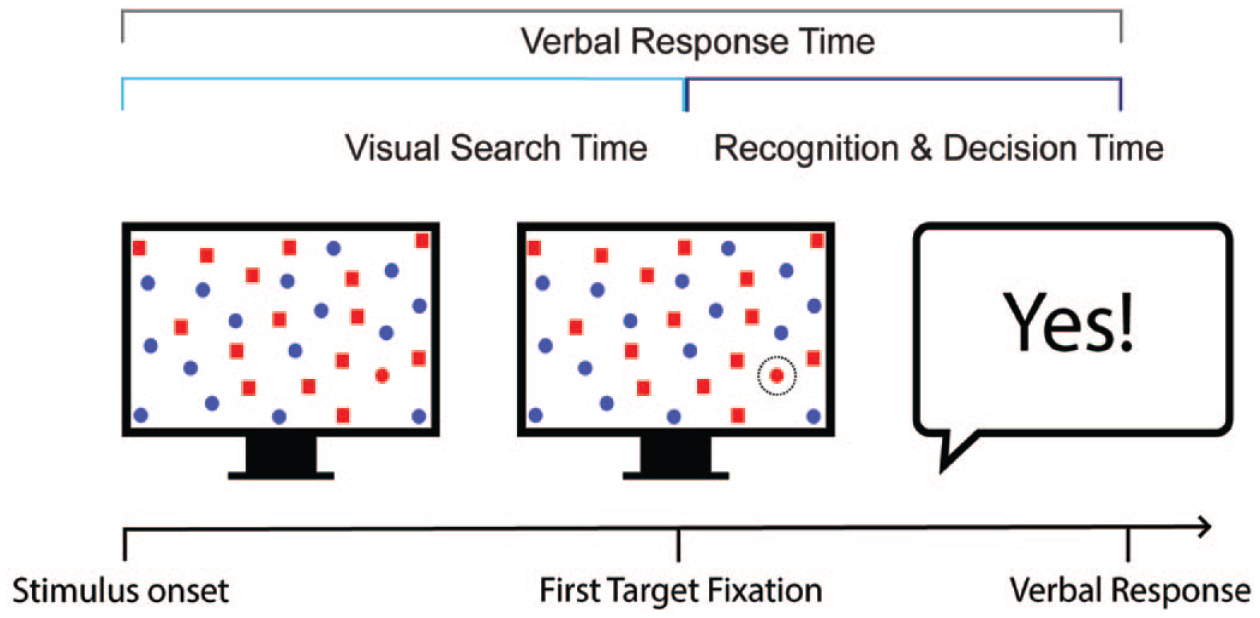
Time-based response parameters of the EEVA conjunction search task.
Visual search behaviour results
The standard calibration procedure was successfully performed in both twin brothers. Both boys cooperated well during all trials, and gaze responses could be sufficiently assessed (twin NT had 88% gaze samples and twin CVI 93% gaze samples). They both fixated on every target, and the first target FD was on average longer in twin CVI (713 ± 314 ms) than in twin NT (571 ± 345 ms). Figure 2 shows the search performance of both boys. On average, twin CVI had longer VRT than twin NT (VRT: 2.9 ± 1.9 s versus 7.9 ± 7.0 s and larger search areas (36 ± 18% versus 17 ± 12%). Regarding VST and RDT, twin NT’s visual search behaviour was efficient: On average, his VST was 2.0 ± 1.6 s, and he verbally responded within a second (0.9 ± 0.5 s). Twin CVI, however, needed more than twice as much time for VST (4.8 ± 3.3 s) and more than three times as much time for DRT (3.1 ± 6.4 s). This may imply that twin CVI had a much larger delay in giving a verbal response. Similarly, the search area of twin CVI was larger during VST, as well as during DRT (29% and 9%, respectively), than that of his brother (14% and 2%, respectively). In addition, twin CVI showed larger variability than his brother in practically all search parameters, indicated by the larger standard deviations (SDs).
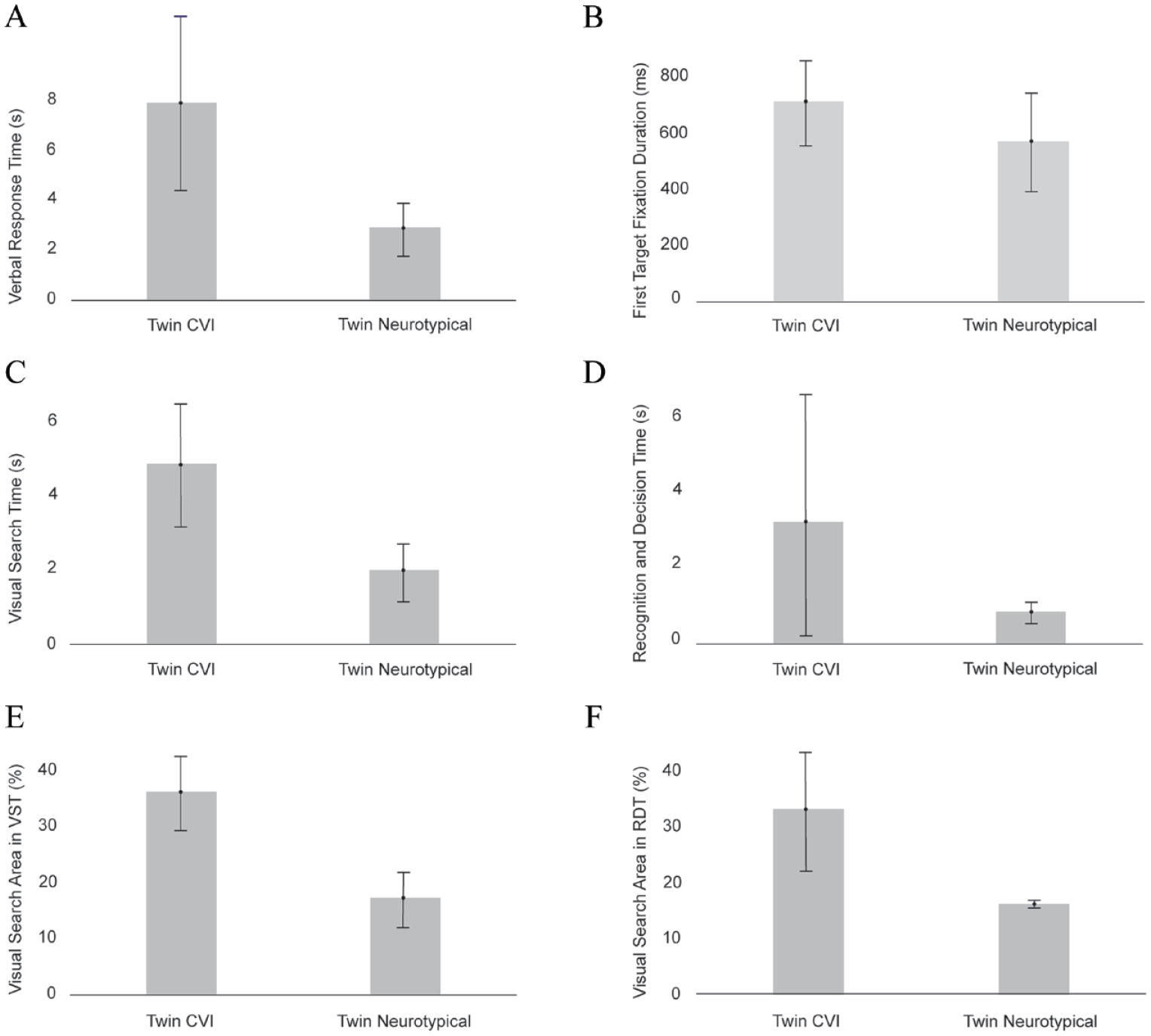
Behavioural data of the twins on the EEVA conjunction search task: (A) Verbal Response Time (VRT), (B) First Target Fixation Duration, (C) Visual Search Time (VST), (D) Recognition and Decision Time (RDT), (E) Visual Search Area in VST, (F) Visual Search Area in RDT.
Figure 3 shows the eight different search displays with the varying task demands and superimposed the gaze patterns of twin CVI and twin NT. In more demanding trials, with higher set sizes and unstructured presentations, twin CVI continued to search for the target after the first target fixation until he fixated it for a second time and gives the verbal response. This suggests that twin CVI had difficulties in target recognition even though he already fixated on it.
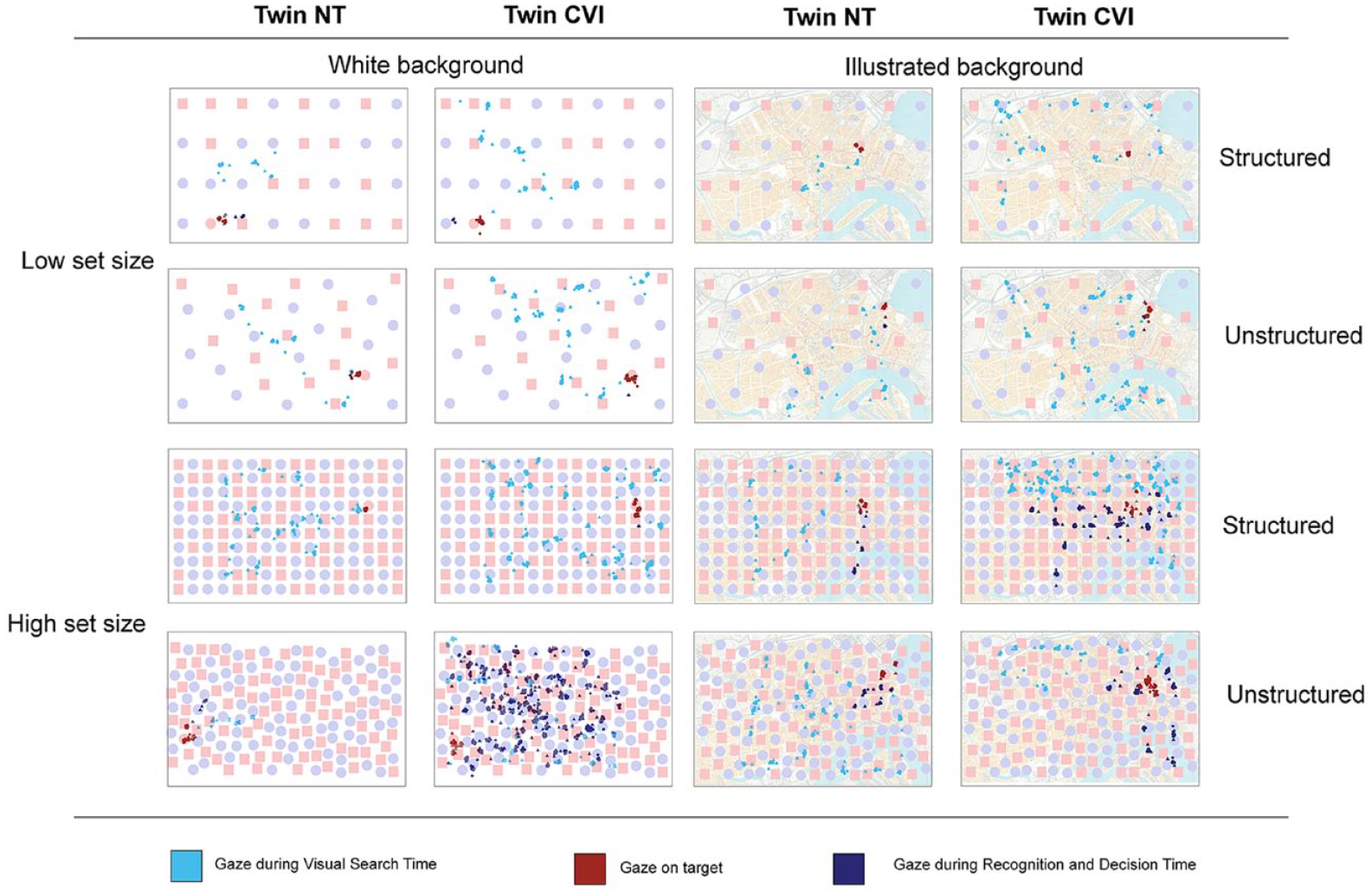
Superimposed gaze patterns of the twins on the eight different search displays with the varying task demands.
Discussion
This twin study provided a unique opportunity to explore the visual search performance of a child with CVI without the influence of verbal IQ levels or environmental factors such as upbringing, education, and social economic status (SES). The boy diagnosed with CVI demonstrated impaired and more variable performance on the EEVA conjunction search task than his neurotypical twin brother. He needed more search time and searched within a larger area to locate the target. Splitting the VRT into VST and RDT revealed that even after a first fixation, he continued to search for the target. Importantly, this result suggests that for twin CVI, looking at and processing the visual information did not seem to automatically trigger conscious perception. This lack of initial recognition was particularly evident in search displays with a larger set size. Whether overlooking a visual target and not consciously perceiving it is a visual processing characteristic of children with CVI in general needs further investigation.
Typical characteristics of children with CVI are that they can show less visual interest in general and tend to fixate shortly and look away often, characterized as volatile viewing behaviour (Zihl & Dutton, 2016). Importantly, these viewing characteristics did not account for the differences in search performance between the brothers. First, the data-capture by the eye-tracker was similar in both twins, suggesting that twin CVI did not look away from the screen more often. Second, the first time twin CVI looked at the target, he did this slightly longer than twin NT, indicating a similar initial fixation pattern. In addition, twin CVI did not have ophthalmic or orthoptic deficits. This provides evidence that there are other factors involved in the impaired search performance. The mentioned visual selective attention deficits, objectified with the neuropsychological assessment after referral, might give direction. These deficits are confirmed by the results on the Map Mission task, designed to assess visual selective attention (Manly et al., 2001), and give a first insight into validation of our gaze-based method. Taken together, it is highly plausible that higher-order visual function deficits, specifically visual selective attention deficits, are causing the impaired search performance.
The significance of differences between the brothers were independent of differences in patterns, set size, and background of the visual search displays. Nevertheless, increasing task demands, in particular, a higher set size, increased the magnitude of differences. Our results confirm previously reported findings that children with CVI in general have more difficulty with increasing task demands and that they benefit from low set sizes during visual tasks, that is, less crowding (Bennett et al., 2018a; Bennett et al, 2018b; Manley et al., 2022, 2023; Zhang et al., 2022). Opposed to most previous studies, however, in the current search task, not only set size but also the degree of structure and background layout varied. Disentangling the effect of those visual conditions on search performance can aid in specifying the child’s needs in daily life situations.
Our results are in line with an earlier study on conjunction search performance in adolescent and young adult patients with CVI (Manley et al., 2023). In this previous study, stimuli were small white or black letters against a grey background, and participants were required to navigate the mouse towards the target. In contrast, our conjunction search task employs larger and colourful shapes as stimuli and does not require hand-motor responses, therefore eliminating the potential confounders such as reduced visual acuity, contrast sensitivity, and motor disabilities (Manley et al., 2023). This makes the task potentially more suitable for young(er) children, children with visual sensory deficits, and children with co-morbid motor disabilities.
In this light, it is important to note that twin CVI had been referred and diagnosed at 7 years of age, even though the signs of abnormal visual behaviour and fatigue existed for a longer period of time. This reflects the previously mentioned diagnostic barrier that lies around the age of 6 years. However, increasingly more research and clinical efforts are made to advance the age at which a so-called working diagnosis of CVI is made. The aim, in line with that of the current research project, is to start providing early rehabilitation and developmental support (see, e.g., Vancleef et al., 2020). Moreover, prior to inclusion in this study, twin CVI underwent about 4 years of visual rehabilitation, including viewing strategy training and educational support. It is expected that without this support, his visual search performance would have been much more abnormal than his brothers’. The presented gaze-based assessment has the potential to better map the individual search difficulties and concurrent rehabilitation needs. Last but not least, reviewing the recorded gaze behaviour can improve the understanding of the child by caregivers and teachers.
The main limitation of the current study concerns the lack of generalizability due to both the task design, showing each display only once and in a fixed order, and the small study population, a single pair of twins. Upon further development and clinical validation of the current qualitative observations, studies should incorporate more trials of the same displays and in a random order and include more participants to minimize bias in results. In addition, the absence of brain imaging data for the twins hindered gaining insights into the underlying neural mechanisms. However, even if these data were available, early brain damage is not always detectable or conclusive, as often seen in premature children like the participants in our study.
Conclusion
This case study provides valuable insights into the challenges faced by a child with CVI during visual search, especially when compared to his neurotypical twin brother. The gaze-based EEVA conjunction search task revealed substantial differences in visual search behaviour between the twins, which seem to originate from higher-order visual processes. We illustrated the significance of evaluating the complexities of visual search behaviour in detail. The results highlight the potential of gaze-based tools for early and inclusive assessments and concurrent support in children. To validate the findings, further research with larger participant groups is essential.
Footnotes
Acknowledgements
The authors are grateful to the twins and their parents for participation in this study.
Funding
The author(s) disclosed receipt of the following financial support for the research, authorship, and/or publication of this article: This work was supported by a grant from the Visio Foundation [grant number: OI0399066], a Dutch non-profit organization providing financial support to (research) projects that improve the quality of life of individuals with a visual impairment ( ).
).