




Abstract
Walking and cycling are considered sustainable transport modes, promoted as a means to reduce car traffic. In the scientific literature, they have mostly been investigated separately, but should be considered jointly to enable a modal shift. Both daytime and dark conditions need to be studied, to improve understanding of how environmental features are affected by temporal variation. A conceptual model is introduced to advance understanding of the significance of different environmental factors for walking/cycling, and serves as the basis for the design of an empirical study. A between-subject design was used, comparing two pedestrian/cycle paths located in two mid-sized Swedish cities during daytime and after dark. Pedestrians (n = 90) and cyclists (n = 74) responded to questionnaires assessing environmental parameters hypothesized to be of importance for walking and cycling. Three-factor ANOVAs indicated differences between the two locations (perceived stimuli), between pedestrians and cyclists (environmental appraisal, affective response, behavioural intention) and between daytime and dark conditions (visual accessibility, restorative potential). The conceptual model helps identify the importance of various environmental features.
Previous research
Walking and cycling are promoted as sustainable, healthy, inclusive modes of transportation, and as a tool to make cities more resilient to pandemics (Hasselwander et al., 2021). Internationally, temporary design solutions have been introduced to facilitate walking/cycling in urban areas (e.g., Rollin & Bamberg, 2021). Successful implementation of design solutions aimed at increasing walking/cycling requires an integrated understanding of what works and what does not. This implies that design must support the needs of pedestrians and cyclists across seasons and under different light conditions. So far, the research field(s) on walking/cycling have largely treated these travel modes separately despite pedestrians and cyclists often sharing the same space, or have their space divided by road markings (e.g., Barnett et al., 2017; Kellstedt et al., 2021).
Daylight and dark conditions seem to be considered separately in research on walking/cycling. Researchers in transport planning, geography, public health and psychology have primarily been concerned with urban form, use and experience of walking/cycling, without taking any great interest in how the perception of a setting transforms when the user travels at different speeds or when it is getting dark (e.g., Brownson et al., 2009; Christiansen et al., 2016). Lighting researchers have focused more on dark conditions and the role of artificial light for pedestrians and, more recently, cyclists (Fotios & Castleton, 2015, 2016; Fotios et al., 2005, 2019).
A few studies have reflected on how artificial light is experienced as interacting with the surroundings (e.g., Nasar & Bokharaei, 2017; Nikunen & Korpela, 2012; Rahm et al., 2021). However, the literature lacks a systematic and integrated approach for addressing people’s environmental experiences of walking/cycling along the same (shared) path and how their experiences may differ between daylight and dark conditions.
In the scientific literature, choice of transportation has largely been studied by means of social psychological theories, such as the Theory of Reasoned Action and Theory of Planned Behavior (Hoffmann et al., 2017). Pedestrians and cyclists directly interact with the surrounding built environment, and they tend to evaluate their trips in terms of the presence or absence of certain components, such as trees (Stradling et al., 2007).
The various disciplines exploring environmental factors supporting walking and cycling, e.g., architecture and urban design (Ewing & Handy, 2009; Southworth, 2005; Sugiyama & Ward Thompson, 2008), environmental psychology (Alfonzo, 2005; Brown et al., 2007; Johansson et al., 2011, 2016), health sciences (Frank et al., 2006; Owen et al., 2004; Sundquist et al., 2011) and transport research (Manaugh & El-Geneidy, 2011; Millward et al., 2013), have approached the task at different scales. A common approach has been to focus on the neighbourhood level of the built environment, for example in terms of density, diversity, design, destination accessibility and distance to transit (Ewing & Cervero, 2010). Another approach has been to focus on micro-level factors, such as traffic, street width and slope (Handy, 2005).
In this paper, we choose to focus on the individual’s environmental perception and experience using an environmental psychology perspective. Environmental psychology postulates that an understanding of how people experience an environment is a critical component in the relationship between urban design and human behaviour, that is, the choice to walk/cycle or not (e.g., Alfonzo, 2005; Nasar, 2008). In a certain setting, people respond to specific components of the environment, perceived environmental qualities, that make up the overall impression of the setting and shape critical human–environment transactions fundamental to human well-being (Küller, 1991).
Previous research regarding perceived environmental qualities of the built environment of importance for walking/cycling has taken a number of starting points, conceptualizing perceived environmental qualities in various ways (Brown et al., 2007; Jensen et al., 2017). Ewing and Handy (2009) focused on operationalizing theoretical constructs used in the field of urban design, such as imageability, enclosure, human scale, transparency and complexity. Bonaiuto et al. took a more psychological stance from the perspective of people’s residential satisfaction (e.g., Fornara et al., 2009), considering both the cognitive aspect of perceived residential quality and affective aspects, including people’s emotional bond to their residential area — their place attachment. Bonaiuto et al. (2006) presented a broad instrument encompassing 11 perceived residential environmental qualities, clustered into four categories (spatial, social, functional and contextual), aimed at capturing the inhabitants’ view of their neighbourhood, their attachment to the place and affective qualities and the consequent associations with walking behaviour (e.g., Ferreira et al., 2016).
Research on walking behaviour departing from the Human–Environment Interaction Model (HEI) (Küller, 1991) has differentiated between perceived qualities in the form of molecular aspects (focusing on individual micro-level infrastructure elements such as surface materials and their quality, crossing design, light sources, landmarks, signs, etc.) and molar aspects that relate to how molecular aspects coexist within the overall environmental setting (Marcheschi et al., 2020; Mattsson et al., 2020). The HEI model also explicitly integrates and assesses the role of the individual’s affective experiences of walking behaviour (Johansson, 2006; Marcheschi et al., 2020; Mattsson et al., 2020).
Johansson et al. (2016) developed an instrument to assess the perceived urban design qualities (complexity & aesthetics, upkeep & order, and well-maintained greenery) especially important for pleasurability, the highest dimension of the pedestrian needs hierarchy (Alfonzo, 2005) that may influence whether a certain path is chosen or not. Inspired by the HEI model, their instrument highlights the interaction between the individual (with its idiosyncratic characteristics and prior experiences) and different aspects of the environment (perceived design qualities) during the walk. This interaction continuously gives rise to affective responses, and the cumulative affective experiences of the walk (i.e., pleasurability) are suggested to influence the intention to walk a similar path in the near future. However, despite the focus on individuals’ experience and perceived environmental qualities, place attachment and affective experiences, there has so far not been an explicit focus on the perceptual processes in the theories and instruments applied in the study of walking and cycling.
Aim
The aim of this paper is twofold: (a) to introduce a conceptual model that in a systematic and integrated way covers concepts relevant for the understanding of the physical environment’s influence on pedestrians and cyclists and their intentions to walk/bike similar paths in the near future; and (b) to apply parts of the model to empirically test for similarities and differences between the environmental experiences of pedestrians and cyclists during daylight and artificially lit conditions in two settings.
A conceptual model of the human–environment interaction of walking/cycling
We propose a conceptual model based on theories and previous findings from the field of environmental psychology. The model consists of four steps. Step one focuses on the physical setting and the perceptual processes of the individual; step two introduces higher-order environmental appraisals; step three deals with behavioural and affective responses to the appraised environment (while also discussing attitudinal factors of importance for step four); step four is intention to walk/cycle a similar path in the near future. An underlying assumption is that all aspects of the individual responses partly depend on individual characteristics and prior experiences (Johansson et al., 2016). This includes sociodemographic factors (e.g., age, gender, level of education) as well as previous experiences of being in similar environments to the path’s location. The conceptual model proposed (Figure 1) aligns with the view of Johansson et al. (2016) on how different aspects of the physical environment influence the walking experience and walking intentions but adds to it in three ways. Firstly, the conceptual model further emphasizes the perceptual processes of pedestrians and cyclists. Secondly, the model considers a wider range of perceived design qualities. Thirdly, the conceptual model integrates attitudinal theory to describe aspects of behavioural intention in greater detail.
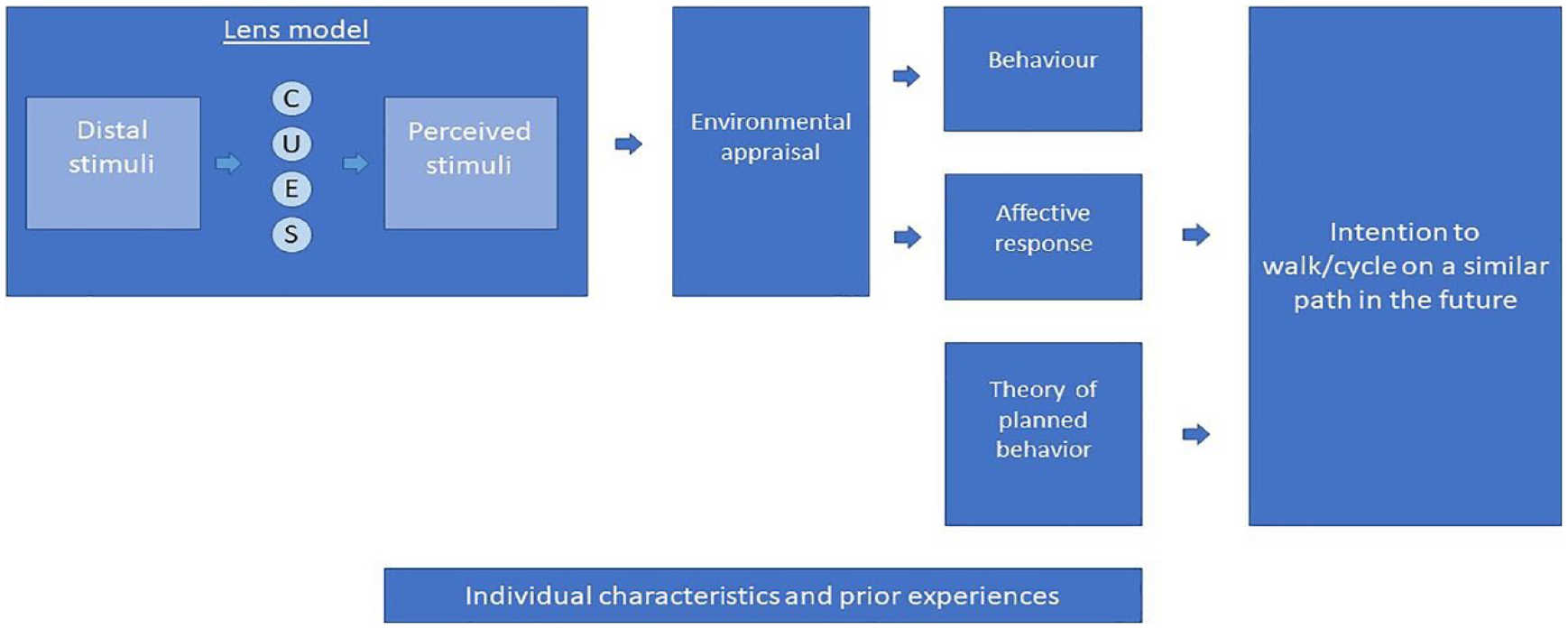
Conceptual model of the physical environment’s influence on the walking/cycling experience and behavioural intentions to use a similar path in the near future.
Step 1: Brunswik’s lens model
The first step of the conceptual model incorporates the physical environment itself, in this case a pedestrian/cycle path during daytime and after dark and the perceptual processes of the pedestrian/cyclist. Brunswik (1952) proposed the lens model as a framework to illustrate the probabilistic nature of the perceptual processes underlying behaviour. For Brunswik, the individual-environment system served as the fundamental unit of analysis (Vicente, 2003), and he differentiated between distal stimuli (objective descriptors of the setting) and proximal stimuli (imperfect sensory information). In the lens model, the objective world (represented by various distal stimuli) is on the left and the perceived world on the right. In between are a number of proximal stimuli serving as cues that represent the distal stimuli to varying degrees (degrees of ecological validity) and that to varying degrees are relied upon by the individual (degrees of utilization) in their perception of the environment (Brunswik, 1952; Cooksey, 2001). In the conceptual model, we adopt the concepts of distal and perceived stimuli as a means for differentiating between characteristics of the environment measured by technical equipment and characteristics perceived by the participants. This resembles the division between technical and observer-based environmental assessment suggested by Craik and Feimer (1987), thereby accounting for both types in the proposed model.
Step 2: Conceptual environmental appraisals
The perceived stimuli act together, similar to the collative properties of visual stimuli (Cupchik & Berlyne, 1979), and thereby form the perceptual basis for higher-order conceptual environmental appraisals in which perceptions of specific stimuli are integrated (Johansson et al., 2019).
Step 3: Affective responses and microscopic movement
The third step of the model accounts for how environmental appraisals translate into affective responses and microscopic movements. Mehrabian and Russell (1974) proposed that people’s affective responses to the built environment consist of the dimensions valence (unpleasant-pleasant) and arousal (passive-active). These affective experiences seem to mediate between the perceived qualities of the environment and behavioural intentions (Johansson et al., 2016). People tend to respond to an environmental setting by making minor adaptations to their movement in terms of walking speed and placement on the path (Johansson et al., 2020).
Step 4: Behavioural intention
The final step focuses on the behavioural intentions of pedestrians and cyclists. The cumulative affective experiences during the walk/cycle trip are likely to influence the intention to walk/cycle a similar path in the near future (Johansson et al., 2016). We also integrate the Theory of Planned Behavior (TPB) (Ajzen, 1991) to account for the complexity associated with predicting future behaviour. TPB, derived from social psychology and extensively used in research on travel mode choice, suggests that behavioural intentions are predicted by three factors: the individual’s attitude towards conducting the behaviour; the perceived social pressure to perform or not perform the behaviour (subjective norm); and the perceived ease/difficulty of performing the behaviour (perceived behavioural control) (Ajzen, 1991).
Operationalization of the conceptual model
We propose that the conceptual model could be operationalized and applied in the analysis of human–environment interactions to obtain a systematic and integrated understanding of pedestrian/cyclist settings.
The various perceived variables serve as the basis for
The cumulative affective experiences of the trip (Alfonzo, 2005; Johansson et al., 2016), along with the
Method
Settings
The data collection was conducted on two pedestrian/cycle paths in the cities of Linköping and Lund, Sweden. The study site in Linköping was a combined cycle and pedestrian path (175 metres long, 3.2 to 4.3 metres wide) located in the outskirts of the city centre (Figure 2). The path surface was asphalt and was lit by a Philips SGS 203 luminaire with a 100W high-pressure sodium lamp mounted on seven-metre-high lampposts placed 30 metres apart. On the left-hand side of the path there was a road, and on the right-hand side were residential multi-storey buildings.
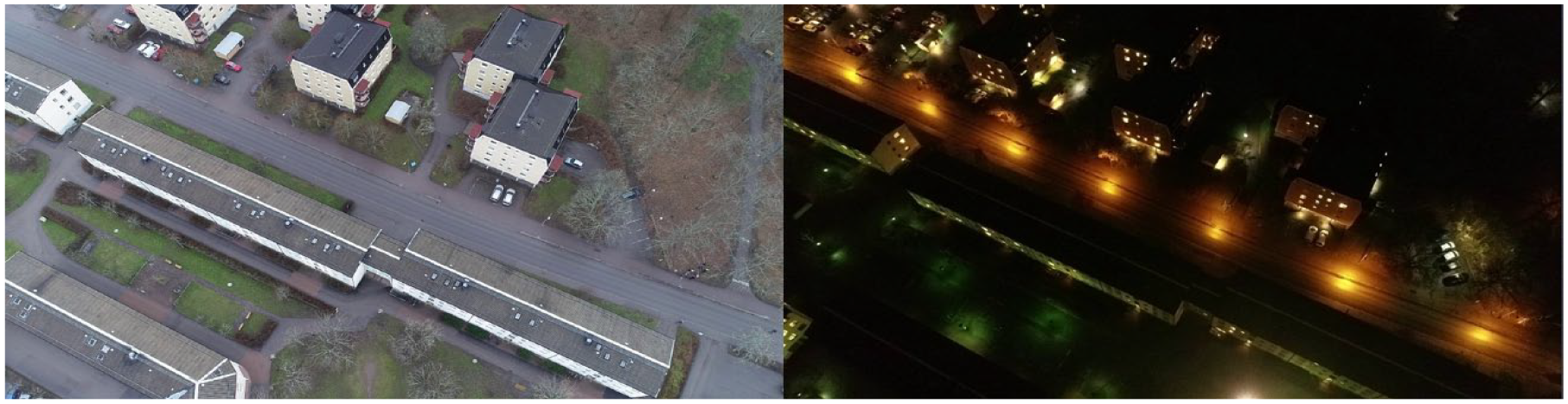
Aerial photographs of the path in Linköping during day and night conditions.
The study site in Lund was a segregated cycle and pedestrian path (245 metres long, 4.2 metres wide, separated by a white line) located in the city centre (Figure 3). On the left-hand side of the path was a road, and on the right-hand side trees and bushes bordered the path. The path surface was asphalt and was lit by Järnkonst 7455 luminaires with a 150W high-pressure sodium light, placed 30 metres apart and mounted on catenaries nine metres above the road, approximately six metres to the left of the path.
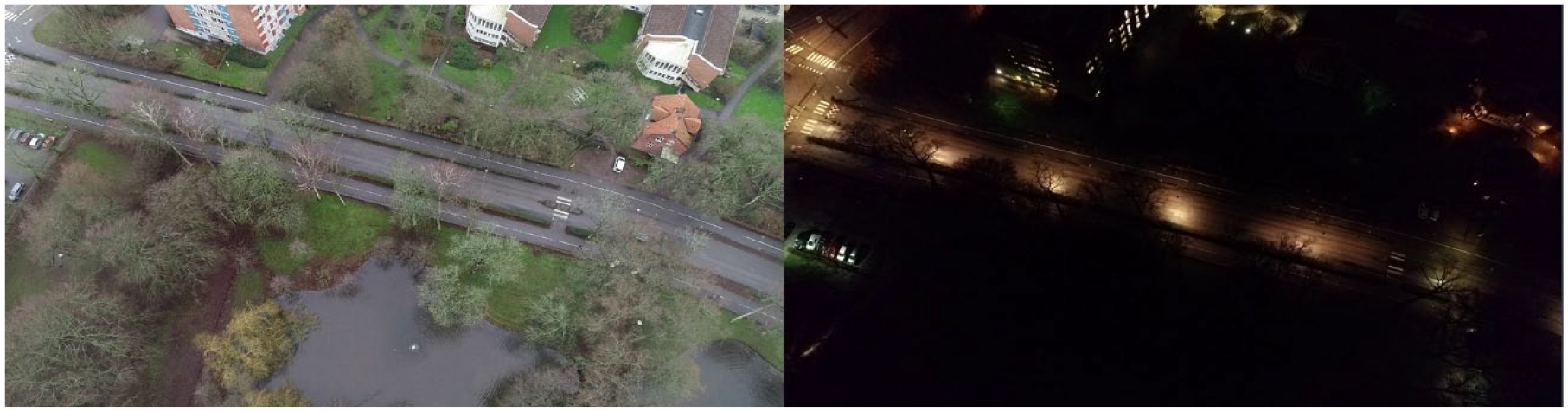
Aerial photographs of the path in Lund during day and night conditions.
Participants
The participants were students at Linköping (n = 79) or Lund (n = 85) Universities, aged 18–35 (mean age 23 years; Linköping: 23 years; Lund: 22 years), 49% female (Linköping: 51%; Lund: 48%), with self-reported normal eyesight, participating as either pedestrians (nTotal = 90; nLinköping = 40; nLund = 50) or cyclists (nTotal = 74; nLinköping = 39; nLund = 35).
Procedure
The participants arrived at the test sites in groups of five. They were informed about the purpose of the study, how their personal information would be treated and about their right to withdraw from the study without providing an explanation, before signing an informed consent form. The procedure complied in all aspects with ethical rules for psychological research, but as the study did not address sensitive personal information as defined by the Swedish Ethical Review Authority, no formal ethical approval was needed.
The study was carried out as a structured walk (Johansson et al., 2016, 2019; Rahm & Johansson, 2021). The participants walked to the starting point together and completed the first part of the questionnaire. When this was completed, the participants individually walked/cycled along the path to the end point, where they completed the second part of the questionnaire. The group then walked back to the starting point together, where they completed the third part of the questionnaire.
Measurements
This study focuses on the observer-based assessment part of the model, and a questionnaire was designed to cover those steps of the conceptual model. The questionnaire followed the procedure of the structured walk but is presented in the order of the conceptual model.
To assess a broad range of
The participants were asked to conduct
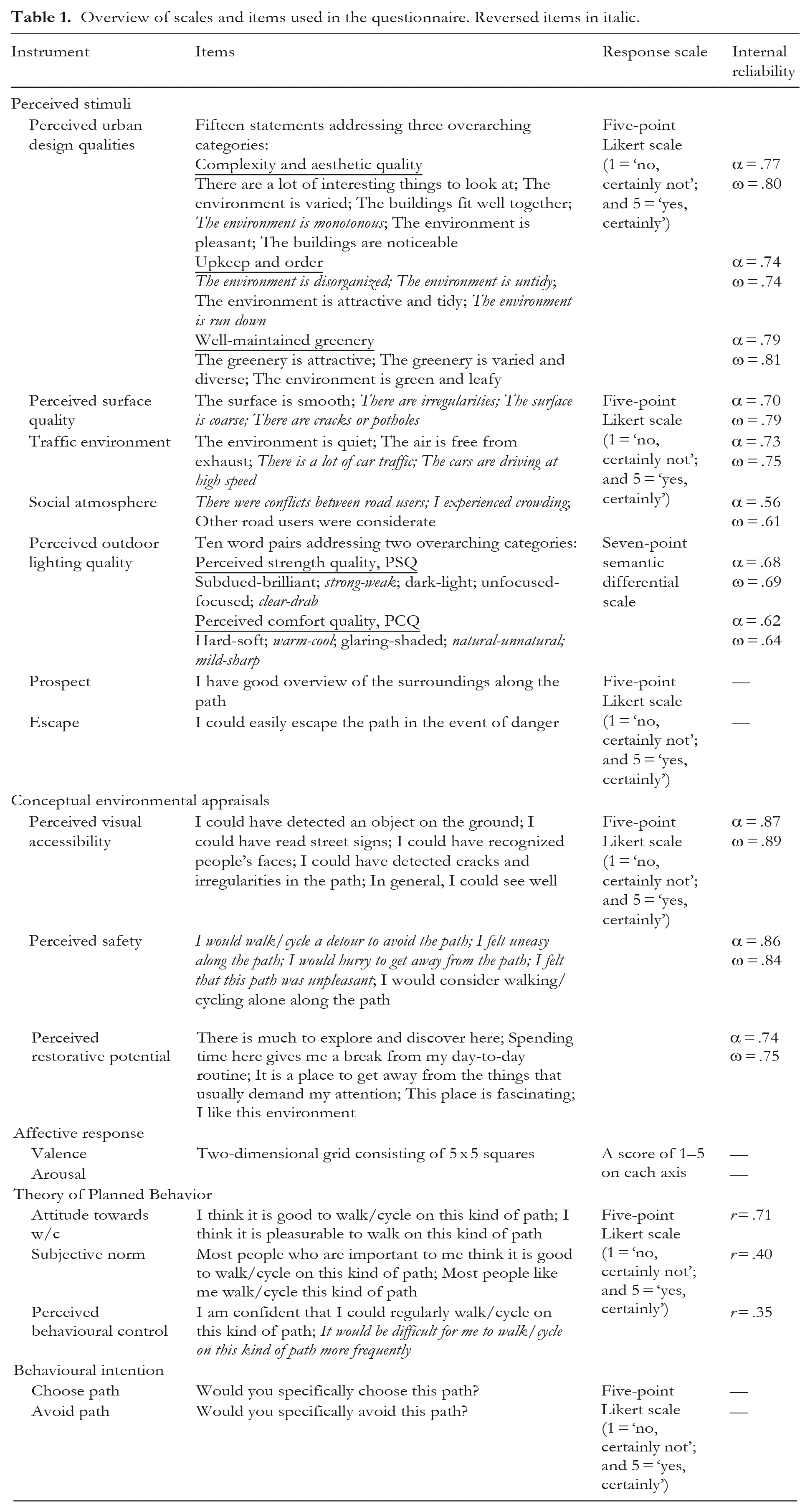
Overview of scales and items used in the questionnaire. Reversed items in italic.
Analyses
The reliability for each index was estimated by calculating Cronbach’s alpha (α) and McDonalds omega (ω) or Pearson correlation (r) (Table 1). Potential differences for each of the indices between the different locations, between pedestrians/cyclists and between day/dark conditions were analysed through three-factor ANOVAs using IBM SPSS 26. Some variables (prospect, perceived visual accessibility, perceived safety, perceived restorative potential and perceived behavioural control) had significant differences on Levene’s test of equality of error variances. To avoid potential problems with violations of assumptions underlying the use of ANOVA, parallel analyses were conducted using a robust three-factor ANOVA on the trimmed means (20%) using the t3way function of the WRS2 package in R. The results from the robust trimmed-means three-factor ANOVAs supported the findings from the original three-factor ANOVA, except for perceived safety and valence, where the results did not indicate significant differences between daytime and dark conditions.
Results
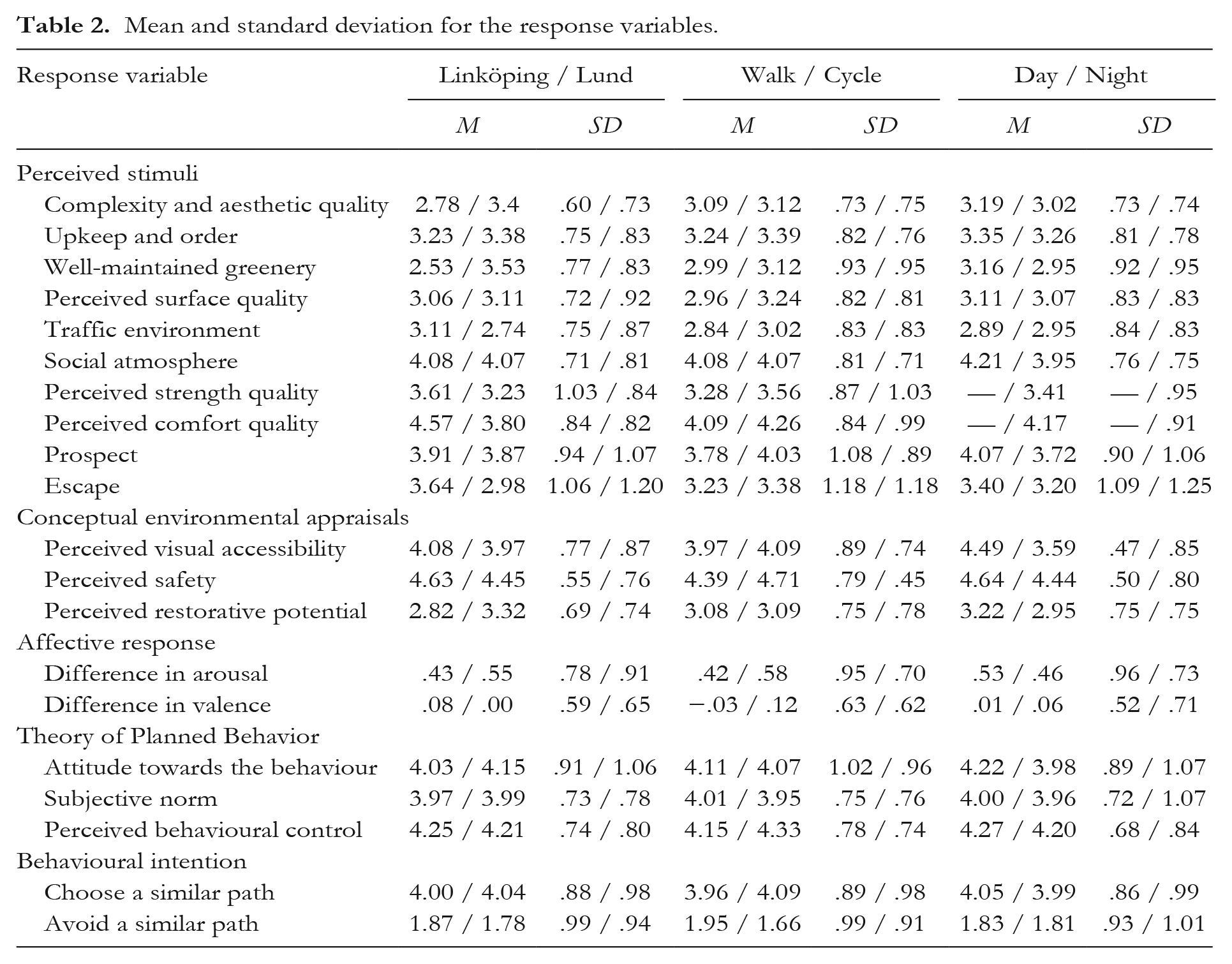
There were mainly significant differences between the locations regarding
Mean and standard deviation for the response variables.
Results from the statistical analyses. Significant differences are marked with bold. Results not supported by the robust three-factor ANOVAs are marked with # and statistically non-significant differences are labelled n.s.
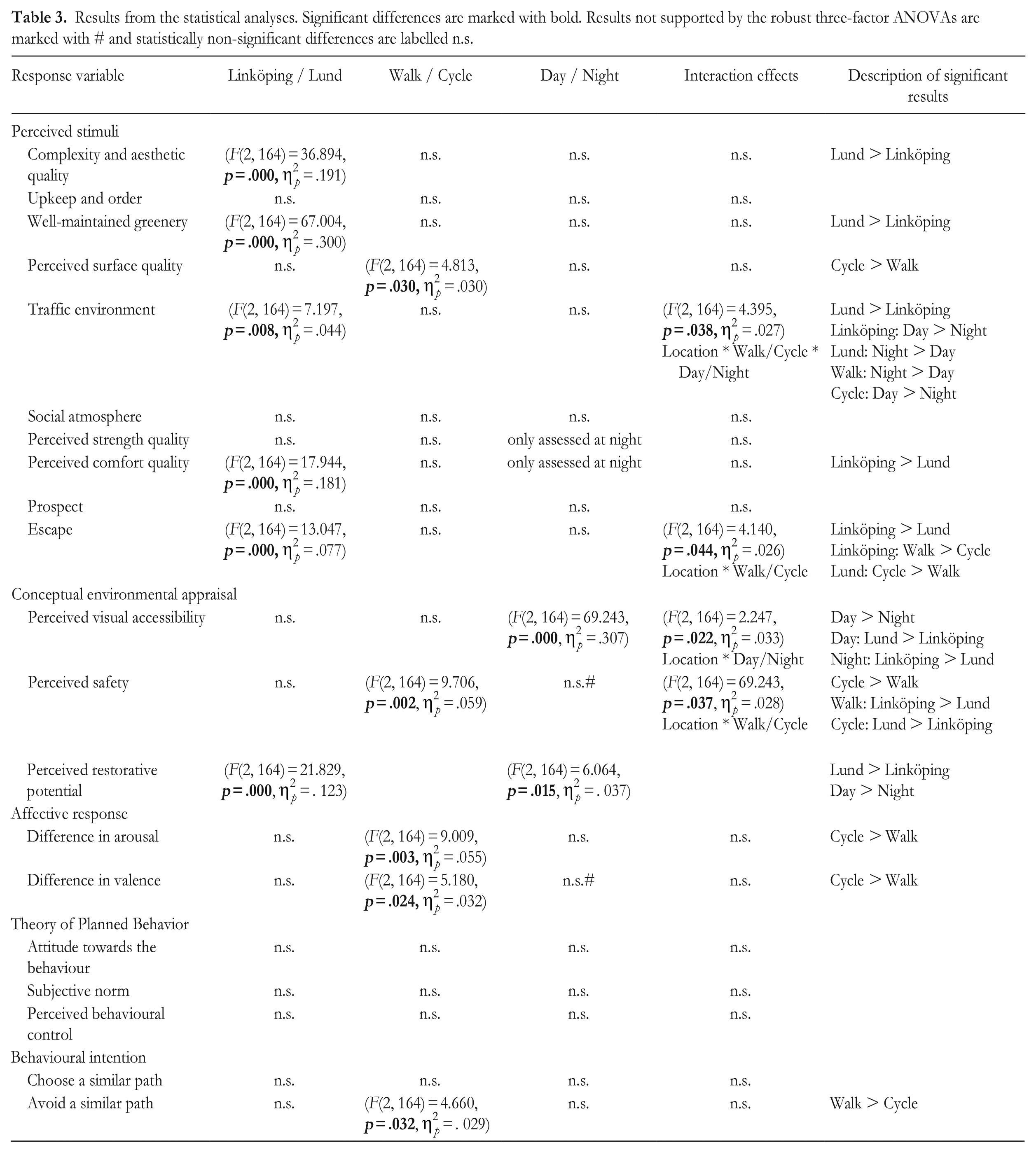
Results were mixed for the
For the
Discussion
This paper introduced a conceptual model of the physical environment’s influence on walking/cycling experience and the intentions to use a similar path in the near future. Starting with the physical setting, the model provides a framework for assessing both different levels of the environment and different psychological constructs of importance for behavioural intentions. By adopting the terms distal and perceived stimuli, the model bridges the gap between disciplines relying on technical assessments of environments and disciplines trying to capture user needs and experiences to understand mobility. An important aspect of introducing the lens model (Brunswik, 1952) is that it helps nuance the differences between perceived stimuli capturing specific features within a setting and conceptual appraisals capturing the impressions of the total setting. The latter has been somewhat neglected in evaluations of pedestrian design (e.g., Ewing & Cervero, 2010).
The conceptual model links two theoretical approaches used in environmental psychology to analyse sustainable travel in urban settings: theory on perception focusing on people’s environmental experiences and attitude theory. A similar approach has previously been useful in the analysis of sustainable behaviour in buildings (Mattsson, 2015). The conceptual model thereby enables theoretical and methodological integration in the study of sustainable travel. The model could also be of practical benefit for municipalities in their assessments of how well existing infrastructure supports walking/cycling or when planning new infrastructure for pedestrians and cyclists. By providing an overview of the different factors of importance, the model could aid the identification of problematic locations that would need to be addressed to prevent deterring the public from walking/cycling in certain areas (see Rahm et al., 2021).
The model also offers flexibility in the operationalization of variables at all levels, but this calls for a valid alignment between distal and perceived variables as well as conceptual appraisals. In this study we relied on existing questionnaire batteries and found that the measures employed to assess perceived stimuli differed between the two environments, indicating that the instruments worked as intended. However, the only significant difference between pedestrians and cyclists for the perceived stimuli instruments was found for perceived surface quality, while no significant differences were found between daylight and dark conditions. On the other hand, there were significant differences in conceptual environmental appraisal between both pedestrians/cyclists and daylight/dark conditions. This may be interpreted as small differences in perceived stimuli, compounding through the process of conceptual environmental appraisal and resulting in significant differences when considering the total setting.
The differences between pedestrians/cyclists may be due to differences in speed. Cyclists were more aroused (possibly due to greater physical exertion), felt more positive, assessed surface quality as better and experienced the path as safer than pedestrians. These differences may have influenced pedestrians to express a greater intent to avoid a similar path in the future, since there were no significant differences between pedestrians and cyclists on TPB that could otherwise have explained the discrepancy.
The comparison between daytime and night-time conditions showed that visual accessibility was greater during daylight conditions, which could be expected. Also, the restorative potential was rated as being better during daytime, which is expected to be the preferred condition (Cheon et al., 2019). There were no significant differences in perceived safety between daytime and dark conditions. This may reflect the study being conducted in generally safe environments, or that the study setup induced a sense of safety.
Since the empirical study only evaluated the components of the conceptual model, the association between the perceived environment, environmental appraisal, affective experience and microscopic movement is still an open question. In further research, larger data sets including greater variation in pedestrian/cycle paths would allow for statistical analysis of the proposed associations between different levels of the model. In future research the conceptual model could be useful for evaluating urban design interventions for pedestrians/cyclists and help identify the extent to which the design succeeded or failed in its purpose.