




Abstract
Climate change is a global problem that targets the whole planet, whose mitigation requires collective involvement. There is an ongoing joint effort between the governments of several countries that aims to devise policies and measures to mitigate each country’s impact on climate change. According to evidence, social identification, self and collective efficacy are relevant psychosocial processes that foster collective involvement in pro-ingroup behaviour. In this work, we test how two types of social identity (global and national identities) predict normative pro-climate behaviour when mediated by perceived individual and collective efficacy. In a correlational study (N = 278), we found that global and national identities predict normative pro-climate behaviour to the extent that participants perceive collective efficacy, which did not occur with individual efficacy. We also found global identity to directly predict pro-climate behaviour. Results highlight the importance of the salience of national and, especially, global identities in predicting perceptions of collective actions’ efficacy and, thus, on climate change mitigation behaviour.
Climate change is currently recognized as a global environmental issue that affects the entire planet (Intergovernmental Panel On Climate Change [IPCC], 2022). As climate change impacts people and ecosystems around the world, it can help shape our collective understanding of ourselves as part of a global community and our shared responsibility for the well-being of the planet. Thus, we may suppose that this problem is highly connected with individuals’ global identity, that is, with individuals’ self-concept as members of the global community.
As the impacts of climate change become increasingly evident, it can become clear that no community or country is immune to the effects of a changing climate. The recognition of our shared vulnerability to the impacts of climate change, thus, should be stronger when global identity is salient. As a fact, the salience of global identity can help to foster a sense of solidarity and interdependence among people around the world, a sense of shared ownership and responsibility for addressing the issue (Barth et al., 2015; Fielding & Hornsey, 2016; Reese, 2016; Reese & Kohlmann, 2015).
In parallel, governments of several countries are attempting to address this problem by devising national and regional policies that aim to mitigate each country's impact on climate change. As different countries adopt different approaches to addressing this global issue, such as through environmental policies, renewable energy initiatives or even denial of the issue itself, the responsibility of the national governments to address climate change is undeniable (IPCC, 2022). Therefore, we also may think that individuals’ responses to climate change may also be shaped by their national identity. Thus, the ideologic, economic and socio-politic involvement in climate change namely on the stimulation towards engagement in pro-climate behaviour might be a relevant dimension of both global and national identity.
However, the intentional adoption of pro-climate behaviour to mitigate the severity of damages caused by climate change should be based on the idea that such behaviour is indeed effective. Thus, the assumption of collective and individual efficacy should be relevant determinants to promote positive attitudes favouring the adoption of pro-climate behaviour (Bradley et al., 2020; Kellstedt et al., 2008).
In this work, we test the idea that both global and national identity may be relevant predictors for pro-climate behaviour, especially daily life behaviour that can be adopted by individuals as their routine. Moreover, we also propose that positive global and national identities should predict the perceived efficacy of collective and individual action that should, in turn, predict engagement in daily life pro-climate change behaviours.
Global and national identities and climate change
The literature has demonstrated the importance of social identity in combatting climate change. For example, Fritsche et al. (2018), in their Social Identity for Pro-Environmental Action (SIMPEA), highlight the positive impact of ingroup identification on the recognition of climate change as an urgent problem, which in turn stimulates pro-environmental actions.
Some authors have shown the direct impact of global identity on combatting climate change by predicting pro-climate behaviour (e.g., Barth et al., 2015; Buchan et al., 2011; Reese, 2016; Reese & Kohlmann, 2015). Carmona-Moya et al. (2021) propose the EIMECA model, which sustains that environmental identity (social identity that includes people’s connection with nature as an important part of their self-concept) is determinant to promote pro-environmental collective action. Both these cases highlight the positive impact of superordinate social identities (based on the highest level of self-categorization process implying the inclusion of all human beings in the same category; Turner et al., 1987) on predicting engagement in behaviour (namely collective action) aimed at combatting climate change challenges. Moreover, global identity was found to increase individuals’ vulnerability and sensitivity to climate change issues (Reese, 2016; Reese & Kohlmann, 2015). Indeed, such a superordinate self-categorization level of abstraction provides individuals with a sense of belonging based on an inclusive category that seems accessible and to have normative fits in a context of a global challenge (as is the case of climate change) to all human beings (Turner et al., 1987).
However, the instances that are responsible for policy decisions and prescriptive rules to mitigate climate change are national governments. The national dimension of policy decision and practices highlights the relevance of considering the role of national identity in promoting pro-climate behaviour, which implies another level of abstraction in self-categorization processes — basic/intergroup level of abstraction (Turner et al., 1987). National identity has been found to be based on an extremely accessible category for all individuals (Tajfel, 1978), but does this identity have sufficient normative fit in a context of a global threat to emerge as a relevant predictor of behaviour consistent to mitigate such threat? How people appraise their nation as compared to other nations and how they identify and commit with their national group, or how they feel about their society, might also contribute to promoting pro-climate behaviour. Some evidence supports such a link (see, e.g., Milfont et al., 2020). Nevertheless, the salience of national identities per se seems less evident in the literature to explain individuals’ commitment to pro-climate behaviour as compared to global identities. Thus, other processes might be needed to commit individuals with pro-climate concrete behaviours.
Some literature has shown that psychosocial processes such as perceived group efficacy are relevant to committing social groups with action aimed at social change (Van Zomeren et al., 2008). Although pro-climate behaviour is hardly considered as relevant action to improve any social group’s status, the fact is that climate change is a global threat that demands steps (and particularly national steps) aimed at social change.
Perceived efficacy and pro-climate behaviours
Literature on collective action has shown that social identification and perceived efficacy are relevant determinants to engage people in movements towards desired social change (see EIMECA model: Carmona-Moya et al., 2021; see SIMPEA model: Fritsche et al., 2018; see SIMCA model: Van Zomeren et al., 2008). The concept of perceived efficacy (Bandura, 1977) has two independent dimensions: the beliefs an individual has about achieving success in their actions (individual dimension) and the beliefs an individual has about their group’s ability to collectively achieve a successful group goal or outcome (collective dimension). Although the individual dimension has also been shown to be a relevant predictor of pro-climate actions (Bradley et al., 2020), the fact is that evidence more frequently gives relevance to the role of collective efficacy on pro-climate actions (Chen, 2015; Homburg & Stolberg, 2006; Van Zomeren et al., 2008). This link is justified based on the fact that climate change is a problem that requires the maximum number of individuals (either at a global or a national plan) engaged in pro-climate behaviour. Therefore, individuals need to believe that the group is effective in solving the problem to adhere to new behaviour.
Considering evidence about the relationship between global and national identities and pro-climate behaviour, a direct connection between global identity and pro-climate behaviour seems more obvious than with national identity. Thus, collective efficacy (e.g., perception that citizens’ behaviour has an impact in mitigating climate changes) might be a necessary factor to reinforce the predictive impact of national identity on pro-climate behaviour.
Overview and hypothesis
The present study intends to test the predictive value of both global and national identity on intention to engage in pro-climate behaviours. On the one hand, thinking about the self as part of the world (global identity) demands a higher level of abstraction in the self-categorization process and a higher level of comprehension about this global problem that transcends any group boundary (Buchan et al., 2011). On the other hand, we might think that national government policies aimed at mitigating the impact of climate change might reinforce the predictive value of national identity on adherence to pro-climate behaviour. However, in such a case, perceived collective efficacy should be a relevant mediator of such a relationship (Figure 1). National government policies directed to improve citizens’ engagement in the fight for climate change mitigation are expected to have an impact on individuals’ daily life behaviour and not necessarily on adherence to collective action. Thus, we considered individuals’ intention to adhere to pro-climate behaviour as the dependent variable, and we hypothesize that the more individuals identify with a group, the more likely they are to recognize the group (and themselves) as able to contribute to mitigating the consequences of climate change, and the more they show motivation to adhere to pro-climate daily routine behaviours. In brief, this study aims to study how national and global identity may be relevant predictors of individuals’ commitment to pro-climate behaviour. These two identities require different cognitive levels of abstraction, and, because they fit differently when it comes to engage individuals in responses to a global threat (as is the case of climate change), collective efficacy might be a needed process to reinforce the impact of national identity on this process. Thus, we also tested the mediator role of self-efficacy in this process since motivation to daily routine behaviour is performed individually and might also be predicted by how individuals perceive they are able to engage in such behaviour.
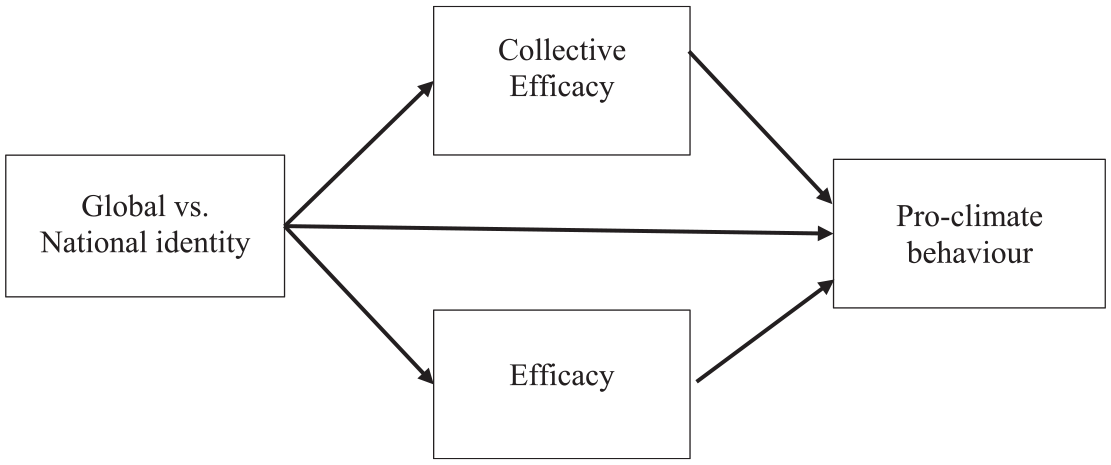
Illustration of the predicted mediation models.
Method
Participants
The sample is composed of 278 participants, 211 women and 60 men (with seven participants indicating ‘other’), with a mean age of 46.89 years (SD = 14.64), ranging from 18 to 87 years. The sample has a high heterogeneity in terms of geographic location in Portugal. Most of the participants indicate living in the centre (n = 144, 51.8%) and in the north (n = 108, 38.8%); 16 live in the south (5.8%) and seven reported living in the islands (2.5%).
Concerning the level of education, 117 have bachelor’s degrees (42.1%), 68 have completed high school (24.5%), 55 have a master’s degree (19.8%), 24 have doctoral degrees (8.6%) and 14 have the basic educational level (5.0%). Regarding socioeconomic status (1 = ‘Very Low’ to 7 = ‘Very High’) participants showed, on average, a median socioeconomic status (M = 3.90, SD = 1.18). Participants showed a mean of political position (1 = ‘Left’ to 7 = ‘Right’) near to the middle point of the scale (M = 3.44, SD = 1.18).
Procedure
Participants were contacted via online platforms and asked to complete a survey about pro-climate behaviours. Invitations for participation were published in a link to an online questionnaire that was shared via Facebook. Participants agreed with an informed consent and participated voluntarily in the study.
Measures
In addition to sociodemographic data (sex, age, nationality, place of residence, level of education), political position and subjective socio-economic status, we also measured the level of global and national identity, perceived individual and collective efficacy and frequency of individuals’ pro-climate daily routine behaviour. All the variables were measured in seven-point Likert scales (1 = ‘totally disagree’ to 7 = ‘totally agree’, except the pro-climate behaviours — see below).
Global identity
Participants stated their opinion about four items from Tu et al. (2012, e.g., ‘My heart mostly belongs to the whole world’) that we translated into Portuguese. We created a Global Identity score corresponding to the average of these items (Cronbach’s α = .876; M = 5.54, SD = 1.53).
National identity
Participants also responded to a national identity scale, with seven items developed by Pinto et al. (2016), for example, ‘I am proud of being Portuguese’ (Cronbach’s α = .836; M = 5.25, SD = 1.19).
Perceived self-efficacy
We adapted to the topic of climate change (and translated into Portuguese) three items: two from Kellstedt et al. (2008) — ‘I believe that my actions have influence on climate change’; ‘My actions to reduce the effects of climate change in my community will encourage others to reduce the effects of climate change through their own actions’ — and one from Carman et al. (2021) — ‘There are things I can do that will address climate change’. A principal components factorial analysis computed on these items extracted one factor, KMO = .724, χ2(6) = 539.32, p < .001, explaining 62.43% of the variability. We averaged this measure to a Perceived Self-Efficacy score (Cronbach’s α = .838; M = 5.54, SD = 1.53).
Perceived collective efficacy
We adapted to the topic of climate change (and translated into Portuguese) four items from different scales that we believed would best fit the concept and the topic we were willing to measure: an item from Carman et al. (2021) — ‘If everyone does their part, we can address climate change’ — another from Zint et al. (2002) — ‘By working with others, I can address climate’ — and two from Capstick and Pidgeon (2014) — ‘There is no point in me doing anything about climate change because no one else is’ and ‘The actions of a single person don’t make any difference in tackling climate change’. Because these items were from different scales, we conducted a principal components factorial analysis computed on these items that extracted one factor, KMO = .614, χ2(3) = 444.67, p < .001, with 73.42% of explained variability. We averaged this measure to a Perceived Collective Efficacy score (Cronbach’s α = .862; M = 5.20, SD = 1.76).
Pro-climate behaviours
Finally, we measured how often participants do some normative pro-climate behaviour (1 = ‘never’ to 7 = ‘always’). The scale consists of seven items that cover individual pro-climate actions (‘Decrease the amount of waste produced per day’; ‘Reduce water waste [e.g., using rainwater to water the plants]’; ‘Reduce meat consumption at meals’; ‘Choose a more energy-efficient appliance when buying a new one’; ‘Avoid having unnecessary lights on’; ‘Whenever laundering, only do it with a full load’; and ‘Take an active role on social networks in publishing environmental actions’), used in previous studies (Arnold et al., 2018; Markle, 2013; Sinatra et al., 2012; Van Valkengoed et al., 2021) that we adapted and translated into Portuguese. A principal components factorial analysis computed on these items extracted a single factor, KMO = .786, χ2(21) = 430.14, p < .001, that explains 42.11% of the variability. We averaged these items into a Pro-climate behaviours score (Cronbach’s α = .768; M = 5.39, SD = 1.03).
Results
Preliminary analyses
Initially, a multiple linear regression was performed aimed at exploring the predicted value of sociodemographic, political tendency and subjective socioeconomic level on pro-climate behaviours. We obtained a significant model, F(5, 257) = 4.51, p < .001, R2 = .08. A further inspection on the impact of each predictor on this model shows that age and political tendency significantly predicted pro-climate behaviours, β = .216, t = 3.59, p < .001, 95% CI = [.01; .02] and β = −.142, t = −2.32, p = .021, CI 95% = [−.23; −.02], respectively. The older the participants are, the more they tend to engage in pro-climate behaviours; the more closely to the left-wing political tendency, the more participants engage in pro-climate behaviours. The remaining predictors (sex, education and socioeconomic status) had no significant predictive value (β ⩽ −.103, t ⩽ −1.71, p ⩾ .088, 95% CI = [−.40; .03]).
Mediated moderated model
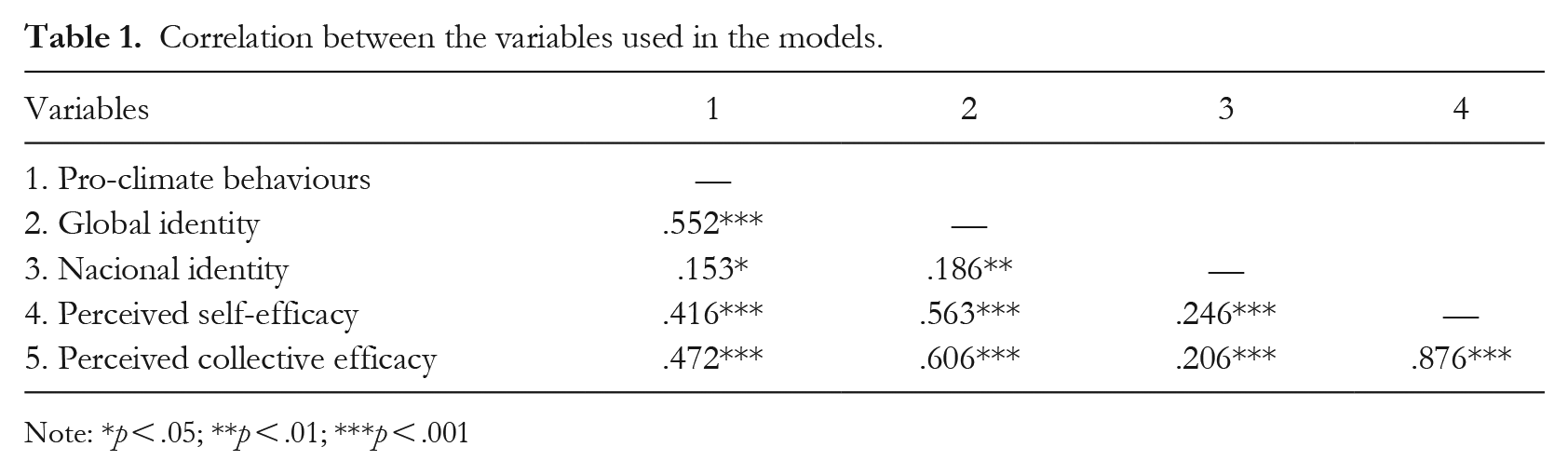
We expected that global identity (Model 1) and national identity (Model 2) would predict a higher frequency of pro-climate behaviours and that collective (and perhaps individual) perceived efficacy would mediate this association. Before the mediation analyses, we conducted Moment-Product Pearson correlations between all variables involved in the models (see Table 1).
Correlation between the variables used in the models.
Note: *p < .05; **p < .01; ***p < .001
Results show that global and national identities are significantly correlated with both dimensions of perceived efficacy and normative pro-climate behaviour. Perceived efficacy, both self and collective, is also significantly correlated with normative pro-climate behaviour. These results seem consistent with our predictions and encouraged us to proceed to the mediation model analyses, predicted by our hypotheses. We conducted two simple mediation analyses with two parallel mediators, using the Process Macro with 5,000 bootstraps (Model 4, see Hayes, 2022).
Model 1
In this model, we considered global identity as the independent variable, self and collective perceived efficacy as parallel mediators and pro-climate behaviours as the dependent variable. The model (Figure 2) significantly predicts variability found in pro-climate behaviours, F(1, 276) = 121.24, p < .001, R2 = .31. As expected, global identity directly predicts pro-climate behaviours, b = .32 (.05), t = 6.81, p < .001, 95% CI = [.23; .4], and perceived collective efficacy also emerged as a significant mediator of this process — indirect effect: b = .12 (.06), 95% CI = [.01; .24]. Perceived self-efficacy did not significantly mediate the association between global identity and pro-climate behaviours: b = −.02 (.05), 95% CI = [−.11; .74].
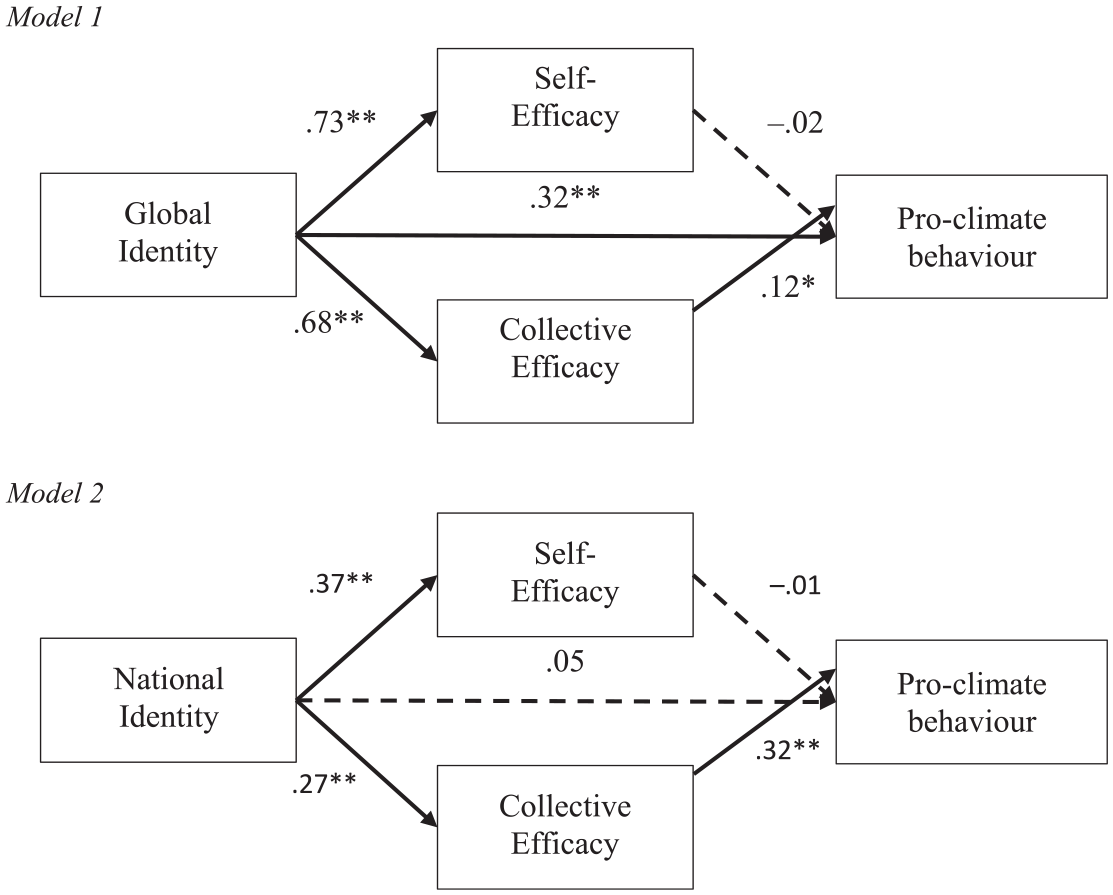
Simple mediation model (1 and 2).
Model 2
In this model we included national identity as the independent variable. The remaining variables occupied the same role as in Model 1. Model 2 significantly explains variability found in pro-climate behaviours, F(1, 176) = 6.64, p = .011, R2 = .02 (see Figure 2). As in the previous model, we observed an indirect effect of collective perceived efficacy on the association between national identity and pro-climate behaviours, b = .08 (.04), 95% CI = [.02; .17]. We did not observe a direct effect of national identity on pro-climate behaviours, b = .05(.05), t = 1.08, p = 281, 95% CI = [−.04; .15], nor evidence of a mediation effect of perceived self-efficacy, b = −.002 (.03), 95% CI = [−.06; .05]. Therefore, collective efficacy reveals a relevant factor to enforce the association between national identity and pro-climate behaviours.
Only perceived collective efficacy seems to mediate both models, contrarily to perceived self-efficacy. Interestingly, perceived self-efficacy was predicted by both identities but did not predict pro-climate behaviours.
In order to test the robustness of these models and the direction of the psychosocial process, we also conducted the reversed models. That is, we analysed two additional models, considering pro-climate behaviours as the independent variable, both perceived self and collective efficacy as parallel mediators and global identity (Model 3) and national identity (Model 4) as the dependent variables. These models would allow us to better inspect the process underlying identities and adherence to pro-climate behaviour. Indeed, considering that this study followed a correlational methodology, this test would allow us to better understand whether the predicted and already found processes are those that we should rely on when considering the role of identities in the adherence to pro-climate behaviour, or whether we are facing a self-feeding continuous process in which identities predict and are reinforced by commitment to pro-climate behaviour.
Model 3
We considered pro-climate behaviour as the independent variable, both perceived self and collective efficacy as parallel mediators and global identity as a dependent variable. We obtain a significant model, F(1, 276) = 121.24, p < .001, explaining 31% of the variance found in global identity; see Figure 3. Consistent with Model 1 (and with a similar power of variability explanation), we observed an indirect effect of collective perceived efficacy, b = .20 (.08), 95% CI = [.06; .35], but not of perceived self-efficacy, b = .075 (.05), 95% CI = [−.03; .19], on the association between pro-climate behaviour and global identity. We also observed a direct effect of pro-climate behaviour on global identity, b = .45 (.07), t = 6.81, p < .001, 95% CI = [.32; .58].
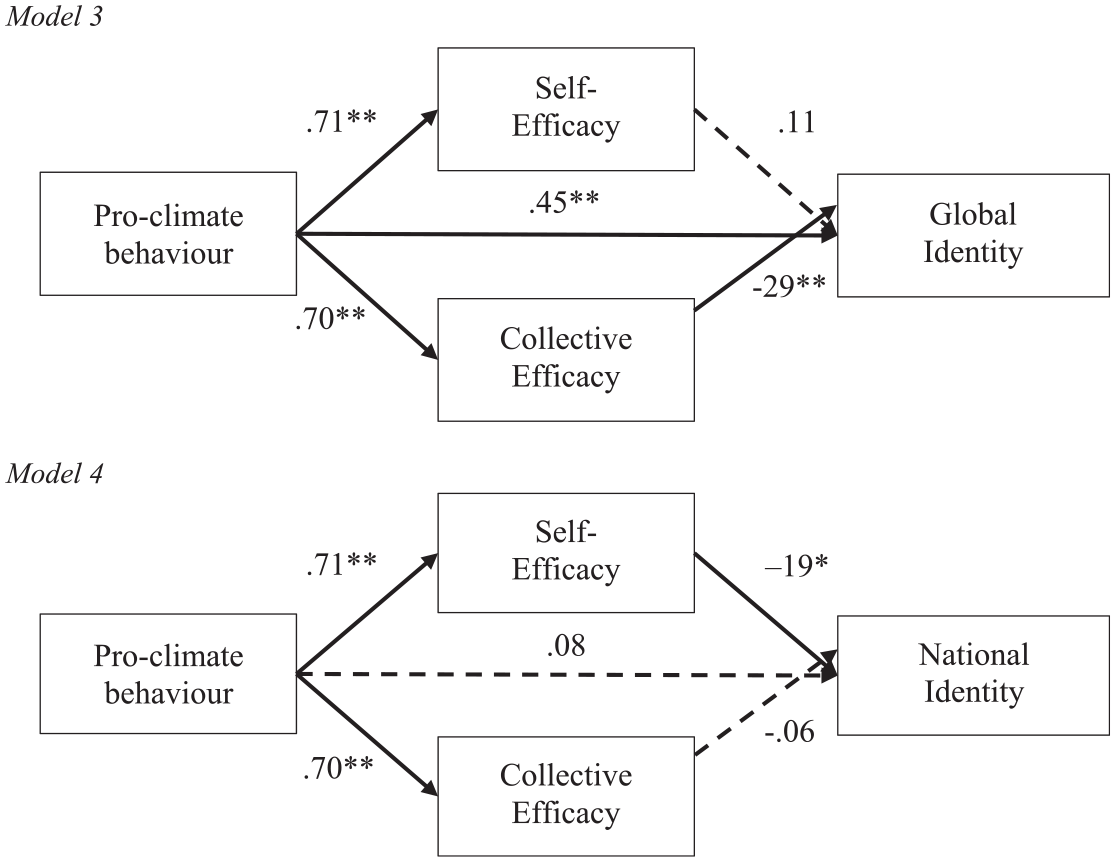
Simple mediation model (3 and 4).
Model 4
We conducted a similar model, but we replaced global identity with national identity. We also obtained a significant model with a similar power of explanation as in Model 2, F(1, 276) = 6.64, p = .011, R2 = .02 (see Figure 3). We found an indirect effect, but this time of perceived self-efficacy, b = .12 (.06), 95% CI = [.01; .23] and not of perceived collective efficacy, b = −.04 (.05), 95% CI = [−.20; .11]. We did not obtain a direct effect of pro-climate behaviour on national identity, b = .08 (.08), t = 1.08, p = .282, 95% CI = [−.08; .23].
Pro-climate behaviour directly predicts global but not national identity. Interestingly, again collective efficacy seems to be a relevant mediator of the association between pro-climate behaviour and global identity. Interestingly and unexpectedly, self-efficacy emerged as a mediator between pro-climate behaviour and national identity. Among all models, we have to say that the power of explanation of data variability is higher when we consider global rather than national identity, either as predictors or as dependent variables of the studied models.
General discussion and conclusion
The literature has shown that some socio-demographic data are important factors to consider in the analysis of adherence to pro-climate behaviour. As far as our research is concerned, only age and political tendency emerged as relevant predictors. Corroborating most studies, we were able to demonstrate that the fact that individuals identify with left-wing ideology predicts pro-climate behaviour (Gregersen et al., 2020; McCright et al., 2016). Regarding age, the evidence is not consensual. Young people seem to be the most engaged in pro-climate actions, but some evidence also supports the opposite direction (see, e.g., Wang et al., 2021). Our study shows that the older participants are the most engaged in pro-climate behaviour. Our measure of pro-climate behaviours involved household behaviours, which might tend to be more associated with older people.
Social identities as predictors of pro-climate behaviours
Important to our predictions, both global and national identities seemed relevant to predicting pro-climate behaviours. These results corroborate Buchan et al.’s (2011) findings that an inclusive social identity promotes contributions to a global public good. Furthermore, this result is also consistent with evidence that shows that participants believe that countries have a relevant role in the combat against climate change. National governments may also have the ability to encourage and strengthen individuals’ actions by highlighting national collective belongingness (Milfont et al., 2020). However, global identity emerged as a more relevant process associated with adherence to pro-climate behaviours than national identity. As a fact, national identity seems a process involved in such a prediction to the extent that individuals perceive the group to be able to be effective in endorsing desired social change. As we mentioned before, we expected a more complex (indirect) process in linking national identity with pro-climate behaviours, even because the salience of the self-categorization level of abstraction has no normative fit when facing a global challenge, as is the case of climate change.
Another important finding was that only collective perceived efficacy emerged as a significant mediator of the association between both identities and normative pro-climate behaviour when considering identities as the independent variables of the mediation models. Consistent with Jugert et al.’s (2016) work, pro-climate behaviours assume a pro-social/pro-environmental meaning to the extent that individuals conceive that the action of all citizens is perceived to be effective in dealing with climate change. Indeed, it is difficult to recognize the relevance of own actions when the goal is the mitigation of a global problem; the solution to a problem such as climate change implies the idea that actions need to be taken massively (see also Carmona-Moya et al., 2021), even when we are referring to daily routine individual behaviour. Thus, individuals recognize the need to have all involved, and when they believe that such collective involvement is effective, they become more motivated to behave accordingly in a pro-climate way.
Self-feeding process
When analysing the results of obtained models in aggregation, they seem to corroborate the idea advocated by some authors (e.g., Fritsche et al., 2018) that pro-climate behaviours are part of a self-feeding cycle. The more individuals identify with a group, the more they perceive a greater collective efficacy that, in turn, predicts pro-climate behaviours, and these actions also seem to reinforce identification with the group. However, there are two different processes depending on which type of identity we are considering (global or national identity). Perceived collective efficacy also contributes to explaining the association between engagement in pro-climate behaviour and reinforcement of global identity. These results highlight the importance of this social category as impacting on combatting climate change not only through perception of collective efficacy on mitigating climate change that predicts adherence to pro-climate behaviour but also because the sense of global belongingness directly potentiates and is potentiated by pro-climate behaviours.
Regarding national identity, the retroactive process differs. Whereas national identity predicts pro-climate behaviours when mediated by perceived collective efficacy, pro-climate behaviour also predicts national identity but to the extent that individuals perceive self-efficacy. Interestingly, national identity seemed to be reinforced by how self-efficient individuals are perceived to be regarding climate change mitigation. Engagement in pro-climate behaviour, by predicting self-efficacy, also reinforces national identity and national commitment to society. Perceived self-worth regarding pro-climate change seems relevant to reinforcing individuals’ commitment to the national group.
We have to say that the way we measured global identity and national identity might contribute to explaining the different predictors of the reinforcement of identities. Indeed, the national identity scale contemplates individuals’ willingness to contribute to the ingroup society, which might turn salient how self-efficacy should play a relevant role regarding the reinforcement of this identity.
Limitations and future research
By using a correlational methodology, we were not able to assess the impact of global and national identities on adherence to normative pro-climate behaviour. Although the results are consistent with such a causal-effect relationship, future research should address this limitation. Moreover, these results have to be contextualized in a particular country and at a specific time. Indeed, this topic is related to cultural aspects, ideologies and specific national political actions. Thus, future research on other contexts could bring more clarification about the power of external validation of these results.
Another direction for future research relates to the inspection of how sociodemographic characteristics impact this process. That is, although we analysed the predictive value of sociodemographic variables on pro-climate behaviours, it was not our intention to observe how these characteristics moderate the process we found in our study. Such information could allow for better knowledge about the potential social impact of this process and specify how it occurs among several social groups. For instance, is this process regarding ‘national identity’ stronger for individuals who support the current government, or is this process generalized to all citizens? Still related to this question, the inclusion of risk perception and eco-anxiety regarding climate change as moderators (or mediators) could also be informative to a better understanding of this process. Indeed, maybe this psychosocial process is higher among those who perceive high risk and eco-anxiety. The response to such and other questions seems relevant to understanding how the national political contexts may raise awareness among citizens regarding the need to adhere to pro-climate behaviour.
Practice implications
This study helps to reinforce existent evidence showing that identification with the national society and the global human categories may contribute to explaining engagement in pro-climate behaviours that, in turn, also enhance commitment to such categories. Literature has long established the relevance of global identity as a process to involve citizens in the fight against climate change, namely through engagement in daily routine behaviours. But our study also shows the relevance of national identity in such a fight, together with the perception that the national group is capable of having a positive impact. This study contributes with knowledge to governments and pro-climate NGOs about the need to work with citizens’ involvement in society and their perceived efficacy of (and trust in) national institutions’ policies regarding climate change. Such a perception is also fundamental not only to reinforcing engagement in pro-climate behaviour but also contributes to the reinforcement of national (but also global) identity, suggesting that engagement in pro-climate behaviour (contributing to a common good) also reinforces commitment to the national group. This self-feeding process enacts pro-normative behaviour and confidence in national institutions, reinforces commitment to society and also has some relevance in improving self-worth.