




Abstract
The sleep quality and (dis)comfort sitting upright was studied among 40 participants who took a nap at home. They were asked to take a nap at 17:00h on three consecutive days. The backrest had to be at a different angle every day: upright, reclined and more reclined. They were asked to record the backrest angle of the three positions and report the length of the sleep, the sleep quality, comfort and discomfort and influence of other factors each during each nap. From the 120 cases (3 conditions, 40 participants), the cases where participants were not able to sleep had an average backrest angle of 110°, which was significantly different from the cases where participants were able to sleep, who had an average backrest angle of 118°. The scores in the more upright position (<110°) resulted in significantly more discomfort and a lower sleep quality than in the reclined positions (>123°). As the conditions were arranged by the participants, there was much variation in outcomes. Therefore, future research under more standardised conditions is recommended.
Introduction
It might be possible that in future autonomous driving cars, buses, trains, and airplanes people like to take a nap. Also, while charging an electric car occupants might take a nap. A nap is defined as any sleep period with a duration of less than 50% of the average major sleep period of an individual (Faraut et al., 2017). The preferred sleeping position for most people is lying flat (Smulders, 2018). However, the space in vehicles like cars and airplanes is often limited, which means that humans also take naps or sleep being seated upright.
There is not much research on the effect of the backrest angle on the quality of sleep. Roach et al. (2018) studied sleep quality while lying on a flatbed (180°), during upright sitting (with a backrest at 110°) and during sitting with a reclined backrest at 130°). They found the better quality of sleep in the reclined seat and flat bed. Nicholsen and Stone (1987) also studied sleeping upright and found that an upright armchair with a backrest angle of 107.5° was least preferred out for four conditions; sleeping in a flat bed, and reclined positions (backrest angle of 139.5° and 127°). Caballero-Bruno et al. (2022) tested sleep in a 110°, 140° and 177° backrest angle while driving in a van. The 177° position was favoured by most subjects (90%) for sleeping during long-term travel, and the reclined position (140°) was selected by 60% of subjects for short- and medium-term travel. These previous studies indicate that a more upright backrest recline around 110° is least preferred, where an increased backrest recline of 127°, 130° and 140° seem to result in a better sleep experience. However, these studies concern sleeping, while napping is seldom studied.
Due to space limitations in vehicles, knowledge on the influence of backrest recline on napping quality and comfort can help in designing comfortable and effective vehicle seats that facilitate napping in transit. Especially the nap quality and comfort in the reclined backrest range between 110° and 127° might be interesting, as it is limited in the required vehicle cabin space. The research question for this study is:
What is the relationship between backrest angle, nap quality and (dis)comfort in the backrest recline range between 110° and 130°?
Method
To answer the research question, the sleep quality and (dis)comfort sitting upright was studied among 40 participants who took a nap at home. They were asked to take a nap at 5 pm on three consecutive days. The participants were instructed that the backrest had to be at a different angle every day: upright, reclined and more reclined. They were asked to record the backrest angle of the three positions with their smart phone or geo-triangle. Additionally, they completed a questionnaire before and after sleeping each day. The questionnaires included the Pittsburgh Sleep Quality Index (Buysse et al., 1989), the question ‘did you had a good sleep’ on a 6-point scale (Smulders & Vink, 2021), a comfort rating on a scale 1-5 (1 no comfort to 5 extreme comfort) and a discomfort rating (on a scale 1-5, 1 no discomfort to 5 extreme discomfort).
In addition, the participants had to take a picture of each condition and had to report whether they did sleep for each condition, and they were asked to report changes in the environment, like noise from outside. Half of the group was asked to start in the most reclined position and the other half to start in the most upright position. Apart from the questionnaires completed in each condition, participants were asked after experiencing all three conditions, to mention their preferred angle for taking a nap and if there were elements influencing the nap.
Results
Thirty females, nine males and one person who did want not mention the gender participated (age 22-30 years; stature 1.71 m (sd 0.09). The napping time varied a lot (average 11.5 minutes; sd 11.3). Figure 1 shows an example of how one of the participants took a nap in two conditions. From the 120 cases (3 conditions, 40 participants) the participants were not able to sleep, the average angle was 110°, which was significantly different from the sleep cases (average angle 118°).
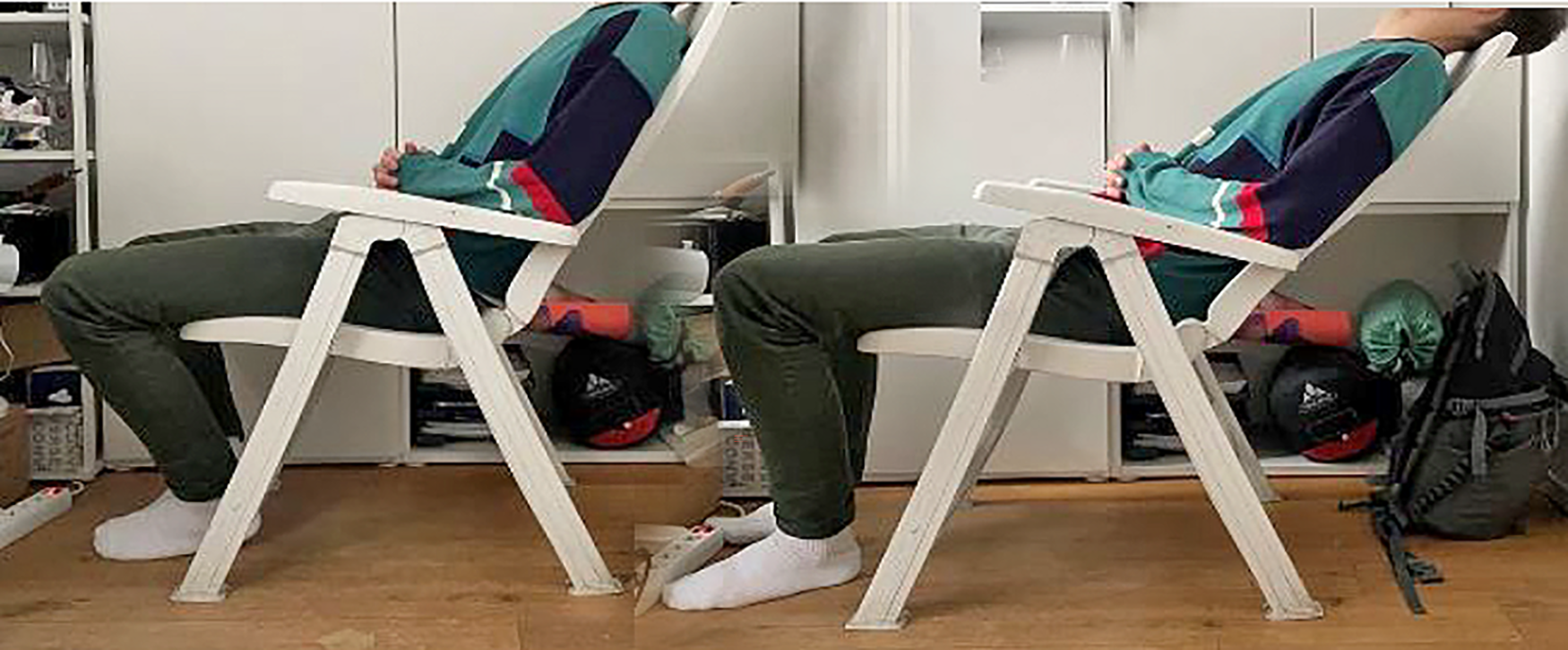
An example of how one of the participants took a nap in two positions.
The discomfort after the nap was lowest in the most upright position (see fig. 2). The score 5 ‘extreme discomfort’ was never given, the score 1 ‘no discomfort’ was given most. The difference between ‘no discomfort’ and ‘some discomfort’ is not significantly different, but between ‘no discomfort’ and ‘medium discomfort there is a significant difference (t-value = 3.098; p-value = .0017). Also, the difference between ‘some discomfort’ and ‘medium discomfort’ is significant (t-value = 3.021; p-value = .0017).
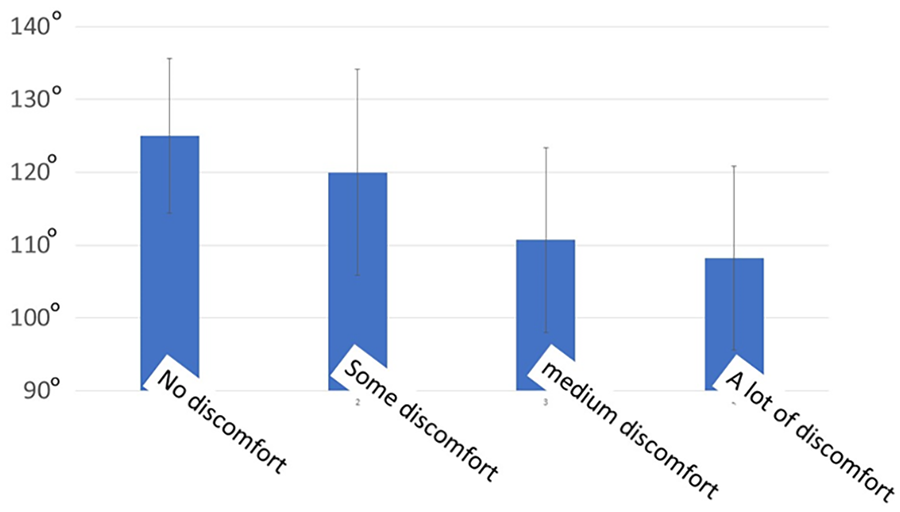
The backrest angle (y-axis) for the different discomfort scores (x-axis).
The angle seems to influence sleep. From the 120 cases that the participants reported that they could not sleep the average angle was 110° (40 cases, SD 11.2) which was significantly different from the cases the participants did sleep (average angle 118°, SD 15.2; t-value -2.32; p-value .011). Figure 3 shows the average backrest angle for different sleep qualities. Only two out of these 120 recordings (each participant 3 angles) had a very good sleep. There seems to be a trend that the sleep quality gets worse with a more upright back rest. A very good and fairly good sleep did not differ that much in back rest angle. The t-test showed significant differences between 2 and 6 (t-value is 3.73; p-value is .00025) and 3 and 6 (t-value is 2.49. The p-value is .0080). 1 = very good and 6 = did not sleep. The other differences are not significant.
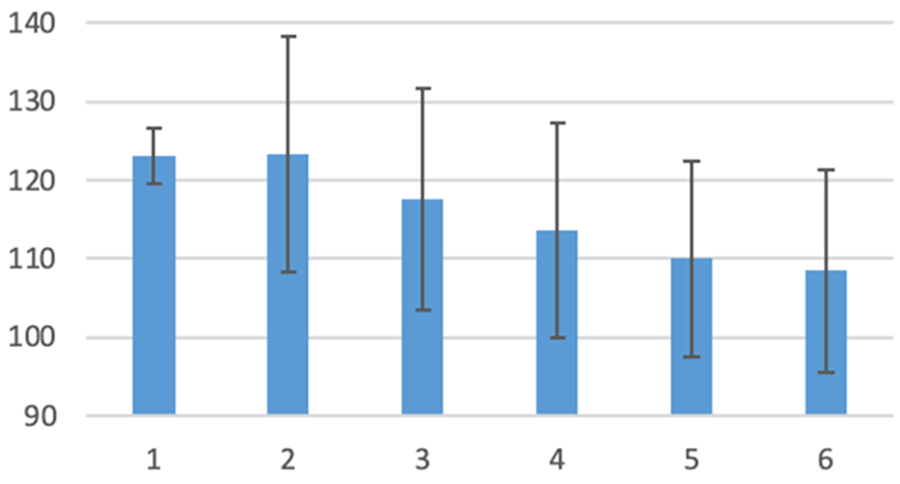
The sleep quality (x-axis, 1= Very good; 2 = Fairly good; 3 = Medium; 4 = Fairly poor; 5 = Very poor and 6 = Did not sleep) versus backres angle in degrees (y-axis).
There was a trend regarding comfort related to back rest angles. The higher comfort scores are found at higher backrest angles, but none of the scores is significantly different.
The sleep quality was best around 123°, while the discomfort was lowest for an average of 125°. If we compare it with the opinion of the participants that they were able to sleep, this was the case for 118° while not sleeping was at 110°. It looks like 118° or more is preferable for a good sleep and to prevent discomfort 125 degrees should be preferred. The standard deviation also shows that there were large individual differences. This could be caused by the type of chair. In figure 4 some of the chairs are shown that were chosen by the participants to perform experiment. The pictures also show, that some participants added a sheet or blanket (7) (see fig. 5) and some did wear headphones (2) or were blindfolded (2). In the open answers regarding the environment, it was reported that a cover with blanket or sheet was preferred to prevent being cold, the headphones were to reduce sound from the environment. These differences could explain the large standard deviations as well.
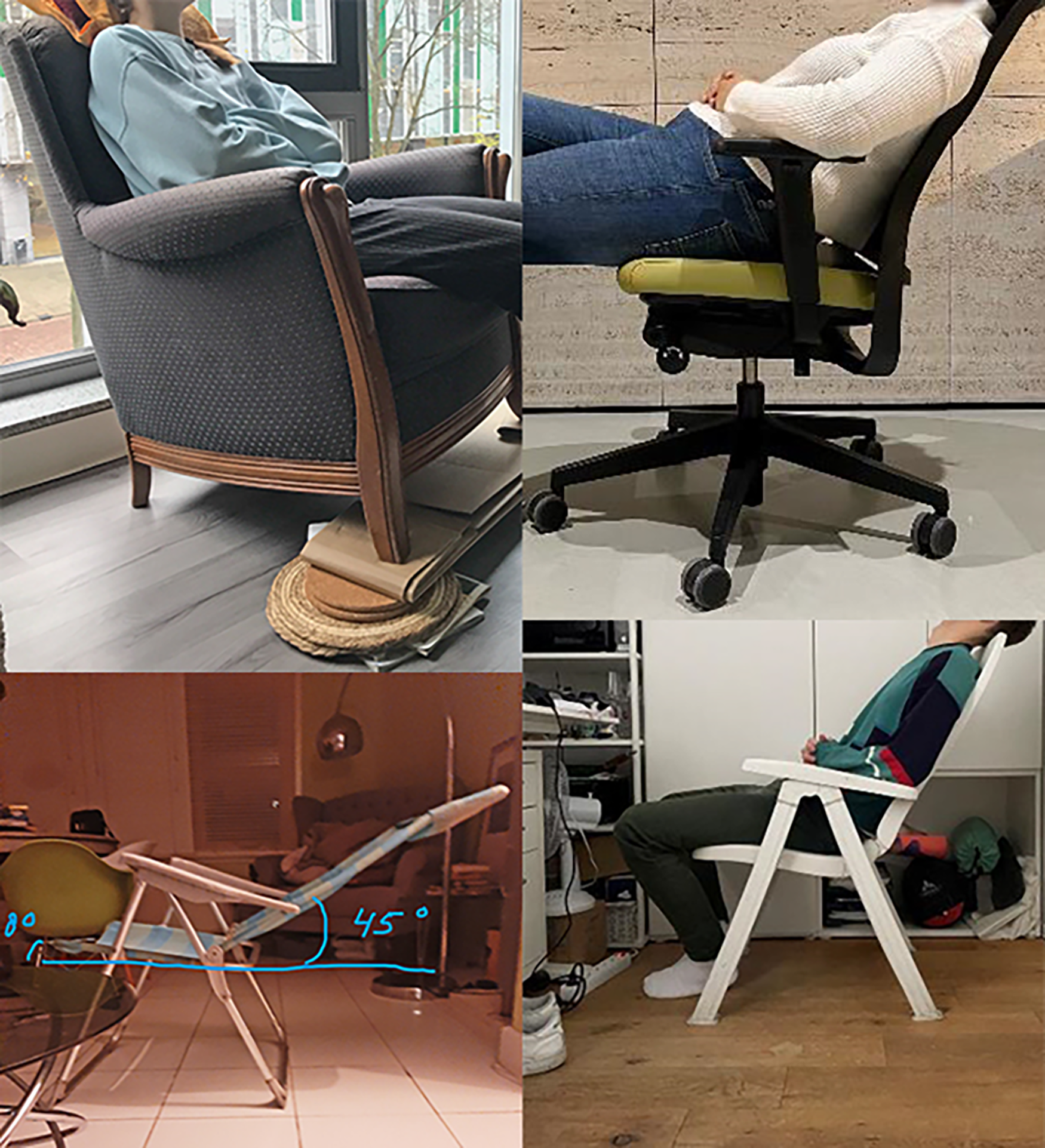
Some of the chairs used by the participants to sleep in different backrest angles.
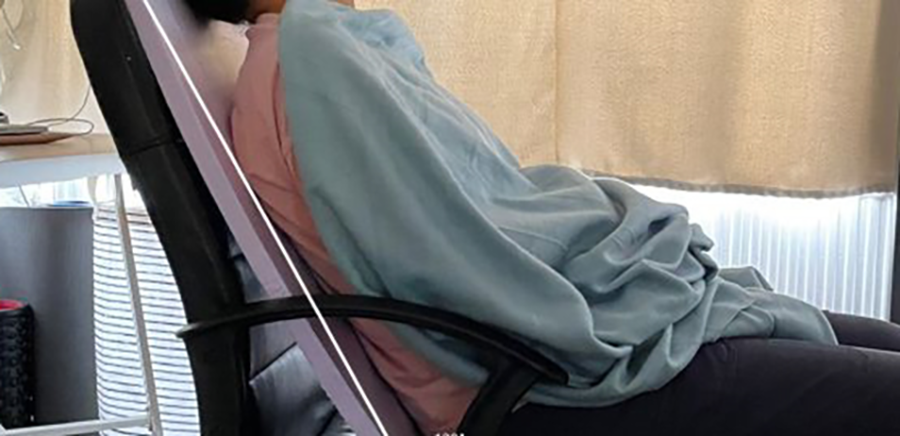
An example of a participant using a blanket.
In the general comments after experiencing all three conditions, the neck support was mentioned in 19 out 40 cases. For sleeping they preferred a neck and head rest. In the pictures, the participants showed that half of the group had a headrest (sometimes as part of the chair, but sometimes improvised with a cushion). Two participants also mentioned that they missed a footrest when the backrest is reclined.
The preferred angle after experiencing all three angles differed, which was also caused by the fact that some had a maximal recline angle of 104° while others had more than 140° recline (see fig. 6). The majority prefers a recline of more than 115° (28 out of 40).
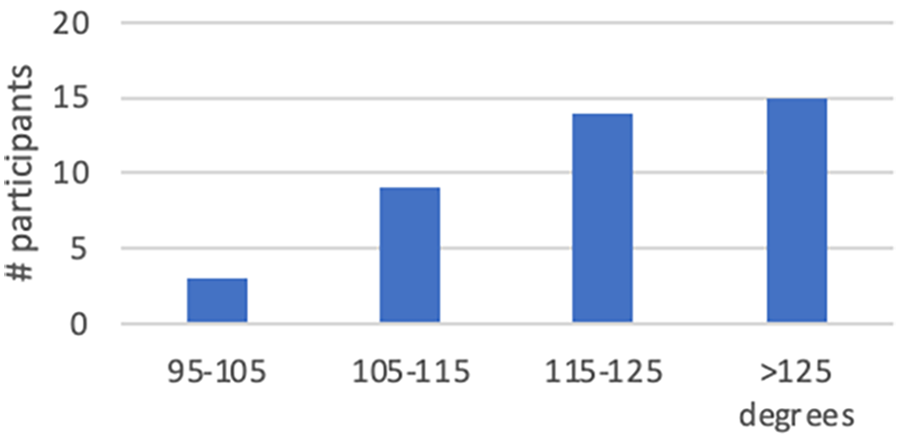
Number of participants (y-axis) mentioning a prefered back rest angle in the angle category shown on the x-axis.
Discussion
The study shows that the backrest angle has influence on whether participants could go to sleep, on discomfort and to some extent on sleep quality. The study indicates that on average a change in backrest angle from 123° and 110° increases sleep discomfort and lowers sleep quality. Roach et al. (2018) also found a lower quality of sleep at a backrest angle of 110° compared with 130°. Our study shows that a 123° backrest angle on average even creates a better sleep quality and less discomfort than 110o degrees. However, in different angles participants mentioned that a headrest is important. Which conditions need head support has to be studied further, as this statement is based on a limited number of participants in our study, and it was not systematically changed in our study. Smulders et al. (2019) showed that the comfort increases using a headrest while watching IFE. In the more upright position, the head has not really a good support which could influence the sleep quality.
Further research might also be needed regarding the lower leg angle. Having the lower leg vertical and the back reclined might lead to stretching the m. quadriceps as it is a bi-articular muscle, which might create discomfort.
This study is a field study, where the conditions of the nap varied a lot and the conclusion on the backrest angle, which is good for sleep, is now based on large variations in conditions. The chairs varied a lot, there was sometimes noise from the environment which made some participants wear a headphone and some participants had blankets and some not. It might be good to add a laboratory study under more strict conditions to determine the ideal backrest angle for a good sleep/nap. It is also clear that the backrest angle is not the only element influencing a good sleep. He and Vink (2020) showed that not only the seat is important for a good sleep in a long-haul flight, but factors like privacy, hygiene and neighbors play a role as well. The more frequent travelers experience more comfort during sleep. So, a good preparation is important as well. Bouwens et al. (2018) showed that for a good sleep in an airplane next to the chair, noise, temperature and light are important factors as well. Also, in our study these factors play a role. As was mentioned before noise was handled by the participants using a headphone. Some participants influenced their temperature by a blanket and light perception was influenced by using blindfolds.
Despite the large differences in the conditions the differences in discomfort and sleep quality for the different back rest angles were significant and a more reclined back rest was preferred.
Conclusion
As is described in the literature a more reclined back rest is more suitable for a good nap. In the literature 127° backrest angle is mentioned as better than more upright. This study shows that even at 123° the sleep quality is better and discomfort lower than at 110°. Apart from the back rest angle attention should be paid to neck and footrest and environmental conditions like light, noise and temperature for a good nap.
