



Abstract
To reduce the weight of a seat of a city car (A-segment), a car seat was developed. First, a questionnaire was used to define the main functions the occupants prefer to have in the seat. The reclining and forward afterwards movement of the seat were seen as most important. Therefore, a reclining mechanism was built into the lightweight chair. This seat was tested by 39 participants and compared with a benchmark seat of the Toyota Aygo. It was clear that comfort testing is difficult comparing a full developed car seat with a prototype, which still needs development. Nevertheless, the comfort was comparable between the two seats and the shoulder space of the new seat was appreciated. The conclusion is that it is possible to develop a lighter weight car seat, which has the main features preferred by occupants, but further development is needed.
Introduction
Much has changed in car seats since the invention of the car. In luxury cars there are now for instance seat heating system, massage systems, moving bolsters and adjustable head rests. However, with the introduction of electric vehicles attention has grown for light weight seats as a lower weight can increase the range. Also, for smaller cars that will be used in the city it is important to increase the range to reduce the number of charging time. Light weight is interesting for the entire transportation sector as reducing weight can offer savings in energy and improve performance (Tempelman, 2014). The challenge is to make a seat light weight and at the same time comfortable (Franz et al., 2011). There are many ways to reduce weight. For instance, Çelik et al. (2015) reduced weight by using EPP (expanded poly propylene) in the seat to replace the PU foam. The PU foam of a seat in the seat pan and back rest is a large part of the seat weight. De Jonghe (2021) showed that the foam accounts for 19% of the total weight of an aircraft seat. Jang and Min (2006) reduced weight by making the seat frame lighter by using a finite element method to calculate where material could be left out and Wu et al. (2023) used carbon fiber to reduce the frame weight.
Smaller cars usually have a seat with a lighter weight. In our case we aim to reduce the weight of a city car seat (A-segment) even further. Our benchmark seat is the seat of the Toyota Aygo, which is also to be found in the Citroën C1 and Peugeot 107. It is seen as one of the best sold models in its segment (GCBC, 2023). The weight of the Aygo seat model that was sold between 2005 and 2014 is 14 kg. The two major weight contributing elements are the frame (75% of the total weight) and the foam (14%). This is based on taking the seat to pieces. This benchmark seat is adjustable. It has the forward backward sliding function and a back rest recline function.
The question is whether these are the most important functions according to users and the question is whether a lighter version could be developed when taking the determined user’ preference into account.
The lighter version is developed in this project and a partly functioning prototype is tested by occupants. The research question for this part of the study is: do occupants experience the lighter seat as comfortable as the benchmark seat?
Method
To study the most important functions of a car seat according to users, an online questionnaire was sent out to 39 car users. The survey consisted of questions of the importance of various functions in the car seat. The outcome of the survey is used as input for the decision on which functions should be part of the design of the new seat.
For the second part of the study a new car seat was developed, and this seat was tested by 39 participants and compared with the benchmark seat. Nineteen started the sitting experience on the new seat and 20 on the benchmark. The local postural discomfort questionnaire was used (Grinten & Smitt, 1992) and completed after 15 min sitting and a general question on comfort had to be completed as well. The 15 min seems short. However, the idea is that in future shared car driving in the city the car will not be used for long distances. Previous studies also show that differences in comfort and discomfort could be established using 15 min (Anjani et al., 2021). Also, the comfort of the different seat parts had to be scored by the participants on a scale 0 to 10 (10 being extremely comfortable) after experiencing the seat. The scores had to be made while still in the seat as memory could influence the outcome (Smulders & Vink, 2021). Once a participant left the seat, it might be difficult te remember the discomfort in the various parts. Differences between the two conditions were tested with the Wilcoxon test (p < .05) as often comfort and discomfort are not normally distributed (Yao, 2023). After experiencing both seats some other questions, like which seat do you prefer were asked as well. Additionally, participants could give comments after experiencing both seats.
Results
The participants (20 female and 19 male) in the online questionnaire had an average length of 1.78 m (1.55–1.95 m) and an average age of 36 years old (17–60), 20 female and 19 males. Sliding the seat backward and forward is seen as the most important function (see Figure 1) and reclining the back rest as the second most important adjustment possibility (see Figure 1), followed by the head rest adjustment in height and seat height adjustment. The seat height or tilt adjustment was scored as least important. Based on the results of this questionnaire it was decided to add the forward-backward sliding possibility in the seat as well as the back rest reclining mechanism. Current back rest reclining mechanisms in small cars have the disadvantage that there is a change that occupants experience more shear force between legs/buttocks and the seat pan. Therefore, an alternative reclining mechanism was developed (see Figures 2 and 3), which was still light weight and prevented shear force and the foam was replaced by EVA foam, which is more light weight than current foam. The frame is constructed out of tubular steel (25 mm diameter and 2 mm wall thickness). This tubular steel can be bend using a computerized bending machine. The headrest, backrest parts and seat pan parts were bent individually and welded together. The seat pan and backrest can be injection molded and the whole was reinforced using a layer of woven glass fiber fabric and epoxy resin.
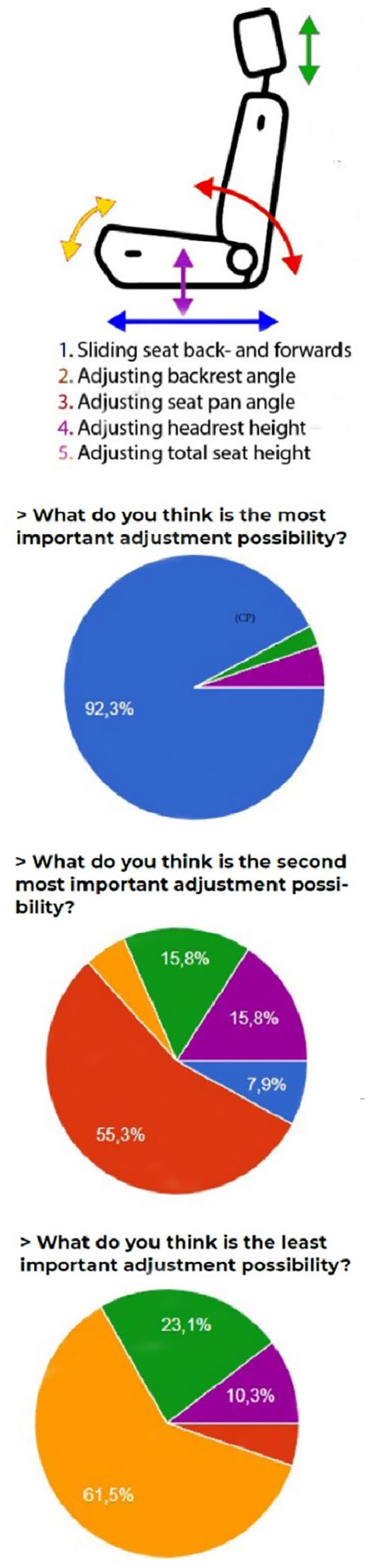
The importance of the adjustability function in the car seat according to 39 car users.
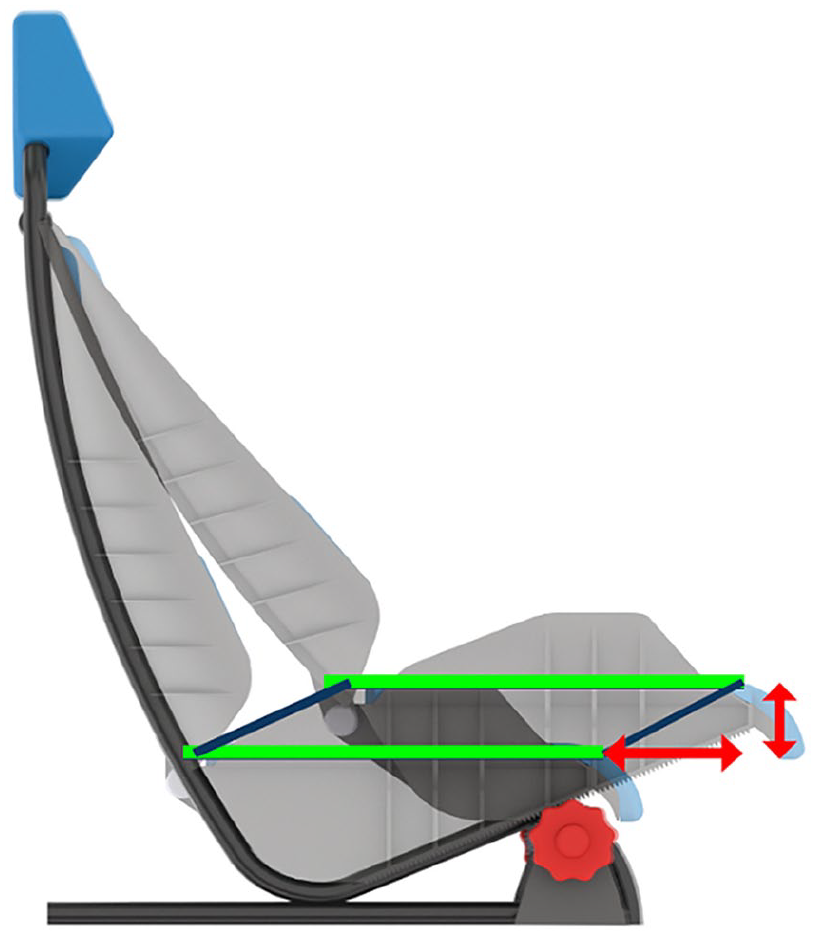
The reclining mechanism. The seat pan slides angled forward and up over the tube of the frame.
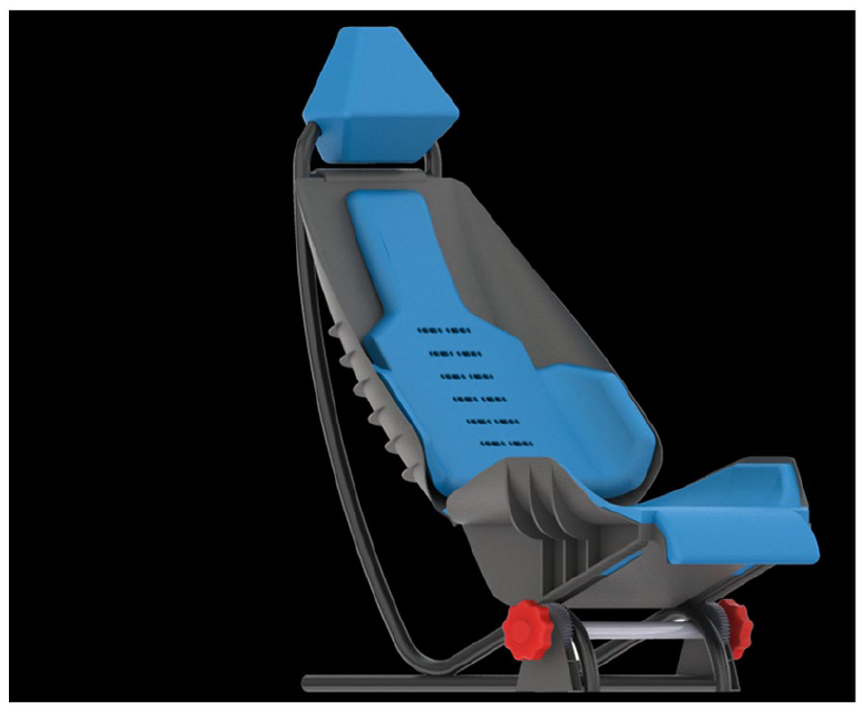
The complete seat as it was developed.
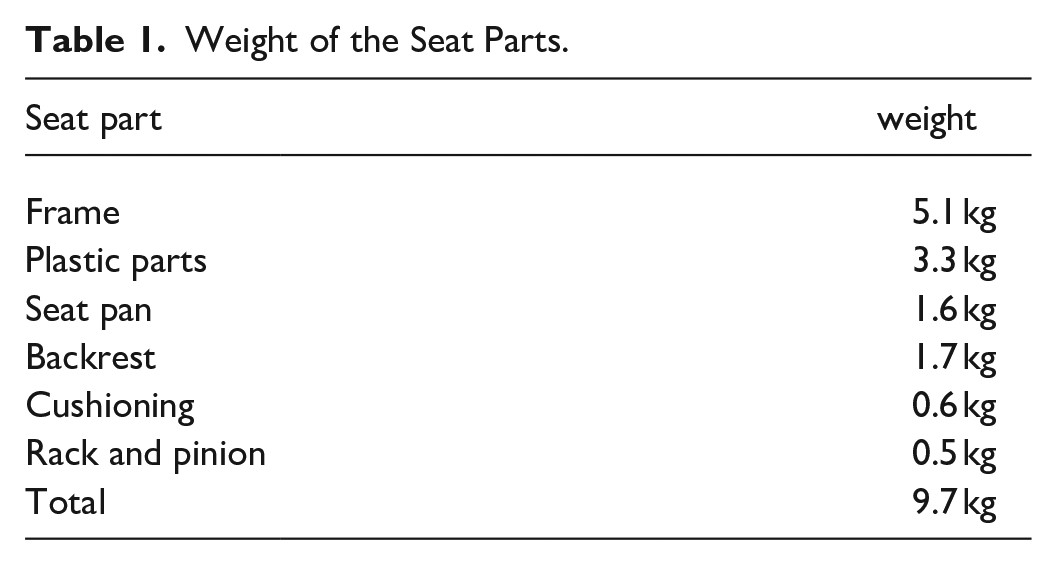
Table 1 shows the weight of the parts of new seat. The total weight of the complete seat is 9.7 kg.
Weight of the Seat Parts.
In the experiment where 39 participants tested the prototype and the benchmark, the average age was 29.4 years (std 6.0), the average stature was 1.74 m (std 0.05) and the average weight was 67 kg (std 11.0). There were no significant differences regarding comfort of the seat parts between the prototype and the bench mark seat, except for two situations: the overall comfort of the bench mark seat was significantly higher (Z-value is −2.6133; p-value is .00906; n = 39) and interestingly there was a significant difference in back rest comfort for the 19 participants who started with the prototype (Z-value is −1.6474; p-value is .04947; n = 19). Also, no significant differences in discomfort were found (see Figure 4), except for the shoulder region (Z-value is −1.8286; p-value is .03362; n = 30). The discomfort was lower in the prototype probably because there was more freedom of shoulder movement in the prototype. Comments after the test were that the benchmark seat looks like completer and more finished and the foam of the benchmark seat was better as well. In the prototype the EVA chosen for the seat pan and back rest, was the material which was available. In de development it was already clear that a softer version should be preferred, which means that in future softer EVA should be chosen. Also, there were some comments that the side supports could be a bit softer.
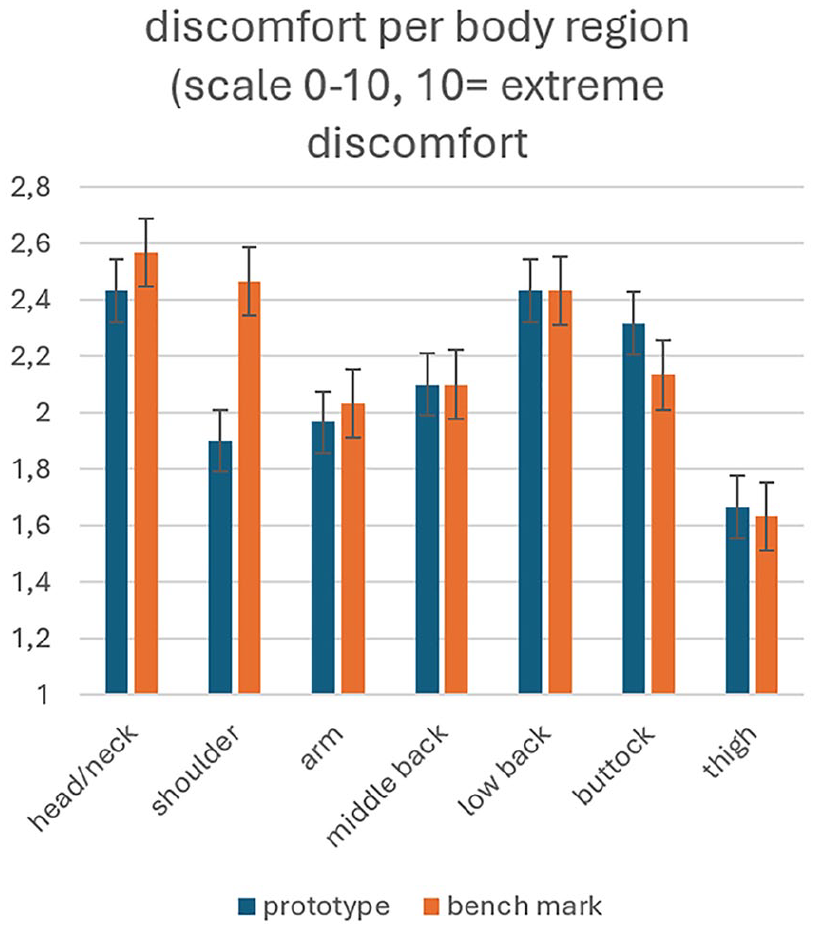
The discomfort in different body regions for the prototype of the new seat and the benchmark seat.
Discussion
Regarding the question on the importance of the adjustability functions in different parts of the car seat, it is clear the forward-afterwards adjustment is seen as most important. This makes sense as reaching the pedals is crucial for driving. The leg length varies between drivers, and it makes adjustability inevitable. The second most important feature was the reclining of the back rest, followed by the head rest and seat height.
It was possible to make a design taking this into account and reduce the weight of the seat by 4 kg. Also, the comfort of the designed seat did not differ much from the benchmark seat. The overall comfort of the benchmark seat was higher, but it was still a prototype and the EVA material covering he seat pan and back rest was quite hard. The difficulty of using a prototype in comfort research has been described before (Vicente et al., 2023). Vicente et al. (2023) tested an aircraft seat offering more space, but participants felt the cushion and rated the comfort lower, while they saw the potential. Also, in our case the foam was not fully optimized. Yao et al. (2023) give some suggestions on how the pressure distribution should be, which can help optimizing the cushion. The shoulder discomfort was lower in the prototype, probably because there was more experienced free shoulder space, which has shown to be important in other studies as well (e.g., Goossens et al., 2003). Regarding the comment on the side support suggestions made by Voort (2018) might be useful for a further development of the seat.
This is still an early stage of development of the seat as other issues to be further developed are for instance the manufacturability, the check on safety and the overall styling.
Regarding the ergonomics/human factors side of this study, asking for comfort and discomfort can be valuable to evaluate a new seat. However, in an early stage of development more broader questions like what you expect from this seat in the future and what needs to improve further. This might more helpful as also in the study Vicente et al. (2023) participants felt the cushion and rated the comfort lower, while they saw the potential of the new seat.
In conclusion, it is possible to develop a lightweight car seat, which has the main features preferred by occupants and has a reclining mechanism which potentially has less shear force. However, further development is needed.
Footnotes
Declaration of Conflicting Interests
The author(s) declared no potential conflicts of interest with respect to the research, authorship, and/or publication of this article.
Funding
The author(s) received no financial support for the research, authorship, and/or publication of this article.
