




Abstract
In manufacturing industries, equipment arrangement, and layout design are critical factors that directly influence productivity, workplace safety, and workers’ performance. Link analysis, as a human factors approach, has been widely used in industries for many years to improve layout design and machinery arrangement. This approach considers humans' physical and cognitive capabilities and movement limitations to find an optimal design. Virtual reality significantly impacts our society from product design to worker training. Hence, effective virtual training platforms require the same attention to layout design as manufacturing work settings which offer efficient testing of multiple layouts. This research focuses on developing a virtual 3D printing laboratory for workforce training and has used a link analysis and user perception study to improve the layout of the virtual workplace. The research demonstrates the importance of layout design in virtual training platforms and the potential benefits of utilizing link analysis in optimizing layout design.
Introduction
The significance of in-lab problem-solving work experience in engineering education, especially in manufacturing, is widely recognized as an essential part of a student’s academic journey. Advanced manufacturing facilities are highly intricate systems that involve frequent movement among different workstations. The complexity of these facilities necessitates selecting appropriate safety equipment, identifying operational parameters, handling materials, and performing processing and post-processing operations. With the advent of cutting-edge immersive learning technologies, such as virtual and augmented realities, administering practical lab experiences has become more convenient and accessible for students regardless of their location (Cooper & Ferreira, 2009; Mshayisa & Basitere, 2021; Potkonjak et al., 2016). Engaging in laboratory work allows students to develop practical skills, reinforce theoretical concepts, generate innovative ideas, collect and analyze data from complex systems, draw conclusions, and cultivate interest in the subject matter.
Effective training programs depend on the successful layout design in a physical, virtual, or simulated environment. A well-designed layout reduces movement between stations, minimizes exertions from material handling, and improves quality and productivity. Trainees actively learn about hands-on activities in a training program to develop practical work experiences. Engaging students in hands-on activities can be challenging if these activities are presented in a more exciting and relevant way. Connecting laboratory activities with real-world applications and considering the flow and sequence of training components within the environment can help minimize confusion and cognitive workload among trainees. This approach ensures that trainees progress through the program independently and effortlessly.
In a physical classroom environment, the layout design should support the sequence of activities during a training session, including seating arrangements for group discussions or individual study and the placement of equipment and materials to support the training program sequence (Amirul et al., 2013). In a virtual and simulated training environment, a straightforward navigation structure with explicit instructions for accessing different components is essential (Rahman et al., 2022). Additionally, in an immersive laboratory environment, where students must explore various components and use different mechanisms (such as teleportation, controller buttons, and gaze) to move around and interact an optimized layout is essential for easy navigation and access to necessary components.
In this paper, the authors discuss their work on designing an immersive laboratory environment for an engineering course focused on additive manufacturing. The instructor team has conducted a link analysis on the existing laboratory layout. It has created a virtual reality-infused lab with an improved layout design by making a few modifications. To support effective learning outcomes, the researchers performed an empirical study investigating students’ learning experiences within the virtual learning environment. The learning outcomes involved gaining hands-on experience with the safety, operational process, printing parameters, and decision-making and information processes to print 3D objects during interactions in the VR lab.
Human factors engineers have found link analysis to be a valuable tool in optimizing layout design for a variety of applications, including advanced manufacturing (Zhao, 2011), user interface design (Lin & Wu, 2010), healthcare process improvement (Lester & Chui, 2016), and nuclear power plant safety (Dinakar et al., 2016). Link analysis involves analyzing the dependencies and connections between different components in a system. Each pair of components is assigned a link weight that reflects the frequency and importance of their interactions, with more interactive components having a higher link weight than those with fewer interactions (Kirwan & Ainsworth, 1992). This information determines the optimal placement of components within the system. The most interactive components are placed close to each other to reduce movements and improve user comfort (Lee et al., 2017).
In order to set up and examine multiple layouts for their efficacy, empirical testing can be useful. Link analysis can determine potential layout designs, and virtual reality can enable the testing of various layout configurations and equipment arrangements in a safe and controlled environment, facilitating rapid design iterations and optimization. However, real-world empirical tests can be costly and time-consuming and limit the number of design iterations tested to achieve an optimal and more significant design with safe and efficient user movement and energy expenditure. On the other hand, virtual reality-based empirical testing can offer a cost-effective and time-efficient means of evaluating the feasibility of new designs, allowing for a more significant number of iterations to reach an optimal design. Therefore, to enhance the layout design and equipment arrangement in the additive manufacturing lab at the authors’ university, this research proposes the development of a virtual 3D printing lab within a VR environment.
Method
Existing 3D Printing Lab
The equipment at the additive manufacturing lab includes a Selective Laser Sintering (SLS) additive manufacturing system for 3D printing along with other systems. The Lab has four stations for this specific printer: (A) a Preparation Station, (B) a Control Station, (C) a Printing Station, and (D) a Post-processing Station. To keep the focus on the scope of this study, Figure 1 shows the existing lab layout with equipment relevant to these four stations. To perform the link analysis of the existing layout and equipment arrangement, a part (shoe insole) was printed using the SLS 3D printer and was post-processed by an expert researcher. During printing and post-processing of the part, the user movement in four stations was observed, and the movement frequency and link distance data were collected for link analysis. A new layout is proposed to reduce user movement and energy expenditure as well as improve efficiency. The virtual lab is developed according to this proposed layout to evaluate student experience during their training within this virtual lab.
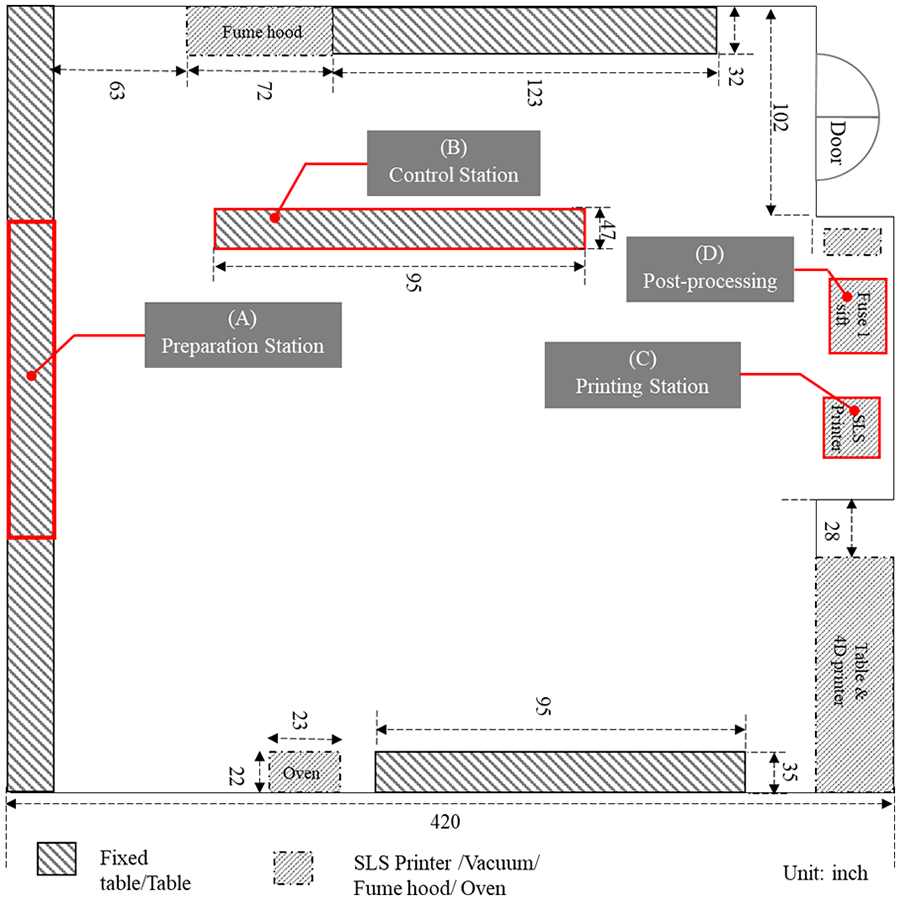
The current layout of the lab for the SLS printer.
Redesigned Virtual Lab
In order to improve the student's learning experience in the virtual environment, the virtual lab keeps the same four stations but arranges them according to the new design, as shown in Figure 2 .
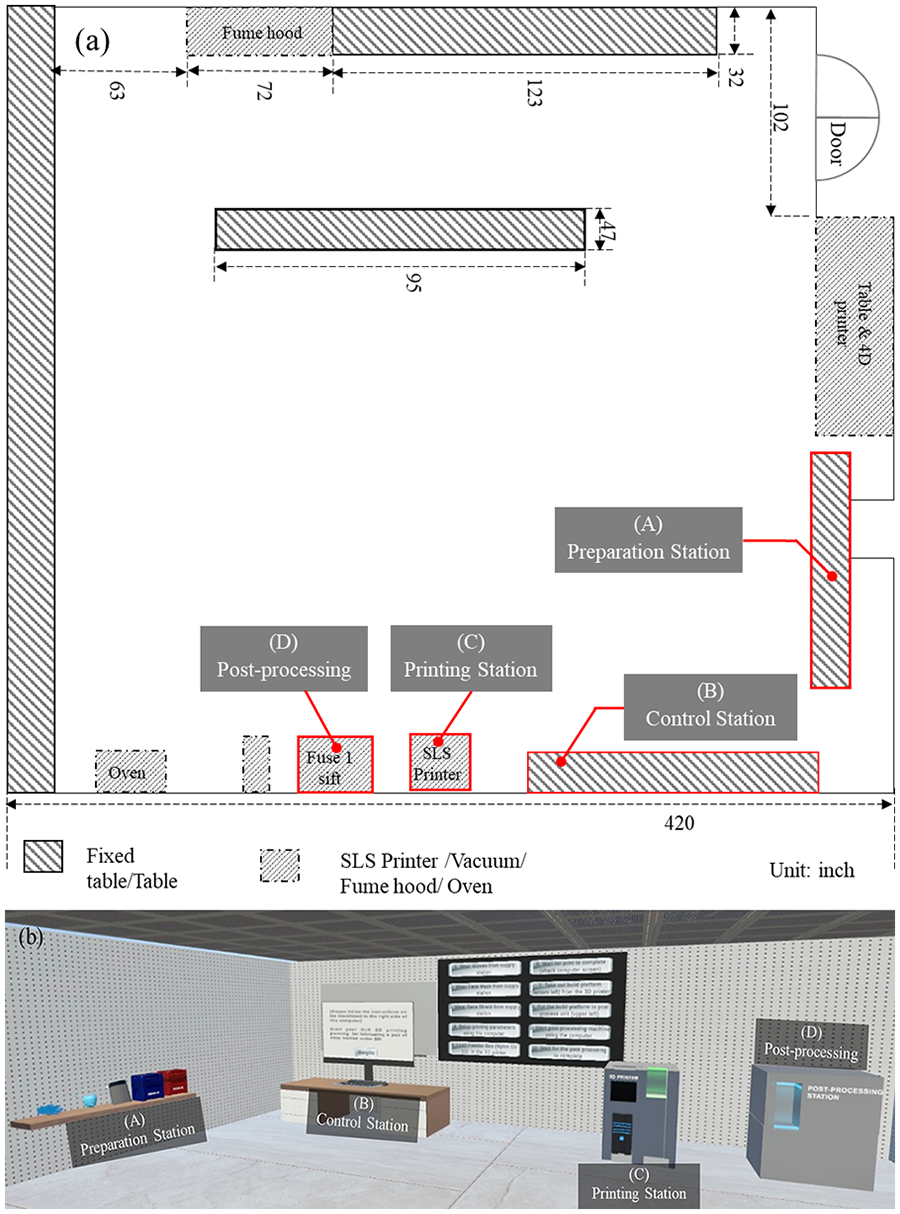
(a) Proposed layout for the lab and (b) the corresponding virtual lab.
Empirical Study in VR
Participants in the virtual testing
Seventeen undergrad students (fourteen males and three females) from a course taught by the instructor team participated in this user experience study. The students were instructed about the concept in the classroom meeting before being exposed to the virtual 3D printers. The students can use VR equipment in its most basic capacities and finish the virtual lab assignment by following the directions. The research received approval from the Institutional Review Board (IRB) at the authors’ university.
Protocol
Each student is instructed to print a shoe insole under $8. A blackboard shows a list of ten sequential tasks on the VR platform. The list of tasks is reported in Table 1. When a student completes a task, the color of the task turns green, and the remaining tasks stay the same gray color as the previous.
Tasks are shown on the VR platform.
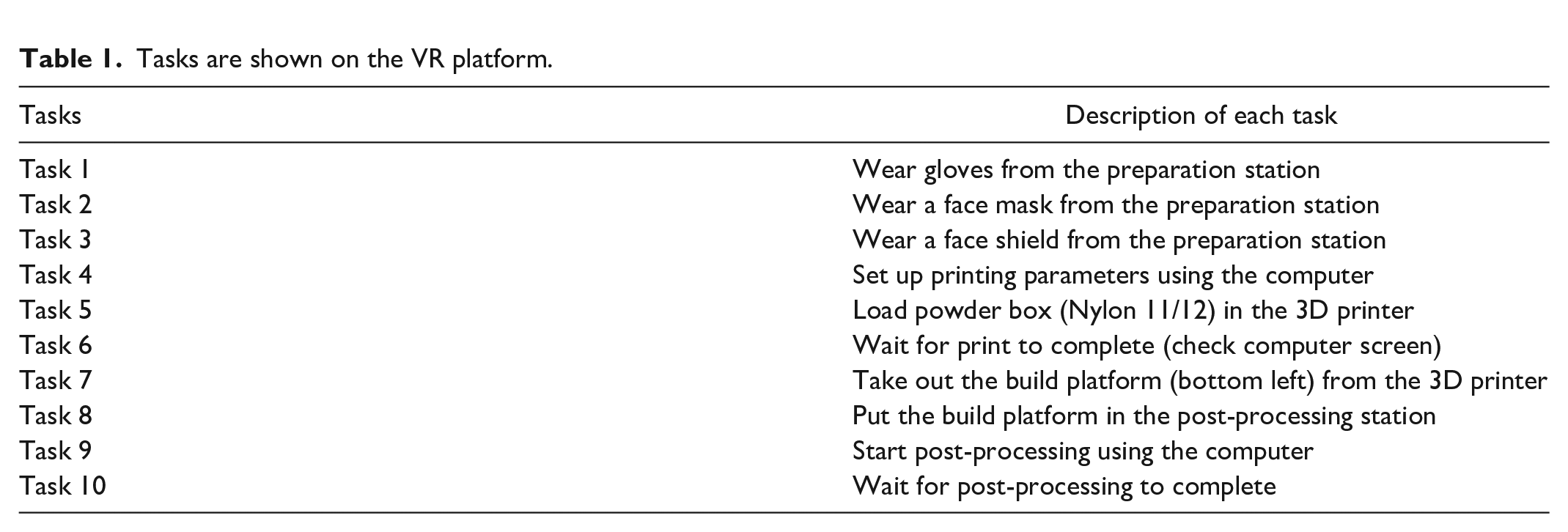
Personal protective equipment such as gloves, face masks, face shields, and powder boxes (Nylon 11 and Nylon 12) are stored in the preparation station. The students are instructed to wear personal protection following tasks 1-3. Students then move to the control station. Students can select the process parameters, such as material type and part orientation using a computer workstation. The monitor presents the selected parameters and the corresponding estimated cost of printing to the students. If the cost is higher than the targeted budget of $8, the student is required to start over and reselect the process parameters to find the estimated cost below or equal to $8. Once the student is satisfied with the cost, s/he moves to the preparation station and grabs the desired powder box, takes it to the printing station, and inserts it into the printer. Next, the student moves to the control station and starts printing the part and the computer also shows the printing progress. Once the printing is completed, the student takes out the build platform and inserts it in the post-processing unit after it is cooled down. The student returns to the control station, starts post-processing using the computer workstation, and waits until the process is completed. The student’s movements and positions are recorded as teleportation data and headset tracking data, respectively, which are collected and utilized for link analysis of the proposed design.
Subjective Experience
Questionnaires are selected to identify the student’s presence and system usability. The participants are surveyed at the end of the training to understand the effects of VR training better. The presence questionnaire is designed according to Witmer & Singer (1998), and the system usability questionnaire is created following Brooke et al. (1996). The presence survey provides insight into participants’ perceptions of the virtual environment as a realistic setting as well as their capacity to engage spontaneously and realistically with various virtual elements. Each question is concluded with a descriptor ranging from “Not at all realistic" to "Very realistic" on a 7-point Likert scale.
System usability testing is one of the most preferred approaches for a newly created user-centered design. The System Usability Scale is a reliable survey method for evaluating the usability of any newly created system. Using a 7-point Likert scale with response possibilities ranging from strongly disagree (1) to strongly agree (7) for each question, it assesses what users expect from a system regarding usability and comfort.
Results and Discussions
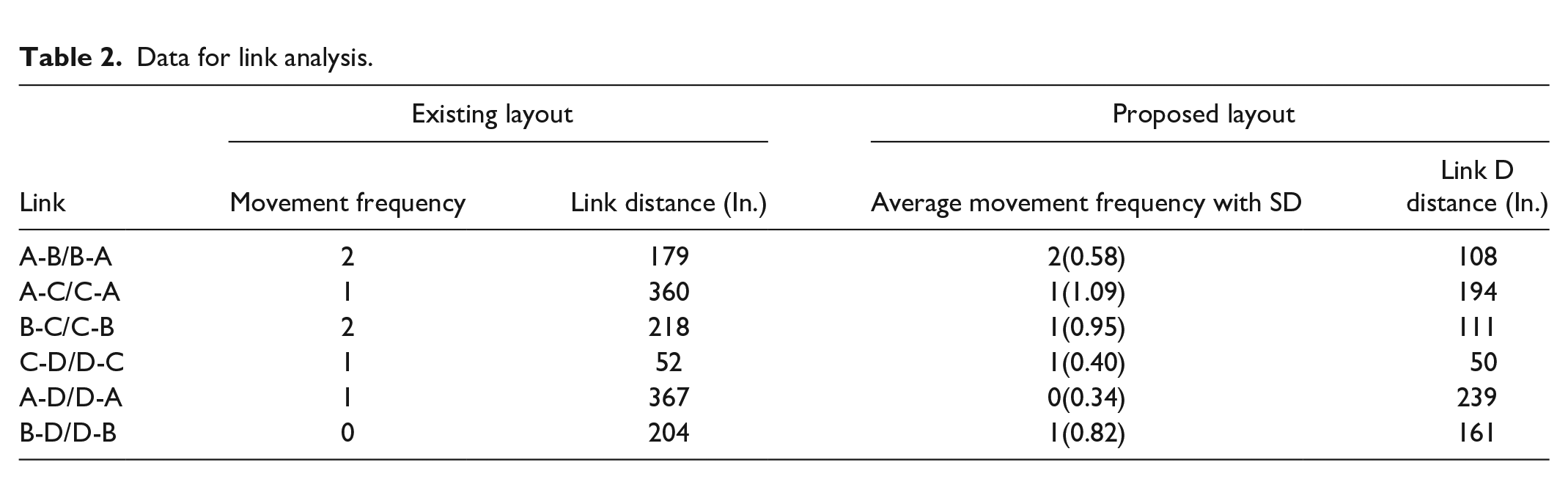
The user movement frequency and the approximate link distance obtained from the existing layout and the proposed virtual lab design are reported in Table 2 . For the existing design, one professional user has completed the experiment; hence no standard deviation (SD) is reported. Seventeen users performed the same experiment for the virtual platform, bringing variability in the data. Thus, an average movement frequency with SD is provided Figure 3 .
Data for link analysis.
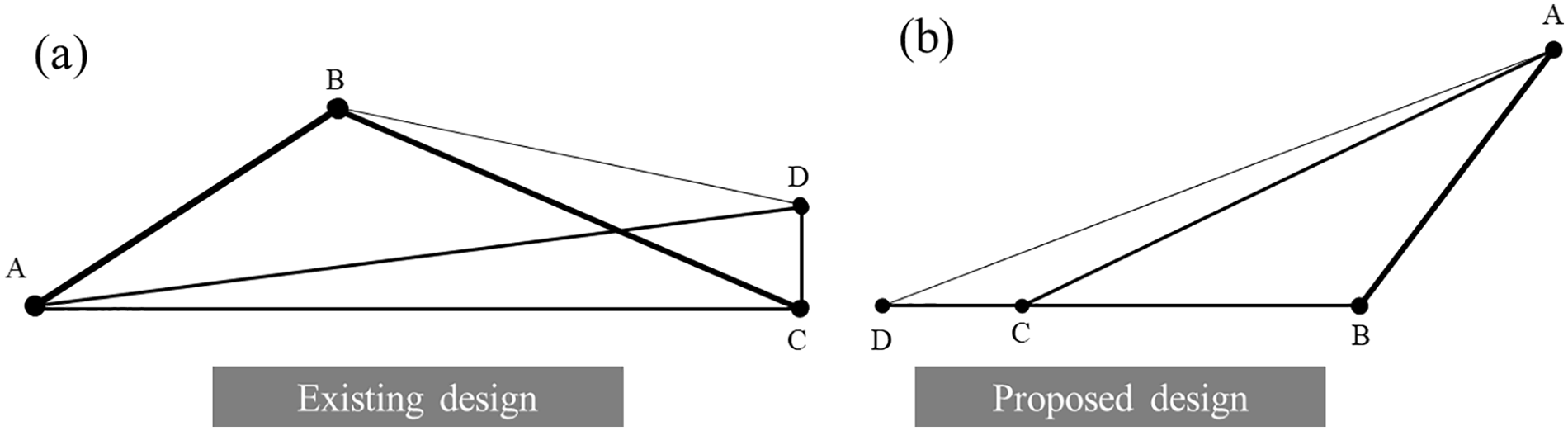
Link network diagram (a) existing layout and (b) proposed layout.
The user movement frequency for the existing and proposed layout is almost similar except for links B-C/C-B and B-D/D-B, indicating that the virtual lab is a similar representation of the existing lab with a different layout. In the improved layout, the link distances for all connections significantly reduce compared to the existing connections. This signifies that the proposed design substantially reduces user movement and improves productivity and efficiency. The total travel distance to print a part in the existing layout is 1573 inches. Meanwhile, the average total travel distance for the proposed design is 732 inches. Therefore, the proposed layout reduces the movement distance to print a part by 53.46%. However, the proposed layout is implemented in the virtual platform, and the user performs the printing in the virtual lab. All the users are not equally efficient in following the instructions in the VR environment. It is found that some users overwhelm while following the instructions and move randomly. As a result, for some links, the standard deviation for movement frequency becomes approximately equal to or larger than the average. The VR platform is a highly visual interface that may be lacking attention principles causing inattention and subsequent distraction. The frequent and random movements with distractions explain that participants were confused about the sequence of tasks within their learning environment. Potential reasons for this confusion include a lack of knowledge about the new learning materials, ineffective ways to provide instructions within VR, and inefficient layout causing distractions over attention. All of these create room for further investigations.
Presence Questionnaire
According to Witmer et al. (2005), the presence questionnaire (PQ) focuses on four critical factors of a newly developed system: immersion, involvement, visual fidelity, and interface quality. This research used five questions from PQ, as reported in APPENDIX A. The response to the survey reflects the participants’ expectations and understanding of the developed system. The participant’s responses indicate that all four crucial factors are present in the developed VR platform, as shown in Figure 4 . The variance of the responses is also small, indicating that most participants agree that the developed VR system meets all four critical requirements.
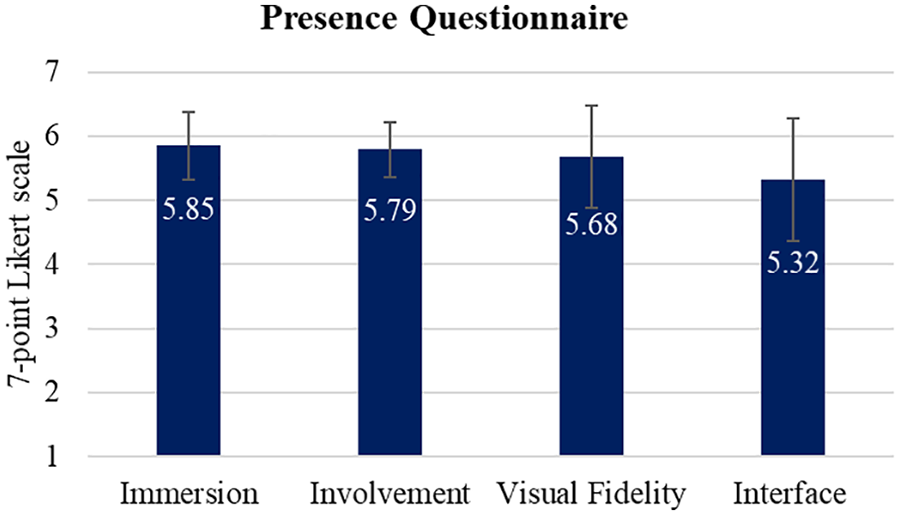
Responses to the presence questionnaire.
System Usability Questionnaire
The system usability measures the user’s comfort in using the developed virtual lab. From this questionnaire, six questions are selected for this study; three are positively worded, and the other three are negatively worded, as reported in APPENDIX B . For the positively worded questions, it is found that the mean score is close to 7 (shown in Figure 5 ). This exhibits that the majority of the participants strongly considered the VR platform is easy to use. In addition, for the negatively worded questions, almost every response was close to 1 (strongly disagree).
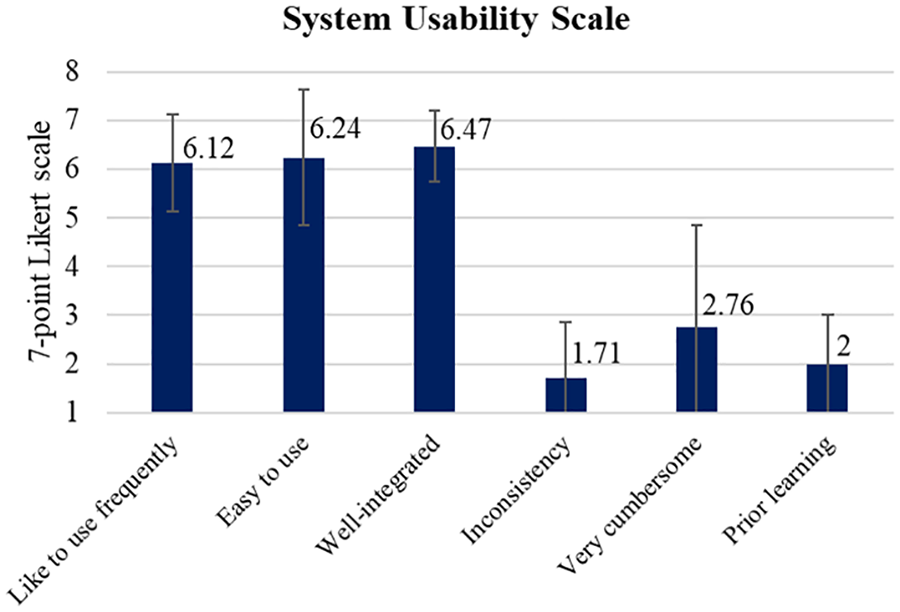
Responses to the system usability questionnaire.
User Performance
The developed VR platform intends to provide the user with hands-on experience in the 3D printing process. This VR training requires information processing and decision-making while interacting with every component to print a 3D object using an SLS printer. The students learned different components of the SLS 3D printing process and made decisions during choosing process parameters in order to achieve budget constraints i.e., printing the shoe insole for $8. An analysis of post-VR videos revealed that 65% of students successfully accomplished the goal of keeping the printing cost below or equal to $8 before initiating the print. However, it was observed that some users mistakenly selected the wrong powder box, while others failed to consider the cost implications for choosing printing parameters, resulting in higher printing costs. These errors were likely due to the users' difficulty in memorizing information presented on one screen in a specific location while performing actions on another screen located elsewhere in the lab. After the training, some students reported that the platform overwhelmed them and created distractions while they were wandering around the lab to achieve specific objectives assigned to them.
Conclusion
In this research, VR is leveraged to improve the layout design and equipment arrangement to enhance user performance and effectiveness. The well-established link analysis approach is applied to identify the potential weakness of an existing layout design and equipment arrangement at an additive manufacturing lab. A new layout design is implemented in the VR platform, and the experiment is performed virtually. The proposed design for positioning the four stations of a 3D printing system significantly reduces the user movement while printing a part. The new layout design achieves an approximately 53.46% average total user movement reduction. The response to the subjective measures indicates that the VR platform satisfies students’ expectations in most cases. To provide students with a better learning experience avoiding similar shortcomings to this VR platform, the researchers advise creating an updated version of the virtual learning platform that includes more user information and feedback. In this research effort, simplified interactions were included in the initial stage of Virtual Reality (VR) development. To understand the full potential of the VR platform for workforce training, more realistic interactions of complex activities will be incorporated in the next version. In addition, only one new layout is proposed and analyzed in this research. More layouts will be investigated in order to achieve an optimal design in the future.
