




Abstract
Binding content together in memory (i.e., associative memory) is often impaired by negative emotion, and adults exposed to childhood adversity tend to show heightened emotional reactivity that may influence memory for emotional content. We tested whether childhood adversity augments the impairing effect of emotion on associative memory. In an online study, young adult participants (N = 700) self-reported exposure to childhood adversity. Participants were then presented with images stratified by emotion (negative, neutral) that were paired with an image of a benign object. Twenty-four hours later, participants’ associative memory for image pairs was tested. Although childhood adversity was prevalent and negatively associated with psychological well-being, it was not associated with poorer associative memory regardless of stimuli valence (b = −0.01, p = .175). Findings suggest that childhood adversity is not always related to associative memory despite theories positing that poor associative memory may drive mental-health concerns associated with childhood adversity.
Memories provide people with a record of their past experiences. Frequently, the most salient memories people have are those for events infused with emotional content (Ack Baraly et al., 2017; T. W. Buchanan, 2007; Kensinger, 2007). Although this may facilitate remembering moments of joy and connection, for individuals with histories of adversity, times of hardship and pain may permeate memory stores. Adverse experiences, particularly those encountered during childhood, often have lasting and detrimental impacts on emotional functioning (Copeland et al., 2018; McLaughlin et al., 2020). Indeed, exposure to adverse childhood experiences has been associated with heightened emotional reactivity to daily stressors (Glaser et al., 2006) and activation of threat responses in response to neutral stimuli (Pfaltz et al., 2019; van Harmelen et al., 2013). Such negative biases may have implications for emotional-memory processes, influencing how new experiences are encoded in memory long after the adversity itself has passed; however, few studies have tested this hypothesis.
Adverse Childhood Experiences
“Adverse childhood experiences” refers to experiences in childhood that deviate from the expectable environment and likely require significant psychological, social, or neurobiological adaptation on behalf of the child (McLaughlin, 2016). Accordingly, childhood adversity can manifest in myriad ways, from interpersonal violence (e.g., witnessing domestic violence, abuse) to household dysfunction (e.g., parental substance use, divorce; see Centers for Disease Control and Prevention [CDC], 2020). Exposure to adverse childhood experiences predicts not only the presence of mental-health disorders but also earlier onset, greater severity, and poorer treatment outcomes (Boullier & Blair, 2018; LeMoult et al., 2020; Shevlin et al., 2015). Furthermore, adverse childhood experiences are common. Nearly two thirds of adults report exposure to at least one adverse experience before the age of 18, and more than a third of individuals exposed to adverse childhood experiences report exposure to more than one type of adversity (Merrick et al., 2018; also see Giano et al., 2020). Evidence suggests that experiencing multiple types of adversity has cumulative effects; that is, the more types of adversity encountered, the worse outcomes tend to be (Copeland et al., 2018; Felitti et al., 1998; Hughes et al., 2016; McGinnis et al., 2022; Shevlin et al., 2015).
Although collapsing across a variety of adverse experiences to measure cumulative scores of adversity has been found to predict poor health outcomes (e.g., Hughes et al., 2016; McGinnis et al., 2022), the type and chronicity of adversity may have dissociable influences on emotional processing. Some have proposed that adverse childhood experiences can be modeled as a circumplex of threat and deprivation in which each unique experience falls along the two dimensions (McLaughlin & Sheridan, 2016; also see McGinnis et al., 2022; McLaughlin et al., 2014; Sheridan & McLaughlin, 2014). Experiences high in threat include those with actual or threatened harm, such as physical or sexual abuse, whereas those high in deprivation involve a lack of an expected resource and may be associated with food insecurity or neglect. Childhood adversities high in threat, in particular, have been found to influence emotional processing in children. For example, children exposed to threatening experiences develop and generalize fear responses more readily (McLaughlin et al., 2016), show heightened threat reactivity toward negative stimuli (McLaughlin et al., 2015), and have biases toward identifying and attending to anger (Pollak & Kistler, 2002; Pollak & Sinha, 2002; Shackman et al., 2007). Note that although these studies dichotomized exposure to threat in childhood, other work has found dose-dependent effects of adversity on emotional processing when measuring cumulative adversity in children (Thompson et al., 2016; Wymbs et al., 2020). This may reflect an adaptive response whereby children exposed to threat become particularly apt at identifying danger in their environments.
Such alterations in emotional processing also seem to carry over into adulthood (McGinnis et al., 2022). For example, adults with histories of sexual or physical abuse exhibit heightened reactivity to daily stressors (Glaser et al., 2006) and tendencies to appraise neutral content as more threatening (Pfaltz et al., 2019), and adults with histories of emotional neglect or emotional abuse show enhanced emotional reactivity toward emotional faces (van Harmelen et al., 2013) compared with adults without these histories. Furthermore, cumulative exposure to more types of adverse childhood experiences has been associated with greater emotion dysregulation in adults (Poole et al., 2018). These findings suggest that as individuals transition into adulthood, biased emotional processes, which potentially were adaptive in childhood, may become overgeneralized, maladaptively manifesting in situations in which they are not warranted and guiding cognition in ways that increase vulnerabilities toward poor mental- and social-health outcomes. Here, we focus on the role of adverse childhood experiences in one aspect of cognition in particular: emotional memory.
Negative Emotion and Associative Memory
Independent of exposure to adverse childhood experiences, negative content tends to hold a preferential position in memory. Indeed, negative emotion triggers a cascade of neurological processes that boost memory consolidation (McGaugh, 2004; Mickley Steinmetz et al., 2017), and negative items tend to capture and hold people’s attention and encoding resources, facilitating memory for negative stimuli (Fujiwara et al., 2021; Madan et al., 2017; Talmi, 2013). Not only are negative items more easily recognized than neutral items, memory also seems to be enhanced for within-items contextual details, such as perceptual features (e.g., color, size; see Chiu et al., 2013). However, negative items do not exist in isolation. Memory holistically stores experiences, binding associations between surrounding items so that people can develop coherent, situation-specific accounts of the past (Maren et al., 2013; Yonelinas et al., 2019). Although emotion may boost memory for central negative items, it can have an opposing, impairing effect for memory of elements surrounding the negative item, limiting one’s ability to bind separate elements together in memory (i.e., associative memory; Bisby & Burgess, 2014; Palombo et al., 2021). Some evidence suggests that the more emotional arousal a negative item elicits, the more associative memory is impaired, indicating a possible trade-off whereby memory prioritizes negative items at the expense of surrounding content (e.g., Mickley Steinmetz et al., 2017).
Associative binding contributes to one’s contextualization of experiences in memory (see Maren et al., 2013; Yonelinas et al., 2019). Recognizing negative content may promote avoidance behaviors that steer a person away from similar adverse stimuli if encountered again, whereas a reduction in associative binding may facilitate one’s ability to apply past negative experiences to a broader range of present and future experiences (Maren et al., 2013). Still, if negative information is completely decoupled from its original context, people may be prone to applying past learning too broadly (Lambert & McLaughlin, 2019; Liberzon & Abelson, 2016). For example, it may be helpful to remember encountering a snake at the bottom of a barrel. Tendencies toward quick, protective behaviors when one glimpses shiny green scales despite the absence of a barrel (e.g., between-items context cues) promote survival. However, some degree of contextualization for negative stimuli is helpful—it allows people to infer that the snake they encounter at the zoo likely does not need to be avoided with the same vigilance (Maren et al., 2013; Yonelinas et al., 2019).
Connecting Adverse Childhood Experiences and Associative Memory
When considering that adverse childhood experiences are associated with a hypervigilance for negative cues, it stands to reason that adverse childhood experiences may detrimentally influence associative memory in adulthood; however, limited studies have tested this premise. Some evidence suggests that children exposed to threatening adverse experiences (domestic violence, physical abuse, or sexual abuse) show worse associative memory for content encoded alongside angry faces compared with children who have not been exposed to such adversities (Lambert et al., 2017, 2019). These studies did not observe a difference in associative-memory performance for content encoded alongside neutral faces for children with adversity histories despite evidence suggesting that such histories may bias individuals toward interpreting neutral content negatively (Pfaltz et al., 2019; also see Lambert et al., 2017, 2019; McLaughlin et al., 2019). However, Lambert et al. (2019) found that overall associative memory improved with age in children without threat exposure, whereas overall associative memory did not shift as a function of age in children exposed to threatening experiences. Children may have a greater tendency toward generalizing information to facilitate rapid and broad learning during development (Ramsaran et al., 2019), and evidence suggests that adults have better associative memory than children (Lee et al., 2016; Rosen et al., 2018; also see Guillery-Girard et al., 2013). It may be that the relationship between adverse childhood experiences and associative-memory performance is more pronounced in adults because exposure to adverse childhood experiences may blunt typical progression in associative-memory ability (also see Lecei & van Winkel, 2020). Studies that have observed an impairment of associative memory for negative items have used adult populations (e.g., Bisby et al., 2016, 2018; Fujiwara et al., 2021; Madan et al., 2012, 2017). Thus, examination of the relationship between adverse childhood experiences and associative memory in adults may be more sensitive to differential memory performance. Moreover, young adults are a particularly important group to explore given that emerging adulthood marks a critical developmental period, characterized by life transitions, instability, self-reflection, and prevalent mental-health concerns (Arnett et al., 2014; Gustavson et al., 2018).
Exploring the Influence of Social Cues
Research on the relationship between emotional responses and adverse childhood experiences has tended to emphasize social cues using images of faces as stimuli and manipulating emotion via facial expressions (e.g., Lambert et al., 2017, 2019; McLaughlin et al., 2015; Pfaltz et al., 2019; Wymbs et al., 2020). The intrinsic social nature of interpersonal and familial hardships at the center of adverse childhood experiences has likely contributed to this. Crucially, social cues may influence memory above and beyond emotion: A prior report employing an analysis of the data set used in the present study revealed an enhancement of associative memory when social content (e.g., depiction of faces, body language) compared with nonsocial content is presented (Stewardson et al., 2023). Indeed, in one of our prior analyses, social information was found to offset impairments of associative memory in the presence of negative information (Stewardson et al., 2023). Thus, disentangling the influence of emotional and social content may be critical to fully understand how associative memory manifests in relation to adverse childhood experiences.
The Present Study
In the present study, we sought to examine whether adverse childhood experiences are associated with between-items associative binding in memory in young adults. In accordance with our preregistered hypotheses (https://aspredicted.org/42N_R1L), we expected more exposure to childhood adversity to be associated with poorer associative memory across neutral and negative content because adults with histories of adversity are likely to appraise neutral content more negatively (Glaser et al., 2006; Pfaltz et al., 2019; Thome et al., 2018). We further predicted that the relationship between adverse childhood experiences and associative memory would be stronger for negative content compared with neutral content given that heightened emotional responses associated with adverse childhood experiences may contribute to a greater associative-memory impairment. Our exploratory analysis tested whether our hypothesized associative-memory impairment is moderated by the presence of social cues given prior work suggesting that such cues may promote between-items binding. Finally, given the association between mental health and childhood adversities (e.g., Boullier & Blair, 2018; Hughes et al., 2016; LeMoult et al., 2020), exploratory sensitivity analyses (not preregistered) were conducted to examine whether current psychological functioning influenced the pattern of results we observed.
Transparency and Openness
The hypotheses and analysis plan were preregistered at https://aspredicted.org/42N_R1L. Materials, de-identified data, and analysis code are available at https://osf.io/ntkmw/. We report how we determined our sample size, all data exclusions, all manipulations, and all measures in the study. This study was approved by the Behavioural Ethics Board at the University of British Columbia (H19-02010).
Method
Participants
The present study involved participating in two online experimental sessions placed approximately 24 hr apart. Participants included a student sample recruited via the human-subject pool at the University of British Columbia and a community sample recruited via the online recruitment platform Prolific from the United States and Canada (www.prolific.co). Data were collected between June 2020 and August 2021 (during the COVID-19 pandemic). Our sample size was determined by the larger study aim of assessing how individual differences relate to the influence of social and emotional content on item- and associative-recognition memory (see Stewardson et al., 2023). As remuneration for participation, participants recruited from the student sample received course credit, and participants from the community sample received USD$6.50.
Eligible participants were required to (a) be between the ages of 18 and 25; (b) be fluent in English, to ensure comprehension of survey items and task instructions; (c) not be colorblind, because of potential differences in processing visual stimuli; and (d) report no history of concussion in the past 6 months, because of potential effects on memory. Although 1,307 participants met eligibility criteria, 312 did not return for the follow-up session within 19 hr to 29 hr of completing the first session. Of the remaining 995 participants, 289 participants were excluded by a strict, multistep data-cleaning procedure employed in prior work using this data set (see Stewardson et al., 2023) to ensure high-quality data were obtained despite the nature of online data collection. High exclusion rates are not uncommon or unexpected in online studies with rigorous standards for data quality (see E. M. Buchanan & Scofield, 2018), and research examining the quality of data from online platforms suggests that one third to one half of responses collected via these participant pools are of low quality (Douglas et al., 2023). Eligible participants were excluded because of (a) reporting technical difficulties during either experimental session (n = 33), (b) taking 2 times the expected duration to complete either experimental session (n = 39), (c) viewing to-be-remembered stimuli multiple times before the memory task (i.e., repeating the encoding task, described below; n = 6), (d) not completing the encoding or memory tasks (n = 55), and (e) failing data-quality checks (n = 156). Data-quality checks were failed when participants (a) failed to correctly identify task instructions (n = 102), (b) performed below chance on the memory tasks (n = 26), or (c) had a mean reaction time 3 SD above or below the median reaction time for the encoding or memory tasks (n = 28; see Fig. S1 in the Supplemental Material available online). After applying study-wide exclusions, the sample included a total of 706 participants. However, to accommodate statistical modeling (e.g., missing covariate data), an additional six participants were excluded (see Data-Analytic Plan). This left a final sample of 700 participants for analysis (age: M = 21.1 years, SD = 2.23; 52.7% women, 46.0% men, 1.3% gender nonbinary; for further demographic information, see Table S1 in the Supplemental Material). Of these subjects, 177 were from the student sample (age: M = 19.7 years, SD = 1.63; 78.0% women, 22.0% men), and 523 were from the community sample (age: M = 21.6 years, SD = 2.21; 44.2% women, 54.1% men, 1.7% gender nonbinary). Exposure to childhood adversity did not differ between our final sample and eligible participants who were excluded, t(1,261) = 0.65, p = .516. 1 Thus, our stringent data-quality checks did not unduly influence the presence of adversity in our sample. For the distribution of adversity in both groups, see Figure S2 in the Supplemental Material.
Materials
Self-report questionnaires
Behavioral Risk Factor Surveillance System ACE Module
The Behavioral Risk Factor Surveillance System (BRFSS) is a nationwide survey that the U.S. CDC distributes annually to assess health-related behaviors and chronic conditions (CDC, 2020). A module assessing adverse childhood experiences is administered as part of the BRFSS, and the resulting data have been used widely in research to examine the impacts of childhood adversity on health (see CDC, 2020). The BRFSS ACE Module inquires into eight experiences: (a) household incarceration, (b) household mental illness, (c) household substance abuse, (d) parental divorce, (e) witnessing domestic violence, (f) physical abuse, (g) emotional abuse, and (h) sexual abuse. Participants either endorse or deny having encountered each adversity before the age of 18. Total scores on the BRFSS ACE Module are tallied out of 8, reflecting the total number of types of adversities individuals endorse encountering. Sexual abuse is queried by three separate items: invitation to sexual touching, being sexually touched, and forced intercourse. Endorsement of any of the three is scored as an endorsement of sexual abuse (see CDC, 2020).
In a factor analysis of the BRFSS ACE Module, Ford et al. (2014) found invariance among age and gender of respondents, providing support for its use in the present young-adult sample. Ford et al. further identified three factors in the measure: (a) household dysfunction, including incarceration, mental illness, and/or substance abuse of a household member and parental divorce; (b) physical/emotional abuse, including domestic violence, physical abuse, and emotional abuse; and (c) sexual abuse, including invitation to sexual touching, being sexually touched, and forced intercourse. These factors are somewhat consistent with models characterizing adversity on dimensions of threat and deprivation, wherein the physical/emotional-abuse and sexual-abuse factors may be more likely associated with high threat than the household-dysfunction factor (see Dennison et al., 2019; McLaughlin et al., 2015, 2016).
General Health Questionnaire–12
The General Health Questionnaire (GHQ-12; Goldberg & Williams, 1988) is a 12-item self-report questionnaire assessing psychological distress. Items address concerns such as anxiety, depression, social dysfunction, and self-confidence and are rated on a 4-point scale from 0 to 3. Total scores range from 0 to 36, and higher scores reflect poorer psychological well-being. The GHQ-12 has demonstrated strong psychometrics among diverse samples (e.g., Anjara et al., 2020; Cornelius et al., 2013; Hankins, 2008; Penninkilampi-Kerola et al., 2006). The GHQ-12 was completed only in the community sample.
Shortened State Trait Anxiety Inventory
The shortened State Trait Anxiety Inventory (STAI; Zsido et al., 2020) is an abbreviated 10-item version of the original 40-item measure (Spielberger, 1983). The STAI is a self-report measure assessing symptoms of trait anxiety (STAI-T; how anxious one generally feels) and state anxiety (STAI-S; how anxious one feels currently) on a 4-point scale from 1 (not at all) to 4 (very much so). Total scores on each scale range from 5 to 20, and higher scores reflect greater levels of trait or state anxiety. The shortened STAI is highly correlated with the original STAI (rs = .86–.88), and both the trait and state subscales have demonstrated strong psychometric properties (Zsido et al., 2020).
Memory stimuli
The stimuli for the present study included a set of 96 images depicting complex scenes derived from the Nencki Affective Picture System (NAPS) database (Marchewka et al., 2014) and 48 images depicting benign objects randomly selected from the Bank of Standardized Stimuli (BOSS; Brodeur et al., 2010). NAPS and BOSS images were paired and presented sequentially to participants at an initial session. Approximately 24 hr later, participants’ associative memory for image pairs was tested (see Procedure). NAPS images were stratified by emotional content (negative, neutral) and social content (social, nonsocial; see Fig. 1). Emotional content was determined based on normative ratings of emotional arousal and valence from the NAPS database (Marchewka et al., 2014). Normative data for emotional arousal and valence are provided on a 9-point scale (1 = relaxed, 5 = neutral/ambivalent, 9 = aroused and 1 = very negative, 5 = neutral, 9 = very positive, respectively). To be included as a stimulus, negative images were required to have a mean arousal rating greater than or equal to 6 and a mean valence rating less than or equal to 3. Neutral images were required to have a mean arousal rating less than or equal to 5 and a mean valence rating greater than 4 or less than or equal to 6.5. NAPS images were further stratified by the presence or absence of social content. Social content was defined as human facial expressions, gestures, and/or body language. Nonsocial images were defined as the absence of facial expressions, gestures, and/or body language. For further detail on image selection, see “Stimulus Selection” and Table S2 in the Supplemental Material.
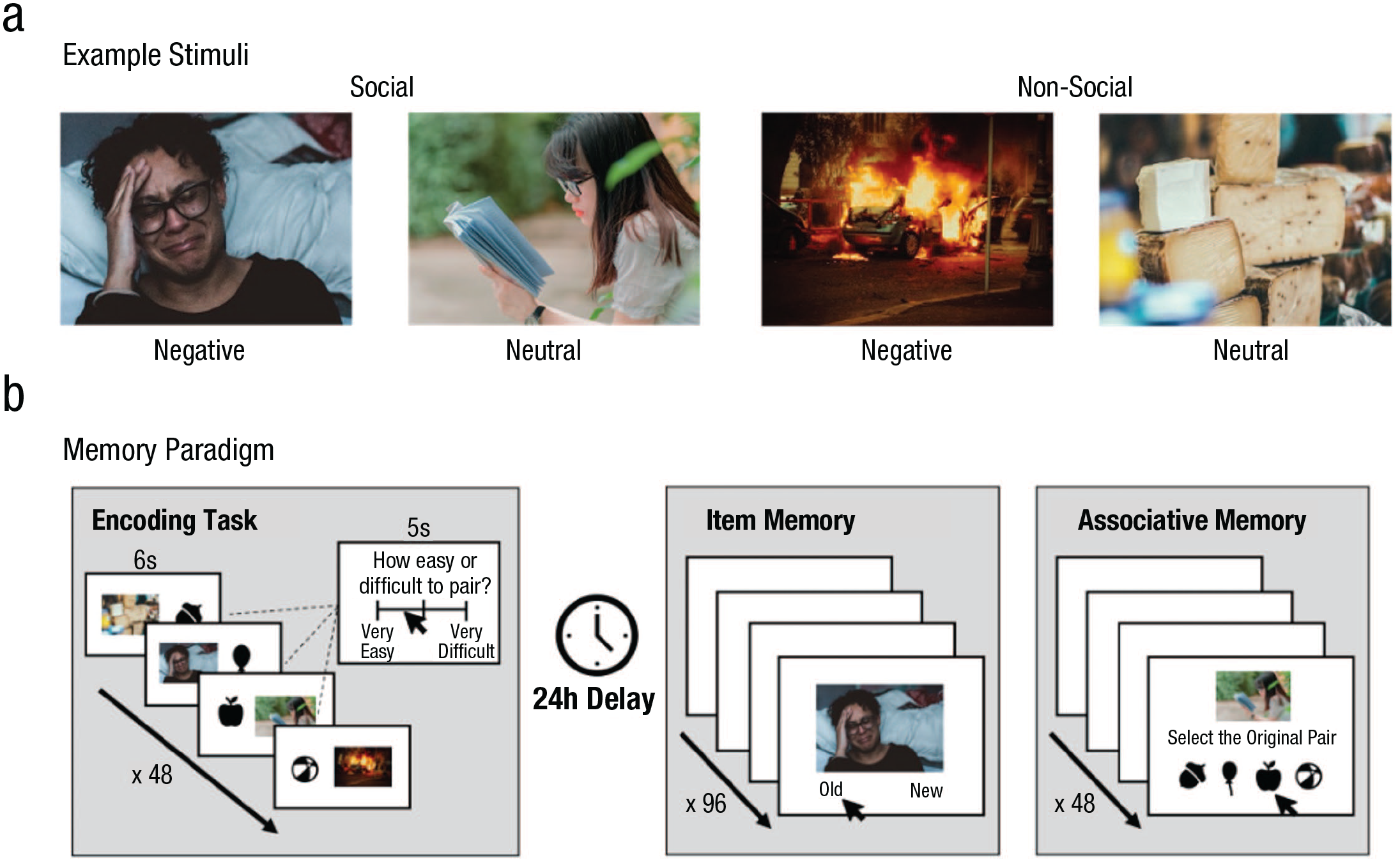
Memory-paradigm schematic. (a) Example NAPS images for each emotion (negative, neutral) by social (social, nonsocial) condition. The images presented here are example “free for use” images from pexels.com and unsplash.com and are not from the original database. (b) Memory paradigm. During encoding, participants viewed 48 NAPS-BOSS image pairs for 6 s and rated each pair on how easy or difficult they were to pair together. After a 24-hr delay, participants were administered our item-memory task, followed by our associative-memory task. NAPS = Nencki Affective Picture System database; BOSS = Bank of Standardized Stimuli.
Twenty-four NAPS images were selected for each of our four conditions (negative social, negative nonsocial, neutral social, neutral nonsocial). Negative and neutral conditions were confirmed to have significantly different arousal and valence properties, and images in the social versus nonsocial conditions were matched on arousal and valence (see Table S3 in the Supplemental Material). Furthermore, images across all four conditions were matched on low-level visual properties (see Table S3 in the Supplemental Material). BOSS images depicted benign objects and were randomly selected from the BOSS_Normative_v2 database. However, BOSS images that appeared to have a negative connotation (e.g., knife) or could not be easily identified (e.g., uncertainty about what the object was) were randomly replaced with neutral images of clearly recognizable objects from the same database.
Procedure
The present study was conducted online across two sessions via Qualtrics (self-report questionnaires) and PsychoPy3 (experimental memory paradigm; Peirce et al., 2019). At the initial session, participants completed a battery of questionnaires, including eligibility screening, a demographic questionnaire, the STAI, BRFSS ACE Module, and a measure of psychological well-being. Psychological well-being was assessed in the community sample via the GHQ-12; however, this measure was not collected for the student sample, who were administered the longer Achenbach Adult Self-Report (ASR; Achenbach & Rescorla, 2003). The GHQ-12 was collected in lieu of the ASR in the community sample to shorten the protocol for Prolific participants. Participants then completed an encoding task during which they viewed 48 of the 96 NAPS images (12 from each condition) randomly paired with a BOSS image. Participants were instructed to imagine a link between the images to encourage attending to the task. Before completing the encoding trials, participants read the instructions, completed an attention check based on the instructions, and completed two practice trials to ensure task comprehension. Image pairs were then presented sequentially for 6 s each in a counterbalanced order. Image pairs were randomized within counterbalanced conditions (for more details on counterbalancing, see “Stimulus Counterbalance” in the Supplemental Material). After 6 s, participants were asked to indicate how easy or difficult it was to imagine the link between the pair on a 7-point scale (1 = very easy, 7 = very difficult). This was conducted to promote task adherence during encoding but was not analyzed.
Participants returned for a follow-up session after a delay of approximately 24 hr (M = 23.43, range = 19.4–29.0) following completion of the initial session as the effect emotion has on memory typically strengthens over time because of faster decay of neutral content (e.g., Sharot & Yonelinas, 2008). During the follow-up session, participants completed two surprise memory tasks, an item-recognition task and an associative-memory task, modeled after Bisby and Burgess (2014; see Fig. 1). During the item-memory task, all 96 NAPS images were sequentially shown to participants. Participants were tasked with identifying if the image was “old,” that is, seen previously during the encoding task, or “new,” that is, not seen during the encoding task. This task was not used in the present study. Following the item-memory task, participants completed the associative-memory task. In the associative-memory task, all 48 encoded NAPS images were shown alongside four BOSS images. Of the four BOSS images, one image had been paired with the NAPS image displayed during the encoding task at the initial session. The remaining three BOSS images acted as lures and were randomly selected and positioned for each trial using custom code in PsychoPy. Participants were instructed to select the BOSS image they believed had been paired with the NAPS images during the initial session and were administered two practice trials to ensure task comprehension before proceeding. After completing the memory tasks, participants were administered a second battery of questionnaires not used in the present study.
Data-analytic plan
Associative-memory performance was calculated as the proportion of correct responses (i.e., correctly identifying the paired BOSS image among three lure images) out of the total number of trials within each of the four conditions. Emotional condition of each image was effect coded, and adversity scores were mean-centered to facilitate interpretation of main effects in our models (Enders & Tofighi, 2007). In our main model, referred to as our “cumulative-adversity model,” childhood adversity was calculated as the cumulative tally of endorsed adversities out of the eight adversities queried by the BRFSS ACE Module. A preregistered follow-up analysis examining the influence of each factor of the BRFSS ACE Module (sexual abuse, physical/emotional abuse, household dysfunction) was run with separate interaction terms for each factor. We refer to this model as our “adversity-specific model.” To better understand the pattern of results we observed, we then ran an exploratory follow-up analysis examining the relationship between associative memory and cumulative exposure to threat, measured as the number of threat-based adversities endorsed. Threat-based adversities included domestic violence and physical and sexual abuse, in line with past research examining emotional processes in relation to childhood adversity (e.g., Lambert et al., 2017, 2019; McLaughlin et al., 2015, 2016; Pfaltz et al., 2019; Pollak & Kistler, 2002; Pollak & Sinha, 2002). We refer to this model as our “threat-adversities model.” Finally, we conducted sensitivity analyses (not preregistered) controlling for psychological well-being in each of our three models. Specifically, we reran our models in our community sample with psychological well-being, measured as total scores on the GHQ-12, entered as a covariate, allowing it to interact with emotion and social cues (see Yzerbyt et al., 2004). We then conducted similar analyses using trait anxiety, measured as total scores on the STAI-T, in our full sample. In accordance with our preregistration, recruitment source, gender, age, and income were entered as covariates to control for potential differences as a function of sample in all models, and sensitivity analyses of all models were run with the social (social, nonsocial) content of images included as a predictor variable, allowed to interact with emotion and adversity (see Yzerbyt et al., 2004).
In accordance with our preregistered analyses (https://aspredicted.org/42N_R1L), we planned to employ multilevel modeling (MLM) to analyze the relationship between childhood adversity and associative memory in the presence of emotional (negative, neutral) content. MLM was selected given that it is appropriate for within-subjects designs (i.e., repeated measures nested within subjects) and, relative to techniques based on analysis of variance, does not make as strict assumptions about the structure of the data (see Haverkamp & Beauducel, 2017). Note that our data were found to violate model assumptions: Although Q-Q plots of residuals indicated that our residuals were roughly normally distributed, Shapiro-Wilks tests of normality were significant (all ps > .0001). Furthermore, visual inspection of density plots for associative-memory performance revealed a moderate positive skew in our data (also see Table 1). To ensure our models were robust to nonnormality and possible ceiling effects, as was preregistered, we conducted generalized linear mixed models (GLMMs) with a gamma outcome distribution.
Descriptive Statistics of Associative-Memory Performance

Note: Descriptive statistics of associative-memory performance were calculated as the proportion of correct responses within emotion and social condition.
GLMM analyses were conducted using the glmer function from the R package lme4 (Bates et al., 2015). GLMMs allow for both fixed and random effects to be incorporated into a model. Fixed effects are appropriate when all values of interest have been measured, whereas random effects are appropriate when values represent a sample of the population of interest (Judd et al., 2012). In each of our models, we allowed the intercept to vary randomly across persons, and thus, participants were modeled as random effects to account for our within-subjects design and individual variability in task performance. Adversity and emotion were modeled as fixed effects, as was the social content of images in follow-up analyses, and all interaction terms were included. Variance inflation factors were calculated using the vif function from the R package car for all of our GLMMs to examine if there was high multicollinearity (Zuur et al., 2010). None of our models revealed high multicollinearity; all generalized variance inflation factors between predictor variables were below 1.27 (Becker et al., 2015). One participant had a score of 0 correct responses on negative nonsocial trials, and because GLMMs with a gamma outcome distribution cannot accommodate nonpositive values, this participant was excluded. Furthermore, five participants did not report data on income. Because income was included as a covariate in our models, these five participants were removed, for a final sample of 700 participants. No outliers, defined as any data point more than 3 SD above or below the mean, were identified.
Results
Adversity in sample
Rates of adversity in our sample were high. More than 80% of our sample reported exposure to at least one adversity in their childhood. Comparatively, population-based estimates suggest that approximately two thirds of adults encounter one or more adversities in childhood (Crouch et al., 2020; Gupta, 2022; Merrick et al., 2018), although these estimates represent data collected before the COVID-19 lockdown. Consistent with population-level data, BRFSS ACE scores in our sample were, on average, higher among women (M = 2.15, SD = 1.60) and gender-diverse individuals (M = 3.22, SD = 1.48) than men (M = 2.00, SD = 1.63), and higher BRFSS ACE scores were negatively correlated with income (r = −.18, p < .0001; see Giano et al., 2020; Gupta, 2022; Merrick et al., 2018). Most participants reported experiencing at least one type of adversity during childhood; on average, participants were exposed to 2.09 types of adverse childhood experiences (SD = 1.62; see Fig. S3 in the Supplemental Material). Of the adversities reported, the most commonly endorsed adversity was emotional abuse (67.7%), followed by physical abuse (32.6%), household mental illness (29.3%), household substance use (21.9%), and parental divorce (20.1%). The least endorsed adversities were familial incarceration (3.9%), sexual abuse (13.9%), and domestic violence (20.0%).
Preregistered analyses
Cumulative-adversity-model results
For our cumulative-adversity model, shown in Figure 2, we observed no effect of adversity on associative-memory performance (b = −0.04, p = .185) and no interaction between emotion and adversity on associative-memory performance (b = −0.01, p = .175). As shown in previous reports of the present data set (see Stewardson et al., 2023), we observed the expected main effect of emotion on associative memory. Specifically, associative memory was, on average, worse for negative images compared with neutral images (b = 0.12, p < .0001). For descriptive statistics of memory performance across conditions, see Table 1. For detailed results of the model, see Table 2. Follow-up analyses including social content of images in this model showed an interaction of social content and emotion, as previously reported (see Stewardson et al., 2023), whereby social content benefited associative-memory performance, offsetting the impairing effect of negative emotion (b = −0.03, p < .0001). The inclusion of social content had no impact on the significance of any other terms, including those involving BRFSS ACE scores (all ps > .222).
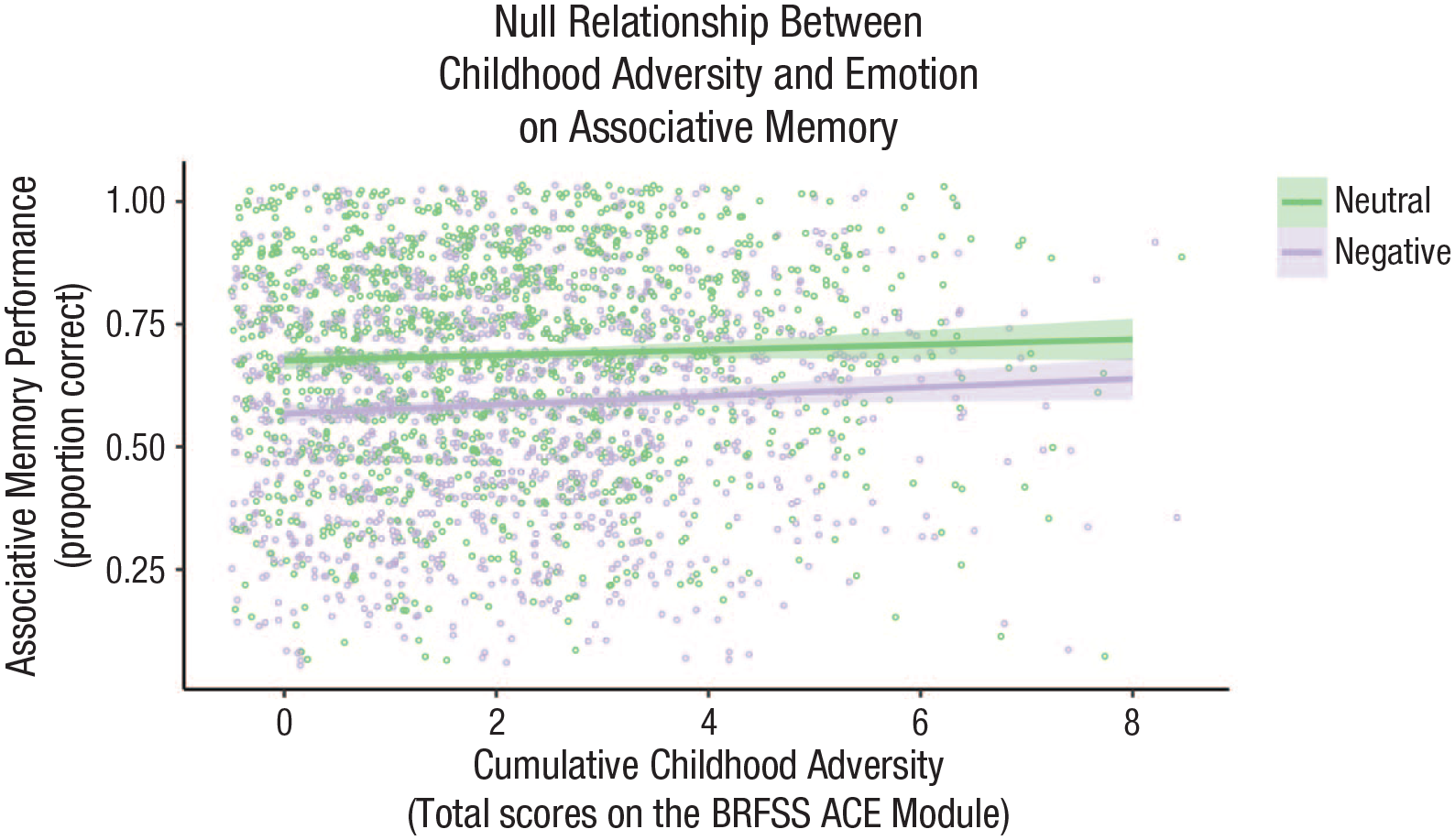
Cumulative-adversity model. Our main model examining the relationship between cumulative scores on the Behavioral Risk Factor Surveillance System ACE Module and associative memory in the presence of negative (in purple) and neutral (in green) stimuli showed no impact of adversity on memory performance.
Preregistered Results

Note: Emotion was effect coded as negative = 1, neutral = −1. Total BRFSS ACE scores were mean-centered. The reference group for recruitment source was the undergraduate university sample, and the reference group for gender was women. CI = confidence interval; BRFSS = Behavioral Risk Factor Surveillance System.
p < .0001.
As a supplement to our analysis, we used Bayes’s factors (BFs) to quantify the support in our data for our cumulative-adversities model compared with a model not including childhood adversity, that is, including only emotion and our covariates. We first calculated BFs for both models compared with an intercept-only model (for details on models, see “Bayesian Analyses” in the Supplemental Material). We then compared evidence between our cumulative-adversity model and the emotion-only model by dividing the emotion-only BF by the cumulative-adversity BF (Hoijtink et al., 2019). A result greater than 1 would favor the emotion-only model, and a result below 1 would favor the adversity model. We found evidence in favor of the emotion-only model compared with the cumulative-adversity model (BF = 9.55). Thus, these data are approximately 9 times more likely under the emotion-only model compared with a model that additionally includes childhood adversity.
Adversity-specific-model results
Examination of individual BRFSS ACE factors did not change our pattern of results. For our adversity-specific model, we observed no effect of household dysfunction (b = −0.04, p = .197), physical/emotional abuse (b = −0.00, p = .975), or sexual abuse (b = −0.02, p = .487) on associative-memory performance. The main effect of emotion (b = 0.12, p < .0001) remained. No other terms of interest were significant (all ps > .284). For detailed results of the model, see Table 2. Follow-up analyses including social content of images showed that the interaction of social content and emotion remained (b = −0.03, p < .0001). The inclusion of social content had no impact on the significance of any other terms, including those involving BRFSS ACE scores (all ps > .081).
To determine the strength of our evidence in support of the null, we again used BFs to compare the likelihood of our adversity-specific model with the emotion-only model. We calculated BFs for both models compared with an intercept-only model (for details on models, see “Bayesian Analyses” in the Supplemental Material). We then compared evidence between our adversity-specific model and the emotion-only model by dividing the emotion-only BF by the adversity-specific BF (Hoijtink et al., 2019). Again, a result greater than 1 would favor the emotion-only model, and a result below 1 would favor the adversity-specific model. A result of 10 or more would provide strong evidence in favor of the emotion-only model (Hoijtink et al., 2019). We found strong evidence in favor of the emotion-only model compared with the adversity-specific model (BF = 1,346.21). Thus, these data are more than 1,000 times more likely under the emotion-only model compared with a model that additionally includes specific childhood adversities.
Exploratory analyses
Threat-adversities model results
Examination of adversities specifically associated with threat did not change our pattern of results. For our threat-adversities model, we observed no effect of exposure to threat-based adversities on associative-memory performance (b = −0.02, p = .572) and no interaction between emotion and adversity on associative-memory performance (b = −0.01, p = .122). The main effect of emotion (b = 0.12, p < .0001) remained (see Table S4 in the Supplemental Material). Follow-up analyses including social content of images showed that the interaction of social content and emotion remained (b = −0.03, p < .0001). The inclusion of social content had no impact on the significance of any other terms, including those involving threat-based BRFSS ACE scores (all ps > .093).
Psychological well-being analyses
To better understand the results of our models, we conducted exploratory analyses that accounted for psychological well-being in our community sample (n = 523), in which data on general psychological well-being were collected via the GHQ-12. Cumulative scores on the BRFSS ACE Module and poor psychological well-being were related (r = .27, p < .0001). We reran our cumulative-adversity, adversity-specific, and threat-based-adversity models in our community sample with mean-centered total scores on the GHQ-12 entered as an interaction term (see Table S5 in the Supplemental Material). The pattern of results did not change in any of our three models. We then examined whether accounting for trait anxiety, as measured by the STAI-T, influenced the pattern of results in our full sample. Higher trait anxiety was also related to total cumulative scores on the BRFSS ACE Module (r = .23, p < .0001). Again, the pattern of results did not change (see Table S6 in the Supplemental Material). Inclusion of our social condition in these sensitivity analyses did not influence the pattern of results, although an interaction between emotion and social content on associative-memory performance was observed in all analyses.
Discussion
In the present study, we examined the relationship between childhood adversity and associative-memory performance in a large young-adult sample. Specifically, we examined whether greater exposure to adverse childhood experiences predicted poorer associative memory for negative stimuli. Contrary to our predictions, exposure to adversity did not relate to performance on our associative-memory task regardless of the emotionality of the stimulus. This was observed despite (a) having a large sample of young adults in which childhood adversities were prevalent and significantly associated with increased anxiety and poorer psychological well-being and (b) administering a sensitive memory paradigm that observed the anticipated impairment of associative memory in the presence of negative stimuli compared with neutral stimuli. Across our statistical models, 95% confidence intervals hung tightly around zero, indicating our data are suggestive of the null being true. Although some past work has suggested a relationship between associative-memory performance and childhood adversity in children (e.g., Lambert et al., 2017, 2019), our results did not support such a relationship, indicating that it may be less robust or subject to boundary conditions. Considering nuances in the assessment of adverse childhood experiences and associative memory may lend insights into these null findings and their implications.
Characterizing childhood adversity
Exposure to adversity in our sample was higher than reports from adult population-based estimates using the BRFSS ACE Module; only 17.3% of participants reported no adverse childhood experiences (compared with 30%–40%; see Crouch et al., 2020; Gupta, 2022; Merrick et al., 2018). Still, consistent with prior reports, higher ACE scores were associated with reduced psychological well-being, lower incomes, and gender (Gupta, 2022; Merrick et al., 2018). Note that our data were collected during the COVID-19 pandemic lockdown. Rates of reported adversity in our sample may reflect increased recall of adversity during this stressful period (see Sonuga-Barke & Fearon, 2021). Recollection of the past can be influenced by current emotional experience (Kensinger & Ford, 2020), and the distress of the pandemic may have led our participants to recall more negative experiences than seen in prior administration of the BRFSS ACE Module.
Despite this high rate of adversity in the sample, we found no relationship between adversities, including threatening adversities, and associative memory. One potential explanation is that the frequency and severity of adversities (not only occurrence) play a critical role in determining their impact on the developing brain and, therein, adult cognition. The severity and chronicity of adverse experiences, particularly those associated with threat, may have compounding influences on associative memory via the long-term changes threat exposure exerts on neuroendocrine circuits associated with emotional learning and stress responses, such as the hypothalamic–pituitary–adrenal axis (Frodl & O’Keane, 2013; Hyman, 2009; McLaughlin et al., 2014). Greater chronicity may require less severe threat to disrupt the stress response over time, whereas greater severity may require fewer exposures (Ellis et al., 2022; also see Kopala-Sibley et al., 2021). We were unable to consider such nuance in this study because the BRFSS ACE items assess only whether an adversity occurred, not how it was experienced.
We sought to indirectly address threat severity by focusing on threatening experiences in exploratory models (see Ford et al., 2014; Lambert et al., 2017, 2019; McLaughlin et al., 2015, 2016) and by examining if associative-memory differences might be detected only among individuals with mental-health concerns. In this latter case, we reasoned that poor mental health in adults with exposure to childhood adversity may indicate that adverse experiences are continuing to color the way an individual is processing an environment, whereas a lack of mental-health concerns following adversity may be a sign of resiliency to detrimental impacts of childhood adversity (see Ungar & Theron, 2020). Neither approach yielded significant findings. Note that threat may pervade many types of adverse childhood experiences, not only those associated with bodily harm (i.e., physical and sexual abuse), and the degree of threat can vary in each unique adversity, even within a given type of experience (Fassett-Carman et al., 2020; Gusler et al., 2022 LoPilato et al., 2020). Moreover, reduced psychological well-being in individuals with adversity histories may be a poor proxy for the specific, threat-based responses to adversity that have been hypothesized to shape memory processes. Although research supports cumulative measures of adversity as predictors of outcomes in adulthood, including those related to emotion regulation (Poole et al., 2018) and psychosocial health (see McGinnis et al., 2022), nonetheless, teasing apart the type, severity, and chronicity of adversity and the individual’s response to childhood adversity—which often requires in-depth clinical interviews (Anda et al., 2020; Holden et al., 2020; Lacey & Minnis, 2020)—may be an important future step to confirm the null result found here.
Associative memory and contextualizing experiences
Disruptions in associative memory is one mechanism hypothesized to drive the relationship between adverse childhood experiences and poor mental-health outcomes (Lambert & McLaughlin, 2019; Lecei & van Winkel, 2020). Here, we examined memory for between-items associations (i.e., the relationships between discrete items in one’s environment) and found—as reported in a prior analysis of this work (Stewardson et al., 2023)—a robust main effect of emotion whereby associative memory was poorer for benign objects paired with negative images compared with neutral images, in line with prior work (e.g., Bisby et al., 2016; Madan et al., 2017). Childhood adversity did not influence associative-memory performance in our study, suggesting that one’s ability to maintain contextual nuance in memory may not differ as a function of the dose of adversity experienced. Still, context is informed by remembering myriad elements of an event, not only the relationships between items but also the perceptual and spatiotemporal characteristics of the content encountered (Yonelinas et al., 2019). Dissociable memory processes have been identified as contributing to the maintenance of such contextual nuances, including between-items associations, as tested here, and within-items associations (i.e., characteristics within the item itself, such as the color or shape) and spatiotemporal source (i.e., where in space or when in time a stimulus is encountered; see Chiu et al., 2013; Kensinger, 2009; Konkel & Cohen, 2009).
The present research question was, in part, inspired by prior work by Lambert et al. (2017, 2019) suggesting poor associative memory in children exposed to threatening experiences. These studies (which were conducted with the same sample) assessed associative memory with both within-items context (e.g., facial expressions) and between-items context (e.g., paired images) trials. Albeit speculative, our null findings (which examined between-items context) raise the possibility that associative-memory effects observed in the Lambert et al. studies could be attributable to within-items context. Poor within-items context may make it more difficult for individuals exposed to childhood adversity to discern when a specific stimulus is safe versus threatening. For example, if a child has been bitten by a dog, poor within-items binding may make it more difficult for that child to specify the biting dog from other dogs. In contrast, poor between-items binding may make it more difficult for the child to determine whether the biting dog is a threat in all settings, such as when it is off leash in an alley or with its owner, leashed at the park. Future work isolating other types of memory that support contextualization of experiences in relation to childhood adversity will be important to pursue to better understand how individuals exposed to childhood adversity contextualize their experiences.
Remembering social content in context
We reasoned that negative biases among individuals exposed to adversity may be most pronounced for social content compared with nonsocial content given that past research assessing emotional biases among adversity-exposed individuals have tended to use social stimuli, such as faces, as stimuli (e.g., Lambert et al., 2017, 2019; McLaughlin et al., 2015; Pfaltz et al., 2019; Wymbs et al., 2020). Furthermore, limitations in contextualizing social content per se may have particularly detrimental impacts, impeding not only threat discrimination but also the development of social ties and connection, which serve a protective role against the development of psychopathology (e.g., Fritz et al., 2018). Although our data, as previously reported (Stewardson et al., 2023), show that social content may offset the impairing effect of negative emotion for memory of between-items associations, prior exposure to adversity was unrelated to social content in all models. Our stimuli involved complex scenes with naturally embedded social content as opposed to isolated faces. It is possible that differences in emotional responses associated with childhood adversity present in relation to interpreting facial expressions per se, and the ability to appraise social stimuli is rescued when other content is provided to help situate the social information.
Childhood adversity and mental health
Persistent theories posit a crucial role of poor memory for context in mental-health etiology and maintenance, particularly in mental-health concerns associated with childhood adversity (Dalgleish & Hitchcock, 2023; Lecei & van Winkel, 2020). Cognitive models of mental illness have situated maladaptive patterns of thinking (e.g., negative attributions, overgeneralization) at the center of many disorders, including depression, anxiety, and traumatic stress (e.g., LeMoult & Gotlib, 2019; Lorenzo-Luaces et al., 2015; Mogg & Bradley, 2018; Pfeiffer et al., 2017), and poor contextualization of past experiences, especially past negative experiences, may encourage such maladaptive cognitions. For example, a lack of context specificity may promote overgeneralization of negative experiences. Propensities to recall generalized accounts of past experiences in place of specific episodes in memory tasks examining memories for one’s personal past (i.e., autobiographical memory) has been identified as a transdiagnostic factor associated with mental-health concerns (Dalgleish & Hitchcock, 2023). Despite speculations that the biases identified in autobiographical memory are driven by associative-memory mechanisms failing to maintain adequate context specificity, the present data indicate that associative memory for the relationships between items may not be a mechanism contributing to models of contextualizing memory, childhood adversity, and poor mental health. Furthermore, identifying mental-health differences in associative-memory performance in well-controlled experimental paradigms has often yielded null or mixed results (e.g., Matsumoto & Kawaguchi, 2020; Mickley Steinmetz et al., 2012; but see Guez et al., 2011, 2013). It may be that poor contextualization of autobiographical-memory recall associated with mental-health concerns is best characterized by other memory processes, such as integrating episodic content into generalized and schematized accounts of the past. After all, experiences from one’s personal past become embedded in the larger context of one’s lived experiences (see Conway et al., 2019). Contextualizing memories in this way may be more related to postencoding processes that manifest over longer delays, such as how one rehearses or ruminates over past events, as opposed to more immediate mechanisms related to attention and consolidation, such as between-items associative memory.
Limitations and future directions
The present study contributes important nuances to understanding of the impact childhood adversity has on memory mechanisms thought to contribute to mental-health concerns. It will be important for future work to parse discrete memory processes to determine whether there is a reliable effect of childhood adversity on associative memory in child and adult samples. Although it is notable that negative health outcomes were associated with cumulative adversity exposure in the present study, further work with well-characterized samples will also be important to pursue because these nuanced relationships may be detectable only in adversities high in severity and when formal clinical assessment of psychopathology and cognitive ability is done in person. Indeed, the high exclusion rates in the present data, particularly among the student sample (see Fig. S1 in the Supplemental Material), warrant reflection on the use of online data collection for studies involving cognitively demanding and time-intensive tasks. The benefit of such an approach is that it allows for well-powered, diverse samples, and we did replicate the expected memory effects, suggesting validity of online administration of this paradigm. However, replication of online studies in in-person samples in which data quality is more easily ensured is important. Still, even if memory shifts are observable in some cases or with in-person testing, the current data suggest that adversity exposure alone is insufficient in capturing a relationship between emotional associative memory and childhood adversity. Thus, developing cognitive models of autobiographical-memory contextualization that integrate not only episodic processes, such as associative binding, but also context provided by schematic autobiographical knowledge may be a more promising avenue to pursue how memories of adversity from one’s past inform present functioning.
We also note that much of past research examining the relationship between childhood adversity and emotional and/or cognitive processes have studied these processes in children (e.g., Lambert et al., 2017, 2019; McLaughlin et al., 2015, 2016), although biases toward negative emotions and poor emotional processing have been observed in adults with histories of adversity as well (Pfaltz et al., 2019; van Harmelen et al., 2013). Given the lasting impact childhood adversity has on mental health (e.g., Boullier & Blair, 2018; Copeland et al., 2018; McGinnis et al., 2022) and theoretical models positing the role of associative memory in this process (e.g., Lecei & van Winkel, 2020; McLaughlin et al., 2019), we examined the relationship between associative memory and childhood adversity in a large sample of young adults. Our null finding suggests that poor associative memory following childhood adversity is an unlikely avenue through which childhood adversity disrupts psychosocial well-being long-term. It is possible that proximity to adversity may have affected our ability to detect an effect, and future work measuring the time since exposure to adversity is needed to elucidate whether a relationship between associative memory and adversity may be strongest soon after exposure but dissipates over time. Alternatively, an ability to detect an effect may require study of an older, adult sample, with the passage of time allowing for differences to emerge, given that associative memory seems to strengthen with age in the general population (Lee et al., 2016; Ramsaran et al., 2019; Rosen et al., 2018; also see Guillery-Girard et al., 2013).
Conclusion
To develop a situation-specific understanding of the world, people rely on binding elements of experience together in memory (Maren et al., 2013). Negative emotion can impair the ability to bind surrounding content together in memory. Individuals exposed to childhood adversity did not show heightened sensitivity to the impairing effect of emotion on associative memory in the present study despite research suggesting heightened emotional reactivity and biases toward threat responses among individuals with experiences of childhood adversity (McLaughlin et al., 2019). That our associative-memory paradigm elicited the anticipated impairing effect of negative emotion and our measure of adversity revealed relationships to demographic and well-being measures consistent with past research support the interpretation of our data as revealing a true null effect in this general population. The present work adds to the understanding of the conditions under which childhood adversity is associated with memory processes thought to contextualize past experiences, indicating that between-items associative binding is not related to greater self-reported childhood adversity among young adults.
Supplemental Material
sj-docx-1-cpx-10.1177_21677026241306048 – Supplemental material for Childhood Adversity Is Not Related to Associative Memory for Emotional Stimuli
Supplemental material, sj-docx-1-cpx-10.1177_21677026241306048 for Childhood Adversity Is Not Related to Associative Memory for Emotional Stimuli by Victoria Wardell, Kate Rho, Charlotte I. Stewardson, Michelle C. Hunsche, Jason D. Rights, Joelle LeMoult, Daniela J. Palombo and Connor M. Kerns in Clinical Psychological Science
Footnotes
Transparency
Action Editor: Jennifer Lau
Editor: Jennifer L. Tackett
Author Contributions
D. J. Palombo and C. M. Kerns contributed equally.

Notes
References
Supplementary Material
Please find the following supplemental material available below.
For Open Access articles published under a Creative Commons License, all supplemental material carries the same license as the article it is associated with.
For non-Open Access articles published, all supplemental material carries a non-exclusive license, and permission requests for re-use of supplemental material or any part of supplemental material shall be sent directly to the copyright owner as specified in the copyright notice associated with the article.
