




Abstract
In this study, we examined how Big Five personality traits relate to outcome-based resilience in primarily female, upper-middle class, ethnically diverse U.S. adolescents (baseline N = 535; age range = 15–17) oversampled on elevated neuroticism. Cross-sectional, prospective-longitudinal, and dynamic analyses were performed with 8-year longitudinal data. Using a residualization approach, we approximated resilience as low stressor reactivity, calculated by regressing depression and anxiety diagnosis severity onto chronic stressor exposure over 1-year periods. Cross-sectional associations with stressor reactivity were observed for neuroticism (positive), extraversion (negative), openness (positive), and conscientiousness (negative). A positive prospective-longitudinal association with stressor reactivity was observed for neuroticism. In contemporaneous and lagged dynamic analyses, within-persons dynamics and mean levels of neuroticism (positive), extraversion (negative), and conscientiousness (negative) related to stressor reactivity. There were also unique associations with stressor reactivity for neuroticism (positive), extraversion (negative), and agreeableness (positive). Results indicate relevance of mean levels and intraindividual dynamics of personality, particularly neuroticism, for resilience in adolescents.
Disorders that involve distress and are often triggered by stressors—including depression, anxiety, and trauma-related disorders—are highly prevalent, disabling, and burdensome mental-health conditions (Hendriks et al., 2015; Kessler et al., 2012). Although life stressors are robust predictors of these conditions (e.g., Hammen, 2005; Mineka et al., 2020; Uliaszek et al., 2012; Vrshek-Schallhorn et al., 2015), not all individuals who experience stressors go on to develop such disorders. Accordingly, research on individual characteristics that contribute to resilience—the maintenance or recovery of mental health during and after stressor exposure (Bonanno et al., 2011; Kalisch et al., 2017)—can inform prevention efforts. Because adolescence is marked by pervasive stressful experiences, increased stress-response activity, and stress-associated psychopathology onset (Compas et al., 1993; Dahl & Gunnar, 2009; Hammen, 2005), this developmental period is crucial for studying predictors of resilience. Devoting resources to adolescent mental health can also yield long-lasting gains because early onset psychopathology is associated with long-term vulnerability (Stelmach et al., 2022). In the present study, we examined cross-sectional, prospective-longitudinal, and dynamic associations among Big Five personality traits and outcome-based resilience (i.e., resilience as an outcome of good mental health during and after stressor exposure) in adolescents from the Youth Emotion Project (Zinbarg et al., 2010).
Personality is conceptualized as patterns of emotions, behaviors, and thoughts that are relatively stable across time and across situations (Johnson, 1997). Personality is malleable in childhood and continues to change throughout the life span (Bleidorn et al., 2022; Schwaba & Bleidorn, 2019). The Big Five personality-trait domains—neuroticism, extraversion, openness, agreeableness, and conscientiousness—are well-studied individual characteristics in relation to how people behave and adapt. A person elevated on neuroticism is prone to chronic negative affect, unpleasant experiences, frequent worry, and emotional instability. High neuroticism is also associated with ineffective coping, poor impulse control, low self-esteem, and irrational thinking and is a potent risk factor for psychopathology (Breslau & Schultz, 2013; Noteboom et al., 2016; Zinbarg et al., 2016). A person who is elevated on extraversion tends to be energetic, sociable, affectionate, and assertive (McCrae & John, 1992; Soto & John, 2017). High extraversion is also associated with a tendency to experience positive emotions (Watson & Humrichouse, 2006). A person who is elevated on openness tends to be creative, curious, intellectual, and sensitive to aesthetics and may hold unconventional values. High agreeableness describes a person who tends to be cooperative, respectful, sympathetic, and caring. Finally, someone who is elevated on conscientiousness tends to be diligent, organized, and responsible and inhibits impulsive behavior (McCrae & John, 1992; Soto & John, 2017).
Personality has a well-established relation with mental health (Klein et al., 2011; Krueger & Tackett, 2003; Soto, 2019; Tackett, 2006; Wright & Hopwood, 2022). One prominent model that links personality to psychopathology is the vulnerability model. The vulnerability model poses that personality traits may increase an individual’s risk to develop psychopathology (Krueger & Tackett, 2003; Tackett, 2006). There is extensive support for this causal model in samples across the life span. For example, longitudinal studies demonstrate causal associations between high neuroticism and internalizing psychopathology (e.g., Davis et al., 2015; Lawson et al., 2023; Mufson et al., 2002) and suicidality (Fergusson et al., 2003) and low conscientiousness and suicidality (Caspi, 2000). In the Youth Emotion Project sample, there is support for neuroticism increasing risk of depression and anxiety longitudinally (e.g., Mineka et al., 2020; Williams et al., 2021; Zinbarg et al., 2016) and a role of extraversion in predicting onsets of these disorders over 3 years (Metts et al., 2021). The other side of the vulnerability perspective is also a growing focus of research, which demonstrates that personality traits can decrease risk for psychopathology over time (e.g., Hastings et al., 2000; Shiner & Masten, 2002).
Personality also influences how people select, change, create, and interpret situations and reflects differences in the magnitude or likelihood of a reaction to life challenges (Caspi et al., 2005; Wrzus et al., 2016). Personality relates to perceptions about stressful events with correlational and longitudinal evidence (Haehner et al., 2023; Rakhshani et al., 2022). Accordingly, personality may contribute to how individuals adapt to life stressors (Riolli et al., 2002; Watson & Hubbard, 1996). In sum, personality affects the risk of adolescents regarding psychopathology onset and can influence how individuals adapt to life stressors.
Resilience factors are extraindividual or intraindividual variables that (partly) predict to what extent individuals maintain or recover their mental health in the face of stressors, that is, to what extent they will exhibit outcome-based resilience (Bonanno et al., 2024; Kalisch et al., 2017, 2024). Personality traits are candidate resilience factors based on the idea that the patterns of emotions, thoughts, and behaviors that define them may affect how individuals adapt to stressor exposure. From this conceptualization, personality is distinct from resilience but may contribute to it. Findings from cross-sectional studies of the Big Five personality traits consistently suggest negative associations between neuroticism and resilience. Such effects have been observed in adults in the context of the COVID-19 pandemic using a residualization-based metric of outcome-based resilience (Bögemann et al., 2023; Kalisch et al., 2021; Veer et al., 2021), adults affected by the Kosovo War using self-reported mental-health outcomes adjusting for stressor exposure (Riolli et al., 2002), and university students using self-reported trait resilience (Balgiu, 2017; Nakaya et al., 2006). Meta-analytic evidence also supports a negative association between neuroticism and self-reported trait resilience (Oshio et al., 2018). Extraversion, openness, and conscientiousness demonstrate positive associations with resilience, operationalized as fewer self-reported mental-health problems controlling for stressor exposure in adults affected by the Kosovo War and in undergraduates with self-reported trait resilience (Nakaya et al., 2006; Riolli et al., 2002). There is also cross-sectional and meta-analytic evidence to support positive associations among extraversion, openness, agreeableness, and conscientiousness with self-reported resilience (Balgiu, 2017; Oshio et al., 2018). Posttraumatic growth—positive psychological change resulting from challenging circumstances; Jayawickreme & Blackie, 2014)—also positively relates to extraversion, openness, and agreeableness (Linley & Joseph, 2004; Tedeschi & Calhoun, 1996). In sum, cross-sectional research suggests that neuroticism may be detrimental to resilience, whereas other personality-trait domains may benefit resilience.
Longitudinal research on personality and outcome-based resilience against development of mental-health conditions is sparse. 1 One study found a negative prospective association between neuroticism and a residualization-based metric of resilience in adults over 5 weeks during the COVID-19 pandemic (Bögemann et al., 2023). A study in German adults found that baseline neuroticism (negatively) and conscientiousness (positively) were associated with a residualization-based metric of resilience informed by self-reported depressive symptoms and number of macro-stressors experienced over 3 years (Linnemann et al., 2022). A separate study in Danish soldiers found that neuroticism was negatively related to resilience profiles (i.e., consistent low symptoms of posttraumatic stress disorder over 7 months; Berntsen et al., 2012). Finally, a study in Dutch adults modeled resilient and nonresilient profiles according to Big Five traits (i.e., elevations on all traits except for neuroticism as resilient) and found that resilient adults experienced a faster recovery in self-reported anxiety and depression symptoms following job-disability onset (Asselmann et al., 2021). In sum, longitudinal research is limited to adult samples and has not focused on chronic stressor exposure to inform resilience.
Separately, given the dynamic nature of resilience, there is a need for research examining resilience processes (Bonanno, 2021; Kalisch et al., 2017). Resilience processes are changes at the individual level that contribute to improved adaptation to stressors and thereby, eventual good long-term mental-health outcomes (Kalisch et al., 2017). Such changes may be initiated by stressor exposure itself, particularly when individuals develop new strategies or competencies that help in recovery from adversity, such as experiences of self-efficacy. Changes may also have other sources, such as developmental processes like maturation (Kalisch et al., 2021). Given evidence that personality traits change over time (e.g., Bleidorn et al., 2022), it is possible that personality changes in our sample may associate with individual stressor-reactivity (SR) changes and thereby influence long-term outcomes.
The Present Study
In this study, we aimed to examine whether personality traits contribute to an adolescent’s ability to maintain positive mental-health outcomes following stressors over an 8-year period. We study this in adolescence because of stressor prevalence and psychopathology onset during this time and examine these associations longitudinally given that young adulthood is a period marked by uncertainty, instability, and high prevalence of mental-health difficulties (Arnett et al., 2014). First, we aimed to replicate cross-sectional associations among the Big Five personality traits and outcome-based resilience. Second, we aimed to contribute to a dearth of longitudinal research on this topic by examining the prospective relationship between personality and outcome-based resilience over a longer time course than existing longitudinal research. Third, we aimed to examine dynamic associations between annual changes in personality and outcome-based resilience in individuals over an 8-year period. We address this third aim by focusing on the dynamic within-subjects component and studying contemporaneous associations and prospective (i.e., lagged) associations of annual changes in personality with outcome-based resilience 1 year later.
We operationalize resilience as an outcome of relatively lower SR. After deriving an estimate of our sample’s normatively expected amount of mental-health problems given different levels of stressor exposure, we calculate the divergence of individual depression and anxiety diagnosis severity from this norm relative to participants’ individual chronic-stressor-exposure scores during a given 1-year time window. The regression residuals quantify SR scores such that a negative residual/SR score represents lower than expected diagnosis severity given an individual’s chronic-stressor-exposure level (i.e., higher resilience) and a positive residual/SR score represents a higher than expected diagnosis severity given their chronic-stressor-exposure level (i.e., higher susceptibility). The purpose of this residualization approach is to correct for individual differences in stressor exposure given that participants do not all have comparable stressor experiences (Kalisch et al., 2021). This is critical because adolescents may exhibit differences in mental-health difficulties over a given year, but these differences may be due to stressor burden rather than differences in resilience (Bögemann et al., 2023).
We hypothesized that neuroticism would have a positive association with SR scores, whereas extraversion, openness, agreeableness, and conscientiousness would have negative associations with SR scores cross-sectionally (Hypothesis 1) and longitudinally (Hypothesis 2). In addition, we hypothesized that annual changes in neuroticism would positively covary with SR scores over time, whereas annual changes in extraversion, openness, agreeableness, and conscientiousness would negatively covary with SR scores over time (contemporaneous dynamic association; Hypothesis 3). Finally, we hypothesized that annual changes in neuroticism would positively associate with SR scores 1 year later, whereas annual changes in extraversion, openness, agreeableness, and conscientiousness would negatively associate with SR scores 1 year later (lagged dynamic association; Hypothesis 4).
Transparency and Openness
This secondary data analysis was not preregistered. De-identified data and analysis code are hosted on OSF at https://osf.io/3wa7j/. Supplemental Material for this article is available online. We used existing data from a larger study in adolescents and did not involve new data collection. Thus, the sample size was determined by the broader study (Zinbarg et al., 2010). Participants were recruited based on neuroticism, and the process for screening and study inclusion are described below. We used a subset of variables that were selected a priori to address our study’s aims. Thus, all measures that are relevant to the current study are reported. There were no manipulations in the present study. All study procedures were approved by Institutional Review Boards at Northwestern University (Protocol 00007246) and University of California, Los Angeles (Protocol 10-001607) and were carried out in accordance with the provisions of the Declaration of Helsinki.
Method
Participants
A total of 1,976 adolescents were screened beginning in fall 2002 for the Youth Emotion Project, a two-site, 8- to 10-year longitudinal study, and 1,269 were invited to participate in the longitudinal study using a strategy that oversampled adolescents who scored high on a neuroticism screening measure to increase the number of and variance in anxiety and depressive disorder onsets over the follow-up period (Zinbarg et al., 2010). Of these adolescents, 688 participants agreed and had parental consent to participate in the study. Of those adolescents, 627 completed baseline assessment. The present study included 535 adolescents who completed structured diagnostic interviews, life-stress interviews, and self-report measures of personality at baseline in cross-sectional analyses. Longitudinal and dynamic analyses were performed in 455 adolescents who had data available for at least one follow-up interview. The sample at each time point was 535 (cross-sectional) and 455 (longitudinal) at baseline, 403 at 1-year follow-up, 341 at 2-year follow-up, 344 at 3-year follow-up, 346 at 4-year follow-up, 347 at 5-year follow-up, 342 at 6-year follow-up, and 311 at 7-year follow-up. The umbrella study aimed to examine psychopathology risk factors during the transition into early adulthood in three cohorts of high school juniors from two diverse public high schools in suburban Chicago and suburban Los Angeles (Zinbarg et al., 2010). Individuals exhibiting high levels of neuroticism (top tertile) as measured by the neuroticism subscale of the revised 23-item Eysenck Personality Questionnaire Neuroticism Scale (Eysenck & Eysenck, 1975) were oversampled 2 (Clark et al., 1994; Hayward et al., 2000). For detailed sampling procedures, see Zinbarg et al. (2010).
The resulting sample used in cross-sectional analyses had a mean age of 16.11 years (SD = 0.41) at baseline (ages 23–25 at the end of the study period) and was 68% female and 50.7% White, 14.4% Hispanic/Latino/a/e/x, 11.2% African American/Black, 4.5% Asian, 0.7% Pacific Islander, 13.6% multiracial, and 4.9% “other.” Participant socioeconomic status (SES) was coded based on participants’ report of their parents’ educational attainment and occupational status (Hollingshead, 1975). The Hollingshead index ranges from 0 to 66; scores greater than or equal to 40 correspond to trained/professional parental employment. Many of our participants reported parental occupations requiring minimal formal training (M = 48.56, SD = 12.70). A portion of our sample also met for a lifetime depressive (n = 126; 23.6%) or anxiety (n = 109; 20.4%) disorder diagnoses at baseline. 3
Regarding missingness, there was a significant association between missing data on focal variables and SES (r = –.10, p = .019), indicating that participants with lower SES had more missing data compared with participants with higher SES. SES was included as a covariate in analyses given that this variable added incremental value to the model and predicted the variable with missing data. There were no significant associations among missing data on focal variables and age, gender, ethnicity, or baseline diagnostic status (ps > .05).
Participants from Chicago (n = 263) and Los Angeles (n = 272) differed according to age, t(533) = 4.98, p < .001; gender, χ2(1) = 6.80, p = .009; race/ethnicity, χ2(6) = 58.48, p < .001; and SES, t(533) = 4.35, p < .001. Participants from the two sites also differed on some focal variables at baseline and select follow-up time points. Consequently, site was included as a covariate in all analyses.
Procedure
Participants who assented to the study and completed the Eysenck Personality Questionnaire Neuroticism Scale received $10. Participants in the final sample completed life-stress and diagnostic interviews and annual self-report measures of personality traits and related cognitive vulnerabilities. Baseline and 1-year follow-up interviews and self-report questionnaires were completed at in-person sessions after school. Remaining follow-up interviews were conducted by phone, and questionnaires were completed by mail or online. Participants were recontacted 10 months after each assessment point to schedule the subsequent interview. If participants were not reachable or available to complete study procedures at a given time point, they were contacted later to schedule the following interview. Life-stress and diagnostic interviews lasted approximately 2.5 hr combined. Self-report measures took approximately 45 min to complete following the interviews. Participants received $40 for completing interview and questionnaire measures at baseline and $15 to $55 for follow-up interviews. Participants were offered a bonus payment for completing all assessments.
Measures
Personality
The Big Five Mini-Markers Scale (Saucier, 1994) was used to measure five personality traits: neuroticism, extraversion, openness, agreeableness, and conscientiousness. This measure is a 40-item self-report questionnaire. Sample items for each trait were “moody” (neuroticism), “talkative” (extraversion), “intellectual” (openness), “cooperative” (agreeableness), and “efficient” (conscientiousness). Each item was rated on a Likert scale from 1 (extremely inaccurate) to 9 (extremely accurate), and trait subscale composite scores were calculated from averaging responses to the eight items that informed each subscale. Cronbach’s αs for each trait in this sample were acceptable to good at baseline (.81 for neuroticism, .82 for extraversion, .78 for openness, .80 for agreeableness, .73 for conscientiousness). Measurement invariance analyses demonstrated adequate fit for models testing invariance over the study period (see Supplemental Material 1 in the Supplemental Material).
As a secondary measure of neuroticism, we analyzed configural invariant factor scores that were previously generated. Factor scores were derived from the general neuroticism factor (GNF), a hierarchical neuroticism model that has been previously validated (Zinbarg et al., 2016). The GNF model was defined using several standard measures of neuroticism (International Personality Item Pool-NEO-PI-R, Goldberg, 1999; Behavioral Inhibition Scale, Carver & White, 1994; Big Five Mini-Markers Scale, Saucier, 1994) in addition to measures of cognitive risk for depression and anxiety (Cognitive Style Questionnaire, Alloy et al., 2000; Hankin et al., 2004); Dysfunctional Attitudes Scale, Weissman & Beck, 1978); Personal Style Inventory, Robins et al., 1994; Anxiety Sensitivity Index–Expanded Form, Li & Zinbarg, 2007; Reiss et al., 1986). Thus, this model—consistent with other models of neuroticism (Costa & McCrae, 1992; Eysenck & Eysenck, 1985; Lilienfeld et al., 1993; Scheier et al., 1994)—expands the measure of neuroticism to include cognitive measures as facets that have not previously been recognized as possible neuroticism facets (for modeling specifics and conceptual rationale, see Zinbarg et al., 2016).
Stressor exposure
Stressor exposure was operationalized as the sum of chronic stressor ratings from the UCLA Life Stress Interview (Hammen, 1991; Hammen et al., 1987). 4 This measure is a semi-structured interview of factual information about ongoing, typical conditions in 10 life domains (close friendships, social life, romantic relationships, family relationships, neighborhood/dorm environment, academic performance, work environment, financial status, personal health, family-member health).
Each domain was rated by trained and reliability-certified interviewers to indicate the severity of chronic stressors on a behaviorally anchored scale ranging from 1 (minimal stress) to 5 (very stressful circumstances) using half-point increments. 5 Interviewer ratings were based on objective information about each domain. The information collected varied by domain. For example, the social-life domain was focused on an individual’s social group, number of friends, activities, presence of conflict, and popularity. In this domain, a score of 1 was assigned to an “exceptional” social life characterized by having many good friends, being very popular, engaging in diverse activities, having a diverse group of friends, getting along with others, and having no conflict, whereas a score of 5 was categorized as “rare/no social life” characterized by having severe social problems with no friends, being totally isolated from peers or having frequent conflicts and fights, and being rejected by peers. Although this approach does not account for the presence of individual stressors, it can be reasonably assumed that greater stress severity scoring appropriately captures the objectively stronger stressor burden through the presence of many individual or severe stressors in the respective domain. Chronic strain was informed by duration in the self and other health domains (need for continuous care or treatment corresponds to higher severity), academic domains (unstable effort corresponds to higher severity), and relationship and neighborhood/dorm domains (more instability corresponds to higher severity).
Interviews administered at baseline covered the past 12 months. Interviews administered at each follow-up time point assessed stressors occurring in the interim since the previous interview. If an interview had been missed, only the previous 12 months were assessed because of concerns about the accuracy of memory going back further in time. 6 Z scores were calculated for chronic life stressors given that the full interview collects data on chronic and episodic life stressors, which are on different scales, and each type was used when determining the best explainer of variance in mental health. To determine baseline reliability of chronic life stressors, intraclass correlation coefficients (ICCs) were calculated using 76 intersite- and intrasite-rated audiotaped interviews. The cross-site ICCs ranged from .57 to .91 for each domain and averaged .73 across domains (Doane et al., 2013).
Psychopathology
Psychopathology was operationalized as the sum of clinical severity ratings of depressive and anxiety disorders assessed using the Structured Clinical Interview for the DSM-IV, nonpatient edition (First et al., 2002) at baseline and follow-up time points. Depressive disorders included major depressive disorder, dysthymia, and depressive disorder not otherwise specified. Anxiety disorders included panic disorder, generalized anxiety disorder, social anxiety disorder, specific phobia, posttraumatic stress disorder, acute stress disorder, obsessive compulsive disorder, and anxiety disorder not otherwise specified. Diagnostic interviews assessed current and past diagnoses at each time point. Follow-up interviews assessed diagnoses occurring in the interim since the previous interview unless an interview had been missed, in which case, only the previous 12 months were assessed. 7 For the current analyses, the baseline diagnosis variable accounted for current diagnoses only to match the period of stressors covered by the stress interview administered at baseline. Follow-up diagnosis variables accounted for current and past diagnoses to match the period of stressors covered by stress interviews. Clinical severity ratings were made by trained interviewers for each diagnosis. Current diagnoses were rated using a severity scale 8 from 0 to 8, and past diagnoses were rated using a severity scale from 0 to 2 (0 = noncase, 1 = probable case, 2 = case; Di Nardo & Barlow, 1988). Participants were given a clinical severity rating for all diagnoses assessed; 0 was assigned when a diagnosis was not present, and a score of at least 1 was assigned when not otherwise specified or diagnosable presentations were assigned. Given that past and current clinical severity ratings were on different scales, z scores were calculated for the mental-health variables to combine clinical severity ratings across current and past diagnoses. The calculated z scores were averaged for analyses using current and past diagnoses to inform variables. Interrater reliability (Cohen’s κ; Cohen, 1960) was acceptable to good when aggregated across all disorders (κ = .82) and for individual disorders (e.g., major depressive disorder: κ = .83; generalized anxiety disorder: κ = .85; Uliaszek et al., 2009).
SR
In line with recent definitions of resilience (Bonanno et al., 2015; Kalisch et al., 2017), we operationalize higher resilience as more positive long-term mental-health outcomes despite stressor exposure. We approximate this outcome-based resilience by calculating participants’ SR, that is, their individual divergence from the sample’s norm relationship between mental-health problems and stressor exposure (Kalisch et al., 2021; Veer et al., 2021). In a first step, we established the sample’s average stressor–psychopathology relationship across all relevant time points by regressing psychopathology onto stressor exposure (i.e., the normative SR). We then calculated participants’ individual SR scores at a given time point as the deviation of their psychopathology score from that average stressor–psychopathology relationship, relative to their individual stressor exposure score, by taking its regression residual. In this way, we obtained a continuous score that is smaller the less mental-health difficulties participants exhibit in the covered time window while accounting for individual differences in stressor exposure during this time window. This is advantageous over analyzing raw psychopathology scores, which may also vary simply because they were differentially exposed (Kalisch et al., 2021). Relatively lower SR over longer time windows corresponds to relatively better long-term mental health despite exposure (i.e., resilience). In scenarios in which stressor exposure is not limited to a single defined time point, stressor exposure may vary considerably in timing and severity within and between persons. Furthermore, when studying multiple time points and longer time frames, the SR score approach is a suitable method to operationalize resilience. The latter also excludes that chance SR fluctuations overly affect the interpretation of results. By contrast, within-persons variations in SR at shorter timescales may well be exploited to describe temporal changes in a participant’s stressor adaptation and link them to temporal changes in resilience factors, thereby describing resilience processes. SR scores, a close approximate to individual SR (and by extension, resilience), have been supported by their association with resilience factors in various samples (Bögemann et al., 2023; Cahill et al., 2022; van Harmelen et al., 2017; Veer et al., 2021).
For the cross-sectional analysis, we fit the stressor–psychopathology regression line over 535 participants. A linear regression analysis was performed to model the cross-sectional stressor–psychopathology relation, and individual SR scores were quantified by the model residuals as described above. For longitudinal analyses, we fit the stressor–psychopathology line over data from 455 participants during Years 1 through 8. The longitudinal stressor–psychopathology line was determined by a linear mixed model with random slopes and intercepts for participants. The fixed-effect estimates for the slope and intercept were then used as estimates of the sample’s average longitudinal stressor–psychopathology relationship, which represents the normative relationship between stressor exposure and psychopathology in our sample (Kalisch et al., 2021).
To ensure that SR calculation was based on unbiased normative stressor–psychopathology lines, we examined our sample for influential data points and tested for the presence of nonlinear stressor–psychopathology relationships. Outlier analysis was performed separately for the cross-sectional SR scores and longitudinal SR scores using Mahalanobis distance to reduce bias in SR scores (Mahalanobis, 1936). Cases were excluded from analyses if χ2 values corresponded to p < .001. Following removal of outliers, careless responders, and participants without baseline assessment, stressor exposure explained 9.79% variance in psychopathology in the cross-sectional analysis (adjusted R2) and 15.00% of variance in psychopathology (combined fixed slope and random slope R2 for multilevel models; Rights & Sterba, 2019) in the longitudinal analysis. Adding a second-order polynomial term did not improve model fit for the cross-sectional SR, F(1) = .77, p = .382, or in the longitudinal SR score calculation, χ2(4) = 2.88, p = .578. Therefore, the quadratic term was not included in SR score calculations.
Data analysis
Analyses to inspect for careless responding (criteria: < 80% of Mini-Markers scale completed, “longstring” for invariant responses, Mahalanobis distance for random responding; Ward & Meade, 2023) and for calculating the SR scores (described above) were conducted using RStudio 2023.03.0+386 (RStudio Team, 2023). We used Bayesian estimation and Blimp 3 software for analyses in which personality predicted SR scores (Keller & Enders, 2021). For model equations, see Supplemental Material 3 in the Supplemental Material.
We used the potential scale reduction factor diagnostic (Gelman & Rubin, 1992) to establish the algorithm’s convergence (i.e., initial burn-in period), and we based all analyses on a varied number of iterations depending on model type following the initial burn-in period. This iterative process produces a distribution of estimates for each model parameter (i.e., posterior distribution), the center and spread of which (i.e., the posterior median and standard deviation, respectively) serve as point estimates and measures of uncertainty that are analogous to frequentist point estimates and standard errors. We report standardized coefficients of the posterior medians and corresponding standard deviations. To evaluate individual model parameters, we used 95% credible intervals (CIs) and Bayesian Wald tests (Asparouhov & Muthén, 2021).
Bayesian estimation assumes a conditionally missing at random process in which unseen scores carry no information about missingness beyond that contained in observed scores. Blimp’s Markov chain Monte Carlo algorithm (a) estimates all model parameters given the filled-in data from the prior iterations and (b) uses updated model parameters to estimate missing values. For more information on missing data and sensitivity analyses that consider a missing not at random process, see Supplemental Material 4 in the Supplemental Material.
For each analysis type, we performed eight models: Models 1 through 6: each trait independently; Model 7: all traits with Mini-Markers neuroticism; Model 8: all traits with GNF representing neuroticism. To examine cross-sectional associations, linear regression analyses were performed with baseline personality traits as predictors and baseline SR scores as outcomes. To examine prospective-longitudinal associations, two-level linear mixed-model analyses (repeated measures at Level 1, participants at Level 2) were performed with baseline personality traits as predictors of SR scores over seven follow-up time points nested within individuals. Cross-sectional and prospective-longitudinal analyses were repeated for participants in the top two tertiles of stressor exposure (according to baseline stressor exposure for cross-sectional analyses and mean stressor exposure over the study period for prospective-longitudinal analyses) to explore whether results apply when excluding participants with low stressor exposure. The coefficients examined in cross-sectional and prospective-longitudinal models were the point estimates for the personality-trait effects in each model.
For dynamic analyses, two-level linear mixed-model analyses were conducted. Personality traits and longitudinal SR scores were used. Each personality trait was disaggregated into its between-persons components (mean across assessments) and its within-persons deviations from the mean at each time point (referred to as “annual changes” in predictors). Coefficients examined in dynamic models representing annual changes were point estimates for the person-centered personality-trait effects at TimeT in concurrent dynamic analyses (predicting TimeT SR) and person-centered personality-trait effects at TimeT in prospective dynamic analyses (predicting TimeT+1 SR). Separately, coefficients examined in dynamic models representing “mean levels” were point estimates for mean personality-trait effects. Given that mean variables were not computed from the same number of data points because of missing data, latent variable group means were constructed in Blimp for mean-level variables (Keller & Enders, 2021). The latent group mean approach is favored to using arithmetic averages because arithmetic averages would be based only on complete cases in the case of missing predictor data (Lüdtke et al., 2008).
Models included covariates (site; grand mean centered; SES; Level 2), latent mean personality trait (grand mean centered; average across all time points; Level 2), and personality traits (group mean centered; Level 1). The random intercept for participant and random effects of personality traits were also included.
To account for multiple testing, we adjusted p values with the Benjamini-Hochberg false-discovery-rate procedure (Benjamini & Hochberg, 1995), which produced analog q values. The level of statistical significance was q < .05.
Results
Descriptive statistics
For Q-Q plots for SR, descriptive statistics for study variables and individual stress-domain ratings, analyses assessing SR stability, and correlations among baseline and person-centered personality traits, see Supplemental Materials 5 through 8 in the Supplemental Material. Our participants rated themselves in the predominantly average range on Mini-Markers neuroticism 9 and extraversion and in the high range on openness, agreeableness, and conscientiousness. Regarding chronic stressors, our sample experienced stressors mildly to moderately negative on average across domains; the most stressful domains were family relationships (Years 1–7) and health of a family member (Year 8).
Cross-sectional associations
Figure 1 displays a visualization of standardized coefficients of point estimates from all analyses. Table 1 outlines study aims, hypotheses, and statistically significant findings (q < .05 level). Baseline neuroticism (Mini-Markers: Standardized coefficient for posterior median [Mdn] = 0.31; GNF: Mdn = 0.40) and openness (Mdn = 0.09) were significantly positively associated with baseline SR scores. Baseline extraversion (Mdn = −0.19) and conscientiousness (Mdn = −0.10) were significantly negatively associated with baseline SR scores. Baseline agreeableness was not significantly associated with baseline SR scores.
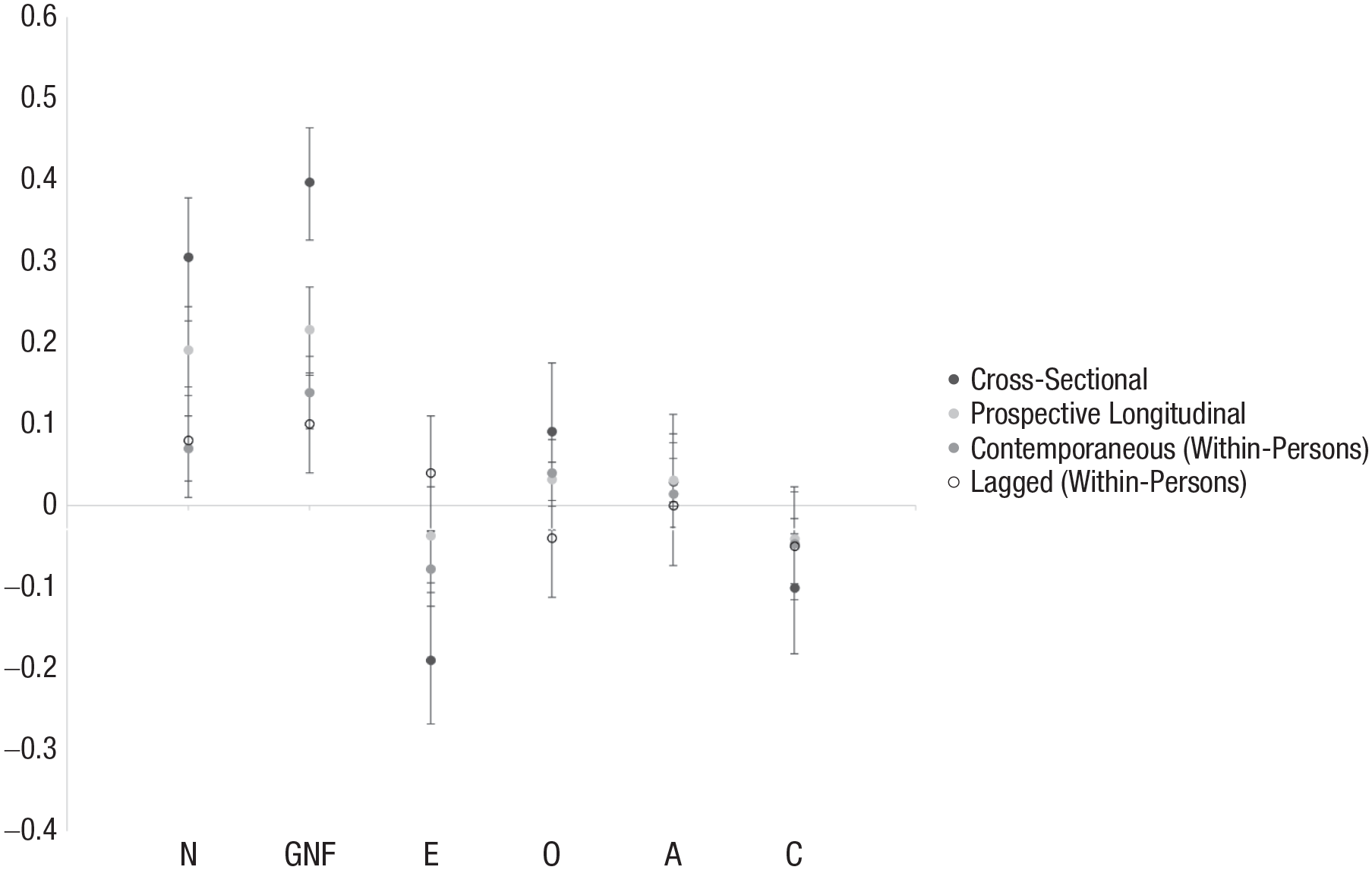
Standardized coefficients of point estimates (i.e., posterior medians): individual personality-trait models (95% credible intervals are depicted). N = Big Five Mini-Markers neuroticism; GNF = general neuroticism factor; E = extraversion; O = openness; A = agreeableness; C = conscientiousness.
Study Aims, Hypotheses, Analyses, and Significant Results
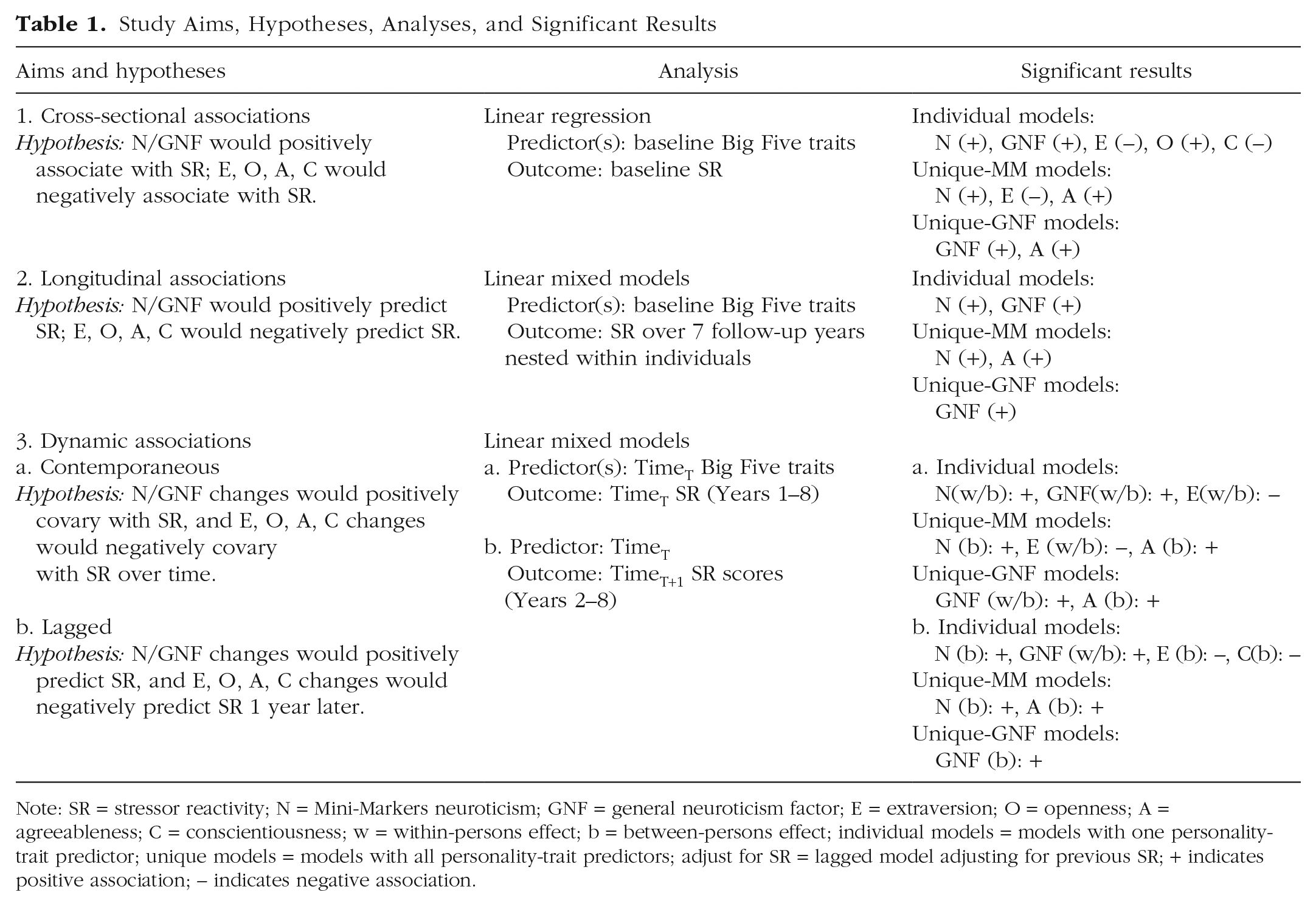
Note: SR = stressor reactivity; N = Mini-Markers neuroticism; GNF = general neuroticism factor; E = extraversion; O = openness; A = agreeableness; C = conscientiousness; w = within-persons effect; b = between-persons effect; individual models = models with one personality-trait predictor; unique models = models with all personality-trait predictors; adjust for SR = lagged model adjusting for previous SR; + indicates positive association; – indicates negative association.
When accounting for all baseline personality-trait effects simultaneously, baseline neuroticism (Mini-Markers: Mdn = 0.29; GNF: Mdn = 0.38) and agreeableness (Mini-Markers Model, Mdn = 0.16; GNF Model, Mdn = 0.13) were positively associated with baseline SR scores. In addition, baseline extraversion (Mdn = −0.16) was negatively associated with baseline SR scores in the Mini-Markers neuroticism model (Table 2).
Standardized Coefficients for Posterior Medians of Personality Traits Predicting Stress Reactivity From Cross-Sectional and Prospective-Longitudinal Analyses
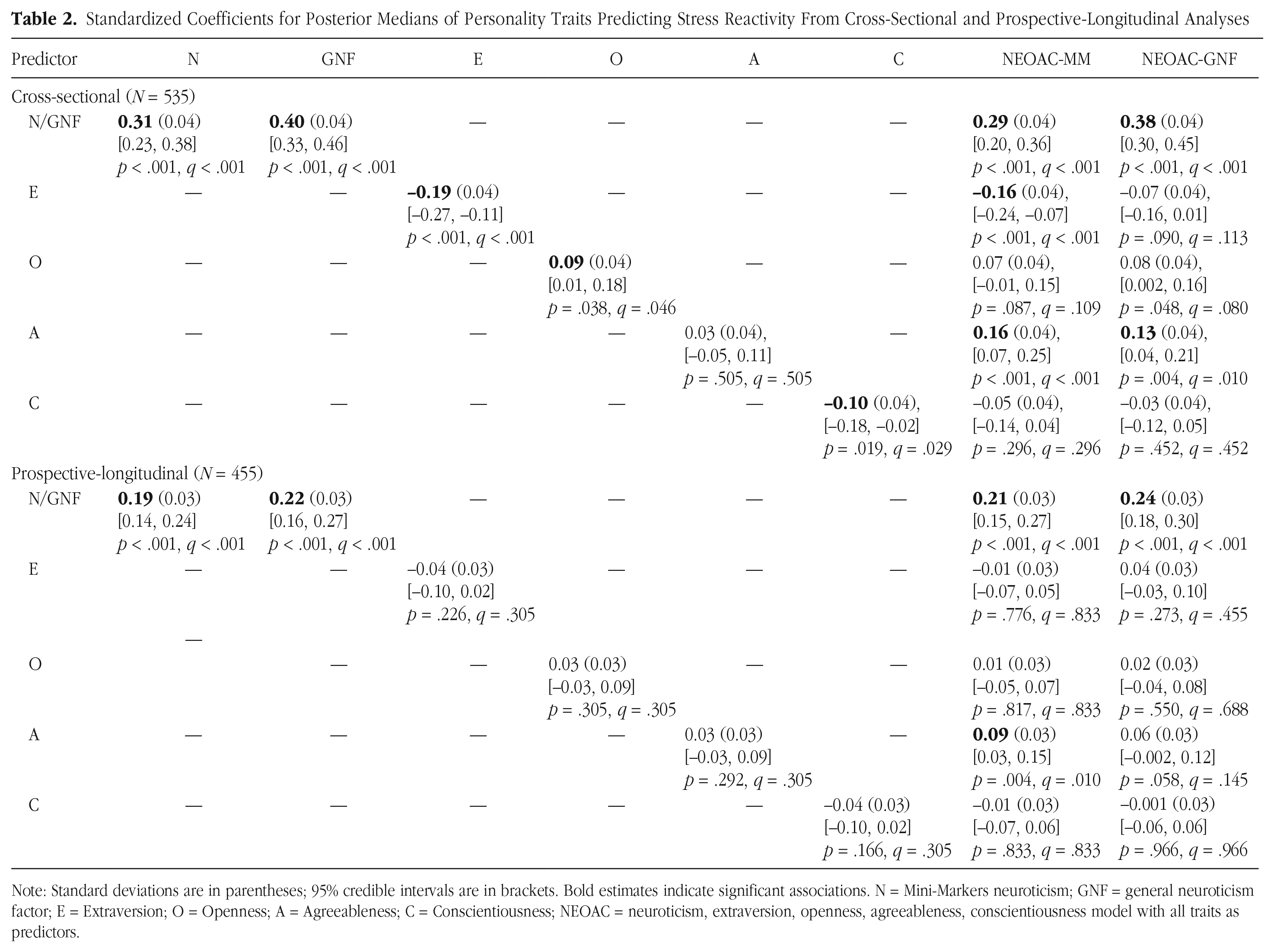
Note: Standard deviations are in parentheses; 95% credible intervals are in brackets. Bold estimates indicate significant associations. N = Mini-Markers neuroticism; GNF = general neuroticism factor; E = Extraversion; O = Openness; A = Agreeableness; C = Conscientiousness; NEOAC = neuroticism, extraversion, openness, agreeableness, conscientiousness model with all traits as predictors.
Prospective-longitudinal associations
The baseline SR score expresses psychopathology reactivity to stressors over a limited time frame of 1 year. A better approximation of resilience as good long-term mental health despite adversity can be obtained from analyzing SR scores of the entire observation period. Furthermore, cross-sectional associations of baseline personality traits with the contemporaneous SR score may be inflated by mood-congruency effects. These can be avoided by prospective analysis. We therefore examined whether baseline personality traits predict SR over Years 2 through 8.
There was a positive linear association between baseline neuroticism (Mini-Markers: Mdn = 0.19; GNF: Mdn = 0.22) and SR scores over Times 2 through 8. Baseline extraversion, openness, agreeableness, and conscientiousness were not significantly associated with SR scores over Years 2 through 8.
When accounting for all personality-trait effects simultaneously, baseline neuroticism (Mini-Markers: Mdn = 0.21; GNF: Mdn = 0.24) was significantly positively associated with SR scores over Years 2 through 8. In addition, baseline agreeableness (Mdn = 0.09) was positively associated with SR scores over Years 2 through 8 in the Mini-Markers neuroticism model (Table 2). Hence, prospective-longitudinal analysis compared with cross-sectional analysis indicates resilience may be associated with a more restricted set of personality traits.
High stressor exposure analyses
Repeating cross-sectional (baseline data) and prospective-longitudinal analyses (baseline personality predicting SR scores over Years 2–8) with participants with high stressor exposure revealed the same pattern of results overall in terms of direction and magnitude (see Supplemental Material 9 in the Supplemental Material). However, three effects reduced to nonsignificance in cross-sectional models: Baseline openness and conscientiousness were not significantly associated with baseline SR scores (individual models), and the association between baseline agreeableness and baseline SR score also reduced to nonsignificance (unique model with GNF measuring neuroticism).
Results were mostly consistent in terms of direction and magnitude in prospective-longitudinal models, with the exception that the unique effect of agreeableness was significant in both models examining all effects of personality traits (the unique effect of agreeableness was significant only in the Mini-Markers neuroticism model in the full sample). This indicates that our observations on the whole hold when a more stringent criterion for stressor exposure is considered.
Contemporaneous dynamic personality–SR associations
ICCs for each personality-trait random-intercept model were calculated to highlight the level of within-persons variance in traits over the study period (see Supplemental Material 10 in the Supplemental Material). Longitudinal analyses separating within- and between-persons variance components indicated positive associations between annual changes in neuroticism (Mini-Markers: Mdn = 0.07; GNF: Mdn = 0.16) and SR scores over Years 1 through 8. Separately, analyses indicated negative associations between annual changes in extraversion (Mdn = −0.08) and SR scores over Years 1 through 8. Results also indicated that mean levels of neuroticism (Mini-Markers: Mdn = 0.22; GNF: Mdn = 0.22) and extraversion (Mdn = −0.06) were associated with SR scores in expected directions over Years 1 through 8.
When accounting for all personality-trait effects simultaneously (Mini-Markers model), annual changes in extraversion (negatively, Mdn = −0.07) were uniquely associated with SR scores over Years 1 through 8. Results also indicated that mean levels of neuroticism (Mdn = 0.26) and agreeableness (Mdn = 0.11) were uniquely positively associated with SR scores over Years 1 through 8. When accounting for all personality-trait effects simultaneously (GNF model), annual changes in GNF (Mdn = 0.12) were uniquely positively associated with SR scores over Years 1 through 8. Results also indicated that mean levels of neuroticism (Mdn = 0.30) and agreeableness (Mdn = 0.08) were uniquely positively associated with SR scores over Years 1 through 8 (Table 3).
Standardized Coefficients for Posterior Medians of Personality Variables From Models Testing Contemporaneous Personality–Stressor Reactivity Associations (N = 455)
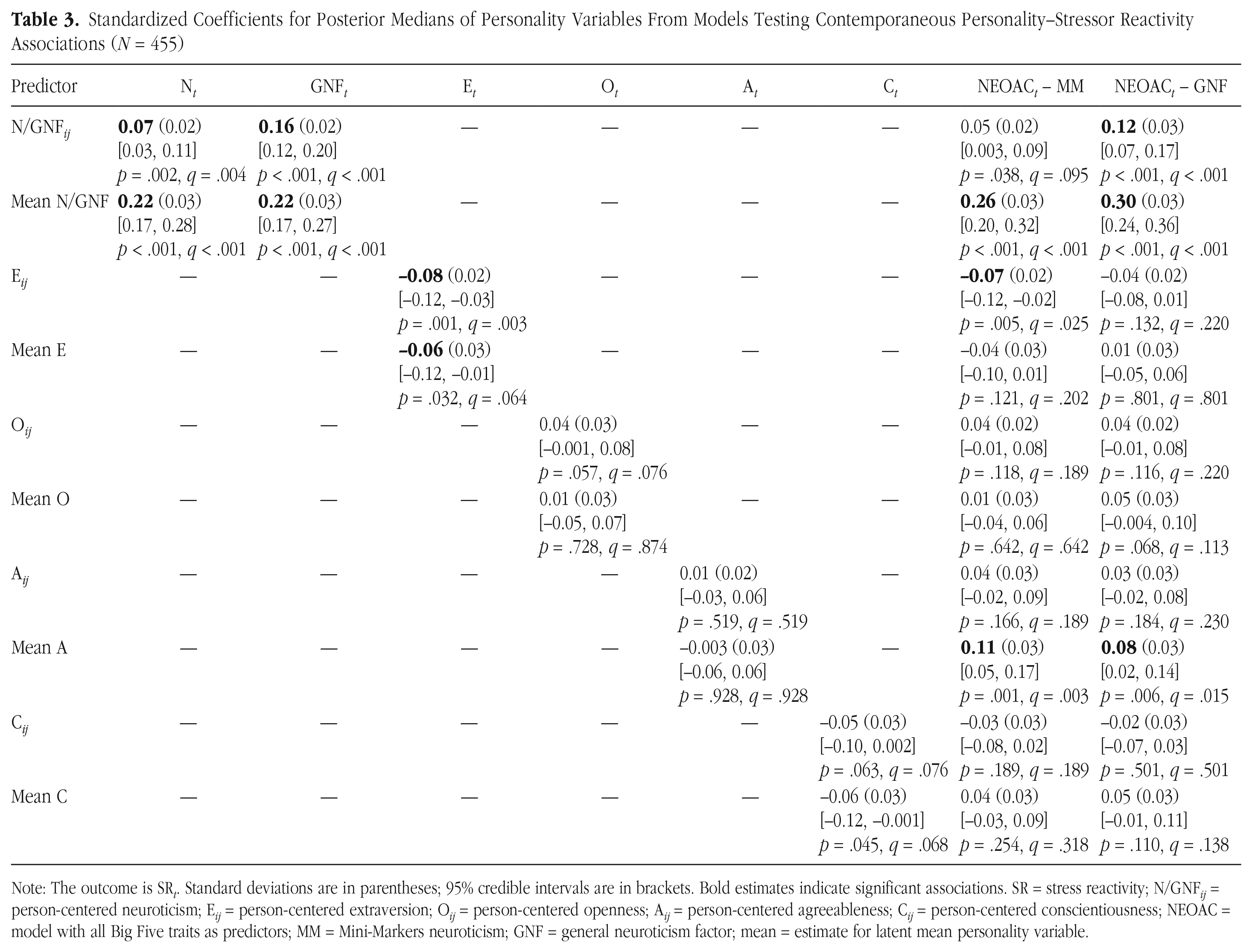
Note: The outcome is SR t . Standard deviations are in parentheses; 95% credible intervals are in brackets. Bold estimates indicate significant associations. SR = stress reactivity; N/GNF ij = person-centered neuroticism; E ij = person-centered extraversion; O ij = person-centered openness; A ij = person-centered agreeableness; C ij = person-centered conscientiousness; NEOAC = model with all Big Five traits as predictors; MM = Mini-Markers neuroticism; GNF = general neuroticism factor; mean = estimate for latent mean personality variable.
Lagged dynamic personality–SR associations
Like the cross-sectional baseline analysis, contemporaneous analyses may be confounded by mood-congruency effects. Furthermore, they do not permit addressing directionality of effects. Both issues can be addressed with lagged analyses.
In individual models, there was evidence for positive associations between annual changes in GNF (Mdn = 0.10) and subsequent SR scores over Years 1 through 8. Results also indicated that mean levels of neuroticism (Mini-Markers: Mdn = 0.23; GNF: Mdn = 0.26) were associated with higher SR over Years 1 through 8. Separately, analyses indicated negative associations between mean levels of extraversion (Mdn = −.10) and conscientiousness (Mdn = −.08) and SR over years 1–8.
When accounting for all personality-trait effects simultaneously, there was additional evidence suggesting that mean levels of neuroticism (Mini-Markers: Mdn = 0.25; GNF: Mdn = 0.29) and agreeableness (Mini-Markers Model: Mdn = 0.11) were significantly associated with higher SR over time (Table 4).
Standardized Coefficients for Posterior Medians of Personality Variables Predicting Stress Reactivity From Models Testing Lagged Personality–Stress Reactivity Associations (N = 455)
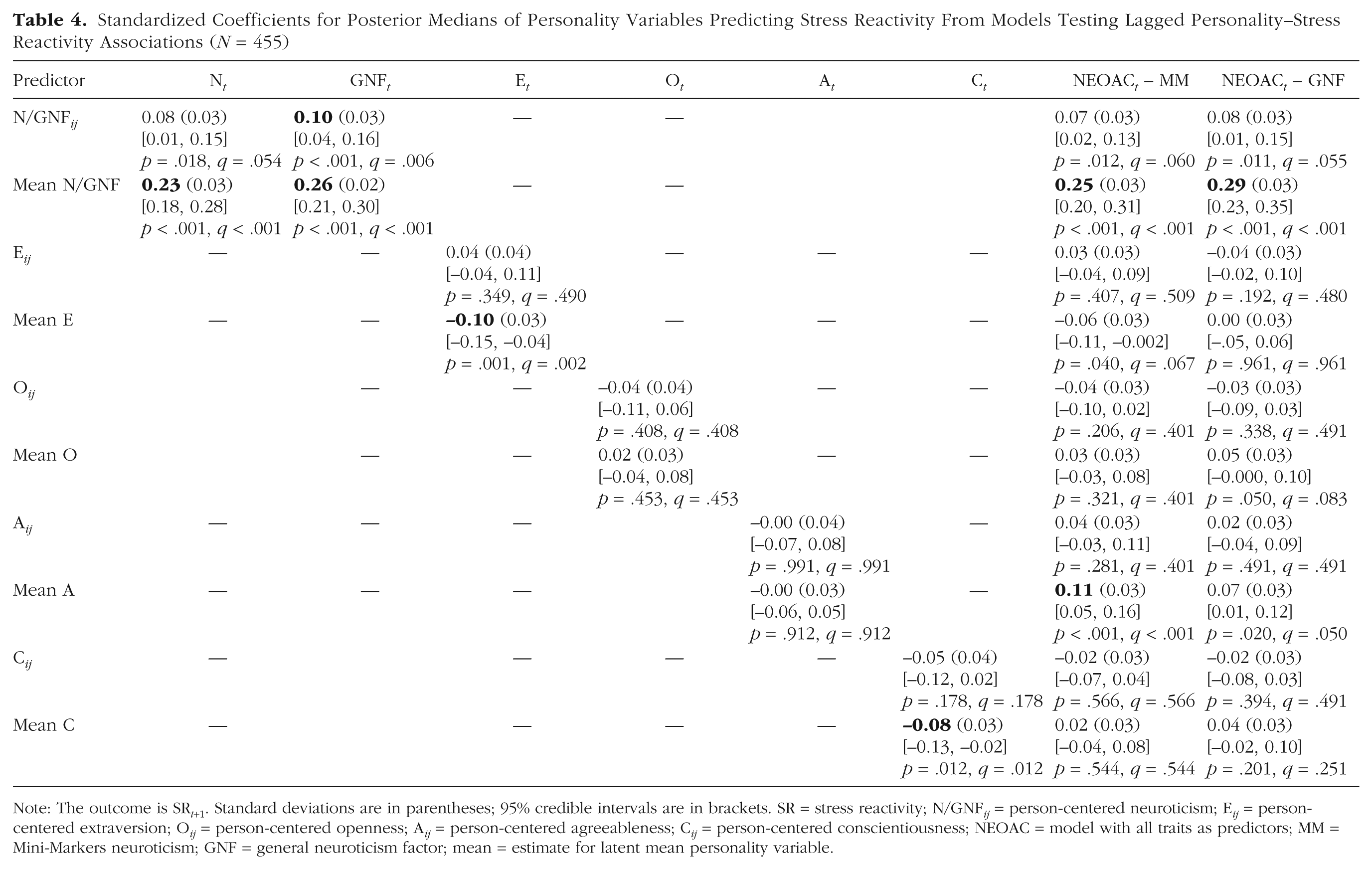
Note: The outcome is SRt+1. Standard deviations are in parentheses; 95% credible intervals are in brackets. SR = stress reactivity; N/GNF ij = person-centered neuroticism; E ij = person-centered extraversion; O ij = person-centered openness; A ij = person-centered agreeableness; C ij = person-centered conscientiousness; NEOAC = model with all traits as predictors; MM = Mini-Markers neuroticism; GNF = general neuroticism factor; mean = estimate for latent mean personality variable.
Discussion
In the present study, we examined cross-sectional, prospective-longitudinal, contemporaneous, and lagged dynamic associations of Big Five personality traits with outcome-based resilience, quantified as relatively lower chronic SR than the sample norm over at least 1 year, in adolescents. We found evidence for associations among personality traits and resilience across different temporal perspectives and analytical methods. Results indicated that the only personality trait consistently associated with SR across different analytic types was neuroticism, contributing to substantial previous work demonstrating the vulnerability posed by this trait. Neuroticism was positively linked with SR and therefore provides further evidence for neuroticism as a risk factor for mental-health problems in stressor-exposed adolescents. No consistent evidence for other personality traits was obtained to clearly classify these traits as resilience factors.
Overall, we contribute to research on the link between personality and psychopathology through recommended methods for research on this topic (Wright & Hopwood, 2022), that is, we examine these relationships on a macro-temporal scale, employ a multimethod approach, and account for context by studying resilience against chronic stressors. We also provide evidence on a range of personality traits as they relate to one’s mental-health response regarding anxiety and depressive disorders while accounting for chronic stressor exposure. Thus, our study contributes to a more comprehensive integration of personality and psychopathology. Our study also provides methodological rigor to the study of the vulnerability model of personality regarding resilience against depression and anxiety outcomes.
Cross-sectional associations
Neuroticism (positively), extraversion (negatively), openness (positively), and conscientiousness (negatively) were individually associated with SR cross-sectionally. Thus, most results from individual cross-sectional models are in line with expected mental-health outcomes in response to stressors given the pattern of behaviors and experiences of each trait domain. Specifically, individuals elevated on neuroticism are conceptualized to be prone to stressors and have strong emotional responses to stressors (Caspi et al., 2005; McCrae & John, 1992). The present study’s findings indicate that low neuroticism is related to resilience. We add to research by linking this trait to a wide range of anxiety and depressive disorders in adolescents and accounting for chronic stressor exposure.
In contrast, high extraversion was individually associated with lower SR, which may be viewed as protection from depression and anxiety in response to chronic stressors. These results suggest that adolescents who tend to be more energetic, sociable, affectionate, and assertive as a function of elevated extraversion may benefit from those resources when experiencing stressors. These resources may be particularly beneficial when seeking support or coping with stressors (Barańczuk, 2019). Separately, the benefit of high extraversion may be noninterpersonal and derive from positive emotionality (McCrae & John, 1992; Sewart et al., 2019; Watson & Humrichouse, 2006). No matter the mechanism, this result suggests that extraversion is linked to lower susceptibility to depression and anxiety in the context of chronic stressors in adolescents.
Separately, high openness was associated with higher SR in our adolescent sample. This finding is not in line with existing research demonstrating positive associations between openness and outcome-based resilience in war-affected adults, trait resilience in young adults, or posttraumatic growth (Linley & Joseph, 2004; Nakaya et al., 2006; Riolli et al., 2002). This discrepancy may be due to a difference in measurement of resilience (e.g., residualization method using interview measures vs. self-report). However, despite evidence suggesting overall weak associations between openness and mental health (Kotov et al., 2010), there is research on elevated openness being linked to the presence of psychopathology and stressful life events (Chiappelli et al., 2021; Trull & Sher, 1994). This effect reduced to nonsignificance in analyses examining participants with high stressor exposure and therefore should not be overinterpreted.
The finding of high conscientiousness being associated with lower SR is in line with the suggested benefits of high conscientiousness and may be explained by greater use of problem-focused coping strategies by individuals elevated on this trait (Bartley & Roesch, 2011). However, this effect reduced to nonsignificance in high stressor exposure analyses and therefore does not hold with a more stringent criterion. Given the cross-sectional nature of associations, another possible interpretation is that the state of depression or anxiety contributes to self-ratings of higher neuroticism or openness and lower extraversion or conscientiousness because of mood congruency.
Regarding unique cross-sectional associations, those for neuroticism and extraversion were consistent with those found in individual models. There was also a unique cross-sectional positive association between high agreeableness and SR, which was not consistent with agreeableness’s individual model result. The unique association between agreeableness and SR is at odds with existing research demonstrating benefits of this trait regarding self-reported resilience (Oshio et al., 2018). This discrepancy may be due to a difference in measurement of resilience or accounting for variance of other personality traits in the same model. Research has found that trait self-enhancement (which may have social costs similar to those associated with low agreeableness) buffers against exposure to potentially traumatic events (Gupta & Bonanno, 2010). However, given that agreeableness was not independently associated with SR, our findings suggest that accounting for the effects of other personality traits leads to unique variance in SR to be explained by this trait. Again, this finding did not hold in high stressor exposure analyses and is therefore interpreted cautiously.
Prospective-longitudinal associations
Longitudinal results suggest that baseline neuroticism contributed variance individually to higher long-term SR. Thus, longitudinal results provide evidence for the robustness of associations between neuroticism with resilience outcomes over 8 years. Our results provide a more nuanced view of the vulnerability model such that we account for stressor exposure in analyses. Results are also in line with longitudinal research demonstrating effects of neuroticism on resilience in international adult samples (Asselmann et al., 2021; Berntsen et al., 2012; Linnemann et al., 2022). Given results of previous studies that failed to provide evidence for a stress-amplification account of neuroticism when longitudinally examining major depressive episodes and transdiagnostic depression and anxiety symptoms (Mineka et al., 2020; Zinbarg et al., 2023), future research should be conducted to reconcile our results with those of such studies. Nevertheless, our results suggest that neuroticism predicts SR during the transition into young adulthood.
In addition, neuroticism and agreeableness (per one model) contributed to higher long-term SR uniquely over and above other personality traits, providing evidence of unique risk posed by these traits that may lead adolescents to be less resilient in the long term. The pattern of results from cross-sectional and longitudinal models converges for neuroticism (individually and uniquely associated) and agreeableness (uniquely associated) but diverges for models examining extraversion, openness, and conscientiousness. Evidence of prospective associations is considered more robust given that analyses avoid bias from state effects (e.g., mood congruency) because there is at least 1 year between assessment of predictors and outcomes.
Contemporaneous dynamic personality–SR associations
Contemporaneous dynamic analyses in individual models revealed positive associations between annual changes in and mean levels of neuroticism (GNF and Mini-Markers) and SR, which is in line with cross-sectional and longitudinal results. In addition, annual changes in and mean levels of extraversion were negatively associated with SR, providing more evidence consistent with cross-sectional analyses. These analyses demonstrate associations using a dynamic analytic approach and adjusting for chronic stressor exposure.
Regarding indication of unique variance in contemporaneous analyses, results were partially in line with cross-sectional analyses investigating unique associations. Specifically, within-persons changes in the GNF and extraversion (one model) were uniquely associated with SR when examining personality traits simultaneously. These results suggest that annual increases in neuroticism may correspond to less adaptive mental-health outcomes adjusting for stressor load, providing support for the vulnerability model regarding unique contributions of changes in this trait over time. Furthermore, annual increases in extraversion seem to contribute unique variance to more adaptive mental-health outcomes relative to stressor load. This result provides evidence for processes related to resilience in adolescents as they enter young adulthood. Changes in extraversion appear to be unique resilience factors, given that these effects were not present in individual contemporaneous models. In addition, the dynamic association is evident only in our sample when accounting for variance of traits assessed by the Mini-Markers measure. Thus, evidence for a contemporaneous dynamic association should be considered limited for extraversion and potentially dependent on measurement.
Moreover, mean levels of neuroticism (both models) and agreeableness (both models) were associated with SR. These results suggest that the relatively stable components of neuroticism and agreeableness may uniquely contribute to resilience. Observed effects demonstrate potentially differential patterns for stable versus trait-like features of these personality variables when and when not accounting for variance of other personality traits. Nevertheless, given the concurrence, these associations are likely explained by state effects. Specifically, altered life situations (e.g., stressful situations, access to resources) that adolescents experience at a given point in time may affect adolescents’ concurrent perceived personality traits and mental health.
Lagged dynamic personality–SR associations
In lagged dynamic analyses, we found evidence for associations among changes in the GNF and SR 1 year later in the expected direction. Results suggest that annual changes in neuroticism predict future resilience status in adolescents emerging into young adulthood. This result is arguably the most robust evidence for the vulnerability model of personality and psychopathology given its prospective and dynamic nature. This analytic approach rules out an explanation of mood congruency or other state dependency for the dynamic effects of these personality traits. It also establishes sequential effects such that personality changes precede resilience changes. Thus, the only clear indication of a resilience process in our sample is for neuroticism. Identifying a resilience process in a lagged fashion is crucial because it suggests that interventions that can produce reductions in neuroticism may affect future increased resilience against chronic stressors.
Moreover, findings regarding mean levels of personality traits in lagged models suggested effects of stable components of neuroticism (both individually and uniquely), extraversion (individually), conscientiousness (individually), and agreeableness (uniquely) affecting resilience levels. This is in line with the notion that resilience is influenced by characteristics that exhibit some stability over time and their change and contextually dependent components (Kalisch et al., 2017; Matthews, 2018; Soto et al., 2011).
The reason for the discrepancy between individual models and models accounting for all personality traits overall is unknown and requires additional research to examine whether such discrepancy results from a nonsubstantial reason (e.g., artifact) or indicates that personality variables differentially predict future response to stressors when examined individually versus when accounting for effects of other traits.
Strengths and limitations
Our study includes several strengths, including studying associations among personality traits and resilience over a longer time course than previous work, which provides knowledge on longer-term associations among personality traits and resilience. Another strength is repeated measurement of chronic life-stressor exposure, mental health, and personality traits over 8 years. These data allowed us to examine cross-sectional, longitudinal, and dynamic associations of both resilience factors and processes in adolescents transitioning into young adulthood. Examining such associations over a sensitive developmental period may have contributed to detection of within-persons associations identified. We also used interviewer-rated measures of stressor exposure and psychopathology and find cross-modality associations between self-reported predictors and interview-rated outcomes. Thus, we can be confident that shared method variance is not the reason for our findings.
However, our study is not without notable limitations. First, our adolescent sample was oversampled on elevated neuroticism at screening. Thus, it is unclear how our results may generalize to a broader adolescent population. In the current study, we also focused on outcome-based resilience such that we examined personality traits as predictors of resilience as opposed to resilience as a predictor of personality traits. Our decision to focus on unidirectional models was clinically informed. Specifically, our analyses prompt focus on detecting personality traits that may be potential intervention targets to boost concurrent and future resilience by modifying traits or environments that exacerbate trait consequences (Frick & Morris, 2004). However, it is possible that resilience may also influence personality traits over time (e.g., coping with stress successfully may reduce neuroticism), and some research has demonstrated how personality may be affected by occurrence of stressful life events, including in the posttraumatic-growth literature (Jayawickreme & Blackie, 2014).
In addition, there are threats to validity of the residual regression approach, including the role of measurement error in our instruments. Furthermore, our measures of personality traits, aside from the GNF, were limited to single scales. More advanced modeling of these traits may elucidate associations that are not found using more narrow and rudimentary measurement. Although we ran select analyses in participants with high stressor exposure to more strictly examine resilience, a separate limitation when examining the full range of stressor exposure is that a larger psychopathology response than expected in the case of low stressor exposure could be conceived as stressor independence as opposed to SR. We also lack a measure of cultural background and therefore cannot examine how one’s culture may affect associations between personality traits and resilience. Finally, we use a SR metric that was calculated using chronic life stressors and depression and anxiety diagnosis severity instead of another operationalization of SR (e.g., stressful life events, symptoms). We chose to not include other iterations of the SR index in our article because such analyses would likely simply reflect the pattern of associations between personality traits and mental health given that there was not sufficient variance explained by stressors in other iterations.
Conclusion
In the present study, we systematically examined cross-sectional, longitudinal, and dynamic associations relating personality traits to outcome-based resilience. We examined a range of personality traits and internalizing disorders, adjusting for stressor exposure, to help elucidate explanatory models of personality traits as they relate to resilience (Tackett, 2006). Overall, we advance the study of personality traits and resilience through our comprehensive analytic approach and operationalization of resilience informed by interview-based assessments and by studying this question during a developmental period that is crucial for addressing SR. Our results add to robust support for neuroticism as a clear target for prevention and intervention efforts given evidence of effects across analytic types and timescales. There was also varied evidence to suggest that extraversion, openness, agreeableness, and conscientiousness may warrant attention regarding mental health in response to chronic stressors.
Thus, interventions targeting select personality traits may be viable targets for increasing resilience to chronic stressors in adolescents in a more immediate time frame and potentially have bearing on long-term changes in resilience. Interventions aimed at enhancing resilience may include prevention programming to develop skills to cope with stressors (e.g., reappraisal) and resources to build on (e.g., relying on social support) given one’s personality profile. Interventions may also encourage replacement behaviors for those commonly associated with neuroticism (e.g., acting on irrational thinking or impulsively) or assist individuals in enacting behaviors associated with more adaptive traits like extraversion (e.g., encouraging sociability or assertiveness; Jayawickreme & Blackie, 2014). Early identification and assessment of personality traits could also guide cognitive-behavioral interventions focused on responding to life stressors.
Supplemental Material
sj-docx-1-cpx-10.1177_21677026241281312 – Supplemental material for Cross-Sectional, Longitudinal, and Dynamic Associations Among Big Five Personality Traits and Resilience in Primarily Female, Upper-Middle Class, Ethnically Diverse U.S. Adolescents
Supplemental material, sj-docx-1-cpx-10.1177_21677026241281312 for Cross-Sectional, Longitudinal, and Dynamic Associations Among Big Five Personality Traits and Resilience in Primarily Female, Upper-Middle Class, Ethnically Diverse U.S. Adolescents by Allison Metts, Lara M. C. Puhlmann, Matthias Zerban, Raffael Kalisch, Richard E. Zinbarg, Susan Mineka and Michelle G. Craske in Clinical Psychological Science
Footnotes
Acknowledgements
We thank Andy Lin and Craig Enders for statistical consultation.
Transparency
Action Editor: Aleksandra Kaurin
Editor: Jennifer L. Tackett
Author Contributions

Notes
References
Supplementary Material
Please find the following supplemental material available below.
For Open Access articles published under a Creative Commons License, all supplemental material carries the same license as the article it is associated with.
For non-Open Access articles published, all supplemental material carries a non-exclusive license, and permission requests for re-use of supplemental material or any part of supplemental material shall be sent directly to the copyright owner as specified in the copyright notice associated with the article.
