



Abstract
International mobility experiences such as student exchange can promote identity development and cultural awareness. However, little research has assessed such processes using a master narrative framework. This study explored undergraduate student perspectives on how changing cultural contexts and the associated cultural master narratives influence identity development during university exchange experiences. Twenty interviews were conducted with Australian and U.S. exchange students aged 21-22 years. Thematic analysis identified a process model of master narrative awareness and associated responses incorporating three key elements: contexts of awareness, identity responses, and experiences of self-transformation. A fourth theme highlighted the influence of individual identities as interaction effects in these processes. The findings show that exposure to diverse master narratives during student exchange enhances students’ awareness of their own and other master narratives, which supports identity development. The study provides new insights into the ways intercultural experiences shape master narrative awareness and identity in emerging adults.
Introduction
University student exchange is an increasingly common experience during emerging adulthood associated with many beneficial outcomes, including increased confidence, intercultural competence, and self-awareness (European Commission, 2014; Roy et al., 2019). Recently, research has increasingly focused on how exchange influences young peoples’ identities (McKay et al., 2022a; McKay et al., 2019). However, many questions remain as to how entering a different culture while abroad influences identity development (Schwartz, 2016). The framework of narrative identity is well suited to answering these questions because it facilitates the study of the ways cultural contexts, embodied in master narratives, such as culturally shared stories, shape an individual’s personal story and subsequent identity formation (Hammack, 2008; McKay et al., 2019). However, the master narrative framework has rarely been applied to the study of short-term international study programs such as student exchange. The current research addresses this gap by assessing students’ experiences of cultural master narratives through exchange and the associated personal identity development that occurs as part of the experience.
Identity at the individual level encompasses a person’s beliefs, values, goals, self-representations, and self-evaluations that are consistently maintained over time and across various contexts (Vignoles et al., 2011). Identity development is a key task during emerging adulthood (Arnett, 2000; Crocetti et al., 2012), involving the formation of an integrated sense of this is ‘who I am’ (McAdams & Zapata-Gietl, 2014). During this time young people explore questions such as “who am I?”, “what do I believe”, and “what will I do with my life?” (Vignoles et al., 2011).
Identity development has been described as comprising three interrelated strands of development (McAdams & Zapata-Gietl, 2014). The first strand relates to the roles and traits that establish an individual’s reputation or the way they are seen by others. The second involves the development of a sense of oneself as a goal-directed agent. The third relates to the development of a personal narrative that encompasses the past and imagines the future. Understanding identity requires an understanding of how all three strands develop and interact over the life course.
Although contextual influences have been acknowledged as fundamental to the identity development process, much of the research on identity has ignored such contextual influences (McLean et al., 2020). Advancements in the narrative identity field facilitate new opportunities for understanding how context, in the form of master narratives, shapes people’s identities (McLean et al., 2018; McLean & Syed, 2015). Master narratives “are culturally shared stories that provide guidance for how to belong to, and be a good member of, a given culture; they are useful frameworks that guide personal story construction” (McLean et al., 2017, p. 2).
McLean and Syed (2015) describe interrelated principles that are indicators of master narratives. None of these principles constitute a sufficient criterion for a master narrative, but together, they help in the identification of master narratives. Firstly, master narratives exhibit utility by providing individuals with guidance on how to be part of their culture, offering information on the group’s history, goals, values, and identities. Secondly, they are nearly ubiquitous within their cultural context, meaning that even if not universally accepted, they are widely recognized by group members. Thirdly, master narratives are largely invisible, as individuals unconsciously and automatically internalize them. These narratives become explicit only when their norms are violated or when alternative narratives challenge them. Fourthly, master narratives possess a compulsory nature, carrying moral and ideological messages that dictate how individuals should think, feel, and behave. Lastly, they are rigid, offering a well-defined but inflexible structure for narrative identity, which often reinforces societal privileges and deeply held values.
Examples of master narratives include cultural scripts about the life course, such as expected roles at different life stages, preferred story structures like the redemptive arc, and frequently retold cultural events, such as the narrative of 9/11 in the U.S. These narratives fall within the narrative identity model, which focuses on how people’s life stories provide coherence to their experiences (McAdams & McLean, 2013). Analyzing personal stories within this framework can offer valuable insights into the identity development process, highlighting how individuals make sense of their experiences in the context of their cultural master narratives (Adler et al., 2017; McLean & Syed, 2015). Importantly, the master narrative and personal narrative approaches to identity align in the adoption of a common metaphor for analyses, namely, what is the story that the person tells about themselves and how does that relate to the story they tell about their culture (McLean & Syed, 2015).
Studying master narratives is complicated because people are often unaware of the influence of the dominant cultural narratives in their lives, especially when they are in a privileged position of aligning with the narrative (McLean et al., 2020). One way to address this challenge is to focus on individuals who endorse alternative narratives—those that resist or counter master narratives, such as narratives that reject traditional gender norms (McLean et al., 2018). These types of alternative narratives can help highlight the salient features of cultural master narratives and the way that they shape individuals (McLean et al., 2018). However, this approach has limitations. It presupposes that individuals are aware of and able to articulate these counter-narratives, which may not hold true for those deeply embedded in or supportive of the dominant narrative. Furthermore, even when individuals are aware of alternative narratives, they might be reluctant or unable to share their experiences due to social pressures or fear of marginalization.
An alternative method to study master narratives is to examine the experiences of those encountering new cultural master narratives when entering a new culture during international study or other mobility experiences. When students go on exchange, they are exposed to a set of new cultural master narratives found within their host culture. Students also regularly interact with a broad range of other international students representing numerous cultures and associated master narratives. The processes of cultural learning that occur through these interactions have been shown to drive increased awareness of cultural biases and the influence of culture generally in the students’ lives (Atkinson, 2010; Bretag & van der Veen, 2015; Paige et al., 2009). This suggests that as individuals discover and learn about different alternative and master narratives found within other cultures, they may become more aware of cultural master narratives both within their home and host cultures by comparing the differences (Hammack, 2008; McKay et al., 2019; 2022b). For instance, students from Australia or the U.S. choosing an exchange program in Nordic countries may encounter social welfare narratives characterized by universal rights to education, health, and social services, which may contrast with more free-market individualist models found in their home culture (de la Porte et al., 2023). A unique feature of these cultural comparisons is that they involve the comparison of multiple dominant narratives rather than comparing dominant and alternative narratives. However, little research has studied such processes within the master narrative framework (McKay et al., 2022b).
Studying an exchange cohort with a master narrative identity approach facilitates the answering of key questions from the fields of exchange, identity, and emerging adulthood. For example, McLean and Syed (2015, p. 319) stated that a central open question in the narrative identity space is “How does the culture ‘get to’ the individual?”. Exchange cohorts are well suited to addressing this question because of their involvement in clearly demarcated cultural experiences that involve a host of alternative narratives. Additionally, individuals may embrace other cultural narratives that do not fit within their home culture and may have to negotiate these differences when they return home. Understanding how such experiences influence identity development in emerging adulthood is not only valuable from a theoretical standpoint but may allow for the identification of key experiences that can be used to support identity development for non-exchange cohorts.
To better understand how these processes of cultural comparison and identity development occur during exchange experiences, it’s crucial to consider the context from which students originate. Our study focuses on emerging adults from Australia and the U.S., two countries that share similarities but also have unique aspects in their emerging adult experiences. In both countries, emerging adulthood is characterized by identity exploration, instability, self-focus, and feeling ‘in-between’ (Arnett, 2000). However, there are notable differences in higher education experiences. While college attendance of high school graduates is higher in the U.S. (66.0%: National Center for Education Statistics, 2024; vs. 52.3% in Australia: Department of Education and Training Victoria, 2022), completion rates are similar (60.0% in the U.S.: National Center for Education Statistics, 2022; vs. 61.8% in Australia: Australian Government Department of Education, 2022), and Australian students face lower debt burdens (AUD ∼$29K: Australian Taxation Office 2023; vs. USD ∼$38K: Hanson, 2024) and more flexible repayment terms (Australian Taxation Office, 2024; Hanson, 2024). Australian students more often live at home and engage in paid work while studying, though students in both countries typically remain financially dependent on their families (Fingerman & Yahirun, 2016; Ribar & Wong, 2022), with those from privileged backgrounds having more opportunities to explore and invest in their future (Marshall & Butler, 2016; Ribar & Wong, 2022). Australian campuses are also more internationally diverse (26% international students: International Education Association of Australia, 2023; vs. 5% in the U.S: Institute of International Education. nd), potentially offering greater pre-exchange intercultural exposure. These financial, living arrangements and diversity differences may influence students’ perspectives on cultural narratives around education, work, and success, potentially impacting how they perceive and adapt to new cultural environments during exchange programs.
This study explores undergraduate student perspectives on the ways in which changing cultural contexts and the associated cultural master narratives influence identity development during university exchange experiences among students from Australia and the U.S.
The research had two primary aims: 1. To explore whether students become more aware of cultural master narratives through participating in a student exchange program and, if so, how such awareness occurs. 2. To explore the ways that exposure to new cultural master narratives influences the personal identity development of emerging adults.
Methods
This study was preregistered (https://osf.io/ygzqp). The preregistered plans were followed with two exceptions. Firstly, we originally included seven research questions that were overly detailed and unnecessarily prescriptive. The revised research questions above captured the key essence of the original seven questions while reducing prescriptiveness in the analytic process. Secondly, we had intended to complete a synthesized member checking process to confirm our findings with participants. Unfortunately, due to delays in the analysis process, many participants were unable to be reached because their student email addresses were no longer active, rendering this process unfeasible. The study was reviewed by the University of Melbourne Human Ethics Review Committee (Reference: 21737) in Australia and the Institutional Review Board at Middlebury College (Reference: 21-016) in the U.S.
Participants
Interviews were completed by 20 emerging adults who had participated in an exchange program within the last two years. Participants were recruited from a list of undergraduates who had studied abroad the previous year as part of their enrollment at a private college in the U.S. and at a public university in Australia. In the initial survey invitation, participants were asked a series of demographic questions, to which they could free-write their responses. In addition to questions about age, gender, and race/ethnicity, one question pertained to the length of their exchange, and three questions pertained to place: (1) What is your home country? (2) What was your host country when you went abroad? (3) What is your nationality?
All of the participants recruited from the Australian university listed Australia as their home country (n = 10, 9 females, 1 male) and, at the time of the interview, were aged between 21 and 25 (M = 22.10, SD = 1.45). Their host countries included Austria (1), Germany (2), Netherlands (2), Wales (1), United Kingdom (unspecified: 3), and U.S. (1). The length of exchange ranged from 1 – 7 months (M = 3.80, SD = 2.04), and 4 participants had their exchange cut short by the COVID-19 pandemic. Of the participants recruited from the U.S. college, one was an international student (male, age 22) who identified his nationality and home country as South Korea but had spent the previous seven years living in the U.S., while the remaining nine participants (six females, three males) identified the U.S. as their home country and their nationality as American or as dual citizens with France, Switzerland, or Canada. The college students from the U.S. were aged between 21 and 22 (M = 21.8, SD = .42) and their length of exchange ranged from 3 – 9 months (M = 5.00, SD = 1.76), with two participants having had their exchange cut short by the COVID-19 pandemic. U.S. exchange student host countries were Argentina (1), China (1), Denmark (1), France (1), Japan (1), Jordan (1), New Zealand (1), Russia (2), United Kingdom (1), Uruguay (1); note that one student studied in two different countries during their time abroad. The majority of participants already had prior international experience, with only one from Australia and one from the U.S. not having visited another country previously.
Materials
A semi-structured interview guide was developed for this study and included an introductory script and a series of questions related to cultural master narratives and students’ exchange experiences (a full copy of the interview guide can be found in Appendix A). The initial pool of questions for the guide was developed collaboratively by the research team based on the study aims and broader literature on cultural master narratives (e.g., Mclean et al., 2018; McLean & Syed, 2015) and identity (e.g., McAdams & Zapata-Gietl, 2014; Vignoles et al., 2011). The preliminary interview guide was then reviewed and revised based on guidance from the Research Review Committee at Orygen, which incorporates subject matter experts, young people with lived experience of mental ill health, and researchers. This led to the inclusion of a definition of master narratives that was shared with participants as part of the introductory script for the interview. The final interview guide included questions focused on students’ home culture master narratives, their experiences of master narratives while abroad, and the impact of their exchange and associated cultural master narrative awareness (or lack of) on their identity and daily lives both while abroad and since returning home.
Procedure
Participants were recruited from a larger pool of students attending university in Australia or the U.S. who completed a brief survey on their exchange experience. Interviews were conducted online using Zoom, as the interviews were conducted while COVID-19 pandemic restrictions were in place. All interviews lasted between 30 and 70 minutes (median = 53 minutes) and were recorded and transcribed verbatim. Transcripts were de-identified and initially coded using the Taguette software. Subsequent analysis of the codes was conducted manually and described in detail next.
To assess data saturation (e.g., repetition of previous data: Saunders et al., 2018) a structured note taking process was conducted after each interview based on the system of Phillippi and Lauderdale (2018). This allowed for preliminary analyses and the identification of new ideas. In the Australian sample, repetition of ideas started after the first interview and no new ideas were identified after the ninth interview. In the U.S. sample, repetition of ideas commenced after the first interview, and no new ideas were identified after the eighth interview.
Data Analysis
A codebook thematic analysis was conducted using guidelines articulated by Braun and Clarke (2019; Clarke & Braun, 2021), which are grounded in meaning-making and researcher reflexivity. All authors initially reviewed the interview transcripts to become familiar with the data. Next, we randomly selected two transcripts for all authors to read and independently generate an initial set of codes. These codes were compared in subsequent discussions, and a preliminary codebook was developed which employed a theoretically engaged inductive approach, aiming to maintain fidelity to participant narratives while being grounded in existing theory. For instance, initial codes revolved around the identification of master narratives (e.g., descriptions of increased awareness of master narratives) and identity responses related to beliefs, values, and goals (e.g., direct descriptions of specific identities such as gender, or indirect descriptions related to the student’s beliefs, values, or goals). Coding was an iterative process in which the initial codes were tested on subsequent transcripts by author pairs, who coded independently and then met to compare results and discuss any differences in coding. Rather than calculate inter-rater reliability, which Braun and Clarke have argued is a quantitative approach imposed on a qualitative method (2019), we took a consensus approach to reliability, where differences in coding were resolved through discussion and moreover were fruitful for clarifying our own conceptual understanding of the data and thus clarifying the codes (Syed & Nelson, 2015). This consensus approach refined the codebook as codes were modified, removed, or added. After several such iterations, a final codebook was agreed upon by all four authors and implemented in a final round of coding for all twenty transcripts with a focus on simultaneously coding transcripts for responses relevant to the two study research aims.
In keeping with the philosophy of thematic analysis, this process was highly reflexive, with each of the co-authors bringing unique lived experiences of living and studying abroad (e.g., different home countries, languages, cultures, and countries where they have lived, studied or worked) that were complementary and used to inform the analyses and the subsequent discussions. We engaged in regular reflexive discussions to critically examine our assumptions, biases, and preconceptions, acknowledging how our individual backgrounds and experiences might shape our understanding of the data. These discussions were integral to the code development process and ongoing analysis, providing a structured approach to identify and address our subjective influences. This reflexive practice was not a one-time activity but a continuous process that often led to new perspectives and deeper insights into both the data and our own biases. By rigorously questioning our interpretations and challenging each other’s viewpoints, we enhanced the validity and richness of our coding and subsequent themes. Through these coding discussions between authors, we developed a process model wherein the twelve codes were organized within four themes (see Figure 1). Summary of themes and codes. Note: bg = background.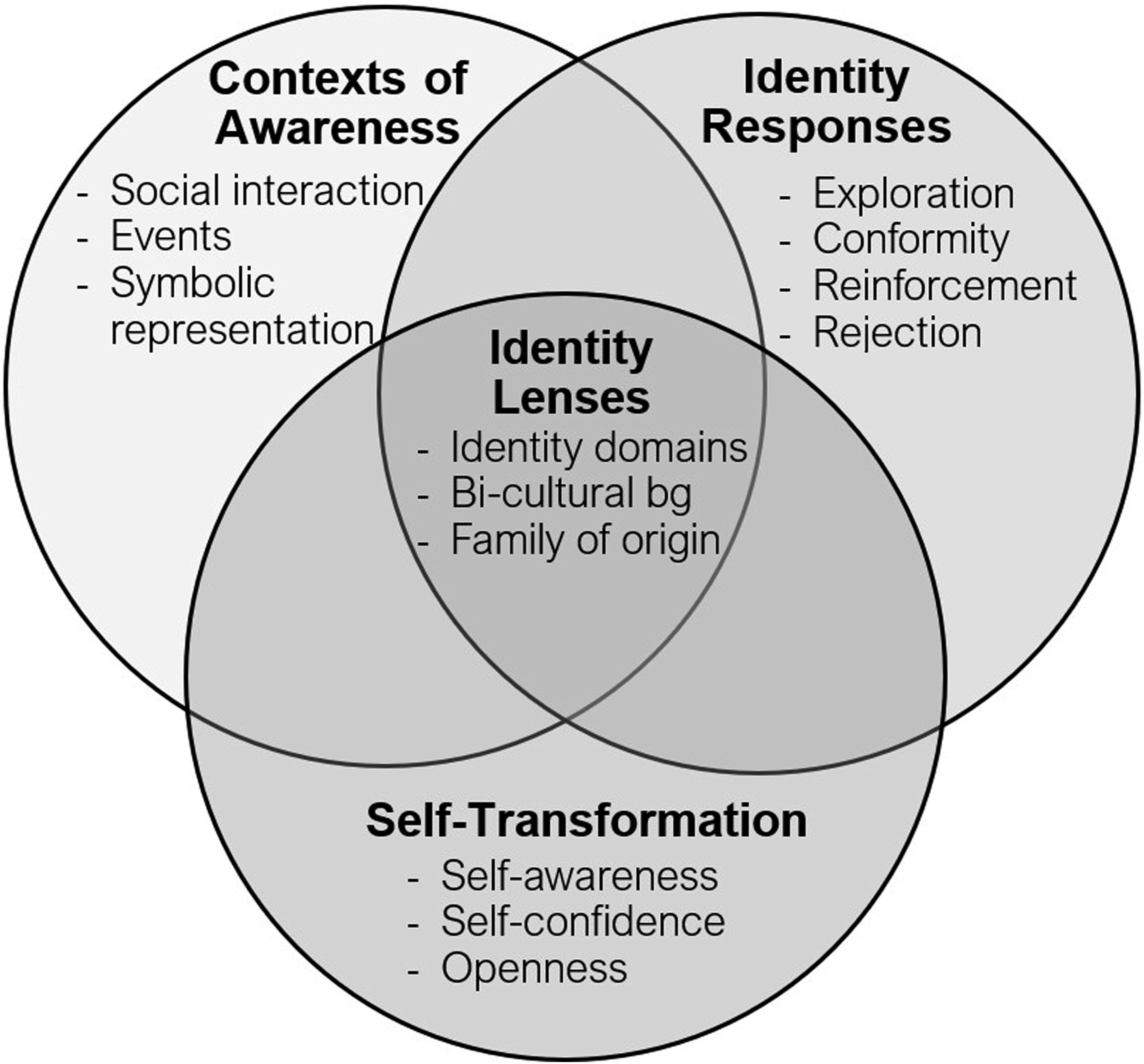
Results
Overview
Interview participants reported becoming more aware of master narratives during their exchange experiences. Our interviews revealed three major elements involved in participants’ awareness and associated responses to this awareness during student exchange experiences, which comprise the first three parent themes: 1. Contexts of awareness: The environments and experiences that prompted master narrative awareness. 2. Identity responses: The strategies individuals used to navigate their identities after becoming aware of different master narratives. 3. Self-transformation: The personal changes participants experienced as a result of master narrative awareness.
Additionally, these three elements were influenced, or intersected, by the identity lenses each participant held, forming a fourth parent theme: 4. Identity lens as interaction effect: How individual identity positions influenced the processes of awareness, response, and outcome
An overview of the results is provided in Figure 1 below.
This process model illustrates how the environments and experiences (Contexts of Awareness) prompt master narrative awareness, leading to various identity navigation strategies (Identity Responses), ultimately resulting in personal changes (Self-Transformation). These processes are further shaped by the individual identity positions of participants (Identity Lens as Interaction Effect). Each of the themes is explained in detail below.
RQ1: Do Students Become More Aware of Cultural Master Narratives Through Participating in a Student Exchange Program, and if So, How Does Such Awareness Occur?
The interview results indicated that participants became aware of the cultural master narratives of both their host and home countries. Notable narratives brought to students’ attention included those related to nationality, family relationships, life course, power, and privilege. This heightened awareness often involved a juxtaposition of the cultural narratives of the students’ home and host countries. Given that participants reported increased awareness, we turned to the question of how such awareness was occurring.
Theme 1: Contexts of Awareness
Three contexts were identified as facilitators of master narrative awareness: social interactions, events, and symbolic representations, the latter of which was defined as external, visible differences that symbolized latent master narratives, such as food, behaviors, or customs. Awareness was triggered through observation or direct experience in one or more of these contexts.
Social Interaction
A common context for awareness occurred within episodes of social interaction, which shaped students’ understanding of, and behavior in, the host culture. Conversations and activities with host family and friends played a central role. For one, “It was certainly conversations, a lot of discussions in fairly large groups as well, like… all six of us at a time in the kitchen… talking about politics” (Australian female, age 20, in Germany). Peers, flatmates, and romantic partners exposed participants to new ideas and activities that prompted awareness and eventual exploration; for instance, a student shared, “I’ve got probably my strongest understanding of German culture through [my girlfriend]” (Australian female, age 19, in Germany) and another discovered, “People that I met who were just completely different to anyone else in my life… and you kind of go, well if that person can do that, why can’t I?” (Australian female, 21, in U.K.).
Social interaction also illuminated aspects of their home culture and personal identity. “Once you go to a foreign place, people ask you about your country, so it forces you to think about what it is like to be Australian…” (Australian male, 20, in Austria). One Australian learned that political views became a determinant for friendships in her host culture of the U.S. “They asked, what was your political stance? And if I said the wrong thing, they literally moved away from me” (Australian female, 20, in U.S.).
Master narrative awareness also arose during attempts to explain their home culture to their host culture friends. For one student conversations about race, … forced me to reckon with and consider much more deeply the legacy of slavery in the U.S. and the legacy of, you know, Native American genocide in the U.S… I often had to defend or explain things that I didn’t necessarily agree with…So I had to start thinking, I really had to reframe where I fit in these debates (American male, age 22, in Uruguay).
Events
For some students, awareness was prompted by experiencing a singular or series of memorable events in a political, academic, or social arena. For one student, dinners and parties served as events that exposed differing cultural narratives around hospitality between his home country of the U.S. and his host country of Uruguay: At the beginning, I don’t know that I understood it exactly so when someone would offer me a drink of their beer or when someone would, buy a pizza for the whole table I think I’d feel somewhat uncomfortable that I wasn't doing my responsibility, or that that exchange was not equal, and I was not giving enough (American male, age 22, in Uruguay).
In contrast, he perceived that in the U.S. people closely monitored gift-giving to ensure that everyone contributed equally, an attempt at fairness which sometimes bred tallying or resentment, compared with the generosity and trust in reciprocity he experienced in Uruguay. Another student described how the university and culture in their host country of Wales were much more politically engaged than in Australia, and this was exemplified during orientation week: It came about because in the orientation week, when they were just giving us a brief overview of Welsh culture, they mentioned the election and the lady delivering it was very strong in her opinions (Australian female, age 20, in Wales).
The student also noticed a stark difference in the response to political events between the two countries: The other thing that I did notice is in my university experience [in Australia] we don't have major uprisings. The university is pretty, like we all obliged by the rules, we just go with the flow, are all pretty happy with it. Whereas when I was over there, for eight or nine weeks, there was a big strike in the university (Australian female, age 20, in Wales).
Symbolic Representation
Practices around food, time, money, clothing, greetings, and communal spaces surfaced as symbolic representations of cultural master narratives. For example, most of the U.S. participants encountered a “more lax” attitude around time in their host cultures, including within the university setting. Adopting a more relaxed attitude and indulging in more down time resulted in an appreciation of “less intensity in daily life” in the host culture, while simultaneously revealing an awareness of master narratives of productivity in the U.S., which included valuing “time management… being on time… getting things done” (American female, age 22, in Jordan).
Symbolic representations raised awareness of cultural attitudes around diversity and power. For instance, “I saw people walking around like full, like emo-goth get-up, like full mohawk and everything. And I’m like, you don’t see that so much in Australia… I think on a whole, there is a lot more openness and accepting in UK” (Australian female, age 21, in U.K.). A participant on exchange in the Netherlands never forgot the experience of seeing “the king and queen [going] to work on their bike with everyone else” and saw that as indicative of a “very low power hierarchy” compared to their home culture of Australia (Australian female, age 22, in the Netherlands).
RQ2: How Does Exposure to New Cultural Master Narratives Influence the Personal Identity Development of Emerging Adults?
Theme 2: Identity Responses
The second research question investigated how individuals’ identities were influenced by shifts in master narrative awareness. Notably, following the recognition of different master narratives, participants responded by adopting one of four identity strategies: exploration, conformity, reinforcement, or rejection.
Exploration
Participants who explored in response to their awareness of master narratives typically did so by intentionally expanding their comfort zones, experimenting with letting go of conceptions of an “old” self and allowing aspects of a “new” self to unfold. Encountering new perspectives facilitated that exploration: “I started to consider things from like other points of view a little bit more” (Australian female, age 23, in U.K.). These new perspectives had an effect: “I was forced to really evaluate… what cultures I was a product of and what I have assimilated and what I have not from my different backgrounds” (American female, age 22, in Japan). One student credited the openness and acceptance she encountered in her host culture with motivating her to “come out as bi[sexual]” once she returned to her home culture (Australian female, 20, in U.S.). Notably, discomfort or confusion stemming from encountering new perspectives did not appear to inhibit these participants from exploring: “I was still confused, but I was more like oh it’s just the time to enjoy myself and explore things and see what happens” (American female, age 22, in France).
Participants acknowledged that a felt sense of freedom and independence contributed to their exploration. For instance, “I felt like I was getting to be my own person, not that I hadn’t before but I’d never had complete autonomy over my actions and the same way that I felt that I did in France” (American female, age 22, in France). Another described it as: That freedom, the new place, the feeling like you're leaving everything that you've ever known and going to something that you have yet to discover. It allows you to try out those identities—am I an English teacher, am I an American, am I all of these things? It allows you to play with them in a way that you're not really allowed to play with them so much in your in your own context, because you know, your friends, your parents, your people would correct those, um, sort of excursions outside of the boundaries of who we normally are. And some of those identities, I said yes, this is actually what I want to do, and sometimes I said well, maybe it's not so much what I want to do… I think my experience abroad helped me look a little bit more critically at what that identity is and actually see alternatives (American male, age 22, in Uruguay).
Conformity
Adapting or conforming to cultural norms was another distinct response, and such conformity allowed them to develop new understandings of master narratives both in their home and host cultures. This process sometimes involved actively adopting local behaviors, languages, or mannerisms. As one participant said, “I changed my accent as well, like tried to embody that Argentinian accent as well as use their colloquial slang, just basically embody their personality or personalities that I’d been seeing in the country” (South Korean male, age 22, in Argentina).
The cultural conformity process generally involved first understanding the norms from other cultures. Sometimes this occurred through interactions with locals where specific ideas or ways of life were shared with the participants, while in other cases the students learned through processes of observation. As one participoant shared, “And so that means that embracing all the German traditions, anything my host family puts me up to, I will, I’m up to it, even if I have no idea what’s going on, which is true most of the time” (Australian female, age 20, in Germany). This learning process allowed them to decide whether to adopt or reject the norm and presented new perspectives on both home and host cultural master narratives.
This process created tension for some. For instance, one student’s experience of the gender stereotypes of her host country of Japan prompted her to modify aspects of her identity that didn’t match those expectations: I felt frustrated by these expectations and by, um, meeting people who expressed that they thought women should behave X number of ways, or should be a stay at home, uh, wife and mom and just do all of these actions that are coded as feminine… when you push back it has pretty serious consequences in that, uh, it's still not a very accepting society or like open society (American female, age 22, in Japan).
This particular student described her response of “downplaying of certain parts of my identity” as a coping strategy used to better assimilate into Japanese culture after experiencing their negative reactions to her “unfeminine” behaviors, such as being assertive and opinionated. However, this strategy came at a cost: “In a way, I think that was a bit harmful to myself, because I was trying to just stifle some of the things that make me ‘me’, and that are obviously products of how I grew up.”
Whether experienced positively or negatively, the conformity response appeared to be utilized as an attempt to adapt to their host culture in a way that helped them assimilate into their new peer groups and communities.
Reinforcement
In some cases, participants responded neither by exploring nor conforming, but rather by reinforcing their current sense of self or beliefs. Participants in this category spoke about their exchange experience “confirm[ing] the existing beliefs that I held” feeling like their views “became stronger” or were “reaffirmed.” Rather than their views and beliefs changing, another said, “I think they’ve been enhanced” (Australian female, age 21, in U.K.). For some, this reinforcement of identity occurred because they found an alignment between themselves and their host culture; for instance, one participant said, “It was so refreshing because I went to Denmark, and I said okay, my attitudes kind of match” (American female, age 21, in Denmark). For others it was the result of living a lifestyle or associating with people very similar to their home culture; one attributed their reinforcement to, “the fact that the people I mainly associated with come from similar cultures to me” (Australian female, age 20, in U.K.).
Reinforcement could also take the form of defending or appreciating an aspect of their identity that they had formerly dismissed or judged. A Chinese-American raised in the U.S. shared that studying abroad in China “really made me like more proud of being Chinese and you know more aware of how amazing Chinese culture is” (American male, age 22, in China). Similarly, another student, who spent the first half of his life in Korea before moving to the U.S., it was while studying abroad in Argentina that he connected with his cultural heritage: Somehow in a country that is so, so far away from my home country, [it] reinvigorated my passion for my home country… going to Koreatown was fascinating because there were immigrants from Korea but also… there were probably other Koreans who were in the same position as I am but they don't really feel like they're fully Argentinian and they don't fully feel that they're Korean… so I would say, compared to my prior self, I hold a bit more pride and comfort to a certain degree about my Korean identity… I’m more at peace with myself as a Korean. (South Korean, age 22, in Argentina).
Rejection
In contrast to the reinforcement of identity, a rejection response to master narratives entailed criticizing an aspect of their own identity or rejecting it in some way. Often this centered around their political or national identity, with a newfound criticism of their home culture. As an Australian, observed while on exchange in Scotland: Hearing them talking about, you know, going net zero emissions by you know, a date that wasn't that far away... And then you kind of go, what the hell is Australia doing? Like, how have we managed to get to this point, as you know, through politics, but also as a society in many ways? (Australian female, age 21, in U.K.)
When participants viewed their nation from the new perspective of their host culture and arrived at a negative self-evaluation, one rejection response was to mask this part of themselves. For instance,
For the first time in my life, I had to really consider myself as an American… [and the] legacies of colonialism… I did not want to be called a Yankee, I did not want to adopt this pretty negative stereotype of what it means to be an American there… I actively distanced myself from that identity… I tried very hard to hide myself… I would totally fit in as long as I didn’t open my mouth, so I wouldn’t open my mouth an awful lot… [in] interactions with strangers, they’d ask me where I was from and I would straight up lie [laughs]… I could convince them that I was from Switzerland, from Germany, so I adopted this (American male, age 22, in Uruguay).
This rejection response was not always confined to the time spent in the host culture; for some it persisted after returning home:
I am a white woman, blonde hair, light eyes, I pass as Danish… I would try to fit in in a way that they didn’t know I was American… and I think since coming back from Europe, I say to my family, ‘I think I was meant to be European’ (American female, age 21, in Denmark).
Rejection also occurred in the domain of occupational identity. A student shared that before going on exchange, “I kind of subscribed a lot more to the fact that like, you get into a good uni, you get into a good degree. From that you get a good job and probably get married and have kids like sort of thing.” However, their experience while on exchange exposed them to alternate life paths and caused them to question and ultimately reject their occupational identity: I ended up transferring out of architecture, because I realised that's not actually what I wanted to do. It was kind of what I felt like other people want me to do… [I’m] kind of trying to push away from the I'm supposed to do X, Y, and Z, get a good job, buy a house and stuff (Australian female, age 23, in U.K.).
Similarly, while on exchange in Great Britain, one American student became aware of his home country’s cultural value of “making the most money… [having] the best job… the biggest house… I didn’t feel comfortable with that goal, like I didn’t see any inherent happiness in it or inherent growth” (American male, age 22, in the U.K.). Whereas before exchange he felt “very, very confident I was going to spend the rest of my life in the U.S.”, after returning home he decided instead to pursue his career in Great Britain, where he felt congruence with his new values.
Theme 3: Self-Transformation
Participants felt the effects of their master narrative awareness during exchange, and as evidenced by their response strategies featured in Theme 2, some of those effects became even more pronounced after they returned to their home cultures. While some participants maintained that they felt their identities had not changed in any substantial way due to exchange, those who did experience a substantive change voiced their experiences as having a transformational effect on the self. The main areas of transformation were related to self-awareness, self-confidence, and increased openness to diverse experiences and ways of life.
Self-Awareness
Enhanced self-awareness entailed a process of reflection brought about by encountering different cultural master narratives. This involved demonstrations of complex thinking, particularly increases in perspective-taking: “I learned that the world is so much bigger than I thought it was, and that I’m not confined to what I know…” (Australian female, age 20, in Germany). Importantly, it was this increase in perspective-taking that laid the groundwork for a transformational shift in behavior or values: I think that this is just part of when you’re exposed to different options and different people, different ways of living, and so on and so forth, all the different things that you experience when you’re living in a new country, new culture, you know, all of a sudden it feels like I have options now, I can choose which parts of myself I want to keep from my childhood and which parts I think, actually no, there's something else that I think works with me better (Australian female, age 20, in Germany).
The specific behaviors and values that shifted were diverse, although many related to cultural master narratives and associated expectations. As one Australian student said, I might be having children without getting married, which for me is a very, like, it’s a concept that I would not have considered for myself previously. It was something I was okay with other people doing. But I would never have considered myself so untraditional (Australian female, age 20, in Germany).
Other values revolved around an improved work life balance, different political ideals, and the breaking down of stereotypes related to cultural and ethnic groups and genders. For instance, while on exchange in Germany a student realized how many gender stereotypes she had inherited from her upbringing in Australia: I've always said that, you know, if I had a daughter, I put her into ballet, maybe voice lessons, gymnastics… typically feminine things whilst I had, you know, for a boy, it was like, I don't care whether he can dance or not, I just want him to play sport. So, you know, I think I, even if I didn't consciously know that at the time, looking back now I see how rigid that seemed and I don't feel the same way now //Laughs//. And I think that, yeah, being with all the I'd say the progressive young people that I lived with in Germany differently kind of opened up pathways for myself, in terms of my thinking, and how I expect people to behave, I guess, because I just don't really hold on to nearly as many gender stereotypes as I used to do. (Australian female, age 20, in Germany)
Self-Confidence
Many students also reported a transformation in self-confidence through overcoming challenges while abroad. They acknowledged that they often had to go beyond their comfort zones meeting new people, speaking another language, and navigating daily life, “without the safety net of the university,” and due to time zone differences, “it’s not like I can really call Mom and be like, what do I do?” For another, studying abroad allowed her to “step up my independence a bit.” She elaborated by saying: Even things like opening foreign bank accounts and paying my own rent in a foreign country, and travel—okay, travel was probably the big thing, actually, for independence. Because I never traveled in Australia. And then I was organizing all this stuff for myself and traveling alone. (Australian female, age 20, in Germany)
Importantly, this confidence stemming from independence sometimes tied back to their processes of becoming aware of and responding to cultural master narratives. As one student said: All the changes that I had are kind of that cultural narrative sense. You know, the independence, my work, all the changes I’ve kind of implemented have kind of rooted from this kind of vast sense of independence... And I feel like, my like, kind of great, progressiveness and just kind of easy, breezy personality that’s come from being overseas, it's all kind of been rooted in those value changes (Australian female, age 20, in U.S.).
Openness
A key value domain that transformed was that of openness to other experiences and ways of life. Participants described themselves as more willing to try new things, as less uptight and more spontaneous, with “more capacity to have more adventures.” They also discussed becoming more accepting of different cultural practices and empathetic to the challenges of living in another culture: “I think I’m just more open to people from different parts of the world, and people with different beliefs and more aware of people being different” (Australian female, age 20, in U.K.). Many students reported becoming more open toward living abroad in the future, with some already initiating a plan to work abroad following completion of their undergraduate degree.
Altogether, participants whose narratives informed this theme of self-transformation articulated a distinct sense of having changed as a person, accompanied by clearer self-definition: It’s my study abroad experience that really just shattered my concepts of myself and my boundaries and what I think is doable or not doable but then I managed to rebuild them in a, in a way, like into someone who I really, really enjoy much more (American female, age 22, in Japan).
They attributed their transformation directly to their exchange experience. For instance, one student noted that before their exchange, “I had no idea what I wanted to do with life” (Australian female, age 20, in U.K.), and another acknowledged, “There’s so much of me that I wouldn’t have if it wasn’t for exchange” (Australian female, age 20, in Germany).
In sum, despite a diverse range of changes experienced by these students, much of the self-transformation they experienced was tied to discoveries rooted within the different cultural master narratives they encountered while on exchange.
Theme 4: Identity Lens as Interaction Effect
The three processes identified in our analysis—Awareness, Response, and Outcome—were intersected by the identity positions held by individual participants. Specifically, we noted that the particular identity domains students identified with (e.g., race, gender, nationality) shaped these processes, with those coming from a bicultural background (e.g., Vietnamese-American) experiencing an additional layer of complexity. Students’ origin stories (e.g., family values and norms) also factored into how they perceived cultural narratives in their host culture.
Identity Domains
We identified gender as one of the most frequently invoked identity domains in participant narratives. Whereas some students, such as one in Germany, encountered a more progressive view: “There’s so much more of a, like, true equality in the sense of anything a man can do a female can do, just as well, if not better” (Australian female, age 19, in Germany); other students confronted more rigid expectations than they were used to, as in the case of the American student who chafed against the norms around femininity in Japan: I was really, really struck by the gender norms, um, because they exist, they've existed all throughout my life as well in both French and Italian American culture that I've experienced, but they were even—as an outsider, because I was a foreigner I, personally, really felt the pressure of how to act as a woman, um, it's still a very heteronormative patriarchal society, and so, women are—it's built, it's fascinating because it's built into the language, the grammar used… (American female, age 22, in Japan).
Ethnic and racial identity also shaped their experiences abroad, and this frequently emerged in stories of encountering racism: It’s people on the streets calling you random, you know, Chinese sounds or Chinese names. It’ll be people saying that you speak German really, really well, for someone who, you know, doesn’t come from here, that kind of thing. And then there's also like, they’ll make accusations or they, what they consider to be like funny jokes about you potentially eating dog or something… I know that it does exist in Australia, but I'd never had it happen so in my face, like the way it did in Germany (Australian female, age 20, in Germany).
An American studying in Russia also encountered a series of microaggressions centered on her ethnic identity: In several cafes it happened more than once, I would be handed the Chinese menu just upon walking into the store, and for the first few months I just didn't know how to kind of navigate the situation because it doesn't really happen here, but… I just started spotting microaggressions a bit more like, it’s, hey what’s your ethnic name or like what’s your real name? (American female, age 22, in Russia).
These encounters included assertions from individuals in the host culture that she “could not be American” because of her Vietnamese heritage: Being told that I’m not American and that I’m Vietnamese really got me thinking that if I’m not American but I’m not Vietnamese, who am I? Because the social norm over there is that there is the nationality with the passport—but your actual national nationality is where your parents are from, where your roots are from and that determines who you are as a person. But I just didn’t really see it that way, um so just having that conflict of growing up thinking I’m American and then continuously being told that I’m not American, it really created—it, it, it was a negative experience.
Bicultural Background
As illustrated by the above story, a participant’s ethnic identity at times intertwined with coming from a bicultural background, and this bicultural position also shaped their perception of cultural master narratives. As a Chinese-American, this participant found that both aspects of his bicultural identity became salient while studying abroad in China, and he drew on both sides of his heritage when responding to his European peers: I felt like at times they were pushing around the Chinese kids a little bit too much… And so, when I was in China I was like, nah you Europeans, like… you know, don't start trash talking everything about Chinese culture when you’re here, like respect their culture, respect us, like you guys aren't better than us, and so I was, you know that American spirit of you know we're not going to let people like stomp over us kind of preceded any Chinese modesty… We Chinese, we’re very, like, docile people, we don't like to take command of things… And, I was like come on, we are, like, better than that… And that's like that inner American-spirited me, like you know learning to stand up for myself and learning to stand up for my, like—I used to hate being Chinese and now I love being Chinese and I don’t, I can't stand for Chinese people being pushed around (American male, age 22, in China).
For these students, traveling to countries that were part of their bicultural heritage activated a process of recognition of themselves or their families in a new way, and uniquely shaped their awareness of and responses to cultural master narratives.
Family of Origin Influence
Finally, students’ awareness of master narratives was discovered through different family values or experiences of family systems. Growing up in a multicultural home, for example, meant that the exchange experience sometimes presented fewer comparisons between home and host culture, compared to those who described themselves as coming from more ‘typical’ or ‘traditional’ families: “…kinda typical family, like, stay at home Mom, Dad goes to work full time, went to school. A very typical Australian experience, I think” (Australian female, age 20, in the Netherlands). Such students shared that they experienced more culture shock, with frequent opportunities to question their beliefs and values as they were confronted with very different norms and expectations.
Discussion
This study examined how immersion in a new culture during student exchange affects master narrative awareness and its subsequent influence on identity development. The results demonstrated that master narratives are regularly identified during exchange and that this awareness facilitates specific identity processes that underpin experiences of self-transformation. The findings build upon the growing body of literature suggesting that temporary mobility experiences such as those of student exchange can support emerging adults to effectively negotiate the increasingly challenging and less structured task of identity development inherent to the modern world (Côté, 2002; Schwartz, 2006). Specifically, by discovering a wider array of ‘stories’ found in different cultures, exchange students are given novel perspectives that prompt them to reflect on their identity, origins, and aspirations.
This experience was liberating for many students, as they had the opportunity to explore and define their values, goals, and beliefs free of the expectations, confines, and pressures of their culture and life at home. This is significant because it appears that exchange pushes individuals out of the often unconscious process of defining the self using the dominant narrative (McLean et al., 2018, 2020; McLean & Syed, 2015) and prompts them to consciously consider how they have defined themselves using their cultural stories. Moreover, individuals with backgrounds already rooted in alternative narratives were often more cognizant of these impacts before traveling abroad and were able to use this knowledge to understand the cultural narratives they discovered, as highlighted by the identity lens interaction effect.
Discovery of Master Narratives During Exchange
The first research question addressed the issue of whether students become more aware of cultural master narratives through participating in a student exchange program and, if so, how such awareness occurs. Our findings showed that most students became more aware of master narratives while abroad and that this occurred in three ways. Specifically, social interactions, memorable events, and symbolic cultural practices each facilitated master narrative awareness by presenting different perspectives and practices representative of alternative narratives to those found in students’ home cultures. Aligning with existing evidence, by moving to a marginalized position through entering a new cultural context (McLean et al., 2018), participants were able to better identify and elaborate on master narratives both found within the host culture and those of their home culture. The commonly identified master narratives spanned a spectrum of themes, encompassing political views, punctuality standards, concepts of equitable treatment, and power dynamics. Each of these experiences allowed students to develop new understandings of how culture shapes their perspectives and experiences through cultural master narratives.
The newfound awareness often led to comparisons between master narratives from students’ home cultures and those found abroad. This aligns with the Master Narrative Framework of McLean and Syed (2015), which suggests that people’s personal narratives develop against, and are confined by, the backdrop of available master and alternative narratives. Notably, within this framework, alternative narratives can only exist in relation to the dominant narrative. However, during exchange, multiple culturally bound dominant narratives can be considered and used to inform participants’ personal narratives, although this may not be as simple as it first appears. Supporting the concept of ‘cultural variability’ (Ferguson et al., 2017) our findings show that individuals might develop context-sensitive personal narratives, allowing them to adapt temporarily to another culture’s dominant practices and associated narratives, while recognizing that these approaches may not be embraced in their native culture. Despite this, the enduring nature of many of the reported changes demonstrates that learning about different narratives and the associated perspectives on good behavior and how life can unfold can fundamentally change individuals’ personal narratives.
Master Narrative Discovery, Identity Responses, and Transformation
Students’ reactions to this newfound awareness addressed our second research question, which delved into the influence of encountering new cultural master narratives on the personal identity development of emerging adults. Upon recognizing these diverse narratives, participants primarily exhibited one of four identity responses: exploration, conformity, reinforcement, or rejection, with a subset indicating no shifts in their identity.
These four responses are – to varying degrees – consistent with adaptive strategies identified in related literature examining how the self intersects with society. The exploration response directly reflects Erikson’s proposal that exploration is a key dimension of identity development (Erikson, 1994), while the conformity response finds similarity with the assimilation strategy in Berry’s work on acculturation (Berry, 1992). The identity reinforcement and rejection responses appear to us be more novel, but reinforcement may somewhat reflect the foreclosure status identified by Marcia (1966), wherein the individual stands firmly committed to a stance and foregoes exploration, while rejection finds some similarity with Berry’s conception of a behavioral shift he termed “cultural shedding” wherein the individual sheds various attitudes and actions typical of their home culture as they adapt to their new host culture (1992).
These identity processes also resonate with broader models of identity development which emphasize that individuals evaluate identity options before choosing to adopt or discard them, ultimately striving for a coherent sense of self (McAdams, 2019; Schwartz et al., 2013). Across these four responses, the negotiation of personal identity emerged as a recurring theme as participants made informed, agentic decisions about their values and life paths. Our findings also underscore the pivotal role of culture in shaping identity choices, revealing how exposure to new master narratives can enrich agentic identity formation— a process often touted as central to identity development but potentially not always possible due to the cultural constraints within which individuals function (McLean & Syed, 2015).
Upon their return home, participants described these identity shifts as transformational, reporting enhancements in self-confidence, self-awareness, and openness. These types of benefits are consistent with those reported in the broader exchange literature (Roy et al., 2019). The reported changes in our study were directly tied to students’ identities, showing increased awareness of the values they viewed as most important. Many of the stories and associated identity development processes also appear to be representative of redemptive style sequences that emphasize agency and independence through overcoming challenges (Luft et al., 2023), which then fostered new perspectives and bolstered their self-confidence, a pattern not uncommon in exchange experiences (McKay et al., 2022b; Mcleod & Wainwright, 2009). Moreover, our findings are consistent with research on the transformational role of insight during life changing events. Such work has demonstrated that undergoing a novel experience that challenges one’s independence tends to prompt strong emotions, subsequently leading to self-awareness and the resolution to make life changes (Levitt et al., 2004); this pattern is supported by the participant narratives in our study.
Histories Matter
Existing identities rooted in students’ histories were identified as central to shaping how students identified and responded to master narratives while abroad. Those with histories that led to identifying more closely with alternative narratives at home often found it easier to recognize new narratives while abroad. Such findings suggest that experiences of deviation build the skills to better understand and navigate alternative narratives in general. However, this was not always positive. Several students were compelled to explore narratives abroad due to experiences of racism or discrimination, a frequent occurrence for marginalized groups that often fosters a heightened awareness and connection to alternative narratives (Hammack, 2010; McLean et al., 2018).
The home culture of participants also played a central role during their exchange. Almost all participants reported identifying new perspectives about their home culture through interactions abroad, but these were very different for the two groups. Students from Australia tended to report positive interactions and perspectives because of their nationality. In contrast, those from the US often described negative views of their culture and some even tried to hide their national origin abroad to minimize the negative associations or related treatment. These types of master narratives about other cultures changed participants’ perspectives on their national identities, particularly when associations were less positive. The results indicate that it is not merely the status of a narrative—whether dominant or alternative—that matters. Rather, the value attributed to that narrative profoundly influences how individuals respond and engage. When a narrative is valued in a specific context, individuals are more likely to embrace and champion it. Conversely, those associated with a devalued narrative may attempt to minimize its visibility or mitigate its influence on how others perceive them.
Implications
In combination, our findings show that deep engagement with other cultures through people, events, practices, and ways of life, encourages an increasing awareness of master narratives. This awareness can drive a questioning of self but does not necessarily change individuals’ identities. Instead, it prompts an identity development process whereby people respond in different ways (e.g., explore, conform, reinforce, reject), which allows them to better understand who they are within their own and other cultural master narratives. Given this process, it seems that providing young people with alternative views, ideas, and ways of life can foster identity development. Programs that encourage meaningful engagement between cultural groups may facilitate these types of processes without the need for individuals to go abroad. In a similar vein, educational programs focused on culture and cultural master narratives may also help support master narrative awareness and the associated identity development processes. Alternatively, encouraging more emerging adults to engage in international cultural experiences may be an effective way to help support young people to form coherent identities and personal narratives that support long-term positive outcomes (Bauer & McAdams, 2010; Reese et al., 2017; Waters & Fivush, 2015).
Limitations and Future Research Suggestions
Our study has several limitations that point to future research opportunities. The first issue relates to our broad exploratory focus. We primarily examined the process of master narrative identification and subsequent identity responses, placing less emphasis on narrative content. Future research could explore the content of master narratives that students identify when interacting with different cultural master narratives. In line with this, we did not explicitly link specific experiences or narratives to the cultures students were interacting with. Future studies should investigate the impact of host culture more explicitly, including how it interacts with students’ home cultures, given that master narratives are deeply tied to each culture (McLean & Syed, 2015). Additionally, we included multiple identity domains due to our broad definition of identity (e.g., beliefs, values, and goals). Future research could explore which specific identity domains are more or less influenced by interacting with master narratives found within other cultures. We were not focused on students’ prior experience with their host culture either through cultural heritage or travel. Such experience may mean they already deeply understood or aligned with the local master narratives, and future research could explore how such experiences shape identity responses during exchange or other migratory experiences. Finally, our sample consisted of American and Australian college students, which are not wholly representative of the world’s emerging adults (Arnett, 2016). Other emerging adult groups may have significantly different experiences and outcomes of temporary mobility experiences, master narratives, and the way they use these to form their identities (Altunnar & Habermas, 2018; Reese et al., 2014; Svensson & Syed, 2019). Future research should explore how such differences impact master narrative awareness and the associated identity development processes.
Conclusion
In conclusion, our study shows that mobility experiences such as study abroad and student exchange present an effective way to study master narrative awareness in groups who may otherwise be unaware of the influence of master narratives in their lives. Importantly, increasing awareness and engaging with different master narratives while abroad can facilitate identity development processes in emerging adults. People’s experiences and histories shape how they react to these processes and should be considered in future identity and migration research. In an ever-more interconnected world, grasping and valuing diverse narratives emerges as both an opportunity and a challenge. Seizing these opportunities and crafting avenues for emerging adults to immerse in transformative experiences can bolster healthy identity growth and potentially pave the way for more inclusive societies.
Supplemental Material
Supplemental Material - I Felt Like I Was Getting to Be My Own Person: Exploring the Impact of Cultural Master Narratives on Identity Development During Student Exchange
Supplemental Material for I Felt Like I Was Getting to Be My Own Person: Exploring the Impact of Cultural Master Narratives on Identity Development During Student Exchange by Samuel McKay, Virginia Thomas, Claire W. Lyons, and Itzel Eguiluz in Emerging Adulthood.
Supplemental Material
Supplemental Material - I Felt Like I Was Getting to Be My Own Person: Exploring the Impact of Cultural Master Narratives on Identity Development During Student Exchange
Supplemental Material for I Felt Like I Was Getting to Be My Own Person: Exploring the Impact of Cultural Master Narratives on Identity Development During Student Exchange by Samuel McKay, Virginia Thomas, Claire W. Lyons, and Itzel Eguiluz in Emerging Adulthood.
Footnotes
Declaration of Conflicting Interests
The author(s) declared no potential conflicts of interest with respect to the research, authorship, and/or publication of this article.
Funding
The author(s) received no financial support for the research, authorship, and/or publication of this article.
Transparency and Openness Statement

Supplemental Material
Supplemental material for this article is available online.
Author Biographies
References
Supplementary Material
Please find the following supplemental material available below.
For Open Access articles published under a Creative Commons License, all supplemental material carries the same license as the article it is associated with.
For non-Open Access articles published, all supplemental material carries a non-exclusive license, and permission requests for re-use of supplemental material or any part of supplemental material shall be sent directly to the copyright owner as specified in the copyright notice associated with the article.
