




Abstract
This study employs narrative positioning analysis to examine how two Chinese mothers in transnational contexts discursively negotiate their maternal identities during their children’s transition to college. Drawing on longitudinal narrative interviews, the analysis advances three interrelated theoretical propositions. First, maternal identity work is revealed as a process of selective cultural bricolage, wherein mothers strategically blend elements from competing scripts of child-centered sacrifice, filial reciprocity, and autonomous individualism to construct a hybrid, workable parental logic. Second, the liminality of this transition precipitates a crucial recentering of the self, a core psychological process as intensive child-focused demands recede. Third, the transnational context is reframed as a constitutive condition that intensifies cultural contradictions and uniquely patterns the resources and constraints for identity negotiation, rather than a mere backdrop. By tracing narrative reauthoring across time, the study moves beyond static models of motherhood. It contributes a process-oriented, culturally situated framework for understanding how maternal identity is continually negotiated and constructed at the intersection of personal, familial, and transnational change, thereby advancing both positioning theory and the literature on immigrant family development.
Keywords
In contemporary Chinese society, the pursuit of educational excellence transcends individual endeavor, constituting a core familial project laden with immense expectations and intergenerational significance (Luo & Chan, 2023). Within this context, mothers are predominantly positioned as the primary managers of their children’s educational journeys, embodying roles that fuse intensive caregiving with academic supervision and strategic planning, often irrespective of their own professional lives (Lee, 2002; Zhou, 2020). This intense involvement is sustained by powerful cultural narratives that tightly bind maternal worth to children’s academic performance. Consequently, a child’s transition to college represents not only a pivotal milestone for the young adult but also a profound juncture for the mother, potentially disrupting the very script that has organized her daily life and sense of purpose for years.
Existing research on Chinese maternal identity has yielded important insights, primarily by correlating maternal characteristics (e.g., burnout, autonomy support) with child outcomes (Chen et al., 2022; Liu et al., 2021), or by highlighting cross-cultural differences in parenting values and practices (He et al., 2021; Ng et al., 2014). However, this body of work often implicitly treats maternal identity as a relatively static attribute, a set of beliefs or styles that mothers possess and that influence development in a cause-effect manner. What remains underexamined is the dynamic process through which mothers themselves actively construct and reconstruct their identities in response to major life transitions. While a few studies hint at the identity costs for mothers (Xu, 2022) or shifts in life satisfaction (Chen et al., 2021), they seldom provide a fine-grained analysis of how this renegotiation unfolds in discourse, particularly during the under-studied phase of launching children into emerging adulthood.
This gap is particularly salient for mothers in transnational contexts, whose lives span cultural and geographic borders. For them, catalyzed by their child’s launch into adulthood is refracted through the lens of competing cultural master narratives: the deeply ingrained “child-centered sacrifice” script of Confucian familism, the enduring “filial piety and reciprocity” narrative, and the encountered “autonomous self and independent child” ideal prominent in Western psychological discourse. Navigating this cultural crossroads during the liminal phase of a child leaving home constitutes a critical, yet poorly understood, site of identity work. It raises a pressing, reflexive question that existing literature has not fully addressed: How do Chinese mothers, especially those navigating transnational spaces, discursively renegotiate their maternal identities amid the competing cultural expectations and relational shifts triggered by their children’s transition to college?
To address this question, the present study adopts a process-relational and sociocultural constructivist perspective, conceptualizing identity not as a fixed entity but as a continuous “project of becoming” (Hall, 1996) accomplished through narrative. We employ positioning analysis of longitudinal interviews with Chinese mothers to investigate how they discursively navigate the tensions between involvement and letting go, and between adherence to and resistance of cultural master narratives. By focusing on this negotiation at a key life-course transition, this study aims to move beyond static or outcome-oriented models of maternal identity. Instead, it seeks to provide a nuanced, discourse-sensitive understanding of maternal identity as a relational and culturally situated accomplishment, actively forged in the interplay of personal biography, family transition, and transnational context (Bamberg, 2014).
Prior Research on Chinese Maternal Identity
Prior research on Chinese maternal identity emphasizes the importance of sociocultural context in understanding how maternal identity is shaped and enacted. Existing studies can be broadly grouped into three themes: cross-cultural comparative work, studies focusing on specific maternal characteristics, and a smaller subset addressing mothers’ own developmental experiences.
Cross-cultural comparisons highlight how cultural values shape maternal identity and practices. For example, Chinese mothers have been found to exert greater academic control and emphasize collectivistic goals more strongly than American mothers, partly due to a closer link between their self-worth and their children’s performance (He et al., 2021; Ng et al., 2014). Similarly, immigrant Chinese mothers in Hong Kong and the U.S. stress effort-based achievement, influenced by perceptions of discrimination and a belief in education as a means of upward mobility (Ng et al., 2017). These studies consistently show that Chinese maternal identity is characterized by high investment in children’s academic success, often mediated by cultural values linking effort, achievement, and family honor.
A second body of research examines how specific characteristics of maternal identity such as, burnout, autonomy support and academic involvement, affect child outcomes. For instance, maternal burnout correlates with increased hostility toward adolescents and higher rates of internalizing and externalizing symptoms in children (Chen et al., 2022). In contrast, mothers’ autonomy-supportive practices, which involve acknowledging children’s perspectives and encouraging independent decision-making, are associated with improved academic outcomes and well-being in adolescents (Liu et al., 2021). Notably, mothers’ involvement is often contingent on children’s academic performance, as high achievement elicits greater engagement, while low performance leads to disengagement (Shi et al., 2023). While these studies primarily conceptualize mothers’ roles in terms of practices, they are relevant to maternal identity research in that such practices can also signal how mothers position themselves in relation to their children and define their role as parents.
Furthermore, a limited number of studies focuses directly on mothers’ own developmental experiences. One quantitative study notes that mothers’ life satisfaction rises with improvements in their children’s class ranking (Chen et al., 2021), while a qualitative study describes the identity conflicts experienced by so-called “middle-aged old mothers” who often lose their sense of self amid intense educational caregiving (Xu, 2022). These studies hint at the emotional and identity costs borne by mothers, but stop short of examining how identity is renegotiated over time.
While the existing research effectively outlines the sociocultural contours and child-outcome correlates of Chinese maternal identity, it leaves two important gaps. First, most studies focus on mothers of young children, paying less attention to later phases of motherhood, such as when children enter emerging adulthood. Second, prevailing approaches treat maternal identity as a static predictor of outcome, rather than as a dynamic, discursively constructed process. This study addresses these gaps by examining how Chinese mothers narratively renegotiate their identities during their children’ transition to college, offering a nuanced, culturally-sensitive, and process-oriented perspective on maternal identity development (Overton, 2014, 2015; Raeff, 2016; van Geert & de Ruiter, 2022; Witherington et al., 2018).
Theoretical Framework: Negotiating Maternal Identity at the Crossroads of Culture and Transition
This study is situated within a process-relational metatheory, which posits that human development is an ongoing, dynamic process of adaptation and co-construction within sociocultural contexts (Overton, 2014, 2015). From this perspective, identity is not a static attribute but a continuous “project of becoming” (Hall, 1996), negotiated through everyday interactions and the stories we tell about our lives. Maternal identity, therefore, is best understood not as a fixed role mothers have, but as a relational and discursive accomplishment that is continually negotiated (Arendell, 2000).
To examine this accomplishment during the pivotal transition of a child leaving for college, this study employs a narrative approach (Bamberg, 2011; McAdams, 2001) informed by positioning analysis (Bamberg, 2004; Harré & van Langenhove, 1999). This combination allows us to move beyond cataloguing what mothers do to analyzing how they discursively construct who they are as mothers in relation to their children, their interlocutors, and broader cultural expectations.
Positioning Analysis as a Lens for Cultural-Psychological Negotiation
I utilize Bamberg’s (2004) three-level model of positioning to unpack this construction: Level 1 (Positioning within the story): How do mothers position themselves and their children in the reported events? Level 2 (Positioning in the interaction): How do mothers position themselves in relation to the interviewer? Level 3 (Positioning in relation to master narratives): How do mothers align with or resist broader cultural storylines about motherhood, success, and family? It is at Level 3 that the analysis engages most deeply with the cultural psychology of family transitions. For the mothers in this study, their child’s departure for college initiates a liminal phase of transition (Arnett, 2000). This period is a cultural crossroads where long-held maternal roles are destabilized, creating a critical juncture for identity renegotiation.
The mothers thus are called upon to navigate among often-contradictory cultural master narratives that organize meanings of good motherhood, parental responsibility, and the self, including (1) a child-centered sacrifice narrative, rooted in Confucian familism and intensified by the contemporary “educational fever” in Chinese societies (Kipnis, 2019), which defines the “good mother” through total investment in her child’s academic success, often at the expense of her own needs; (2) a filial piety and long-term reciprocity narrative, which structures expectations of lifelong, mutual obligation between parents and children, framing parental emotional and financial support as an enduring moral duty rather than a time-limited responsibility (Ho, 1996; Yeh & Bedford, 2003); and (3) an autonomous self and independent child narrative, prominent in Western psychological discourse and often encountered through transnational educational pursuits, which valorizes individual autonomy, self-fulfillment, and parenting practices that foster a child’s independent decision-making (Kagitcibasi, 2017; Markus & Kitayama, 1991).
Maternal Identity Renegotiation as Discursive Navigation
The central theoretical aim of this study is to elucidate how the renegotiation of maternal identity can be understood as a process of discursive navigation among these competing narratives (Bamberg, 2014, 2021, De Fina, 2008, 2015; Wang & Lee, 2025). Mothers do not simply accept or reject one script; they engage in a nuanced, situated practice of selectively appropriating, blending, and reinterpreting elements from these narratives to construct a coherent sense of self as mothers within their specific life circumstances (McAdams, 2019).
Situating the Study: Transnational Context and Conceptual Goals
Building on this framework, it is crucial to note that the participants in this study embody complex transnational family arrangements. They navigate extended residence in the United States for their children’s education while maintaining significant emotional, relational, and moral ties to China. This study therefore treats “transnationality” not merely as a demographic background variable, but as an active, constitutive condition that intensifies the salience and complexity of narrative negotiation (Tudge et al., 2016). The realities of geographic mobility, potential family separation, and engagement with multiple cultural systems are understood as forces that uniquely shape the contours of maternal identity work (Hartanto et al., 2024; Herzberg-Kurasz, 2023; Qiu, 2020).
By framing the study in this way, the analysis aims to advance conceptual understanding by empirically tracing how abstract cultural contradictions become concrete, lived dilemmas in discourse, and how mothers maneuver through them to forge a coherent, yet hybrid, post-intensive maternal identity (McAdams, 2001, 2019). This approach positions the study at the intersection of narrative psychology, critical family studies, and culturally informed developmental science.
The Current Study
Guided by the theoretical framework outlined above, this study employs narrative positioning analysis to examine the discursive negotiation of maternal identity among Chinese mothers in transnational arrangements, as their children transition to college. This transition is theorized as a liminal phase that precipitates a reworking of the self, compelling mothers to navigate among the competing cultural master narratives of child-centered sacrifice, filial reciprocity, and autonomous individuation.
The central research question is: How do Chinese mothers discursively navigate contradictory cultural master narratives to reconstruct their maternal identity during the liminal transition of their child leaving for college?
To address this overarching question, the study investigates the following interrelated sub-questions, which correspond to the analytical levels of positioning: (1) Discursive Strategies: What specific linguistic and narrative strategies (e.g., pronoun shifts, rhetorical questions, temporal contrasts) do mothers use to position themselves between involvement and restraint, and between their own needs and those of their child? (2) Negotiation of Cultural Scripts: How do mothers selectively align with, resist, or blend elements of the dominant cultural master narratives in their talk, and what does this reveal about the psychological tensions and agentive work involved in this negotiation? (3) Identity Dynamics across the Transition: How does this discursive navigation, and the sense of self it constructs, shift from the anticipatory stage of college applications to the reflective stage after the child has left home, revealing the processual nature of identity reformation during this liminal period?
By centering the negotiation of cultural narratives as the core identity process, this study moves beyond cataloguing static parenting styles or outcomes. It aims to provide a dynamic, discourse-sensitive account of how maternal identity is actively remade at a life-course crossroads. The analysis seeks to illuminate the micro-level cultural-psychological processes through which macro-level social contradictions are lived and managed. In doing so, it contributes not only to the literature on Chinese and transnational motherhood but also to broader theoretical conversations about identity, narrative, and family development in contexts of cultural mobility.
Method
Participants
This study employs an in-depth, contrastive case study design to examine the experiences of two mothers. Following a theory-guided sampling logic common in small-sample qualitative research (Demuth, 2018; Lee & Budwig, 2024; Wang et al., 2026; Wang & Lee, 2025), these two specific cases were selected for their maximum contrast in a key dimension relevant to the research question: their underlying parenting ethos and goals. Mary embodies an outcome-oriented, intensive parenting style closely aligned with the concept of ‘jīwa’ (educational hyper-investment aimed at competitive achievement), whereas Cara prioritizes a child-centered, well-being-oriented approach that values happiness and personal fulfillment over conventional metrics of success. This fundamental contrast, informed by scholarship on the spectrum of Chinese educational parenting (e.g., Wang & Lee, 2025), was deliberately sought to illuminate how the core process of negotiating cultural master narratives, particularly the tension between ‘child-centered sacrifice’ for achievement and the ‘autonomous self’ manifests across divergent maternal ideologies. Their differing marital, career, and transnational circumstances further enrich this comparative analysis, allowing for a fine-grained exploration of maternal identity negotiation within specific, varied life contexts.”
Mary is married with two children. She completed her undergraduate education at a university in China and began her career working for a large domestic corporation. She later immigrated to Canada with her husband, where her first son was born. Following this period, Mary returned to China to continue her professional development, working in investment-related financial roles. Her younger son was born in Hong Kong during this phase of transnational mobility. She subsequently completed a master’s degree at Harvard University, further consolidating her professional identity and cross-national experience. At the time of the study, Mary owned a technology company and lived in Beijing, while her husband resided in Canada. As a result, decisions regarding her children’s daily care and educational planning were largely made by Mary herself. This long-standing transnational marital arrangement formed an important backdrop to her everyday life and shaped her experiences of responsibility, independence, and resource management. During the first wave of interviews in fall 2022, her older son was in Grade 12 and her younger son in Grade 9, both attending schools in the U.S. By the second wave of interviews in fall 2024, her older son was a sophomore in college, while her younger son remained in high school.
Cara is a mother of three. She was born and raised in a county-level town in China. After completing an associate degree in nursing, she initially worked in a government-affiliated public-sector position. Following her marriage, Cara resigned from this position in order to prioritize her children’s education and relocated to a provincial capital city. Subsequently, in response to her children’s educational needs, Cara moved again, this time to Beijing. This period of intensified mobility coincided with her divorce. Throughout these transitions, Cara remained the primary caregiver for all three children, and decisions regarding their education were made solely by her, with no involvement from the children’s father. She was unemployed during both interview periods. At the time of the first interview in fall 2022, she was residing in the U.S. Her eldest daughter was in 12th grade and her older son was in 8th grade in the U.S., while her younger son remained in Beijing with Cara’s mother, where he attended elementary school. By the second interview in fall 2024, Cara had remarried and was living in the United States with her husband and both sons. Her eldest daughter was then a sophomore in college.
Procedure
Participants were recruited via posts in Chinese parent-focused WeChat groups over a two-month period in 2022. Eligibility required that the oldest child of each participant be in Grade 12 at the time of the first interview. Recruitment was open and did not target specific family structures or parental arrangements. Participants were additionally selected based on temporary residence in the United States and/or regular transnational travel between China and the U.S., allowing for feasible in-person data collection. This criterion was designed to capture families embedded in transnational educational arrangements rather than to delimit legal or residential categories. Although not an a priori selection criterion, the two mothers who responded to the recruitment shared a family configuration in which fathers were not centrally involved in children’s daily care or educational decision-making at the time of the study. This characteristic reflects an empirical feature of the final sample, shaped by transnational mobility and marital trajectories, rather than an analytic exclusion.
All procedures received approval from the Institutional Review Board of Clark University, and ethical guidelines were strictly followed. Participants were fully informed of the study’s purpose, interview process, and their rights, including voluntary participation, the option to skip any question, and the ability to withdraw at any time. Confidentiality was assured for all collected data. No ethical conflicts or dilemmas arose during the study. This study was conducted solely by the author.
The two-wave interview design was employed to capture maternal identity work across the threshold of the transition itself. The first wave (Fall 2022), conducted during the college application period, accessed narratives of anticipation, strategy, and anxiety. The second wave (Fall 2024), conducted after the child had completed at least one year of college, elicited narratives of reflection, adjustment, and lived experience of the new relational dynamic. This design enables the analysis to distinguish between projective and retrospective positioning, crucial for understanding identity as a process.
Two waves of interviews were conducted in Boston, Massachusetts. Each interview session lasted approximately 2 hours and followed a conversational interview approach (Holstein & Gubrium, 1995; Swain & King, 2022), which allowed for semi-structured, open-ended dialogue. This method encouraged participants to guide the conversation within broad thematic areas such as, parenting practices, educational goals for their children, spousal involvement, their own upbringing, and their relationships with their children, thereby fostering naturalistic and rich data collection. The second wave of interviews employed the same approach to ensure methodological consistency, with additional attention to changes in perspectives, experiences, and identity reconstructions in light of their children’s transition to college. All interviews were audio-recorded with participant consent and conducted under the same ethical and confidentiality protocols.
I transcribed the audio recordings verbatim using iFLYREC, a multilingual transcription platform. I then read the transcripts multiple times to become deeply familiar with the material. Next, I segmented the data into small story scenes, defined as short stretches of talk in which mothers narrated particular events or situations that allowed for positioning to become visible (Bamberg, 2004, 2011). I then organized these segments thematically to support cross-case and longitudinal comparisons across the two mothers and the two interview waves.
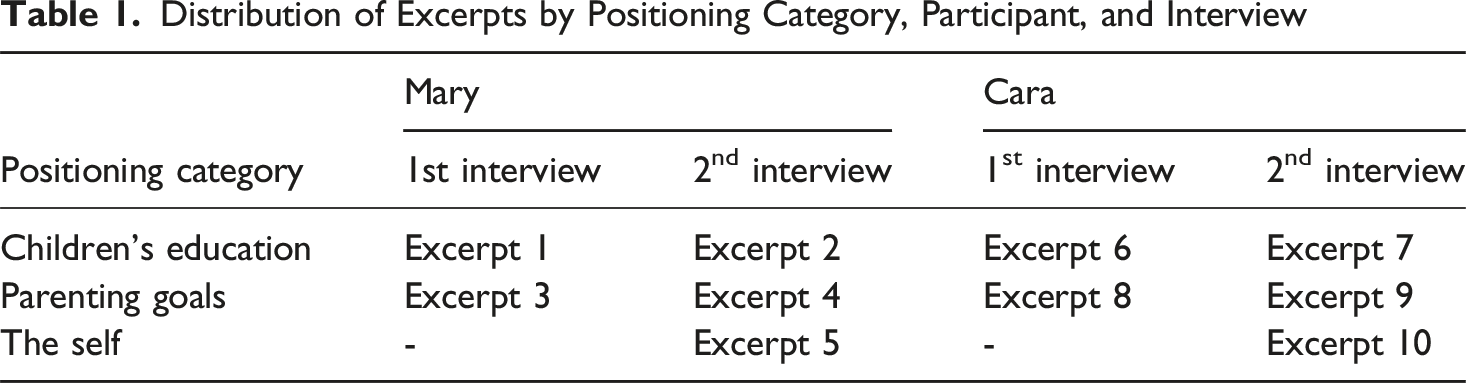
Prominent overlapping themes included the mothers’ own upbringing (especially relationships with their parents and the involvement or absence of fathers), how they positioned themselves relative to other mothers, and how they negotiated identity as their children gained independence and began romantic relationships. For the present analysis, I curated 10 excerpts that most clearly illuminate changes in maternal positioning across the two waves of interviews, particularly in relation to children’s education, parenting goals, and the emergent theme of self-redefinition.
I translated these excerpts into English by first generating an initial draft with DeepSeek and then revising line-by-line. In revision, I attended to culturally specific expressions, pronoun choice, markers of agency, and syntax to preserve participants’ narrative positioning. This procedure ensured that the translated excerpts retained the linguistic and rhetorical features essential for fine-grained positioning analysis.
Author’s Positionalities
I, the author of this study, was born and raised in China and am currently living in the U.S. as a mother of two children. Having pursued study abroad from high school through doctoral training, my own educational trajectory echoes, in part, the journeys envisioned for the participants’ children. This dual positioning deeply informs my understanding of maternal identity and educational transitions.
In data collection, my insider status as a Chinese mother likely facilitated rapport and enabled participants to share culturally nuanced narratives with assumed mutual understanding. However, I remained conscious that this shared background could also lead to unspoken assumptions. Therefore, during interviews, through mindful listening and open-ended follow-up questions, I was attending fully to each mother’s unique story rather than my own preconceptions.
In analysis, my familiarity with the cultural master narratives (e.g., “child-centered sacrifice,” filial piety) provided an initial interpretive lens for recognizing relevant discourses. To ensure analytic rigor and mitigate potential over-identification, I employed positioning analysis as a disciplined, discourse-focused framework. This method forced me to ground all interpretations in the participants’ specific linguistic choices (e.g., pronoun shifts, rhetorical questions) and narrative structures, treating their talk as the primary object of analysis rather than confirming my cultural knowledge.
Throughout the research process, this ongoing reflexivity functioned as a key validity strategy. By continuously articulating how my perspective interacted with the data, from generating empathy in the interview to being scrutinized through the analytical framework, I aim to make the interpretive process as transparent and accountable as possible. Thus, my positionality is leveraged not merely as a biographical note, but as a critical, active resource that shaped and was disciplined by the entire inquiry.
Findings
Distribution of Excerpts by Positioning Category, Participant, and Interview
Mary’s Narratives Regarding Son’s Education
Excerpt 1 - First Interview

Analysis of Excerpt 1
Positioning Level 1
In this narrative, Mary positions her expectations towards her son’s educational outcome as gradually becoming more realistic as he moves from entering high school to college admission. She uses the third person pronoun “they” to refer to expectations (2), which indicates a lack of agency and no control over them. Then Mary shifts the pronoun to “he,” referring to her son for the remainder of this excerpt (3–11). This pronoun use positions Mary at a narrative distance from the events, casting her son as the primary agent in the account.
Mary summarizes the story of her son’s incident in two stages. In the first stage, she positions him as questioning the reason for being injured, then losing the captaincy of the school (4–7). In the second stage, she positions the incident within a broader frame, stating that “the world turned gray” to imply that everything went wrong. She incorporates a direct quote from her son, “I can’t do anything” (8), as a strategy to represent the scene, and at the same time, she positions herself as remaining outside of the process.
In response to the interviewer’s question clarifying her use of the phrase “I can’t do anything,” Mary affirms that it ultimately impacted her son academically. She again uses “he says he couldn’t do anything well” (10), positioning the agency on her son. This positioning locates evaluative authority with her son, while leaving Mary’s own stance implicit. She then ends this conversation with “it just spirals into a vicious cycle” (11), by framing the situation as an ongoing and self-perpetuating problem at that moment in time.
Positioning Level 2
Mary positions herself in relation to the interviewer as an observer. She maintains emotional distance from her son’s struggles during his high school years. She frames her expectations toward her son’s education as his story, rather than as a shared experience.
Positioning Level 3
This narrative aligns with a merit-based admissions master narrative, yet it also activates a script of parental acceptance in the face of uncontrollable setbacks. Mary’s discursive distancing can be seen as an initial negotiation of the ‘child-centered sacrifice’ script, rather than portraying herself as deeply entangled in his failure, she begins to navigate a shift toward a more detached, though still concerned, maternal position. This excerpt thus captures an early moment in the liminal transition, where the mother starts to recalibrate her role in response to the child’s declining trajectory, prefiguring the more explicit identity work to come.
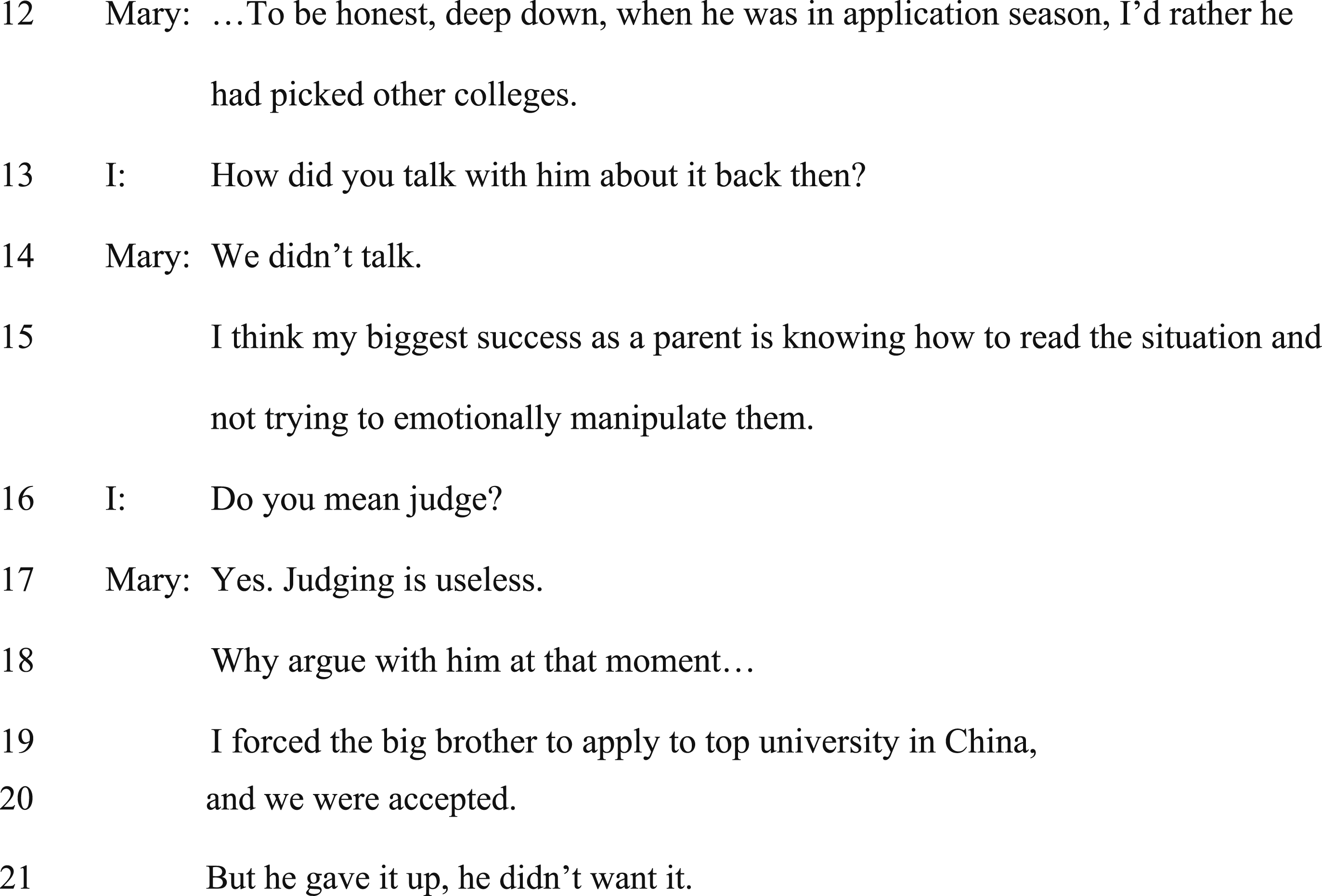
Excerpt 2 - Second Interview
Analysis of Excerpt 2
Positioning Level 1
Mary initiates a contrast by using “I’d rather” to position herself in opposition to her son’s college choice (12). When asked how this was negotiated, she asserts a stance of deliberate non-engagement: “we didn’t talk” (14). The collective pronoun “we” frames this silence as a mutual, co-constructed avoidance, effectively removing the issue from the realm of direct dialogue.
She then reframes this avoidance as a principled parental strategy, linking it to her “biggest success… not trying to emotionally manipulate them” (15). Here, she equates direct discussion with manipulation, thereby morally positioning restraint as superior to intervention. This is reinforced by a rhetorical question implying argument is futile (18). To substantiate this stance, she narrates a past parallel: “I forced the big brother to apply…” (19). The use of “big brother” (a respectful yet potentially distancing Chinese address form) and the verb “forced” accentuate the past conflict and her own excessive agency in that scenario. She then performs a subtle but significant pronoun shift: from “we were accepted” (20), claiming shared credit, to “he gave it up, he didn’t want it” (21), retroactively transferring full agency and ownership of the negative outcome to her son. This linguistic maneuver allows her to narrate past failure while upholding her current philosophy of non-coercion.
Positioning Level 2
Mary positions herself to the interviewer as a reflective and strategic parent, whose apparent passivity (“we didn’t talk”) is recast as a learned, rational ethic of restraint, legitimized by prior negative experience.
Positioning Level 3
This excerpt powerfully engages with the ‘autonomous self and independent child’ master narrative. Mary’s refusal to “emotionally manipulate” and her valorization of not talking constitute a direct discursive resistance to the controlling dimensions of the ‘child-centered sacrifice’ script. However, the ghost of that script lingers in her recounted past action (“I forced”), highlighting the ongoing tension between these competing ideals. Her narrative solution is a strategic withdrawal, a performative distancing that manages both her maternal identity (“respectful parent”) and social face by ceding overt control while narratively managing past blame. This complex positioning illustrates the active, and often painful, work of realigning one’s maternal practice with a newly embraced cultural script, a core process of identity renegotiation during the transition away from hands-on parenting.
Mary’s Narratives Regarding Parenting Goals
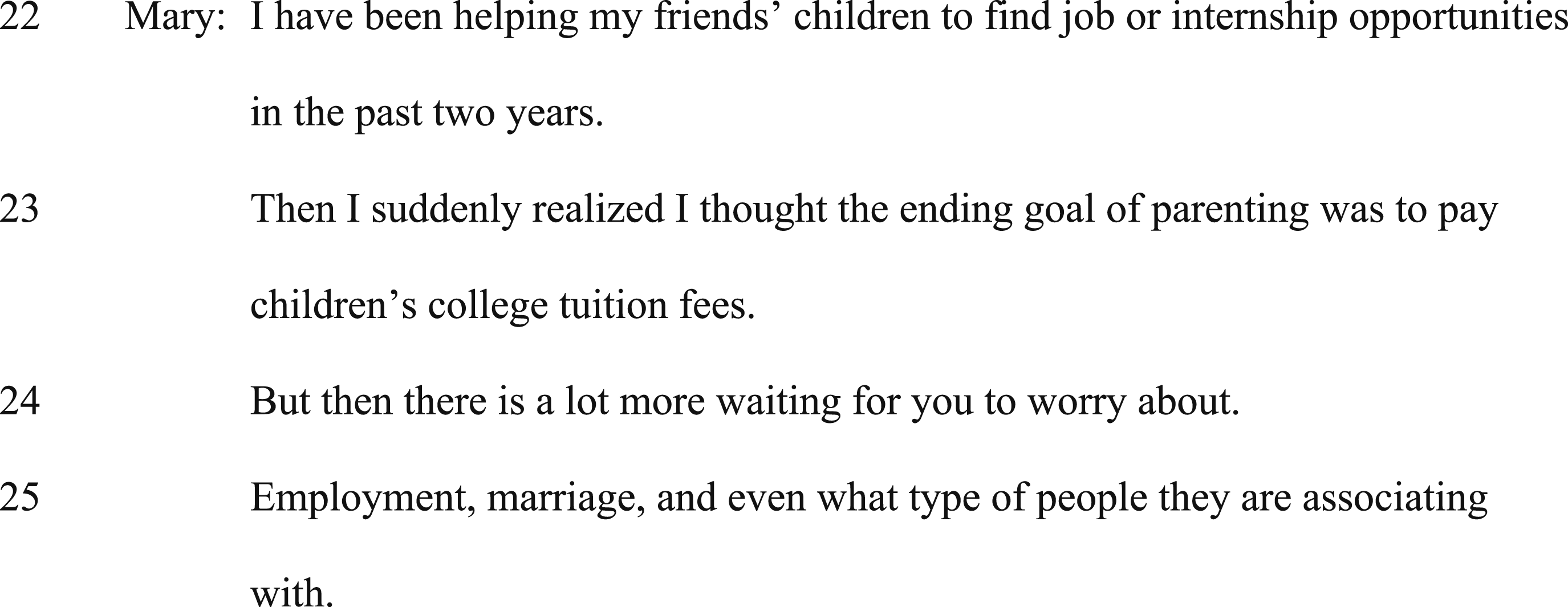
Excerpt 3 - First Interview
Analysis of Excerpt 3
Positioning Leve1 1
Mary opens by positioning herself as a resource within her parental network, citing her active support for friends’ children (22). This experience serves as a catalytic narrative device, prompting her to reflect on and explicitly revise her own timeline of parental responsibility. She contrasts a past, finite goal (“pay children’s college tuition fees”) with an emergent, open-ended horizon of concerns encompassing career, marriage, and social circles (23, 25). Through this contrast, she does not merely list new worries but narratively expands the very scope of “parenting.” She aligns herself with her friends, using their present concerns as a lens to prefigure her own future, thereby positioning herself within a continuous lineage of involved parenthood that extends far beyond college admission.
Positioning Level 2
To the interviewer, Mary positions herself as a forward-thinking and socially embedded parent. By grounding her revised perspective in concrete, collaborative actions (helping friends), she presents this expanded view of lifelong involvement not as a personal anxiety, but as a shared, normative reality within her cultural community.
Positioning Level 3
This excerpt is a clear enactment of the ‘filial piety and long-term reciprocity’ master narrative. However, Mary’s narrative does not simply accept this script passively. Instead, she actively appropriates and personalizes it through the specific, modern conduits of “job contacts” and professional networking. Her reflection signifies a proactive mental shift during the liminal phase: as the immediate goal of college admission is attained, she discursively rehearses and legitimizes the next stage of maternal duty. This moment captures the anticipatory dimension of identity renegotiation, where the mother begins to internalize and articulate the terms of her ongoing, albeit transformed, involvement, thus bridging the ‘child-centered sacrifice’ of adolescence with a framework for lifelong relational reciprocity.
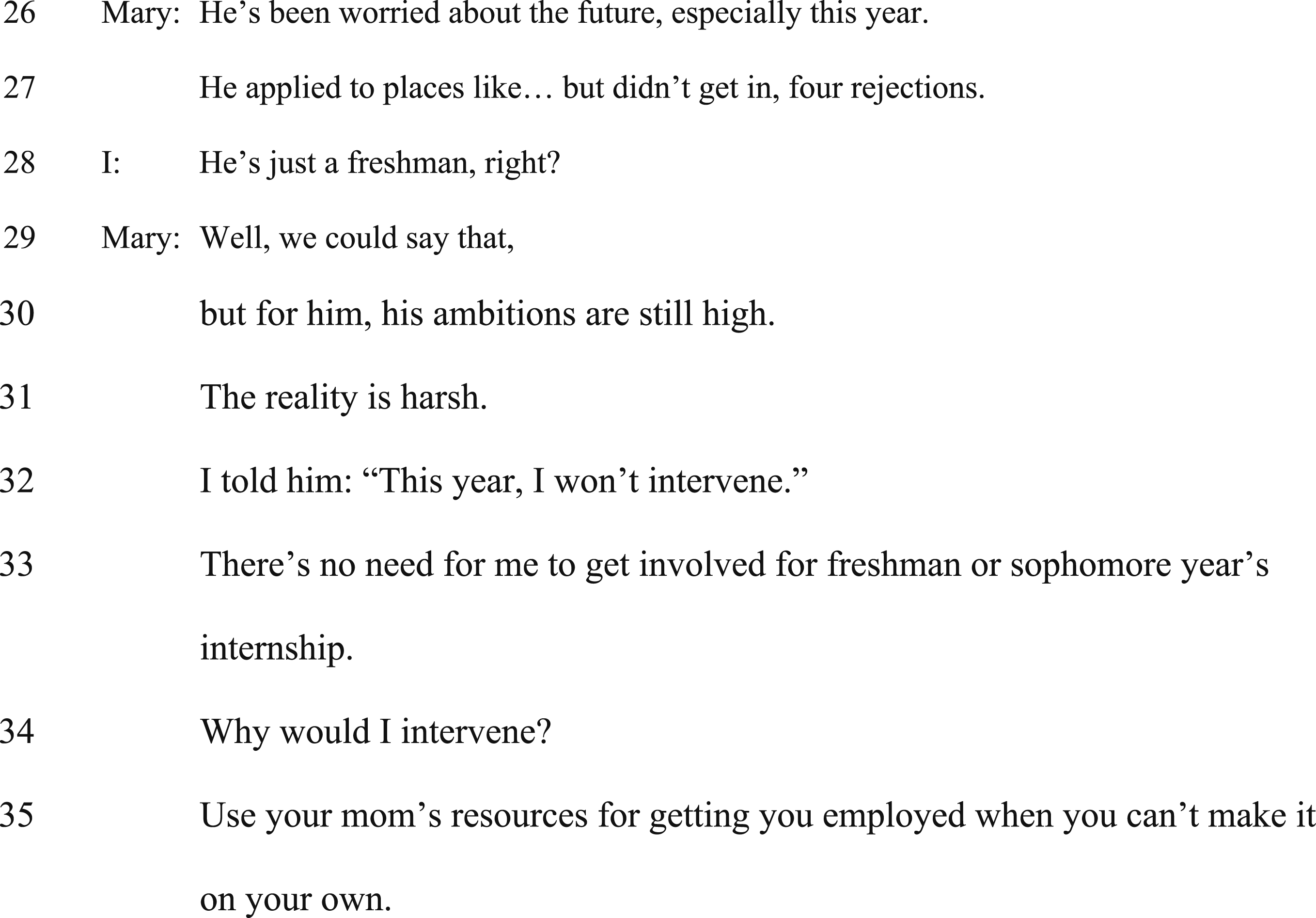
Excerpt 4 - Second Interview
Analysis of Excerpt 4
Positioning Leve1 1
Mary introduces her son’s difficulty in securing internships (27). When the interviewer normalizes this by noting he is “just a freshman,” Mary initially aligns with this external perspective through the collective “we” (29). However, she promptly introduces a contrast with “but,” shifting to “him” and “his ambitions” (30). This discursive move separates her son’s internal, high-expectation world from the shared, pragmatic adult perspective, a separation she reinforces by labeling “the reality is harsh.”
Mary then pivots to articulate her own strategic stance: “this year, I won’t intervene” (32). The temporal marker “this year” frames her non-intervention as a deliberate, time-bound choice. She justifies this with a rhetorical question (“why would I intervene?”) that renders her restraint as common sense (34). The conclusion, however, reveals the conditional nature of this stance. By shifting to the generalized second-person “you,” she outlines a principle: “use your mom’s resources… when you can’t make it on your own” (35). This creates a two-stage model of maternal involvement: first, a mandated space for independent struggle; second, a legitimized activation of parental capital as a final safety net.
Positioning Level 2
To the interviewer, Mary positions herself as a pragmatic and strategic guide. She performs a balancing act: validating her son’s struggle while demonstrating parental wisdom through measured restraint, ultimately presenting herself as a resource-holder whose help is both powerful and ethically disbursed only upon proven need.
Positioning Level 3
This excerpt enacts the negotiation between the ‘autonomous self’ and ‘long-term reciprocity’ narratives. Mary’s staged approach, first autonomy, then rescue, constructs a hybrid parental logic. It honors the cultural imperative of fostering independence by performatively withholding help, while simultaneously reaffirming the core of the filial reciprocity script: the mother’s ultimate responsibility and capacity to provide critical life support. Her rhetoric (“when you can’t make it”) moralizes this intervention not as intrusive interference, but as a justified, almost contractual, fulfillment of a lifelong duty. This discursive maneuvering showcases how mothers in transition precisely calibrate their involvement, using time and conditions to manage the inherent tension between letting go and never fully letting go.
Mary’s Narratives Regarding Recentering Herself
Excerpt 5 - Second Interview
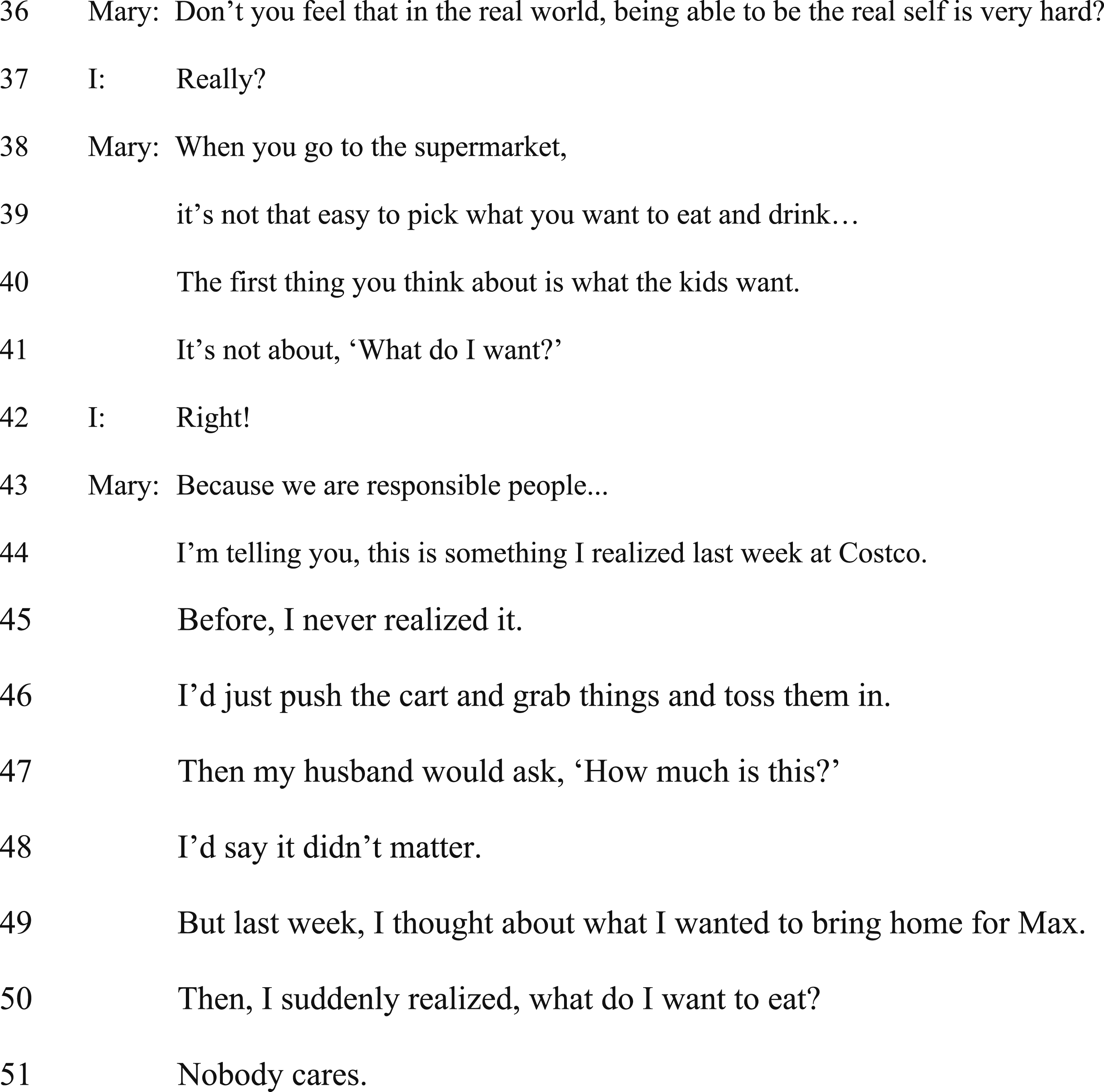
Analysis of Excerpt 5
Positioning Leve1 1
Mary initiates a meta-reflective turn by posing a rhetorical question about the difficulty of being the “real self” (36). This formulation posits a latent, authentic self, distinct from her habitual maternal role. She elaborates through a vignette of supermarket shopping, using the generalized “you” to induct the interviewer into a universal parental experience: prioritizing children’s desires (“what the kid wants”) over one’s own (39–40). She morally frames this tendency under the collective identity “we are responsible people” (43).
Her narrative then marks a decisive epistemic shift. The phrase “I’m telling you” (44) signals a claim to authoritative personal insight. She constructs a temporal dichotomy between “before, I never realized it” and the recent moment of sudden realization (“last week… I suddenly realized”) (45, 49–50). This contrast narrativizes an awakening. Within the “before” period, she further differentiates herself from her husband’s pragmatic concern with cost, highlighting her own previously unreflective, consumption-oriented mode of care (48). The culminating, solitary questions, “What do I want to eat? Nobody cares” (50–51), perform the very emergence of the neglected “real self” into discursive consciousness, framing its neglect not just as a personal oversight but as a relational absence.
Positioning Level 2
Mary positions herself in relation to the interviewer first as a co-member of the self-sacrificing “responsible” collective, and then, more powerfully, as a pioneer of a new awareness. She invites the interviewer to witness and validate this moment of insight, transforming a personal epiphany into a shared testimony about a silenced aspect of maternal experience.
Positioning Level 3
This excerpt captures a critical moment of resistance against the pervasive ‘child-centered sacrifice’ narrative. Mary’s discourse names and challenges the erasure of maternal subjectivity that this script demands. Her “real self” is the discursive reclamation of a standpoint beyond the maternal role. This is not merely about self-care; it is a fundamental reorientation of perspective, a ‘re-centering’ that occurs as the external demands of intensive parenting wane. The vignette epitomizes the liminality of her transition: standing in a supermarket aisle, a space of familial provision, she discovers a new question about her own desires, thereby initiating an internal dialogue of self-repositioning. This moment exemplifies the “self-to-self” positioning that becomes salient when the primary “child-to-mother” positioning is destabilized, marking a pivotal stage in reauthoring a post-intensive maternal identity.
Cara’s Narratives Regarding Daughter’s Education
Excerpt 6 - First Interview
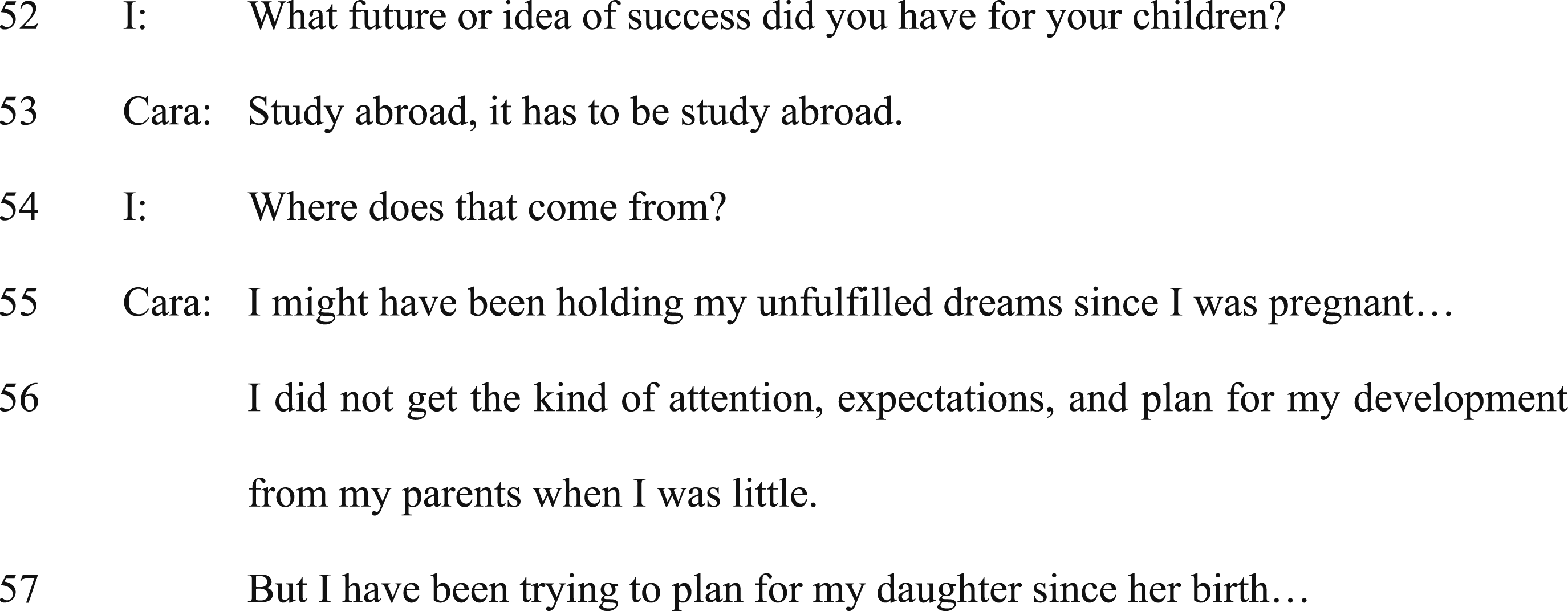
Analysis of Excerpt 6
Positioning Leve1 1
When asked about her hopes for her daughter, Cara does not offer a generic goal but asserts a singular, non-negotiable pathway: “has to be study abroad” (53). She immediately roots this imperative in a personal history of lack, attributing it to “my unfulfilled dreams” (55). This move accomplishes a double positioning: it frames her daughter’s future as a vehicle for reparative action, while contrasting Cara’s own childhood, marked by an absence of parental “attention, expectations, and plan” with the deliberate, intensive “planning” she has enacted since her daughter’s birth (56–57). The child’s trajectory is thus narratively constructed as both a compensation for and a stark reversal of the mother’s past.
Positioning Level 2
Cara positions herself in relation to the interviewer as a reflective mother who aims to give her daughter what she most desired in her own life and considered essential for her development, yet was unable to obtain. She presents her drive for her daughter’s study abroad not as mere aspiration, but as a moral and psychological necessity born of intergenerational redress.
Positioning Level 3
This excerpt represents the ‘child-centered sacrifice’ narrative, but inflects it with a specific psychological motive: intergenerational compensation. Cara’s discourse fuses the cultural script of educational mobility with a deeply personal narrative of repair. Her declaration, “my unfulfilled dreams,” exposes the profound intertwining of maternal identity with the child’s projected success, revealing how the mother’s sense of self-worth and historical grievance can be invested in the child’s pathway. This constitutes a potent form of psychological projection that intensifies the stakes of parenting. It highlights how, on the threshold of the child’s departure, a mother’s reckoning with her own past can powerfully shape the expectations and pressures placed upon the transition, setting the stage for the subsequent negotiation of control and autonomy that unfolds in later interviews.
Excerpt 7 - Second Interview
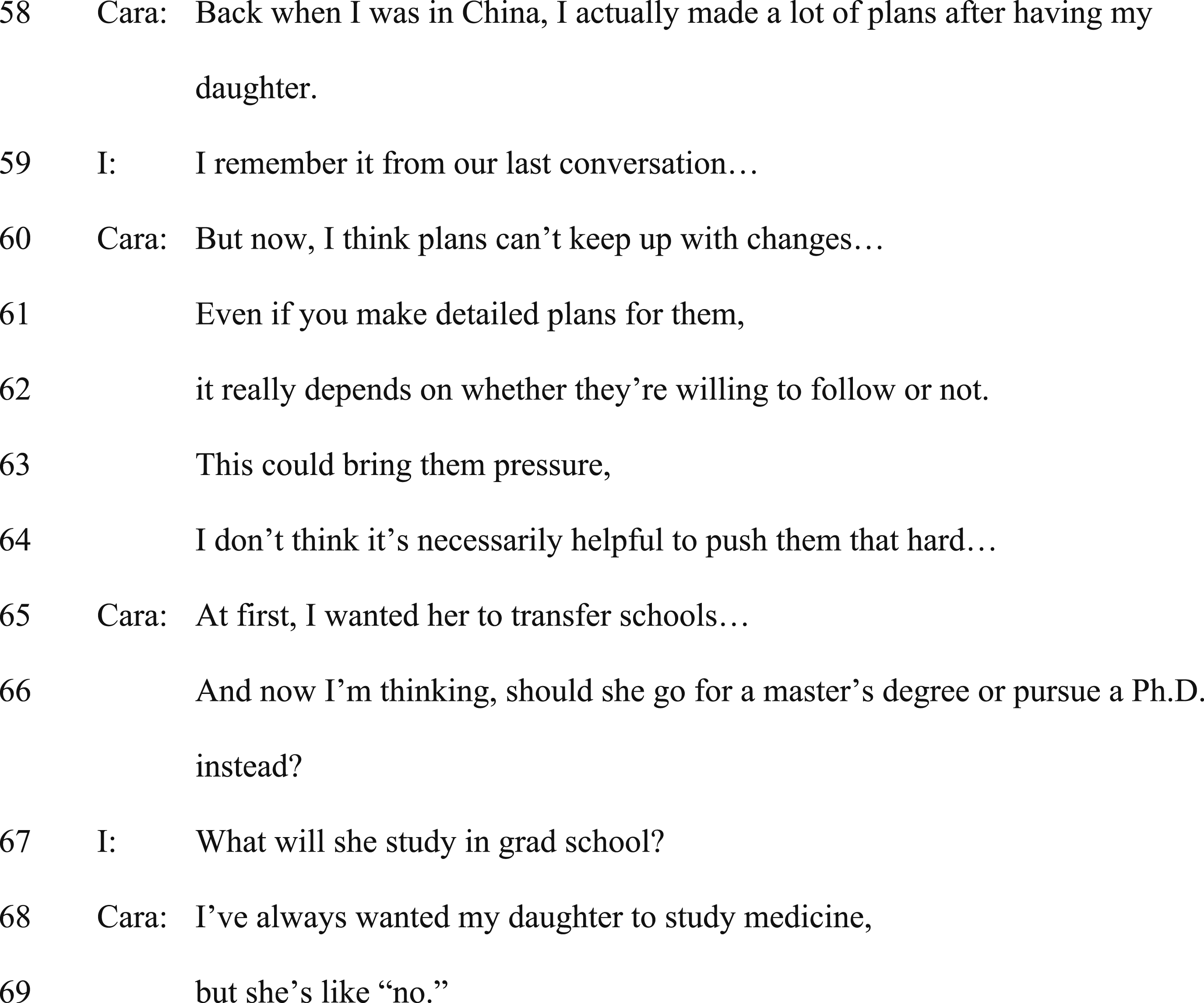
Analysis of Excerpt 7
Positioning Leve1 1
Cara begins by establishing a past identity, “I actually made a lot of plans,” before using “but now” to signify a discursive rupture and a shift in her philosophy of control (58, 60). She articulates a new stance where “plans can’t keep up with changes,” framing detailed planning as not only ineffective but potentially harmful due to the child’s potential resistance and felt pressure (60–64). This positions her as having relinquished the agency of the managerial planner.
However, this proclaimed renunciation is immediately followed by a contradictory discursive performance. She proceeds to detail her ongoing plans: wanting her daughter to transfer schools, contemplating graduate degrees, and reiterating a long-held desire for her to study medicine (65–69). The use of “at first” and “I’ve always wanted” maintains a narrative thread of her own enduring hopes, even as she verbally dismisses the utility of planning. This creates a striking contradiction between her metanarrative about planning (“it’s not helpful”) and her instantiated narrative practice (continuing to plan), revealing an unresolved tension.
Positioning Level 2
Cara positions herself as an adaptive and pragmatic mother who has learned from experience. She performs a stance of enlightened flexibility. Yet, the content of her talk simultaneously betrays a persistent, almost involuntary, commitment to an advisory and visionary maternal role, suggesting the deep-seated nature of her investment in her daughter’s path.
Positioning Level 3
This excerpt lays bare the fraught process of negotiating the ‘child-centered sacrifice’ and ‘autonomous child’ narratives. Cara’s discourse performs a public alignment with the autonomy script (plans are futile, children must choose) which is culturally ascendant in her transnational context. Yet, this performance is undermined by the private, persistent pull of the sacrifice/management script, evidenced by her continued mental planning. This internal contradiction is not a failure of logic but a diagnostic of her liminal position. She is discursively trying on a new “guide-on-the-side” identity while her habits of mind remain those of an invested “manager.” The excerpt thus captures identity renegotiation in medias res, not as a clean switch, but as a lived, discursive struggle where old and new scripts overlap and compete, precisely illustrating the psychological work of redefining maternal agency during the transition.
Cara’s Narratives Regarding Parenting Goals
Excerpt 8 - First Interview
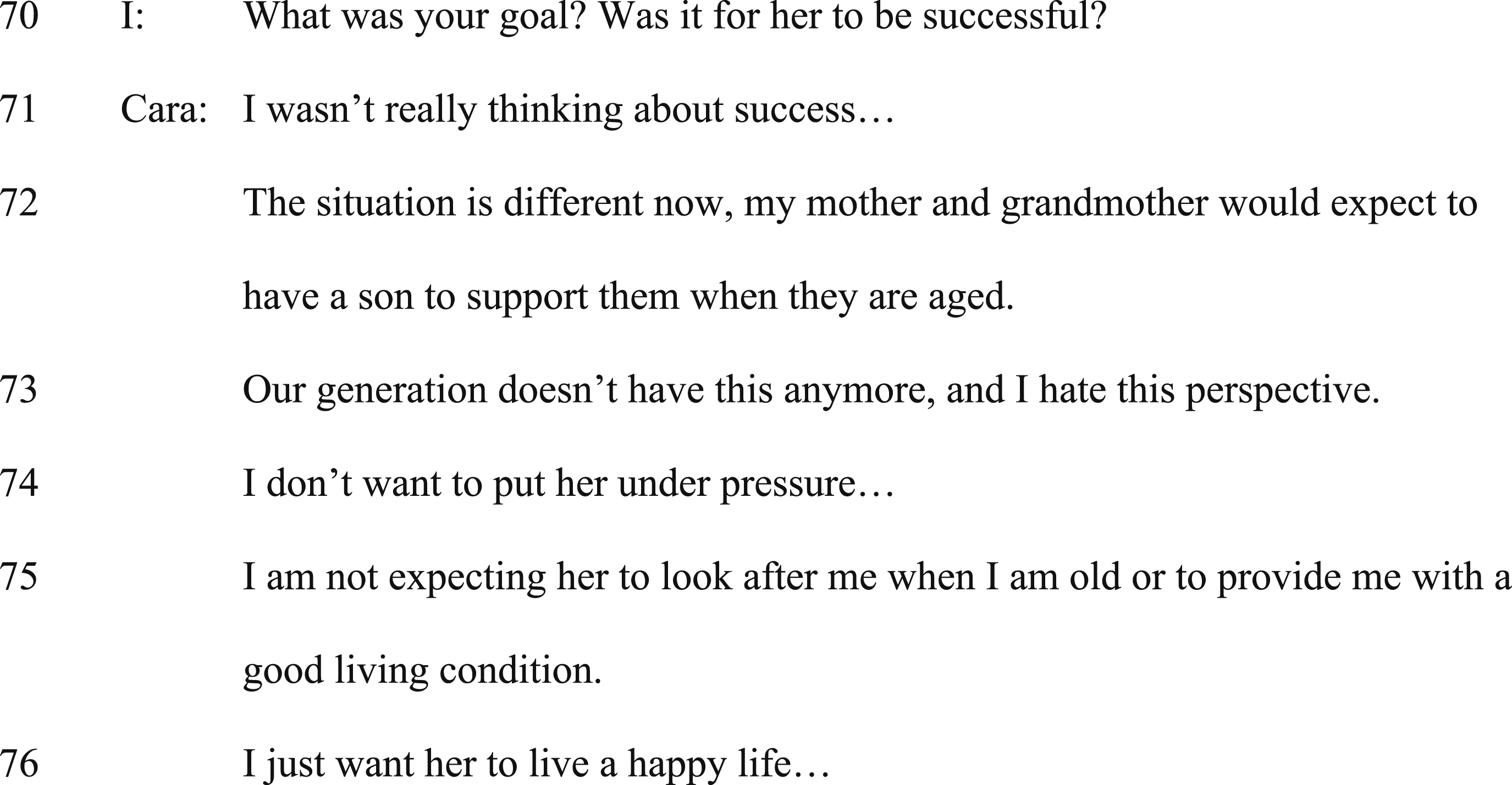
Analysis of Excerpt 8
Positioning Leve1 1
When asked about her parental goal, Cara explicitly rejects the frame of conventional “success,” shifting instead to a generational critique (71). She positions her mother and grandmother’s goals as rooted in a son-preference logic for old-age security, a narrative that implicitly positioned her, as a daughter, as a disappointment (72). By contrasting this with “our generation,” she collectivizes her rejection, framing the older script as obsolete. The shift to a forceful, individual “I” (“I hate this”) marks a personal and moral dis-identification from that inherited model (73). Her concluding goal by stating that “I just want her to live a happy life” (76), replaces a transactional, duty-bound framework with an affective, child-centered one, completing a discursive shift from filial obligation to individual well-being.
Positioning Level 2
Cara positions herself to the interviewer as a conscious break from tradition and a protective, modern mother. She leverages her own experience of gendered marginalization to authorize a new, more liberated maternal ethic for her daughter, presenting herself as both a critic of the past and an architect of a more emotionally attuned future.
Positioning Level 3
This excerpt demonstrates a critical renegotiation of the ‘filial piety and long-term reciprocity’ narrative. Cara does not merely moderate this script; she actively dismantles its gendered and instrumental core (“having a son to support them”) and rejects its implied conditional love. In its place, she subscribes to a ‘happiness and well-being’ narrative prevalent in contemporary globalized parenting discourse. However, this substitution is not a simple adoption of a Western ideal. It is a purposive, reparative act informed by her own painful positioning within the traditional script. Her discourse thus performs a dual identity work: it de-legitimizes an oppressive cultural model for herself as a daughter, while simultaneously authorizing a new, emotionally generous maternal identity for herself as a mother. This moment highlights how the transition to college prompts a reckoning with intergenerational legacy, where letting go of control is intertwined with rewriting the foundational terms of the parent-child contract itself.
Excerpt 9 - Second Interview
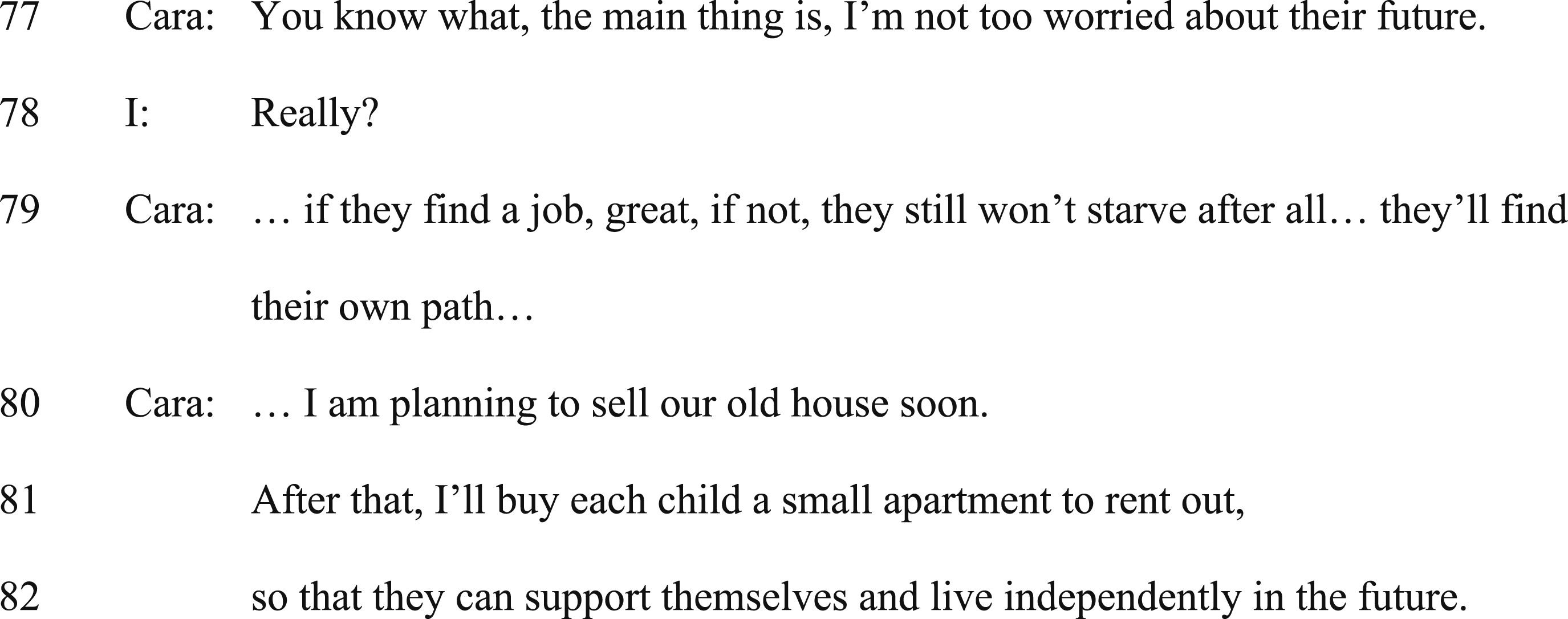
Analysis of Excerpt 9
Positioning Leve1 1
Cara opens with a performance of discursive release, using the collective “they” to generalize across her children and asserting a stance of non-worry: “They’ll find their own path” (79). This constructs an identity of a trusting mother who has ceded prognostic control. However, this narrative of abdication is immediately complicated by the revelation of a concrete, material plan: to “buy each child a small apartment” (81). The shift from the generalized “they” to the specific “each child” is significant; it re-personalizes her provision, enacting a meticulously equitable maternal generosity. She frames this substantial financial transfer as a tool for their future independence (82). The persistent use of “they” as the grammatical subject of the sentence (“so that they can support themselves”) performs a subtle but crucial agentive displacement: it linguistically obscures her role as the benefactor, making the resulting independence appear as the children’s own achievement, even as it is scaffolded by her capital.
Positioning Level 2
To the interviewer, Cara positions herself as a provider who equips rather than directs. She performs a duality: rhetorically embracing uncertainty and child-led futures, while practically preparing to orchestrate long-term security through asset-based gifts. This allows her to present a coherent identity as both a proponent of autonomy and a guarantor of stability, resolving a core tension through planned economic action.
Positioning Level 3
This excerpt reveals a sophisticated discursive and practical negotiation of the ‘long-term reciprocity’ and ‘autonomous self’ narratives. Cara’s strategy hybridizes a logic of release with a logic of endowment. The apartment purchase is the physical instantiation of the filial reciprocity script, a major, life-stage-appropriate transfer of family resources. Yet, its discursive framing (“so they can support themselves”) fully aligns it with the autonomy script, recasting it not as creating dependence but as enabling its opposite. This represents a culturally salient “capital-transfer” model of launching adulthood, common in contexts where property signifies security. Critically, her talk minimizes the parental power inherent in this gift by downplaying her agency in the syntax. This allows her to simultaneously fulfill a deep cultural mandate for parental provision and adhere to a modern ideal of raising self-reliant individuals, illustrating a key mechanism through which transnational mothers reconcile contradictory cultural imperatives by transforming sustained responsibility into a finite, empowerment-focused investment.
Cara’s Narratives Regarding Recentering Herself
Excerpt 10 - Interview Two
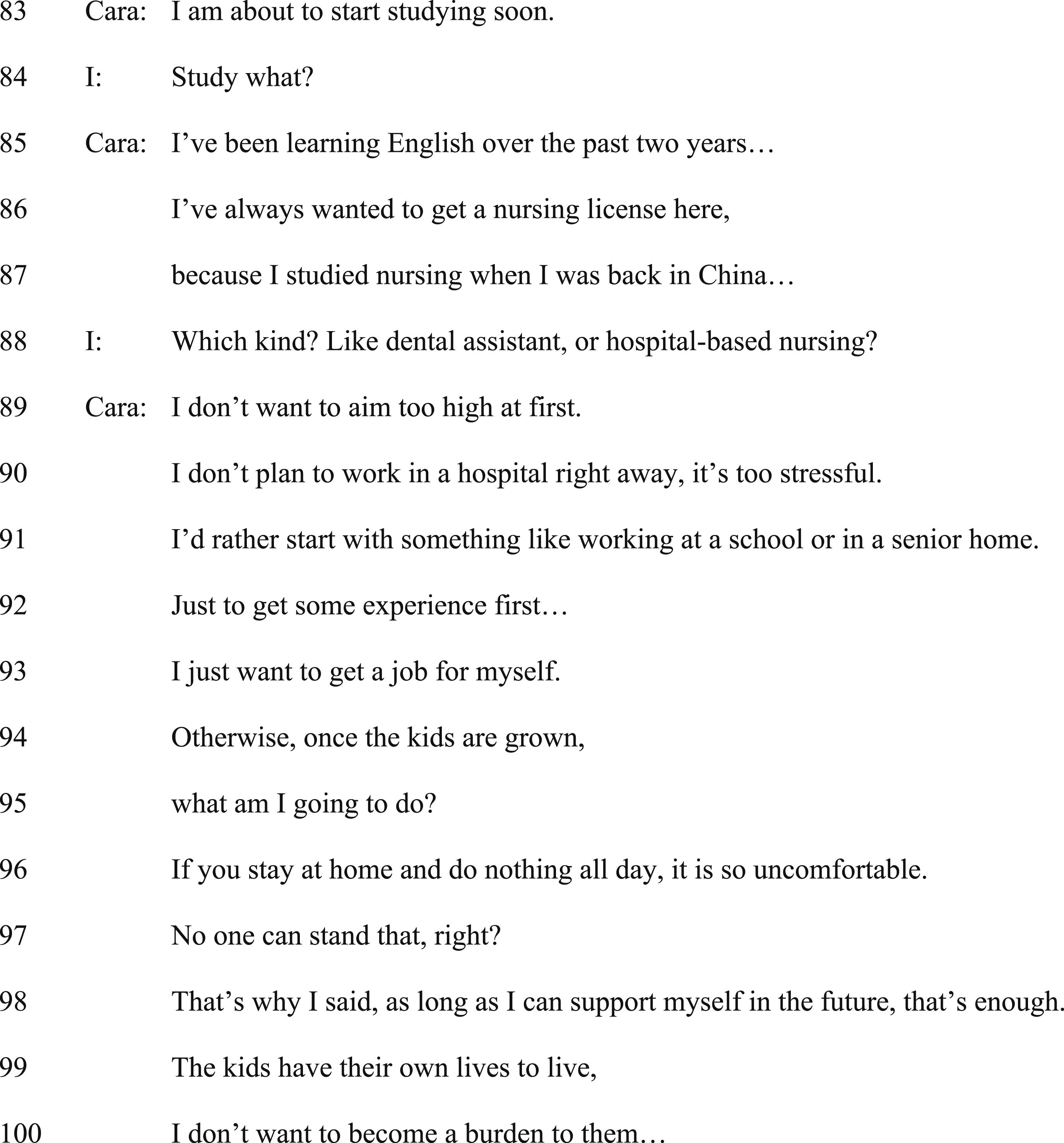
Analysis of Excerpt 10
Positioning Leve1 1
Cara introduces her plan to obtain a U.S. nursing license, positioning it as a logical reactivation of her prior training (86–87). She frames this pursuit with strategic modesty (“I don’t want to aim too high first”), outlining a staged, pragmatic pathway from gaining experience in less demanding settings to potential advancement (89–92). This constructs an identity of a deliberate, self-reinvesting learner.
She then explicitly links this career plan to her children’s impending independence, posing the reflexive question, “what am I going to do?” (95). By labeling a stagnant, child-free future as universally unbearable (“no one can stand that, right?”), she transforms a personal fear into a collective, normative crisis of the empty nest, justifying her proactive upskilling as a necessary adaptation (97). Crucially, she conflates her own independence with her children’s: her goal to “support myself” is framed as the prerequisite to not becoming “a burden to them,” as they will have “their own lives to live” (98–100). In this logic, maternal self-sufficiency is discursively produced as the final, necessary gift to her autonomous children, the ultimate enactment of “letting go.”
Positioning Level 2
Cara positions herself as a forward-thinking and responsible actor. She narrates a shift from a parenting-centric identity to one actively building a post-parenting professional self. She presents this not as a quest for personal fulfillment in a Western sense, but as a moral and practical imperative within the changed family economy, showcasing her adaptability and continued sense of duty.
Positioning Level 3
This excerpt exemplifies the culminating phase of identity renegotiation in the liminal transition. Cara’s discourse masterfully intertwines and reinterprets multiple cultural scripts. She draws on the “autonomous child/letting go” narrative to define her children’s future, but simultaneously activates a potent “self-reliant parent” counter-narrative that individualizes responsibility for the empty-nest self. Her plan transforms the potential void left by the receding “child-centered sacrifice” script into a project of credentialing and self-provision, a move that resonates deeply with immigrant narratives of resilience and re-credentialing. Most significantly, she performs a profound discursive reversal: where the “sacrifice” script demanded the mother’s erasure for the child’s gain, Cara now frames the mother’s proactive self-construction (pursuing a license, ensuring her own support) as the highest form of maternal care, freeing the child from future filial obligation. This represents the full discursive recentering of the self, where the mother’s independence becomes the cornerstone of a newly negotiated, reciprocal yet non-binding, intergenerational contract. It marks a shift from positioning the self for the child, to positioning the self alongside the autonomous child.
Discussion
This study aimed to examine how Chinese mothers in transnational contexts discursively negotiate their maternal identities during their children’s transition to college, focusing on their articulation of expectations, their navigation of cultural master narratives, and the longitudinal shifts in their positioning. Guided by a process-relational framework, we conceptualized this transition as a liminal phase that destabilizes established roles. Through positioning analysis, our findings move beyond descriptive accounts to offer deeper conceptual insights. Below, I synthesize these insights into three propositions that directly address and extend our initial aims.
Beyond Binarism: Identity as Selective Cultural “Bricolage”
The first proposition addresses how mothers negotiate cultural expectations. The analysis reveals they do not choose between static “traditional” or “Western” scripts. Instead, they engage in selective cultural bricolage, actively piecing together a hybrid parenting logic from contradictory narratives. Mary, for instance, dismantles the control mechanism of the “child-centered sacrifice” narrative by rejecting “emotional manipulation,” a stance aligned with critiques of psychological control (Chen et al., 2024; Choe et al., 2023). Yet, she fervently upholds the “filial piety and long-term reciprocity” script by positioning herself as her son’s ultimate career safety net. Similarly, Cara explicitly rejects the gendered, obligation-based filial piety of her parents’ generation (Bian et al., 2022; Guo, 2021), while performing a modernized version of provisioning by planning to buy apartments for her children. This bricolage embracing emotional autonomy while maintaining instrumental responsibility shows mothers as agentive “cultural designers” who construct a coherent, situated maternal ethos from available cultural resources.
The Reflexive Turn: “Recentering the Self” as Core Identity Work in the Liminal Phase
A central, emergent finding is the process of recentering the self. This study theorizes this not as a side effect but as a fundamental dimension of identity renegotiation during the liminal transition, a critical form of “self-to-self” positioning (Arendell, 2000; Stryker & Burke, 2000). As the intensive “child-to-mother” positioning recedes, a space opens for profound reflexive questioning. Mary’s epiphany at Costco “What do I want to eat? Nobody cares” is a discursive reclaiming of a subjective standpoint long eclipsed by maternal duty. This moment of reckoning is not trivial self-care; it is an existential reorientation where the mother’s own desires become a legitimate locus of attention.
Cara’s narrative explicitly links this recentering to the child’s autonomy. Her plan to obtain a U.S. nursing license is framed as a solution to the impending void (“what am I going to do?”) and, more significantly, as a moral imperative to avoid becoming “a burden” to her independent children. Here, maternal self-sufficiency is discursively constructed as the ultimate gift of letting go.
This process resonates with narrative identity scholarship, where the self is an evolving story revised at life transitions (McAdams, 2019), and with life-course research highlighting midlife as a period of heightened self-reflection (Lachman, 2004; Lachman et al., 2015). Crucially, this theme of ‘recentering the self’ was entirely absent in the first interviews and emerged consistently only in the second. This pattern underscores that such reflexive identity work is catalyzed by the lived experience of the child’s physical absence and newfound independence, a finding that validates the longitudinal design by allowing us to trace the emergence of this self-positioning rather than inferring it retrospectively.
For these mothers, the broader developmental dynamic is powerfully organized around the maternal role, reframing the central question from “Who am I?” to “Who am I now as a mother?” This reflexive turn expands positioning theory by highlighting that identity work involves not just negotiating with others, but also turning discourse inward to recalibrate one’s sense of self, a process central to transitions.
This finding illuminates a distinct pathway within family life-course research. While the later “empty nest” phase is often framed as a period of couple re-centering, the present study captures an earlier, liminal threshold, made analytically visible by the two-wave design, during which role and identity reconfiguration unfolds primarily through maternal self-repositioning. Within the family configurations examined here, where daily caregiving and educational responsibility were concentrated with the mother, this liminal phase prompted a proactive, reflexive recentering of the self. This pattern highlights how maternal identity can be renegotiated as an individual, psychological project, thereby revealing a critical and under-examined dimension of the family transition process.
Transnationality as the Constitutive Crucible of Negotiation
These processes of bricolage and recentering are not generic; they are uniquely shaped by transnationality as a constitutive condition. The mothers’ physical and social positioning between China and the U.S. intensifies the salience and immediacy of competing cultural scripts, transforming abstract cultural tensions into concrete, daily dilemmas (Michelson, 2022; Syed & McLean, 2022). This environment amplifies the internal negotiation, making the clash between, for instance, the duty-bound “child-centered sacrifice” narrative and the individuated “autonomous self” narrative a lived reality that demands resolution. Such navigation of contradictory cultural expectations is a central psychological process in immigrant family transitions (Mistry & Dutta, 2015; Syed & McLean, 2022).
Furthermore, the transnational context provides specific resources and imposes distinct constraints that actively pattern the negotiation. Mary’s ability to leverage a professional network spanning both countries enables her particular form of conditional, resource-based support, exemplifying how transnational social capital can be mobilized for intergenerational projects (Ng et al., 2017). Conversely, Cara’s need and plan to re-credential in the U.S. not only addresses economic necessity but also frames her self-recentering within a powerful narrative of immigrant resilience and adaptation, a common thread in studies of migrant professional identities (Arribas et al., 2025). The geographic mobility and potential family separation (e.g., Mary’s marital arrangement, Cara’s initial split-family phase) inherent in such lives can heighten the sense of relational dislocation, thereby fueling the urgency and particular character of the reflexive turn toward the self.
Therefore, the identity work observed, the selective bricolage and the profound recentering, is inextricably linked to the resources, ruptures, and relational geometries of transnational life. It illustrates that this family transition for these mothers is not merely a developmental or familial event, but a culturally compounded liminality uniquely configured by their position between worlds.
Longitudinal Trajectories: Contrasting Pathways of Negotiation
The two-wave interview design was essential not only for capturing the emergent theme of recentering but also for tracing the distinct temporal trajectories of identity negotiation for each mother. Placing their narratives in sequence reveals contrasting pathways through the liminal phase.
Mary’s trajectory illustrates a process of progressive repositioning and integration. In Wave 1, her discourse was characterized by managing her son’s academic crisis through narrative distance (Excerpt 1), while simultaneously beginning to cognitively expand her timeline of maternal responsibility (Excerpt 3). By Wave 2, this evolved into a coherent, hybrid philosophy: she enacted a principled withdrawal from direct control (Excerpt 2) while establishing clear rules for conditional, resource-based support (Excerpt 4). This externally-focused renegotiation ultimately created the psychological space for the internal, reflexive turn captured in her ‘Costco epiphany’ (Excerpt 5). Her path demonstrates a sequential mastery of competing scripts, culminating in a redefined maternal self.
Cara’s trajectory, in contrast, highlights enduring tension and adaptive persistence. Her powerful, compensatory drive to fulfill ‘unfulfilled dreams’ through her daughter’s education (Excerpt 6, Wave 1) remained a potent force in Wave 2, even as she verbally endorsed children’s autonomy and the futility of planning (Excerpt 7). This longitudinal perspective reveals that her identity work was less about a linear shift from control to release, and more about managing the persistent pull of the ‘sacrifice’ script while pragmatically adjusting its expression (e.g., shifting focus from specific majors to providing property). Her proactive plan for self-reliance (Excerpt 10) can be read as both an adaptation to the transition and a new, inverted form of maternal sacrifice, ensuring she will not burden the child she has invested in so deeply.
These trajectories validate the longitudinal design by moving beyond a snapshot comparison. They show that identity renegotiation is not a uniform event but a divergent, processual experience shaped by personal history and existing life structures. For Mary, the transition enabled a gradual integration of new scripts; for Cara, it intensified a need to manage profound, cross-temporal obligations. Without the temporal lens, the depth and nature of these negotiations would remain obscured.
Theoretical Implications and Future Directions
These propositions contribute to positioning theory by highlighting: first, the active negotiation of multiple, contradictory cultural master narratives as a core Level 3 positioning activity; second, the “self-to-self” positioning that becomes critically salient during life-course liminal phases. Our findings advance the understanding of immigrant family transitions by capturing the initial “launching phase” a culturally compounded liminal period where the first child’s departure for college triggers a significant renegotiation of maternal identity (Arnett, 2000, 2023; Sundqvist et al., 2024). This focus on the onset of the transition provides a dynamic, in-process view of identity reconstruction.
Future research should include more diverse socioeconomic backgrounds and, crucially, the perspectives of fathers and children to achieve a relational systems view. Longitudinal designs can trace how the identity work initiated in this launching phase evolves into a more stabilized post-intensive maternal identity.
Conclusion
This study set out to investigate how Chinese mothers in transnational contexts discursively renegotiate their identities during their child’s transition to college. The findings contribute to the literature through three interrelated theoretical propositions. First, maternal identity work is best understood as a process of selective cultural “bricolage,” where mothers actively blend elements from competing scripts of child-centered sacrifice, filial reciprocity, and autonomous individualism to construct a hybrid, workable parental logic. Second, the liminality of this transition precipitates a crucial recentering the self, which emerges as a core psychological process as the intensive child-focused demands recede. Third, the study reframes transnationality as a constitutive condition that intensifies cultural contradictions and uniquely patterns the resources and constraints for identity negotiation, rather than treating it as a mere backdrop. By tracing how mothers reauthor their narratives across time, this research moves beyond static models of motherhood. It offers a process-oriented, culturally situated framework for understanding how maternal identity is actively remade at the intersection of personal, familial, and transnational change.
Footnotes
Acknowledgments
I thank my participants for taking part in the study.

Funding
The authors received no financial support for the research, authorship, and/or publication of this article.
Declaration of Conflicting Interests
The authors declared no potential conflicts of interest with respect to the research, authorship, and/or publication of this article.
Institutional Review Board Statement
The study was approved by the Institutional Review Board of Clark University (IRB Protocol #310).