



Abstract
Resilience has been championed as important for mitigating stressors and challenges experienced by students during post-secondary education, as evidenced by the abundance of programs aimed at enhancing student resilience. Despite growing attention to resilience, there continues to be a lack of consensus about the definition or operationalization of the concept. Even less is known about how to foster resilience in the post-secondary context, especially for marginalized or underrepresented students, who are recognized to be at increased risk for negative mental health outcomes during their post-secondary education. To address these gaps, we employed qualitative methodology to explore marginalized or underrepresented students’ perceptions of resilience. Findings demonstrated that resilience arises from a complex and dynamic interplay between personal skills and attitudes and resources available within students’ communities. Post-secondary institutions are called to shift from individual student responsibility to a collective and shared responsibility for students’ wellbeing in the face of adversity.
Introduction
Post-secondary education (PSE) is fast-paced, ever-changing, and challenging environment (Ahmed & Julius, 2015). Students are from increasingly varied demographics, including gender, ethnicity, age, domestic and international student status (Trends in Higher Education, 2011). They face new and unprecedented stressors (e.g., pandemic, housing, affordability, food insecurity) added to the usual stressors of post-secondary life (Linden et al., 2023; Lisnyj et al., 2021). The mental health of post-secondary students has become a topic of concern. While some studies suggest that North American post-secondary students have similar prevalence of mental illness as their same-aged peers (Cvetkovski et al., 2012; Weins et al., 2020), other evidence suggests that post-secondary students experience more subclinical distress and perceived stress than same-aged peers (Cvetkovski et al., 2012; Schmidt et al., 2015; Wiens et al., 2020).
Post-secondary administrators and mental health service providers have recognized the importance of resilience to mitigate the stress experienced by students (Brewer, 2019). Subsequently, strategies to strengthen and support student resilience have been a priority for many colleges and universities (Gamble & Crouse, 2020; Holdsworth et al., 2018; Sanderson & Brewer, 2017). Building resilience and self-management competence can help decrease vulnerability to mental health issues by strengthening students’ ability to cope with the stressors of the university experience. To this end, a range of resilience-based interventions have been developed and offered to students (e.g., Brecher, 2016; Thannhauser et al., 2023).
Evolving Understanding of Resilience
Human beings experience a variety of challenges as they navigate life, ranging from day-to-day stressors (e.g., economic hardship, failure, loss of a loved one) to major traumatic life events (e.g., natural disaster, sexual violence, war). The study of resilience has emerged as a paradigm shift away from risk factors for human development to positive adaptation in the context of adverse experiences or stress (Fletcher & Sarkar, 2013). Mahoney and Bergman (2002) argued that adaptation is at the heart of human development and foundational to understanding the ontogeny of effective functioning. In this regard, early conceptualizations of resilience sought to understand the factors that enabled successful developmental outcomes for some children while other children struggled in the context of adverse childhood experiences (Fleming & Ledogar, 2008). Much of this early research strived to identify specific protective factors (e.g., easy temperament, healthy self-esteem, executive functioning skills) that contributed to positive developmental outcomes. Over the last three decades, resilience has become a multi-disciplinary field of study, drawing interest from diverse disciplines, including genetics, psychology, political science, architecture, human ecology, and others (Ungar & Theron, 2020).
Despite growing attention to the concept of resilience, there continues to be lack of consensus about its definition and operationalization. Numerous articles have been published in effort to address conceptual and methodological weaknesses in studying resilience (e.g., Fletcher & Sarkar, 2013; Luthar et al., 2000; Southwick et al., 2014; Ungar et al., 2013). The concept of resilience typically revolves around two core constructs, adversity, and positive adaptation, and for resilience to be enacted both adversity and positive adaptation must be evident (Luthar & Cicchetti, 2000). However, there is disagreement about how adversity is operationalized (Fletcher & Sarkar, 2013). Some conceptualize adversity as atypical challenge or trauma (e.g., violence, poverty, disability; Ungar et al., 2013). Others operationalize adversity as chronic and/or persistent daily stressors (Davis et al., 2009). Fletcher and Sarkar (2013) raised concern about the value-laden connotations associated with the term “adversity”, arguing that such connotations preclude the inclusion of ongoing daily stressors under the rubric of resilience. Researchers and theorists also disagree about whether resilience is a trait (Prince-Embury, 2014), state (Rutter, 2006), skill (e.g., Baker et al., 2021; Patry & Ford, 2016), process (e.g., Luthar et al., 2000; Ungar et al., 2013), outcome (e.g., Patry & Ford, 2016; Reyes et al., 2018) or some combination of the above (Kuldas & Foody, 2022).
Inconsistencies in the operationalization of “resilience” leads to differences in measurement and subsequent questions about whether the same entity is being studied. Critiques have been raised about the use of Western paradigms to define positive adaptation, which emphasize personal factors (Southwick et al., 2014). In contrast, contemporary theorists foreground sociocultural context when describing and defining positive adaptation (Liebenberg & Ungar, 2009; Mahoney & Bergman, 2002; Ungar et al., 2013). Interactional (Mahoney & Bergman, 2002), transactional (Kuldas & Foody, 2022), or social-ecological (Ungar et al., 2013) frameworks attribute resilience to the interplay between an individual and the social-ecological systems within which an individual exists. Overall, definitions of resilience have evolved to describe a more complex, multidimensional, contextual, and dynamic process of adapting to a range of stressors, adversity, and trauma (Southwick et al., 2014).
Resilience in the Post-secondary Context
Resilience is deemed necessary for positive outcomes among post-secondary students (Gamble & Crouse, 2020; Linden et al., 2023). Within the post-secondary context, resilience has been identified as a moderating variable between adversity and students’ academic success and well-being (Brewer et al., 2019; Hartley, 2011). Ahmed and Julius (2015) found that 9% of variance in resilience scores was negatively predicted by depression scores and depression scores significantly predicted academic performance. Hartley (2013) reported a significant interaction between mental health and intrapersonal resilience, such that intrapersonal resilience became increasingly important for students with elevated psychological distress to complete academic credits over time. Leipold et al. (2019) found a significant interaction effect between stress and coping styles, such that support-seeking and meaning-focused coping, both factors contributing to resilience, moderated the relationship between academic stress and well-being. Further, Zubair et al. (2018) reported that resilience positively enhanced the relationship between mindfulness and well-being in university students. Taken together, there is a clear moderating role for resilience on post-secondary students’ academic and well-being outcomes.
Enhancing resilience while students are attending post-secondary education has been argued to be developmentally necessary to prepare emerging adults for the responsibilities and demands of adulthood (Brewer et al., 2019). A wide range of resilience-focused interventions have been developed and delivered in post-secondary institutions worldwide. Brewer and colleagues completed a scoping review of resilience literature within higher education. They identified 17 evaluation studies of resilience interventions and one proposed intervention. Most intervention programs included mindfulness-based stress reduction and/or cognitive-behavioural interventions. They also found 12 articles reviewing the literature or proposing a conceptual model or strategy to enhance resilience. Models for enhancing resilience included three interrelated domains: intrapsychic factors, interpersonal resources and strategies, and contextual resources. Methods and assessment tools varied significantly among studies, limiting comparisons between studies.
Marginalized or Underrepresented Students
The post-secondary population in the United States is predominately White, female, and from a higher socioeconomic status, as compared to non-college emerging adults (Arnett, 2016). Canadian statistical data between 2016–2021 reflects similar trends, with higher enrolment of female students (55.8%–56.5%) compared to other gender identities (Statistics Canada, 2022b). Ethnic or racial identity data have not been consistently collected in Canadian post-secondary settings (Canadian Broadcasting Corporation, 2017); however, between 2016 – 2020 the enrolment of international students continued to grow from 15.3% to 22.7% (with a slight decrease to 19.1% between 2020–2021; Statistics Canada, 2022a). Studies based on the 2020 and 2022 cycles of the Canadian Campus Wellbeing Survey also reflect an ethnically diverse student population (Fagan et al., 2023; Porter et al., 2023).
Marginalized students are at increased risk for negative mental health outcomes during their post-secondary education given the systemic barriers related to access to and retention within higher education (Lerma et al., 2020; Park & Bahia, 2022). We define marginalized as “a social process by which individuals or groups are (intentionally or unintentionally) distanced from access to power, social capital and resources and constructed as insignificant, peripheral, or less valuable/privileged to a community or ‘mainstream’ society’” (University of British Columbia, 2023). Discrimination from peers and professors has been linked with less favorable adjustment outcomes for racialized students, including lower grades, longer time until graduation, and decreased school satisfaction (Del Toro & Hughes, 2020). Microaggressions and racism have consistently been linked to negative mental health outcomes for marginalized students (Beagan et al., 2021; Bernard et al., 2017).
Until recently, male identifying and graduate students have both been underrepresented in the post-secondary mental health literature. We define “underrepresented” as those students who have not engaged with or had access to relevant mental health resources and supports in the post-secondary context. Male identifying individuals are typically viewed in a position of privilege and we do not equate their experiences to those of marginalized communities. Despite having access to services, male identifying students are consistently underrepresented in post-secondary mental health surveys and in mental health services engagement (DeBate et al., 2022). Scholarly research on the mental health of graduate students was limited up until the start of the pandemic (Okoro et al., 2022). Graduate students face unique stressors distinct from their undergraduate counterparts (Wyatt & Oswalt, 2013) and many institutional social, cultural, and mental health supports are targeted to the undergraduate population (Wildey et al., 2022). As such, male identifying and graduate student groups were included here to better understand their perceptions of resilience in the post-secondary context.
The Current Study
Despite the more recent and dynamic conceptions of resilience, individually focused definitions dominate recent post-secondary discourse. Individually focused approaches have been critiqued for placing too much responsibility on the individual with limited long-term impact on resilience (Ungar & Theron, 2020). There is also limited research about how to enhance resilience in the post-secondary context (Brewer, 2019), especially for marginalized or underrepresented students (Clay, 2019; Mills, 2021). As a result, we do not know how individually focused definitions of resilience align with the lived experiences of marginalized or underrepresented students. To address this knowledge gap, the current study explored students’ perspectives of resilience, with a focus on the experiences of marginalized or underrepresented student groups. We defined “perspectives” broadly, seeking to understand how students define, experience, and make meaning of resilience within a post-secondary context.
Method
We employed reflexive thematic analysis (RTA; Braun & Clarke, 2006; Clarke & Braun, 2017), and a qualitative description (QD) methodology (Neergaard et al., 2009) to examine how students understand the concept of resilience. Qualitative methods, such as RTA and QD, lend themselves well to studying complex and abstract concepts about human experience. RTA offers thick description, highlights similarities and differences across the data set, generates unanticipated insights, allows for social and psychological interpretation, and can be used to inform policy development (Braun & Clarke, 2006). Qualitative description stays close to the data, rather than relying on pre-existing theory, and more heavily utilizes participants’ language when presenting results (Neergaard et al., 2009).
Positionality
Reflexive thematic analysis and QD assume the researchers co-construct meaning with the data in a specific context (Braun & Clarke, 2006; Neergaard et al., 2009). The identities of both researchers and participants may have a resulting impact on the research process. For this reason, it is important to share the context of our positionalities. Two research assistants (RAs) with current or recent experience in post-secondary education, and the lead author, a psychologist in a post-secondary counselling centre, collaborated on data collection and analysis. A second senior co-investigator also co-facilitated one of the focus group interviews. The lead author identifies as a White, middle-class, middle-aged, cis-gender woman who is second generation Canadian. One of the RAs identifies as a White, middle-class, cis-gender woman born and raised in Canada. The other RA identifies as an East Asian, middle-class, cis-gender man who was an international student during his undergraduate studies in Canada. The senior co-investigator also identifies as white, middle class, cis-gender woman who is a second generation Canadian. The lead author was familiar with recent literature about resilience and the RAs, trained in mental health professions at the graduate-level, held a general understanding of resilience prior to the start of analysis. Given their recent experiences as university students, the RAs voices were prioritized throughout the coding. We strived to be mindful of our respective privilege and bias and recognize how these might influence the research process.
Data Collection
Students at a research-intensive university in Western Canada were invited to participate in a survey exploring students’ perceptions of resilience. Recruitment included public posters and targeted email invitations in effort to seek participation from a broad representation of students. After completing the survey, participants had the option to consent to participate in a follow up focus group. Consenting students were sorted based on their self-identified demographic characteristics (i.e., Indigenous, 2SLGBTQ+, racialized, international student, graduate student, and/or male). Participants were eligible for the focus groups if they identified with at least one of the aforementioned demographic variables. Given students’ intersectional identities, participants were sorted to maximize participation and representation of each of the demographic variables of interest. Our attention to intersectionality also resulted in a sample of male identifying and graduate student participants with diverse identities. Focus group participants were then randomly selected from among the students sorted to each of the identified demographic variables. Due to scheduling challenges, one focus group was homogenous to graduate student status (i.e., FG1), while the remaining seven focus groups were heterogenous.
Focus Group Participant Demographics.
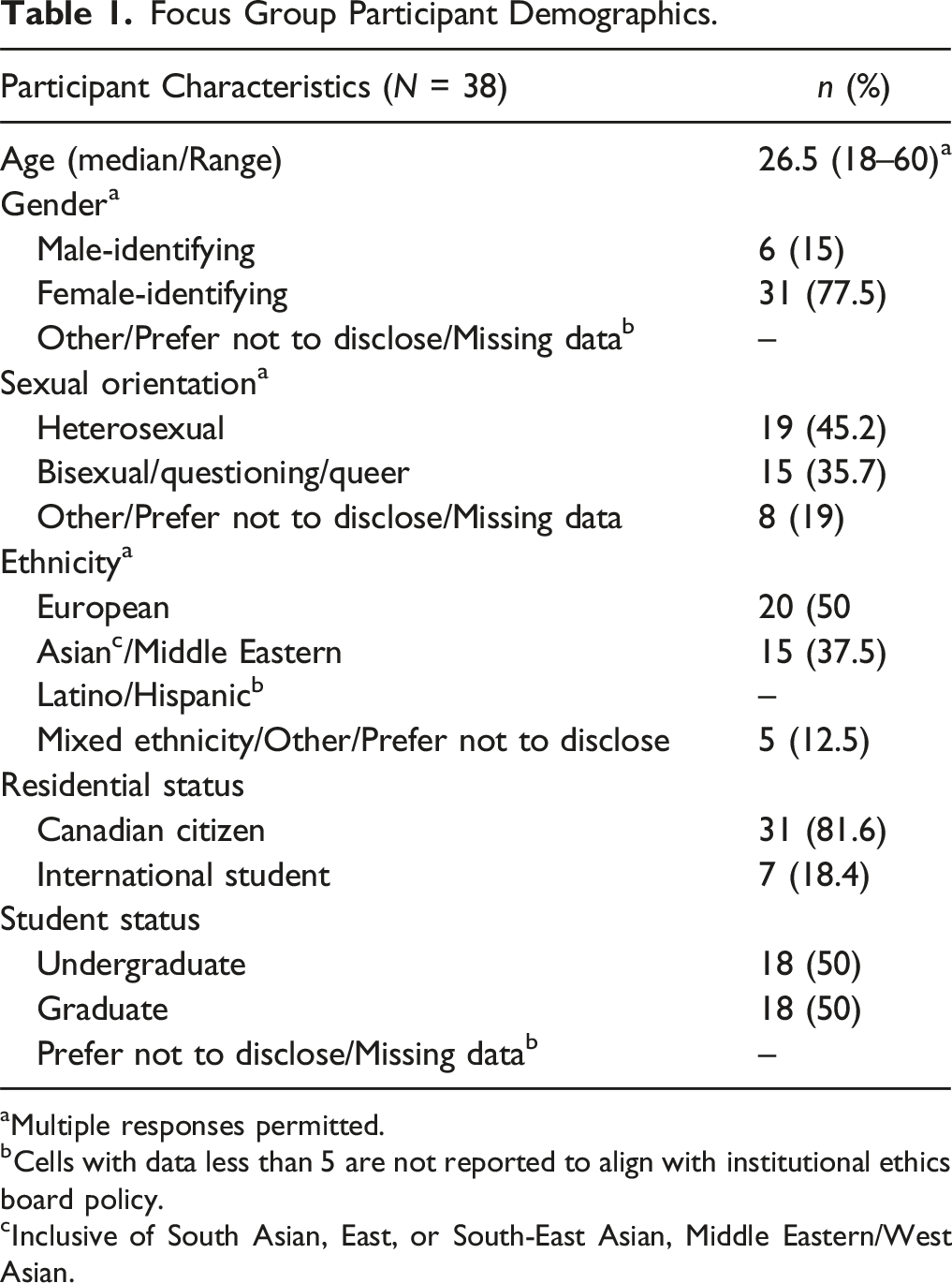
aMultiple responses permitted.
bCells with data less than 5 are not reported to align with institutional ethics board policy.
cInclusive of South Asian, East, or South-East Asian, Middle Eastern/West Asian.
Focus groups were led by two facilitators, including one of two RAs and either the first author or a senior co-investigator on the study, using a semi-structured interview guide. Participants were asked about their understanding of the word “resilience”, what resilience looks like in their lives, what factors contribute to resilience, and how resilience supports their goals. Interviews were hosted on Zoom and audio recorded to aid transcription. All interviews lasted 90 minutes. This study was approved by University of Calgary Research Ethics Board (REB21-1699) and adhered to recognized ethical standards.
Data Analysis
A paid transcriptionist transcribed the interviews and reviewed them for accuracy. The first author and two RAs then: (1) independently read the transcripts to build familiarity with the data; (2) independently generated initial codes for the first transcript then met to discuss initial codes and themes; (3) conducted independent detailed coding of three transcripts, with meetings to discuss emerging themes for each transcript, themes in relation to previously coded transcripts, and how the themes related to the overall research question; (4) continued independent detailed coding, collation into themes, and several rounds of collaborative coding for the remaining transcripts. The first author and two RAs then reviewed themes for coherency, relevancy, and inclusiveness, and recoded transcripts as needed to refine themes and create descriptions for each theme. Finally, the first author and the two RAs organized the themes into four main topics, prepared a preliminary report, and presented it to the remaining authors, which included one student RA and three experienced researchers, for their feedback. The first author and the two RAs used the feedback to further refine the final themes.
The research team employed several strategies to establish trustworthiness of the analysis, drawing on the recommendations of Nowell et al. (2017). To address credibility, there was prolonged engagement with the data over several months, researcher triangulation, and peer debriefing with the research team members not directly involved in the analysis. A record of all coding discussions was kept, and each researcher kept independent reflexive journals. Transferability supports the generalizability of the analysis, which is addressed by providing rich descriptions. To achieve dependability, we created an audit trail including documentation of all decisions relevant to the analysis process, independent records of our coding, shared documentation summarizing all collaborative coding discussions, independent and shared reflexive journals, and a step-by-step description of the analysis process and decisions made.
Results
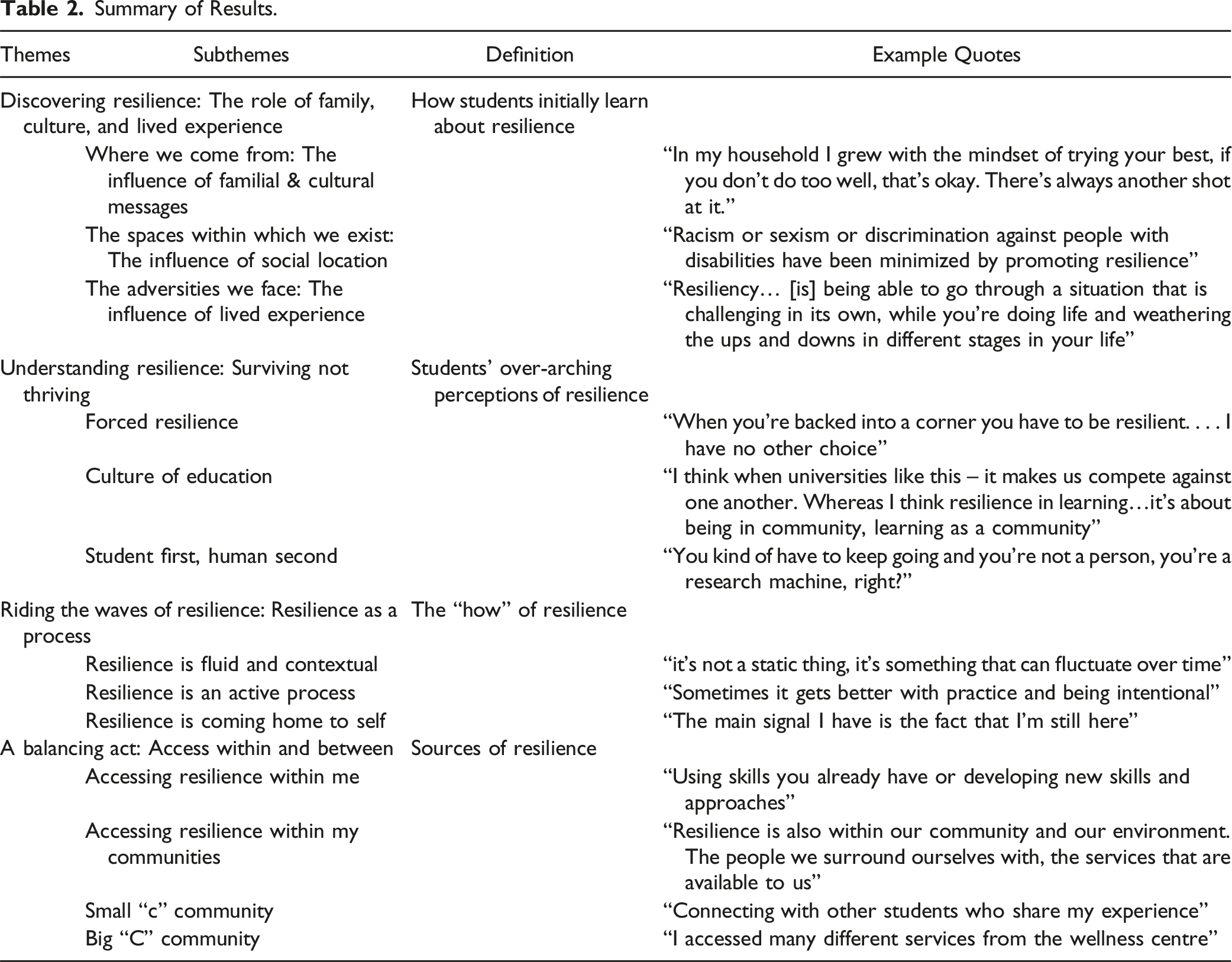
Summary of Results.
Discovering Resilience: The Role of Family, Culture, and Lived Experience
The first theme captures how students initially learn about resilience. Perceptions of resilience were shaped by familial history, cultural and societal values, students’ social locations, as well as past experiences with adversity. This theme included three subthemes.
Where We Come From: The Influence of Familial and Cultural Messaging
The meaning of resilience for students was deeply embedded within their familial and cultural histories and values. Many students described learning about resilience through relationships within their families. While some families encouraged seeking support through relationships, other families encouraged stoicism. For example, one student articulated, “my parents have shaped me to get help when I need to and destress and talk to people” (FG3). In contrast, other students were taught that resilience means “you tough it out and there’s no other option” (FG1) or “you don’t talk about it and you just get through it” (FG1). Still other families taught students to adopt a growth mindset, “if you’re given lemons, you make lemonade” (FG4). Some students began to question familial messages about resilience as they were exposed to alternate narratives and lived experiences: In my family…you don’t talk about the things that you’re struggling with, and so…it gave me very thick skin, but it also made me realize that [it] can only go so far and you do need other people to be resilient. (FG1)
Students discussed the influence of individualistic and collective worldviews on their perceptions of resilience, demonstrating how the construct of resilience is culturally embedded. One student shared, “our society is very individualistic. It honours those who are strong – yeah, maybe the weak or people who are struggling are seen as less than” (FG1). Or as this student explained, In my culture we often try to hide our challenges, the troubles, the difficult situations.… I often forget to ask for help, because I am afraid that they will label me as weak or lazy or other things, so I try to hide and manage those difficult situations on my own until it becomes unbearable. (FG2)
In contrast, other participants described how their views of resilience were shaped by experiences from within a collectivist culture, “in my cultural community, it’s always about putting other people first” (FG1). And another student shared, resilience is a very collective thing. If I can seek outside help from someone, even if it’s just like talking with my mom or something, I’ll do it. I feel like that comes from, I mean I’m Filipino, and so there’s a big emphasis on family and always having your family’s back. (FG8)
Some students pointed to how societal values, distinct from those of their families’, can reshape how they face challenges, as shared by this male-identifying student: I grew up in a very loving and caring relationship with my parents as in whatever I wanted to do, I could do it. But at school, in sport, I kind of feel a little bit of that of like the toxic masculinity, just kind of push your emotions behind and just keep going. (FG3)
For this student, resilience is characterized by supportive relationships within the family context but shifts to a more self-reliant, stoic approach in the school environment.
Conflicting messages about the role of internal factors and external supports that contributed to resilience emerged through the discussion. A somewhat inconsistent use of language and descriptions of resilience throughout the focus groups further demonstrated the tensions they experienced when trying to articulate how these factors contribute to resilience.
The Spaces Within Which We Exist: The Influence of Social Location
Perceptions of resilience were linked to students’ social positions and their experiences of power, privilege, and oppression within educational and broader social systems. For example, one student highlighted the subjective and contextual nature of what constitutes a challenge, “it isn’t the same for everyone and not everyone has the same privileges in every situation or the same advantages or even the same barriers” (FG2). Another student explained, “I hold a lot of positions of power, and I feel like I don’t have to depend on resiliency in some ways because of that” (FG3).
Students emphasized the importance of considering the concept of resilience through the lens of oppression and power dynamics. A minoritized, 2SLGBTQ + -identifying student described their experience this way: My association of resilience is being told how resilient I am all the time for like just merely existing. Like hearing people say, “Oh, you’re so brave. Oh, I’m so proud of you. Oh, like you’re doing so good.” Stuff like that just—and I think it’s often people thinking they’re speaking in allyship, but just like hammering down how hard my existence is as a trans-woman and how resilient I must be to be living my life. (FG4)
Affirmation of resilience can inadvertently underscore the extra burden some individuals carry due to societal prejudice and discrimination. One participant pointed out that “racism or sexism or discrimination against people with disabilities have been minimized by promoting resilience” (FG3). In essence, some students perceived resilience as normalizing the oppression of vulnerable or marginalized students by placing responsibility on the individual to persevere rather than addressing the need for structural changes. Indeed, a decontextualized understanding of resilience misses the complexities of intersecting factors, such as structural barriers, that may impede academic performance or progress of socially disadvantaged students (Zembylas, 2021). As this student pointed out, “sometimes it is good to just step back and look at the system or the environment that things are operating in, because there might be things that are out of our control that require a bigger discussion, right?” (FG3).
The Adversities We Face: The Influence of Lived Experience
Students’ awareness of resilience developed through reflection about past adversities: “For myself, it’s always after the fact: I never notice it in the moment, but after the fact, looking back” (FG1). Participants consistently identified the inherent link between resilience and navigating adversity. One student stated, “resiliency …[is] being able to go through a situation that is challenging in its own, while you’re doing life and weathering the ups and downs in different stages in your life” (FG1). Another student described resilience as “any challenge that you go through and that can be mental, physical, emotional, financial” (FG4). Adversities identified by students included navigating transitions (e.g., from high school to university, from another country to Canada), adapting during the pandemic, workload and time scarcity, financial pressures, university policies and bureaucracy, and racism/discrimination. Personal (e.g., loss of a family member, ending of relationships), health (e.g., mental/physical illness), and employment (e.g., loss of job, burnout, interpersonal conflict) challenges also arose. By virtue of being in university, students recognized themselves as having access to resilience: “this is already a subset that has probably fairly higher resilience. . . I think there’s some sort of resilience that helps you get to this point even, especially at the graduate level” (FG 3).
Understanding Resilience: Surviving not Thriving
The second theme captured students’ over-arching perceptions of the purpose or role of resilience in their lives as students. They recognized resilience as necessary to being human and the pursuit of long-term goals. One student stated: “no matter what, there are going to be hurdles and barriers and things that come up, that we have to be resilient to get through and to navigate” (FG1). For some students, resilience meant a return to a previous set point (“bounce back”; “recover”), for others it was a welcomed opportunity for adaptation and growth; for most, resilience during post-secondary was about survival. Overall, the focus group discussions demonstrated students felt conflicted about the role resilience plays in their lives as students. This theme included three subthemes.
Forced Resilience
Resilience was deemed necessary for navigating adversity during one’s post-secondary years as students move toward their preferred futures. While a few students valued resilience as an opportunity for personal growth by virtue of learning to navigate the challenges they faced, resilience was predominantly viewed as a forced requirement for surviving their post-secondary experiences: I think part of that learning comes from just having to survive in these spaces and I think it’s almost kind of like a survival mode – resilience. I think as a people we kind of, we try to find ways to survive. (FG7)
Another student compared resilience to using all their energy to keep their head above water in order to succeed: Like sometimes being in school is like being thrown into a large body of water and sometimes you’re swimming and trying to get to the other side and other times you’re just treading water. Sometimes resiliency is just having it in you to keep treading water so that you can stay afloat even [if] you don’t have the energy to put in the effort. (FG7)
Resilience was often perceived as a personal responsibility being thrust upon the students to keep up with the fast-paced, seemingly never-ending demands of post-secondary and used to evaluate their worthiness. One student stated, “if you don’t push through, there’s like deficiency in you” (FG 3). Another student described, “you kind of have to put on that face, because otherwise you get questions like, ‘Well, maybe you’re not strong enough to be here?’” (FG 7). Many students believed that no matter how much time, energy or effort was put into succeeding in their academic endeavours, there was always an expectation to continuously be doing more. Self-care strategies that are frequently promoted to enhance resilience were described as an additional burden on their time and energy: “sometimes university students feel like they have to do all that work. They have to do all these things to take care of themselves and they shouldn’t really rely on other people to help them through” (FG8). This “do-more” mentality led participants to conclude that post-secondary is a time for students to suffer now in order to prosper later rather than a safe space to learn, grow and thrive as they prepare for the future: “often we are pushed into that survival mode way instead of a thriving space” (FG 7). Resilience ultimately helped students to endure their post-secondary experiences while pursuing future goals.
Some students clearly questioned the messages they received extolling the value of resilience. In some situations, students perceived resilience as a weapon in aid of a do-more culture: I would say, just like in our broader cultural society that there’s almost too much of an emphasis on things like resilience. Whereas we push ourselves to the breaking point and we use resilience as this value, this virtue …resilience is really about just being as productive as possible” (FG6).
Others questioned how resilience fit alongside balance and thriving, “where is the resilience to try and get the most out of life and be happy and be flourishing …what about being happy, living life, doing things because you care about them?” (FG6). However, the idea of forced resilience also led some participants to reflect on the greater question of who holds the responsibility for resilience? I don’t think resilience goes far enough. And I think what we shared today is that forced resilience piece and I think that it’s good to talk about resilience and it’s good to talk about the ways that you can personally stand up after something difficult or after a long time of difficult things, but I think that we also need to recognize “Where’s the responsibility in this, and if any, is it a personal responsibility of whether I’m resilient enough or not to stand up? Or is it a larger discussion about what’s not knocking me down so much?” (FG 7).
While programs to enhance students’ skills for resilience have a place, students repeatedly called for the removal of systemic barriers and inflexible processes that necessitated resilience in the first place: “addressing the system issues as well as building individual skills I think is just as important” (FG 3).
Culture of Education
The culture of education as one of competition and excellence was identified in seven out of the eight focus groups and meaningfully influenced students’ perceptions of resilience. Students described pressure to consistently perform well in their post-secondary programs, both to stand out amongst their peers and to keep up with perceived expectations imposed by the institution or society. “There is a culture [of] competitiveness, so you have to be on edge all the time. You have to be prepared and there’s not really time to fall behind ‘cause once we do it’s kind of a downward spiral” (FG7). Other students shared a more cynical perspective, criticizing the push for excellence as a way for institutions to weed out those who may not live up to the standards of academia. In part, “it does inform resilience, right? You should be able to do it, — there is an eliteness to it [post-secondary], and it’s not about supporting all people because there is stratification” (FG1). The competitive culture was particularly apparent in graduate studies and science programs. The burden to demonstrate excellence on behalf of post-secondary institutions contributed to students’ experiences of forced resilience: If they wish to succeed, they need to do what is asked of them no matter the barriers they face. Students perceived a need to be the best in competitive academic and job markets to secure their ideal jobs and gain financial stability.
A culture of competition and excellence reinforced messages that resilience is first and foremost a personal responsibility that requires students to rely on themselves, as described by these students, “there’s this isolation competitiveness between programs” (FG3), “my program it is extremely competitive …it’s just elbows and barely teamwork or barely studying together …in this program everybody is so focused on their own interests” (FG8), and “it’s a personal matter and you have to deal with it on you own … so, there’s definitely a culture thing there” (FG7). A culture of competition impeded building peer relationships that students perceived as support for navigating challenges: “from an international student perspective, I think that feeling part of a community is very important.… I felt the competition and I found it harder to make friends” (FG8).
Some students positioned an academic culture of competition and excellence in opposition to resilience: And I think it’s hard, almost, to build resilience in a post-secondary context because it’s too scary to fail, and if that continues to be the case, I don’t think that people will ever get — none of us will ever get the level of resilience that we could if we knew that it was okay to fail and then be given an opportunity to learn. (FG1)
In contrast to a culture of competition, students identified a culture of connection and collaboration as more supportive of resilience, “I think when universities like this – it makes us compete against one another. Whereas I think resilience in learning …it’s about being in community, learning as a community” (FG4) and
I would like to see more collective support of helping people in university.… I would like to see less academic competition. I would like to see less emphasis on GPA. I would like to see more focus on teamwork and collaboration and getting to know your peers. (FG8)
Students recognized the difficulty of shifting culture within higher education, as apparent in this student’s reflections: I just think it’s a really tricky culture that we’ve gotten ourselves into and I don’t actually see a way out.… I don’t know how we get past it, but it just feels like a huge issue, ‘cause it does create I think so much barrier for resilience in so many ways. (FG 3)
Student First, Human Second
Throughout the focus groups, students described needing resilience to navigate the demands of multiple roles and responsibilities in their lives. Learning to navigate these demands helped students develop important skills and attitudes, such as time management, boundary-setting, prioritizing, and perseverance, or as this student stated about managing multiple responsibilities: “a big part of resilience for me is – is recognizing what I can influence and what I cannot influence” (FG3). However, students believed their resilience was not always recognized and called on the institution to do more: “they should kind of just take a look at the students we have and see how much of themselves they give [to the] university and just see how resilient they are and make more accommodations” (FG4).
Students frequently described tension between the challenges in their academic and personal lives, and the perceived pressure to prioritize their role as a student over everything else. One international student explained, “I don’t think professors take into account [a student] has fulltime and parttime work … and she has a husband that she has to take care of and a family” (FG4). This student believed that the complexities of her personal life as an international student were not appreciated and there was an unfair expectation she should always be able to plan and prepare so school could be prioritized, downloading responsibility for resilience onto her: “And I think a lot of times that you like, ‘Oh, you should have planned better if you’re late for an assignment or you can’t come to class. It’s up to you to plan better’” (FG4). Another student described the need to prioritize school over other aspects of life in order to maintain resilience this way, “you kind of have to keep going and you’re not a person, you’re a research machine, right?” (FG7).
Students suggested resilience could be enhanced with greater recognition of and support for the multiple roles and responsibilities they were navigating, “I think there must be a little more attention to what we are going through” (FG2). Professors who demonstrated flexibility and consideration of students’ competing demands were identified as supportive of students’ resilience: “The school system could support resilience when profs [are] being mindful. ‘Cause I know some professors they don’t assign that much readings, for example, ‘cause they know people have other responsibilities” (FG5).
Riding the Waves of Resilience: Resilience as a Process
The third theme captured students’ perceptions of the process of resilience in the post-secondary context and included three subthemes. Students identified resilience as an active process that typically involved learning and adaptation over time. Resilience was also perceived as dynamic and contextual, whereby resilience in one context and at one point in time did not necessarily determine resilience in another context or at another time. Students often did not recognize resilience while they were struggling, rather they would become aware of it in retrospect.
Resilience is Fluid and Contextual
Students were clear about the need to approach resilience as a fluid and contextual concept rather than as a static concept. One student demonstrated this understanding as, “I also kind of see it as like fluid. So, just because you’re resilient in one situation doesn’t mean that you’re just a resilient person in all hardships” (FG3). Another student expanded on the contextual nature of resilience by sharing, I think as a university student, you could be resilient or less resilient, and in life, you could be a different form of resilient or less resilient. If you were to say, ‘I’m resilient at university’, it doesn’t necessarily mean you’re resilient in other aspects of your life, like work or home or other things. (FG1)
Resilience could also vary over time, as this student explained, “just because it worked in the past doesn’t mean it’s necessarily the same thing’s going to work again” (FG1). Another student suggested, “it’s not a static thing, it’s something that can fluctuate over time, up and down. It can be built up, it can be – many factors contribute to it” (FG4).
Many students believed resilience involved a process of acquiring skills and strategies over time, often through trial and error, “the more I lived, the more I experienced, the more I know how to deal with situations, I have this collection of responses that I have access to” (FG8). Having familiarity with a particular type of challenge prepared students to navigate similar challenges in the future. However, sometimes other people were needed as an important cue for how to overcome adversity, usually when I’m at a place that I would be not able to access any kind of tools or skills, I actually can’t access them myself. And so I need somebody external to me to remind me of other – a tool, right? (FG1)
Resilience was seen as a dynamic process of accessing the supports and resources available to the student in a given context: “wherever I go I can find something that helps me build resilience” (FG7).
Resilience is an Active Process
Across all focus groups, students consistently used action verbs to describe their understanding of resilience, such as “bouncing back”, “pushing through”, “overcoming”, “trying again”, “keep going”, “changing”, “learning”, “growing”, “adapting”, “progress”, “asking for help”, and “accessing support”. The active process involved making choices, “sometimes you have to pick your battles according to what you got to do at that time.… So, choose what you can do. What is in your control at the moment” (FG4). It also involved intentionally taking steps that helped the students to maintain forward momentum: “sometimes it gets better with practice and being intentional.” (FG8).
Sometimes resilience involved actively drawing on existing personal skills, “I would describe [resilience] as your ability to take your strengths and use them to support yourself in times that are really aversive or really challenging for you” (FG1). Other times, resilience involved “building skills and finding methods to push through hard times, and reaching out for support if you need it” (FG5). A significant aspect of resilience was learning to do things differently, “I think there’s almost an element of learning to resilience that, if something’s not working, that you do something differently” (FG1). Resilience was fostered by reflecting on past challenges and integrating what was learned to inform responses to future adversity: “a part of resiliency is also being able to reflect on a hard time, and see what can be done differently in the future if it happens again” (FG8). The capacity to access resilience was typically motivated by their sheer determination to pursue their preferred futures: “I had to constantly remind myself of my goals and I had to find solutions to the situation … I was trying everything I could” (FG8).
Resilience is Coming Home to Self
Participants were asked to describe how they know when they have been resilient. While navigating the adversity, students were in survival mode; however, they recognized resilience when they reflected on the situation with a new perspective. And so I know that I’m not resilient, it’s a feeling like I’m underwater and drowning, and there’s this impending doom that I can’t explain. Something’s going to happen and I can’t explain it, and I know that moment. But then after, knowing — seeing that and recognising that I had that moment and now I don’t feel that way. (FG1)
Resilience might include overcoming the adversity; however, participants suggested it might also be developing a different way of co-existing with the adversity, as explained by this student, [it’s] not necessarily overcoming the challenge, because sometimes you never do and sometimes it does take awhile, and it doesn’t mean that you’re not resilient because you don’t overcome it, but just those steps that you take… that’s resiliency, for me. (FG4)
Students used several indicators to tell them they had successfully navigated a challenge. Emotional wellbeing was one sign of resilience, as the following students described, “when I’m less frustrated” (FG6); “it’s just feeling comfortable… and it’s not like a hard indicator, it’s kind of like a gradual indicator” (FG6). Students recognized resilience when they were able to adopt a hopeful, future-oriented perspective again. This was demonstrated through renewed excitement for life, as shared by this student, “being excited about things again, about life, or about school, or whatever I have to face. If I’m feeling excited, I know that I’ve bounced back” (FG1). Other students noted their capacity for adopting a new perspective or making meaning about their experiences, just being thankful for why I’m here and that makes me more grounded in a sense that it reminds me of my purpose in life… we’re not going through this for no reason, but there is a reason why everything happens. (FG4)
For some students, resilience led to new learning and personal growth, “it was a tough time going through it, but looking back it was very beneficial for my character and for my skills now” (FG8).
For some students, resilience was equated to academic success, graduation, or obtaining their preferred job. For most students, resilience was reflected through their persistence toward their goals: “the main signal I have is the fact that I’m still here” (FG6) or as this student shared, “it’s just the fact that I’ve even got into university at all” (FG2).
A Balancing Act: Access Within and Between
The fourth theme reflected perceptions about sources of resilience. Two broad subthemes emerged related to internal and external factors. When asked about their perceptions of resilience, students initially described the importance of individual skills and attitudes. As they further discussed their experiences, it became clear that both personal skills and attitudes and community supports and resources were necessary for resilience in the post-secondary context, as explained by this student: … I think the individual has from my perspective the individual pieces are a lot more bigger than the environment. But without environment, it’s so difficult to make things happen on the individual level. So, they kind of loop, they depend on each other. (FG2)
Social support enhanced students’ coping through the development of new skills, access to resources, offering alternate perspectives, encouragement, reminders of their goals, and empathy. Individual skills and community resources were both necessary for optimal functioning; each alone was deemed insufficient. Ungar & Jefferies, 2021 labelled these individual and systemic characteristics of resilience as ruggedness and resourced.
Students discussed the tendency to access social support and community resources in situations of greatest adversity, as in this situation, in the beginning I was really stressed out and I guess you could say I had a couple mental breakdowns. I reached out to my parents ‘cause, and my brothers, ‘cause their opinion meant quite a lot to me … I talked to them, and I also did a lot of research. (FG5)
If the needed social supports and resources were not available, students noted having a harder time accessing the personal skills and attitudes that enabled resilience, “sometimes we need to be prodded to re-tap into the resiliency that we already have, and I think sometimes we just need a reminder of what we actually are capable of doing and managing” (FG1). Accessing social support often took personal initiative, “having to find alternative resources to help myself. So, asking teachers, looking online, asking friends, so I could get the help” (FG5), and students recognized that it took courage to reach out, “it takes courage to actually go and seek out help” (FG4).
Accessing Resilience within Me
Students identified a lengthy list of personal skills and attitudes to support resilience. Internal factors included belief in self, personal values, personal goals, and sense of purpose. Students also identified a cluster of coping strategies, including stress management skills, self-care practices, healthy lifestyle (e.g., nutrition, sleep, physical activity), hobbies, and boundary-setting. Coping skills set students up for navigating the challenges that arose unexpectedly, as one student explained, “I really try and take care of myself as I go, so that when something hard happens it’s not too much of a change. Like I have a lot of cushion and ability to handle whatever it is” (FG8).
Participants also attributed personal resilience to a set of executive functioning skills, including self-awareness, emotion regulation, time management, flexibility, growth mindset, prioritization, compartmentalization, goal-orientation, and attitudes of determination and persistence. Time management helped one student to balance multiple academic and personal demands: I’ll have my school task list…integrated into my calendar. I’ll know when things are due…like I’m a planner, so I plan ahead …then the evening’s kind of like … to spend time with my partner, to have a good supper, maybe spend some time with friends. (FG8)
Executive functioning skills assisted the students to juggle competing demands and navigate their multiple roles and expectations. These skills helped one student not only endure difficulties and negative emotions, but also oriented them toward positive outcomes, “[making them] a better person in the end” (FG3). Notably, students were more likely to rely on personal skills/attitudes when they perceived a lack of support within their communities (e.g., culture of competition).
Accessing Resilience within My Communities
Resilience was maximized through support from different communities. Small “c” communities refer to informal relationships with peers, family, friends, cultural and religious groups, professors, and staff at the university. Big “C” Communities capture formal resources and systems of care that contributed to optimal functioning. Informal supports were typically prioritized over formal resources when students sought social support.
Small “c” Communities
Academic peers were the most frequently identified source of informal social support, “sometimes I just want to be real and talk to people going through similar experiences. I often feel when I can engage in that I feel less isolated and more supported” (FG3). Notably, degree programs that used cohort models were highly valued by students. A graduate student described the importance of a supportive cohort: You asked about what maybe is supportive, and I would say [my cohort], because I’m going through a program…like I was isolated on my own, and that has been extremely helpful. Even though the frustrations of the other things are still there, at least I’m frustrated with a whole bunch of people, not just myself. (FG7)
Consistent with the language of self-compassion (Neff, 2003), students emphasized the value of a common human experience to normalize their experiences, provide a space to vent and obtain empathy, provide perspective, renew their sense of purpose and motivation, and overall feel more connected and less isolated. Other post-secondary communities that were mentioned included student clubs, volunteering, and mentorship opportunities. Different communities were recognized for providing different resources and types of support that collectively provided “mutual aid and solidarity” (FG7).
Students also placed value on responsive relationships with staff and faculty at all levels within the PSI. One student stated, “I really appreciate my program administrator because she always has an open ear and helps and is there to talk about anything that’s going on.” (FG8). Another student shared, a lot of the professors in my program have been extremely supportive of me and all my different health concerns as I’m trying to remain resilient and finish my courses, and they’ve really helped to set me up for success in that way. (FG1)
Professors were particularly influential when they demonstrated flexibility, compassion, and encouragement, which enhanced students’ hope, fueled motivation, encouraged them to face challenges, and fostered development of skills for students to persist on their academic journey. Professors were seen to be well-positioned to cultivate opportunities for informal peer connection, “I’ve also had professors make discord groups for their classes. I’ve had one psychology professor that did that, and it helped so much because it was so much easier to talk to people that way.” The same student also suggested, “just having a chat group or something to actually talk to people outside of class.… I feel like that is something that I kind of wish professors knew more about or implemented more” (FG6).
Big “C” Communities
Timely, affordable access to formal resources and supports within the PSI and the broader community were also perceived as important for setting students up for success. The participants listed several helpful student services, such as accessibility and wellness services, student advising, career services, and financial aid. One student shared this experience, in my first year I used the Writing Center… my papers definitely got better, and I think that helped with my writing because there’s a lot of papers you have to write [in my program]… so, that helped my resiliency. (FG6)
Students also identified a range of other programs, such as an LGBTQ + centre, active living spaces, childcare, and extracurricular programs and associations as meaningful to help students navigate adversities during their post-secondary education. Formal services provided valuable information, tangible resources, and professionals to reach out to for support, “they provided me information that I guess my family wouldn’t have. They have professional information. They had the resources to provide me” (FG5). However, students also expressed an awareness that not everyone has the same access to these resources due to their social locations. Students expected the post-secondary system to provide resources to address systemic and structural challenges, such as “the Campus Food Bank for students who might be dealing with food insecurity” (FG2). Students also believed PSIs to be well-positioned to cultivate community connection as a foundation for resilience in the post-secondary context: I think just some planned events that are available, and we spoke about that a little bit earlier in terms of accessibility and availability of those, but I think that those can certainly contribute to supporting resilience as well, just like a way to get people together and meeting people from different faculties and departments and things like that. (FG3)
Discussion
The current study used qualitative methods to investigate post-secondary students understanding of the construct of resilience. Given the absence of a unified definition for resilience, it is understandable that students understood the concept of resilience in diverse ways. When initially asked, “what is resilience?” most students responded with popularized language about their individual capability to “bounce back” and “push through” in the face of a challenge. The contribution of individual capabilities to resilience has been echoed in other research in the post-secondary context (Dobson et al., 2023; Holdsworth et al., 2018; Wilson et al., 2019; Wilson-Strydom, 2017). There are several possible explanations for this response pattern. First, students may prioritize their own skills when they initially navigate challenges, especially if they feel pressure to stand out from their peers. Second, this pattern may reflect a broader societal trend toward neoliberalism, which places responsibility for success, failure, and change on the individual (Tierney & Almeida, 2017). Third, the emphasis on individual skills may result from institutional messaging that largely places responsibility for resilience on the student (Zembylas, 2021).
When asked to provide examples of resilience from their own lives, most students shared stories that reflected an interactive process between social supports/resources and personal skills/attitudes. It is important to note that neither alone were deemed sufficient, and that both personal and social resources are necessary in a dynamic fashion for resilience. Support from family, friends, classmates, professors, and other university staff fueled motivation, provided encouragement, and ensured necessary resources were available so students could persevere toward their goals despite the stressors they encountered. Other studies of student resilience have also demonstrated the necessary interplay between individual and social/organizational resources to enable positive outcomes for students (Deva et al., 2023; Wilson-Strydom, 2017). This finding is consistent with a social-ecological model of resilience, defined as an interactive process whereby an individual is able to negotiate for and draw on the necessary resources (i.e., psychological, social, cultural, environmental), and the relevant systems’ capacity to provide the necessary resources, to regain, sustain or improve wellbeing in the face of adversity (Ungar, 2011; Ungar & Theron, 2020). From this perspective, resilience seems to depend on having access to the right resources, at the right time, for the given context (Ungar & Theron, 2020).
Since Masten’s (2001) seminal article, resilience is understood as an ordinary human process in response to significant adversity. Resilience is typically considered a protective process (Bonanno, 2012) and an asset that allows individuals to attain success and wellbeing (Sarkar & Fletcher, 2014). While participants in the current study clearly identified resilience as necessary (protective) to survive the post-secondary context, many wished they did not need to experience it and almost resented having to draw on resilience in the first place. The metaphor of feeling alone in a deep body of water has been echoed in other research exploring student resilience (Holdsworth et al., 2018; Wilson et al., 2019). Further exploring this reaction toward resilience and how it could reflect messages from the broader post-secondary community is needed.
Students’ perceptions of resilience as necessary to survive post-secondary raises the question of what type of experience do students desire during their education? Present-day PSIs, especially those that are research-intensive, are driven by neoliberal ideals of innovation, competition, and individualism (Taylor, 2017). These ideals trickle down to influence the student experience, driven by perceptions of competition and a culture of excellence requiring them to abandon their full self in favour of their role solely as a student. Consistent with other findings (Brewer et al., 2019; Holdsworth et al., 2018), however, the current results suggest that resilience is reliant on positive relationships with peers, teaching faculty and supervisors, student support staff, and administration. Students in our study desired a community where their full self, inclusive of multiple roles and responsibilities, is acknowledged and valued; where they are safely supported to learn, grow, and thrive.
Implications for Practice
The insights shared by the marginalized or underrepresented students in this study hold several implications for how PSIs can contribute to resilience for students.
Community and Collaboration
Participants clearly called for PSIs to intentionally foster a greater sense of community. In contrast to a culture of competition, a culture of collaboration creates space for mistakes and failures to be used as growth opportunities, creative problem-solving, empathy, and empowerment (Hogan, 2020). Students value positive learning environments that offer safety to take risks, hold high expectations, and provide opportunity to both contribute and participate (Holdsworth, 2018).
Systemic Reform
Resilient students require responsive institutions (Wilson-Strydom, 2017). PSIs need to actively identify barriers that unnecessarily impede the student experience, especially for marginalized students. Institutions also need to align the learning environment to a deeper and richer understanding of students’ lives (Tierney, 2013), allowing students to be fully human.
Informal Supports
PSIs are advised to invest in opportunities for building informal relationships within the campus community. Peer to peer networks allow individuals and higher education communities to remain resilient (Hogan, 2020; Price, 2023). Relationships with peers can be built in the classroom, through expanded peer support initiatives, using cohort models, within student-led clubs and associations, and through broadly available and accessible active living programs.
Formal Supports
Students emphasized the importance of having available and affordable resources that were accessible when they needed them. Institutional support services are particularly important for socially disadvantaged students who may need to rely more heavily on these sources of supports (Ang et al., 2021).
Skill Development
Programming is still needed to enhance individual coping skills, such as time management, growth mindset, and goal setting. Institutions can adopt Ungar & Jefferies’ (2021) two-R approach that fosters individual ruggedness and enhances resources, aligning with students’ perspectives about resilience. Training can also be used to help students understand the value of learning to navigate adversity to long-term success and wellbeing (Fletcher & Sarkar, 2013).
Limitations and Future Research
Insights from this study add the perspectives of marginalized or underrepresented students to a growing understanding of resilience in the context of higher education. Most studies on resilience in higher education have focused on defining and enhancing resilience (e.g., Brewer et al., 2019; Holdsworth et al., 2018). In contrast, this study revealed a broader, more dynamic, and nuanced conceptualization of resilience, and provided insight into how marginalized or underrepresented students relate to the concept.
Further research is needed to explicate what resources, for who, and in which circumstances best enable resilience. Given that resilience is highly contextual, a more nuanced understanding of the resources required by diverse students can inform programming, policy, and resource-allocation to optimize student wellbeing. Despite our effort to amplify voices of marginalized or underrepresented students, due to sample size and scheduling challenges, we were limited in our ability to provide more detailed insight into the perceptions of students with specific identities. Research with more homogamous groups of students will contribute deeper insight into the process of resilience for students of different identities. The current sample was also one of convenience and the topic of resilience may have held particular interest for these participants. Exploring perceptions of resilience in a broader range of students, such as first-generation students and students who are parents, and with larger sample sizes will help to further refine how resilience is conceptualized in the post-secondary context and will likely illuminate additional enablers and barriers to the development of resilience. Finally, as this study represents perceptions of resilience at only one university, the perspectives of students in other geographic contexts and at different sizes and types of institutions (e.g., college, technology institute) may provide alternate perspectives.
Conclusion
Post-secondary institutions are being called to shift the narrative about resilience from individual student responsibility to a collective and shared responsibility for student wellbeing in the face of adversity. Building resilience demands a multifaceted approach that equips students with skills, provides necessary resources and supports, and addresses the systemic barriers that demand resilience in the first place (Wilson-Strydom, 2017; Zembylas, 2021). It is recommended that PSIs develop a contextualized and comprehensive whole-campus approach to resilience. This approach will ideally include enhanced opportunities for peer connection and more flexible and responsive policies and procedures that acknowledge the inherent complexities of students’ lives. A multi-systemic approach to resilience aligns strongly with the vision of the Okanagan Charter (2015) and the National Standard for Mental Health and Well-being for Post-secondary Students (Canadian Standards Association, 2020) to provide transformational teaching and learning environments that enable all members of the campus community to become healthy and engaged citizens and leaders, locally and globally (Supplemental Material).
Supplemental Material
Supplemental Material - Shifting the Resilience Narrative: A Qualitative Study of Resilience in the Canadian Post-secondary Context
Supplemental Material for Shifting the Resilience Narrative: A Qualitative Study of Resilience in the Canadian Post-secondary Context by Jennifer E. Thannhauser, Madison Heintz, Thomas Qiao, Alex Riggin, Gina Dimitropoulos, Keith S. Dobson, and Andrew C. H. Szeto in Emerging Adulthood
Footnotes
Declaration of Conflicting Interests
The author(s) declared no potential conflicts of interest with respect to the research, authorship, and/or publication of this article.
Funding
The author(s) disclosed receipt of the following financial support for the research, authorship, and/or publication of this article: This study was funded by a CIHR SPOR grant (397532), in partnership with the Rossy Foundation.
Transparency and Openness Statement
The raw data, analysis code, and materials used in this study are not openly available but are available upon request to the corresponding author. No aspects of the study were pre-registered.

Supplemental Material
Supplemental material for this article is available online.
Author Biographies
References
Supplementary Material
Please find the following supplemental material available below.
For Open Access articles published under a Creative Commons License, all supplemental material carries the same license as the article it is associated with.
For non-Open Access articles published, all supplemental material carries a non-exclusive license, and permission requests for re-use of supplemental material or any part of supplemental material shall be sent directly to the copyright owner as specified in the copyright notice associated with the article.
