



Abstract
Transitioning successfully into the workforce is an essential step toward adulthood; yet there are significant challenges many emerging adults face. In Sweden, there is a noticeable gap in research concerning the perspectives of these individuals, particularly regarding their barriers and support needs. To bridge this knowledge gap, a qualitative study was conducted, involving semi-structured interviews with 22 Swedish emerging adults who were neither employed nor engaged in education or training (NEET). The aim was to delve deeper into their views on the necessary personal and systemic support to secure employment or pursue further education. The analysis revealed three main themes: Flawed capabilities, Support systems, and Emerging adults’ determination. While the participants acknowledged the benefits of personal and systemic support, they also expressed that obstacles within these support structures hindered their progress towards employment or education. Reducing these barriers could significantly enhance the prospects for NEET young adults to obtain work or continue their education.
Introduction
Joining the work force is a primary component of entering adulthood (Arnett et al., 2014). Emerging adulthood is seen as the transition period between adolescence and adulthood (Arnett et al., 2014), which can be characterized by high instability, and often involves frequent job changes and explorations of possibilities and identities, leading to further education or training. Within the European Union, 13.1% of 15–29 year olds were not in employment, education, or training (NEET) (Eurostat Statistics Explained, 2023). NEETs may struggle to make a successful transition into adulthood for several reasons such as entry into higher education (O’Reilly et al., 2015), being discriminated against (Arai & Vilhelmsson, 2004), lacking a strong social network (Bolíbar et al., 2019), and having long periods of unemployment (Daly & Delaney, 2013). Consequently, when people are unemployed, they are at greater risk of mental ill-health (Daly & Delaney, 2013; Paul & Moser, 2009), substance abuse (Henkel, 2011), and suicidal behavior (Frasquilho et al., 2015), which can further negatively affect their ability to find employment (Layard, 2013). Additionally, being unemployed can impact NEETs’ health beyond the unemployment period (Hammarstrom & Ahlgren, 2019). Therefore, supporting emerging adults to more successfully transition into adulthood can benefit their own well-being, as well as society (Rahmani & Groot, 2023).
NEETs are a heterogenous group consisting of both vulnerable and non-vulnerable emerging adults, where the reasons for being NEET varies between individuals and across countries (Eurofound, 2016a; Rahmani & Groot, 2023). For example, compared to the European average, Sweden has a higher share of short-term unemployed NEETs, a higher share of NEETs due to illness or disability, a lower share of NEETs due to family responsibilities and lower share of long-term unemployment (Eurofound, 2016b). As such, the way European countries work to integrate emerging adults into the labor market varies greatly (Wolbers, 2007), including within the Nordic countries (Lorentzen et al., 2019). In Sweden, the municipalities have an overall responsibility for NEET individuals up to age 20, while the Swedish public employment service is responsible for those 20 and older (Statens Offentliga Utredningar (SOU), 2018). While there seems to be, according to our knowledge, no central list of all programs directed at NEETs in Sweden, the main focus areas have been around i) education and interventions focusing on strengthening the competency of the individual, ii) NEETs connection to employers, and iii) a general effort to increase the accessibility and reachability of the interventions (Statens Offentliga Utredningar (SOU), 2018). However, previous Swedish investigations show that support is often lacking, potentially due to i) weak collaborations, ii) that programs are hindered by regulations and iii) programs are based on assumed needs, or iv) are time-limited and project-specific; thus resulting in poor potential for sustainability (Statens Offentliga Utredningar (SOU), 2018).
Bronfenbrenner’s socio-ecological model illustrates how an individual is interrelated to the ecological system in which they live (Bronfenbrenner, 1979). In the current context, the potential for an individual to gain employment or go into further education is not only dependent on the individual themselves, but also on the different structural systems (from micro to macro levels) surrounding and influencing them. As such, several NEET articles have used Bronfenbrenner’s socio-ecological model to identify processes and structures of disadvantages contributing to NEETs marginalization (Bertolini et al., 2018; Carmichael-Murphy et al., 2022; Lörinc et al., 2020). A recent scoping review found that individual, educational and family-related factors, such as physical and mental health, level of education, living situation, parental income, education and work status, all contribute to NEETs unemployability (Rahmani & Groot, 2023). Previous research has further concluded that NEETs’ health is shaped via the social and cultural context and is dependent on their own abilities to adapt and respond to challenges (Lögdberg et al., 2018). Another study further found that the quality of work opportunities available to emerging adults is imperative for sustainable labor market participation and that negative experiences risk de-motivating emerging adults (Simmons et al., 2014). Therefore, the interplay between i) individual possibilities and opportunities, ii) structural, social and economic barriers, and iii) the importance of flexibility and tailored policies addressing structural barriers are needed for NEETs to find and gain employment (Pesquera Alonso et al., 2022).
Research suggest that interventions to trigger employment or further education should preferably be based on theory (Mawn et al., 2017) and be developed in line with the situation and needs of NEETs (Strat et al., 2018). Professionals working with the target group further emphasize the need for holistic, flexible and tailored services that take place in a caring, positive and collaborative atmosphere where the focus lies on strengthening the emerging adults’ competence and confidence (Ayoub et al., 2021; Jonsson & Goicolea, 2020). For example, a Danish study on trust and vulnerability in learning situations showed that receiving help in the classroom helped NEETs succeed in the classroom, especially via the teacher providing support for personal issues, allowing flexibility with assignments, and taking the time to explain complex topics (Görlich, 2021). Similarly, in considering employment, NEETs expressed a need to increase vocational readiness by receiving support to better understand their own interests and goals and then enhancing soft and professional skills related to those goals (Zhu et al., 2022). In addition, they also wished to receive support for mental health and well-being (Zhu et al., 2022). As such, using a multi-component behavior change process should be considered when designing appropriate intervention strategies for NEET individuals (Mawn et al., 2017; Niyadurupola & Esposito, 2021). However, while interventions are important, because of the diversity and complexity of NEETs, specific calls for more qualitative local research have been made to better understand the needs of NEETs to design more effective interventions (Rahmani & Groot, 2023; Statens Offentliga Utredningar (SOU), 2018; Zhu et al., 2022).
The current study takes a pragmatic approach and was conceptualized when preparing an intervention focusing on emerging adult NEETs. During this preparation phase, a lack of knowledge was identified regarding what kinds of support (personal and structural) the target group itself requested and their views on existing barriers. In addition to the study of Zhu et al. (2022) described above, two recent studies are approaching this subject. One is investigating unemployed emerging adults’ perceptions and experiences of employment support in UK and Norway highlighting the challenges and the importance of responding to the needs and expectations of the emerging adults (Gjersöe et al., 2023). A recent qualitative study in Sweden found that NEETs had a clear, but fragile motivation to work, where workplace adaptations could help them succeed (Schön et al., 2023). The aim of the current study is therefore to increase the understanding of how emerging adults in the process of seeking support at youth centres experience their situation of not being in employment or education, and their perspectives on the personal and structural supports needed to gain employment (or go into further education).
Research questions supporting the aim included: i) What barriers do emerging adults attending youth centres perceive exist in the process of gaining employment of going into further education? ii) What kinds of personal and structural supports are requested and wished for by emerging adults attending youth centres in an urban and suburban setting in Sweden?
Methods
Study Design
The current study was based on a qualitative descriptive design where the analysis and the findings stayed close to the data and where descriptive validity of the participants’ accounts were emphasized (Sandelowski, 2000). Using a qualitative descriptive design is appropriate to use when research is aiming to provide straightforward descriptions of perceptions and experiences. Qualitative, semi-structured individual interviews with emerging adults attending youth centers were conducted. The choice to use semi-structured individual interviews was made to allow for each participant to freely discuss their experiences, while remaining focused on the aim of the current study.
Setting
Youth centers in Sweden are governmentally funded (Arbetsmarknadsförvaltningen, 2019), and have the primary goal of supporting emerging adults that receive subsistence allowance to become self-sufficient, either by enrolling into further educational programs or by helping them secure employment. They also target emerging adults, aged 16–29 years, that are not receiving subsistence allowance, but are not in education or employment (Arbetsmarknadsförvaltningen, 2019). Their support consists of work-oriented coaching, preparatory courses, matching and recruitment, internships, coordination of rehabilitation, study and vocation guidance, cognitive-behavioral therapy, and posting job announcements (Stockholm Stad, 2019). Youth centers have discretionary power and can therefore choose to integrate several different models of support.
In 2018, there were approximately 15,000 emerging adults who were not in education or employment in the Stockholm region; 8638 were registered at a youth center (Arbetsmarknadsförvaltningen, 2019). Youth centers have a relatively good track record, as nearly two-thirds (62.3%) end up with securing employment or starting further education (Arbetsmarknadsförvaltningen, 2019).
Participants and Recruitment
As recommended for a study using a qualitative descriptive design (Sandelowski, 2000), maximum variation purposive sampling was used, taking into account neighborhood sociodemographic characteristics of the location of the youth center where emerging adults who were seeking employment or career support at any of the youth centers in Stockholm were recruited. That is, each youth center included in the current study served a slightly different emerging adult population and supported them, often through different services. In this way, we did not target a specific youth support methodology, but rather sought to find disparate youth centers. Participants who sought employment or career support at youth centers were typically not in employment, education, or training. Recruitment took place in the spring and fall of 2018 at eight different employment youth centers. Potential participants were invited to participate by either a youth worker at the youth center or the interviewer. Invited participants were handed the semi-structured interview guide and informed about the types of questions that would be asked. They were also informed that their participation was completely voluntary and would not affect their contact with the youth center. None of the participants were known to the interviewers prior to the study. Participants were also informed that they would receive two movie tickets for participation. While it is unknown how many potential participants were asked to participate, since youth center workers helped recruit participants, in total, 22 emerging adults were interviewed, of which the majority were men (86%). Participants were 19–28 years old (average 22.3 years) and came from both wealthy and poor municipalities, as well as urban and suburban areas of Stockholm. While we did ask the participants about how long they had been NEETs, their answers could most often not be quantified to specific numbers of months or years. Rather, several participants described it as a journey, jumping on and off between shorter temporary positions. Six participants came from neighborhoods with relatively low socio-economic status and high rates of criminality (Polisen, 2019), and eight were non-Swedish born. These participants were born in Africa, the Middle East or Asia. None of the participants had a higher education and most had stopped schooling at either age 15 or at age 19. Four participants had been diagnosed with a mental health disorder.
Data Collection
A semi-structured interview guide (Supplemental Material) was used to allow for each emerging adult to freely discuss their experiences on a particular topic. The interview guide started with questions on their current situation, their past working experiences and their preferences for the near future in terms of finding employment/further education. Thereafter, the guide focused on the emerging adults’ experiences of finding employment or going back to school followed by what kinds of support the participants thought they needed to find employment/receive further education. The interviewer conducted ‘on-the-spot’ member checks and used prompts and clarifying questions to ensure that they had understood the participants’ statements correctly and allowed the participants time to expand or rephrase their statements. Field notes were also taken during the interview. The interview guide was first pilot tested on two emerging adults. No changes were necessary to the guide, and those interviews were therefore included in the analyses.
All interviews were conducted in a private room at the youth centers. Before each interview, an information letter was provided to the participant by the interviewer and discussed verbally. Written consent was obtained from all participants. Three female psychologists conducted the interviews, where one (F.L.) interviewed 14 participants, one (K.Ö.) interviewed six participants and the third (J.E.) interviewed two participants. In all but two interviews, it was only the interviewee and the interviewer in a private room. In two interviews (J.E.), a second interviewer (M.B.W.) attended, as the primary interviewer had little experience interviewing; therefore, the second interviewer listened and asked follow-up questions where necessary. All three interviewers held the preconception of wanting to help NEET emerging adults, but none were aware of how or in what ways they could be helped to find employment or further education.
To enhance confirmability, researchers reflected on and acknowledged their preconceptions of emerging adults in the NEET situation. These preconceptions differed amongst the researchers and were discussed before the interviews were conducted to minimize potential biases. Interviews lasted between 14 and 38 minutes (19 minutes in average). All interviews were audio-recorded and transcribed verbatim. One of the interviewers plus one researcher (M.M.A.) then independently reviewed the transcriptions for accuracy and the interviews were discussed with the research team. After having conducted 22 interviews, the researchers concluded that the interviews had provided enough content-rich data to elucidate how emerging adults experience their NEET situation, and their perspectives on the personal and structural support needed to gain employment or go into further education (Malterud, 2012).
Data Analysis
The transcripts were analyzed using systematic text condensation (STC) according to Malterud (2012). STC utilizes four steps: Step 1) interviews are first read to obtain an overview of the data and gain a general impression of the whole material. Two researchers independently completed step one and from there created preliminary themes based on the aims of the current study. They then met to discuss the preliminary themes, along with a third researcher. Step 2) The researchers systematically reviewed the transcripts to identify meaning units containing information about the participants’ experiences being NEET, and their perspectives on the personal and structural supports needed to become employed/further education. During this step, the meaning units were then grouped into code groups. Each code group should only cover one phenomenon, and therefore, any code group covering two or more phenomena were split and re-organized, while code groups that presented the same phenomena were merged and formed the basis of each theme. At the thematic level, nearly all or all participants were represented in each theme. Step 3) subgroups were formed from the code groups within each theme, where the authors consistently reminded themselves of the aim in connection to that subgroup. By doing this, the total data from the interviews was reviewed and abstracted systematically. Code groups, subgroups, and themes were continuously adjusted, both independently and when meeting as a pair to discuss our findings. Potential illustrative quotations were also identified at this stage. Step 4) consisted of synthesizing the subgroups; in other words, reducing the text, without losing the meaning of the subgroup. Once the subgroups and themes were agreed upon, the original transcripts were then re-read to confirm that the results were reflected in the original transcripts. All authors agreed on the final analysis. The researchers conducting the analysis had different backgrounds (e.g., public health, health economics, psychology), genders (male and female), and experience levels (novice to expert) to increase the robustness of the data. Two researchers, M.B.W. and L.B., independently analyzed the transcripts and met to discuss their findings at each step. They discussed their conclusions and did not move to the next step until a consensus was reached. The other researchers had read the original transcripts and further agreed to the themes and sub-themes. Thereafter, a new perspective in the form of an independent researcher (L.L.) who had not been involved in the interviews came in. The final themes and sub-themes were developed after discussion and all co-authors agreed on the findings.
Ethics
The Stockholm regional ethics board granted ethical approval for the current study (dnr: 2018/1017-31/5).
Results
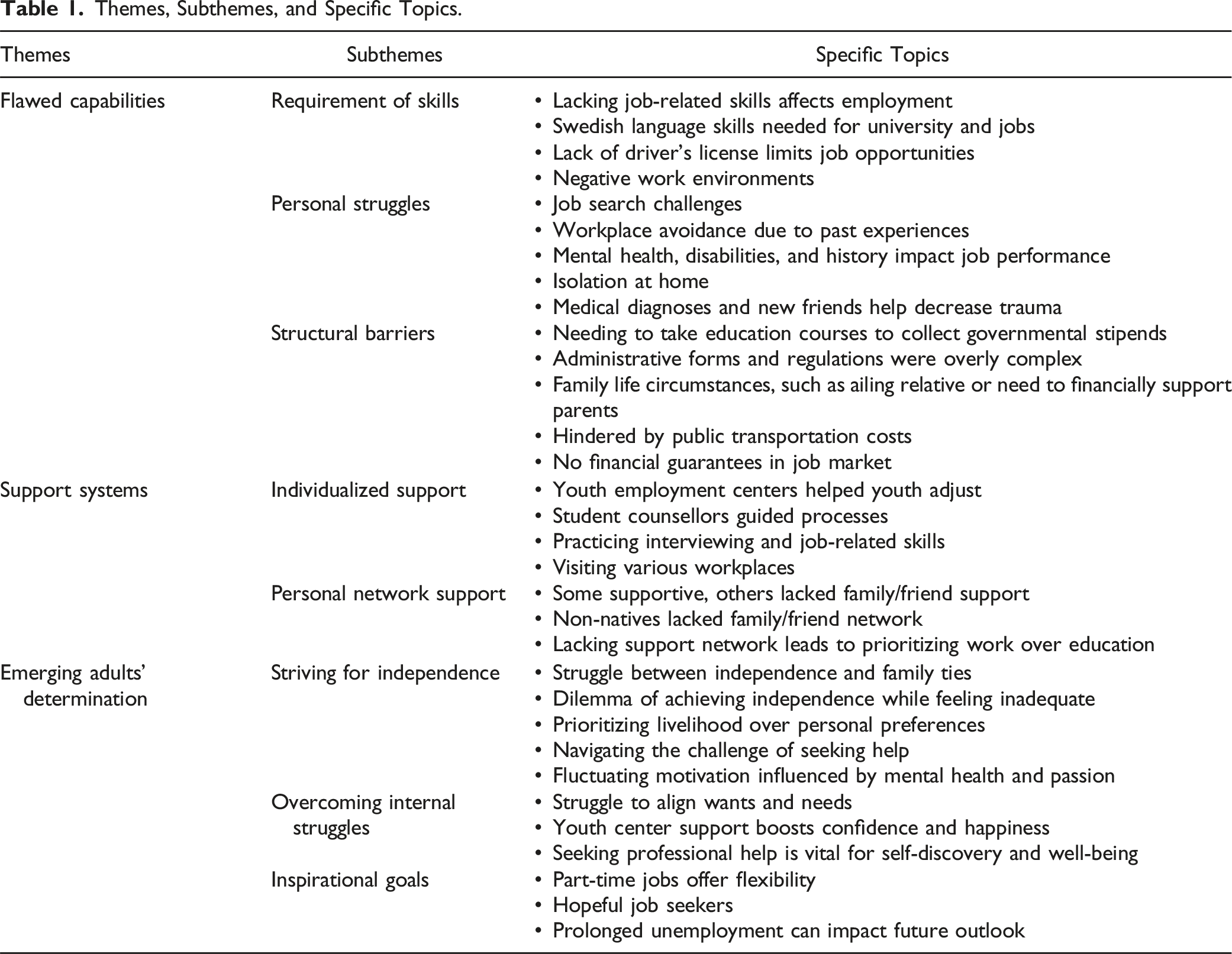
Three themes, and their respective sub-themes are reported (Figure 1): Flawed capabilities, Support systems, and Emerging adults’ determination. As illustrated in Figure 1, the themes encompass different topics, but may slightly overlap. For example, because the emerging adults recognized their flawed capabilities, they requested a strong support system, or conversely, when they lacked a strong support system, they stated that they had flawed capabilities, which impacted their ability to find employment/further education. Similarly, having greater support or lacking certain job-related skills may encourage emerging adults to have a stronger determination to succeed. This illustrates how emerging adults, in line with Bronfenbrenner’s model, often perceive their opportunities as consequences of their own abilities, as well as dependent on the support structures around them. The themes, sub-themes and a summary of the specific topics appearing in respective sub-themes were found in Table 1. Three themes and their respective sub-themes, where themes are partially overlapping, as participants described the multi-directionality of the themes. Themes, Subthemes, and Specific Topics.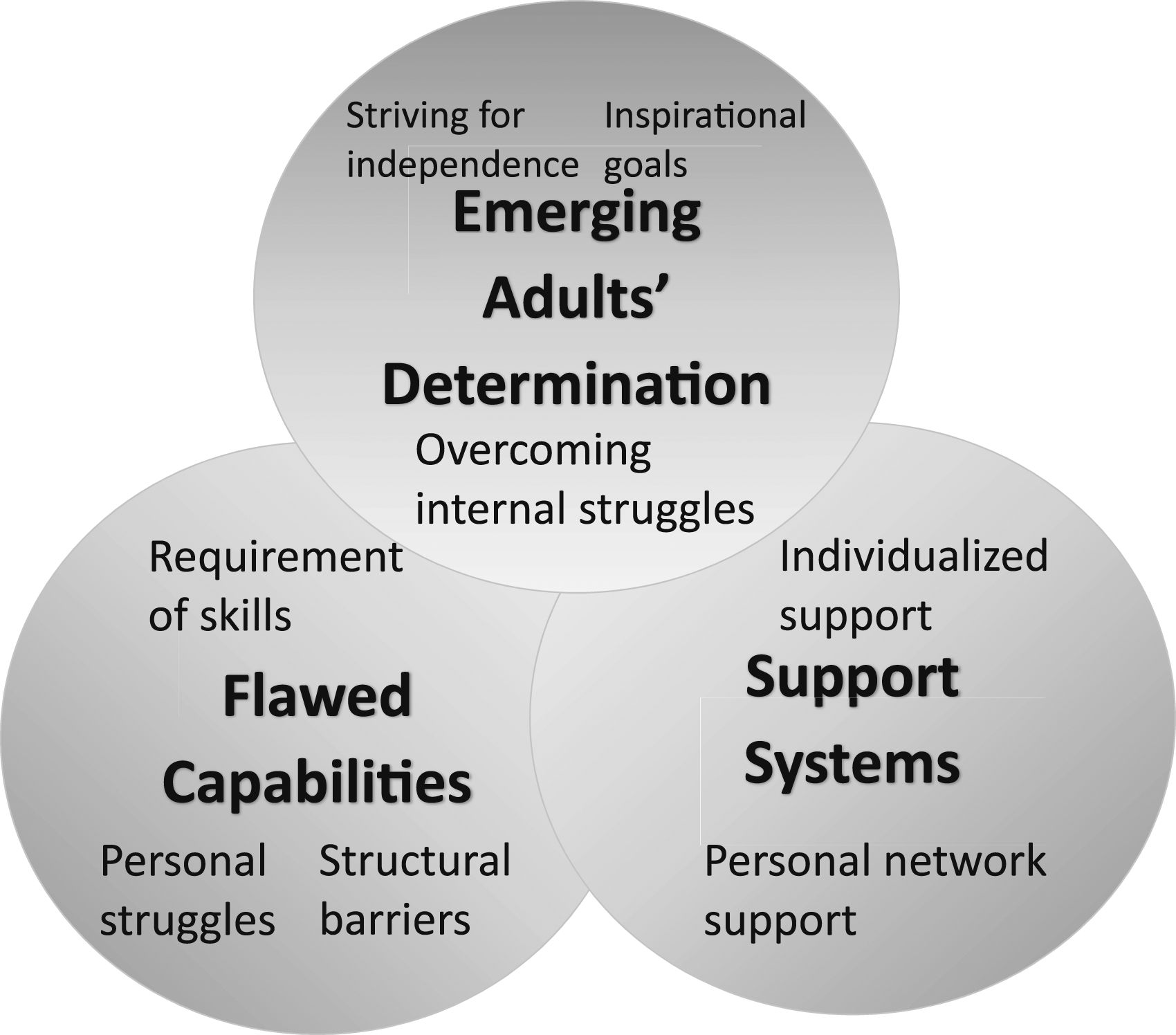
Flawed Capabilities
This theme described participants’ past experiences and the present situation in which the emerging adults lived. The theme was constituted by three sub-themes: Requirement of skills, Personal struggles and Structural barriers.
Requirement of Skills
Many emerging adults reported that they lacked certain job-related skills that would help them find employment. Several described that their levels of education and/or work experience often disqualified them from jobs, for example, by not having completed high school, which many jobs required. Several participants stressed that schools, especially in relation to high schools, should update themselves to better meet the needs of emerging adults today and that the education system made students feel tired and depressed. A few participants reported that the reasons for not succeeding in high school were that they were not there by their own free will and that it was more fun to do other things than study. However, these same participants disclosed that they regretted not trying harder in school. A few described that they were more motivated to study now compared to when they were in high school. “Now that I’m unemployed and I kind of understand that if I had been a little more concentrated and kind of went to the lessons more, I know how stubborn I am, I could have done it easily but yes it was the motivation and the will, they were kind of completely gone so that was one of the reasons why I didn’t pass high school.” Emerging adult #5
Due to these decisions, a few participants expressed that they feared life-long judgement regarding their future education and career paths.
A few emerging adults also lacked other job requirements, such as Swedish language skills, especially for those not born in Sweden. Non-native Swedes further reported that they needed to study Swedish before they could start studying at the university, resulting in an additional barrier for this group. Similarly, a native Swede acknowledged Swedish as a potential problem, as slang, which was commonly spoken in his neighbourhood, was not well-received in the job market.
A few emerging adults described not having a driver’s license as a barrier into the job market. They further elaborated that they could not afford to pay for the books, driving tests, and other preparation materials needed for securing a Swedish driver’s license, which they described led to feelings of frustration. The participants suggested that if they could receive financial assistance to help pay for a driver’s licence, then more job opportunities would be available to them. “I’ve looked a little at the job market, but as soon as you enter, they’re looking for an electrician or something like that. It’s always one thing that they want a driver’s license; that it’s meritorious or it’s a requirement, so it’s a bit discouraging; just this that you don’t have a driver’s license. I’ve tried to get a driver’s license, but it wasn’t so easy. And since it was a bit difficult to get my father out and drive, so you get into the habit of driving, that’s how it happened, so the flame went down.” Emerging adult #16
While several of the emerging adults had never worked, a few had prior working experiences, exclusively from part-time or temporary jobs with low qualification requirements. Their descriptions of those jobs varied from being of acceptable conditions, sometimes even empowering, to poor working conditions with low control and unpleasant interactions between colleagues and bosses. “It was a very bad environment there. I liked the work itself, but the colleagues and the boss I had and the environment that was in it all, was a very uncomfortable environment, so I had sleep problems for over a year. Then when I realized that okay, maybe you should actually be able to sleep at night, I thought, maybe I should resign. So, then I resigned from there.” Emerging adult #4
Personal Struggles
Many emerging adults described that they were stressed and bored with their current life situation. A few described that the boredom they experienced positively motivated them to find employment, while others described that these feelings could be further exacerbated into depression or suicidal thoughts if they did not find employment: “If I get a lot of rejections then I’ll probably be suicidal, so I’m a little afraid to submit because I feel bad as soon as I get a rejection.” Emerging adult #16
Several also described that they had a hard time understanding their own needs, and therefore found it difficult to make the right choices. One participant described it the following way: “…driving force isn’t the problem. When I find something I like, then I can really do it for several hours in a row, for as long as I want. But what I have a problem with is that I have a hard time knowing what I want, so I sort of go against my own needs. Because if I get tired then I can’t take it, and then I don’t want to do things. So, what I would need is, yes professional help.” Emerging adult #4
While several participants had applied for many different jobs, they were seldom contacted for interviews. Not hearing back from potential employers was described as highly demotivating, as being rejected negatively affected their mood, especially if it was a job they were passionate about.
In reference to the application process, many participants emphasized that it was hard to start the process, but that they would be more motivated to show their enthusiasm for a position if they had a job interview. Several emerging adults discussed that employment interviews made them feel insecure, as they did not know if they had the right skillset to perform the job tasks. They also described that they were uncertain about how much of their personal life and mental struggles they should share during the interview: “It’s not hard to search for jobs. Sadly, I have been to many interviews. It’s like it is that I’m very insecure with myself, so I can think of many reasons why someone should hire me but when I’m on an interview and they ask like what are your strengths, then I get completely blank.” Emerging adult #5
Several emerging adults reported searching for employment as energy draining and a few described that they avoided applying for a job if they envisioned that it would be an uncomfortable work environment. For example, a participant who had been bullied as a child felt insecure about applying for jobs where the boss might be domineering and demanding. Several participants reported that they had some personal issues, such as not feeling mentally well, having sleep issues, disabilities or history of mental ill-health, including depression and PTSD, as well as drug usage, which they described to negatively affect their ability to work and go to school. One described how high demands from their father was a cause of ill-health, while a few others had experiences of physical abuse. A few emerging adults described that mental ill-health and surrounding circumstances sometimes led to them isolating themselves in their home, either by being too depressed to get out of bed or as a way to escape friends who had developed illicit drug habits. Receiving a mental health diagnosis or making new friends, respectively, were described to help leave the residence or to start making adjustments to get back on track.
Structural Barriers
Several emerging adults had attended adult education courses. A few of those noted that they needed to take a certain amount of course credits to collect a governmental living stipend. They stated that accomplishing this was not always feasible, resulting in them needing to pay back their stipend, which further negatively affected their overall attitude toward earning their high school equivalency, let alone attending higher education institutions. However, financial assistance from the employment office was described as a main income, but the regulations around how to qualify for assistance were described by several as complicated, confusing, and stressful, which could lead to a loss of financial assistance for not correctly following the rules. “…the system at the employment agency is very, very rigid. It’s very hard, and it becomes very difficult when you are both, like when you have my disabilities and are very depressed, just that you must, between the first and the fifteenth I think it is, you must report what you have done, all the activities you have done in the previous month, otherwise you will have your compensation withdrawn. And the employment agency’s website is among the least user-friendly I have ever experienced.” Emerging adult #19
One participant expressed that the meticulous control measures around their daily activities were demotivating and wished for more trust from the system. Therefore, it was suggested that youth workers should be directly involved, by either helping to navigate the employment office or to sometimes speak on behalf of the emerging adults.
Several participants also described how surrounding life circumstances impacted their ability to complete school and subsequently, their ability to find meaningful employment. For example, a few emerging adults reported that they needed to help take care of a sick relative, while others described that their family required additional income for survival. Because the emerging adults often lacked money, several brought up that they wanted to have public transportation subsidized to make it more affordable to visit the youth centres, Swedish language classes, and to meet potential employers. “SL [the public transportation] and so on…it feels very, it costs a lot of money for a trip and then I’ve become a bit that, if it’s a trip here that might not, which I notice might not give me much but still might need to go through something, it’s hard to take from the money and deduct from the SL card to go here.” Emerging adult #18
A few participants reported that they did not really see the point of studying, assuming that they would receive the same salary regardless of their education. One of them expressed that re-attending school was a gamble that cannot guarantee better employment opportunities. A few emerging adults with disabilities had positive experiences from attending adult education classes and described that the teachers had made appropriate adjustments for them, for example by allowing them to complete missed classes. They described the system at these schools to be more flexible compared to high school. Receiving flexible support was described to help to further motivate the emerging adults to continue with their education. “I was very nervous because right now with my disabilities, to study, but it’s actually gone unexpectedly well, because it’s very, Komvux [adult education], the difference to what I’ve sort of studied at university, it has been a lot more, the teachers are trained teachers, they are much more pedagogically knowledgeable and they are much more, they have a much better understanding and have much more respect for my disabilities and it’s so cool” Emerging adult #19
A couple of participants emphasized the struggle to find secure employment as opposed to short-term jobs. One described it the following way: So I haven’t felt that it was difficult to look for a job if I’m being completely honest, I just feel that it’s difficult to find secure employment. I think it’s very easy to get a job, there are many jobs available, in Stockholm especially…I just feel that I want a secure job where I can combine it with studies, it’s very difficult to find, very difficult.” Emerging adult #9
Support Systems
The second theme, Support systems includes two sub-themes: Individualized support and Personal network support. These sub-themes focus on the emerging adults’ experiences of support and their expressed needs and recommendations.
Individualized Support
Several emerging adults emphasised the diversity within the group of young NEET individuals and therefore emphasized the need of different types of support. A few had experiences from the general employment office and emphasised the advantages of the youth employment centre where they provided support that was more tailored to the age group. Several participants stated that youth workers provided them with a lot of hands-on, helpful, practical job acquisition skills such as teaching them how to write a CV and cover letter, job coaching skills, informing them about different potential career options and job positions, websites to search for employment, practical Swedish-language support, and how to best contact potential employers. A few emerging adults further reported that they had received information from student counsellors about different education tracks, governmental education loans, and what preparations they would need to make to go back to school. Another advantage of attending the youth employment centre was the social training it implied. Several participants described how they appreciated the information and training they received on how to act during an interview, how to introduce themselves to new people and the opportunities to practice interviewing techniques. As one participant described it: “They train us how to go for an interview, how to face an interview, how to search for jobs. So, it’s very helpful for me, because I’m very new here and I don’t have much experience about work, about jobs; so it was very useful for me.” Emerging adult #1
A few participants described that panic attacks or extreme nervousness during interviews had substantially subsided after practicing interviewing skills with the youth workers. Several participants further stated that youth workers were very supportive and a few described youth workers as people they could talk to about everyday life. One participant compared the youth worker to a psychologist, while another one emphasised the positive ambiance at the youth employment centre stating: “They support me. What is it that they are saying: ‘you should continue studying,’ ‘you should try to live where you want,’ ‘you shouldn´t think negatively, you should think positively.’ They have helped me a lot with that as well.” Emerging adult #15
A few of the emerging adults had even recommended their friends to visit the youth centres. Several emerging adults reported that they had received support beyond employment and education, such as information on how to get a driver’s licence, different types of governmental economic support, setting up goals for the future, therapy sessions and interventions for their addictions. Non-native Swedes reported that they had received support in validating their foreign qualifications and saw the meetings with the youth worker as an opportunity to practise speaking Swedish.
While most emerging adults described that they were satisfied with the support they had received, some further suggestions were brought up, such as that they would appreciate receiving further help with sending in job applications, recommendations to employers, paid internships, additional guidance on how to prepare for job interviews, and help with speaking Swedish. Someone also expressed that it would be appreciated with more specific opinions from youth workers on what to write or not write in the cover letter. Furthermore, one participant wished for the youth workers to continuously direct on their next steps: “That’s why I have trouble getting started. So it is, it would be good if you, if someone could send in my CV for me and such things and then tell me to go to this place and see if you can get a job.” Emerging adult #16
To improve their motivation toward finding employment, a few participants expressed a wish to visit different workplaces to see what potential opportunities might look like or to speak with other people who recently were hired to hear about their experiences on finding and keeping employment.
Personal Network Support
The amount of support received from family and extended family varied greatly between the emerging adults. Several described that their family was very supportive and provided economical, motivational or practical support, such as making phone calls or accompanying them to the youth centres. As one emerging adult described it: “It is my stepmom and my stepsister that are my biggest cheerleaders, and also my best friends. It is insane how much help you can get from your best friends.” Emerging adult #5
Others stated that they lacked support from their family and friends. This was especially true for non-native Swedes who often reported that they did not have any friends or family in the country. A few participants did not have any contact with their family due to abuse during childhood. One participant acknowledged that even though they had family and friends, these people were not necessarily supportive: “When I was 18, my mom was like, you should go and be independent. I can’t bare taking care of you. So when I was 18, I had to take care of myself until now, and actually I did it very well.” Emerging adult #12
The lack of a strong supportive family network was perceived as an obstacle for continuing with education for a few of the emerging adults, as they sometimes needed to financially provide for themselves and therefore placed work over their education. A few participants reasoned that their parents did not always approve of their chosen lifestyle in the past, and therefore were less supportive then, but now their parents were more responsive and helpful when they wanted to “grow-up” and become independent. However, a couple of participants noted that their parents had always been uninvolved in supporting their transition into adulthood. In considering their extended family, a few emerging adults stated that most of their family members would help them find employment if they asked for help, but stated that asking for help was not easy, and they often failed to ask.
A couple of emerging adults reported that their friends were very supportive and that spending time with friends made them feel better. However, participants with prior addiction issues stated that they lacked reliable friends since many had been lost when trying to get out of the addiction.
Emerging Adults’ Determination
The theme Emerging adults’ determination includes the three sub-themes: Striving for independence, Overcoming internal struggles and Inspirational goals. These sub-themes described motivators among the emerging adults, how emerging adults themselves coped with their situation, and their views on the future and necessary adjustments or support needed to reach some of their goals.
Striving for Independence
A few emerging adults reported that they had tried to become more independent either by physically moving or considering moving far from the family but ended up realising that they needed to live closer to their families, as they missed their families or that their families needed their support. These emerging adults were in juxtaposition between wanting to be physically closer to their family, while struggling to be independent. Another emerging adult expressed a strong will to start working so she could become independent, as she had always been reliant on her family and husband. Several participants further stated that even if they would rather study than work or work and study at the same time, making a living was the highest priority: “So, right now I need to work. It is like I have just lost my apartment, so right now I need to think about what I should do and no matter how much I want to study, I need to get an income first, regardless of where I will live.” Emerging adult #5
A few participants mentioned that they did not care if they studied or worked, as long as they could leave their parents’ house. Earning money was described as a way to become independent from their parents, and also helpful for them to live, travel, contribute to their families’ economic situation, pay off debts, and to prove to others that they could “make it”. As such, several participants stated that they did not want to work in unpaid internships. A few emerging adults also emphasised the costs of traveling to internships and the risk of feeling exploited. A couple of participants were more positive in their views stating that an internship could be beneficial if it was in a relevant area and could provide some social training, create routines and keeping individuals active. Several participants mentioned that they needed to start prioritizing their own needs instead of others, and start asking for and accepting help. “I have a very hard time letting others help because everyone has said all the time that you can’t do this. Then I have to refute and usually there are so many, because instead of choosing like who I should ask for help, I try to prove to everyone and then it becomes like, the people I really should ask for help, they have become such that it has not worked out. But now I have to think differently.” Emerging adult #5
Several emerging adults routinely reported that they had a motivational drive to do things, especially if they enjoyed it, and described positive perceptions toward gaining employment. A few further mentioned that unemployed emerging adults were those who did not really want to work. Several participants stated that they were motivated to change their situation, and that they wanted to feel normal, improve their lives, and not be dependent on others, especially their parents. However, a few participants described that motivation could shift daily, depending on their mental health status and their passion for a specific position. One emerging adult described it the following way: “Yes, it has depended on how I have been feeling. Some days, when I was depressed, it was like, yes, no today I can only stay in foetal position the whole day. But then I know that I have had really productive days, once I find a job that I really want such as funeral advisor, then I get started right away, and like write my application on a day or two, so it has varied a lot” Emerging adult #19
For emerging adults living in asylum, they expressed an inherent motivation to contribute to the Swedish society by working and paying taxes.
Overcoming Internal Struggles
A few participants reported that they had problems with low self-esteem and did not consider themselves to be social. They stated this stemmed from different traumatic childhood experiences. For example, one emerging adult noted that he decided to become less social since his friends could never find time to meet up with him. A few emerging adults reported having a lack of self-esteem, which they described as leading them to doing things that were against their own best interests, such as substance abuse or prioritizing time with friends over finding employment, resulting in mixed feelings, overthinking, and sad thoughts. They said that they could feel fine mentally, while simultaneously expressing stress and anxiety regarding their situation. Other participants described themselves as fighters with high self-confidence. They believed that their troubled childhood made them stronger, constantly striving to improve themselves and their performance during job interviews. As one emerging adult described it: “What I lack is nothing. I don’t miss anything because I have always been outgoing. I have always been positive when it comes to work. I have decided I will get this job…I just say hello to everyone, and I will get this job.” Emerging adult #12
A few participants described that they started to feel better mentally after having received support from the youth centres. However, they discussed how they had “hit rock bottom” and had felt depressed, alone, and trapped, both emotionally, as well as physically. The emerging adults pointed out that they considered it important to be allowed to feel bad and wait until they were ready and motivated to try to feel better again. Several participants reportedly went to the gym or exercised regularly to keep well, while others described their days as sedentary: “A whole day I can just sleep at home, but it feels boring to do nothing.” Emerging adult #6
Several emerging adults expressed that they wanted to learn how to be social and build self-confidence. They stated that they needed to have someone that truly cared for them, especially so they did not feel alone. A few emerging adults also discussed how they struggled with finding their identity, and therefore having a professional to talk with could be helpful. As one participant described it: “My problem is that I have trouble knowing what I want, so I’m going against my own needs. That’s why I get tired and then I can’t be bothered, and then I don’t want to do stuff. So, what I need is, yes, professional help… to find myself, find what I need so that I can do what I want.” Emerging adult #4
Several participants described that youth workers could make them feel important, resulting in emerging adults having increased confidence and feeling happy. However, one participant expressed that support was not needed at all and that mental issues could be managed without others’ help.
Inspirational Goals
A few of the emerging adults did not have goals, and this was described as a source of stress. Others described that they had future plans, where they were inspired by past working experiences, by parents or by having visited workplaces of relatives. One emerging adult emphasized the support provided by the youth worker at the employment office in the process to find out and articulate goals: “My former coach [youth worker], we became very goal oriented together because she posed those questions very often, ‘what is your goal?‘, ‘what do you want your future to look like?’ and then it happened all the time that, because it came up, then you also started to look at it a little more than you had done before. Nowadays, as I said earlier, I don’t meet youth workers that often, but I keep on working on fulfilling the goals and those directions, the plan we had made and the goals that we had set, that is what I am doing and trying to get fulfilled right now then.” Emerging adult #17
Many participants noted that they needed to work in the short-term (as described earlier) but saw education as a future means to pursue their real interests and to get the necessary qualifications for the employment that they were passionate about. Several emerging adults expressed that they wanted to attend university one day, but most discussed the importance of getting a job as quickly as possible. As one emerging adult described it: “Preferably a job and start getting some money and then I can start studying again and get better grades, and then you get a better job.” Emerging adult #8
Therefore, finding a way to be employed, while allowing the flexibility and freedom to pursue studies was expressed as the most ideal situation by several of the participants. A few of the emerging adults described that they tried to achieve this by, for example, taking part-time or temporary jobs so that they could also focus on their education. At the same time, they wanted a more flexible adult education system that would allow them to also work. Other emerging adults stated that they would only consider going back to school if they found a job that required further education. “My favorite, so I’ve always wanted to work in the media, all kinds of media. But I’ve also been a bit skeptical about it lately because I haven’t seen that it needs an education. Much of the media now today is a lot of finance so I felt that I can do it on my own time, but if I’m going to take training for something then it should be something quite robust and something you can get a job on straight away like that.” Emerging adult #9
A few emerging adults described that they were hopeful about finding a job and that the process of searching for work had not been that difficult. However, they often noted that they could become less complacent toward the future if “too much” time passed without finding a job.
Discussion
The present study qualitatively assessed emerging adults’ perceptions of their personal and structural barriers that hindered them from finding employment (or further education), resulting in three main themes that are reflective of Bronfenbrenner’s socio-ecological model: Flawed capabilities, Support systems, and Emerging adults’ determination. Participants consistently discussed personal and structural barriers that negatively affected their ability to gain employment, including how their personal motivation either positively or negatively was affected by these barriers. Participants attributed their increased self-confidence to the support they received from youth workers who often both directly and indirectly supported their transition into adulthood and therefore independence. They further acknowledged that by feeling more capable and confident regarding their future job prospects, their mental health had improved, which consequently had positively affected their motivation to make further improvements to their own well-being, including strengthening their career preparedness skills. Reducing or eliminating emerging adults’ personal and structural barriers should therefore aid in improving emerging adults’ ability to gain employment.
Emerging Adults’ Barriers
At the individual, micro- and meso-system levels, unemployed emerging adults reported several personal barriers during the interviews, such as lacking job-skills, higher education, and a strong supportive social network, as well as mental health problems and not speaking the local language. These personal barriers, for example having a lack of job-skills (Akkermans et al., 2015; Caplan et al., 1989), an unsupportive family (Swartz et al., 2011), smaller social networks (Cotterell, 2013), lower education opportunities (Rahmani & Groot, 2023) are reported in the literature to negatively affect emerging adults employment possibilities. A lack of language skills has also been described in the literature as a major obstacle for migrant NEET individuals (Pesquera Alonso et al., 2022; Zanfrini & Guiliani, 2023). Furthermore, mental ill-health, has been described to have a negative impact on the ability to find and keep a job (Rahmani & Groot, 2023; Strandh et al., 2014), and where mental health support can disrupt the process of finding employment or going into further studies (Schön et al., 2023).
At the exo- and macro-system levels, the participants in this study mentioned structural barriers, such as not being able to navigate governmental rules and regulations, needing to financially and physically support relatives, and not being able to afford public transportation and/or afford a driver’s license. Participants often viewed these exo- and macro-system level issues as difficult barriers to solve. However, the participants gave several solutions regarding transportation, including either free or reduced fair options for public transportation and/or reduced financial fees for earning a driver’s license for emerging adults. In Stockholm, a monthly public transportation pass is 970 SEK ([$93], SL, 2023), while a Swedish driver’s license typically costs between 15,000 to 25,000 SEK ([$1435-$2391] Motor Trafikskola, 2023), but can become much higher if further practice testing is warranted. For emerging adults aged 18–24, the average monthly salary is around 27,000 SEK ([$2583/month] Statistics Sweden, 2023); thus, the economics of receiving a driver’s license, a requisite for many jobs, may have an impactful burden towards emerging adults (Kågeson, 2014), especially with those from low-income families or those who struggle with the driving tests.
Youth Workers’ Support to Reduce Barriers
The participants stated that youth workers did a good job of reducing the impact of their personal and structural barriers by providing both direct and indirect support, leaving the emerging adults hopeful that they would soon become employed and/or go back to school. The participants appreciated the non-job-related support they received, such as helping them with navigating government bureaucracy paperwork, earning a driver’s license, and being referred to mental health services. Performing these tasks in addition to direct job-related skills building helped provide a holistic support program for the emerging adults. Previous research has similarly found that including job-related skill acquisition, as well as psychological and social support may directly impact emerging adults’ overall well-being more than receiving employment support alone (Di Blasi et al., 2016; Robertson, 2018), suggesting that youth workers are performing at a high quality.
The emerging adults described an improved life satisfaction and positive affect by being supported by the youth workers. Previous research indicates that this can offset psychological and behavioral problems (Park, 2004), as well as improve their confidence and personal agency (Robertson, 2018), self-concept and self-determination (Keyes, 2006). The participants also brought up the functions of attending youth centers or training programs, stating that those provided a time management structure, made them leave home, and kept themselves active. This can be related to Jahoda’s model of latent functions specifying that one of the beneficial effects of working is the time structure it offers of the day (Ayoub et al., 2021; Jahoda, 1982). Support from peers and help to identify life-career goals has been suggested as important features to include in programs directed at emerging adults (Robertson, 2018; Zhu et al., 2022). Similar to the descriptions conveyed by the participants in this study, social support from family, friends or shorter encounters in relation to social services and school, were also expressed as meaningful and appreciated in a study on young people in Sweden who were not working or studying (Lögdberg et al., 2018).
Youth Motivation
In the current analysis, emerging adults mentioned being motivated by both controlled and autonomous factors (Ryan & Deci, 2000), where independence is important (Ayoub et al., 2021; Gaspani, 2019; Görlich, 2021), as failing to become independent can led to stress and conflicts (Gaspani, 2019). For example, participants could be externally motivated to find employment because they needed to secure housing, earn money, and because they lacked familial support, while they also discussed internal motivation, such as wanting to better their own lives, become independent, finding work/studying enjoyable, and wanting to feel normal. The latter, according to previous research, resembles a resistance toward identifying themselves to stereotypically unemployed people (Peterie et al., 2019). The participants further described a process of jumping between school and work, as well as being motivated and unmotivated to find a career path, similar to previous research (Biggart et al., 2001; Lundahl & Olofsson, 2014). Therefore, the motivation of the emerging adults could wax and wane, especially depending on their mental health status, as well as other factors, such as support from their social network or from the ‘system’, such as youth workers’ support which highlights the interrelatedness between the individual and its socio-ecological system; highlight the importance of a social safety net surrounding the individual. The pivotal role of supportive and committed teachers or youth workers has been highlighted previously (Ayoub et al., 2021; Görlich, 2021; Jonsson & Goicolea, 2020; Schön et al., 2023; Zhu et al., 2022) and this is in line with mentorship programs (Forte, 2020). Indeed, several of the participants that were interviewed in this study had not finished high school, which is a major risk factor for not successfully transitioning into the labor market (De Ridder et al., 2013).
Even in the Swedish setting, that has a relatively robust welfare system, a few participants expressed that the reason for not finishing school was needing to contribute to the family economy. Economic support to families with adolescents at risk of dropping out of school has shown positive results internationally if the support is conditional (Forte, 2020); therefore, this strategy might be worth testing in Sweden. To relate to Bronfenbrenner’s social-ecological model, when support or conditions at the microsystem’s levels were present, then the emerging adults felt encouraged, happier, and supported, helping them become an independent young adult. This pattern emerged throughout the findings, where support from friends and family, as well as from adult education teachers, Swedish language teachers, the employment office, youth centers, and positive work experiences all supported emerging adults in becoming more independent. Similarly, at the mesosystem level, when organizations, like the youth center and employment office, worked together in collaboration with the emerging adults, then they perceived this support to be importantly helpful, as navigating the bureaucracies was perceived as difficult. However, when the microsystems were weaker or more unstable, robust support from the macrosystem’s levels (for example the welfare system) could help compensate. Currently however, as described by the participants, many exo- and macro-level barriers still exist for emerging adults.
Participants also shared negative experiences of the educational system. Both cognitive and non-cognitive abilities are important for education and work life; therefore, the educational system should be designed to develop both these abilities and contribute to the learning and development of adolescents/young adults irrespective of individual prerequisites to provide equal opportunities for health (Statens Offentliga Utredningar (SOU), 2018). The importance of early interventions focusing on increasing the chances of completing high school, such as having smaller class sizes (Forte, 2020; Fredriksson et al., 2013), and early identification of students in need of support (Forte, 2020), has been highlighted (Statens Offentliga Utredningar (SOU), 2018).
As previous research also describes (Simmons et al., 2014), repeated negative experiences from the labor market seemed to affect the motivation of the emerging adults in this study negatively. This is one example of how the surrounding systems influence the individual and the individual’s ability to become employed. The interviewed participants further explained the difficulty of juggling both work and school, acknowledging that while they often wanted to pursue more education, they needed to earn money for survival. Participants suggested that other systems should be in place to reduce these barriers, such as being able to receive enough money to live on while studying or to have more flexible workplaces or education programs. Participants noted that adult education classes were more flexible and teachers made appropriate adjustments to accommodate to the students’ needs. They consequently felt more motivated to continue studying, similar to previous research (Ayoub et al., 2021; Görlich, 2021; Jonsson & Goicolea, 2020; Schön et al., 2023).
However, further negative experiences may be present, but latent, and consequently, not described by our participants. For example, there is research regarding how racism limits youths’ ability to gain employment/education in Sweden (Akhigbemen & Mutshipule, 2022; Behtoui et al., 2019; Räthzel, 2006), where refugees have an even harder time gaining employment than immigrants (Borsch et al., 2019). In our sample, eight participants were not born in Sweden, and yet, none of the participants talked about how their ethnic background might affect their ability to gain employment. This lack of discussion might have resulted from having ethnic Swedish women conduct the interviews or because they did not directly ask participants if they have felt discriminated against. On the other hand, participants often blamed their own lack of skills and knowledge instead of relating their problems to finding employment to exo- or macro levels of society. They also sometimes blamed language abilities and even their willingness to show up to work on time, so-called ‘weaker signals’, which are also factors that affect employment (Räthzel, 2006). However, structural and institutional discrimination can exist, whether or not our participants were directly aware of it. For example, ethnic minority emerging adults, especially men, are less likely to gain employment if they have the same work experience as an ethnic majority applicant (Arai et al., 2016); thus, organizational hiring practices may limit equal opportunities to gain employment.
Strengths and Limitations
A potential limitation was that the average interview length was 19 minutes. This may be related to a low education level among some youths and/or that a few did not speak Swedish as a native language even though they stated that they felt comfortable speaking Swedish. However, youths had similar comments about their personal and structural support barriers, amounting to three themes; suggesting the data to be information-rich (Malterud, 2012). Furthermore, another limitation was that even though we have information about the participants’ NEET journeys from their descriptions, specific quantitative information in terms of exactly how long they have been NEET is missing from several participants, which can make it more difficult to draw conclusions on the transferability of the findings.
A strength to the current study was that it included youths with lower educational levels, as they were more likely to struggle when they found employment compared to those with a higher education. In addition, the youths represented both urban and suburban municipalities; however, all municipalities were located within the Stockholm region, which might affect the transferability of the findings. The transferability might be less affected though, as the current study represented youths who had different socio-economic backgrounds, including being born inside/outside of Sweden, having/not having mental ill-health, and coming from wealthy/poor neighborhoods. However, all participants were currently attending a youth center, and therefore, the results might not transfer to youths who have not reached out for unemployment support or who are socially isolated.
Conclusions
After qualitatively analysing the results from 22 emerging adults in Sweden on their perceptions of needed personal and structural support, three primary themes emerged: Flawed capabilities, Support systems, and Emerging adults’ determination. Swedish emerging adults may have diverse backgrounds and experiences and their accounts reflected to a high extent the stage of emerging adulthood characterized by instability, identity, and goal searching. Many shared experiences of challenging situations dealt with their capacities to cope with personal and structural barriers. Overall, emerging adults felt like they lacked important job-related skills, as well as other necessities needed to be successful in the workplace, such as language skills and a driver’s license. However, when they did receive social support, as well as support from different agents (e.g., youth centers, employment office, educational units), then youth felt empowered, where this support helped them become more independent. Emerging adults often discussed their own perseverance and internal motivation to try to overcome everyday obstacles in securing employment/further education, but cited that receiving individualized support for their unique issues was important and helpful, where NEET emerging adults benefitted from support from government workers and youth centers, as well as friends and family. Emerging adults provided ideas on several policy solutions that could aid them in securing employment including financial assistance while studying and for taking the driver’s exam. They also requested paid internships, subsidized public transport, and a more flexible adult education system to make it possible to combine employment and education. Emerging adults further requested the possibility for psychological support at youth centers which could help strengthen/support emerging adults in their transition to adulthood and working life. Listening to the needs and experiences of emerging adults could be helpful when providing more supportive and effective interventions.
Supplemental Material
Supplemental Material - Emerging Adults’ Perspectives of Received Youth Worker Support and Their Personal and Structural Barriers to Find Employment or Further Education: A Qualitative Study From Sweden
Supplemental Material for Emerging Adults’ Perspectives of Received Youth Worker Support and Their Personal and Structural Barriers to Find Employment or Further Education: A Qualitative Study From Sweden by Michael B. Wells, Lisa Blom, Michaela Asper Modin, and Lene Lindberg in Emerging Adulthood
Supplemental Material
Supplemental Material - Emerging Adults’ Perspectives of Received Youth Worker Support and Their Personal and Structural Barriers to Find Employment or Further Education: A Qualitative Study From Sweden
Supplemental Material for Emerging Adults’ Perspectives of Received Youth Worker Support and Their Personal and Structural Barriers to Find Employment or Further Education: A Qualitative Study From Sweden by Michael B. Wells, Lisa Blom, Michaela Asper Modin, and Lene Lindberg in Emerging Adulthood
Footnotes
Acknowledgments
The authors wish to thank all participants for their time and contribution. Sharing your experiences is helpful to providing better resources and support. We further wish to thank the youth workers for allowing us access and for helping recruit participants. Lastly, the authors wish to thank Frida Lindegren, Kristin Öster, and Josefine Ericksson for helping conduct the interviews.
Declaration of Conflicting Interests
The author(s) declared no potential conflicts of interest with respect to the research, authorship, and/or publication of this article.
Funding
The author(s) received no financial support for the research, authorship, and/or publication of this article.
Transparency and Openness Statement
Disclosures. As part of the submission procedures, authors will be asked to confirm the following (even though not all apply to all types of research designs):
1. You included a clear statement of how the sample size was determined
Yes
2. You included a statement of a priori statistical power based on a reasonable effect size (quantitative studies) or how you ensured saturation of depth and breadth of themes (qualitative studies)
Yes
3. You included a description of all data exclusions (e.g., outliers), how the decisions about exclusions were made, and have conducted all analyses with and without the exclusions
Not applicable
4. You included a description of all data transformations, how the decisions about transformations were made, and have conducted all analyses with both the transformed and raw data
Yes, but with respect to a qualitative analysis.
5. You included a rationale for including covariates and tested all models with and without covariates included
Not applicable
6. All measures and questions relevant to the research question contained in the project were included in the manuscript
Yes
7. You included a clear statement of the amount, type, and method of handling missing data
Not applicable
8. You included effect sizes for all statistical tests
Not applicable
9. All research questions and hypotheses are clearly and accurately labeled as either exploratory or confirmatory
Not applicable
10. You included rationale for any deviations from standard scoring procedures of measures
Not applicable
11. You included, as appendix or supplement, a detailed description of the interview questions asked
Yes
12. You included detailed description of your qualitative coding/analysis process
Yes
13. You included an assessment of coding trustworthiness, either quantitative or qualitative
Yes
These items are presented as a checklist in the submission portal, with authors actively confirming adherence to each practice. A separate statement for disclosures is not required but authors can choose to include one in the manuscript if they wish (e.g., the 21-word solution; Simmons, Nelson, & Simonsohn, 2012).
Transparency and Openness Statement. As part of the submission process authors must include a Transparency and Openness Statement. This statement will be included as part of the peer review process and will ultimately appear in the Author Note section of accepted manuscripts. The Transparency and Openness Statement must indicate the following:
1. Are the raw data contained in this manuscript openly available for download?
No
1. If yes, did you include a DOI or other persistent identifier in the manuscript?
2. For quantitative analyses, is the analysis code/syntax used for the analyses openly available for download?
Not applicable
1. If yes, did you include a DOI or other persistent identifier in the manuscript?
3. For qualitative analyses, are the list of questions and coding manuals openly available for download?
The list of questions asked are openly available. Coding manuals were not used.
1. If yes, did you include a DOI or other persistent identifier in the manuscript?

4. Are all materials used in the study openly available for download?
The actual interviews are available if researchers contact the contact author. For ethical purposes, these are not openly available data.
1. If yes, did you include a DOI or other persistent identifier in the manuscript?
5. Did this study include a pre-registration plan for data collection and/or analysis?
No.
1. If yes, did you include a link to the pre-registration plan in the manuscript?
2. If yes, were deviations from the pre-registration plan clearly indicated in the manuscript?
Supplemental Material
Supplemental material for this article is available online.
Author Biographies
References
Supplementary Material
Please find the following supplemental material available below.
For Open Access articles published under a Creative Commons License, all supplemental material carries the same license as the article it is associated with.
For non-Open Access articles published, all supplemental material carries a non-exclusive license, and permission requests for re-use of supplemental material or any part of supplemental material shall be sent directly to the copyright owner as specified in the copyright notice associated with the article.
