



Abstract
In this paper, we expand on the concept of life crafting and discuss how a life crafting intervention may be useful for emerging adults to help them live a more meaningful and authentic life. Combining self-determination, meaning-making, and life crafting theories, we propose an intervention that involves five components: values exploration, intrinsic interests, contribution to others, a coherent life narrative, and self-concordant goal-setting. First, we discuss the two conceptualisations of life crafting in the literature to date. Second, we explore the eudaimonic philosophy of self-determination theory and how this serves to guide the intervention. Finally, we propose our life crafting intervention and discuss how the components may be delivered to emerging adults to foster more meaning, authenticity, and psychological need satisfaction. Similarities and differences with other programs of research are discussed, as well as the unique contribution of this life crafting intervention.
The ongoing search for an authentic and meaningful life may be one of the greatest challenges of modern living. However, recent increases in mental health issues such as depression, especially in emerging adults, suggest that many are struggling to find value and meaning in their lives, which has only been exacerbated by the COVID-19 pandemic (Halliburton et al., 2021). While these issues need to be addressed systemically, mental health professionals, educators, and others who have contact with young people are uniquely positioned to help them find more meaning in their lives and live in ways that feel more authentic.
Emerging adults––18 to 29-year-olds––are at an important time in their lives for exploring and forming an authentic identity (Arnett, 2000). This process involves exploring and ‘trying on’ various ways of living, especially in areas such as work, relationships, leisure activities, and ideologies (Schwartz et al., 2013). This exploration is a normal and important part of the emerging adult years. However, rates of anxiety and depression are frequently quite high in this age group, in part because of the instability of this period; identities are explored and often rejected, leaving young people without direction (Arnett et al., 2014). Emerging adults are often searching for a sense of meaning in life and this search for meaning is negatively correlated with well-being (Steger et al., 2009). Researchers have found that committing to an identity and life purpose predicted higher levels of well-being in emerging adults (Schwartz et al., 2013; Sumner et al., 2015) and that sources of meaning associated with personal achievement and altruistic activities were especially relevant to fostering well-being in this age group (To & Sung, 2017). These results suggest that young adults are looking for secure identities and clear meaning in their life but may be struggling with the process on their own.
In this paper, we expand on the recent concept of a life crafting intervention (Schippers & Ziegler, 2019), exploring how an intervention based on self-determination and meaning-making theory, as well as newer life crafting models (van Zyl et al., 2023) might help these young adults experience more meaning and authenticity. First, we discuss the two current conceptualisations of life crafting as both an intervention and construct and show how an intervention may benefit from including some concepts from the construct approach. Next, we explore self-determination theory, one of the leading theories in motivation, eudaimonic well-being, and authentic living (Martela, 2023; Ryan & Deci, 2017; Ryan et al., 2008), and discuss how it may offer a useful framework for a life crafting intervention. Finally, we integrate these various theories to provide our model of life crafting and discuss how this may be used to guide a life crafting intervention for emerging adults. We propose an intervention that involves exploring values and intrinsic interests, fostering important relationships and social contribution, crafting a coherent life narrative, and working towards self-concordant life goals. We show how our intervention is based in the latest understanding of fostering meaning and authenticity and how this might be a useful intervention for emerging adults who are struggling with a sense of direction.
Crafting One’s Life
Crafting has been defined as the intentional, self-targeted, behavioural or cognitive changes that people make to their lives to satisfy their psychological needs (de Bloom et al., 2020). It can be seen as the ways in which people actively take control of their situation, by making changes, both in their behaviour and how they think about that situation, to satisfy psychological needs, especially if that need is unfulfilled (e.g., a person feels that they do not have much autonomy at their job; Bindl et al., 2019). Much of the research in crafting has looked at how people craft their jobs in a proactive, bottom-up way to find more meaning and develop a sense of work identity (Wrzesniewski & Dutton, 2001). Recently, this proactive approach to meaning-making has been investigated in other life domains outside of the workplace, such as leisure crafting, home crafting, needs crafting, and off-job crafting (Demerouti et al., 2020; Kujanpää et al., 2022; Laporte et al., 2021a; Petrou & Bakker, 2016). From this, life crafting has emerged as the most holistic concept, investigating the ways that people may proactively shape their entire lives to increase a sense of meaning. (Chen et al., 2022; Schippers & Ziegler, 2019; van Zyl et al., 2023).
Two Conceptualisations of Life Crafting
Being a relatively recent concept, scholars have yet to agree on exactly what life crafting is. However, to date, two conceptualisations prevail in the literature, which we refer to as the intervention approach and the construct approach.
The intervention approach was initially conceptualised by Schippers and Ziegler (2019), who defined life crafting as “a process in which people actively reflect on their present and future life, set goals for important areas of life—social, career, and leisure time—and, if required, make concrete plans and undertake actions to change these areas in a way that is more congruent with their values and wishes” (p. 3). The authors suggest a writing-based goal-setting intervention with seven steps: (1) exploring values and passions, (2) considering current and desired habits, (3) reflecting on one’s present and future social life, (4) reflecting on one’s potential future career, (5) reflecting on an ideal versus non-ideal future, (6) setting goal-attainment plans, and (7) making a public commitment of these goals. This process has been suggested to help participants find more meaning in their lives and help improve young adults’ mental health (de Jong et al., 2020). As such, the intervention approach to life crafting views it as something to be delivered in the form of an intervention or program to guide a person through particular strategies.
Because it recently emerged, there is a dearth of available empirical evidence for the life crafting intervention to date. Of the few studies conducted, the focus has been on the outcome of academic achievement rather than well-being or meaning in life (e.g., Schippers et al., 2015, 2020) and has included a variation on the original intervention proposed by Schippers and Ziegler (2019; i.e., lacking a values exploration component). Nevertheless, the proposed intervention includes several evidence-supported techniques that may foster meaning and well-being. Several strategies are supportive of psychological needs, such as encouraging people to reflect on important life aspirations, values, and long-term interests; considering external pressures and how they relate to their goals; and creating goal-attainment plans (Teixeira et al., 2020). In addition, a large body of research has shown that to the extent that goals are more congruent with an individual’s personally held values, they experience more meaning, intrinsic motivation, and well-being (Emmons, 2003; Holding & Koestner, 2023; Klinger, 2012; Sheldon, 2014; Sheldon & Elliot, 1999).
In contrast to the intervention approach, Chen et al. (2022) and van Zyl et al. (2023) have explored life crafting in what can be called the construct approach. The construct approach views life crafting as a set of behaviours and strategies that all people engage in to varying degrees to better align their values, goals, and skills in order to experience more meaning in life. Therefore, unlike the intervention approach which defines life crafting as something to be delivered, the construct approach defines life crafting as something that can be measured (i.e., a construct). Chen et al. (2022) conceptualised this as having three components: (1) cognitively crafting/reframing, (2) seeking social support, and (3) seeking challenges. They developed the 9-item Life Crafting Scale to measure these three dimensions. The scale development involved multiple forms of validation, including a very high relationship with meaning in life (β = .91), suggesting a lack of discriminant validity. It is possible that such a brief measure of such a broad concept simply measured how meaningful people felt their lives were.
In response to this, van Zyl et al. (2023) performed a systematic review of the crafting literature to isolate the various types of crafting strategies in which people engage, developing a “holistic life crafting” model that involved 22 distinct strategies across seven themes: cognitive crafting (altering the meaning attached to various aspects of one’s life), environmental crafting (physical changes to work, home, or life environments), interest crafting (engaging in activities one finds interesting), relational crafting (changing whom one interacts with and how), resources-demands crafting (optimising life resources and managing life demands), skill crafting (developing a wide range of skills across life domains), and task crafting (altering the type, number, and scope of life tasks one engages in). This model presented a much more inclusive range of elements than the one proposed by Chen et al. (2022) and offers the chance to measure life crafting in a way that may separate it from experiencing life as meaningful.
The intervention approach and the construct approach to life crafting share similarities and differences. All have viewed life crafting as a proactive approach whereby someone makes a conscious change to live a more meaningful life. Yet, the two views of life crafting also differ in important ways. Mainly, the construct approach views life crafting as a construct that everyone shares and can therefore be measured, whereas the intervention approach views life crafting as an intervention to be delivered to certain individuals. Additionally, the intervention approach suggested by Schippers and Ziegler (2019) does not incorporate cognitive crafting, an important element of meaning-making, as we outline below. In contrast, the construct approach does not emphasize the importance of goal-setting, which van Zyl et al. (2023) argue is outside the scope of crafting. As much research discussed above has shown, pursuing personally valued goals is at the heart of a meaningful life, especially early in life when young adults begin exploring their own personal values and interests (Bronk & Baumsteiger, 2017; Mayseless & Keren, 2014). If crafting is any proactive, self-targeted, mid-to long-term behavioural or cognitive changes made to satisfy psychological needs (de Bloom et al., 2020), then clarifying and beginning to work towards goals would be an important part of a life crafting process. Moreover, the van Zyl et al. (2023) model includes important strategies such as interest crafting (exploring interesting activities and hobbies), identity formation (creating a positive self-image through investing in important identities), and reflective practice (reflecting on aspirations and motivations), all broad practices that could be supported by an intervention for young adults who may find these challenging. The intervention approach has attracted criticism for lacking theoretical support, especially regarding how it increases meaning (van Zyl et al., 2023). Thus, as we expand on below, we suggest that it would be advantageous for the intervention approach to life crafting to incorporate elements from the construct approach (along with other theories) to create a more encompassing model that is particularly relevant for emerging adults.
Life Crafting in Emerging Adulthood
While crafting a meaningful life should not be restricted to one particular age group, we suggest that life crafting should have a larger impact on emerging adults, as this is a stage in life where people begin to explore their identities and life goals in greater depth (Arnett et al., 2014). As Schwartz et al. (2013) highlight, identity exploration may begin earlier, during adolescents, but the exploration does not begin to be resolved until a variety of alternative ‘adult commitments’ are explored. These commitments take various forms in different contexts, but may involve studying different academic topics, working in different roles, spending time with different groups of people, and exploring different recreational activities. Adolescents begin this process as their cognitive abilities to ask more abstract questions develop. But as emerging adults experience greater independence, are afforded less structure, and are exposed to more alternative lifestyles, this period is rife with possibilities and opportunities to begin consciously life crafting (Scharf & Mayseless, 2010). This additional exposure to life activities can help to build resources that further build on the young adult’s sense of purpose and identity which may be one avenue through which the full transition to adulthood takes place (Bronk & Baumsteiger, 2017). In addition, emerging adults begin to develop the autobiographical reasoning and cognitive skills to think about who they are more abstractly than adolescents can (McAdams, 2013b, 2016). Rather than simply thinking about individual episodes, emerging adults begin to create coherent narratives of their life so far or they begin to draw more complex life lessons from previous experiences and how those experiences may shape their future decisions. As we explore below, life crafting should entail some form of cognitive life crafting (what we call creating a coherent life narrative) and this ability becomes more accessible and important during the emerging adult years.
Many factors shape someone’s identity and life goals, both individual characteristics and social influences. Some intrinsically enjoyable activities may shape later identity, but a young person’s identity and value system are most heavily influenced by socialising agents such as parents, teachers, and peers (La Guardia, 2009; Soenens & Vansteenkiste, 2011). Therefore, it is important to keep in mind how these contextual factors can play a role for emerging adults who are trying to proactively shape their life. In fact, as we discuss below, emerging adults may benefit from having a life crafting intervention delivered in a group-based session where ideas can be discussed with peers and other people who impact their life.
Living a Meaningful and Authentic Life: A Self-Determination Theory Perspective
The various life crafting models put forward to date have been atheoretical. To help build on the life crafting intervention, we suggest that it would benefit from a guiding framework. To do so, we now turn to self-determination theory (SDT; Ryan & Deci, 2000, 2017) which we argue offers a philosophical position about basic psychological needs that lie at the heart of all crafting efforts (de Bloom et al., 2020). Crafting has frequently been investigated through the lens of SDT, with the satisfaction of basic psychological needs of autonomy, competence, and relatedness consistently shown to be important to the crafting process (Bakker & Oerlemans, 2019; Bindl et al., 2019; de Bloom et al., 2020; Petrou & Bakker, 2016; Slemp & Vella-Brodrick, 2014; Napier et al. 2024). Therefore, SDT is well-positioned to guide a life crafting intervention as well.
SDT is a leading theory of motivation, growth, and flourishing that has been investigated across many domains of life (Ryan & Deci, 2017). SDT scholars have proposed what a meaningful and full life entails according to some of the key tenets of the theory (Ryan et al., 2008, 2013; Ryan & Martela, 2016). Four important areas arise: (1) the satisfaction of basic psychological needs of autonomy, competence, and relatedness, (2) more autonomous forms of behaviour regulation, (3) the pursuit of more intrinsic, rather than extrinsic, life goals, and (4) awareness of and interest in one’s experiences. Before introducing our model of life crafting, we discuss these four important areas of flourishing according to SDT in more detail and how they relate to living a meaningful and authentic life. If young adults can proactively craft their lives to experience these conditions, SDT would predict that they will be more likely to flourish.
Basic Psychological Need Satisfaction
A central tenet of SDT is that humans have an innate tendency to grow and flourish and that three basic psychological needs are important to fostering this process. Autonomy refers to the need to endorse one’s own actions according to personal interests and values. Competence refers to the need to feel a sense of efficacy and mastery over the environment. Finally, relatedness refers to the need for social connection and belonging (Deci & Ryan, 2000). A wealth of research shows that these three needs are paramount to growth, flourishing, meaning, and the integration of goals and values as a part of a full life (Ryan & Deci, 2017). A prototypical manifestation of this propensity for growth and flourishing is intrinsic motivation, the desire to explore, play, or pursue a goal for its own sake, irrespective of the perceived outcome (Ryan et al., 2013).
Autonomous Behaviour Regulation
While intrinsic motivation is considered the most internalised and beneficial type of motivation, the majority of human behaviour is extrinsically motivated, whereby an outcome is pursued for instrumental reasons outside of the behaviour itself (Deci & Ryan, 2000; Pelletier & Rocchi, 2023). In the absence of any motivation, a person can experience amotivation, which may occur when they see no value in the activity, or they may value it but consistently fail to achieve the goal. Unlike the single form of intrinsic motivation, extrinsic motivation can vary from more to less internalised and autonomous. At one end of the spectrum is external regulation, where goals are pursued for purely instrumental reasons, such as avoiding punishment, receiving a reward, or complying with a demand. Introjected regulation is a slightly more internalised form of regulation whereby external pressures become partially internalised, now taking the form of internal pressures such as guilt, shame, or embarrassment. Next, identified regulation occurs when a person sees the value of the behaviour or goal. Finally, integrated regulation refers to bringing a value or behaviour regulation into congruence with other personal values or aspects of one’s identity. Amotivation, external, and introjected regulation are considered more controlled forms of behaviour regulation, while identified, integrated, and intrinsic regulations are considered to be more autonomous (Ryan & Deci, 2017).
A core tenet of SDT is that the satisfaction of the three basic psychological needs facilitates the internalisation of goals and behaviours, leading them to be more autonomously endorsed (Ryan & Deci, 2017). An abundance of research has shown that more self-concordant goals—that is, goals that are personally valued and self-endorsed, pursued for more autonomous reasons—foster more sustained motivation, increased chances of goal attainment, and greater well-being (Koestner et al., 2002, 2008; Milyavskaya et al., 2014; Sheldon, 2014, 2016; Sheldon & Elliot, 1999). Therefore, a life that is well crafted should be one that strives toward life goals that are based on what one personally enjoys, values, and has truly endorsed as one’s own, as opposed to being controlled by external forces or internal pressures and expectations.
Intrinsic Aspirations
While the level of integration of life goals and values is important, the type of goal also matters. SDT posits that people can have intrinsic aspirations or life goals that are important in and of themselves, such as personal growth, physical health, or supporting a community. In contrast, someone may hold extrinsic aspirations, where the goal is instrumental to some other goal, such as wealth, fame, or social status (Bradshaw, 2023; Kasser & Ryan, 1993, 1996; Martela et al., 2019). The attainment of intrinsic aspirations has been shown to be positively related to well-being and negatively related to ill-being mainly because intrinsic goals are more likely to satisfy basic psychological needs (Bradshaw et al., 2022; Niemiec et al., 2009).
In addition, Yeager and colleagues (Yeager & Bundick, 2009; Yeager et al., 2012) found that intrinsic goals could be both self-oriented (focused on personal growth and interest) and beyond-the-self-oriented (focused on contributing to society and having a positive impact on others). Both of these types of goals were related to a sense of meaning and purpose in adolescents and young adults, especially beyond-the-self-oriented goals. In order to craft a life that is meaningful, the way one’s life relates to others, both at the small scale (e.g., close relationships) and the large scale (e.g., how one’s life contributes to society more broadly), is an important element to consider.
Awareness and Interest-Taking
Finally, the process of autonomous regulation and intrinsic goal pursuit becomes much more likely if the person is fully aware of both their internal and external states and takes interest in their current situation (Brown & Ryan, 2003). Awareness and interest-taking facilitate autonomous motivation by encouraging people to be in touch with their values, interrogate their motivations, and act in more volitional and self-endorsed ways (Deci et al., 2015; Martela, 2023). Research within SDT has demonstrated that awareness of one’s values and motives is a key aspect of personality integration, often leading to increased ownership of one’s choices and feelings of vitality, life satisfaction, and meaning in life (Weinstein et al., 2013; Weinstein, Przybylski, & Ryan, 2012). In addition, people who are more mindfully aware are more likely to aspire toward intrinsic aspirations (Brown & Kasser, 2005) and to have more autonomous forms of motivation (Donald et al., 2019; Ryan et al., 2021).
To craft a life, these four cornerstones should be at the centre of this process. We now briefly turn to the connection within the research literature between the processes described above and the development of meaningful and authentic identities. This process is especially relevant to emerging adults, who are at a time where crafting an identity that feels authentic and purposeful is a key developmental task (Arnett et al., 2014; Mayseless & Keren, 2014).
Meaning, Authenticity, and Identity Formation in SDT
Psychologists have argued that the process of meaning-making is an innate aspect of human nature and is fostered by the process of intrinsic goal pursuit and the internalisation of social values (Weinstein, Ryan, & Deci, 2012). Thus, a meaningful life is created when a person is aware of and makes choices in accord with their values and intrinsic motives and integrates new experiences to create a coherent sense of self. Weinstein, Ryan, and Deci (2012) argue that this process is facilitated by need satisfaction. That is, when one makes personally-valued choices, feels a sense of efficacy in their goal pursuit, and feels supported by others throughout this journey, their life goals will be more internalised and their life will be experienced as more meaningful. Some recent evidence from Martela et al. (2018) supported this, finding that participants’ sense of meaning could be explained by their feelings of autonomy, competence, relatedness, and a sense of benevolence (giving back and helping others; see also Eakman, 2013; Martela et al., 2023).
Authenticity, too, has been related to need satisfaction and internalisation of values and life goals. Authenticity is described as actions and goals that are experienced as self-endorsed, willingly enacted, and genuine (Ryan & Deci, 2006; Ryan & Ryan, 2019). Important to the concept of authenticity is that actions are performed mindfully, intentionally, and with open awareness of one’s needs and desires, and that those actions are “owned” or consistent with one’s core values and interests (Baumeister, 2019; Hitlin, 2003; Kernis & Goldman, 2006; Wood et al., 2008). Ryan and Ryan (2019) argue that people are not simply authentic or inauthentic; rather authenticity is expressed in degrees, from completely controlled through to completely autonomous. Using similar SDT concepts, Assor (2017) has conceptualised an authentic inner compass, which he defines as the striving to know what we truly value and to use that to guide us toward authentic goals, interests, and inclinations within the constraints of our reality. The authentic inner compass gives a person a sense that they fully understand what values and principles guide their life and which life aspirations they find truly important, leading to a sense of authenticity in how they interact with and navigate the world. Research within this area has clearly shown that one of the most important predictors of authenticity, and subsequent well-being, is the degree to which a person is able to act or pursue goals in concordance with their own values and interests (Kernis & Goldman, 2006; Ryan & Deci, 2017; Ryan & Ryan, 2019; Sheldon et al., 1997; Sutton, 2020). In fact, Thomaes et al. (2017) showed that, in adolescents, feeling authentic explained the relationship between basic psychological needs, in particular feelings of autonomy, and subjective well-being.
Assor (2017) suggest that adolescents and emerging adults are most in need of an authentic inner compass to help them navigate information-flooded societies, when they are most vulnerable to socialising agents’ views (e.g., parents and peers), as well as the various values and lifestyles presented to them by companies and institutions hoping to capture their attention. Indeed, Mayseless and Keren (2014) and Scharf and Mayseless (2010) have argued that living an authentic and meaningful life is one of the key developmental tasks of emerging adulthood as they begin to explore and commit to certain identities. Importantly, as people develop through adolescence and emerging adulthood, they begin to explore different identities across various life domains, internalising and accepting some identities, while rejecting others (Arnett, 2000; Arnett et al., 2014; Erikson, 1968; Schwartz et al., 2013).
In SDT terms, these identities are partly shaped by the socialising agents within their life and the level of need satisfaction experienced within life domains (Soenens & Vansteenkiste, 2011). Two interrelated processes are important: discovering intrinsic interests and internalising societal values (Ryan & Deci, 2017). Identity starts from the discovery of innate skills, proclivities, and abilities that the young person finds intrinsically enjoyable. Most of the identity formation process, though, happens through the internalisation of societal values, and the degree to which identities are assimilated and integrated into the self will impact the degree of psychological adjustment and well-being that arises. When a person autonomously adopts and deeply integrates an identity based on their own values, they will experience greater authenticity, self-esteem, and a coherent sense of self. In contrast, if an identity is formed through external or introjected motivation––a sense of pressure to act in a certain way––the result might be a fragmented sense of self and a feeling of alienation (La Guardia, 2009; Luyckx et al., 2009; Soenens et al., 2011). Thus, life crafting should be useful across all life stages but may be especially beneficial during emerging adulthood, as the young person proactively seeks out identities and environments that are congruent with their interests, values, and needs (Ratelle & Guay, 2023).
Together, the satisfaction of basic psychological needs, more autonomous behaviour regulation, intrinsic rather than extrinsic goal pursuit, and taking an interest in one’s life should lead to a life that feels meaningful and authentic. Having outlined the key elements of SDT’s views on living a meaningful life, we now bring these together with the current life crafting models to explore our life crafting intervention for emerging adults.
A Life Crafting Intervention Using Self-Determination Theory
While life crafting has been operationalised as either a construct to be measured or an intervention to be delivered, the construct approach has attracted more attention in the literature lately. The intervention approach has also been criticised for lacking clarity and theoretical grounding, especially regarding how the components may foster a sense of meaning in participants (van Zyl et al., 2023). Here, we build on the original life crafting intervention proposed by Schippers and Ziegler (2019) to bring it more in line with SDT, meaning-making, and life crafting research. We suggest that a life crafting intervention is a proactive process that emerging adults may engage in across important life domains to foster psychological needs and live a more meaningful and authentic life. This process involves (1) the exploration of personal values, (2) developing intrinsic interests, (3) fostering supportive relationships and social contribution, (4) creating a coherent life narrative, and (5) setting self-concordant goals and goal plans (see Figure 1). The life crafting intervention model.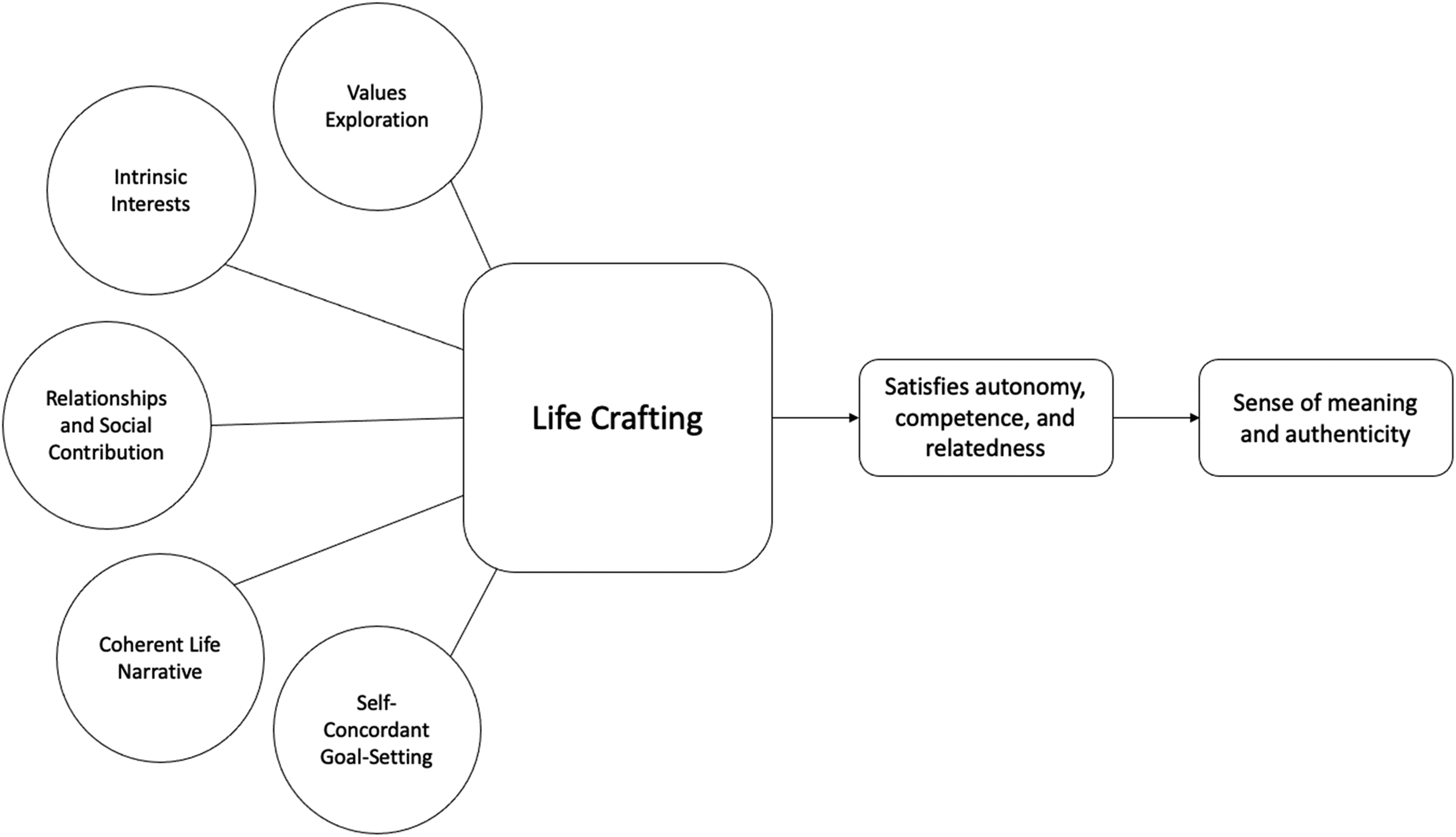
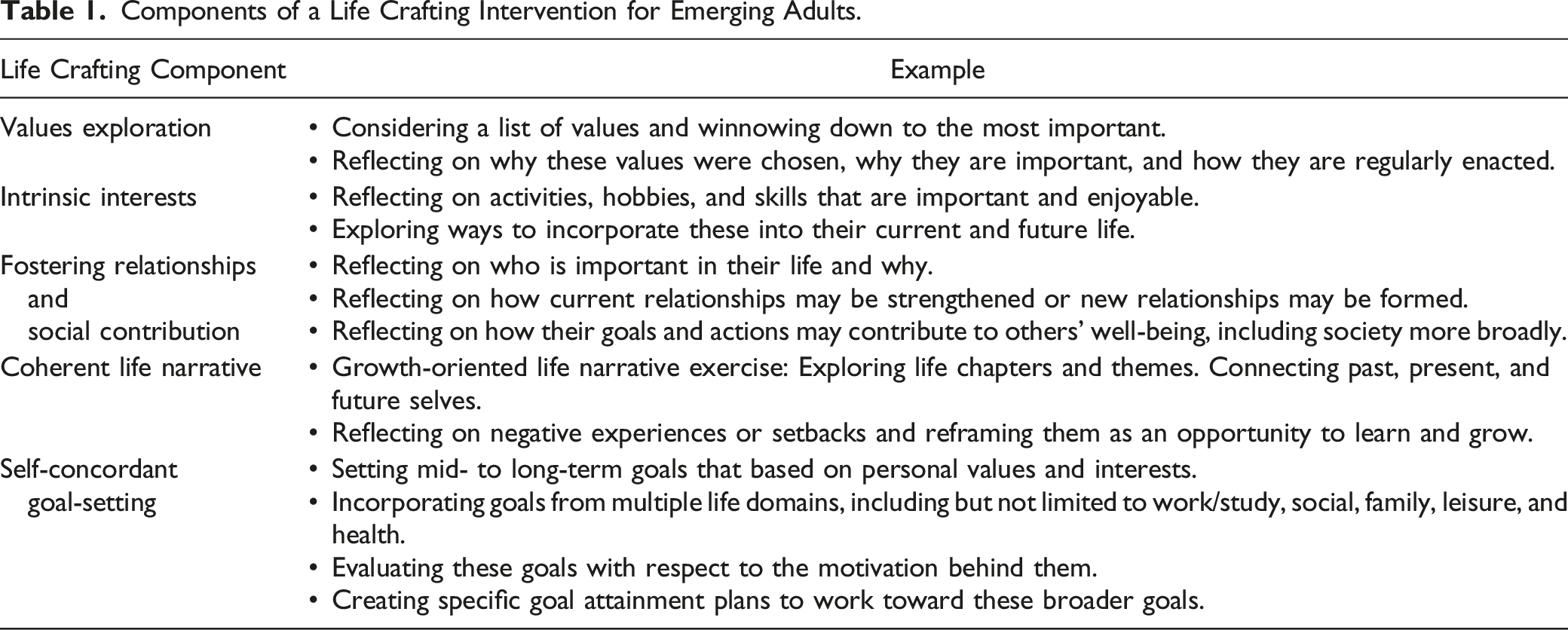
Components of a Life Crafting Intervention for Emerging Adults.
Crafting Across Domains
To begin with, life crafting takes place across multiple life domains, as the quest for a meaningful life often includes multiple aspects of one’s identity (Mayseless & Keren, 2014). These domains, such as work, study, social relationships, family, leisure, health, and religion may vary in the level of significance attributed to them, yet the satisfaction of basic psychological needs remains important across all domains (Deci & Ryan, 2008; Milyavskaya & Koestner, 2011). In fact, the meaning maintenance model suggests that when people’s sense of meaning is threatened or disrupted in one domain, they may actively search for or reaffirm meaning in another domain (Heine et al., 2006). This suggests that crafting a life that is meaningful needs to incorporate more than a single life domain. This is especially important for emerging adults, where the majority of identity exploration takes place (Schwartz, 2016). Young adults often explore who they want to be, what type of relationships they want, the kind of paid and unpaid activities they would like to spend time doing, and the types of communities they want to build, and these explorations take place across multiple life domains.
In line with the meaning maintenance model, the crafting literature has begun to investigate how crafting in one domain may affect crafting (and subsequent well-being) in another domain. Within the crafting literature, the spillover and compensation hypotheses have been suggested. The spillover hypothesis suggests that when people craft to satisfy their needs in one life domain (e.g., work), they are more likely to craft in another domain (e.g., at home; Demerouti et al., 2020; Petrou & Bakker, 2016). Conversely, the compensation hypothesis suggests that when people are unable to proactively satisfy their needs in one domain, they may craft another domain to make up for these frustrated needs (Berg et al., 2010; Petrou et al., 2017). Together, these concepts support the notion that crafting takes place across multiple life domains. A meaningful life requires the active exploration of more than one domain, even if a single domain (e.g., work) is prominent within one’s life.
Values Exploration
A key component of a life crafting intervention is exploring one’s values. As extensive research reviewed above shows, reflecting on and being aware of what one values is crucial for fostering autonomous motivation, authenticity, and a sense that one’s life is meaningful (Bauer, 2016; Bauer et al., 2019; Ryan & Ryan, 2019; Tiberius, 2018; Weinstein et al., 2013). People whose behaviour regulations are external or introjected (i.e., experienced as pressure and control rather than personal value) are less likely to experience their pursuits as meaningful and fulfilling (Ryan & Deci, 2017). Therefore, a life well-lived is one in which a person is actively aware of what they value and can craft a life in which these values are applied as intended.
Schwartz and Bilsky (1987) define values as “(a) concepts or beliefs, (b) about desirable end states or behaviours, (c) that transcend specific situations, (d) guide selection or evaluation of behaviour and events, and (e) are ordered by relative importance” (p. 551). Using this definition, the process utilised in life crafting may involve young people considering what they value (i.e., what guiding principles they use to determine what is important to them) and ordering them in relative importance (e.g., selecting a top 10 or 5 values). Importantly, once they have explored their values, a key aspect would include reflecting on why these values were selected (i.e., what or who may have influenced the development of that value) and how these values are enacted in daily activities or how they might like them to be enacted if they feel as though their actions and values do not align. Additionally, they may reflect on the conflict they may feel between two opposing values and how to mitigate these feelings. While more research is needed in this area, some research suggests that selecting from a list of values in combination with writing about those values fosters a greater sense of meaning than other methods (Sandoz & Hebert, 2015).
Beginning the process with a values exploration exercise is an important step in helping young people clarify what is important to them and where they should direct their energies. For example, Davis et al. (2016) found that when students reflected on why they were pursuing their academic goals, they experienced more meaning and self-concordance than when they reflected on how they might pursue it. In a similar vein, Assor et al. (2020) highlight the concept of reflective authentic inner compass facilitation (RAICF) as an active way to help young adults better understand their authentic selves and develop an inner compass. RAICF involves helping people to explore important values, reflect on intrinsic interests, and commit to those values in specific actions and goals. Assor et al. (2020) showed that when participants reported more RAICF in their lives, they were more likely to report experiencing an inner compass and subsequent well-being. When a person is guided to life crafting in the way we define it, they are essentially activating and refining their inner compass.
Intrinsic Interests
A core component of SDT and many crafting theories, including life crafting, is that pursuing activities and hobbies that one finds interesting and enjoyable is one way to experience meaning, authenticity, and well-being (Kernis & Goldman, 2006; Ryan & Ryan, 2019; van Zyl et al., 2023; Weinstein, Ryan, & Deci, 2012). Intrinsic motivation propels people to explore their surroundings, develop a sense of mastery, and make sense of their environment. Along with values, intrinsically enjoyable activities are considered more autonomous and can contribute to goal pursuits that drive a sense of purpose in people’s lives. These autonomous pursuits are associated with more effort, higher performance, and an increased sense of competence (Ryan & Deci, 2020; Sheldon, 2014). Therefore, aside from exploring what one values, an important part of crafting a life is reflecting on what one enjoys.
A life crafting program could ask young adults to reflect on which activities, hobbies, and skills they currently find enjoyable and how much they are currently able to engage in these behaviours. This could be linked back to their values (i.e., why do they enjoy these tasks). They may then reflect on ways to increase their engagement with these activities or to foster these skills in a more consistent way. This aligns with the holistic model of life crafting that features task crafting, skill crafting, and interest crafting as important elements within a life crafting model (van Zyl et al., 2023).
Relationships and Social Contribution
Life crafting does not occur in a vacuum. Instead, research has clearly shown that close, supportive, and caring relationships are one of the main ways that people establish well-being and meaning in their lives (Delle Fave et al., 2011; Lambert et al., 2010; Wissing et al., 2021). In his seminal work, Frankl (1959) proposed that love is an important route to a meaningful life, and SDT conceptualises relationships as intrinsically (rather than instrumentally) valuable, important in and of themselves (Ryan & Deci, 2017). Supportive relationships can be beneficial not only in the level of emotional support they offer on their own but also as a form of literal support throughout the person’s life as they pursue their goals. Life crafting may incorporate active reflection on who is important to the person, how these people may support them in their endeavours, and the types of social, familial, and community relationships they might like to foster in the future.
Moreover, crafting a meaningful life involves more than one’s own relationships. How one’s actions might benefit others or contribute to society more broadly is also important (Delle Fave et al., 2013). This is in line with research showing that beneficence, the positive impact one has on other people, is a universally important value (Schwartz, 2012), an intrinsic aspiration beneficial in and of itself (Bradshaw, 2023), and is related to a sense of meaning (Martela et al., 2018; Schnell, 2009) and well-being (Martela & Ryan, 2020). The life crafting intervention proposed by Schippers and Ziegler (2019) focuses solely on the individual’s own social network without highlighting more self-transcendent and altruistic contributions. Based on the above research on the broad benefits of beneficence, it would be important for young people to reflect on how some of their goals and actions might positively impact others, rather than just themeselves. A person who is actively crafting a meaningful life may reflect on how their life goals and aspirations could contribute to the well-being of others, whether individually (e.g., helping a friend) or collectively (e.g., through the contribution to society in the work that they do). People guiding others to craft their life (e.g., a coach, teacher, or mentor) should be careful not to undermine participants autonomy by imposing on them any requirement to pursue certain goals. Instead, goal pursuits could be framed in a way that encourages intrinsic goals (e.g., the benefit of social contribution) rather than discouraging extrinsic pursuits (telling the person not to pursue wealth and fame; see, Lekes et al., 2012).
A Coherent Life Narrative
An important part of the construct approach to life crafting has been the concept of cognitive crafting, or reframing aspects of one’s life and the meaning associated with it (Chen et al., 2022; van Zyl et al., 2023). This element is lacking in the intervention approach proposed by Schippers and Ziegler (2019), which we believe could give a life crafting program more depth. Given that cognitive crafting––the way in which someone changes how they think about their situation, without necessarily making any physical changes––is a large part of both job and life crafting models (van Zyl et al., 2023; Wrzesniewski & Dutton, 2001), a life crafting intervention would benefit from including this strategy. It is important to understand what cognitive life crafting may look like compared with other forms, such as cognitive job crafting. For example, Chen et al. (2022) asked people for examples of how they cognitively life crafted. All the reported responses were behavioural rather than cognitive (e.g., “seeking social support” or “sharing my life with others”) suggesting that participants may have misunderstood the prompt. One way in which young adults can cognitively craft their life is through the use of a personal narrative. Shin and Steger (2014) suggest that helping people to live more meaningful lives should involve both a motivational component (e.g., self-concordant goal progress) and a cognitive component (e.g., narrative coherence). Therefore, a life crafting intervention that helps emerging adults live more meaningfully may encourage people to reflect on the narratives they tell about themselves and to draw connections between their past, present, and future selves.
Researchers have shown the importance of people creating a coherent life narrative (Bauer & McAdams, 2000; McAdams, 2016; McAdams & Guo, 2014; McLean & Pratt, 2006). This life narrative is an evolving story an individual tells themselves about their life to try to make sense of who they are and who they are becoming. It helps them to make connections between past, present, and future selves, integrate various memories and experiences, and create a meaningful story out of random events. In turn, these narratives give the person a sense of purpose, predictability, and control (Bauer et al., 2008; McAdams, 1996, 2001; Pennebaker & Seagal, 1999). A coherent narrative, one that integrates personally significant experiences across time and situations into a clear story of cause and effect (Adler et al., 2018), is especially important in contributing to the development of identity and purpose in emerging adults (McAdams, 2016; Waters & Fivush, 2015), a time when people begin thinking of themselves as ‘authors’ of their lives (McAdams, 2013a).
One type of prompt may be similar to the life story interview in narrative psychology (McAdams & Guo, 2014), whereby people are asked to consider their life as a book with chapters and to consider which chapter they are in now, which chapters have already occurred, how they might move from their current chapter to the next, and to reflect on broader themes of their life. This concept is often referred to as a growth-oriented narrative and is a way in which people can develop a sense of coherence between their past, present, and future selves, using prior experiences to anchor themselves within a stable narrative (Bauer et al., 2008; Shin & Steger, 2014). This temporal narrative is an important source of meaning in life (Baumeister et al., 2020; Baumeister & Landau, 2018).
Alternatively, cognitive life crafting may take the form of a person reflecting on a negative life experience or setback and what they learned from this or how it may help them grow into the person they want to be (McAdams, 2006; Sommer et al., 2012). This type of cognition helps people to experience a sense of meaning by discovering insights from their experiences as well as feeling a sense of ordered progress from a past event to a present state (McLean et al., 2007; Thompson & Janigian, 1988). Recent research has found that reframing an event as something challenging to learn from or that offers opportunities to grow is a critical component of internalising motivations, thus allowing a person to pursue life goals for more autonomous reasons (Hewett, 2023).
Self-Concordant Goal-Setting
Life crafting is an active and growth-fostering process involving intentional reflection whereby people become aware of their values and motivations and decide how these may guide their life goals. Therefore, a key part of life crafting is to turn these values into something concrete and future-focused, reflecting on broader life goals they wish to pursue in the coming 1–5 years. These valued life goals may be considered across various important life domains, such as work and study, social groups, family, communities, hobbies, leisure activities, and health behaviours. Importantly, these goals should be self-concordant, reflecting their personal values and interests. According to SDT, this is reflected in the pursuit of identified and integrated (i.e., personally valued) or intrinsic (i.e., personally enjoyable) goals (Sheldon, 2014). If somebody is crafting their life by setting goals that are more controlled (e.g., a student pursuing a degree because of parental pressure), then the positive outcomes may be hindered. Research has found that, in young adults, more external and introjected motivation for studying is associated with experiencing lower well-being (Howard et al., 2021) and a higher risk of mental disorders (Auerbach et al., 2018). Emerging adults and university-aged students have also been the focus of much self-concordance research, highlighting the importance of young adults pursuing life goals that are based on personal values and interests rather than external contingencies and pressures (Sheldon, 2014, 2016; Sheldon & Elliot, 1999).
Of course, this is why the life crafting intervention begins with an exploration of values and interests. Though, while focusing on these may be an important part of fostering autonomy, competence should also be prioritised. To that end, these broader goals should be turned into specific, short-term goals using goal action plans (e.g., Morisano et al., 2010). This could involve setting specific goals that are achievable within the coming weeks to months (Locke & Latham, 2002). It may also involve using implementation intentions to make the short-term goals more achievable (Gollwitzer, 1999). Young adults often find meaning through personal growth and setting challenging goals (Delle Fave et al., 2013). Therefore, setting and working toward self-concordant goals that allow the person to expand their capabilities in line with their values is an important part of a life well crafted. Some evidence, however, has shown that when somebody begins proactively crafting their life, competence may take longer to satisfy than other needs (Kujanpää et al., 2022; Petrou & Bakker, 2016), therefore the life crafting intervention should reflect the first step in the process of change, with on-going reflection and evaluation taking place.
Putting It Together: The Life Crafting Intervention in Practice
The life crafting intervention that we propose involves five core elements that should support basic psychological needs, authenticity, and a sense of meaning in life: (1) the exploration of personal values, (2) developing intrinsic interests, (3) fostering supportive relationships and social contribution, (4) creating a coherent life narrative, and (5) setting self-concordant goals and goal plans. Research has demonstrated that wellbeing interventions are more effective to the extent that they are congruent with one’s individual personality and strengths (Schueller, 2014). This can partly be explained by the need for autonomy, to choose experiences that feel personally relevant rather than being prescribed activities that may be experienced as incongruent with the self. While the life crafting intervention has autonomy built into it (i.e., all the prompts are designed to encourage personal reflection) there is scope for the intervention to be presented in various ways depending on the needs and proclivities of participants.
To begin with, emerging adults are frequent users of digital technologies, such as smart phones (Coyne et al., 2016) and therefore may benefit from the delivery of the life crafting intervention online. This is in line with theory which has often suggested that life crafting is ‘scalable’: deliverable online and self-paced, so that many people (such as first-year university cohorts) could be sent the intervention simultaneously to complete in their own time. (Dekker et al., 2020). A completely self-paced and online intervention may come into issues with participant retention, whereas group-based or face-to-face interventions may help hold people more accountable to show up and participate (Baños et al., 2017). The use of a group-based life crafting intervention may also be beneficial for emerging adults as it may help stimulate peer-to-peer interactions and discussions about important life topics. Research has shown that emerging adult peers can often facilitate positive adjustment with one another and act as important forms of social support during life transitions (Schwartz, 2016). Therefore, peer support and facilitation during a life crafting intervention may help participants work through difficult prompts.
The life crafting intervention described here could be modified to be completed as a self-guided activity using text or videos or as part of a group activity with a facilitator to help guide people through the prompts. While the intervention may be delivered in various formats, some form of conscious reflection is important. Given the impact that writing-based interventions can have (Baikie & Wilhelm, 2005; Ruini & Mortara, 2022), using self-reflective writing could be beneficial for some cohorts. The program, though, may be modified to be presented in a group or individually; using text, verbal discussions, or visual media and interaction; or presented online or in person. These changes may be made depending on the participant’s cognitive, cultural, or academic abilities, with the core elements remaining the same. For example, the values exploration exercise could be delivered visually with a list of universal values, through a verbal discussion, by using a values card sorting exercise, or any combination (e.g., Sandoz & Hebert, 2015). The core element of selecting, refining, and then reflecting on the importance of the chosen values remains the same.
The life crafting intervention should also be applicable cross-culturally. People from various cultures may respond quite differently to the prompts, but the core ingredients should remain relevant. For example, while values and interests may differ between cultures (for example between collectivist and individualist cultures; Schwartz & Bilsky, 1987) the importance of understanding your value system to better integrate goals and motives should remain important for anyone taking part. Relationships and social contribution also hold differing levels of importance across cultures, but social belonging is a universal need (Ryan & Deci, 2017) and therefore should benefit anyone who reflects on the importance of their social connections. Self-concordant goal pursuit may seem like a Western idea, framing goals as something pursued for selfish or individualistic reasons. But, as SDT scholars have long argued (e.g., Ryan & Lynch, 1989), autonomy is not the same as independence. Autonomy involves self-congruence and the deep internalisation of social norms and values, therefore the pursuit of self-concordant (i.e., autonomous) goals should remain important to well-being and meaning across cultures.
Importantly, while a life crafting intervention should remain flexible, these core elements are presented in sequential order. Exploring values and intrinsic interests are presented at the beginning of the process to help the person better understand their own goals and motives. Feeling volitional, autonomous, and authentic requires a person to understand how much they have internalised the values and beliefs of others and assimilated them as their own (Ryan & Deci, 2017; Weinstein et al., 2013). Therefore, before relational, cognitive, or goal crafting (steps 3, 4, and 5 respectively), reflecting on personal values and interests, and the degree to which these are “owned” by the individual, is an important first step. In addition, the positive impact on meaning, authenticity, and basic psychological needs is suggested to come from completing all core elements. For example, by exploring values and interests alone, a person may feel more autonomous, but may lack feelings of competence if no time is spent reflecting on and creating self-concordant goal plans.
Outcomes of Life Crafting: Need Satisfaction, Authenticity, and Meaning
Finally, we turn to the hypothesised outcomes of life crafting: the satisfaction of basic psychological needs and an increased sense of authenticity and meaning in life. Much of this has been covered in detail in previous sections, so we only briefly review them here.
Basic Psychological Needs
By exploring what one values and how these influence their motivations and broader life goals, someone life crafting should experience a sense of increased autonomy in what they want out of life and whether this is their own choice or influenced by pressure from others. Reflecting on the story that they tell about themselves and how this story reflects their values and interests may also encourage a sense of personal agency (Bauer & McAdams, 2000). Through setting and working toward personal goals using goal-attainment plans, a sense of competence should be fostered. Lastly, relatedness may be fostered when people reflect on who is most important to them, how these relationships might be deepened throughout life, and how they might contribute to the well-being of others.
Authenticity
A sense of authenticity is, by its definition, autonomous, coming from actions and expressions of self that are willingly endorsed and congruent with one’s values (Ryan & Ryan, 2019). Therefore, if life crafting is hypothesised to increase a person’s feelings of autonomy, a sense that they are acting more authentically and being true to themselves should also arise (Kernis & Goldman, 2006). The self-awareness and value exploration that is a fundamental part of life crafting should help the person to become more aware of who they wish to be based on their genuine interests and values, making it more likely that they take ownership of their actions and experiences (Baumeister, 2019).
Meaning
Finally, life crafting should lead to an increased feeling that life is meaningful. The most comprehensive model of meaning in life is the three-factor model (King & Hicks, 2021; Martela & Steger, 2016), which suggests that meaning is comprised of a sense of purpose – that one’s life has direction, centred around core goals and aims; coherence – that one’s life makes sense; and significance – that one’s life has inherent value.
First, and most obviously, life crafting may foster purpose by directing people toward goals that they find valuable and giving them a sense of direction in their lives (Emmons, 2003). McKnight and Kashdan (2009) define purpose as a “central, self-organising life aim that stimulates goals, manages behaviors, and provides a sense of meaning” (p. 242). A purpose is not one single goal, but rather provides a framework from which a person may decide which goals are most important and how to work towards them. This search for a purpose to drive behaviour is most salient in emerging adulthood, when a person is exploring various roles, identities, and needs in the social world (Bronk & Baumsteiger, 2017; Sumner et al., 2015). Next, a sense of coherence will likely be achieved through reflecting on past themes and how these connect to present and future selves (including the values that the self holds). Meaning, at its core, is about creating connections between and finding patterns among things (Baumeister, 1991; Heine et al., 2006; Heintzelman & King, 2014). Thus, creating a sense of unity across time by reflecting on one’s life narrative should stimulate a greater sense of meaning (McAdams, 2006; Steger, 2012). A recent experience sampling study found that people who reported thinking about past, present, and future thoughts experienced more meaning than those who focused on the present alone (Baumeister et al., 2020). In fact, Baumeister and Landau (2018) suggest that “people derive meaning in life partly by crafting a story in which the present is explained both as the product of past events and as a springboard for future states toward which they are striving” (p. 3). Young adults may especially find a sense of coherence from reflecting on who they are and how this may relate to the person they aspire to be in their future lives (Habermas & Bluck, 2000). Finally, significance may be achieved through the reflection on and participation in valued life activities, especially those involving helping others and contributing to the good of society (de Jong et al., 2020; King & Hicks, 2021). Personal values have become an especially important source of meaning for young adults in modern societies, though often they may lack clarity around what specifically is important to them and how they might demonstrate these values (Baumeister, 1991).
In fact, Steger (2022) recently reviewed a wealth of meaning in life literature and identified five broad themes related to the promotion of meaning in interventions: (1) consciousness: developing abilities to notice and reflect on sources of meaning; (2) time: integrating different time perspectives–past, present, and future; (3) doing: intentionally living life with more purpose and direction; (4) self: exploring and embracing core aspects of the authentic self (e.g. values); and (5) others: connecting and engaging with important others in life. The life crafting intervention, as we define it, is likely to stimulate all five of these meaning-making elements.
Differentiating Life Crafting from Similar Concepts
While our model of life crafting is meant to be integrative, bringing together research from a variety of areas within psychology to create an applied intervention, we acknowledge that the areas discussed above have been explored in various other ways previously. Below, we address two such areas: life coaching and need crafting and highlight how life crafting might differ from, but also complement, these areas.
Life Coaching
Life coaching is a burgeoning field within coaching psychology that has been described as a “long-term efficient relationship that allows clients to maximise their potential” (Jarosz, 2016, p. 40). Life coaching is a future-oriented, non-directive process of working with individuals or groups of people to help them work toward valued goals, pursue purposes across life domains, and reach their potential (Grant, 2003; Green et al., 2006). In this sense, life coaching shares similarities with life crafting in the focus on increased self-awareness, goal-pursuit, maximising potential, and future-oriented selves (Lefdahl-Davis et al., 2018), though life coaching usually involves an ongoing relationship with a coach who helps facilitate this process (Grant, 2003). Life crafting may, in fact, act as a precursor to a full coaching relationship. That is, life crafting could be delivered completely remotely and self-guided (Dekker et al., 2020) or to a class of students, giving many people a taste of questions to do with values, life goals, narratives, and intrinsic pursuits that, perhaps, they had not yet considered. For some, this might then open the door to a desire for deeper exploration and an ongoing relationship that may encourage them to seek out a professional coach to continue the process of self-exploration.
While there are differences between life crafting as a potentially scalable, self-paced program and life coaching as a more intimate relationship with a coach, the two may complement one another if used together. For example, perhaps life crafting is best performed as a combination of individual self-exploration and facilitator-led coaching or group work afterwards. Future research, when investigating the benefits of life crafting, could study this.
Need Crafting
In recent years, a similar concept involving both psychological needs and crafting has emerged in the literature: need crafting (Laporte et al., 2021a). Need crafting entails both the awareness of sources of basic psychological need satisfaction and proactive action to act upon this awareness to create conditions that foster psychological needs in everyday life. Some research has begun to show that when adolescents report more proactive attempts at fostering their psychological needs in daily life, they are more likely to report well-being and less ill-being and this was in part fostered by more autonomy support they experienced from their parents (Laporte et al., 2021b). A recent program tested whether need crafting techniques could be taught to adult participants and whether this would impact their well-being. Laporte et al. (2022) developed a program spanning 7–14 days where participants were educated on what autonomy, competence, and relatedness needs are, became aware of their own needs, and encouraged (using homework activities) to engage in need-satisfying activities throughout the week. The researchers found that those in the need crafting condition showed a small increase in their well-being compared with a control group, and this effect was positively related to increases in their need crafting behaviours, but only for those highly engaged in the program. Thus, some evidence is emerging that people can be taught how to become aware of and craft areas of their lives to satisfy their psychological needs.
While need crafting and life crafting share similarities, specifically the focus on psychological needs as important to the crafting process, we see need crafting as focusing on a smaller range of features. Specifically, need crafting targets specific daily activities that may foster autonomy, competence, and relatedness. While this is important, the scope of need crafting is not as long-term as life crafting in that values, past selves (coherent narrative), and future selves (self-concordant goals) are not prioritised. Therefore, someone who is need crafting may engage in activities they enjoy doing and are good at without a deeper exploration of why they find it valuable. In this sense, need crafting is more focused on direct need satisfaction, whereas life crafting views the satisfaction of needs as happening more indirectly via the processes described previously. To that end, need crafting can offer unique insights into how people actively craft their daily lives to satisfy their psychological needs and could complement a broader life crafting program.
Conclusion and Future Directions
In this paper, we have expanded on the previous life crafting intervention proposed by Schippers and Ziegler (2019). This model may be applied to programs delivered to many people, though we argue that it may be most effective for emerging adults, who are in the process of exploring and trying out various identities. Drawing on work from both the intervention and construct approaches to life crafting and incorporating self-determination and meaning-making theories, we conceptualised life crafting as having five important elements: the exploration of values, fostering intrinsic interests, fostering important relationships and social contribution, creating a coherent life narrative, and setting and working towards self-concordant life goals. These concepts should be enacted across a wide variety of life domains and, in turn, should satisfy basic psychological needs, foster a sense of meaning and authenticity, and lead to a more integrated sense of self. We hope that this model helps to guide researchers and practitioners when exploring practical ways for young adults to live more authentically and meaningfully.
This model only begins the process of understanding life crafting that future research should expand on. To begin with, differences and similarities between the intervention approach and the construct approach to life crafting need to be investigated in more detail. How might these two ways of viewing life crafting be integrated, or how might they help inform each other? In this paper, we have begun this process by identifying the differences between the two approaches, though more theoretical work needs to be done. As life crafting is intended to be a practical exercise used in the real world, future research should begin to design and implement life crafting programs and measure certain well-being outcomes, such as meaning and need satisfaction, especially among emerging adults (an endeavour the authors are currently undertaking). Moreover, further work could also expand on the construct approach to life crafting. For example, given the strong relationship between the Life Crafting Scale proposed by Chen et al. (2022) and meaning in life (.91), how does life crafting differentiate from the sense that one’s life is meaningful? The more holistic model recently proposed by van Zyl et al. (2023) may help to address this problem, though measuring life crafting using such a large model may prove challenging. Additionally, we believe the intervention and construct approaches can complement one another, as we have outlined here. Perhaps future life crafting interventions might infuse more elements of the holistic model of life crafting into them.
Evidence for some of the individual processes within our life crafting model should also be explored in more depth. For example, while values clarification exercises are quite popular within a therapeutic setting (especially Acceptance and Commitment Therapy), little scientific evidence exists to distinguish which method is best for emerging adults exploring what they find generally important in life. It is also unclear whether long-term behavioural change (i.e., congruence between one’s values and actions) actually occurs (McLoughlin & Roche, 2023). Moreover, if writing is used as part of a life crafting intervention, the words people use when reflecting on their life may also be important (e.g., Pennebaker & Seagal, 1999). This facet could be investigated to understand who benefits the most from a life crafting intervention. Finally, how to craft a coherent life narrative is also an area that might be explored. While researchers are investigating what exactly a coherent life narrative entails (e.g., Adler et al., 2018), how to foster this in a non-therapeutic setting would be beneficial.
Life crafting is a life-long exercise, and while younger people may benefit more, the process should be something that people return to throughout their lives. Becoming aware of what we value and find interesting, working toward self-concordant life goals, taking control of the story of our lives, and helping others in the process should lead people to feel more integrated, authentic, and meaningful, satisfying the basic psychological needs important to all humans.
Supplemental Material
Supplemental Material - Life Crafting and Self-Determination: An Intervention to Help Emerging Adults Create an Authentic and Meaningful Life
Supplemental Material for Life Crafting and Self-Determination: An Intervention to Help Emerging Adults Create an Authentic and Meaningful Life by Andrew D. Napier, Gavin R. Slemp, and Dianne A. Vella-Brodrick in Emerging Adulthood
Footnotes
Declaration of Conflicting Interests
The author(s) declared no potential conflicts of interest with respect to the research, authorship, and/or publication of this article.
Funding
The author(s) disclosed receipt of the following financial support for the research, authorship, and/or publication of this article: This work was supported by an Australian Government Research Training Program Scholarship provided by the Australian Commonwealth Government and the University of Melbourne.
Transparency and Openness Statement
As this paper is advancing theory and is a review article (not a scoping or systematic review), the elements of the transparency and openness statement as designated on the Emerging Adult website are not relevant.

Supplemental Material
Supplemental material for this article is available online.
Author Biographies
References
Supplementary Material
Please find the following supplemental material available below.
For Open Access articles published under a Creative Commons License, all supplemental material carries the same license as the article it is associated with.
For non-Open Access articles published, all supplemental material carries a non-exclusive license, and permission requests for re-use of supplemental material or any part of supplemental material shall be sent directly to the copyright owner as specified in the copyright notice associated with the article.
