



Abstract
The rise of social media coupled with declining trust in major social institutions (e.g., business, government) has arguably intensified the challenges young people face in developing their beliefs and identity. Our exploratory study used in-depth, semi-structured interviews with nineteen young adults (14 female, 5 male, 17 aged 18–23, and 2 aged 24–30) to explore how young adults navigate the diverging viewpoints and competing truth claims encountered from friends, family, and social media. A cluster analysis of interview responses revealed three groups: Relativistic Explorers, marked by high openness to views without judging them; Differentiated Committers, who displayed strong commitments to specific views or values; and Precipitated Explorers, who shared a common history of social and/or familial rejection, and thus an involuntary launch into belief exploration. Results underscore both the developmental challenges facing young adults in our modern, media-saturated society and some of the strategies they adopt to navigate the current epistemic landscape.
Introduction
Identity development is widely considered the central psycho-social challenge of adolescence and early adulthood (Crocetti, et al., 2013; Erikson, 1959; Kroger, 2007; Marcia, 1966). In virtually all societies, young people must transition to adult roles (Schlegal & Barry, 1991). In addition, they must develop their adult beliefs systems in matters such as religion, the proper role of government, gender roles, etcetera. It is normative to rely on parents and on social institutions such as news organizations and universities (what Hopp et al., 2020 call ‘epistemic authorities’) to provide the initial framing against which one forms their beliefs. However, what if there are no clear, uncontested epistemic authorities? We argue that young people in modern America face a significantly increased burden in forming their beliefs: a social landscape where confidence in traditional social institutions is low and dramatically different worldviews are locked in often vituperative competition. In this way, the challenges of emerging adulthood may be magnified. The term ‘emerging adulthood’ was proposed by the psychologist Jeffrey Arnett (2000) to capture the phenomenon, common across many developed economies, where young adults are taking longer and longer to enter into fully adult roles such as marriage and careers. Arnett (2004) characterizes this stage as a period of identity explorations and possibilities—but also of personal instability. To our knowledge, ours is the first study to explicitly consider how society-wide tensions around race, a politicized pandemic, and nearly unprecedented levels of partisanship (e.g., Bessi et al., 2016; Brown, 2020; Geiger, 2021) may have increased the challenges for young adults attempting to navigate through the processes of developing their belief systems.
Social Media and Confidence in Social Institutions
Since 2014, the Pew Research Group has asked questions regarding Americans’ confidence in major social institutions (e.g., business leaders, religious leaders). Their results show both a decline over time and an age gap: for many social institutions, confidence is notably lower among younger age groups compared to older. For example, in 2018 only 50% of emerging adults (18–29) in a nationally representative sample had either a great deal or a fair amount of confidence in religious leaders ‘to act in the best interests of the public’, compared to 71% of older adults (50+). Thirty-four percent of young people held confidence in business leaders, while 50% of respondents 50 years or older were confident in business leaders (Gramlich, 2020). Americans in general are also distrustful of the information they receive from government and news media. For example, already in 2019 only a third (36%) of adults had a ‘great deal’ of trust in the accuracy of the news and information they got from their main news source; however, younger adults were actually less likely to be concerned about made-up news and information (Mitchell et al., 2019)—raising concerns about how critically they are evaluating the information they encounter.
At the same time as confidence in traditional institutions is declining, a major new form of influence has emerged. Smartphones and the social media they platform have created an entirely new information ecosystem (Hanna et al., 2011). A large majority of young adults use social media sites such as Youtube, Instagram, and Facebook multiple times a day (Auxier & Anderson, 2021; Pelletier et al., 2019), and by some recent estimates American adults spend more than 3 hours a day on social media (Suciu, 2021).
This ecosystem has generated wide social concern and extensive research. For example, social media has been frequently blamed for increasing rates of anxiety, depression, and self-harm among youth (e.g., Kelly et al., 2019; Twenge et al., 2017). However, a longitudinal study (Coyne, et al., 2020) failed to find a relationship between social media use and changes in depression and anxiety, and a recent comprehensive review suggests a more nuanced picture (Odgers & Jensen, 2020), with some studies identifying some benefits of social media. For example, Przybylski and Weinstein (2017) found a ‘goldilocks’ point such that a small to moderate amount of digital screen time was not predictive of poor mental health and, in some cases, had small positive associations. Social media can also provide a lifeline for sexual minority youth (Pacely et al., 2022), posing as a form of social and informational support for LGBTQ + adolescents (Karim et al., 2022).
Social Media and Epistemic Cognition
Almost entirely missing from debates on the benefits and costs of social media is any acknowledgment of the epistemic challenge social media may create for young people. Epistemic cognition concerns assumptions and beliefs about the nature of knowledge and the processes of knowing. William Perry developed his classic theory on epistemic development in the 1970s (Perry, 1970, 1981). It posits nine ‘positions’ of increasing epistemological sophistication, commonly collapsed into three main stages: dualism (knowledge as certain, with clear right and wrong answers), relativism (recognition of conflicting views, and a disinclination to judge any as wrong), and commitment within relativism (where initial commitments are made, while still acknowledging some uncertainty). Subsequent models of epistemic cognition have used different terms but have largely traced the same progression (for a helpful summary, see King & Kitchener, 2015).
Reaching more advanced levels not surprisingly correlates with age and with specific kinds of experiences, especially exposure to and engagement with differing perspectives (Barzilai & Zohar, 2015; Pascarella & Terenzini, 2005). For example, in one study exposure to a plurality of divergent religious information and beliefs on social media positively correlated with young adults’ self-reported expansion of their repertoire of religious practice (McClure, 2016). Another study found Facebook users with a heterogeneous networking environment were significantly more likely to report increases in political knowledge, and this effect was moderated by social and institutional trust (Hopp et al., 2020). Hopp et al. (2020) posit that those with more trust may be more likely to engage with posts, take more time to learn, and apply informational filters, thus increasing their likelihood of acquiring knowledge.
However, in today’s context of political and social tension and low trust, exposure to other perspectives can sometimes lead to more intellectual rigidity rather than less. For example, in one study Republicans on Twitter who were exposed to opposing liberal political messages expressed reinforced conservative political ideology. Liberals showed a similar trend, although it was not significant (Bail et al., 2018). More broadly, there has been a documented increase in affective polarization–adverse feelings toward those with opposing political ideologies–in the US since the 1980s (Boxell et al., 2022). In 2014, 38% of liberals and 43% of conservatives held “very” unfavorable opinions of members of the other party, compared to 16% and 17% respectively in 1994 (Geiger, 2021). By 2020, members of both parties, but particularly Democrats, reported that they would hesitate to date members of the other party (Brown, 2020).
The issue of polarization is intensified as social media enables its users to selectively curate the information they are exposed to (Chan et al., 2022). When it comes to information on controversial issues, the vast majority of YouTube and Facebook users read and interact with information that focuses on a single narrative (Bessi et al., 2016). Further, it is believed that consuming a greater variety of news sources helps reduce susceptibility to echo chambers (Sindermann et al., 2020). Age and openness to experience are two factors that have been found to positively predict diversified news consumption (Sindermann et al., 2020). Thus, younger people, who may consult fewer news sources, and use social media more frequently than other age cohorts (Pew Research Center, 2023) may be at risk of becoming trapped within belief-reinforcing echo chambers on social networking sites. In this way, their exploration may be prematurely truncated.
Exploration and Identity Development
Exploration is key not only to epistemic development but is also an essential component in James Marcia’s (1966; 1993) classic model of identity development: attaining Identity Achievement entails first exploring various possibilities prior to committing to specific beliefs. Young people who are exploring aspects of their identity (e.g., religious, political, vocational) but have not yet settled on their answers (an identity status labeled Identity Moratorium) show higher levels of anxiety and lower levels of well-being (e.g., Schwartz et al., 2015). Although uncomfortable, exploration is considered a necessary step on the route to identity achievement. Youth who commit without exploration may enjoy low levels of anxiety and depression but are considered (at least in a Western context) to have made premature commitments (“Foreclosed”) (Kroger, 2007; for consideration in other cultural contexts, see Berman et al., 2011). Finally, youth who neither explore nor commit (“Diffused”) are at the greatest developmental risk (Schwartz et al., 2005).
The importance of active exploration is further affirmed in work by Berzonsky and colleagues (Berzonsky, 1989, 2008), who demonstrated the importance of an active, information-gathering processing style for identity development. For example, Berzonsky and Kuk (2000) showed that college students who take an active approach to the transition to university fare better in adapting to the college context than students who simply follow the expectations of others (normative processing style) or students who avoid confronting the challenges and choices of college (the diffuse/avoidant processing style).
Surprisingly little prior research has studied how epistemic understanding relates to identity development. An early study by Boyes and Chandler (1992) concluded that epistemic uncertainty is an important component in identity formation, specifically predicting the more developmentally desirable Moratorium and Achieved statuses. More recent work by Krettenauer (2005) confirmed the importance of epistemic stance. In a longitudinal study of German adolescents, teens with a multiplistic stance towards knowing (similar to Perry’s relativistic stage) showed higher moratorium scores, whereas teens with the capacity to evaluate the warrants for their beliefs (called evaluatism, and analogous to Perry’s commitment within relativism) showed increased identity achievement scores eighteen months later.
The Current Study
These results suggest that epistemic cognition can play an important role in identity development. However, to our knowledge, no research has focused on epistemic cognition in current social conditions. Our exploratory study examines how college-educated young adults arrive at their beliefs in the current context of high social distrust, highly divergent worldviews, and rampant social media usage. To keep the interviews a manageable length while still supporting in-depth exploration, our focus was on two broad areas where young adults often confront, or revisit, the question of what they believe: politics and religion/spirituality. While concerns regarding young adults’ political apathy have been common in the past few decades (e.g., Snell, 2010), more recently political identity has gained salience as the ‘culture wars’ have increased in America (Gidron et al., 2020). Online media provide a new opportunity for political exploration (e.g., Kushin & Kitchener, 2009) in the context of a broader movement towards the personalization of politics (Bennett, 2012). Adolescence has been posited as a sensitive period for the development of religious identity (Good & Willoughby, 2008; Hungsberger et al., 2001; King & Boyatzis, 2004), and for many Americans, is a key aspect of self-concept through the life (Ano & Vasconcelles, 2005). It is no surprise then that religious beliefs are linked to time spent on social networking cites (McClure, 2016). Our qualitative study provides an in-depth look at how respondents themselves understand these influences. Finally, we explicitly asked participants how they made sense of competing claims encountered in social media.
Methods
Participants
Potential interviewees were drawn from respondents to a survey titled “The Impact of Social Media on Young Adults” that was posted online for one week in September 2021. All survey respondents were invited to participate in interviews and were offered a chance to be compensated with one of two $25 gift cards. Fifty-eight respondents initially volunteered, and 19 were interviewed 1 ; most were undergraduate students at one university in the southeastern United States (N = 13) and were female (N = 14). All were current students: freshman (N = 2), sophomore (N = 7), junior (N = 5), senior (N = 3), and graduate (N = 2). They identified as conservative (N = 1), moderate (N = 6), liberal (N = 6), very liberal (N = 4), or ‘something else’ (N = 2) and as not religious at all (N = 7), somewhat religious (N = 3), moderately religious (N = 7), or very religious (N = 2).
Researcher Background
Five undergraduate research assistants conducted the interviews. The team of assistants consisted of two individuals of African American descent, one male and one female, and three individuals of Caucasian descent, one female, one male and one non-binary. During the data collection period, most assistants were upperclassmen, with three being juniors and one being a senior. One was a sophomore. All were second-generation college students and worked on the project for over a year (M = 1.60, SD = .22).
Interview Protocol
In preparation for data collection, researchers first trained in conducting semi-structured interviews and completed two preliminary practice interviews (i.e., with another student researcher and a friend). In-depth 1:1 semi-structured interviews were conducted via an online video chat software (Zoom) over two weeks in October 2021 (the potential limitations of this timeframe are addressed in the discussion). Interviews ranged from 45 to 75 minutes and questioned participants on how they knew what to believe, their exposure to different beliefs, approaches for arriving at sound beliefs, and how similar or different their beliefs were relative to family members and friends. Questions encompassed three main areas of inquiry: political and religious/spiritual beliefs, as these are two important areas of belief formation during early adulthood, and social media more broadly, as we did not miss the opportunity to directly ask young adults’ how they approached information encountered in the context of social media. Sample questions include: “When you encounter different viewpoints or ideas on social media, how do you know what to believe?”, “How does information from social media influence your views on political issues?” and “Do your parents have the same religious beliefs as you? If yes, Have you ever explored other religious viewpoints?”. (Full text available at https://osf.io/5pbgd/).
Zoom audio files were transcribed, checked, and de-identified after each interview. The principal investigator saved the transcript and audio files on a password-protected laptop, and all data initially stored by lab members were destroyed.
Methodological Approach
Developing one’s belief systems is not only challenging but also deeply personal. Accordingly, the unique responses from each participant coupled with the exploratory nature of this research necessitated a methodological approach that (a) accommodated the flexible nature of our semi-structured interviews, (b) inductively developed the unit of analysis based on close reading of interviews and (c) provided researchers with the suitable means (i.e., consensual deliberation) for better understanding the textual data.
Consensual Qualitative Research (CQR)
Consensual Qualitative Research (CQR) is a qualitative methodological approach initially developed by Hill et al. (1997) to measure client experiences with psychotherapeutic treatment. This approach centers on the lived experiences of interview participants. Through collaboration and consensus building among three to five research team members, researchers share interpretations of the text and work towards understanding the meaning of the participant’s beliefs within a specific context. Researchers consensually agree on themes (termed categories) and codes (termed subcategories) discovered within cases (i.e., interview transcripts) and assess their consistency across cases.
Codebook Construction
Codebook of Major Categories and Subcategories.
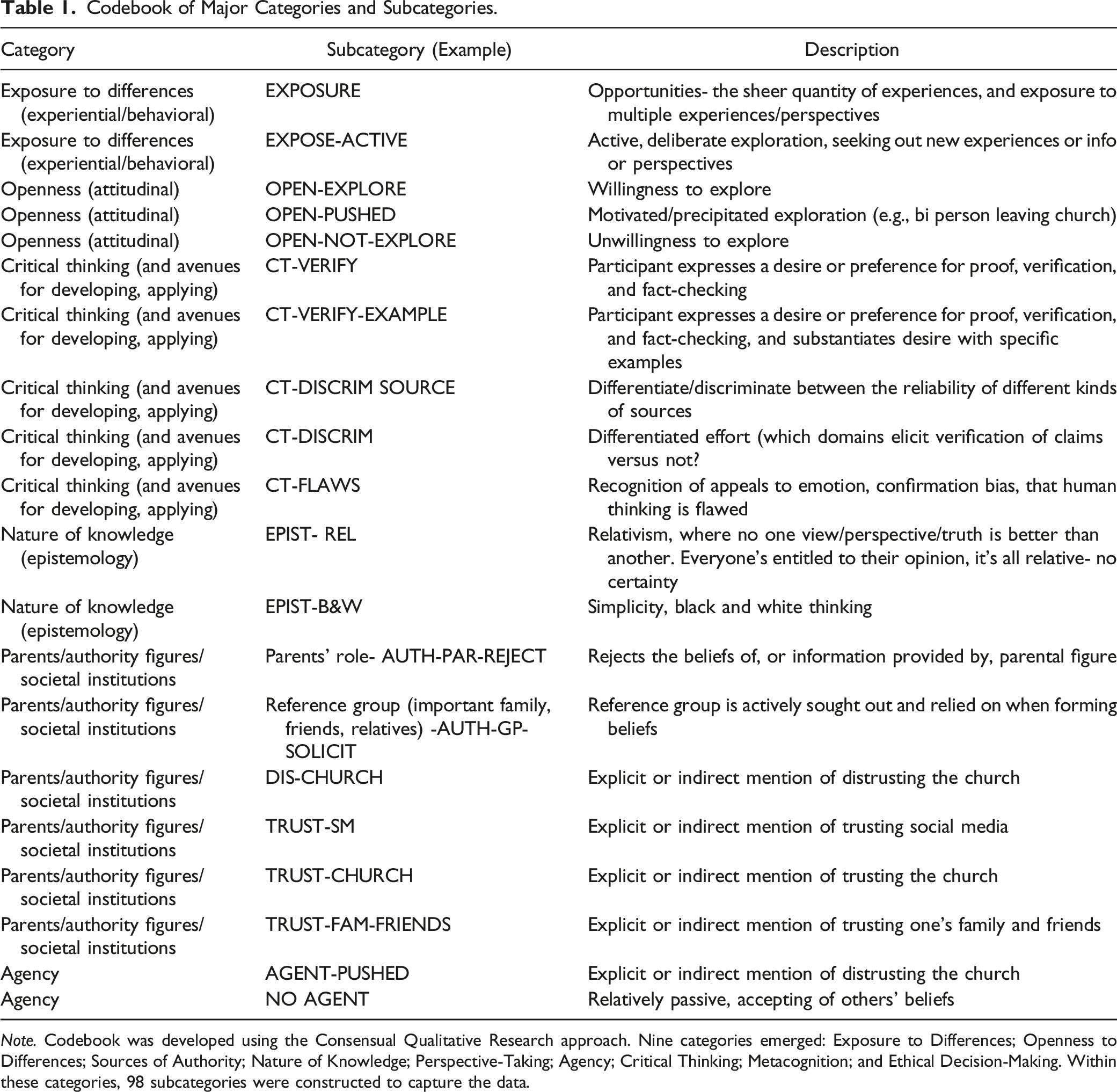
Note. Codebook was developed using the Consensual Qualitative Research approach. Nine categories emerged: Exposure to Differences; Openness to Differences; Sources of Authority; Nature of Knowledge; Perspective-Taking; Agency; Critical Thinking; Metacognition; and Ethical Decision-Making. Within these categories, 98 subcategories were constructed to capture the data.
Data Analysis Plan
As previously discussed, exposure to and engagement with a range of viewpoints is associated with developing more sophisticated epistemic orientations (Pascarella & Terenzini, 2005). To examine the fertile ground within which young adults’ epistemologies may grow, we first analyze the extent to which participants were exposed to and actively explored differing perspectives. Specific attention is then given to the social media context to understand informational filtering strategies in a polarized and politicized media environment. Finally, a cluster analysis seeks to capture individual participants’ overall strategies for forming their beliefs.
Results
Exposure to Differences
Findings suggest that most participants (15 out of 19) reported passive-level exposure (EXPOSURE) to different experiences, information, and diverse perspectives; such exposure did not differ across religion/spiritual, political, and social media contexts (see Table 2). It often came with changes to their social environment, such as leaving a politically homogeneous hometown to attend a university with a mix of liberal, moderate, and conservative students, or being a part of a friend group composed of religiously diverse members. Likewise, participants reported being unintentionally exposed to politically charged posts and beliefs on social media. When one male participant (junior) was asked about his exposure to political beliefs on social networking platforms he said, I would say that I’ve seen…a lot of differing beliefs, so that’s why I am so vague now about my political beliefs…social media in my opinion, can be polarizing, and it is easy to argue a point or get behind an idea without understanding the implications of that. Proportion of Participants Referencing Key Category/Subcategory Codes in a Specified Area of Inquiry. Note. These labels denote the percentage of interviewees who talked about a specific category/subcategory in a particular area of inquiry. General = present in all members; typical = more than 50% of participants; variant if less than half of the participants.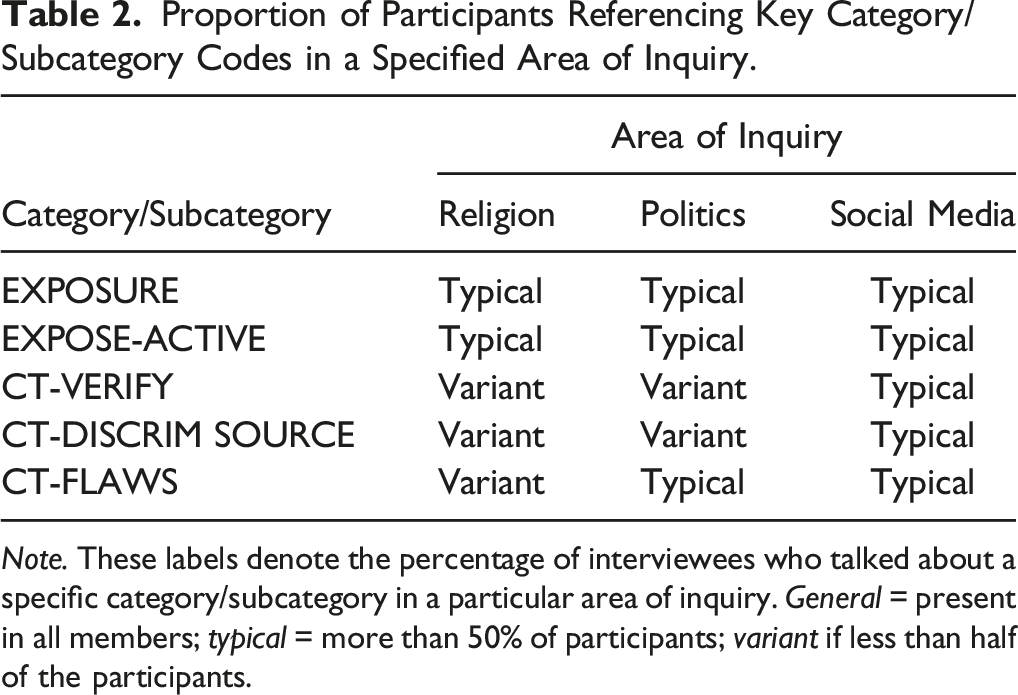
From the perspective of this participant, exposure to polarizing political views on social media allowed him to recognize the potentially flawed nature of human thinking (i.e., people ascribing to certain beliefs without critical thought). Thus, exposure to different beliefs generated uncertainty in his own beliefs.
Additionally, participants typically referenced actively exploring new experiences, information, and perspectives. These comments (EXPOSE-ACTIVE) arose in a religious context for 14 out of the 19 participants, in a political context for 11 participants, and regarding social media for 15 participants. Interestingly, participants made nearly twice as many references to deliberately exploring differences on social media than any other area of inquiry. Participants discussed many ways to engage on social media with people who bear different beliefs. For example, some participants actively went to the comment sections of posts to gain insight into what others believed before drawing their own conclusions. One young woman (sophomore) stated: When I’m active on social media…I’ll read the comments to kind of see what other people are saying before I determine if I’m going to believe it or not.
Moreover, participants’ active engagement with content manifested in the form of debate with other users to learn about why they believe what they believe. Another female participant (sophomore) said: I would often engage in debates with people. I would respond to their prompts on their story, and I would engage in those conversations to see how far their perspective really goes. [To see] what reason they have to hold to that…and to see if there’s actually grit to their argument.
By examining the “grit” of outside arguments, this quote illuminates how participants evaluate information seen within a domain.
Critical Thinking
Somewhat unexpectedly, social media typically elicited greater critical thinking than either the religious or political contexts. When looking at the references to Critical Thinking aggregated across area of inquiry, participants made nearly two and three times as many references when discussing social media than in political and religious contexts respectively (see Table 3). Looking at the level of the individual, slightly over half of participants (10 out of 19), recognized that on social media as well as in the realm of politics, beliefs and truth claims often appeal to one’s emotions (CT-FLAWS). For example, one female participant (sophomore), who encountered posts about racial and human rights, stated: A lot of the issue there was that people aren’t providing facts, and they [are] not doing independent research. They’re just following this headline and preaching it as gospel. Total Category/Subcategory References for Key Codes Across Different Areas of Inquiry. Note. The table displays the frequency of references made by participants to a category/subcategory within a area of inquiry. For example, within the religious context participants made 33 references to being exposed to multiple experiences/perspectives.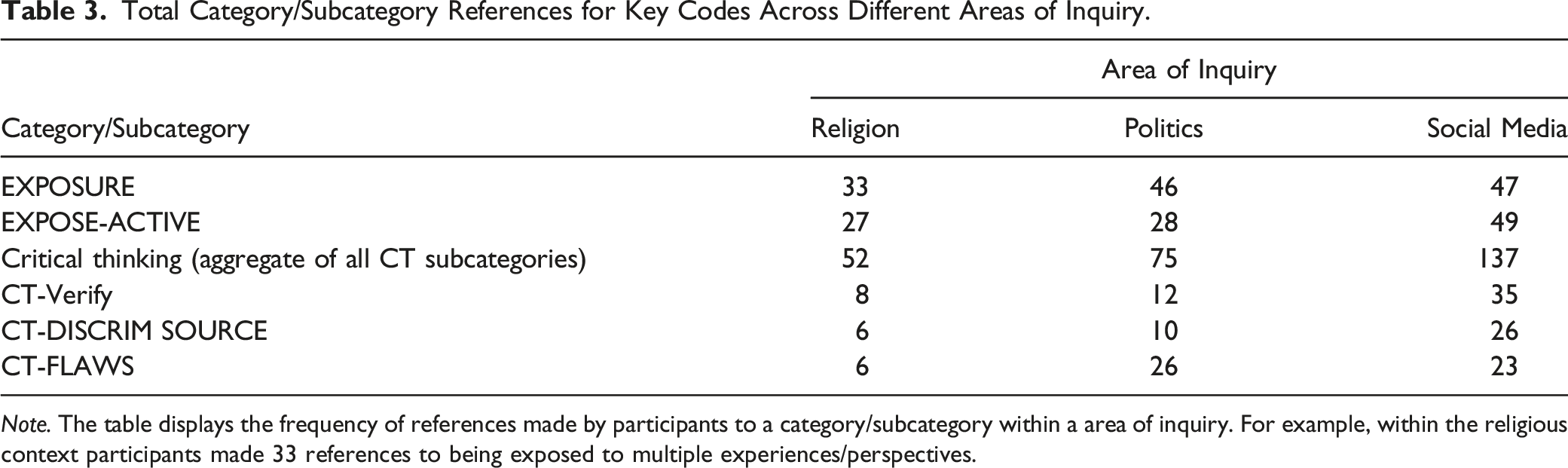
Later, when the same interviewee was asked to provide more insight into why she held high levels of mistrust for politics and social media, she responded: People just follow blindly and just repost and just take these few phrases like they’ll find a catchphrase that just resonates with them, and they just repost it without actually having any real information. I think that leads to a lot of misinformation and misinterpretation…
Exposure to unsubstantiated and flawed views on social networking platforms elicited strategies for discriminating legitimate and illegitimate claims (CT-DISCRIM-SOURCE). Twelve of the participants reported specific behaviors like differentiating between the reliability and credibility of different sources. For example, one participant (a sophomore female) assessed the credibility of news outlet posts on Twitter, based on said post’s inclusion of a hyperlink to the original informational source. If the included link redirected the participant to a blog or biased news outlet, then the post was deemed untrustworthy.
At the same time as there was evidence that young adults were employing information -filtering techniques on social media, exposure to a multitude of differing perspectives and polarizing opinions also sometimes lead to what one participant (quoted above) described as a sense of “vague[ness]” in their personal beliefs. Consequently, for some young adults, social media may give rise to belief paralysis, compounding their epistemic challenges.
Epistemic Clusters
Major Category/Subcategory Similarity and Variation by Epistemic Cluster.
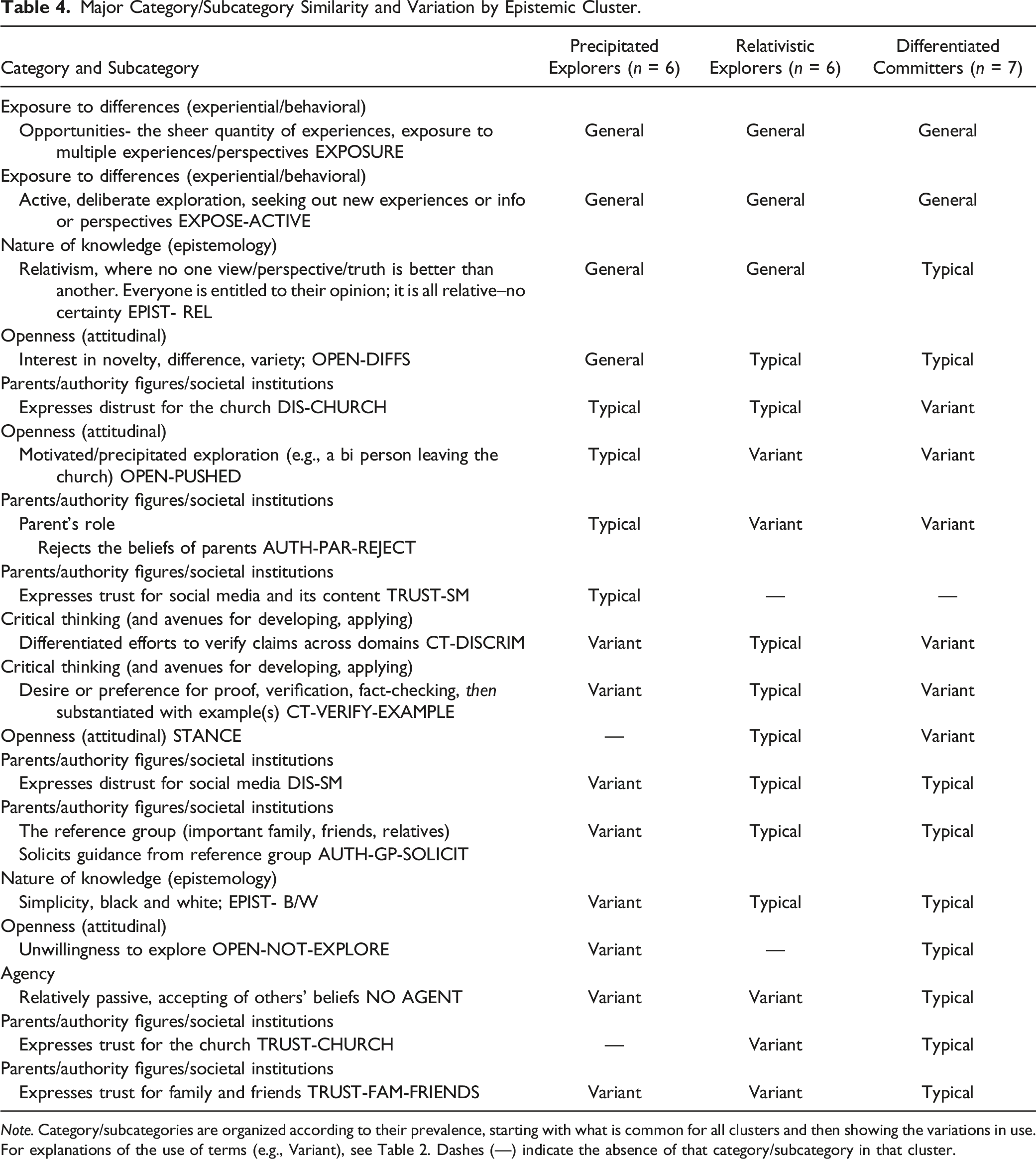
Note. Category/subcategories are organized according to their prevalence, starting with what is common for all clusters and then showing the variations in use. For explanations of the use of terms (e.g., Variant), see Table 2. Dashes (—) indicate the absence of that category/subcategory in that cluster.
Precipitated Explorers
All participants in this cluster reported adverse experiences with major social institutions. Four of the six individuals identified as a member of the LGBTQ + community. As seen in Table 4, Precipitated Explorers often found themselves at odds with–and distrustful of–the religious institutions in which they were reared (DIS-CHURCH); this starkly contrasts with the Differentiated Committers, where only one interviewee referred to distrusting the church. Five out of six participants were launched into a premature exploration of beliefs (OPEN-PUSHED). For example, when discussing religion and sexuality, a young man (senior) stated, I became aware that not everyone thought the same way I did about sex. Then I realized I was bisexual…the more and more that came out, I was like, ‘Oh, it is not normal to feel like this.’ There is no way it came from my environment because it was not the environment I [grew] up in, you know… the first step was leaving the Catholic Church. Then recognizing that I no longer could exist as myself under that belief system spurred the questioning of all my other beliefs.
A divergence between parental beliefs and their own was common for members of this cluster. Precipitated Explorers typically rejected their parent’s religious and/or political beliefs (AUTH-PAR-REJECT). One female participant (sophomore) was raised in a highly traditional Indian household, and her beliefs on LGBTQ + rights diverged significantly from her parents. As an ally of the LGBTQ + community, she expressed, When I was younger, it was easier to be more influenced by them…as I got older, especially going to school and attending programs where I was not in the house, I was exposed to other people with different ideals. That allowed me to sit and say, ‘ok, wait, but I do not like what they say about this; I do not think that is right; I think I believe this about this.’ It was challenging because it felt like I was going against what I was taught when I was younger and what they had still preached to this day. But at the same time, it felt more liberating to be like, no, this is what I believe, and I should be allowed to stick to it regardless of what my parents are trying to push.
The last distinguishing characteristic of members of this cluster is their apparent trust in social media (TRUST-SM). For most Precipitated Explorers, social media was a trusted outlet for consuming news, receiving educational information about sexuality and gender, and expanding political ideas. This is consistent with Karim et al. (2022) and Pacely et al. (2022), who find social media to be a source of informational and social support for LGBTQ + adolescents and emerging adults. In contrast, neither the Relativistic Explorers nor Differentiated Committers made any references to trusting social media; instead, distrust for social media was typical for participants within these clusters.
Relativistic Explorers
Like most participants, this cluster actively pursued new environments, information, and perspectives. However, these individuals more frequently discussed maintaining an open attitude toward outside perspectives, opinions, and beliefs (see Openness (attitudinal) STANCE in Table 4). Additionally, the frequency with which Relativistic Explorers showed an unwillingness to judge outside thoughts, opinions, and views (EPIST-REL) was greater than that of the other clusters by a factor of two. Every participant within this cluster referenced being open to other people’s beliefs. For example, one female interviewee (senior) expressed, We were talking about it [religion], and I was ‘they are the same’ even if they were not the same? Why does it matter? It’s very much like, why can’t you just let people believe what they believe? It’s not affecting me at all, so why does it matter?
Openness and relativism were mutually reinforcing. Compared to the other epistemic approaches, Relativistic Explorers made eight times as many references to being open to exploring different beliefs, followed by the recognition that there is validity/truth to other people’s views and that no one view can be definitively right or wrong. When asked how they make sense of diverging political views and make the distinction between right and wrong beliefs, a female participant (senior) expressed, I have my experiences, but that does not mean I can diminish someone else’s. I think it is one of those things where…it may not be right or wrong; I have to listen to what they are experiencing…It is essential to understand that other people have different experiences than you.
However, while open to divergent views, members of this cluster still employed critical thinking. When encountering differences, particularly divergent information, Relativistic explorers employed informational filtering strategies across areas of inquiry (CT-DISCRIM) and fact-checking information while substantiating their desire to fact-check with concrete examples (CT-VERIFY-EXAMPLE) before arriving at a belief. A female (senior) participant said, As a rule of thumb, I find three sources that do not end in .com. [For the] pandemic…I’ll sometimes look at medical research places from overseas; I go on their websites, compare, and contrast, and try to figure it out.
In addition, Relativistic Explorers, as well as Differentiated Committers, recruited members from their reference group (e.g., family or friends) for guidance in making sense of uncertain beliefs (AUTH-GP-SOLICIT). For example, when talking about the current state of the United States immigration system and deciding on how to proceed ethically, a male participant (sophomore) said, For that, it just comes from experience and outsourcing to like friends. My parents are immigrants, and many of my friends either come from immigrant families or are immigrants themselves. So, it is just about talking to them and seeing the struggles they had to get into the country, the struggles that they had in their place of origin, and how people have treated them now that they are in the US. So, those all play a factor.
In this way, members from this cluster use their reference group as an informational source and a guide for arriving at sound conclusions.
Differentiated Committers
The third epistemic approach was characterized by firm beliefs corresponding to trusted social institutions like the church, family, and/or friends (TRUST-CHURCH & TRUST-FAM-FRIENDS). Like the Relativistic Explorers, soliciting advice and information from one’s reference group (AUTH-GP-SOLICIT) was typical across this epistemic approach, with 5 of the 7 participants discussing this. For example, one female participant (sophomore) talked about how when she is on social media, she actively seeks out users who are demographically like her (i.e., black women) because she perceives them as trustworthy. Similarly, when a female participant (junior) was instructed to consider how she would potentially approach and understand news information on social media that she disagreed with, she stated, I would turn to my parents first because there are some things that I do not know because I have not lived long enough or experienced them yet.
Additionally, a male participant (junior) expressed that his knowledge and thinking surrounding the conflict between Israel and Palestine were shaped by a close friend. He expressed, I have a friend who is from Pakistan, and they post a lot about that issue. Those posts just made me change how I perceive the situation because when I trusted them, uh, I trusted that the source of information that they were going to give was trustworthy. After all, some people like to be skeptical as well. And yeah, that is one main example where my thinking was influenced by those types of posts.
As mentioned by the participant, he had no reason to question his friend because his friend subjected information to scrutiny. Thus, the friend was a trusted source, and the beliefs shared by the friend were not questioned.
The passive acceptance of other people’s beliefs (NO-AGENT) was present in many members of this cluster. For example, when one sophomore participant encountered different political viewpoints, they relied on a friend’s fact-checking. They stated, I had already heard from other people that it had been fact-checked…95% of what I hear from [family] tends to be valid, so I never really have to question it that much.
Another typical characteristic of this cluster was Black-and-white thinking (EPIST-B&W). Differentiated Committers believed authority figures (e.g., parents and professors) to have right and wrong answers that did not need to be questioned. (While black-and-white thinking was typical in Relativistic Explorers, many of the mentions pertained to other people’s thinking and not their own).
Lastly, participants in this cluster typically reported an unwillingness to explore, especially as it relates to their religious beliefs. For example, a female participant (freshman) said, That is just what I grew up on, and I feel like hearing somebody else’s beliefs should not shake your foundation in your belief.
From this participant’s perspective, religious faith should withstand the test of exposure to differences. This contrasts greatly with the Relativistic Explorers, most of whom discussed openness to other views.
While the degree to which participants of this cluster discussed unwavering commitments and adherence to the beliefs of close others was high, members of this subgroup were surprisingly able to differentiate between their own commitments/beliefs and the beliefs of others. One female interviewee (junior) expressed, I’ve had to understand that, the way they interact or respond to certain things is shaped by a whole life that they had, that I never knew about. When I do find myself talking to people and they have certain stances or beliefs or views especially if they’re different from mine, I need to try my best to check myself and remind myself that they have lives that I don’t know about that shape [what] they believe.
Discussion
The purpose of our study was to explore how young adults navigate the current epistemic landscape. Results may offer some very cautious basis for optimism. Contrary to common concerns that Americans increasingly reside in information silos (Chan, et al., 2023) both exposure to different perspectives and active exploration of those perspectives was present in every interview (Table 4), and typically arose in all three areas of inquiry (Table 2). Further, critical thinking was especially prevalent when respondents were asked specifically about how they approached information from social media sources (Table 3).
Of course, there were differences in how young adults responded to the challenges of this new informational landscape. Among our participants, three distinct epistemic approaches emerged: Precipitated Explorers, Relativistic Explorers, and Differentiated Committers. The latter two of these seem closely aligned with Perry’s epistemic positions (Perry, 1981), while the first is new. It is no surprise that exposure to different information, views, and experiences, as well as the endorsement of relativistic sentiments, was present in all participants, regardless of their cluster identification. College is a developmental testing ground where individuals from various cultural, racial, and socioeconomic backgrounds convene, exposing students to various beliefs. Accordingly, when college students befriend a peer of a different background, they report greater appreciation of differing worldviews (Rockenbach et al., 2019), experience cognitive growth because of exposure to difference (Pascarella & Terenzini, 2005) and as they advance through their collegiate careers, they commonly endorse relativism (Perry, 1970). Despite these between-cluster commonalities, critical findings from our study highlight the category and subcategory variation across clusters.
Most participants labeled Precipitated Explorers reported adverse experiences with social institutions, namely the Christian church, and/or had sexual identities incongruent with Christian ideals. These factors uprooted their religious commitments and precipitated the exploration of their beliefs more broadly. One participant pointed out their epistemic uncertainty as the “questioning of all my other beliefs …” followed this forced exploration. Unsurprisingly, distrust in the church and rejection of parental beliefs were most prevalent within this cluster, while at the same time, this was the only cluster to typically trust social media. This juxtaposition displays not only the uniqueness of the cluster but also the individualized pathways imposed on these participants for constructing their beliefs.
Unlike the previous cluster, Relativistic Explorers were distrustful of social media, at the same time as being very open to outside thoughts, opinions, and views. They acknowledged the validity of multiple truths more than Precipitated Explorers and Differentiated Committers. Accordingly, they reported applying informational filters, like assessing the reliability of social media sources and fact-checking social media information with outside research while seeking to arrive at a rational belief. This active and critical style maps to Berzonsky’s (1989) information processing style, whereby emerging adults pair active exploration with an open mind. In conjunction with their own critical analysis, they also turned to trusted others for grappling with uncertain information.
Differentiated Committers shared similar levels of distrust in social media as the previous cluster. Their distinctive feature, however, was their firm beliefs in certain areas of inquiry (i.e., religious and political), alongside an unwillingness to explore in those areas. At the same time, members of this cluster recognized some validity in other perspectives and beliefs. When uncertain, family, friends, and religious institutions were actively solicited for guidance on what to believe. Taken together, Differentiated Committers reported high levels of trust in family, friends, and the church while accepting others’ beliefs without critical inquiry. Members of this cluster appear to employ a normative processing style, which Berzonsky (1989) characterized as a passive approach with solid adherence to values of authorities.
Our findings suggest that social media may pose epistemic challenges for some adolescents and young adults. Precisely at the same age when it is developmentally appropriate to be exploring their world and their beliefs, youth are confronted with a previously unimaginable plethora of information about people, views, and lifestyles near and far. The sheer amount of information to navigate naturally increases the demands on young people’s abilities to develop their own considered and consciously chosen beliefs. We see this as an intensification of Côté’s (2002; Schwartz et al., 2005) ‘individualization thesis’ whereby, as societies become more complex, the burden on young people to effectively navigate among a profusion of career choices and possible belief systems necessarily increases. This burden can only be worsened by the lack of societal consensus on so many issues.
One intriguing pattern was the apparent role of parental beliefs. Almost all (6 out of 7) members of the Differentiated Committers group were committed to the same religious and/or political values of their parents. In effect, adherence to parental beliefs appears to have created an epistemic refuge, a secure base for navigating the larger epistemic landscape. Whether this refuge is ultimately developmentally adaptive is a question for further research. However, some prior research has shown the protective value of religious beliefs throughout the lifespan (e.g., Ano & Vasconcelles, 2005; Krok, 2015). For example, Nelson and Padilla-Walker (2013) explored predictors of ‘flourishing’ or ‘floundering’ in early adulthood and found that the most well-adjusted young adults also had the highest level of religious faith.
Limitations and Future Directions
Naturally, there are limitations. The interviews necessarily involved a small, self-selected group which cannot capture the breadth of experiences across young adults. A future study with non-college attending adults could be particularly informative. For example, the cluster labeled Relativistic Explorers may have been primed by their college experience to seek out different experiences. This would be consistent with the findings of Pascarella and Terenzini (2005). Another fruitful direction would be to follow Precipitated Explorers longitudinally, to explore how (and to what extent) they navigate their premature launch into epistemic independence. Similarly, it could be interesting to follow Differentiated Committers to see if or when they venture farther from their parents’ beliefs. The growing role of media ‘influencers’ on identity formation also warrants attention. In a 2019 survey, over three-fourths of young Americans were interested in becoming influencers (Min, 2019)—a professional identity that didn’t exist a decade ago. While most are unlikely to achieve that goal, the high levels of interest raise questions about the extent to which they themselves are being influenced.
We also acknowledge particularities arising on our side as researchers. There may have been some effect of individual interviewers (the three clusters were not evenly distributed across interviewers), and of practice (the number of codes increased with time). Finally, as with any interview, social desirability may arise, and there was no independent way of verifying the accuracy of participants’ memories.
Some might further object that the results are a product not only of the particular sample but the particular cultural and historical moment: interviews took place in the fall of 2021, in a time of heightened racial tension, a politicized pandemic, and rampant misinformation surrounding both the pandemic and purported election fraud in 2020. The World Health Organization has coined the term “infodemic” (WHO, 2021) to capture the propagation of COVID myths and misinformation on social media. Further, in response to the murders of Breanna Taylor, George Floyd, and countless Black victims, social networking platforms saw a resurgence in the Black Lives Matter (BLM) social movement, with users reporting both positive and negative belief/attitude changes because of exposure (Perrin, 2020). Future research should reassess the epistemic burden of social media in a context where these social problems are less immediate. However, given the continuity in polarization trends (Geiger, 2021) and social media usage (Pew Research Center, 2023), we would argue that the epistemic burden is likely to persist, if not increase, especially with the recent addition of deepfakes (Verdoliva, 2020).
Recommendations for Research and Practice
Our participants’ responses confirmed the overriding importance of opportunities to explore worldviews and values other than one’s own. As the media landscape becomes more fragmented, it is imperative that young people have safe avenues for engaging with others, without fear of personal attack. Faculty and residential life professionals alike could consider developing curricula that offer structured exploration of divergent viewpoints specifically on social media, where young people spend so much of their time. It is also important to consider how young adults outside educational settings might gain greater exposure (if, in fact, they experience less breadth of exposure). Fortunately, there may be ways to facilitate more anechoic networking environments. For example, Chan et al. (2022) suggest that being open-minded, paired with maintaining a critical disposition toward information and exploring and engaging with others (coined social activeness) are all factors that may enable individuals to escape information silos.
An additional lesson is the importance of varied samples. The problem of so-called WEIRD (Western, Educated, Industrialized, Rich, and Democratic) samples is well known (Henrich et al., 2010; see also Arnett, 2016), and essential to acknowledge. For example, Zhang (1999) showed that Perry’s framework lacked generalizability to Chinese students. However, there are other populations which are under-represented in psychological research, such as undocumented immigrants, individuals from lower socioeconomic backgrounds, and adults over 65 (Corrington et al., 2020). Based on the demographic profile of our institution, most respondents were likely from the Southeast United States, where religion is an important part of the cultural fabric of everyday life. In broadening the scope of coverage in psychological research, we should attend also to regional and faith variations.
Conclusion
Despite the current challenges of media overload and political polarization, we see some reason for optimism: all the interviewees were both open to other perspectives and concerned with critically evaluating at least some of the information they encounter. In short, they appear to have a constructive mindset for managing the political and social realities of the 21st century. We very tentatively conclude that the current epistemic landscape creates challenges for college-educated young adults but not (yet) a crisis.
Supplemental Material
Supplemental Material - Social Media & Declining Trust: An Epistemic Challenge for Emerging Adults?
Supplemental Material for Social Media & Declining Trust: An Epistemic Challenge for Emerging Adults? by Tanya Sharon, and Matthew Encarnación in Emerging Adulthood.
Footnotes
Declaration of Conflicting Interests
The author(s) declared no potential conflicts of interest with respect to the research, authorship, and/or publication of this article.
Funding
The author(s) received no financial support for the research, authorship, and/or publication of this article.
Transparency and Openness Statement
The materials used in this manuscript are openly available at  . The raw data contained in this manuscript are not openly available due to privacy restrictions set forth by the institutional ethics board but can be obtained from the corresponding author following the completion of a privacy and fair use agreement. No aspects of the study were pre-registered.
Supplemental Material
Supplemental material for this article is available online.
Note
Author Biographies
References
Supplementary Material
Please find the following supplemental material available below.
For Open Access articles published under a Creative Commons License, all supplemental material carries the same license as the article it is associated with.
For non-Open Access articles published, all supplemental material carries a non-exclusive license, and permission requests for re-use of supplemental material or any part of supplemental material shall be sent directly to the copyright owner as specified in the copyright notice associated with the article.
