



Abstract
This study tested whether age moderates the longitudinal relationships between upward and downward comparisons on Instagram and three identity processes (i.e., commitment, in-depth exploration, and reconsideration of commitment). Two hundred and eleven British emerging adults completed two self-report surveys, two months apart, in early 2020. A cross-lagged panel model with interaction terms found that age moderated the relationships between both upward and downward comparisons on Instagram and commitment. Contingent moderations were found: the relationship between upward comparisons and commitment was negative for older participants, whilst the relationship between downward comparisons and commitment was negative for younger participants. Significant age differences were not found in the paths between the comparison behaviours and the two exploratory processes. Findings therefore provide evidence to suggest that developmental factors may inform the identity implications of social comparisons on Instagram during emerging adulthood, and thus, developmental sensitivity is required when supporting emerging adults to navigate the platform.
Introduction
Social comparisons are valuable tools for learning about the self, and social networking sites (SNSs) such as Instagram have provided young people with convenient outlets for social comparison. Perhaps unsurprisingly, initial evidence suggests that social comparisons on SNSs may inform the process of identity development (e.g., Noon et al., 2021; Noon, 2020; Yang, 2021), a key developmental task during emerging adulthood (ages 18–29) (Arnett, 2000; Erikson, 1950). However, the existing literature has several limitations which this study intends to address.
First, existing research has tended to examine the relationships between non-directional or ‘neutral’ measures of social comparison behaviour and identity-related constructs. However, comparisons between the self and others are never non-directional; instead, they are often framed in terms of upward and downward comparisons (Guyer & Vaughan-Johnston, 2018). As upward and downward comparisons represent distinct psychological processes (Buunk et al., 1990) and tend to occur with differing degrees of frequency on SNSs (Midgley et al., 2020), it is necessary to differentiate between these behaviours to generate a more nuanced understanding of their identity implications. This investigation therefore determines the associations between upward and downward comparisons on SNSs and three key identity processes (i.e., commitment, in-depth exploration, and reconsideration of commitment). Specifically, this study considers the identity implications of upward and downward comparisons on Instagram, as this platform is not only highly popular amongst emerging adults, but the visual self-related content that is typically shared on Instagram also lends itself well to social comparison behaviour (Jiang & Ngien 2020).
Second, whilst the social psychological literature has identified several factors which can influence the outcomes of social comparisons (e.g., Lockwood & Kunda, 1997; Stapel & Koomen, 2000), little is currently known about the moderators which may inform the identity implications of social comparisons on SNSs. However, initial evidence indicates that due to the progressive nature of identity development, the consequences of social comparisons on Instagram may differ in accordance with age (Noon et al., 2021). Thus, this investigation also examines whether age moderates the associations between upward and downward comparisons on Instagram and three identity processes.
Finally, much of the existing research has focused on the outcomes, rather than the drivers, of social comparisons on SNSs. Yet, such behaviour is often utilised to fulfil individuals’ self-related needs (Corcoran et al., 2011). It is therefore possible that emerging adults’ sense of identity and/or their desire to explore their identity may trigger social comparison behaviour. Thus, this investigation utilises a longitudinal cross-lagged panel design to explore the bi-directional associations between three identity processes and upward and downward comparisons on Instagram.
Identity Development
During adolescence and emerging adulthood, significant biological, psychological, and social changes often provoke uncertainty regarding self, relationships, and place in the world. To overcome this uncertainty, young people are required to reflect on who they are and who they wish to become, and in the process, develop a synthesised and coherent sense of identity (Arnett, 2000; Erikson, 1950). Identity formation is key to psychosocial functioning, and to understand the dynamics of identity development during emerging adulthood, we draw upon Crocetti et al.’s (2008) process-oriented model. The three-factor model holds that emerging adults form, evaluate, and revise their identity through three identity processes: commitment, in-depth exploration, and reconsideration of commitment. Commitment refers to the choices that individuals make in identity-relevant domains and the extent to which they identify with these choices; in-depth exploration is the extent to which individuals reflect on, and seek further information about, their current commitments; whilst reconsideration of commitment occurs when individuals compare their current commitments with alternatives as their existing goals, values, and beliefs are no longer considered satisfactory (Crocetti et al., 2010).
Research utilising the three-factor model has consistently evidenced how identity synthesis is central to healthy adjustment and psychosocial functioning. For instance, commitment positively associates with self-concept clarity, emotional stability, and strong peer and familial relationships (Crocetti et al., 2010; Morsunbul et al., 2014), whilst reconsideration of commitment - which captures a sense of uncertainty - has been found to associate with feelings of anxiety, depression, and poor familial relationships (Crocetti et al., 2010; Hatano et al., 2016). More mixed results have been reported regarding in-depth exploration, as whilst this process is characterised by intellectual curiosity and a desire to learn, it can result in feelings of confusion and distress (Crocetti et al., 2008, 2010). Studies utilising the three-factor model have also evidenced the progressive nature of identity development across adolescence and emerging adulthood: as young people report increasingly stable identity profiles, their tendency to explore commitments increases, whilst their reconsideration typically decreases over time (Klimstra, Hale, et al., 2010). Furthermore, identity maturation has been found to continue throughout emerging adulthood, and as emerging adults progressively identify more strongly with their commitments, their commitments tend to become more important for well-being as they occupy a more central role in self-definition (Luyckx et al., 2013). In this sense, emerging adulthood is where young people increasingly develop a more solid identity structure, and as emerging adults progressively make enduring decisions in important identity-relevant domains, they become increasingly self-sufficient, engage in more mature relationships, and assume more adult roles and responsibilities (Arnett, 2000).
Instagram and Identity Development
The process of identity formation is embedded within one’s social and historical context (Crocetti, 2017), and for contemporary emerging adults, SNSs are important contexts for identity development. One platform which is currently popular amongst British emerging adults is Instagram, with around three quarters of those aged 16–24 (78%) in the UK having an Instagram account (OFCOM, 2021). Instagram has also proven to be a highly engaging platform for British emerging adults, with 24% of those aged 16–24 reporting that Instagram is their ‘main’ SNS (OFCOM, 2021), whilst around two thirds (62%) of 15–34-year-olds visit the platform several times per day (Ipsos Mori, 2020). Instagram is an image-sharing platform on which individuals typically share visual content regarding themselves, their friends, and/or their day-to-day activities (Hu et al., 2014). Notably, the platform contains in-built ‘filters’ or editing tools, and therefore invites its users to enrich or modify their content before sharing it with their online communities. Whilst it is therefore reasonable to assume that Instagram can support identity exploration through selective self-presentation, young people spend considerably more time engaging with content posted by others on Instagram than they do sharing content of their own (Frison & Eggermont, 2017). Limited scholarly research has considered how other-focused SNS behaviours may influence identity development, and as identity is informed through interactions with others within individuals’ social networks (Crocetti, 2017), this significant gap in the literature warrants further study. To explore how engaging with content shared by other Instagram users may inform the process of identity development during emerging adulthood, we draw upon social comparison theory.
Social Comparison Theory
Social comparisons - comparisons between the self and others - are fundamental, ubiquitous, and robust human proclivities which can have judgemental, affective, and behavioural consequences (Corcoran et al., 2011). Although such behaviour can occur spontaneously or unconsciously, social comparisons are often motivated by individuals’ desire to evaluate, improve, or enhance the self. Comparisons with others can therefore have important implications for self-knowledge and can guide future behaviour. Following Festinger’s (1954) original social comparison theory, researchers often differentiate between social comparisons of ability (comparisons of performance or achievement) and social comparisons of opinion (comparisons of beliefs and values). In this study, we focus on the identity implications of social comparisons of ability on Instagram, as given the visual self-related content that is typically shared on the platform, Instagram provides its users with abundant opportunities to compare their lives, relationships, and achievements to those of others (Jiang & Ngien 2020). Indeed, comparisons on Instagram are often conducted in key identity-related domains such as education, romantic and peer relationships, and physical appearance (Midgley et al., 2020), and research has consistently found that the more time emerging adults spend passively browsing Instagram (e.g., Burnell et al., 2019) and the more intensely young people use Instagram (e.g., Stapleton et al., 2017), the more frequently they compare themselves to others on the platform.
Much of the social comparison literature focuses on the direction of ability comparisons, and such processes are often framed in terms of upward and downward comparisons. Individuals conduct upward comparisons with those they deem superior on a given dimension, with the superior other typically acting as a role model who demonstrates how to improve the self (Wheeler, 1966). In contrast, downward comparisons occur when individuals compare themselves with those they consider inferior on a given dimension, and such comparisons are typically utilised to maintain a positive self-image (Wills, 1981). Despite these typical motives for comparison, within the social media literature, upward comparisons have been found to associate with both positive (e.g., Meier et al., 2020) and negative outcomes (e.g., Vogel et al., 2014) for psycho-emotional wellbeing and self-evaluation. Furthermore, although studied less frequently, research regarding downward comparisons on SNSs has also reported inconsistent results (e.g., Rosenthal-von der Pütten et al., 2019; Steers et al., 2014).
Notably, the consequences of upward/downward comparisons are determined by whether the comparer assimilates or contrasts themselves with the superior/inferior other (Suls et al., 2002). Broadly speaking, assimilation refers to perceiving oneself as similar to the comparison target, whilst contrast refers to perceiving oneself as different (Groothof et al., 2007). Several factors have been found to influence the outcome of this assimilation versus contrast dynamic, including individuals’ beliefs regarding their ability to become like the advantaged/disadvantaged other (Lockwood & Kunda, 1997), and individuals’ sense of self-mutability (Stapel & Koomen, 2000). These factors are therefore important moderators that are likely to inform the implications of upward/downward comparisons on Instagram. Given the progressive nature of identity and societal pressures to perform, we propose that perceived attainability and self-mutability are likely to differ in accordance with age during emerging adulthood. Thus, in the following sections, we first introduce the existing literature regarding upward/downward comparisons on SNSs and identity development, and then discuss how age may moderate the relationships between upward/downward comparisons on Instagram and the three identity processes.
Social Comparisons on Instagram and Identity Development
Upward Comparisons
As Instagram users tend to strategically share positively biased self-related content on the platform, upward comparisons with those who seemingly excel in various life domains are commonplace (Schreurs & Vandenbosch, 2021). Young people often view the standards portrayed in idealised Instagram content as unattainable (i.e., upward contrast) (Verduyn et al., 2020), and in instances where emerging adults believe that they are unlike - or unable to be like - superior others on SNSs, upward comparisons can have negative consequences for well-being and self-evaluation (e.g., Liu et al., 2017; Vogel et al., 2014; Wang et al., 2017). Significantly, negative self-evaluations can have detrimental implications for identity development by reducing commitment, disturbing exploration, and increasing self-uncertainty (Harter, 1999; Hirschi, 2011). Unsurprisingly, then, research concerning ability comparisons on SNSs (which are predominately upward in nature) has consistently found that such behaviour associates with negative outcomes for identity development during emerging adulthood (e.g., Yang et al., 2018b). For instance, a study of emerging adult SNS users in the US found that such comparisons positively associated with the diffuse-avoidant identity style, which then predicted reduced identity clarity (Yang et al., 2018a). Notably, the diffuse-avoidant identity style reflects a condition of identity uncertainty and avoidance, and negatively associates with commitment and in-depth exploration, and positively associates with reconsideration of commitment (Crocetti et al., 2009).
Yet, differential susceptibility factors can moderate the relations between media use and media responses (Valkenburg & Peter, 2013a), and in this instance, we propose that developmental factors may lead upward comparisons on Instagram to have different consequences for younger and older emerging adults 1 . Indeed, younger emerging adults tend to be less committed to their identity, identify less with their commitments, and experience less societal pressure to make choices and perform in identity-related domains (Luyckx et al., 2013; Raiu et al., 2014). Therefore, as younger emerging adults are typically less certain about their choices and have more time to make commitments and consider alternatives, they may experience an increased belief that change and progression over time is possible. Thus, should ‘possible-self’ mindsets be triggered, upward comparisons should lead to more assimilative responses (Blanton, 2001), and younger emerging adults should display a greater tendency to believe that their own futures could be as bright as the upward comparison targets (Lockwood & Kunda, 1997). This may, in turn, enhance younger emerging adults’ sense of self-evaluation and motivate them to learn more about how to better themselves in identity-related domains.
Previous research regarding the identity implications of performance-related comparisons on SNSs supports the idea that age could be an important moderating factor. For instance, research with adolescent samples has found that such comparisons tend to associate with positive identity-related outcomes (i.e., increased commitment and in-depth exploration) (e.g., Noon, 2020), whilst studies with emerging adult samples have consistently reported negative outcomes (i.e., rumination and the diffuse-avoidant identity style) (e.g., Yang et al., 2018a). Furthermore, one cross-sectional study has tested the moderating effect of age with a sample of adolescent and emerging adult participants (Noon et al., 2021), and age was found to moderate the concurrent relationships between non-directional performance-related comparisons on Instagram and commitment and in-depth exploration. Aligning with notions of developmental progression, comparisons positively associated with commitment and in-depth exploration for adolescents, and negatively associated with commitment for emerging adults. Results were therefore indicative of developmental differences in the assimilation versus contrast dynamic, whereby for younger participants, comparisons on Instagram may evoke further motivation to learn more about future possibilities, and in the process, support the strengthening of commitments. However, for older participants - who tend to believe they have less scope for positive change over time and report fewer ‘possible selves’ (Cross & Markus, 1991; Heckhausen & Krueger, 1993), results were more suggestive of contrastive processes resulting in decreased self-certainty.
Whether these possible developmental differences exist within emerging adulthood (rather than just between adolescence and emerging adulthood) is currently unclear, as is whether these results regarding the moderating effects of age would replicate longitudinally. However, as identity is an ongoing process, the factors which inform identity development should exert their influence over time. As such, longitudinal evidence is required to enhance confidence in causal inference and shed further light on whether age can indeed inform the identity implications of social comparisons on Instagram. Thus, guided by the existing evidence, we predict the following longitudinal cleaved moderations (i.e., statistically significant IV-DV relationships of opposing valence at different levels of the moderator; Holbert & Park, 2010): H1a: Age will moderate the relationship between upward comparisons on Instagram and commitment two months later; the relationship will be negative for older emerging adults, and positive for younger emerging adults. H1b: Age will moderate the relationship between upward comparisons on Instagram and in-depth exploration two months later; the relationship will be negative for older emerging adults, and positive for younger emerging adults. H1c: Age will moderate the relationship between upward comparisons on Instagram and reconsideration of commitment; the relationship will be positive for older emerging adults, and negative for younger emerging adults.
Downward Comparisons
As content shared on Instagram typically has a strong positive skew, downward comparisons with those deemed inferior are less likely to occur (Midgley et al., 2020). Perhaps because such behaviour occurs less frequently, less research has been conducted regarding the implications of downward comparisons on the platform, and to date, no research has examined how downward comparisons on SNSs inform identity development. Nevertheless, as with upward comparisons, downward comparisons on SNSs have been found to have both positive (e.g., increased self-esteem) and negative (e.g., increased depressive symptoms) outcomes for emerging adults (Rosenthal-von der Pütten et al., 2019; Steers et al., 2014; Vogel et al., 2014).
The consequences of downward comparisons are again dependent upon the assimilation versus contrast dynamic, and we predict temporal considerations may also moderate the identity implications of such behaviour. Yet, with downward comparisons, one’s ability to become more like the comparison target is no longer advantageous: downward assimilative responses are deleterious, in that downward comparison targets represent ‘feared selves’ rather than ‘hoped-for selves’ (Blanton, 2001). Thus, younger emerging adults - with their increased uncertainty and scope for change over time - may be more susceptible to believing that they themselves could suffer the same misfortune as downward comparison targets. This can pose a threat to the self (Lockwood, 2002), and could therefore result in more maladaptive implications for identity development during early emerging adulthood (i.e., reduced commitment, inhibited in-depth exploration, and increased reconsideration of commitment). However, a mature, clearly defined, and stable sense of self may potentiate more positive contrastive responses. Thus, having made firm commitments and began progressing in valued identity-related domains, older emerging adults are more likely to have enough self-knowledge to recognise that such an inferior outcome is improbable. For older emerging adults, then, a downward comparison may be more of a pleasing reminder of their own relative superiority (Lockwood, 2002), which may help to validate their identity-related choices. This would also likely reduce older emerging adults’ desire to reconsider their commitments and may even potentiate further in-depth exploration as they seek to further develop their superior performance in identity-related domains. Guided by this reasoning, we predict the following cleaved moderation: H2a: Age will moderate the relationship between downward comparisons on Instagram and commitment two months later; the relationship will be positive for older emerging adults, and negative for younger emerging adults. H2b: Age will moderate the relationship between downward comparisons on Instagram and in-depth exploration two months later; the relationship will be positive for older emerging adults, and negative for younger emerging adults. H2c: Age will moderate the relationship between downward comparisons on Instagram and reconsideration of commitment two months later; the relationship will be negative for older emerging adults, and positive for younger emerging adults.
Bi-Directional Relationships
Whilst we predict that upward and downward comparisons on Instagram may have implications for identity development during emerging adulthood, a reverse relationship whereby emerging adults’ identity processes inform social comparison behaviour on Instagram may also exist. Indeed, upward and downward comparisons are particularly commonplace amongst individuals who experience self-uncertainty and high intolerance of uncertainty (Butzer & Kuiper, 2006). Studies have found similar results regarding online behaviour, with emerging adults scoring high in self-uncertainty reporting the highest scores in comparison behaviour on Facebook (Lee, 2014). As individuals who experience self-certainty also report high identity commitment (Crocetti et al., 2008), we predict that emerging adults with low commitment may be more likely to compare themselves to others on Instagram. Specifically, as such individuals often seek information from others - irrespective of their perceived similarity - to support uncertainty reduction (Michinov & Michinov, 2001), we predict that those with low commitment will report higher levels of both upward and downward comparisons on Instagram. We therefore propose the following hypotheses: H3a: Commitment will negatively associate with upward comparisons on Instagram two months later H3b: Commitment will negatively associate with downward comparisons on Instagram two months later
Furthermore, exploratory processes may also predict comparison behaviour on Instagram. Whilst there are many ways in which young people can explore their identity, social comparisons can be a useful means of evaluating current commitments (i.e., in-depth exploration) and reflecting on the merits of alternatives (i.e., reconsideration of commitment). In this sense, emerging adults may actively seek out comparisons with others to help make identity-related decisions (Albarello et al., 2018). Guided by this reasoning, we predict that emerging adults who are actively exploring their identity will report higher levels of upward and downward comparisons on Instagram. We therefore hypothesise: H3c: In-depth exploration will positively associate with upward comparisons on Instagram two months later H3d: In-depth exploration will positively associate with downward comparisons on Instagram two months later H3e: Reconsideration of commitment will positively associate with upward comparisons on Instagram two months later H3f: Reconsideration of commitment will positively associate with downward comparisons on Instagram two months later
Method
Participants and Procedure
To explore the hypothesised reciprocal causal relationship between social comparisons on Instagram and identity development, a two-wave longitudinal study was conducted. Three hundred and twenty-seven British emerging adult (M age = 22.12, SD = 2.28; Female = 74.31%; White British = 74.01%) Instagram users responded to an initial online survey distributed on Facebook and Twitter between February and March 2020 (W1). The only inclusion requirements were that respondents were aged 18–29 years, were regular Instagram users, and were still in full-time education. No incentives were offered to prospective participants, and prior to W1, ethical approval was obtained from the Sheffield Hallam University Research Ethics Committee. Respondents were subsequently invited to participate in a follow-up survey (W2) two months from the date they completed their initial survey. All W2 surveys were therefore completed during a period of COVID-19 lockdown in the UK. Although a two-month interval is relatively short for those studying identity development longitudinally, identity is dynamic and often emerges through short-term micro-level exploratory processes (Becht et al., 2021). Furthermore, longitudinal research using a two-month lag has previously evidenced significant media effects amongst emerging adult samples (e.g., Barlett & Gentile, 2012; Mittal et al., 2013; van Oosten & Vandenbosch, 2020). Thus, as Instagram use was part of the daily lives of respondents - particularly during the COVID-19 pandemic which saw increased social media use during emerging adulthood (Lisitsa et al., 2020), a two-month interval was considered long enough to assess changes in identity processes and social comparison behaviours, whilst being short-enough to protect against high attrition.
Two hundred and seventeen emerging adults participated in both waves of data collection, indicating a retention rate of 66.36%. Attrition of 120 participants was not related to age (t(182.89) = 0.34, p = .73) or gender (χ2(1) = 1.61, p = .20), but ethnicity differences were identified, with non-White British participants being more likely to only complete the W1 survey (χ2(1) = 5.03, p = .03). Independent samples t-tests reported no significant differences in mean scores for focal variables between those who completed both surveys and those who completed just the W1 survey (ps = .09–.77), except for scores regarding reconsideration of commitment (t(191.50) = 4.00, p < .001). Respondents who only completed W1 surveys reported higher scores for reconsideration of commitment. Of the 217 participants who participated in both surveys, six were removed from the study due to significant missing data for dependent variables (Hair et al., 2014). Twenty-one of the remaining cases (9.95%) reported a small amount of missing data (0.53% of all values), and Little’s missing completely at random (MCAR) test indicated that missing data were MCAR (χ2(1606) = 1638.29, p = .28). To detect a medium effect (.03) within the hypothesised model, a sample size of 208 was required (α = .05, power = .80) (Soper, 2022). Thus, to preserve statistical power and provide a complete dataset from which parcels and interaction terms could be computed, a single imputation using the expectation maximation algorithm was applied. The final sample therefore consisted of 211 British emerging adults (W1: M age = 22.09, SD = 2.09; Female = 76.78%; White British = 78.20%).
Measures
The survey contained questions regarding age, gender, and ethnicity, along with Likert-scale multi-item questions which measured upward and downward comparisons on Instagram and identity processes. Additional data regarding the amount or intensity of Instagram use were not collected, as self-report media exposure measures are often inaccurate (Valkenberg & Peter, 2013b). Furthermore, whilst such variables typically relate to social comparison frequency, previous research has evidenced that frequency of social media use does not have a significant effect on identity (e.g., Yang et al., 2017) or self-esteem (e.g., Vogel et al., 2014) above and beyond social comparison behaviours.
Upward and Downward Comparisons on Instagram
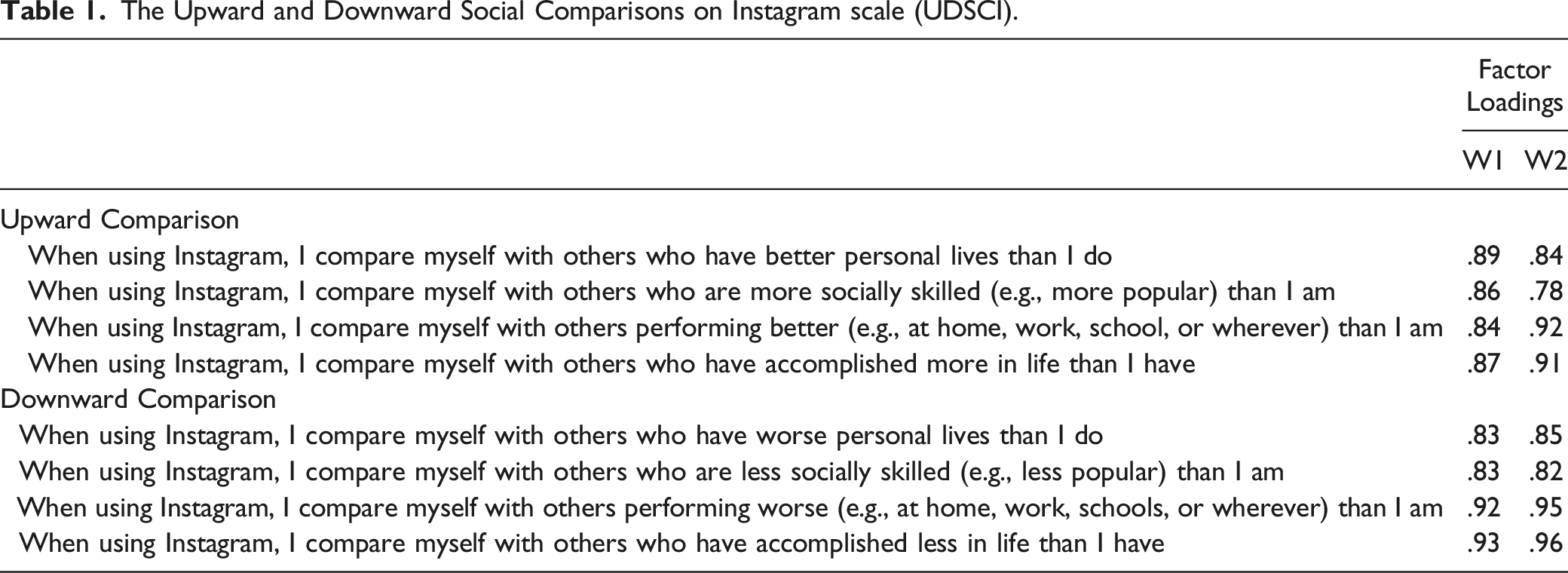
The Upward and Downward Social Comparisons on Instagram scale (UDSCI).
Identity Processes
To measure identity processes, we utilised a short-form version of the Utrecht-Management of Identity Commitments Scale (U-MICS; Schubach et al., 2017). The short-form version of U-MICS contains nine items on a five-point Likert scale (1 = Completely untrue, 5 = Completely true): three items concern commitment (e.g., “My education gives me self-confidence”), three assess in-depth exploration (e.g., “I often reflect on my education”), and three measure reconsideration of commitment (e.g., “I often think that a different education would make my life more interesting”). Although U-MICS can be used to study identity in terms of specific ideological or relational domains, global identity scores are often generated through combining scores from at least one ideological and one relational domain (e.g., Crocetti et al., 2010; Dimitrova et al., 2015; Vosylis et al., 2018). In this study, a global approach to identity was adopted to ensure conceptual consistency with the domain-independent scale used to measure upward and downward comparisons on Instagram. Global identity processes were discerned through combining scores from two ideological (i.e., education and politics) and two relational (i.e., peer relationships and romantic relationships) domains. As measures for four domains were utilised, there were a total of 36 items. Confirmatory factor analyses using random parcelling confirmed the three-factor structure of the global identity processes (W1: χ2/df = 1.87, CFI =.99, TLI = .98, RMSEA = .06; W2: χ2/df = 1.58, CFI = .99, TLI = .99, RMSEA = .05). Furthermore, global commitment (W1: α = .69; W2: α = .73), in-depth exploration (W1: α = .70; W2: α = .72), and reconsideration of commitment (W1: α = .81; W2: α = .81) all reported acceptable internal consistency.
Results
Exploratory Analysis
Means, Standard Deviations, and Zero-Order Correlations for Focal Variables.
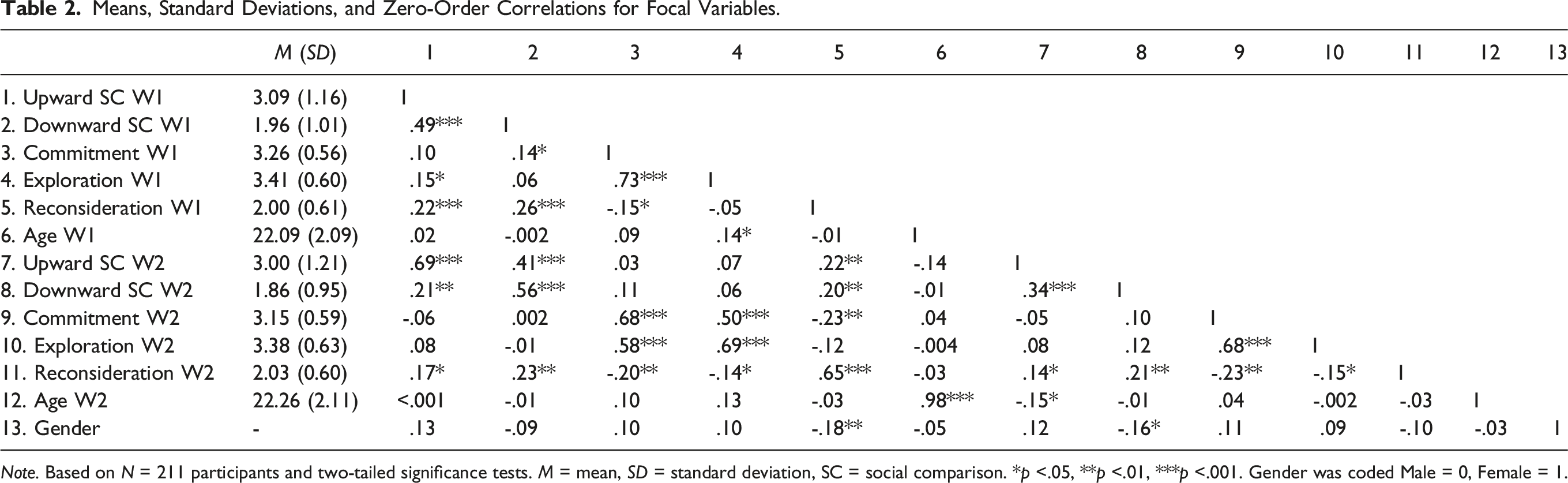
Note. Based on N = 211 participants and two-tailed significance tests. M = mean, SD = standard deviation, SC = social comparison. *p <.05, **p <.01, ***p <.001. Gender was coded Male = 0, Female = 1.
Testing the Hypothesised Model
Analytic Strategy
To examine the reciprocal relationships between social comparison behaviour on Instagram and identity processes, study hypotheses were tested using a cross-lagged panel model on AMOS. Cross-lagged models enable researchers to investigate temporal precedence, and by fitting autoregressive paths between dependent variables across time points, stronger causal inference can be made (Falkenstrom et al., 2020).
All focal variables (i.e., upward comparisons, downward comparisons, commitment, in-depth exploration, and reconsideration of commitment) were treated as latent variables. To enhance model parsimony, reduce random error, and increase model fit (Matsunaga, 2008), parcels were used as manifest indicators of latent identity process variables (W1 and W2). Consistent with previous studies employing U-MICS (e.g., Crocetti et al., 2008), parcels were computed randomly, and three parcels - each containing four items (i.e., one item per domain) - were computed for each identity process. Latent variable interaction terms (e.g., upward comparison x age, downward comparison x age; W1) were computed using the double-mean-centering approach, whereby observed variables were centered before product terms were computed and centered again (Lin et al., 2010).
In addition to the hypothesised paths, direct paths were modelled between all focal variables across both time points. Age (18–27), gender (Male = 0; Female = 1), and ethnicity (White British = 0; Non-White British = 1) (W1) were also entered as control variables for predicting all dependent variables (W2). Furthermore, as previous research has identified gender differences in terms of the implications of social comparisons on SNSs (e.g., Noon, 2020), we controlled for this effect by modelling paths between upward comparisons × gender and downward comparisons × gender (W1) and the three identity processes (W2). Finally, covariances were estimated between all independent variables, between the residual variances of the dependent variables, and between the error terms of the same items/parcels across both waves. Model fit was considered acceptable when χ2/df ≤ 3.00 (Schermelleh-Engel et al., 2003), CFI and TLI were ≥.90, and RMSEA was ≤.08 (Byrne, 2010).
Results
Estimates for Direct Paths of Interest, Hypothesised Paths, and Significant Control Paths.
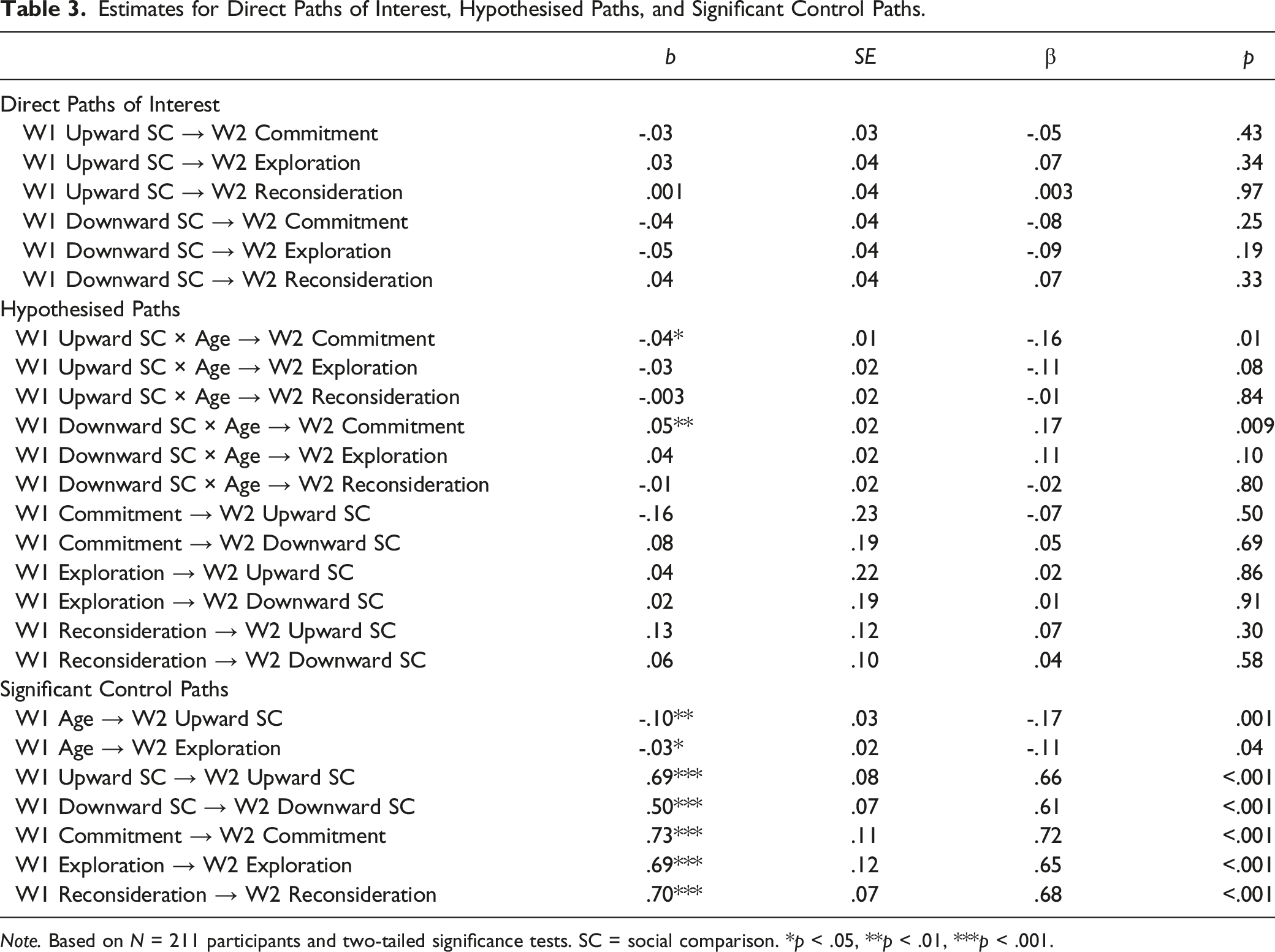
Note. Based on N = 211 participants and two-tailed significance tests. SC = social comparison. *p < .05, **p < .01, ***p < .001.
Age significantly moderated the relationship between downward comparisons on Instagram (W1) and commitment (W2): the relationship was negative for younger emerging adults (b = −.14, p = .03), but not significant for older emerging adults (b = .06, p = .26). H2a was therefore partially supported. Furthermore, age did not significantly moderate the relationships between downward comparisons on Instagram (W1) and in-depth exploration (W2) or reconsideration of commitment (W2). H2b and H2c were therefore not supported.
In terms of the reverse paths, none of the three identity processes (W1) predicted either upward or downward comparisons on Instagram (W2). H3a, H3b, H3c, H3d, H3e, and H3f were therefore not supported.
Discussion
Guided by the developmental and social psychological literatures, this study examined whether age moderated the longitudinal relationships between upward and downward comparisons on Instagram and three identity processes during emerging adulthood. As expected, there was no direct longitudinal relationship between upward and downward comparisons on Instagram and the three identity processes. Age was found to moderate the longitudinal relationships between upward and downward comparisons on Instagram and commitment, but significant age differences were not found when predicting in-depth exploration or reconsideration of commitment. We also tested whether identity processes longitudinally predicted upward and downward comparisons on Instagram, though significant results were not found. Below, we discuss these results in more detail.
As predicted, age was found to moderate the relationship between upward comparisons on Instagram and commitment (H1a). For older emerging adults, upward comparisons negatively predicted commitment two months later. These results suggest that due to the progressive nature of identity development and societal pressures to perform, older emerging adults may be more at risk of experiencing increased feelings of pressure and inadequacy following comparisons with superior others on Instagram, and this may lead them to doubt important aspects of their identity. Age also moderated the relationship between downward comparisons on Instagram and commitment (H2a), and downward comparisons negatively predicted commitment two months later for younger emerging adults. This suggests that given their less mature identity profiles and greater scope for change over time, younger emerging adults may find inferior others to be more self-threatening. Indeed, it is possible that younger emerging adults are more prone to believing they will suffer the same misfortune as downward comparison targets, which may in turn reduce their sense of self-certainty. These results provide evidence of the negative implications that upward/downward comparisons may have on emerging adults’ sense of commitment. Furthermore, the effect of age on the direction of comparison which negatively associated with commitment was consistent with our assumptions regarding developmental differences in the assimilation versus contrast dynamic.
Guided by this reasoning, we also hypothesised that upward comparisons on Instagram would positively predict commitment for younger emerging adults (H1a), and downward comparisons on Instagram would positively predict commitment for older emerging adults (H1b). Whilst the directions of the relationships were consistent with our hypotheses, neither were significant at the p < .05 level. Thus, although we predicted a cleaved moderation, the analysis only provided evidence of a contingent moderation, whereby only negative longitudinal relationships between upward/downward comparisons on Instagram and commitment were found. These exclusively negative associations may be resultant of the instability and uncertainty associated with emerging adulthood. Indeed, individuals report more negatively valanced comparisons in times of uncertainty, as uncertainty can enhance feelings of strain, which can increase vigilance to the negative information inherent in social comparisons (Buunk et al., 1990). These results should also be interpreted against the backdrop of the COVID-19 lockdown that was observed during W2 of data collection, wherein increased uncertainty and insecurity were experienced by many emerging adults (Germani et al., 2020), thus potentiating an even greater focus on the negative aspects of social comparisons. Furthermore, reduced autonomy and self-directedness were common experiences amongst young people during COVID-19 lockdowns (Fioretti et al., 2020), and low perceived control over one’s relative status has also been found to increase the likelihood of negative comparisons (i.e., upward contrast and downward assimilation) (Smith, 2000). Thus, whilst it is reasonable to assume that emerging adults did engage with Instagram content that could have positive consequences for identity formation during the period of this study, respondents may have experienced an elevated tendency to interpret Instagram content as self-threatening. It would therefore be prudent for future research to replicate this study to help determine whether differing social conditions may potentiate more positive comparisons (i.e., upward assimilation and downward contrast) amongst emerging adult Instagram users.
We also hypothesised that age would moderate the longitudinal associations between upward and downward comparisons on Instagram and the two exploratory processes (i.e., in-depth exploration and reconsideration of commitment). However, no significant moderator effects were found (H1b, H1c, H2b, H2c). Because the longitudinal direct relationships between upward and downward comparisons on Instagram and the exploratory processes were also not significant, findings provide no longitudinal evidence to suggest that such behaviour prompts emerging adults to explore their identity. Methodological factors may help to explain these non-significant results. There was a two-month interval between waves of data collection, and whilst this is not a particularly long period for those researching identity development longitudinally, identity is dynamic and often emerges through short-term micro-level exploratory processes (Becht et al., 2021). Thus, it may be that the exploratory implications of upward and downward comparisons on Instagram are less detectable in more long-term longitudinal studies. Indeed, whilst causal inference cannot be made, positive concurrent correlations were found between upward and downward comparisons and the exploratory processes during both waves of data collection, which could be suggestive of social comparisons having short-term effects on identity exploration. As exploratory behaviour predicts identity commitment over time (Klimstra, Luyckx, et al., 2010), this short-term exploration may have prompted the longitudinal changes in commitment detected in this study.
However, the significant concurrent correlations at both time points may also be reflective of the reverse relations (i.e., the momentary effects of identity processes on social comparison behaviour on Instagram). Indeed, in-depth exploration positively correlated with upward comparisons on Instagram during W1, and this may suggest that emerging adults compare themselves with superior others on Instagram to help learn more about how to better themselves in identity-related domains. Reconsideration of commitment concurrently associated with upward and downward comparisons on Instagram during both waves of data collection, and because social comparison behaviour typically increases during times of uncertainty (Gibbons & Buunk, 1999), it is possible that these correlations reflect the fact that emerging adults engage in social comparison behaviour on Instagram to help overcome their identity confusion. Whilst we tested whether identity processes would predict social comparison behaviours on Instagram two months later (H3a, H3b, H3c, H3d, H3e, and H3f) to shed further light on these concurrent correlations, no significant results were found. Thus, as social comparisons can occur quickly and are often triggered by individuals’ current self-related motives (Arigo et al., 2020), these results further emphasise the importance of conducting more short-term longitudinal research (e.g., experience sampling and/or daily diaries) to help determine temporal sequence.
Limitations and Future Research
Whilst this study provided important insight into how age may moderate the identity implications of social comparisons on Instagram during emerging adulthood, it comes with limitations which ought to be addressed in future research. In terms of methodology, as previously outlined, shorter-term longitudinal designs may provide more nuanced insights into the dynamic bi-directional relationship between social comparisons on Instagram and identity development. Furthermore, having only collected data over two time points, we were unable to distinguish within-person from between-person variance, and given the number of paths in our model, our sample size (N = 211) was relatively small. Larger samples and additional waves of data collection may provide more reliable results. Finally, in this study, we only collected data from emerging adults in full-time education. Whilst this was to ensure that the domains in which identity-related data were collected (i.e., education, politics, peer relationships, and romantic relationships) were salient in the lives of all participants, it is important to recognise that results may not replicate amongst emerging adults in full-time employment.
As with all previous studies exploring the identity implications of social comparisons on SNSs, this investigation utilised domain-independent approaches to both social comparison behaviour and identity development. However, certain self-related domains are more prominent and/or idealised on Instagram (e.g., romantic relationships and physical appearance), and it is possible that social comparisons in these domains may have greater consequences for identity formation. As the relationship between global and domain-specific identity is often modest (Goossens, 2001), future research should examine how different aspects of identity are shaped by domain-specific social comparisons on Instagram (e.g., how comparisons related to educational achievement inform educational identity). It was not possible to align identity domain and social comparison behaviour in this study due the domain-independent nature of the scale used to measure social comparison behaviour on Instagram.
Further research should also consider who emerging adults are comparing themselves to on Instagram. Indeed, comparisons with strangers (e.g., Chou & Edge, 2012) and those perceived as dissimilar to the self (e.g., Noon & Meier, 2019) on Instagram are more likely to have negative psycho-emotional consequences for young people, and it is therefore reasonable to assume that certain comparison targets tend to have more maladaptive implications for identity development. It would also be fruitful for researchers to consider the impact that social comparison motive (e.g., self-enhancement, self-evaluation, and self-improvement) may have on how social comparisons on Instagram inform identity development, as initial evidence suggests that opposing comparison motives can produce differing affective responses amongst emerging adults (Cramer et al., 2016).
Finally, whilst this investigation shed light on how age may moderate the outcomes of social comparisons on Instagram, less is known about the drivers of social comparison behaviour on the platform. We predicted that identity processes may guide social comparison behaviour on Instagram, and although concurrent correlations suggested that there may be short-term effects, no longitudinal relationships were found. Given that evidence is accumulating which suggests that such behaviour can have negative implications for identity development and well-being during emerging adulthood, future research could consider the drivers of social comparisons on Instagram. Research may also consider more person-centered analyses to explore individual patterns in both upward and downward social comparison tendencies. By having a more nuanced understanding of what leads emerging adults to engage in potentially ‘risky’ social comparison behaviours, and how individuals differ in specific social comparison patterns, we will be better placed to support young people to successfully navigate the platform.
Conclusion
This investigation explored whether age moderated the longitudinal relationship between upward and downward comparisons on Instagram and identity processes during emerging adulthood. Whilst many of the hypothesised paths were not significant, age differences were found regarding how upward and downward comparisons on Instagram predicted commitment two months later: upward comparisons negatively associated with commitment for older emerging adults, and downward comparisons negatively associated with commitment for younger emerging adults. Results provide support for the notion that developmental factors may inform the identity implications of social comparison behaviour on Instagram, and therefore have important consequences for those supporting young people. Specifically, given emerging adults’ differential susceptibility to media effects, a ‘one-size-fits-all’ approach to support is unlikely to provide the desired outcome. Rather, when attempting to support emerging adults to navigate Instagram in a way that is beneficial for identity formation, developmental sensitivity is required, and consideration should be given to the maturation of individual emerging adult Instagram users before providing guidance.
Footnotes
Declaration of Conflicting Interests
The author(s) declared no potential conflicts of interest with respect to the research, authorship, and/or publication of this article.
Funding
The author(s) received no financial support for the research, authorship, and/or publication of this article.
Open practices
The raw data, analysis code, and materials used in this study are not openly available. The design and analysis plans were not preregistered.
