



Abstract
This qualitative investigation explored the identity development of emerging adults who revealed their parents’ negative experiences. Participants were 169 Chinese college students (M = 19.83, SD = 1.19, 76.92% women) from southwest China. Thematic analysis of the data which were collected in December 2022 suggests that the participants revealed various parental negative experiences including hardships and poverty, failure and regrets, as well as family scandals and interpersonal conflicts. The participants strived to make meaning out of such experiences and looked into the future to make a difference based on their meaning-making capacities. Such a process leads to both personal identity exploration and family identity negotiation which become foundations for their future family narratives. We created a model of personal and family identity development to capture the process of identity development in revealing parental negative experiences. The findings of this study contribute to the scholarship on family narratives and identity development.
Keywords
Recent studies support the idea that family narratives serve to shape identity in adolescence and emerging adulthood (Fivush, 2019; McLean, 2016; Thompson et al., 2009; Thomsen & Vedel, 2019). It is, however, unclear how the identity function of family narratives applies to negative family stories which people usually avoid disclosing to family outsiders due to mechanisms of social acceptance (Fivush & Merrill, 2016; Marin et al., 2008). When experiences such as family estrangement, parental separation, or intergenerational trauma are narrated, offspring might feel anger, guilt, or unworthy and fragmented as a person (e.g., Arranz Becker & Hank, 2022; Liu et al., 2021; Wiseman et al., 2006), or in some cases, make meaning out of such negative events which contributes to their personal development (Glavan et al., 2020; Kross & Ayduk, 2011). In this study, we paid attention to the identity development of a group of Chinese college students who narrated the negative life experiences of their parents. Given that family narratives are constantly changing (Fivush & Merrill, 2016), seemingly negative experiences are not necessarily interpreted negatively (Berntsen et al., 2011; Marin et al., 2008), and individual differences such as personality, emotional distress, and self-images affect the revealing of such negative experiences (Rathbone & Steel, 2015; Thomsen & Pillemer, 2017; Zaragoza Scherman et al., 2015), understanding emerging adults’ self-reported negative family stories and their interpretation of such narratives is with great value in the research of family narratives, identity, vicarious stories and their relations to identity development among youth.
Literature Review
Identity refers to people’s conscious and unconscious beliefs, goals, expectations, motivations, and understanding of who one is at a given time and within a social-historical context (McAdams, 1995). The development of identity, as an ever-changing process, integrates various dimensions in life to strive for a sense of self with wholeness and meaning (Freeman, 2017; Schwartz et al., 2013). According to Erikson’s (1963) psychosocial stage theory, adolescents and younger adults develop identity through exploring the many roles and beliefs in life, dealing with crises and confusion, and constructing a coherent sense of self. Marcia (2002) further theorizes that young adults strive to formulate identity commitment through identity exploration which leads to four identity statuses: diffusion, foreclosure, moratorium, and achievement. For emerging adults who are leaving their homes and exploring their positions in the world, identity development is particularly crucial for their well-being and maturity (Côté, 2018). In a life period with various developmental challenges, they make sense of the many experiences in life and develop multiple identities to adapt (Abes et al., 2007).
To investigate the process of identity development in emerging adulthood, many researchers adopt a narrative perspective and believe that storytelling is one promising way that people use to express and construct identity (McLean, 2016). Young adults tell both personal and vicarious life stories while making sense of who they are and formulating familial and other social identities (Fivush & Merrill, 2016; Lind & Thomsen, 2018; Liu & Zhu, 2023). For example, in a study of family narratives, a group of college students wrote down a story about their grandparents and reflected on how they had been impacted by the story. The findings suggest connections between family narratives and young adults’ gender identities in that the women participants revealed more relationship-related stories that taught them to be loving, while the men participants recalled memories emphasizing work ethic (Taylor et al., 2013).
Family narratives provide emerging adults opportunities to gain insights about themselves, and their parents, parent-child relationships, and family history (Haydon, et al., 2023; Merrill et al., 2019). Parents and parent-child relationships, in particular, hold consistent importance in identity development across the lifespan (Köber & Habermas, 2018) and people tell stories about their parents and their families when reviewing their personal lives (Liu & van Schalkwyk, 2021; Thomsen & Vedel, 2019). Younger adults constantly hear and tell stories about their parents and grandparents who hold importance in their lives (McLean, 2016). Existing research yielded complex results regarding vicarious storytelling on parent-child relationships and children’s identity development. Through retelling such stories, ideally, young adults integrate their reconstructed past, perceived present, and envisioned future about themselves and their parents, families, communities, and countries into a whole with continuity and stability (Thomsen & Pillemer, 2017). As indicated in Merrill et al.s’ (2019) study, the telling of parents’ stories serves to build and maintain parent-child relationships for adolescents and college students. When traumas such as parents’ Holocaust experiences were revealed, however, children’s identities and communications with their parents were difficult to negotiate (Wiseman et al., 2006). In these regards, exploring the relationship qualities with the person that an individual’s vicarious story is about could be promising to fully understand vicarious life stories and their impacts on identity development (Lind & Thomsen, 2018).
When telling family stories, people selectively share culturally desirable experiences with others to gain social acceptance and construct positive personal and familial identities (Merrill et al., 2019). In this regard, positive experiences are usually used as a “default” for life storytelling and identity, while narratives with negative emotions deviate from cultural norms (Berntsen et al., 2011; Ow & Katz, 1999; Zaragoza Scherman et al., 2015). Negative experiences, however, stick longer in our memories and might play an important role in shaping and reconstructing people’s identities as indicated in the literature (Berntsen et al., 2011; Williams, Ford, & Kensinger., 2022). We believe that negative experiences of parents are concerned about the events that were lived through by parents and revealed by children who perceived them as having some negative impacts on their parents and/or themselves. Fivush and Merrill (2016) proposed a model of family narratives that categorizes family narratives into three dynamically interacting systems: shared family narratives, communicative and intergenerational family narratives, as well as family history and cultural myths. Intergenerational narratives are stories that adults from prior generations such as parents and grandparents tell their children or grandchildren about their past including their childhood experiences (Merrill et al., 2017), experiences of growing up (Merrill & Fivush, 2016), and life experiences across various life stages (Liu & Zhu, 2023; Thompson et al., 2009). Children’s stories about their parents’ negative experiences, in these regards, could be constructed as intergenerational family narratives. Children might hear stories about their parents’ negative experiences from their parents, grandparents, and other people around, or could create stories about such experiences based on their interactions with their parents. Such experiences belong to parents but are disclosed by children who may be involved in such experiences and use them to satisfy their needs such as emotional release and self-enhancement (Kross & Ayduk, 2011). They might express complex emotions, even positive ones, toward parents’ negative experiences when revealing them (Liu & van Schalkwyk, 2021).
Experiences with negative emotions, although might be challenging to reveal, are common topics in both personal and vicarious stories (e.g., Kongshøj et al., 2022; Liu et al., 2021). On one hand, disclosing negative experiences of family members could cause distress and disruption and evoke resistance from both the teller and the listener, particularly when such experiences are with a lot of pain and regret (Liu & Zhu, 2023). For example, many offspring felt guilt, anger, and frustration when revealing their parents’ experiences of survival from the Holocaust (Wiseman et al., 2006). On the other hand, people might go through post-traumatic growth and construct meaning and identity integration through adapting and balancing seemingly opposing forces (Côté, 2018; Erikson, 1963). People tell stories for certain purposes such as self-enhancement, even if such stories are perceived by them as negative (Kross & Ayduk, 2011; Liu et al., 2021). As argued by Pasupathi et al. (2009), a story with no emotional pain “lacks a point and ought, really, not to be told” (p. 114). For instance, family stories with negative emotions could benefit children’s development under certain circumstances such as when the narrations are accompanied by explanatory discussions (Marin et al., 2008; Sales & Fivush, 2005). Although the question of how positive and negative experiences impact people’s sense of self is to be determined, Berntsen and colleagues (2011) propose that positive and negative life events might relate to identity differently. The American college students in Vangelisti et al.’s (1999) study, for example, were asked to share a story about their families and then retell the story in a way that embodied their ideal expectations of their families. Findings suggest that family stories with attributes such as care and togetherness are associated positively with participants’ satisfaction with their families, while stories reflecting disregard and hostility are not. The participants in Kongshøj et al.’s (2022) study who mentioned traumatic events when telling their stories, although scored higher in measures of PTSD and depression, did not tell less coherent stories than those who only recalled positive events.
As far as we knew, the question of how sharing negative experiences of parents affects emerging adults’ identity development is far from clear, particularly in Chinese contexts. China has been going through huge social transformations such as rural-to-urban migration, fast aging, and low birth rate which might create tensions in emerging adults’ identity development regarding their embracement and rejection of traditionality and modernity (Yuan & Ngai, 2018). For example, facing challenges in graduation, job hunting, and living, Chinese emerging adults might share a Sang subculture expressing incapacity to live up to the life statuses that they and their parents anticipated (Tan & Cheng, 2020). In the family context, although many Chinese college students recognized the sacrifice that their parents and grandparents made to the growth and wanted to pay back by giving them company, a lot of them considered first working in the cities that may be far away from their homes and then taking care of their aging parents in the future (Liu & Zhu, 2023). They presented themselves as filial children, explorers of life opportunities, and future workers in professional settings (Yuan & Ngai, 2018).
Given that challenges are “the how of identity development” (Syed & McLean, 2015, p. 569) and stressful events increase identity exploration (Anthis, 2002), the investigation of identity development among emerging adults who disclose their parents’ negative experiences is intriguing and valuable. In this study, we aimed to answer the following two research questions: what are the experiences of parents that Chinese emerging adults would disclose and perceive as negative? How would they make sense of such narratives regarding their sense of self and their construction of family closeness?
Study Framework
To efficiently answer these intriguing questions, we situated the current study into the discourse of family narratives (Fivush & Merrill, 2016; Liu & Zhu, 2023; Thompson et al., 2009) to understand college students’ identity development (Abes et al., 2007) in Chinese contexts. According to Abes et al., emerging adults, college students in particular, use their meaning-making capacities to construct multiple identities within their personal and social contexts. Such meaning-making capacities function as a filter that they employ to selectively recall, share, and reflect on their vicarious stories which serve their identity development (Fivush, 2019; Thompson et al., 2009). Emerging adults reveal their parents’ life experiences and use them as templates to understand their personal lives (McLean, 2016). As argued by Thomsen and Pillemer (2017, p. 474), “vicarious life stories interact with and expand the self.” Such a function might occur indirectly in that offspring use their parents’ life stories as templates for their own, reflect on their personal life experiences (Lind & Thomsen, 2018), and embrace, reject, or extend the values, attitudes, and life lessons within their family narratives to make sense of who they are and whom they want to be in the world (Thompson et al., 2009). Due to cultural and personal influences on family narratives (Reese et al., 2017), we still could not be sure what types of family narratives youth would embrace, reject, or extend, how they do it, and how such a complex process of meaning-making would impact their sense of self in a given social-cultural context, in particular regarding parental negative experiences. Considering the complexities of the positive and negative aspects of family narratives and their relation to identity development (Berntsen et al., 2011; Marin et al., 2008; Sales & Fivush, 2005), it is necessary to understand the development of identity among emerging adults who reveal their parents’ negative experiences.
Concerning the identity of Chinese people, research suggests that Chinese participants put a lot of weight on historical and social events and significant others while telling their personal life stories (e.g., Wang & Conway, 2004) and identity for Chinese people is relationship-oriented and defined primarily by social roles and obligations (Liu et al., 2010). Another related and influential cultural issue is dialectical thinking which Chinese people are prone to employ when telling stories and making sense of their lives (Liu & van Schalkwyk, 2021; Spencer-Rodgers et al., 2004). People who employ a dialectical thinking style can hold conflicting and even opposite ideas which may all be true when understanding a specific phenomenon. According to Spencer-Rodgers and colleagues (2004, p. 1417), is characterized by three primary principles: contradiction (two opposite statements may be true at the same time), change (things are constantly evolving and changing), and holism (“all things in the universe are interrelated”). Concerning parents’ negative experiences, various personal and cultural values—such as the saving of face, filial piety, and elder respect—might hinder Chinese emerging adults from revealing some of their parents’ negative experiences (Liu & Zhu, 2023; Ow & Katz, 1999). For instance, Ow and Karz’s study (1999) indicates that the mechanisms of saving the face of both parents and families are influential when Chinese people talk about sensitive issues with family outsiders. In these regards, we assumed that the participants of this study might disclose some of their parents’ negative experiences, and their narratives might include experiences of other people and social-historical events that are featured with contradiction, change, and holism.
Methods
Participants
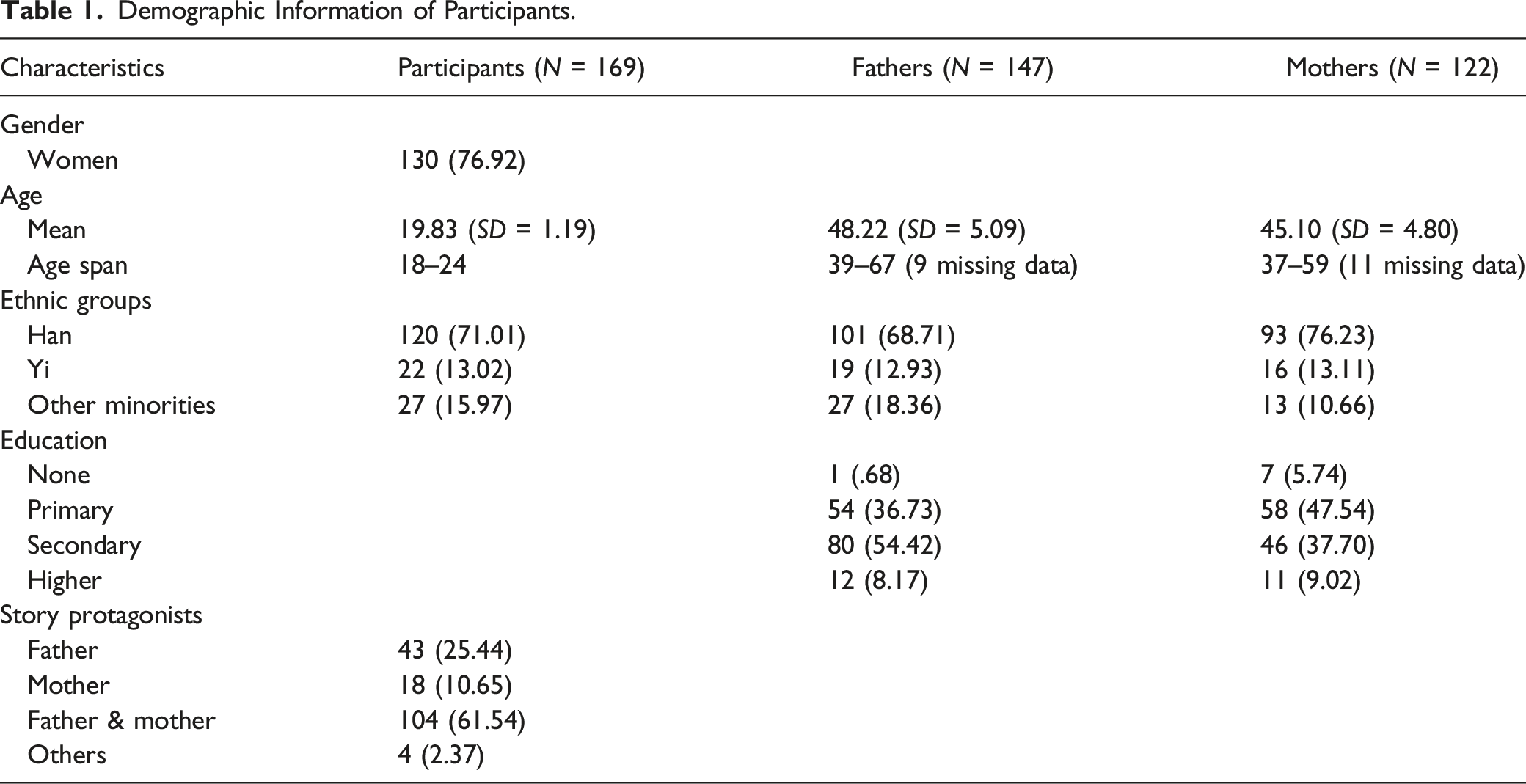
Participants of this study were 169 Chinese college students who took a course in the year 2022 entitled Psychological Health Education in College which was lectured by the first author adopting a narrative pedagogy approach (Goodson & Gill, 2011). The enrolled students were assigned homework on family storytelling to facilitate their personal development. To earn 20% of the total grades, they had to submit a report to the lecturer describing their parents’ positive and negative experiences with reflections. After granting the students’ grades, the course lecturer sent a message to the 596 enrolled students inviting them to participate in this study. They were informed about the purpose of this study, the research experiences of the first author, the confidentiality of using their reports, and that they could choose not to participate or drop out without any consequences.
Demographic Information of Participants.
Data Collection
The data for this study were the 169 participants’ submitted reports. The participants were told to write down stories about their parents’ experiences, connect such stories to them, and reflect on how such stories impact their development. They were reminded that they could report any kind of story about their parents but had to provide at least one story about their parents’ negative experience and another story about their parents’ positive experience. A template was provided for them to follow when writing their reports. The template illustrates three sections that should be included in the report: the title of the report, positive experiences with reflections, and negative experiences with reflections. A few participants had questions about whether there is any criterion in determining what kind of experience is positive or negative. Given that people’s perceptions toward positivity or negativity are diverse and constantly changing and our intention to understand the participants’ subjective lived experiences, we informed them that it is up to them to determine the positivity and negativity of their parents’ experiences.
Information about grading was provided to the participants who could earn 20% of the total grade by submitting their reports. They were informed that (i) the report should be submitted to the school teaching system electronically (2%); (ii) the report is integrative including all the required sections: title of the report, positive experiences including at least one story about parents’ positive experiences and participants’ thorough reflections, negative experiences including at least one story about parents’ negative experiences and participants’ thorough reflections (14%); (iii) the report reads smoothly and engaging without wrongly written characters (4%). Concerning the length of the reports, the participants were told to write as long as they preferred under the condition that their reports included all the required sections.
Only the stories that were indicated by the participants as describing their parents’ negative experiences were used for this study. After collecting the 169 participants’ reports, the first author read them, copied the content of negative experiences and participants’ reflections, and pasted them into a new document ready for further analysis. We checked the dataset and found there are 110,762 Chinese characters in the participants’ narratives about their parents’ negative experiences. The length of the participants’ responses ranges from 228 to 1,590 Chinese characters, with an average of 655 characters.
Data Analysis
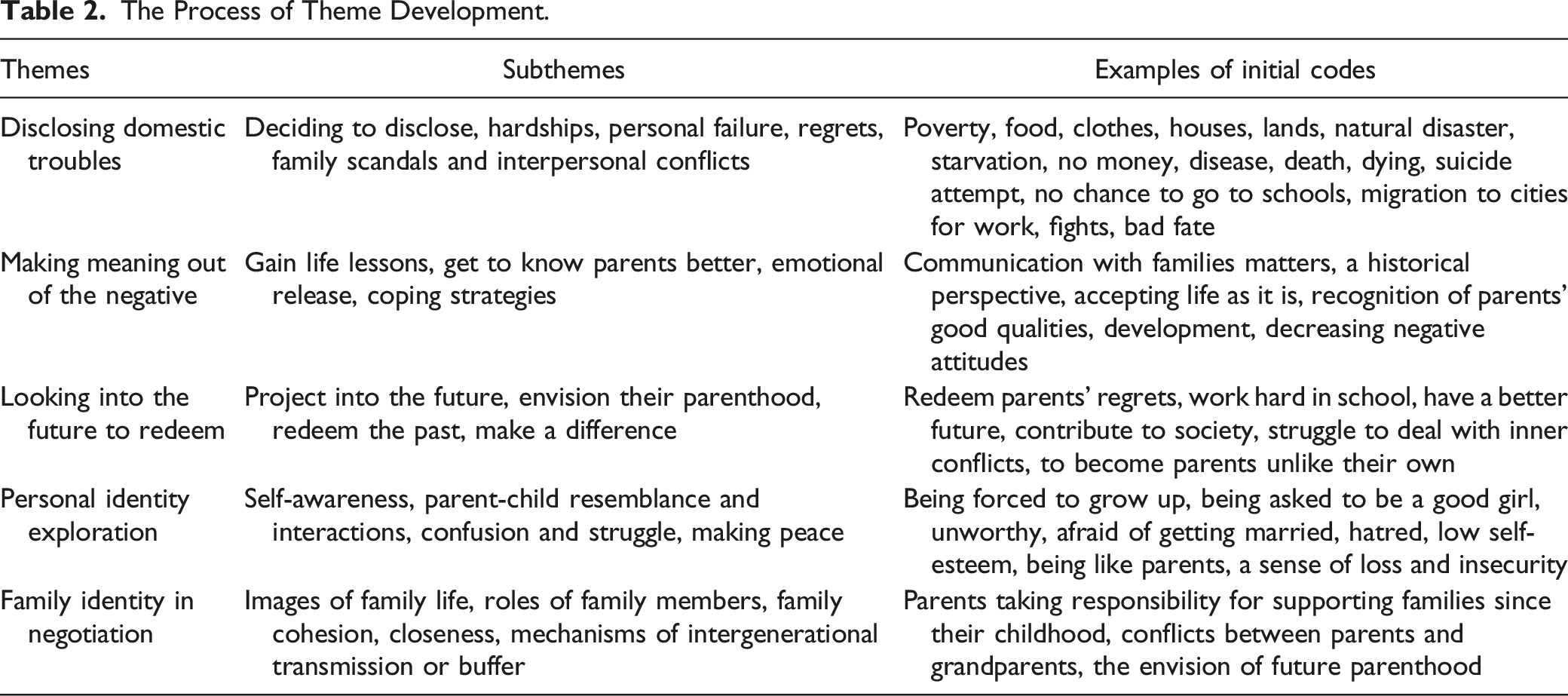
We followed the six analytic stages of thematic analysis (Braun & Clarke, 2021) while making sense of the data which include getting familiar with the data and taking notes, coding, generating initial themes, developing themes, revising and naming themes, and writing. When the document that contains the negative experiences of the participants’ parents was ready, the first author shared it with the second author. The two authors then got familiar with the data by carefully reading the document and coded the data line by line independently, meanwhile taking notes about their concerns and reflections regarding the participants’ narratives. Coding, as Braun and Clarke claimed, is “open and organic, with no use of any coding framework” that progressed as a process of generating themes and does not necessarily require multiple coders to ensure desirable quality. A theme describes a pattern of shared meaning within the data being investigated. Themes are complex and multi-faceted, and might “draw together data that on the surface appear rather disparate,” or like stories that researchers create about the data (p. 41).
The Process of Theme Development.
We adopted various strategies to establish the research trustworthiness and credibility of this study, including researchers’ collaboration, reflection, and thick description (Merriam, 2009). The two authors worked together throughout the study process. Although we recognize researcher subjectivity as a valuable resource in qualitative studies (Braun & Clarke, 2021), the collaboration between the two authors provides multiple insights into the research design, data analysis, and report writing. We also constantly reflected on how our personal experiences might impact our understanding of the participants. For example, the second author always reminded the first author how his previous experiences of investigating intergenerational narratives might be a base for the current investigation. We also presented the participants’ experiences of identity development in revealing their parents’ negative experiences to readers as apparent as we could by thick description. This study is part of a larger project on narratives of college students which received ethical approval from the university to which the first author was affiliated.
Findings
Disclosing Domestic Troubles
The informants in this study disclosed various kinds of negative experiences of their parents that are family-based, including hardships, personal failure, regrets, as well as family scandals and interpersonal conflicts. Almost all of them described the hardships that their parents went through. Topics within this category include poverty, suffering, sacrifice, health issues, and death. For example, a lot of participants remembered that their parents had to do long-lasting labor work since their early childhood. Participant W80 (20 y/o) vividly described how her father worked as a construction worker in the city when he was a teenager, intentionally starved himself, saved money, and sent it to her grandparents. Another (W133, 18 y/o) recalled that when she was a baby, her family was always in financial crises and her father went to sell his blood to buy food and groceries. Within the hardship category, the lack of education due to poverty and its impacts on their parents’ lives was also commonly discussed. Participant M08 (21 y/o), e.g., said that his grandfather did not allow his father to go to school, claiming that schooling was useless and working in the farmlands was required. Once, his father secretly went to school, came home in the afternoon, and was severely beaten by his grandfather. When sharing these memories with the participant, his father attributed the hardships in adulthood to his lack of education, a phenomenon that was commonly observed in the data.
Regrets and failures were also revealed by the participants. Many participants’ parents were not reconciled to their past in that they did not have a chance to go to school, work hard, go to college, receive a degree, and have a better life. Several (e.g., participants W14, W107, M12) described how their parents gave up the opportunities to go to school to their parents’ siblings due to poverty and felt regret when reminiscing. Participant M12’s (20 y/o) father received excellent grades in middle school but dropped out due to economic pressure. He recalled how his father had a serious fight with his grandparents to earn an opportunity for schooling, saying “When failed in the fight, my father ran away from home. He always feels his parents love his younger brother more because they allowed him to go to school. He cried with remorse when telling me these.” Some participants also revealed regrets when their parents did not choose a different life path, such as giving up opportunities to learn new skills due to family crises (e.g., W45, W107) or leaving children back home while migrating to the city for work (e.g., W19, W125, W139). Compared to regret, failure was more related to fathers. Participant W46 (20 y/o) described her father’s failure to make money in the city after dropping out of school. Her father went back home but was reluctant to become a farmer like her grandfather, meanwhile, feared failure when thinking about starting a business, and then lived his life as other villagers did.
Family scandal in the participants’ reports was primarily interpersonal and referred to parental conflicts (e.g., parental quarrel, separation, infidelity, and divorce), conflicts with people outside the core family (e.g., grandparents), unacceptable parenting behaviors (e.g., neglecting children’s needs), and parents’ behaviors that are immoral or illegal such as heavy drinking, gambling, domestic violence, stealing, fighting, manslaughter, and going to jail. Memories in this category usually evoked complex emotions among the participants who reflected on how they were impacted by their parents’ experiences. Participant W68 (19 y/o) remembered that when she was six years old, her parents were often fighting with each other. Whenever a fight ended, her mother would ask her who she was going to live with if her parents got a divorce. Her mother also complained to her and her younger brother that if it were not for them, she would have divorced her father a long time ago. “Listening to her complaints, I often wondered maybe it is me and my brother who are in the way of their pursuit of happiness,” she remarked.
Making Meaning out of the Negative
The reveling of parental negative experiences, particularly family conflicts, was not easy as participant W55 (21 y/o) claimed, “Domestic shame should not be made public.” Many explained why they decided to disclose the troubles that they disclosed in that they gained something from such experiences. Some (e.g., participants M30, M42), e.g., learned lessons from their parents’ quarrels that communication matters in relationship maintenance. Others (e.g., participants W55, W139) claimed that such experiences impacted their parents or themselves profoundly, deepened their understanding of their parents, or just wanted to disclose them for emotional release. Participant W80’s (20 y/o) reflection was illustrative: The reason why I told this story is that I hardly believe that my father suffered so much when he was a child. When writing down the story, I felt strongly heavy in my heart and thought about telling another one. But I kept this one because it means so much to me.
The participants further adopted various strategies to make meaning out of the negative. One of which was taking a historical perspective, limiting such experiences to a period that was in the long past, and believing that the related problems had been properly dealt with. Even for those who presented their family stories with ups and downs, they seemed to find merits in these events, such as accepting that is how life is or appreciating their parents’ diligence in developing their families. They prioritized the good qualities of their parents or themselves while involved in stressful life events, such as endurance, resilience, and diligence. Participant W138 (21 y/o), for example, said that her parents were poor after getting married but changed the situation with amazing efforts, saying “Although my father’s parents were extremely poor, he was not lazy. My parents worked hard and improved the situation.” Another (participant W88, 19 y/o) claimed that her parents were resilient and persistent in developing the family.
For many participants, the disclosure of parents’ negative experiences was helpful in gaining insights about their parents and families which may decrease their negative attitudes toward their parents or themselves and increase their connection to their family members. Participant W146’s (21 y/o) story was illustrative. She told a story about a telecom fraud. One night when she was in the second grade, her father received a phone call and was told that his daughter had an accident and was in the hospital needing 20,000 RMB to pay the medical bill. Given the fraud could tell her sister’s name and other personal information, her father was convinced and urgently transferred the money. Her first reaction to the accident at that time was a realization that her father does care about his daughters. She was moved by her father’s behavior, saying “My father drank, cursed all day, and usually did not talk too much to me. But he loves his family, and will do whatever he could when his family is in danger.”
Looking into the Future to Redeem
When meaning could not be made directly out of their parents’ negative experiences, projecting into the future was a way that the participant adopted to cope. For those who depicted their parents’ failures and regrets, both the participants and their parents seemed to believe that the participants have responsibilities to redeem the past. Participant M13 (21 y/o) claimed that his mother had never had a chance to go to school and explained that is why his mother encouraged him to work hard in school. Such an insight motivated him, saying “I will work hard to make peace with my mother’s regrets and to have a better future for myself.” Another (participant M56, 19 y/o) said that his entrance into college “is the finish to the unfinished in my family.” When imagining the future, he talked about his role as a father who would also cultivate his children to receive a proper education. Several participants (e.g., M64, W110) took a broader perspective and claimed that their parents’ stories of overcoming difficulties could encourage Chinese youth to create a bright future and contribute to the development of the country.
For the participants, interpersonal conflicts within families and the subsequent pain in parents’ experiences made it particularly difficult to make peace. Many believed that they could do something to make a difference regarding the effects on themselves. Several (e.g., participants W23, W55) described their struggles while dealing with the emotional burden that was evoked from troubling interactions with their parents. Participant W109 (20 y/o) told stories about her mother who beat and scolded her, apologized to her for forgiveness, and then repeated the circle again and again when she was a little girl. She remarked, “Sometimes I could not bear it anymore and thought about suicide, but the belief that I have not yet revenge my mother helped me survive.” The rage helped her but with a price in that she had always struggled with inner conflicts. She wanted to find peace, but the more she fought against the conflicts, the stronger they became. Such a vicious cycle was evident in other participants’ reflections. Participant M112 (19 y/o) narrated his parents’ destructive relationships and his father’s marital infidelity and reflected on how such events negatively influenced his growth. He had tried to save himself from the past which was progressing but inefficient. He comforted himself by looking into the future, claiming, “I don’t want to live in such inner conflicts anymore. I am changing. It is painful. I just hope that the day of relief comes early.”
Witnessing family conflicts made several participants fearful of finding the wrong spouses, getting married, having an unhappy family, or becoming parents like their parents. A lot of them talked about change and wanted to become qualified spouses and parents. For example, participant M71 (20 y/o) recalled that his grandfather was too busy at work to discipline his father properly which might cause the many behavioral issues of his father. When he was growing up, a similar pattern was repeating itself, in that he did not receive enough discipline and was misbehaving, and then corrected his behaviors due to his self-control. “In the future, I will pay attention to stopping this vicious cycle. I will conduct proper education for my next generation,” he claimed.
Personal Identity Exploration
All participants connected their parents’ negative experiences with themselves and discussed the implications for their growth. Many described how they resemble their parents in certain ways, such as having a particular type of appetite, an impulsive personality, or a strong and optimistic character. When perceiving the resemblance as negative, they endeavored to change. Participant M101 (21 y/o) claimed that his father was kind but had never been promoted like his colleagues at work. He pondered, “I am a person who does her job without getting involved in competition, just like my father. Honestly, I envy my friends who fight to get what they want. I want to change, but always failed.” Another participant (W115, 20 y/o) expressed a similar concern. She told stories about her father being a person having unconditional trust in others and being hurt or exploited. She said, “Because of my father, I have a great guard against others. I feel I am wearing masks and can not face others sincerely. I want to put down the masks. It is hard, but I want to.” It seems that they attributed some of their personality characteristics to their parents, believed they were restricted by such characteristics, and struggled to make a difference, but realized that they become a paradox who mirrored their parents’ personalities that they did not accept while fighting to be different.
Parent-child interactions were commonly linked to the participants’ growth. One participant (M58, 22 y/o), for instance, had conflicts with his parents about after-class tutoring when he was in middle school which “made me a person who could not take advice.” Another (W05, 20 y/o) claimed that she had been forced to grow up and felt unworthy as a person due to her parents. The following quote illustrates her struggles: I was about five years old. That day in the market, my brother and I wanted to buy a toy which was rejected by my parents. I can still hear their yelling and my brother’s crying. I wore a pair of shoes made of cheap fabric when I was in the sixth grade. I could not remember how I survived that year. Maybe it was too cold to feel a thing. Even at this moment, I feel sad and want to cry when these memories hit me. I was a little innocent girl but was told to be a good girl without bothering my parents, save money, and be industrious. I find it difficult to let all these go away. When meeting the boys that I liked, the first thing I felt was that I was unworthy. I always feel self-embarrassed. The doctrine of being a good child is like a cage to me. I am trapped.
Many participants described how their sense of self was impacted by family scandals such as parental conflicts. Witnessing their parents’ quarrels, fights, separation, or divorces, many felt scared, neglected, or believed that they were somehow responsible for their parents’ unhappiness and self-blaming. Now as younger adults, they reflected on how they were negatively molded by such events. Participant M112 (19 y/o) described a scene in which his parents were fighting one night when he was about seven years old. He recalled, “I still remember my mother’s bitter crying and the tension in my father’s face. When the fight ended in the middle night, my mother put down the knife and told me my father had an affair.” Such memories influenced him profoundly, as he claimed, “I feel that I have no childhood. I am afraid of confrontation. I try to avoid direct conflict with others. I feel inferior and very timid in front of others. I fear marriage. I often escape, just like I use video games to numb my nerves.”
Some participants seemed to make peace with the negative impacts brought on by their parents. Participant M74’s (21 y/o) father accidentally killed a man and then had been in jail for ten years. He described various events in which he was reminded about his father’s past by schoolteachers or people around him and realized that “I could not do a lot of things due to my father’s experience in jail, such as joining the army or the Communist Party of China. The impact is huge.” A few days before writing the report, he was having a video call with his mother who said that his father suggested a divorce with her so that his future would not be impaired by his father’s past. He remarked, “I felt pain in my heart because I did not make my father proud. Now I understand him, I do not blame him. If I were him, I would do the same thing and protect my family as he did.”
Family Identity in Negotiation
The narration of parents’ negative experiences also represented participants’ impressions of family life and the various roles of family members. They told stories about how their parents met, got married, had babies, raised children, worked hard to sustain the family, fought and loved each other, or how other people such as their grandparents and people in their communities interacted with their parents, as well as how they envisioned their future as a parent. Participant W79 (20 y/o) remembered that her father was forced to drop out of school when he was 13 years old and went to work in a factory. Her grandparents seemed indifferent toward her father’s vulnerability. Her father deemed his marriage as the luckiest thing that happened to him and appreciated her mother’s endless care and love toward him. She expressed positive emotions toward her parents’ mutual love and support that helped them overcome life challenges, meanwhile imagined meeting someone who could be with her and maintain a loving relationship.
Constructing a sense of closeness with their parents was also commonly referred to by those participants who recalled troubling parent-child interactions. Participant W139 (20 y/o) said that when she was in the fourth grade, her mother migrated to the city for work and left her at home with her father. She missed her mother and always cried in bed after witnessing the scenes where her friends’ mothers came to take them home. She described a car accident that seemed to be a turning point in her relationship with her mother. She told: Mother was despising me, like always. I shouted the words that I had always wanted to that she should not get involved in my life given that she had never cared about me. She was very angry and said things like wishing me dead. I knew she did not mean it as she was crying too. But that day, I lost my mind and jumped out of the car while it was still moving. I was not hurt. She ran to me and hugged me tightly, trembling. Since then, she phoned me more often. Now I understand her. Going to work in the city alone must be difficult for her. I feel sorry for my behavior.
The negotiation of family identity was also represented in the intergenerational transmission or buffer of the impacts of their parents’ negative experiences. Several women participants who disclosed their mothers’ painful experiences due to their gender noticed how their mothers were consciously stopping the reproduction of gender inequality. The participants also associated their parents’ difficult childhood and adulthood with their lives through intergenerational comparisons. Such comparisons always yielded a sense of privilege that life nowadays is much better and a feeling of appreciation toward their parents’ sacrifices which made their current lives possible.
Discussion
The aim of this study was to understand the identity development of emerging adults who disclose their parents’ negative experiences. In congruence with existing theorization, the sharing of parental stories, and negative experiences in this study, contributes to the identity development of emerging adults (Fivush & Merrill, 2016; McLean, 2016; Thomsen & Pillemer, 2017). The Chinese participants told the stories that they heard about their parents’ lives, decided to disclose some of them, perceived them as negative, made meaning out of the negative, and explored their personal identity and family connections. Such a finding echoes the argument that when selectively sharing family stories, emerging adults incorporate, reject, and extend the values, attitudes, and life lessons within family narratives and make sense of who they are (Thompson et al., 2009) based on their meaning-making capacities (Abes et al., 2007).
Revealing parental negative experiences, although as challenging as it is, could be rewarding for children’s development (Köber & Habermas, 2018; Sales & Fivush, 2005; Wiseman et al., 2006). As pointed out by several participants, the belief that family scandals should remain hidden discouraged them from revealing ugly family matters to strangers. Their acts of disclosing their parents’ negative experiences also contradict a commonly observed phenomenon that people usually tell socially acceptable stories (Berntsen et al., 2011; Zaragoza Scherman et al., 2015). Such a paradox might be better explained by referring to the process of meaning-making (Abes et al., 2007; Glavan et al., 2020; Merrill et al., 2019). As argued by Merrill et al. (2019), both children and their parents might choose to focus on family stories that are related to children’s life circumstances. Children tend to believe that their parents tell certain stories to them for their benefit, such as teaching them lessons (Reese et al., 2017), even if the stories are perceived as negative.
Many participants made meaning out of their parents’ negative experiences by pointing out that they gained something valuable from the disclosing. Such a phenomenon could be properly interpreted by referring to the self-enhancement in vicarious storytelling (Thomsen & Vedel, 2019). Due to self-enhancement effects, people not only tell positive family stories but also positively interpret those narratives with negative emotions and derive merits from them (Haydon, et al., 2023). Given that vicarious life stories of parents are usually connected to personal life stories and people make comparisons between them leading to self-enhancement (Thomsen & Pillemer, 2017), it is not surprising that the participants felt privileged and appreciated their parents’ sacrifices that made their current lives possible, a phenomenon that was found in a study on Chinese intergenerational narratives (Liu & Zhu, 2023). The participants’ reveling of their parents’ negative experiences was also featured with a temporal structure in that they put the stories that they told in a timeline which included what happened in the past and how they are related to the present and imagined future. They used their parents’ lives as templates for their future, particularly their imagined identity as a parent. Although this finding echoes Freeman’s (2017) theory that narrative identity is temporal, attention should be paid to emerging adults’ imagined identity as parents in family narratives and how such anticipations impact their actual parenthood.
In cases when regrets and pain are too strong to redeem, positivity and meaning might be difficult to create, and people might project themselves into the future and create possible selves to cope (Dunkel, 2000). For many participants, the realization that their parents’ behaviors influenced them negatively seemed to be a stimulus for them to change and make a difference for themselves. Such a psychological process brings autonomy and a sense of control, but the envision of becoming different from their parents, however, evokes inner conflicts that might lead to psychological or behavioral troubles. The question of how emerging adults balance such tensions while telling family stories with negative emotions deserves more academic and clinical attention. When revealing parents’ regrets and shame, a lot of participants felt they had the responsibility to redeem such experiences and expressed a sense of mission to satisfy their parents. Although intergenerational transmission of values and goals in family narratives is revealed in existing research (Fivush & Merrill, 2016), particularly among individuals whose parents went through wars and holocausts (e.g., Wiseman et al., 2006), we suggest the need to investigate the mechanism of anticipating to redeem parents’ regrets and its relation to regular younger adults’ identity.
Given that people’s personal stories are situated in their families and broader social, cultural, and historical contexts (Fivush, 2019; Freeman, 2017) and “vicarious life stories interact with and expand the self” (Thomsen & Pillemer, 2017, p. 474), it is reasonable that the participants’ descriptions of their parents’ negative experiences and their personal stories were interrelated and circulated into a whole speaking for their sense of self. They revealed their parents’ life experiences and used them as templates to understand their personal lives (McLean, 2016). The close integration of vicarious and personal life stories and even historical and national narratives in storytelling seems common among Chinese people (Liu et al., 2010). For example, one study indicates that Chinese older people revealed a lot of experiences of important others’ experiences and national history while reminiscing (Liu & van Schalkwyk, 2021). Another investigation on Chinese college students’ intergenerational narratives implies that the participants told stories about their grandparents and disclosed a lot of personal experiences while using their grandparents’ stories to understand themselves (Liu & Zhu, 2023). Such findings align with the propositions that Chinese people emphasize historical and social events and significant others while telling their life stories (e.g., Wang & Conway, 2004), identity for Chinese people is relationship-oriented and defined primarily by social roles and obligations (Liu et al., 2010), and narrative identity is temporal and relational (Freeman, 2017).
Chinese people are prone to employ a dialectical thinking style when telling stories and making sense of their lives (Liu & van Schalkwyk, 2021; Spencer-Rodgers et al., 2004), which explains the interrelation between the participants’ personal stories and narratives of their parents’ negative experiences. People who employ a dialectical thinking style can hold conflicting and even opposite ideas which may all be true when understanding a specific phenomenon. According to Spencer-Rodgers and colleagues (2004, p. 1417), dialectical thinking is characterized by three primary principles: contradiction (two opposite statements may be true at the same time), change (things are constantly evolving and changing), and holism (“all things in the universe are interrelated”). The contradiction in the participants’ reports was illustrated in that they revealed various negative experiences of their parents that were interpreted positively. Concerning change, the participants took a historical perspective restricting their parents’ negative experiences to a period that was in the long past and envisioning their future to redeem their parents’ regrets or to overcome the negative influences that were created by their parents. Holism was illustrated in that the participants tended to combine their personal stories with the vicarious stories of their parents and situated their disclosing of their parents’ negative experiences into their family narratives.
Consistent with the argument that intergenerational connection relates to identity (Fivush & Merrill, 2016), disclosing parents’ negative experiences facilitated the participants’ personal identity exploration. Identity exploration refers to the process in which individuals search for their personal values and beliefs to construct a sense of continuity and wholeness (Erikson, 1963; Marcia, 2002). The telling and reflecting on parental negative experiences provide the participants a chance to explore their sense of self regarding what they were, how they became what they are, and what they wanted to be. Exploration is deemed necessary for identity development in that identity commitment can be achieved when adolescents explore and reflect on their experiences (Marcia, 2002). We noticed that the participants’ personal identity exploration was particularly evident in the stories that depicted their relationship with their parents which echoes the idea that narrative identity is relational (Freeman, 2017).
The disclosure of parents’ negative experiences also facilitated the participants’ development of family identity. Family identity refers to the construction of a sense of connection to individuals’ families and family members (Thompson et al., 2009). According to Merrill and colleagues (2019), many parental stories told by young adults serve to provide insights about parents and themselves and build parent-child relationships. The emerging adults in this study reinforced their previous impressions about their parents (e.g., diligent or impulsive) and about how they resemble their parents. A lot of them also noticed how personal and interpersonal characteristics such as an impulsive personality and an insecure parent-child connection were reproduced in their families. They explored how such intergenerational transmission influenced them negatively and how they intended to stop its reproduction in the next generations. This phenomenon is very similar to the “generativity buffer” that was conceptualized by Kotre and Kotre (1998) to describe how adults choose to not pass on toxic legacies to their offspring. Younger adults not only accept, extend, or reject the cultural values, life lessons, and family heritage that are embedded in family stories, but also might struggle to buffer or stop the negative impacts of family narratives (Taylor et al., 2013). Such mechanisms of intergenerational buffer and transmission regarding family identity, however, have rarely gained academic attention.
Family identity development, as a vital part of personal identity (Marcia, 2002), contributes to the construction of personal identity (Haydon et al., 2023). The disclosure of parents’ negative experiences facilitates emerging adults’ understanding of their parents (Merrill et al., 2019). For those having negative attitudes toward their parents such as those who felt neglected or being forced to grow up due to poverty or family crises, the revealing of such experiences contributed to their identity exploration. They usually expressed a decrease in negative attitudes such as hatred toward their parents or an increase in positive emotions such as love for them leading to a sense of appreciation toward their parents’ sacrifice, meanwhile felt remorse that they misunderstood them. This finding broadens our understanding of the positive effects of family narrative and should be verified in other populations and contexts.
A Model of Identity Development in Revealing Parents’ Negative Experiences
We establish a model to efficiently capture the complexities of identity development of Chinese emerging adults while disclosing their parents’ negative experiences (Figure 1). When asked to share parental negative experiences, emerging adults first have to decide to disclose certain experiences, judge them as negative, then connect them with their personal stories and use them as life templates for themselves, reflect on how these personal and vicarious stories affect their sense of selves, and reconstruct their personal and familial identities which, in return, become foundations for their future family narratives. The term meaning-making capacity originates from Abes et al.’s (2007) Model of Multiple Dimensions of Identity, which refers to a filtering mechanism that emerging adults use to determine what negative parental experiences are to be told and how they interpret those to maintain a coherent sense of self. Such a filtering process not only equips them with the “proper” experiences that they could safely share with others, but also is weaved together with their embracement, rejection, and extension of their parents’ negative experiences. To cope with the negative emotions that are evoked while revealing negative experiences, emerging adults strive to make meaning out of the negative and look into the future to redeem while exploring their personal and familial identities. A model of identity development in revealing parental negative experiences.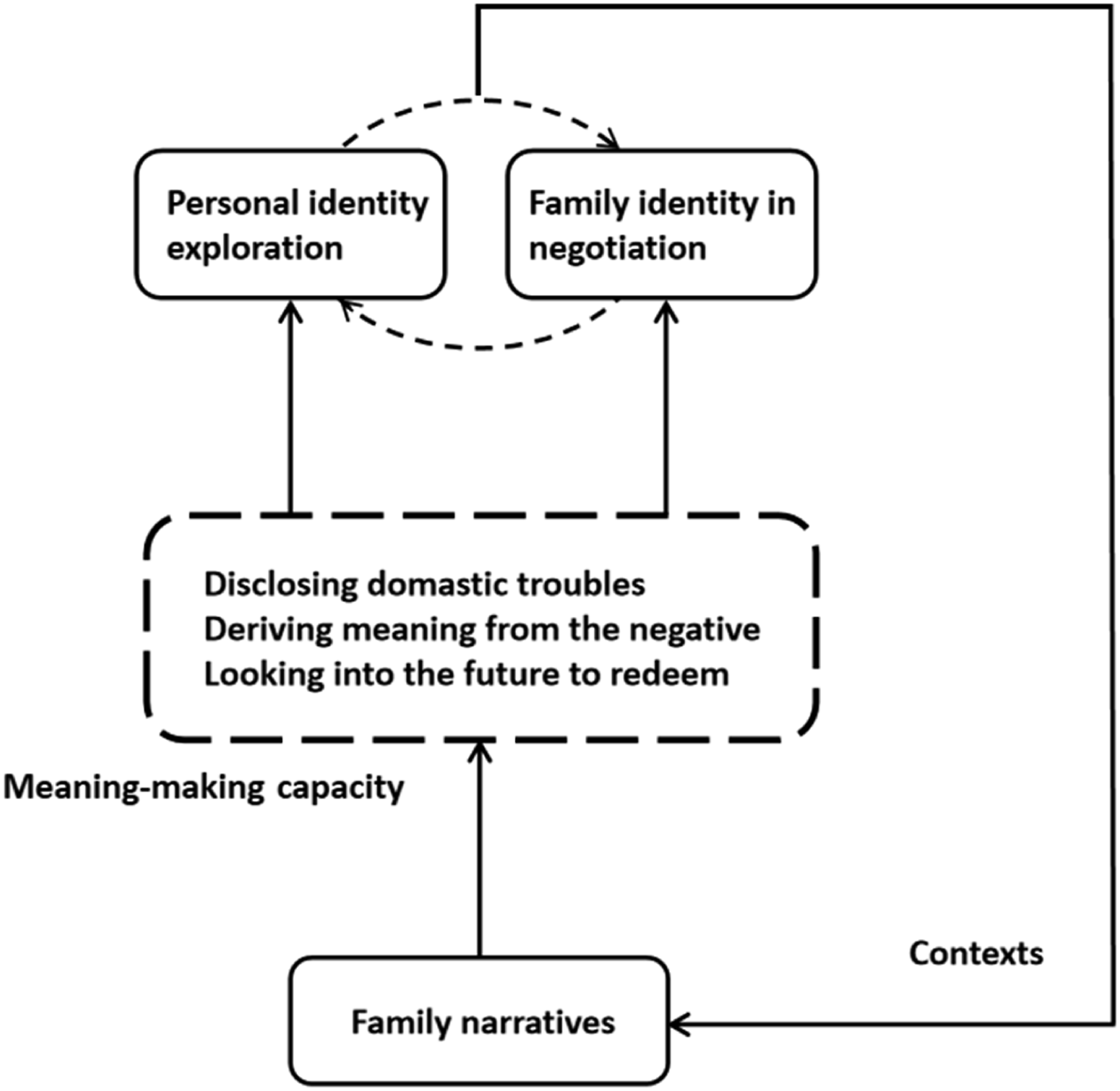
The constructed model could be used to theorize future research on emerging adults’ narrative identity development. Further research is needed to verify the explanatory power of this model by, for instance, working with emerging adults in other places around the globe and those who are in vulnerable positions such as those mentally hospitalized. Researchers, educational policymakers, mental health professionals, and teachers could use the model to enhance the self-exploration of youth.
Study Limitations and Recommendations
There are some limitations of this study. First of all, the participants’ motivation to earn 20% of their course grades might affect their decisions on what negative experiences to reveal and how to present them. Due to the Pygmalion effect, they might create and interpret their parents’ negative experiences in a way that they assumed that the course lecturer would prefer. We managed to reduce such an effect by informing them that they could present any stories that they wanted, inviting them to participate in this study after their grades were granted, and ensuring them that they could decline our invitations without any consequences. Caution should also be made when using the findings of this study to interpret the experiences of those who refused to share their stories with us and the large populations of college students in China. Although qualitative research is usually not designed to speak for a larger population in the ways quantitative research does (Braun & Clarke, 2021; Merriam, 2009), we collaborated throughout this study and provided thick descriptions of the data with intensive reflections which strengthened the credibility of the findings. These findings have merits in understanding the identity development of emerging adults who are from similar social contexts.
Further research is needed to understand more about the types of parental negative experiences (e.g., highly traumatic experiences, transgressions, mildly negative experiences, and family secrets) and how each of them is told by emerging adults and impacts their identity development. In this study, we presented various forms of negative experiences in an integrated way without distinguishing them and exploring how each of such types of stories impacted participants’ identity development. We recommend that researchers inform their participants to focus on specific types of parents’ experiences, such as shared family narratives, intergenerational narratives, or just participants’ memories of their interactions with their parents. In this way, researchers might be able to explore how each type of these stories is made by emerging adults and how they use them as templates for their lives.
Additionally, given that gender dynamics regarding family narratives have received much attention in existing intergenerational narrative research (Reese et al., 2017; Taylor et al., 2013; Zaman & Fivush, 2011) and might be influential in interpreting the participants’ identity development, we made efforts to manage effects of the gender composition of the sample who agreed to be in the study, such as instructing participants that they could tell stories about either of their parents or both of them. Future research is necessary to understand how such strategies of data collection relate to emerging adults’ narratives of their parents’ negative experiences.
Another limitation relates to cultural factors. Given that family narratives serve different functions in different cultures (McLean, 2016; Thomsen & Pillemer, 2017), the model that we presented above should make sense by locating it in Chinese historical-social-cultural contexts such as relational identities, dialectic thinking, elder respect, and filial piety. For example, like Chinese older adults who used stories of suffering and sacrifice to construct their hero-victim identity and earn recognition (Liu & van Schalkwyk, 2021), the participants might as well selectively put a lot of weight on the negative experiences of their parents to save the faces of their parents. Of course, this assumption should be tested in future investigations.
Conclusion
Based on 169 Chinese college students’ family stories, this study investigated Chinese emerging adults’ identity development through the disclosure of parents’ negative experiences. Analysis of the data suggests that the participants disclosed various kinds of their parents’ negative experiences including hardships and poverty, personal failure and regrets, as well as family scandals and interpersonal conflicts. They integrated those experiences with their personal lives to speak for their identity development. By making meaning out of their parents’ negative experiences and looking into the future to redeem the past, they constructed both their personal and familiar identities. Such a process of identity development further became the foundation for further family narratives. The model of identity development in revealing parents’ negative experiences that we present in this study, although is to be verified regarding its explanatory power by future research, contributes to our understanding of the identity function of family narratives, particularly negative experiences of parents.
Footnotes
Declaration of Conflicting Interests
The author(s) declared no potential conflicts of interest with respect to the research, authorship, and/or publication of this article.
Funding
The author(s) disclosed receipt of the following financial support for the research, authorship, and/or publication of this article: This work was supported by the Yunnan Revitalization Talent Support Program.
