



Abstract
While living with roommates in residence presents a unique set of challenges for emerging adults who are just beginning to navigate a world of adult responsibilities and are adjusting to living with an often-unfamiliar companion, conflicts become inevitable. Common sources of conflict, such as disputes over cleaning duties or noise levels, combine with still-developing conflict resolution skills to create an escalating environment of hostility that can develop into bullying if not properly addressed. However, what remains relatively understudied is how emerging adults navigate conflict management and how conflict resolution styles mitigate such household conflicts. Employing a multi-methods approach, this study utilized quantitative (i.e., questionnaires) and qualitative (i.e., short answer questions) methods to investigate the relative influence of conflict management styles and social support on roommate victimization and bullying among 804 undergraduate students aged 18–21 years old (79% female; M = 19). Multiple hierarchal linear regressions and thematic analyses were employed to analyze the data. The findings revealed that roommate compromise predicted an increase in roommate victimization and bullying, and an inverse relationship between resolving conflict with self-interest, where increased self-interest predicted lower roommate victimization and bullying. Social support was significantly inversely related to roommate bullying and victimization, such that increased social support tended to mitigate bullying and victimization. Taken in unison, these findings convey while students may believe they are compromising, whether they are requires further investigation. This work highlights the need to teach students how to manage conflict in healthy ways while verifying the continued importance of social support.
Introduction
Living with roommates is nothing new, especially among university students. As would be expected among any group of people living together, conflicts are inevitable. However, living with roommates in residence presents unique challenges for emerging adults who are beginning to navigate a world of adult responsibilities while adjusting to living with an often-unfamiliar companion. Common sources of conflict, such as disputes over cleaning duties or noise levels, combine with still-developing conflict resolution skills to create an escalating environment of hostility which can escalate into bullying (negative physical, verbal, and/or social behaviours that intend to harm, are repeated over time, and include a power differential), or victimization, (being the recipient of physical, verbal, or relational bullying behaviours) (Craig & Pepler, 2003; Hawdon et al., 2016; Reijntjes et al., 2010) if not properly addressed. Social support has been found to protect individuals from the potentially harmful outcomes of bullying (Reid et al., 2016), although, little to no research has examined the role of how young adults manage conflict and how the interplay between conflict resolution styles and social support might help resolve these situations before they escalate into bullying. Thus, the purpose of this study was to examine the relative influence of conflict management styles and social support regarding roommate victimization and bullying to better understand how conflict navigation may be bolstered across EA roommates to decrease the likelihood of bullying and victimization.
Emerging Adults and Roommate Relationships
Approximately 41% of emerging adults (those between the ages of 18–24 years) are enrolled as undergraduate students at a post-secondary institution (Erb et al., 2014). This life stage is typically marked by increased autonomy and self-agency, curiosity and exploration, and the growing reliance on peers who support socialization, identity formation, and self-discovery (Arnett, 2000, 2004; Chickering & Reisser, 1993; Erikson, 1968). Adjacent to this developmental period, Emerging adults (EAs) are often tasked with seeking living arrangements independent from their origin family as they embark on a new academic journey. Emerging adults change residences frequently: leaving home for a college dormitory, moving into a house (or successive houses) with other students, and then cohabitating with a romantic partner for a series of years (Goldscheider & Goldscheider, 1999). The transition from living at home with their parents/guardians to living in student housing introduces a new level of autonomy and a myriad of new experiences that EAs may have difficulty navigating, especially with respect to new roommates. Indeed, there is evidence to indicate that over 40% of first-year university students experienced conflict with their house/roommates at least once a week, and, in a sample of 31,500 undergraduate students, 50.1% reported experiencing house/roommate conflict frequently (Liu et al., 2008) where these conflict situations often escalated over time to become more serious bullying incidences (Hoel et al., 1999; Keashly & Nowell, 2002; Law, Shapka, Hymel et al., 2012; Zapf & Gross, 2001). Moreover, a recent systematic review by MacMillan et al. (2022) reported that bullying appears pervasive among undergraduate learners and may vary by department (i.e., medical-based programs) and population (i.e., racial, and ethnic minoritized groups), with between 30% and 90% of EAs being subject to bullying while pursuing post-secondary education. Notably, there is also evidence to suggest that this trend persists across (Lund & Ross, 2017; Tight, 2023) and beyond university with approximately 98% of EAs pursuing higher education self-reporting that they had indulged in peer-bullying and 88% reporting experiencing peer-victimization during the span of their postsecondary tenure (Kapoor, 2016). Thus, there is reason to believe that mishandled conflict may be a reliable pathway to consistent incidences of bullying behaviour among undergraduate roommates. Strikingly, these deteriorations in relationships occur despite students choosing to live with peers largely out of a desire to find a sense of belonging (Collins & van Dulmen, 2006). With conflict with a roommate being largely inevitable, how do EAs manage these situations?
Conflict Management in the Context of Roommate Housing
For many, precarious living arrangements associated with enrollment in post-secondary education provide EAs with their earliest experience of living independently from their immediate family. Successful transition into the role of a ‘roommate’ is particularly crucial, where roommates are a specific type of interpersonal relationship unique to emerging adulthood, which has many implications for EAs as they progress through their social and psychological development. Such interpersonal relationships are relatively novel for EAs, due to the frequent exposure and interaction, negotiations surrounding the distribution of domestic chores and responsibilities, and ongoing compromise associated with individual differences in lifestyles (e.g., social habits, sleep schedules, noise levels; Erb et al., 2014). Namely, research have reported that, due to the unique properties of such relationships, coupled with dependence on peers as primary socializing agents, university roommate dynamics contribute significantly to the quality of life, psychological and socioemotional functioning, and overall wellness documented among post-secondary students (Erb et al., 2014). For example, Bowman (2010) found students’ capacity to develop substantial and cohesive friendships with others predicted improved psychological outcomes in the domains of personal growth, perceived purpose, self-acceptance, and environmental mastery. Thus, it is evident that, along with a novel living environment, undergraduate students are presented with a unique opportunity to connect meaningfully to their peers in the context of forming roommate relationships and establishing functional housing arrangements; such cooperation and kinship may lead to not only desirable living dynamics but more optimal psychological outcomes, if healthfully navigated.
Similarly, other foundational work has found empirical evidence linking higher roommate quality and decreased roommate dysfunction to a range of healthy developmental outcomes for psychological and socioemotional wellness, including reduced anxiety and depression, improved academic adjustment, increased emotional resilience and adaptability, and reduced internalizing and externalizing problem behaviour in the context of acclimating to post-secondary and beyond (Waldo, 1984). By contrast, several studies have reported adverse psychological and emotional outcomes associated with dysfunctional roommate relationships and the inability to navigate interpersonal conflict with success. For example, Dusselier et al. (2005) suggested that increased inter-roommate conflict reliably predicted heightened overall stress levels. In accordance with these findings, other work has suggested that challenges posed by frequent roommate conflict and incongruence are among the central setbacks reported by first-year post-secondary roommates, with students reporting decreased overall life satisfaction and constrained adjustment (Erb et al., 2014; Keup, 2007). While interpersonal conflict between roommates does not necessarily yield negative repercussions, research maintains that such conflict can also render positive outcomes; whether such conflict derive desirable or adverse outcomes depends largely on how conflict is approached and managed (Park & Antonioni, 2007). For example, more healthful roommate relationships may be leveraged as a protective factor for reducing mental health struggles while assimilating to post-secondary (Waldo, 1984). Conversely, past work suggests a polarizing effect where these relationships may also be considered points of risk, and disrupted roommate relationships could enhance susceptibility to the onset of mental health conditions and maladjustment. Therefore, while personality mismatches may exist among roommates (Erb et al., 2014), unlike voluntary friendships, students must manage conflicts that arise among them, both out of necessity and a need to maintain order within their shared environment. Indeed, the importance of successfully managing roommate conflict to foster positive interaction and cohesive interpersonal relationships is underscored here. However, what remains relatively understudied is how undergraduate students navigate conflict with their roommates. Considering the unique processes and properties involved in roommate interpersonal relationships (i.e., disproportionally high frequency of contact, interaction, navigating shared space, and delegating household responsibilities), how do 17–19-year-old EAs address this conflict?
Collaborative and ongoing efforts to navigate roommate conflict are paramount, as the quality of ongoing interactions can establish the foundation for subsequent approaches to conflict experienced by roommates. While less conspicuous, such emotionally charged interactions present peers with potentially hindered or bolstered opportunities to foster inter-roommate closeness and cohesion, if managed adaptively. Thus, maladaptive approaches to re-occurring conflict may have extensive ramifications for later approaches to conflict resolution, sense of belonging, interpersonal roommate satisfaction, and overall academic success (Reid et al., 2016). Extant lines of research in this area have exercised different approaches when attempting to account for the cause of variability across strategies applied, by EAs, to interpersonal conflict amongst peers. Among sparse literature pertaining specifically to interpersonal conflict management in the context of roommate dynamics, some works have sought to identify and understand the strategies employed by EAs when attempting to rectify, neutralize, enhance, or avoid conflict, while the overwhelming majority of scholars have sought to identify causes of roommate, or peer-peer, conflict. For example, a meta-analysis conducted by Laursen et al. (2001) to examine conflict resolution strategies among peers and romantic partners across childhood, adolescence, emerging adulthood, and early adulthood found that peer-to-peer conflict among a sample of EAs was typically met with strategies such as negotiation, disengagement, and coercion, where certain strategies were drawn on based on the cause of the issue. Interestingly, the study found that the strategies EAs reported employing varied by prompt, where EAs reported utilizing inconsistent resolution strategies when responding to hypothetical vignette questions versus when reporting on lived experience with their peers. These findings suggest greater exploratory analyses is needed to better understand the conflict resolution strategies which may (or may not) emerge, frequency of their employment, and under which circumstances specific strategies are favoured, relative to others. Moreover, exploratory analyses may be an asset in attempting to identify strategies which most reliably yield successful conflict resolution, and associated positive outcomes, such as increased perceived social support, sense of belonging, and overall psychological and socioemotional wellness.
Unresolved Roommate Conflict: Bullying, Victimization, and Mental Wellness
With detrimental implications for academic performance, mental health, and social cohesion due to reoccurring maladaptive conflict resolution, what might occur if roommate conflict is not successfully resolved? A larger, coinciding body of literature has sought to identify the vast repercussions of frequent unresolved conflict among peers and within shared spaces. Here, conflict is defined as “time-distributed social episodes” involving a range of underlying components such as issues, oppositions, management, and outcomes (Laursen et al., 2001; Shantz, 1987, p. 285). Broadly, work in this area has suggested that unsuccessful conflict resolution among peers in post-secondary can lead to reductions in perceived sense of belonging, social support, and wellness, and overwhelming increases in the potential for peer bullying and victimization (Law, Shapka, Domene, & Gagne, 2012). Specifically, studies conducted by Dusselier et al. (2005) and McCorkle and Mason (2009) found that stress associated with roommate dynamics predicted lower academic success due to mediating variables such anxiety and depressive symptoms, fatigue, substance dependency, and suicidal ideation. Interestingly, stress levels were disproportionately higher across this group irrespective of whether roommates reported positive relationships with their roommates (McCorkle & Mason, 2009). Moreover, research also suggest that the likelihood of experiencing adverse outcomes related to peer-to-peer conflict largely varies as a function of the conflict resolution strategies employed. For example, work conducted by Hawdon et al. (2016) indicated that individuals who subscribed to confrontational conflict resolution styles, across a sample of youth and emerging adults, were at increased risk of being subject to peer victimization. Evidently, there is a need to better understand conflict resolution styles and strategies and how EAs apply them with their roommates. Indeed, researchers should be cautious about extrapolating findings from literature pertaining to platonic or romantic relationships in young adulthood, as many studies have found distinct differences in conflict etiology and resolution strategies based on developmental period (i.e., childhood, adolescence, or EA) and context (i.e., romantic, platonic, or roommate relationships), with roommate dynamics documented as the most problematic yet least investigated to date (McEwan & Soderberg, 2006). As such, this study attempts to understand the nuance between conflict resolution strategies and roommate dynamics through social processes theory (Schellenberg, 1996), where conflict is examined as a process of social interactions related to how EAs perceive, communicate about, and cope with conflict with their roommates.
Purpose
While these findings underscore the contribution of adaptative conflict resolution skills in sustaining peer relationships among EAs, few studies have considered the pattern of effect among these variables in roommate settings – a unique interpersonal relationship with dynamics that are largely amplified (i.e., increased contact, interaction, shared space, and negotiation), and prone to high-intensity conflict. Moreover, despite evidence highlighting the detrimental influence of (mal)adaptive conflict resolution on a range of outcomes (i.e., psychological wellness, perceived social support, and bullying and victimization), further exploration is needed to better understand the pattern of effect among these variables. Thus, the purpose of this study was to investigate (1) the motivations behind roommate conflict, bullying, and victimization; (2) how conflict management styles may predict roommate bullying and victimization; and (3) how social support relatively influences peer bullying and victimization among roommate EAs, over and above conflict resolution strategies.
To respond to these questions, the current study employed a mixed-method approach, utilizing both quantitative (i.e., questionnaires) and qualitative (i.e., short answer questions) methods to investigate the relative influence of conflict management styles and social support on roommate victimization and bullying among 804 undergraduate students aged 18–21 years old (79% female; M = 19). Multiple hierarchal linear regressions and thematic analyses were employed to analyze the data.
Method
Data for this study were collected as part of a larger study during the winter and fall of 2016 through self-report questionnaires where participants responded to a series of quantitative and qualitative short answer questions. A concurrent nested mixed-method research strategy (Creswell, 2009) was employed. Findings from each format of questioning were merged and examined together to gain a deeper sense of the motivations for roommate conflict and how resolution was (not) accomplished.
Participants
After receiving Research Ethics Board approval, interested undergraduate students signed up for the study through the university’s psychology research pool where they would receive .5 research credit toward their introductory psychology grade. Prior to completing the questionnaire, students provided their informed consent by clicking on a link that took them to the survey. Participants completed the questionnaire in their own time using the university’s approved online data collection system. Most participants completed the survey within 30–45 minutes. After checking for missing data, most were missing completely at random and retained for the study using pairwise deletion. Participants included 804 students (exceeding our target sample size of 500, indicated by a G*Power analysis; 79.1% female; M age = 19) from a Canadian university campus in Southern Ontario. The majority of students were Caucasian (67.2%) while 11.3% identified as South Asian, 7.9% as East Asian, 4.2% as Black, and 6.9% as mixed descent. Only 1.3% were of Indigenous or Latin American descent. Participants were asked to self-identify as male, female, male to female trans, female to male trans, bigendered or gender fluid. The majority of participants. 79.4%, identified as female while 20.6% identified as male. Only .1% identified as bi-gendered and gender fluid. The majority (91%) of participants were in their first year of university and 94.7% lived in student housing or in university residence most of the time and 87.5% lived with at least one roommate. About 53% of participants did not know their roommates before moving in. Only students in their first year who lived with roommates were included in the study.
Measures
Demographic Information
Demographic information was collected using a 21-item demographic questionnaire which assessed gender, age, ethnicity, living arrangement, and roommate dynamics.
Conflict Management
Inter-roommate conflict resolution was gauged using the Rahim Organization Conflict Inventory for Emerging Adults (ROCI-II). This measure was designed to tap into the ways conflict was resolved among emerging adults, and, for the purpose of this study, adapted to assess conflict resolution ability in the context of undergraduate housing arrangements and roommate conflict dynamics. The ROCI-II (Rahim & Psenicka, 1995) is a 28-item instrument constructed to measure five dimensions of interpersonal conflict: Obliging (e.g., ‘I generally try to satisfy the needs of my peers), Integrating, (e.g., ‘I try to investigate an issue with my peers to find a solution acceptable to us’), Dominating (e.g., ‘I use my influence to get my ideas accepted’), Compromising (e.g., ‘I try to find a middle course to resolve an impasse’), and Avoiding (e.g., ‘I attempt to avoid being “put on the spot” and try to keep my conflict with my peers to myself’) on a 5-point Likert response scale ranging from 1 (Strongly Disagree) to 5 (Strongly Agree), where higher scores indicate frequent use of the corresponding conflict style, and higher overall conflict resolution skills. Strategy scores were obtained by calculating the mean totals as recommended by Rahim and Psenicka (1995). Our tests yielded a = .89 internal consistency overall and the following across each domain: Obliging (a = .81), Integrating (a = .85), Dominating (a = .83), Compromising (a = .82), and Avoiding (a = .76).
Roommate Bullying and Victimization
Bullying and victimization was measured using a revised version of the Olweus Bully/Victim Questionnaire (OBVQ-R; 1996). Participants responded to 42 items about physical, verbal, and social/relational aggression and four core dimensions of bullying and victimization behaviour: (1) intention to cause harm; (2) repetition of that harm; (3) power imbalance between the victim and bully; and (4) degree the social environment (e.g., peers, family, teachers) was aware of and reacted to the bullying (Olweus, 1996). For this study, all items were adapted to the roommate context, inquiring specifically about the participants’ experiences while living with other students (e.g., When I lived with other students, I have called other students mean names or made comments about their race; when I lived with other students, other students have called me mean names or made comments about my race). Participants responded to how frequently they experienced these incidences on a 5-point Likert scale (1 = Hasn’t happened to me; 2 = happened once or twice; 3 = 2 to 3 times a month; 4 = about once a week; 5 = several times a week). While the OBVQ was originally intended for use with a younger demographic, a myriad of studies have since employed and validated the scale extensively with several age groups ranging from adolescence to adulthood (Darney et al., 2013; Gaete et al., 2021; Hamburger et al., 2011; Kritsotakis et al., 2017; Olweus, 1996; Rivers, 2001; Vessey et al., 2014; Xiu et al., 2021), reporting good to excellent reliability with emerging adult populations (i.e., a = .75–.95; Kritsotakis et al., 2017). To verify the reliability and factor structure of this measure more thoroughly on an emerging adult population, unweighted least squares extraction method, with oblimin rotation, was used. The Kaiser–Meyer–Oklin value was .96, exceeding the recommended minimum value of .6 (Kaiser, 1970, 1974), and the Bartlett’s Test of Sphericity (Bartlett, 1954) reached statistical significance (p < .001); thus, supporting the factorability of the items. The scree plot illustrated a clear change in slope after the second factor eigenvalue, and the pattern of factor loadings identified two distinct factors: (a) Harming others (bullying) (b) Harmed by others (victimized). Composite variables were created by taking the average across the items for each factor; higher scores represented higher bullying or victimization. The reliability of the bullying items was a = .96, and it was a = .90 for the victimization items.
Social Support
Social Support was measured using a modified version of the Berlin Social Support Scale (Schwarzer & Schulz, 2013), which has been validated across a number of studies (DiMillo et al., 2017). Questions were modified slightly to make the language a bit less formal and more accessible to emerging adults. Participants were asked a series of 12 questions about the degree to which they felt supported by others (e.g. When everything becomes too much for me to handle, others are there to help me; I know some people upon who I can always rely; When I am worried, there is someone who helps me), using a 7-point Likert Scale ranging from Strongly Disagree to Strongly agree. A composite for social support was derived by taking the mean of the items and the reliability was a = .88.
Roommate Responses to Situations that Lead to Conflict
Participants were asked short answer questions about how they would respond to the following: disagreements with their roommate(s); their roommate(s) not cleaning up their mess in the kitchen; their roommate(s) bringing over people they are not comfortable with; and their roommate(s) making loud noise when the participant is trying to sleep. Responses from the short answer questions were coded using thematic analysis which is a process by which lines of text are analyzed and grouped together using common themes (Creswell, 2009). Two graduate student coders examined all qualitative data and discrepancies were resolved and reliability was achieved using consensus agreement.
Transparency and Openness
We report how we determined our sample size, all data exclusions (if any), all manipulations, and all measures in the study, and we follow JARS (Kazak, 2018). All data, analysis code, and research materials are available upon request. Data were analyzed using IBM SPSS Statistics, version 28.0. This study’s design and its analysis were not pre-registered.
Analysis and Results
Descriptive Statistics and Reasons for Roommate Victimization
Participant responses to demographic questionnaire items were utilized to perform descriptive analyses. Many students in the study reported that disagreements in their household/dorm room occur once a week (43.9%), never (39.5%), or 2–3 times per week (10.5%). In terms of seriousness of the disagreements, most participants claimed the disagreements were not serious at all (70.3%), while some claimed that the disagreements were slightly serious (21.4%). The most common disagreements were household duties not being completed (64.2%), misunderstandings (52.4%), one roommate being rude to another roommate (27.4%), invasion of privacy (19.3%), and one roommate feeling excluded by the others (15.7%). The general self-reported emotional state of students in their households was pride (72.4%), anxiety (65.7%), frustration (60.3%), and fear (49.6%).
In terms of roommates, most (52.8%) did not know their roommate(s) prior to moving in with them and did not choose them. Communication and relationships with roommates were rated to be good (communication 33.0%; relationships 37.8%) or very good (communication 35.6%; relationships 37.2%). Most students reported that they got along well with all their roommates (59.9%) and a considerable number of students also said that they moderately liked their roommates (36.7%). An additional 45.9% of students reported liking their roommates a great deal. For both dependent variables, most students indicated little to no experience with victimization or bullying (mean = 1.44 and 1.29 respectively). While most students did not report being afraid of being bullied by their roommates (66.0%) or being bullied through technological means (i.e., text, internet) (53.1%), they did report that the most hostile situations that came about involved housework (73.8%), house rules (64.0%), school work (51.4%).
Independent-Samples T-Test were used to examine gender differences in victimization and bullying. Significant differences for victimization were found for males (M = 1.57, SD = .828 and females (M = 1.41, SD = .824; t (497) = 3.05, p = .002 two-tailed). Significant differences were also found for bullying (M = 1.41, SD = .844; M = 1.26, SD = .916 for males and females respectively (t (533) = 2.82, p = .005, two-tailed). The effect size was found to be large (Cohen’s d = .825 and .902 for victimization and bullying, respectively). These gender difference ought to be taken with a grain of salt, however, because the sample is comprised primarily by those who identify as female (male = 319; female = 1211).
Conflict Management Style, Social Support, and Roommate Bullying and Victimization
When we examine the styles of conflict management, usage of all the management styles was moderately low (i.e., Joint Problem Solving: M = 2.06, SD = .55; Avoidance: M = 2.44, SD = .66; Assertiveness: M = 2.80, SD = .74; Giving In: M = 2.23, SD = .55; Compromising: M = 2.06, SD = .58). In addition, many students reported that they receive moderately high amounts of social support (M = 5.45, SD = .84). Moreover, the amount of self-reported roommate victimization was low (M = 1.36, SD = .57). Multiple hierarchal linear regressions were used to examine how interpersonal conflict management style might predict bullying and victimization after controlling for age, gender, and number of roommates. Moderation analyses were conducted to explore how social support influenced the relationship between the predictor variable, conflict management style, and outcome variables, peer bullying and victimization. The assumption for normality and linearity were violated given the skewed nature of the data; however, given no other violations were found and the large sample, we deemed it safe to proceed (Tabachnick & Fidell, 2013).
Regression Results for Roommate Victimization and Bullying Perpetration (N = 804).
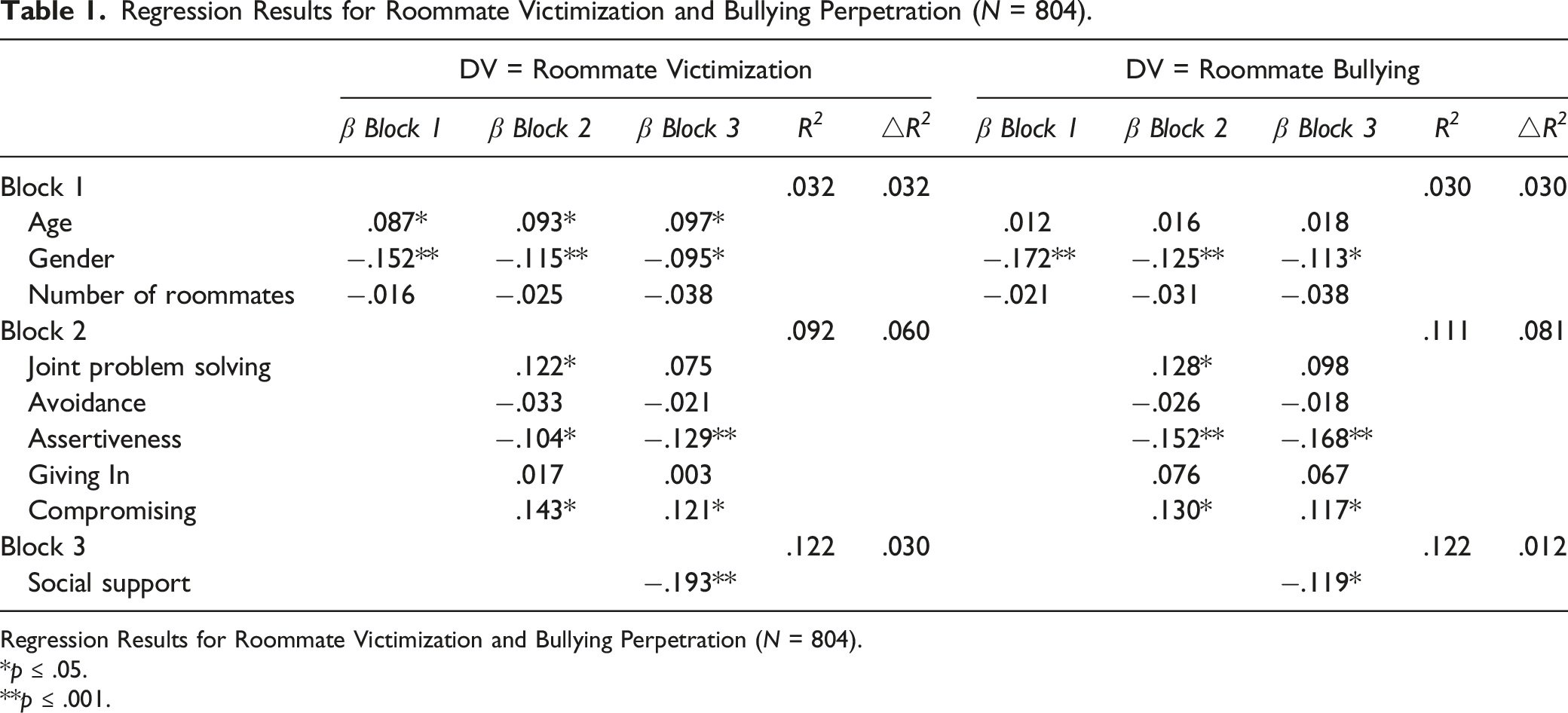
Regression Results for Roommate Victimization and Bullying Perpetration (N = 804).
*p ≤ .05.
**p ≤ .001.
The same analyses were applied to look at how conflict management style predicted degree of roommate bullying. Similarly, in predicting roommate bullying, joint problem solving (B = .128, p < .05), self-interest (B = −.152, p < .001), and compromise (B = .130, p < .05) conflict management strategies significantly predicted level of roommate bullying reported (R2 = .111, F (8, 733) = 11.4, p < .001). Again, a positive relationship was found for elevated joint problem solving, where increased joint problem solving predicted increased roommate bullying. By contrast, an inverse association was found for self-interest, where increased self-interest predicted decreased roommate bullying. Moreover, findings revealed that compromise shared a positive relationship with roommate bullying where greater compromise predicted increased bullying. However, avoidance (B = −.026, p = .53) and giving-in (B = .076, p = .12) did not significantly predict roommate bullying. Finally, social support was found to predict roommate bullying over and above conflict resolution items, with increased social support predicting lower roommate bullying (B = −.119, p < .005; R2 = .122, F (9, 732) = 11.3, p < .001). Table 1 summarizes the results of this regression.
Qualitative Findings
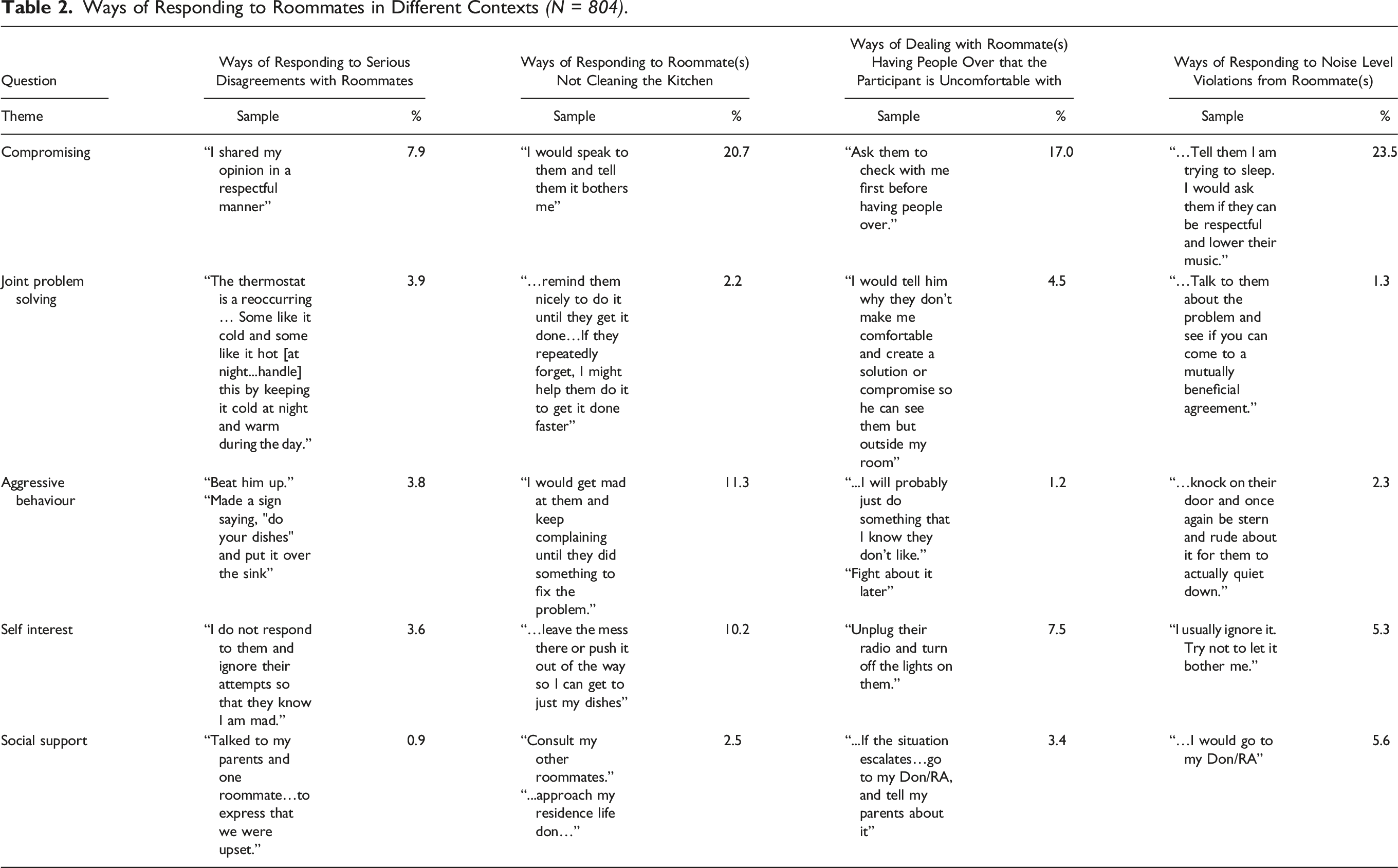
Ways of Responding to Roommates in Different Contexts (N = 804).
Aggression
Aggression codes were assigned to responses that indicated either explicit (i.e., verbal, or physical) or implicit (i.e., passive) aggression through the acts of subtle remarks or confrontation, displays of annoyance, the ‘cold shoulder’, pettiness, withholding kindness, offering ultimatums, anger, shouting, throwing objects, hostility, defensiveness, and physical or verbal altercations. Here, participants reported various modalities for aggressive behaviour when attempting to manage conflict stating things like, “I made rude comments out loud so that I know they heard them.” Similarly, many respondents reported employing passive aggressive tactics for conveying their dissatisfaction, such as, “[I/We] make signs that say, ‘do your dishes’ and put it by the sink.” Evidently, while participants may believe their behaviour reflects communication, hostile undertones may be detected or perceived by the recipient of this message.
Moreover, in housing dynamics with several roommates, group bullying behaviours may begin to develop, posing imminent risk for roommate social cohesion, individual sense of belonging, and mental wellness (Craig & Pepler, 2003; Law, Shapka, Hymel et al., 2012). By contrast, other participants reported relying on physical forms of aggression, stating, “I would restrict their entry into the kitchen, unless the reason to enter the kitchen area would be to clean it,” or “I dump all their messy dishes onto their bed.” Interestingly, aggression, in its many forms (i.e., physical, passive, verbal, explicit) appeared most frequently in response to prompts where participants were asked to reflect on past events and experiences with their roommates. Notably, indices of aggression emerged 3x more in response to event recall questions, relative to hypothetical, vignette-style questions. Moreover, a substantial proportion of the respondents coded for aggression justified their aggressive behaviours by suggesting they were retaliating to repetitive inconveniences caused by the victim (e.g., roommate 1 becomes aggressive with roommate 2 because they have neglected to do their dishes for five consecutive days).
Joint Problem Solving
Joint problem-solving codes were assigned to responses that indicated the respondent made a clear, and intentional attempt to come to a resolution with their roommate without the help of a third party. Here, participants recounted times when they worked alongside their roommate(s) to manage conflict by identifying a resolution, stating, “The largest disagreement that I had with my housemates was in relation to household chores. We decided to make a schedule determining whose chores had to be done on what day. This successfully resolved the issue.”
While a proportion of respondents echoed this sentiment in their approaches to collaboratively generate a resolution to inter-roommate conflict, others reported ‘collaborative’ approaches to joint problem solving which resonated with self-interest, saying, “[I] talk to them and tell them it is important to me to get enough sleep, so they need to be quiet,” or “I would talk to my roommate on the side and ask them to go somewhere else when they want to hang out with that specific person. I do not want to be around someone that makes me feel uncomfortable,” or, “[I would] move out or my roommate moves out. We are not compatible.”
As illustrated by EA testimony, though many respondents report arriving at a mutually agreeable solution with their roommate(s), it is unclear whether they constructively and productively worked toward a resolution that was adopted by both parties involved. Rather, while many EAs believe they are engaging in joint problem-solving, they may not be. Instead, they may be engaging in independent problem solving but believe that the problem solving was joint simply because they stated their desires and the other party agreed.
Compromise
Compromise codes were assigned to responses that indicated the respondent attempted to speak, or communicate, with their roommate(s) to address the emotions or friction evoked by a conflict. It is worth noting the point of distinction here is that, while joint problem solving entails identifying an actionable, more practical resolution to a problem (source of conflict), compromise involves working through the initial conflict via communication with the intention of resolving harboured emotions associated with a problem. Here, participants reflected on experiences where they were tasked with navigating conflict with their peer through compromise and stated, “[I say] okay, clearly, we both disagree. Let’s find common ground. What would you like me to do next time…. Well, next time it would be great if you…” or “I tell them to warn me when they are coming over, so I know to either stay in my room or go to another one of my friends’ houses.” Here, is seems a proportion of participants reported employing an approach that targets the conflict, as well as the emotions evoked by the conflict, rather than solely directing attention to a pragmatic solution. Moreover, based on these extracts, it appears that some participants subscribe to approaches that prioritize the platonic element shared between housemate(s), rather than solely orienting their attention to conflicts which arise from co-existing, and generating solutions to harmoniously co-exist. Rather, these participants frame their resolutions in a way that facilitates communication and cohesion among roommates, and a framework for tackling future conflicts as they move forward.
Social Support
Social support codes were assigned to responses that indicated the participant either depended on, or confided in a third-party (i.e., a parent, significant other, friend) to cope with the conflict, or drew on a third-party to mediate the conflict on their behalf (i.e., an upper year student who acts as an advisor (don), a different roommate). Here, participants described a time when they coped with roommate conflict by integrating a third-party by stating, “I went to my don to figure out my approach to the situation. My don suggested talking to the girl who was causing the problem, which I did,” or, “I became silent and listened to music and called friends outside [my university].”
While some participants reported confiding in social networks external to their roommate and household conflict, others describe managing conflict by recruiting the involvement of those directly implicated by the conflict at-hand, saying, “[I] talked to my parents and one roommate, who was in the same situation as me, to express that we were upset,” or “I would send a picture [of the dishes] in the group chat and call them out in front of the other housemates.”
Interestingly, a proportion of EAs suggested they would seek external social support as an initial response to roommate conflict rather than first employing collaborative strategies such as compromise, or joint problem solving. Though a myriad of work has underscored the importance of a strong social network, other works have documented relational aggression and division among roommates when external parties are brought into roommate conflict (Erb et al., 2014). While social support may be adaptive in some situations among EAs that effectively leverage it,
Overall, the findings from both the closed- and open-ended questions were relatively consistent with each other. Specifically, the findings suggest that strategies, such as compromise or joint problem solving, which involve addressing conflict directly, or “head-on”, were associated with increases in peer bullying and victimization among roommates. By contrast, strategies that involved dismissing the conflict or other party involved, such as self-interest or social support, were associated with decreases in bullying and victimization. Qualitative responses confirmed that although EAs report favouring adaptive strategies (i.e., joint problem solving, compromise), the strategies they employ in practice may deviate, or contain overlap with less adaptive strategies (i.e., aggression, self-interest). Thus, while EAs may believe they are effectively resolving inter-roommate conflict, they may require further support in how to better leverage and employ conflict resolution strategies amid roommate conflict.
Discussion
This study sheds light on the variability in EA roommate experiences of peer bullying and victimization. The examined models investigated the associations between conflict management strategies (e.g., joint problem solving, compromise, aggression, social support) on peer bullying and victimization using a multi-methods approach. Thus, these findings may inform the identification of conflict-based antecedents of peer bullying and victimization in roommate-specific contexts and offers a more nuanced investigation of conflict resolution strategies and associated outcomes, among EAs, due to the integration of qualitative and quantitative approaches. The purpose of this study was to investigate (1) the reasons/motivations behind roommate conflict, bullying, and victimization; (2) how conflict management styles predict roommate bullying and victimization; and (3) how social support influences peer bullying and victimization among roommate EAs, over and above conflict resolution styles.
The current model demonstrated that the likelihood of bullying perpetration and victimization, may vary as a function of how conflict is navigated among EA roommates. Indeed, the resolution strategies employed by EAs, in response to roommate conflict or disagreements, may be associated with whether EAs perpetuate bullying and whether they become victimized by others in their conflict. Here, the conflict resolution strategies ‘joint problem solving’ and ‘compromise’ were associated with increased levels of bullying and victimization where EAs who reported greater willingness to joint problem-solve or compromise were victimized or demonstrated bullying behaviours more frequently. By contrast, conflict resolution strategies such as ‘self interest’ or ‘social support’ were associated with decreased levels of roommate bullying and victimization where EAs who reported increased employment of self interest or social support seeking were victimized or demonstrated bullying behaviours less frequently. These findings could be explained by research on proactive and reactive aggression, where proactive aggression is used to reach a desired goal (e.g., yelling at someone to do the dishes) while reactive aggression is employed because one feels threatened (e.g., were yelled at to do the dishes) (Crick & Dodge, 1996; Dodge & Coie, 1987). Indeed, the relationship between proactive and reactive aggression highlight how aggression can co-occur and become cyclical as each member interprets the other’s behaviour as threatening (Law, Shapka, Domene, & Gagne, 2012). In the case of our results, this framework for understanding aggression and its motivations could explain the similar findings yielded by both the victimization and the bullying models.
Findings also revealed a distinction among conflict resolution strategies. That is, while findings suggest conflict resolution style predicts peer bullying and victimization more broadly, that the conflict resolution strategies could also be classified in two ways: interpersonal versus intrapersonal conflict management strategies. Interpersonal strategies, such as compromise or joint problem solving, were those that entailed addressing the source of confrontation directly with the roommate, where each party occupies an active role in dismantling the conflict. By contrast, intrapersonal strategies, such as self-interest or social support, involved telling, dismissing, or avoiding the conflict and/or the role of the roommate within the conflict. Typically, EAs in this study provided demands without holding space for negotiation (e.g., “I told them, that person is not coming over anymore or I will move out”; self-interest) or demonstrated excessive dependence on third parties; confiding and expressing to them as a method of coping with the situation at-hand (e.g., “I left the situation alone and, instead, told my friends from home how much I disliked living with her”; social support). The EAs that offered demands (i.e., those that were assertive), tended to experience decreased roommate bullying and victimization. One explanation could be that EAs may be misrepresenting their reports of conflict resolution strategy use. While quantitative analyses revealed that most participants report using interpersonal strategies frequently, the qualitative data revealed that many participants made insufficient attempts to do so. For example, many respondents reported communicating frustrations to their roommate to compromise, by confronting them in the presence of their other roommates. While this approach emulates the process of communication, the modality through which it is delivered may resonate more closely with passive aggressive behaviour. Similarly, other EAs reported working alongside their roommate(s) to jointly problem-solve disagreements by providing resolutions; resolutions which resonate closely with ultimatums, and ultimately, self interest (i.e., “The thermostat is a reoccurring fight between my roommates and I. Some like it cold and some like it hot [at night], and it is tough to choose which to leave it on. We resolve this by keeping it cold at night and warm during the day”). Thus, while EAs may believe they are adequately demonstrating interpersonal, collaborative approaches to roommate conflict, discrepancies in their understanding and performance of these strategies may hinder their ability to successfully resolve it. Follow-up work must continue to construct mixed- or multi-methods research designs to better understand conflict resolution strategies within roommate contexts, and aim to merge quantitative and qualitative findings in a way that allows for increased reliability in identifying discrepancies.
Another explanation may be that this distinction emerged because EAs who tend to rely on interpersonal strategies position themselves in a way that increases their level of susceptibility to victimizing- or bully-like behaviour. For example, strategies such as joint problem solving or compromise task EAs with the challenge of opening themselves up to receiving opposing opinions, unlike collaboratively working or negotiating with a peer. The development of bullying and victimization behaviours also require such dynamics –where each party occupies an engaged role in the conflict (rather than removing themselves and mitigating the conflict through disengagement). By contrast, those who tend to rely on intrapersonal strategies for conflict resolution could be better positioned to increase the amount of psychological distance they perceive between themselves, the conflict, and the roommate involved, because their approach primarily involves their independent engagement (e.g., dismissing the conflict and roommate involved, but coping through emotional venting to a third party; leaving a post-it note above the dishes, rather than openly communicating the problem), even though they believe they are working together. In line with this framework, most often, a bullying and victimization dynamic may emerge as a consequence of a failed attempt to “collaboratively” resolve repeated conflict between two engaged peers. Moreover, most participants differentiate themselves as those who participate in peer bullying or victimization behaviours, as opposed to individuals who identify with the labels associated (i.e., bully or victim; Law, Shapka, Hymel et al., 2012). Thus, it is plausible that, from the perspective of EAs, the line separating the utilization of ‘adaptive’ or prosocial behaviours, such as joint problem solving or compromise, and ‘maladaptive’ or antisocial behaviours which contribute to the bullying and victimization, such as presenting ultimatums or relational aggression, has become blurred. Follow-up work should attempt to rectify the discrepancy between EAs’ reported conflict-management behaviours and the behaviours they employ in practice. Observational, or experimental methodology may aid in this endeavour. Practically, work in this area must be leveraged to inform preventative approaches to peer bullying and victimization in undergraduate populations. Here, EAs should receive targeted intervention which instill the tools for prosocial and adaptive, interpersonal approaches to conflict. Through targeted and practical training, EAs may learn to bridge their (1) theoretical understandings and (2) practical employment of conflict resolution strategies, therefore mitigating susceptibility to roommate bullying and victimization in the face of peer-peer conflict.
Conclusions
Overall, findings from this work suggest that the likelihood of engaging in or being a recipient of peer bullying with roommates vary based on conflict management strategy. EAs who favoured interpersonal approaches to conflict resolution, such as joint problem solving or compromise, were more likely to identify with peer bullying and victimization behaviours. By contrast, EAs who favoured intrapersonal approaches, such as self-interest or external social support, were less likely to report engaging in or experiencing peer bullying and victimization behaviours, respectively. However, while the quantitative data offers this conclusion, the effects were not very high which could be due to the discrepancies between how conflict management strategies were defined and interpreted by the participants – as highlighted by the responses in the qualitative data. Indeed, the qualitative data revealed that many EAs’ understanding of conflict resolution strategies, or their intended use of these strategies, differed from the strategies being employed in practice. While many respondents reported a preference for interpersonal strategies, these responses revealed many EAs were employing both adaptive and maladaptive strategies. Moreover, it is worth noting that EA’s responses varied based on the structure of the question and how it was posed; when EAs were presented with hypothetical, future-tense vignettes, they often reported favouring adaptive, interpersonal strategies. By contrast, when EAs were asked to recount past experiences, EAs reported ‘authentic’ overviews of their behaviours –which were consistent with maladaptive approaches. Therefore, while EAs may believe they are taking mindful, collaborative approaches to resolving conflict, whether they are remains unclear.
Limitations and Future Directions
Despite the strengths of this work, several limitations should be acknowledged. Although the use of standardized measures allowed us to assess relational aggression broadly, further consideration should have been taken to analyze relational aggression in-depth across both quantitative and qualitative responses; the greater proportion of the questionnaire items were oriented toward overt, observable modalities for aggression which limited our degree of understanding alternate forms. Moreover, reoccurring findings note that female EAs are often associated with relational forms of aggression, while male EAs are typically linked to physical forms of aggression (Cullerton-Sen et al., 2008). Thus, because our demographic was predominantly female, the bias of questionnaire items toward overt aggression may have hindered our ability to capture a thorough scope of peer bullying and victimization behaviours across the sample. Relatedly, while the quantitative findings may have suggested a lower prevalence of bullying, offering evidence counter to past work, this study was able to contribute to the literature through highlighting the discrepancies that emerge between how EAs report managing conflict (illustrated by our quantitative findings) and how it is handled in practice (illustrated by our qualitative findings). Furthermore, a limitation of our sample is that the data were obtained from middle-class, primarily white undergraduate students; thus, placing limitations on the generalizability of our findings.
Another limitation of the current study was our inability to infer causation from the findings, due to the correlational methods used. Future work could employ observational or experimental methods within field settings (e.g., undergraduate housing) to account for the limitations of correlational methods based on self-report. Moreover, our ability to attain a heterogeneous sample, and thus, moderate to high levels of roommate or household conflict may have been limited by the time in which data collection occurred. Data collection took place solely during the Fall semester, a time marked by new friendships and the formation of peer cohesion. Therefore, future research should consider collecting data with first-year undergraduate students at different timepoints to examine differences in conflict when it occurs further into the school year. Employing a longitudinal approach to peer-peer conflict in undergraduate samples may mitigate the effects of friendship novelty, typically experienced in sprouting friendships, on findings. Finally, it is worth noting that the OBVQ was originally intended for use with a younger demographic. While a range of studies have since employed and validated revised versions of the scale with several age groups ranging from adolescence to adulthood (Gaete et al., 2021; Kritsotakis et al., 2017; Olweus, 1996; Rivers, 2001; Xiu et al., 2021), and our own study found our revised version to be reliable, the results ought to be interpreted with caution. Future research could further explore the efficacy of this measure for emerging adults through confirmatory factor analysis.
Implications
Despite these limitations, this study expands upon the literature by using a multi-method design to examine the ways conflict resolution strategies can predict adverse outcomes, such as peer bullying and victimization, in roommate contexts. Moreover, these findings can be leveraged to inform the development of preventative/intervention strategies that target EA conflict management skills; evidently, EAs require targeted training which goes beyond theoretical understandings of these strategies. Thus, practical training could offer EAs tools to independently navigate conflict with roommates, and peers, as they progress through their development. Most importantly, this work highlights that while EAs make primitive attempts to resolve conflict, further targeted scaffolding is vital to supporting youth in dismantling peer conflict using evolved approaches and to improving their psychological and social outcomes.
Supplemental Material
Supplemental Material - Compromising, Avoiding, or Bullying? A Mixed Method Approach to Understanding Conflict Resolution and Bullying Among Undergraduate Roommates
Supplemental Material for Compromising, Avoiding, or Bullying? A Mixed Method Approach to Understanding Conflict Resolution and Bullying Among Undergraduate Roommates by Katrina Abela, Avnee Sharma, and Danielle Law in Emerging Adulthood
Supplemental Material
Supplemental Material - Compromising, Avoiding, or Bullying? A Mixed Method Approach to Understanding Conflict Resolution and Bullying Among Undergraduate Roommates
Supplemental Material for Compromising, Avoiding, or Bullying? A Mixed Method Approach to Understanding Conflict Resolution and Bullying Among Undergraduate Roommates by Katrina Abela, Avnee Sharma, and Danielle Law in Emerging Adulthood
Footnotes
Declaration of Conflicting Interests
The author(s) declared no potential conflicts of interest with respect to the research, authorship, and/or publication of this article.
Funding
The author(s) disclosed receipt of the following financial support for the research, authorship, and/or publication of this article: This project was supported by the Social Sciences and Humanities Research Council of Canada (Insight Development Grant; 430-2013-0914). The first author, Katrina Abela, was funded by the Social Sciences and Humanities Research Council of Canada (Canada Graduate Scholarship; CGS-M).
Ethical Statement

Data Availability
Supplemental Material
Supplemental material for this article is available online
Author Biographies
References
Supplementary Material
Please find the following supplemental material available below.
For Open Access articles published under a Creative Commons License, all supplemental material carries the same license as the article it is associated with.
For non-Open Access articles published, all supplemental material carries a non-exclusive license, and permission requests for re-use of supplemental material or any part of supplemental material shall be sent directly to the copyright owner as specified in the copyright notice associated with the article.
