



Abstract
We examine the relations between critical consciousness and perceptions of neighborhood quality (PNQ) in the context of social positions among young Black adults in the U.S. (n = 524; μ age = 26.4; SD = 3.29). Multigroup structural equation modeling revealed that social identities, such as age and income, were positively related to PNQ for Black women. Critical reflection and critical agency were positively related to PNQ for Black men and critical action was negatively associated with PNQ for Black women. Model fit indices suggest that gender significantly moderates these associations. These findings suggest that reflection on societal inequities, agency and motivation to address injustices, and social justice-oriented actions are related to how Black emerging adults perceive and evaluate urban areas, and in different ways for Black men and Black women. Considerations for studying spatial critical consciousness and for supporting Black emerging adults’ wellbeing in urban areas are discussed.
Keywords
Introduction
Urban areas are characterized by extreme stratification of resources. Low- and high-income families live further apart from each other now than before, and there has been an increase in racial segregation and concentrated poverty since the 1970s (Galster & Sharkey, 2017). These neighborhood-level disparities are racialized and classed. Particularly, Black Americans have historically lived among predominately racial/ethnic minority populations in clusters according to their socioeconomic class (Itzigsohn & Brown, 2020). Black and Latinx Americans of any given household income also typically live in lower income neighborhoods than White and Asian Americans of that same income level (Reardon et al., 2017). Thus, Black people are among the minoritized groups that are likely to experience the brunt of the negative consequences of urban stratification, including uneven distribution of resources like quality public education, and inequity may be especially salient in urban areas (Taylor Jr. et al., 2013). Further, the life stages of urban-residing Black Americans may have implications for how they perceive and navigate these inequities. Specifically, young Black adults continue to populate and exert economic and cultural influence over urban areas through the work they seek and the amenities they value (Moos, 2016; Moos et al., 2019; U.S. Census Bureau, 2018). Though “urban” has been used interchangeably with “low-income” or “racial/ethnic minority”, urban is a geographic descriptor, and is defined as dense areas of development with residential, commercial, and other non-residential land uses (Clark, 2003; U.S. Census Bureau, 2018). Amidst the unique dynamics in urban areas, which are sites of stratification and injustice, Black emerging adults may develop distinctive social analyses and engage in social action that contributes to how they perceive and evaluate the neighborhoods in which they live.
Interdisciplinary theory from Black Studies and Black Geographies suggests that Black Americans have perspectives and evaluations of physical spaces, which are imbued with awareness of social inequities, and that result in actions that create dignifying spaces for Black people (Hunter et al., 2016; Lipsitz, 2011; McKittrick, 2006; 2011). In psychology, scholars have also theorized that expectations for equity and reflections on other neighborhood conditions impact perceptions of neighborhood quality (PNQ; Campbell et al., 1976; Connerly & Marans, 1985). However, these assertions have not been substantially investigated. Instead, much of the research on PNQ has focused on comparing groups across social identities (e.g., race) and social locations (e.g., partner status) rather than exploring residents’ analytical attitudes and behaviors. However, Black emerging adults residing in urban areas are in a unique position to develop and hone critical social analyses and to use these refined analyses to evaluate urban neighborhoods. Finlay and colleagues (2010) highlight that during emerging adulthood, young adults may engage with more heterogenous perspectives and experiences than in earlier life stages, creating increased opportunities for reflection on political and social conditions, and to engage in actions to improve these conditions. Thus, it is a worthwhile exploration to examine concepts such as critical consciousness, which involves equity considerations, systems-level attributions of inequity, and actions to resist and dismantle oppressive circumstances, as contributors to the meaning that young Black adults make of the conditions of their communities, especially in urban areas.
We approach this goal by examining the extent to which social identities, social locations, and critical consciousness are related to PNQ for young Black urban residents. In doing so, researchers and practitioners interested in the impacts of urban neighborhoods on young Black adults may consider an understudied contributor to the ways that young Black adults perceive and evaluate their neighborhoods. First, we define key concepts, such as perceptions of neighborhood quality and critical consciousness, and review literature that implicates each element of critical consciousness in perceptions of place for Black people. We also ground our study in arguments from sociology and Black feminist geography, which offer a generative frame to analyze the associations between Black peoples’ social identities, social locations, critical consciousness, and perceptions of physical spaces.
Defining Perceptions of Neighborhood Quality and Critical Consciousness
Residents’ subjective experiences of the condition of their neighborhood is referred to as perceptions of neighborhood quality (PNQ) (Bonaiuto & Fornara, 2004; Roosa et al., 2009). Scholars have argued that PNQ is multidimensional, as environmental quality can include architectural and town planning features, municipal services, and social aspects of neighborhoods (Bonaiuto & Fornara, 2004; Galster, 2001). We align with these multidimensional perspectives on PNQ, operationalizing it as residents’ evaluations of features within the subjective bounds of their urban neighborhoods. Though neighborhood quality has been conceptualized as multidimensional, neighborhood disorder has received disproportionate attention in the neighborhood perceptions literature. Much of the research about Black residents’ neighborhood perceptions focuses on the negative impacts of deleterious neighborhood conditions on their well-being, such as high crime and drug activity, blighted buildings, and suspicious people and behavior (Elo et al., 2009; Williams et al., 2020). The importance of studying the impacts of neighborhood disorder on Black urban residents’ well-being is undeniable. However, there is a need to explore Black residents’ perceptions of a variety of neighborhood conditions, not just harmful ones, to paint a fuller picture of both how these perceptions relate to well-being outcomes and of what contributes to these perceptions.
PNQ research that focuses on social identities (e.g., age, race, and gender) and social locations (i.e., parent status, partner status) tends to compare groups rather than center particular aspects of these social positions and their unique relationships with urban places. Somewhat consistent trends suggest that Black residents, women, and older residents rate their neighborhood quality lower than White residents, men, and younger people (Carp & Carp, 1982; Stokes, 2019). While earlier work conflated marginalized groups with underresourced and high crime areas (Kasl & Harburg, 1972), Stokes (2019) highlighted the overlapping systemic and structural barriers that work to marginalize groups across several social identities and social locations as potential explanations for these trends. Social identity and social location are often used interchangeably, but the term “social location” has been used to implicate systemic forces that shape people’s positions within social hierarchies and that facilitate access to privilege (Kendall & Wijeyesinghe, 2017; Wood, 2005). We take the implication of systemic forces as inherent in the conceptualization of social identities and use social locations to highlight relational ties that may also have ramifications for our position in social hierarchies. While our social identities may help to represent our position in a social hierarchy, our social locations capture other meaningful identities (e.g., parent or partner status) that implicate people close to us and thus may structure what we perceive and value in our neighborhoods.
For example, parents may prioritize specific features of the neighborhood to evaluate neighborhood quality, such as the behaviors of nearby neighbors or the presence of other children in the neighborhood (Galster & Santiago, 2006). Another example of the unique ways in which parents may interact with community settings can be found in Marchand and colleagues’ (2019) work on critical parent engagement in their children’s education. The authors argue that Black parents recognize issues of racism in schools, which impact their children’s education and parents’ interactions with schools. This critical reflection informs the ways parents perceive educational systems and intervene on their children’s behalf within school systems. Theoretical arguments and studies in humanistic disciplines have also pointed to the role of kinship and family in the ways that Black women in particular evaluate and navigate physical space (McKittrick, 2006). However, additional empirical evidence is needed to explore the relations between social locations (i.e., parent and partner) and PNQ among Black emerging adults rather than across racial groups. Examining social identities and social locations as categorical contributors to PNQ does not capture within-group variation in psychological concepts that may relate to neighborhood evaluations, such as Black residents’ critical consciousness.
Early research conceptualized PNQ as a generalized process that is impacted by a range of factors including expectations for equity (Campbell et al., 1976). However, few PNQ studies discuss the importance of social histories and context in relation to places, especially in the case of race and class politics that have shaped where and how one might live. More recently, sociological studies of race and place have indirectly implicated critical consciousness in Black people’s evaluations of their neighborhoods (Hunter et al., 2016; Lipsitz, 2011; Sampson & Raudenbush, 2004). That is, these studies consider Black Americans’ perceptions of urban spaces alongside their insights about systemic oppressive conditions as they manifest in urban spaces, as well as Black urban residents’ actions aimed at liberating themselves and/or others from these oppressive systems. Critical consciousness as described by Paulo Freire (1973) focused on the process and nature of marginalized people becoming aware of social and political conditions that work to constrain their lives and engaging in strategies to work against those conditions. Since then, scholars have taken up this construct to understand how marginalized groups develop this critical awareness, resist oppressive conditions, and strive toward liberation. Critical consciousness has been operationalized with three elements: critical reflection, critical motivation, and critical action (Diemer et al., 2015; Watts et al., 2011). Critical reflection refers to the recognition of inequities that create structural oppression and advantages (Diemer et al., 2015). Critical motivation reflects one’s feelings of agency and commitment to addressing injustices. Though there may be conceptual differences between agency and motivation to address injustices and effect change, critical motivation has been operationalized in ways that involve both one’s self-efficacy beliefs in relation to addressing injustices and the value and importance one places on addressing injustices, or the motivation to do so (Heberle et al., 2020). As such, we use critical motivation to refer to these conceptual aspects of critical consciousness and critical agency when referring to the specific measure we utilized in the current study. Critical action refers to individual or collective behaviors in which people engage to effect social change. Critical actions may involve political engagement in the traditional sense (e.g., voting), or engagement in civic and social justice activities more broadly (e.g., protesting or sharing a political video on social media; Diemer et al., 2017). Though each of these elements are thought to mutually inform one another, they are not expected to develop in tandem, as they are shaped by the contexts in which individuals sharpen their critical consciousness, and the elements measure different aspects of the overall construct of critical consciousness (Diemer et al., 2015, 2017). Thus, it is useful to explore them separately precisely because of the ways in which each element may have a unique relation to neighborhood perceptions among young Black adults.
Given the novelty of explicitly connecting critical consciousness to neighborhood perceptions, we highlight research on Black emerging adults’ sociopolitical development (SPD) and Black youths’ involvement in neighborhood-focused action-oriented research to provide a foundation for the current study. Critical consciousness can be conceptualized within a SPD framework. Watts et al. (2003) wrote “SPD is the process by which individuals acquire the knowledge, analytical skills, emotional faculties, and the capacity for action in political and social systems necessary to interpret and resist oppression.” (pg. 185) The authors articulate critical consciousness as an analytical aspect of SPD that is necessary to start to unravel the processes and outcomes of oppression. Importantly, SPD also involves the development of liberatory visions, which moves beyond critiquing injustice or documenting oppression to imagining a new, more just society. Research guided by SPD theory has considered the contexts in which Black emerging adults develop critical reflection, critical motivation, and engage in actions aimed to improve society. For example, Hope et al. (2015) argued that Black emerging adults are uniquely tasked with navigating an extended launch into adulthood while contending with oppressive systems, including racism. Hope and colleagues (2015) mention the broad range of civic engagement and critical actions that Black emerging adults enact as adaptive coping strategies and active forms of resistance. Conceptually, it follows that Black emerging adults’ critical consciousness might relate to their social and physical environments as proximal places where they can perceive, understand, and act upon social injustice. Prince and colleagues (2019) also drew connections between neighborhood perceptions and collective efficacy, which is conceptually related to critical motivation. The authors highlighted that collective efficacy refers to one’s sense of their community’s power to effect positive change, especially on issues that impact proximal social networks and environments. As such, critical motivation also shares conceptual space with collective efficacy in that people’s beliefs in their ability to enact positive, social justice-oriented change are key components of both of these concepts. Prince and colleagues (2019) found that neighborhood perceptions (i.e., safety, aesthetic quality, and walkability) are related to collective efficacy. Action-oriented and intervention research with youth of color has also produced some initial directions for conceptualizing a link between critical consciousness and PNQ. For example, in a qualitative study with Black adolescents ages 14 to 19, Teixeira (2016) found that participants pointed out that a lack of accountability and responsibility in their neighborhoods allows for vacant lots and buildings to fall into disrepair and to be used in illicit ways. Black adolescents held both residents and community officials responsible for the state of their neighborhood, remarking on the role that class injustice plays in their neighborhood quality. Richards-Schuster and Dobbie (2011) also noted the close link between youth of color’s critical reflection, critical actions, and their perceptions of issues in their neighborhoods using archival data from multiple youth programs.
Research on SPD among Black emerging adults and on Black adolescents’ involvement in community-focused actions and intervention programs provides useful background for the current study. Our study also bridges and furthers these literatures in three ways. First, we take preliminary steps toward relating an analytic aspect of SPD, critical consciousness, to a proximal environment, specifically urban neighborhoods. Since SPD theory suggests that critical consciousness involves learning to see existing structures of inequity, we explore whether critical consciousness contributes to neighborhood perceptions, conceptualizing neighborhoods as proximal sites that can illustrate structural inequities. Second, we examine neighborhood perceptions among young Black adults, rather than Black adolescents. Black adolescents may have a different relationship with the urban neighborhoods they inhabit compared to young Black adults who may be navigating urban communities for full-time employment, higher education, and/or leisure, as well as considering expanding their own families. Indeed, scholars have called for more attention to the ways that Black people develop positively in the context of urban dynamics, which can reinforce or hinder their positive development (Mattis et al., 2019). Third, the sample is from a variety of neighborhoods, rather than primarily low-income neighborhoods. Since Black people live in a variety of neighborhoods, some of which are mixed-income or affluent (Patillo, 2005), we aim to discern how relations between critical consciousness and PNQ unfold for young Black adults across social and geographic locations. Rather than associating Black emerging adults with low-income or underresourced urban spaces, we seek to explore the ways in which young Black adults evaluate the conditions of their neighborhoods, which may vary in resource levels and facilitate both privilege and oppression for residents simultaneously. Conceptual frames that center social identities, social locations, and critical social analysis in the study of Black people’s perceptions of urban spaces further guide our analyses.
Theoretical Frameworks
George Lipsitz’s (2011) Black Spatial Imaginary concept offers guidance for theorizing the relation between race as a social identity, critical consciousness, and perceptions of physical spaces. Lipsitz (2011) argued that Black people developed unique perspectives on physical space in response to oppressive spatial systems including slavery, sharecropping, and segregation. Rooted in historical analysis, the Black Spatial Imaginary posits that Black adults imagine that all community members have equal ownership of both the benefits and problems of their communities. This way of understanding people and place has led Black people to generate democratic solutions to social problems, and to use principles of radical coalition-building to combat structural racism and classism (Lipsitz, 2011). Ultimately, the Black Spatial Imaginary aligns with the idea that Black people have developed 1) a critical awareness of inequity, 2) agency to disrupt inequities, and 3) a tendency to engage in progressive action that benefits society rather than individuals. Lipsitz’s (2011) articulation of the Black Spatial Imaginary suggests that these processes can be aimed at spatial inequity and issues that impact the quality of one’s neighborhood in particular. Thus, the critical analysis that Black people bring to, and develop within, urban spaces may relate to how residents perceive and evaluate those spaces. These commitments and behaviors align with Freire’s (1973) articulation of critical consciousness. However, to our knowledge, no empirical research has explicitly examined the link between critical consciousness and PNQ. This study serves as a corrective to that gap. While the Black Spatial Imaginary (Lipsitz, 2011) highlights the importance of Black people’s critical perspectives on urban spaces, theories from Black feminist geography highlight the need to attend to the intersectional relationships between race, place, and gender (McKittrick, 2006).
McKittrick (2006, 2011) drew connections between Black people’s social identities (e.g., race and gender), perspectives on societal injustice, and evaluations of physical spaces. In Demonic grounds: Black women and the cartographies of struggle, McKittrick (2006) described Black women’s awareness and agency in relation to physical spaces, including the ways in which Black women create new geographies to accomplish their goals. For example, McKittrick (2006) highlighted how Harriett Jacobs/Linda Brent, an enslaved Black woman, evaded the plantation owner where she lived by living in a small attic, which gave her a birds-eye view of the plantation and her family while simultaneously constraining and concealing her body. Yet, racial-sexual domination is not the only motivating force behind Black Women’s Geographies. McKittrick (2006) asserted that Black women’s familial and kinship relationships shape their engagement with and perspectives of physical spaces in ways that both demonstrate individual agency and highlight their constrained choices within oppressive structures. In line with McKittrick’s (2006) focus on gender, empirical work suggests that Black men who reside in urban areas have gendered experiences that may catalyze critical reflection on both their positionality and their neighborhoods (Jones, 2014; Shabazz, 2015). For example, Jones (2014) found that young Black men conceptualized stop-and-frisk tactics enacted by police in their neighborhood to be regular but harassing occurrences. Their perspectives on these encounters suggest critical reflection about their social positions within oppressive systems and about the ways these encounters impact their perceptions of their neighborhoods (e.g., as unsafe, constraining). Taken together, these arguments support the empirical investigation into potential relations between critical consciousness and neighborhood perceptions, with particular attention to how these relations may vary among Black men and Black women.
The Current Study
The current study examines the associations between critical consciousness and perceptions of neighborhood quality (PNQ) in the context of social identities and social locations for Black emerging adults across a variety of urban neighborhoods. Drawing from sociology and Black feminist geography, this work advances research on PNQ by centering Black emerging adults, considering the role of important social identities and social locations, and by suggesting that perceptions of urban spaces are potentially shaped by critical analyses and actions that young Black adults engage in. The current study has three aims: 1) to examine if social identities (i.e., age, education, gender, and income) and social locations (i.e., partner status and parental status) are associated with PNQ; 2) to examine whether critical reflection, critical agency, and critical action are associated with PNQ net of social identities and social locations for Black emerging adults; and 3) to examine if and how the relations between social identities, social locations, critical consciousness, and PNQ vary among young Black men and women.
There is limited literature on the relations between social identities, social locations, critical consciousness, and PNQ. However, drawing from existing literature, we hypothesize the following: H1: income and education will be positively related to PNQ (see Stokes, 2019; Weden et al., 2008), while age and parental status will be negatively related to PNQ (see Connerly & Marans, 1985; Galster & Santiago, 2006). To our knowledge, no research has tested if and how dichotomized partner status is related to PNQ. As such, no hypothesis regarding this relation is posited. Given the lack of empirical links between PNQ and critical consciousness, we hypothesize based on conceptual work in the Black Spatial Imaginary (Lipsitz, 2011), which suggests that individuals who are more aware of injustice, who are motivated to disrupt injustice, and who are more engaged in efforts to transform injustice may rate the neighborhood’s quality lower (H2). Consistent with McKittrick (2006), we expect that gender will play a role in PNQ and that the models will suggest unique patterns among young Black men and women (H3). Though we expect the models will significantly differ across Black men and Black women, we do not posit specific hypotheses about the nature of these differences. We used a multigroup structural equation model (SEM) to test the conceptual model presented in Figure 1 by gender. An mulitgroup SEM approach to these analyses will allow for the use of the robust maximum likelihood estimator over traditional ordinary least squares estimators, as well as simplify the typical interaction analyses that would be used to explore the role of gender in a regression approach. In addition to testing the fit of the proposed model, these analyses will offer insight as to how the proposed relations may vary among young Black women and Black men. Unconstrained SEM model for Black Women with Perceptions of Neighborhood Quality as the Criterion. Note. + p < .10; *p < .05; **p < .01; ***p < .001.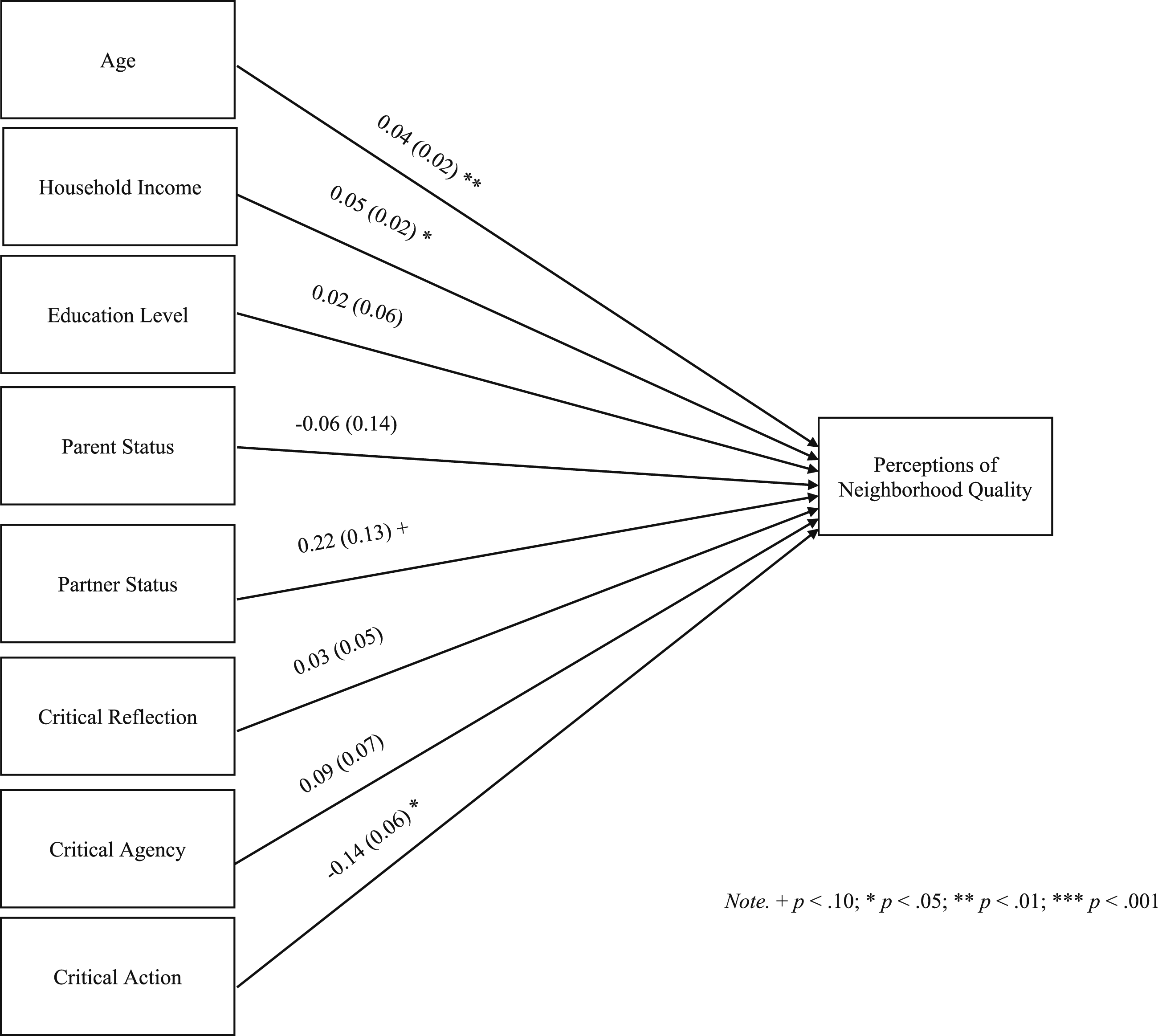
Methods
Participants
The current study is a secondary analysis of data from the Life in the City Study (P.I.'s: Jacqueline S. Mattis, Kayla J. Fike, and Gordon J.M. Palmer) which examined how prosocial behavior, psychological well-being, religiosity and spirituality may be related for urban-residing Black adults. Participants were encouraged to participate if they lived in a city with 10,000 people or more. These criteria meet the U.S. Census Bureau’s classification of an urbanized area. Participants were recruited online (i.e., Facebook, Twitter, and Instagram) and in urban community settings from 2017 to 2019, such as Black-owned and Black-run businesses. In person, we distributed and left fliers in businesses with QR codes to direct potential participants to the survey. Online, we posted the flier with the survey link and participation criteria on our research groups’ social media pages, our personal social media pages, and sent the flier and survey link to popular cultural and networking pages targeted toward Black audiences.
The analytic sample for this study is limited to adults ages 18-30 (n = 524) as this range represents a middle ground between varying definitions of emerging adulthood (Arnett, 2000; Syed, 2016). The U.S. Census Bureau counts young adults as ages 18-29 to account for individuals turning 30 during the year of data collection and we align with this view of young adults as well. Young Black adults in the sample were from across the U.S., with the largest proportions of respondents reporting they lived in the Midwestern (26%) and the Southern (31%) regions, delineated by the U.S. Census Bureau. The rest of the sample reported being from the West (20%) and the Northeast (11%) or had missing data on the region in which they lived (11%). Three participants identified as non-binary and gender minority individuals. These individuals were excluded from the analyses so as to not overlook their uniquely gendered experiences by grouping them with cis-gendered men and women.
Procedure and Data Preparation
Participants completed the survey online via Qualtrics and were compensated with a $10 Amazon gift card for survey completion. Attention and validity checks were included in the Qualtrics survey to address non-effortful and non-human responses. For example, we included questions that asked participants to type in a word (e.g., red) that was included in the item stem or that we expected most participants to know the answer to (e.g., “a zebra is both black and ___ [fill in the blank]”). If responses failed these checks, they were excluded based on their potential invalidity. Additionally, the research team flagged potentially non-human responses after data collection was complete. These flags included checking for consistency across two different places in the survey to enter one’s name and zip code, and examining whether respondents’ zip codes matched with states that respondents indicated they lived in. Respondents that failed at least three of these flags were also removed from the dataset.
Measures
The descriptive statistics, correlations, and reliability indices were calculated in SPSS version 27. Aside from the demographic measures, scores were calculated as the average item response and treated as observed variables for the multigroup SEM analysis. Only participants who responded to all items in a measure received a score.
Age
Age in years was measured using a single open-ended question.
Gender
Participants were asked to choose their gender from seven options: male (sex assigned at birth and current), female (sex assigned at birth and current), transman, transwoman, non-binary gender identity, other, and “prefer not to answer.”
Household Income
Household income was scored on an 8-point scale: 1) less than $19,999, 2) $20,000–39,999, 3) $40,000-59,999, 4) $60,000-79,999, 5) $80,000-99,999, 6) $100,000-149,999, 7) $150,000-199,999, 8) $200,000 or above. Participants could also select a “prefer not to answer” response option.
Education
Participants reported the highest level of education they had completed from a list of five options: 1) less than a high school degree, 2) GED/HS diploma, 3) some college, 4) college degree, and 5) graduate or professional degree.
Parental Status
Participants reported the number of children via an open-ended item. A binary variable was created such that participants who reported having at least one child were labeled parents and participants who noted they had no children were labeled nonparents.
Partner Status
Participants selected their partner status from one of five options: 1) single/never married, 2) partnered, 3) married/domestic partner, 4) divorced, and 5) widowed. A binary variable was created such that participants who selected single/never married, divorced, and widowed were labeled unpartnered and participants who selected partnered and married/domestic partner were labeled partnered.
Perceived Inequality
To assess participants’ critical reflection on societal injustice, we used Diemer and colleagues’ (2017) Critical Consciousness Scale subscale, critical reflection-perceived inequality. This eight-item measure assessed participants’ endorsement of beliefs that some groups are more privileged than others based on social identities, such as gender and class. Response options ranged from “strongly agree” (1) to “strongly disagree” (8). Sample items include “Women have fewer chances to get good jobs.” and “Poor children have fewer chances to get a good education.” Cronbach’s alpha in this sample is .88. Higher scores indicate stronger endorsement of the belief in perceived inequality.
Critical Agency
Participants responded to McWhirter and McWhirter’s (2016) measure of critical agency, which assessed the extent to which participants thought they had the power to make change in societal injustice. The measure had seven items with response options that ranged from “not true at all” (1) to “very true” (5). Sample items include “I can make a difference in my community.” and “It is important to fight against social and economic inequality.” Cronbach’s alpha in this sample is .82. Higher scores indicate stronger critical agency beliefs. Though developed and validated initially with Latino/a high school students, this measure of critical agency has been examined psychometrically and used with Black adolescents as well (Hope et al., 2020).
Critical Action
We measured participants’ engagement in critical actions aimed at social change with Diemer and colleagues’ (2017) sociopolitical participation measure. This scale has a list of nine behaviors and measures the frequency with which participants engaged in each behavior in the past year. Response options ranged from “never did this” (1) to “at least once a week” (5). Sample items include “Participated in a civil rights group or organization” and “Worked on a political campaign”. Cronbach’s alpha in this sample is .87. Higher scores reflect more frequent sociopolitical participation.
Perceived Neighborhood Quality
We asked participants to report their perceptions of their neighborhood quality using a ten-item measure designed for the parent study. The items asked about features of the neighborhood, such as parks, schools, safety, and social cohesion between neighbors. Sample items included “In my neighborhood, there are parks where people can play, jog, and have a good time.” and “I live in a close-knit neighborhood”. The response options ranged from “strongly disagree” (1) to “strongly agree” (5). Participants’ scores were averaged, and higher scores reflect higher perceptions of neighborhood quality. It is important to note that higher PNQ could be understood as more positive perceptions. However, we approached our interpretations of the PNQ scale in the context of residents’ evaluations of the quality of neighborhood features. Thus, we did not interpret lower scores as more negative perceptions of neighborhood features, but as evaluations of these features as lower quality. Notably, we performed a K-fold cross-validation for factor analysis (KFA) on the PNQ scale in R (Version 4.2.2; R Foundation for Statistical Computing, 2022), which conducts exploratory and confirmatory factor analyses on subsets of the sample, to test for stability of the factor structure (Nickodem & Halpin, 2021). After identifying a viable one factor solution, the model testing the factor structure of the scale was run on the whole sample. The model fit indices for the 6-item scale are CFI = .967, RMSEA = .066, and SRMR = .037 with average factor loadings ranging from .34 to .68, which were appropriate for use in the current study (Kline, 2015). The Omega-h reliability for this measure in the analytic sample is .66.
Data Analysis
We used three reverse-scored items from the original 10-item PNQ measure to identify uneffortful responses (i.e., straight-lining) following guidance from Vriesema and Gehlbach (2021). Three cases were identified and were removed. Fourteen percent of the remaining sample (n = 71) were missing data on at least one of the other measures of interest in the current study and were excluded from the regression analyses. Since the largest proportion of missing cases came from missingness on the number of children item (n = 69), we conducted sensitivity analyses that included those cases that were missing information on number of children. The results did not significantly change the interpretation of our results. These analyses are included in the supplementary materials. Thus, the analytic sample (n = 441) is 51% Black women (n = 226).
We fit a multigroup SEM by gender to the conceptual model in Figure 1. An unconstrained model was run first, which examined the proposed associations separately for Black men and Black women by estimating unique parameters for each group. A constrained model was then run with the estimates for the associations of age, household income, education, parental status, partner status, perceived inequality, critical agency, critical actions, and PNQ constrained to equality for men and women. Variances were still estimated freely by gender. The models were run in lavaan (Rosseel, 2012) using robust maximum likelihood estimation. For each model, overall fit was assessed with a non-significant chi-square test (α > .05), comparative fit index (CFI) > .95, root mean square error of approximation (RMSEA) < .06, and standardized root mean square residual (SRMR < .08) indicting good fit (Kline, 2015). The unconstrained and constrained models were then compared with a Satorra and Bentler (2001) scaled chi-square difference test and change (Δ) in fit indices, including change in Akaike Information Criterion (AIC) and Bayesian Information Criterion (BIC). The comparison provides an omnibus test for whether gender had a moderating effect on any of the model pathways.
Results
Sample Demographics.
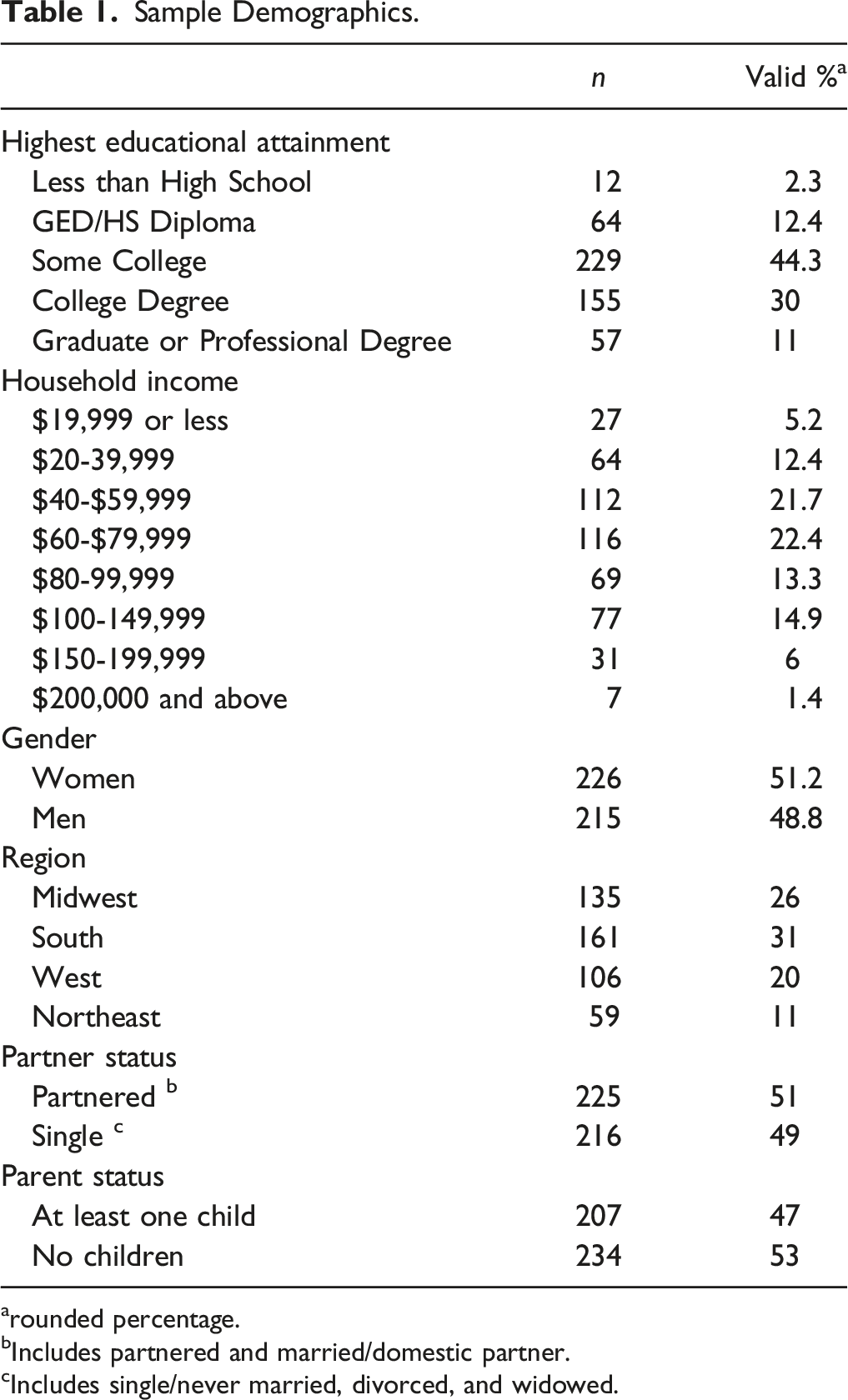
arounded percentage.
bIncludes partnered and married/domestic partner.
cIncludes single/never married, divorced, and widowed.
Descriptive Information on Participants’ Urbanized Areas.

a% of families making 2 times or less than the poverty threshold in 2018 ($25,100 for four-person family).
Means, Standard Deviations, and Pearson/Spearman Correlations for Independent and Dependent Variables.
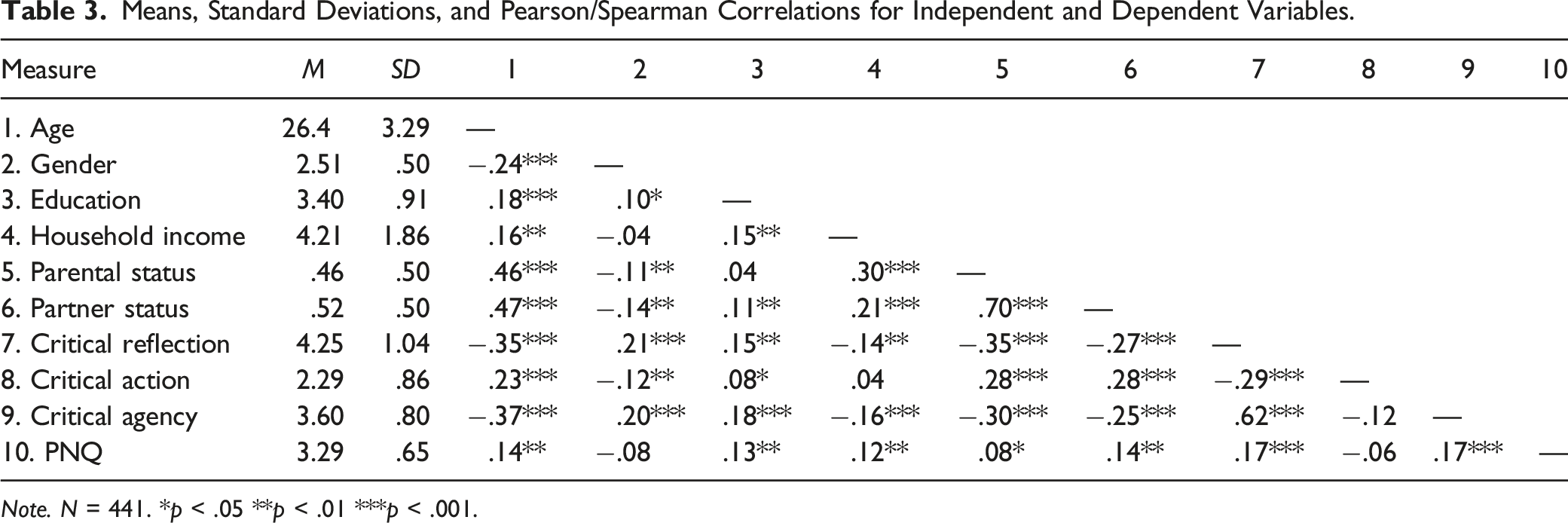
Note. N = 441. *p < .05 **p < .01 ***p < .001.
Model Fit and Comparison of Multigroup Analysis by Gender (n = 441).
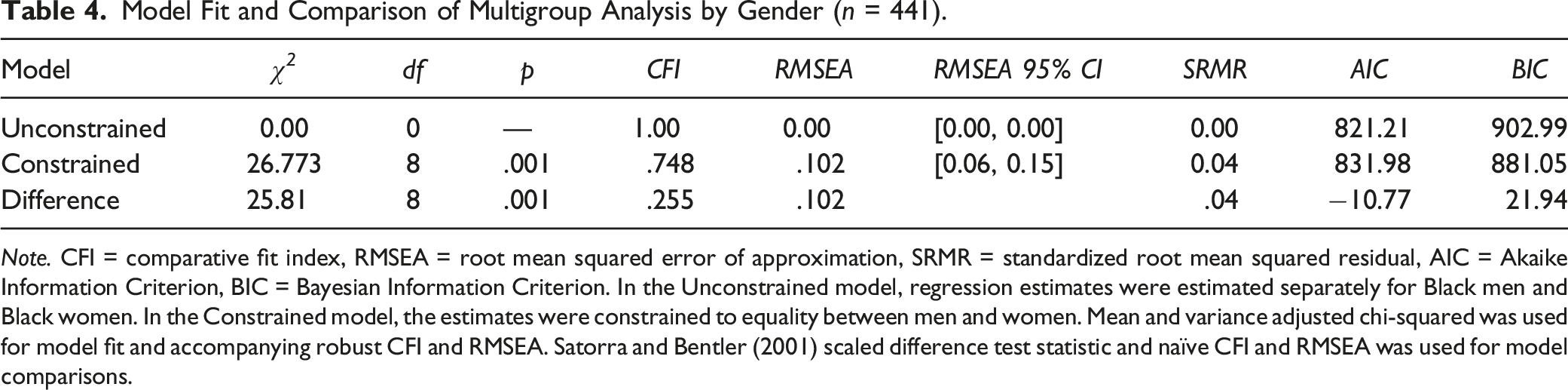
Note. CFI = comparative fit index, RMSEA = root mean squared error of approximation, SRMR = standardized root mean squared residual, AIC = Akaike Information Criterion, BIC = Bayesian Information Criterion. In the Unconstrained model, regression estimates were estimated separately for Black men and Black women. In the Constrained model, the estimates were constrained to equality between men and women. Mean and variance adjusted chi-squared was used for model fit and accompanying robust CFI and RMSEA. Satorra and Bentler (2001) scaled difference test statistic and naïve CFI and RMSEA was used for model comparisons.
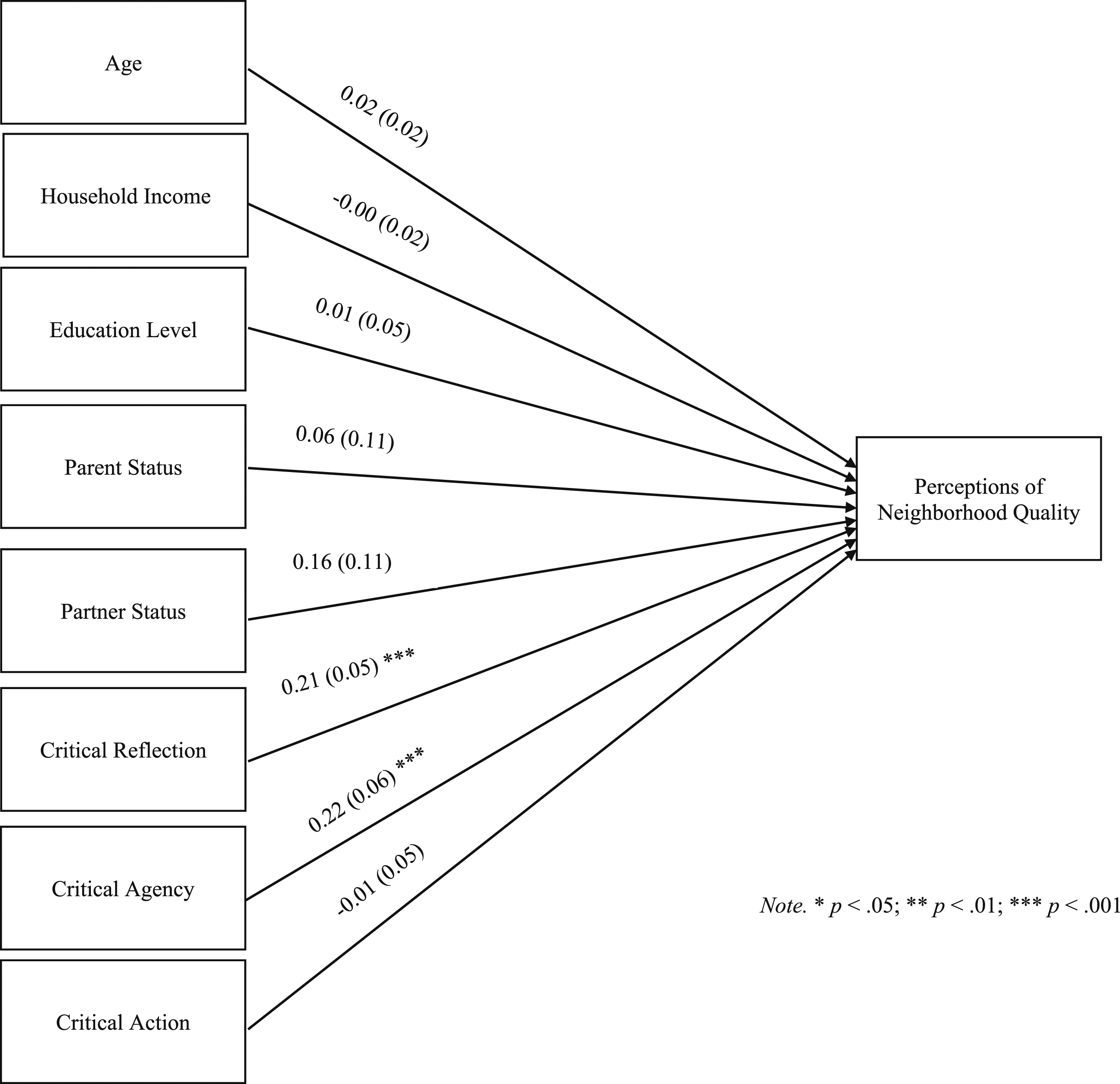
Unconstrained SEM model for Black Men with Perceptions of Neighborhood Quality as the Criterion. Note. *p < .05; **p < .01; ***p < .001.
Discussion
Perceived neighborhood quality (PNQ) was conceptualized as a generalized process that is impacted by equity considerations (Connerly & Marans, 1985; Campbell et al., 1976). Yet, the current study is the first to our knowledge to explore relations between social identities, social locations, critical consciousness and PNQ among young Black urban-residing adults. Guided by the Black Spatial Imaginary (Lipsitz, 2011) and Black women’s geographies (McKittrick, 2006), we explored how critical consciousness may relate to young Black adults’ perceptions and evaluations of neighborhood quality. These theoretical frames argue that Black people’s understandings, experiences, and perceptions of place are shaped by their historical and contemporary experiences of inequities. Further, these theories suggest that Black men’s and women’s gendered experiences of inequity inform different experiences and perceptions of place. Our findings lend preliminary empirical support to these arguments, suggesting that young Black adults’ ages, household incomes, partner status, and critical consciousness elements are related to PNQ and in different ways among young Black women and men.
The results regarding social identities and social locations contributes to the literature on PNQ. The positive relation between income and PNQ is well-supported by previous literature (Connerly & Marans, 1985; Galster & Sharkey, 2017). However, the null finding regarding the relation between education and PNQ is surprising since previous research connected socioeconomic status in general, and education in particular, to higher ratings of neighborhood attributes (Roosa et al., 2009; Stokes, 2019). Findings regarding age and PNQ have found contradictory results as to whether older or younger people have higher PNQ (Carp & Carp, 1982; Stokes, 2019), and the current study’s findings suggest older Black emerging adult women have higher PNQ than their younger counterparts. Additionally, it seems that partnered young Black women in particular rate their neighborhood quality higher than their unpartnered counterparts, given the trending significance of partner status. However, since partner status did not reach statistical significance within our sample of young Black women, we interpret this trend cautiously. Given previous research examined partner status through multiple categories (i.e., married, divorced, single, widowed), our dichotomized exploratory approach was beneficial in that it explores whether having a life partner to consider would contribute to young Black adults’ PNQ. Our multigroup SEM approach suggests that Black women are driving the significant associations between social identities and social locations with PNQ because the model fit indices suggested separate parameter estimates fit the data significantly better than the constrained model. The parental status null finding also represents an important contribution given the relatively few psychological studies that examine this social location in relation to PNQ generally or among young Black adults in particular.
Neighborhood and residential home choice may be a factor that links the significant income and age findings along with the trending partner status association in the current study. It may be the case that older, mostly middle-class, partnered, Black emerging adult women have been able to choose their neighborhoods and homes, whereas younger, single, Black emerging adult women with lower household incomes have not. Black women in the later years of emerging adulthood may have achieved greater independence from family, started in their career paths, and earn more income which may allow them to choose neighborhoods. In contrast, younger Black women in emerging adulthood may still be somewhat dependent on family and may be pursuing goals (e.g., higher education, vocational training) that influence both the neighborhoods where they live and the ways that they experience those neighborhoods (Arnett, 2016; Furstenberg, 2016). Also, older Black emerging adult women who may earn more money than their younger counterparts and who may be in partnerships that provide them with more disposable income could meet and even exceed their standards for neighborhood quality. Interestingly, education and parental status were not significantly related to PNQ for young Black women nor men in the study. These non-significant findings are contrary to previous research which suggests that more educated people have higher PNQ (Stokes, 2019) and that parents may have more critical views of their neighborhoods’ features (Galster & Santiago, 2006). It is possible that critical consciousness might heighten parents’ concerns about their neighborhood if they live in an underresourced place. However, this sample reported about average educational attainment and higher income levels than most Black Americans so this may not be an issue for the parents in the sample (U.S. Census Bureau, 2018). Future research would benefit from examining whether parents have unique or additional standards for evaluating their neighborhood’s quality, and whether critical consciousness plays a role in these standards.
The positive relations between critical reflection and PNQ as well as critical agency and PNQ were contrary to our hypothesis, but generated interesting questions about the processes that occur when Black emerging adult men reflect on their urban neighborhood’s quality. Critical reflection and critical agency may be related to higher neighborhood quality perceptions because young Black men are aware of the societal inequities that would either privilege or disadvantage their neighborhood conditions and are willing to endorse its quality in either case. On the one hand, acknowledging that one’s neighborhood’s conditions are of relatively high quality can reflect an awareness of the ways in which urban neighborhoods experience wide variation in resources and investments, usually in ways that reflect systemic racism and classism. On the other hand, in the case that one’s neighborhood conditions are underresourced, recognizing these inequities could lead young Black men living in these areas to double down on the efforts that community leaders and residents are investing in their communities. Thus, young Black men in these areas could be less likely or unwilling to rate these neighborhood features as low quality. Research and public narratives about the spaces Black urban residents call home can perpetuate individualistic narratives of blame and deficit when systemic analyses are better suited (Sampson & Raudenbush, 2004). Considering these trends, young Black men may be hesitant to endorse statements that paint their communities in a negative light, though they are aware of the societal inequities that might constrain the possibilities and health of their communities. As such, it is worth considering why critical reflection and critical agency are related to neighborhood perceptions: is it because of an awareness of relative privilege or because of a positive view of the efforts one’s community is engaged in to address constraining circumstances?
Notably, the SEM analyses indicate that critical reflection and critical agency are positively related to PNQ for young Black men, but not for young Black women. Though we do not suggest that Black men are more involved in critical reflection and critical agency, or that they are better positioned to develop these critical consciousness attitudes, it is worthwhile to consider potential explanations for the connections between critical consciousness and PNQ for young Black men in particular. Young Black men may have received unique socialization messages that 1) lead them to place high value on the specific aspects of neighborhood quality that are measured in this study, and 2) inspire them to believe that it is particularly important and possible for them to address societal inequities. Social justice-oriented groups, such as the Black Panthers, were represented as predominately Black and male and addressed issues of social inequity and neighborhood quality in tandem (Marable, 1983). Through contemporary cultural and community-based organizations, such as churches and fraternities, Black men may continue to be bolstered in their involvement in change-making actions (Fike et al., 2022). Research with urban-residing Black men also suggests that they consider the ways in which social identities and biases impact who society sees as deserving of help when they enact prosocial behaviors toward others in their community, which evidence both critical reflection and critical actions (Mattis et al., 2008). Further, Hammond and Mattis (2005) found narrative themes of responsibility for one’s community, leadership in community efforts, and participation in community outreach as defining features of manhood among their sample of Black men. These themes may relate to Black men’s identification of social inequities, aligned with critical reflection, perceived importance of acting on behalf of one’s community to enact social change, aligned with critical agency, and their perspectives on their urban neighborhood’s conditions as captured in our PNQ measure. In sum, critical reflection and critical agency may be positively related to PNQ for young Black men because their neighborhoods represent proximal spheres in which they can both engage in social analysis and influence change.
The findings of this study offer empirical evidence of a link between elements of critical consciousness and evaluations of place for young Black people. These findings lend preliminary support to arguments in the Black Spatial Imaginary (Lipsitz, 2011) and Black Women’s Geographies (McKittrick, 2006). Lipsitz (2011) articulated awareness of societal inequity, agency to enact changes to inequitable systems, and engagement in actions to eradicate social inequity as key elements in the Black Spatial Imaginary. These tenets align with the operationalization of critical consciousness and each element was significantly related to PNQ, albeit differently for Black men and women. Yet, there are nuanced aspects of the Black Spatial Imaginary that are not explicitly measured in the current study and should be investigated in future research. For example, the Black Spatial Imaginary posits urban spaces as the object of critical analysis and that Black urban residents engage in coalitional actions to mitigate the impact of oppressive spatial practices and improve neighborhood quality. Future research that explicitly examines a spatial critical consciousness would advance the work of the current study. Specifically, quantitative measures of critical reflection and critical agency that center awareness of spatial inequities, such as segregation and disproportionate siting of environmental hazards, and agency to work against spatial inequities could be developed and examined in relation to PNQ. Further, mixture modeling, such as latent profile analysis, may illuminate whether different constellations of spatial and broader critical consciousness (e.g., high on critical reflection and critical agency versus high critical reflection and low critical agency) relate to PNQ in unique ways. Optimism and hope may also be worthwhile constructs to investigate, as spatial critical reflection and critical agency may be encouraged or inhibited by the belief in the possibility for positive change in general. Qualitative methods are integral to examine which aspects of urban neighborhoods are salient for Black emerging adults, the ways in which they critically analyze the conditions of urban neighborhoods, and how these analyses play a role in their PNQ. Further, exploring if and how Black emerging adults engage in coalitional organizing to address neighborhood quality will contribute to the research on PNQ and to local organizing efforts.
Limitations
As with all studies, there are limitations to the current study. First, the participants in the current study are highly educated, higher income than average Black Americans, and predominately child-free. Their reported levels of household incomes place them above the average compared to Black Americans in general (U.S. Census Bureau, 2018). The relative economic privilege that young Black adults in the sample experience may have had an impact on their PNQ if they interact with the neighborhood differently, had greater choice in selecting their home, and were better able to access resources in and outside of the neighborhood to meet their wants and needs (Lee & Guest, 1983; Owens, 2017). Future research would benefit from purposive sampling designs that allow for separate analyses by class groups. In doing so, PNQ research could more closely examine the ways in which race, class, and disproportionate privilege interact with young Black people’s perceptions of and experiences in urban neighborhoods.
The second set of limitations in this study relate to the current study’s design. The study was cross-sectional and employed a new PNQ measure. Given the cross-sectional design, it is possible that young Black adults bring critical consciousness to their urban neighborhoods, which impacts their PNQ, or that young Black adults’ urban neighborhoods are places where they cultivate an awareness of social inequity and a positive sense of agency to make social change. Similarly, it is possible that the negative relation between critical action and PNQ reflects a pattern wherein young Black women who evaluate their neighborhoods negatively respond by getting engaged in social action. Alternatively, it may the case that young Black women who are socially engaged are more critical of the neighborhoods where they live.
The current study’s findings regarding the positive relation between age and PNQ raises questions about what lifestyle changes may occur for young Black adults as they age, such as moving away from home or starting one’s career, that may explain their higher ratings of the quality of their neighborhood. A longitudinal study with young Black adults would provide more robust evidence regarding whether PNQ increases as people age. Another design choice in the current study was to use multigroup SEM analyses to examine the proposed relations separately for young Black women and Black men. These analyses encourage attention to patterns in PNQ among young Black women and men, yielding a more intersectional view of young Black adults’ PNQ than only examining gender differences between groups. However, future research would benefit from more specifically gendered analyses. For example, models that identify and include different constructs for urban-residing men and women based on their unique lived experiences may reveal further insight to the intersectional nature of PNQ. These gendered analyses will also address the problematic assumptions that have characterized the interpretations of gender differences in PNQ, such as assuming that neighborhood safety is more of a priority to women than men (Carp & Carp, 1982). It is also vitally important to examine PNQ using non-binary approaches to gender in both qualitative and quantitative research. Lastly, we used a new PNQ measure where items were based on existing literature and related studies. After further psychometric analyses, this measure had an omega-h reliability coefficient of .66 and model fit indices suggested it was suitable to use in the current study. Yet, a measure of PNQ developed with and validated for Black urban-residing people may produce an even more reliable and conceptually nuanced scale. Future research on subjective PNQ would benefit from measure design and validation that prioritizes Black urban residents’ perceptions of distinguishing or essential neighborhood features (Bonaiuto & Fornara, 2004).
Conclusion
The current study highlighted the importance of critical consciousness in young Black adults’ perceptions of neighborhood quality (PNQ). Critical reflection on inequity and critical agency to address inequity were related to higher PNQ for young Black men, while actions to enact social change were related to lower PNQ for young Black women in the sample. The critical consciousness processes and actions that are related to PNQ are of interest to policymakers and interventionists committed to supporting urban quality of life. Young Black women involved in making social change in their communities may need specific supports in addressing the issues impacting their neighborhood’s quality, given the negative relation between critical actions and PNQ. Supporting awareness of and agency to address inequity is important to the development of engaged young Black people as well (Watts & Flangan, 2007). Thus, critical reflection and critical agency may be specific points of intervention that support urban neighborhood quality and well-being among this group.
Supplemental Material
Supplemental Material - Black Emerging Adults’ Critical Consciousness and Perceived Neighborhood Quality
Supplemental Material for Black Emerging Adults’ Critical Consciousness and Perceived Neighborhood Quality by Kayla J. Fike, Jacqueline Mattis in Emerging Adulthood
Supplemental Material
Supplemental Material - Black Emerging Adults’ Critical Consciousness and Perceived Neighborhood Quality
Supplemental Material for Black Emerging Adults’ Critical Consciousness and Perceived Neighborhood Quality by Kayla J. Fike, Jacqueline Mattis in Emerging Adulthood
Footnotes
Declaration of Conflicting Interests
The author(s) declared no potential conflicts of interest with respect to the research, authorship, and/or publication of this article.
Funding
The author(s) received no financial support for the research, authorship, and/or publication of this article.
Transparency and Openness Statement
The raw data, analysis code, and materials used in this study are not openly available but are available upon request to the corresponding author and after consultation with principal investigators of the original study. No aspects of the study are pre-registered.

Supplemental Material
Supplemental material for this article is available online.
Author Biographies
References
Supplementary Material
Please find the following supplemental material available below.
For Open Access articles published under a Creative Commons License, all supplemental material carries the same license as the article it is associated with.
For non-Open Access articles published, all supplemental material carries a non-exclusive license, and permission requests for re-use of supplemental material or any part of supplemental material shall be sent directly to the copyright owner as specified in the copyright notice associated with the article.
