



Abstract
Perceived drinking motives of social network members appear to influence emerging adults’ alcohol use indirectly through their own drinking motives. Ascertaining the accuracy of motive perceptions can determine the relevance of social norm interventions for drinking motives and the utility of egocentric versus direct-reporting social network designs. As part of a larger study, 60 emerging adults (70% female; mean age = 21.57) reported cross-sectionally on their own drinking motives and the drinking motives of a peer. Peers were recruited and reported on their drinking motives. Regression analyses utilizing the truth and bias model indicated social, coping-with-anxiety, and coping-with-depression motives exhibited accuracy. Participants also overestimated peers’ social, enhancement, and conformity motives. Coping-with-depression and enhancement motives exhibited assumed similarity. Most motive perceptions were heavily or singularly influenced by bias. Whether to include actual and/or perceived motives in social network research designs should be carefully considered.
Alcohol researchers are increasingly attentive to the social context of alcohol use. Researchers frequently examine the influence of both large undifferentiated social networks and various types of social network members (e.g., peers, romantic partners, parents, siblings) on the alcohol use of emerging adults in both community and university settings (e.g., Barnett et al., 2014; Bartel et al., 2017; Bartel et al., 2020; Meisel & Barnett, 2017). Results generally suggest the alcohol use of one’s social network members significant predicts one’s own alcohol use. It is now largely recognized emerging adult drinking is often inextricably linked to social context.
The study of social influence has also extended to drinking motives (i.e., the reasons one chooses to consume alcohol; Cooper et al., 2016); studies have examined the influence of various social network members’ drinking motives (e.g., partners, drinking buddies, friends, classmates, and larger undifferentiated networks; Bartel et al., 2021; Kehayes et al., 2019, 2021; Kuntsche & Stewart, 2009) on individual’s own drinking motives and alcohol use. This work suggests the actual (Kehayes et al., 2019, 2021; Kuntsche & Stewart, 2009) or perceived (Bartel et al., 2021) motives of specific and general social network members influence adolescents’ and emerging adults’ alcohol use indirectly through their own drinking motives. In other words, individuals may adopt others’ reasons for drinking, resulting in social influence. As drinking motives have a clear and well-established impact on alcohol use (Cooper et al., 2016), examining the social influence of drinking motives is critical.
One of two approaches is used to study social influence on alcohol or drinking motives: recruiting participants’ social network members to report on themselves (i.e., direct reporting), or having participants report on their social network members (e.g., egocentric social network designs). While direct reporting is often viewed as superior because it does not rely on potentially biased participant perceptions, egocentric designs also have significant benefits (Chung et al., 2005). For example, they only require recruitment of a single sample (not requiring social network members), making them cost-effective and efficient. They also provide more complete data sets (e.g., eliminating the missing data for social network members who are not recruited). Moreover, egocentric designs’ reliance on perceptions may be an asset. Our perceptions of others’ behavior influence our own behavior (i.e., modeling/vicarious learning; see Bandura and Walters, 1977; Maisto et al., 1999). As our perceptions may be not always be accurate, measuring perceptions through egocentric designs may better capture social influence than direct-reporting designs. For example, if an individual does not perceive their friend’s alcohol use patterns or motives correctly (e.g., they perceive their friend to consume three drinks instead of the actual seven they consumed; they perceive their friend to drink for enhancement motives instead of their actual conformity motives), it is likely that they will be influenced by their own misperceptions, rather than the actual behavior/motive of their friend. Thus, direct-reporting designs which only ask for the friend’s report would miss the potential social influence conferred through this misperception.
Given these benefits of egocentric designs, research has examined the accuracy and utility of participant perceptions of the alcohol use of their social network members (e.g., Cox et al., 2019; Dumas et al. 2019; Kenney et al., 2017; Mason et al., 2019; Reid et al. 2020). This research suggests adults are fairly accurate in their perceptions of close social network members. For example, in samples of emerging adults recruited from either colleges or general communities, Cox et al. (2019), Kenney et al. (2017), and Mason et al. (2019) found perceptions of close friends’ and peers’ drinking patterns (e.g., quantity, frequency, binge drinking frequency) to be relatively accurate. Similarly, even after using a more statistically complex approach (i.e., truth and bias analyses; West & Kenny, 2011) to account for the false consensus effect (i.e., assuming others are similar to oneself; Ross et al., 1977), Reid et al. (2020) found emerging adults’ perceptions of friends’ drinking status (e.g., abstainer, light drinker) and maximum drinks per day were fairly accurate (i.e., significant accuracy effect within the truth and bias model). While some studies suggest perceptions of peers’ alcohol use are inaccurate, these studies often involve perceptions of more distal peer groups (e.g., other students on a college campus; Kenney et al., 2017). Thus, research in emerging adults suggests perceptions of others’ alcohol use can be accurate, when these perceptions concern close social network members. Therefore, egocentric social network designs are increasingly utilized to study social influence on alcohol use.
While the volume of literature on social influences on drinking motives has rapidly increased, only one study examined the correspondence between self- and social network-reports on drinking motives (Kim et al., 2021). Using a simple correlational approach, the authors report small positive associations between perceptions of same-sex drinking buddies’ motives and drinking buddies’ actual motives for both coping-depression (r = .17) and enhancement motives (r = .18). While this study is an important first step, replication and more complex analyses (see below) are required to clarify whether direct-reporting or egocentric social network designs are more appropriate for studying the social influence of drinking motives. As such, the accuracy and bias of drinking motives perceptions remains a notable gap in the literature. In fact, accuracy literature for alcohol use perceptions may not apply to drinking motives perceptions; whereas others’ patterns of alcohol use can be directly observed in social situations (e.g., the number of drinks consumed), drinking motives must be either inferred or transmitted verbally. Thus, drinking motives perceptions may be less accurate than perceptions of drinking behavior.
Filling this gap in the literature by ascertaining the accuracy of motives perceptions is important not only to help determine the appropriateness of different research designs, but also to inform interventions. If emerging adults are largely overestimating the risky motives of others (e.g., enhancement motives, coping motives; Cooper et al., 2016), interventions targeting these misperceptions may reduce one’s own risky drinking motives and in turn impact one’s own drinking behavior. For example, if an individual believes their social network members are drinking for enhancement reasons (a motive associated with risky alcohol misuse; Cooper et al., 2016), when they are truly drinking for social reasons (a motive associated with lower-risk alcohol use; Cooper et al. 2016), providing corrective information about social network members’ actual motives may reduce a participant’s own enhancement motives and thereby their own risky drinking. If, on the other hand, motives perceptions are found to be accurate, a broader intervention addressing motives at a social network level may be more appropriate (e.g., changes to the social network to select network members with less risky motives). Given rates of harmful alcohol use are particularly high in emerging adulthood, research that may aid in understanding and intervening with their risky alcohol use is essential (Canadian Centre on Substance Use and Addiction, 2017; Substance Abuse and Mental Health Services Administration, 2013).
We sought to fill these gaps by examining the accuracy of perceptions of drinking motives of social network members in a sample of emerging adults. Given the drinking motives of many different types of network members (e.g., Kehayes et al. 2019; Kehayes et al. 2021), as well as undifferentiated network members (Bartel et al., 2021), predict the drinking motives of emerging adults, we aimed to include diverse network members, rather than limiting our work to one type of network member as has been previously done (e.g., Kim et al., 2021).
Research studying the accuracy of alcohol-related perceptions has used several different approaches with varying degrees of statistical rigor. Some research has subtracted perception variables (i.e., participants’ reports of social network members’ alcohol use) from truth variables (i.e., social network members’ reports on their own alcohol use) and then categorized perceivers into three categories: over-estimators, under-estimators, and accurate perceivers (e.g., Cox et al., 2019; Kenney et al., 2017). While this approach is useful, it does not provide any knowledge about the source of the biased judgements (e.g., are participants projecting their own characteristics onto others?). It also only categorizes participants as accurate if their perceptions are completely correct (i.e., perception– truth = 0; Cox et al., 2019) or not significantly different from zero (Kenney et al., 2017). Ultimately, this statistical approach results in a significant loss of nuance. Other research has examined correlations between perceptions and truth variables (e.g., Kim et al., 2021), or the ability of perceptions to predict the social network members’ self-reports reports (i.e., “truth”) in regression analyses (e.g., Mason et al., 2019). These latter approaches only provide information about correspondence between perceptions and truth variables (i.e., the extent to which perceptions increase/decrease as network members’ self-reports increase/decrease). Moreover, they lack information about the extent to which these variables align or are systematically over- or under-estimated. Thus, these approaches are also not maximally informative.
A more advanced statistical approach for studying accuracy and bias, the truth and bias model of judgement (West & Kenny, 2011), has emerged. This model allows for the simultaneous examination of three distinct influences on participant perceptions: accuracy (i.e., network member’s reports of their own behavior/motives), assumed similarity (i.e., projecting one’s own characteristics onto others; bias), and systematic over- or under-estimation of characteristics in one’s social network (i.e., whether one tends to perceive social network members as having higher or lower scores than the network members actually reported about themselves; bias). As the truth and bias model is a clear improvement over typical approaches to study accuracy, we sought to utilize it in our investigation.
Hypotheses
As the literature suggests adults are relatively accurate in their perceptions of social network members’ alcohol use behavior, we hypothesized (H1) all drinking motives perceptions would be relatively accurate, corresponding well with network members’ self-reported behavior. Given drinking motives are less observable than drinking patterns (potentially reducing the observable/behavioral information perceivers have to base their judgements upon), we also hypothesized (H2) that assumed similarity would be present. In other words, we believed participants would assume social network members have similar drinking motives to themselves. Despite this, in line with recent findings of Reid et al. (2020) regarding assumed similarity effects for drinking behavior, we expected that when both effects are present, accuracy effects would be stronger than the assumed similarity effects (H2.1). With respect to a systematic under- or over-estimation of drinking motives, we hypothesized (H3) that participants would overestimate social and enhancement motives, as they are the most frequently endorsed and socially accepted drinking motives (Cooper et al., 2016). In other words, because enhancement motives and social motives are ubiquitous (e.g., frequently portrayed in the media) and tend to be neutrally or positive evaluated (Atkinson et al. 2013), participants would be primed to perceive their social network members as very frequently drinking for these reasons. We also hypothesized (H4) participants would underestimate conformity and coping drinking motives as they are the least-commonly endorsed (i.e., participants would not be primed to perceive them; Cooper et al., 2016), may be associated with negative connotations (e.g., poor coping, mental health difficulties; Grazioli et al., 2018; Kenney et al., 2013), and may not be openly discussed. We also sought to investigate the moderating role of relationship closeness, as increased levels of relationship closeness could impact accuracy (i.e., when participants know their social network members more intimately, perceptions could be more accurate). As relationship closeness has not previously been explored in the motive perception literature, we did not make hypotheses regarding the nature of this potential moderation; our examination of relationship closeness as a moderator should be considered exploratory. While it is common to investigate gender as a moderator in accuracy and bias research, recent close network research has not found this variable to impact accuracy or bias of alcohol-related perceptions (Reid et al., 2020); thus gender moderation was not investigated in our study.
Methods
Participants
Sixty emerging adults (mean age = 21.57; range = 19–25; SD = 1.90; male = 17; female = 42; intersex = 1; 68% university students) who used both alcohol and cannabis and 60 of their social network members (mean age: 23.83; range = 18–50; 76% emerging adults; male = 25; female = 34; intersex = 1) participated in the current study (i.e., one social network member per participant). Given most social network members were emerging adults, we will hereafter refer these social network members as “peers.” According to our 60 emerging adult participants, on average, dyads had known each other 6.92 years (SD = 6.74; range = .25-23 years) and had contact with each other either in person, by phone, or via social media 5.40 days of a typical week (SD = 2.12). Twenty-seven participants indicated the type of relationship they had with the member of their dyad (friends = 13, romantic partner = 6, roommate = 4, siblings = 3; co-worker = 1). 1 Half of all dyads were same-sex (50.00%; 24 F-F; 6 M-M), while the other half were mixed-sex (50.00%; 18 F-M; 1 M-intersex; one intersex-M; 10 M-F). In terms of racial identity, 78.4% of our 60 emerging adult participants identified as White, 16.8% identified as biracial or multiracial, and 4.8% identified as Black, Middle Eastern, or Other. To be included in the study, the emerging adult participants had to report using alcohol ≥ four times, and using cannabis recreationally ≥ two times, in the past month. Note that the cannabis use criterion was for another arm of the research study (Bartel, Sherry, Stewart, 2020). There were no exclusion criteria for emerging adult participants. Beyond knowing the referring participant, there were no inclusionary or exclusionary criteria for peers; however, 100% of recruited peers reported using alcohol (i.e., were not abstainers) and 76.3% reported using cannabis.
Measures
Brief Alcohol Motives Measure
All participants and social network members completed the Brief Alcohol Motives Measure (BAMM; Bartel et al., 2021), a 6-item measure of alcohol motives based on the Modified Drinking Motives Questionnaire— Revised (MDMQ-R; Grant et al., 2007). This measure was included instead of the MDMQ-R to reduce participant burden associated with the egocentric study design. The BAMM assesses own enhancement, social, coping-with-depression, coping-with-anxiety, conformity, and expansion drinking motives. Each of the six items includes a brief general statement describing an alcohol use motive, as well as two specific examples of the motive within parentheses (e.g., “In the past 30 days, I’ve used alcohol because it’s a good way to socialize with others (e.g., because it makes social gatherings more enjoyable or to be sociable)”). Response options are in the form of a sliding visual analog scale with anchors of “Never” and “Always.” Each item is scored individually from 0–100. As indicated by a sample of experts, the BAMM has excellent face and content validity (Blinded for Review et al., 2021b). The BAMM has moderate to strong correlations with the MDMQ-R, indicating good convergent validity (r = .47–.73 for subscales; mean r = .61). The BAMM also has comparable test-retest reliability with the MDMQ-R (r = .35–.67; a level that would be expected for a trait-state variable; Blinded for Review et al., 2021b). Furthermore, the BAMM has adequate concurrent validity (e.g., concurrently predicts drinking levels) and predictive validity (e.g., prospectively predicts alcohol-related problems; Blinded for Review et al., 2021b).
Social Network Member Perceptions Questionnaire
This measure asked participants to report on their social network member and their relationship with that individual. Questions assessed: (1) relationship closeness using the Inclusion of Other in Self Scale (Aron et al., 1992); (2) social network member drinking using recommended questions from the National Institute of Health (National Institute of Health, 2003); and (3) social network member drinking motives using reformatted BAMM items. For the reformatted BAMM items, participants were given the following instructions: “Listed below are 6 reasons people might be inclined to drink alcohol beverages. Please decide how frequently [X’s] drinking is motivated by each of the reasons listed.” A reformatted version of each BAMM question was then given ((e.g., “In the past 30 days, [X] has used alcohol because it enhances positive feelings (e.g., because they like the feeling, or to get a high)”). The reformatted BAMM items were answered on the same visual analog scale and scored from 0–100.
Procedure
Participants were part of a larger study on social networks and substance use (N = 177; Bartel et al., 2021), which recruited emerging adults from university and community settings through social media posts on university and community pages, posters in university and community locations, and community newspapers. In addition to the measures listed above, participants were also asked to list 15 members of their social networks and answer questions about those individuals. Participants completed measures online in the lab, with a completion time of between 60–90 min. Prior to completing measures, participants were given consent forms which were verbally reviewed with participants by research assistants. Participants also provided written informed consent. Participants were compensated with psychology credits, a $20 CDN Amazon gift card, or a combination as remuneration. Following the completion of these measures online in the lab, participants were then given the option to provide the contact information for as many of the 15 network members they listed as possible. If contact information was given (n = 106 participants; 353 network members), the study team attempted to contact these social network members via phone or email. A total of 101 peers, belonging to 60 participants, were recruited (1–4 network members per participant). Each social network member completed an online survey and was provided a $5.00 CDN Amazon gift card as compensation for their participation. Given our chosen data analysis approach (i.e., truth and bias analyses) cannot address the dependence created by having a different number of peers for each participant, one social network member for each of the 60 participants was selected for analyses using a random number generator. Random selection of one network member out of several was employed previously (Fillo et al., 2017; Reid et al., 2020). As such, our sample includes the 60 participants with recruited peers and 60 of their peers. This study received institutional Research Ethics Board approval and followed Tri-Council Ethical Standards (Canadian Institute of Health Research, 2018).
Data Analysis Approach
We conducted regression analyses using the truth and bias model of judgement (West & Kenny, 2011) to test if participants tended to be accurate and/or biased in their perceptions of peer drinking motives. The basic regression model includes two independent variables (participants’ own self-reported motives and peers’ own self-reported motives) predicting the participants’ judgements of peer motives (the dependent variable). This model was run separately for each motive. Our sample included participants reporting on themselves and their peers, as well as peers reporting on themselves (but not on our participants); thus, a multilevel modeling approach within the Truth and Bias framework was not appropriate.
Our regression model allowed us to test for three distinct influences on participant perceptions of network members’ drinking motives: accuracy, assumed similarity, and directional bias. The direction of the slope for accuracy indicates whether there is agreement or disagreement between participants’ judgements of peers’ motives and peers’ reports on their own motives. A significant positive slope suggests agreement, while a significant negative slope suggests disagreement. The magnitude of the slope indicates the degree of agreement or disagreement. The direction of the slope for assumed similarity indicates whether participants assume their peers have similar motives to themselves. A significant positive slope suggests participant judgements tend to be skewed towards their own motive scores (i.e., assumed similarity), while a significant negative slope suggests participant judgements tend to be skewed away from their own motives scores (i.e., assumed dissimilarity). The magnitude of the slope indicates the degree of assumed similarity or dissimilarity. The directional bias indicates whether systematic over- or under-estimation of social network motives is present. It is ascertained by examining the intercept. A significant positive intercept (>0) indicates overestimation and a significant negative intercept (<0) indicates underestimation.
In accordance with the truth and bias model (West & Kenney, 2011), we centered both participants’ judgements of peers, as well as their own motives on the mean of peers’ self-reported motives. This allows the intercept to be interpreted as the average difference between the mean of the judgement and the mean of the truth (i.e., whether participants overestimate or underestimate peers’ motives after accounting for the effects of accuracy and assumed similarity West & Kenny, 2011). This directional bias is reported in units (0–100) on the BAMM.
To ascertain whether accuracy, assumed similarity, or directional bias effects were moderated, the outlined models were also run to include relationship closeness as a moderator (grand-mean-centered on the sample mean for relationship closeness). An interaction between relationship closeness and the truth value, or relationship closeness and the bias value represent relationship closeness moderating the accuracy and assumed similarity effects, respectively. A significant effect of relationship closeness represents a moderation of the directional bias (i.e., the main effect; as relationship closeness predicts judgement when all other variables are at the zero value for accuracy).
Perceptions can simultaneously be accurate and biased; participants may accurately track whether peers have relatively low, moderate, or high levels of a drinking motive, while at the same time, also being biased towards their own motives and/or systematically over- or under-estimating the network member’s motive. Let us examine a hypothetical case in which there were significant accuracy, assumed similarity, and directional bias effects found for enhancement motives. This result would suggest that while peers who drink for enhancement reasons are being perceived to drink relatively frequently for enhancement reasons (accuracy effect), the extent to which they are perceived to drink for enhancement reasons is overestimated (directional bias). Moreover, while generally correlating with network members’ actual motives, judgements are also skewed towards the individual’s own motives (assumed similarity).
Results
Descriptive Statistics.
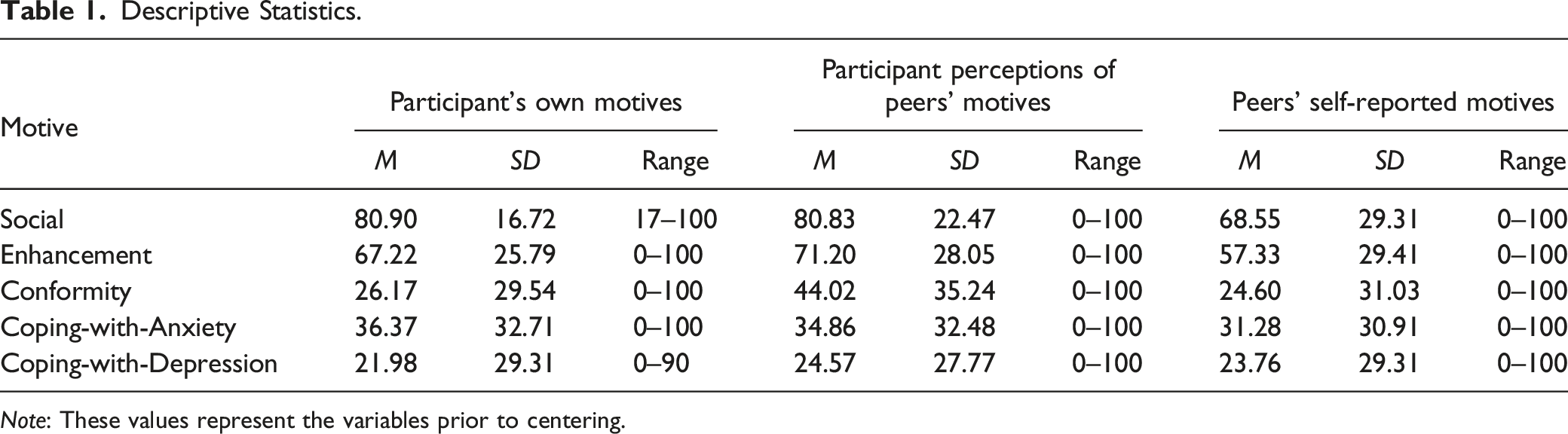
Note: These values represent the variables prior to centering.
Truth and bias analyses.
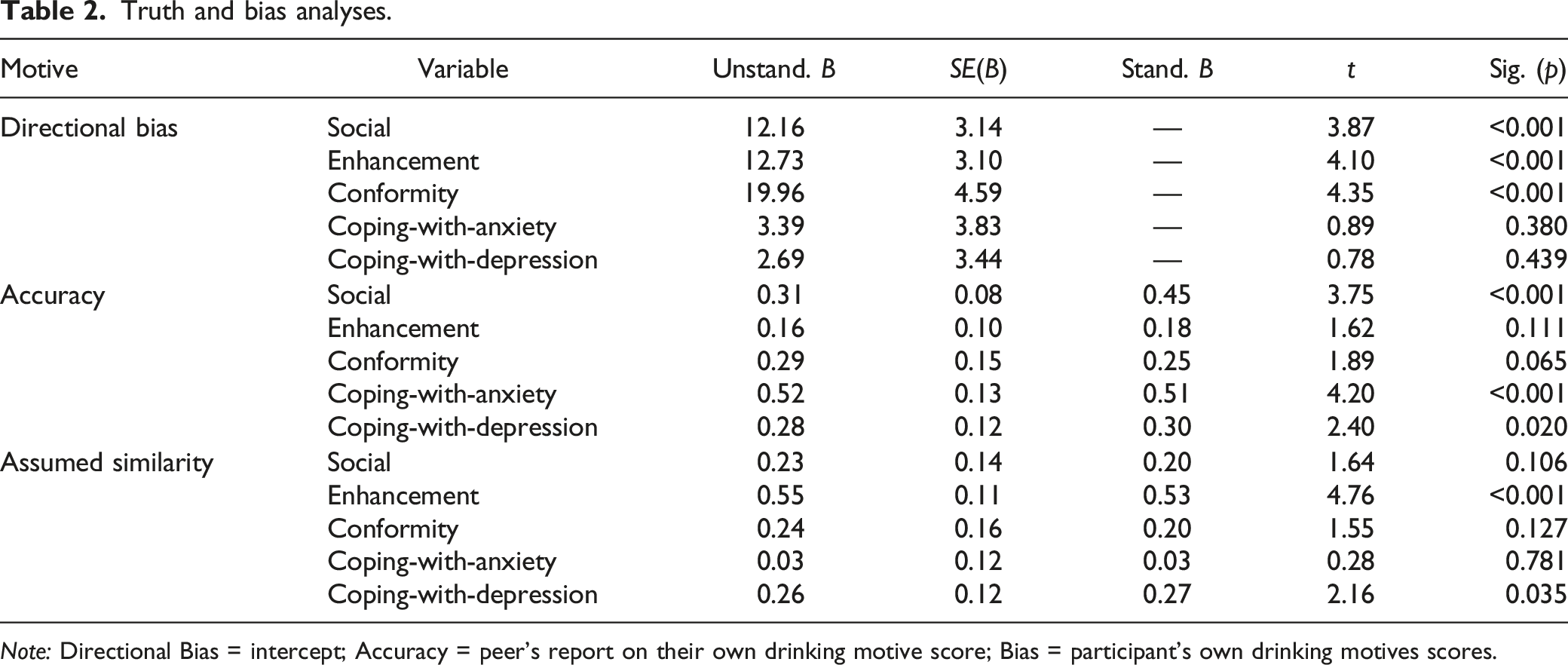
Note: Directional Bias = intercept; Accuracy = peer’s report on their own drinking motive score; Bias = participant’s own drinking motives scores.
Accuracy Effects
As indicated in Table 2, social, coping-with-anxiety, and coping-with-depression motives demonstrated a significant and positive slope for accuracy, suggesting participants’ judgements positively correlated with network members’ reports for these three motives. The standardized effect sizes for accuracy did not differ between the three motives t(113) = 1.19, p = .248 (social vs. coping-with-depression); t(113) = 1.04, p = .300 (coping-with-anxiety vs. coping-with-depression); t(113) = .39, p = .695 (social vs. coping-with-anxiety). Participants were not accurate in their perceptions of network members’ enhancement and conformity motives, as indicated by non-significant accuracy slopes.
Assumed Similarity
As seen in Table 2, enhancement and coping-with-depression motives demonstrated a significant and positive slope for assumed similarity, suggesting participants were biased towards their own enhancement and coping-with-depression motives. The standardized effect sizes for assumed similarity did not differ between enhancement and coping-with-depression t(114) = 1.60, p = .113. Coping-with-anxiety, social, and conformity motives demonstrated a non-significant slope for assumed similarity.
Comparison of Accuracy and Bias Effects
To examine whether the significant effect of accuracy was stronger than that of assumed similarity (H2.1), we compared the strength of these effects for all motives. Given we compared the slopes within a single regression model, we calculated confidence intervals for the difference between overlapping correlations (see Zou, 2007). Results indicated that judgements were pulled more strongly towards accuracy for coping-with-anxiety (95% CI = 0.05, 0.64). Judgements were not pulled more strongly towards either assumed similarity or accuracy for social (95% CI = −0.08, 0.61), enhancement (95% CI = −0.06, 0.02), conformity (95% CI = −0.29, 0.39), or coping-with-depression (95% CI = −0.31, 0.33).
Directional Bias
As demonstrated in Table 2, social, enhancement, and conformity motives demonstrated a significant positive directional bias (i.e., intercept), suggesting participants were overestimating these three motives of their peers. On average, social motives were overestimated by approximately 12 points out of 100, enhancement by approximately 13 points out of 100, and conformity by approximately 20 points out of 100. Coping-with-anxiety and coping-with-depression motives did not demonstrate a significant directional bias (i.e., intercept), suggesting participants were not systematically underestimating or overestimating the coping motives of their peers.
Moderation by Relationship Closeness
There were no significant effects of relationship closeness as a moderator (p > .05) for any motives. Relationship closeness did not interact with any significant truth or bias effects for any motives (p > .05). See Supplementan Table A1 in Supplementary Materials A for regression coefficients for main effects and interactions of relationship closeness.
Discussion
Our study significantly advances extant research, representing the first study to examine the accuracy and bias in perceptions of network members’ drinking motives,. Results indicated partial support for most hypotheses. Regarding H1, emerging adult participants were generally accurate in their perceptions of peers’ social, coping-with-anxiety, and coping-with-depression motives, as indicated by significant slopes for accuracy. This is particularly notable for coping-with-anxiety and coping-with-depression motives, as coping motives are conceptualized as internal motives (Cox & Klinger, 1988). Individuals may be able to perceive such motives, even though they may be less observable and are often associated with drinking in solitary contexts (Skrzynski & Creswell, 2020). Individuals may communicate directly about drinking to cope, as is often modeled in popular culture (Atkinson et al., 2013). Thus, for social, coping-with-anxiety, and coping-with-depression motives, participants’ perceptions are reasonably correlated with peers’ actual motives. In contrast, participants did not demonstrate accuracy when perceiving enhancement or conformity motives. Taken together, there is general evidence that certain drinking motives can be perceived accurately; however, this accuracy is not universal.
Partially in support of H2, there was evidence of assumed similarity for coping-with-depression and enhancement motives; however, assumed similarity was not present for coping-with-anxiety, conformity, or social motives. This suggests that the false consensus effect occurs for some drinking motives (Ross et al., 1977). Individuals may assume others have more similar drinking motives to their own than they really do. Assumed similarity may be more likely to occur for motives that involve changing an internal emotional state (e.g., reducing depression, increasing pleasure). Internal emotional states may be more difficult to observe than social rewards like affiliation or group acceptance. When perceiving the enhancement or coping-with-depression motives of peers, individuals may rely on their own motives as a more accessible source of information and project their motives onto others. Notably, coping-with-anxiety motives did not exhibit assumed similarity. It may be that despite being an internal motive, coping-with-anxiety motives are frequently verbalized (e.g., “I need a drink to relax”), and thus individuals have more information upon which to base their judgements. Overall, assumed similarity results suggest that most motive perceptions are not biased towards one’s own motives; however, there appear to be exceptions for certain internal motives.
In support of H3 (participants would overestimate social and enhancement motives), enhancement and social motives exhibited a systematic overestimation (i.e., directional bias). Media portrayals of emerging adult drinking include positive reinforcement motives such as social and enhancement motives (e.g., Atkinson et al., 2013), which may contribute to this overestimation. In contrast to H4 (participants would underestimate conformity and coping motives), coping-with-anxiety and coping-with-depression did not exhibit under- (or over-) estimation. Unexpectedly, conformity motives exhibited a systematic overestimation (i.e., directional bias). This latter overestimation may represent the developmental stage of participants and peers, as all participants and 76% of network members were emerging adults. Given emerging adulthood is a time of expanding social networks and identity formation (Arnett, 2005; Wrzus et al., 2013), participants may be experiencing higher pressures to fit in during this developmental stage. This context may prime participants to view other emerging adults’ drinking in new environments or with new social circles as being prompted by conformity motives, more so than it is. Overall, there is some evidence for systematic overestimation within motive perceptions, and no evidence to suggest close peers’ motives is underestimated.
Finally, with respect to relationship closeness, our results suggest that accuracy and bias of drinking motives perceptions do not depend on relationship closeness. This is notable, as one could imagine that as relationships become more intimate, perceptions of internal processes such as drinking motives would become more accurate. As on average the relationships within our sample were reported to be quite close, effects of relationship closeness may have been attenuated in the current sample due to range restriction. Additionally, the current study design may not have been ideally suited to capture an existing impact of relationship closeness, as it utilized a single item measure of relationship closeness (which may not be the ideal quantification of this variable). It is also possible that the accuracy of drinking motive perceptions does not improve with intimacy and closeness.
Implications
Our results have important implications for clinical practice, theory, and future research. Perceptions of coping-with-anxiety motives are mostly accurate, rather than biased; however, perceptions of social, coping-with-depression, conformity, and enhancement motives are all significantly impacted by bias. When comparing our results with the extant literature, our findings suggest peer drinking motives are not as accurately perceived as peer alcohol use behavior (e.g., Cox et al., 2019; Kenney et al., 2017; Mason et al., 2019; Reid et al., 2020). Given peer alcohol use can be directly observed, while peer drinking motives must be inferred or assumed, this result is not surprising; however, it also raises the possibility that other social network variables that cannot be directly observed (e.g., injunctive norms; Labrie et al., 2010) may also be misperceived.
Moreover, research suggests perceiving others to drink for enhancement or conformity reasons can indirectly influence one’s own binge drinking frequency through own motives (Bartel et al., 2021). As such, an overestimation of these motives may represent a significant vulnerability factor for risky drinking behavior. This aligns with research demonstrating that overestimating the drinking behavior of distal and close peers is a significant risk factor for frequent heavy drinking (Cox et al., 2019). Given research suggesting alcohol use overestimations can be corrected using personalized normative feedback interventions (Miller et al., 2013), an intervention correcting overestimated drinking motives may also help to reduce alcohol use.
Such an intervention has previously been developed for distal peers, and shows promise (Blevins & Stephens, 2016). This existing intervention could be adapted for close peers. In addition to comparing an individual’s motives to existing norms, receiving psychoeducation about motives, and learning non–alcohol-related ways to reach desired effects (e.g., alternative coping strategies, alternative ways to enhance experience), individuals could also be informed of a general tendency of emerging adults to overestimate certain drinking motives of close others. Clients could also test out the accuracy of their motive perceptions by conducting a survey of peers (e.g., behavioral experiment, Beck & Beck, 2011). Informing emerging adults of the inaccuracy and overestimation of motive perceptions and correcting them may function to indirectly reduce their drinking. This may occur by interrupting social learning in real time (“I’m assuming my friend is drinking for enhancement reasons, but I don’t actually know. Best not to make assumptions.”). Future research should investigate this possibility.
Notably, as perceived drinking motives in the social network have been found to predict one’s own drinking motives over time (Bartel et al., 2021), the current study suggests that social influence of drinking motives may occur regardless of the accuracy of such perceptions. In other words, drinking motive perceptions do not need to be accurate to have impact. Given this, and our findings that perceptions of peer motives are not always a fully accurate, whether participant perceptions (egocentric design) or network members’ actual motives (direct reporting design) should be studied is an important question. The study of perceptions may be a better approximation of social influence; indeed, research often suggests that perceptions of others are more important than the actual reports in several domains (e.g., alcohol use, interpersonal relationships; Fiske et al., 2010; Rodriguez et al., 2013; Rodriguez & Neighbors, 2015). For example, if a network member is perceived to be drinking for enhancement reasons, when they are truly drinking for social reasons, it will likely be the perceived enhancement reasons that exert social influence on the perceiver’s own drinking behavior. The influence of these perceived enhancement motives would not be captured if network members’ actual motives were studied exclusively, meaning a significant source of influence would be lost. As such, results from previous research utilizing direct reports to study the social influence of drinking motives might not be replicated with motive perceptions. Alternatively, replicating previous research with perceptions rather than direct reports may result in stronger or wider reaching effects due to perceptions capturing an additional source of social influence. Future research should compare the influence of perceived versus actual motives of network members on the individual’s drinking to provide further guidance on study design selection for future social network research.
Limitations
Our results are limited by several factors, many of which open doors to future avenues of research. First, our sample was predominantly female, White, and used both alcohol and cannabis; it is not clear if our results generalize to samples with more diverse characteristics. Second, our peers represent a variety of different types of network members, rather than one type (e.g., friends) and varied in same versus mixed-sex dyads. We chose to use this design because research suggests the motives of diverse network members influence use (e.g., Kehayes et al., 2019; Kehayes et al., 2021); however, it is not clear if the results are different for perceptions of certain peer groups (e.g., friends vs. romantic partners). Future research with a larger sample may be able to address this question. Third, we did not assess whether participants and their peers consumed alcohol together, which may moderate accuracy or bias effects. Future research should examine this possibility. Fourth, Truth and Bias analyses assume that self-reported motives of network members represent the “truth”; however, self-reports of own motives are influenced by factors such as social desirability, which were not controlled in the current study (Davis et al., 2010; Moeller & Crocker, 2009; van de Mortel, 2008). Participants may not be as biased as our analyses suggest but are rather accurately reporting on their network members’ motives.
Conclusions
Our study examined the accuracy and bias of perceived drinking motives of close peers. Results indicated that, while some motives are perceived accurately, most drinking motive perceptions were partly or exclusively influenced by own motives (i.e., assumed similarity bias) and/or overestimation (i.e., directional bias). As perceived motives of social network members are strong predictors of one’s own motives and indirectly predict own risky alcohol use (Bartel et al., 2021), misperception (i.e., assumed similarity, over-estimation) of peer motives may have significant consequences. Given perceptions of others’ drinking motives contain important biases, researchers must carefully consider whether to study peers’ actual motives and/or perceptions of their motives when examining peer influences in the emerging adult drinking motives field.
Supplemental Material
sj-pdf-1-eax-10.1177_21676968211065910 – Supplemental Material for Accuracy and Bias in Perceptions of why Social Network Members Drink: A Truth and Bias Approach to Drinking Motive (mis)perception
Supplemental Material, sj-pdf-1-eax-10.1177_21676968211065910 for Accuracy and Bias in Perceptions of why Social Network Members Drink: A Truth and Bias Approach to Drinking Motive (mis)perception by Sara Bartel, Simon B.Sherry, Lindsey M.Rodriguez, and Stewart H. Sherry in Emerging Adulthood
Footnotes
Declaration of Conflicting Interests
The author(s) declared no potential conflicts of interest with respect to the research, authorship, and/or publication of this article.
Funding
The author(s) disclosed receipt of the following financial support for the research, authorship, and/or publication of this article: This work was supported by the Funding for this study was provided by a Dalhousie University Department of Psychiatry Research Fund grant. The funder had no role in the study design, collection, analysis, or interpretation of the data, writing the manuscript, or the decision to submit the paper for publication.
Open Practices
The raw data, analysis code, and materials used in this study are not openly available but are available upon request to the corresponding author, in correspondence with privacy restrictions set forth by the Research Ethics Board. No aspects of the study were pre-registered.

Supplemental Material
Supplemental material for this article is available online.
Notes
Author Biographies
References
Supplementary Material
Please find the following supplemental material available below.
For Open Access articles published under a Creative Commons License, all supplemental material carries the same license as the article it is associated with.
For non-Open Access articles published, all supplemental material carries a non-exclusive license, and permission requests for re-use of supplemental material or any part of supplemental material shall be sent directly to the copyright owner as specified in the copyright notice associated with the article.
