



Abstract
Qualitative work suggests that young people’s motives for playing drinking games (DGs) extend beyond those assessed in the Motives for Playing Drinking Games (MPDG) measure. Using a mixed-methods approach, we tested whether the 7-factor model of the MPDG would emerge among university students from Australia, New Zealand, and Argentina, and whether their open-ended responses regarding their reasons for playing would map onto the MPDG subscales. Students (N = 895; ages = 18–30 yrs) completed the MPDG-33 measure and an open-ended-question regarding their reasons for playing DGs. We found support for the 7-factor model of the MPDG among students across sites. Open-ended responses revealed that students were motivated to play for a variety of reasons, some of which overlapped with the MPDG subscales while others did not. We present a conceptual model that considers motives specific to alcohol consumption in the context of a DG and reasons/possible motives for playing a DG given its specific features.
Keywords
University students are at risk for heavy drinking and negative alcohol-related consequences (Carter et al., 2017; Pilatti et al., 2017; Whatnall et al., 2020), and playing drinking games (DGs) can add to this risk. DGs are rule-based, social drinking activities that often encourage heavy alcohol consumption among participants (Zamboanga et al., 2013). A large body of research indicates that DGs participation is linked to increased alcohol consumption and related negative health outcomes (George & Zamboanga, 2018; Zamboanga et al., 2014; Zamboanga, Napper, et al., 2019; Zamboanga, Newins, et al., 2021). For example, results from a study with emerging adults in the U.S. indicated that half or more reported that they said/did embarrassing things, experienced a hangover, felt sick or vomited, had difficulties limiting drinking while playing, and/or had less energy from playing DGs (Zamboanga, Napper, et al., 2019). Given the negative consequences that can result, we need to understand the reasons university students play DGs.
Research suggests that while students recognize the health risks stemming from heavy drinking, this does not discourage them from playing DGs (George et al., 2023); the positively reinforcing social features of DGs can draw students to participate. For example, students play DGs to get to know others better, bond with people they want to become closer to, and/or compete against other players (Zamboanga, Audley, et al., 2019). DGs can also serve as an icebreaker activity during social events with casual acquaintances (George et al., 2023). As such, it is not surprising that young drinkers from different countries report having played a DG (e.g., Australian university students: 69% played at least once within 6 months, George & Zamboanga, 2018; New Zealand adolescents/emerging adults: ∼59% played at least occasionally, Bavin & Owens, 2016; Argentinian university students: 27% played at least once within 30 days, Zamboanga, George, et al. 2021 1 ; see also Zamboanga et al., 2023).
A motivational theoretical framework of alcohol use (Cooper et al., 2016; Cox & Klinger, 1988; Kuntsche et al., 2005) can help explain why emerging adults might generally consume alcohol, as well as drink in the context of a DG. According to this theoretical framework, individuals are motivated to consume alcohol to enhance and/or improve their affect. These motives to drink are informed by learned experiences, expectations about the effects of alcohol, and incentives to drink within a given situation (Cox & Klinger, 1988). People’s motives to imbibe are also likely to be influenced by the drinking norms of their cultural environment (Cox & Klinger, 1988); indeed, sociocultural norms around alcohol use can differ between countries (Gordon et al., 2012; Room et al., 2019). Cooper’s (1994) Drinking Motives Questionnaire-Revised (DMQ-R) measures drinking motives derived from the motivational theory of alcohol use. The DMQ-R consists of four distinct motives to drink including two positively reinforcing motives, social (e.g., “Because it helps you enjoy a party”) and enhancement (e.g., “Because it gives you a pleasant feeling”), and two negatively reinforcing motives, coping (e.g., “To forget your worries”) and conformity (e.g., “To fit in with a group you like”). The source of reinforcement for social and conformity motives is external whereas the source of reinforcement for enhancement and coping motives is internal. Grant et al. (2007) modified the DMQ-R (i.e., M-DMQ-R) by separating coping motives into two subscales: coping-depression (e.g., to numb one’s pain) and coping-anxiety (e.g., to lessen one’s anxiety). Drinking motives are particularly important as (a) researchers posit that they are “the final pathway to alcohol use” (Cox & Klinger, 1988, p. 178; see also Cooper et al., 2016; Kuntsche et al., 2005), and (b) studies suggest that different motives are associated with different patterns of alcohol use (Bresin & Mekawi, 2021).
In line with the motivational theory of alcohol use, research suggests that emerging adults drink alcohol in the context of a DG for social, enhancement, and conformity motives 2 (e.g., George et al., 2018, 2023; Zamboanga, Audley, et al., 2019). However, research also suggests that university students may endorse motives (or reasons) to play DGs that are not captured by the DMQ-R and M-DMQ-R. For instance, they may play DGs to compete with others, pass time, experience something new, and/or “put the moves on someone” (George et al., 2018; Johnson & Sheets, 2004; Zamboanga, Audley, et al., 2019). Qualitative studies conducted in Australia and New Zealand also indicate that university students play DGs as a way to predrink or bond with others (Dresler & Anderson, 2018; George et al., 2023). Because these findings do not align with established motives to drink, they raise questions about the distinction between a motive to consume alcohol in the context of a DG versus a reason to play a DG given the specific features of a game. For example, competition motives may influence whether students will play a DG but may not explain their motivation for drinking alcohol in the context of a DG. Thus, in this regard, DGs may serve as a means to an end for consuming alcohol or they may supplement or enhance students’ drinking experience.
The distinction between a reason to drink and a motive to drink is subtle and underlies the concepts of specificity and generality, respectively (Kuntsche et al., 2005). According to Kuntsche et al. (2005), “drinking reasons appear to imply a rational process based on practical facts, whereas drinking motives appear to be more general and also incorporate unconscious and automatized causes” (p. 845). Kuntsche et al. (2005) further noted that motives encompass items that fall under a broad drinking motive category or dimension (e.g., social, enhancement, coping, or conformity) while a “reason” to drink is more specific. Reasons to drink could be classified under a motive category or dimension, or they may fall outside these boundaries. Thus, some reasons to play DGs, such as to strengthen social bonds or reduce social tension, could be classified under motive categories (social or coping motives, respectively, in the case of these examples). In contrast, other reasons to play DGs, such as to compete with others or as a protective drinking strategy, may represent specific reasons to play a DG that do not fit a broad drinking motive category or dimension; thus, these specific reasons for playing DGs would not be classified under a motive category or dimension.
Johnson and colleagues published the first set of measures (Johnson et al., 1999; Johnson & Sheets, 2004) assessing “motives” specific to playing DGs. In a sample of U.S. university students, Johnson and Sheets (2004) found support for an 8-factor model of “motives” for playing DGs. Using a large U.S. sample of emerging adults, a follow-up study by Zamboanga, Audley, et al. (2019) found support for a 7-factor model which did not include coping and included the following subscales: competition, enhancement/thrills, conformity, social lubrication, novelty, sexual pursuit, and boredom [modified scale referred to as the Motives for Playing Drinking Games (MPDG) measure]. This 7-factor model was replicated with university students in Australia (George et al., 2018). In short, although the available research suggests that there could be seven, instead of eight “motives” to play DGs, it is not yet clear whether these do in fact represent motives or whether some “motives” (i.e., competition) better reflect reasons for game play. Our review of the DGs literature suggests that the distinction between a motive and a reason to play a DG may not be well understood. Thus, in the present study, we used an open-ended question format to query students about their reasons for playing a DG so we can better understand, and differentiate, their reasons and motives to participate in this risky drinking practice.
Like the general drinking motives literature (Bresin & Mekawi, 2021; Cooper et al., 2016; Kuntsche et al., 2005), certain “motives” identified on the MPDG are associated with different patterns of DG behaviors and related consequences. For instance, research with university students in Australia (George et al., 2018) indicated that while controlling for age, gender, and general alcohol use, motives to play DGs for enhancement/thrills were positively related to DG consumption whereas conformity, enhancement/thrills, and sexual pursuit were positively associated with negative DG consequences. Research with university students in the U.S. has also shown that enhancement/thrills was positively associated with DG frequency and consumption while playing for competition was positively related to DG frequency, even after controlling for age, gender, typical alcohol use, and general drinking motives (Zamboanga et al., 2018). In short, students who endorse certain types of motives to play DGs seem at risk for more frequent DG participation, increased consumption, and negative DG consequences. Further knowledge of university students’ motives for playing DGs across different countries can help to inform prevention and intervention programming within these populations.
Study Aims
Researchers’ and practitioners’ understanding of emerging adults’ motives to play DGs outside a U.S. context is limited in two important ways. First, the MPDG was developed and revised among university students in the U.S. (Johnson et al., 1999; Johnson & Sheets, 2004; Zamboanga, Audley, et al., 2019) with only minimal replication (Australia: George et al., 2018) in other countries. Thus, our first study aim was to test the 7-factor structure of the MPDG-333 using confirmatory factor analysis among university students from Australia, New Zealand, and Argentina. Recent qualitative findings (Dresler & Anderson, 2018; George et al., 2023) with Australian and New Zealand university students regarding motives for playing DGs that are not assessed by the MPDG served as the impetus for our second study aim. We conducted a qualitative analysis to (a) identify other reasons or motives to play DGs among university students from Australia, New Zealand, and Argentina and, for the first time, (b) formulate a conceptual model (see Figure 1) that differentiates students’ motives to drink in the context of a DG from their reasons to play a DG. Conceptual model of motives for consuming alcohol in the context of a drinking game and reasons or possible motives for playing drinking games. Note. This figure conceptually displays the results of qualitative analyses aimed at identifying reasons for playing drinking games that may underlie motivations to consume alcohol in the context of a drink game. The left half of the figure shows motives for consuming alcohol in the context of a drinking game. The numbers appearing in superscripts indicate with which of the four general drinking motives (Cooper et al., 1994) each motive for consuming alcohol during a drinking game best corresponds: 1 = enhancement, 2 = social, 3 = coping, and 4 = conformity. The right half of the figure shows reasons for playing drinking games that may or may not (with further research) underlie motives to play drinking games; for example, a desire to compete against others may influence whether someone will play a drinking game but may not explain their motivation to drink alcohol in the context of a drinking game.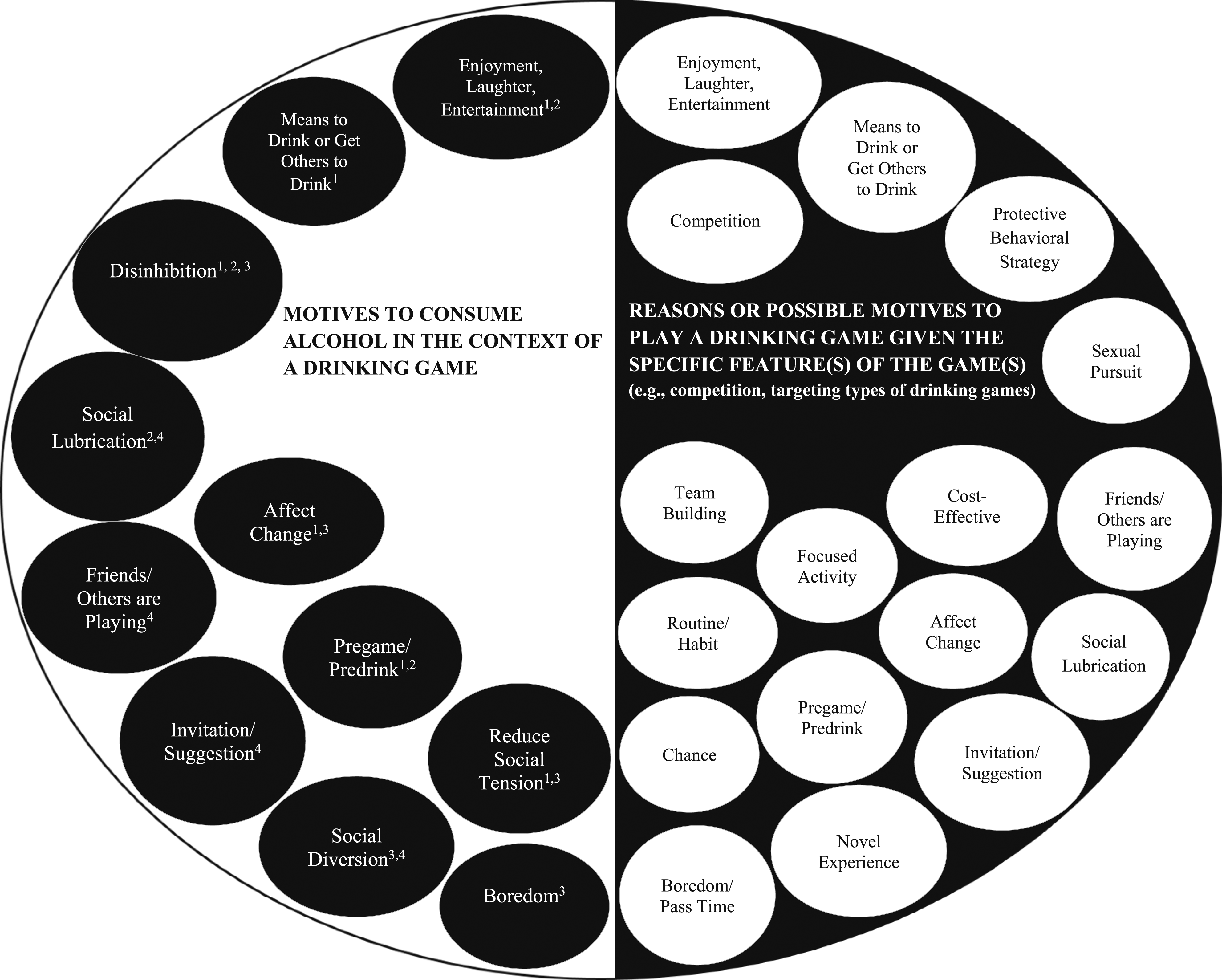
We focused our investigation on Australia, New Zealand, and Argentina because Australia and New Zealand are geographically distant and culturally different with respect to cultural customs and language relative to Argentina. Despite these cultural and geographical differences, these countries also share features that may impact alcohol use among university students. For instance, these three countries share a minimum legal age for purchasing alcohol (i.e., 18 years) and a lack of fraternities/sororities at their postsecondary institutions. These shared and unique elements might influence alcohol drinking practices and motives to drink alcohol. Indeed, past research indicated that drinkers from these countries differ in their experience of alcohol-related consequences (Graham et al., 2011). It is important and needed to study alcohol-related variables across different countries and cultures. The present study aimed to address the limited research in this area. It is conceivable that university students’ motives or reasons to play DGs, which can be influenced by the cultural drinking norms of their environment (Cox & Klinger, 1988), differ between these sites. Thus, differences in the factor structures of the MPDG and their reasons for playing DGs might be expected between Argentinean students and those from Australia and New Zealand. Given the geographical proximity and cultural similarities between Australia and New Zealand, similar factor structures of the MPDG for playing DGs might be expected between students from these sites.
Method
Participants and Procedures
Descriptives.
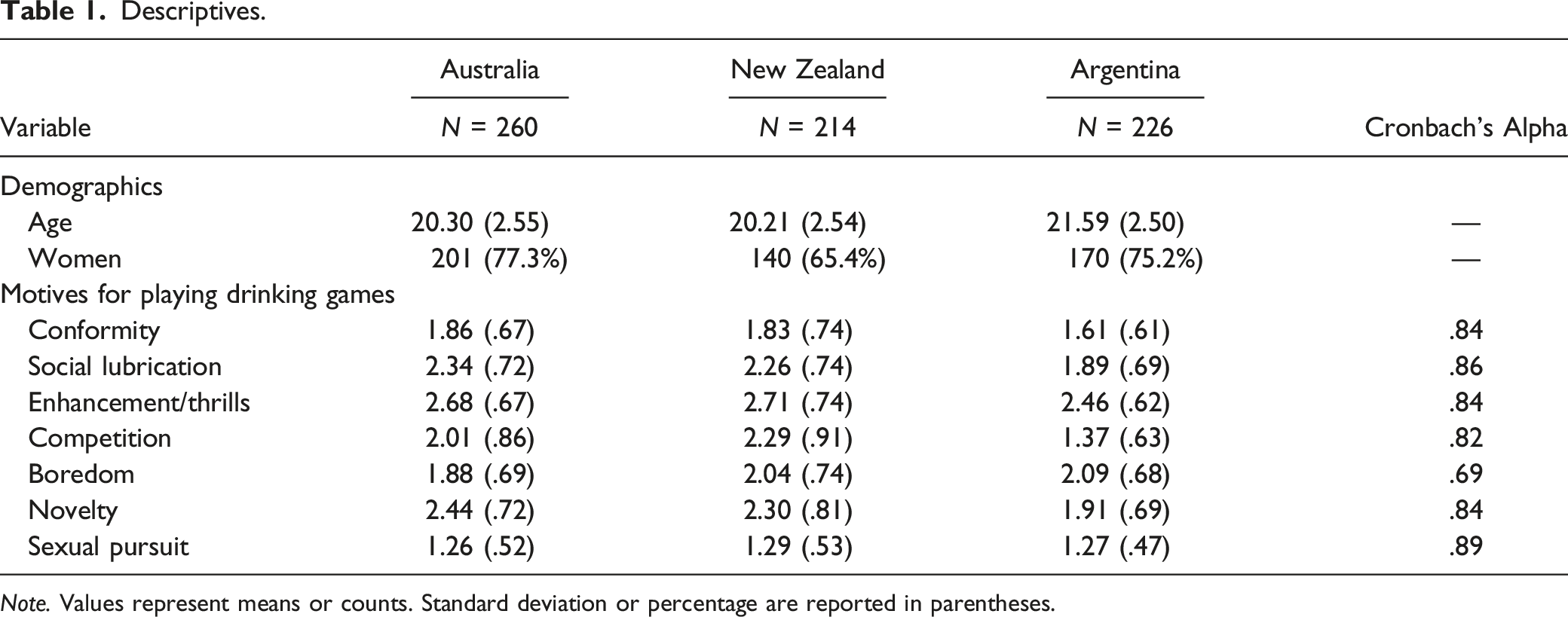
Note. Values represent means or counts. Standard deviation or percentage are reported in parentheses.
Measures
Motives for Playing Drinking Games (MPDG-33) 3
Students reported the importance (1 = not at all important, 2 = somewhat important, 3 = moderately important, 4 = very important) of each motive in their decision to play DGs on the MPDG (Zamboanga, Audley, et al., 2019). Descriptives for each subscale are provided in Table 1. In Argentina, the original English version was translated into Spanish by three psychologists who were proficient in English and Spanish, and knowledgeable of the scale’s rationale. Versions were compared and subjected to discussion until consensus was reached. A Spanish–English bilingual psychologist back-translated this version (Spanish to English). All experts belonged to the same Argentinian geographic and ethnic community as the present sample.
Reasons to Play Drinking Games
Using an open-ended response format, we asked participants to indicate their top three reasons for playing DGs.
Analytic Approach
Quantitative Analyses
Considering the number of items (33) and factors (7) that constitute the current version of the MPDG, the country-specific sample sizes available for the present study are likely insufficient to support a formal assessment of metric (cross-group equivalence of factor loadings) or scalar (equivalence of factor loadings and intercept/threshold parameters) invariance across countries. Instead, multiple group ordinal factor analyses were conducted using Mplus 8.8 (Muthén & Muthén, 2018) to evaluate the tenability of a model with the same factor structure across groups, also known as configural invariance (Horn & McArdle, 1992). The multi-group ordinal Confirmatory Factor Analysis (CFA) was specified based on the factor structure identified by previous research (Zamboanga, Audley, et al., 2019), using the default probit link function and weighted least-squares mean and variance adjusted estimator.
Qualitative Analyses
Responses from participants were first condensed while maintaining the meaning of the participants’ responses (Erlingsson & Brysiewicz, 2017). Of note, open-ended responses from the Argentinian site were provided in Spanish and translated into English by the PI from the respective site and revised by one undergraduate student who is bilingual in English and Spanish. Three coders (Zamboanga, Ford, and Bacon) with familiarity in drinking motives research then used a hybrid coding approach (Fereday & Muir-Cochrane, 2006) to determine the extent to which the open-ended responses for participants’ self-reported reasons to play DGs mapped onto existing MPDG subscales while also allowing for creation of new codes. The initial codebook was developed a priori based on the seven MPDG subscales (Zamboanga, Audley, et al., 2019). Coders applied the initial codebook to a randomly selected subsample of 10 responses to make appropriate edits, which was then reviewed on 10 more responses to ensure reliability above 85%. Following the initial reviews of the 10 responses, responses were coded by all 3 coders for the presence of the MPDG subscales and any new codes. All discrepancies were discussed until consensus was met.
New codes that arose were discussed with other coauthors/project collaborators (George, Olthuis, Pilatti, and Dresler) with research expertise in motives for playing DGs and refined accordingly. Following this task, the same coders also mapped the open-ended responses for reasons to play DGs onto the subscales of the DMQ-R (Cooper, 1994) and M-DMQ-R (Grant et al., 2007) to determine the extent to which the responses for playing DGs matched onto motives to drink alcohol. This was done in an effort to address the distinction between motives to consume alcohol (measured by the DMQ and M-DMQ-R) while playing DGs versus reasons for playing DGs that may be unrelated to drinking. For example, the research team noticed that competition motives may influence whether someone will play a DG but may not explain their motivation for consuming alcohol. In this sense, DGs may just be a means to an end for drinking alcohol and/or a way to supplement/enhance students’ drinking experience. The full research team then met again to discuss, and agree upon, the updated codes which were applied to the data.
Results
Quantitative Findings
Standardized Loadings From Multiple-Group Confirmatory Factor Analysis of the Motives for Playing Drinking Games (MPDG-33) Measure.
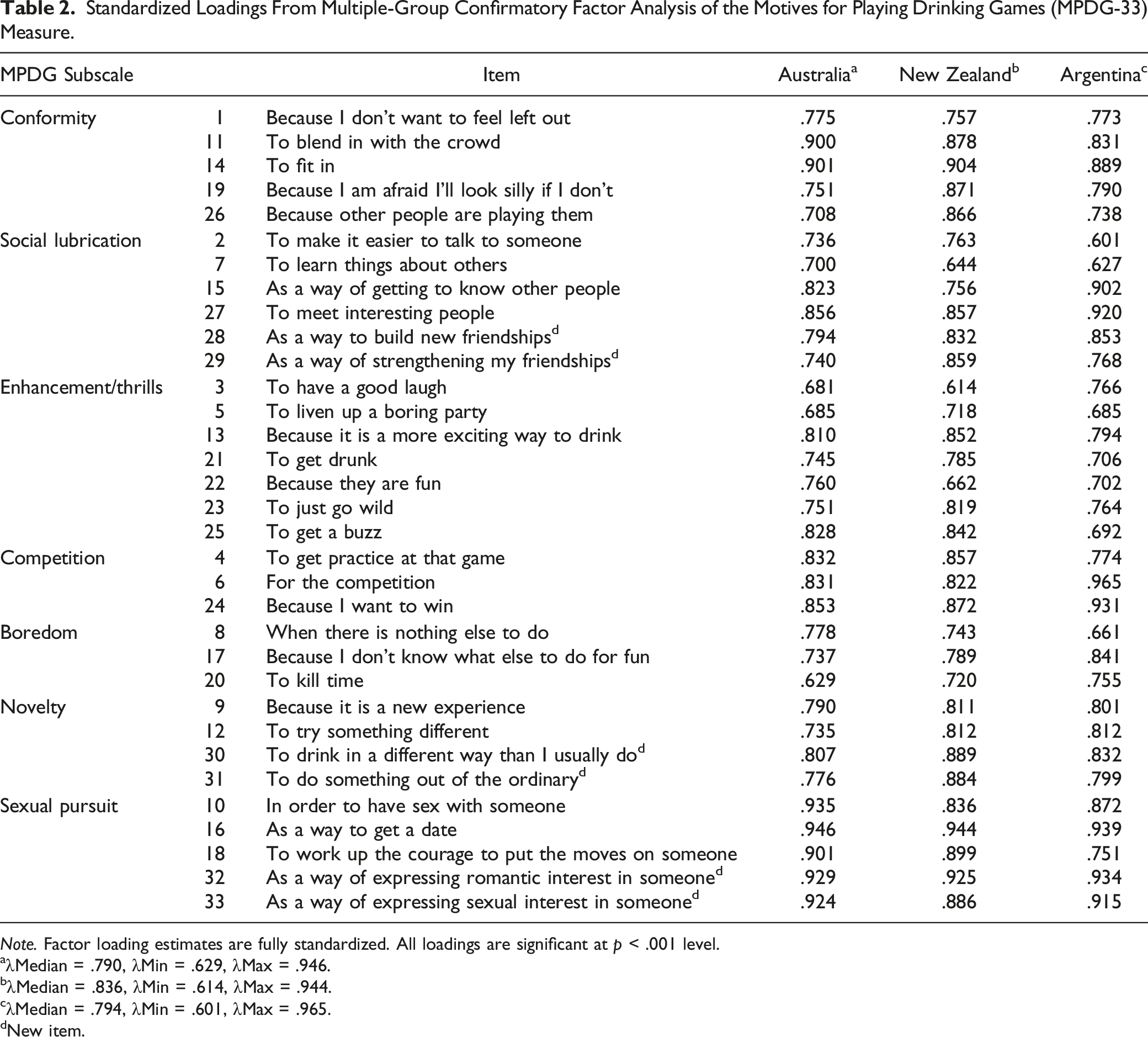
Note. Factor loading estimates are fully standardized. All loadings are significant at p < .001 level.
aλMedian = .790, λMin = .629, λMax = .946.
bλMedian = .836, λMin = .614, λMax = .944.
cλMedian = .794, λMin = .601, λMax = .965.
dNew item.
Qualitative Findings
A large proportion (88.3%) of participants’ responses aligned with the seven subscales on the MPDG. The most frequently endorsed subscale across each country was Enhancement/Thrills (53.6%; nNZ = 359, nARG = 435, nAUS = 487; e.g., “they’re fun”), followed by Social Lubrication (17.8%; nNZ = 109, nARG = 154, nAUS = 163; e.g., “liven up a party”). The remaining subscales were endorsed less frequently: Conformity (5.7%; nNZ = 19, nARG = 73, nAUS = 44; e.g., “peer pressure”), Competition (3.9%; nNZ = 23, nARG = 17, nAUS = 52; e.g., “enjoy the competition”), Novelty (2.3%; nNZ = 9, nARG = 23, nAUS = 23; e.g., “different ways to drink”), and Sexual Pursuit (.2%; nNZ = 3, nARG = 0, nAUS = 1; e.g., “sexual interest”).
Overview of Codes, Descriptions, and Sample Responses From a Qualitative Analysis of Participants’ Motives or Possible Reasons for Playing Drinking Games (DG).
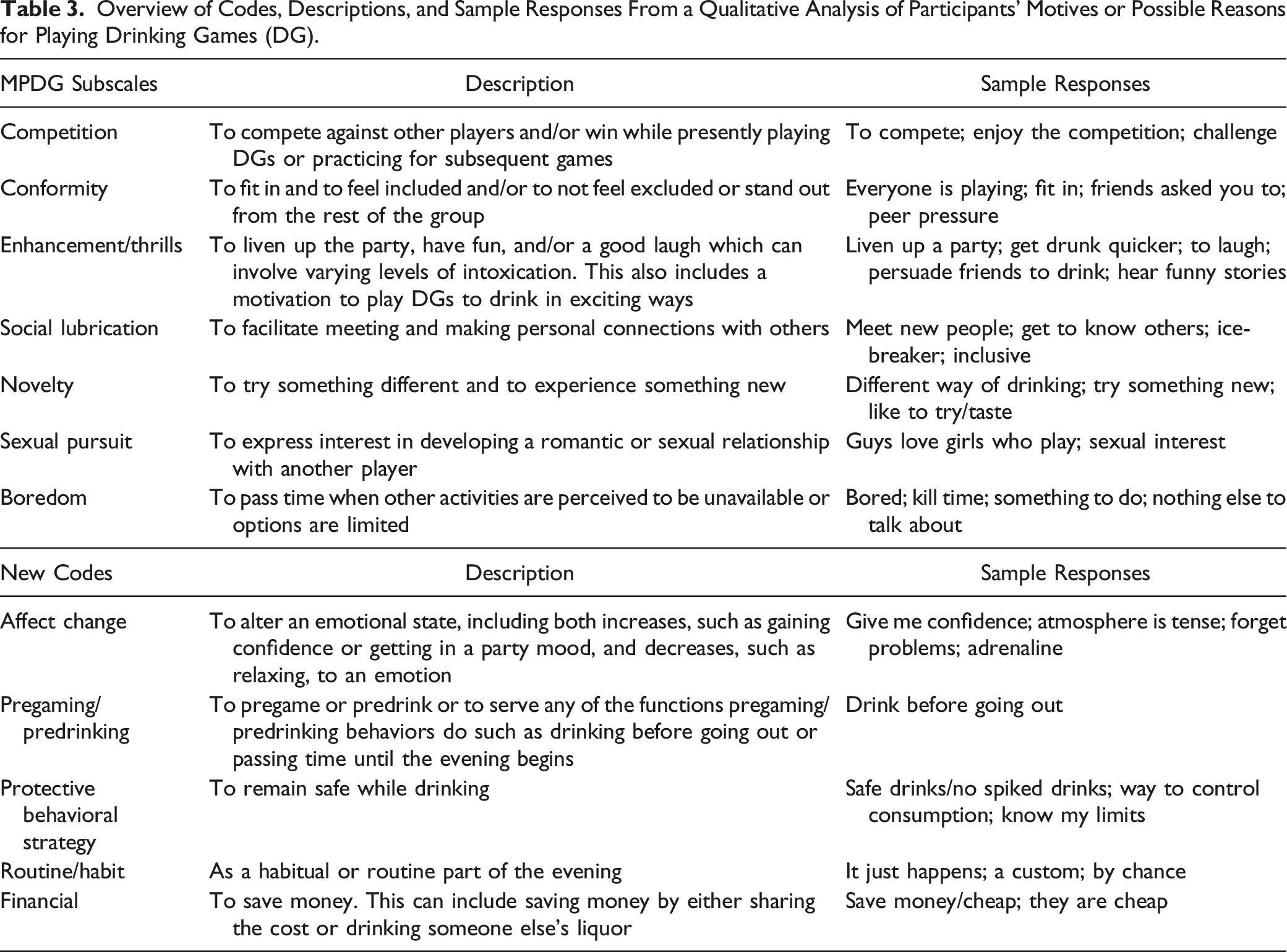
Mapping open-ended responses onto existing motivational theories of alcohol use revealed that almost half of the responses were reasons for playing DGs (48.8%; e.g., “something to do”, “adrenaline”, “everyone is playing”) rather than motives for consuming alcohol as conceptualized by the DMQ-R or the M-DMQ-R (i.e., coping, conformity, social, enhancement).
Discussion
The purpose of this study was to further researchers’ and practitioners’ understanding of Australian, New Zealand, and Argentinean university students’ motives to play DGs and to delineate motives from reasons for participation. Our quantitative analysis showed new evidence to support the 7-factor structure model of the MPDG-33 among university students from New Zealand and Argentina. Consistent with prior work (George et al., 2018), we also replicated this 7-factor structure among Australian students. Although our sample size precluded us from conducting a formal examination of metric or scalar invariance of the MPDG-33, findings suggest that configural invariance was met for this measure across all sites. Most students’ open-ended responses regarding their reasons for playing DGs also aligned with the seven MPDG subscales with many reporting Enhancement/Thrills as the most common motive for playing DG, followed by Social Lubrication. Conformity, Competition, and Novelty were endorsed less frequently, and Sexual Pursuit was the least reported motive to play DGs. To some extent, the former findings align with other work with university samples from non-U.S. countries which indicated that a higher proportion of students reported playing “to get drunk” or “to meet people” as a “very important” reason to play DGs, especially compared to other reasons (i.e., “to get someone else drunk”, “to control others”, “peer pressure”) to play DGs (McInnes & Blackwell, 2021). Based on our findings and prior work (George et al., 2018), it appears that the MPDG-33 can be used with Australian students. While further psychometric studies on the MPDG-33 with New Zealand and Argentinian students are needed, our preliminary results suggest that this measure can also be used with university students from these countries.
While a substantial proportion of participants’ qualitative responses aligned with the pre-existing MPDG subscales, five additional codes emerged from the qualitative data suggesting additional reasons for playing DGs that are not captured by the MPDG. One of these codes was Affect Change which entailed playing DGs to increase or decrease a participant’s affect (e.g., loosen up, feel more confident, relax/destress, and/or to get in a party mood). These motives reflect a desire to improve or enhance one’s emotional state and as such, are consistent with Cox and Klinger’s (1988) motivational framework of alcohol use. Students also reported that they played DGs as a way to pregame/predrink or to pass time before the night began. Drinking before going out (i.e., pregaming/predrinking) has been well-documented in studies conducted with emerging adult samples in Australia (George et al., 2023), New Zealand (e.g., Dresler & Anderson, 2018), and Argentina (e.g., Pilatti & Read, 2018). It is worth noting that the Affect Change motives that we identified in the present study appear to overlap with certain items (e.g., loosening up/relaxing before going to a social event/gathering; increase one’s self-confidence before going out) on the Preparty Motives Inventory (LaBrie et al., 2012), the Predrinking Motives Questionnaire (Labhart et al., 2017), the Pregaming Motives Measure (Bachrach et al., 2012), and the Argentinean-version of the Pregaming Motives Questionnaire (Pilatti & Read, 2018). In situations where emerging adults and university students are playing DGs while pregaming/predrinking (e.g., Ford et al., 2022; Hummer et al., 2013), it is possible that their motives or reasons to play DGs or pregame/predrink may intersect. Thus, when assessing students’ motives or reasons for playing DG, researchers and practitioners could also consider motives for pregaming/predrinking as these two risky drinking practices can co-occur.
Playing DGs as a protective drinking strategy also emerged as a reason for playing DGs from qualitative data. Students reported that the drinks they consumed while playing a DG were safe (e.g., no spiked drinks) and participating allowed them to learn their limits and control their drink consumption. Similar findings were reported in a recent qualitative study among Australian university students who acknowledged that they were unaware of their alcohol tolerance but, over time, consuming alcohol in the context of a DG allowed them to become more cognizant of their drink tolerance and limits (George et al., 2023). This perception conveyed by students should, however, be interpreted in the context of the well-established link between DGs participation and increased alcohol consumption and negative drinking consequences (Zamboanga, Newins, et al., 2021), and prior qualitative work with Australian young women who indicated that they experienced difficulties keeping track of how much they drink while playing DGs given the fast rate at which DGs are played (Murugiah, 2014). To help reduce students’ risk for DGs harm, practitioners could leverage students’ perceptions of the protective function of playing DGs by encouraging them to use protective behavioral strategies (e.g., limiting one’s drinks) in the context of a DG (see Stephens et al., 2022).
Finally, qualitative findings also identified Routine/Habit and Financial reasons for DG participation. Regarding Routine/Habit (i.e., playing due to custom or chance factors), perhaps students find that repeated exposure to and practice with playing DGs helps reduce the amount of effort needed to make group gatherings flow more smoothly and as such, this practice becomes built into their typical get-together protocol. Over time, this may lead to perceived norms whereby the practice is accepted and not questioned. Financially, students reported playing DGs to save money by sharing drink costs and/or consuming alcoholic beverages provided by others. Given that emerging adults also report cost as one of their reasons or motives for pregaming/predrinking (Foster & Ferguson, 2014; Labhart et al., 2017; O’Neil et al., 2016; Pilatti & Read, 2018), university students may use DGs as a method of pregaming/predrinking so they can save money.
Taken together, the additional identified reasons (or potential motives) beyond the MPDG suggests that the MPDG does not fully capture the motives or specific reasons for playing DGs among students from Australia, New Zealand, and Argentina. Researchers could modify and improve the MPDG by (a) including items that reflect the five additional motives/reasons that emerged in the present study, and (b) testing its psychometric properties with a sample of Australian, New Zealand, and Argentinean university students and other populations of interests. We developed a conceptual model (Figure 1) to serve as a roadmap to modify the MPDG or curate a more comprehensive DG motives measure which could include reasons to play a DG due to the specific feature(s) of the game.
Proposed Conceptual Model
We incorporated the knowledge obtained from our qualitative findings to create a conceptual model that differentiates between university students’ (a) motivations to drink in the context of a DG, and (b) reasons (that may be a DG motive with further research) to play a DG given the specific features of the game [i.e., even competition (e.g., beer pong/die), communal (e.g., Never Have I Ever), targeted/skills (e.g., quarters) games; LaBrie et al., 2013]. On the left side of Figure 1, we note that specific motives to consume alcohol in the context of a DG may underlie the four broad motivations to drink alcohol on the DMQ-R (Cooper, 1994). For example, playing DGs to reduce social tension, alleviate boredom, and/or to feel more disinhibited may underlie drinking to cope, particularly in social settings. Students may also participate in a DG because (a) their friends or other people are playing them and they were invited to play, (b) it was suggested by someone, and/or (c) they perceive DGs as an inclusive group activity. These reasons to play a DG may underlie drinking to conform. Finally, playing DGs as way to drink and become disinhibited, get others to drink, and/or as a method to pregame/predrink may underlie enhancement drinking motives.
The right side of Figure 1 focuses on students’ reasons or possible motives (with further research) to play certain types of DGs due to the specific feature(s) of the game. For example, students may play DGs to compete against others and participate in a team building activity by playing an even competition game (e.g., beer pong; LaBrie et al., 2013). Others may play DGs because they are novel, enjoyable, and entertaining. By definition, DGs are a social activity (Zamboanga et al., 2013) and as a result, people may also be motivated to play a DG with acquaintances or friends in order to get to know people better or as a means to strengthen their bonds with people they already know. Some students may play DGs because participating in certain types of DGs serves a protective function (e.g., Never Have I Ever whereby players can keep a close eye on their drinks) or is cost-effective (e.g., everyone contributes to the drink costs or the host provides free drinks), while others might play different types of DGs due to chance factors (e.g., people at a party were playing them). As shown in Figure 1, other students may play a targeting/skills game (e.g., quarters; LaBrie et al., 2013) so they can select someone to drink when given the opportunity to do so. Some may play a DG because they see it as an activity that requires everyone to focus on a specific task (e.g., listen to the lyrics of a song while playing a music DG). This may appeal to students who seek to divert their attention away from their social environment (possibly due to awkward social experiences) to the specific game task (Kilmer et al., 2014). Finally, some may play a targeting/skills game as a means to get someone to drink whom they are sexually attracted to.
In summary, students play certain types of DGs for a variety of reasons, and these may reflect possible motives for game play. Indeed, some of these reasons overlapped with the seven subscales on the MPDG, although some did not (i.e., the five additional dimensions). Given the possibility that some students may be motivated to play DGs given the specific features of the game itself (e.g., targeting/skills games, even competition games; LaBrie et al., 2013), game type should be considered in future modifications of the MPDG or the development of a new DG motives measure. Perhaps moving forward, researchers could consider conducting higher order factor analysis and testing whether students’ reasons to play DGs load onto broad motives to drink (e.g., DMQ-R, Cooper, 1994; M-DMQ-R, Grant et al., 2007) and motives to play DGs (e.g., MPDG; George et al., 2018; Zamboanga, Audley, et al., 2019).
Study Limitations and Conclusions
The current findings should be considered in light of several limitations. Our cross-sectional data consisted of convenience samples of students at a single university in each country. We also recognize the limitations involved in using self-report methods to gather data (e.g., accuracy in memory recall) and that asking students to list their reasons for participating in DGs may not necessarily have reflected their motives for game play. However, the present study contributes to the alcohol literature by advancing researchers’ and practitioners’ understanding of university students’ motives for playing DGs by showing new evidence to support the 7-factor model of the MPDG-33 among university students from New Zealand and Argentina, and replication of the 7-factor model with Australian students (George et al., 2018). Students from these countries also reported reasons and potential motives for playing DGs not currently assessed by the MPDG. As such, the present findings highlight the need to expand researchers’ and practitioners’ conceptualizations of DG motives by considering motives specific to alcohol consumption in the context of a DG, as well as reasons or possible motives for playing a DG for its specific features (e.g., to compete against others; select others to drink). Participants provided information regarding their reasons for playing DGs via open-ended responses to an online survey rather than an interview. Thus, future qualitative studies could employ interview-based methods designed to differentiate students’ motives to consume alcohol in the context of a DG from their reasons to play certain types of DGs given their specific features. We hope that researchers will build on our study and utilize the information presented in our conceptual model to develop a more comprehensive way to assess DG motives while also providing clarity in the distinction between motives and reasons for alcohol consumption to help guide clinical practice.
Supplemental Material
Supplemental Material - Why Do University Students From Australia, New Zealand, and Argentina Play Drinking Games? A Mixed-Method Cross-Country Study
Supplemental Material for Why Do University Students From Australia, New Zealand, and Argentina Play Drinking Games? A Mixed-Method Cross-Country Study by Byron L. Zamboanga, Kayla Ford, Amanda M. George, Miller Bacon, Janine V. Olthuis, Robert E. Wickham, Angelina Pilatti, Kathryne Van Hedger, and Emma Dresler in Emerging Adulthood.
Footnotes
Authors’ Note
Inquiries concerning the quantitative statistical analyses for this study should be addressed to Dr Robert E. Wickham (
Declaration of Conflicting Interests
The author(s) declared no potential conflicts of interest with respect to the research, authorship, and/or publication of this article.
Funding
The author(s) disclosed receipt of the following financial support for the research, authorship, and/or publication of this article: A Fulbright Australia Scholar Award (funded by the University of Canberra) to Prof. Byron L. Zamboanga supported his contributions to this article.
Transparency and Openness Statement
The data, analysis codes, and coding manual used in this study are not openly available but could be made available upon request to the corresponding author and approval from all co-authors.

Supplemental Material
Supplemental material for this article is available online.
Notes
Author Biographies
References
Supplementary Material
Please find the following supplemental material available below.
For Open Access articles published under a Creative Commons License, all supplemental material carries the same license as the article it is associated with.
For non-Open Access articles published, all supplemental material carries a non-exclusive license, and permission requests for re-use of supplemental material or any part of supplemental material shall be sent directly to the copyright owner as specified in the copyright notice associated with the article.
