



Abstract
Findings from interviews with 15 emerging adults (M age = 29.00, SD = .37) subjected to bullying victimization as children and suffering from poor psychological health in emerging adulthood revealed experiences of a very long duration of victimization, coping through adaptation to the bullying, and experiences of not receiving help from school personnel. Many participants described experiences of depression, anxiety, and even suicidal thoughts during the school-years victimization. They perceived several direct long-term consequences of the victimization in emerging adulthood: feelings of insecurity; actively avoiding social situations; an identity formed into viewing oneself as worthless; and body-image problems. Additionally, many of them still felt anger towards school personnel who they remembered as not stopping the victimization. A longitudinal and prospective design enabled insights into victims’ experiences of both the childhood victimization as well as perceived long-term consequences on their emerging adulthood – and into how the victims experience that these aspects might be related.
Keywords
Introduction
Consequences of bullying victimization during the school years have been found to persist and lead to problems with mental health and social relationships in adulthood (see Arseneault, 2018; Wolke & Lereya, 2015, for reviews). However, previous studies have not investigated the impact of childhood victimization on the specific characteristics of the developmental phase of emerging adulthood, despite the possible severe consequences of such experiences at a time of life characterized by heightened instability (Arnett et al., 2014), weakened social and institutional structures (Arnett, 2011), new relationships, self-centredness, and identity exploration (Henin & Berman, 2016) – all aspects that could be affected by the impact of earlier victimization.
Bullying is a form of aggression that is intentional, targets a less powerful individual, and occurs repeatedly (Olweus, 1993). Long-term consequences of these experiences have been found in a range of negative outcomes in adulthood, such as depression (Lund et al., 2009; Takizawa et al., 2014; Ttofi et al., 2011), agoraphobia (Copeland et al., 2013), anxiety (Copeland et al., 2013; Gibb et al., 2011; Stapinski et al., 2014; Takizawa et al., 2014), panic disorder (Copeland et al., 2013), suicidality (Takizawa et al., 2014), lack of social relationships (Takizawa et al., 2014; Wolke et al., 2013), and increased risk of adult psychiatric disorders (Sourander et al., 2016). Other studies have also indicated that individuals who were subjected to victimization in childhood experience poorer body image, which also predicts higher levels of disordered eating (Gattario et al., 2019) as well as higher levels of body shame as adults (Lunde & Frisén, 2011).
In their review of the field of study on the long-term effects of victimization, McDougall and Vaillancourt (2015) conclude that there seem to be several different, both direct and indirect, paths from victimization to adult outcomes; they also suggest making better use of qualitative studies in order to learn more about how, and why, some individuals subjected to school-years victimization end up with negative long-term effects while others do not. The few studies of long-term consequences of childhood bullying victimization that have used qualitative methods have certainly provided more in-depth understanding of, for example, social avoidance (Carlisle & Rofes, 2007; deLara, 2019; Pabian & Vandebosch, 2019; Thornberg et al., 2013), feelings of insecurity (Pabian & Vandebosch, 2019; Thornberg et al., 2013), and body-image problems and eating disorders (deLara, 2019) as outcomes later in life. However, these studies have relied on retrospective data, used convenience sampling, and have not used a predetermined definition of bullying, and their participants have been of different ages. For instance, in the study by Carlisle and Rofes (2007), the age range was 27–57 years. Moreover, none of these studies has investigated the long-term consequences of childhood victimization on those characteristics that are specific to the developmental phase of emerging adulthood. Overall, studies of the long-term effects of victimization point to a connection between school-years victimization and several negative outcomes in adulthood. However, the different findings of both direct and indirect paths between victimization and adult outcomes, the underused possibilities of qualitative studies, and the methodological shortcomings in the qualitative studies that do exist suggest that qualitative inquiry using purposive sampling from a longitudinal study including individuals reporting having been bullied at the age of 10 and having the poorest psychological health in emerging adulthood would enable enhanced knowledge on the specific negative, long-term consequences of victimization. The present study therefore focuses on the stories of individuals who were victimized in childhood and suffer from poor psychological health as emerging adults.
From an international perspective, Sweden (where this study is set) has among the lowest prevalences of both bullying and bullying victimization (Craig et al., 2009; World Health Organization. Regional Office for Europe, 2016). However, in recent years the Public Health Agency of Sweden (2018) has indicated an increase in the frequency of both. Although Swedish schools are obligated by law (SFS, 2010:800) to prevent harassment and bullying, only a fourth of former victims reported that school personnel were responsible for ending the victimization (Frisén et al., 2012). Ending victimization is not only essential in relation to the immediate experience of bullying; studies on the long-term effects of victimization also indicate that a longer duration of victimization potentially leads to a worsening of the negative long-term effects (Wolke et al., 2013). However, as not all victims of childhood bullying victimization end up with negative long-term consequences (see, McDougall & Vaillancourt, 2015, for a review), possibly due in part to resilience factors (Lin et al., 2020; Schoeler et al., 2018 ), understanding the long-term effects of victimization necessitates a deeper consideration of the experienced victimization itself (see, Salmivalli, 2018, for a review). Previous qualitative studies on the long-term effects of victimization suggest that being labelled ‘different’ as well as being socially excluded can lead to a social process whereby internal victimization develops as a result of the external peer victimization, a process that lingers after the victimization has ended, which may be an important aspect to consider in order to understand the processes involved in the long-term effects (Thornberg et al., 2013). Other studies have found similar processes in which being called names, being laughed at, and being excluded lead to self-blame (Pabian & Vandebosch, 2019), and that experiences of bullying force the victim to socially distance themselves from peers (deLara, 2019), contributing to negative long-term effects. However, although these experiences have been connected to negative long-term outcomes, their impact on the specific developmental phase of emerging adulthood is not known. Furthermore, it has been stressed that victimization experiences need to be understood from a developmental perspective (Troop-Gordon, 2017), which then also ought to be applied to the process of long-term effects, whereby emerging adulthood is the first developmental period after school (and hence possible victimization has ended) and development is dependent on identity exploration, instability, increased self-focus, and a feeling of being in-between (Arnett, 2000, 2007), processes at risk of being affected by victimization.
For many, the developmental period of emerging adulthood, if resolved successfully, leads to the establishment of adulthood markers of accepting responsibility for one’s self, making independent decisions, and becoming financially independent (Arnett, 2011). However, the goal of achieving adulthood via the passage through emerging adulthood also requires dealing with a time of increased mental health problems (Arnett et al., 2014) and navigating the development of one’s self in relation to others as a social cognitive process (Lapsley & Woodbury, 2015). Additionally, the importance of identity exploration during emerging adulthood (Arnett, 2000) and the strong connection between identity and psychosocial functioning in this life phase (Schwartz et al., 2011; Wängqvist & Frisén, 2011) heighten the risk of one’s identity development being stalled in an intertwined process of identity and mental health problems (Kaufman et al., 2014; Klimstra & Denissen, 2017; Verschueren et al., 2019). However, the mental health of individuals in this period of life is not well understood in the context of its specific developmental processes (Tanner, 2015) and is thus often misinterpreted by healthcare providers (Arnett et al., 2014), treating emerging adults either as adolescents and hence underestimating their own capacities, or as young adults and hence misinterpreting normal developmental processes like feelings of instability and identity exploration as mental health problems. As the possible impact of negative long-term outcomes of school-years victimization might influence the developmental processes in emerging adulthood, and as there is also a significant lack of psychological assessment and clinical practice guidance in relation to experiences of long-term consequences of bullying victimization (Samara et al., 2017), emerging adults with victimization experiences who suffer from poor psychological health comprise a group in need of further study. Additionally, emerging adulthood as a developmental period needs to be understood in its societal context (Arnett, 2011), whereby the possible negative outcomes of victimization have to be identified. In all of Europe, it is young people in Sweden who leave home the earliest, and a well-developed social welfare system enables free university studies, a study allowance, and beneficial study loans (Wängqvist & Frisén, 2015). However, it has also been suggested that the Swedish welfare system produces emancipated and autonomous individuals and high individualistic values (Trägårdh, 2018), a societal context that potentially leads to increased loneliness in emerging adulthood, especially if one already struggles with psychological distress and problems with social relations, which then coincides with a period in life when institutional and social structures are already weak (Arnett, 2011) and social isolation increases, for some due to a substantial part of their leisure time being devoted to media and technology (Henin & Berman, 2016). As social networks and close relationships are vital parts of navigating the developmental period of emerging adulthood (Barry et al., 2015), the socially avoidant behaviour (Carlisle & Rofes, 2007) and lack of social relationships (Takizawa et al., 2014) found to be long-term consequences of childhood bullying victimization might be especially hard to cope with in a highly individualistic, and potentially lonely, society like Sweden.
The aims of this study were to explore how emerging adults with experiences of bullying victimization during their school years and suffering from poor psychological health as emerging adults describe their experiences of victimization, as well as whether, and if so how, these experiences are perceived to have had consequences for them in their lives.
More specifically, the study investigated the following research questions: Do individuals who were subjected to victimization during their childhood school years and who have poor mental health today as emerging adults perceive a direct connection between the school-years bullying and the poor psychological health they suffer from today? How did they experience their victimization when the bullying occurred? What perceived consequences do they describe that the victimization has had on their lives as emerging adults?
Method
Participants
The present study is part of a Swedish longitudinal research project investigating experiences of bullying MoS (Mobbning och Skola [Bullying and School]) which was initiated in 2000 with a sample of 967 ten year olds (520 girls and 447 boys) from schools in different socio-economic areas in the city of Gothenburg (second largest city in Sweden). Since the first data collection there has, so far, been six additional waves in the study, at ages 13, 16, 18, 21, 24, and 27 years. Additionally, there have been three interview follow-ups with smaller groups of participants. Those carried out when the participants were 14 and 25 years old, respectively, focused on body image and the one carried out when they were 29 years old focused on long-term consequences of bullying, which is the interview follow up that has contributed to the present study. The participants in the present study were nine women and six men (M age 29.00, SD .37).
In accordance with the specificity of the research question, a purposive sampling procedure was conducted (Schwab & Syed, 2015), with those recruited to this study meeting the inclusion criteria of (a) having reported that they were bullied when completing the questionnaire (see section Peer Victimization below for a description of how bullying victimization was measured) at the first wave of the longitudinal study when they were 10 years old (117 eligible participants) and (b) having the poorest psychological health in emerging adulthood. To assess which of the participants meeting the first criterion also had the poorest psychological health in emerging adulthood, analyses of the participants’ ratings of their psychological symptoms (see below for description of the Brief Symptom Inventory) were carried out at both the sixth wave (24 years) (55 eligible participants) and the seventh wave (27 years) (42 eligible participants) – and if both were available (35 eligible participants), the mean of these scores was used. The reason for using reports of psychological symptoms from both ages 24 and 27 was that some participants only answered these questions at one of the study waves. In sum, 35 participants had reports of psychological symptom scores from both ages 24 and 27, 20 participants only from age 24, and 7 participants only from age 27. A total of 62 participants were eligible for this study; that is, they had reported being bullied at age 10 and had measurements of psychological symptoms at age 24 and/or 27.
Descriptive data on bullying victimization at age 10 and BSI-18 at ages 24 and/or 27.
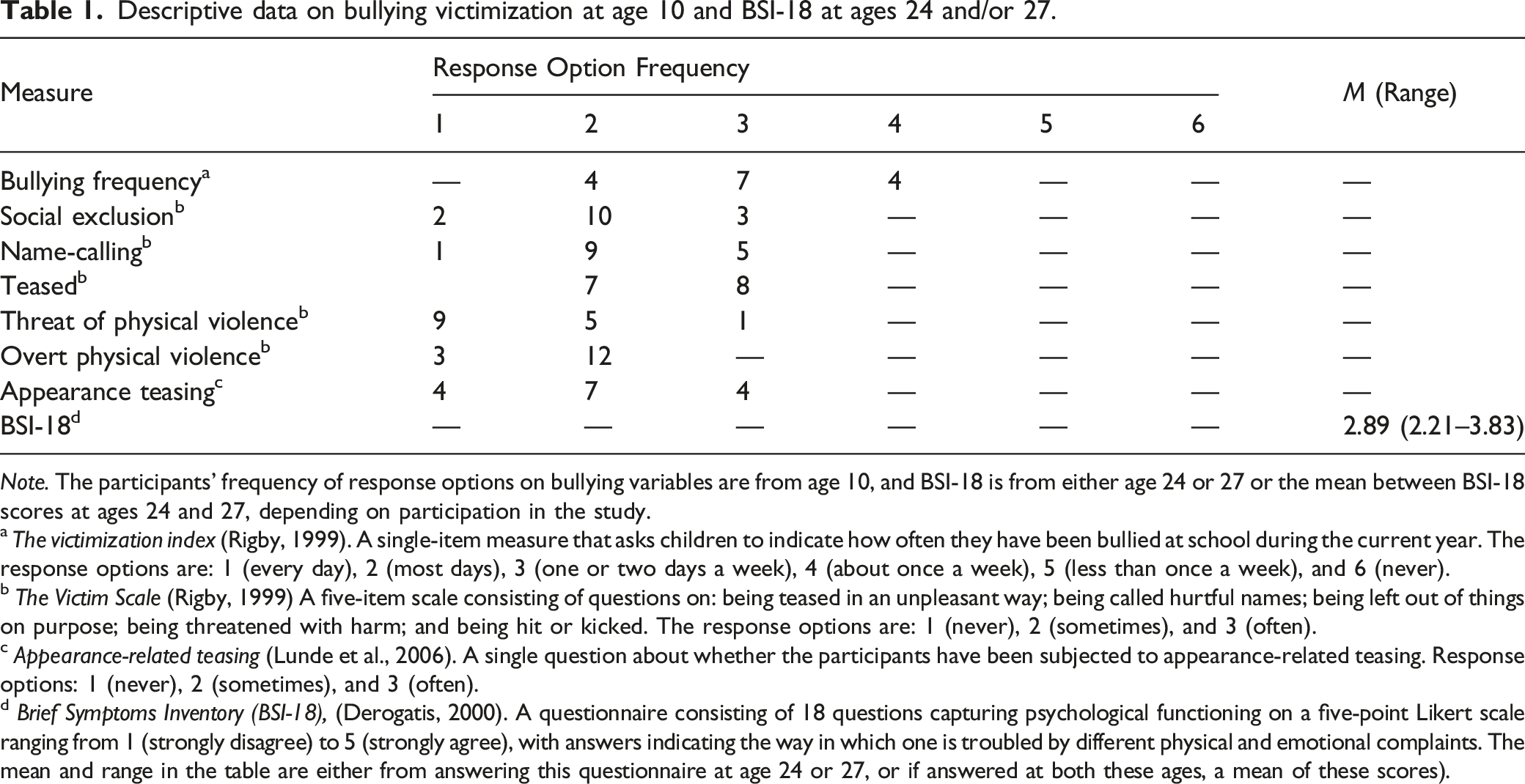
Note. The participants’ frequency of response options on bullying variables are from age 10, and BSI-18 is from either age 24 or 27 or the mean between BSI-18 scores at ages 24 and 27, depending on participation in the study.
a The victimization index (Rigby, 1999). A single-item measure that asks children to indicate how often they have been bullied at school during the current year. The response options are: 1 (every day), 2 (most days), 3 (one or two days a week), 4 (about once a week), 5 (less than once a week), and 6 (never).
b The Victim Scale (Rigby, 1999) A five-item scale consisting of questions on: being teased in an unpleasant way; being called hurtful names; being left out of things on purpose; being threatened with harm; and being hit or kicked. The response options are: 1 (never), 2 (sometimes), and 3 (often).
c Appearance-related teasing (Lunde et al., 2006). A single question about whether the participants have been subjected to appearance-related teasing. Response options: 1 (never), 2 (sometimes), and 3 (often).
d Brief Symptoms Inventory (BSI-18), (Derogatis, 2000). A questionnaire consisting of 18 questions capturing psychological functioning on a five-point Likert scale ranging from 1 (strongly disagree) to 5 (strongly agree), with answers indicating the way in which one is troubled by different physical and emotional complaints. The mean and range in the table are either from answering this questionnaire at age 24 or 27, or if answered at both these ages, a mean of these scores).
In this longitudinal research project spanning 17 years and 7 waves, rates of attrition have been low overall but with larger attrition in later waves, with 90% (n = 875) of the original sample participating at age 13, 78% (n = 757) at age 16, 74% (n = 712) at age 18, 63% (n = 607) at age 21, 56% (n = 545) at age 24, and 53% (n = 511) at age 27. This study concerns three waves of the MoS study: Wave 1 at age 10 with 967 participants (childhood bullying measures), Wave 6 at age 24 (psychological health measure) with 545 participants (56% of the original sample), and Wave 7 at age 27 (psychological health measure) with 511 participants (53% of the original sample). Attrition analysis revealed that only 10 participants have declined further participation in the study over the 17 years between Waves 1 and 7, and that it varies between the 6 additional waves which of the participants did not respond at a certain wave. Further analyses showed that there are differences in how large a portion of the sample had experienced bullying victimization between the original sample and those participants who took part in the study at Wave 6 χ2(1) = 4.73, p = .03 and Wave 7 χ2(1) = 15.34, p < .001, with fewer of those at later waves reporting bullying victimization.
Procedure
Eligible participants first received a written letter with information about the study, in which they were also reminded that they had reported being victimized when completing the questionnaire at the first wave (when they were 10 years old). Within a week after receiving the information letter, they were contacted by text message and thereafter (if needed) by telephone to be asked whether they would agree to take part in the interview. The contact information they had supplied online during their previous participation in the longitudinal study was used. As an incentive, participants were offered a gift card.
Most of the participants (n = 8) were interviewed at the Department of Psychology, University of Gothenburg, Sweden, while three were interviewed by telephone, two in their homes, one in a public place (a hotel lobby), and one via Skype.
Written consent was obtained from each participant before the interview. Interviews were audio-recorded and lasted approximately 1 hour. After the interview the participants were asked how they had experienced the interview and were able to ask questions about the study. The data collection was approved by the Regional Ethical Review Board in Gothenburg, Sweden (T446-15.2.3).
Measures
Peer Victimization
Experience of bullying victimization was measured using a self-report measure called the victimization index (Rigby, 1999). This index is a single-item measure that asks children to indicate how often they have been bullied at school during the current year. The response options are: every day, most days, one or two days a week, about once a week, less than once a week, and never. In the present study, victims were those who had been bullied weekly or more often. This was due to few participants reporting the most frequent category of bullying, and is also in line with literature in this area (e.g. Sweeting & West, 2001).
Brief Symptom Inventory (BSI-18)
In this study, psychological symptoms (somatization, depression, and anxiety) were assessed using the Brief Symptom Inventory (BSI-18) (Derogatis, 2000). The BSI-18 consists of a five-point Likert scale, on which participants indicate their agreement from not at all (0) to extremely (4). In the present study, out of those subjected to victimization at age 10, those who scored the poorest on the BSI-18 were included as participants.
Semi-Structured Interviews
A semi-structured approach was used where the participants were directly asked about the phenomena of interest, which were then followed up with other questions to probe and explore further the participants’ experience. In this way the interview guide was constructed with initial interview items and main questions to guide the interview in relation to the research questions where after the researchers used open ended follow up questions to explore the participants’ perceived experiences on the matter. The interview guide was constructed to include the following topics: experiences of bullying victimization during childhood, long-term consequences of bullying victimization, long-term consequences of bullying victimization on psychological health, and long-term consequences of bullying victimization on body image. Two pilot interviews were conducted by the second author, along with a trained research assistant, to discern any potential concerns with the interview. However, there was no need to adjust the interview guide. A third research team member (the first author) also conducted interviews after receiving training from the second author.
Analyses
As the topic in question is under researched and the design of the study was exploratory, a thematic, semantic (i.e. looking at the explicit or surface level of speech) analysis was conducted in accordance with the methodology suggested by Braun and Clarke (2006). As the analyses were based on data rather than theory, the study is to be viewed as inductive (i.e. codes and themes are strongly linked to what was said in the interviews). However, as qualitative inquiry is a process of interpretation (Schwab & Syed, 2015), researchers need to be aware of their own preunderstandings of the area of study and reflect upon this as a possible influencing factor in the data analysis. As the researcher cannot totally free themselves from theoretical understandings (Braun & Clarke, 2006) the analytic process was conducted with the knowledge of possible preconceptions from previous research on consequences of bullying and the developmental phase of emerging adulthood, which were addressed and discussed during the analytic process in order to keep the analysis as close to the data as possible. An open approach to the data was used in the initial analysis, with all statements related to victimization and mental health noted as potential codes and themes. As the analysis continued it followed the research questions, with potential codes and themes related to victimization, long-term consequences, and the connection between victimization in school and poor mental health in emerging adulthood guiding the authors’ approach to the data.
The thematic analysis began with repeated readings of the interview transcripts, in a first step to confirm the accuracy of the transcripts and in a second step to get familiar with the interviews. Thereafter the authors reread the transcripts, taking notes on initial thoughts regarding potential themes from the interviews. As a next step, the authors met and discussed their notes and impressions from reading the transcripts. The process continued with a step-by-step analysis of the transcripts in order to identify the most basic meaningful segments of the data. Segments that had similar content and were prevalent throughout the transcripts were collated and grouped into potential themes and subthemes. However, it should be mentioned that, in line with suggestions from Braun and Clarke (2006), the authors did not rely solely on prevalence in the search for themes. Thus, some themes were built from segments that were less prevalent than others but contributed to an understanding of long-term consequences of victimization among emerging adults. After a first analysis, the authors discussed the themes.
Consensus reliability was applied, meaning that disagreements among the authors in the descriptions of the participants’ experiences captured in the model were discussed and resolved among the authors until consensus was reached (Raskin, 1984; Syed & Nelson, 2015). Throughout the process the potential themes and subthemes were reviewed, discussed, and constantly compared to the transcripts in order to ensure that they remained true to the data. During this process, some of the themes and subthemes were further combined. The interrater reliability was calculated based on the agreement of all themes over all interviews, resulting in an interrater agreement of 97%, with a Cohen’s Kappa of .93 p < .000. Finally, all themes and subthemes were named, and quotes were added to exemplify the themes.
In order to elaborate on the participants’ experiences the themes were structured in a frequency table, illustrating how common they were (see Table 4). Additionally, to provide a more in-depth exemplification of the uniqueness of the different participants’ experiences, as well as to illustrate how diverse pathways between experiences of bullying victimization and psychological health might emerge, two participants with different experiences were summarized in two case descriptions. This process involved some degree of interpretation, but was kept close to the participants’ own words and was as neutral as possible. The summaries were then read and discussed between the researchers until consensus on them was reached.
In order to maintain the participants’ anonymity, any identifying information was changed or removed in the quotes and case descriptions.
Results
The results from this study are presented in four sections. The first concerns whether individuals who were subjected to victimization during their childhood and have poor psychological health as emerging adults do or do not perceive a direct connection between the school-years bullying victimization and their poor psychological health. The second section contains an analysis of the participants’ experiences of the victimization when the bullying occurred. The third section explores the perceived long-term consequences the participants say the childhood victimization has had for them as emerging adults. The fourth section provides information on how the themes were distributed over the sample, highlighting the differences and similarities between the participants. The similarities and differences in trajectories are further elaborated on in two case descriptions.
1. A Perceived Connection Between School Bullying and Poor Psychological Health in Emerging Adulthood
In almost all interviews, the participants described perceiving a direct connection between the victimization in childhood and poor psychological health in emerging adulthood, as exemplified in the following quote: ‘I have a lot of social anxiety, and I think that’s a direct effect of [the victimization]’. The two participants who did not perceive a direct connection between the experienced victimization in childhood and poor psychological health in emerging adulthood instead talked about how it had affected their way of handling social situations and how they had become sensitive to situations involving their own or others’ exclusion. Additionally, many participants described having tried to repress their victimization experiences, as in the following quote: ‘Even though I try to repress that I’ve been bullied, I haven’t gotten rid of it [the victimization]; it’s still with me’. Consequently, the victimization, although it happened many years ago, was perceived as being directly connected to the participants’ poor psychological health in emerging adulthood, as described in this quote: ‘I repeat to myself what others have said about me, and it makes me sad and [I get] stuck in negative and destructive thoughts, and I’ve had many episodes of depression’.
2. The Participants’ Experience of Victimization during Their School Years
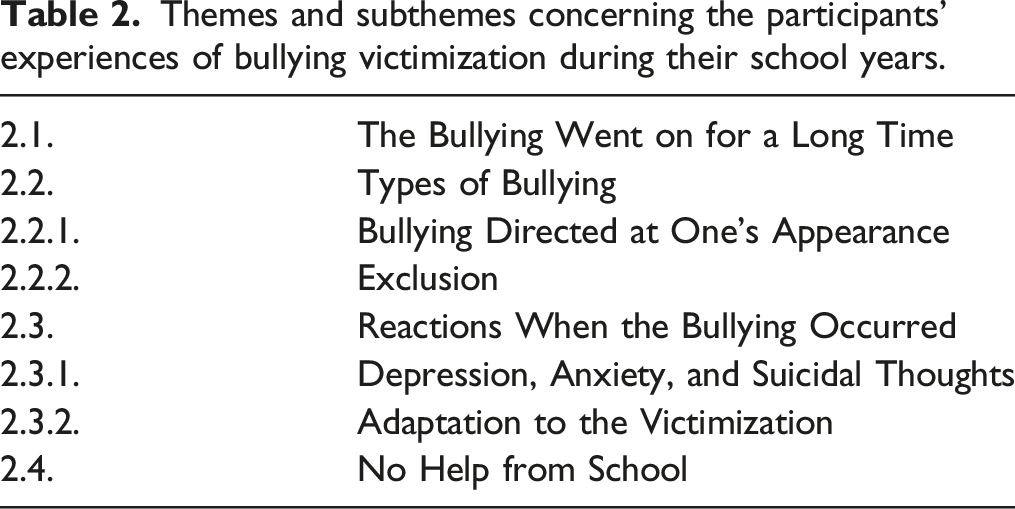
Themes and subthemes concerning the participants’ experiences of bullying victimization during their school years.
2.1. The Bullying Went on for a Long Time
Several participants described experiences of victimization during their entire time in school. Some even described that the victimization had started as early as preschool. For most participants, though, the victimization had taken place from Grades 1 to 6 (in Sweden, ages 7–12 years), with the highest described frequency occurring during Grades 4–6 (in Sweden, ages 10–12 years). Many participants described having been accustomed to being bullied, as it was a constant process that affected them daily. This became very clear to one participant upon changing schools, when the bullying became a bit less intense: ‘Then I started in a new school in Grade 6, and I was all like, wow, I could walk through the halls and no one tried to trip me, no one called me a whore’.
2.2. Types of Bullying
Many participants described that, during their school years, anything the bullies considered odd or abnormal had served as a means to start the bullying. The experiences the participants described resulted in the two themes: Bullying directed at one’s appearance; and Exclusion.
2.2.1. Bullying Directed at One’s Appearance
Most participants described experiences of victimization directed at their appearance. As described by one participant, ‘In school, it was a lot about my being chubby, or fat, and there were a lot of comments about my appearance’. The participants described that it did not matter what they did, how they looked, or whether they changed how they looked; the bullies still directed the bullying at their appearance. One participant gave the following example of what their peers had said: ‘You’re ugly, you don’t have a good enough body, you’re disgusting … no one wants you because of the way you look’. All kinds of bodily features, deemed as deviant by the bullies, could be objects of bullying. This could include facial features, birthmarks, body hair, stature [too tall or too short], foreign features, or the victim simply being deemed ‘odd looking’. However, most often, the victimization revolved around body size. Participants described repeatedly being called fat, as in the following quote: I basically quit …wearing a swimsuit or doing any kind of physical activity, because I felt like I was attacked when I did. If I was in Physical Education I was told ‘Hey you, damn fatso, your fat’s shaking.’ So, people laughed at me when I ran or jumped, … would poke me in the stomach … I was humiliated in the shower … different things that just made it so that I got a very strong picture that my body wasn’t okay.
2.2.2. Exclusion
Many participants described an experience of exclusion as part of the bullying during their school years, as expressed by one participant in the following statement: ‘[My peers] froze me out and refused to listen to me or answer questions, or refused to make eye contact with me and such things’. Participants described the exclusion in terms of not being allowed to participate, expressed by one participant as follows: ‘It could be anything, like playing in the schoolyard and not being allowed to participate’. However, the exclusion was also described as more of a normative culture in the whole class. As one participant said: ‘The rest of the class was like, no they don’t talk to me, they don’t want to be with me’. In addition, what these quotes exemplify is that the exclusion was a more or less constant process the participant had to face. However, at the same time that it was a constant process it was not always obvious; nonetheless, it was always there, as in the example offered by a participant who told of hearing his peers talking to each other, not necessarily for him to hear: ‘Like it was probably usually “Oh no, here he comes”’. However, not all participants were subjected to exclusion and some described having friends who were nice and inclusive towards them despite the victimization other pupils subjected them to.
2.3. Reactions When the Bullying Occurred
The participants described their reactions when the bullying occurred, resulting in the following themes: Depression, anxiety, and suicidal thoughts; and Adaptation to the victimization.
2.3.1. Depression, Anxiety, and Suicidal Thoughts
All participants experienced poor psychological health as emerging adults, but most of them also described experiences of poor psychological health when the bullying occurred. They described that the victimization had led to depression, panic-like anxiety experiences, and sometimes even suicidal thoughts during their school years. One participant gave the following description: It was so hurtful, I was so helpless that I wanted to take a knife and hold it against my throat, like this … I couldn’t do anything about it. It was very hard to escape; that is, I couldn’t master the situation, and it was very depressing.
One participant was even admitted to psychiatric care for a year, and then changed schools and was able to escape the bullies.
2.3.2. Adaptation to the Victimization
The bullying the participants were subjected to during their school years made most of them go to great lengths in trying to adapt to whatever it was that the bullies wanted – or rather what the participants thought the bullies wanted – in an attempt to make the bullying stop. This is exemplified in the following quote: ‘I was in despair. I constantly tried to turn myself inside out, and either tried to be more visible or tried to be less visible, keep myself under the radar’.
In addition, as described earlier, exclusion was a central part of the bullying. This was another situation the participants had to adapt to, which in turn made them even more excluded, but through a more subtle process by which their own behaviour led to additional exclusion, or rather loneliness. This is described by one participant as follows: ‘Before Grade 4 I was a really social person. Then, during the following years it started to change, and from Grade 7 it started to disappear and in secondary school I’d become a withdrawn person’. As can be understood from this quote, the adaptation in its turn also led to feelings of loneliness, as described by the participants.
2.4. No Help From School
Most participants described having felt during their school years that the school did not understand, or did not want to offer any help or support in ending the bullying, or was not able to do so. Some participants even described teachers’ behaviour as an enabling factor in relation to the bullying. Some of their descriptions entail the participant telling their teacher about the bullying, but the teacher telling them they had to take responsibility for it themselves and avoid the bullies or do as the bullies said. This is exemplified in the following statement: The adults at school … let me down in several situations where it was obvious what had happened, and they just didn’t give a damn what was happening, or even took the bully’s side and told me ‘You understand that you have to leave these [bullies] alone.’ Or like, ‘Don’t you understand that you have to leave, just walk away.’
However, most participants’ parents tried to do what they could to stop the bullying, by talking either to the school or directly to the bullies. However, their efforts were most often fruitless and did not end the victimization. Therefore, as described by most participants, instead of there being a constructive solution, the victimization only stopped when the participant changed schools or finished compulsory school. However, one of the participants who did not perceive any connections between the victimization experiences and poor psychological health described a turning point in the bullying he had experienced. This turning point came when he told his teacher about the victimization, which led to the teacher immediately intervening and stopping the victimization and talking to the bullies, which changed the participant’s whole situation.
3. Perceived Consequences of Childhood Victimization in Emerging Adulthood
Themes and subthemes concerning the perceived consequences the participants described that the bullying victimization has today.
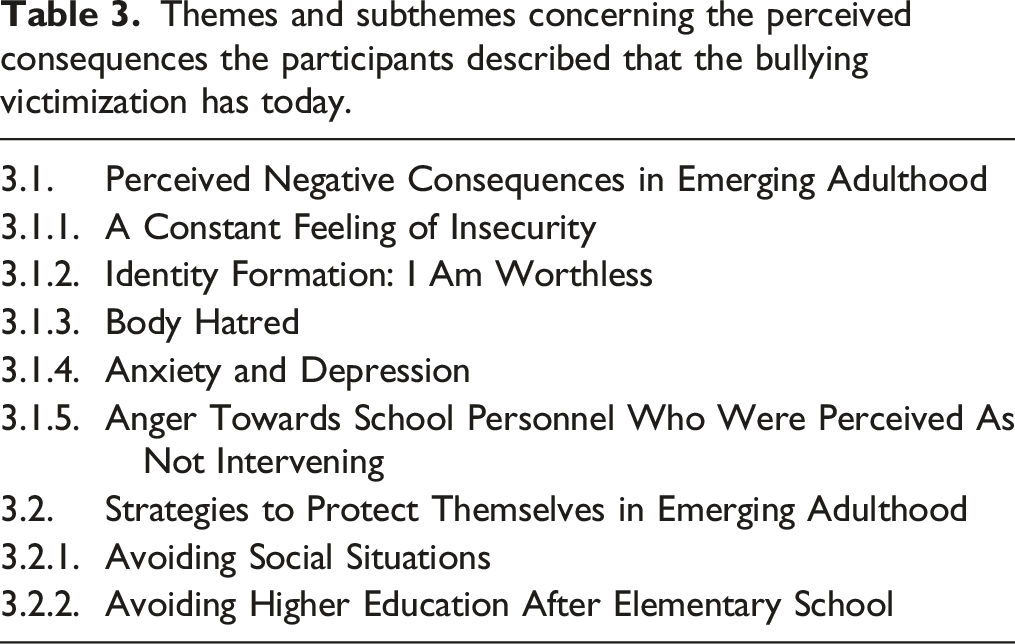
3.1. Perceived Negative Consequences in Emerging Adulthood
The perceived negative consequences of the bullying the participants described resulted in the following themes: A constant feeling of insecurity; Identity formation: I am worthless; Body hatred, Anxiety, and depression; and Anger towards school personnel who did not intervene.
3.1.1. A Constant Feeling of Insecurity
The feeling of insecurity, perceived as a consequence of the victimization, appeared as an integrated part of how most participants described their way of relating to themselves and their surroundings as emerging adults. One participant described this as follows: ‘The insecurity, how I still go into it, well there are many false thoughts and such. That I’m not good enough, that I’m bad, and [I’m] insecure about how I look’. The participants described that the insecurity, perceived as being generated by the victimization, had continued to be an influential force ever since, exemplified in the following statement: No matter how much I try to work on it, there’s an insecurity in there somewhere all the time that; no matter how much you want to get rid of it from childhood, it remains there, sort of. It’ll, like, haunt you, and you relive or hear these words that you’ve been called as a child.
3.1.2. Identity Formation: I Am Worthless
Some participants even described that their whole identity as emerging adults was perceived as being formed by their victimization experiences. As a consequence of this developmental process, a feeling of being worthless had become an integrated part of their identity as emerging adults. As one participant said: It [being bullied] has so many consequences and it sticks to you … it becomes your identity, it gets ruined. … just that it gets so consolidated, like, ‘I’m bad,’ basically … but as a person I’m nobody, as a person I’m totally worthless. After all, it’s always been my identity.
Another participant described that they perceived the victimization as experiences that had created ‘psychological scars’ that had become parts of forming the participant’s identity: ‘It gets better gradually, but they don’t disappear, and in addition to these scars. … It shapes you into a person; it’s a bit like that’.
Several emerging adults also described that they actively tried to repress their experiences of victimization. However, they ultimately surrendered to the fact that the experiences will always be with them, perceived as a process shaping them into who they are.
3.1.3. Body Hatred
The participants described that they perceived the victimization as having a major consequence in regard to difficulties in relation to their own body and appearance. This in turn was described as leading to problems with intimacy, feelings of body shame, and disordered eating as emerging adults. These consequences were perceived as something coming from always being told during their school years that they were ugly and obese and had disgusting bodies. One participant described this as follows: Shame about how my body looks or my height, my eyes. Although I really feel like it doesn’t matter; that was when we were kids. But it keeps coming back. So, I know somewhere that it’s affected me. Look at me now, I still cry today. It’s so sick!
Moreover, one of the perceived main consequences of the victimization was that the emerging adults did not feel at home in their own bodies. One participant offered an example of this: I have, I have huge, huge problems in relation to my body, or even how I perceive my own body, today. And I have, like, eating disorders in different ways … I have this very difficult relationship with my body.
Some participants described perceiving a connection between their experiences of victimization in school and developing anorexia and bulimia as emerging adults. One participant gave the following description: But it’s also made you exposed to bullying about weight and so on, and so it’s been that you switch and then you try to pressure yourself and starve yourself instead, kind of. Yes, it was in [emerging] adulthood that I developed anorexia and had a lot of trouble with it. So that’s definitely a direct consequence.
However, the two participants who did not perceive a connection between their bullying victimization experiences and their poor psychological health also did not report any bullying victimization directed at their appearance. In the rest of the group, all but one participant had been subjected to appearance teasing during the years of victimization.
3.1.4. Anxiety and Depression
The participants described that they perceived both anxiety and depression to be long-term consequences of the victimization, which they now suffered from as emerging adults. This was described by one participant as follows: ‘I feel, in some way, that I have, like, some kind of post-traumatic stress … a lot of these things that I’ve been subjected to have gotten stuck in me’. Alternatively, as other participants described, the victimization was perceived as leading to trust issues, which led to loneliness, which in turn was experienced as causing depression and anxiety. This is exemplified in the following quote: It’s so broad, sort of, but I have a lot of trouble just making friends. … because I have a little bit of, like, trust issues, like this. … So, it’s very much like this, stress stuff in it as well, and has led to depression.
3.1.5. Anger Towards School Personnel Who Were Perceived As Not Intervening
A constantly recurring perceived consequence of the victimization described by many of the emerging adults involved frustration and anger at the school personnel who they remembered as not intervening when the bullying took place. One participant stated: ‘I’ve been thinking about it a lot, like, now in [emerging] adulthood. How the hell could they not see that a student wasn’t feeling well?’ Other participants described frustration at what they experienced as a lack of a better social safety net that could have seen and stopped the bullying, as described in the following: So, it’s all these thoughts, in general, about the whole bullying, how these things can be allowed to happen without any consequences … so, it’s this very strong frustration about, like, that nothing happened. That’s what I’m the most annoyed about today; like, that there’s not a better safety net.
At the end of the interview, when the participants were asked whether there was anything they would like to add, they most commonly wanted to talk about the frustration they felt in relation to their memory of how school personnel had not intervened, even though many of them had already mentioned this frustration during the interview. As a contrasting story, one of the two participants who did not perceive a connection between the bullying victimization and poor psychological health praised his teacher, who had intervened and stopped the victimization, engaging the bullies in talks about their problematic behaviour, and as the participant described, totally changed the school situation for him.
3.2. Strategies to Protect Themselves in Emerging Adulthood
As a consequence of the strong negative effect that the emerging adults perceived that the bullying was still imposing on their lives, most of them had developed different kinds of strategies, as described by the participants and resulting in the following themes: Avoiding social situations; and Avoiding higher education after elementary school.
3.2.1. Avoiding Social Situations
Many emerging adults described that they had developed a behaviour whereby they actively avoided social situations. This strategy, intended to protect them from pain, unfortunately led to more loneliness. Several of the participants described choosing to have limited social interaction, and some also described being very careful in initiating social contact: ‘I’ve kept the same friends; I haven’t dared to meet new people and I’ve held on to what’s familiar’. Moreover, some emerging adults offered examples of an attentiveness to their surroundings, in order to be able to withdraw from a social situation if it became uncomfortable, exemplified by one participant as follows: I’ve found myself in situations in [emerging] adulthood where, bullying-like situations in different ways, not necessarily involving me, where I’ve found ways to remove myself from that situation without affecting things around me too much … and I guess that’s a skill I’ve developed, because of being bullied.
Most emerging adults explained that they perceived the avoidant behaviour they used in social situations to be a direct consequence of their bullying experiences, as described in the following: ‘It’s definitely a kind of defence mechanism that I’ve developed from that time. That I’m a little, sort of, careful in, like, interacting with people and so on’. Many participants expressed that the terrible experiences of social interactions connected to their victimization had made them insecure and afraid of social situations, and that as an active strategy as emerging adults they chose to avoid various social situations. However, some participants also described that as emerging adults they had been engaged in supportive and loving relationships that were significant in their lives. Although these romantic relationships offered feelings of security and trust in this dyad itself, the participants still described problems in relation to social situations in general.
3.2.2. Avoiding Higher Education After Elementary School
Some of the participants also described that as the experienced victimization occurred at school, their subsequent school situations became problematic. To protect themselves from the risk of repeated victimization in their present life, some participants described avoiding engaging too much socially at university, as in the following quote: I don’t connect with these people … if you come to a new place you can, like, fantasize about how you want it to be, then maybe you go into a role, but quite quickly you fall back on the, on the level you really are. And then I’ve distanced myself from them, most of them.
Alternatively, they withheld their actual achievements. As one emerging adult described: ‘When it comes to writing, which is my thing [something the participant liked to do]. … it’s related to this social nervousness as well. Being referred to as weird or ridiculous or the like’. There were even participants who described leaving their studies as emerging adults because of the perceived consequences of their victimization experiences, captured in the following: I also tried to attend university, but it was the same: It was really good when it was good, but when you have classmates who don’t have the same values, it was shit and I’d rather not go than have to be in school with them. So there, that stuff is still there somewhere.
This strategy, used by some participants as what they perceived as a consequence of the victimization, worked as a type of protection of the self, but, as we have seen in the previous themes, the protective intention easily has limiting consequences for the individual. In contrast, though, other participants had attended higher education but did not mention any specific problems during their studies, which in turn does not diminish the importance of the experiences of those participants who described these perceived consequences. Still other participants had not attended higher education at all, and it is not clear whether this had any connection to their bullying experiences or was due to other things in their lives.
4. Distribution of Themes and Diverse Pathways Illustrated by Case Descriptions
Frequency of themes.
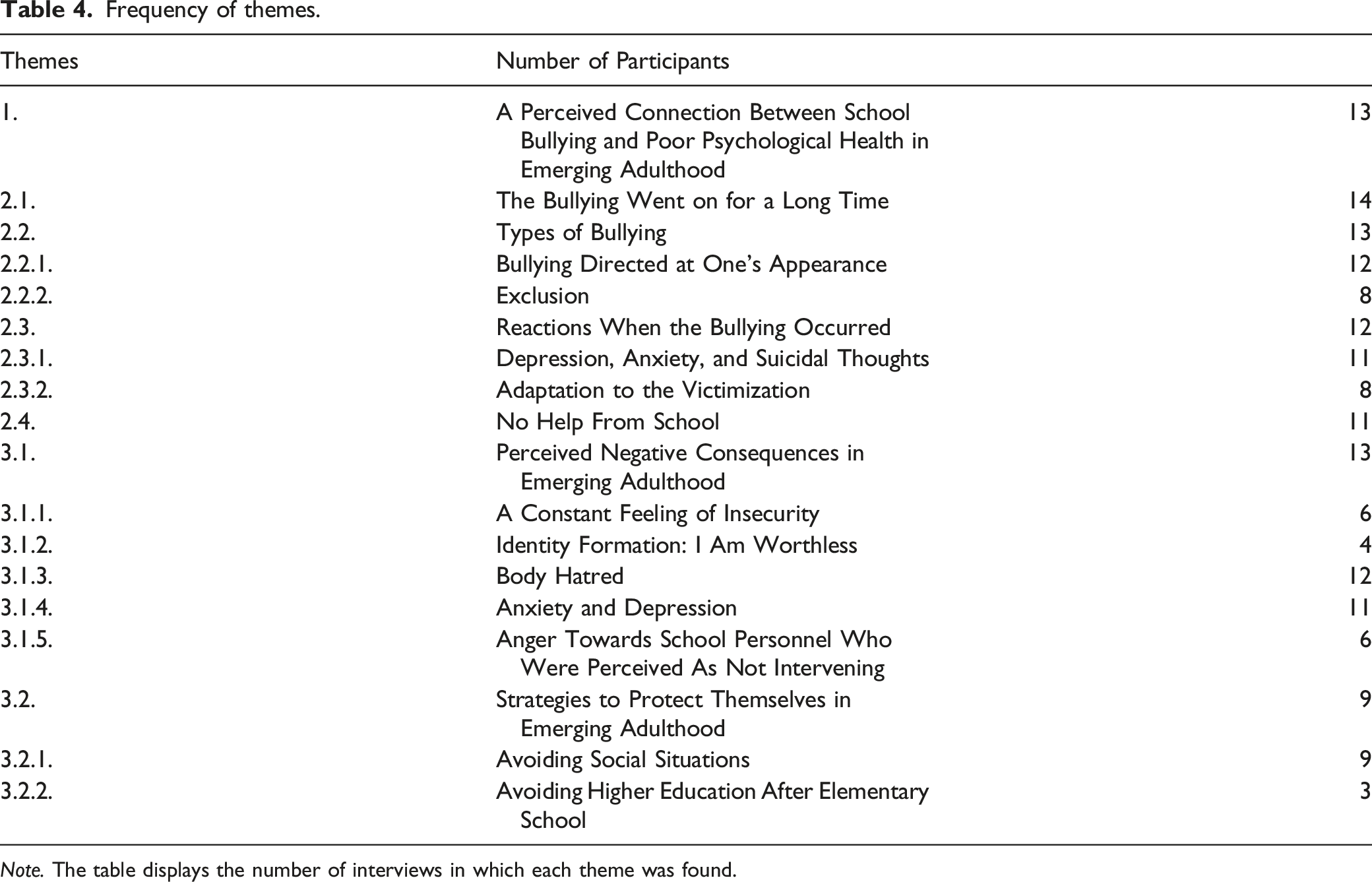
Note. The table displays the number of interviews in which each theme was found.
Almost all participants in the present study perceived a direct connection between their bullying victimization experiences and their poor psychological health. However, two of the participants did not perceive such a connection. To illustrate the possible different pathways of experiences from bullying victimization in school to perceived long-term consequences in emerging adulthood, two case descriptions are presented: The first is a summary of the interview with one of the participants who did not perceive a direct connection between bullying victimization in school and poor psychological health in emerging adulthood, and the second is a summary from one of the participants who did perceive such a connection.
The first case description is a participant who perceived that her poor psychological health was a consequence of her mother’s death instead of connecting it to her victimization experiences. This participant described that the victimization she had been subjected to was to be understood as part of a larger process at the school she was attending at the time, where there were a great deal of fights and problems all over the school. She did not feel she had been specifically subjected to the bullying victimization more than any other peer there. However, she described that the situation – the violence and bullying that were part of the situation for her, and others, at the school – had made her angry and was an important part in her having developed externalizing problems. She described that her father had been worried about the school situation and that when she had become increasingly angry he had arranged for her to change schools. She described herself as one of the smartest students in her class, and said that when she started at her new school she was finally able to focus on the work in school and on getting good grades. She described the situation in the following way: It was damn good luck that I could change schools, or things wouldn’t have worked out for me. I’ve always been good in school, and when I got to the new school, I had the opportunity to prove that…//… If dad hadn’t moved me to another school, the situation in the first school would definitely have led me onto a totally different pathway.
Despite the negative effect on her situation in school, she did not perceive that the bullying was part of her poor psychological health in emerging adulthood. This participant also described that she had always appreciated the teachers and had felt that they appreciated her as well. In the new school, as she described it, she had become a student who tried to stop bullying and told the teachers if she saw it taking place. She perceived that these experiences led to her now seeing herself as a fighter for justice. Now, as an emerging adult, she described herself as being highly sensitive to injustice, and she perceived that this was something that had grown out of her own bullying victimization experiences. But in terms of negative long-term consequences of the victimization, this participant did not perceive any such experiences.
The next case description concerns a participant who had been subjected to bullying victimization from an early age and during most of his years in school. The main focus of the victimization had revolved around his body size, and he was told he was fat and ugly. As the victimization continued, the few friends he had become frightened of also being bullied if they were seen with him, so he grew increasingly lonely. Sadness and depression followed, as both bullying and loneliness prevailed in a process he described as involving adapting to the bullying and trying not to be noticed. As he got older the physical bullying decreased and he made some friends, but appearance teasing and exclusion were always around the corner. He described trying to get help from school personnel, but experienced that he had not gotten any help. The victimization only ended as a consequence of changing schools at the shift of grades. This participant described that he perceived the victimization as a major force in forming his life and even his identity, leading to long-term consequences of depression, anxiety, and insecurity as well as enormous problems in relation to his body. This is exemplified in the following quote: …so much of it [the bullying victimization] has been, sort of, integrated in me…//…even though it isn’t a part of my life anymore I can see that it has, sort of, formed a kind of filter that all my thoughts have to pass through, so it’s really formed the way I perceive myself today.
At the time of the interview this participant was in a positive romantic relationship, but he had trouble with social situations and chose not to engage in social activities because he easily felt uncomfortable and had a hard time trusting others. He was attending higher education part-time to become an engineer, as he was recovering from a longer period of depression for which he had gotten therapy and medication. This participant described that he believed that the victimization experiences would always to be part of his life.
The pathways in these two case descriptions illustrate how the different themes link together as an integrated part of an emerging adult’s trajectory, and nuance the results by showing how different individuals can perceive the connection between the bullying victimization and poor psychological health in different ways.
Discussion
The purposive sampling (Schwab & Syed, 2015) of emerging adults, both subjected to childhood bullying victimization and suffering from poor mental health in emerging adulthood, proved useful. This group of emerging adults did, indeed, perceive several negative consequences from their experiences of childhood victimization, and as such, their stories help to illustrate possible relationships between victimization and poor psychological health. As described by Persike et al. (2020), emerging adults are the next generation in a society to take on the collective responsibility of participating in the workforce, contributing to political and social progress, and generally moving society forward. From this perspective, the mental health of – and hence the long-term consequences of victimization for – emerging adults are not only an individual matter but also a matter of interest to the collective society.
The Long Duration of Victimization
This study’s first major finding is that the participants described that they had been victimized for a very long time. Thus, what the participants described is not in line with the general overall decline in victimization over the school years that has been found in previous quantitative studies (Scheithauer et al., 2006; Smith et al., 1999). Instead, it is in line with the findings involving a stable group of students being subjected to victimization over a longer period of time (Sourander et al., 2000; see Salmivalli, 2018, for a review). The experiences the participants in our study described seem to be more like those of this more stable group, having had to adjust to a victim career (Thornberg, 2011), which some described as having started as early as preschool. The reason for these emerging adults’ poor psychological health, perceived as a consequence of bullying victimization experiences, might thereby be understood as a dose-effect phenomenon, whereby a longer duration of victimization increases the risks of adverse outcomes in adulthood (Takizawa et al., 2014; Wolke et al., 2013).
Furthermore, by using a qualitative methodology the present study offers an in-depth understanding of the participants’ own views of their victimization experiences, in which depression, anxiety, and suicidal thoughts were described as reactions to being victimized at the time and in which the only possible way to reduce further pain was adaptation to the victimization. From this perspective, the participants’ situation can be understood as not having had access to the same possibilities as their peers did in trying out different behaviours, relationships, and identities as part of a healthy identity development. Instead, as in Thornberg’s (2015) ethnographic study, adaptation to the victimization and loneliness as part of the exclusion are illustrative examples of the prerequisites on which they had to develop their identities. Furthermore, the present study expands the findings of this process of identity development, as some emerging adults described that they perceived the victimization as a process whereby the identity of being worthless had continued to have an influence on their lives even after the victimization had ended.
Moreover, as the participants described, they ‘turned themselves inside out’ in order to change in some way to make the victimization stop. However, no matter what or how much they changed about themselves, it was described as never resulting in ending the victimization. It was the bullies who dictated which of the participants’ features were considered wrong and should be the object of bullying. One participant described developing extreme body shame already at 10 years of age, due to constantly hearing negative comments about her body.
The term odd student repertoire (Teräsahjo & Salmivalli, 2003), referring to the explanation among young people that bullying occurs because victims have characteristics that others find disturbing in some way, seems to have been part of the process by which the participants became victims when the bullies decided what was considered odd and thus justified the victimization. Thornberg (2011, 2015) suggests that this phenomenon, understood in the light of ethnographic studies, explains why it is common for young people to create a peer culture of intolerance towards deviance or difference in any aspect, which can develop into and justify bullying. According to labelling theory (Becker, 1963) and stigma theory (Goffman, 1963), when a social group labels a person ‘different’ or ‘deviant’, this leads to the assumption that the person deviates from a norm established by the peer group. The participants expressed that it was impossible to escape the victimization in this situation, and that they instead had to adapt to it.
Notably, these described experiences reflect a continuation of what the participants reported in the questionnaires on the different forms of bullying they were subjected to at the first wave when they were 10 years old, with most of them reporting being subjected to threats, violence, exclusion, and appearance teasing every day or most days, as displayed in Table 1. From the experiences the participants described in the interviews, it is clear that the reported victimization on the questionnaires at age 10 captured information about a situation that for most of them would continue for many years to come. This highlights the need for efficient anti-bullying interventions early on that seek to facilitate an environment in which students disclose victimization (Boulton et al., 2017), as well as the need to train school personnel in understanding, recognizing, and intervening in bullying situations (Verseveld et al., 2019). The trajectories in the described cases illustrate that intervening, or not, is not only an act of stopping victimization at the time of the victimization but also has a potency in forming a person’s life into emerging adulthood.
Additionally, the participants’ recollections of how teachers did not intervene in the bullying situations still made these emerging adults angry. Whether or not the teachers had actually tried to intervene cannot be verified. However, the participants’ perception of the situation is important, as it can be understood through the notion that when teachers neglect to intervene this signals a silent approval of a continuation of the victimization (Yoon & Bauman, 2014), and this is how the participants seem to have understood the situation. Consequently, it might be important to let the victim know that something is being done even though it might not be successful in ending the victimization. In addition, this might explain why, as emerging adults, the participants are still angry with school personnel who they perceived as not having intervened or tried to stop the victimization. These findings stress the vital importance that teachers both actually intervene and also make it clear that they are intervening and trying to stop the bullying, which they are not only obligated to do according to current law (Swedish Education Act [SFS, 2010:800]) but were also obligated to do at the time the participants were in school, according to the Swedish Education Act (SFS, 1985:1100) with changes (SFS, 1999:886). As a rejection and disapproval of authority is part of the developmental process of emerging adulthood (Mistler et al., 2016), this might explain the intensity of these statements by the emerging adults, possibly also adding to an already negative experience of the educational system.
Moreover, the described experiences of the two participants who did not perceive a direct connection between their bullying victimization and poor psychological health need attention. One of these participants described having told his teacher about the bullying, which resulted in the teacher intervening and stopping the bullying, while the other got help from her father in changing schools. As illustrated in one of the case descriptions, these experiences seem to offer a different pathway than that of the majority of the group, stressing the need for future studies to compare groups of individuals who got help in ending the victimization to those who did not, examining how these two groups might differ in their perceptions of possible long-term consequences of their victimization.
Perceived Connection between the Victimization and Poor Psychological Health, Body-Image Problems, and Eating Disorders in Emerging Adulthood
Another major finding involves the profound negative consequences that the participants perceived the victimization has had on their lives as emerging adults. Not only did these perceived consequences, described by the participants, entail constant feelings of insecurity and symptoms connected to various psychological diagnoses; they were also experienced as forming both the emerging adults’ identities into viewing themselves as worthless and their behaviour into actively avoiding social situations. Moreover, the emerging adults described that they perceived the bullying as having consequences in relation to their view of their own appearance, their body image. Many participants in this study expressed the perception that the experience during their school years of constantly being told they were ugly or obese and that their bodies were disgusting had led to difficulties accepting their own bodies, difficulties with intimacy, feelings of body shame, and even disordered eating as emerging adults. The findings from this study illustrate that the experience of severe problems in relation to the body might be a long-term consequence of bullying victimization, as the emerging adults still relate to their own bodies based on what they were told during the victimization in their school years.
There were both differences and similarities between the participants’ experiences of bullying victimization and perceived long-term consequences. The findings illustrate several different possible long-term consequences of bullying victimization and the specific impact these consequences might exert in emerging adulthood as a developmental period. Although the focus in the present study is on an exploration of negative long-term consequences of bullying victimization, it is clear that the pathways between victimization and long-term consequences come in different shapes. The insight gained in the present study into the specific understanding of negative long-term consequences of bullying victimization would benefit from being contrasted with experiences of emerging adults who have been subjected to bullying victimization and now function well, which is a recommended topic for future studies.
During emerging adulthood there is a peak in mental health problems (Arnett et al., 2014; Henin & Berman, 2016; Public Health Agency of Sweden, 2020) and the onset of psychiatric disorders, possibly as a ‘spillover’ function of untreated psychological problems in childhood and adolescence (Tanner, 2015). These increases coincide with heightened problems with attrition and adherence to treatment (Arnett et al., 2014; Henin & Berman, 2016), possibly due to a distrust of authority figures as part of the developmental process (Mistler et al., 2016). Consequently, the work of clinical psychologists and counsellors might benefit from addressing emerging adults’ mental health problems in relation to the specific challenges of this developmental stage (Arnett et al., 2014; Tanner, 2015). Additionally, guidance regarding psychological assessment and clinical practice concerning experiences of bullying victimization is described as underdeveloped (Samara et al., 2017), which makes the treatment of emerging adults suffering from poor psychological health an area in need of development.
Furthermore, previous qualitative studies have found that victimization influences participants in who they are as adults (Pabian & Vandebosch, 2019), and that it has a significant influence on adult life (deLara, 2019). The present study offers additional findings in this regard, with participants explicitly describing that they perceive their victimization experiences as having affected their identity; this is described by the emerging adults in terms of identifying as worthless, living with psychological scars from the victimization, and fruitlessly trying to repress and forget the victimization experiences. These findings add to the understanding of long-term consequences of victimization in relation to the specific developmental process of emerging adulthood. As identity development is one of the main features of emerging adulthood (Arnett, 2000), this study’s findings illustrate that problems of identity formation due to victimization might impair the identity developmental process of emerging adulthood, a process found to be connected to psychosocial functioning during this developmental stage (Schwartz et al., 2011; Wängqvist & Frisén, 2011). Furthermore, as the emerging adults in the present study also described constant feelings of insecurity and a social avoidant behaviour as perceived long-term consequences of victimization, these experiences might be understood in the suggested integration of identity and psychopathology (Kaufman et al., 2014; Klimstra & Denissen, 2017; Verschueren et al., 2019), whereby identity and psychopathology become intertwined as a function of psychopathology, development, and social context, and the identity is a negotiation process in which change is dependent on the renegotiation of one’s self-view in relation to one’s social context (Klimstra & Denissen, 2017). The emerging adults in the present study, describing that they experience both poor psychological health, feelings of insecurity, and a social avoidant behaviour, might then be stuck in a situation that hinders the renegotiation of a negative identity formed out of their victimization experiences, hindering them in the exploration of identity as part of the developmental stage of emerging adulthood. However, as some emerging adults described being involved in supportive and loving romantic relationships, it is possible that these relationships, over time, might work in favour of a positive identity development for the participants in the coming years.
As our sample was from Sweden, the perceived negative consequences were manifested in the Swedish context, in which young people leave their home the earliest in all of Europe (Wängqvist & Frisén, 2015) and the welfare system fosters emancipated and autonomous individuals and individualistic values (Trägårdh, 2018). These circumstances might lead to a situation in which the participants have to struggle with the long-term consequences they perceive as being due to their victimization, including poor psychological health, social avoidant behaviour, and problems in identity formation, at the same time as they would likely benefit from inclusion and social contacts in order to be able to change their current behaviours and improve their well-being. As cultural and societal variations are of importance in understanding emerging adulthood (Arnett, 2011), it is recommended that future studies further investigate how societal contexts might influence the long-term consequences of bullying victimization in emerging adulthood.
Moreover, the participants described problems with body image alongside problems with their identity formation as perceived consequences of the victimization. This finding points to a need to incorporate both these aspects in the understanding of different pathways to long-term consequences of childhood victimization (McDougall & Vaillancourt, 2015).
Verschueren et al. (2019) describe how the connection between identity and psychopathology targeting the body (eating disorders and nonsuicidal self-injury) can be understood as a process whereby the body is seen as a physical object for others to look at, lacking a first-person perspective. This ‘lived body for others’ leads to a situation in which the identity is formed around external appearance and the body in such a way that others’ evaluation becomes the most prominent self-defining process of one’s identity (Stanghellini et al., 2012). This process might be in play among the participants in the present study, as they described both body hatred, eating disorders, insecurity, and social avoidance in a manner that could be understood as a lived body for others, whereby the participants’ described experiences might illustrate possible processes driving the victimization experiences to become continuous, long-term consequences. Moreover, as it has been found that ‘other orientedness’ and a perception of others’ regard are prominent features of the identity explorative process of emerging adulthood (Skulborstad & Hermann, 2016), the described socially avoidant behaviour, insecurity, and body-image problems risk becoming problems in the participants’ work to achieve a stable identity status connected to positive psychosocial functioning (Schwartz et al., 2011), and may potentially even lead to psychopathology (Klimstra & Denissen, 2017).
The magnitude with which the participants perceive their experiences of bullying directed at their appearance as having resulted in consequences of body hatred implies a need for both bullying interventions in school and a special awareness of the issue in clinical work with emerging adults.
Furthermore, the findings from the present study also confirm and expand the findings of socially avoidant behaviour and feelings of insecurity as perceived long-term consequences of victimization in other qualitative studies (Carlisle & Rofes, 2007; deLara, 2019; Pabian & Vandebosch, 2019; Thornberg et al., 2013), as some of the participants in the present study, due to social avoidance, are struggling with attending university. This novel finding has implications for students with victimization experiences, indicating a need to support those individuals in this group who need help in overcoming their self-confidence problems when producing or presenting their academic work, or problems taking part in the social arena of being a student. Furthermore, as emerging adults’ internalizing symptoms have been found to negatively correlate across time with perceived social support from peers during the transition from high school to college (Young et al., 2015), the experiences described by the participants in the present study might be helpful in revealing how some of these problems in establishing social networks in college might be understood.
Additionally, as the exploration of one’s self in secure friendships and social interactions is a prerequisite for the social cognitive development of establishing independence in emerging adulthood (Lapsley & Woodbury, 2015), it is possible that the problem of a social avoidant behaviour, as a perceived long-term consequence of victimization, hinders the process of achieving autonomy in the process of reaching the adulthood markers of accepting responsibility for one’s self, making independent decisions, and becoming financially independent (Arnett, 2011).
The findings from the present study illustrate how the experiences of bullying victimization and their perceived long-term consequences might affect emerging adults and possibly impair the developmental process of emerging adulthood.
Limitations and Future Directions
There are several limitations to this study. First, attrition analyses revealed differences in how large a portion of the sample had experienced bullying victimization between the original sample and those who took part in the study at Waves 6 and 7, with fewer of those at later waves reporting experiences of bullying victimization. This is of course unfortunate, as fewer individuals (those with the experience of bullying) were eligible to be part of the sampling for this interview study – thus increasing the risk that potentially important experiences were left out. However, it should be noted that there are 17 years between the original assessment and Wave 7, which is a long time to remain in a study. While we were pleased to see in our attrition analyses that only 10 of the original 967 participants had declined to continue in the study, unfortunately there was variation in which individuals took part in which wave.
Another concern is that some of the individuals who did not take part in Wave 6 or 7 suffered, even more so than those who did participate, from poor psychological health, and that this could be a reason for their not taking part in the study at that time – unfortunately, though, we have no information about this. However, in the process of contacting participants for the interviews (who did participate in Waves 6 and/or 7), we were unable to reach some of those who had scored the lowest on the BSI-18, which could indicate that poor psychological health might be a reason for their not participating. Issues with sampling might thus have led to important experiences from other individuals being left out of the study. However, we believe that the study’s exploratory aim – to better understand victimization experiences and possible long-term consequences for those suffering from poor psychological health in emerging adulthood – was possible to explore using the information from the experiences of the emerging adults who took part in Waves 6 and/or 7.
Third, another measurement of psychological health, ideally including cutoff levels, which are not specified in the BSI-18, might have been more helpful in narrowing down a specific sample of individuals with poor psychological health in emerging adulthood. If the sampling procedure were to include a larger proportion of the sample, the study group would include participants with lower scores on the BSI-18 (better psychological health).
Fourth, the participants in this study were specifically asked to describe their bullying experiences and what they perceived to be their possible effects. The focus was not on other possible experiences that the participants might have had that may have had negative impacts on their lives. Future studies could enhance the understanding of long-term consequences of bullying victimization by also including other negative life experiences and associated risk factors that might affect individuals who are victims of bullying.
Fifth, the present study focused on long-term consequences of bullying victimization and how emerging adults perceive that these consequences affect their lives, connecting these experiences to the developmental features of emerging adulthood. However, the severity of the perceived effects of the victimization described by the participants reflects a need for future studies to look further into the clinical and public health perspective of these perceived effects. The need to link experiences of childhood bullying victimization to trauma in order to better understand the process of how these experiences can be transferred into adulthood has also been suggested by other research in this area (Carlisle & Rofes, 2007).
Sixth, this study did not investigate potential resiliency factors in the group with the poorest psychological health, which is an area for future studies to explore in order to obtain a fuller picture of different pathways of long-term bullying victimization consequences (McDougall & Vaillancourt, 2015). Future studies could address these differences by including two groups and comparing individuals who experience negative outcomes and those who do not. Another suggestion for future studies is to utilize the possibilities of case studies as a method for enhancing the knowledge of long-term consequences; a closer look at a few individuals’ changes over time might offer further insight into these processes (Robinson & McAdams, 2015).
Finally, the present study used a definition of bullying, which is sometimes considered to restrain participants in their descriptions of their bullying experiences (deLara, 2019). However, a problem with previous qualitative studies in this field is that they have lacked a definition of bullying, which might lead participants to answer questions with different definitions of the study’s most central concept in mind. Using a prospective longitudinal design whereby the participants were sampled based on having stated that they had been victimized 19 years ago, and presenting a definition of bullying during the interviews, are among this study’s strengths.
Conclusion
The use of a prospective longitudinal design with interviews made it possible to explore how individuals who had been subjected to victimization in school and now suffer from poor psychological health as emerging adults described their victimization experiences as well as what they perceived to be long-term consequences of the bullying, and their influence on the developmental process of emerging adulthood. The findings point to four especially important characteristics of the victimization, described by the participants: its long duration; its focus on appearance; adaptation to the victimization; and a perceived lack of help from school personnel in stopping it. These findings all have important implications for schools, as a focus on these aspects when encountering victimization might be instrumental in helping future victimized children avoid developing poor psychological health in emerging adulthood. Importantly, virtually all participants experienced a perceived direct connection between the victimization they had suffered and their poor psychological health in emerging adulthood. It is important to note the social costs that were perceived to be consequences of the victimization. These consequences were in turn described as hindering participation in social situations as well as causing insecurity in relationships and even problems attending higher education, all relating to the features of emerging adulthood as a developmental phase. Furthermore, the participants experienced both anxiety and depression as perceived long-term consequences of the victimization. These experiences were accompanied by problems with identity formation, insecurity, and body image as the participants were developing into emerging adults. These findings are especially relevant for clinicians working with emerging adults experiencing poor psychological health, and indicate a need to address possible childhood victimization experiences and their specific impact on the developmental phase of emerging adulthood in clinical work, as experiences of victimization can hinder emerging adults from attending to the features of this developmental period and fully taking part in life.
Supplemental Material
sj-pdf-1-eax-10.1177_21676968211051475 – Supplemental Material for Challenges in Emerging Adulthood Related to the Impact of Childhood Bullying Victimization
Supplemental Material, sj-pdf-1-eax-10.1177_21676968211051475 for Challenges in Emerging Adulthood Related to the Impact of Childhood Bullying Victimization by Johan Lidberg, Sofia Berne and Ann Frisén in Emerging Adulthood
Footnotes
Acknowledgements
The authors would like to express our sincere gratitude to the emerging adults who made the study possible through their participation. We would also like to acknowledge Dr Moin Syed for his valuable contribution in reading an early draft of this paper.
Declaration of Conflicting Interests
The author(s) declared no potential conflicts of interest with respect to the research, authorship, and/or publication of this article.
Funding
The author(s) disclosed receipt of the following financial support for the research, authorship, and/or publication of this article: This study was funded by the Swedish Crime Victim Compensation and Support Authority.
Open Practises

Data Availablity
The data collection was approved by the Regional Ethical Review Board in Gothenburg, Sweden (T446-15.2.3).
Supplemental material
Supplemental material for this article is availble online.
Author Biographies
References
Supplementary Material
Please find the following supplemental material available below.
For Open Access articles published under a Creative Commons License, all supplemental material carries the same license as the article it is associated with.
For non-Open Access articles published, all supplemental material carries a non-exclusive license, and permission requests for re-use of supplemental material or any part of supplemental material shall be sent directly to the copyright owner as specified in the copyright notice associated with the article.
